#help-43
1 messages · Page 60 of 1
 twin salmon
 livid spruce
We denote a Turing Machine M_k if its encoding is the binary string w_k
And L(M_k) is the language of the turing machine
twin salmon
livid spruce
And L(M_k) is the language of the turing machine
Ah so just what it accepts? I don’t have the encoding you are using for the Turing machines (there are many ways to encode them) outside of the fact that M_i corresponds to w_i but I’m guessing a good approach would be to consider the Turing machine that accepts everything. I’m supposing you are using a binary input alphabet as well
livid spruce
Yes a binary input, I can show you how we encode it one second
twin salmon
From there you can prove this is the smallest one in terms of length of encoding if it works
livid spruce
The symbol 0, 1 and B are encoded with 0, 00 and 000 respectively.
• The directions L and R are encoded with 0 and 00 respectively.
• Each state qi is encoded by i consecutive 0s.
• The initial state is q1 (there is no q0... obviously).
• The machine has only one final state denoted by q2 and encoded with 00.
This is always possible with TMs.
• The symbol 1 will be used as separator while encoding a transition, and
the string 11 will be used as to separate between two transitions.
twin salmon
And then just the transition function since the initial and final state are fixed (I’m guessing the final state is an accept state)? Try $(q_1, x) \mapsto (q_2, 0, L)$ for each x in the alphabet. the idea is to minimize each component of the Turing machine in terms of encoding
 boreal girderBOT
Elizabeth
 twin salmon
You could then try proof by contradiction for a smaller machine and show that due to it being invalid it will have to reject everything
livid spruce
the final state is an accepting state, but idk why if I remember correctly my professor just picked the smallest encoding and then concatenated a 1 next to the encoding and changed it from binar to decimal
twin salmon
livid spruce
the final state is an accepting state, but idk why if I remember correctly my pr...
Wdym smallest encoding?
 compact pewterBOT
@livid spruce Has your question been resolved?
compact pewterBOT
@livid spruce Has your question been resolved?
compact pewterBOT
Channel closed
Closed due to timeout
Use .reopen if this was a mistake.
 Available help channel!
Send your question here to claim the channel.
Remember:
• Ask your math question in a clear, concise manner.
• Show your work, and if possible, explain where you are stuck.
• Do not immediately ping people or roles. After 15 minutes, feel free to ping <@&286206848099549185> once.
• Type the command .close to free the channel when you're done.
• Be polite and have a nice day!
Read #❓how-to-get-help for further information on how to ask a good question, and about conduct in the question channels.
 flat inlet
Question: find all pairs of digits (a,b) for which the number 2a6 divides 9b10. I am looking for alternative ways to arrive at the answer a=6,b=3 that is perhaps more efficient
 compact pewterBOT
flat inlet
Question: find all pairs of digits (a,b) for which the number 2a6 divides 9b10. ...
compact pewterBOT
flat inlet
Question: find all pairs of digits (a,b) for which the number 2a6 divides 9b10. ...
 hushed magnet
well if k is divisible by 5 and just from comparing 200 vs 9000 you know k is 40 or 45
or 35
whether the resulting casework is faster than what you have done, dunno
hushed magnet
hushed magnet
well if k is divisible by 5 and just from comparing 200 vs 9000 you know k is 40...
effectively this gives you ell in {7,8,9}. 8 is easy to exclude, 7 was what you did at the end anyway, so then you would have to think about 9
compact pewterBOT
@flat inlet Has your question been resolved?
compact pewterBOT
Channel closed
Closed due to timeout
Use .reopen if this was a mistake.
Available help channel!
Send your question here to claim the channel.
Remember:
• Ask your math question in a clear, concise manner.
• Show your work, and if possible, explain where you are stuck.
• Do not immediately ping people or roles. After 15 minutes, feel free to ping <@&286206848099549185> once.
• Type the command .close to free the channel when you're done.
• Be polite and have a nice day!
Read #❓how-to-get-help for further information on how to ask a good question, and about conduct in the question channels.
flat inlet
Thanks, I'll have a go using that method
compact pewterBOT
flat inlet
Thanks, I'll have a go using that method
flat inlet
.close
compact pewterBOT
Channel closed
Closed by @flat inlet
Use .reopen if this was a mistake.
 rough fjord


on 3, since a = A and b = B, we prove that (Matrix(A) * Matrix(B))^2 is equal to a^2 b^2 right?
compact pewterBOT
Available help channel!
Send your question here to claim the channel.
Remember:
• Ask your math question in a clear, concise manner.
• Show your work, and if possible, explain where you are stuck.
• Do not immediately ping people or roles. After 15 minutes, feel free to ping <@&286206848099549185> once.
• Type the command .close to free the channel when you're done.
• Be polite and have a nice day!
Read #❓how-to-get-help for further information on how to ask a good question, and about conduct in the question channels.
rough fjord
isn't (Matrix(A) * Matrix(B))^2 = {{-1, 1}, {0, 1}}?
compact pewterBOT
rough fjord
isn't (Matrix(A) * Matrix(B))^2 = {{-1, 1}, {0, 1}}?
rough fjord
yet according to Quizlet, it is this

I got {{-1, 1}, {0, 1}} and Quizlet got {{-1, -1}, {0, 1}}
I checked mine with a matrix multiplier and mine is right apparently
 short lantern
show your work because my answer matches the quizlet
they havent squared the matrix yet
thats probably why
 open girder
.close
 woeful schooner
.close
compact pewterBOT
Channel closed
Closed by @woeful schooner
Use .reopen if this was a mistake.
Available help channel!
Send your question here to claim the channel.
Remember:
• Ask your math question in a clear, concise manner.
• Show your work, and if possible, explain where you are stuck.
• Do not immediately ping people or roles. After 15 minutes, feel free to ping <@&286206848099549185> once.
• Type the command .close to free the channel when you're done.
• Be polite and have a nice day!
Read #❓how-to-get-help for further information on how to ask a good question, and about conduct in the question channels.
 open sage
Question 5
Why +-1 is also in domain? Doesn't it lead y = root(3) which is irrational but x and y should be integers as per given condition.

 compact pewterBOT
open sage
Question 5
Why +-1 is also in domain? Doesn't it lead y = root(3) which is irra...
compact pewterBOT
open sage
Question 5
Why +-1 is also in domain? Doesn't it lead y = root(3) which is irra...
 balmy dawn
It's ≤, not =
 spark folio
you dont need y to be sqrt3, it could be 0
open sage
balmy dawn
It's ≤, not =
Ah, yes. I'm not use to inequations.
 severe remnant
open sage
Question 5
Why +-1 is also in domain? Doesn't it lead y = root(3) which is irra...
severe remnant
open sage
Question 5
Why +-1 is also in domain? Doesn't it lead y = root(3) which is irra...
domain is the set of all values which R can take
now whats the issue with taking +-1 in either of x or y
open sage
Thank you all. I got it.
severe remnant
type .close @open sage to close it
open sage
.close
compact pewterBOT
Channel closed
Closed by @open sage
Use .reopen if this was a mistake.
compact pewterBOT
Available help channel!
Send your question here to claim the channel.
Remember:
• Ask your math question in a clear, concise manner.
• Show your work, and if possible, explain where you are stuck.
• Do not immediately ping people or roles. After 15 minutes, feel free to ping <@&286206848099549185> once.
• Type the command .close to free the channel when you're done.
• Be polite and have a nice day!
Read #❓how-to-get-help for further information on how to ask a good question, and about conduct in the question channels.
 wary mulch
is the p correct?

 kind viper
tons and tons and tons of whitespace in that picture.
anyway, the period of a function ought to be positive, i would think.
but if you correct for that, then you get that the period is 2pi. which is in fact correct.
kind viper
that is what i said
compact pewterBOT
@wary mulch Has your question been resolved?
 terse coral
wary mulch
so u cannot have -
terse coral
wary mulch
so u cannot have -
pretty much
formally, a function is periodic if there exists a positive number T such that f(x + T) = f(x) ∀ x, which means it repeats its values at regular intervals
the smallest such positive T is called the fundamental period
it's also important to understand that the period and the frequency are inversely proportional
compact pewterBOT
Channel closed
Closed due to timeout
Use .reopen if this was a mistake.
Available help channel!
Send your question here to claim the channel.
Remember:
• Ask your math question in a clear, concise manner.
• Show your work, and if possible, explain where you are stuck.
• Do not immediately ping people or roles. After 15 minutes, feel free to ping <@&286206848099549185> once.
• Type the command .close to free the channel when you're done.
• Be polite and have a nice day!
Read #❓how-to-get-help for further information on how to ask a good question, and about conduct in the question channels.
 scenic sluice
Doing group theory and struggling on having a deeper understanding of quotient groups. Ive tried reading my textbook but wondering if some can explain some intuition for it.
I understand quotients groups in the sense of the modulo like Z/nZ
but when it becomes more abstract groups i struggle what makes up the different cosets
compact pewterBOT
scenic sluice
Doing group theory and struggling on having a deeper understanding of quotient g...
@scenic sluice Has your question been resolved?
compact pewterBOT
Channel closed
Closed due to timeout
Use .reopen if this was a mistake.
scenic sluice
.reopen
compact pewterBOT
✅ Original question: #help-43 message
scenic sluice
 mild sky
so you are stuggling to compute quotient groups
mild sky
so you are stuggling to compute quotient groups
Yes like given two groups i dont always know what there difference is that will make up the different cosets
mild sky
can you give an example? I don't quite understand you issue
scenic sluice
ive seen the answer now but GL2(R)/SL2(R)
like identifying that i the two cosets differ by one having det =1 and det = -1
mild sky
In this case for example you have a homomorphism $\mathrm{GL}_2(\bR) \rightarrow \bR^*$ given by $A \mapsto \det(A)$
boreal girderBOT
ExpertEsquieESQUIE
 mild sky
this homomorphism has kernel $\mathrm{SL}_2(\bR)$ and its surjective, so by the first isomorphism theorem $\mathrm{GL}_2(\bR)/\mathrm{SL}_2(\bR) \cong \bR^*$
scenic sluice
yeah alright
boreal girderBOT
ExpertEsquieESQUIE
 mild sky
and even more explictly, the isomorphism is $A \cdot \mathrm{SL}_2(\bR) \mapsto \det(A)$
boreal girderBOT
ExpertEsquieESQUIE
 mild sky
so what I have shown here that the cosets are determined by the determinant of their elements, so they are of the form of all the matrices with the same determinant
scenic sluice
how do i know when given that im considering their determinants
like i know now
mild sky
are you asking where does this come from?
a hint about this comes from the definitions of GL and SL
since Gl is all matrices of non-zero det
and SL is all matrices of det 1
scenic sluice
yeah
so for the case of C^x/S_1
since S_1 is C^x but restricted to magnitdue of 1 i should be think that the magnitude will be the difference in cosets??
mild sky
what is C^x
scenic sluice
can i just think of it as , an elemtn of C^x will have form re^itheta and element of S_1 will have form e^i*theta, si what is left is just the magnitude of each element
the complex not including 0 my bad
scenic sluice
so think about what makes the subgroup different and use that quality to figure out what the different cosets would be
mild sky
quotient groups in general are characterized by the equivalence relation $$a \sim b \iff ab^{-1} \in H$$
boreal girderBOT
ExpertEsquieESQUIE
 scenic sluice
lovely
mild sky
so for |ab^-1| to be in S1, a and b must have the same magnitude
scenic sluice
ohhh
mild sky
this works nicely again because |?| is a homomorphism
mild sky
nice
scenic sluice
.close
compact pewterBOT
Channel closed
Closed by @scenic sluice
Use .reopen if this was a mistake.
Available help channel!
Send your question here to claim the channel.
Remember:
• Ask your math question in a clear, concise manner.
• Show your work, and if possible, explain where you are stuck.
• Do not immediately ping people or roles. After 15 minutes, feel free to ping <@&286206848099549185> once.
• Type the command .close to free the channel when you're done.
• Be polite and have a nice day!
Read #❓how-to-get-help for further information on how to ask a good question, and about conduct in the question channels.
 hoary cradle
how to prove this
 compact pewterBOT
hoary cradle
how to prove this
kind viper
compact pewterBOT
hoary cradle
how to prove this
kind viper
come up with a combinatorial interpretation for that fraction, i guess?
hoary cradle
??
kind viper
come up with a permutations and combinations question that would have this as an answer
compact pewterBOT
@hoary cradle Has your question been resolved?
hoary cradle
kind viper
come up with a permutations and combinations question that would have this as an...
wait
im here

now what
 winged lion
that doesnt seem right
hushed magnet
one option is to let f(n,m) be that thing and then work out a recurrence
hoary cradle
i dont know what that is
hushed magnet
another is to consider how often a prime p divides denom and numerator and show that it divides the numerator at least as many times as the denom
hoary cradle
,,\frac{\binom{2m}{m}\binom{2n}{n}}{(m+n)!} = = \binom{2m+2n}{m+n}.
,,\binom{2m}{m}\binom{2n}{n}}= \binom{2m+2n}{m+n}.
,,\binom{2m}{m}\binom{2n}{n}} =\binom{2m+2n}{m+n}
hushed magnet
its an old imo problem so you will need more than just simple rewriting
 hushed magnet
1972
compact pewterBOT
Channel closed
Closed by @hoary cradle
Use .reopen if this was a mistake.
Available help channel!
Send your question here to claim the channel.
Remember:
• Ask your math question in a clear, concise manner.
• Show your work, and if possible, explain where you are stuck.
• Do not immediately ping people or roles. After 15 minutes, feel free to ping <@&286206848099549185> once.
• Type the command .close to free the channel when you're done.
• Be polite and have a nice day!
Read #❓how-to-get-help for further information on how to ask a good question, and about conduct in the question channels.
 flint wing
im confused how we get m<=n
 compact pewterBOT
flint wing
im confused how we get m<=n
compact pewterBOT
flint wing
im confused how we get m<=n
 urban kindle
flint wing
im confused how we get m<=n
urban kindle
flint wing
im confused how we get m<=n
(n+1)/2<=n
flint wing
urban kindle
(n+1)/2<=n
huh
urban kindle
n is at least 1
flint wing
ye
open girder
n+1 = 2m implies m = (n+1)/2 so when is (n+1)/2 <= n?
And it should make sense intuitively why m<=n
flint wing
oh so u subtitute
open girder
open girder
And it should make sense intuitively why m<=n
If m = n+1, then 2m = 2n+2 which is clearly greater than n+1.
compact pewterBOT
Channel closed
Closed by @flint wing
Use .reopen if this was a mistake.
compact pewterBOT
Available help channel!
Send your question here to claim the channel.
Remember:
• Ask your math question in a clear, concise manner.
• Show your work, and if possible, explain where you are stuck.
• Do not immediately ping people or roles. After 15 minutes, feel free to ping <@&286206848099549185> once.
• Type the command .close to free the channel when you're done.
• Be polite and have a nice day!
Read #❓how-to-get-help for further information on how to ask a good question, and about conduct in the question channels.
 lofty mountain
 compact pewterBOT
lofty mountain
kind viper
compact pewterBOT
lofty mountain
kind viper
let's recast the same problem with the same numbers but an entirely different setting.
Cities A and B are 819 km apart. Two high-speed trains leave the stations in each city at the same time.

The train headed from A to B is moving at 200 km/h. The train headed from B to A is moving at 150 km/h.

How far from city A will the two trains pass each other?
root (Time 1st × Time 2nd)
kind viper
??
lofty mountain
or 819 / 200+150
kind viper
where is any of this coming from
it sounds like you just tried to guess a formula
twice
lofty mountain
lofty mountain
root (Time 1st × Time 2nd)
that's what the teacher taught me
kind viper
just magic formula with zero explanation got it
lofty mountain
first one is the formula to find the meeting point
 kind viper
,rccw
boreal girderBOT
 kind viper
can you un-crop this
i want to see entire question that this came from
i for one have no idea why you even would have roots in the question you sent originally
lofty mountain
wait i am sending

1st statement is another meething point concept
i know i am wrong
but after reading the question..only these came to mind

@kind viper
 kind viper
does t1 mean time for B to cover segment BP?
oh, no
apparently T1 and T2 are the times taken for each train to reach their destination after meeting.
this just means nothing for us at all.
completely irrelevant to the question.
lofty mountain
oh
kind viper
so all formulas involving T1 and T2 that you sent also are useless for us right now.
kind viper
kind viper
```
Cities A and B are 819 km apart. Two high-speed trains leave the stations in...
this is simpler: the trains are approaching each other at a combined speed of (200+150) km/h. use this to figure out the time until they meet
and then how much the train from A travelled in that time
it is simple distance-speed-time concept, no roots necessary, none of this fancy shit that applies only in questions designed specifically for these formulas.
lofty mountain
819/350
kind viper
if you say number only i will PURPOSEFULLY understand it in wrong way to force you to explain yourself.
lofty mountain
kind viper
if you say number only i will **PURPOSEFULLY** understand it in wrong way to for...
do i have to divide it...and change it inti points
kind viper
no you have to say what this 819/350 represents.
lofty mountain
time they meet
kind viper
right.
"time to meet is 819/350 hrs"
is how i expected you to say this
not very long to type unless your fingers fall off
lofty mountain
yes..i mean
kind viper
any case i told you what to do afterwardxs.
reread what i said earlier
or should i repeat?
kind viper
maybe i should learn hindi so you understand better.
lofty mountain
haha...i understand basic english
kind viper
igure out the time until they meet
and then how much the train from A travelled in that time
lofty mountain
kind viper
>>> igure out the time until they meet
and then how much the train from A travel...
A wrote 370 pages
right?
kind viper
did you mean 370 LINES not pages? why do you keep saying pages?
kind viper
anyway how did 370 come
kind viper
every time you give a new number i will always ask how it came
lofty mountain
i am making lot of mistakes
kind viper
you can say 5824 or 82342 or 83582 or 1818283 or 5821823 or 7819999999
but with no calculation to show how you got it it will be useless EVEN IF right answer
lofty mountain
 lofty mountain
kind viper
but with no calculation to show how you got it it will be useless EVEN IF right ...
lofty mountain
kind viper
but with no calculation to show how you got it it will be useless EVEN IF right ...
sorry..i noted
open sage
lofty mountain
what is going to be found
Find it and add it to 468
You'll find a known no. given in question
kind viper
lofty mountain
what is going to be found
the number of lines written by B
lofty mountain
the question didn't tell about from first or from last
kind viper
yes it did
it says the boy writing 200 lines/hr went from start and other went from end
read it again
compact pewterBOT
Channel closed
Closed by @lofty mountain
Use .reopen if this was a mistake.
compact pewterBOT
Available help channel!
Send your question here to claim the channel.
Remember:
• Ask your math question in a clear, concise manner.
• Show your work, and if possible, explain where you are stuck.
• Do not immediately ping people or roles. After 15 minutes, feel free to ping <@&286206848099549185> once.
• Type the command .close to free the channel when you're done.
• Be polite and have a nice day!
Read #❓how-to-get-help for further information on how to ask a good question, and about conduct in the question channels.
 round pier
im confused how this is wrong
 compact pewterBOT
round pier
im confused how this is wrong
compact pewterBOT
round pier
im confused how this is wrong
 barren horizon
where does cos(√...) come from?
round pier
sinx derivative
round pier
yeah
sinx derivative
chain rule
d/dx root(1-sin) = 1/2(1-sinx)^-1/2 * -cosx
= -cosx/2rt(1-sinx)
i then bring the 2sqrt term to the denominator
then quotient rule says denominator
-cos *g(x)
and i STILL got it wrong?
 slate sand
Why is there sqrt inside the cos..
 round pier
sinx derivative
round pier
round pier
sinx derivative
^
round pier
how
oh wait
its still wrong

it gave me a new question instead lol

what was the correct answer to the previous one @slate sand
i still dont get what i did wrongf
 wicked pelican
how did you solve this question
i bet its not mental math
So i need the steps you do it
compact pewterBOT
@round pier Has your question been resolved?
round pier
wicked pelican
~~i bet its not mental math~~
So i need the steps you do it
i can just send the pic if you want
well, if youre still here
wicked pelican
round pier
well, if youre still here
Yep please
round pier
okay
Only look at the first 4 lines of the page

What I like to do with weird derivatives is to find the derivative of each component
The answer is incomplete on my book though
But essentially I found f’, g’ and plugged it in
wicked pelican
round pier
its still wrong
Its 7-sinx not 1-sinx
round pier
round pier
its still wrong
i thoughtbyou meant for this
my bad
well, i left the new one for later since it was stressing me out
but if i can solve the old one i can do the new one
round pier
wicked pelican
Sorry
its ok
compact pewterBOT
Channel closed
Closed due to timeout
Use .reopen if this was a mistake.
round pier
.reopen
compact pewterBOT
✅ Original question: #help-43 message
 wicked pelican
👍
round pier
like how is this wrong
wicked pelican
So you mean the answer in the box is wrong
round pier
yeah
when i simplified
mayube its because i didnt put parenthesis on it
on the denominator
round pier
yeah then i dont know lol. i assume its at least correct
if its correct i wont worry about anything else
wicked pelican
You might did something wrong in product rule
Like you missed something out
Answer is close
round pier
but even when i asked ai it had the same answer
its fine tbh ill just ask in office hours
thanks for the help. appreciated @wicked pelican
.close
compact pewterBOT
Channel closed
Closed by @round pier
Use .reopen if this was a mistake.
Available help channel!
Send your question here to claim the channel.
Remember:
• Ask your math question in a clear, concise manner.
• Show your work, and if possible, explain where you are stuck.
• Do not immediately ping people or roles. After 15 minutes, feel free to ping <@&286206848099549185> once.
• Type the command .close to free the channel when you're done.
• Be polite and have a nice day!
Read #❓how-to-get-help for further information on how to ask a good question, and about conduct in the question channels.
 vocal matrix
Is there any short way to do this?
 compact pewterBOT
vocal matrix
Is there any short way to do this?
vocal matrix
compact pewterBOT
vocal matrix
Is there any short way to do this?
vocal matrix
My proof ended up taking a couple pages and I'm not sure it's airtight
Basically I reasoned that some series of elementary matrices could transform A into U, the upper echelon form
 swift sun
Using Laplace expansion this would be a one-liner 
vocal matrix
swift sun
Using Laplace expansion this would be a one-liner <:sotrue:826971355542192148>
haven't learned that 😭
vocal matrix
vocal matrix
Basically I reasoned that some series of elementary matrices could transform A i...
and every single one of these elementary matrices had some corresponding elementary matrix for the augmented matrix
swift sun
In general though, if you have a block diagonal matrix (which you do here), a nice result is that the determinant is equal to the product of the determinants of the blocks
swift sun
It even holds in a stronger way:
If the matrix is upper-triangular with block diagonal matrices, then the determinant is still the product of the determinants of the blocks
$\det \left(\begin{matrix}A&B\ 0&D\end{matrix}\right) = \det(A)\det(D)$.
boreal girderBOT
Kepe
 swift sun
Well anyways that's just for the more general case lol
vocal matrix
yeah it would be very helpful if I managed to learn why that was true
 short ferry
vocal matrix
Is there any short way to do this?
short ferry
vocal matrix
Is there any short way to do this?
do you know some thms about determinants already?
Like the computation thingy when you expand along some row and write it as sum of determinants of smalelr matrices
vocal matrix
short ferry
do you know some thms about determinants already?
some, just learned it recently
vocal matrix
short ferry
Like the computation thingy when you expand along some row and write it as sum o...
not yet
short ferry
then maybe the elementary matrices, it doesnt look so bad
maybe your prof just included quite a lot of details
if you look at it intuitively, you can do exactly the same row operations (just shifted one row down) and it'll bring the A part to row-echelon, while not changing the first row and column
swift sun
vocal matrix
yeah it would be very helpful if I managed to learn why that was true
IIRC the proof uses the Schur complement
vocal matrix
short ferry
if you look at it intuitively, you can do exactly the same row operations (just ...
basically what I did, I just used a lot of paper since it took a lot for me to write this out formally
short ferry
yeah, the proof in its essence is quite elegant and simple, it's just tedious to fill in all the little details
vocal matrix
boreal girder
**Kepe**
proving this happened to be my exact next question so I would appreciate if you could help me here

steps I have thus far
 swift sun
Something along the lines of this: \ \li \ Say we have $\mathbf{M}=\left(\begin{matrix}\mathbf{A}&\mathbf{B}\ \mathbf{C}&\mathbf{D}\end{matrix}\right)$ and $A$ is invertible (don't worry this won't impose a restriction later, we can use limits). Then [\mathbf{M}=\left(\begin{matrix}\mathbf{I}&\mathbf{0}\ \mathbf{CA}^{-1}&\mathbf{I}\end{matrix}\right)\left(\begin{matrix}\mathbf{A}&\mathbf{0}\ \mathbf{0}&\mathbf{D}-\mathbf{CA}^{-1}\mathbf{B}\end{matrix}\right)\left(\begin{matrix}\mathbf{I}&\mathbf{A}^{-1}\mathbf{B}\ \mathbf{0}&\mathbf{I}\end{matrix}\right).] Now hopefully you know that $\det(AB) = \det(A)\det(B)$. Then we get [\det (\mathbf{M})=\det \left(\begin{matrix}\mathbf{I}&\mathbf{0}\ \mathbf{CA}^{-1}&\mathbf{I}\end{matrix}\right)\det \left(\begin{matrix}\mathbf{A}&\mathbf{0}\ \mathbf{0}&\mathbf{S}\end{matrix}\right)\det \left(\begin{matrix}\mathbf{I}&\mathbf{A}^{-1}\mathbf{B}\ \mathbf{0}&\mathbf{I}\end{matrix}\right).] Now if you set $\mathbf C = 0$, then the first determinant is just $1$. The second stays like that and the third is $1$ again (just by multiplying it out, it's a bit tedious but you can actually write out the large matrix and see that the only summand that will be $1$ is the diagonal one, every other one contains a $0$). \ \li \ And so we reduced the entire thing to just a block diagonal matrix
boreal girderBOT
Kepe
 vocal matrix
what is S?
swift sun
Ok and now we still need that the det of a block diagonal matrix is the product of the dets
vocal matrix
if I never learned it before, could I assume you could treat blocks like scalars?
swift sun
vocal matrix
what is S?
That's the D - CA^(-1)B thing
We care about C = 0 anyways though so S = D
vocal matrix
vocal matrix
if I never learned it before, could I assume you could treat blocks like scalars...
assuming this is true
swift sun
vocal matrix
if I never learned it before, could I assume you could treat blocks like scalars...
Yep, you can actually write out every block and do the whole multiplication but as I said it's tedious
But lets you confirm this
vocal matrix
swift sun
Yep, you can actually write out every block and do the whole multiplication but ...
alright thanks, I'll open a new ticket if I run into issues
best, thank you both
.close
compact pewterBOT
Channel closed
Closed by @vocal matrix
Use .reopen if this was a mistake.
compact pewterBOT
Available help channel!
Send your question here to claim the channel.
Remember:
• Ask your math question in a clear, concise manner.
• Show your work, and if possible, explain where you are stuck.
• Do not immediately ping people or roles. After 15 minutes, feel free to ping <@&286206848099549185> once.
• Type the command .close to free the channel when you're done.
• Be polite and have a nice day!
Read #❓how-to-get-help for further information on how to ask a good question, and about conduct in the question channels.
 modern arch
Number a6)
 compact pewterBOT
modern arch
Number a6)
compact pewterBOT
modern arch
Number a6)
 chilly basalt
,rccw
boreal girderBOT
 chilly basalt
Right, what’s your doubt?
modern arch
chilly basalt
Right, what’s your doubt?
How do I find the consecutive numbers between 3(pie)
chilly basalt
modern arch
How do I find the consecutive numbers between 3(pie)
Can you assess the number of pi?
modern arch
chilly basalt
Can you assess the number of pi?
3.141592654
chilly basalt
Right, times three then you’ll get the result you want
If you’re having problem with how to do it in general, here’s a rule for you
modern arch
chilly basalt
Right, times three then you’ll get the result you want
9.42477961
But how do I use this
 native shard
modern arch
9.42477961
native shard
modern arch
9.42477961
without using a calculator
modern arch
🥀
chilly basalt
modern arch
9.42477961
That number is between 9 and 10
chilly basalt
chilly basalt
If you’re having problem with how to do it in general, here’s a rule for you
^^ wanna check it out?
native shard
your idea should be to bound 3pi between two numbers whose difference is at most 1
modern arch
chilly basalt
^^ wanna check it out?
Yes
modern arch
native shard
your idea should be to bound 3pi between two numbers whose difference is at most...
How do I bound it
native shard
so here we know that 3 < pi clearly but also pi < 3.2.
modern arch
native shard
so here we know that 3 < pi clearly but also pi < 3.2.
Wdym also pie
I don’t get it
chilly basalt
modern arch
Wdym also pie
Look, we already know that pi =3.14XXXXXXXX
Do you agree with this?
native shard
modern arch
Wdym also pie
its pi, not pie
modern arch
Yes
modern arch
native shard
its pi, not pie
Mb
kind viper
modern arch
Wdym also pie
.. but also, pi < 3.2
chilly basalt
So we assess the value of 3.2x3 and 3.1x3, because they’re the number on 3pi’s left and right
kind viper
\*
kind viper
chilly basalt
So we assess the value of 3.2x3 and 3.1x3, because they’re the number on 3pi’s l...
you mean 3pi's left and right
chilly basalt
Right 😔
modern arch
How did u get 3.1
native shard
i mean you can just use 3
kind viper
how many decimals of pi do you know
native shard
both work
modern arch
Oh it’s less
chilly basalt
modern arch
How did u get 3.1
We’re just looking for their neighbors
modern arch
Ic
kind viper
we are looking for some numbers close to pi yeah
there is some freedom of choice there
modern arch
native shard
i mean you can just use 3
So 3x pi?
native shard
$3 < \pi < 3.2 \implies 3 \cdot 3 < 3\pi < 3 \cdot 3.2$
boreal girderBOT
knief
 kind viper
native shard
$3 < \pi < 3.2 \implies 3 \cdot 3 < 3\pi < 3 \cdot 3.2$
kind viper
native shard
$3 < \pi < 3.2 \implies 3 \cdot 3 < 3\pi < 3 \cdot 3.2$
this is also exactly what i said.
kind viper
kind viper
3.1 < π < 3.2
therefore
3×3.1 < 3π < 3×3.2
right here
native shard
im aware ann
native shard
yes because they asked about 3pi
modern arch
native shard
^
Wht does this mean
native shard
modern arch
Wht does this mean
secret code
anyways do you get the inequality
either anns
or mine
modern arch
No
native shard
tough
kind viper
ok let's start again then shall we?
if i say that
pi lies between 3.1 and 3.2
do you understand that
modern arch
2 and 4?
kind viper
how tf did that happen
native shard
maybe you confused it with pi lies between 2 and 4?
modern arch
So something between 3.1
kind viper
how did the numbers 2 and 4 come about
kind viper
modern arch
So something between 3.1
no you're thinking in the wrong way i think
modern arch
kind viper
how did the numbers 2 and 4 come about
Lie between 3?
modern arch
kind viper
no you're thinking in the wrong way i think
Oh
modern arch
Ok
kind viper
imagine there's a certain gizmo that you remember seeing at the mall, and you don't remember how much it cost exactly
but you remember that it cost more than €50.
modern arch
Yes please
kind viper
then you can say with certainty that
4 gizmos cost more than _____.
fill in the blank
modern arch
50
kind viper
i mean yeah duh, but you can put a bigger number than that.
modern arch
60
kind viper
ok no stop guessing
modern arch
It like 55
kind viper
1 gizmo > 50
4 gizmos > ?
modern arch
Like this?
 native shard
where did 30 come from
kind viper
you kinda overthought this again even tho now it's vaguely on the right track
modern arch
native shard
where did 30 come from
It’s 50
kind viper
native shard
where did 30 come from
bad handwriting for sure
modern arch
Yes please
 solemn matrix
kind viper
solemn matrix
kind viper
you should have said that
4 of these gizmos cost more than 4×€50
do you understand
yes or no
modern arch
Yes
kind viper
ok
let's try a similar thing again...
if some other thing at the mall was sold for something less than €70 per unit,
then you can be certain that 5 of those things will cost less than _____.
fill in the blank again
this is like, basic multiplication with inequalities that you have to really just not overthink
i don't know how to put it any other way
modern arch
kind viper
this is like, basic multiplication with inequalities that you have to really jus...
I got 350
Bc I mupltied it
kind viper
that spelling is a bit 🥀
modern arch
Multiplied
kind viper
yes so
kind viper
if x<70 then 5x<350
good
ok
now we come back to the extremely scary case when there's not one inequality but two
3.1 < π < 3.2
do you agree or disagree with this inequality firstly
do you understand pi lies between 3.1 and 3.2 yes or no
modern arch
Ok
kind viper
 glossy steppe
Pi=3.14159265359
glossy steppe
Pi=3.14159265359
let's not pretend pi stops at eleven decimals tho
glossy steppe
kind viper
let's not pretend pi stops at eleven decimals tho
ok then buddy
kind viper
@modern arch do you know how to compare decimals
glossy steppe
kind viper
let's not pretend pi stops at eleven decimals tho
3.1415926535 8979323846 2643383279 5028841971 6939937510 5820974944 5923078164 0628620899 8628034825 3421170679
kind viper
as in how to tell which one of two decimals is bigger
modern arch
kind viper
<@1354133211499860008> do you know how to compare decimals
Kind of
kind viper
modern arch
Kind of
there's no kinda, you either do or you don't.
modern arch
Then no
kind viper
glossy steppe
3.1415926535 8979323846 2643383279 5028841971 6939937510 5820974944 5923078164 0...
you are being obstructive.
glossy steppe
im sorry but i was trying to help you started iit
kind viper
ok, do you know how to compare integers
modern arch
Yes
modern arch
CAn u give an example
modern arch
kind viper
so how do you tell which of two integers (numbers without a decimal) is bigger
Their value
kind viper
sure i guess.
35358 vs. 1154
who is bigger and how can you tell
kind viper
modern arch
Their value
mmmm that's gonna be a no
modern arch
Oh
kind viper
there's gonna be another example coming
but for now tell me how we can tell which of the numbers
35358 and 1154
is bigger just by looking at them on the page
modern arch
kind viper
but for now tell me how we can tell which of the numbers
35358 and 1154
is big...
35358
Has more numbers
kind viper
has more digits.
modern arch
Digits
kind viper
ok.
what if the amount of digits is the same for both numbers? what do you do then to compare them?
modern arch
kind viper
ok.
The first digit
kind viper
and if the first digits also match?
kind viper
ok and can you say it more generally
modern arch
The next digit
kind viper
when two numbers have the same amount of digits, we start at their leftmost digits and go left to right until we find a pair of digits that aren't the same.
modern arch
Oh yes
kind viper
this is the same logic that also works for comparing decimals
- are the integer parts (before the decimal point) the same? if not, compare those. if yes, continue.
- if the integer parts are the same, compare the decimal parts digit by digit, left to right. if one of the decimals stops, all of its digits from then on are 0.
do you understand this
modern arch
kind viper
* are the integer parts (before the decimal point) the same? if not, compare tho...
Yes
kind viper
ok let's try this then. round 1
a = 7.3563
b = 7.3502
who is bigger?
modern arch
kind viper
ok let's try this then. round 1
```
a = 7.3563
b = 7.3502
```
who is bigger?
A
kind viper
ok good
would prefer lowercase a bc it IS possible to turn off auto capitalization but ok
round two
modern arch
sorry
kind viper
c = 0.6
d = 0.11
who is bigger?
modern arch
c
kind viper
why?
modern arch
Bc the second digit of c is greater than the second digit of d
kind viper
right
i would say the first digit after the decimal
but yes that's correct
now
3.1 = 3.1000
pi  = 3.14159...
3.2 = 3.2000
3.2
kind viper
i didnt ask you to say who is biggest among these
modern arch
Oh
kind viper
even though 3.2 actually is
but now that we have gone over how to compare decimals
do you NOW understand that 3.1 < pi < 3.2 ?
modern arch
yes
kind viper
ok
now what i want you to do is
take this inequality i just wrote
and multiply everything by 3.
 kind viper
good ok.
we got to here.
... if you're writing by hand you should use the π symbol but like. ok. whatever.
so now 3pi lies between 9.3 and 9.6.
modern arch
ok
kind viper
can you show this on a number line with integer points marked on it
it doesn't need to be to-scale but it does need to be accurate
modern arch
I don’t think I can
kind viper
mmmm.
well
if a number lies between 9.3 and 9.6, between what two integers will it be?
modern arch
Are they suppose to be in decimals?
kind viper
who are "they"
modern arch
The number between
modern arch
Ic
kind viper
ok look
9.3 lies between ___ and ___.
fill in the blanks here with two consecutive whole numbers.
kind viper
8 and 10 aren't consecutive
 stable viper
Close but make the numbers consecutive (Like 1 and 2; 3 and 4)
modern arch
9 and 10
kind viper
 kind viper
well you just did but sure ig
 kind viper
they are drawn in weird places
but they're supposed to signify that the sets continue off to the left or to the right respectively ig
 kind viper
...i outright refuse to attach or confirm any such labels.
compact pewterBOT
@modern arch Has your question been resolved?
modern arch
.close
compact pewterBOT
Channel closed
Closed by @modern arch
Use .reopen if this was a mistake.
Available help channel!
Send your question here to claim the channel.
Remember:
• Ask your math question in a clear, concise manner.
• Show your work, and if possible, explain where you are stuck.
• Do not immediately ping people or roles. After 15 minutes, feel free to ping <@&286206848099549185> once.
• Type the command .close to free the channel when you're done.
• Be polite and have a nice day!
Read #❓how-to-get-help for further information on how to ask a good question, and about conduct in the question channels.
 regal mango
I have a doubt about power rule
compact pewterBOT
regal mango
I have a doubt about power rule
 dull moon
just post the doubt. you need not ask before posting
chilly basalt
regal mango
I have a doubt about power rule
Right, what is your doubt? Could you be more specific?
regal mango
 chilly basalt
,rccw
boreal girderBOT
 regal mango
This is the rule Right
chilly basalt
mhm

 storm tusk
This is by application of chain rule
regal mango
How
storm tusk
What does chain rule state?
kind viper
Courses on Khan Academy are always 100% free. Start practicing—and saving your progress—now: https://www.khanacademy.org/math/ap-calculus-ab/ab-differentiation-2-new/ab-3-1a/v/chain-rule-introduction
The chain rule states that the derivative of f(g(x)) is f'(g(x))_g'(x). In other words, it helps us differentiate composite functions. For e...
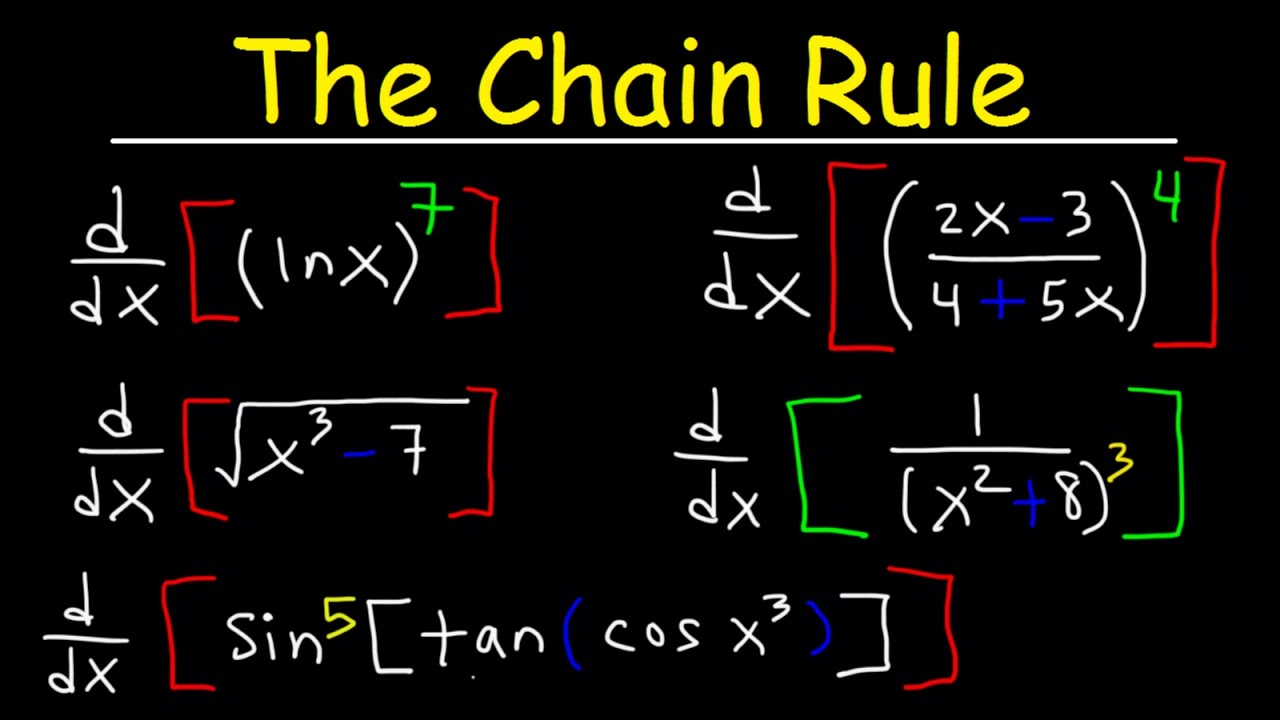
This calculus video tutorial explains how to find derivatives using the chain rule. This lesson contains plenty of practice problems including examples of chain rule problems with trig functions, square root & radicals, fractions, ln, product rule, and quotient rule. This video gives you a simple way to find the derivative of a function using ...
regal mango
Why we have to take another darivative
Why we have to take another darivative of inner eq
regal mango
@storm tusk Thanks for trying to help!
@kind viper @storm tusk @severe remnant Thanks for helping me but now my confusion is clear by this video
Check this
severe remnant
regal mango
Why we have to take another darivative of inner eq
thats the very definiton of chain rule
u HAVE to keep differentiating until the inner fxn has been differntiated fully
regal mango
.close
compact pewterBOT
Channel closed
Closed by @regal mango
Use .reopen if this was a mistake.
compact pewterBOT
Available help channel!
Send your question here to claim the channel.
Remember:
• Ask your math question in a clear, concise manner.
• Show your work, and if possible, explain where you are stuck.
• Do not immediately ping people or roles. After 15 minutes, feel free to ping <@&286206848099549185> once.
• Type the command .close to free the channel when you're done.
• Be polite and have a nice day!
Read #❓how-to-get-help for further information on how to ask a good question, and about conduct in the question channels.
 trail sluice
Can someone give me an oppinion on this. Does this sound interesting?
 compact pewterBOT
trail sluice
Can someone give me an oppinion on this. Does this sound interesting?
compact pewterBOT
trail sluice
Can someone give me an oppinion on this. Does this sound interesting?
 rigid perch
uhh that sounds like misunderstanding the complex numbers
trail sluice
yes, indeed. Hi Cloud. Thanks for your time. Let me post the rest. Then it should make more sense to you

 rigid perch
so like $i = \sqrt{-1}$ is just an informal definition we give to students for intuition. it's not the actual definiton of $i$
boreal girderBOT
cloud ☁
 kind viper
nobody actually defines i as the result of applying the square root function to -1.
trail sluice
so to what is i defined then?
kind viper
there are several ways to construct C which are internally consistent
all of them of course contain an element whose square is equal to -1, and this element thus deserves to be named as "i"
there are 3 constructions i can think of off the top of my head:
- ordered pairs with explicitly defined + and * operations
- quotient ring (a.k.a. modular arithmetic on polynomials)
- matrices
which one would you like to hear
trail sluice
it doesn't really matter how many layers you put on top. In the end, you end up with something that is the square root of -1, don't you?
kind viper
you end up with something that solves the equation z^2 = -1
which, sure, is "a square root of -1" by any other name.
only that's not a starting point
it's a consequence of whatever construction you use
trail sluice
I think you're just contradicting yourself. Here's a question: what's the square root of -25? can you calculate it?
kind viper
where am i contradicting myself exactly?
hushed magnet
in the natural numbers 7/2 is also not allowed
but so what
we extended from the natural numbers to a system where you can do that
kind viper
once C is constructed, in whatever fashion you like, the two square roots of -25 are going to be ±5i.
trail sluice
you see, that's a little bit overkill. because it's easy to say that the result is simply +- 5. No i required here.
I just seems to be like an unncecessary helper, like I introduced in my paper. A very contradicting one at the same time.
See, in basic math, we can take the sqrt of 625. we end up with +- 25. So -25 is a valid result of a square root operation.
So if I am asking, what happens if you take the square root of a negative number, a positive and negative number will both be valid candidates.

Maybe this helps
kind viper
because it's easy to say that the result is simply +- 5
no, these guys give **+**25 when squared, not -25.
I just seems to be like an unncecessary helper, like I introduced in my paper. A very contradicting one at the same time.
you keep yapping about a contradiction yet you're not pointing out where the contradiction is in what i have said
trail sluice
kind viper
> because it's easy to say that the result is simply +- 5
no, these guys give **...
That's the trap, I claim your falling into. See the addendum
kind viper
ok so now multiplication produces something that smells vaguely like an ordered pair, and also isn't commutative...
what is {+5, -5} * {+5, -5}?
jeez ok yknow what
<@&268886789983436800> we got a potential crank over here, can y'all have a look
trail sluice
I like your question, let me think for a second
 zealous rune
The help channels are not really for this kind of thing. I can assure you that Ann, Denascite, and Cloud know what they're talking about. Please be polite if you are looking for genuine guidance, otherwise please go elsewhere than a help channel.
I'll keep an eye out, Ann.
trail sluice
Ok, there are multiple solutions.
First of all, in case 1, there's 5 * 5 = 25
second case: -5 * -5 = -25
third case: +5 * -5 = { 25, -25 }
case 4: -5 * 5 = { -25, 25 }
now this basically means your input was case 3.
meaning, you will also multiply with case three. meaning you get { 625, -625(see case 2) }
it's fine, we can end this conversation at any time. I was just asking for another oppinion. I knew that it wasn't easy to understand what I was trying to say
kind viper
do you have a full definition of the number system which you are proposing, yes or no
emphasis on the word "full"
hushed magnet
I can imagine what you are trying to say. but you just have simply completely misunderstood what sqrts and complex numbers are
trail sluice
hushed magnet
I can imagine what you are trying to say. but you just have simply completely mi...
What if not? What if it were you who did? Did you try and read my draft including the addendum? Because I rather think that common math is overlooking something
kind viper
you gave only part of your draft, & i dont see anything resembling the full definition that i asked for
trail sluice
case 1: 5 * 5
case 2: 5 * -5
case 3: -5 * 5
case 4: -5 * 5
two results: +25 and -25
sorry, there is a loss of information!
All I'm trying to do is to preserve it
trail sluice
kind viper
you gave only part of your draft, & i dont see anything resembling the _full def...
If you wouldn't fight against me, you could easily follow my tracks and complete what you're looking for, or ask a question, like you did earlier, which I answered
kind viper
im not fighting against you
im trying to understand what this {x,y} notation is supposed to mean
right now it sounds as if you are making things up on the spot and dont have a defn you could point me to
zealous rune
trail sluice
If you wouldn't fight against me, you could easily follow my tracks and complete...
Ann is being very patient. If you feel no progress is being made, we could simply close this help channel if you'd like?
kind viper
if im right about this then the convo is kinda pointless
trail sluice
kind viper
im trying to understand what this {x,y} notation is supposed to mean
thanks, let me help you. If you look at my last post, it's supposed to indicate the ordering, and the sign of the numbers used to create the result
trail sluice
zealous rune
Ann is being very patient. If you feel no progress is being made, we could simpl...
it's just bouncing, like any proper discussion, no bad feelings here
kind viper
so {x,y} notation is only meaningful for you if x and y have the same magnitude? is that correct? yes or no.
trail sluice
yes, it has to be, because we're essentially still talking about squares and roots. So basically, the input is a starting number, which is squared, but there are 4 situations. However all 4 outcomes have the same magnitude, yes. They are just created by different sign combinations
kind viper
ok
so let me just say this for the record: the notation {x,y} only makes sense when x and y are real numbers of the same magnitude.
my next question:
in your number system, what is {5, -5} + 1
trail sluice
kind viper
so let me just say this for the record: **the notation {x,y} only makes sense wh...
let me put it this way: the notation {x,y} applies when two equal numbers or two numbers of the same magnitude are multiplied, in order to preserve their sign
kind viper
idgaf when it "applies" or not
you have just confirmed to me that a notation like {5,-5} is meaningful but {3,7} is not.
also you're avoiding my question of
in your number system, what is {5, -5} + 1
trail sluice
"only makes sense" and applies - is one and the same thing to me. Something can not make sense and at the same time not apply
kind viper
in your number system, what is {5, -5} + 1
trail sluice
it's {6, -4}
kind viper
the notation {x,y} only makes sense when x and y are real numbers of the same magnitude.
and now you are giving me {6, -4}
6 ≠ 4
trail sluice
it's obvious, isn't it?
kind viper
girl you have just contradicted yourself
first you say {x,y} requires |x| = |y| then you're saying the result of some calculation is {6,-4}.
this is quite an overt contradiction.
trail sluice
kind viper
first you say {x,y} requires |x| = |y| then you're saying the result of some cal...
aaah, language barrier, sorry, magnitude was confusing. because it means sign and amount at the same time.
trail sluice
German
trail sluice
yeah, but we're not talking about absolute values here, maybe my bad. We're talking about equal numbers, given no sign, that include a sign.
so basically +- |x| and +-|y|
This magnitude is absolutely confusing in what we're doing here.
Always remember the 4 cases.
Let me try again. If you allow me.
Give me 5 minutes, it's really difficult to explain, as it's contradicting the classic oppinion so much
kind viper
its not about contradicting the "classical opinion"
it is that you cannot express yourself clearly
and you obviously dont have a full definition of this {} number system written anywhere, in english OR german
otherwise you could have pointed me to it long ago
trail sluice
The {x, y} notation is all about preserving the sign. Aren't the examples I gave enough in my original draft.
This one.
The idea is as follows: we say: 5 *5 = 25, we ignore, that it could maybe be -25. Yet we know, that 5 * -5 is -25. I'm just trying to say, that it matters a lot what sign the number has. the number is equal, just the sign matters. the word magnitude has no sign, it ignores it, and explicitely gets rid of it.
So we say, we can do: 5 * 5 = 25 * 5 = 625 - all positive numbers, classic square
but on the way back, the square root, gives two results, plus and minus...
yet we also know, that we could do 5 * -5 to get a negative value after a "square" operation

I'm just trying to say, that like the square root operation which has two results, the common square operation should also have two outcomes. And to note them, I introduced this { x, y} notation
That's it. Got it now
kind viper
ok so this is all just pure nonsense and you're using notation that you yourself have no idea how to handle and you obviously have no rules set out for it.
so im sorry but theres no way this could even be examined.
im out and im gonna alert <@&268886789983436800> again
 sullen merlin
I have been summoned
 brazen quiver
Huh?
trail sluice
alright, wow. well then... thanks for your time I guess
zealous rune
OK, I can see that there's no actual question here
Since this seems to have met its end naturally, let's close the channel.
Please use help channels for help in the future.
trail sluice
well, maybe, could I get something else than anna to have a look at it?
zealous rune
.close
compact pewterBOT
Channel closed
Closed by @zealous rune
Use .reopen if this was a mistake.
zealous rune
trail sluice
well, maybe, could I get something else than anna to have a look at it?
Maybe you could talk about it in #discussion or a similar channel instead.
kind viper
something else 💀
 pastel sapphire
Heeeeelp
trail sluice
then it's going to really explode ....
kind viper
pastel sapphire
Heeeeelp
!occupied
compact pewterBOT
pastel sapphire
Heeeeelp
Someone else is already using this help channel. If you need help with a question, please open your own help channel/thread (see #❓how-to-get-help for instructions).
 ashen crown
Can I get some help at 8
compact pewterBOT
Available help channel!
Send your question here to claim the channel.
Remember:
• Ask your math question in a clear, concise manner.
• Show your work, and if possible, explain where you are stuck.
• Do not immediately ping people or roles. After 15 minutes, feel free to ping <@&286206848099549185> once.
• Type the command .close to free the channel when you're done.
• Be polite and have a nice day!
Read #❓how-to-get-help for further information on how to ask a good question, and about conduct in the question channels.
pastel sapphire
Fine 😪
compact pewterBOT
pastel sapphire
Fine 😪
zealous rune
.close
compact pewterBOT
Channel closed
Closed by @zealous rune
Use .reopen if this was a mistake.
kind viper
ok now the chann-
wa
ok fuck it whatever
@pastel sapphire do you have a question to ask
the channel opened in your name
 verbal kiln
zealous rune
.close
verbal kiln
zealous rune
.close
ended before it even started lmao.
pastel sapphire
kind viper
<@1157315192330403951> do you have a question to ask
Yes
compact pewterBOT
✅ Original question: #help-43 message
pastel sapphire
Wait lemme send pic
pastel sapphire
pastel sapphire
kind viper
in the future you can (and should) _begin by_ sending the pic of your question
K
pastel sapphire
 vague seal
Why does one side have lengths and the other angles
vague seal
Why does one side have lengths and the other angles
Idk ask the one who made it
kind viper
i think on the rhs it's about arcs
pastel sapphire
kind viper
i think on the rhs it's about arcs
BC and AD are arcs im sure
kind viper
have you made any progress so far
pastel sapphire
kind viper
have you made any progress so far
Well... no
kind viper
you may have some circle theorems at your disposal...
ok, do you know the inscribed angle thm
pastel sapphire
kind viper
ok, do you know the inscribed angle thm
Hmm
Ye I do not know them with names
pastel sapphire
kind viper
ok, do you know the inscribed angle thm
And probably not im assuming
I searched it up and I do NOT know it 🙁
 kind viper
i dont have the energy to give you the entire proof but the idea is going to be to draw the lines AC and BD and look at some angles you can form this way
pastel sapphire
kind viper
i dont have the energy to give you the entire proof but the idea is going to be ...
Well is BC arc twice as big as AD or not cuz im tweakin rn
Wait nah nvm
What am I yappin
kind viper
we dont know their ratio at all
pastel sapphire
Well if I draw a shape that connects BC and AD it shall be a paralellogram
I couldnt even get ChatGPT to help bruh
 ashen niche
pastel sapphire
ashen niche
pastel sapphire
Yo this is 9th grade am i wrong
pastel sapphire
ashen niche
Yo this is 9th grade am i wrong
Nope youre not
ashen niche
U indian ?
pastel sapphire
ashen niche
U indian ?
Nah
ashen niche
Ahit
pastel sapphire
We dont even learn this in school
ashen niche
pastel sapphire
We dont even learn this in school
This was taught in school to us like this exact question
ashen niche
pastel sapphire
Balkan vibes ig
Ah k
pastel sapphire
ashen niche
This was taught in school to us like this exact question
Lol
Well any way you can help?
pastel sapphire
pastel sapphire
Btw I got this from school olympiad past papers
The teacher didnt even prepare us about anything
ashen niche
Lmao
pastel sapphire
She just said olympiad on monday
ashen niche
Haha
ashen niche
ashen niche
bc and ad are the arcs right?
?
pastel sapphire
Its alr
Whats the percentage of the filled part?

This is also in old olympiad
Options are 80%, 82%, 84%, 86%, 88% and 90%
pastel sapphire
We havent even gotten the tring functions yet we get them in 10th grade
But ive studied them myself lol so thx
vague seal
pastel sapphire
We havent even gotten the tring functions yet we get them in 10th grade
What about heron's formula
pastel sapphire
vague seal
What about heron's formula
Im not sure bout that idk
vague seal
you can use heron's formula to solve this as well, but it will take more time
pastel sapphire
Nope I also dont know that
vague seal
You can also use geometry but that will be tedious
pastel sapphire
Well lets go step by step using a formula
vague seal
flat inlet
100-4x3=88
This solution is much better
pastel sapphire
flat inlet
Ratio of small to big is 1/5 so area is 1/25=4%
Very snart
Smart
So I just imagine triangles to assume the ratio?
flat inlet
You don't imagine
vague seal
pastel sapphire
So I just imagine triangles to assume the ratio?
Take the ratio of their side lengths
flat inlet
Theyre in front of you
flat inlet
What is m()?
flat inlet
By arc you mean the angle the arc makes with the origin?
compact pewterBOT
@pastel sapphire Has your question been resolved?
flat inlet
Ok whatever here goes:
Construct Q as the intersection of AC and BD. Fix m(BC)=2a, m(AD)=2b, APD=p. By inscribed angle theorem ACD=a and BDC=b. Similarly ABD=a and BAC=b. So BDP=CAP=180-b. Use angle sum of quadrilateral to get AQD=2b-p. Finish by equating (ACD+BDC) and AQD by exterior angle of triangle, which simplifies to the problem statement
compact pewterBOT
Channel closed
Closed due to timeout
Use .reopen if this was a mistake.
compact pewterBOT
Available help channel!
Send your question here to claim the channel.
Remember:
• Ask your math question in a clear, concise manner.
• Show your work, and if possible, explain where you are stuck.
• Do not immediately ping people or roles. After 15 minutes, feel free to ping <@&286206848099549185> once.
• Type the command .close to free the channel when you're done.
• Be polite and have a nice day!
Read #❓how-to-get-help for further information on how to ask a good question, and about conduct in the question channels.
 spice flicker
im a bit confused
 compact pewterBOT
spice flicker
im a bit confused
spice flicker
compact pewterBOT
spice flicker
im a bit confused
spice flicker
im given a matrix A = [1 1; 2 2], and its rref = [1 1; 0 0]
What does it even mean for a column space to have a basis?
wait, a column space is the span of all of the column vectors
but there's dupes? (1, 0) = (1, 0)
 timid lodge
in that case the column space is just the span of (1,0), which is just a line
spice flicker
timid lodge
in that case the column space is just the span of (1,0), which is just a line
but doesnt [1 1 | a; 0 0 | b] have an inconsistency when b != 0, therefore it can't span, since span requires consistency?
in fact if I rref it, I'll get [1 1 | a; 0 0 | b-2a]
oh but if I rref it, it'll show me that I need to discard the second column vector when constructing the set to make it linearly depending, and therefore form a basis for the column space
rigid perch
yeah so because the first column alone forms a basis of the column space of rref(A), correspondingly the first column of A forms a basis of the column space of A
compact pewterBOT
@spice flicker Has your question been resolved?
Channel closed
Closed by @spice flicker
Use .reopen if this was a mistake.
compact pewterBOT
Available help channel!
Send your question here to claim the channel.
Remember:
• Ask your math question in a clear, concise manner.
• Show your work, and if possible, explain where you are stuck.
• Do not immediately ping people or roles. After 15 minutes, feel free to ping <@&286206848099549185> once.
• Type the command .close to free the channel when you're done.
• Be polite and have a nice day!
Read #❓how-to-get-help for further information on how to ask a good question, and about conduct in the question channels.
 lean sky
im not sure if im really on the right track here with these limits or how to even sketch the graph

 compact pewterBOT
lean sky
im not sure if im really on the right track here with these limits or how to eve...
lean sky
compact pewterBOT
lean sky
im not sure if im really on the right track here with these limits or how to eve...
lean sky
what's confusing me the most is how I'd graph the middle to fulfill 6 but i could be overthinking it
 lean holly
TRİGONOMETRİ
lean sky
elaborate
 lime shale
lean sky
im not sure if im really on the right track here with these limits or how to eve...
lime shale
lean sky
im not sure if im really on the right track here with these limits or how to eve...
wherever the both sided limit doesn't exist, there is either a vertical asymptote or a jump discontinuity in the graph
if the one sided limits exist but are unequal, theres a jump discontinuity
 kind hollow
lean sky
what's confusing me the most is how I'd graph the middle to fulfill 6 but i coul...
kind hollow
lean sky
what's confusing me the most is how I'd graph the middle to fulfill 6 but i coul...
you basically want f to run from left to right taking all values of x, but having the jumps where the jumps are needed
lean sky
so something like this? but wouldn't it not fulfill 6 because of the 2 points at x=-3 and x=3
 kind hollow
lean sky
so something like this? but wouldn't it not fulfill 6 because of the 2 points at...
kind hollow
lean sky
so something like this? but wouldn't it not fulfill 6 because of the 2 points at...
all you need is for x to take the values of all real numbers. f(x) is defined at x=-3 but not continuous
you painted one of the two lil circles black on -3 right?
kind hollow
gut gut
lean sky
there's so much leftover shit from erasing my bad 😭
lean sky
oh so is that it? it was that simple?
kind hollow
unless your function is not extending to +-infty for x it should be good yea
kind hollow
ur welcome
lean sky
.close
compact pewterBOT
Channel closed
Closed by @lean sky
Use .reopen if this was a mistake.
compact pewterBOT
Available help channel!
Send your question here to claim the channel.
Remember:
• Ask your math question in a clear, concise manner.
• Show your work, and if possible, explain where you are stuck.
• Do not immediately ping people or roles. After 15 minutes, feel free to ping <@&286206848099549185> once.
• Type the command .close to free the channel when you're done.
• Be polite and have a nice day!
Read #❓how-to-get-help for further information on how to ask a good question, and about conduct in the question channels.
 sharp herald
Im wondering, my prof said, that even within the same SCM, if its cyclic, there can be multiple solutions to the same counterfactual. I dont understand how to get to that point. Ive been trying to build examples, but its not working out for me.
compact pewterBOT
sharp herald
Im wondering, my prof said, that even within the same SCM, if its cyclic, there ...
sharp herald
(based on the work of judae pearl)
compact pewterBOT
@sharp herald Has your question been resolved?
compact pewterBOT
Channel closed
Closed due to timeout
Use .reopen if this was a mistake.
Available help channel!
Send your question here to claim the channel.
Remember:
• Ask your math question in a clear, concise manner.
• Show your work, and if possible, explain where you are stuck.
• Do not immediately ping people or roles. After 15 minutes, feel free to ping <@&286206848099549185> once.
• Type the command .close to free the channel when you're done.
• Be polite and have a nice day!
Read #❓how-to-get-help for further information on how to ask a good question, and about conduct in the question channels.
 drowsy cedar
OK so I'm doing quadratic equations and I understand how to do them just fine it's just the one part is I don't know which order the factors go in when you do the x bracket stuff
compact pewterBOT
drowsy cedar
OK so I'm doing quadratic equations and I understand how to do them just fine it...
native shard
drowsy cedar
OK so I'm doing quadratic equations and I understand how to do them just fine it...
multiplication is commutative
drowsy cedar
Like the question I'm doing is 8x²-2x-15=0
So I put (2x+3)(4x-5)=0
And then I got x = -3/2 x= 5/4
But the actual answer is x=-5/4 x= 3/2
native shard
how did you get -5/3 and 4/3
native shard
and you mean 5/4 and -3/2?
drowsy cedar
yea I looked at the wrong question lol
I just don't understand which order to put the stuff in the x brackets
 drifting flax
We have $8x^2 - 2x -15 = 0$
boreal girderBOT
USS-Enterprise

 feral flicker
You mean the diamond method for finding roots?
drowsy cedar
native shard
like (2x + 3)(4x - 5) vs (4x - 5)(2x + 3)
Like idk if it would be (4x +3) (2x -5) or (2x +5) (4x-3)
drowsy cedar
It dosent make it clear what goes where
drifting flax
Well
drowsy cedar
And that's where I'm messing up
native shard
i don't know what method you're using for factoring
drowsy cedar
It's just called factorising method in my books idk
feral flicker
Can you draw an example of the x brackets you are talking about?
native shard
yea but are you using some organizational tool like a diagram
me personally id factor this by grouping
drowsy cedar
feral flicker
Can you draw an example of the x brackets you are talking about?

These
Like (x- ) (x+ )
native shard
right but how are you getting these numbers
drowsy cedar
Factors of 15
native shard
if you use an approach that isnt just guessing then it wont be a problem
drowsy cedar
I multiply it out in my head to see if I can make -2x
native shard
write $8x^2 - 2x - 15 = 8x^2 - 12x + 10x - 15$ then factor by grouping
boreal girderBOT
knief
 native shard
i got -12 and 10 from two numbers that multiply to 8(-15) = -120 and add to -2
drowsy cedar
I don't think we're doing the same method here
native shard
drowsy cedar
I multiply it out in my head to see if I can make -2x
yea but then you're just doing an unnecessary amount of guess work
drowsy cedar
It's not really guess work it takes 2 seconds
native shard
then how come you can't find the order
drowsy cedar
Because I don't know where to put what
native shard
if it takes 2 seconds you should have no issue
drowsy cedar
Because each question does it differently
And the notes don't say anything about it
feral flicker
Regardless, both of your answers are incorrect. Why did you swap the coefficients of the x variables?
native shard
i mean correct me if im wrong but it seems like you're just looking for factors of the constant term then making that your constants in the two factors but then you also have to go back in each of those cases and consider possible factorizations of the leading coefficient
this is highly inefficient
native shard
boreal girder
**knief**
do this
drowsy cedar
native shard
do this
I don't understand that at all
native shard
ok ill show you
drowsy cedar
I'm just doing it the way I was taught I don't think ill be allowed to do that in the test
native shard
drowsy cedar
I'm just doing it the way I was taught I don't think ill be allowed to do that i...
?
why wouldn't they allow this
the question is just going to say "factor ..."
not "factor by this method only"
anyways
you group the two pairs of terms here
drowsy cedar
What I'm trying to ask is how do I know which one is right
 feral flicker
,rotate ccw