
#help-42
1 messages · Page 109 of 1
 abstract wasp
 calm coralBOT
abstract wasp
how would I turn this from degrees to radians
calm coralBOT
abstract wasp
how would I turn this from degrees to radians
 potent smelt
To convert degrees to radians multiply by pi/180
potent smelt
The length of the arc of the angle on a unit circle
abstract wasp
mmm
potent smelt
So in other words, if you have an angle of 3π/5, and you consider a unit circle centered at the angle in question, the angle would cut an arc in the circle and the length of that arc will be exactly 3π/5
Hence 2π radians is 360 degrees because the circumference of a unit circle is 2π
abstract wasp
so this is what I need to do>?
 potent smelt
So to convert from degrees to radians you have to convert using:
360 degrees = 2π radians
360 degrees / 2π radians = 1
(180 / π) (deg/rad) = 1
And (π/180) (rad/deg) = 1
potent smelt
abstract wasp
so this is what I need to do>?
Not quite
abstract wasp
wait
 potent smelt
It's all good
calm coralBOT
Channel closed
Closed by @abstract wasp
Use .reopen if this was a mistake.
calm coralBOT
 Available help channel!
Send your question here to claim the channel.
Remember:
• Ask your math question in a clear, concise manner.
• Show your work, and if possible, explain where you are stuck.
• After 15 minutes, feel free to ping <@&286206848099549185>.
• Type the command .close to free the channel when you're done.
• Be polite and have a nice day!
Read #❓how-to-get-help for further information on how to ask a good question, and about conduct in the question channels.
 jaunty grail
What about this is wrong
 calm coralBOT
jaunty grail
What about this is wrong
calm coralBOT
calm coralBOT
jaunty grail
What about this is wrong
calm coralBOT
Channel closed
Closed by @jaunty grail
Use .reopen if this was a mistake.
jaunty grail
.reopen
calm coralBOT
✅

 normal anchor
whats your first step? @jaunty grail
jaunty grail
normal anchor
whats your first step? <@687828909315981336>
Implicitly differentiate both sides

.rotate
,rotate
 potent lotusBOT
 jaunty grail
That’s my first step
normal anchor
remember to multiply by dx or dy when you differentiate
i.e. the left hand side should be 2xdx
jaunty grail
I thought since we are differentiating only x^2 it would only be 2x
I thought when u r differentiating in terms of y than u do what u said
?
normal anchor
oh, i learned it using a different technique. yours is probably correct let me see
jaunty grail
This question due for me in 58 mins 😭
normal anchor
yep
 potent lotusBOT
 normal anchor
it looks completely fine to me so i dont know why its wrong, maybe divide the numerator and denominator by 2?
calm coralBOT
@jaunty grail Has your question been resolved?
calm coralBOT
Channel closed
Closed by @jaunty grail
Use .reopen if this was a mistake.
Available help channel!
Send your question here to claim the channel.
Remember:
• Ask your math question in a clear, concise manner.
• Show your work, and if possible, explain where you are stuck.
• After 15 minutes, feel free to ping <@&286206848099549185>.
• Type the command .close to free the channel when you're done.
• Be polite and have a nice day!
Read #❓how-to-get-help for further information on how to ask a good question, and about conduct in the question channels.
 placid anchor
hi
calm coralBOT
placid anchor
hi
 potent smelt
,rccw
potent lotusBOT
 potent smelt
For clarification: this deals with 6 digit numbers consisting only of the digits "5", "7", and "9", such as 555555, or 795597. And it's asking for the probability that such a number chosen uniformly at random contains 2 "5"s, 1 "7", and 3 "9"s, such as 557999
Is the above a correct understanding of the question?
placid anchor
yes
potent smelt
If so, consider the permutations of 557999 vs the total number of ways to make a number consisting only of 5, 7, and 9s

 lost thistle
is the answer 0.0823?
like i solved it as 3^6 for total
and 6!/2!3!
for required case
then divide it?
potent smelt
Yup
lost thistle
im not sure
potent smelt
That's what I was thinking of
lost thistle
mhm
potent smelt
,w 6!/(2!3!) / 3^6
potent lotusBOT


 Requested by omnipotententity
lost thistle
Requested by omnipotententity
lost thistle
yup
potent smelt
And I get the same decimal approximation as you
lost thistle
then ig thats the answer??
placid anchor
ok i got it now
potent smelt
It should be!
placid anchor
thanks
lost thistle
wanna solve this question i made?
placid anchor
yes
lost thistle
here

 restive mortar
bro format that better please
potent smelt
Fr
lost thistle
haha
placid anchor
lost thistle
here
i think answer is 2
restive mortar
placid anchor
i think answer is 2
no its 3
restive mortar
lost thistle
its 0
obviously it is
placid anchor
.close
calm coralBOT
Channel closed
Closed by @placid anchor
Use .reopen if this was a mistake.
calm coralBOT
Available help channel!
Send your question here to claim the channel.
Remember:
• Ask your math question in a clear, concise manner.
• Show your work, and if possible, explain where you are stuck.
• After 15 minutes, feel free to ping <@&286206848099549185>.
• Type the command .close to free the channel when you're done.
• Be polite and have a nice day!
Read #❓how-to-get-help for further information on how to ask a good question, and about conduct in the question channels.
 ornate star
 calm coralBOT
ornate star
ornate star
calm coralBOT
ornate star
ornate star
J ai fais O1I mais impossible de faure le O2I
calm coralBOT
@ornate star Has your question been resolved?
ornate star
.help
calm coralBOT
Commands:
- clopen:
.close,.reopen - consensus:
.poll - factoids:
.tag - help:
.help - version:
.version
Type .help <command name> for more info on a command.
ornate star
.close
calm coralBOT
Channel closed
Closed by @ornate star
Use .reopen if this was a mistake.
calm coralBOT
Available help channel!
Send your question here to claim the channel.
Remember:
• Ask your math question in a clear, concise manner.
• Show your work, and if possible, explain where you are stuck.
• After 15 minutes, feel free to ping <@&286206848099549185>.
• Type the command .close to free the channel when you're done.
• Be polite and have a nice day!
Read #❓how-to-get-help for further information on how to ask a good question, and about conduct in the question channels.
 thorn bear
 calm coralBOT
thorn bear
calm coralBOT
thorn bear
 calm coralBOT
@thorn bear Has your question been resolved?
calm coralBOT
@thorn bear Has your question been resolved?
 idle pendant
i think u have to expand (z-1/z)^2 (z+1/z)^4 ? @thorn bear
then use what youve already written
thorn bear
right I see
I did something similar to that but I expanded the last line by putting it in the identity form for de moivre's thing and I think its right
thank you
.close
calm coralBOT
Channel closed
Closed by @thorn bear
Use .reopen if this was a mistake.
calm coralBOT
Available help channel!
Send your question here to claim the channel.
Remember:
• Ask your math question in a clear, concise manner.
• Show your work, and if possible, explain where you are stuck.
• After 15 minutes, feel free to ping <@&286206848099549185>.
• Type the command .close to free the channel when you're done.
• Be polite and have a nice day!
Read #❓how-to-get-help for further information on how to ask a good question, and about conduct in the question channels.
 remote mural
<@&286206848099549185>
remote mural
.close
calm coralBOT
Channel closed
Closed by @tropic quest
Use .reopen if this was a mistake.
calm coralBOT
Available help channel!
Send your question here to claim the channel.
Remember:
• Ask your math question in a clear, concise manner.
• Show your work, and if possible, explain where you are stuck.
• After 15 minutes, feel free to ping <@&286206848099549185>.
• Type the command .close to free the channel when you're done.
• Be polite and have a nice day!
Read #❓how-to-get-help for further information on how to ask a good question, and about conduct in the question channels.
 kind kraken
This... doesn't seem right..
calm coralBOT
kind kraken
This... doesn't seem right..
kind kraken

Is my answer really going to be 0? I feel like I probably have the wrong upper and lower bounds for theta
 crisp aspen
well -7x is odd, so it cancels out since your domain of integration is symmetric over the y axis
kind kraken
Odd.. peculiar? Or odd.. instead of even?
crisp aspen
kind kraken
Odd.. peculiar? Or odd.. instead of even?
an odd function satisfies f(-x)=-f(x)
so you can think of summing ..., -2, -1, 0, 1, 2, ...
it cancels out around 0
kind kraken
So.. it's just me not recognizing something about the function before I get started?
0 is a legit answer?
crisp aspen
kind kraken
0 is a legit answer?
yeah
crisp aspen
kind kraken
So.. it's just me not recognizing something about the function before I get star...
something to look out for in the future
calm coralBOT
Channel closed
Closed by @kind kraken
Use .reopen if this was a mistake.
calm coralBOT
Available help channel!
Send your question here to claim the channel.
Remember:
• Ask your math question in a clear, concise manner.
• Show your work, and if possible, explain where you are stuck.
• After 15 minutes, feel free to ping <@&286206848099549185>.
• Type the command .close to free the channel when you're done.
• Be polite and have a nice day!
Read #❓how-to-get-help for further information on how to ask a good question, and about conduct in the question channels.
 slim fox
Jack does 3/5th of the jobs around the house and Jill does the rest. Jack finishes 35% of his jobs properly and Jill finishes 55% of her jobs properly. Find the probability that a job done around the house will be done.
calm coralBOT
slim fox
Jack does 3/5th of the jobs around the house and Jill does the rest. Jack finish...
calm coralBOT
Channel closed
Closed by @slim fox
Use .reopen if this was a mistake.
calm coralBOT
Available help channel!
Send your question here to claim the channel.
Remember:
• Ask your math question in a clear, concise manner.
• Show your work, and if possible, explain where you are stuck.
• After 15 minutes, feel free to ping <@&286206848099549185>.
• Type the command .close to free the channel when you're done.
• Be polite and have a nice day!
Read #❓how-to-get-help for further information on how to ask a good question, and about conduct in the question channels.
 untold fern
i need help with geometry proof
calm coralBOT
untold fern
i need help with geometry proof
untold fern
i confused on how to prove a line is an altitude of a triangle

this is the problem
meb is congruent to dec becaude they are vertical angles
im trying to prove angle erb is congruent to drb because congruent supplementary angles are right angles, which proves ar to be an altitude
 spring lagoon
untold fern
im trying to prove angle erb is congruent to drb because congruent supplementary...
spring lagoon
untold fern
im trying to prove angle erb is congruent to drb because congruent supplementary...
you mean angle erb is congruent to erc?
untold fern
yes mb
i proved triangle mbc is congruent to dcb just now
i realize i often overlook overlapping triangles
still dunno how to prove erb and erc are right angles tho
spring lagoon
Ok I found a way to do it but it's a bit long-winded and Im not sure if it's the most efficient way
If you're interested though you can start by showing that triangles ADE and AME are congruent
untold fern
its fine, most of the proofs we do are like 12-13 steps
untold fern
spring lagoon
If you're interested though you can start by showing that triangles ADE and AM...
i was thinking the same, from sss = sss right
spring lagoon
yeah nevemrind that should be fine
spring lagoon
untold fern
i was thinking the same, from sss = sss right
Oh yes SSS should work
I was actually thinking SAS but that's slightly more work
untold fern
but what to do with that information
spring lagoon
ok so notice that if we could show triangle ECR congruent to triangle EBR we would be done right?
Is there a way to apply the recent development to trying to prove this
untold fern
yes
i see uh
angle aem is congruent to aed
because cpctc
and i think that means angle reb and rec are congruent
because vertical angles
then er = er because reflexive
last things that can be used to prove it is sas i think
because asa would require knowing the right angles already
untold fern
idk from there, maybe trying to prove mbe is congruent to dce
spring lagoon
Ph have we not proved that yet
Shoot that's on me
Hmmm this is actually a little tricker than anticipated without using some outside knowledge which may be circular
untold fern
yoo wait what if we look at the bigger picture like proving aec is congruent to aeb
spring lagoon
yeah that's fine
you don't even need the entire triangle syou can just look at the angles as well
to rpvoe that triangle mbe is congruent to dce
untold fern
easy to prove aec to aeb
i think
o shit ssa doesnt work, how to prove they are congruent
is there a way to prove rab is congruent to rac?
ohh shit we already know that cuz of previous triangle being congruent
triangle arb is congruent to arc because angle side angle,
rb is congruent to cr because cpctc
and im stuck again 😭
uh am i allowed to ping helpers its been like 20 minutes
<@&286206848099549185>
every set of triangles comes out to be ssa which doesnt work and idk how to prove triangle erb is congruent to erc
rec is congruent to reb, cr is congruent to rb
are medians also angle bisectors? that would change everything
OH MY GOD
they are
thanks for your help @spring lagoon sorry for pinging helpers
.close
calm coralBOT
Channel closed
Closed by @untold fern
Use .reopen if this was a mistake.
spring lagoon
untold fern
they are
thanks for your help <@430767460980097024> sorry for pinging helpers
Ah, sorry for not being there just now, but glad to see you solved it!
calm coralBOT
Available help channel!
Send your question here to claim the channel.
Remember:
• Ask your math question in a clear, concise manner.
• Show your work, and if possible, explain where you are stuck.
• After 15 minutes, feel free to ping <@&286206848099549185>.
• Type the command .close to free the channel when you're done.
• Be polite and have a nice day!
Read #❓how-to-get-help for further information on how to ask a good question, and about conduct in the question channels.
 blazing coyote
 calm coralBOT
blazing coyote
blazing coyote
calm coralBOT
blazing coyote
blazing coyote
trying to prove this
using the defn of a definite integral
$\lim_{n \to \infty}\sum_{i=1}^{n} \frac{1}{n+i}$
potent lotusBOT
A dense set(Ping when reply)
 blazing coyote
would be the left hand limit
how do. find this given that the haromonic sum diverges
hmm
calm coralBOT
@blazing coyote Has your question been resolved?
blazing coyote
<@&286206848099549185>
I mean I could convert it into an integral, but that feels like cheating
calm coralBOT
@blazing coyote Has your question been resolved?
Channel closed
Closed by @blazing coyote
Use .reopen if this was a mistake.
Available help channel!
Send your question here to claim the channel.
Remember:
• Ask your math question in a clear, concise manner.
• Show your work, and if possible, explain where you are stuck.
• After 15 minutes, feel free to ping <@&286206848099549185>.
• Type the command .close to free the channel when you're done.
• Be polite and have a nice day!
Read #❓how-to-get-help for further information on how to ask a good question, and about conduct in the question channels.
 olive matrix
can someone help me with this question?
calm coralBOT
olive matrix
can someone help me with this question?

 leaden thunder
olive matrix
I found the factors after making it into division
leaden thunder
olive matrix
I found the factors after making it into division
Show what you mean
olive matrix
log{(2x-3)(x-1)/(x-3)(x-4)]
oh shoot
I factored wrong
but still
shouldn't it be x<4 and x=-1/2
as the restriction?
@leaden thunder
leaden thunder
No
olive matrix
or do I have the definition wrong
leaden thunder
You combined the logs too early
The arguments for each log term must be positive
log(a) - log(b) means both a> 0 and b > 0
But by combining them into log(a/b), you could have a=b=-1
calm coralBOT
Channel closed
Closed by @olive matrix
Use .reopen if this was a mistake.
calm coralBOT
Available help channel!
Send your question here to claim the channel.
Remember:
• Ask your math question in a clear, concise manner.
• Show your work, and if possible, explain where you are stuck.
• After 15 minutes, feel free to ping <@&286206848099549185>.
• Type the command .close to free the channel when you're done.
• Be polite and have a nice day!
Read #❓how-to-get-help for further information on how to ask a good question, and about conduct in the question channels.
 native raptor
I'm not sure how to do 13
 calm coralBOT
native raptor
I'm not sure how to do 13
calm coralBOT
native raptor
I'm not sure how to do 13
 brazen elbow
can you tell me the linearization of y at some point a?
native raptor
Erm not sure I understand?
potent smelt
If you have a point on the graph, can you find a tangent line to that point?
@native raptor
If so, how?
native raptor
Hmm
native raptor
potent smelt
If so, how?
By them having the same graident
potent smelt
Yup, do you recall the point slope formula?
native raptor
Y2-y1/x2-x1
potent smelt
Sorry I meant the point slope form of the line
Not the point point formula for the slope
native raptor
Y=mx+c?
potent smelt
That's the slope intercept form
native raptor
Or y-y1=m(x-x1)
potent smelt
So let's say I'm examining the point x = a on the curve f(x)
And I want to find the formula for the tangent line
Can you use the point slope form to give me that tangent line in terms of a, f(a), and f'(a)?
native raptor
Y-y1=dy/dx(x-x1)
potent smelt
y - f(a) = f'(a) (x-a)
native raptor
Oh
potent smelt
Ok, now, can you rewrite this into the slope intercept form of the line?
y = mx + b
potent smelt
y = f'(a) x + (f(a) - a f'(a))
potent smelt
Yes. b = 0 for the points we are interested in
This means f(a) - a f'(a) = 0
If you solve this equation for a, you will find the points we want.
native raptor
Wait I'm not sure I understand why is b=0 after dy/dx I got like a quadratic
potent smelt
Yes, the slope changes as a changes
native raptor
Err I'm not sure I understand
native raptor
native raptor
Y-y1=dy/dx(x-x1)
Well I did get smth from what ik y-y1=m(x-x1) gives u the eqn of a line that's tangent to that point? but when I sub m=dy/dx
In the end I got a quadratic which I'm not rlly sure what it represent
potent smelt
@native raptor https://www.desmos.com/calculator/pornayvvtk

Desmos
This is an animation of the tangent line right?
native raptor
Hmm yes
Wait the cubic is the expanded form of the eqn?
But I don't rlly understand the f'(a)(x-a) thing
Like I don't understand what it means
potent smelt
Here I have included the f'(a) (x-a) thing and a helpful line to give you an idea of the meaning.
Maybe you can adjust f(x) to be a little bit better?
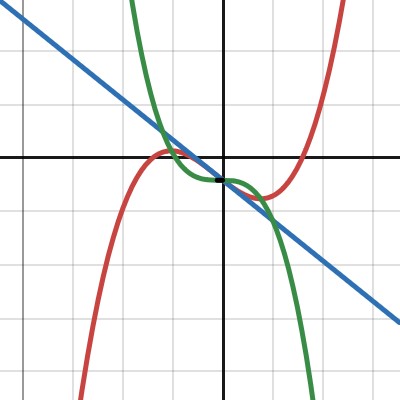
Desmos
native raptor
potent smelt
Here I have included the f'(a) (x-a) thing and a helpful line to give you an ide...
Hmm the black line?
potent smelt
Yes the black line
native raptor
Hmm what does that represent tho the distance from the y axis to the curve?
potent smelt
It is drawn from the y-intercept of a particular tangent line, to the function that describes all of the y-intercepts of all of the tangent lines.
calm coralBOT
Channel closed
Closed by @native raptor
Use .reopen if this was a mistake.
potent smelt
https://www.desmos.com/calculator/ojsywb4fez
Better helper lines

Desmos
@native raptor better late than never
calm coralBOT
Available help channel!
Send your question here to claim the channel.
Remember:
• Ask your math question in a clear, concise manner.
• Show your work, and if possible, explain where you are stuck.
• After 15 minutes, feel free to ping <@&286206848099549185>.
• Type the command .close to free the channel when you're done.
• Be polite and have a nice day!
Read #❓how-to-get-help for further information on how to ask a good question, and about conduct in the question channels.
 ivory crag
My guess is BCDA but for some reason that's incorrect
 brazen elbow
show your work?
ivory crag
There's no actual function so I'm basing it off the interval and how much area there would be based on the interval
brazen elbow
yeah i would say BC is correct since they are negative
DA im not so sure
you can kinda eyeball it and see that with D, it covers the area without the tiny area in [4, 5]
but for A, it covers the area with the tiny area, but its pointless since the negative area from [5, 8] destroys that tiny area
so its bigger loss for A
ivory crag
That's right I forgot the negative area would basically cancel out the positive
.close
calm coralBOT
Channel closed
Closed by @ivory crag
Use .reopen if this was a mistake.
Available help channel!
Send your question here to claim the channel.
Remember:
• Ask your math question in a clear, concise manner.
• Show your work, and if possible, explain where you are stuck.
• After 15 minutes, feel free to ping <@&286206848099549185>.
• Type the command .close to free the channel when you're done.
• Be polite and have a nice day!
Read #❓how-to-get-help for further information on how to ask a good question, and about conduct in the question channels.
 prime topaz
Hi I dont get how to turn the equations in part b to the form in part a

 pseudo wedge
try comparing the coefficients of z and zbar to the coefficients in the equation in part (a)
you can deduce what z0 should be, from which you can find r^2
prime topaz
pseudo wedge
try comparing the coefficients of z and zbar to the coefficients in the equation...
I tried and the only thing I could deduce was that the beginning z * zbar is the same
pseudo wedge
you mean z = zbar?
prime topaz
nah like this
 pseudo wedge
oh well yeah
now compare the coefficients of z
in the top equation, the coefficient is -z0bar
what is it in the bottom equation?
prime topaz
2z?
prime topaz
I think im just confused between the z, z bar and z0 bar
Oh wait I see the coefficient mbmb
Ok hold up so that does that mean the answer to bi) is just |z+2|=0
prime topaz
There's no corresponding value for r though?
prime topaz
Wait is it because z0=-2 so z0*z0bar is 4
But then r^2 has to be -4 huh
pseudo wedge
prime topaz
Wait is it because z0=-2 so z0*z0bar is 4
But then r^2 has to be -4 huh
yes, z0*z0bar = 4
calm coralBOT
Channel closed
Closed by @prime topaz
Use .reopen if this was a mistake.
Available help channel!
Send your question here to claim the channel.
Remember:
• Ask your math question in a clear, concise manner.
• Show your work, and if possible, explain where you are stuck.
• After 15 minutes, feel free to ping <@&286206848099549185>.
• Type the command .close to free the channel when you're done.
• Be polite and have a nice day!
Read #❓how-to-get-help for further information on how to ask a good question, and about conduct in the question channels.
blazing coyote
 calm coralBOT
blazing coyote
potent lotusBOT
calm coralBOT
blazing coyote
potent lotusBOT
A dense set(Ping when reply)
 blazing coyote
right?
 bronze adder
yes

 bronze adder
you should avoid using the same variable in the first line
blazing coyote
Let $g(x) = \int_{2}^{x} \sqrt{1+t^3}dt$
\
$g(x+h) - g(x) = \int_{x}^{x+h} \sqrt{1+t^3}dt$
\
$g'(x) = \lim_{h \to 0} \frac{1}{h} \int_{x}^{x+h} \sqrt{1+t^3} dt$
potent lotusBOT
A dense set(Ping when reply)
 bronze adder
yeah looks good then
I mean you did take the long way round instead of just LH
but I guess it was necessary
blazing coyote
bronze adder
I mean you did take the long way round instead of just LH
We haven't proven LH yet
we have proven FTC in a handwavey way
which is why I used it
bronze adder
alright
blazing coyote
the 2 in the question is confusing me
is this basically saying
$g'(2) = \lim_{ h \to 0} \frac{1}{h} \int_{2}^{2+h} \sqrt{1+t^3}dt$
potent lotusBOT
A dense set(Ping when reply)
 blazing coyote
and we know that $g'(2) = 3$
potent lotusBOT
A dense set(Ping when reply)
 pseudo wedge
Yes
pseudo wedge
blazing coyote
We haven't proven LH yet
LH is just first principle when the denominator is linear btw
blazing coyote
pseudo wedge
LH is just first principle when the denominator is linear btw
Yeah, I see that now
Thanks!
This stuff is kind of fun
wish I could do LA instead though

.close
calm coralBOT
Channel closed
Closed by @blazing coyote
Use .reopen if this was a mistake.
calm coralBOT
Available help channel!
Send your question here to claim the channel.
Remember:
• Ask your math question in a clear, concise manner.
• Show your work, and if possible, explain where you are stuck.
• After 15 minutes, feel free to ping <@&286206848099549185>.
• Type the command .close to free the channel when you're done.
• Be polite and have a nice day!
Read #❓how-to-get-help for further information on how to ask a good question, and about conduct in the question channels.
 shy nova
 shy nova
I didn’t wanna write it all again
 dull wagon
don't forget about the 1/2
shy nova
what about it
dull wagon
don't forget about it
shy nova
I didn’t
I used half angle formula for ctg
and the square root is +-
im having trouble choosing the sign
dull wagon
you seemed to only considered the location of the arccos in your reasoning
arccos(4/7) gives you an angle in Q2,
90° < arccos(-4/7) < 180°
what interval will 1/2 * arccos(4/7)
lie in
calm coralBOT
Channel closed
Closed by @shy nova
Use .reopen if this was a mistake.
calm coralBOT
Available help channel!
Send your question here to claim the channel.
Remember:
• Ask your math question in a clear, concise manner.
• Show your work, and if possible, explain where you are stuck.
• After 15 minutes, feel free to ping <@&286206848099549185>.
• Type the command .close to free the channel when you're done.
• Be polite and have a nice day!
Read #❓how-to-get-help for further information on how to ask a good question, and about conduct in the question channels.
remote mural

 marble pendant
when a=0, v is non zero
marble pendant
 radiant sluice
that is a common mistake
radiant sluice
that is a common mistake
Yeah
radiant sluice
maximum elongation of spring is when
the velocity of block reaches zero again
after being released initially
remote mural
oh
marble pendant
!show
calm coralBOT
Show your work, and if possible, explain where you are stuck.
marble pendant
Use WPE
marble pendant
remote mural
kx = 100
When a=0 v is non zero
remote mural
Mhm
marble pendant
100 is mg
remote mural
Doesn't the block come to rest after some time if there is friction?
and the elongation being 1m? herein?
i get that 1/2 kx^2 = mgx
<@&286206848099549185>
marble pendant
Friction?
marble pendant
Was having dinner
marble pendant
For 9th you can neglect friction
Even in 11th majority of questions will be without friction
remote mural
yes
radiant sluice
question says there is no friction btw
remote mural
YES
marble pendant
If there was friction then you are right, x<2m
remote mural
But if the block comes to rest due to air friction, what will be the elongation at last
oh
1m precisely?
marble pendant
To know the exact value I would need the function for air resistance
Which is usually kv
So the answer will now be exponential
e^ something
remote mural
what if there was no friction, and we lower the block slowly until when it is not lowered by the gravitational force due to the force of the spring, what will be the elongation then?
marble pendant
You mean neglect gravity?
remote mural
yeah
no
friction
I mean
Till the block is not allowed to go down due to the force of the spring
marble pendant
I don't understand what you are doing with gravitational forces
remote mural
ok
remote mural
so 1m?
marble pendant
Because no force will pull it down
Still 2m
Because the normal force of our hand will have 0 work done
(when normal acts, the block isn't moving)
 calm coralBOT
Channel closed
Closed by @honest stream
Use .reopen if this was a mistake.
marble pendant
Kk gn
calm coralBOT
Available help channel!
Send your question here to claim the channel.
Remember:
• Ask your math question in a clear, concise manner.
• Show your work, and if possible, explain where you are stuck.
• After 15 minutes, feel free to ping <@&286206848099549185>.
• Type the command .close to free the channel when you're done.
• Be polite and have a nice day!
Read #❓how-to-get-help for further information on how to ask a good question, and about conduct in the question channels.
 glad sinew
 calm coralBOT
glad sinew
glad sinew
calm coralBOT
glad sinew
glad sinew

for b I disagree
because you have 4P4 for 24 ways to order the triplets (egAAA is a triplet)
but 3P3 for the ordering of the triplets
so there can be multiple AAABBBCCCDDD if that makes sense
so wouldnt it be 24(6)/369600?
radiant sluice
glad sinew
but 3P3 for the ordering of the triplets
the triplets are umm indistinguishable for the second question
they are only distinguishable for first question
glad sinew
thats so annoying
no but when you divide by 369600, thats the num of outcomes where each type is distinguishable
radiant sluice
uhh
glad sinew
oh I guess not, you're just putting them in different places
radiant sluice
yeah i calculated they are not
calm coralBOT
@glad sinew Has your question been resolved?
Channel closed
Closed by @glad sinew
Use .reopen if this was a mistake.
Available help channel!
Send your question here to claim the channel.
Remember:
• Ask your math question in a clear, concise manner.
• Show your work, and if possible, explain where you are stuck.
• After 15 minutes, feel free to ping <@&286206848099549185>.
• Type the command .close to free the channel when you're done.
• Be polite and have a nice day!
Read #❓how-to-get-help for further information on how to ask a good question, and about conduct in the question channels.
 atomic kernel
can someone explain this to me?
 calm coralBOT
atomic kernel
can someone explain this to me?
atomic kernel
calm coralBOT
atomic kernel
can someone explain this to me?
atomic kernel
i cant really visualize this
 rustic geyser
The essence of calculus by 3blue1brown is excellent at visualising this and more
atomic kernel
alright thank you
calm coralBOT
@atomic kernel Has your question been resolved?
Channel closed
Closed by @atomic kernel
Use .reopen if this was a mistake.
calm coralBOT
Available help channel!
Send your question here to claim the channel.
Remember:
• Ask your math question in a clear, concise manner.
• Show your work, and if possible, explain where you are stuck.
• After 15 minutes, feel free to ping <@&286206848099549185>.
• Type the command .close to free the channel when you're done.
• Be polite and have a nice day!
Read #❓how-to-get-help for further information on how to ask a good question, and about conduct in the question channels.
 spare meadow
Is this solvable easily by hand?
 calm coralBOT
spare meadow
Is this solvable easily by hand?
calm coralBOT
spare meadow
Is this solvable easily by hand?

 cobalt bone
spare meadow
Is this solvable easily by hand?
cobalt bone
spare meadow
Is this solvable easily by hand?
unless you can do 1000 factorial then no
cobalt bone
 stiff notch
ok
calm coralBOT
Channel closed
Closed by @spare meadow
Use .reopen if this was a mistake.
cobalt bone
stiff notch
(-80538738812075974)^3 + 80435758145817515^3 + 12602123297335631^3 = 42
calm coralBOT
Available help channel!
Send your question here to claim the channel.
Remember:
• Ask your math question in a clear, concise manner.
• Show your work, and if possible, explain where you are stuck.
• After 15 minutes, feel free to ping <@&286206848099549185>.
• Type the command .close to free the channel when you're done.
• Be polite and have a nice day!
Read #❓how-to-get-help for further information on how to ask a good question, and about conduct in the question channels.
 floral stag
I can't find how to do this question
 calm coralBOT
floral stag
I can't find how to do this question
floral stag
calm coralBOT
floral stag
I can't find how to do this question
floral stag
i know torque = |r*F|
and F=1i+2j+3k
do you first find cross product? or dot product?
 pallid halo
well which product is used in the definition of torque?
floral stag
i dont know
pallid halo
i would suggest looking that up first
floral stag
pallid halo
i would suggest looking that up first
i cant find it and i dont know what you mean
its a vector?
 kindred estuary
floral stag
do you first find cross product? or dot product?
kindred estuary
floral stag
do you first find cross product? or dot product?
You're asking this, to find torque. Perhaps you should formulate your question something like "is torque calculated by cross or dot product?"
Then you'll see your answer on what to do
floral stag
kindred estuary
Then you'll see your answer on what to do
i need help on the entire process, i don't know what to do at all
kindred estuary
You asked if you needed cross product or dot product, someone suggested to look it up, did you?
pallid halo
floral stag
i know torque = |r*F|
^ your first step is to work out what this * stands for, is it a dot product or a cross product?
calm coralBOT
@floral stag Has your question been resolved?
Channel closed
Closed by @floral stag
Use .reopen if this was a mistake.
Available help channel!
Send your question here to claim the channel.
Remember:
• Ask your math question in a clear, concise manner.
• Show your work, and if possible, explain where you are stuck.
• After 15 minutes, feel free to ping <@&286206848099549185>.
• Type the command .close to free the channel when you're done.
• Be polite and have a nice day!
Read #❓how-to-get-help for further information on how to ask a good question, and about conduct in the question channels.
 tired locust
equilateral triangle ABC has sides of 14cm. A circle of a radius of 2 cm it is tangent to sides AB and AC. Find the distance from the circle's centre to side BC in cm
calm coralBOT
tired locust
equilateral triangle ABC has sides of 14cm. A circle of a radius of 2 cm it is t...
tired locust
i know if you make the centre of the circle o you have to find the distacne of 0 to line bc but I am not usre where to start
 unkempt drift
tired locust
i know if you make the centre of the circle o you have to find the distacne of...
unkempt drift
tired locust
i know if you make the centre of the circle o you have to find the distacne of...
try drawing it out
then you should make use of the side length ratios in the two small 30-60-90 degree triangles
tired locust
ok
unkempt drift
so that you can find the distance from the circle centre to point A
tired locust
but how do you aount of the lenght on the angle where the circle is
unkempt drift
tired locust
but how do you aount of the lenght on the angle where the circle is
wdym?
unkempt drift
yeah
I'm using the fact that if a point is the same (perpendicular) distance to 2 lines
then the point lies on the angle bisector btw
that's how you know it's 30-60-90
tired locust
o that nice
I understand how get it to a 30-60-90 but i am notsure how to firgure out the distance form the center to the line
unkempt drift
tired locust
I understand how get it to a 30-60-90 but i am notsure how to firgure out the di...
which side is the radius 2 in this triangle?
 tired locust
the hypothunuse
unkempt drift
tired locust
the hypothunuse
nope
tired locust
also can elxplain a little bit more what is means byt he circle is tanget to sides ab and ac
unkempt drift
that's actually what you want to find
unkempt drift
tired locust
also can elxplain a little bit more what is means byt he circle is tanget to sid...
oh
the circle touches the sides at exactly one point for each side
unkempt drift
tired locust
you make it into two 30-60-90
yes
unkempt drift
unkempt drift
which side is the radius 2 in this triangle?
then this
which side corresponds to the radius = 2?
tired locust
the base
unkempt drift
tired locust
the base
you mean a right?
yes that's correct, the side opposite 30 degrees
tired locust
ok
tired locust
ok
unkempt drift
tired locust
ok
great then after that you just need to draw the line from point A to the midpoint of side BC
use the 30-60-90 triangle again to find that distance
then you're pretty much done
tired locust
oooooooooh
unkempt drift
that's it
tired locust
thanks
unkempt drift
subtracting gives you the answer
tired locust
yes
unkempt drift
no worries!
tired locust
.close
calm coralBOT
Channel closed
Closed by @tired locust
Use .reopen if this was a mistake.
calm coralBOT
Available help channel!
Send your question here to claim the channel.
Remember:
• Ask your math question in a clear, concise manner.
• Show your work, and if possible, explain where you are stuck.
• After 15 minutes, feel free to ping <@&286206848099549185>.
• Type the command .close to free the channel when you're done.
• Be polite and have a nice day!
Read #❓how-to-get-help for further information on how to ask a good question, and about conduct in the question channels.
 tall moon
let there be a set that contains n+1 positive integers that are not greater than 2n, prove that there is atleast one number that divides another number
calm coralBOT
tall moon
let there be a set that contains n+1 positive integers that are not greater than...
calm coralBOT
Channel closed
Closed by @tall moon
Use .reopen if this was a mistake.
calm coralBOT
Available help channel!
Send your question here to claim the channel.
Remember:
• Ask your math question in a clear, concise manner.
• Show your work, and if possible, explain where you are stuck.
• After 15 minutes, feel free to ping <@&286206848099549185>.
• Type the command .close to free the channel when you're done.
• Be polite and have a nice day!
Read #❓how-to-get-help for further information on how to ask a good question, and about conduct in the question channels.
 serene urchin
 calm coralBOT
serene urchin
serene urchin
calm coralBOT
serene urchin
serene urchin
I have tried to multiply the brackets to form a quadratic and divide the cubic by the quadratic but im still unsure on how to find the a and b terms
 solid crag
serene urchin
I have tried to multiply the brackets to form a quadratic and divide the cubic b...
solid crag
serene urchin
I have tried to multiply the brackets to form a quadratic and divide the cubic b...
the cubic has 3 roots
so we have (kx+l) for some k and l, we know that (x)(2x)(kx)=2kx^2=2x^3 so k=1 and (-2)(-1)(l)=2 so l=1
right?
does this make sense
serene urchin
yes
solid crag
than (x-2)(2x-1)(x+1) write it out and set a=x^2 term and b= x term
since $a_1x^3+b_1x^2+c_1x+d_1=a_2x^3+b_2x^2+c_2x+d_2$ when $a_1=a_2$, $b_1=b_2$, $c_1=c_2$ and $d_1=d_2$
potent lotusBOT
SayMyName
 calm coralBOT
Channel closed
Closed by @serene urchin
Use .reopen if this was a mistake.
calm coralBOT
Available help channel!
Send your question here to claim the channel.
Remember:
• Ask your math question in a clear, concise manner.
• Show your work, and if possible, explain where you are stuck.
• After 15 minutes, feel free to ping <@&286206848099549185>.
• Type the command .close to free the channel when you're done.
• Be polite and have a nice day!
Read #❓how-to-get-help for further information on how to ask a good question, and about conduct in the question channels.
 old epoch
for this problem, the solution first says lets x1 ^2 = y and x2 ^2 = y. Then x1 ^2 = x2 ^ 2...
 calm coralBOT
old epoch
for this problem, the solution first says lets x1 ^2 = y and x2 ^2 = y. Then x1 ...
old epoch
calm coralBOT
old epoch
for this problem, the solution first says lets x1 ^2 = y and x2 ^2 = y. Then x1 ...
old epoch
but why can we assume that x1 ^2 = x2 ^ 2?
becaus then arent we already assuming two solutions
and how do we know it is exactly two?
and not more?
 torn gorge
I think it is related to the fact that a polynomial (with coefficients in a field) of degree 2 has at most 2 roots
but you know that they are at least 2 as you have two solution for x^2=1, that are +-1
remark: if p=2 then +1=-1, in fact x^2 is 1-1 here
calm coralBOT
@old epoch Has your question been resolved?
calm coralBOT
Channel closed
Closed due to timeout
Use .reopen if this was a mistake.
Available help channel!
Send your question here to claim the channel.
Remember:
• Ask your math question in a clear, concise manner.
• Show your work, and if possible, explain where you are stuck.
• After 15 minutes, feel free to ping <@&286206848099549185>.
• Type the command .close to free the channel when you're done.
• Be polite and have a nice day!
Read #❓how-to-get-help for further information on how to ask a good question, and about conduct in the question channels.
 calm chasm
 calm coralBOT
calm chasm
potent lotusBOT
calm coralBOT
calm chasm
potent lotusBOT
w

 calm chasm
Yes
 vernal portal
0/6 = 0
calm chasm
But doesn’t it have to be 0/0 for me to do L’H again
vernal portal
huh wait
vernal portal
calm chasm
But doesn’t it have to be 0/0 for me to do L’H again
yes thats true but if direct sub works it right
calm chasm
So what do I do from here to find my answer
vernal portal
using L'hopital i got $\lim_{x \to \infty} \frac{\frac{10}{10x+4}}{\frac{8}{8x+2}}$
potent lotusBOT
w
 calm chasm
Ohh when I take the der of a natural log is it still like chain rule where I take the der out and multiply it?
potent lotusBOT
w
 vernal portal
potent lotus
**w**
vernal portal
potent lotus
**w**
look here
vernal portal
potent lotus
**w**
clearly, this evalutes to 1
calm chasm
calm chasm
Ohh when I take the der of a natural log is it still like chain rule where I tak...
@vernal portal ?
calm chasm
Then how did u get 10/10x+4
vernal portal
potent lotus
**w**
it easier for me to just memorize this
its easier for me to just find the antiderivative of f'(x)/f(x)
calm chasm
Cus isn’t the derivative of lnx 1/x so I thought the der of ln(10x+4) would just be 1/10x+4
 pseudo moss
chain rule babyyyyy
calm chasm
Ok yea
vernal portal
calm chasm
Cus isn’t the derivative of lnx 1/x so I thought the der of ln(10x+4) would just...
again... this is a general form
$\frac{d}{dx} \log(f(x)) = \frac{f'(x)}{f(x)}$
potent lotusBOT
w
 calm chasm
.close
calm coralBOT
Channel closed
Closed by @calm chasm
Use .reopen if this was a mistake.
calm coralBOT
Available help channel!
Send your question here to claim the channel.
Remember:
• Ask your math question in a clear, concise manner.
• Show your work, and if possible, explain where you are stuck.
• After 15 minutes, feel free to ping <@&286206848099549185>.
• Type the command .close to free the channel when you're done.
• Be polite and have a nice day!
Read #❓how-to-get-help for further information on how to ask a good question, and about conduct in the question channels.
 winged pollen
Given 3 vectors, A,B,C (x,y,z), and a circle Radius.
I'm trying to find tangent points of the circles.
Circle 1, is place either "above" or "below" B, Circle B will have a tangent that is B.
Circle 2, will have a tangent along the BC line (BC2) and on Circle 1 (BC1). Circle 2 will be perpendicular to the BC line.
So far, I've been able to figure out the location of the Circle 1, by finding a line that is perpendicular AB line and that intersects B. From this, I've taken vector B and added the perpendicular AB * radius. and taken vector B and MINUS the perpendicular AB * radius. Then I've gotten the distance from these two points and choose the smaller one as the location for Circle 1.
What I'm trying to achieve with this is a "smooth" path when traveling from A to B, and then turning towards C after passing the point B.

 calm coralBOT
winged pollen
Given 3 vectors, A,B,C (x,y,z), and a circle Radius.
I'm trying to find tangent...
calm coralBOT
winged pollen
Given 3 vectors, A,B,C (x,y,z), and a circle Radius.
I'm trying to find tangent...
@winged pollen Has your question been resolved?
calm coralBOT
@winged pollen Has your question been resolved?
winged pollen
.close
calm coralBOT
Channel closed
Closed by @winged pollen
Use .reopen if this was a mistake.
calm coralBOT
Available help channel!
Send your question here to claim the channel.
Remember:
• Ask your math question in a clear, concise manner.
• Show your work, and if possible, explain where you are stuck.
• After 15 minutes, feel free to ping <@&286206848099549185>.
• Type the command .close to free the channel when you're done.
• Be polite and have a nice day!
Read #❓how-to-get-help for further information on how to ask a good question, and about conduct in the question channels.
 nocturne zephyr
Im a bit confused on the overall process here
 nocturne zephyr
I know I have to use the form (lambda * v - A)(v) = 0, and I can get my matrix from there, then I know I use the rows of said matrix to create a system of equations, but where do i go from there?
calm coralBOT
@nocturne zephyr Has your question been resolved?
 manic hawk
you mean once you have v2=0, -v2=0, and 7v1 + 7v2 + 7v3 = 0?
nocturne zephyr
manic hawk
you mean once you have v2=0, -v2=0, and 7v1 + 7v2 + 7v3 = 0?
yes
I know v2 is fixed so that stays at zero
is the whole idea here just to set v1 or v3 equal to some variable like aplha or beta and to rewrite it into whatever form?
manic hawk
yes
remember than scalar multiples of eigenvectors are also eigenvectors
so when you end up with v1 + v3 = 0, you can just choose a non-zero number for one of them
 manic hawk
,rotate
potent lotusBOT
 nocturne zephyr
was this what you were meationing, the scalar being -1?
manic hawk
nocturne zephyr
Ok so there’s technically more than 1 answer here?
technically no, but there are many ways to write the one correct answer
because alpha is any nonzero number
nocturne zephyr
gotchaa
manic hawk
these two boxed answers are actually the same answer
 nocturne zephyr
there was one more thing, a lot of online resources Ive seen talk a lot about when solving these kinds of problems you assign a variable to a free variable, what is that exactly? is that just some variable that does not have a set value?
nocturne zephyr
manic hawk
these two boxed answers are actually the same answer
gotcha
manic hawk
nocturne zephyr
there was one more thing, a lot of online resources Ive seen talk a lot about wh...
when you get to v1+v3=0, you might say v1=x, then deduce that v3=-x
so your answer will look like (x, 0, -x)
and then you factor out x to get Vectors = x(1, 0, -1)
nocturne zephyr
i see, that makes a lot more sense
would anything change if v2 was not zero
its not in this example here, but I ran into a problem where I had a matrix like this

that was the matrix after doing all the (A - I*lambda)
where I ended up with two equations -v1 + v2 - v3 and essentially the same thing for the third row, I'd assume here I would only have to fix one of my V's?
manic hawk
you're going to get two parameters
your answer will look like V = a (-,-,-) + b(-,-,-)
calm coralBOT
@nocturne zephyr Has your question been resolved?
nocturne zephyr
cool thanks!
calm coralBOT
Channel closed
Closed due to timeout
Use .reopen if this was a mistake.
Available help channel!
Send your question here to claim the channel.
Remember:
• Ask your math question in a clear, concise manner.
• Show your work, and if possible, explain where you are stuck.
• After 15 minutes, feel free to ping <@&286206848099549185>.
• Type the command .close to free the channel when you're done.
• Be polite and have a nice day!
Read #❓how-to-get-help for further information on how to ask a good question, and about conduct in the question channels.
blazing coyote
what does it mean to index sets using say $\R$
potent lotusBOT
A dense set(Ping when reply)
 calm coralBOT
Please don't occupy multiple help channels.
manic hawk
It's basically the same as a function with domian R
blazing coyote
ah
 swift laurel
each element of the set is associated with one real number
in general the indexing is a function from the index set to the set of interest
calm coralBOT
Channel closed
Closed by @blazing coyote
Use .reopen if this was a mistake.
calm coralBOT
Available help channel!
Send your question here to claim the channel.
Remember:
• Ask your math question in a clear, concise manner.
• Show your work, and if possible, explain where you are stuck.
• After 15 minutes, feel free to ping <@&286206848099549185>.
• Type the command .close to free the channel when you're done.
• Be polite and have a nice day!
Read #❓how-to-get-help for further information on how to ask a good question, and about conduct in the question channels.
blazing coyote
 calm coralBOT
blazing coyote
blazing coyote
calm coralBOT
blazing coyote
blazing coyote
How do I prove if $S$ is injective, it is an inner product space
potent lotusBOT
A dense set(Ping when reply)
 potent lotusBOT
A dense set(Ping when reply)
 blazing coyote
can I assume this
swift laurel
all you are given is that S is injective and that <,*,*> is an inner product
blazing coyote
swift laurel
all you are given is that S is injective and that <,\*,\*> is an inner product
okay
Thanks
As S is injective, it follows that $\rangle S(v),S(v)\langle =0 $ iff v=0$. It thus follows $\langle v,v \rangle v=0 iff v=0.$
\
$ \rangle S(v),S(v)\langle \geq 0 \froall v \in V. $ being an inner product space, as $\langle v, v \rangle v_1 = \langle Sv,S v \rangle$ it follows that the ouput of $\langle \cdot, \cdot \rangle \geq 0$
logic like this works, right?
potent lotusBOT
A dense set(Ping when reply)
Compile Error! Click the  reaction for more information.
(You may edit your message to recompile.)
 blazing coyote
As $S$ is injective, it follows that $\langle S(v), S(v) \rangle = 0$ iff $v = 0$. It thus follows that $\langle v, v \rangle = 0$ iff $v = 0$. \
$\langle S(v), S(v) \rangle \geq 0$ \text{ for all } $v \in V$, being an inner product space. As $\langle v, v \rangle = \langle S(v), S(v) \rangle$, it follows that the output of $\langle \cdot, \cdot \rangle \geq 0$. \
We now have $\langle S(u + v), Sw \rangle = \langle u + v, w \rangle_1 = \langle Su, Sw \rangle + \langle Sv, Sw \rangle = \langle u, w \rangle + \langle v, w \rangle$.
We now have $\langle \lambda Su, Sv \rangle = \langle S(\lambda u) ,Sv) = \langle \lambda , Sv \rangle = \lambda \langle u , v \rangle $
is this fine
potent lotusBOT
A dense set(Ping when reply)
 calm coralBOT
@blazing coyote Has your question been resolved?
Channel closed
Closed by @blazing coyote
Use .reopen if this was a mistake.
Available help channel!
Send your question here to claim the channel.
Remember:
• Ask your math question in a clear, concise manner.
• Show your work, and if possible, explain where you are stuck.
• After 15 minutes, feel free to ping <@&286206848099549185>.
• Type the command .close to free the channel when you're done.
• Be polite and have a nice day!
Read #❓how-to-get-help for further information on how to ask a good question, and about conduct in the question channels.
 celest adder
 calm coralBOT
celest adder
celest adder
calm coralBOT
celest adder
celest adder
how do i even solve this
 gray smelt
first divide
I don't know if there is any shortcut to it
but you can expect the coefficient to be either 1 or -1
or zero
celest adder
how to divide
gray smelt
celest adder
how to divide

Keep going! Check out the next lesson and practice what you’re learning:
https://www.khanacademy.org/math/algebra2/x2ec2f6f830c9fb89:poly-div/x2ec2f6f830c9fb89:poly-div-by-x/v/dividing-polynomials-by-x
When we divide the polynomial p(x) by q(x) we are basically asking "what should we multiply by q(x) to get p(x)?" If this sounds familiar, it's ...
calm coralBOT
Channel closed
Closed by @celest adder
Use .reopen if this was a mistake.
celest adder
.reopen
calm coralBOT
✅
celest adder
@gray smelt @gray smelt
need help
how to divide such large degree though
many coefficients are missing too
nvm got it
.close
calm coralBOT
Channel closed
Closed by @celest adder
Use .reopen if this was a mistake.
calm coralBOT
Available help channel!
Send your question here to claim the channel.
Remember:
• Ask your math question in a clear, concise manner.
• Show your work, and if possible, explain where you are stuck.
• After 15 minutes, feel free to ping <@&286206848099549185>.
• Type the command .close to free the channel when you're done.
• Be polite and have a nice day!
Read #❓how-to-get-help for further information on how to ask a good question, and about conduct in the question channels.
blazing coyote
 calm coralBOT
blazing coyote
blazing coyote
calm coralBOT
blazing coyote
blazing coyote
I know this is $\N + {0}$
potent lotusBOT
A dense set(Ping when reply)
 blazing coyote
but for that I'd have to prove that each side is a subset of the other
and advice
 mortal orbit
easy to see that each A_i is a subset of N_0?
(N_0 = N U {0})
@blazing coyote then you only have to show that 0 and every positive integer is in some A_i...
blazing coyote
ah
okay
We first show that $A_i$ is a subset of $\N_0$. Consider $A_n$ for some $n \in \N$. ${0,1,2,\dots, n} \subseteq \N_0$ as $0,1,2 \dots, n \in \N_0$
\
We now prove that $\N_0 \subseteq \bigcup_{i \in \N} A_i$
\
let $n \in \N$. Then by construction , $n \in A_n$, thus every natural number $n$ is in some $A_n$. Thus $N \subseteq \bigcup_{i \in \N} A_i$
\
BY construction $0$ is also in every set, thus $\N + {0} \subseteq \bigcup_{i\in \N} A_i$
potent lotusBOT
A dense set(Ping when reply)
 blazing coyote
This is just ${0}$ as it's the only element common to all $A_i$
 potent lotusBOT
A dense set(Ping when reply)
 pseudo wedge
well it depends if your N starts from 0 or 1
if it's 1, then {0, 1} will be the intersection
blazing coyote
pseudo wedge
if it's 1, then {0, 1} will be the intersection
oh yeah
true
I forgot that
oops
thanks
pseudo wedge
what book is this btw?
pseudo wedge
nice, all the best
calm coralBOT
Channel closed
Closed by @blazing coyote
Use .reopen if this was a mistake.
calm coralBOT
Available help channel!
Send your question here to claim the channel.
Remember:
• Ask your math question in a clear, concise manner.
• Show your work, and if possible, explain where you are stuck.
• After 15 minutes, feel free to ping <@&286206848099549185>.
• Type the command .close to free the channel when you're done.
• Be polite and have a nice day!
Read #❓how-to-get-help for further information on how to ask a good question, and about conduct in the question channels.
calm coralBOT
 sharp flare
What's delta y in this context?
calm coralBOT
@potent sorrel Has your question been resolved?
calm coralBOT
Channel closed
Closed due to timeout
Use .reopen if this was a mistake.
calm coralBOT
Available help channel!
Send your question here to claim the channel.
Remember:
• Ask your math question in a clear, concise manner.
• Show your work, and if possible, explain where you are stuck.
• After 15 minutes, feel free to ping <@&286206848099549185>.
• Type the command .close to free the channel when you're done.
• Be polite and have a nice day!
Read #❓how-to-get-help for further information on how to ask a good question, and about conduct in the question channels.
 hard valley
 calm coralBOT
hard valley
calm coralBOT
hard valley
 ocean cypress
$$\frac{\dd y}{\dd x} + \frac{y^2+y+1}{x^2+x+1} = 0$$
potent lotusBOT
Mr. Gamer 🇵🇸
 ocean cypress
solve this as an exact equation
 ocean cypress
In this section we will discuss identifying and solving exact differential equations. We will develop of a test that can be used to identify exact differential equations and give a detailed explanation of the solution process. We will also do a few more interval of validity problems here as well.
read this
then return
(y^2+y+1) dx + (x^2+x+1) dy = 0
that is your exact equation
calm coralBOT
Channel closed
Closed by @hard valley
Use .reopen if this was a mistake.
calm coralBOT
Available help channel!
Send your question here to claim the channel.
Remember:
• Ask your math question in a clear, concise manner.
• Show your work, and if possible, explain where you are stuck.
• After 15 minutes, feel free to ping <@&286206848099549185>.
• Type the command .close to free the channel when you're done.
• Be polite and have a nice day!
Read #❓how-to-get-help for further information on how to ask a good question, and about conduct in the question channels.
calm coralBOT
 hollow totem

 copper hemlock

 dreamy lance
Do you have a question?
calm coralBOT
@vale bobcat Has your question been resolved?
 glad parrot
Meh
 fluid crag
wtf
calm coralBOT
Channel closed
Closed due to timeout
Use .reopen if this was a mistake.
Available help channel!
Send your question here to claim the channel.
Remember:
• Ask your math question in a clear, concise manner.
• Show your work, and if possible, explain where you are stuck.
• After 15 minutes, feel free to ping <@&286206848099549185>.
• Type the command .close to free the channel when you're done.
• Be polite and have a nice day!
Read #❓how-to-get-help for further information on how to ask a good question, and about conduct in the question channels.
 compact drum
heya
calm coralBOT
compact drum
heya
compact drum
consider these two functions

now the problem:
For each value of gold, find the tuple (hp,armor) that maximizes ehp
I did solved it by rearranging gold to armor. This way I can substitute this armor into the equation for ehp giving us a function ehp(hp, gold) where gold is given.
taking the derivative of ehp wrt hp and setting that to 0, we can find hp and then armor each depending on gold
as shown here

the issue is that here, armor and gold can be negative
i want to avoid that
what approach would be best here? Could we pose armor,hp>=0 as a constraint and use lagrange multipliers?
remote mural
im not rly good at this type of math but why do u make a link with gold if u just want to maximize ehp ?
i mean that u could probably find a tuple (hp,armor) just by studying the ehp function
compact drum
lets say you have 100 gold. the question then becomes, how do you best invest your gold?
remote mural
ok i get it
compact drum
armor and hp will cost you a different amount of gold per stat point
tall moon
does hp and armor have to be integers?
compact drum
practically yes, but we can ignore that
remote mural
gold is actually just a constant right ?
remote mural
then u can express let's say armor in function of gold and hp
and u put this expression in the ehp function
and now it depends only on 1 variable
calm coralBOT
@compact drum Has your question been resolved?
compact drum
.close
calm coralBOT
Channel closed
Closed by @compact drum
Use .reopen if this was a mistake.
calm coralBOT
Available help channel!
Send your question here to claim the channel.
Remember:
• Ask your math question in a clear, concise manner.
• Show your work, and if possible, explain where you are stuck.
• After 15 minutes, feel free to ping <@&286206848099549185>.
• Type the command .close to free the channel when you're done.
• Be polite and have a nice day!
Read #❓how-to-get-help for further information on how to ask a good question, and about conduct in the question channels.
 mossy wigeon
why isnt w=lwl
 calm coralBOT
mossy wigeon
why isnt w=lwl
calm coralBOT
calm coralBOT
mossy wigeon
why isnt w=lwl
calm coralBOT
Channel closed
Closed by @mossy wigeon
Use .reopen if this was a mistake.
 unique jackal

calm coralBOT
Available help channel!
Send your question here to claim the channel.
Remember:
• Ask your math question in a clear, concise manner.
• Show your work, and if possible, explain where you are stuck.
• After 15 minutes, feel free to ping <@&286206848099549185>.
• Type the command .close to free the channel when you're done.
• Be polite and have a nice day!
Read #❓how-to-get-help for further information on how to ask a good question, and about conduct in the question channels.
 digital inlet
$a_0=-(a_1w+a_2w^2+\cdots+a_nw^n)$
$a1=-(2a_2w+3a_3w^2+\cdots+(n-1)\cdot a_n w^{n-1})$
 calm coralBOT
digital inlet
$a_0=-(a_1w+a_2w^2+\cdots+a_nw^n)$
$a1=-(2a_2w+3a_3w^2+\cdots+(n-1)\cdot a_n w^{...
potent lotusBOT
calm coralBOT
digital inlet
$a_0=-(a_1w+a_2w^2+\cdots+a_nw^n)$
$a1=-(2a_2w+3a_3w^2+\cdots+(n-1)\cdot a_n w^{...
potent lotusBOT
dThirteen
 digital inlet
a0, a1 being dependent, dimension of the subspace reduces by two? am i correct?
calm coralBOT
@digital inlet Has your question been resolved?
ocean cypress
digital inlet
a0, a1 being dependent, dimension of the subspace reduces by two? am i correct?
sure, but first you have to make sure it's actually a subspace
calm coralBOT
Channel closed
Closed due to timeout
Use .reopen if this was a mistake.
calm coralBOT
Available help channel!
Send your question here to claim the channel.
Remember:
• Ask your math question in a clear, concise manner.
• Show your work, and if possible, explain where you are stuck.
• After 15 minutes, feel free to ping <@&286206848099549185>.
• Type the command .close to free the channel when you're done.
• Be polite and have a nice day!
Read #❓how-to-get-help for further information on how to ask a good question, and about conduct in the question channels.
 lusty sand
hi guys so, if you look at this question it seems like it has one obvious way through, but for some reason there is also a different answer which i don't understand where is came from.. can someone please help me out there and explain it to me?

 calm coralBOT
lusty sand
hi guys so, if you look at this question it seems like it has one obvious way th...
calm coralBOT
lusty sand
hi guys so, if you look at this question it seems like it has one obvious way th...
 fluid oxide
lusty sand
hi guys so, if you look at this question it seems like it has one obvious way th...
fluid oxide
lusty sand
hi guys so, if you look at this question it seems like it has one obvious way th...
what is the "different" answer?
lusty sand
fluid oxide
what is the "different" answer?
oh sorry let me send you a picture of my answer give me about a minute
@fluid oxide there, this is my answer
 fluid oxide
"sometimes this answer will not be available in the mcq" crazy
lusty sand
Our teacher said that sometimes this answer won't be available in the mcq so he suggested a second way which I don't understand, do you know it's name?
fluid oxide
im not sure of any second method
lusty sand
Oh no I sent it's photo
fluid oxide
you correctly simplified cot(pi - 1/x) into -cot1/x
fluid oxide
lusty sand
Oh no I sent it's photo
oh lol
lusty sand
That was his work
lusty sand
lusty sand
hi guys so, if you look at this question it seems like it has one obvious way th...
There
Second photo
lusty sand
fluid oxide
do u know trigonometry quadrants?
like
No..
lusty sand
fluid oxide
you should look up unit circle stuff on youtube
whats its name? and whats the methods name so i can look it up and practise
dull wagon
their work is incomplete,
their first step was to simplify the initial expression applying the periodic and odd property of cot
they have yet to do any differentiation
fluid oxide
lusty sand
whats its name? and whats the methods name so i can look it up and practise
its not really a method, its just how periodic functions or trig functions in general works
i can give you a summary but its better to learn it off youtube
look up "unit circle" or "ASTC rule"
lusty sand
fluid oxide
look up "unit circle" or "ASTC rule"
okay, thank you! can i come back afterwards?
fluid oxide
yeah bet
lusty sand
fluid oxide
yeah bet
okay i'm back
lusty sand
yes
potent lotusBOT
@fluid oxide
 fluid oxide
$\pi-\theta=180^\circ-\theta$, which comes in the second quadrant
potent lotusBOT
@fluid oxide
 fluid oxide
by the ASTC rule, only sin is positive in that quadrant, rest all, including cot, are negative
in this case, we have theta = 1/x
so cot(pi - 1/x) = cot (1/x)
lusty sand
potent lotus
<@951897314333700186>
hmm makes sense.. so you looked at the angle inside cot
fluid oxide
yep
lusty sand
okok
lusty sand
fluid oxide
by the ASTC rule, only sin is positive in that quadrant, rest all, including cot...
how do i know whether sec, cosec and cot are positive or negative
fluid oxide
lusty sand
how do i know whether sec, cosec and cot are positive or negative
whatever letter / function is positive in the quadrant, the rest are negative
its like
lusty sand
i know astc
fluid oxide
I. All functions are positive.
II. Sine and therefore its reciprocal, cosec, is positive.
III. Tangent, and therefore its reciprocal, cot, is positive.
IV. Cosine and therefore its reciprocal, sec, is positive.
lusty sand
but what about cot sec and cosec??
lusty sand
fluid oxide
I. **A**ll functions are positive.
II. **S**ine and therefore its reciprocal, co...
okay let me read this
lusty sand
fluid oxide
I. **A**ll functions are positive.
II. **S**ine and therefore its reciprocal, co...
got it
thank you so much i'll write everything you said then close the thread
again, youre really generous for giving me some of your time, really appreciate it <3
lusty sand
fluid oxide
so cot(pi - 1/x) = cot (1/x)
sorry dont understand this part
where you removed pi
fluid oxide
lusty sand
sorry dont understand this part
ah i forgot the -
Its $\cot\left(\pi-\frac{1}{x}\right)=-\cot\left(\frac{1}{x}\right)$
potent lotusBOT
@fluid oxide
 lusty sand
nono dw i realised that tiny error, but i'm talking about removing pi
fluid oxide
lusty sand
nono dw i realised that tiny error, but i'm talking about removing pi
pi is 180deg right?
lusty sand
yeah
fluid oxide
and 180 - theta is second quadrant?
lusty sand
yep
fluid oxide
in second quadrant, is tan or cot positive?
lusty sand
nope