#help-39
1 messages · Page 325 of 1
 sterile python
sterile python
sterile python
 random ermine
who gave bro helpful 🥀
random ermine
who gave bro helpful 🥀
God is
 cinder flower
sterile python
You made me sad layla 🥺
cinder flower
sterile python
You made me sad layla 🥺
too bad
sterile python
Sigh.
 fleet ridge
sterile python
Sigh.
fleet ridge
sterile python
Sigh.
In slayla's thought bubble, it says she needs to be held. If you can offer her those services she might accept you
 vivid jetty
Are we still focusing on solving the problem.
fleet ridge
vivid jetty
Are we still focusing on solving the problem.
Good point
@low kestrel did you need help in any other problem?
vivid jetty
@low kestrel !done
 wicked edge
vivid jetty
Are we still focusing on solving the problem.
wicked edge
vivid jetty
Are we still focusing on solving the problem.
Supposedly we are.
wicked edge
vivid jetty
<@1499088410848268298> !done
You should have factoid first, then ping.
vivid jetty
wicked edge
You should have factoid first, then ping.
Perchance.
wicked edge
vivid jetty
Perchance.
You can see it didn't work.
sterile python
fleet ridge
In slayla's thought bubble, it says she needs to be held. If you can offer her t...
Pass
 lament dawn
what is going on here 😭
 low kestrel
@timelord tbh l have more trigonometry problems that l need help with
sterile python
fleet ridge
I really dont get it...
If you know, you know
lament dawn
this is a psyop for me to do my homework
lament dawn
low kestrel
@timelord tbh l have more trigonometry problems that l need help with
(i can help too!)
wicked edge
Guys, this is the 4th time for a redirection...
fleet ridge
sterile python
*If you know, you know*
I don't unfortunately
random ermine
sterile python
*If you know, you know*
no one knows twin
fleet ridge
low kestrel
@timelord tbh l have more trigonometry problems that l need help with
Please share
low kestrel
alright but l have a requst
sterile python
random ermine
no one knows twin
She is too old for me, and too far away from me to hold. So I can't hold her.
wicked edge
Guys.
wicked edge
low kestrel
alright but l have a requst
What is it?
fleet ridge
sterile python
She is too old for me, and too far away from me to hold. So I can't hold her.
Supposed to be metaphorical
low kestrel
l'm requseting all the people who aren't willing to discuss trigonometry to leave please
if you're here to make friends l request that you dm each other privately thanks
ok moving on
 wraith jacinth
low kestrel
alright but l have a requst
wraith jacinth
low kestrel
alright but l have a requst
go ahead!! we are listening 
fleet ridge
low kestrel
l'm requseting all the people who aren't willing to discuss trigonometry to leav...
This was the request @wraith jacinth
wraith jacinth
-# oh ah i though it was an acedmic request oops coniute dont mind me!
lament dawn
low kestrel
anyways lets talk about the special angles in trigonometry
mm, what about them?
wraith jacinth
low kestrel
anyways lets talk about the special angles in trigonometry
-# okay what would u like to know about this? why they occor or what are they or when do they happen?? or do u want to understand why its these angels?
low kestrel
well can you all solve cos(45- 30)?
lament dawn
also, special angles referring to the 15deg, 30deg, 45deg, 60deg, 75deg?
lament dawn
low kestrel
well can you all solve cos(45- 30)?
we can! you use the cos(a-b) formula as timelord stated^^
low kestrel
special angles are only 3 , namely 45,30 and 60
fleet ridge
low kestrel
special angles are only 3 , namely 45,30 and 60
And 0, and 90
lament dawn
ah, fair enough, how ive learned it they expanded it to include 15 and 75 deg
fleet ridge
Maybe not special but still relevant
wraith jacinth
lament dawn
also, special angles referring to the 15deg, 30deg, 45deg, 60deg, 75deg?
this might help-
-# also oops wrong reply dont mind me wjs
 lament dawn
low kestrel
well can you all solve cos(45- 30)?
lament dawn
low kestrel
well can you all solve cos(45- 30)?
use the idea that cos(a-b) = cos a cos b + sin a sin b
low kestrel
so is there anyone who can use special angles to solve cos 720? it came in the end of term exam and mob guys were stranded
vivid jetty
low kestrel
so is there anyone who can use special angles to solve cos 720? it came in the e...
Do you know about periodic functions? Such type of questions could be solved by using periodicity of a function.
wraith jacinth
low kestrel
so is there anyone who can use special angles to solve cos 720? it came in the e...
well we can simplfy the angle first!
fleet ridge
vivid jetty
Do you know about periodic functions? Such type of questions could be solved by ...
This is basically it. Also there are formulas for cos(x+90k) where k is an Integer
wraith jacinth
wraith jacinth
this might help-
-# also oops wrong reply dont mind me wjs
this is bassicly because every 360 degress corect me if am wrong this circle repeats
lament dawn
low kestrel
so is there anyone who can use special angles to solve cos 720? it came in the e...
cosine and sine have a period of 360deg
all this means is that if you have, say, sin(a) you can add or subtract whatever number times 360degrees to a, and still get sin(a)
wraith jacinth
wraith jacinth
this is bassicly because every 360 degress ~~corect me if am wrong~~ this circle...
so we would do atotal of two revolutions 720-360 and then 360 - 360
 wraith jacinth
https://tenor.com/view/matematica-gif-7322246
wraith jacinth
wraith jacinth
https://tenor.com/view/matematica-gif-7322246
this gif here might help and as u can see the angle (the exaxct nubmer is seen at the top)
notice how when we cross the 360 degree mark we starts over
so forexample if i gave u an angle of cos(370) is it the same as cos(10)
does that make sense so far?
lament dawn
fleet ridge
This is basically it. Also there are formulas for cos(x+90k) where k is an Integ...
||-# hey, sorry, i dont take unsolicited dms due to preferences and other reasons, but yes, i did make the guide myself and so on||
low kestrel
100%
fleet ridge
lament dawn
||-# hey, sorry, i dont take unsolicited dms due to preferences and other reason...
Yes I found a mistake in it
wraith jacinth
low kestrel
100%
okay so u can imagne how removing the 360 from the angle can help!
so for example try it if i give u an angle of cos(400) = cos(x) can u tell me what we can use as x here instead of 400?
fleet ridge
lament dawn
||-# hey, sorry, i dont take unsolicited dms due to preferences and other reason...
I sent you the mostake. You dont have to respond if you dont want to
low kestrel
40
wraith jacinth
low kestrel
40
yup exactly!!
low kestrel
yayy!!
wraith jacinth
so if i give you an angle of cos(720) can u solve this now?
-# like cmon justopenur ownhelp channel atp or go to #serious-discussion
vivid jetty
wraith jacinth
okay so u can imagne how removing the 360 from the angle can help!
You can remove or add 360° as much as you want, until you get whatever you want in parenthesis ( or something very close to it, or something you already know. )
low kestrel
cos 720 = cos 360 but using special angles how should l calculate that?
wraith jacinth
low kestrel
cos 720 = cos 360 but using special angles how should l calculate that?
well here is the thing what does cosine and sine really mean?
 low kestrel
cos = adjacent over hypotenuse and sine = opposite over hypotenuse
wraith jacinth
 vivid jetty
low kestrel
cos 720 = cos 360 but using special angles how should l calculate that?
vivid jetty
low kestrel
cos 720 = cos 360 but using special angles how should l calculate that?
You could remove another 360°, you do realise that?
random ermine
sohcahtoa
lament dawn
wraith jacinth
https://tenor.com/view/matematica-gif-7322246
another good visualisation is using the sine and cosine graphs! this graph is in radians, and 2pi is 360degrees, but this shows that the output of sin(a+k*2pi) where k is some integer is basically the same as sin(a)
 wraith jacinth
low kestrel
cos = adjacent over hypotenuse and sine = opposite over hypotenuse
wraith jacinth
low kestrel
cos = adjacent over hypotenuse and sine = opposite over hypotenuse
okay so for sin u can say it is the Ratio of how big the (the side opposite to the angel is COMPARED to the hyptonuse)
low kestrel
mhmm
wraith jacinth
wraith jacinth
so notice how when we increase the angel what happens to the hieght here?
low kestrel
but if we subtract another 360, hen we would get cos (o) is that acceptable?
lament dawn
lament dawn
another good visualisation is using the sine and cosine graphs! this graph is in...
using this idea, we can rewrite cos(720deg) as cos(a+k*360deg), and we know that that is also equivalent to essential cos(a)
lament dawn
low kestrel
but if we subtract another 360, hen we would get cos (o) is that acceptable?
yes!
wraith jacinth
low kestrel
but if we subtract another 360, hen we would get cos (o) is that acceptable?
wait wait- if u understand cos and sin u wll understand what this means
 wraith jacinth
wraith jacinth
wraith jacinth
so here look at this notice how when the angle (on the left shown by blue green and light blue) gets bigger the (hieght) gets taller?
lmk if anything does make anysense at any point-
lament dawn
low kestrel
but if we subtract another 360, hen we would get cos (o) is that acceptable?
-# well, yes! cos 0deg is the same as cos 720deg!
wraith jacinth
-# they are essnetaily the same because if uturned around 0 degrres and 360 degrees and look at where ur looking in both cases it wouldbe as if u didnt move at all
wraith jacinth
wraith jacinth
so bassicly sin describes the hieght relative to the angel
this is why if u imagne increasing that angel until its 90 (Degrees) you would notice that both the hyptonuse and the hieght would be exactly = therfore once
But if u reduce the angel all the way down to 0 u will notice that the WIdth is what is = the hyptonuse now
this is why sin (90) = 1/1 so 1 and cos (90) ((remeber cosine describse adj which is width here)) would be 0
followning this logic can u guess what would be the width (cos) at angle 0 ?
 pearl pondBOT
@low kestrel Has your question been resolved?
pearl pondBOT
Channel closed
Closed due to timeout
Use .reopen if this was a mistake.
pearl pondBOT
 Available help channel!
Send your question here to claim the channel.
Remember:
• Ask your math question in a clear, concise manner.
• Show your work, and if possible, explain where you are stuck.
• Do not immediately ping people or roles. After 15 minutes, feel free to ping <@&286206848099549185> once.
• Type the command .close to free the channel when you're done.
• Be polite and have a nice day!
Read #❓how-to-get-help for further information on how to ask a good question, and about conduct in the question channels.
 daring bay
yo so


 pearl pondBOT
daring bay
yo so
pearl pondBOT
daring bay
yo so
 summer imp
daring bay
but somethings off
summer imp
daring bay
but somethings off
The derivative of x^3 is not 3x
 ocean vale
blud got hacked
daring bay
summer imp
The derivative of x^3 is not 3x
oh my god
what is wrong with me
but then can you just use uhh
wait
im thinking
do i use 0 and 4 as boundaries
but how do i actually get the triangle area
shit man
yes im
sure 0 and 4 are the boundaries, but
summer imp
If you find the point where they intersect you'll get the height of the triangle pretty much instantly.
The tangent line and g I mean
daring bay
summer imp
If you find the point where they intersect you'll get the height of the triangle...
yup but
i mean
summer imp
And then your base is between the two x-intercepts.
daring bay
summer imp
And then your base is between the two x-intercepts.
oh
oh shit yeah
but
wait so i just integrate the lines only
summer imp
You don't really need to integrate anything.
The triangle's base is on the x-axis delimited by the x-intercepts of the lines, and the height of the triangle is given by the intersection
summer imp
 daring bay
summer imp
daring bay
summer imp
damn
man they just like to do some weird stuff
so 2*intersection/2
is my area
i got another problem i geniuenly do not understand them

so here i basically tried drawing it in
it does look like its the midpoint all the time but like
if you put 0 in then its 0
ill open a new channel
.close
pearl pondBOT
Channel closed
Closed by @daring bay
Use .reopen if this was a mistake.
pearl pondBOT
Available help channel!
Send your question here to claim the channel.
Remember:
• Ask your math question in a clear, concise manner.
• Show your work, and if possible, explain where you are stuck.
• Do not immediately ping people or roles. After 15 minutes, feel free to ping <@&286206848099549185> once.
• Type the command .close to free the channel when you're done.
• Be polite and have a nice day!
Read #❓how-to-get-help for further information on how to ask a good question, and about conduct in the question channels.
 stoic imp
can i get help with exercise 10
 pearl pondBOT
stoic imp
can i get help with exercise 10
summer imp
pearl pondBOT
stoic imp
can i get help with exercise 10
summer imp
You need to show it's regular first.
Can you take its derivative and check that it's nonzero?
stoic imp
summer imp
Can you take its derivative and check that it's nonzero?
its an integral
you mean ftc1?
summer imp
You need to check that $\tilde{\sigma}(s)$ is regular.
 jolly parrotBOT
Azyrashacorki

 buoyant panther
stoic imp
you mean ftc1?
buoyant panther
stoic imp
you mean ftc1?
yes, you can use this theorem
stoic imp
buoyant panther
yes, you can use this theorem
how
summer imp
Consider the new parametrization they give you, differentiate it using the chain rule, compute the velocity.
stoic imp
summer imp
Consider the new parametrization they give you, differentiate it using the chain...
but is an integral
buoyant panther
stoic imp
how
in your case g'(t) is literally the definition of this theorem, the derivative will simply be the function under the integral (the norm of velocity)

In other words:
jolly parrotBOT
Modus
 summer imp
stoic imp
but is an integral
summer imp
stoic imp
but is an integral
Just use the chain rule. $(\tilde{\sigma}(s))' = (\sigma(g^{-1}(s)))' = \sigma'(g^{-1}(s)) \cdot (g^{-1}(s))'$. Now figure out what $(g^{-1}(s))'$ is with what Modus gave you.
jolly parrotBOT
Azyrashacorki
 stoic imp
can we start from the scratch I dont think I follow
summer imp
You need to show that the parametrization given by $\tilde{\sigma}(s) = \sigma(g^{-1}(s))$ is regular. To do that, differentiate it as above to figure out what the velocity vector is.
jolly parrotBOT
Azyrashacorki
 summer imp
Once that's done, the second part where you show the parameter gives the arclength is instant.
This will involve finding an expression for the derivative of $g^{-1}(s)$. There is a rule for differentiating inverse function you should know.
jolly parrotBOT
Azyrashacorki
 stoic imp
summer imp
This will involve finding an expression for the derivative of $g^{-1}(s)$. There...
stoic imp
summer imp
This will involve finding an expression for the derivative of $g^{-1}(s)$. There...
yes
inverse function theorem
 summer imp
Good, so what's the derivative of g^(-1)(s)?
 blazing garden
stoic imp
summer imp
Good, so what's the derivative of g^(-1)(s)?
blazing garden
stoic imp
summer imp
Good, so what's the derivative of g^(-1)(s)?
it should be 1/g'(g^1(s))
summer imp
Okay, and what is g'(g^(-1)(s)) given how g is defined?
summer imp
No
stoic imp
sigma hat
 summer imp
Well now that we know $(g^{-1}(s))' = \frac{1}{||\sigma'(g^{-1}(s))||}$
So now what is the velocity of sigma hat?
stoic imp
unsure
jolly parrotBOT
Azyrashacorki
 summer imp
What is sigma hat?
stoic imp
sigma circ g^-1
summer imp
So how do you differentiate the composition of functions?
stoic imp
⛓️
stoic imp
summer imp
So how do you differentiate the composition of functions?
function composition rule for derivatives
 stoic imp
sigma' circ g^-1(s) cdot (g^-1)'
stoic imp
stoic imp
sigma' circ g^-1(s) cdot (g^-1)'
@summer imp
summer imp
Okay, so you have $(\tilde{\sigma}(s))' = \sigma'(g^{-1}}(s)) \cdot (g^{-1}(s))'$
stoic imp
yeah, what about sigma hat
jolly parrotBOT
Azyrashacorki
Compile Error! Click the  reaction for more information.
(You may edit your message to recompile.)
 summer imp
And what was g^(-1)(s)?
stoic imp
jolly parrot
**Azyrashacorki**
Compile Error! Click the <:errors:504266556054962196> reaction...
there is some error with the latex @summer imp
summer imp
Yes it's still right.
stoic imp
Okay, so you have $(\tilde{\sigma}(s))' = \sigma '(g^{-1}(s)) \cdot (g^{-1}(s))'$
jolly parrotBOT
Renato
 summer imp
It's just an extra curly brace
stoic imp
summer imp
Okay, so you have $(\tilde{\sigma}(s))' = \sigma'(g^{-1}}(s)) \cdot (g^{-1}(s))'...
what about it?
summer imp
Well this is meant to be the velocity of sigma tilde.
But you found an expression for the derivative of g^(-1)(s) earlier
stoic imp

$(\tilde{\sigma}(s))' = \sigma '(g^{-1}(s))\frac{1}{\norm{\sigma'(g^{-1}(s))}}$
@summer imp
stoic imp
summer imp
It's the magnitude in the denominator
wdym
summer imp
jolly parrot
**Azyrashacorki**
.
jolly parrotBOT
Renato
 summer imp
Well what is the magnitude of this vector?
stoic imp
I believe is normalized
stoic imp
summer imp
Yes, so it's constant 1.
how
stoic imp
right
stoic imp
summer imp
Can it ever be 0?
no
summer imp
Right, so then that parametrization is regular.
stoic imp
what
summer imp
The velocity vector is never 0, so it's regular.
Now use the definition of the arclength to compute the arclength between 0 and s of this parametrization.
stoic imp
summer imp
Now use the definition of the arclength to compute the arclength between 0 and s...
which parametrization thou
summer imp
Sigma tilde
The whole point is to show that the arclength of sigma tilde between 0 and s is s.
summer imp
We didn't normalize it. The velocity is normalized by definition
It's from how sigma tilde is defined
stoic imp
okay
anyways to find the arclength of sigma tilde between 0 and s
I need to differentiate sigma tilde once and find its magnitude
so the integral of the magnitude of the velocity of sigma tilde right
@summer imp
summer imp
Yes. You've already computed the derivative of sigma tilde though
stoic imp
when?
stoic imp
jolly parrot
**Renato**
in here
?
but I need the magnitude of this right?
so $\int_0^s \norm{(\tilde{\sigma}(s))'} ds = \int_0^s \norm{\sigma '(g^{-1}(s))\frac{1}{\norm{\sigma'(g^{-1}(s))}}} ds = \int_0^s 1 ds = \left[s\right]_0^s = s$
@summer imp
summer imp
What is the magnitude of a normalized vector?
stoic imp
1
jolly parrotBOT
Renato
 stoic imp
@summer imp like this ?
summer imp
Yes like this
summer imp
The way sigma tilde is defined makes it parametrize the same curve, but with speed 1.
Then it's regular, and by definition the arclength between 0 and s is s.
summer imp
What do you want to rewing to? That's pretty much all you did.
You computed the velocity of sigma tilde, found it was normalized and thus had constant speed 1.
stoic imp
summer imp
You computed the velocity of sigma tilde, found it was normalized and thus had c...
yes

we basically proved that g'(t) is always 1 for all t in T
@summer imp
summer imp
No, that sigma tilde' has speed 1 for all t.
g'(t) isn't 1 it's the speed of sigma'(t).
sigma'(t) isn't normalized
stoic imp
can we start from scratch?
it was a long amount of steps, first we used tfc1 on g(t) in order to find g'(t)
after that we get that g'(t) is the magnitud of sigma'
but where is sigma' defined
@summer imp
summer imp
Sigma is some parametrization.
summer imp
There aren't that many steps.
You want to show sigma tilde is regular, so you compute its velocity using the chain rule and FTC1 for the factor that pops out.
This turns out to give that sigma tilde' is normalized, so has speed 1.
stoic imp
,, g(t) = \int_a^t \norm{\sigma'(\mathcal{T})} d\mathcal{T} \ g'(t)) = \frac{d}{dt} \int_a^t \norm{\sigma'(\mathcal{T})}d\mathcal{T} \ g'(t) = \norm{\sigma'(t)} \ (g'(t) \neq 0 \text{ , } \forall t \in \left[a,b\right] \implies (g^{-1})^{'}(t) = \frac{1}{g^{'}(g^{-1}(t)} \ (g^{-1})^{'}(t) = \frac{1}{g^{'}(g^{-1}(t)} \implies (g^{-1})^{'}(t) = \frac{1}{\norm{\sigma' \circ g^{-1} (t)}}
@summer imp
after applying fundamental theorem of calculus 1, then we are being told that forall t in T that g'(t) != 0 so we can use inverse function theorem
right?
summer imp
Yes
stoic imp
@summer imp
jolly parrotBOT
Renato
 stoic imp
like this
stoic imp
 lean totem
estas en analisis 2 de la uba
lean totem
estas en analisis 2 de la uba
anal 2 si
lean totem
jajajaja que coincidencia
stoic imp
recien empezando jeje
lean totem
es dificil, tenele paciencia
lean totem
yy pega un salto
igual tene en cuenta que estos ejercicios son para que entiendas conceptos, no te van a tomar nada asi en un parcial
lean totem
esto era guia 1 si no mal recuerdo
stoic imp
y si, ando re atrasado mal
lean totem
siempre es primer parcial con algo de parametrizacion, segundo de green, tercero stokes y cuarto gauss
stoic imp
ando priorizando taller de calculo avanzado
lean totem
no se si seguira siendo asi
lean totem
stoic imp
ando priorizando taller de calculo avanzado
banqué totalmente, yo estoy en datos pero se ve en analisis avanzado esas cosas
algunas nociones y demos de analisis 2 las vas a entender mas faicl sabiendo tca
perdon te re ocupé el canal
si queres hablame al dm
te dejo seguir
pearl pondBOT
Channel closed
Closed by @stoic imp
Use .reopen if this was a mistake.
pearl pondBOT
Available help channel!
Send your question here to claim the channel.
Remember:
• Ask your math question in a clear, concise manner.
• Show your work, and if possible, explain where you are stuck.
• Do not immediately ping people or roles. After 15 minutes, feel free to ping <@&286206848099549185> once.
• Type the command .close to free the channel when you're done.
• Be polite and have a nice day!
Read #❓how-to-get-help for further information on how to ask a good question, and about conduct in the question channels.
 valid nova
is a negative number prime?
pearl pondBOT
valid nova
is a negative number prime?
valid nova
like -5,-7 ?
 nocturne night
technically not?
valid nova
well. i was solving an inequality, and they asked number of prime numbers satisfying that inequality. the boundaries are
$$(-\infty, -2.5) \cup (-2, 8)$$
jolly parrotBOT
TheAstorPastor
 valid nova
so i just have to include +ve ones right?
nocturne night
yep
valid nova
hmm
in some book, i saw them to be -ve
Hungerford's Abstract Algebra: An Introduction
i think
buoyant panther
the classical definition exludes negative integers (among other things, due to the factorization of numbers), so negative numbers do not enter
valid nova
nocturne night
-ve's can be considered prime elements js not prime nums generally
hmm
ok
.close
pearl pondBOT
Channel closed
Closed by @valid nova
Use .reopen if this was a mistake.
pearl pondBOT
Available help channel!
Send your question here to claim the channel.
Remember:
• Ask your math question in a clear, concise manner.
• Show your work, and if possible, explain where you are stuck.
• Do not immediately ping people or roles. After 15 minutes, feel free to ping <@&286206848099549185> once.
• Type the command .close to free the channel when you're done.
• Be polite and have a nice day!
Read #❓how-to-get-help for further information on how to ask a good question, and about conduct in the question channels.
pearl pondBOT
Channel closed
Channel closed due to the original message being deleted.
If you did not intend to do this, please open a new help channel,
as this action is irreversible, and this channel may abruptly lock.
 warped violet

pearl pondBOT
Available help channel!
Send your question here to claim the channel.
Remember:
• Ask your math question in a clear, concise manner.
• Show your work, and if possible, explain where you are stuck.
• Do not immediately ping people or roles. After 15 minutes, feel free to ping <@&286206848099549185> once.
• Type the command .close to free the channel when you're done.
• Be polite and have a nice day!
Read #❓how-to-get-help for further information on how to ask a good question, and about conduct in the question channels.
 wind lagoon
Consider $\Phi ( r,\theta,\varphi ) = (x,y,z)$, the usual map from spherical to Cartesian coordinates. The domain of $\Phi$ is the $3$-cell $D=[0,1]\times [0,\pi]\times [0,2\pi]$. Is this map $C^1$? There's an example in Rudin's book where he integrates $dx\land dy\land dz$ over $\Phi$, but this integral is only defined for a $C^1$ $3$-surface.\
What makes me uncertain is that Rudin comments "... that the mapping is 1-1 in the interior of $D$ (but certain boundary points are identified by $\Phi$) ..." What does he mean by this?
pearl pondBOT
wind lagoon
Consider $\Phi ( r,\theta,\varphi ) = (x,y,z)$, the usual map from spherical to ...
jolly parrotBOT
psie
 pearl pondBOT
@wind lagoon Has your question been resolved?
wind lagoon
.close
pearl pondBOT
Channel closed
Closed by @wind lagoon
Use .reopen if this was a mistake.
pearl pondBOT
Available help channel!
Send your question here to claim the channel.
Remember:
• Ask your math question in a clear, concise manner.
• Show your work, and if possible, explain where you are stuck.
• Do not immediately ping people or roles. After 15 minutes, feel free to ping <@&286206848099549185> once.
• Type the command .close to free the channel when you're done.
• Be polite and have a nice day!
Read #❓how-to-get-help for further information on how to ask a good question, and about conduct in the question channels.
daring bay
yo i hate fucking hate math
 pearl pondBOT
daring bay
yo i hate fucking hate math
daring bay
pearl pondBOT
daring bay
yo i hate fucking hate math
daring bay
how do i even approach the event D
 ebon skiff
is this the entire problem
daring bay
ebon skiff
is this the entire problem
no but like generally
ik the bernoulli formula
were allowed to use calculators for this but
ebon skiff
just send the entire problem

 daring bay
yeah
ebon skiff
now you hvae 16 people reimaining
and out of these 16
5 choose salad
so you can have something like
daring bay
so
ebon skiff
(s,s,s,s,s,notsalad,notsalad....)
or
(s,not s, s,s,s , nots, nots,...)
any combination
of 5
from 16
ebon skiff
nah
ebon skiff
ebon skiff
(s,s,s,s,s,notsalad,notsalad....)
ok lets take this case
whats the probability for this
daring bay
1/3^5 + 1/3^4
daring bay
i mean other exponent
ebon skiff
this is correct
daring bay
oh yes right
ebon skiff
so
lets take this case
( salmon, salmon, salmon, salmon, salad, salad, salad ,salad, salad, notsalad, notsalad,...(in total 11 notsalads)
whats the probability for this
daring bay
wait its 4 salmon
daring bay
ebon skiff
1/3^4 * 1/3 ^5 * this is correct
what about the not salads
ebon skiff
whats P(notsalad)
daring bay
2/3
daring bay
7
ebon skiff
( salmon, salmon, salmon, salmon, salad, salad, salad ,salad, salad, notsalad, notsalad,...(in total 11 notsalads)
ebon skiff
yes
1/3^4 * 1/3 ^5 * 2/3^11
but remember
this was jsut 1 case
( salmon, salmon, salmon, salmon, salad, salad, salad ,salad, salad, notsalad, notsalad,...(in total 11 notsalads)
we can arrange the salads in any way we like
not necessarily the first 5
out of 16
the salmon never changes though
cuz it says so in the question
so
only the 16 change
right?
daring bay
ebon skiff
only the 16 change
wdym only 16 change
daring bay
ebon skiff
not necessarily the first 5
yep
ebon skiff
ebon skiff
nah
daring bay
ebon skiff
nah
its something with ! right
ebon skiff
yeah
daring bay
but idk how
ebon skiff
hast du schon mal von "Binomialkoefizzient" geheort
ebon skiff
yeah
daring bay
so 16 5
ebon skiff
yeah
daring bay
is it just 16!/5!
daring bay
oh damn
ebon skiff
Der Binomialkoeffizient ist eine mathematische Funktion, mit der sich eine der Grundaufgaben der Kombinatorik lösen lässt, nämlich auf wie viele verschiedene Arten man aus einer Menge von
    n


{\displaystyle n}
verschiedenen Objekten jeweils
    k


{\displaystyle k}
...
so you have this 1/3^4 * 1/3 ^5 * 2/3^11 and this many options 16! / (5! (16-5)!)
and you just multiply them together
so
1/3^4 * 1/3 ^5 * 2/3^11 * 16! / (5! (16-5)!)
,w 1/3^4 * 1/3 ^5 * (2/3)^11 * 16! / (5! (16-5)!)
jolly parrotBOT


 Requested by masteroogway0599
ebon skiff
Requested by masteroogway0599
ebon skiff
yeah
daring bay
jolly parrot
oh damn
ebon skiff
so 0,257%
ebon skiff
you dont usually need to memorize it
cuz you have the C button on the GTR
and you just plug in (16 5)
but yes i memorized it after using it for quite a while
ebon skiff
,w 16C5
daring bay
bro
jolly parrotBOT
 Requested by masteroogway0599
ebon skiff
Requested by masteroogway0599
ebon skiff
look
daring bay
do yk the vierfeldertafel
ebon skiff
yeah
daring bay
thats always conditional probability right
ebon skiff
um
not really
i mean
kinda
it depends what you mean
every square is P(something AND something else)
to get the conditional prob you need to take this square and divide it by the outside square
cuz the formula is P_B(A) = P(a und b) / P(b)
daring bay
ebon skiff
to get the conditional prob you need to take this square and divide it by the ou...
damnn
ebon skiff
and you find P(b) on the outside
ebon skiff
daring bay
damnn
 daring bay
man i gotta learn some other stuff now holy shit
why did i study so late im so stupidd
pearl pondBOT
If you are done with this channel, please mark your problem as solved by typing .close
pearl pondBOT
Channel closed
Closed by @daring bay
Use .reopen if this was a mistake.
pearl pondBOT
Available help channel!
Send your question here to claim the channel.
Remember:
• Ask your math question in a clear, concise manner.
• Show your work, and if possible, explain where you are stuck.
• Do not immediately ping people or roles. After 15 minutes, feel free to ping <@&286206848099549185> once.
• Type the command .close to free the channel when you're done.
• Be polite and have a nice day!
Read #❓how-to-get-help for further information on how to ask a good question, and about conduct in the question channels.
 left anchor
Can someone explain what reordering a sequence/series means and how it can affect the limit
pearl pondBOT
left anchor
Can someone explain what reordering a sequence/series means and how it can affec...
left anchor
I saw a basic explanation on the fact that it doesn’t seem to affect the limit of a sequence because a sequence is essentially a set and sets don’t really care about the order of elements anyway
Now how is that different for a series
And how would I reorder a series to tend to any limit
I have a specific problem in mind but I’d like to figure out how everything works first
Maybe with simple examples
pearl pondBOT
@left anchor Has your question been resolved?
 plush bramble
left anchor
I have a specific problem in mind but I’d like to figure out how everything work...
plush bramble
left anchor
I have a specific problem in mind but I’d like to figure out how everything work...
just show your specific problem
pearl pondBOT
left anchor
Can someone explain what reordering a sequence/series means and how it can affec...
Asking the actual question right away is more likely to get responses.
Asking "Can I ask...?" or "Does anyone know about...?" doesn't give people enough information to decide whether they can help, and answering can feel like a promise to help with the actual question, which they might find themselves unable to.
left anchor
left anchor
Now how is that different for a series
And how would I reorder a series to ten...
This is the main part I’m interested in I was hoping it’d be clear enough
I can post the actual problem too but I wanted to make sure that I understand the concepts well enough in advance hence the questions
plush bramble
yes post the actual problem
left anchor
Working on it
Need to take photos of the necessary parts and explain
I have this series which converges to 0 but it is not absolutely convergent (is that the right term?)

All the problem asks for is reordering it to converge to 7 instead while maintaining the given structure from the photo

<@&286206848099549185>
pearl pondBOT
@left anchor Has your question been resolved?
pearl pondBOT
@left anchor Has your question been resolved?
 vagrant briar
left anchor
Can someone explain what reordering a sequence/series means and how it can affec...
vagrant briar
left anchor
Can someone explain what reordering a sequence/series means and how it can affec...
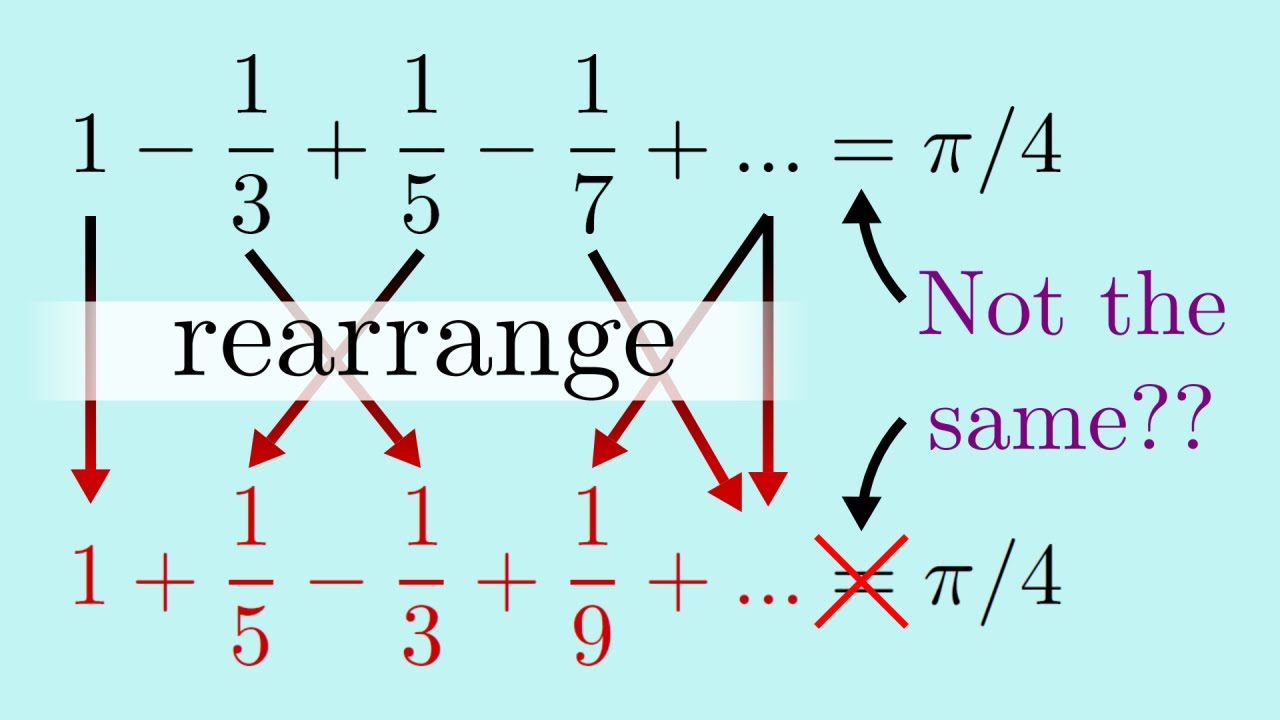
Normally when you add up numbers, the order you do so doesn't matter and you get the same sum regardless. And, of course, the same holds true even if you add up infinitely many numbers.....
Right?
=Chapters=
0:00 - Let's rearrange a sum!
1:48 - Investigation
6:32 - Riemann Series Theorem explained visually
13:58 - Resolving objections
18:52 - A...
Something like this?
left anchor
Yes
Changing the order of addends to get a different sum
vagrant briar
left anchor
Yes
Changing the order of addends to get a different sum
Maybe this video will help, or did u already watch this
left anchor
vagrant briar
https://youtu.be/U0w0f0PDdPA?si=jXTM6fx0CnBMt1_r
I’ve tried doing research by myself in the meantime and found the Riemann rearrangement theorem
left anchor
vagrant briar
Maybe this video will help, or did u already watch this
Not that specific one
vagrant briar
left anchor
Not that specific one
Its a great watch
 dense jasper
left anchor
All the problem asks for is reordering it to converge to 7 instead while maintai...
left anchor
dense jasper
left anchor
All the problem asks for is reordering it to converge to 7 instead while maintai...
left anchor
Now I’m still struggling to understand how I would do that for a specific series
The key concept of going back and forth by adding / subtracting numbers around the limit makes perfect sense
But how do I define the series to do that?
left anchor
vagrant briar
Its a great watch
I’ll open it up thanks
left anchor
.close
pearl pondBOT
Channel closed
Closed by @left anchor
Use .reopen if this was a mistake.
pearl pondBOT
Available help channel!
Send your question here to claim the channel.
Remember:
• Ask your math question in a clear, concise manner.
• Show your work, and if possible, explain where you are stuck.
• Do not immediately ping people or roles. After 15 minutes, feel free to ping <@&286206848099549185> once.
• Type the command .close to free the channel when you're done.
• Be polite and have a nice day!
Read #❓how-to-get-help for further information on how to ask a good question, and about conduct in the question channels.
 inland ivy
 pearl pondBOT
inland ivy
inland ivy
pearl pondBOT
inland ivy
inland ivy
I've been struggling at (ii) for so long
So we get f(x+h) > f(x-h) for all x and sufficiently small h
but how do I go from this to f being strictly increasing?
I've been considering an approach similar to using the mean value theorem but it's not been working
pearl pondBOT
@inland ivy Has your question been resolved?
inland ivy
<@&286206848099549185>
 rustic tendon
I think I did this with contradiction
 rough stream
f^s is just f', no?
So you just need to prove that f is strictly increasing when f' > 0
Which, I'd be surprised if that's not just a theorem in your book
rustic tendon
rough stream
f^s is just f', no?
So you just need to prove that f is strictly increasing whe...
We can't assume differentiability though right
f^s existing doesn't imply f' existing
inland ivy
yeah that's the point
 vital crescent
inland ivy
I've been struggling at (ii) for so long
vital crescent
inland ivy
I've been struggling at (ii) for so long
consider , on (0,1)
$f(x)\begin{cases}1 &x=\frac{1}{2}\
x&\text{otherwise}\end{cases}$
inland ivy
rustic tendon
I think I did this with contradiction
I've been trying to
rough stream
Ah the if. Didn't see it
jolly parrotBOT
qwertytrewq
 inland ivy
this is not continuous
vital crescent
this is a counterexample i think
inland ivy
yeah so continuity is critical here somehow
 warm furnace
inland ivy
warm furnace
inland ivy
what grade level math is this
inland ivy
it's first year uni
rustic tendon
I can give you a hint, assume for contradiction that there exist c, d in (a, b) such that c < d and f(c) > f(d). Then choose any y in between these function evaluations and define the set S_y = {x \in [c, d] : f(x) >= y}
inland ivy
what the blud
vital crescent
inland ivy
i think contradiction should work. Let f(a)<f(b)\geq f(c) with a<b<c. Find the maximum of the function on [a,c], and f^s should be weird there
rustic tendon
the continuity comes into picture when you show that ||f must possess an uncountable number of strict local maxima||
inland ivy
this is what I thought but you can't really say much about the symmetric difference even at the max
inland ivy
rustic tendon
the continuity comes into picture when you show that ||f must possess an uncount...
😭
rustic tendon
all I'll say is good luck bro
vital crescent
inland ivy
this is what I thought but you can't really say much about the symmetric differe...
how so? eval at -h and h must agree no?
inland ivy
symmetric quotient always agrees, it's an even function
vital crescent
inland ivy
symmetric quotient always agrees, it's an even function
i dont see how f^s isnt going to be 0
oh wait
mb it could
inland ivy
rustic tendon
I can give you a hint, assume for contradiction that there exist c, d in (a, b) ...
if I take z = sup(S_y) then by continuity f(z) = y and f(z-h) >= y > f(z+h) for sufficiently small h
but then f(z-h) - f(z+h) > 0 which is a contradiction
does this work
 oak nebula
inland ivy
oak nebula
inland ivy
okai youre kinda in the right way ig.
mvt does NOT work directly cuz f isn't necessary differentiable thr cheat code here s to assume for a sec that f has local max and if it did f^8 (x) would have < or = 0
which contradicts the given f^8 (x) > 0
so f cant have local maxima or minimum which forces it to be strictly mono. since f( x + h ) > f (x-h ) it has to be increasing ig
hope this helps
inland ivy
why does f having a local maximum force the symmetric derivative to be <= 0
oh my god i hate this fucking problem
oak nebula
inland ivy
why does f having a local maximum force the symmetric derivative to be <= 0
at a local max the function has to stop right? and turn back down so if f(x) is a peak then f(x+h) and f(x-h) are both similar then the peak so when you subtract em in the sym derivative formula youll NEVER get a + result it will be < or = 0
since our f^8 =is strictly > 0 a peak is literally impossible it has no choice but to keep going up
inland ivy
@rustic tendon can you just give me the answer i've spent too long on this
 vital crescent
oak nebula
at a local max the function has to stop right? and turn back down so if f(x) is ...
vital crescent
oak nebula
at a local max the function has to stop right? and turn back down so if f(x) is ...
consider x when x<0 and -1/2x when x>=0
0 is max
but the symmetric derivative is positive at 0
inland ivy
yeah f can decrease slower on the right than the left, so f(x+h) is still > f(x-h)
vital crescent
u have, in the derivative formula (-1/2h-(-h))/(2h), the limit is 1/4 i think
rustic tendon
inland ivy
if I take z = sup(S_y) then by continuity f(z) = y and f(z-h) >= y > f(z+h) for ...
why must f(z - h) >= y
rustic tendon
inland ivy
<@1276805241286688798> can you just give me the answer i've spent too long on th...
I just got left my room for a break 
inland ivy
rustic tendon
why must f(z - h) >= y
well for any delta there exists h < delta with f(z-h) >= y
but that's not enough i realise now
rustic tendon
inland ivy
if I take z = sup(S_y) then by continuity f(z) = y and f(z-h) >= y > f(z+h) for ...
see but you're getting there
inland ivy
wait it's still a contradiction right??
oak nebula
f(0) =0 then f(h)= -1/2h and f(-h)= -h ---> into the formula (-1/2h -(-)) /2h = (1/2h)/2h =1/4
so even with a shrp peak at 0 f^8 is still a 1/4 which s >0
@vital crescent
inland ivy
because you need f(z+h) > f(z-h) for ALL sufficiently small h
but you can always find arbitrarily small h with f(z-h) > f(z+h)
vital crescent
oak nebula
f(0) =0 then f(h)= -1/2h and f(-h)= -h ---> into the formula (-1/2h -(-)) /2h ...
which is my point no? u claimed that at the peak it should be <0 or =0
oak nebula
vital crescent
which is my point no? u claimed that at the peak it should be <0 or =0
but thats my whole point since ur examples symm derivative @ x = 0 turned out to be 1/4 which is > 0 it proves that x=0 isn't actually a local max in the context
a true local max would require f^8 (x) < or = 0
if the f^8 is strictly + everywhere a peak literally cannot exist lol
vital crescent
oak nebula
but thats my whole point since ur examples symm derivative @ x = 0 turned out to...
then how does f not having local max and local min (where they are defined in your context, not the actual local max/min) imply that it is monotone?
if u define critical points to be such that f^s at the point must be 0, then I feel like this is merely a restatement of the original question
oak nebula
vital crescent
then how does f not having local max and local min (where they are defined in yo...
its basic calc bro if a continuous function on an interval doesn't have any local max or min it literally can't turn around
if it starts going up and never hits a peak to turn back down
it has to stay strictly increasing
vital crescent
oak nebula
its basic calc bro if a continuous function on an interval doesn't have any loca...
u r using the definition of actual local max/min
vital crescent
oak nebula
but thats my whole point since ur examples symm derivative @ x = 0 turned out to...
u said here the local max is "in your context"
this is my function

x=0 is, in the usual sense of local max and min, a local max
symmetric derivative is >0 at 0
but u claimed that it isn't a local max in your context, which I dont understand. If tou change the context of what local max/min means, youd have to reprove the statement that no local max/min implies monotone
oak nebula
mhm
vital crescent
so the issue sort of is that what if, every where, the function looks like this (it sure will be some weierstrass like function)
By the statement it can't exists but it's not immediately obvious
oak nebula
okai look im not changing the def of a local max but if s f^8(x) > 0 for all x then for any point x0 the function MUST be higher at x0 +h than at x0-h for small h this property alone makes a local max (where a point is higher than its neighbors on BOTH sides) impossible und in calca if a continuous function has no local peaks or valleys to turn it around it has no choice but to stay strictly monotone in this case increasing right ? its a standard result for symmetric derivatives so no need to overcomplicate the definitions ig
vital crescent
oak nebula
okai look im not changing the def of a local max but if s f^8(x) > 0 for all x t...
this property alone doesn make it a local max as illustrated by my example tho
i gave an example where it is local max ( in fact a global max) in the usual sense, but at 0, the symmetric derivative is 1/4
the f(x+h)>f(x-h) is always true using my function at x=0
u could have all these properties while not stopping f(x) being greater than every single one of those f(x+h)
If it were f' then sure all that you said is true. But it is f^s, and f^s does not directly compare f(x+h) with f(x), which is where the issue lies
pearl pondBOT
@inland ivy Has your question been resolved?
Channel closed
Closed by @inland ivy
Use .reopen if this was a mistake.
pearl pondBOT
Available help channel!
Send your question here to claim the channel.
Remember:
• Ask your math question in a clear, concise manner.
• Show your work, and if possible, explain where you are stuck.
• Do not immediately ping people or roles. After 15 minutes, feel free to ping <@&286206848099549185> once.
• Type the command .close to free the channel when you're done.
• Be polite and have a nice day!
Read #❓how-to-get-help for further information on how to ask a good question, and about conduct in the question channels.
 leaden thunder
Hello im struggling with finding which of those answers are wrong... I've looked over and I can't figure out which one is wrong. It says atleast 1 is wrong.
 pearl pondBOT
leaden thunder
Hello im struggling with finding which of those answers are wrong... I've looked...
pearl pondBOT
leaden thunder
Hello im struggling with finding which of those answers are wrong... I've looked...
 arctic oracle
leaden thunder
Hello im struggling with finding which of those answers are wrong... I've looked...
arctic oracle
leaden thunder
Hello im struggling with finding which of those answers are wrong... I've looked...
you on your own
leaden thunder
arctic oracle
you on your own
how come?
 viscid shale
leaden thunder
Hello im struggling with finding which of those answers are wrong... I've looked...
viscid shale
leaden thunder
Hello im struggling with finding which of those answers are wrong... I've looked...
Okay, so, do you recall the definition of a line integral over a vector field?
pearl pondBOT
@leaden thunder Has your question been resolved?
pearl pondBOT
Channel closed
Closed due to timeout
Use .reopen if this was a mistake.
leaden thunder
.reopen
pearl pondBOT
✅ Original question: #help-39 message
leaden thunder
viscid shale
Okay, so, do you recall the definition of a line integral over a vector field?
not the full definition to be honest but like i used it for circulation and flux and masses. Since those are the formulas I have
wait no thats just for line intrgals... not over a vector field..
viscid shale

Thats how you do the calculation, visually, it has to do with tracing the dot product of the field with the direction of the parametrization.
wikipedia has this quite intuitive gif.
So you go about the curve using r', evaluating the dot product at each point w/ the vector field, and finding the acumulation of this value.
Notably, you have to know how the dot product works
viscid shale
viscid shale
Notably, you have to know how the dot product works
I want to believe youre familiar enough with it.
pearl pondBOT
@leaden thunder Has your question been resolved?
pearl pondBOT
Channel closed
Closed due to timeout
Use .reopen if this was a mistake.
Available help channel!
Send your question here to claim the channel.
Remember:
• Ask your math question in a clear, concise manner.
• Show your work, and if possible, explain where you are stuck.
• Do not immediately ping people or roles. After 15 minutes, feel free to ping <@&286206848099549185> once.
• Type the command .close to free the channel when you're done.
• Be polite and have a nice day!
Read #❓how-to-get-help for further information on how to ask a good question, and about conduct in the question channels.
 fading nexus
I’m not sure what to do for b and c
 pearl pondBOT
fading nexus
I’m not sure what to do for b and c
pearl pondBOT
fading nexus
I’m not sure what to do for b and c
 timber cape
,rccw
jolly parrotBOT

 errant solstice
(hint: say, does x = 50 make sense for this problem? why (not)?)
timber cape
fading nexus
I’m not sure what to do for b and c
what function did you get for part A?
fading nexus
V(x)=40•12•x? Idk if that’s what you r looking for or not
timber cape
fading nexus
V(x)=40•12•x? Idk if that’s what you r looking for or not
ouch thats wrong
fading nexus
I thought l•w•h is the formula for volume?
timber cape
yeah but we are cutting the lengths and breadths so they could turn to heights
fading nexus
Oh would it be 40-2x or smth? And then12-2x
timber cape
fading nexus
Oh would it be 40-2x or smth? And then12-2x
exactly
now what would be V(x)?
fading nexus
 timber cape
can you visualise the maximum possible value of x we can take such that the box still has non zero volume?
fading nexus
Wdym visualize
timber cape
like for eg in the given diagram taking x=0 and gradually increasing x
fading nexus
I’m not really sure how to do that in my head
errant solstice
errant solstice
(hint: say, does x = 50 make sense for this problem? why (not)?)
(or, if I may interrupt, you can try an extreme value like this and see what happens physically.)
fading nexus
I’m really confused 😭
errant solstice
in that case, sorry for interrupting. I'll let Itsuki continue.
timber cape
fading nexus
I’m really confused 😭
 fading nexus
I just don’t know how to approach b liek what math to do to get an answer
 modern talon
fading nexus
I just don’t know how to approach b liek what math to do to get an answer
modern talon
fading nexus
I just don’t know how to approach b liek what math to do to get an answer
can you have negative length
fading nexus
So it’s above 0 and not including so (0,_)
Oh wait
Could it include 0?
I don’t think so
Would it be (0,10)?
WAIR
modern talon
technically we could have 0 (flat, so not really a box)
fading nexus
(0,11.8)
fading nexus
40 and 12
modern talon
no
timber cape
(reference image)
 modern talon
40-2x and 12-2x
modern talon
correct
fading nexus
Can I just make them equal to zero to solve?
modern talon
yep!
fading nexus
So I got x=6 and x=20 but what one do I put in the domain
modern talon
so anything between 0 and 6 should work right?
because all the side lengths would be positive
fading nexus
Yea
fading nexus
It would make the side length to big
modern talon
could those work?
okay you're right that it wouldnt work
but for the wrong reason
fading nexus
To small?
modern talon
if i took something like 10, then 12-10(2) is -8, and we would then get a negative side length
i just want you to understand why stuff past 6 wouldnt work
anyways, we have our domain 0 to 6 now it looks like
can you carry on with the rest of the problem?
fading nexus
Yea but go c I’m stuck I know I need to isolate smth but u do not know what because there’s only x in the volume equation
modern talon
also, im sorry for taking over @timber cape , please carry on
you're both doing great
timber cape
modern talon
also, im sorry for taking over <@754291311007236186> , please carry on
its okay, sometimes i feel like observing more experienced people is better than just self trial and error
modern talon
no worries, you wanna take over for c? im gonna go back to studying, just taking a little break
timber cape
fading nexus
Yea but go c I’m stuck I know I need to isolate smth but u do not know what beca...
do you remember the concept of derivatives?
fading nexus
timber cape
do you remember the concept of derivatives?
We haven’t done derivatives. I asked a question earlier and the person was surprised the way my teacher did it. We do it with like graphs and finding maximums and minimums

Not the same problem but yea
I know I’ll likely have to find the max on a graph
timber cape
fading nexus
We haven’t done derivatives. I asked a question earlier and the person was surpr...
yes you can try the same logic but the function here is a bit worse
-# it will work but will take forever
timber cape
fading nexus
I know I’ll likely have to find the max on a graph
if you want, i can show you the derivative approach at a glance
-# ill just show the derivative approach anyways

basically, the derivative or slope of a function y= f(x) (in this case V(x)) is equal to dy/dx
for a maximum/ minimum, the slope needs to make 0 degree angle with the horizontal(x-axis)
fading nexus
I caved and look at the answer key and I was overthinking it all I had to do was put the equation I already had into my calc and find the max 😭
timber cape
damn
fading nexus
I just need to get at least like a b on this test at this point I’m a senior I’m checked out
like I got 13 days left… college won’t reject me if I get a b in math
pearl pondBOT
@fading nexus Has your question been resolved?
pearl pondBOT
Channel closed
Closed due to timeout
Use .reopen if this was a mistake.
Available help channel!
Send your question here to claim the channel.
Remember:
• Ask your math question in a clear, concise manner.
• Show your work, and if possible, explain where you are stuck.
• Do not immediately ping people or roles. After 15 minutes, feel free to ping <@&286206848099549185> once.
• Type the command .close to free the channel when you're done.
• Be polite and have a nice day!
Read #❓how-to-get-help for further information on how to ask a good question, and about conduct in the question channels.
 north talon
Let $P(x) = x^{2026} - x^{2025} + ... -x+1$.Does there exists a sequence of integers $1 \le a_1 < a_2 <... < a_{2027} < 2027^{2027^{2027}}$ such that $\ (i)$ $a_i | a_j$ for each $1 \le i < j \le 2027 \ (ii) P(a_i) | P(a_j)$ for each $1 \le i <j \le 2027$
pearl pondBOT
north talon
Let $P(x) = x^{2026} - x^{2025} + ... -x+1$.Does there exists a sequence of inte...
jolly parrotBOT
Copter
 north talon
i dont really have many ideas other than using a - b | P(a) - P(b) or factoring P(x)
jolly parrotBOT
Copter
 north talon
<@&286206848099549185> ;-;
 inner granite
Maybe try finding $a$ and $b$ such that $P(a) \mid P(ab)$
jolly parrotBOT
Erebus
 north talon
hmmmm
pearl pondBOT
@north talon Has your question been resolved?
pearl pondBOT
@north talon Has your question been resolved?
inner granite
Do you perhaps know the source of the problem?
north talon
no
wicked edge
Are you doing question a, right?
pearl pondBOT
@north talon Has your question been resolved?
pearl pondBOT
Channel closed
Closed due to timeout
Use .reopen if this was a mistake.
Available help channel!
Send your question here to claim the channel.
Remember:
• Ask your math question in a clear, concise manner.
• Show your work, and if possible, explain where you are stuck.
• Do not immediately ping people or roles. After 15 minutes, feel free to ping <@&286206848099549185> once.
• Type the command .close to free the channel when you're done.
• Be polite and have a nice day!
Read #❓how-to-get-help for further information on how to ask a good question, and about conduct in the question channels.
 winged pulsar
I calculated.
A = 35°
B = 64,33°
C = 80,67°
a = 35
b = 55
c = 60,21
but apparently there are two solutions??? Explain please don’t y’all start to yap.
 pearl pondBOT
winged pulsar
I calculated.
A = 35°
B = 64,33°
C = 80,67°
a = 35
b = 55
c = 60,21
but app...
winged pulsar
pearl pondBOT
winged pulsar
I calculated.
A = 35°
B = 64,33°
C = 80,67°
a = 35
b = 55
c = 60,21
but app...
winged pulsar
It’s 3.
 sterile python
What do you need to find, given a,b and angle A?
Would you mind translate the question?
 light helm
have you been introduced to the ambiguous case for sine rule
pearl pondBOT
@winged pulsar Has your question been resolved?
winged pulsar
sterile python
What do you need to find, given a,b and angle A?
I already founded it
sterile python
winged pulsar
I already founded it
Great, any more questions?
winged pulsar
BUT THERE ARE FOCKING TWO ANSWERS.
pearl pondBOT
@winged pulsar Has your question been resolved?
pearl pondBOT
Channel closed
Closed due to timeout
Use .reopen if this was a mistake.
Available help channel!
Send your question here to claim the channel.
Remember:
• Ask your math question in a clear, concise manner.
• Show your work, and if possible, explain where you are stuck.
• Do not immediately ping people or roles. After 15 minutes, feel free to ping <@&286206848099549185> once.
• Type the command .close to free the channel when you're done.
• Be polite and have a nice day!
Read #❓how-to-get-help for further information on how to ask a good question, and about conduct in the question channels.
 swift spindle

 pearl pondBOT
swift spindle
pearl pondBOT
swift spindle
 cobalt hinge
swift spindle
can someone epxlain this q
cobalt hinge
swift spindle
can someone epxlain this q
what is p(x)?
swift spindle
cobalt hinge
what is p(x)?
i have no idea too
cobalt hinge
nothing liem that?
cobalt hinge
whaddafuq
oh it actually means f(x)=px…
why couldn’t they just write that bru
anyways
pearl pondBOT
@swift spindle Has your question been resolved?
 split void
swift spindle
oh, they might ltierally mean p * (x)
split void
swift spindle
oh, they might ltierally mean p * (x)
horrible abuse of notation.
pearl pondBOT
Channel closed
Closed due to timeout
Use .reopen if this was a mistake.
pearl pondBOT
Available help channel!
Send your question here to claim the channel.
Remember:
• Ask your math question in a clear, concise manner.
• Show your work, and if possible, explain where you are stuck.
• Do not immediately ping people or roles. After 15 minutes, feel free to ping <@&286206848099549185> once.
• Type the command .close to free the channel when you're done.
• Be polite and have a nice day!
Read #❓how-to-get-help for further information on how to ask a good question, and about conduct in the question channels.
 crimson haven

 pearl pondBOT
crimson haven
crimson haven
pearl pondBOT
crimson haven
crimson haven
I looked at the memo and I don’t understand why they kept the 90-3x
light helm
memo as in the stuff in blue?
crimson haven
 fleet ridge
crimson haven
fleet ridge
crimson haven
The first line in blue seems wrong. its supposed to be sin(90-3x) not cos(90-3x)
crimson haven
Why le
fleet ridge
Also you cant just divide by sine. you "cancel" it
crimson haven
*pls
light helm
complementary relationship between sine and cos
cos(t) isn't the same as cos(90 - t)
I looked at the memo and I don’t understand why they kept the 90-3x
Wdym
crimson haven
Huh
fleet ridge
crimson haven
Huh
Your going to have to be more specific. What are you confused about
crimson haven
What they said
light helm
90-x appears again in the following line
But what is your issue with that?
do you think it shouldn't be there anymore or that it should be something else
crimson haven
Yeah
light helm
Firstly, do you have any issue with the first line
sin(2x-20) = sin(90-3x)
crimson haven
No
light helm
For the next step
What do you think it should've been, and
what law/property are you applying
fleet ridge
Also you cant just divide by sine. you "cancel" it. This is done by taking the inverse of both sides
crimson haven
How pls
fleet ridge
Its a bit complicated, but essentially:
sina=sinb
arcsin(sina)=arcsin(sinb)
a=b
This isn't always right due to the period of sine
light helm
they're applying the periodic property of sine to get the general solution
crimson haven
Wha
light helm
note that
sin(t) = sin(t + 360°)
you've done plenty of problems related to that this past week
or more generally
sin(t) = sin(t + k * 360°)
light helm
exactly what followed in their work, they split it into two cases
First case was a direct application of the above
fleet ridge
crimson haven
How would the inverse work pls
If sin(a)=b, arcsin(b)=a
light helm
you mean doesn't get affected?
crimson haven
Yes
light helm
k represents some integer
could be positive or negative or 0
so when representing a general solution, the sign before doesn't matter
fleet ridge
!done
pearl pondBOT
If you are done with this channel, please mark your problem as solved by typing .close
crimson haven
.close
pearl pondBOT
Channel closed
Closed by @crimson haven
Use .reopen if this was a mistake.
pearl pondBOT
Available help channel!
Send your question here to claim the channel.
Remember:
• Ask your math question in a clear, concise manner.
• Show your work, and if possible, explain where you are stuck.
• Do not immediately ping people or roles. After 15 minutes, feel free to ping <@&286206848099549185> once.
• Type the command .close to free the channel when you're done.
• Be polite and have a nice day!
Read #❓how-to-get-help for further information on how to ask a good question, and about conduct in the question channels.
 zinc zenith
Can someone walk me through some problems
pearl pondBOT
zinc zenith
Can someone walk me through some problems
random ermine
!da2a
pearl pondBOT
Asking the actual question right away is more likely to get responses.
Asking "Can I ask...?" or "Does anyone know about...?" doesn't give people enough information to decide whether they can help, and answering can feel like a promise to help with the actual question, which they might find themselves unable to.
zinc zenith
 random ermine
!status
pearl pondBOT
What step are you on?
1. I don't know where to begin.
2. I have begun but got stuck midway.
3. I got an answer but I was told that it's wrong.
4. I got an answer and would like my work checked.
5. I have a question about someone else's work/solution.
6. I have completed the problem and don't need help anymore. Thank you.
7. None of the above
let's start with q1
zinc zenith
Ok
random ermine
quick
random ermine
pearl pond
```
What step are you on?
1. I don't know where to begin.
2. I have begun but go...
?
zinc zenith
1
zinc zenith
2?
zinc zenith
^4 ^5
random ermine
where do you see ^5
 junior osprey
Hello
zinc zenith
Kind of
random ermine
how many terms are there
zinc zenith
3
zinc zenith
4, 3, 2 1
zinc zenith
^4

 zinc zenith
X^4
zinc zenith
Degree?
random ermine
yes
zinc zenith
Yay
fleet ridge
zinc zenith
This is the original problem right?
wraith jacinth
h-
zinc zenith
 wraith jacinth
fleet ridge
This is the original problem right?
wraith jacinth
fleet ridge
This is the original problem right?
-# time lord how are you awlayws one step ahead lol
fleet ridge
wraith jacinth
-# time lord how are you awlayws one step ahead lol
Hehe. I have future sight
zinc zenith
Cool
 calm wing
wraith jacinth
-# time lord how are you awlayws one step ahead lol
calm wing
wraith jacinth
-# time lord how are you awlayws one step ahead lol
because he is literally time lord?? 😭
wraith jacinth
fleet ridge
Hehe. I have future sight
-# you truly are a time lord
calm wing
you fell right into that one xd
zinc zenith
…
fleet ridge
zinc zenith
But still hat question are you stuck on
zinc zenith
Number 3 in the image
fleet ridge
Ok
So do you know how to group the terms
Essentially you need to group the terms with the same variable and exponent
fleet ridge
Basically, you can group 9x and 4x because they have the SAME variable with the SAME exponent
wraith jacinth
so bassicly grouping terms is like grouping same type of objcests together like having 10 squares and 5 circles and 2 squares and 8 circles
wraith jacinth
wraith jacinth
so bassicly grouping terms is like grouping same type of objcests together like ...
so in total u have how many sqaures and how many circles?
fleet ridge
-# would recommend expanding first
So @zinc zenith take the third question and expand the bracket
fleet ridge
No problem. When your device is charged we can continue
pearl pondBOT
@zinc zenith Has your question been resolved?
pearl pondBOT
Channel closed
Closed due to timeout
Use .reopen if this was a mistake.
Available help channel!
Send your question here to claim the channel.
Remember:
• Ask your math question in a clear, concise manner.
• Show your work, and if possible, explain where you are stuck.
• Do not immediately ping people or roles. After 15 minutes, feel free to ping <@&286206848099549185> once.
• Type the command .close to free the channel when you're done.
• Be polite and have a nice day!
Read #❓how-to-get-help for further information on how to ask a good question, and about conduct in the question channels.
 willow wren
Hello guys. What is the point of finding the maximum of a function by finding the point where the derivative is 0 if you can just use the vertex maximum formula?
pearl pondBOT
willow wren
Hello guys. What is the point of finding the maximum of a function by finding th...
 sharp vigil
the vertex maximum formula only applies to parabolas
sharp vigil
a circle is not a function
willow wren
Aka two points where dy/dx = 0
sharp vigil
a point where the derivative is 0 can be a maximum, or a minimum, or neither
willow wren
sharp vigil
a point where the derivative is 0 can be a maximum, or a minimum, or neither
I see
willow wren
sharp vigil
the vertex maximum formula only applies to parabolas
So what else has a maximum?
 toxic fractal
many continuous functions have a maximum
willow wren
toxic fractal
many continuous functions have a maximum
Alr
cinder flower
sin has a max of 1
pearl pondBOT
@willow wren Has your question been resolved?
willow wren
Got left on read but ig
pearl pondBOT
Channel closed
Closed by @willow wren
Use .reopen if this was a mistake.
Available help channel!
Send your question here to claim the channel.
Remember:
• Ask your math question in a clear, concise manner.
• Show your work, and if possible, explain where you are stuck.
• Do not immediately ping people or roles. After 15 minutes, feel free to ping <@&286206848099549185> once.
• Type the command .close to free the channel when you're done.
• Be polite and have a nice day!
Read #❓how-to-get-help for further information on how to ask a good question, and about conduct in the question channels.
 inland laurel
 pearl pondBOT
inland laurel
valid nova
pearl pondBOT
inland laurel
valid nova
hmm
inland laurel
How can I proceed further from this step
inland laurel
valid nova
{x} = x - [x]
Yes
valid nova
x is an integer here,right?
inland laurel
Yes
valid nova
um. [4]
inland laurel
4
inland laurel
Yes
inland laurel
Yes
valid nova
inland laurel
Yes
now {x^2} must be 0 as well
inland laurel
Yes
inland laurel
Yes
valid nova
inland laurel
Yes
!done
pearl pondBOT
inland laurel
Yes
If you are done with this channel, please mark your problem as solved by typing .close
inland laurel
.close
pearl pondBOT
Channel closed
Closed by @inland laurel
Use .reopen if this was a mistake.
Available help channel!
Send your question here to claim the channel.
Remember:
• Ask your math question in a clear, concise manner.
• Show your work, and if possible, explain where you are stuck.
• Do not immediately ping people or roles. After 15 minutes, feel free to ping <@&286206848099549185> once.
• Type the command .close to free the channel when you're done.
• Be polite and have a nice day!
Read #❓how-to-get-help for further information on how to ask a good question, and about conduct in the question channels.
 sinful snow
 pearl pondBOT
sinful snow
pearl pondBOT
sinful snow