#help-39
1 messages · Page 305 of 1
 dusky widget
 stoic imp
surely it is sir
stoic imp
dusky widget
||It is, but you should ask yourself why||
we proved it
b-aua-b is b symdiff a
dusky widget
Alright, then if you proved it, you can be certain!
 dusky widget
stoic imp
https://tenor.com/view/for-sure-macron-wef-sunglasses-fo-shure-gif-1323736929889...
dusky widget
stoic imp
https://tenor.com/view/for-sure-macron-wef-sunglasses-fo-shure-gif-1323736929889...

 tropic saddle
you just wanted to prove that?
why didnt you just switch A and B in the first line then
stoic imp
tropic saddle
you just wanted to prove that?
no
stoic imp
tropic saddle
you just wanted to prove that?
it was part of a exercise wanted to check if it's commutative
quickly did this and got lost in the last step
but that's just another definition of the sym diff
stoic imp
tropic saddle
why didnt you just switch A and B in the first line then
alright thank you for the help lads
.close
 pearl pondBOT
Channel closed
Closed by @stoic imp
Use .reopen if this was a mistake.
 shell brook
you're welcome
 sterile python
 pearl pondBOT
 Available help channel!
Send your question here to claim the channel.
Remember:
• Ask your math question in a clear, concise manner.
• Show your work, and if possible, explain where you are stuck.
• Do not immediately ping people or roles. After 15 minutes, feel free to ping <@&286206848099549185> once.
• Type the command .close to free the channel when you're done.
• Be polite and have a nice day!
Read #❓how-to-get-help for further information on how to ask a good question, and about conduct in the question channels.
 static isle
Helo
pearl pondBOT
static isle
Helo
static isle
How did this happen

 heavy onyx
is there more context
 mortal seal
Please don’t divide by 0

 static isle
How did this happen
static isle
static isle
How did this happen
I don't get how they wrote it in normal form
heavy onyx
is the comma , meant to be an equal to =?
 static isle
It would've made sense if it was = instead of comma
Is that just a printing error
Oh okaay, thank youu
 pastel umbra
No, the line is both equations (separated by a comma) being true at the same time
heavy onyx
i see
pastel umbra
It's the intersection of two planes
mortal seal
pastel umbra
No, the line is both equations (separated by a comma) being true at the same tim...
Wait nvm you’re right
I’m tired sorry
pastel umbra
static isle
This is what Google says
Incidentally, it's why Google just threw up here and divided by 0 like that were a sane thing to do 
mortal seal
Another proof of why not to trust ai in maths
static isle
mortal seal
Another proof of why not to trust ai in maths
Ikrrr
heavy onyx
in that case, you already know it (the lines) intersects at y=1 so try using (x-1)/3 = -y and find the x coordinate too. the z coordinate is fixed by z+1=0
to find a line perpendicular to both lines, try to get the direction vectors of line 1 and line 2 by converting it into vector form
static isle
Okaay
pearl pondBOT
@static isle Has your question been resolved?
Channel closed
Closed by @static isle
Use .reopen if this was a mistake.
Available help channel!
Send your question here to claim the channel.
Remember:
• Ask your math question in a clear, concise manner.
• Show your work, and if possible, explain where you are stuck.
• Do not immediately ping people or roles. After 15 minutes, feel free to ping <@&286206848099549185> once.
• Type the command .close to free the channel when you're done.
• Be polite and have a nice day!
Read #❓how-to-get-help for further information on how to ask a good question, and about conduct in the question channels.
 halcyon fjord
I found ef to equal 2 and vertical height to be 12. how do I find the area of adm. I think I need vertical height but idk how ot get that.
 pearl pondBOT
halcyon fjord
I found ef to equal 2 and vertical height to be 12. how do I find the area of ad...
pearl pondBOT
halcyon fjord
I found ef to equal 2 and vertical height to be 12. how do I find the area of ad...
@halcyon fjord Has your question been resolved?
 autumn fossil
halcyon fjord
I found ef to equal 2 and vertical height to be 12. how do I find the area of ad...
autumn fossil
halcyon fjord
I found ef to equal 2 and vertical height to be 12. how do I find the area of ad...
Do you know this red length?
 halcyon fjord
i do not know that yet
halcyon fjord
not really, i'm guessing to get line ac, you'll need to cord bash?
autumn fossil
I dont think that'll be necessary, ill try to figure sth out
oh, ADM and BMC are equal
so we only need to find the height at which M is
and that seems doable by similar triangles
halcyon fjord
autumn fossil
oh, ADM and BMC are equal
how do we know that?
autumn fossil
its a property of trapezoids, the "left and right" triangles formed by the diagonals are equal in area
halcyon fjord
ah ok
autumn fossil
you can look at the triangle BCD and ACD
they are clearly the same area, and if you subtract the overlap, you get BMC and AMD. So they must be equal in area too
halcyon fjord
so we need to find the height from m to the 2 bases?
autumn fossil
for that, try looking for some similar triangles
halcyon fjord
and the area of triangle bad is 48?
autumn fossil
,calc 8 * 6
 jolly parrotBOT
Result:
48
yeah
halcyon fjord
autumn fossil
for that, try looking for some similar triangles
I think you can prove it by just aaa thanks to the diogonals? and the scale factor is 14/8
autumn fossil
indeed
halcyon fjord
is the height from m to ab 4.36? x + (14/8)x = 12
autumn fossil
,calc 12 * 8/22
jolly parrotBOT
Result:
4.3636363636364
ok ya, the answer is 336/11 ft
jolly parrotBOT
Result:
30.545454545455
damn it
jolly parrotBOT
Result:
30.545454545455
alr thanks
autumn fossil
np
halcyon fjord
how do u close a channel?
autumn fossil
.close
halcyon fjord
.close
pearl pondBOT
Channel closed
Closed by @halcyon fjord
Use .reopen if this was a mistake.
pearl pondBOT
Available help channel!
Send your question here to claim the channel.
Remember:
• Ask your math question in a clear, concise manner.
• Show your work, and if possible, explain where you are stuck.
• Do not immediately ping people or roles. After 15 minutes, feel free to ping <@&286206848099549185> once.
• Type the command .close to free the channel when you're done.
• Be polite and have a nice day!
Read #❓how-to-get-help for further information on how to ask a good question, and about conduct in the question channels.
 shadow elm
 pearl pondBOT
shadow elm
shell brook
pearl pondBOT
shadow elm
shell brook
what have you tried
 tardy flicker
!status
pearl pondBOT
What step are you on?
1. I don't know where to begin.
2. I have begun but got stuck midway.
3. I got an answer but I was told that it's wrong.
4. I got an answer and would like my work checked.
5. I have a question about someone else's work/solution.
6. I have completed the problem and don't need help anymore. Thank you.
7. None of the above
 jolly parrotBOT

 random ermine
try u = 1/x
random ermine
anywhere
 pearl pondBOT
Channel closed
Closed by @shadow elm
Use .reopen if this was a mistake.
pearl pondBOT
Available help channel!
Send your question here to claim the channel.
Remember:
• Ask your math question in a clear, concise manner.
• Show your work, and if possible, explain where you are stuck.
• Do not immediately ping people or roles. After 15 minutes, feel free to ping <@&286206848099549185> once.
• Type the command .close to free the channel when you're done.
• Be polite and have a nice day!
Read #❓how-to-get-help for further information on how to ask a good question, and about conduct in the question channels.
 wooden vessel
How do I find the Area of the trapezoid?
 pearl pondBOT
wooden vessel
How do I find the Area of the trapezoid?
pearl pondBOT
wooden vessel
How do I find the Area of the trapezoid?
 hollow jolt
@wooden vessel Do you remember the condition for a line to be tangent to a circle?
(/what that statement that I made even means)
 lethal crane
jolly parrotBOT
lethal crane
jolly parrotBOT
M0UNT_Z10N
 jolly parrotBOT
M0UNT_Z10N
 pearl pondBOT
@wooden vessel Has your question been resolved?
pearl pondBOT
Channel closed
Closed due to timeout
Use .reopen if this was a mistake.
Available help channel!
Send your question here to claim the channel.
Remember:
• Ask your math question in a clear, concise manner.
• Show your work, and if possible, explain where you are stuck.
• Do not immediately ping people or roles. After 15 minutes, feel free to ping <@&286206848099549185> once.
• Type the command .close to free the channel when you're done.
• Be polite and have a nice day!
Read #❓how-to-get-help for further information on how to ask a good question, and about conduct in the question channels.
wooden vessel
hollow jolt
<@807187212494962708> Do you remember the condition for a line to be tangent to ...
Hey, sorry for the late response
pearl pondBOT
wooden vessel
Hey, sorry for the late response
wooden vessel
I don't exactly get what you're asking
The intersection has to be perpendicular is guess
Making a right angle
Nevermind, figured it out
The sum of the parallel sides of a rectangle in which a circle is drawn have to be the same
.close
pearl pondBOT
Channel closed
Closed by @wooden vessel
Use .reopen if this was a mistake.
pearl pondBOT
Available help channel!
Send your question here to claim the channel.
Remember:
• Ask your math question in a clear, concise manner.
• Show your work, and if possible, explain where you are stuck.
• Do not immediately ping people or roles. After 15 minutes, feel free to ping <@&286206848099549185> once.
• Type the command .close to free the channel when you're done.
• Be polite and have a nice day!
Read #❓how-to-get-help for further information on how to ask a good question, and about conduct in the question channels.
 green aurora

 pearl pondBOT
green aurora
green aurora
pearl pondBOT
green aurora
green aurora
How do you switch from the photo on the left to the one on the right?
 rough forge
Do you know what this means?
 green aurora
No
rough forge
You can read it from right to left; take the first row and multiply it by 0.6, subtract it from the second row. Then replace this result with the current second row
green aurora
rough forge
You can read it from right to left; take the first row and multiply it by 0.6, s...
Yes
tropic saddle
what is your message "yes" supposed to indicate. do you now know whats going on?
tropic saddle
0.10 times what = 0.06 ?
rough forge
When you do stuff with matrix, your goal is often to row reduce into row echelon form and derive from that properties off the matrix
green aurora
tropic saddle
0.10 times what = 0.06 ?
I meant why did you subtract R1 and put a coefficient of 0.6 multiplied in front?
tropic saddle
well to get the zeros
green aurora
Yes

I suppose the same thing was done here
So the matrix is independent because for example rows 2 and 3 are not multiples of the 1st
Right?
tropic saddle
the second row is 0 times the first row
pearl pondBOT
@green aurora Has your question been resolved?
pearl pondBOT
Channel closed
Closed due to timeout
Use .reopen if this was a mistake.
pearl pondBOT
Available help channel!
Send your question here to claim the channel.
Remember:
• Ask your math question in a clear, concise manner.
• Show your work, and if possible, explain where you are stuck.
• Do not immediately ping people or roles. After 15 minutes, feel free to ping <@&286206848099549185> once.
• Type the command .close to free the channel when you're done.
• Be polite and have a nice day!
Read #❓how-to-get-help for further information on how to ask a good question, and about conduct in the question channels.
 desert jackal
I have a question. Why can't I distribute and mutiple exponent with it's +,-.
pearl pondBOT
desert jackal
I have a question. Why can't I distribute and mutiple exponent with it's +,-.
desert jackal

 prime bramble
desert jackal
I have a question. Why can't I distribute and mutiple exponent with it's +,-.
prime bramble
desert jackal
I have a question. Why can't I distribute and mutiple exponent with it's +,-.
well, there's not much of a reason in as much as it simply isn't true 
(x + y)^2 is not equal to x^2 + y^2; you can try a few examples with small numbers to see this 
the right thing to do here instead is to use the distributive law 
(x + y)^2 = (x + y)(x + y) and then distribute (or FOIL, if you've heard that before :p)
desert jackal
I'm kinda stupid with it, I always fail with something easy such as forgot to conjugate with the portion is radical and many more, Lol. Whatever, Thank for answer.
 left steppe
!done
pearl pondBOT
If you are done with this channel, please mark your problem as solved by typing .close
left steppe
,tex .freshman
jolly parrotBOT
! sniper3d107
 shell brook
No Junping Xi you are not stupid
left steppe
jolly parrot
**! sniper3d107**
why can’t math be like this 😞
desert jackal
Whatever, I will try my best. Thanks
 tame topaz
left steppe
why can’t math be like this 😞
tame topaz
left steppe
why can’t math be like this 😞
$(x + y)^2 = x^2 + y^2$ is true over $\bZ / p \bZ$ :D
jolly parrotBOT
 left steppe
tame topaz
$(x + y)^2 = x^2 + y^2$ is true over $\bZ / p \bZ$ :D
left steppe
tame topaz
$(x + y)^2 = x^2 + y^2$ is true over $\bZ / p \bZ$ :D
what if p = 3?
prime bramble
tame topaz
it works over Z/3Z yes
er, it is? 
,, (1 + 1)^2 = 2^2 = 4 \equiv 1 \mod 3
 worldly jewel
did you mean (x+y)^p
jolly parrotBOT
higher!
 prime bramble
,, 1^2 + 1^2 = 2 \equiv 2 \mod 3
jolly parrotBOT
higher!
 prime bramble
worldly jewel
did you mean (x+y)^p
prime bramble
worldly jewel
did you mean (x+y)^p
that's what I suspect they did 
 amber pagoda
ye
left steppe
desert jackal
I'm kinda stupid with it, I always fail with something easy such as forgot to co...
!done
pearl pondBOT
desert jackal
I'm kinda stupid with it, I always fail with something easy such as forgot to co...
If you are done with this channel, please mark your problem as solved by typing .close
@desert jackal Has your question been resolved?
Channel closed
Closed by @desert jackal
Use .reopen if this was a mistake.
Available help channel!
Send your question here to claim the channel.
Remember:
• Ask your math question in a clear, concise manner.
• Show your work, and if possible, explain where you are stuck.
• Do not immediately ping people or roles. After 15 minutes, feel free to ping <@&286206848099549185> once.
• Type the command .close to free the channel when you're done.
• Be polite and have a nice day!
Read #❓how-to-get-help for further information on how to ask a good question, and about conduct in the question channels.
 sonic sleet
 pearl pondBOT
sonic sleet
sonic sleet
pearl pondBOT
sonic sleet
sonic sleet
How do I start it?
tardy flicker
sonic sleet
How do I start it?
venn diagrams
is the only way i see out of this mess
 pearl pondBOT
Channel closed
Closed by @sonic sleet
Use .reopen if this was a mistake.
pearl pondBOT
Available help channel!
Send your question here to claim the channel.
Remember:
• Ask your math question in a clear, concise manner.
• Show your work, and if possible, explain where you are stuck.
• Do not immediately ping people or roles. After 15 minutes, feel free to ping <@&286206848099549185> once.
• Type the command .close to free the channel when you're done.
• Be polite and have a nice day!
Read #❓how-to-get-help for further information on how to ask a good question, and about conduct in the question channels.
pearl pondBOT
 lyric glen
pearl pond
lyric glen
pearl pond
<@&268886789983436800>
pearl pondBOT
Channel closed
Channel closed due to the original message being deleted.
If you did not intend to do this, please open a new help channel,
as this action is irreversible, and this channel may abruptly lock.
Available help channel!
Send your question here to claim the channel.
Remember:
• Ask your math question in a clear, concise manner.
• Show your work, and if possible, explain where you are stuck.
• Do not immediately ping people or roles. After 15 minutes, feel free to ping <@&286206848099549185> once.
• Type the command .close to free the channel when you're done.
• Be polite and have a nice day!
Read #❓how-to-get-help for further information on how to ask a good question, and about conduct in the question channels.
 quick venture
 pearl pondBOT
quick venture
quick venture
pearl pondBOT
quick venture
quick venture
can someone explain how we get fxy
worldly jewel
f_xy is y then x
but since the function is twice-differentiable, f_xy = f_yx anyway so it does not matter which order you take them
quick venture
but how do i do it though?
becus wouldnt it be this:

like wouldnt it be 2 not 3?
becuase we differentiate 2x
 summer imp
You do once differentiated with x and then with y
fx = 2x + 3y
Differentiate that in y
3
quick venture
oh y then x
summer imp
The point is you do once with one variable and once with the other
As the other helper pointed out for twice differentiable functions those will actually always match
So $(f_x)_y=(2x+3y)_y = 3 = (2y + 3x)_x = (f_y)_x$
jolly parrotBOT
Azyrashacorki
 quick venture
ah okay
pearl pondBOT
@quick venture Has your question been resolved?
pearl pondBOT
Channel closed
Closed due to timeout
Use .reopen if this was a mistake.
Available help channel!
Send your question here to claim the channel.
Remember:
• Ask your math question in a clear, concise manner.
• Show your work, and if possible, explain where you are stuck.
• Do not immediately ping people or roles. After 15 minutes, feel free to ping <@&286206848099549185> once.
• Type the command .close to free the channel when you're done.
• Be polite and have a nice day!
Read #❓how-to-get-help for further information on how to ask a good question, and about conduct in the question channels.
 south ice
Hello I have a question
In problems like projectile motions with vector functions, why is it that we work with components separately when solving for things? For example if I’m tryna find the maximum height why do I take the derivative of the j component and not the whole thing? Isn’t the entire function what’s responsible for tracing the projectile motion’s path?
 pearl pondBOT
south ice
Hello I have a question
In problems like projectile motions with vector functi...
pearl pondBOT
south ice
Hello I have a question
In problems like projectile motions with vector functi...
 clear pivot
projectile motion is a combination of motions in x and y plane (z plane too in 3d)
here, the height is defined on y plane (j vector), so you would take derivative of the j component only if you need maxm height
@south ice did you understood what i said
south ice
clear pivot
<@1402083806034268161> did you understood what i said
Mb I didn’t see your message
south ice
clear pivot
here, the height is defined on y plane (j vector), so you would take derivative ...
The height isn’t defined by the motion of the object ?
Which that in and of itself is defined by the vector function as a whole?
Like the entire path is dependent on x and y no?
clear pivot
when an object moves in a plane it can have various accelerations and velocities. To make the computation easier we divided the plane in various axes and do the computation on those axis.
imagine a ball, if you give it a push in direction of i vector, it will move in that direction
clear pivot
what is f(x)
clear pivot
yeah, could be
south ice
<x,f(x)>
Converting it to vector form
Then you’d have to derive the j component here as well
If im not wrong
south ice
clear pivot
you are confusing with them
Wdym
clear pivot
I mean that the i component and j component do not depend on each other in this case.
They depend on the time t
clear pivot
south ice
(x,f(x))
In this statement you were claiming that the j component depends on i component but it not be true
summer imp
south ice
<x,f(x)>
The position has components s(t) = (x(t), y(t)). Those two aren't, in general, dependent on each other, except by virtue of both being functions of t.
If you frame this as a maximization problem, you're just trying to find the time, which maximizes the height (which is by definition y(t), a function from R to R). This has no inherent link with the horizontal component.
So really you're just solving for t where the derivative of the height is 0, i.e. where y'(t) = 0, just like you would maximize any function from R to R.
south ice
summer imp
The position has components s(t) = (x(t), y(t)). Those two aren't, in general, d...
But j on its own can’t graph that path right
summer imp
south ice
But j on its own can’t graph that path right
The path is just two coordinates which are both functions of t
You’re just maximizing the second one
south ice
summer imp
You’re just maximizing the second one
Right
Okay why do we differentiate the second one specifically
summer imp
Because that’s the height.
The height is the second component
You maximise y(t) just like any function. Set derivative to zero
south ice
I see
south ice
summer imp
Because that’s the height.
But if I graph j on its own I won’t get the same curve right
Or would I ?
summer imp
If you graph y(t) it’ll just give you a function giving the height at every moment
south ice
summer imp
If you graph y(t) it’ll just give you a function giving the height at every mome...
Will it look the same though ? It wouldn’t right
summer imp
It wouldn’t be the curve because it’s just the second component of the curve
Graphed against t
south ice
summer imp
It wouldn’t be the curve because it’s just the second component of the curve
Right exactly
So our original curve needs the i component as well
summer imp
The curve does because that gives you a point at every time.
But they’re not asking about the curve, they’re asking specifically about the second component.
south ice
summer imp
The curve does because that gives you a point at every time.
But the curve modules height
No?
I don’t see how it’s only the second component and not both
Since the graph is traced via the two components
summer imp
The graph is traced by two components. They are asking you to maximize the second component
The second component is a function of t
You maximize it like any function
summer imp
south ice
But the curve modules height
The height is just y(t)
The module would give you the distance from the origin to the point (x(t),y(t))
south ice
summer imp
The height is just y(t)
It’s just a visualization thing I’m stuck on
But I guess I’ll figure it out
Do you know here why in part b they didn’t just set the vertical component = 0?

Why did they set it = -100
And not just 0
summer imp
The way they’ve set up the problem would be with the x axis at the level of the cliff rather than the ground.
south ice
summer imp
The way they’ve set up the problem would be with the x axis at the level of the ...
I thought so too
Btw if I’m asked how far a distance traveled before reaching the ground
You find the time when the vertical component = 0?
south ice
south ice
Btw if I’m asked how far a distance traveled before reaching the ground
Horizontal distance btw
summer imp
Well in b you found the time time it took to reach the ground.
south ice
Yea
summer imp
Then if x(0) = 0 was the initial horizontal position,
x(the time you found in b) is the final horizontal position, which is also your horizontal distance.
south ice
summer imp
Then if x(0) = 0 was the initial horizontal position,
x(the time you found in b...
Do you plug for x only or the whole thing?
Cuz they plugged for the whole thing
Which is why I’m asking
 summer imp
Well plugging that in s(t) just gives you the point at the end, so the x component of it gives the horizontal distance
south ice
summer imp
Well plugging that in s(t) just gives you the point at the end, so the x compone...
Ohhh
Yea
pearl pondBOT
@south ice Has your question been resolved?
south ice
For this problem, after finding t such that v_0cos(θ)=0, why do we plug t back into the vertical component?

I think I figured it out
pearl pondBOT
@south ice Has your question been resolved?
pearl pondBOT
Channel closed
Closed by @south ice
Use .reopen if this was a mistake.
pearl pondBOT
Available help channel!
Send your question here to claim the channel.
Remember:
• Ask your math question in a clear, concise manner.
• Show your work, and if possible, explain where you are stuck.
• Do not immediately ping people or roles. After 15 minutes, feel free to ping <@&286206848099549185> once.
• Type the command .close to free the channel when you're done.
• Be polite and have a nice day!
Read #❓how-to-get-help for further information on how to ask a good question, and about conduct in the question channels.
 keen plaza
I'm trying to figure out the number and type of roots for a problem " x^5 + 4x^3 = 0". I keep getting 3 roots but i thought the number of roots was supposed to be the highest exponent? so far i factored to x^3 (x^2 + 4) =0 and solved from there to get roots of 0, 2i and -2i. I'm unsure whether this is right and im being stupid, or if theres supposed to be 5 roots
pearl pondBOT
keen plaza
I'm trying to figure out the number and type of roots for a problem " x^5 + 4x^3...
summer imp
keen plaza
I'm trying to figure out the number and type of roots for a problem " x^5 + 4x^3...
The degree of the polynomial gives the number of complex solutions up to multiplicity.
 glacial bluff
there are 5 roots, but not all of them are distinct.
summer imp
Since x^3 is a factor of you polynomial, x=0 is a triple root (it counts as 3 roots).
keen plaza
OHHH that makes alot of sense
thank you
i was sitting here wondering what i did wrong lol
.close
pearl pondBOT
Channel closed
Closed by @keen plaza
Use .reopen if this was a mistake.
keen plaza
.reopen
pearl pondBOT
✅ Original question: #help-39 message
keen plaza
wait would the category for those be imaginary roots or do they just not get mentioned?
like its not three real roots because its the same number
 split void
You can't really differentiate between the three equal real roots.
If you do factorize the polynomial, they'll show up as factors
split void
keen plaza
theres at least 2 imaginary from the +-2i
yes its degree 5
keen plaza
ill just leave it blank and if my teacher gets on me about it i'm gonna ask what she wants me to do
glacial bluff
it's 3 real roots and 2 complex, but of course those 3 real roots are the same (multiplicity 3).
pearl pondBOT
Channel closed
Closed by @keen plaza
Use .reopen if this was a mistake.
pearl pondBOT
Available help channel!
Send your question here to claim the channel.
Remember:
• Ask your math question in a clear, concise manner.
• Show your work, and if possible, explain where you are stuck.
• Do not immediately ping people or roles. After 15 minutes, feel free to ping <@&286206848099549185> once.
• Type the command .close to free the channel when you're done.
• Be polite and have a nice day!
Read #❓how-to-get-help for further information on how to ask a good question, and about conduct in the question channels.
keen plaza
 pearl pondBOT
keen plaza
keen plaza
pearl pondBOT
keen plaza
keen plaza
What do I do from here? I’m so confused as this doesn’t seem factorable
glacial bluff
,rccw
jolly parrotBOT
 summer imp
Do synthetic / long division since you know a root
keen plaza
Would I divide by three? Teacher barely covered this and we’re quizzing on it tommorow
tardy flicker
Divide the function by x-3
keen plaza
Oh no it’s factors again
I can do that
Just annoyed she didn’t tell us that’s what we were supposed to do
lowk just doomed at this point
i'm trying to synthetic divide, is the remainder/final number a root?


or do i now have to write it out again and then factor more
pearl pondBOT
@keen plaza Has your question been resolved?
pearl pondBOT
Channel closed
Closed by @keen plaza
Use .reopen if this was a mistake.
shell brook
i unironically ended up helping 😞
keen plaza
was lowk very helpful
pearl pondBOT
Available help channel!
Send your question here to claim the channel.
Remember:
• Ask your math question in a clear, concise manner.
• Show your work, and if possible, explain where you are stuck.
• Do not immediately ping people or roles. After 15 minutes, feel free to ping <@&286206848099549185> once.
• Type the command .close to free the channel when you're done.
• Be polite and have a nice day!
Read #❓how-to-get-help for further information on how to ask a good question, and about conduct in the question channels.
 iron basin
how is this what
 pearl pondBOT
iron basin
how is this what
iron basin
pearl pondBOT
iron basin
how is this what
iron basin
would (sum of squares of roots) x (sum of roots) work?
shell brook
it should
iron basin
and how would i evaluate the weird residue $\sum \alpha \beta^2$
jolly parrotBOT
 pearl pondBOT
Channel closed
Closed by @iron basin
Use .reopen if this was a mistake.
pearl pondBOT
✅ Original question: #help-39 message
iron basin
i think i got the answer but it seems to mismatch
so $(\sum \alpha^2)(\sum \alpha) = (\sum \alpha^3) + (\sum \alpha \beta ^2)$
jolly parrotBOT
 iron basin
and then $(\sum \alpha)(\sum \alpha \beta) = 2(\sum \alpha \beta^2)$
jolly parrotBOT
 iron basin
then $\sum \alpha^3 = 0$ but the given answer is 9
jolly parrotBOT
 pearl pondBOT
@iron basin Has your question been resolved?
 plush bramble
Did you try using sum root^3 = sum (3 - 1/root) and then vieta's to find sum(1/root)
iron basin
ooh
i forgot that works
i think thats the intended method since it matches
ill troubleshoot from here
thank you
.close
pearl pondBOT
Channel closed
Closed by @iron basin
Use .reopen if this was a mistake.
pearl pondBOT
Available help channel!
Send your question here to claim the channel.
Remember:
• Ask your math question in a clear, concise manner.
• Show your work, and if possible, explain where you are stuck.
• Do not immediately ping people or roles. After 15 minutes, feel free to ping <@&286206848099549185> once.
• Type the command .close to free the channel when you're done.
• Be polite and have a nice day!
Read #❓how-to-get-help for further information on how to ask a good question, and about conduct in the question channels.
 void flume
I really need someone to explain how to antiderivative
 void flume
I don’t get the whole theirs over ours thing
I understand regular anti derivative but I missed a couple days and now I’m posts
Lost*
 versed mica
void flume
I don’t get the whole theirs over ours thing
versed mica
void flume
I don’t get the whole theirs over ours thing
theirs over ours?
versed mica
pretty straightforward
void flume
I thought it was 3x^4/2
versed mica
just power rule after rewriting this
void flume
+c
versed mica
yes
void flume
Wtf
versed mica
🤔
void flume
So 2x-1)^3 /3
void flume
Why though
versed mica
since the derivative of 2x-1 is 2
 torn flicker
Yeah
void flume
void flume
Like I got a problem 2x(3x^2)
Why not here?
torn flicker
You differentiate a constant its 0
void flume
Yes?
versed mica
void flume
Why not here?
because the derivative of x is 1
the thing being raised to the power is what mattered
in that case it was just x
here it’s 2x - 1 so it’s different
void flume
But the last one 2 x’s were raised to powers
versed mica
🤔
void flume
2x(3x^2)
versed mica
$2x(3x^2) = 6(x^3)$
jolly parrotBOT
knief
 versed mica
constant multiple rule allows us to bring out this 6
torn flicker
jolly parrot
**knief**
If you multiply
versed mica
and as you see it’s just x being cubed
torn flicker
Then dy/dx = 18x^2
versed mica
so 6 times x^4/4 or 3/2 x^4
void flume
Why’s it divide on one and multiple on the other
versed mica
don’t know what you mean
versed mica
versed mica
so 6 times x^4/4 or 3/2 x^4
here?
void flume
Actually no
I get that
But why don’t you divide by the derivative then
Because it’s not a chain?
versed mica
where?
void flume
2x(3x^2)
versed mica
what should i be dividing?
we divide by 1
but again like not really
we divide when we perform a substitution
versed mica
here it might be easier to just expand
versed mica
why
void flume
X^4/4
versed mica
go on
void flume
Ok
Idk if my teacher is putting the answers down wrong or smt
But this sucks

Left is answers he gave us
So I’m slowly going through them trying to understand how
And his whole there’s over ours thing too
void flume
Like he makes us take the first part of the function
And then second part
Just the x’x
X’s*
Then divide them by each others derivatives
Then solve and multiply by that at the end
versed mica
a bit vague
versed mica
what’s this x/2x
void flume
Can u see prob 7
versed mica
yes
void flume
Ya that’s where he loses me
versed mica
where is 2x coming from
void flume
The derivative of the second x
versed mica
so the x^2 + 2
void flume
Ya
versed mica
ok so he’s just complicating u sub
void flume
Please god less complicate it😭
versed mica
in all of these integrals you have some function being multiplied by its derivative or a constant times its derivative which looks exactly like what happens in the chain rule.
so you just have to identify these pairs to find your right u sub
void flume
How do u know it’s one of these pairs
Well ig if the x^s r the same power when doing it
If they aren’t can u not do them?
versed mica
- x is a constant times the derivative of x^2 + 2
- 6x is the derivative of 3x^2 + 1
- 5x is a constant times the derivative of 4x^2 + 7
- x + 1 is a constant times the derivative of x^2 + 2x
- 3 is the derivative of 3x - 5
- here just expand, no u sub
- 1 is a constant times the derivative of 2x - 1, but you can also just expand if you want
in all of these cases we look at the composition of functions and identify the inner function and see if we multiply by its derivative or a constant times its derivative
remember what the chain rule is about, it’s about differentiating a composition of functions
multiplying by the derivative of the inner function
if we see that happen in our integrand then we can easily identify what must have been differentiated
versed mica
we have other techniques
and sometimes the u sub isn’t as straightforward
and it actuakly takes multiple substitutions along with algebraic manipulation to get it into a form we like
this is why i don’t like your teachers explanation
i think he should just teach u sub the traditional way
the way he teaches it assumes it’s always in this precise form
pearl pondBOT
@void flume Has your question been resolved?
pearl pondBOT
Channel closed
Closed due to timeout
Use .reopen if this was a mistake.
Available help channel!
Send your question here to claim the channel.
Remember:
• Ask your math question in a clear, concise manner.
• Show your work, and if possible, explain where you are stuck.
• Do not immediately ping people or roles. After 15 minutes, feel free to ping <@&286206848099549185> once.
• Type the command .close to free the channel when you're done.
• Be polite and have a nice day!
Read #❓how-to-get-help for further information on how to ask a good question, and about conduct in the question channels.
 vagrant kraken
How do u do this q
 pearl pondBOT
vagrant kraken
How do u do this q
vagrant kraken
pearl pondBOT
vagrant kraken
How do u do this q
vagrant kraken
and also i cant rlly visualise why for a circle to intersect, r1-r2 occurs but i can understand why r1+r2 is required
 sterile python
vagrant kraken
How do u do this q
sterile python
vagrant kraken
How do u do this q
It is form (x-a)^2 + (y-b)^2 +(z-c)^2 =r^2 where centre (a,b,c) and radius r
If d> r1+r2 then the circles dont contact = is contact at 1 point
then to intersect the distance must less then sum of 2 radius
vagrant kraken
sterile python
If d> r1+r2 then the circles dont contact = is contact at 1 point
yea i get that
sterile python
For example you have 2 circles and they touch at 1 point, d =r1+r2
vagrant kraken
is r1-r2 like this
sterile python
 vagrant kraken
 sterile python
Correct
sterile python
Could be other way around like u drew
 sterile python
If d <|r1-r2| then the circles inside eafh other
Basically the same i guess but have absolute value since d cant be negative
vagrant kraken
ahh ok
sterile python
Nw
 sterile python
It is form (x-a)^2 + (y-b)^2 +(z-c)^2 =r^2 where centre (a,b,c) and radius r
sterile python
sterile python
It is form (x-a)^2 + (y-b)^2 +(z-c)^2 =r^2 where centre (a,b,c) and radius r
.
vagrant kraken
i usually get qs w ith two spheres that have the same x,y or y,z or x,z tho so it's a simultaneous eqn wioth only 1 variable coordinate
would u just expand everything?
and then equate?
sterile python
Its like formula (x-a)^2 + (y-b)^2 = r^2
This formula u given have z, seems more like a sphere to me

Like this
vagrant kraken
sterile python
This formula u given have z, seems more like a sphere to me
how do u find centre and radius?
sterile python
vagrant kraken
how do u find centre and radius?
Chat. I sent u the photo
The radius is square root of rhs
And stick to the formula😭
vagrant kraken
sterile python
The radius is square root of rhs
no as in the intersection of the spheres
right?
vagrant kraken
vagrant kraken
like r=4 r=5 for s1 s2 respectively?
 pearl mauve
vagrant kraken
like r=4 r=5 for s1 s2 respectively?
pearl mauve
vagrant kraken
like r=4 r=5 for s1 s2 respectively?
u must subtract the equation then simplifiy to get the plane of intersection first
vagrant kraken
pearl mauve
u must subtract the equation then simplifiy to get the plane of intersection fir...
o-o
what eqn do i subtract
like i got soemthing in terms of x y z and constnat =0
what do i do after?
vagrant kraken
pearl mauve
u must subtract the equation then simplifiy to get the plane of intersection fir...
4x−3y+4z−10=0?
pearl mauve
vagrant kraken
4x−3y+4z−10=0?
Find the vector eq of the line between the centres next right since the plane is perp to line between centres
And so this would imply something right do yk what?
Or what do u think it implies
pearl pondBOT
@vagrant kraken Has your question been resolved?
vagrant kraken
pearl mauve
Find the vector eq of the line between the centres next right since the plane is...
 vagrant kraken
pearl mauve
Find the vector eq of the line between the centres next right since the plane is...
vagrant kraken
pearl mauve
Find the vector eq of the line between the centres next right since the plane is...
wait so does this equation 4x−3y+4z−10=0 repreesent a plane that the circle lies on or perpendicular to the circle plane
next step would be to sub in i j k components of line eqn into the plane equation?
so i get lambda
and then i sub it back into r
?
vagrant kraken
vagrant kraken
wait so does this equation 4x−3y+4z−10=0 repreesent a plane that the circle lies...
wait why does this work tho
to obtain the centre
pearl mauve
vagrant kraken
wait so does this equation 4x−3y+4z−10=0 repreesent a plane that the circle lies...
Yea basically the intersection circle is inside the plane
pearl mauve
vagrant kraken
and then i sub it back into r
Yea bc the intersection of the vector line of centres of both spheres with the plane is exactly the centre of the intersection circle
vagrant kraken
pearl mauve
Yea bc the intersection of the vector line of centres of both spheres with the p...
ohh
is the line eqn perpendicular to the plane then?
pearl mauve
vagrant kraken
is the line eqn perpendicular to the plane then?
Yes
vagrant kraken
or does it run along the plane
pearl mauve
vagrant kraken
or does it run along the plane
No perp
Its perpendicular
U can check urself look at the direction vector and the normal of the plane
vagrant kraken
like this?
 vagrant kraken
pearl mauve
But remember the intersection circle lies on the plane
vagrant kraken
pearl mauve
But remember the intersection circle lies on the plane
like this?
 vagrant kraken
pearl mauve
Hope i helped! 🥹
vagrant kraken
pearl mauve
Hope i helped! 🥹
YESSS thank u
pearl mauve
vagrant kraken
like this?
Yupp
vagrant kraken
also h o wwould u find x?
 pearl mauve
vagrant kraken
also h o wwould u find x?
pearl mauve
vagrant kraken
also h o wwould u find x?
Do u mean radius?
vagrant kraken
 pearl mauve
You could just take the difference between the sphere radius and distance from sphere centre to the intersection centre
vagrant kraken
pearl mauve
You could just take the difference between the sphere radius and distance from s...
THANK U 🙏 🙏
pearl mauve
np! Lol
sterile python
Nice
pearl pondBOT
@vagrant kraken Has your question been resolved?
Channel closed
Closed by @vagrant kraken
Use .reopen if this was a mistake.
Available help channel!
Send your question here to claim the channel.
Remember:
• Ask your math question in a clear, concise manner.
• Show your work, and if possible, explain where you are stuck.
• Do not immediately ping people or roles. After 15 minutes, feel free to ping <@&286206848099549185> once.
• Type the command .close to free the channel when you're done.
• Be polite and have a nice day!
Read #❓how-to-get-help for further information on how to ask a good question, and about conduct in the question channels.
sonic sleet
 pearl pondBOT
sonic sleet
pearl pondBOT
sonic sleet
 honest oyster
Whats your question?
sonic sleet
How do I prove line p and m are parallel?
honest oyster
Prove BOP+OPD=180°
sonic sleet
why?
Because parallel lines interior angles sum?
Ahha nice
I can see easily it would be 100
So sum is 180°
Thanks
.close
pearl pondBOT
Channel closed
Closed by @sonic sleet
Use .reopen if this was a mistake.
Available help channel!
Send your question here to claim the channel.
Remember:
• Ask your math question in a clear, concise manner.
• Show your work, and if possible, explain where you are stuck.
• Do not immediately ping people or roles. After 15 minutes, feel free to ping <@&286206848099549185> once.
• Type the command .close to free the channel when you're done.
• Be polite and have a nice day!
Read #❓how-to-get-help for further information on how to ask a good question, and about conduct in the question channels.
 wild fable
i am confused if we want to compute alpha * beta why do we start from beta first, like right to left why dont we do alpha first then beta
 pearl pondBOT
wild fable
i am confused if we want to compute alpha * beta why do we start from beta first...
pastel umbra
wild fable
i am confused if we want to compute alpha * beta why do we start from beta first...
pearl pondBOT
wild fable
i am confused if we want to compute alpha * beta why do we start from beta first...
pastel umbra
wild fable
i am confused if we want to compute alpha * beta why do we start from beta first...
cf. matrices, you're applying a transformation from the right
ABv is the matrix B applied to the vector v, then A applied to the result Bv
 unborn abyss
if we want to compute f º g we start with g
pastel umbra
Similarly, ... ^
wild fable
unborn abyss
if we want to compute f º g we start with g
oh yeah
pastel umbra
It's a composition of permutations
wild fable
pastel umbra
ABv is the matrix B applied to the vector v, then A applied to the result Bv
but these arent matrices right
theyre just notation for function
pastel umbra
No, but they're the same sorta thing in that they get applied onto something
wild fable
.solved
pearl pondBOT
Channel closed
Closed by @wild fable
Use .reopen if this was a mistake.
pastel umbra
so beta would apply on an arrangement, then alpha would
unborn abyss
they can be expressed as matrices if you want, like swapping row elementary operations
pearl pondBOT
Available help channel!
Send your question here to claim the channel.
Remember:
• Ask your math question in a clear, concise manner.
• Show your work, and if possible, explain where you are stuck.
• Do not immediately ping people or roles. After 15 minutes, feel free to ping <@&286206848099549185> once.
• Type the command .close to free the channel when you're done.
• Be polite and have a nice day!
Read #❓how-to-get-help for further information on how to ask a good question, and about conduct in the question channels.
 silent fractal
uh hi everyone
pearl pondBOT
silent fractal
uh hi everyone
silent fractal
i need help bout math
 narrow matrix
just post the question, it is easier for everyone
 pearl pondBOT
Please show the original problem, exactly as it was stated to you, with the entire original context. A picture or screenshot is best. If the original problem is not in English, then post it anyway! The additional context might still be helpful. Do your best to provide a translation.
silent fractal
sterile python
Which question, and what have you done?
a,b,c,d
i cant do all of that
sterile python
What was the question about?
sterile python
I know but what question asking, identifying elements or..?
honest oyster
The union doesnt remove the elements that exists in both P and Q tho
 placid geyser
maybe they confused it with n(A U B) = n(A) + n(B) - n(A intersection B) lol
honest oyster
Probably
pearl pondBOT
@silent fractal Has your question been resolved?
 pearl pondBOT
Channel closed
Closed due to timeout
Use .reopen if this was a mistake.
Available help channel!
Send your question here to claim the channel.
Remember:
• Ask your math question in a clear, concise manner.
• Show your work, and if possible, explain where you are stuck.
• Do not immediately ping people or roles. After 15 minutes, feel free to ping <@&286206848099549185> once.
• Type the command .close to free the channel when you're done.
• Be polite and have a nice day!
Read #❓how-to-get-help for further information on how to ask a good question, and about conduct in the question channels.
 flint basalt
 pearl pondBOT
flint basalt
flint basalt
pearl pondBOT
flint basalt
flint basalt
i got to $\int \int_D \sqrt{(u^2+v^2)(u^2+1)} dA$ but dont know where to go from there
jolly parrotBOT
Krish
 flint basalt
well, $\int_0^1 \int_0^{\frac{\pi}{2}} \sqrt{(u^2+v^2)(u^2+1)} dv du$
jolly parrotBOT
Krish

 leaden cape
sqrt(x^2 + y^2) transforms to u not sqrt(u^2 + v^2)
flint basalt
is it not $(u \cos v)^2 + (u \sin v)^2$
jolly parrotBOT
Krish
 flint basalt
which factors u^2(cos^2 + sin^2)
leaden cape
So now it should be a nice integrand in the end with that fix
flint basalt
for my final answer i got $\frac{\pi (2\sqrt2 -1)}{6}$
jolly parrotBOT
Krish
 flint basalt
or $\frac{\pi \sqrt2}{3} - \frac{\pi}{6}$
jolly parrotBOT
Krish
 flint basalt
.close
pearl pondBOT
Channel closed
Closed by @flint basalt
Use .reopen if this was a mistake.
pearl pondBOT
Available help channel!
Send your question here to claim the channel.
Remember:
• Ask your math question in a clear, concise manner.
• Show your work, and if possible, explain where you are stuck.
• Do not immediately ping people or roles. After 15 minutes, feel free to ping <@&286206848099549185> once.
• Type the command .close to free the channel when you're done.
• Be polite and have a nice day!
Read #❓how-to-get-help for further information on how to ask a good question, and about conduct in the question channels.
 royal harness
Can someone please walk me through this exercise. I've been sick and absent during class.
https://chatgpt.com/share/69b0953f-6d70-8012-ab8c-cc8d27fbe55e
 pearl pondBOT
royal harness
Can someone please walk me through this exercise. I've been sick and absent duri...
pearl pondBOT
royal harness
Can someone please walk me through this exercise. I've been sick and absent duri...
 latent quail


 rare scaffold
royal harness
here are the non translated exercises
rare scaffold
royal harness
here are the non translated exercises
is there any terminology that you do not recognize?
royal harness
rare scaffold
is there any terminology that you do not recognize?
i recognize every terminology except vector spaces since we didn't get to that part yet. the problem is i don't know how to write and justify things correctly
rare scaffold
take (1) as an example; we know what a subgroup is, so what we ought to show is that all the conditions for A being a subgroup of M_2(R) are met
component by component
royal harness
rare scaffold
take (1) as an example; we know what a subgroup is, so what we ought to show is ...
so i should first show that the elements are stable in A and that every element has a symetric
is that right ?
rare scaffold
yeah, the english terms are different but it sounds close
royal harness
rare scaffold
yeah, the english terms are different but it sounds close
finding that it is stable is easy but what about the symetrics, what should i do ?
it should be M + M' = the matrice where there's only zeros ?
rare scaffold
take an element M of A, and determine if it's inverse, -M, is in A as well
royal harness
rare scaffold
take an element M of A, and determine if it's inverse, -M, is in A as well
ohhhh alrightttt
what about question 3)a
rare scaffold
royal harness
what about question 3)a
we need to know what an isomorphism is, and what the underlying spaces are
in particular, C^* and A^* are C and A, but removing the additive identity from both
and the operation is typical complex number / matrix multiplication respectively
royal harness
ugh i don't really understand especially since english isn't my first language, can you please do the question so that I can get a proper demonstration please
pearl pondBOT
The purpose of this server is to help you learn; please don't ask for direct answers. Ask for guidance, explanations, or feedback instead.
 fluid axle
c'est quoi le souci ? @royal harness on parle de l'exo en haut right ?
royal harness
fluid axle
c'est quoi le souci ? <@611977038126907392> on parle de l'exo en haut right ?
oui question 3
a
fluid axle
ok qu'est-ce que tu piges pas sur cette question ?
t'as vu ce que c'était un groupe déjà ou c'est exactement ça que t'as loupé en étant absent ?
royal harness
fluid axle
t'as vu ce que c'était un groupe déjà ou c'est exactement ça que t'as loupé en é...
je galere avec la redaction, mais sinon ca va pour le reste
fluid axle
ok t'as un brouillon de réponse ou qqch dans ce cas ?
si qqun me dit qu'il/elle galère juste à la rédaction, c'est qu'au moins la personne pige ce que la question lui demande, c'est ok de côté-là pour toi?
@royal harness
royal harness
fluid axle
si qqun me dit qu'il/elle galère juste à la rédaction, c'est qu'au moins la pers...
il faut que f(z x z') = f(z) + f(z') et que la fonction soit bijective. c'est ca ?
fluid axle
royal harness
il faut que f(z x z') = f(z) + f(z') et que la fonction soit bijective. c'est ca...
l'opération c'est le produit pour les 2 groupes, donc f(z x z') = f(z) x f(z')
a gauche le produit de complexes, à droite le produit de matrices
royal harness
fluid axle
injection et surjection, le truc classique
c'est la meme chose qu'avec les fonctions normales ?
meme si on a des matrices
fluid axle
il y a un truc en plus qu'il vaut mieux que tu montres aussi, on te donne une fonction C -> A, c'est pas dit que la définition marche forcément bien de C* -> A*
i.e. si z != 0, que t'aies bien f(z) != 0
fluid axle
royal harness
c'est la meme chose qu'avec les fonctions normales ?
ça reste une fonction oui, injection bijection surjection ça change pas
royal harness
est ce possible de me montrer comment faire pour montrer qu'elle bijective stp, j'ai besoin d'un exemple pour savoir comment rediger
fluid axle
c'est toujours pareil,
pour l'injection
soit z1 = x1 + i y1, z2 = x2 + i y2 dans C* tel que f(z1) = f(z2)
.....
tu bosses jusqu'à en déduire z1 = z2
et puis pour la surjection
soit M dans A*, et tu veux trouver un z dans C* avec f(z) = M
et puisque M dans A* ça veut exactement dire que il existe x, y avec M = [[x -y] [y x]], ton z il est vite trouvé
royal harness
qlq chose comme ça ?
 royal harness
la rédaction est correcte ? j'ai l'impression que j'ai peu écrit
j'espère que c'est bon 😭
fluid axle
je disais que c'était ok pour les ... que je te laissais faire
c'est vrai que là on voit pas directement quel est le rapport entre ton travail et la fonction f
royal harness
fluid axle
c'est toujours pareil,
pour l'injection
soit z1 = x1 + i y1, z2 = x2 + i y2 dan...
je peux pas faire l'injection et la surjection en meme temps ? je suis oblige de les faire separemment ?
royal harness
fluid axle
c'est vrai que là on voit pas directement quel est le rapport entre ton travail ...
😭
 royal harness
fluid axle
mais bon tu me fais ça ça me va très bien
royal harness
fluid axle
mais bon tu me fais ça ça me va très bien
oh oui c vrai
mais puisque que c'est vrai pour quelque soit x y ca veut dire que la fonction est surjective aussi
fluid axle
royal harness
je peux pas faire l'injection et la surjection en meme temps ? je suis oblige de...
ça dépend si ton prof est assez sympa pour juste te laisser écrire l'inverse de f et montrer que c'est bien l'inverse, ça marche aussi
royal harness
fluid axle
ça dépend si ton prof est assez sympa pour juste te laisser écrire l'inverse de ...
il est tout sauf sympa pour le coup
fluid axle
c'est pour ça que je préfère faire un truc très standard là
royal harness
fluid axle
mais bon tu me fais ça ça me va très bien
et pour montrer qu'elle est surjective ?
ca fait un an qu'on a fait le cours sur les applications desole 😭
fluid axle
surjective je t'ai quasiment donné la preuve en entier là
royal harness
fluid axle
et puis pour la surjection
soit M dans A\*, et tu veux trouver un z dans C\* av...
j'ai pas vraiment compris comment je suis sense trouver le z
fluid axle
fluid axle
et puis pour la surjection
soit M dans A\*, et tu veux trouver un z dans C\* av...
il y a toutes les infos là dedans, j'ai fait exprès d'écrire la dernière ligne pour être 100% explicite
t'as pas besoin d'introduire de nouvelles notations ou quoi, les x et y sont pas là pour faire joli
c'est encore plus simple que pour l'injection honnêtement
faut pas te casser la tête, il y a un choix bien évident pour ton z, prends-le
@royal harness
royal harness
comme ça ?
 fluid axle
yes indeed
royal harness
fluid axle
yes indeed
enfin
dernier truc, pour la question 3)d est ce que je dois montrer qu'elle reversible ?
et si oui comment je fais
MxM-1 = e (avec e l'element neutre) ?
fluid axle
royal harness
dernier truc, pour la question 3)d est ce que je dois montrer qu'elle reversible...
vaut mieux oui
fluid axle
royal harness
et si oui comment je fais
le déterminant c'est cool
royal harness
fluid axle
le déterminant c'est cool
mais comment je vais trouver M-1 avec le determinant
fluid axle
tu me demandais comment montrer que M est inversible, le déterminant ça te donne une réponse direct
et sinon il y a une formule bien classique pour l'inverse d'une 2x2
qui utilise le déterminant
royal harness
fluid axle
tu me demandais comment montrer que M est inversible, le déterminant ça te donne...
ah deso la question c'etait de trouver l'inverse de chaque element
royal harness
fluid axle
et sinon il y a une formule bien classique pour l'inverse d'une 2x2
c'est quoi
 royal harness
fluid axle
ça m'étonnerait que t'aies jamais vu ça
royal harness
fluid axle
ça m'étonnerait que t'aies jamais vu ça
j'etais absent lors du cours j'ai rate qlq truc
royal harness
fluid axle
ah c plutot simple alors
il y a une formule pour les matrice de rang 3 ?
je suis bete je peux rechercher sur google
sinon merci beacoup @fluid axle pour ton aide tu me sauve !
bonnenuit a toi et merci encore une fois !
.close
pearl pondBOT
Channel closed
Closed by @royal harness
Use .reopen if this was a mistake.
fluid axle
royal harness
il y a une formule pour les matrice de rang 3 ?
oui avec les matrices adjointes etc...
https://en.wikipedia.org/wiki/Adjugate_matrix#3_×_3_generic_matrix ça devient vite moche
In linear algebra, the adjugate or classical adjoint adj(A) of a square matrix A is the transpose of its cofactor matrix. It is occasionally known as adjunct matrix, or "adjoint", though that normally refers to a different concept, the adjoint operator which for a matrix is the transpose.
The product of a matrix with its adjugate gives a diagona...
déjà juste le déterminant 3x3 va commecer à être un peu emmerdant
- tout le reste
pearl pondBOT
Available help channel!
Send your question here to claim the channel.
Remember:
• Ask your math question in a clear, concise manner.
• Show your work, and if possible, explain where you are stuck.
• Do not immediately ping people or roles. After 15 minutes, feel free to ping <@&286206848099549185> once.
• Type the command .close to free the channel when you're done.
• Be polite and have a nice day!
Read #❓how-to-get-help for further information on how to ask a good question, and about conduct in the question channels.
 lean niche
I need someone to prove my calculations
A drop-off pocket for public transport and taxis, located in front of a supermarket entrance, is shaped like an isosceles trapezoid ABCD. The length of the larger base AD is 38 m, and the width (height) of the pocket is 5 m. Safety bollards are planned to be installed along the smaller base BC and the side legs AB and CD at a distance of 1 m from each other. Some of them have already been installed (see figure). How many bollards in total should there be according to the plan along sides AB, BC, and CD of this pocket, if 15 bollards have already been installed along BC?
 pearl pondBOT
lean niche
I need someone to prove my calculations
A drop-off pocket for public transport ...
lean niche
pearl pondBOT
lean niche
I need someone to prove my calculations
A drop-off pocket for public transport ...
lean niche
 pearl pondBOT
@lean niche Has your question been resolved?
lean niche
<@&286206848099549185>
 vernal jasper
Length of CD = Length of AD
So, no. of bollards along the slopes is 2x the legnth of either CD/AD.
Also you know BC already has 15 bollards, which i suppose is 14m (n-1) in length.
Then we can find the sloped length by taking (38-14)/2 = 24/2 = 12m.
So by the Pythagorean Theorem,
CD^2 = 5^2 + 12^2
CD = sqrt(12^2+5^2)
CD = 13m
No. of Bollards along slopes = 2(13+1)
= 26 bollards.
Therefore, total no of bollards would be 26 + 15 = 41
@lean niche
lean niche
vernal jasper
Length of CD = Length of AD
So, no. of bollards along the slopes is 2x the legn...
Ty
.close
pearl pondBOT
Channel closed
Closed by @lean niche
Use .reopen if this was a mistake.
vernal jasper
🙂
pearl pondBOT
Available help channel!
Send your question here to claim the channel.
Remember:
• Ask your math question in a clear, concise manner.
• Show your work, and if possible, explain where you are stuck.
• Do not immediately ping people or roles. After 15 minutes, feel free to ping <@&286206848099549185> once.
• Type the command .close to free the channel when you're done.
• Be polite and have a nice day!
Read #❓how-to-get-help for further information on how to ask a good question, and about conduct in the question channels.
green aurora
$f(x)+f(\frac{1}{1-x})=x$
pearl pondBOT
green aurora
$f(x)+f(\frac{1}{1-x})=x$
jolly parrotBOT
Lups
 green aurora
Determine f(10)
 eager jewel
What have u tried
green aurora
I actually would like a hint
eager jewel
Sub x-->1/(1-x)
green aurora
okay
 neat salmon
hello, im new at math, can you guys share the best course to learn calculus from basic to advanced details?
eager jewel
neat salmon
hello, im new at math, can you guys share the best course to learn calculus from...
 calm wing
neat salmon
hello, im new at math, can you guys share the best course to learn calculus from...
calm wing
neat salmon
hello, im new at math, can you guys share the best course to learn calculus from...
check out #❓how-to-get-help and #book-recommendations too :)
neat salmon
alright tq guys
green aurora
f(10)+f(-1/9)=10
f(-1/9)+f(9/10)=-1/9
f(9/10)+f(10)=9/10
2f(10)=991/90
f(10)=991/180
eager jewel
yes thats correct
green aurora
thanks!
eager jewel
no problem
green aurora
.close
pearl pondBOT
Channel closed
Closed by @green aurora
Use .reopen if this was a mistake.
pearl pondBOT
Available help channel!
Send your question here to claim the channel.
Remember:
• Ask your math question in a clear, concise manner.
• Show your work, and if possible, explain where you are stuck.
• Do not immediately ping people or roles. After 15 minutes, feel free to ping <@&286206848099549185> once.
• Type the command .close to free the channel when you're done.
• Be polite and have a nice day!
Read #❓how-to-get-help for further information on how to ask a good question, and about conduct in the question channels.
 primal viper
So I have an object and a plane here and their equation, if I get z in term of x then integrate z wrt x would it give me the cross section area in this case?
 pearl pondBOT
primal viper
So I have an object and a plane here and their equation, if I get z in term of x...
pearl pondBOT
primal viper
So I have an object and a plane here and their equation, if I get z in term of x...
@primal viper Has your question been resolved?
rough forge
primal viper
So I have an object and a plane here and their equation, if I get z in term of x...
That doesn't seem quiet right...
primal viper
I do have a feeling that it's not right either but I'm not sure
 midnight haven
by cross sectional area you mean the one of the shape formed by intersection of plane and object ?
primal viper
Uhh.. yeah
jolly parrotBOT
 primal viper
Wao... uh
I'm still in highschool so I don't understand a bit of what you just wrote
rough forge
The idea is you have a surface, and on that surface you create normal vectors across the surface. If you sum up their magnitudes, you get roughly an approximation of that surface.
 primal viper
Holy cow 
primal viper
primal viper
So I have an object and a plane here and their equation, if I get z in term of x...
Is there another way that I can find the area in this case
It's my hw, I just want to finish my hw
Also they probably won't accept that sol even if I understand it
rough forge
Well I spoke for general cases, your case is simple enough to consider the area formula for circles
 rocky socket
An ellipsoid and a plane intersect in an ellipse, generally. Try getting the equation of this ellipse in the plane? The area would be pi a b, where a, b are the semi-axes lengths
Or is it a circle in this case?
rough forge
Probably an ellipse
primal viper
They never said anything about ellipsoid and a plane intersect is an ellipse
rough forge
since z is being scaled
rocky socket
If you forget the 2 in front of z it’s simpler
Then it’s a sphere and a plane intersecting in a circle as said above
primal viper
rocky socket
An ellipsoid and a plane intersect in an ellipse, generally. Try getting the eq...
Is it always like that, or it's just that the plane are perpendicular to Oxy plane and only z component is scaled down?
rocky socket
You could have a circle intersection in a special case between an ellipsoid and a plane, sure. Let me see
primal viper
So only circle and ellipse ?
That's good enough
Thank you
I can do it from here
Ty both
.close
pearl pondBOT
Channel closed
Closed by @primal viper
Use .reopen if this was a mistake.
rocky socket
The axes lengths are .63 and .89 sorry to say
pearl pondBOT
Available help channel!
Send your question here to claim the channel.
Remember:
• Ask your math question in a clear, concise manner.
• Show your work, and if possible, explain where you are stuck.
• Do not immediately ping people or roles. After 15 minutes, feel free to ping <@&286206848099549185> once.
• Type the command .close to free the channel when you're done.
• Be polite and have a nice day!
Read #❓how-to-get-help for further information on how to ask a good question, and about conduct in the question channels.
 fading nexus
I’m doing trig identities and some how got the answer but flipped and don’t know how to fix it
 pearl pondBOT
fading nexus
I’m doing trig identities and some how got the answer but flipped and don’t know...
midnight haven
fading nexus
I’m doing trig identities and some how got the answer but flipped and don’t know...
pearl pondBOT
fading nexus
I’m doing trig identities and some how got the answer but flipped and don’t know...
midnight haven
fading nexus
I’m doing trig identities and some how got the answer but flipped and don’t know...
Multiply numerator and denominator by 1-sinx
 feral olive
no you multiply both top and bottom of the fraction by 1-sinx
if you expand it out you can simplify it
fading nexus
How do I know when I can do this? Sorry if that doesn’t make sense s it just feels random I don’t know how I would know this on a test
And what would be the reason for this
midnight haven
fading nexus
I can’t change stuff on both sides
If you multiply and divide a fraction by the same term the value of fraction remains same
It is like multiplying by a/a or 1
fading nexus
I don’t know how to simplify this though
 midnight haven
fading nexus
I don’t know how to simplify this though
midnight haven
fading nexus
I don’t know how to simplify this though
1-sinx
 warm patio
fading nexus
I don’t know how to simplify this though
warm patio
fading nexus
I don’t know how to simplify this though
sinx-1 not sinx + 1
midnight haven
Do you know (a+b)(a-b) = a^2-b^2
midnight haven
Hm.. do you know how to simplify (a+b)(a-b)
fading nexus
No
midnight haven
or multiplication of any two expressions
midnight haven
fading nexus
No
Hm.. basically when you multiply a(b+c) you multiply a with each term b and c then add them
a(b+c) = a*b + a*c
fading nexus
14?
midnight haven
Mhm
That is how it works
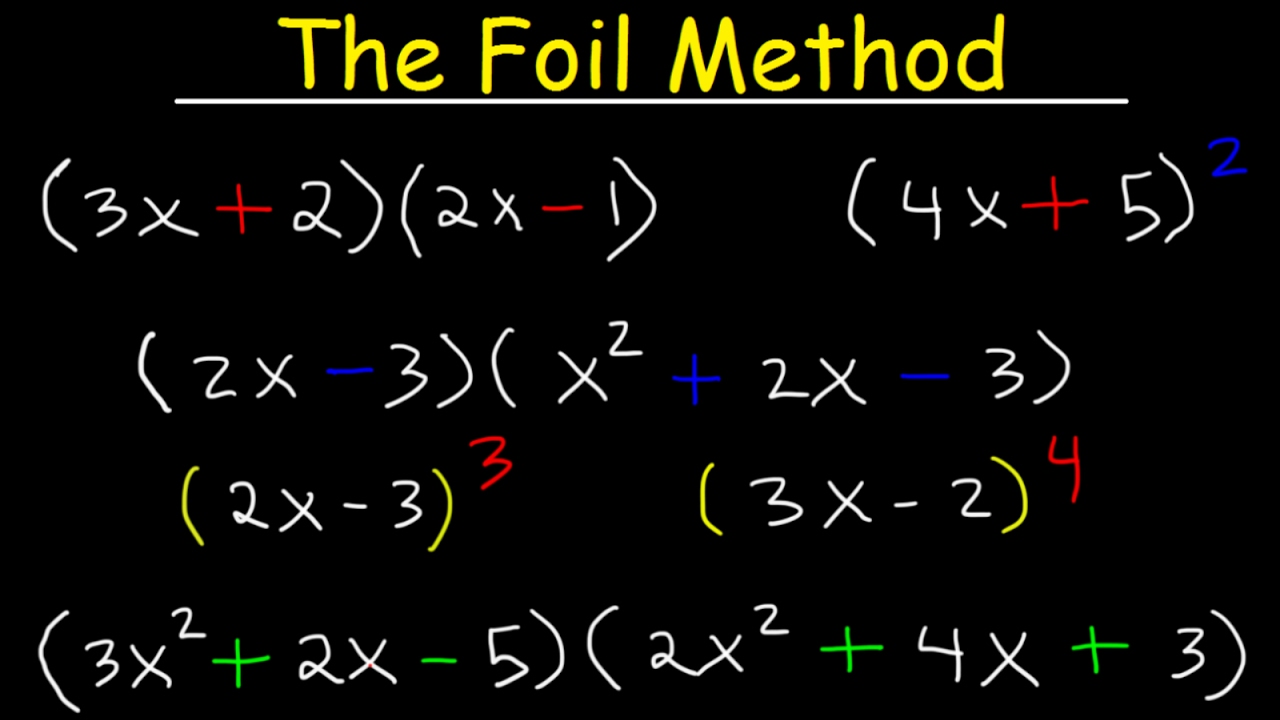
This algebra video tutorial focuses on the foil method. It explains how to multiply binomials, trinomials and polynomials together. It also includes foiling examples of binomials with exponents. In addition, this video goes over another technique known as the binomial theorem which goes along well with pascal's triangle. You can use the bino...
Try watching this you might get an idea
fading nexus

If I multiply the fraction both the denominator and numerator what is that called?
Would I just list the reason as algebra
midnight haven
fading nexus
Oh ic
midnight haven
fading nexus
Would I just list the reason as algebra
You don't need to list any reason tbf its just algebra
Well back to the original question you can remember this (a+b)(a-b) = a^2-b^2 as a standard result
It is easy to understand why it is after knowing multiplication of expressions
fading nexus
I’m looking at the ANSWR key and I’m still confused because how did they cancel if it is not matching

And then on like half of my problems I can’t finish them because I don’t know how to multiply cosx and sinx together
midnight haven
fading nexus
I’m looking at the ANSWR key and I’m still confused because how did they cancel ...
Looks like they multiplied by cosx in numerator and denominator
Then used cos^2x =1-sin^2x
Then they split 1-sin^2x as (1+sinx)(1-sinx)
midnight haven
midnight haven
Well back to the original question you can remember this (a+b)(a-b) = a^2-b^2 as...
Using this
midnight haven
They skipped few steps
midnight haven
fading nexus
Where did it go though
Where did what go
fading nexus
Like it look liked they cancelled it
midnight haven
I gtg rn
flint basalt
fading nexus
Like it look liked they cancelled it
they use the identity $\cos^2x + \sin^2x = 1$
jolly parrotBOT
Krish
 flint basalt
therefore, $\cos^2x = 1 - \sin^2x$
jolly parrotBOT
Krish
 flint basalt
and using difference of squares, $a^2 - b^2 = (a+b)(a-b)$, you can say that $1 - \sin^2x = (1+\sin x)(1-\sin x)$
jolly parrotBOT
Krish
 flint basalt
then you can cancel from there
pearl pondBOT
@fading nexus Has your question been resolved?
 jade skiff
fading nexus
And then on like half of my problems I can’t finish them because I don’t know ho...
jade skiff
fading nexus
And then on like half of my problems I can’t finish them because I don’t know ho...
theres no need to multiplu sinx and cos x js simplify it out cox(sinx+1)/ 1-sin2x and 1-sin2 x can be written as (1-sinx)(1+sinx) its an identity (a2-b2)=(a+b)(a-b)
pearl pondBOT
Channel closed
Closed due to timeout
Use .reopen if this was a mistake.
Available help channel!
Send your question here to claim the channel.
Remember:
• Ask your math question in a clear, concise manner.
• Show your work, and if possible, explain where you are stuck.
• Do not immediately ping people or roles. After 15 minutes, feel free to ping <@&286206848099549185> once.
• Type the command .close to free the channel when you're done.
• Be polite and have a nice day!
Read #❓how-to-get-help for further information on how to ask a good question, and about conduct in the question channels.
 sharp smelt
Really silly question, is the "In particular" part just refering to when HK=G
 pearl pondBOT
sharp smelt
Really silly question, is the "In particular" part just refering to when HK=G
worldly jewel
pearl pondBOT
sharp smelt
Really silly question, is the "In particular" part just refering to when HK=G
worldly jewel
yes
pearl pondBOT
Channel closed
Closed by @sharp smelt
Use .reopen if this was a mistake.
worldly jewel
What are you sorry for? Don't be!
pearl pondBOT
Available help channel!
Send your question here to claim the channel.
Remember:
• Ask your math question in a clear, concise manner.
• Show your work, and if possible, explain where you are stuck.
• Do not immediately ping people or roles. After 15 minutes, feel free to ping <@&286206848099549185> once.
• Type the command .close to free the channel when you're done.
• Be polite and have a nice day!
Read #❓how-to-get-help for further information on how to ask a good question, and about conduct in the question channels.
 final smelt
1+1
flint basalt
<@&268886789983436800> troll
 sharp vigil
final smelt
1+1
sharp vigil
final smelt
1+1
The help channels are not for troll questions.
flint basalt
oop lol
sharp vigil
.close
pearl pondBOT
Channel closed
Closed by @sharp vigil
Use .reopen if this was a mistake.
Available help channel!
Send your question here to claim the channel.
Remember:
• Ask your math question in a clear, concise manner.
• Show your work, and if possible, explain where you are stuck.
• Do not immediately ping people or roles. After 15 minutes, feel free to ping <@&286206848099549185> once.
• Type the command .close to free the channel when you're done.
• Be polite and have a nice day!
Read #❓how-to-get-help for further information on how to ask a good question, and about conduct in the question channels.
 warm elbow
\subsection{Problem 4.}
\textbf{For any set $x$, the \textit{transitive closure of x}, written $TC(x)$, is defined by: $TC(x) = \bigcup{h_n(x) : n \in \omega}$ where $h_0(x) = x$ and $h_{n+1}(x) = \bigcup h_n(x)$ for all $n \in \omega$.}
\\
\textbf{(a) Prove that for every set $x$, $TC(x)$ is transitive.}
\\
Let $x$ be any arbitrary set. Select $a \in TC(x)$. So $a \in \bigcup {h_n(x) : n \in \omega}$. There exists some $b \in {h_n(x) : n \in \omega}$ such that $a \in b$. Call $b = h_{n}(x)$, where $n \in \omega$.
pearl pondBOT
warm elbow
\subsection{Problem 4.}
\textbf{For any set $x$, the \textit{transitive closure ...
warm elbow
lowkey stuck on this
jolly parrotBOT
toast
 pearl pondBOT
@warm elbow Has your question been resolved?
autumn fossil
warm elbow
lowkey stuck on this
So your strategy is proving that a is a subset of TC(x)?
autumn fossil
hmm so generally, you'd now pick some a' in a and try to prove that a' is in TC(x) ig
autumn fossil
that's just from the definition of subset
it's still just proving that a is a subset of TC(x)
jolly parrotBOT
toast
 autumn fossil
Sometimes, yeah
warm elbow
i cant tell if this is the case o rnot
autumn fossil
That'd probably depend on the theorems you have proven before, but i cant see any direct way here
autumn fossil
autumn fossil
hmm so generally, you'd now pick some a' in a and try to prove that a' is in TC(...
i believe this is pretty simple
warm elbow
kk