Channel closed
Closed by @quasi patrol
Use .reopen if this was a mistake.
1 messages · Page 282 of 1
 pearl pondBOT
Closed by @quasi patrol
Use .reopen if this was a mistake.
 Available help channel!
Send your question here to claim the channel.
Remember:
• Ask your math question in a clear, concise manner.
• Show your work, and if possible, explain where you are stuck.
• Do not immediately ping people or roles. After 15 minutes, feel free to ping <@&286206848099549185> once.
• Type the command .close to free the channel when you're done.
• Be polite and have a nice day!
Read #❓how-to-get-help for further information on how to ask a good question, and about conduct in the question channels.
pearl pondBOT
Channel closed due to the original message being deleted.
If you did not intend to do this, please open a new help channel,
as this action is irreversible, and this channel may abruptly lock.
pearl pondBOT
Available help channel!
Send your question here to claim the channel.
Remember:
• Ask your math question in a clear, concise manner.
• Show your work, and if possible, explain where you are stuck.
• Do not immediately ping people or roles. After 15 minutes, feel free to ping <@&286206848099549185> once.
• Type the command .close to free the channel when you're done.
• Be polite and have a nice day!
Read #❓how-to-get-help for further information on how to ask a good question, and about conduct in the question channels.
 proud frost
Are there any recommendations for learning first order logic + other stuff related to it fundementally that build from the ground up? (i.e. assuming reader is a complete noob to first order logic stuff)? I know Hanako gave a recommendation above and wanted to knwo if there were any more people recommedned
pearl pondBOT
proud frost
Are there any recommendations for learning first order logic + other stuff relat...
proud frost
I found this: https://www.logicmatters.net/tyl/ although im not sure how biased it is (since all the books here are by the same author

A Study Guide A re-titled, expanded version of the old Teach Yourself Logic study guide. This is a book length guide to the main topics and some suitable texts either for teaching yourself logic by individual self-study, or to supplement a university course. You only need to read just the first half-dozen pages to see […]
 crystal dew
Avigad - Mathematical Logic and Computation
proud frost
crystal dew
Avigad - Mathematical Logic and Computation
would you say the books you recommended should be read front to back?
crystal dew
almost no texts should be read front to back, much less Open Logic
you can if you want to
proud frost
oh shoot, ig i mean sequentially yeah
cuz ig i learn more in a structured manner
sry if this is too many requirement
cuz i just finished parts of Folland (real analysis)
and his writing kinda hurt
crystal dew
structured is fine
but you aren't gonna need everything in OL
unless you do
that being said, I'd highly recommend skipping the first section of OL and come back to it after you've understood first-order logic
proud frost
crystal dew
that being said, I'd highly recommend skipping the first section of OL and come ...
i see yeah, i was thinking of/trying to find unified source/source that is self contained for first order logic
and ig Avigad is the way to go then?
im looking at its reviews rn and etc
since once i start im gonna commit
crystal dew
Avigad for main reading, OL for reference (which is what I'm doing atm too)
crystal dew
Introduction to Mathematical Logic by Elliott Mendelson is also not bad
proud frost
or what woudl you say his style is like ok
crystal dew
proud frost
wouuld you say his style is terse
eh... it can be
proud frost
rip ggs
crystal dew
but that's where OL comes in
crystal dew
I suppose you will have to at least be familiar with a bit of set theory
crystal dew
proud frost
https://www.andrew.cmu.edu/user/avigad/Teaching/landc_notes.pdf
no, those are his lecture notes
proud frost
okay becuase he says
 crystal dew
I'm talking about his book Mathematical Logic and Computation
crystal dew
https://www.amazon.com/gp/product/1108478751/ref=ox_sc_act_title_1?smid=A2XZ7JICGUQ1CX&psc=1
this one specifically

This new book on mathematical logic by Jeremy Avigad gives a thorough introduction to the fundamental results and methods of the subject from the syntactic point of view, emphasizing logic as the study of formal languages and systems and their proper use. Topics include proof theory, model theory...
you can skip the set theory chapters and come back to them later I guess
proud frost
crystal dew
https://www.amazon.com/gp/product/1108478751/ref=ox_sc_act_title_1?smid=A2XZ7JIC...
youd say the book is moslty self contained tho right
and just lke OL is helpful to fill in gaps he deosnt say in proofs'
crystal dew
mostly self-contained for what it needs to do, but not completely for set theory
you'd supplement this with other sources like Kunen or Jech for set theory
if you want to further in computation, Rich's book is also a choice
so depends on what you mean by self-contained: if you mean in mathematical logic, mostly, for the fundamentals
proud frost
crystal dew
if you want to further in computation, Rich's book is also a choice
waiti wdym computation
crystal dew
computational theory
proud frost
crystal dew
so depends on what you mean by self-contained: if you mean in mathematical logic...
yeah ig for mathemtaical logic and like what is considered "canoncial" for that field (sry this probably very ignorant but im open to learn mroe)
crystal dew
if by canonical you mean fundamental, then yes, Avigad is not a bad idea
if by canonical you mean "all-in-one solution", no
as in from beginner all the way to research-level, then no
you'd need other resources to continue
proud frost
crystal dew
as in from beginner all the way to research-level, then no
nah just like maybe first course for logic
crystal dew
by the way, for resource recommendations, consider #book-recommendations next time
crystal dew
proud frost
nah just like maybe first course for logic
then Avigad and OL more than suffice
arguably a little too overpowered
but hey that shouldn't be a concern, you can cherry-pick topics as needed
proud frost
crystal dew
by the way, for resource recommendations, consider <#716264872018706443> next ti...
yeah i thought there should be a channel like that ngl but why is it hidden from me

like there are hidden channles in server?
crystal dew
you collapsed the discussion category
proud frost
crystal dew
right above <#342850939306246145> and below <#1364708617072148591>
wait sry i dont even thinki have those channels, like my discussion is uncollapsed
 crystal dew
then go to id:browse and select #book-recommendations (and other channels as you see fit)
crystal dew
please refrain from asking personal questions in a help channel.
if you wish to chat, you may do so in the discussion channels or #chill.
proud frost
crystal dew
then Avigad and OL more than suffice
okay so just to be clear, Avigad (prob chapters 1-7, more if needed) is main, read thru sequentially and then OL helps supplement gaps that Avigad does nto have (i.e. when working thru problems or if proofs too terse)?
i just dont wanna end up jumping around everywhere cuz then i go down rabbithole
crystal dew
if you can understand chapter 1 then yes
proud frost
.close
pearl pondBOT
Closed by @proud frost
Use .reopen if this was a mistake.
proud frost
.reopen
pearl pondBOT
✅ Original question: #help-39 message
proud frost
crystal dew
if you can understand chapter 1 then yes
wait sry i was just browsing the book recomenedaiton channel and there seems to be book by Mendelson and Enderton, what do you think of those?
crystal dew
if you mean Introduction to Mathematical Logic by Elliott Mendelson, I have it on my to-buy list. heard good things about it but no comment since I have not read it myself
never heard of Enderton, unless you have the title
nvm I know what book you meant.
I would say, they seem overlapping to me. Mendelson is good enough for a first run through (of course, this means your first run through won't be super thorough but your second run through with Avigad would be just right)
proud frost
crystal dew
nvm I know what book you meant.
I would say, they seem overlapping to me. Mendel...
ah i see. when you say first run do you just mean like i read thru the stuff and work on some fo the exercises but i dont dive too deep, i.e. more like kinda reading book/novel? Im not really sure how to approach reading books on logic and etc and if i shoudl treat them diffrently than say an analysis or lin alg textbook
crystal dew
no, I mean first run as in a deep run through Mendelson
you'll definitely not cover all of logic with Mendelson, hence the second run with Avigad and OL
also for Avigad, you might want to hear a review of the book from a better person than myself
 ivory basin
Avigad is a good book, quite notationally heavy right from the start. It's good if you already are comfortable with stuff, but want to learn logic formally
Perfect for a second run as Hana put it, but even for a first run it's all right, just maybe a bit of effort
proud frost
ivory basin
Avigad is a good book, quite notationally heavy right from the start. It's good ...
okay yeah, and would you say Enderton covers logic formally as well then? or just like enough
ivory basin
I haven't read Enderton
I started with Avigad, did the first 4 chapters cuz that was all I needed and moved on to HoTT
crystal dew
Enderton and Mendelson have similar styles, and from what I know of Mendelson it's decent enough as scaffolding to Avigad
ivory basin
I'd recommend Avigad to someone who's done a decent amount of maths but has never seen logic formally
Cuz if you can tolerate some notational weight, it is much superior because of how well it motivates stuff
pearl pondBOT
@proud frost Has your question been resolved?
pearl pondBOT
Closed due to timeout
Use .reopen if this was a mistake.
pearl pondBOT
Available help channel!
Send your question here to claim the channel.
Remember:
• Ask your math question in a clear, concise manner.
• Show your work, and if possible, explain where you are stuck.
• Do not immediately ping people or roles. After 15 minutes, feel free to ping <@&286206848099549185> once.
• Type the command .close to free the channel when you're done.
• Be polite and have a nice day!
Read #❓how-to-get-help for further information on how to ask a good question, and about conduct in the question channels.
 wraith hatch
When we linearize a nonlinear first order ode system, why is it that the Jacobian's eigenvalues might fail to predict the behavior of the nonlinear system? This behavior occurs in orbits but I cant justify why.
pearl pondBOT
wraith hatch
When we linearize a nonlinear first order ode system, why is it that the Jacobia...
pearl pondBOT
@wraith hatch Has your question been resolved?
pearl pondBOT
@wraith hatch Has your question been resolved?
wraith hatch
.close
pearl pondBOT
Closed by @wraith hatch
Use .reopen if this was a mistake.
pearl pondBOT
Available help channel!
Send your question here to claim the channel.
Remember:
• Ask your math question in a clear, concise manner.
• Show your work, and if possible, explain where you are stuck.
• Do not immediately ping people or roles. After 15 minutes, feel free to ping <@&286206848099549185> once.
• Type the command .close to free the channel when you're done.
• Be polite and have a nice day!
Read #❓how-to-get-help for further information on how to ask a good question, and about conduct in the question channels.
 crimson nebula
Q1 .
For the part :-
I ⊆ I' => a'≤a and b≤b'
Check my proof
My proof :-
For second implication:
My proof for other way around
From a'≤a and b≤b' , combining both inequalities we get :
a'≤a≤b≤b'
Which implies a'≤a≤b' , so a ∈ [a',b']=I
Hence a ∈ I'
Also , a'≤ b≤b' , so b ∈ [a',b']=I
Hence B ∈ I'
Since a,b ∈ I' and a<b , from the Characterization theroem I= [a,b] ⊆ I'
 pearl pondBOT
crimson nebula
Q1 .
For the part :-
I ⊆ I' => a'≤a and b≤b'
Check my proof
My proof :-
Fo...
pearl pondBOT
crimson nebula
Q1 .
For the part :-
I ⊆ I' => a'≤a and b≤b'
Check my proof
My proof :-
Fo...
 worldly jewel
it looks correct but your formatting and symbols seem messed up
 cursive wraith
crimson nebula
Q1 .
For the part :-
I ⊆ I' => a'≤a and b≤b'
Check my proof
My proof :-
Fo...
cursive wraith
crimson nebula
Q1 .
For the part :-
I ⊆ I' => a'≤a and b≤b'
Check my proof
My proof :-
Fo...
ok so you only want us to look at "$a'\leq a$ and $b\leq b'$ $\Longrightarrow I\subseteq I'$" right?
 jolly parrotBOT
Rafilouyear2026
 crimson nebula
I have also proved that part ..
But about this part i was uncertain
cursive wraith
crimson nebula
I have also proved that part ..
But about this part i was uncertain
Wdym you've also proved this part?
crimson nebula
jolly parrot
**Rafilouyear2026**
This part i have proved ..
In question it's double implication.
cursive wraith
crimson nebula
Q1 .
For the part :-
I ⊆ I' => a'≤a and b≤b'
Check my proof
My proof :-
Fo...
The proof you've shown us is "From a'≤a and b≤b' we get I= [a,b] ⊆ I'"
crimson nebula
cursive wraith
The proof you've shown us is "From a'≤a and b≤b' we get I= [a,b] ⊆ I'"
In my message
I went from I ⊆I' to a' ≤a and b≤b'
cursive wraith
crimson nebula
In my message
I went from I ⊆I' to a' ≤a and b≤b'
No, look again
cursive wraith
From a'≤a and b≤b'
your assumptions
Since a,b ∈ I' and a<b , from the Characterization theroem I= [a,b] ⊆ I'
Your conclusion
You've shown a'≤a and b≤b' implies I ⊆ I'
crimson nebula
The message I wanted to forward somehow wasnt copied
I will put down my idea here :-
a'≤a and b≤b'
Combining both inequalities, we get :
a'≤ a ≤ b≤b'
Which implies a'≤a≤b'
So a ∈ [a',b']=I'
Also a'≤b<b'
So b ∈ [a',b']=I
Since a,b ∈ I'
And a<b
Therefore by Characterization theorem
I= [a,b] ⊆ I'
.
.
This is the proof i want to know if it's correct
cursive wraith
Well, if your characterization theorem is to be believed, since I don't see any problems other than some typos here and there
Yes your proof is correct
crimson nebula
Typos...?
cursive wraith
Also a'≤b<b'
So b ∈ [a',b']=I
Also a' ≤b***≤b'
So b ∈ [a',b']=I'***
cursive wraith
Overall it seems fine
crimson nebula
Okay thanks for your patience and help
cursive wraith
It's just the "Since" "Therefore" that seems a little clunky
You could replace "Since" By "We thus have"
pearl pondBOT
Closed by @crimson nebula
Use .reopen if this was a mistake.
pearl pondBOT
Available help channel!
Send your question here to claim the channel.
Remember:
• Ask your math question in a clear, concise manner.
• Show your work, and if possible, explain where you are stuck.
• Do not immediately ping people or roles. After 15 minutes, feel free to ping <@&286206848099549185> once.
• Type the command .close to free the channel when you're done.
• Be polite and have a nice day!
Read #❓how-to-get-help for further information on how to ask a good question, and about conduct in the question channels.
 daring bay
hello, how do you calculate the conditional probability in an event where its "or"
pearl pondBOT
daring bay
hello, how do you calculate the conditional probability in an event where its "o...
 steady vapor
addition
steady vapor
and = multiplication and or = addition
daring bay
So the event is "the person is a man or has a winner bowling ball"
steady vapor
,rrcw
daring bay
steady vapor
and = multiplication and or = addition
so id just do 0,3 + 0,05?
daring bay
daring bay
,rotate
jolly parrotBOT
 steady vapor
What's the probability a person is a man
 viscid shale
steady vapor
addition
viscid shale
steady vapor
addition
this is a really bad oversimplification
daring bay
steady vapor
What's the probability a person is a man
0,7
why does chatgpt say this then
 steady vapor
viscid shale
this is a really bad oversimplification
steady vapor
viscid shale
this is a really bad oversimplification
Yeah, my bad
steady vapor
daring bay
why does chatgpt say this then
You have to add the probabilities but only if they can't both happen
daring bay
steady vapor
You have to add the probabilities but only if they can't both happen
but in my case they can right
steady vapor
Yeah you're right
So what's the probability that it's both a man and a winning ball
daring bay
0,05
steady vapor
Look at the cell where W and M meet
steady vapor
Yep exactly
jolly parrotBOT
bartdestinkerd34
 steady vapor
If this equality holds, they are independent
steady vapor
Sorry my brain is not working
daring bay
tysm
steady vapor
This is the correct one lmao
pearl pondBOT
@daring bay Has your question been resolved?
pearl pondBOT
Closed due to timeout
Use .reopen if this was a mistake.
pearl pondBOT
Available help channel!
Send your question here to claim the channel.
Remember:
• Ask your math question in a clear, concise manner.
• Show your work, and if possible, explain where you are stuck.
• Do not immediately ping people or roles. After 15 minutes, feel free to ping <@&286206848099549185> once.
• Type the command .close to free the channel when you're done.
• Be polite and have a nice day!
Read #❓how-to-get-help for further information on how to ask a good question, and about conduct in the question channels.
 wary vault
Hello. Does anyone know of an "easy" proof of the Schröder-Bernstein theorem? In class, we defined a bunch of sets and our prof didnt really explain why, and its taking me a long ass time to understand that proof. So, if you have a recommended proof in your disposal, pray share
pearl pondBOT
wary vault
Hello. Does anyone know of an "easy" proof of the Schröder-Bernstein theorem? In...
 toxic lichen
is that the one where if theres injections both ways between two sets then there is a bijection
wary vault
yep
toxic lichen
ok right yeah there is a visual proof for it actually
or at least a proof that is more visual than the "define a whole bunch of sets" thing
call our sets X and Y and also assume wlog they're disjoint (otherwise biject X with something disjoint from Y and continue)
wary vault
id love to see that
 carmine schooner
a very informal argument. for (wlog disjoint) sets A and B, if for every element in A we can take one distinct in B, and for every element in B we can take one distinct in A, then surely there exists a way to associate every element in A with one in B
toxic lichen
and let's call our injections f: X -> Y and g: Y -> X
what we'll consider will kinda be a disjoint graph structure on X \cup Y
connect x ∈ X to y ∈ Y with a red arrow x -> y if f(x) = y, and connect them with a blue arrow y -> x if g(y) = x
wary vault
carmine schooner
a very informal argument. for (wlog disjoint) sets A and B, if for every element...
i see, but as you said this is quite informal lol
toxic lichen
so in other words we now visualize f as "follow a red arrow" and g as "follow a blue arrow"
here are some facts about these arrows:
 glass meadow
carmine schooner
a very informal argument. for (wlog disjoint) sets A and B, if for every element...
glass meadow
carmine schooner
a very informal argument. for (wlog disjoint) sets A and B, if for every element...
Your "then surely" is kind of the whole point of the theorem isn't it?
carmine schooner
glass meadow
Your "then surely" is kind of the whole point of the theorem isn't it?
shhhhhhhhhhhhhhhhhhhh
but yeah i realize that takes a lot for granted. i'll let ann finish
toxic lichen
are we in agreement so far
wary vault
toxic lichen
what we'll consider will kinda be a disjoint graph structure on X \cup Y
what does this sentence mean exactly? it confuses me
wary vault
got it lol
toxic lichen
uh
ok so hold on augh
let me just draw what happens at the level of individual elements
and get my colored pens
glass meadow
wary vault
what does this sentence mean exactly? it confuses me
Just make a graph where the vertices are elements of X and Y, and directed edges going from X-vertices to Y-vertices that correspond to applications of f, and similarly from Y to X for applications of g
wary vault
toxic lichen
- elements of X have at most one blue arrow going out and one red arrow coming i...
i dont get the third point here
wary vault
glass meadow
Just make a graph where the vertices are elements of X and Y, and directed edges...
you just assumed that my intelligence is high enough to understand this
carmine schooner
wary vault
i dont get the third point here
this isn't one-to-one
 wary vault
carmine schooner
this isn't one-to-one
wary vault
carmine schooner
this isn't one-to-one
yes, but ann said so about different colours too
glass meadow
X = {1, 2, 3}, Y = {a, b, c}
f(1) = a, f(2) = b, f(3) = c
g(a) = 2, g(b) = 1, g(c) = 3
Make a graph with vertices 1, 2, 3, a, b, c
Then add blue directed edges 1->a, 2->b, 3->c and red directed edges a->2, b->1, c->3
wary vault
wary vault
yes, but ann said so about different colours too
"opposite colours would violate the fact that X,Y are disjoint"
glass meadow
Because f and g are both injective, you cannot have more than one arrow (directed edge) going into any one vertex
wary vault
glass meadow
X = {1, 2, 3}, Y = {a, b, c}
f(1) = a, f(2) = b, f(3) = c
g(a) = 2, g(b) = 1, g(...
what are edges and vertices?
glass meadow
Have you never done any graph theory?
wary vault
no
glass meadow
Damn
toxic lichen
 toxic lichen
wary vault
"opposite colours would violate the fact that X,Y are disjoint"
toxic lichen
wary vault
"opposite colours would violate the fact that X,Y are disjoint"
if you're pointed to by a red arrow then you live in Y. if you're pointed to by a blue arrow then you live in X. you can't have both colors pointing at you.
carmine schooner
wary vault
"opposite colours would violate the fact that X,Y are disjoint"
this implies some element of y is mapped to by some element in x and some element in y as well
 toxic lichen
toxic lichen
toxic lichen
@wary vault do you understand what goes on in this picture
wary vault
toxic lichen
if you're pointed to by a red arrow then you live in Y. if you're pointed to by ...
i see that makes sense
wary vault
toxic lichen
<@989217139821002802> do you understand what goes on in this picture
im reading it gimme a min. i understand the top half so far
glass meadow
Keep in mind that if X and Y are finite, you can only have loops
Red/blue rays and lines (in Ann's terminology) go on to infinity
wary vault
toxic lichen
i dont get the point the second half makes
toxic lichen
try this
theres a slightly psychedelic version of this same argument but with cats and dogs
starting page 59
it is cartoonish and weird but trust me
glass meadow
glass meadow
X = {1, 2, 3}, Y = {a, b, c}
f(1) = a, f(2) = b, f(3) = c
g(a) = 2, g(b) = 1, g(...
Taking my (bad) example:

The black parts (1,2,3,a,b,c) are vertices
The arrows are directed edges and correspond to applications of f (in blue) or g in red)
wary vault
glass meadow
The arrows are directed edges and correspond to applications of f (in blue) or g...
okay i see
glass meadow
Now you want to look at the sequences or chains of arrows
If you start at 1, you get 1,a,2,b, and back to 1
toxic lichen
the thing about these arrows is that the properties of f and g ensure there's never any branching, which allows us to speak of chains and shit in the first place
glass meadow
If X and Y are finite, |X| = |Y| and so once you start somewhere, you necessarily end up back there at some point, making a loop
wary vault
glass meadow
If you start at 1, you get 1,a,2,b, and back to 1
yes i see how now
wary vault
toxic lichen
the thing about these arrows is that the properties of f and g ensure there's **...
branching meaning something like divergence from a pattern?
glass meadow
So then for infinite sets, you can also have rays and lines. For rays, you can build your bijection by pairing the first two vertices from the end, and then the next two, and so on
glass meadow
wary vault
branching meaning something like divergence from a pattern?
No like a vertex from which two arrows go to different vertices
wary vault
u said the black parts are vertrices but the entire background of the pic is black
glass meadow
(or to which two arrows come from different vertices)
Oh sorry the background is fucked
 wary vault
glass meadow
So then for infinite sets, you can also have rays and lines. For rays, you can b...
wary vault
glass meadow
So then for infinite sets, you can also have rays and lines. For rays, you can b...
how does one pair two vertrices from the end?
glass meadow
The end here is x_0

Pair x_0 and y_0, then x_1 and y_1, ...
Basically for red rays your bijection is the red function
For blue rays, it's the blue function
carmine schooner
toxic lichen
https://www.math.brown.edu/reschwar/infinity.pdf
just want to say this was a great read
glass meadow
For lines and loops, just choose either one
wary vault
glass meadow
Basically for red rays your bijection is the red function
oh i see it
i still have gaps in understanding how that proves existence
lemme elaborate a bit
Ann writes: "points of XUY are joined up by arrows according to f and g". what does that mean?
glass meadow
glass meadow
The arrows are directed edges and correspond to applications of f (in blue) or g...
.
toxic lichen
connect x ∈ X to y ∈ Y with a red arrow x -> y if f(x) = y, and connect them with a blue arrow y -> x if g(y) = x
wary vault
wait i may be onto something
aughhh
its weird
what does x_(something negative), or y_(something negative) denote exactly?
something negative as an index i mean
glass meadow
They're just elements of X or Y, their indexing doesn't really matter
wary vault
okay and why is there even a difference between the blue/red ray and the line structures?
glass meadow
f and g are injective functions
f: X -> Y, the output of f doesn't necessarily cover all of Y
g: Y -> X, the output of g doesn't necessarily cover all of X
(they do if X and Y are finite)
x_0 in Ann's example is just an element of X that is not an output of g
y_-1 is just an element of Y that is not an output of f
In other words, there is no blue arrow going to x_0, and there is no red arrow going to y_-1
wary vault
hmm okay i see
so the line represents the case of the two sets having the same cardinality?
glass meadow
No
glass meadow
All four of these structures can potentially be found in the situation where X and Y are infinite and there exist f and g (injections X->Y and Y->X)
Take X=N and Y=N\{0}, with f(n) = n+1 and g(n) = n-1
The only structure here is a red ray, with x_0 = 0
wary vault
glass meadow
All four of these structures can potentially be found in the situation where X a...
how could the loop be one of these structures? that would mean that there is an x, or a y that maps to two different outputs
wary vault
wary vault
how could the loop be one of these structures? that would mean that there is an ...
mayb not actually im not sure anymore
glass meadow
I don't see a vertex here with multiple arrows coming out of it
 wary vault
glass meadow
I don't see a vertex here with multiple arrows coming out of it
wary vault
glass meadow
I don't see a vertex here with multiple arrows coming out of it
okay true. but if X is infinite then how can a loop occur?
then all the rest of X's elements are left out
wary vault
glass meadow
The only structure here is a red ray, with x_0 = 0
okay i see why
glass meadow
Take X=N and Y=N\{0} again, but this time f(0) = 1, g(1) = 1, f(1) = 2, g(2) = 0 and otherwise f(n) = n+1 and g(n) = n-1
0->1->1->2->0->... is a loop
The rest is a ray
wary vault
oh so the loop is consisting of a finite amount of elements and there exists one of the two rays to continue right? not a line because we have a starting point
glass meadow
In this case, yes
wary vault
okayokay so loops can always occur
glass meadow
Any combination of these structures can occur
wary vault
im still struggling tho i feel like im missing on something important
wary vault
glass meadow
Any combination of these structures can occur
oh shit
glass meadow
I suppose if the sets are infinite you can't have just a finite number of loops since those are finite
An "infinite loop", if that could exist, would just be the same as a line
wary vault
glass meadow
I suppose if the sets are infinite you can't have just a finite number of loops ...
that doesnt make much sense. unless u mean in a scenario where we have only loops
glass meadow
Yes I mean only loops
wary vault
okeoke
wary vault
so 1->1 , 1->1,... , 2->2, 2->2,... ?
glass meadow
Yes
wary vault
okeoke
 severe hemlock
yo any1 help me on maths questions?
wary vault
i feel like we veered off too much lol
wary vault
severe hemlock
yo any1 help me on maths questions?
find an available channel, this ones reserved rn

sending it to see it without scrolling
so Ann's point is that we can create a bijective function in any scenario consisting of those 4 structures?
severe hemlock
wary vault
find an available channel, this ones reserved rn
Well I'm asking a some1 that can help cuz no1 is rn
glass meadow
In any scenario where there exist the two injections, because only these structures can form
wary vault
severe hemlock
Well I'm asking a some1 that can help cuz no1 is rn
are you a fucking pirate bro? this my ship get out
severe hemlock
wary vault
are you a fucking pirate bro? this my ship get out<:catglasses:10377705872354345...
so dumbolic
wary vault
glass meadow
In any scenario where there exist the two injections, *because* only these struc...
mhm mhm
glass meadow
severe hemlock
so dumbolic
What's dumb is expecting random volunteers to answer your questions within minutes of you asking
wary vault
so what we do is isolate each structure and show that a bijection exists in each one, thus combining structures wont change anything?
glass meadow
<@&268886789983436800> basically insulting and just overall disrespectful
glass meadow
wary vault
so what we do is isolate each structure and show that a bijection exists in each...
Yeah
wary vault
hmm okay lemme think on it some more i think im close
 cinder bough
severe hemlock
yo any1 help me on maths questions?
cinder bough
severe hemlock
yo any1 help me on maths questions?
Please find a free help channel rather than coming to occupied ones. Doing this does not help you get answers.
glass meadow
I find this example for a bijection between [0,1] and [0,1) pretty good
wary vault
glass meadow
I find [this example](<https://en.wikipedia.org/wiki/Schr%C3%B6der%E2%80%93Berns...
tbh that seems like a topic for a different help thread lol
actually i think i understand it
i see the logic behind it at least
but i cant connect it to the proof of the theorem here
i guess my only question left is how do we construct a bijection in each of the 4 structures?
glass meadow
Basically for red rays your bijection is the red function
For blue rays, it's the blue function
For lines and loops, just choose either one
wary vault
glass meadow
> Basically for red rays your bijection is the red function
> For blue rays, it'...
well whats the difference between f and the red function? if there is none, then f is a bijection no?
glass meadow
No, f is defined as an injection, not necesarily a bijection
wary vault
i mean yeah, but saying that the red function is a bijection means f is bijective, i dont see a way around that
glass meadow
No we're taking parts of each function
wary vault
oh, how so?
glass meadow
If you restrict the domain (and codomain) of f to just the red rays, then it is a bijection
That's the point
wary vault
thats kinda confusing to me
glass meadow
Take that [0,1] -> [0,1) example
wary vault
bc the blue lines only represent g, not f
glass meadow
f(x) = x/2
And we define the set C = {1, 1/2, 1/4, ...}
If you restrict the domain of f to C and its codomain to C\{1}, then it becomes a bijection
But on [0,1] -> [0,1), it's just and injection
wary vault
oh wait a minute i forgot what a codomain is
glass meadow
The set of possible outputs
A function is surjective if its range equals its codomain
glass meadow
f is an injection because it takes all of [0,1] and all its outputs are different
wary vault
glass meadow
But on [0,1] -> [0,1), it's just and injection
hmm yes i see that
f<=1/2
glass meadow
If you make it take only C then it's still an injection, but not a surjection since, for example, 3/4 is not a possible output
Now if you also make its codomain equal its new range, that is C\{1}, then it becomes bijective
wary vault
glass meadow
If you make it take only C then it's still an injection, but not a surjection si...
okay true
wary vault
glass meadow
Now if you also make its codomain equal its new range, that is C\\{1}, then it b...
very true
glass meadow
And now we have g: [0,1) -> [0,1], so the other way, and g(x) = x
For anything that is not in C, we take g^-1, and that's obviously a bijection
For anything that is in C, we take f, and that's also a bijection
So both combined into h(x) = x/2 if x in C and h(x) = x if x in [0,1]\C is a bijection
wary vault
yerp i see it
glass meadow
In this case, we have a ray that goes 1 -> 1/2 -> 1/2 -> 1/4 -> ...
(alternating between [0,1] and [0,1) )
That ray is covered by f
wary vault
glass meadow
In this case, we have a ray that goes 1 -> 1/2 -> 1/2 -> 1/4 -> ...
why does 1/2 map to 1/2?
glass meadow
The rest is an infinite number of loops, all covered by g
glass meadow
wary vault
why does 1/2 map to 1/2?
Because that's what g does
glass meadow
The ray starts at 1 in X (where X = [0,1])
You use f to go to 1/2 in Y (where Y = [0,1) )
Then you use g to go back to X, specifically to 1/2
Then f again to go to 1/4 in Y
wary vault
ohhh
glass meadow
And so on
But now you make pairs with these vertices
First pair is 1, 1/2
That's covered by f
Second pair is 1/2, 1/4
Also f
And so on
wary vault
and thats a bijection
glass meadow
Yes
wary vault
now that confused me what
glass meadow
For the bijection
The ray is a chain of arrows alternating between f and g
But the bijection needs to use a single function and its inverse
That's why we pair the vertices
glass meadow
Again, the ray is 1 --(red)-> 1/2 --(blue)-> 1/2 --(red)-> 1/4 --(blue)-> 1/4 -> ...
We only keep the red parts to build our bijection
glass meadow
We don't need them
wary vault
 glass meadow
For anything that is not in C, we use the blue parts
That just means we use g^-1 (the identity in this case)
wary vault
yeah because we only wanted to exclude 1, so the rest we just map to themselves, or halve them
wary vault
wary vault
yeah because we only wanted to exclude 1, so the rest we just map to themselves,...
pls tell me thats right
glass meadow
From 1, using f and g, you create a ray that goes through all of C
For anything that is then not in C, we indeed map the elements to themselves
And that makes an infinite number of small loops
wary vault
mhm mhm
im a bit fried but i get it i think
im tryna connect the same logic to our original example
glass meadow
glass meadow
And that makes an infinite number of small loops
Actually that's wrong I got confused myself
Anything that is not in C is part of a ray that starts in Y
wary vault
why does it start in Y? to exclude 1 because its in X?
glass meadow
So there are an infinite number of rays starting from some y in Y, and so we use g first, which becomes the bijection
Take 3/4 in X
It comes from 3/4 in Y, because g(3/4) = 3/4
But there is no x in X such that f(x) = 3/4
So that's a ray starting from 3/4 in Y
wary vault
g is a func that goes from Y to X then?
glass meadow
Well yeah...
glass meadow
You have an injection from X to Y and one from Y to X, that's the premise
If you take something further down, like 1/5 in Y, you get the chain 1/5 <- 2/5 <- 2/5 <- 4/5 <- 4/5 and that ends (or starts) in Y
The only ray that starts in X is the one corresponding to C, which starts at 1
wary vault
glass meadow
If you take something further down, like 1/5 in Y, you get the chain 1/5 <- 2/5 ...
why did you make the arrows go the opposite way now?
glass meadow
That's the direction of applications of f and g
wary vault
i feel like i need a semester of graph theory to not keep getting confused by simple stuff like that
glass meadow
Honestly, do learn the basics of graph theory, if only just to understand what graphs even are and how to build one
It's not difficult at all
wary vault
i didnt know yall would use graphs to explain the theorem
glass meadow
And it's very useful to visualize a lot of things
wary vault
glass meadow
And it's very useful to visualize a lot of things
yeah even tho ive never used that kinda thing before it did help
its better to stop it here, and ill keep the pic Ann sent saved for the future. you helped me understand a lot of stuff and get a deeper understanding in bijections and stuff so thank you
ill go read the weed book too
glass meadow
wary vault
i didnt know yall would use graphs to explain the theorem<:bearlain:762653539092...
Functions can always be described using bipartite graphs (that means two parts, corresponding to the domain and the codomain)
So sometimes a graph (network) is better than a graph (plot)
wary vault
idk what a network or a plot is exactly lol
glass meadow

glass meadow
Network is another word for the kind of graph we've been talking about
Plot is another word for the usual "graph of a function" with axes and stuff
wary vault
hmm yeah we dont need an analytic expression to create a network
its the first time ive seen a network so ig its natural to be confused at the basics
glass meadow
Well you don't need one for a plot either, you just draw each point
Of course that's bothersome if there are an infinite number of points to draw, but you can't be infinitely precise anyway
wary vault
glass meadow
Well you don't need one for a plot either, you just draw each point
points on a 2d plane are random tho. so if the function doesnt follow a pattern we cant rlly plot it
wary vault
glass meadow
Of course that's bothersome if there are an infinite number of points to draw, b...
yeah, the network describes them through the properties of the function, while the plot shows you whats happening. thats my interpretation
wary vault
plotting seems a bit useless in proving stuff
well ig were just visualizing
anyway
ill go take a break cuz my brain is a slime rn
thank you for the help, appreciate it
.close
pearl pondBOT
Closed by @wary vault
Use .reopen if this was a mistake.
severe hemlock
.reopen
severe hemlock
wary vault
plotting seems a bit useless in proving stuff
Nobody knows u when u r done and under hmm
wary vault
severe hemlock
Nobody knows u when u r done and under hmm
down and out*
severe hemlock
GL
pearl pondBOT
Available help channel!
Send your question here to claim the channel.
Remember:
• Ask your math question in a clear, concise manner.
• Show your work, and if possible, explain where you are stuck.
• Do not immediately ping people or roles. After 15 minutes, feel free to ping <@&286206848099549185> once.
• Type the command .close to free the channel when you're done.
• Be polite and have a nice day!
Read #❓how-to-get-help for further information on how to ask a good question, and about conduct in the question channels.
 simple tusk
I’m practicing for a test in which I’m not allowed pen, paper or a calculator
The formula to find fuel required = burn rate X time in hours
You’d need to find the time first (SDT) (Time = D/S)
I’m able to do this on a calculator however I’m not allowed to use one
I get 1 minute per question
How can i do this quickly with mental maths
Example Questions:
**• You travel 176 miles. How much fuel will you need if you burn 36 kgs per minute, and are travelling at 264 mph?
• You travel 343 miles. How much fuel will you need if you burn 40 kgs per minute, and are travelling at 490 mph?
• You travel 423 miles. How much fuel will you need if you burn 60 kgs per hour, and are travelling at 470 mph? **
pearl pondBOT
simple tusk
I’m practicing for a test in which **I’m not allowed pen, paper or a calculator*...
pearl pondBOT
@simple tusk Has your question been resolved?
pearl pondBOT
@simple tusk Has your question been resolved?
steady vapor
goated naam
 honest spear
simple tusk
I’m practicing for a test in which **I’m not allowed pen, paper or a calculator*...
honest spear
simple tusk
I’m practicing for a test in which **I’m not allowed pen, paper or a calculator*...
i mean it really just is a mental maths challange, just look for multiples that are familiar
like in the firsts question you have $36 \frac{176}{264}$ i'd be thinking well maybe they are nice and its a multiple of 36. 36, 72, 144, 176 you get the idea. Its just a game of find a nice multiple reduce the fraction
jolly parrotBOT
Nyxzore
 steady vapor
In the initial time calculations there's always a common divisor in these examples you've given. Example 1: 88, example 2: 7, example 3: 47
Obviously you can't recognize these easily without a lot of practice
Eventually you'll see them very quickly
honest spear
just practice
sometimes thats the hard truth, no funny tricks at your disposal
❤️
pearl pondBOT
@simple tusk Has your question been resolved?
pearl pondBOT
Closed due to timeout
Use .reopen if this was a mistake.
pearl pondBOT
Available help channel!
Send your question here to claim the channel.
Remember:
• Ask your math question in a clear, concise manner.
• Show your work, and if possible, explain where you are stuck.
• Do not immediately ping people or roles. After 15 minutes, feel free to ping <@&286206848099549185> once.
• Type the command .close to free the channel when you're done.
• Be polite and have a nice day!
Read #❓how-to-get-help for further information on how to ask a good question, and about conduct in the question channels.
 empty reef
i keep getting 100 for the average acceleration...my points r (40,2.2) and (22, 0.4)
 pearl pondBOT
empty reef
i keep getting 100 for the average acceleration...my points r (40,2.2) and (22, ...
empty reef
pearl pondBOT
empty reef
i keep getting 100 for the average acceleration...my points r (40,2.2) and (22, ...
empty reef
also a question..am i allowed to send a viscous drag related question iin help category? i need urgent help since my exams soon and im not getting answers in physics server
 midnight haven
Show ur work
empty reef
my working is 2.2-0.4/(40-22)*10^-3
maybe the keyword is they want average accelertation during collision so i should consider the start and end of straighjt line?
 golden birch
yes that would make more sense
empty reef
alr tyy
empty reef
empty reef
also a question..am i allowed to send a viscous drag related question iin help c...
also does anyone have a clue if this is fine? 😓
yes
crystal dew
empty reef
also a question..am i allowed to send a viscous drag related question iin help c...
are you asking about concepts or calculations?
empty reef
can i send it in this channel or do i open a new one.
crystal dew
if concepts, a little iffy, but if calculations, send them along with the relevant formulae
you can send it here and I'll pin it, but make sure you're done with your current question first so as to avoid confusion
empty reef
crystal dew
are you asking about concepts or calculations?
i want to check my method of solving for one, and for the other question i used a different logic but its not in the marking scheme and i dont know why its not correcr
empty reef
crystal dew
you can send it here and I'll pin it, but make sure you're done with your curren...
yes
ty
crystal dew
empty reef
golden birch
how did you get eta in page 2
if you're not sure of the liquid
you assumed it is glycerol and tried to prove by contradiction or something?
pearl pondBOT
@empty reef Has your question been resolved?
golden birch
it appears that yielding density through viscosity leads to a greater numerical uncertainty
so that try judging yse or no with viscosity instead of density
empty reef
golden birch
you assumed it is glycerol and tried to prove by contradiction or something?
yeah i assumed it is and used the eta given in the question and then found its density following that calculation
then i compared it with its actual density which is also given
empty reef
golden birch
it appears that yielding density through viscosity leads to a greater numerical ...
ohhh
empty reef
i see, thats why theres a big differece in the density
okay thanks a lot, also does the workig in page 1 look okay to u? the marking scheme says this so ig they allow other methods?
 pearl pondBOT
Closed due to timeout
Use .reopen if this was a mistake.
pearl pondBOT
Available help channel!
Send your question here to claim the channel.
Remember:
• Ask your math question in a clear, concise manner.
• Show your work, and if possible, explain where you are stuck.
• Do not immediately ping people or roles. After 15 minutes, feel free to ping <@&286206848099549185> once.
• Type the command .close to free the channel when you're done.
• Be polite and have a nice day!
Read #❓how-to-get-help for further information on how to ask a good question, and about conduct in the question channels.
 brazen stream
 pearl pondBOT
brazen stream
pearl pondBOT
brazen stream
 still hamlet
<@&268886789983436800>
wraith hatch
brazen stream
have you solved the ode?
its linear first order so it shouldnt be that bad
try the method of integrating factor
brazen stream
i dont know where to start
wraith hatch
brazen stream
i dont know where to start
do you know how to solve a first order linear ode?
brazen stream
wraith hatch
do you know how to solve a first order linear ode?
no 🙁
wraith hatch
https://youtu.be/gd1FYn86P0c
Learn that first
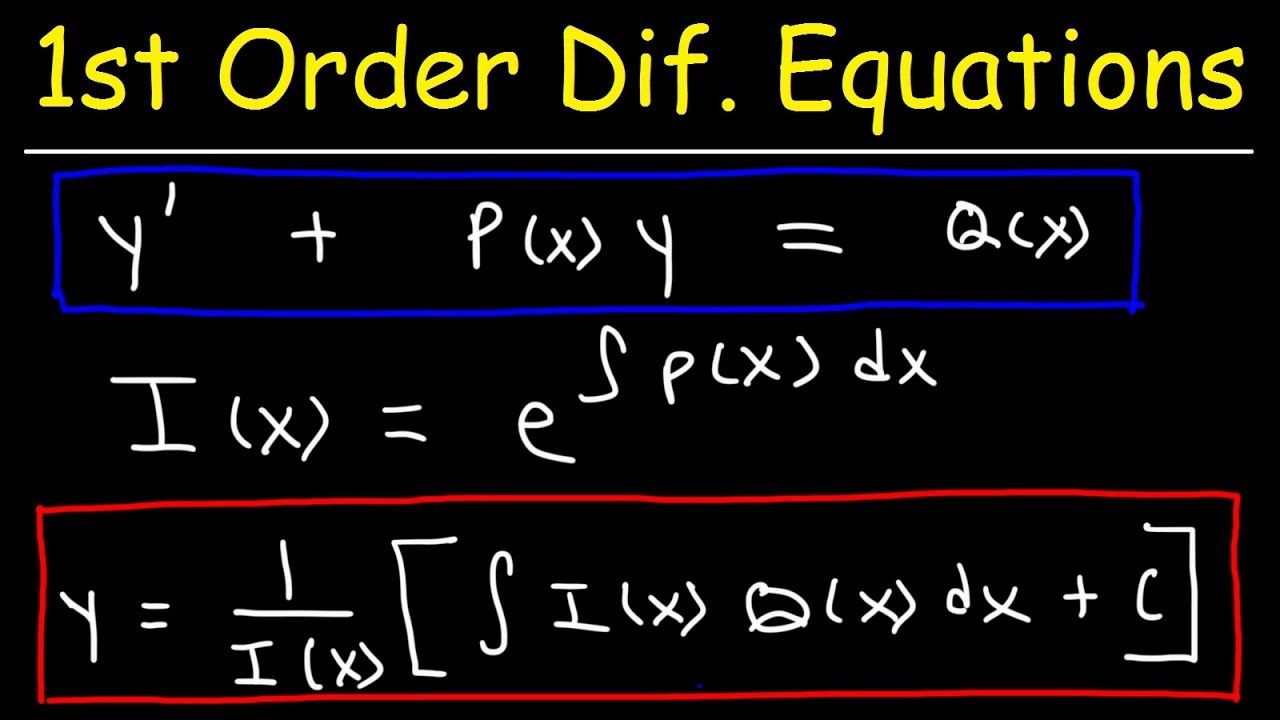
This calculus video tutorial explains provides a basic introduction into how to solve first order linear differential equations. First, you need to write the equation in standard form [y' + P(x)y = Q(x)] and then identify the functions P(x) and Q(x). Next, you need to determine the integrating factor I(x) using the formula I(x) = e^(integral o...
 fresh olive
$$\frac{dy}{dx}+\frac{x}{x^{2}-1}y=\frac{x^{6}+4x}{\sqrt{1-x^{2}}}$$
jolly parrotBOT
BBMaths
 brazen stream
okay w8
wraith hatch
yeah ping me once u watched the video
fresh olive
(I just rewrote the question for anyone to use)
pearl pondBOT
@brazen stream Has your question been resolved?
fresh olive
So the first step would be to work out what P(x) and Q(x) are
brazen stream
okay
fresh olive
The video has this right $$\frac{dy}{dx}+P(x)y=Q(x)$$
jolly parrotBOT
BBMaths
 fresh olive
jolly parrot
**BBMaths**
fresh olive
jolly parrot
**BBMaths**
So just match that up with the equation
 prisma portal
twin
brazen stream
fresh olive
So just match that up with the equation
thas all ryt?
fresh olive
Well the formula in the thumbnail is the general case for any possible P and Q
fresh olive
3 steps: \
jolly parrotBOT
BBMaths
 pearl pondBOT
@brazen stream Has your question been resolved?
wraith hatch
so did u solve the ode?
pearl pondBOT
Closed by @brazen stream
Use .reopen if this was a mistake.
Available help channel!
Send your question here to claim the channel.
Remember:
• Ask your math question in a clear, concise manner.
• Show your work, and if possible, explain where you are stuck.
• Do not immediately ping people or roles. After 15 minutes, feel free to ping <@&286206848099549185> once.
• Type the command .close to free the channel when you're done.
• Be polite and have a nice day!
Read #❓how-to-get-help for further information on how to ask a good question, and about conduct in the question channels.
 whole jolt
 pearl pondBOT
whole jolt
whole jolt
pearl pondBOT
whole jolt
whole jolt
Help guys
 scenic wedge
hello
whole jolt
hello
pearl pondBOT
Please only use the <@&286206848099549185> ping once if your question has not been answered for 15 minutes. Please do not ping or DM individual users about your question.
What step are you on?
1. I don't know where to begin.
2. I have begun but got stuck midway.
3. I got an answer but I was told that it's wrong.
4. I got an answer and would like my work checked.
5. I have a question about someone else's work/solution.
6. I have completed the problem and don't need help anymore. Thank you.
7. None of the above
1
 tulip ore
whole jolt
tulip ore
whole jolt
as a hint,
draw a horizontal line from the tip of the leftmost triangle to the tip of the rightmost triangle
then erase the base and \ side of the rightmost triangle
whole jolt
ill need more hints ;-;
oh and also we dont know wht type of triangle it is
if its isosceles, equilateral, or scalene
tulip ore
whole jolt
if its isosceles, equilateral, or scalene
with problems like this, you assume its equilateral
rigor does not seem to be the focus of this problem, its too much of a popular clickbait one to require that
have you followed the two instructions in the hint?
whole jolt
yes
tulip ore
tulip ore
with problems like this, you assume its equilateral
also, the trick Ill show you would work for any triangle, but equilateral triangles are the easiest to be convinced by
whole jolt
ohk
tulip ore
whole jolt
uh the other half?
can you show it then
whole jolt
like shade it and show?
tulip ore
yea
whole jolt
 tulip ore
whole jolt
tulip ore
whole jolt
yep
next up is a bit harder to realize

consider pairing up the dark and light areas like this
similarly:

next up you can prove that each pair together has the same area
whole jolt
uh how
tulip ore
how do you calculate the area of a triangle?
whole jolt
1/2 bh
tulip ore
now lets say you had two parallel lines (like the two //s)
and two transversals going through them (the \ and the -)
whole jolt
yeah same angle
tulip ore
tulip ore
similarly:
we can use this as an example
we know the triangles are similar, right?
whole jolt
yep
tulip ore
whole jolt
can you see that their bases add up to the same amount each time?
tulip ore
yea youre not done yet
whole jolt
;-;
tulip ore
let me be sure on the next step
whole jolt
ohk
whole jolt
nothing ;-;
tulip ore
did you want to guess that, because the dark and light areas always added up to the same, that theyd add to 36?

you can see in this picture for example that whatever area they add to, it has to be less than 36
since the light area < the unshaded area of the ∆
whole jolt
true
whole jolt
hm?
tulip ore
first, we know if we can figure out the dark + light area here, that should be it for the whole problem, right
whole jolt
yes
tulip ore
and also, the exact position of the - line doesnt matter
since the area is always the same in any of its positions we've seen so far, right
whole jolt
im getting 162
tulip ore
Ill check
 bronze heath
eh does 90 work
tulip ore
tulip ore
did you want to guess that, because the dark and light areas always added up to ...
as a reminder, the dark + light area here has to be < 36
that means all four dark + light areas < 36 * 4
since four dark = four light,
four dark + four dark < 36 * 4
so four dark < 36 * 2 = 72
make sure your guesses are less than 72
whole jolt
ohk
tulip ore
brb
whole jolt
okk
tulip ore
tulip ore
next up you can prove that each pair together has the same area
messed up, the dark + light doesn’t always add to the same area
bronze heath
hmm..
idk if this helps
-# those two statements mean the same
i think i messed up
bronze heath
following the below one those sum should be twice
bronze heath
this should do
 whole jolt
the orner half triangles
bronze heath
nvm
whole jolt
its wrong
bronze heath
we reach nowhere with this
bronze heath
whole jolt
its wrong
why
bronze heath
@frank violet get your ass over here
whole jolt
dem
bronze heath
maybe do some geo
 timid cipher
im doing geo
bronze heath
whole jolt
dem
she went to bed ig
timid cipher
lemme see if i can help
whole jolt
;-;
whole jolt
timid cipher
lemme see if i can help
saviour
timid cipher
definently not
bronze heath
imma go to bed its 1 am here
timid cipher
but lemme see what i can do
timid cipher
bronze heath
imma go to bed its 1 am here
i just woke up and its at this time
whole jolt
timid cipher
i just woke up and its at this time
dem
bronze heath
oh
bronze heath
timid cipher
i just woke up and its at this time
do you sleep in day
whole jolt
timid cipher
i just woke up and its at this time
ur bio is so true🥀
bronze heath
timid cipher
bronze heath
do you sleep in day
idk how i slept 19- 00
bronze heath
nocturnal being
timid cipher
NOW I CANT SLEEP
whole jolt
eh ill go study rotational dynamics
timid cipher
also are the triangles congruent?
whole jolt
timid cipher
also are the triangles congruent?
i believe
timid cipher
whole jolt
i believe
alright then.
bronze heath
whole jolt
eh ill go study rotational dynamics
jee?
whole jolt
yep
bronze heath
ic
bronze heath
anywayz lemme know if it is solvable
whole jolt
;-;
bronze heath
whole jolt
our teach gives us unsolvable questions
no way this came from teacher
bronze heath
dem
whole jolt
at 2 am he was scrolling reels
bronze heath
better do something else
whole jolt
yes
timid cipher
now these triangles are congruent from congruency and since they lie on the same bases and parallels. They have the same area.
 bronze heath
assumes all equilateral triangles
whole jolt
i still cant do it
timid cipher
this feels like a 10th grade question but it isnt somehow
timid cipher
you can close if you wanna
whole jolt
yep
timid cipher
im half asleep and the last thing i wanna do is do more math.
whole jolt
.close
pearl pondBOT
Closed by @whole jolt
Use .reopen if this was a mistake.
pearl pondBOT
Available help channel!
Send your question here to claim the channel.
Remember:
• Ask your math question in a clear, concise manner.
• Show your work, and if possible, explain where you are stuck.
• Do not immediately ping people or roles. After 15 minutes, feel free to ping <@&286206848099549185> once.
• Type the command .close to free the channel when you're done.
• Be polite and have a nice day!
Read #❓how-to-get-help for further information on how to ask a good question, and about conduct in the question channels.
daring bay
can anyone help
 pearl pondBOT
daring bay
can anyone help
daring bay
pearl pondBOT
daring bay
can anyone help
daring bay
 cinder flower
those look like relevant expressions but not quite everything
cinder flower
those look like relevant expressions but not quite everything
whats missing
cinder flower
the or vice versa part
 fair basalt
daring bay
can anyone help
fair basalt
daring bay
can anyone help
firstly what's the probability he makes it and what's the probability he misses
for any single shot
daring bay
fair basalt
firstly what's the probability he makes it and what's the probability he misses
0,25 he makes it 0,75 he doesnt
so we can just do that ^25
because half half kinda right
but the vice versa part
fair basalt
why .25/.75
daring bay
fair basalt
why .25/.75
cuz p^4 = 0.0016
cinder flower
daring bay
times 2
yea
 ruby lance
so it 0.2 not 0.25
fair basalt
ruby lance
so it 0.2 not 0.25
^^
fair basalt
yeah reasoning is correct, fourth root of .0016 is .2
daring bay
if u dont come to a result
fair basalt
daring bay
why does it say u can assume max misses with 0.7
if you can't figure out .2, use that
fair basalt
daring bay
why wouldnt they just say 0.8
it's prolly for partial credit, so they can't make it same number or else they won't know which one you used
cinder flower
daring bay
why wouldnt they just say 0.8
it’s like…
part (a) compute this
part (b) use what you found in part (a) to do this, but if you didn’t find it just use this number so that you can still try this part
daring bay
cinder flower
it’s like…
part (a) compute this
part (b) use what you found in part (a) to do t...
yea
so
(0.2)^25 * (0.8)^25 * 2
this is correct?
fair basalt
ok i think you're on right track, now question is what are the different ways you can alternate missing and scoring
cinder flower
yea
daring bay
fair basalt
ok i think you're on right track, now question is what are the different ways yo...
so
fair basalt
daring bay
(0.2)^25 * (0.8)^25 * 2
wait you're good
fair basalt
yep you add over the configurations, which in this case is exactly multiplying by two because both configurations have equal probability
daring bay
yeah
fair basalt
notably if it was some odd number instead of fifty you would not be able to multiply
yep good job
daring bay
fair basalt
notably if it was some odd number instead of fifty you would not be able to mult...
nah thats not gonna come
thats too hard
wat
wait
nvm
yea
ruby lance
op are 0 2 4 9 it was on my test yesterday can anyone cook this up??
 fair basalt
wait where's the rest of the question
ruby lance
thats it
fair basalt
is w then last digit of w is?
ruby lance
last digit of w is asked
fair basalt
what is w
ruby lance
tbh i cant understand a single thing here
fair basalt
OHH
What's the last digit of the number of length 6 king move walks that start and end at the origin
i think it suffices to find the number of length 6 king move walks that start by going one unit to the right, then multiplying by eight due to rotational symmetry
ruby lance
8 i thought of only 4 still i cant calculate possibilities and whatever that mnabcd part written there
fair basalt
I'm tryna count them out but I'm in car rn 😭
fair basalt
ruby lance
8 i thought of only 4 still i cant calculate possibilities and whatever that mna...
king move is just saying it's one square out, like literally the valid king moves from chess
ruby lance
yk what the answer is 8840 so we cant rlly calc manually
fair basalt
the mnabcd part is irrelevant I'm sure
fair basalt
ruby lance
yk what the answer is 8840 so we cant rlly calc manually
wait last digit so answer is just 0?
ruby lance
yeah
fair basalt
ruby lance
yk what the answer is 8840 so we cant rlly calc manually
just need to find where remaining 1105 comes from
maybe some inductive thing?
ruby lance
fair basalt
the mnabcd part is irrelevant I'm sure
i got scared looking at that only and skip the question
ruby lance
fair basalt
just need to find where remaining 1105 comes from
bruhh
fair basalt
wait yeah i don't see why it's there unless I'm misinterpreting and it's asking for the number of those sets constituting the walks?
pearl pondBOT
@daring bay Has your question been resolved?
pearl pondBOT
@daring bay Has your question been resolved?
Closed by @daring bay
Use .reopen if this was a mistake.
Available help channel!
Send your question here to claim the channel.
Remember:
• Ask your math question in a clear, concise manner.
• Show your work, and if possible, explain where you are stuck.
• Do not immediately ping people or roles. After 15 minutes, feel free to ping <@&286206848099549185> once.
• Type the command .close to free the channel when you're done.
• Be polite and have a nice day!
Read #❓how-to-get-help for further information on how to ask a good question, and about conduct in the question channels.
 flint basalt
can someone help me find where i went wrong on evaluating this?
 plush bramble
!ss
pearl pondBOT
Please post images (such as PNGs or JPGs) of the question rather than other filetypes such as PDFs which have to be downloaded. Non-image downloads can potentially contain viruses or other security risks.
plush bramble
integral of 3x^2 dy is not 3x^2
 grim fractal
that's not what he meant
flint basalt
 grim fractal
yes
flint basalt
this should be 3x^2/2
grim fractal
yes
pearl pondBOT
Closed by @flint basalt
Use .reopen if this was a mistake.
pearl pondBOT
Available help channel!
Send your question here to claim the channel.
Remember:
• Ask your math question in a clear, concise manner.
• Show your work, and if possible, explain where you are stuck.
• Do not immediately ping people or roles. After 15 minutes, feel free to ping <@&286206848099549185> once.
• Type the command .close to free the channel when you're done.
• Be polite and have a nice day!
Read #❓how-to-get-help for further information on how to ask a good question, and about conduct in the question channels.
daring bay
hello i need help here im gonna go ballistic
 pearl pondBOT
daring bay
hello i need help here im gonna go ballistic
daring bay
pearl pondBOT
daring bay
hello i need help here im gonna go ballistic
daring bay
this is bernoulli right so
so 60/24
nah i dont have the slightest idea
this humbled me
daring bay
bro
wait let me look at the

this was literally the exact translation of the problem
wtf
nah this doesnt make sense
i got another problem

so we got 180 minutes and 1 customer lasts 10 minutes so
yeah wtf man this is some bullshit too
fresh olive
24 minutes out of 60 minutes is 40% of the time=0.4 I guess
daring bay
fresh olive
24 minutes out of 60 minutes is 40% of the time=0.4 I guess
damn ok
fresh olive
I don't see how binomial distributions come into these problems but I can "solve" them if I just assume they are
daring bay
wait so
we have 50 customer
and 5 technichans
so each techncian can have 10 customers
this is so weird
fresh olive
daring bay
There is literally no way to calculate this, like if all the calls come at the start, all but 5 of them (45 of them) will be put on hold, but if the calls are perfectly spaced it would be 0 Nevermind, it says what's the probability a customer is put on hold I misread it
daring bay
fresh olive
~~There is literally no way to calculate this, like if all the calls come at the...
wait
let me look at the solution
fresh olive
Is the question what is the probability someone is put on hold or what is the expected number of people on hold
Questions that require looking at the answers to work them out are always fun 

daring bay
in what % of all cases are customers put on hold
whatever

this is the solution
the left is for the numbers cuz the translatiob bugging
fresh olive
This is just wrong, what if some technicians end up unluckily getting more customers
fresh olive
180 is from 180 minutes = 3 hours
10 minutes per customer / 180 minutes=10/180=1/18=0.05333...
daring bay
fresh olive
10 minutes per customer / 180 minutes=10/180=1/18=0.05333...
but what does that 0.05333... mean
fresh olive
Yeah this question is weird so I don't really have a good answer
Oh
It's supposed to be the probability that a technician is on a call with a specific customer at a randomly chosen time (Given that technician helped that customer)
daring bay
ohh
fresh olive
Since there are 10 customers per technician they just multiply by 10 to get 10/18=0.533....
Which is the probability that a technician is on a call with a customer
fresh olive
fresh olive
It's supposed to be the probability that a technician is on a call with a specif...
I mean it's not, but this question either becomes wrong when translated or it is poorly written
daring bay
poorly written
fresh olive
So probability of technician being on a call is 0.53333
And then they use the binomial distribution to find the probability that all 5 technicians are in a call, but they don't need to calculate this way lol
The final answer is just 0.533333^5
pearl pondBOT
@daring bay Has your question been resolved?
Closed by @daring bay
Use .reopen if this was a mistake.
Available help channel!
Send your question here to claim the channel.
Remember:
• Ask your math question in a clear, concise manner.
• Show your work, and if possible, explain where you are stuck.
• Do not immediately ping people or roles. After 15 minutes, feel free to ping <@&286206848099549185> once.
• Type the command .close to free the channel when you're done.
• Be polite and have a nice day!
Read #❓how-to-get-help for further information on how to ask a good question, and about conduct in the question channels.
 stoic minnow
Hi sorry if its a stupid question but realistically aren't these two limit laws the same thing ?
 pearl pondBOT
stoic minnow
Hi sorry if its a stupid question but realistically aren't these two limit laws ...
pearl pondBOT
stoic minnow
Hi sorry if its a stupid question but realistically aren't these two limit laws ...
 west sapphire
you mean 8 and 9?
stoic minnow
The laws themselves. Root and power
west sapphire
not if n is constrained to be an integer, as it is here
stoic minnow
Like you can put a fraction for the power in the power law no ?
Why does it have to be root law
west sapphire
yes you can, but they've only stated (and i assume, only proved) the power law for positive integer n
 odd anvil
Ig root means this
 stoic minnow
west sapphire
yes you can, but they've only stated (and i assume, only proved) the power law f...
stoic minnow
west sapphire
yes you can, but they've only stated (and i assume, only proved) the power law f...
Hmm. I really cant get my head around why this works. Do you think I should worry about how it works or just acknowledge that this is just how it works.
west sapphire
well it depends on whether you're trying to understand why the results are true (i.e. how to prove them)
are you being asked to do exercise 1.8.69, where you have to prove the root law?
if not and you just want to use the results then it's another story
pearl pondBOT
Closed by @stoic minnow
Use .reopen if this was a mistake.
pearl pondBOT
Available help channel!
Send your question here to claim the channel.
Remember:
• Ask your math question in a clear, concise manner.
• Show your work, and if possible, explain where you are stuck.
• Do not immediately ping people or roles. After 15 minutes, feel free to ping <@&286206848099549185> once.
• Type the command .close to free the channel when you're done.
• Be polite and have a nice day!
Read #❓how-to-get-help for further information on how to ask a good question, and about conduct in the question channels.
 queen rock
Can someone point me in the right direction of what substitution to use? I really can't see it. Here is the question: Determine the sum function R(x) of the series by means of a suitable substitution and termwise differentiation and/or integration.
 pearl pondBOT
queen rock
Can someone point me in the right direction of what substitution to use? I reall...
pearl pondBOT
pearl pondBOT
queen rock
Can someone point me in the right direction of what substitution to use? I reall...
pearl pondBOT
Closed by @queen rock
Use .reopen if this was a mistake.
pearl pondBOT
Available help channel!
Send your question here to claim the channel.
Remember:
• Ask your math question in a clear, concise manner.
• Show your work, and if possible, explain where you are stuck.
• Do not immediately ping people or roles. After 15 minutes, feel free to ping <@&286206848099549185> once.
• Type the command .close to free the channel when you're done.
• Be polite and have a nice day!
Read #❓how-to-get-help for further information on how to ask a good question, and about conduct in the question channels.
 rare holly
hello for questions like this i can assume a value for example 100 when am i allowed to do that and when am i not?
 pearl pondBOT
rare holly
hello for questions like this i can assume a value for example 100 when am i all...
viscid shale
pearl pondBOT
rare holly
hello for questions like this i can assume a value for example 100 when am i all...
viscid shale
When you have a question relating to ratios and no further knowledge, you can almost everytime do it
Still, you probably should get comfy with the idea of system of equations
 autumn fossil
do u need that
viscid shale
autumn fossil
do u need that
not really, no.
autumn fossil
the spheres are unnecessary, its just if quantity Q is 50% more than quantity P...
carmine schooner
(algebraically, i would express the volume of r in terms of q and q in terms of p)
then it's smooth sailing
rare holly
is easier to use 100 tho but some questions im allowed and some are not how do i know if i can assume it as 100 or 10 etc
autumn fossil
rare holly
is easier to use 100 tho but some questions im allowed and some are not how do i...
Whenever you are not given any specific sizes, and are give only ratios, you can use 100
mostly
 feral olive
you can use a value and it will get you the right answer but its generally good practice to understand the rule and use that to get the answer


 cinder wedge
