#help-39
1 messages · Page 230 of 1
 rapid wagon
 rare burrow
oh this looks dirty
yeah what if you integrate by parts twice
and then it should work out I think?
wait let me look at something
rapid wagon
rare burrow
yeah what if you integrate by parts twice
What do you mean by that?
Also can someone remind what is integration by parts? is it the integration method using multiplication rule of derivatives?
rare burrow
like, maybe pick the $u$ that hylke suggested and $dv=\frac{1}{1+x^2}$
 jolly parrotBOT
00100000
 rare burrow
rapid wagon
Also can someone remind what is integration by parts? is it the integration meth...
rare burrow
rapid wagon
Also can someone remind what is integration by parts? is it the integration meth...
it's basically $\int u~dv=uv-\int v~du$
jolly parrotBOT
00100000
 rapid wagon
Ah yes
rapid wagon
How you know to use this one and not substitution method or something else? experience? or I can tell by something specific here
jolly parrotBOT
00100000
 jolly parrotBOT
00100000
Compile Error! Click the  reaction for more information.
(You may edit your message to recompile.)

 toxic lichen
yes you do
rare burrow
$\dd v$
jolly parrotBOT
00100000
 rare burrow
there we go!
toxic lichen
the thing about LaTeX commands is that they look \like{this} generally, and the name of the command is a sequence of letters without spacing between them
rare burrow
lmao allow me to use dirty syntax on mathcord
toxic lichen
so if some other letter brushes up against that
you can get unrecognized commansd
commands*
e.g. \sinx fails
rare burrow
ye ye ik ik. it's like the whole $\frac 12$ thing
jolly parrotBOT
00100000
 toxic lichen
but a number, bracket or whatever else breaks the sequence
 jolly parrotBOT
 rapid wagon
I'm stuck🫡
 hazy pilot
owh
jolly parrotBOT
Couldn't find an attached image in the last 10 messages.
 jolly parrotBOT
 rapid wagon
Oh wait i have arctanx
I want arctan^2x so i can get I(x)
How?
Oh wait if i do integration by parts again
Nvm
rare burrow
jolly parrot
v is wrong here
 dapper spruce
you can use IBP on I(x)
rare burrow
jolly parrot
oh wait you fixed it, my bad
dapper spruce
I(x) = int of arctan²(x)dx
put , u=arctan²(x) , du = 2arctan(x)/(1+x²)dx , dv =dx , v =x
dapper spruce
jolly parrot
and compare it with this
hazy pilot
it's imaginary I think
rapid wagon
dapper spruce
put , u=arctan²(x) , du = 2arctan(x)/(1+x²)dx , dv =dx , v =x
How u=arctan²(x) when my expression only has arctan(x)
rapid wagon
hazy pilot
it's imaginary I think
What is
rapid wagon
I'm a bit lost ngl
rapid wagon
dapper spruce
use IBP on the first integral
Didn't I already do this
jolly parrotBOT
ΔCΣ♠
 jolly parrotBOT
ΔCΣ♠
 dapper spruce
jolly parrot
**ΔCΣ♠**
dapper spruce
jolly parrot
**ΔCΣ♠**
and this is the first integral
dapper spruce
use IBP on the first
rapid wagon
Ok
rapid wagon
dapper spruce
put , u=arctan²(x) , du = 2arctan(x)/(1+x²)dx , dv =dx , v =x
dv= dx ?
dapper spruce
yep
rapid wagon
U can do that?
rapid wagon
No i just thought u need a function dx is not function
dapper spruce
No problem
 dapper spruce
true
rapid wagon
Tysm!!
dapper spruce
No problem
rapid wagon
.close
dapper spruce
if you have more integrals you can send them
 pearl pondBOT
Channel closed
Closed by @rapid wagon
Use .reopen if this was a mistake.
rapid wagon
dapper spruce
if you have more integrals you can send them
Ok!
pearl pondBOT
 Available help channel!
Send your question here to claim the channel.
Remember:
• Ask your math question in a clear, concise manner.
• Show your work, and if possible, explain where you are stuck.
• After 15 minutes, feel free to ping <@&286206848099549185>.
• Type the command .close to free the channel when you're done.
• Be polite and have a nice day!
Read #❓how-to-get-help for further information on how to ask a good question, and about conduct in the question channels.
 desert solar
$\rho=4, \theta=\frac{\pi}{3}$
pearl pondBOT
desert solar
$\rho=4, \theta=\frac{\pi}{3}$
jolly parrotBOT
Task Bot
 desert solar
corresponds to $z = 2+2 \sqrt {3}i$?
jolly parrotBOT
Task Bot

 frozen lantern
,w 4e^{i pi/3}
jolly parrotBOT


 frozen lantern
,calc 2 sqrt(3)
jolly parrotBOT
Result:
3.4641016151378
seems okay.
desert solar
Because the solution says $2\sqrt{3}+2i$
jolly parrotBOT
Task Bot
 desert solar
😭
frozen lantern
misprint maybe
desert solar
Okay!
frozen lantern
or maybe you read the argument wrong
desert solar
Write in algebraic form the complex numbers they have as a form and
as the main topic the pairs of numbers indicated below
It says this
frozen lantern
hmm
 pale frost
book is wrong
pearl pondBOT
Channel closed
Closed by @desert solar
Use .reopen if this was a mistake.
pearl pondBOT
Available help channel!
Send your question here to claim the channel.
Remember:
• Ask your math question in a clear, concise manner.
• Show your work, and if possible, explain where you are stuck.
• After 15 minutes, feel free to ping <@&286206848099549185>.
• Type the command .close to free the channel when you're done.
• Be polite and have a nice day!
Read #❓how-to-get-help for further information on how to ask a good question, and about conduct in the question channels.
 pearl pondBOT
dapper spruce
dapper spruce
pearl pondBOT
dapper spruce
dapper spruce
i want to see if my steps are true
hazy pilot
I don't see any mistakes
toxic lichen
dapper spruce
where are you typesetting this
the exponents are very very indistinct rn
like i legit thought they were all asterisks
dapper spruce
$(a+ib)^n , (\sqrt{a^2+b^2})^n$
jolly parrotBOT
ΔCΣ♠

 dapper spruce
?
toxic lichen
relies on an unspoken assumption that a>0
like what you've essentially recreated is de moivre's formula except arg(a+ib) ends up off by half a turn if a < 0.
no, $\sqrt{a^2} = |a|$ not just $a$.
jolly parrotBOT
Ann
 toxic lichen
\a is not a command.
dapper spruce
so are there problem too ?
toxic lichen
i just told you exactly where i saw a problem.
if you want, i can repeat myself n times.
i'd rather not do that though.
dapper spruce
ok dont be mad
toxic lichen
i am not mad.
dapper spruce
we can try for some values
toxic lichen
@midnight haven why are you shushing me?
toxic lichen
dapper spruce
we can try for some values
try a=-1, b=0. your y ends up as 0 and you get (-1)^n = 1.
dapper spruce
i see , so "a" should be more than 0
toxic lichen
this is what i said all along.
it would have been much better if you heard and understood me the first time i said it.
pearl pondBOT
Channel closed
Closed by @dapper spruce
Use .reopen if this was a mistake.
toxic lichen
dapper spruce
hmm , that doesnt matter , have a nice day and dont be mad
the more you say "don't be mad" the more likely it is that the other person will actually get mad because of that
pearl pondBOT
Available help channel!
Send your question here to claim the channel.
Remember:
• Ask your math question in a clear, concise manner.
• Show your work, and if possible, explain where you are stuck.
• After 15 minutes, feel free to ping <@&286206848099549185>.
• Type the command .close to free the channel when you're done.
• Be polite and have a nice day!
Read #❓how-to-get-help for further information on how to ask a good question, and about conduct in the question channels.
desert solar
Factor $z^4-2z^3+12z^2-14z+35=0$
pearl pondBOT
desert solar
Factor $z^4-2z^3+12z^2-14z+35=0$
jolly parrotBOT
Task Bot

 robust oar
!status
pearl pondBOT
What step are you on?
1. I don't know where to begin.
2. I have begun but got stuck midway.
3. I got an answer but I was told that it's wrong.
4. I got an answer and would like my work checked.
5. I have a question about someone else's work/solution.
6. I have completed the problem and don't need help anymore. Thank you.
7. None of the above
$z(z^3-2z^2+12z-14+35/z)=0$
jolly parrotBOT
Task Bot
 toxic lichen
this is a fake factorization and is completely in the wrong direction
desert solar
Wdym
desert solar
I can try to divide by Z-1
desert solar
$(z^4-2z^3+12z^2-14z+35)/(z-1)$
jolly parrotBOT
Task Bot
 desert solar
,w (z^4-2z^3+12z^2-14z+35)/(z-1)
jolly parrotBOT


 Requested by sofficino9188
desert solar
Requested by sofficino9188
desert solar
$(1-2i)(1+2i)(-i\sqrt{7})(i\sqrt{7})=0$
jolly parrotBOT
Task Bot
 desert solar
,w graph z^4-2z^3+12z^2-14z+35
Here you have to use Wolfram
How to read these graphics
😭
,w graph z^4-2z^3+12z^2-14z+35=0
jolly parrotBOT
 Requested by sofficino9188
desert solar
Requested by sofficino9188
desert solar
.close
pearl pondBOT
Channel closed
Closed by @desert solar
Use .reopen if this was a mistake.
pearl pondBOT
Available help channel!
Send your question here to claim the channel.
Remember:
• Ask your math question in a clear, concise manner.
• Show your work, and if possible, explain where you are stuck.
• After 15 minutes, feel free to ping <@&286206848099549185>.
• Type the command .close to free the channel when you're done.
• Be polite and have a nice day!
Read #❓how-to-get-help for further information on how to ask a good question, and about conduct in the question channels.
 spice nest
For quetsions like the following:
Where y = equation find the points on the parabola or equation which are closet to point (a,b)
when do I need to do (x+a) or (x-a) added to (y+b) or (y-b)?
 pearl pondBOT
spice nest
For quetsions like the following:
Where y = equation find the points on the par...
pearl pondBOT
spice nest
For quetsions like the following:
Where y = equation find the points on the par...
 rough stream
There's many ways such a question could be handled, but you seem to have a method in mind. Does the method have a name? Or do you have an example of that method being used?
spice nest

This is how it is done in answer keys and I was just curious on how I should be handeling it or if their are other alternatives, etc...
rough stream
Did you have a question about this solution?
spice nest
Yes I do
Where they do (y-3) (where y is replaced with 6 - x^2)
when do I know
I need to do y-3 as opposed to y+3
rough stream
This line is the distance between (x,y) and (0,3)
It could have been written:
d² = (x - 0)² + (y - 3)²
You'd never write + 3
Note they are just finding the distance between (x,y) and (0,3), then minimizing that distance by taking a derivative in terms of x
spice nest
what if it was (x,y) and (-1,-3)
would I be doing
d^2 = (x+1)^2 + (y+3)^2
spice nest
rough stream
Note they are just finding the distance between (x,y) and (0,3), then minimizing...
Yes I understand that part clearly
Alright then thanks a lot!
.close
pearl pondBOT
Channel closed
Closed by @spice nest
Use .reopen if this was a mistake.
pearl pondBOT
Available help channel!
Send your question here to claim the channel.
Remember:
• Ask your math question in a clear, concise manner.
• Show your work, and if possible, explain where you are stuck.
• After 15 minutes, feel free to ping <@&286206848099549185>.
• Type the command .close to free the channel when you're done.
• Be polite and have a nice day!
Read #❓how-to-get-help for further information on how to ask a good question, and about conduct in the question channels.
 heady vault
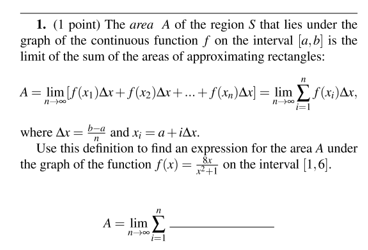
I'm so confused by this question on definition integrals. It's for finding the rectangle approximation problems, like you would find in 5.1 [https://openstax.org/books/calculus-volume-1/pages/5-1-approximating-areas]
But what the fuck man, I come up with insaaaane numbers and it wants some equation form?
https://i.imgur.com/ICZJMEs.png - this isn't a homework question just practice.
I'm looking at my notes and the textbook and I don't see /anything/ remotely similar on generating an expression for A=
 pearl pondBOT
heady vault
I'm so confused by this question on definition integrals. It's for finding the r...
heady vault
pearl pondBOT
heady vault
I'm so confused by this question on definition integrals. It's for finding the r...
heady vault
is it just asking for like integral lower bound 1, upper bound 6 f(x)dx?
 rancid depot
it is asking for the sum version
 full relic
heady vault
is it just asking for like integral lower bound 1, upper bound 6 f(x)dx?
full relic
heady vault
is it just asking for like integral lower bound 1, upper bound 6 f(x)dx?
Yes
full relic
It’s riemann integration
 sharp vigil
it gives you an explicit formula for both $x_i$ and $\Delta x$, which you can simply plug into the given definition
full relic
heady vault
f(xi)dx
Yeah
jolly parrotBOT
cloud
 heady vault
why would it ask me for something that has the answer higher up though
sharp vigil
note that it does want you to calculate this as the limit of the sum, not using the fundamental theorem of calculus
heady vault
interesting
sharp vigil
so you'll have to plug in f, x_i, Delta x, and find the limit
full relic
But it’s still just an integral
sharp vigil
you compute the sum as a function of n and then take the limit as n approaches infinity
that's what the definition says
heady vault
This is actually needlessly complicated, if b-a/n is just 5/n
xi is just 1+ (1 through 6) times 5/n
Then you have to plug in n, n(n+1)/2, up to 6....
sharp vigil
i is an index variable which varies between 1 and n (in the sum)
heady vault
right but it's between 1 and 6 because of the interval
sharp vigil
i is the index of a particular rectangle, so its range (1 to n) depends on the number of rectangles (n), not the length of the interval
broad overview of your steps:
- calculate the expression in the sum as a function of i and n
- sum that expression with i ranging from 1 to n
- take the limit as n approaches infinity
heady vault
yeah I'm completely lost none of this is making any sense
the textbook doesn't match what it's asking
my notes are about an example of x+x^2+x^3 which just translates into pure numbers not an expression
it's not (5/n)(1+i/(5/n)) so I don't see what I'm doing wrong
delta is is 5/n, a is 1
sharp vigil

In this video, I showed how evaluate a definite integral using the Riemann Sum Definition
sharp vigil
heady vault
it's not (5/n)(1+i/(5/n)) so I don't see what I'm doing wrong
that nearly correct for $\Delta x \cdot x_i$, but what they are looking for is not that but $f(x_i) \cdot \Delta x$
jolly parrotBOT
cloud
 sharp vigil
looking at the question more closely i don't think you actually have to evaluate the sum/limit, but you do need to write it out correctly
so here is an example just focusing on writing the sum itself: https://youtube.com/watch?v=eidemLqiPyQ
Courses on Khan Academy are always 100% free. Start practicing—and saving your progress—now: https://www.khanacademy.org/math/ap-calculus-ab/ab-integration-new/ab-6-3/v/rewriting-definite-integral-as-limit-of-riemann-sum
Given a definite integral expression, we can write the corresponding limit of a Riemann sum with infinite rectangles.
P...
heady vault
yeah it's just not computing in my head how to go through it
I'll get it but this example was not explained at all in class
sharp vigil
you have all of the information you need in the problem image, it's just a matter of applying it
heady vault
yeah that first video helped a lot I think, if this is the right way
but wtf how does a fraction change it because he's taking merely addition
like it's i^2 + i + 1 at the end, whereas mine is i/i^2+i+1
i's cancel out?
sharp vigil
well the placement of i is based on where x was
for this problem they only ask for "an expression" so i think you can just write out the sum without evaluating it
heady vault
Got the submission wrong so working through new one
This shit is fucking aids tiny annoying steps
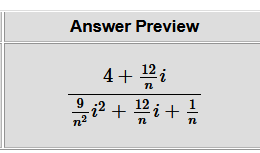
that's wrong apparently
even following the videos steps it's not right lol
sharp vigil
what function and region are you trying to compute for?
heady vault
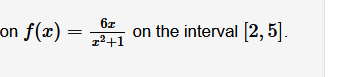
So I'm starting with 6(2+(3/n)i) on the top, then on the bottom I'm getting (9/n^2)i^2 + (12/n)i + 4
heady vault
so +5?
 fickle schooner
Yh
heady vault
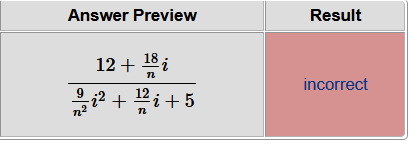
I don't get this
at all
let me try cnacelling out the (/n)i
nope
what in the fuck is this question even asking me man
sharp vigil
webwork generally doesn't require you to simplify your answers
heady vault
oh
I forgot to multiply by 3/n
that was the most aids question I've done all year
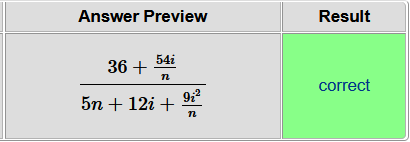
so you take x subscript i to substitute for X, map it out algebraically then multiply that by delta x
pearl pondBOT
@heady vault Has your question been resolved?
Channel closed
Closed by @heady vault
Use .reopen if this was a mistake.
Available help channel!
Send your question here to claim the channel.
Remember:
• Ask your math question in a clear, concise manner.
• Show your work, and if possible, explain where you are stuck.
• After 15 minutes, feel free to ping <@&286206848099549185>.
• Type the command .close to free the channel when you're done.
• Be polite and have a nice day!
Read #❓how-to-get-help for further information on how to ask a good question, and about conduct in the question channels.
 frosty grail
I am learning how to find the derivative of exponential functions
For this example,
y = 2^x + 3^x
pearl pondBOT
frosty grail
I am learning how to find the derivative of exponential functions
For this examp...
frosty grail
The final answer in the answer key is (2^x)(ln2) + (3^x)(ln3)
Is this really how far you can go with it?
jolly parrotBOT
Bonk
 frosty grail
 open rivet
yup
open rivet
yup
Ok, thanks so much!
I have another question
So for f(x) = 3e^2x - 2^3x,
I got 6e^2x - (2^3x)(ln2)(3)
Can I multiply the 3 and the 2^3x?
So I would get 6e^2x - (6^3x)(ln2)
?
open rivet
no
frosty grail
Why not?
frosty grail
I thought that would matter when you are collecting light terms through addition or subtraction.
Oh
open rivet
if i do 3 * 2^3 i get 3 * 2 * 2 * 2 which is not equal to 6 * 6 * 6 which is 6^3
frosty grail
I see, that makes sense
So it changes the exponents
It would lose its original meaning
Ok thank you
open rivet
if you had 3^3 * 2^3, then you can make it 6^3
frosty grail
So if the exponents are the same, then you can multiply them?
open rivet
yes
and you can see this once again when you expand them
$3^3=3\cdot 3\cdot 3\2^3=2\cdot 2\cdot 2\3^3\cdot 2^3=3\cdot 3\cdot 3\cdot 2\cdot 2\cdot 2=(3\cdot 2)\cdot (3\cdot 2)\cdot(3\cdot 2)\=6\cdot6\cdot6=6^3$
jolly parrotBOT
Bonk
 frosty grail
I see!
But if we had something like 3^2 and 2^3, then it wouldn't work, right?
3 * 3 * 2 * 2 * 2 = 72
And then if you somehow multiply them together, I'm not even sure how that would work out cuz you can't do it
Ok thank you so much, I get it now
 edgy wren
frosty grail
But if we had something like 3^2 and 2^3, then it wouldn't work, right?
3 * 3 *...
edgy wren
frosty grail
But if we had something like 3^2 and 2^3, then it wouldn't work, right?
3 * 3 *...
you could rewrite it as 3^2 * 2^2 2 and then
(32)^2 (2)
open rivet
frosty grail
But if we had something like 3^2 and 2^3, then it wouldn't work, right?
3 * 3 *...
indeed, but what you can do is something like 3^2 = 3^3/3 => 3^2 * 2^3=(6^3)/3
frosty grail
edgy wren
you could rewrite it as 3^2 * 2^2 *2 and then
(3*2)^2 (2)
Oh wait that's right
OHH you guys are right
So you're saying I would have 2^2 * 3^2 = 6^2
then just have the other 2 multiplied alone?
So like 6^2 * 2
frosty grail
open rivet
indeed, but what you *can* do is something like 3^2 = 3^3/3 => 3^2 * 2^3=(6^3)/3
Wait I am having a bit of trouble reading that math, is it okay if you can do it on that math drawing thing
edgy wren
$3^2=\frac{3^3}{3}, \frac{(3\cdot2)^3}{3}$
jolly parrotBOT
yoboiqimmah
 open rivet
frosty grail
Wait I am having a bit of trouble reading that math, is it okay if you can do it...
open rivet
frosty grail
Wait I am having a bit of trouble reading that math, is it okay if you can do it...
\begin{align*}&3^2=\frac{3^3}3\&3^2\cdot 2^3=\frac{3^3}3\cdot2^3=\frac{6^3}3\end{align*}
jolly parrotBOT
Bonk
 open rivet
clearer?
frosty grail
Yes, that's much better! But I don't understand what the second line is trying to do. I don't understand what 6^3/3 is supposed to mean or do
open rivet
idk either
just a different way of writing it
doesnt necessarily need to have a use
what does have a use is being able to recognise that you can rewrite it
frosty grail
Mmm
So what is 6^3/3 supposed to represent
I get the first line, with the rewriting of 3^2
open rivet
since perhaps you get an exercise where having it has 6^3/3 is more useful than 3^2*2^3
open rivet
frosty grail
So what is 6^3/3 supposed to represent
,calc 6^3/3
jolly parrotBOT
Result:
72
Oh, I see
3^2 * 2^3 isn't specific to my original question, you were showing how that expression can be rewritten
That makes sense now, quite new too
open rivet
frosty grail
3^2 * 2^3 isn't specific to my original question, you were showing how that expr...
yeah
and being able to rewrite equations is a very useful skill to have
frosty grail
open rivet
and being able to rewrite equations is a very useful skill to have
That's really true
I can't tell you how many times I am doing math problems and I look at the way someone solved it and I'm like, "that's possible to do??"
It feels like illegal math but somehow you can do it
Very cool
 fossil jewel
frosty grail
That's really true
I can't tell you how many times I am doing math problems and ...
fossil jewel
frosty grail
That's really true
I can't tell you how many times I am doing math problems and ...
lol youll have this feeling for the rest of your mathematical career
stronger year by year if anything haha
frosty grail
LMAO
open rivet
true
frosty grail
Do you guys happen to know if it is possible to save a PDF of my convos here so I can refer back to them
Is that possible?
Aside from taking screenshots
open rivet
this works as long as the messages dont get deleted
frosty grail
Do these channels get deleted or do they keep getting recycled
I saw some ones got wiped
frosty grail
Alright good to know, thanks so much for your help
open rivet
!done
pearl pondBOT
If you are done with this channel, please mark your problem as solved by typing .close
@frosty grail Has your question been resolved?
Channel closed
Closed by @frosty grail
Use .reopen if this was a mistake.
Available help channel!
Send your question here to claim the channel.
Remember:
• Ask your math question in a clear, concise manner.
• Show your work, and if possible, explain where you are stuck.
• After 15 minutes, feel free to ping <@&286206848099549185>.
• Type the command .close to free the channel when you're done.
• Be polite and have a nice day!
Read #❓how-to-get-help for further information on how to ask a good question, and about conduct in the question channels.
Channel closed
Closed by @tiny jay
Use .reopen if this was a mistake.
pearl pondBOT
Available help channel!
Send your question here to claim the channel.
Remember:
• Ask your math question in a clear, concise manner.
• Show your work, and if possible, explain where you are stuck.
• After 15 minutes, feel free to ping <@&286206848099549185>.
• Type the command .close to free the channel when you're done.
• Be polite and have a nice day!
Read #❓how-to-get-help for further information on how to ask a good question, and about conduct in the question channels.
 storm verge
hello
pearl pondBOT
storm verge
hello
storm verge
Find all odd positive integers
n > 1 such that if a and b are relatively prime divisors of n, then a + b − 1 divides n.
.close
pearl pondBOT
Channel closed
Closed by @storm verge
Use .reopen if this was a mistake.
Available help channel!
Send your question here to claim the channel.
Remember:
• Ask your math question in a clear, concise manner.
• Show your work, and if possible, explain where you are stuck.
• After 15 minutes, feel free to ping <@&286206848099549185>.
• Type the command .close to free the channel when you're done.
• Be polite and have a nice day!
Read #❓how-to-get-help for further information on how to ask a good question, and about conduct in the question channels.
 umbral lodge
How can a slope be equal to 0 in a linear equation graphed if Ax + By = C, so By = C - Ax, so, if A, B, C are constants, C - Ax_1 must be different of C - Ax_2 ?
pearl pondBOT
umbral lodge
How can a slope be equal to 0 in a linear equation graphed if Ax + By = C, so By...
umbral lodge
If x_1 isn't equal x_2
 thick raven
What is the slope of the line graphed by Ax + By = C?
umbral lodge
I probably used the wrong terms, but if you have a graph like this one

It is a linear equation correct
thick raven
Correct
thick raven
Good
What I mean is
In the general case Ax + By = C, what is the slope?
In terms of A, B, and C
umbral lodge
The

 placid geyser
umbral lodge
How can a slope be equal to 0 in a linear equation graphed if Ax + By = C, so By...
placid geyser
umbral lodge
How can a slope be equal to 0 in a linear equation graphed if Ax + By = C, so By...
In this case, for the slope to be 0, if x1 ≠ x2,
B(y1-y2) = (C-Ax1) - (C-Ax2)
B(y1-y2) = A(x2-x1)
As slope = (y1-y2)/(x1-x2),
slope = -A/B
A can be 0
Hence, if A is 0, slope is 0
thick raven
Unless A=B=0 in which case it's either the entire 2d plane or none of it
umbral lodge
( y_2 - y_1 ) / ( x_2 - y_2 )
placid geyser
placid geyser
In this case, for the slope to be 0, if x1 ≠ x2,
B(y1-y2) = (C-Ax1) - (C-Ax2)
B(...
??
thick raven
I mean yeah that's basically the answer, much better to let him work it out though than just telling him
But yes it's -A/B
placid geyser
I was asking whether he understood that process
placid geyser
thick raven
But in terms of A, B, and C?
I thought samuel asked this thing so I replied with the answer
Then I realised it and deleted it lol
umbral lodge
damn
umbral lodge
placid geyser
In this case, for the slope to be 0, if x1 ≠ x2,
B(y1-y2) = (C-Ax1) - (C-Ax2)
B(...
I don't quite understand this one
placid geyser
Which step?
umbral lodge
Primarily the first one, I knew slope was y2 - y1 / x2 - x1
How does taht work with A B C
umbral lodge
Yes
umbral lodge
don't worry
jolly parrotBOT
Suika
 jolly parrotBOT
Suika
 umbral lodge
ok
placid geyser
$slope=\frac{By_1-By_2}{B(x_1-x_2)}$
jolly parrotBOT
Suika
 placid geyser
$slope=\frac{(C-Ax_1)-(C-Ax_2)}{B(x_1-x_2)}$
jolly parrotBOT
Suika
 placid geyser
$slope=\frac{(C-C-Ax_1 + Ax_2)}{B(x_1-x_2)}$
jolly parrotBOT
Suika
 placid geyser
$slope=\frac{(Ax_2 - Ax_1)}{B(x_1-x_2)}$
jolly parrotBOT
Suika
 placid geyser
$slope=\frac{-A(x_1 - Ax_2)}{B(x_1-x_2)}$
jolly parrotBOT
Suika
 placid geyser
$slope=-\frac{A}{B}$
jolly parrotBOT
Suika
 placid geyser
So, if A = 0, it's possible that the slope is 0
umbral lodge
placid geyser
$slope=\frac{-A(x_1 - Ax_2)}{B(x_1-x_2)}$
Wait
Wouldn't it be $slope=\frac{A(x_2 - x_1)}{B(x_1-x_2)}$
jolly parrotBOT
samuel
 umbral lodge
jolly parrot
**Suika**
umbral lodge
jolly parrot
**Suika**
So here you use $slope=\frac{B(y_2-y_1)}{B(x_2-x_1)}$
jolly parrotBOT
samuel
 umbral lodge
Does that make sense?
placid geyser
Yes
umbral lodge
Awesome
placid geyser
umbral lodge
Wouldn't it be $slope=\frac{A(x_2 - x_1)}{B(x_1-x_2)}$
It is that
I just switched the x1 and x2 and put a minus there
umbral lodge
I understand nwo
So I could simply say that C - Ax_1 is equal to C - Ax_2 if A is 0
That was pretty simple
lol
thanks a lot Suika and depression
.close
pearl pondBOT
Channel closed
Closed by @umbral lodge
Use .reopen if this was a mistake.
umbral lodge
indeed, but it is their name 
placid geyser
Yea lol
pearl pondBOT
Available help channel!
Send your question here to claim the channel.
Remember:
• Ask your math question in a clear, concise manner.
• Show your work, and if possible, explain where you are stuck.
• After 15 minutes, feel free to ping <@&286206848099549185>.
• Type the command .close to free the channel when you're done.
• Be polite and have a nice day!
Read #❓how-to-get-help for further information on how to ask a good question, and about conduct in the question channels.
 cosmic saffron
Assume there is an interger number of a very large digits (it is unknown how large the number is).
We will call this X.
Then there is also Y, which are an interger number from number 1 to 99.
Assuming X and Y always positive {X > 0; Y > 0}
F = X - Floor(X/Y) * Y
F will only result in interger number of 0 to 10.
is that statement true?
pearl pondBOT
cosmic saffron
Assume there is an interger number of a very large digits (it is unknown how lar...
thick raven
Try it with Y=99000000000000000 and X = 99
thick raven
Yeah sorry I meant the other way round
cosmic saffron
cosmic saffron
Assume there is an interger number of a very large digits (it is unknown how lar...
there fixed
it should be
F = X - Floor(X/Y) * Y
i only changed that ^
placid geyser
cosmic saffron
Assume there is an interger number of a very large digits (it is unknown how lar...
I think it's 0 to 99 instead
Not 0 to 10
 odd surge
yeah
cosmic saffron
how do you achieve 99?
odd surge
wait hold up
cosmic saffron
no, that is 9
pearl pondBOT
@cosmic saffron Has your question been resolved?
Channel closed
Closed by @cosmic saffron
Use .reopen if this was a mistake.
pearl pondBOT
Available help channel!
Send your question here to claim the channel.
Remember:
• Ask your math question in a clear, concise manner.
• Show your work, and if possible, explain where you are stuck.
• After 15 minutes, feel free to ping <@&286206848099549185>.
• Type the command .close to free the channel when you're done.
• Be polite and have a nice day!
Read #❓how-to-get-help for further information on how to ask a good question, and about conduct in the question channels.
 sharp smelt
\bf{Prove that every convergent sequence is bounded}
\
It follows by definition, If a sequence converges to $L$, that $\forall \varpesilon >0, \exists N \in \N$, such that if $n \geq N$, then $\abs{a_n-L}< \varepsilon$.
\
If a sequence is bounded, by say, $M$, then $\abs{a_n} \leq M; \forall n \in \N$
\
\t proof: By the reverse triangle inequality, it follows that $\abs{a_n} -\abs{L} < \abs{ \varpesilon}$
\
OR
\
$\abs{a_n} < L + \varepsilon$
pearl pondBOT
sharp smelt
\bf{Prove that every convergent sequence is bounded}
\\
It follows by definitio...
sharp smelt
I'm stuck beyond this
jolly parrotBOT
What a wonderful world !
Compile Error! Click the reaction for more information.
(You may edit your message to recompile.)
 rough stream
Your start is great.
an < L + e. So for all n > N, an is bounded.
sharp smelt
thought tbf, the contrapositive may be easier to prove
sharp smelt
rough stream
Your start is great.
an < L + e. So for all n > N, an is bounded.
yea
but what about n<N
rough stream
There's finitely many. So, there's a maximum element.
There might be a better way to say that haha
sharp smelt
rough stream
There's finitely many. So, there's a maximum element.
I'll have to show that I think
sounds like a modified version of WOP
A set with finitely many elements has a least and greatest element
No idea how I'd prove that though
toxic lichen
this is much simpler
sharp smelt
hmm?
sharp smelt
toxic lichen
this is much simpler
Does this follow from some sort of axiom?
 lilac jackal
you can try proving it by induction later. for now just take it for granted
sharp smelt
Cool, thanks!
sharp smelt
rough stream
Your start is great.
an < L + e. So for all n > N, an is bounded.
Wait, I'm sort of confused here, epsilon can blow up to infty right
so how is it bounded
toxic lichen
epsilon doesnt blow up to shit
you can fix ε = 0.42069
then you get that a tail of your sequence is bounded by |L| + 0.42069
and before the tail you have only a finite number of terms
sharp smelt
toxic lichen
epsilon doesnt blow up to shit
Yeah, but the defn says for a;ll epsilon>0
sharp vigil
if you know it converges already, then you can pick any epsilon you want and be guaranteed an N for it
toxic lichen
for all positive epsilon, and in particular for epsilon=0.42069
sharp smelt
Ah, got it
Thanks
I would like to do another proof now( of the algebric limit theorm) now
More specifically for the product
We wish to show that $\abs{a_nb_n - ab} < \varepsilon$
jolly parrotBOT
What a wonderful world !
 toxic lichen
you want to do it w/ epsilonics directly?
sharp smelt
yea
toxic lichen
cause there's an easier and less crunchy way to do it
rough stream
"epsilonics" I like that
toxic lichen
thats like, more structured by being broken down into a bunch of lemmas
would you like to hear me out on that
sharp smelt
yea
toxic lichen
Definition: A sequence (x_n) is said to be null if lim x_n = 0.
Lemma 1: If a sequence (a_n) converges to a finite limit L, then the sequence (a_n - L) is null.
Lemma 2: If (x_n) is a null sequence and L is a real number, then lim (x_n + L) = L.
Lemma 3: The sum of two null sequences is another null sequence. [That is, if (x_n) and (y_n) are null sequences, then (x_n + y_n) is null too.]
Lemma 4: The product of a null sequence and a bounded sequence is a null sequence. [That is, if (x_n) is a null sequence and (b_n) is a bounded sequence (which actually need not converge!), then (b_n x_n) is null.]
toxic lichen
yes
but all of these lemmas have very easy proofs that you should not overthink.
ok there we go all formatting and typos fixed
once you have all of those lemmas, use your "convergent implies bounded" result to get the product thing:
let $\lim a_n = L$ and $\lim b_n = M$. consider the sequences $a'_n := a_n - L$ and $b'_n := b_n - M$, both of which are null by lemma 1. then write: $$a_nb_n = (L+a'_n)(M+b'_n) = LM + Lb'_n + Ma'_n + a'_nb'_n$$
each term other than the first is a null sequence by lemma 4 and the ``convergent implies bounded'' theorem. by lemma 3, the sequence $(Lb'_n + Ma'_n + a'_nb'_n)$ is null, and so by lemma 2 we get $a_n b_n \to LM$, as desired.
jolly parrotBOT
Ann
 toxic lichen
(note that this proof is quite terse so do not try to skip over lines you don't understand)
sharp smelt
No, it all makes sense to me
toxic lichen
glad it does.
the spirit of what im trying to convey here is that the idea of breaking a big problem down into manageable chunks pays rather big dividends.
at no point did i have to do any heavy epsilon lifting
toxic lichen
(i do acknowledge that a breakdown may not always be obvious, which is why i am sharing mine here)
lilac jackal
another classic divide n conquer is "all polynomials are continuous"
sharp smelt
thanks
toxic lichen
lilac jackal
another classic divide n conquer is "all polynomials are continuous"
there's another one in probability theory: E[XY] = E[X]E[Y] for X, Y indep
 inland ivy
toxic lichen
there's another one in probability theory: E[XY] = E[X]E[Y] for X, Y indep
inland ivy
toxic lichen
there's another one in probability theory: E[XY] = E[X]E[Y] for X, Y indep
is that not how independent events are defined?
toxic lichen
RVs not events
toxic lichen
no it's not
lilac jackal
its a theorem not a def
toxic lichen
the definition of two RVs X and Y being independent is that for any borel-measurable sets A, B ⊆ R the events {X ∈ A} and {Y ∈ B} are independent-as-events
or to put this in a less formal way
to say X and Y are independent is to say that any event having to do with just X is independent of any event having to do with just Y
inland ivy
ahh okay that makes sense
sharp smelt
I want to prove something quite simple now
if $a_n \geq 0 \forall n \in \N$, then $a \geq 0$, where $lim(a_n)=a$
lilac jackal
u didnt define a
sharp smelt
oops
jolly parrotBOT
What a wonderful world !
 lilac jackal
a drawing may help
jolly parrotBOT
What a wonderful world !
 sharp smelt
I let $\varepsilon = \abs{a}$
jolly parrotBOT
What a wonderful world !
 lilac jackal
bad use of reverse triangle but ok choice of e
sharp smelt
lilac jackal
bad use of reverse triangle but ok choice of e
yea, my bad
$\abs{a_n - a} < \varepsilon$
This means $a_n<0$, which isn't possible
jolly parrotBOT
What a wonderful world !
 lilac jackal
exactly how do u get a_n<0
jolly parrotBOT
What a wonderful world !
 sharp smelt
so $\abs{a_n - a} < \abs{a}$
jolly parrotBOT
What a wonderful world !
 sharp smelt
lilac jackal
exactly how do u get a_n<0
sharp smelt
lilac jackal
exactly how do u get a_n<0
if $a_n>0$, then $\abs{a_n-a} > \abs{a}$
jolly parrotBOT
What a wonderful world !
 lilac jackal
thats not clear
sharp smelt
hmm
 sharp smelt
so $\abs{a_n-a}<\abs{a}$
a_n^2+a^2-2aa_n<a^2 \implies $a_n(a_n-2a)<0$. So $a_n<2a$ and $a_n<0$
jolly parrotBOT
What a wonderful world !
Compile Error! Click the reaction for more information.
(You may edit your message to recompile.)
 lilac jackal
that looks complicated and probably wrong
yeah i dont believe the last step
redo n think simpler
sharp smelt
I mean one way is $a_n-a<-a$
jolly parrotBOT
What a wonderful world !
 lilac jackal
np!
sharp smelt
.close
pearl pondBOT
Channel closed
Closed by @sharp smelt
Use .reopen if this was a mistake.
pearl pondBOT
Available help channel!
Send your question here to claim the channel.
Remember:
• Ask your math question in a clear, concise manner.
• Show your work, and if possible, explain where you are stuck.
• After 15 minutes, feel free to ping <@&286206848099549185>.
• Type the command .close to free the channel when you're done.
• Be polite and have a nice day!
Read #❓how-to-get-help for further information on how to ask a good question, and about conduct in the question channels.
 midnight haven
 pearl pondBOT
midnight haven
midnight haven
pearl pondBOT
midnight haven
midnight haven
to find the other roots
what i did
is i found the conjugate
and multiplied it with the normal thingy
then divided the answer of multiplication with the original equation
is this correct?
fickle schooner
Yep
 compact ridge
midnight haven
and multiplied it with the normal thingy
compact ridge
midnight haven
and multiplied it with the normal thingy
after this step you should get x^2 + 2x + 3
midnight haven
where did he get that from
compact ridge
yeah then you just divide the quartic by x^2 + 2x + 3
fickle schooner
Is that not what you did?
midnight haven
midnight haven
this is not my work
im confused on where x- (-1 +square root of 2) came from
where did x- come from
compact ridge
midnight haven
where did x- come from
if $r$ is a root of a polynomial, then $x - r$ is a linear factor
jolly parrotBOT
south
 compact ridge
say if 3, 5 were the roots of a quadratic
the quadratic would be y = a * (x - 3)(x - 5)
a being some real number: this is the root form of a quadratic
fickle schooner
You can decompose a polynomial into a product of its linear factors
Yh
Wait, that's a tautology
 fickle schooner
In south's example
If you had a quadratic $x^2 + 5x + 6$ and decided to factorize it: you get $(x + 3)(x + 2)$
jolly parrotBOT
StrangeQuarkAL
 midnight haven
right
jolly parrotBOT
StrangeQuarkAL
 fickle schooner
See how I've decomposed the quadratic as a product of linear factors?
midnight haven
yea
fickle schooner
Same thing here
$P(x) = x^4 + ...$
It is a quartic so it has 4 roots
$P(x) = (x - a)(x - b)(x - c)(x - d)$
jolly parrotBOT
StrangeQuarkAL
 fickle schooner
where a, b, c and d are the roots
midnight haven
i dont really understand but since my exam is tomorrow should i just do x-(z) * x-(z conjugate) to any similar questions?
fickle schooner
Technically yes but it's important to understand this and it's a little nuanced than that
Lemme at least finish my explanation
midnight haven
alright sure
fickle schooner
jolly parrot
**StrangeQuarkAL**
Do you agree that the quartic (4th degree polynomial) has 4 (not necessarily distinct) roots?
midnight haven
fickle schooner
Do you agree that the quartic (4th degree polynomial) has 4 (not necessarily dis...
yea
fickle schooner
Alright
pearl pondBOT
Channel closed
Closed by @mint glade
Use .reopen if this was a mistake.
fickle schooner
Epic
pearl pondBOT
Available help channel!
Send your question here to claim the channel.
Remember:
• Ask your math question in a clear, concise manner.
• Show your work, and if possible, explain where you are stuck.
• After 15 minutes, feel free to ping <@&286206848099549185>.
• Type the command .close to free the channel when you're done.
• Be polite and have a nice day!
Read #❓how-to-get-help for further information on how to ask a good question, and about conduct in the question channels.
 lucid moth
 pearl pondBOT
lucid moth
pearl pondBOT
lucid moth
 compact ridge
the slope m = tan(theta)
lucid moth
Doesnt the fact that its a point of inflection tell us that the slope is just -1?
lucid moth
compact ridge
the slope m = tan(theta)
Hi south ❤️
compact ridge
lucid moth
Doesnt the fact that its a point of inflection tell us that the slope is just -1...
nope
lucid moth
compact ridge
nope
But the slope is changing from negative to positive no?
I mean the slope of the point of inflection
 spare lark
lucid moth
Doesnt the fact that its a point of inflection tell us that the slope is just -1...
spare lark
lucid moth
Doesnt the fact that its a point of inflection tell us that the slope is just -1...
You can have an inflexion point with an always positive slope (x³)
lucid moth
spare lark
You can have an inflexion point with an always positive slope (x³)
Yeah when its changing from concave up to concave down, right?
lucid moth
We can see an example in this graph
compact ridge
lucid moth
But the slope is changing from negative to positive no?
hopefully you get the idea

and the slope can be positive too at a point of inflection
lucid moth
 compact ridge
yeah the slope can be anything, including 0
spare lark
lucid moth
For example
compact ridge
(think of y = x^3 for the slope being 0)
lucid moth
compact ridge
hopefully you get the idea
Hmm ok I see your point
lucid moth
spare lark
You can make a sign chart of your second derivative and see where it change sign
Whats that? I havent heard of a sign chart before
spare lark
Didn't see you was at (d)

 lucid moth
spare lark
lucid moth
spare lark
Hmm I dont think ive covered that yet
spare lark
We do it way before second derivative and all this stuff kekw
For solving inequality mostly
lucid moth
compact ridge
so for the tangent line
Ok so to solve I just take f'(pi/8) then add 45 degrees? (because its the y axis instead of x axis, right?
compact ridge
nope
 lucid moth
spare lark
We do it way before second derivative and all this stuff kekw
lucid moth
spare lark
We do it way before second derivative and all this stuff kekw
Ahh im self studying so I might have missed some stuff hehe
spare lark
Ic
compact ridge
lucid moth
Ok so to solve I just take f'(pi/8) then add 45 degrees? (because its the y axis...
that's dimensionally incorrect
f'(pi/8) is not an angle
a slope is not an angle
lucid moth
compact ridge
that's dimensionally incorrect
Ah sry I mean we put the answer into arctan
Then add 45 degrees
compact ridge
lucid moth
Ah sry I mean we put the answer into arctan
good so far
lucid moth
But I guess thats wrong too
compact ridge
lucid moth
Then add 45 degrees
this is wrong
just look at the diagram
also just to make sure we're on the same page, you want the angle between the tangnet line and the y-axis
lucid moth
Ah so we take our answer from the arctan away from 180 degrees?
compact ridge
lucid moth
Ah so we take our answer from the arctan away from 180 degrees?
nope
so arctan(-2) is negative right?
compact ridge
okay what's the green angle then?
 lucid moth
Is -2 the slope?
compact ridge
lucid moth
Is -2 the slope?
yes
lucid moth
I thought that arctan(-2) would give us this angle
 compact ridge
lucid moth
I thought that arctan(-2) would give us this angle
compact ridge
lucid moth
I thought that arctan(-2) would give us this angle
nope, that purple angle is not negative
lucid moth
The angle between the x axis and the slope
compact ridge
arctan always returns an angle in either the 1st or the 4th quadrants
lucid moth
Ok good rule im adding that to my notes haha
compact ridge
yes pls, it's super important
intuitively you can see that that obtuse angle can't possibly be 63 deg
lucid moth
And we know whether its the 1st or 4th by its sign right?
compact ridge
lucid moth
And we know whether its the 1st or 4th by its sign right?
yes
compact ridge
lucid moth
So its 90 degrees takeaway arctan(-2), right?
nearly
cause arctan(-2) is negative, we need to negate it to make the angle positive again
lucid moth
Ahh yeye
lucid moth
Okkkk
I understand now
Which is 90 - 63 = 26 degrees
27, whatever 😝

I get the method thats the most important hehe
Thank you everyone!
❤️
.close
pearl pondBOT
Channel closed
Closed by @lucid moth
Use .reopen if this was a mistake.
Available help channel!
Send your question here to claim the channel.
Remember:
• Ask your math question in a clear, concise manner.
• Show your work, and if possible, explain where you are stuck.
• After 15 minutes, feel free to ping <@&286206848099549185>.
• Type the command .close to free the channel when you're done.
• Be polite and have a nice day!
Read #❓how-to-get-help for further information on how to ask a good question, and about conduct in the question channels.
 naive dirge
You guys
pearl pondBOT
naive dirge
You guys
naive dirge
Better explain
It
Explain why continuous value means I have to encode it with numbers
Or face the wrath of a loyal servant of Mickey Mouse
Choose wisely
toxic lichen
this is quite the combative tone from you
naive dirge
hazy pilot
maybe he explains why in a later part
I hate it, I should be informed of that
 autumn fossil
naive dirge
Explain why continuous value means I have to encode it with numbers
autumn fossil
naive dirge
Explain why continuous value means I have to encode it with numbers
well text isnt very "continous"
firstly, you must always change a whole letter. You cant change 1/2 or 1/10th of a letter
 primal blade
Yeah letters are quantised 😂
autumn fossil
and you will probably want words like "large" and "big" to be close together, because they have similar meanings
im pretty sure that 3b1b makes this point somewhere in the vid
so just keep watching
toxic lichen
autumn fossil
im pretty sure that 3b1b makes this point somewhere in the vid
yes he does.
pearl pondBOT
@naive dirge Has your question been resolved?
pearl pondBOT
Channel closed
Closed due to timeout
Use .reopen if this was a mistake.
Available help channel!
Send your question here to claim the channel.
Remember:
• Ask your math question in a clear, concise manner.
• Show your work, and if possible, explain where you are stuck.
• After 15 minutes, feel free to ping <@&286206848099549185>.
• Type the command .close to free the channel when you're done.
• Be polite and have a nice day!
Read #❓how-to-get-help for further information on how to ask a good question, and about conduct in the question channels.
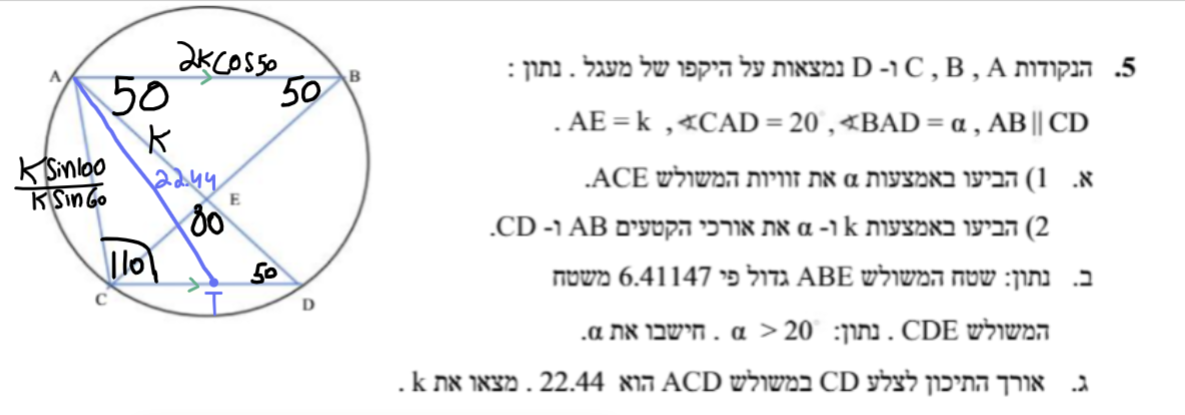
 brazen swift
 pearl pondBOT
brazen swift
https://i.imgur.com/ESpyL08.png
brazen swift
pearl pondBOT
brazen swift
https://i.imgur.com/ESpyL08.png
brazen swift
C.) The length of the median to side CD in Triangle ACD is 22.44 . find k
 languid goblet
we would appreciate if its english
brazen swift
took me a bit to type
 dapper kraken
could you translate it?
pearl pondBOT
@brazen swift Has your question been resolved?
brazen swift
dapper kraken
could you translate it?
Sure, i just translated whatever i thought was necessary
but sure ill translate all of it
Points A , B , C , D are on the Parameter of a circle. Given:
AB || CD , <Bad = α , <CAD = 20 , AE = k
A. 1) Express using α the angles of triangle ACE
2) Express with k and α the length of sides CD & AB
B) Given: Surface of triangle ABE is 6.41147 times bigger than the Surface of triangle CDE. Given: α >20 , calculate α .
**C.) The length of the median to side CD in Triangle ACD is 22.44 . find k **
I'm stuck on C)

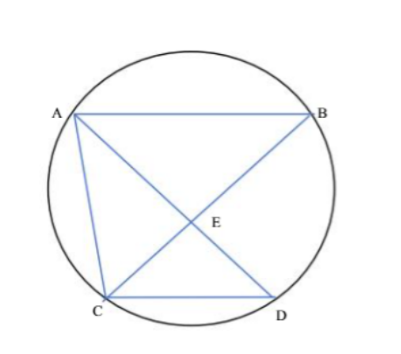 brazen swift
https://i.imgur.com/ESpyL08.png
brazen swift
brazen swift
https://i.imgur.com/ESpyL08.png
sketch with everything that's given^
pearl pondBOT
@brazen swift Has your question been resolved?
brazen swift
<@&286206848099549185>
dapper kraken
oh wait sorry i forgot about this
dapper kraken
brazen swift
Points A , B , C , D are on the Parameter of a circle. Given:
AB || CD , <Bad = ...
what did you get for B?
dapper kraken
brazen swift
https://i.imgur.com/ESpyL08.png
ok i think the idea is with B and law of sines, you can find the ratio of AC and CD, and you know AC^2+(CD/2)^2-AC×CD×cos(110)=22.44^2, so you can combine them to get a value of AC and CD, then you can use law of cosines to find AD
(hopefully you can ise a calculator for this)
brazen swift
yeah i can
pearl pondBOT
@brazen swift Has your question been resolved?
pearl pondBOT
Channel closed
Closed by @brazen swift
Use .reopen if this was a mistake.
Available help channel!
Send your question here to claim the channel.
Remember:
• Ask your math question in a clear, concise manner.
• Show your work, and if possible, explain where you are stuck.
• After 15 minutes, feel free to ping <@&286206848099549185>.
• Type the command .close to free the channel when you're done.
• Be polite and have a nice day!
Read #❓how-to-get-help for further information on how to ask a good question, and about conduct in the question channels.
 jolly geyser
how did they also get 129?
 pearl pondBOT
jolly geyser
how did they also get 129?
pearl pondBOT
jolly geyser
how did they also get 129?
 snow sail
jolly parrotBOT
snow sail
jolly parrotBOT
Result:
129
 cobalt hinge
jolly geyser
how did they also get 129?
cobalt hinge
jolly geyser
how did they also get 129?
Yeah, sin(180-x)=sin(x), just to let you know.
pearl pondBOT
@jolly geyser Has your question been resolved?
Channel closed
Closed by @jolly geyser
Use .reopen if this was a mistake.
Available help channel!
Send your question here to claim the channel.
Remember:
• Ask your math question in a clear, concise manner.
• Show your work, and if possible, explain where you are stuck.
• After 15 minutes, feel free to ping <@&286206848099549185>.
• Type the command .close to free the channel when you're done.
• Be polite and have a nice day!
Read #❓how-to-get-help for further information on how to ask a good question, and about conduct in the question channels.
 pallid kestrel
Wait guys so in trigonometry 1 is sinx square plus cosx square but what is -1 is it (1.-1) so [(-1).(sin2 + cos2)] sorry for the simple question I'm going over trigonometry again
pearl pondBOT
pallid kestrel
Wait guys so in trigonometry 1 is sinx square plus cosx square but what is -1 is...
autumn fossil
pallid kestrel
Wait guys so in trigonometry 1 is sinx square plus cosx square but what is -1 is...
yes, you could write -1 = - sin^2(x) - cos^2(x)
pallid kestrel
autumn fossil
yes, you could write -1 = - sin^2(x) - cos^2(x)
Oh it's that simple?
Thanks alot 😃
autumn fossil
pallid kestrel
Oh it's that simple?
Yes, 1 = sin^2(x) + cos^2(x) and if you multiply both sides by -1, it's still valid
if you multiplied it by 2, it would still be valid
2 = 2sin^2(x) + 2cos^2(x)
if you added -2 to both sides, it would again be valid
pallid kestrel
Oh yeah
autumn fossil
-1 = sin^2(x) + cos^2(x) - 2
autumn fossil
pallid kestrel
-2?
Just arbitrary example
the point is that you can do almost anything to both sides and it will remain valid
autumn fossil
you too :)
pallid kestrel
.close
pearl pondBOT
Channel closed
Closed by @pallid kestrel
Use .reopen if this was a mistake.
pearl pondBOT
Available help channel!
Send your question here to claim the channel.
Remember:
• Ask your math question in a clear, concise manner.
• Show your work, and if possible, explain where you are stuck.
• After 15 minutes, feel free to ping <@&286206848099549185>.
• Type the command .close to free the channel when you're done.
• Be polite and have a nice day!
Read #❓how-to-get-help for further information on how to ask a good question, and about conduct in the question channels.
 next forum
hey guys, i ran this through a calculator, i multiplied each anser choice by the denominators conjugate on top and bottom and didnt get anything. do i multiply the tops conjugate by the top, and the bottom's conjugate by the bottom or is there smth im missing?
 pearl pondBOT
next forum
hey guys, i ran this through a calculator, i multiplied each anser choice by the...
next forum
pearl pondBOT
next forum
hey guys, i ran this through a calculator, i multiplied each anser choice by the...
next forum
please ping me if you respond :3
 terse tartan
Have you rationalised the denominator?
 hazy crypt
i multiplied each anser choice by the denominators conjugate on top and bottom and didnt get anything.
do this to the original expression instead of each of the answer choices
autumn fossil
next forum
hey guys, i ran this through a calculator, i multiplied each anser choice by the...
Can you show your work with the conjugation?
oh, yeah, you gotta do it to the original expression
hazy crypt
@next forum
terse tartan
It's (2sqrtx +3)×(sqrtx)/4x-9
next forum
autumn fossil
oh, yeah, you gotta do it to the original expression
oh then i didnt do that
 celest cedar
terse tartan
It's (2sqrtx +3)×(sqrtx)/4x-9
celest cedar
terse tartan
It's (2sqrtx +3)×(sqrtx)/4x-9
Don't give him answer, but lead him
next forum
so my ork is pretty irrelevent
next forum
terse tartan
It's (2sqrtx +3)×(sqrtx)/4x-9
Delete this please
next forum
autumn fossil
Can you show your work with the conjugation?
i can sho you but i kno its rong no
sorry about my keys messing uo
celest cedar
$(a + b) \cdot (a - b) = a^2 - b^2$
jolly parrotBOT
SLANDER
 celest cedar
When you divide by a number, multiply by itself.
next forum
i think i may actually have a better lead elsehere
thank you for hel;ing me out as much as you did though
have a good day guyss!
.close
pearl pondBOT
Channel closed
Closed by @next forum
Use .reopen if this was a mistake.
cobalt hinge
terse tartan
It's (2sqrtx +3)×(sqrtx)/4x-9
!nosols btw
pearl pondBOT
terse tartan
It's (2sqrtx +3)×(sqrtx)/4x-9
As a helper, please do not give out answers that could be copied as a homework solution. Have the student work through the problem themselves and guide them along the way.
Available help channel!
Send your question here to claim the channel.
Remember:
• Ask your math question in a clear, concise manner.
• Show your work, and if possible, explain where you are stuck.
• After 15 minutes, feel free to ping <@&286206848099549185>.
• Type the command .close to free the channel when you're done.
• Be polite and have a nice day!
Read #❓how-to-get-help for further information on how to ask a good question, and about conduct in the question channels.
 iron karma
question is to find the maclaurin series - how on earth is this right? isn't f(0) undefined?
 pearl pondBOT
iron karma
question is to find the maclaurin series - how on earth is this right? isn't f(0...
pearl pondBOT
iron karma
question is to find the maclaurin series - how on earth is this right? isn't f(0...
 west sapphire
presumably they're filling in the gap at x=0 by setting f(0) = log(1) = 0
iron karma
i mean i guess but let's say they didn't do that, would the expansion exist?
west sapphire
no, you have to have f and its derivatives defined at x=0 in order to define the maclaurin series
 dawn dirge
It is undefined but we know that $$ \lim_{n \to \infty} \frac{\sin x}{x} = 1$$, and since $\log$ is continuous, the limit of $f$ as $x \to 0$ is $\log 1 = 0$
jolly parrotBOT
elliot
 dawn dirge
Sorry should say $x \to 0$ in the limit
jolly parrotBOT
elliot
 iron karma
right yeah, thats why f(0)=0 is a good like 'fix' to fix the discontinuity
but then when trying to find f' f'' etc given f(0)=0 let's assume (as this isn't in the question), the same thing ends up happening again and again
where the derivative DNE but you can find some sort of 'this would make sense as a fix' value
west sapphire
yep you're gonna have to do more work to show that the values given by the coefficients are consistent with the derivatives of f (with the gap at x=0 plugged in)
dawn dirge
It’s not even a ‘fix’ really, it’s just the limit as x approaches 0, but you can think about it that way. You will just have to figure out the derivative as normal and figure out what happens near 0 in the limit, similar to above
That’s when you can use e.g. L’Hôpital’s rule
iron karma
dawn dirge
It’s not even a ‘fix’ really, it’s just the limit as x approaches 0, but you can...
slightly confused as what you mean by it's not a 'fix', i think i meant that in the way that the expansion DNE unless we define f(0) as the limit as x->0 of f(x)
am i wrong to say that the expansion DNE without defining f(0) like that? or am i misunderstanding something else
west sapphire
correct, the expansion DNE if f(0) is not defined
clearly f(0) has to be 0 in order to make f continuous
you have to do more work to show that this also makes it differentiable (at least 4 times) in order to verify the formula
pearl pondBOT
@iron karma Has your question been resolved?
Channel closed
Closed by @iron karma
Use .reopen if this was a mistake.
Available help channel!
Send your question here to claim the channel.
Remember:
• Ask your math question in a clear, concise manner.
• Show your work, and if possible, explain where you are stuck.
• After 15 minutes, feel free to ping <@&286206848099549185>.
• Type the command .close to free the channel when you're done.
• Be polite and have a nice day!
Read #❓how-to-get-help for further information on how to ask a good question, and about conduct in the question channels.
 glass jungle
 pearl pondBOT
glass jungle
glass jungle
pearl pondBOT
glass jungle
glass jungle
I don’t know what to multiply the equation by?
celest cedar
What's the question?
glass jungle
Solve for X.
celest cedar
$a^2 - b^2 = (a+b)(a-b)$
jolly parrotBOT
SLANDER
 glass jungle
I need to multiply the equation by a common factor from the denominator but how here?
celest cedar
$a^2 + a = a (a + 1)$
jolly parrotBOT
SLANDER

 untold zephyr
Hint: $x^2$ and $1$ are both squares, so apply the above identity
jolly parrotBOT
Oliver
 untold zephyr
See if you can spot a common denominator then
glass jungle
The left side is (X+/-1) but I don’t know about the right side.
untold zephyr
jolly parrot
**SLANDER**
How does the LHS denominator factorise using this?
celest cedar
Try to find common denominator, and it would be x + 1 because of 7/(x+1)
glass jungle
What about the other right side term?
untold zephyr
Can you factorise that denominator as well?
The 2 coefficiets share a common variable
celest cedar
jolly parrot
**SLANDER**
.
glass jungle
Is it X (X+1)(x-1)?
celest cedar
$x^2 - 1^2 = ?$
jolly parrotBOT
SLANDER
 celest cedar
$x^2 + x = ?$
jolly parrotBOT
SLANDER
 celest cedar
Factorise or simplify these parts
glass jungle
jolly parrot
**SLANDER**
X=1
 glass jungle
(X-1)^2
celest cedar
glass jungle
(X-1)^2
Wrong
glass jungle
jolly parrot
**SLANDER**
X(X+1)
celest cedar
jolly parrot
**SLANDER**
Here is the identity
celest cedar
glass jungle
X(X+1)
Right
glass jungle
And that’s for the second one?
celest cedar
4/(x² + x)
glass jungle
celest cedar
Wrong
How is this wrong for the first one?
jolly parrotBOT
SLANDER
 celest cedar
a = x
and
b = 1
glass jungle
glass jungle
So how would I find the right side?
celest cedar
glass jungle
So how would I find the right side?
What does right side mean?
 glass jungle
The entire thing?
celest cedar
Factorise all denominatores so u can see x + 1, then multiply by it
glass jungle
 celest cedar
$x^2 - 1 = (x + 1) (x - 1)$
jolly parrotBOT
SLANDER
 glass jungle
Why can’t I add an extra X at front to rid the X squares?
celest cedar
U have x² - 1 not x²
When you multiply by a number, you multiply the whole operation.
glass jungle
I’m aware.
celest cedar
Hmm
celest cedar
glass jungle
You can unify the denominator
celest cedar
$\frac{4x + 1}{x^2 - 1} = \frac{7}{x+1} + \frac{4}{x(x+1)}$
jolly parrotBOT
SLANDER
 celest cedar
$\frac{4x + 1}{x^2 - 1} = \frac{7x}{x(x+1)} + \frac{4}{x(x+1)}$
jolly parrotBOT
SLANDER
 celest cedar
jolly parrot
**SLANDER**
celest cedar
jolly parrot
**SLANDER**
Here
celest cedar
jolly parrot
**SLANDER**
Multiply it here
celest cedar
$\frac{4x + 1}{(x+1)(x-1)} = \frac{7x}{x(x+1)} + \frac{4}{x(x+1)}$
jolly parrotBOT
SLANDER
 celest cedar
@glass jungle
glass jungle
There isn’t an extra X under the 7x
glass jungle
celest cedar
<@1308241664388763652>
Yeah?
celest cedar
glass jungle
There isn’t an extra X under the 7x
We multiplied by x and divided by itself
celest cedar
jolly parrot
**SLANDER**
Look at here
glass jungle
Yeah I see it
celest cedar
jolly parrot
**SLANDER**
Multiply x(x+1)(x-1) here and calcul


 celest cedar
glass jungle
I’m stuck
celest cedar
glass jungle
I’m stuck
Do u know how to calcul Delta?
glass jungle
We’ve never done delta. This is algebra 2.
celest cedar
Something like b² - 4ac
glass jungle
DISCRIMMINANT
celest cedar
Use it
celest cedar
Get solutions x1 and x2
 plain finch
what's the fucking delta, it's called discriminant
celest cedar
plain finch
what's the fucking delta, it's called discriminant
Call it what you want
glass jungle
.close
pearl pondBOT
Channel closed
Closed by @glass jungle
Use .reopen if this was a mistake.
pearl pondBOT
Available help channel!
Send your question here to claim the channel.
Remember:
• Ask your math question in a clear, concise manner.
• Show your work, and if possible, explain where you are stuck.
• After 15 minutes, feel free to ping <@&286206848099549185>.
• Type the command .close to free the channel when you're done.
• Be polite and have a nice day!
Read #❓how-to-get-help for further information on how to ask a good question, and about conduct in the question channels.
 gleaming nebula
Im supposed to determine 2 equations relating to this sine wave, I know how to find amplitude and vertical phase shift, but because the x intercepts are equitidistant from the origin, how do I know which way it shifted horizontally?
 pearl pondBOT
gleaming nebula
Im supposed to determine 2 equations relating to this sine wave, I know how to f...
gleaming nebula
pearl pondBOT
gleaming nebula
Im supposed to determine 2 equations relating to this sine wave, I know how to f...
gleaming nebula
2 equations in the form y = asin[b(x-c)]+d where a > 0 and another equation where a < 0