#help-36
1 messages · Page 286 of 1
 final saddleBOT
@raw patrol Has your question been resolved?
Channel closed
Closed by @raw patrol
Use .reopen if this was a mistake.
final saddleBOT
 Available help channel!
Send your question here to claim the channel.
Remember:
• Ask your math question in a clear, concise manner.
• Show your work, and if possible, explain where you are stuck.
• Do not immediately ping people or roles. After 15 minutes, feel free to ping <@&286206848099549185> once.
• Type the command .close to free the channel when you're done.
• Be polite and have a nice day!
Read #❓how-to-get-help for further information on how to ask a good question, and about conduct in the question channels.
final saddleBOT
 chilly granite
final saddleBOT
chilly granite
final saddleBOT
Channel closed
Channel closed due to the original message being deleted.
If you did not intend to do this, please open a new help channel,
as this action is irreversible, and this channel may abruptly lock.
Available help channel!
Send your question here to claim the channel.
Remember:
• Ask your math question in a clear, concise manner.
• Show your work, and if possible, explain where you are stuck.
• Do not immediately ping people or roles. After 15 minutes, feel free to ping <@&286206848099549185> once.
• Type the command .close to free the channel when you're done.
• Be polite and have a nice day!
Read #❓how-to-get-help for further information on how to ask a good question, and about conduct in the question channels.
 pearl stone
How do I do this
 final saddleBOT
pearl stone
How do I do this
final saddleBOT
pearl stone
How do I do this
 night raft
do you know how to complete the square?
pearl stone
No
 raven marsh
do you know what vertex form is?
pearl stone
Yes
night raft
pearl stone
No

This algebra video tutorial explains how to solve quadratic equations by completing the square. It contains plenty of examples and practice problems.
Quadratic Equations - Free Formula Sheet: https://www.video-tutor.net/algebra-formula-sheet.html
Quadratic Equations - More Video Content:
https://www.video-tutor.net/quadratic-equations.htm...
raven marsh
pearl stone
Yes
Can you tell me what it is?
raven marsh
night raft
https://www.youtube.com/watch?v=2MKigAgPZMQ&pp=ygUUY29tcGxldGluZyB0aGUgc3d1YWU%3...
Or alternatively, just watch the video
pearl stone
F(x)=3(x-2)^2 +3
pearl stone
raven marsh
Or alternatively, just watch the video
And ok
 ornate token
pearl stone
F(x)=3(x-2)^2 +3
ornate token
pearl stone
F(x)=3(x-2)^2 +3
There we go.
pearl stone
Ok well I will close this and watch the video thanks
raven marsh
pearl stone
F(x)=3(x-2)^2 +3

pearl stone
.close
final saddleBOT
Channel closed
Closed by @pearl stone
Use .reopen if this was a mistake.
final saddleBOT
Available help channel!
Send your question here to claim the channel.
Remember:
• Ask your math question in a clear, concise manner.
• Show your work, and if possible, explain where you are stuck.
• Do not immediately ping people or roles. After 15 minutes, feel free to ping <@&286206848099549185> once.
• Type the command .close to free the channel when you're done.
• Be polite and have a nice day!
Read #❓how-to-get-help for further information on how to ask a good question, and about conduct in the question channels.
 brazen breach
so I integrated and (after a bit of simplification) got ((ln((x^3+1)^n)/(3x+1)))/3 which I assume converges for n values __<__1/3?
 final saddleBOT
brazen breach
so I integrated and (after a bit of simplification) got ((ln((x^3+1)^n)/(3x+1)))...
final saddleBOT
brazen breach
so I integrated and (after a bit of simplification) got ((ln((x^3+1)^n)/(3x+1)))...
@brazen breach Has your question been resolved?
 kindred mortar
brazen breach
so I integrated and (after a bit of simplification) got ((ln((x^3+1)^n)/(3x+1)))...
kindred mortar
brazen breach
so I integrated and (after a bit of simplification) got ((ln((x^3+1)^n)/(3x+1)))...
not exactly. I think the full factorized form is not really helping to see what is happening.
brazen breach
kindred mortar
not exactly. I think the full factorized form is not really helping to see what ...
wdym
kindred mortar
your expression is equal to $n/3\ln(x^3 + 1) - 1/3\ln(3x+1)$ right ?
 soft zealotBOT
Lin Xia
 kindred mortar
from here you can develop this way $\ln(x^3 + 1) = \ln(x^3) + \ln(1 + 1/x^3)$
soft zealotBOT
Lin Xia
 kindred mortar
and the second term goes to 0
using this you can show that the solution is $n = 1/3$.
soft zealotBOT
Lin Xia
 final saddleBOT
Channel closed
Closed by @brazen breach
Use .reopen if this was a mistake.
final saddleBOT
Available help channel!
Send your question here to claim the channel.
Remember:
• Ask your math question in a clear, concise manner.
• Show your work, and if possible, explain where you are stuck.
• Do not immediately ping people or roles. After 15 minutes, feel free to ping <@&286206848099549185> once.
• Type the command .close to free the channel when you're done.
• Be polite and have a nice day!
Read #❓how-to-get-help for further information on how to ask a good question, and about conduct in the question channels.
 sonic crystal
$$y"-2xy'+y=0$$
final saddleBOT
sonic crystal
$$y"-2xy'+y=0$$
soft zealotBOT
water beam
 sonic crystal
Find the general series solution about x=0
soft zealotBOT
water beam
 sonic crystal
this is what i got
i want to check if its right im not sure about the factor of a0 and a1 inside the summations if it needs to be there or not
 runic needle
you can check ur answer by putting it back in the ode
it makes sense for there to be 2 parameters to your solution (a0 and a1) because it's 2nd order
sonic crystal
hm okay
but does a2k / a0 and a2k+1 / a1 look right
like the / a0 and /a1
if i factor it out
runic needle
sonic crystal
like the / a0 and /a1
idk, i mean as long as it matches the first line
sonic crystal
 bronze grove
how the tables have turned
bronze grove
how the tables have turned
?? gtfo vie
sonic crystal
runic needle
idk, i mean as long as it matches the first line
alright
bronze grove
sonic crystal
?? gtfo vie
u used in laugh in my help channels 

sonic crystal
do not flood my channel with your nonsense
bronze grove
soft zealot
**water beam**
are u sure about the - in first equation
like after x^2/2
runic needle
good question
sonic crystal
i think so
runic needle
also what if a0 or a1 are 0. ur dividing by 0
sonic crystal
but usually we dont choose a0 or a1 to be 0
runic needle
alright, well that's an edge case. as long as ur aware
sonic crystal
bronze grove
like after x^2/2
a2 = -1/2 a0
a4 = -1/8 a1
so the negative sign is right im pretty sure
at least for this recurrence the even terms a_2n will be negative
but also
[
\text{Solution:} \quad
y(x) = \sum_{k=0}^{\infty} a_{2k} x^{2k} + \sum_{k=0}^{\infty} a_{2k+1} x^{2k+1},
]
soft zealotBOT
water beam
 sonic crystal
runic needle
alright, well that's an edge case. as long as ur aware
sonic crystal
runic needle
alright, well that's an edge case. as long as ur aware
i can write the series like this without factoring which avoids factoring the a0 and a1
bronze grove
sonic crystal
a2 = -1/2 a0
a4 = -1/8 a1
how is ur next term + then
sonic crystal
bronze grove
how is ur next term + then
its just convention i really mean like +....(- insert term) + (-insert term)
bronze grove
sonic crystal
its just convention i really mean like +....(- insert term) + (-insert term)
ohh that confused me
sonic crystal
bronze grove
ohh that confused me
cuz if i write it as -.....- it might look like im talking about descending powers but im rlly just adding a bunch of negative ascending powers of x
 sullen quail
difference between + ... + and - ... - ?
bronze grove
sonic crystal
cuz if i write it as -.....- it might look like im talking about descending powe...
ur just specifically writing the next term as (- ) not all- the prof may misread it
sullen quail
sullen quail
difference between + ... + and - ... - ?
or per notation same
bronze grove
sonic crystal
its just convention i really mean like +....(- insert term) + (-insert term)
but u didnt add brackets for first few terms no
 bold turtle
If the signs are to flip, the continuation should be made as clearly as possible
So, for instance, a + b - c + d - ... implies the sign flips every other term
But a + b - c + d + e - f + ... implies every third term is negative
bold turtle
If you write a - b - c - ..., you're implying all other terms are negative
bold turtle
bruh take some time off the internet for a bit and get some rest
You can write a +... but that's ambiguous
sullen quail
bold turtle
_bruh take some time off the internet for a bit and get some rest_
i can't go outside sorry
sonic crystal
the recurrence relation a_2k already has negative signs encoded into it so i think its fine to keep it as +.....+ ?
bold turtle
I said off the internet, not touch grass 
sonic crystal
if i said -....- that could be mistaken as subtracting my terms in a_2k which will get me positive signs which is not what i want
 glossy zephyr
you will solve for the general solution and then find the power series
 bold turtle
sonic crystal
if i said -....- that could be mistaken as subtracting my terms in a_2k which wi...
bold turtle
sonic crystal
if i said -....- that could be mistaken as subtracting my terms in a_2k which wi...
The compromise is to write more terms
Aside from the 1, are all the other fractions here being minus-ed?
 bronze grove
sonic crystal
if i said -....- that could be mistaken as subtracting my terms in a_2k which wi...
bronze grove
sonic crystal
if i said -....- that could be mistaken as subtracting my terms in a_2k which wi...
but if u leave it like that in exam- there is 100% possibilty of prof misreading it and cuting ur marks
sonic crystal
bold turtle
Aside from the 1, are all the other fractions here being minus-ed?
yeah because a_2k generates only negative terms except 1
bold turtle
Then you need a -...
sonic crystal
bronze grove
but if u leave it like that in exam- there is 100% possibilty of prof misreading...
na my prof would know what im referring to im sure
bold turtle
Because the series only continues with negative algebra-terms
(by this I mean -x is a negative algebra-term, even if x = -3 say)
bronze grove
sonic crystal
na my prof would know what im referring to im sure
until the prof knows u personally- aint no way
sonic crystal
soft zealot
**water beam**
okay ts sign convention isnt what my doubts was about 😹 my doubts is if i correctly factored out the a0 and a1 here in the series
 sonic crystal
bronze grove
until the prof knows u personally- aint no way
sonic crystal
bronze grove
until the prof knows u personally- aint no way
he does
bronze grove
bold turtle
Aside from the 1, are all the other fractions here being minus-ed?
making all the x terms in bracket with - ( x + x + .. ) makes it very neat
glossy zephyr
soft zealot
**water beam**
On a serious note, this is correct, but for reference, a_2k and a_2k+1 (completely separate) to each other, form a certain sequence starting from a0 and a1.
a0 associated terms are always negative except for 1
glossy zephyr
sonic crystal
okay ts sign convention isnt what my doubts was about 😹 my doubts is if i cor...
also, reminder, the 1 and x can be incorporated to the sums
bold turtle
bronze grove
making all the x terms in bracket with - ( x + x + .. ) makes it very neat
Maybe, but the 1 there is positive, so that's less viable
bronze grove
bold turtle
Maybe, but the 1 there is positive, so that's less viable
we leave 1 out 1 - (x terms)
bold turtle
But that's more clunky, esp. when beam's trying to rewrite this as a power series
glossy zephyr
Also, doesnt the question ask for the solution at/neighbouring x = 0?
bold turtle
(I suppose you could do -(-1 + ...) though)
sullen quail
topic about + and - notation is brainrot maybe ignore this
isn't your notation already fine?
sonic crystal
glossy zephyr
On a serious note, this is correct, but for reference, a_2k and a_2k+1 (complete...
wait so what form should i keep it in
should i keep where a0 and a1 is factored or
bold turtle
sonic crystal
wait so what form should i keep it in
Also, incidentally, googling the question just sent me straight to a video solution lol
https://youtu.be/7w_GdalO9p0 They just left it as an expanded series
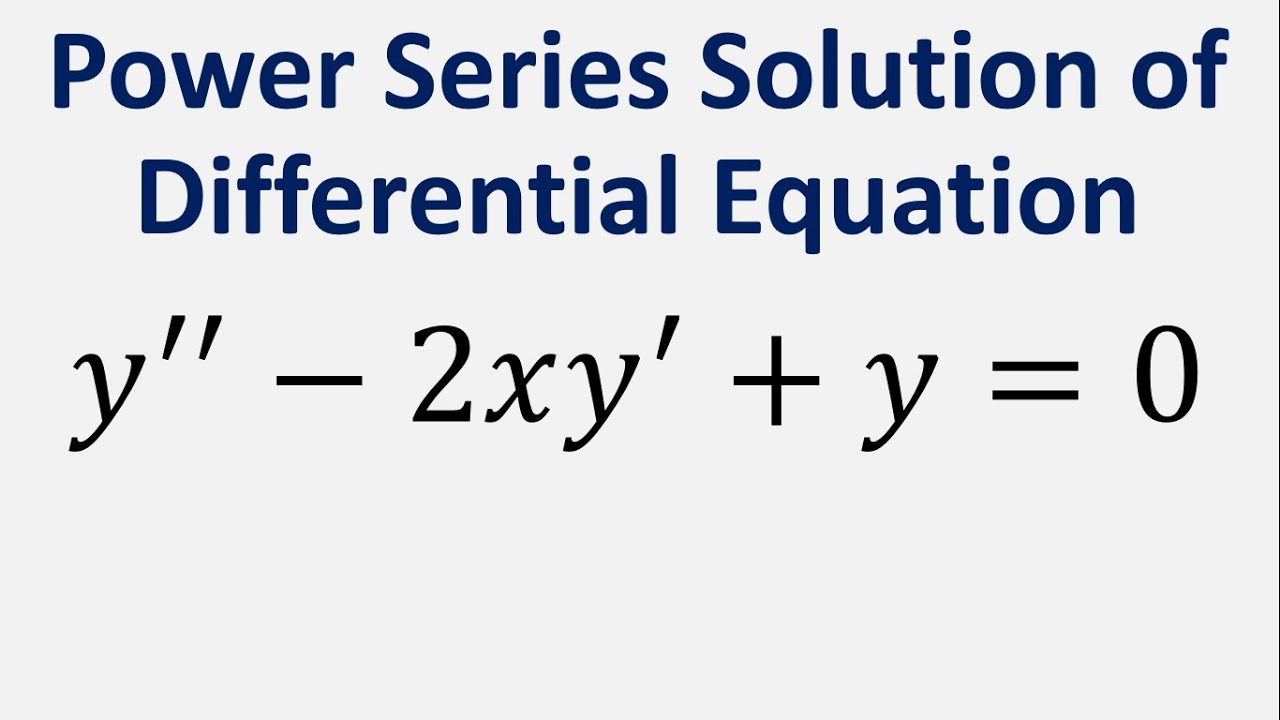
Differential Equation using Power Series: y'' - 2xy' + y = 0
#powerseries #powerseriessolution #differentialequation #differentialequations
glossy zephyr
a_2k is always a multiple (one thats predictable) of a0
sonic crystal
bold turtle
Also, incidentally, googling the question just sent me straight to a video solut...
i stole it off a youtube video
sullen quail
bold turtle
https://youtu.be/7w_GdalO9p0 They just left it as an expanded series
okay spoilers
sonic crystal
bold turtle
https://youtu.be/7w_GdalO9p0 They just left it as an expanded series
my prof wants me to keep it in a series form tho
bold turtle
sullen quail
okay spoilers
It's not a spoilers since beam's already got that answer
bold turtle
soft zealot
**water beam**
That's literally this message
glossy zephyr
Like, i dont want to spoil it, but you can write the sum as
a0 Σ f(k)x^2k
Where f(k) represesnts sequence that arises from the fact that a_2k are all multiples of a0
sonic crystal
glossy zephyr
Like, i dont want to spoil it, but you can write the sum as
a0 Σ f(k)x^2k
ohhh wait thats true wait cant i just say a0 ( 1 + sum a_2k*x^2k)
glossy zephyr
the 1 can be incorporated btw
bold turtle
yeah
bold turtle
You can pull the 1 out entirely, and just have a0 be a separate thing yh
Well not separate, but yk
glossy zephyr
Heres a small ex. of wikipedia

Again, we keep the a0 and a1 since these are from IVC
which we dont have
Im not precisely sure if f(k) (a_2k) can be expressed in closed form tho.
soft zealotBOT
water beam
 sonic crystal
wait so are we allowed to write it as this?
glossy zephyr
make the index n = 0 and erase the +1
sonic crystal
oh tru
glossy zephyr
Notably, its not a_2k, you can write it as a_2k / a0
or "some" f(k)

im not precisely sure that the sequence 1, -1/2, -1/8, -7/240... has a closed form tho.
sonic crystal
$a_{0}\left(\sum_{n=1}^{\infty}\left(\frac{a_{2k}}{a_{0}}\right)x^{2k}+1\right)$
soft zealotBOT
water beam
 glossy zephyr
Like, it isnt precisely hard to compute the values from the recursive definition, but it would be neat to have a closed equation for it.
sonic crystal
ye would be nice if possible but my prof said for series solutions this is enough for full marks if u can get it down to here
okay anways i think thats all
thank you for the help
.solved
final saddleBOT
Channel closed
Closed by @sonic crystal
Use .reopen if this was a mistake.
final saddleBOT
Available help channel!
Send your question here to claim the channel.
Remember:
• Ask your math question in a clear, concise manner.
• Show your work, and if possible, explain where you are stuck.
• Do not immediately ping people or roles. After 15 minutes, feel free to ping <@&286206848099549185> once.
• Type the command .close to free the channel when you're done.
• Be polite and have a nice day!
Read #❓how-to-get-help for further information on how to ask a good question, and about conduct in the question channels.
 gentle zephyr

 drowsy epoch
What's your question
gentle zephyr
can i get some help
drowsy epoch
You been here for like 2 years, you know how it works
Just state ur doubt and translate if possible
gentle zephyr
the doubt is howto integrate this with the given region
the translation is not necessary is just a region in a set and an integral
 blissful meadow
Hint : ||cylindrical coordinates||
Before you ask:
"Why?" Because the function and region has some x,y circular symmetry (x^2 + y^2) and z has easy bounds.
"How?" Look through your notes for what cylindrical coordinates are, try to write your region R in terms of those coordinates, look through your notes again for how you change from cartesian to cylindrical coordinates in an integral.
gentle zephyr
blissful meadow
Before you ask:
"Why?" Because the function and region has some x,y circular sym...
why not polar coord
blissful meadow
Polar is 2D. For 3D you either have cartesian, cylindrical or spherical.
blissful meadow
Because
z has easy bounds.
gentle zephyr
wdym?
blissful meadow
Your z is bounded from -3 to 1.
gentle zephyr
say I want to use cylyndrical coordinates, how to write the integral with this? and what would be the jacobian @blissful meadow
 marsh mountain
gentle zephyr
say I want to use cylyndrical coordinates, how to write the integral with this? ...
marsh mountain
gentle zephyr
say I want to use cylyndrical coordinates, how to write the integral with this? ...
before you ask, dont you have notes on cylindrical? im sure you've had experience transforming variables
gentle zephyr
if I would know everything I wouldn't be asking for help
marsh mountain
have you tried anything at all? like show where you're struggling
gentle zephyr
Idk how to start
marsh mountain
what are your notes on cylindrical coordinates and their transformations?
gentle zephyr
im pretty sure cylindrical is just polar but you leave z free
meaning (x,y,z) = (rcos,rsin,z)
idk why you are making a big fuss about it @marsh mountain
marsh mountain
never mind
anyways
how would you turn the $1 \leq x^2 + y^2 \leq z^2 + 2$ into polar with this, using $x = r\cos\theta$ and $y = r\sin\theta$?
soft zealotBOT
blanketism
 gentle zephyr
marsh mountain
how would you turn the $1 \leq x^2 + y^2 \leq z^2 + 2$ into polar with this, usi...
gentle zephyr
marsh mountain
how would you turn the $1 \leq x^2 + y^2 \leq z^2 + 2$ into polar with this, usi...
.
final saddleBOT
gentle zephyr
<@178624944505094144> <@125307464647180288>
Please do not ping individual helpers unprompted.
gentle zephyr
final saddle
Please do not ping individual helpers unprompted.
he was asking me a question
gentle zephyr
marsh mountain
do you know how to calculate the jacobian?
no
marsh mountain
gentle zephyr
no
do you have notes on the jacobian?
gentle zephyr
its the determinant of the transition matrix
marsh mountain
okay
gentle zephyr
idk
marsh mountain
can you calculate the terms?
marsh mountain
okay, what do you know about the jacobian
what do you have on what the transition matrix is
can you start this at all
gentle zephyr
if I would know everything i wouldn't be needing help dawg
we would need to see the change of coordinates as a linear transformation
and the jacobian as a matrix representation of change of basis of a linear map
@marsh mountain
marsh mountain
gentle zephyr
if I would know everything i wouldn't be needing help dawg
im not saying you need to know everything, but you seem like you dont even make an attempt to do things on your own before asking for help
blissful meadow
gentle zephyr
idk why you are making a big fuss about it <@178624944505094144>
They're not making a big fuss about it and you don't need to know everything. If you ask for help you should have already made a decent attempt at it, and if you really don't know where to start then the least you could do is be aware of the definitions you used in your course, in this instance cylindrical coordinates, how to compute a Jacobian, how to compute its determinant, how to change variables.
If you get stuck doing one of those things, then that's fine but you should say where you're stuck instead of just saying you don't know where to start. Is it with writing the region in terms of cylindrical coordinates? Is it with computing the Jacobian matrix? Is it with computing the determinant of a matrix? Is it with doing the actual change of variables? Is it with computing the iterated integrals?
marsh mountain
you're asking basic questions about what a jacobian is, which is strange because you're being given questions about it. you're telling me you have no notes about the jacobian in your book or something where you can try to discern what you need to do before asking here?
but whatever
soft zealotBOT
Please give me something to compile, for example latex ,tex The solutions to \(x^2 = 1\) are \(x = \pm 1\).See ,help and ,help tex for detailed usage and further examples!
gentle zephyr
oof
marsh mountain
$$\frac{\partial(x, y, z)}{\partial(r, \theta, z)} =
\begin{vmatrix}
  \partial x/\partial r & \partial x/\partial \theta & \partial x/\partial z \\
  \partial y/\partial r & \partial y/\partial \theta & \partial y/\partial z \\
  \partial z/\partial r & \partial z/\partial \theta & \partial z/\partial z \\
\end{vmatrix}
$$
blanketism
 marsh mountain
where cylindrical coordinates are $x = r\cos\theta, y = r\sin\theta, z = z$
soft zealotBOT
blanketism
 marsh mountain
can you proceed with this?
gentle zephyr
yeah
marsh mountain
okay, go ahead
gentle zephyr
cos -rsin 0
sin -rcos 0
.0. 0. 1
gentle zephyr
-rcos^2 + -rsin^2 = -r
gentle zephyr
wat
gentle zephyr
right
gentle zephyr
cos -rsin 0
sin rcos 0
.0. 0. 1
gentle zephyr
r
gentle zephyr
no
marsh mountain
do you know your bounds for r, z, and theta?
gentle zephyr
gentle zephyr
1 <= r^2 <= z^2 + 2
this is for r
marsh mountain
okay
gentle zephyr
1 <= r <= sqrt(z^2 + 2)
gentle zephyr
-3 <= z <= 1
gentle zephyr

gentle zephyr
no
marsh mountain
okay
gentle zephyr
0 to 2pi then?
gentle zephyr
why
marsh mountain
if we restricted x or y specifically, then we would need to solve for theta
since $x^2 + y^2 = r^2$, then nothing about theta's restricted
soft zealotBOT
blanketism
 marsh mountain
we just go a full circle
gentle zephyr
this is hard
marsh mountain
$\int_0^{2\pi}\int_{-3}^1\int_1^{\sqrt{z^2 +2}} ze^{r^2} \cdot r drdzd\theta$


 soft zealotBOT
blanketism
 gentle zephyr
uff
marsh mountain
i hope you can handle integration
gentle zephyr
we can use fubini
blissful meadow
-# that's already Fubini
gentle zephyr
blissful meadow
-# that's already Fubini
 blissful meadow
You can't separate them as a product like this when the bounds depend on one of the variables.
blissful meadow
Yes.
gentle zephyr
,w integral xe^x^2
soft zealotBOT


 Requested by renatoxbz
drowsy epoch
Requested by renatoxbz
drowsy epoch
reverse chain rule
gentle zephyr
u mean u sub
drowsy epoch
call it how you want it lol
 drowsy epoch
kind of funny integral cause you encounter twice the xe^(x^2) form
blissful meadow
-# (For the record Fubini just says that you can take your integral over are region R with respect to dA or dV and rewrite it as iterated integrals like you have. That's all it says. In the specific case where the region is a rectangle/product of intervals AND the function can be expressed as a product of functions in terms of the respective variables of integration only, then you can just rearrange stuff and it becomes the product of three integrals.)
gentle zephyr
oh this shit is tough


@blissful meadow @drowsy epoch


,w 2pi * ((e^3-e^(11))/4 + 2e)
soft zealotBOT
 Requested by renatoxbz
gentle zephyr
blissful meadow
-# (For the record Fubini just says that you can take your integral over are reg...
Requested by renatoxbz
gentle zephyr
blissful meadow
-# (For the record Fubini just says that you can take your integral over are reg...
can the volume be negative?
blissful meadow
You're not computing the volume.
blissful meadow
In this specific case there is no physical context.
If f(x,y,z) gave some sort of density, then you'd get the mass, just like in your problem from yesterday.
gentle zephyr
where is the mistake then
blissful meadow
There is no mistake.
The volume can't be negative. The mass won't be negative too, provided the density is chosen such that it's always positive (which is the only way it makes sense physically).
In this case, as I said, there is no physical context. You computed the integral. That's it.
final saddleBOT
Channel closed
Closed by @gentle zephyr
Use .reopen if this was a mistake.
final saddleBOT
Available help channel!
Send your question here to claim the channel.
Remember:
• Ask your math question in a clear, concise manner.
• Show your work, and if possible, explain where you are stuck.
• Do not immediately ping people or roles. After 15 minutes, feel free to ping <@&286206848099549185> once.
• Type the command .close to free the channel when you're done.
• Be polite and have a nice day!
Read #❓how-to-get-help for further information on how to ask a good question, and about conduct in the question channels.
 sour copper
Consider the unit circle $C$ defined in the real plane $R^2$ as:
$$C={(x,y)\in R^2 : x^2+y^2=1}$$
Let $T_\theta$ be a rotation of this circle in the counter-clockwise (positive) direction by an angle $\theta > 0$. It is given that $\theta$ is not a rational multiple of $\pi$ i.e. $\theta \notin \pi Q$\par
Let $M (1,0)$ be a point on this circle.
- Prove that $T_\theta^k(M) \neq M$ for all $k \in Z^*$\par
- Use the Principle of Mathematical Induction on $n\in N$ to prove the following statement:
For every $n\in N$ there exists an integer $m\in N$ such that the length of the arc of the circle extending between $M$ and $T_\theta^m(M)$ does not exceed $\theta\over2^n$\par - Prove that any segment (arc) of the circle $l$ no matter how small, will contain an infinite number of points from the orbit $l$, where:
$$l={T_\theta^n(M),n\in N}$$ - If we represent the unit circle in complex form, prove that the orbit L constitutes a subgroup of C
final saddleBOT
sour copper
Consider the unit circle $C$ defined in the real plane $R^2$ as:
$$C=\{(x,y)\in...
soft zealotBOT
Amer

 final saddleBOT
@sour copper Has your question been resolved?
 vital crag
Can also try #real-complex-analysis or #groups-rings-fields
sour copper
ain't got no perms
vital crag
final saddleBOT
@sour copper Has your question been resolved?
final saddleBOT
Channel closed
Closed due to timeout
Use .reopen if this was a mistake.
Available help channel!
Send your question here to claim the channel.
Remember:
• Ask your math question in a clear, concise manner.
• Show your work, and if possible, explain where you are stuck.
• Do not immediately ping people or roles. After 15 minutes, feel free to ping <@&286206848099549185> once.
• Type the command .close to free the channel when you're done.
• Be polite and have a nice day!
Read #❓how-to-get-help for further information on how to ask a good question, and about conduct in the question channels.
final saddleBOT
Channel closed
Channel closed due to the original message being deleted.
If you did not intend to do this, please open a new help channel,
as this action is irreversible, and this channel may abruptly lock.
ornate token
Which one?
final saddleBOT
Available help channel!
Send your question here to claim the channel.
Remember:
• Ask your math question in a clear, concise manner.
• Show your work, and if possible, explain where you are stuck.
• Do not immediately ping people or roles. After 15 minutes, feel free to ping <@&286206848099549185> once.
• Type the command .close to free the channel when you're done.
• Be polite and have a nice day!
Read #❓how-to-get-help for further information on how to ask a good question, and about conduct in the question channels.
 fluid river
hello, could someone please help me with these two questions?
Given that:
AB = BC
AF = FE
CD = DE
using point X, where AD = BX and AB = DX, prove that vector BE = AD + CF
must this triangle be an isosceles triangle?
thank you and apologies in advance for the poorly drawn diagram
 final saddleBOT
fluid river
hello, could someone please help me with these two questions?
1.
Given that:
A...
brazen breach
fluid river
hello, could someone please help me with these two questions?
1.
Given that:
A...
final saddleBOT
fluid river
hello, could someone please help me with these two questions?
1.
Given that:
A...
brazen breach
fluid river
hello, could someone please help me with these two questions?
1.
Given that:
A...
ok I'm not entirely suer on my own logic here
so you have AD=BX so BE=BX+CF
notice that BE=BX+XE, so we have CF=XE which we have to prove
going back we have BE-BX=XE so CF=BE-BX, express BE as the sum of vectors including CF
fluid river
so trying to find XE = CF
brazen breach
for 2. I have no idea if you can prove it is, maybe consider that centroids don't really move when triangles are changed so no
brazen breach
fluid river
so trying to find XE = CF
yes, you go back with BE=BX+XE -> BE-BX=XE=CF
fluid river
brazen breach
yes, you go back with BE=BX+XE -> BE-BX=XE=CF
how did you arrive at the conclusion that XE = CF?
brazen breach
fluid river
how did you arrive at the conclusion that XE = CF?
AD=BX
AD=BX, BE=AD+CF => BE=(BX)+CF=BX+CF
brazen breach
brazen breach
AD=BX, BE=AD+CF => BE=(BX)+CF=BX+CF
BE=BX+XE
hmm isn't that familiar
sullen quail
AB=BC, AF=FE, CD=DE tell you that B, F, D are midpoints of AC, AE, CE respectively
also that does NOT force triangle ACE to have two equal sides, so large triangle need not be isosceles
fluid river
brazen breach
BE=BX+XE
hmm isn't that familiar
ahhh, after writing it down it makes sense!
and we dont know it must be isosceles?
fluid river
sullen quail
AB=BC, AF=FE, CD=DE tell you that B, F, D are midpoints of AC, AE, CE respective...
yeah, i understand theyre midpoints, just wondering how to use that to prove q1
fluid river
sullen quail
i think 1 pretty much implies 2
as in question 1 proves question 2 or the fact that their midpoints proves question 1?
fluid river
sullen quail
or you need to prove 2 too somehow?
nono, that im just curious about
so triangle ACE DOESN'T have to be an isosceles?
sullen quail
proof should vector ?
fluid river
wdym?
sullen quail
sullen quail
proof should vector ?
or go with undesirable say
fluid river
wdym by proof should vector or go with undesirable say? as in does it have to use vectors to prove it?
sullen quail
should vectors be used in the proof, or is that, say, undesirable?
fluid river
it doesnt really matter, the second part of the question im just curious about. you dont have to use vectors, I just want some sort of explination to whether or not AE has to equal CE
fluid river
brazen breach
BE=BX+XE
hmm isn't that familiar
sorry for the ping, I have a follow up question
you say that BE = BX + CF and BE = BX + XE, therefore CF = XE
but we dont know whether or not BE = CF + AD is true or not, so doesnt that mean we cant compare the two? because although we know that BE = BX + XE is true, we dont know that BE = BX + CF is true or not?
fluid river
sullen quail
i mean there are vector proofs haters exist
oh yeah, nw. just want some sort of explination
sullen quail
name explanation of what, maximally concretely
fluid river
sullen quail
name explanation of what, maximally concretely
just an explanation of whether triangle ACE has to be an isosceles triangle with AE = CE
fluid river
fluid river
sorry for the ping, I have a follow up question
you say that BE = BX + CF and B...
and this^
final saddleBOT
@fluid river Has your question been resolved?
fluid river
<@&286206848099549185>
fluid river
fluid river
sorry for the ping, I have a follow up question
you say that BE = BX + CF and B...
pls help with this
sullen quail
counterexample
A=(0,0) C=(2,0) E=(0,3)
then B=(1,0) F=(0,1.5) D=(1,1.5)
so
AB=BC=1
AF=FE=1.5
CD=DE=√(1²+1.5²)=√3.25
and in triangle ACE
AE=3
CE=√((2-0)²+(0-3)²)=√13
equalities only tell you that B F D are the midpoints of AC AE CE resp.
(triangle is isosceles only when it has two equal sides)
fluid river
sorry, let me draw this out to visualize
sullen quail
(my bad counterexample is worst way to state something, but anyway may be helpful a bit still)
fluid river
sullen quail
counterexample
A=(0,0) C=(2,0) E=(0,3)
then B=(1,0) F=(0,1.5) D=(1,1.5)
so
AB=B...
sorry im currently really confused
you just solved for CE & CD, but you didnt prove that BE = AD + CF. didnt you just- create a triangle? you know that BFD are midpoints, but you never proved that BE = AD + CF?
fluid river
fluid river
sorry for the ping, I have a follow up question
you say that BE = BX + CF and B...
also, could you explain whether this is correct or not? Im still not sure that I understand the first part of the question
fluid river
fluid river
hello, could someone please help me with these two questions?
1.
Given that:
A...
someone please help, I'm still so confused🙏
sullen quail
fluid river
sorry im currently really confused
you just solved for CE & CD, but you didnt pr...
you mean vectors?
fluid river
sullen quail
you mean vectors?
yeah, how vectors BE = AD + CF
sullen quail
fluid river
also, could you explain whether this is correct or not? Im still not sure that I...
both equations must already be proven, if you asking this, then, yes
fluid river
sullen quail
both equations must already be proven, if you asking this, then, yes
Im trying to figure out how I can prove that BE = AD + CF, and the person ealier used BE = AD + CF to solve for CF = XE. but since we dont know whether BE = AD + CF is in fact true, isnt the whole proof invalid? we cant say that CF = XE useless we state we know that BE = CF + AD, which is what were trying to prove.
right......?
i feel like im more confused than when we started
if it helps, can we go from the top again? how does vector BE = AD + CF?
sullen quail
im not sure even in what i myself sayin
i tried to help
i don't saying proof itself tho
i also think that your proof may be better than mine, so i will refrain, sorry
i think i helped at least btw, sorry
fluid river
um, its ok, thanks for trying though, appreciate it
----------------------------------------------------------------------------------------------------------------------------------------------------------
just gonna copy and paste my question again, clean slate, someone please help me, I feel like I havent gotten anyway in the past few hours
Given that:
AB = BC
AF = FE
CD = DE
using point X, where AD = BX and AB = DX, prove that vector BE = AD + CF
must this triangle be an isosceles triangle?
 fluid river
FE?
ornate token
AF = 1/2 AE.
Do the same, AB = 1/2 AC.
DE = 1/2 CE.
Now, BE = BC + CE.
Which is?
ornate token
BE = BC + CE.
Similarly, CF = CA + AF.
You want the mid segments.
Then since CA = -2AB, AF=FE, as well as BC=AB, you can adjust those 2 equations.
fluid river
so CF = -2AB + FE and BE = AB + CE?
ornate token
We also want to show AD + CF = BE.
But AD = BX.
Then triangle law somewhere here.
fluid river
triangle law? so like BC + CE = BE?
fluid river
well
AD = BX, so we need to check if CF = XE
so if CF = XD + DE
CF = CB + BF
so does BF = DE
BF = FE
but FE = DE only if triangle is isosceles right?
fluid river
fluid river
but FE = DE only if triangle is isosceles right?
@ornate token?
<@&286206848099549185> someone please help explain, I havent gotten anywhere in the past few hours 🙏 . I'm sorry for pinging a second time, but idk what else to do.
 weary cosmos
fluid river
1.
Given that:
AB = BC
AF = FE
CD = DE
using point X, where AD = BX and AB = DX...
weary cosmos
fluid river
1.
Given that:
AB = BC
AF = FE
CD = DE
using point X, where AD = BX and AB = DX...
Is anything else given ? Like BE being perpendicular to AC or any other info?
fluid river
weary cosmos
Is anything else given ? Like BE being perpendicular to AC or any other info?
nope
just that FBD are midpoints
do you have to assume that theyre perpendicular? that would make it isosceles right?
weary cosmos
Wait listen
Let's assume some vectors
Say that AB vector is a
And then BC vector is in same direction
So BC vector would be ?
fluid river
a as well
weary cosmos
Yes good
Now say that BE vector is some b
Okay ?
Ok so
AE vector
If we would write it
It would be ?
fluid river
-a+b
fluid river
(a+b)/2?
fluid river
AD = 3/2 a + b/2
fluid river
BE = CF + AD
b = 3/2a + b/2 -3/2a + b/2
b = b
OHHHHH
weary cosmos
Yesssss !
fluid river
hmmm, i wonder why x is included then
fluid river
now i wonder if there is a way i can use x in my proof
fluid river
okok
thank you so much
ive been suck here for like 3 hours
trying to do this
i really appreciate it
weary cosmos
My pleasure!
fluid river
.close
final saddleBOT
Channel closed
Closed by @fluid river
Use .reopen if this was a mistake.
final saddleBOT
Available help channel!
Send your question here to claim the channel.
Remember:
• Ask your math question in a clear, concise manner.
• Show your work, and if possible, explain where you are stuck.
• Do not immediately ping people or roles. After 15 minutes, feel free to ping <@&286206848099549185> once.
• Type the command .close to free the channel when you're done.
• Be polite and have a nice day!
Read #❓how-to-get-help for further information on how to ask a good question, and about conduct in the question channels.
 hot owl
can someone help me with part g i have no idea what im doing

 modest sequoia
it is asking you to graph g(x), using the info you get from parts a-f
 late gazelle
Using the information from the previous parts, we should have all defining features of the graph, x,y intercepts, maxima / minima, etc.
Just put it all together to sketch the graph
hot owl
i have no idea how to sketch a graph
late gazelle
Plot the points we do know first
modest sequoia

This calculus video tutorial provides a basic introduction into curve sketching. it explains how to graph polynomial functions using the signs of the first derivative and the second derivative of a function. You need to identify the critical numbers and potential inflection points in addition to the concavity of the graph. You need to combin...
take a look at this, a visual representation will probably help you better than just words
hot owl
late gazelle
Plot the points we do know first
so like (2,-16) etc
hot owl
modest sequoia
take a look at this, a visual representation will probably help you better than ...
thanks
late gazelle
Yea
And just “connect the dots” in smooth way
Making sure that:
You have the concavity of each part correct
modest sequoia
for a small interval like this just connecting may or may not work, but for larger intervals you'll definitely want to make sure of your concavity and intervals of inc/dec as the other helper mentioned above
and well you'll get all that information from parts a-f, of course.
modest sequoia
show what you have right now, it definitely won't ever be perfect but it'll get better as you practice it
modest sequoia
no worries go ahead and make a rough sketch of what you think it'll look like to the best of your ability and send that
 modest sequoia
that looks very good actually, just try to make it a smoother curve going from (0, 0) to (3, -27)
but you got the basic idea right
,w graph x^4-4x^3 from x = -1 to 5
soft zealotBOT

 Requested by diamondbtw
hot owl
modest sequoia
that looks very good actually, just try to make it a smoother curve going from (...
Requested by diamondbtw
hot owl
modest sequoia
that looks very good actually, just try to make it a smoother curve going from (...
okay will do
thank you very much
modest sequoia
ofc! your sketching will get better as you go on, just keep up the practice :)
final saddleBOT
Channel closed
Closed by @hot owl
Use .reopen if this was a mistake.
final saddleBOT
Available help channel!
Send your question here to claim the channel.
Remember:
• Ask your math question in a clear, concise manner.
• Show your work, and if possible, explain where you are stuck.
• Do not immediately ping people or roles. After 15 minutes, feel free to ping <@&286206848099549185> once.
• Type the command .close to free the channel when you're done.
• Be polite and have a nice day!
Read #❓how-to-get-help for further information on how to ask a good question, and about conduct in the question channels.
 lime crest
A round robin tournament has $2n+1$ competing teams, in each game the outcome is always a win or a loss. For teams $X,Y,Z$, call the set ${X,Y,Z}$ "circular" if $X$ won against $Y$, $Y$ won against $Z$, and $Z$ won against $X$. Determine $\$ $(a)$ the minimum amount of circular sets in the tournament $\ (b)$ the maximum amount of circular sets in the tournament
final saddleBOT
lime crest
A round robin tournament has $2n+1$ competing teams, in each game the outcome is...
soft zealotBOT
Copter

 ionic venture
Did you finish the geo?
lime crest
which one
ionic venture
It's not that difficult
lime crest
can you dm me?
ionic venture
You just need to look at something
ionic venture
lime crest
can you dm me?
Ofc
lime crest
soft zealot
**Copter**
^
ionic venture
soft zealot
**Copter**
Complete Directed Graph?
lime crest
wuh..
ionic venture
Are you familiar with graphs?
ionic venture
ionic venture
Complete Directed Graph?
The teams are the nodes and the games are the edges
 final saddleBOT
@lime crest Has your question been resolved?
lime crest
uhhhhh
ionic venture
Might've overflown you with information my bad
What do you think about the problem tho?
lime crest
no idea man
ionic venture
Hmm...
We should try looking at small cases
Maybe we could find some patterns in the results
lime crest
n=1?
final saddleBOT
@lime crest Has your question been resolved?
final saddleBOT
@lime crest Has your question been resolved?
 cerulean epoch
you should think about small cases for (a) because there is a construction
hmm you haven't answered Erebus for 2n + 1 = 3
is there something that's confusing you
final saddleBOT
Channel closed
Closed due to timeout
Use .reopen if this was a mistake.
Available help channel!
Send your question here to claim the channel.
Remember:
• Ask your math question in a clear, concise manner.
• Show your work, and if possible, explain where you are stuck.
• Do not immediately ping people or roles. After 15 minutes, feel free to ping <@&286206848099549185> once.
• Type the command .close to free the channel when you're done.
• Be polite and have a nice day!
Read #❓how-to-get-help for further information on how to ask a good question, and about conduct in the question channels.
 mossy chasm
.close
final saddleBOT
Channel closed
Closed by @mossy chasm
Use .reopen if this was a mistake.
final saddleBOT
Available help channel!
Send your question here to claim the channel.
Remember:
• Ask your math question in a clear, concise manner.
• Show your work, and if possible, explain where you are stuck.
• Do not immediately ping people or roles. After 15 minutes, feel free to ping <@&286206848099549185> once.
• Type the command .close to free the channel when you're done.
• Be polite and have a nice day!
Read #❓how-to-get-help for further information on how to ask a good question, and about conduct in the question channels.
pearl stone
I need help understanding how to get the points for this -1/3 (x-5)^2 +1/2
final saddleBOT
pearl stone
I need help understanding how to get the points for this -1/3 (x-5)^2 +1/2
drowsy epoch
wdym points
pearl stone
So far I have the point (5,0.5)
pearl stone
drowsy epoch
wdym points
For graphing the coordinates
brazen breach
pearl stone
I need help understanding how to get the points for this -1/3 (x-5)^2 +1/2
substitute values of x into the expression
that's it
y=-1/3 (x-5)^2 +1/2
pearl stone
I know but I get confused midway through
modest sequoia
pearl stone
I know but I get confused midway through
you got your vertex (5, 0.5)
 wet crater
pearl stone
I know but I get confused midway through
wet crater
pearl stone
I know but I get confused midway through
can you show where you worked up until?
modest sequoia
now just find values around it and plug them in
if you have the point 5 as your vertex, that means the parabola either goes up or down around it with that point as your minimum or your maximum. so if you have 5 as your "midpoint" then plug in values like 4 and 6, then 3 and 7, etc. into your function
pearl stone
Ok .close
final saddleBOT
@pearl stone Has your question been resolved?
Channel closed
Closed by @pearl stone
Use .reopen if this was a mistake.
final saddleBOT
Available help channel!
Send your question here to claim the channel.
Remember:
• Ask your math question in a clear, concise manner.
• Show your work, and if possible, explain where you are stuck.
• Do not immediately ping people or roles. After 15 minutes, feel free to ping <@&286206848099549185> once.
• Type the command .close to free the channel when you're done.
• Be polite and have a nice day!
Read #❓how-to-get-help for further information on how to ask a good question, and about conduct in the question channels.
 keen hare
is this reasonable or did i miss the point or do somethin weong
 keen hare
this question felt very easy and i feel like somethings wrong
 tiny gorge
you seem to be assuming that P is linear instead of affine
in general, can't it also change F?
keen hare
tiny gorge
in general, can't it also change F?
i dont know
tiny gorge
what's your definition for affine transformation?
final saddleBOT
@keen hare Has your question been resolved?
keen hare
tiny gorge
what's your definition for affine transformation?
when you multiply a solution of a differential equation by a matrix P (made up of eigenvectors) to get a simpler equation with the same shape
tiny gorge
isn't that a linear transformation?
an affine transformation is more general, it's a translation composed with a linear transformation
keen hare
then i guess i dont really understand affine transforms
keen hare
tiny gorge
isn't that a *linear* transformation?
how would you start with this problem
.close
final saddleBOT
Channel closed
Closed by @keen hare
Use .reopen if this was a mistake.
final saddleBOT
Available help channel!
Send your question here to claim the channel.
Remember:
• Ask your math question in a clear, concise manner.
• Show your work, and if possible, explain where you are stuck.
• Do not immediately ping people or roles. After 15 minutes, feel free to ping <@&286206848099549185> once.
• Type the command .close to free the channel when you're done.
• Be polite and have a nice day!
Read #❓how-to-get-help for further information on how to ask a good question, and about conduct in the question channels.
lime crest
 final saddleBOT
lime crest
lime crest
final saddleBOT
lime crest
lime crest

im only stuck on a very small part in this
Let QK intersect RM at F.
im trying to show that QMFA is a rhombus
i know that DEM is equiv to QAM, and NEQM is a kite, all is left is to show that <QMA = <AMF
final saddleBOT
@lime crest Has your question been resolved?
lime crest
<@&286206848099549185>
 sterile marsh
bmo?
lime crest
wuh
final saddleBOT
@lime crest Has your question been resolved?
lime crest
i got it, i think
Let H be the foot of the atitude dropped from R to BC. Let RH intersect QM at G.
i claim that R,G are reflections of eachother on MB
and rhen you can just angle chase, i think

.close
final saddleBOT
Channel closed
Closed by @lime crest
Use .reopen if this was a mistake.
lime crest
lime crest
also BN, MQ intersect on (RHB) which is cool
final saddleBOT
Available help channel!
Send your question here to claim the channel.
Remember:
• Ask your math question in a clear, concise manner.
• Show your work, and if possible, explain where you are stuck.
• Do not immediately ping people or roles. After 15 minutes, feel free to ping <@&286206848099549185> once.
• Type the command .close to free the channel when you're done.
• Be polite and have a nice day!
Read #❓how-to-get-help for further information on how to ask a good question, and about conduct in the question channels.
Please don't occupy multiple help channels.
modest sequoia
<@&268886789983436800>
final saddleBOT
Channel closed
Channel closed due to the original message being deleted.
If you did not intend to do this, please open a new help channel,
as this action is irreversible, and this channel may abruptly lock.
Available help channel!
Send your question here to claim the channel.
Remember:
• Ask your math question in a clear, concise manner.
• Show your work, and if possible, explain where you are stuck.
• Do not immediately ping people or roles. After 15 minutes, feel free to ping <@&286206848099549185> once.
• Type the command .close to free the channel when you're done.
• Be polite and have a nice day!
Read #❓how-to-get-help for further information on how to ask a good question, and about conduct in the question channels.
 ember peak
how can i fill in the variables such that F become fields (not sure that's the right translation for körper) ? i know the solution but i don't understand how to get there. the only thing i can understand is how to get that in 𝔽₃ a is not equal to 1
 final saddleBOT
ember peak
how can i fill in the variables such that F become fields (not sure that's the r...
ember peak
final saddleBOT
ember peak
how can i fill in the variables such that F become fields (not sure that's the r...
ember peak
?
ember peak
the spam today is so strange, there are places where you could ask where people care about such edits, why do you ask in random maths help forums instead
 compact laurel
 olive osprey
Do u like my edits
olive osprey
Do u like my edits
This is not the place for that
 gritty kiln
nice
ornate token
Please delete.
ornate token
Do not spam please.
olive osprey
@olive osprey
ornate token
olive osprey
<@1490842064718528613>
!redir
final saddleBOT
olive osprey
<@1490842064718528613>
This channel is only for on-topic discussion. Please take casual conversation to #discussion or #chill.
drowsy epoch
ember peak
how can i fill in the variables such that F become fields (not sure that's the r...
Hmm, b would just be 2+2 but what's that mod 3
ember peak
"but what's that mod 3" i'm not sure what you mean by that. i mean, i know what mod 3 is but i don't see why you bring it up
wait, no, i only know mod with two parameters but mod 3 only has 1 parameter
ember peak
that sounds familiar but i don't remember that.
i thought i should somehow use the qualities of fields to figure out a solution
drowsy epoch
Well you only need commutativity and that each element appears once per row and col
ember peak
i don't know why each element only appears once per row. for plus i know there must be an inverse element so there must be 0 somewhere. for * i know there must be an inverse element as well so d must be 1
like, talking about F3 for now, i want to get that done before moving to F4
drowsy epoch
ember peak
i don't know why each element only appears once per row. for plus i know there m...
Because when you add and multiply u want the result to be unique
drowsy epoch
ember peak
i don't know why each element only appears once per row. for plus i know there m...
Yeah
 willow cliff
you can think of the elements of F_3 as being the remainders of numbers when you divide by 3
so then $\mathbb{F}_3 = { 0,1,2}$, since those are the only remainders that can result from dividing by 3
soft zealotBOT
TestTickler
 willow cliff
and so addition respects the fact that these are the only possible "outputs" over mod 3 ($\mathbb{F}_3$)
soft zealotBOT
TestTickler
 ember peak
so, any time i have the same thing twice i could do something like for example
0+1=1=1+1, therefore 0=1 which contradicts that F has 3 elements ?
willow cliff
well 1 + 1 is just 2 right, but 2 divided by 3 just leaves a remainder 2
so it still stays the same
but when we do 1 +2 = 3, 3 is a number that when divided by 3 leaves 0 remainder , so then 1+2 = 0
you essentially just compute the operation like normal, and then look at what remainder is left with respect to dividing by the size of your field
that is your answer for the variables
bold turtle
-# Randomly jumping in, but yes, field is the correct translation for Körper here 
 drowsy epoch
Yeah should work
 late spade
lime crest
late spade
lime crest
can anyone give me the full pic of this problem plssss
drowsy epoch
ember peak
However ur reasoning for d is weird
We know it has an inverse, the question is what the result would be applying it
ember peak
my thinking was 2*x = 1 and we know it's not 2*0 or 2*1 so it has to be 2*2
drowsy epoch
Either you do that by mod 3 or rule 2 out by the uniqueness property
drowsy epoch
ember peak
my thinking was 2*x = 1 and we know it's not 2\*0 or 2\*1 so it has to be 2\*2
Why 2x=1?
ember peak
because there exists some inverse element for 2 for *, otherwise it wouldn't be a field
 ember peak
i mean, that does happen to me more often than i'd like so it was a fair assumption
drowsy epoch
I was js 2nd guessing myself
drowsy epoch
ember peak
how can i fill in the variables such that F become fields (not sure that's the r...
IF_4 is a bit tricky because there is not really a natural choice like before
ember peak
those should be all the possible cases for a,b,c, if i'm not mistaken, i'm trying to see how that interacts with d,e,f right now
 ember peak
typo
drowsy epoch
I am not quiet sure on this one, there seem to multiple choices possible?
drowsy epoch
bold turtle
-# Randomly jumping in, but yes, _field_ is the correct translation for _Körper_...
-# Jump back 
ember peak
i'm pretty sure those are all possible options
 drowsy epoch
What does the solution say
ember peak
the second option from the top, a=0,d=0
i'm assuming there is only one solution but i just noticed i don't actually know if that's the case
drowsy epoch
Hmm
Even if we said 1+2=3=b then the choices for a and c need something too
Guess you can choose a=0 instead of 2 because we don't want to do mod 4 here since Z_4 isn't a field
But that's circular idk
Z_2 x Z_2 would make sense for the + table
final saddleBOT
@ember peak Has your question been resolved?
drowsy epoch
I am sure that the choices for IF_4 are based on Z_2[x]/(x²+x+1)
ember peak
i am considering going to sleep. luckily the task is just to find some solution, not to explain it, so i would be fine with figuring out the reason at any point between now and next week at this same time
drowsy epoch
Ok
ember peak
unless you had some train of throught going that could help here ?
drowsy epoch
fwiw I don't think it helps since it would dive too deep into abstract algebra
ember peak
what does fwiw mean ?
drowsy epoch
for what it's worth
final saddleBOT
@ember peak Has your question been resolved?
Channel closed
Closed by @ember peak
Use .reopen if this was a mistake.
final saddleBOT
Available help channel!
Send your question here to claim the channel.
Remember:
• Ask your math question in a clear, concise manner.
• Show your work, and if possible, explain where you are stuck.
• Do not immediately ping people or roles. After 15 minutes, feel free to ping <@&286206848099549185> once.
• Type the command .close to free the channel when you're done.
• Be polite and have a nice day!
Read #❓how-to-get-help for further information on how to ask a good question, and about conduct in the question channels.
 quiet garden
can someone explain what these B and D stuff r i dont get linear transformations
 final saddleBOT
quiet garden
can someone explain what these B and D stuff r i dont get linear transformations
quiet garden
final saddleBOT
quiet garden
can someone explain what these B and D stuff r i dont get linear transformations
quiet garden
its something like i plug B into T and then idk after
 formal trail
In matrix notation
[ \begin{bmatrix} 1 & 2 & -1 \ - 1 & 0 & 1 \end{bmatrix} \begin{bmatrix} a \ b \ c \end{bmatrix} = \begin{bmatrix} d \ e \end{bmatrix} ]
corresponds to the function
[ T\big(a(1) + b(x) + c(x^2)\big) = d(1,1) + e(0,1) ]
soft zealotBOT
clôud
 formal trail
so the idea is that you do a matrix multiplication with column vectors, but those column vectors are really just "coordinates", i.e. coefficients of a linear combination of the given bases
quiet garden
formal trail
so the idea is that you do a matrix multiplication with column vectors, but thos...
what about B
in all these problems they all got diff stuff and sometimes u use them sometimes u dont i dont get it
 formal trail
if the vector spaces are the same then you can use the same basis for both the input and output
so you always multiply a vector representing coefficients of a linear combination of B by the matrix to get out a vector representing coefficiennts of a linear combination of D
quiet garden
formal trail
so you always multiply a vector representing coefficients of a linear combinatio...
i dont get it so i plug each thing in B into T?
formal trail
to be honest i'm not sure what they actually mean by "action of T", does your textbook define it somewhere?
quiet garden
formal trail
to be honest i'm not sure what they actually mean by "action of T", does your te...
i dont either but i mean in general for linear transformation problems how do i do them
formal trail
what textbook is this?
quiet garden
nicholson-2023A.pdf
formal trail
soft zealot
**clôud**
well from reading the textbook they actually do seem to want it something like this
but you actually do the matrix multiplication to find a formula for d and e in terms of a, b, and c and then simplify
because by "action of T" they seem to mean "formula for the output given a generic input"
quiet garden
but for linear transformation r all of them pluging B into T, and then plugging D into those answers?
formal trail
well you always plug in an arbitrary linear combination of B into T, do the matrix multiplication to find the coordinates of the output given the coordinates of the input, and then turn those coordinates into a linear combination of D
quiet garden
formal trail
well you always plug in an arbitrary linear combination of B into T, do the matr...
can u give an example i cant find any
formal trail
 quiet garden
formal trail
quiet garden
formal trail
where did the 4 matrices from B go. it became v? i dont get what T, M_DB ,C and all these letters stand for
formal trail
all of this notation is explained in the textbook but C_B is the coordinate vector representation of a vector with respect to B
that means if a vector $\vb v$ can be written as $$\vb v = \bmat{ a & b \ c & d }= a \bmat{1 & 0 \ 0 & 0} + b \bmat{0 & 1 \ 0 & 0} + c \bmat{0 & 0 \ 1 & 0} + d \bmat{0 & 0 \ 0 & 1}$$ then it's coordinate vector representation is $$C_B(\vb v) = \bmat{ a \ b \ c \ d}$$ (note how it's just the coefficients of the linear combination)
soft zealotBOT
clôud
 formal trail
$M_{DB}(T)$ is the matrix defined so that multiplying the coordinate vector representation of $\vb v$ wrt basis $B$ gives the coordinate vector representation of $T(\vb v)$ (the output of the transformation given input $\vb v$) wrt $D$
soft zealotBOT
clôud
 quiet garden
is this even english im so cooked
final saddleBOT
@quiet garden Has your question been resolved?
final saddleBOT
Channel closed
Closed due to timeout
Use .reopen if this was a mistake.
final saddleBOT
Available help channel!
Send your question here to claim the channel.
Remember:
• Ask your math question in a clear, concise manner.
• Show your work, and if possible, explain where you are stuck.
• Do not immediately ping people or roles. After 15 minutes, feel free to ping <@&286206848099549185> once.
• Type the command .close to free the channel when you're done.
• Be polite and have a nice day!
Read #❓how-to-get-help for further information on how to ask a good question, and about conduct in the question channels.
 short ore

 sweet imp
When the global minimum is satisfied, what is the value of f'(x)?
short ore
But how do you find range of k
short ore
sweet imp
When the global minimum is satisfied, what is the value of f'(x)?

I got this but I don’t think it’s correct
 ruby crypt
short ore
I got this but I don’t think it’s correct
ruby crypt
short ore
I got this but I don’t think it’s correct
its correct
u can try plotting the graph online to double-check
short ore
But it asks for the range of k
short ore
ruby crypt
its correct
Oh I think the range of k values is for the other parts
Alright all good thank you
short ore
ruby crypt
its correct

these are the answers @ruby crypt
dont know how they got less than
@sand barn can u help pls man
ruby crypt
short ore
I misunderstood the question sorry, the question is asking values of K which has global minimum at x = 1
so its not limited to -2e^2
final saddleBOT
@short ore Has your question been resolved?
Channel closed
Closed by @short ore
Use .reopen if this was a mistake.
Available help channel!
Send your question here to claim the channel.
Remember:
• Ask your math question in a clear, concise manner.
• Show your work, and if possible, explain where you are stuck.
• Do not immediately ping people or roles. After 15 minutes, feel free to ping <@&286206848099549185> once.
• Type the command .close to free the channel when you're done.
• Be polite and have a nice day!
Read #❓how-to-get-help for further information on how to ask a good question, and about conduct in the question channels.
 tired iron
A block of wood of mass 10kg floats on water density of wood is 600 and that of water is 1000 find the buyount force acting on wood block
So i calculated the upthrust using the formual row g V that resulted in 163.33N and the book says the answer is 98 N is there sm issue or point i am missing
final saddleBOT
tired iron
A block of wood of mass 10kg floats on water density of wood is 600 and that of ...
 eternal saffron
tired iron
A block of wood of mass 10kg floats on water density of wood is 600 and that of ...
eternal saffron
tired iron
A block of wood of mass 10kg floats on water density of wood is 600 and that of ...
The block of wood is in equilibrium, because it's has not net force acting on it. For the buyount force must just counteract the weight force
Given that is floats, but it does because its less dense then water
tired iron
eternal saffron
Given that is floats, but it does because its less dense then water
But upthrust can be more than its weight?
eternal saffron
No, or else it would shoot off into the sky
eternal saffron
np!'
tired iron
.close
final saddleBOT
Channel closed
Closed by @tired iron
Use .reopen if this was a mistake.
final saddleBOT
Available help channel!
Send your question here to claim the channel.
Remember:
• Ask your math question in a clear, concise manner.
• Show your work, and if possible, explain where you are stuck.
• Do not immediately ping people or roles. After 15 minutes, feel free to ping <@&286206848099549185> once.
• Type the command .close to free the channel when you're done.
• Be polite and have a nice day!
Read #❓how-to-get-help for further information on how to ask a good question, and about conduct in the question channels.
 static oak
I’m confused by the answer key for 21 because I got <-2/SR20, 4/SR20> and why is it U/|U| and not just |U|

 final saddleBOT
static oak
I’m confused by the answer key for 21 because I got <-2/SR20, 4/SR20> and why is...
static oak
final saddleBOT
static oak
I’m confused by the answer key for 21 because I got <-2/SR20, 4/SR20> and why is...
static oak
I’m not sure what that means
sonic crystal
youre just dividing by the magnitude/length of the vector
static oak
Oh kk
sonic crystal
static oak
Oh kk
like a unit vector is just the vector itself divided by how long the vector is
 sonic crystal
do you know what component form is
 minor field
static oak
I’m not sure how to do the a part of this question
minor field
static oak
I’m not sure how to do the a part of this question
you can work with the X and Y singh I guess?
they are both positive so the must be vector in the first quarter
🤷
final saddleBOT
@static oak Has your question been resolved?
 late laurel
static oak
I’m not sure how to do the a part of this question
late laurel
static oak
I’m not sure how to do the a part of this question
Try writing them in i,j form
final saddleBOT
Channel closed
Closed due to timeout
Use .reopen if this was a mistake.
Available help channel!
Send your question here to claim the channel.
Remember:
• Ask your math question in a clear, concise manner.
• Show your work, and if possible, explain where you are stuck.
• Do not immediately ping people or roles. After 15 minutes, feel free to ping <@&286206848099549185> once.
• Type the command .close to free the channel when you're done.
• Be polite and have a nice day!
Read #❓how-to-get-help for further information on how to ask a good question, and about conduct in the question channels.
 cinder vapor
 final saddleBOT
cinder vapor
cinder vapor
cinder vapor
final saddleBOT
cinder vapor
cinder vapor
cinder vapor
Hey <@&286206848099549185> I am having hard time getting the logic behind it
final saddleBOT
Please do not ping individual helpers unprompted.
sterile marsh
cinder vapor
Hey <@&286206848099549185> I am having hard time getting the logic behind it
!15m
final saddleBOT
cinder vapor
Hey <@&286206848099549185> I am having hard time getting the logic behind it
Please only use the <@&286206848099549185> ping once if your question has not been answered for 15 minutes. Please do not ping or DM individual users about your question.
 cunning ridge
oops wrong command
cinder vapor
sterile marsh
!15m
What ?
sterile marsh
cinder vapor
What ?
read the bot's message
cunning ridge
cinder vapor
What ?
if your q remains unanswered for 15 mins then you can ping helpers
cinder vapor
cunning ridge
if your q remains unanswered for 15 mins then you can ping helpers
Oh sorry
sterile marsh
What's the issue in this problem
cinder vapor
sterile marsh
What's the issue in this problem
Oh I m having problem on creating equation for this prob
sterile marsh
cinder vapor
Oh I m having problem on creating equation for this prob
what do you understand from the first sentence?
cinder vapor
sterile marsh
what do you understand from the first sentence?
Nothing like I m trying understand what it is saying but I m just getting zoned out
cinder vapor
cinder vapor
Nothing like I m trying understand what it is saying but I m just getting zoned ...
This question is in my native language but still I can't get it for some reason
sterile marsh
cinder vapor
This question is in my native language but still I can't get it for some reason
Hindi?
cunning ridge
has to be hindi
cinder vapor
sterile marsh
Hindi?
No
cunning ridge
nvm
sterile marsh
cinder vapor
No
I see.
Let's consider Nabil's present age to N, and Shuvo's present to be S. The question begins when Nabil's age was the same as Shuvo's.
"was" So, we are talking about N−S years ago.
cinder vapor
cunning ridge
nvm
But it belong to same language family
sterile marsh
Do you get this much?
sterile marsh
cinder vapor
But it belong to same language family
Bhojpuri?
cinder vapor
sterile marsh
Bhojpuri?
Bengali
cunning ridge
oh cool indian
sterile marsh
cinder vapor
Bengali
Ah. I see
cinder vapor
cunning ridge
oh cool indian
Erm m not indian
cinder vapor
sterile marsh
Let's consider Nabil's present age to N, and Shuvo's present to be S. The quest...
Why N minus S
If we are talking about them being same
cinder vapor
sterile marsh
There's a contradiction
Where?
cunning ridge
sterile marsh
No wait. This question seems wrong
where
sterile marsh
Suppose Nabil is 30, and Shuvo is 20.
So when Nabil was 20, Shuvo's age must be twice of 30.
So Shuvo must be 60
Which is not possible
fit in with any age
cinder vapor
sterile marsh
Which is not possible
Wait so is the problem with Google translate
Call this is my question from my like government textbook
cunning ridge
sterile marsh
Which is not possible
if u still solve it u get an answer
cuz i got an ans
cinder vapor
cunning ridge
cuz i got an ans
To be honest I didn't get the question
sterile marsh
Let Nabil's present age be $n$ and Shuvo's present age be $s$.
Assume first that Nabil is older, so $n>s$.
The statement says that when Nabil's age was equal to Shuvo's present age, that was $n-s$ years ago.
At that time:
$$
\text{Nabil's age} = s
$$
$$
\text{Shuvo's age} = s-(n-s)=2s-n
$$
According to the condition:
$$
2s-n=2n
$$
$$
2s=3n
$$
$$
s=\frac{3n}{2}
$$
This implies $s>n$, contradicting the assumption that Nabil is older.
Now assume that Shuvo is older, so $s>n$.
The statement requires a past time when Nabil's age was equal to Shuvo's present age $s$. But if $s>n$, then Nabil has not yet reached age $s$, so such a past time cannot exist.
soft zealotBOT
TheAstorPastor
 cinder vapor
Like I have done other math like linear algebra or like quadratic formulas I can get that but I can't get like questions that are in like constructed with linguistic logic
cunning ridge
well even if it isnt valid we get the answers that balance those equations even if it isnt logical
cinder vapor
cunning ridge
well even if it isnt valid we get the answers that balance those equations even ...
Okay then I will give the question with my native language you guys translate it because this question is from my government text book
cunning ridge
cinder vapor
Okay then I will give the question with my native language you guys translate it...
ok
cinder vapor
 sterile marsh
chatgpt says,
When Nabil's age was equal to Shuvo's present age, Shuvo's age was three times Nabil's present age. When Shuvo's age becomes equal to Nabil's present age, if the sum of their ages is 63, what are their present ages?
cunning ridge
uh
 sterile marsh
gemini says "When Nabil's age was equal to Shuvo's current age, Nabil's current age was double the age Shuvo had at that time. When Shuvo's age becomes equal to Nabil's current age, the sum of their ages will be 63. What is the current age of each?"
cunning ridge
cunning ridge
uh
and thats copilot
cinder vapor
cunning ridge
and thats copilot
Ok
sterile marsh
cunning ridge
and thats copilot
2:1 rules. that translation is correct i think
do we have bengali helpers here?
cinder vapor
So is still the answer illogical
sterile marsh
cinder vapor
So is still the answer illogical
lemme read it
cinder vapor
I can get the answer from YouTube but they will not like tell me the logic behind it so I am here to understand a logic actually
cunning ridge
sterile marsh
lemme read it
rather than error in the q its prob error in the translator
modest sequoia
i can read hindi its a little different though
sterile marsh
 plucky rover
Uh do we need a translator for bangla here
plucky rover
Uh do we need a translator for bangla here
yes please
modest sequoia
zavier locked in W
cunning ridge
plucky rover
Uh do we need a translator for bangla here
yess
new info : zavier is from wb
modest sequoia
google translate says this
 sterile marsh
modest sequoia
google translate says this
modest sequoia
sterile marsh
modest sequoia
google translate says this
modest sequoia
oh nvm that was the original post lol oops
plucky rover
sterile marsh
gemini says "When Nabil's age was equal to Shuvo's current age, Nabil's current ...
Yeah that's correct
cinder vapor
modest sequoia
oh nvm that was the original post lol oops
Ye
sterile marsh
plucky rover
Yeah that's correct
ok thanks
 proper dagger
sterile marsh
gemini says "When Nabil's age was equal to Shuvo's current age, Nabil's current ...
plucky rover
cunning ridge
new info : zavier is from wb
proper dagger
sterile marsh
gemini says "When Nabil's age was equal to Shuvo's current age, Nabil's current ...
plucky rover
cunning ridge
new info : zavier is from wb
Cute didn't know I was being regionally profiled
Anyway leaving this to the helpers who were here already 🌺
cunning ridge
yea
cinder vapor
plucky rover
Yeah that's correct
So the question is contradictory enough to be wrong as a answer?
sterile marsh
so. @cinder vapor let's suppose nabil's age is x, and shuvo's is y. let's take the first condition to be z years behind
cunning ridge
pastor can do the rest
cinder vapor
sterile marsh
so. <@1388484928231968923> let's suppose nabil's age is x, and shuvo's is y. let...
Okh
Then ?
sterile marsh
cinder vapor
Okh
so. can you convert "Nabil's current age was double the age Shuvo had at that time." into an equation
cunning ridge
plucky rover
Cute didn't know I was being regionally profiled
its a joke 😔
plucky rover
-# so was mine lmao
cunning ridge
plucky rover
-# so was mine lmao
fair
cinder vapor
sterile marsh
so. can you convert "Nabil's current age was double the age Shuvo had at that ti...
So x = y- z?
sterile marsh
cinder vapor
So x = y- z?
what are the present ages of nabil and shuvo?
cinder vapor
sterile marsh
what are the present ages of nabil and shuvo?
X and y ?
sterile marsh
cinder vapor
X and y ?
then what will be their ages z years ago?
cinder vapor
X-z, y-z?
sterile marsh
cinder vapor
X-z, y-z?
ok great. now the question reads when nabil's age was equal to shuvo's current age.
so nabil must be older right?
cinder vapor
sterile marsh
ok great. now the question reads when nabil's age was equal to shuvo's current a...
Yea
sterile marsh
cinder vapor
Yea
what will be the difference in their age?
cinder vapor
cinder vapor
Yea
X - (y-z) = z years
sterile marsh
cinder vapor
X - (y-z) = z years
huh? the age of nabil is x. age of shuvo is y
so difference should be x-y
 dawn tide
2x = y+z
cinder vapor
Oh
sterile marsh
Nabil's current age = $x$
Shuvo's current age = $y$
The difference in their ages = $z$ (where $x - y = z$)
soft zealotBOT
TheAstorPastor
 cinder vapor
sterile marsh
Nabil's current age = $x$
Shuvo's current age = $y$
The difference in their age...
cinder vapor
sterile marsh
Nabil's current age = $x$
Shuvo's current age = $y$
The difference in their age...
Okh now I get it
sterile marsh
"When Nabil was Shuvo's current age ($y$)," the time passed was $z$ years ago.
soft zealotBOT
TheAstorPastor
 modest sequoia
<@&268886789983436800>
cinder vapor
soft zealot
**TheAstorPastor**
Okh
modest sequoia
mrbeast aint getting to us that easy
cinder vapor
Go it
sterile marsh
cinder vapor
Okh
can you convert the condition, which is "Nabil's current age was double the age Shuvo had at that time." into an equation now?
dawn tide
Mrbeast will receive $10,000 if they solve this question.
cinder vapor
sterile marsh
can you convert the condition, which is "Nabil's current age was double the age ...
2y =x-z?
sterile marsh
cinder vapor
2y =x-z?
not quite.
what's nabil's present age again?
dawn tide
sterile marsh
can you convert the condition, which is "Nabil's current age was double the age ...
2y = x+z because they need to be equal.
X+y = 63
cinder vapor
sterile marsh
not quite.
what's nabil's present age again?
Y
cinder vapor
dawn tide
2y = x+z because they need to be equal.
Oh
sterile marsh
dawn tide
2y = x+z because they need to be equal.
hmm. well, yeah that's correct as well. can you pick from here. i guess that's an easier way to approach the problem
i gotta go
mum's calling me. prolly for dinner
 cinder vapor
sterile marsh
mum's calling me. prolly for dinner
cinder vapor
sterile marsh
mum's calling me. prolly for dinner
Okh bye
cinder vapor
dawn tide
x+y = 63
Wait how if x is nabils current age and y is shuvos current age
Wait imma come back after 10 minutes ig
dawn tide
Let me think about it for a while during that time.
I didn't fully understand the question.
 final hedge
why we using ai bro 🥀
 tropic crest
<@&268886789983436800> using ai to help
dawn tide
final hedge
why we using ai bro 🥀
I don't understand the question.
final hedge
dawn tide
I don't understand the question.
then js let some1 else take over
dont use ai
final saddleBOT
Please do not trust ChatGPT or similar AI tools for mathematical tasks, as they often generate output which "sounds correct" but has numerous factual or logical errors. Use of these AI tools to answer other people's help questions is strictly against server rules (see #rules).
dawn tide
Is using AI prohibited?
tropic crest
final hedge
then js let some1 else take over
Yup
final hedge
dawn tide
Is using AI prohibited?
yeah
 steep hatch
dawn tide
Is using AI prohibited?
steep hatch
dawn tide
Is using AI prohibited?
Yes and is usually a bannable offence
if users want to see an LLM's output they can open chatGPT themselves
dawn tide
I'm new to this server, so I didn't know what I was doing, and I apologize.
dawn tide
ARROW
steep hatch
Dw, just don't do it again or else you might get a less nice mod responding 
final hedge
lance goat
dawn tide
steep hatch
Dw, just don't do it again or else you might get a less nice mod responding <:ca...
😄
final hedge
@cinder vapor you there?
cinder vapor
I m back
 leaden moon
let me see
cinder vapor
final hedge
<@1388484928231968923> you there?
Yes
cinder vapor
leaden moon
let me see
 final hedge
cinder vapor
Yes
final hedge
cinder vapor
Yes
ight
leaden moon
final hedge
see 2nd pin
yea i saw that
final hedge
let N be nabil's current age and S be shuvo's current age
leaden moon
Shuvo's present = Nabil's then
Nabil's present = 2(Shuvo's then)
(Nabil's present) + (Nabil's future) = 63
so @cinder vapor what were their ages (N-S) years ago
leaden moon
leaden moon
```
Shuvo's present = Nabil's then
Nabil's present = 2(Shuvo's then)
(Nabil's pr...
so basically this is the info
leaden moon
leaden moon
```
Shuvo's present = Nabil's then
Nabil's present = 2(Shuvo's then)
(Nabil's pr...
is that what im understanding correctly?
final hedge
leaden moon
```
Shuvo's present = Nabil's then
Nabil's present = 2(Shuvo's then)
(Nabil's pr...
not fully correct
leaden moon
final hedge
not fully correct
like what the hell are the timestamps 😭
leaden moon
final hedge
3rd line seems wrong
shuvo's age in the future + nabil's in the future = 63
final hedge
yeah
cinder vapor
final hedge
let N be nabil's current age and S be shuvo's current age
Okh
leaden moon
but since shuvo's age in the future = nabil's present
final hedge
ngl this q hella confusing
leaden moon
final hedge
ngl this q hella confusing
yea ngl
final hedge
final hedge
so <@1388484928231968923> what were their ages (N-S) years ago
@cinder vapor
cinder vapor
final hedge
ngl this q hella confusing
Fr trig seems less confusing
leaden moon
this thing algebra
cinder vapor
final hedge
so <@1388484928231968923> what were their ages (N-S) years ago
Wha?