#help-33
1 messages · Page 135 of 1
 twilit grove
 whole thorn
 visual storm
twilit grove
write out all the steps carefully, before canceling/simplifying
visual storm
twilit grove
write out all the steps carefully, before canceling/simplifying
i understand it like this
 twilit grove
that's not right. (x^2 + 1) should be the denominator only for the first term, if you're going to cancel
whole thorn
nvm this is wrong
visual storm
twilit grove
that's not right. (x^2 + 1) should be the denominator only for the first term, i...
what means only for the first term?
twilit grove
as I suggested already, do the quotient rule without canceling or simplifying yet
whole thorn
i think she was trying to product rule initially
twilit grove
whole thorn
i think she was trying to product rule initially
then there would still need to be (x^2 + 1) as the denominator of one term
whole thorn
yh hence the mistake
visual storm
 twilit grove
yes
visual storm
so what is next move?
 marsh citrusBOT
@visual storm Has your question been resolved?
visual storm
<@&286206848099549185> T_T
 last oasis
good luck
visual storm
why
last oasis
visual storm
why
even I cant think of a way to solve it lmao
visual storm
.close
marsh citrusBOT
Channel closed
Closed by @visual storm
Use .reopen if this was a mistake.
marsh citrusBOT
 Available help channel!
Send your question here to claim the channel.
Remember:
• Ask your math question in a clear, concise manner.
• Show your work, and if possible, explain where you are stuck.
• After 15 minutes, feel free to ping <@&286206848099549185>.
• Type the command .close to free the channel when you're done.
• Be polite and have a nice day!
Read #❓how-to-get-help for further information on how to ask a good question, and about conduct in the question channels.
 tranquil swift
Give an example of functions f and g; integrable on the intervals [a, b] and [c; d] respectively such that c ≤ f (x) ≤ d for all ∈ [a, b]; and the composition g ∘ f is not integrable on the interval [a, b].
marsh citrusBOT
tranquil swift
Give an example of functions f and g; integrable on the intervals [a, b] and [c;...
tranquil swift
I was thinking of taking f(x) = x at first, but then if g is integrable, then the composition is too
Now I'm considering 1/x
It would be integrable on [1, 2]
I just can't think of another one
 glad yew
ur true
tranquil swift
what if I took the same 1/x but on the interval [0,5, 1] for the second one...
glad yew
its still the same
tranquil swift
What is
tranquil swift
Yeah, it would just be x
and it is integrable
so that doesn't cut it
what if I got a non-continuous fucntion
idk
 glass perch
Are improper integrals allowed here?
tranquil swift
what do you mean by improper?
glass perch
I mean it would work, but here it is just not allowed
tranquil swift
to be integrable
glass perch
tranquil swift
to be integrable
1/x^2 is integrable in [1, infinity)
tranquil swift
Uh... Maybe we just haven't gotten to that yet
glass perch
So you don't know either that the integral of 1/√x from 0 to 1 is equal to 2. One could construct a counterexample with that
tranquil swift
Yeah... We haven't had integrals with infinities yet idk
only on [a,b] bound where they both are rational
Yeah... I can't think of anything
marsh citrusBOT
@tranquil swift Has your question been resolved?
tranquil swift
.close
marsh citrusBOT
Channel closed
Closed by @tranquil swift
Use .reopen if this was a mistake.
marsh citrusBOT
Available help channel!
Send your question here to claim the channel.
Remember:
• Ask your math question in a clear, concise manner.
• Show your work, and if possible, explain where you are stuck.
• After 15 minutes, feel free to ping <@&286206848099549185>.
• Type the command .close to free the channel when you're done.
• Be polite and have a nice day!
Read #❓how-to-get-help for further information on how to ask a good question, and about conduct in the question channels.
 distant lichen
how do i plugin this

 marsh citrusBOT
distant lichen
how do i plugin this
distant lichen
marsh citrusBOT
distant lichen
how do i plugin this
distant lichen
into this (((∂^2)z)/∂x∂y)=((∂^2)z)/∂y∂x
 broken dome
You don't
need to do second derivative
do the derivate of dz/dx with respect to dy
to get the left hand side
similiarly for the right hand side
the d is partial d
distant lichen
broken dome
need to do second derivative
so after finding first derivative i do the second one now?
broken dome
ye
distant lichen
i have forgotten how to derivate dz/dx with respect to dy
broken dome
treat x as a constant
and derive in terms of y
you first have multiplication here
and then exponent and stuff
distant lichen
i dont get how to derivate with respect to ∂y when it is ∂z/∂x
distant lichen
i just cant think of how do it
broken dome
Take the function you got as ∂z/∂x and derive it with respect to y
distant lichen
 marsh citrusBOT
@distant lichen Has your question been resolved?
marsh citrusBOT
Channel closed
Closed due to timeout
Use .reopen if this was a mistake.
Available help channel!
Send your question here to claim the channel.
Remember:
• Ask your math question in a clear, concise manner.
• Show your work, and if possible, explain where you are stuck.
• After 15 minutes, feel free to ping <@&286206848099549185>.
• Type the command .close to free the channel when you're done.
• Be polite and have a nice day!
Read #❓how-to-get-help for further information on how to ask a good question, and about conduct in the question channels.
 fallow furnace
when i have quadric in space $\mathbb{R}^3$ given by notation $xy-xz+yz+y=0$ can i multiply that whole notation by 2 to get nicer matrix[\Tilde{A}=\begin{pmatrix}
0&0&1&0\0&0&1&-1\1&1&0&1\0&-1&1&0
\end{pmatrix}]
marsh citrusBOT
fallow furnace
when i have quadric in space $\mathbb{R}^3$ given by notation $xy-xz+yz+y=0$ can...
 elfin berryBOT
Slowaq
 elfin berryBOT
Slowaq

 mystic heath
nah it's fine
marsh citrusBOT
@fallow furnace Has your question been resolved?
marsh citrusBOT
@fallow furnace Has your question been resolved?
marsh citrusBOT
Channel closed
Closed due to timeout
Use .reopen if this was a mistake.
Available help channel!
Send your question here to claim the channel.
Remember:
• Ask your math question in a clear, concise manner.
• Show your work, and if possible, explain where you are stuck.
• After 15 minutes, feel free to ping <@&286206848099549185>.
• Type the command .close to free the channel when you're done.
• Be polite and have a nice day!
Read #❓how-to-get-help for further information on how to ask a good question, and about conduct in the question channels.
 grand isle
 marsh citrusBOT
grand isle
marsh citrusBOT
grand isle

 broken dome
❤️
grand isle
sup aki
im confused with this question because it says we're not allowed to use F in our answer
grand isle
how is that possible if the block is moving?
 zinc condor
And the coefficient of friction
broken dome
Note that the block is in equilibrium
grand isle
oh what
zinc condor
broken dome
Note that the block is in equilibrium
?
broken dome
wait nvm
grand isle
wait sorry
 broken dome
I missread again
grand isle
forgot to post this
but yeah if it was in equilibrium
id equate F to the friction force
grand isle
0
grand isle
net force is 0?
broken dome
Once the kinetic friction settles down with F, yeah
For all intents and purposes you can treat it as such I guess
broken dome
ah but there's more
grand isle
i think
broken dome
yeah
grand isle
almost forgot that
broken dome
don't forget dear old gravity
grand isle
broken dome
don't forget dear old gravity
sin and cos are inverted for x and y right
F_g sin theta is x component?
broken dome
Depends on what you mean by x
 broken dome
yeah x is sin
 marsh citrusBOT
@grand isle Has your question been resolved?
marsh citrusBOT
Channel closed
Closed due to timeout
Use .reopen if this was a mistake.
marsh citrusBOT
Available help channel!
Send your question here to claim the channel.
Remember:
• Ask your math question in a clear, concise manner.
• Show your work, and if possible, explain where you are stuck.
• After 15 minutes, feel free to ping <@&286206848099549185>.
• Type the command .close to free the channel when you're done.
• Be polite and have a nice day!
Read #❓how-to-get-help for further information on how to ask a good question, and about conduct in the question channels.
 loud stratus
how to find the limit as x approaches infinity of x^4/4^x ?
 sand fable
loud stratus
how to find the limit as x approaches infinity of x^4/4^x ?
sand fable
loud stratus
how to find the limit as x approaches infinity of x^4/4^x ?
can you identify what kinds of functions x^4 and 4^x are
loud stratus
4th degree and exp
sand fable
loud stratus
4th degree and exp
do you know if one grows faster or if they grow at roughly the same rate?
loud stratus
yeah the exp will grow faster so it'll go to 0
i need to prove it algebraically tho
 still temple
loud stratus
i need to prove it algebraically tho
still temple
loud stratus
i need to prove it algebraically tho
What form is the limit in ?
still temple
Do you mean that you don't know how to differentiate 4^x ?
still temple
That is the only one I know
marsh citrusBOT
Channel closed
Closed by @loud stratus
Use .reopen if this was a mistake.
marsh citrusBOT
Available help channel!
Send your question here to claim the channel.
Remember:
• Ask your math question in a clear, concise manner.
• Show your work, and if possible, explain where you are stuck.
• After 15 minutes, feel free to ping <@&286206848099549185>.
• Type the command .close to free the channel when you're done.
• Be polite and have a nice day!
Read #❓how-to-get-help for further information on how to ask a good question, and about conduct in the question channels.
 finite linden
5.3. (a) Graphandstudythesignoff:f(x)=x2−2x
(b) Find the area of the region bounded by the graph of the function f, the 0x axis in the interval [0, 2]
(c) Find the area of the region bounded by the graph of the function f, the 0x axis in the interval [0, 4]
 marsh citrusBOT
finite linden
5.3. (a) Graphandstudythesignoff:f(x)=x2−2x
(b) Find the area of the region bo...
marsh citrusBOT
finite linden
5.3. (a) Graphandstudythesignoff:f(x)=x2−2x
(b) Find the area of the region bo...
 marsh citrusBOT
@finite linden Has your question been resolved?
finite linden
<@&286206848099549185>
still temple
finite linden
this part is wrong. you've already done the integral

the actual integration is fine, but u cant leave the sign there like that
 glass silo
(and should really have a dx for the integral that's on the left, to indicate you're integrating with respect to x)
glass silo
(be very careful though - they ask you for the area between the x axis and the curve, and remember what being below the x axis does to you)
 marsh citrusBOT
@finite linden Has your question been resolved?
marsh citrusBOT
Channel closed
Closed due to timeout
Use .reopen if this was a mistake.
Available help channel!
Send your question here to claim the channel.
Remember:
• Ask your math question in a clear, concise manner.
• Show your work, and if possible, explain where you are stuck.
• After 15 minutes, feel free to ping <@&286206848099549185>.
• Type the command .close to free the channel when you're done.
• Be polite and have a nice day!
Read #❓how-to-get-help for further information on how to ask a good question, and about conduct in the question channels.
 pliant quail
help
marsh citrusBOT
pliant quail
help
pliant quail

without prior knowledge of this graph how would I numerically check if this point is a local min or max?
i guess what i'm asking is how do i tell if it's a min, max or doesn't exist without knowledge of the graph?
 wraith cobalt
No,you can use the second derivative
if, at a critical point, the second derivative is negative, the critical point is a maximum
if its positive the critical point is a minimum
and if its zero the point is (probably) a point of inflection
pliant quail
wraith cobalt
and if its zero the point is (probably) a point of inflection
what is an inflection?
wraith cobalt
something you should have been taught in class if you've been asked to classify the point, but its a point where the second derivative changes sign
pliant quail
wraith cobalt
something you should have been taught in class if you've been asked to classify ...
Yeah he didn't talk about it in the lectures
He was showing how to compare points over and interval
And those critical points will be the absolute min and max based on which values are bigger or smaller
but he didn't explain the local points
pliant quail
wraith cobalt
and if its zero the point is (probably) a point of inflection
okay well thank you so much! this helps so much
pliant quail
wraith cobalt
something you should have been taught in class if you've been asked to classify ...
why would the second derivative change sign though? since the second derivative would just be 0?
wraith cobalt
the second derivative of the function is -sin(x) right
so between 0 and pi(exclusive), its negative, and between pi and 2pi(exclusive) its positive
went from negative to positive at pi- that means its sign changed
 supple jewel
Can I disturb you for a moment?

 wraith cobalt
supple jewel
Can I disturb you for a moment?
wraith cobalt
supple jewel
Can I disturb you for a moment?
t1 fan 🤩
pliant quail
f(pi)=(pi)+sin(pi)
f(pi)=pi
(pi, pi) is a critical point
so then you take the second derivative of pi right?
pliant quail
supple jewel
Can I disturb you for a moment?
what's up?
supple jewel
Consider the polynomial P(x) = x² + ax + b with a and b being integer coefficients. Prove that if P(1+√2) = 2024 then P(1-√2) = 2024
wraith cobalt
but fi you have another question post in another channel
#help-7|zen1thxyz is open for instance
pliant quail
@wraith cobalt so what did you mean by the second derivative switching signs?
since at an inflection point the second derivative would be 0
wraith cobalt
supple jewel
Consider the polynomial P(x) = x² + ax + b with a and b being integer coefficien...
post in #help-7|zen1thxyz , this channel si already occuped
supple jewel
wraith cobalt
post in <#423244559682764800> , this channel si already occuped
okayyy,thank u 💗
wraith cobalt
pliant quail
<@329749386315956225> so what did you mean by the second derivative switching si...
no, the second derivative of the original function!
so the derivative of x+sinx is 1+cosx
then the derivative of that is -sinx
that's the second derivative
,w plot -sin(x) between 0 and 2pi
elfin berryBOT


 Requested by sneaky0928
wraith cobalt
Requested by sneaky0928
wraith cobalt
which looks like this
pliant quail
ohhhhhh interesting
wraith cobalt
and as you can see, at pi it goes from negative to positive, meaning that the second derivative changed sign
pliant quail
hm interesting
wraith cobalt
but it sounds like this is not the method your teacher was talking about
then again they didnt teach you about points of inflection at all so its hard to say
pliant quail
wraith cobalt
but it sounds like this is not the method your teacher was talking about
no he was kind of just guessing i'm not sure
or using a number line?
it's hard to tell but he kind of just said "this is local max" and "this is local min" without showing how he figured that out
 pliant quail
wraith cobalt
ah was it something like this
pliant quail
wraith cobalt
ah was it something like this
but how do they figure out the signs of the function as x increases?
are they plugging in numbers or something?
wraith cobalt
yes
theyre looking for the change in the sign of the derivative on either side of the critical point
cause if you think about it, it can only change at the critical points since it ahs to cross through the x-axis
then from the sign there you can basically tell what "direction" f is there
and the second row with f and the arrows forms the shape of the critical point so like the first one at -1 here looks like /\ and is therefore a maximum
and simialarly to say the second point is a minimum
pliant quail
wraith cobalt
then from the sign there you can basically tell what "direction" f is there
from what sign?
oh wait
pliant quail
hm
wraith cobalt
then with this method a point of inflection would like like \\ or //
the way this transfers from the understanding of inflection points as changes in the second derivatives sign is that say for example this was the derivative f' of some function

a maximum occurs in the original function at b, because the derivative changes from + to -, i.e. f's shape looks like /\
but at a, a point of inflection occurs since the derivatives slope (f'', the second derivattive) going in from the left is negative, its sloping down
but to the right of a, the slope (f'') of the derivative (f') is positive
i hope this is at least somewhat clearly explained and im not overloading with information, this is just for understanding and consolidating the two classifcation techniques
but all you really need to know is how to use either my test or the teachers provided test
pliant quail
wraith cobalt
i hope this is at least somewhat clearly explained and im not overloading with i...
yeah a little bit overloaded LOL
it's okay though
pliant quail
wraith cobalt
ah was it something like this
so with this though how can he tell that + is on the left of -1 and - is on the right of -1? how does he tell that it's not vice versa?
wraith cobalt
oh, he just chooses some number in the given interval and plugs it in, so he may have just plugged in -2 to f' for the left of -1 and seen that its +
and then chosen say 0 for the right of -1 and seen that its -
pliant quail
wraith cobalt
oh, he just chooses some number in the given interval and plugs it in, so he may...
ahh gotcha
that's what i was trying to figure out
okay one last question LOL
wraith cobalt
sure
 wraith cobalt
well for one rmb critical points also occur when f' doesnt exist, so x=-1 and x=1 are easy gets
as for solving it for 0
pliant quail
is that because 0/0?
wraith cobalt
not really its just the definition of critical points
critical points are points where the derivative is either 0 or undefined
pliant quail
 wraith cobalt
for actually finding when its zero, just consider three cases: x<-1, -1<x<1, and x>1 and see what the function looks like in each acse
pliant quail
wraith cobalt
critical points are points where the derivative is either 0 or undefined
yeah i understand this
wraith cobalt
so like for x<-1, |x+1|=-(x+1) and |x-1|=-(x-1) so your function is (x+1)/-(x+1)+(x-1)/-(x-1)=-1+-1=-2
and for the other cases as well
wraith cobalt
pliant quail
yeah i understand this
oh, its just because the denominators of the fractions become 0
and you cant divide by 0
pliant quail
but 0/0 is indeterminate form
wraith cobalt
in limits it is
wraith cobalt
in a straight up expression, its just undefined
pliant quail
0/0=all numbers
wraith cobalt
no, 0/0 is not everything at once, its just undefined
in the specific case where it occurs in a limit, it may be "all numbers" in some sense
but not here
there is no limit involved
pliant quail
hm
man
i'm just not sure how to get the number range @wraith cobalt
i know that -1 and 1 are critical points
since dividing by 0 makes it undefined
wraith cobalt
wraith cobalt
for actually finding when its zero, just consider three cases: x<-1, -1<x<1, and...
ok well, for 0=(x+1)/|x-1|+(x-1)/|x-1| you can divide up into 3 cases, based on the absolute values: the ones i have detailed here
wraith cobalt
wraith cobalt
so like for x<-1, |x+1|=-(x+1) and |x-1|=-(x-1) so your function is (x+1)/-(x+1...
so in the first case, you get 0=2, which is never true of course
then in the second case, you get |x+1|=x+1, and |x-1|=-(x-1)
so that 0=(x+1)/(x+1)+(x-1)/-(x-1)=1+-1=0
i.e. 0=0 which is true everywhere, so everywhere in -1<x<1
and you get something similar to the first case for x>1, i.e. the derivative is never zero
so it ends up looking like this, where you can see its only zero in that line from -1 to 1
 pliant quail
Yeah hm
Okay this is a lot of info and I'm getting a bit overwhelmed LOL
Thank you so much for the help I really appreciate it
.close
marsh citrusBOT
Channel closed
Closed by @pliant quail
Use .reopen if this was a mistake.
marsh citrusBOT
Available help channel!
Send your question here to claim the channel.
Remember:
• Ask your math question in a clear, concise manner.
• Show your work, and if possible, explain where you are stuck.
• After 15 minutes, feel free to ping <@&286206848099549185>.
• Type the command .close to free the channel when you're done.
• Be polite and have a nice day!
Read #❓how-to-get-help for further information on how to ask a good question, and about conduct in the question channels.
 buoyant lake
 marsh citrusBOT
buoyant lake
marsh citrusBOT
buoyant lake
 sinful thistle
,rccw
elfin berryBOT
 marsh citrusBOT
What step are you on?
1. I don't know where to begin.
2. I have begun but got stuck midway.
3. I got an answer but I was told that it's wrong.
4. I got an answer and would like my work checked.
5. I have a question about someone else's work/solution.
6. I have completed the problem and don't need help anymore. Thank you.
7. None of the above
Is long easier
sinful thistle
it's longer
but i think it's easier to understand in the long run
both times, no pun intended
 lyric kelp
Oh that’s
sinful thistle
u sure this is the right long div
sinful thistle
THAT'S NOT THE RIGHT LONG DIV LMAO
lyric kelp
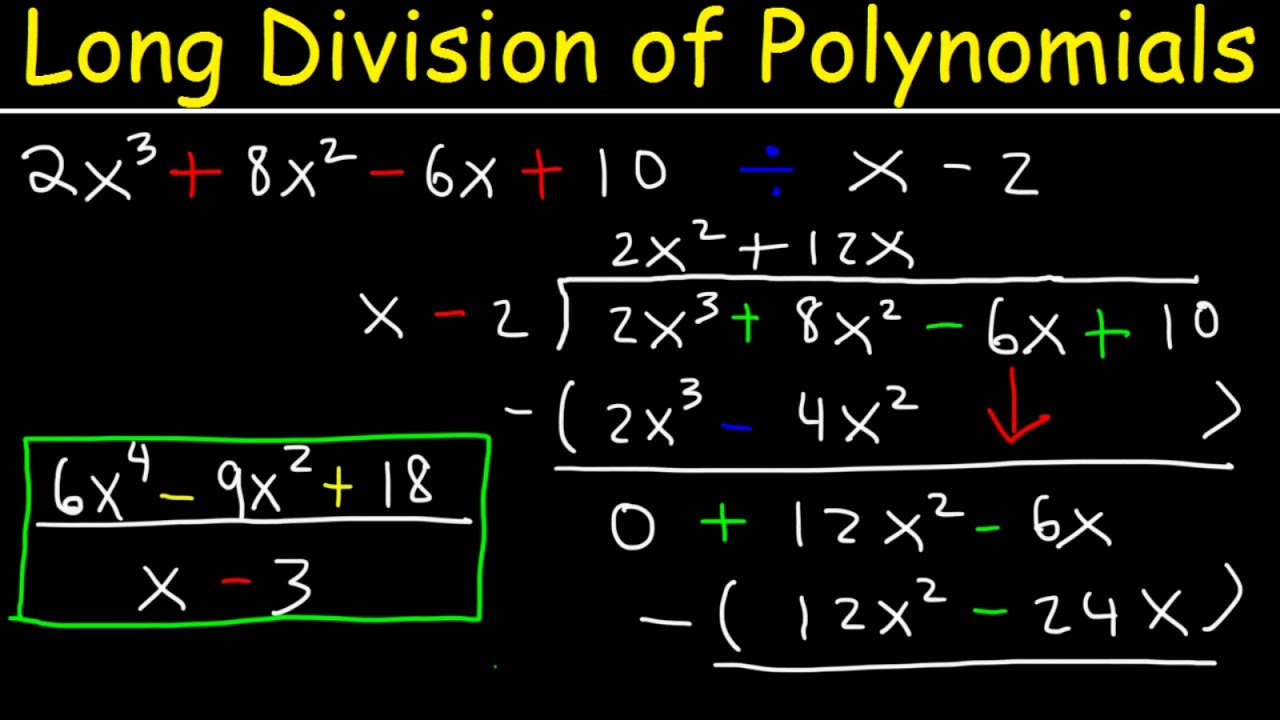
This video tutorial explains how to perform long division of polynomials with remainder and with missing terms.
Introduction to Polynomials: https://www.youtube.com/watch?v=Rxx4HepHI_E
Polynomials - Basic Operations:
https://www.youtube.com/watch?v=ZvL9aDGNHqA
Dividing Polynomials By Mo...
Here
sinful thistle
ah u sniped me
marsh citrusBOT
@buoyant lake Has your question been resolved?
Channel closed
Closed by @buoyant lake
Use .reopen if this was a mistake.
buoyant lake
I understand
marsh citrusBOT
Available help channel!
Send your question here to claim the channel.
Remember:
• Ask your math question in a clear, concise manner.
• Show your work, and if possible, explain where you are stuck.
• After 15 minutes, feel free to ping <@&286206848099549185>.
• Type the command .close to free the channel when you're done.
• Be polite and have a nice day!
Read #❓how-to-get-help for further information on how to ask a good question, and about conduct in the question channels.
 brisk totem
What’s going on here and why is the u sub on the left now working

 fervent rampart
1/4 + C (where C is an arbitrary constant) is another arbitrary constant
brisk totem
So they do both work?
Anytime I have a constant in my work I can just throw it into the C?
I thought it’s a determined constant though
C is undetermined
1/4 is like a core component of it
Why no
glass silo
Because it doesn't really matter if there's an additional 1/4 (or whatever other constant), you can just relabel it
brisk totem
But if we didn’t merge them, and C was 5, we would get a different result wouldn’t we?
fervent rampart
we usually take the position that C can be any constant, so you can end up with a "different" C. The constant is usually determined by the value of the function at some point anyway (e.g. if you know F(0) = 5, then C = 5 for one and C = 4.75 for the other, and in either case you end up with + 5 at the end of the integral)
brisk totem
I see
So the 1/4 existing in F wouldn’t change anything because C would just adjust to whatever it needs to be
fervent rampart
yes. which is why we usually would just "absorb" the 1/4 into the +C (even though it's a different constant, it still represents adding an arbitrary constant)
marsh citrusBOT
Channel closed
Closed by @brisk totem
Use .reopen if this was a mistake.
Available help channel!
Send your question here to claim the channel.
Remember:
• Ask your math question in a clear, concise manner.
• Show your work, and if possible, explain where you are stuck.
• After 15 minutes, feel free to ping <@&286206848099549185>.
• Type the command .close to free the channel when you're done.
• Be polite and have a nice day!
Read #❓how-to-get-help for further information on how to ask a good question, and about conduct in the question channels.
 scarlet comet
I need to model an ellipse equation that touches (0, 8) and (12.5, 8) and the top of the ellipse must be at (6.25, k) where 15<k<20, but the ellipse cannot touch the two lines shown. I am lost on how to make the ellipse not touch the lines.
 marsh citrusBOT
scarlet comet
I need to model an ellipse equation that touches (0, 8) and (12.5, 8) and the to...
marsh citrusBOT
scarlet comet
I need to model an ellipse equation that touches (0, 8) and (12.5, 8) and the to...
 limber marsh
I don't think that's possible?
Not with your restrictions on k
Can we have some more context?
scarlet comet
Um this is a practise test, and i got told that the top of the ellipse must be above y=15
My friends said something about putting the centre of the ellipse below the y-axis, but im unsure how to work from there
scarlet comet
How do you know that it is maybe possible?
limber marsh
scarlet comet
Um this is a practise test, and i got told that the top of the ellipse must be a...
Are you sure it has to be below 20?
The main issue is that you can't go over 20
scarlet comet
The context was the two lines are a roof, and the ellipse must be below the roof and the roofs top is at (6.25,20)
limber marsh
Are you sure the ellipse has to go through 0,8 and 12.5,8?
scarlet comet
Yeah
scarlet comet
I mean maybe i remembered the question wrong because I left my book in my locker but I think those were the correct details
limber marsh
A parabola would work better
scarlet comet
Yeah the parabola is easier, but the task was we had to model both an ellipse and parabola equation that met the requirements
sand fable
scarlet comet
Um this is a practise test, and i got told that the top of the ellipse must be a...
who said this?
scarlet comet
That was one of the requirements of the question
sand fable
doing some calculation it seems the highest possible height of the ellipse given those conditions is y = 14
scarlet comet
Can I ask how you were able to know that?
sand fable
set up an ellipse in form (x - 6.25)^2 / a^2 + (y - h)^2 / b^2 = 1
solved a system of equations relating the conditions that the ellipse passes through (0, 8) and it doesn't go above y = 12/6.25 x + 8
the end result in my work is that |h| + 14 > |b|, which seems to contradict the problem
*specifically |h| + 14 - |b| ~ 0
scarlet comet
Wait let me ask my friend about the measurements then, because I probably got them wrong 😦
I dont think my teacher would give a problem that couldnt be solved
sand fable
hm
 sand fable
yeah that makes a lot more sense
well at least it looks like your problem is resolved
scarlet comet
I just tried to get the closest thing
But I still have trouble of how i would get to this point
sand fable
like an exact answer?
scarlet comet
Yeah
sand fable
what class are you in?
sand fable
alright go figure
scarlet comet
year 13
sand fable
so there's a few things you want to do
using your equation of an ellipse, make use of the conditions that:
- it passes through (0, 12.5)
- it has slope 7.5/6.25 at x = 0
the first condition can be resolved by plugging in the point (0, 12.5)
the second condition can be resolved by implicitly differentiating the ellipse and plugging in the point (0, 12.5)
scarlet comet
ill try that
sand fable
🎉
scarlet comet
With the general equation of a vertical ellipse, how do I find all a,b and k by just doing those two things though?
limber marsh
It's sufficient
You already know the x coordinate of the center
sand fable
scarlet comet
With the general equation of a vertical ellipse, how do I find all a,b and k by ...
you don't
you end up with 2 equations with 3 variables
but these conditions aren't strict by any means so you can just say a = 25 or something and then solve for the other 2 variables
which gives you a valid example of an ellipse that fulfills the problem requirements
marsh citrusBOT
Channel closed
Closed by @scarlet comet
Use .reopen if this was a mistake.
marsh citrusBOT
Available help channel!
Send your question here to claim the channel.
Remember:
• Ask your math question in a clear, concise manner.
• Show your work, and if possible, explain where you are stuck.
• After 15 minutes, feel free to ping <@&286206848099549185>.
• Type the command .close to free the channel when you're done.
• Be polite and have a nice day!
Read #❓how-to-get-help for further information on how to ask a good question, and about conduct in the question channels.
 humble granite
dr is the difference in radius. How do smaller and smaller dr help to make a better approximation of circle?
 marsh citrusBOT
humble granite
dr is the difference in radius. How do smaller and smaller dr help to make a be...
humble granite
marsh citrusBOT
humble granite
dr is the difference in radius. How do smaller and smaller dr help to make a be...
humble granite
I am referring to this video : https://youtu.be/WUvTyaaNkzM?si=-LNhOuTPzsmP6L0_

What might it feel like to invent calculus?
Help fund future projects: https://www.patreon.com/3blue1brown
An equally valuable form of support is to simply share some of the videos.
Special thanks to these supporters: http://3b1b.co/lessons/essence-of-calculus#thanks
In this first video of the series, we see how unraveling the nuances of a simp...
limber marsh
Because when you unroll the hollow circle into a rectangle, you're not actually preserving the area of the hollow circle
You're just approximating it
As dr gets smaller and smaller
The more accurate the approximation is
humble granite
limber marsh
Because when you unroll the hollow circle into a rectangle, you're not actually ...
Could you please watch the video till 4 min? I think I didn't provide enough context.
humble granite
humble granite
I am referring to this video : https://youtu.be/WUvTyaaNkzM?si=-LNhOuTPzsmP6L0_
this one
limber marsh
Oh, you're on the first video
humble granite
yeah
limber marsh
Still, my previous answer stands
humble granite
limber marsh
Because when you unroll the hollow circle into a rectangle, you're not actually ...
which hollow circle?
limber marsh
humble granite
dr is the difference in radius. How do smaller and smaller dr help to make a be...

Didn't know what else to call it
humble granite
they called it a ring.
limber marsh
Still, whatever I call it by, my answer stands
As dr gets smaller the area approximation of the ring is more accurate
humble granite
why though?
limber marsh
Because when you unroll the ring it really isn't a rectangle
It's just close to a rectangle
humble granite
so how does smaller dr help make better approximation of area of that ring?
limber marsh
I can prove it to you, but the explanation would probably be kinda useless to you
humble granite
should i just assume it?
limber marsh
At this point yeah,
Grant isn't going into depth bc for the first video he's just trying to do more of an overview of where you're going
Besides, I'd probably use limits to prove this
Which I'm not sure if you know yet
humble granite
In the video, he says "The top and bottom sides of this shape are getting closer and closer to being exactly the same length."
Do you know what this means?
limber marsh
humble granite
In the video, he says "The top and bottom sides of this shape are getting closer...
Of the rectangle you made from the ring
humble granite
limber marsh
Besides, I'd probably use limits to prove this
Which I'm not sure if you know y...
I do know limits.
limber marsh
humble granite
I do know limits.

Here's proof
Make of it what you will
Needed to use l'hôpital's
marsh citrusBOT
Channel closed
Closed by @humble granite
Use .reopen if this was a mistake.
limber marsh
Awesome
marsh citrusBOT
Available help channel!
Send your question here to claim the channel.
Remember:
• Ask your math question in a clear, concise manner.
• Show your work, and if possible, explain where you are stuck.
• After 15 minutes, feel free to ping <@&286206848099549185>.
• Type the command .close to free the channel when you're done.
• Be polite and have a nice day!
Read #❓how-to-get-help for further information on how to ask a good question, and about conduct in the question channels.
 austere pulsar
Hey, so I had this random idea to take apart exp(ix) with euler's formula and then do a series expansion for the cosine and sine term. So once I had that, I could put the i from the Imaginary part of the formula into the series because it's a constant. Then I had to summs which i could add together because they had the same limits (n=0 -> infinity). So I had one series for exp(ix), then i put the i back out because it's still constant and I pugged pi into x. So you can imagine it as follows: exp(ipi)=iK, K being my series that i found. So now i knew that my series had to be equal to i, because exp(ipi)=-1 and the only thing multipled by i which is equal to -1 is i! So now I have an expression for i in terms of real numbers... Is this right what I did? I would show my work, but it's so messy I would have to find the important parts myself:/
marsh citrusBOT
austere pulsar
Hey, so I had this random idea to take apart exp(ix) with euler's formula and th...
 devout mauve
then sort through your work first?


 devout mauve
austere pulsar
devout mauve
austere pulsar
that converges to -1
austere pulsar
how?
devout mauve
wolframalpha
austere pulsar
oh..
That's helpful give me 1 sec
Ok, but I took out the i, so wouldn't that imply that exp(ipi)=-i?
Sorry, I'm thinking..
Yeah, it does converge to -1, but it shouldn't:( I'll check my steps again
marsh citrusBOT
@austere pulsar Has your question been resolved?
Channel closed
Closed by @austere pulsar
Use .reopen if this was a mistake.
Available help channel!
Send your question here to claim the channel.
Remember:
• Ask your math question in a clear, concise manner.
• Show your work, and if possible, explain where you are stuck.
• After 15 minutes, feel free to ping <@&286206848099549185>.
• Type the command .close to free the channel when you're done.
• Be polite and have a nice day!
Read #❓how-to-get-help for further information on how to ask a good question, and about conduct in the question channels.
 outer ibex
Guys do we omit the first solution, because I was under the impression that cot of 0 would be undefined
marsh citrusBOT
outer ibex
Guys do we omit the first solution, because I was under the impression that cot ...
 marsh citrusBOT
@outer ibex Has your question been resolved?
marsh citrusBOT
@outer ibex Has your question been resolved?
Channel closed
Closed by @outer ibex
Use .reopen if this was a mistake.
Available help channel!
Send your question here to claim the channel.
Remember:
• Ask your math question in a clear, concise manner.
• Show your work, and if possible, explain where you are stuck.
• After 15 minutes, feel free to ping <@&286206848099549185>.
• Type the command .close to free the channel when you're done.
• Be polite and have a nice day!
Read #❓how-to-get-help for further information on how to ask a good question, and about conduct in the question channels.
 acoustic storm
Hello. I know I have gone wrong here since the correct answer is supposed to be 1/9. But I can't figure out where I've made my mistake
 marsh citrusBOT
acoustic storm
Hello. I know I have gone wrong here since the correct answer is supposed to be ...
still temple
marsh citrusBOT
acoustic storm
Hello. I know I have gone wrong here since the correct answer is supposed to be ...
still temple
Step 1
 worn sluice
Hello @acoustic storm
still temple
Why write 1^2/3 unnecessarily
acoustic storm
still temple
Why write 1^2/3 unnecessarily
yea, true, its redundant
worn sluice
Can you please explain why didn't you keep -27 in brackets?
You have to keep it in brackets
worn sluice
Because it is also being raised to the power
worn sluice
acoustic storm
so its -3 whole square
Yes
acoustic storm
$$(-3)^2$$
elfin berryBOT
Reuben
 worn sluice
1/(-3)^2 to be precise
marsh citrusBOT
Channel closed
Closed by @acoustic storm
Use .reopen if this was a mistake.
marsh citrusBOT
✅
acoustic storm
I get why you have to do that
but why can i not do this?

cause isnt $\frac{a}{-b} &= \frac{-a}{b}$
elfin berryBOT
Reuben
Compile Error! Click the  reaction for more information.
(You may edit your message to recompile.)
 still temple
acoustic storm
but why can i not do this?
still temple
acoustic storm
but why can i not do this?
That's 1/{(-1)^x × (27)^x}
acoustic storm
still temple
That's 1/{(-1)^x × (27)^x}
but if i multiply the numerator and denominator by $ (-1)^x $, wont it cancel out? leaving me with $$\frac{(-1)^x}{(27)^x}$$
 lucid zenith
surround the first (-1)^x in $
elfin berryBOT
Reuben
 worn sluice
elfin berry
**Reuben**
Compile Error! Click the <:errors:504266556054962196> reaction for mo...
worn sluice
elfin berry
**Reuben**
Compile Error! Click the <:errors:504266556054962196> reaction for mo...
Actually this is true
still temple
acoustic storm
but if i multiply the numerator and denominator by $ (-1)^x $, wont it cancel ou...
No
acoustic storm
lucid zenith
surround the first (-1)^x in $
thanks, im still new to LaTeX
still temple
Division cannot suddenly become multiplication
worn sluice
@acoustic storm the minus sign is also getting raised to the power
lucid zenith
elfin berry
**Reuben**
even if you do that, $(-1)^{\frac{2}{3}}\ne -1$
elfin berryBOT
kheerii
 acoustic storm
OH RIGHT, becauses you square it inside the radical
lucid zenith
sure
technically this wouldn't even be a real number due to the way it's written
but that works for your purpose
acoustic storm
alright, thanks. out of curioisity, why wouldnt it be real?
I know about complex numbers, but how would it be complex? since cbrt(-1) is -1 and (-1)^2 is 1
lucid zenith
you'd consider the primary root
$(-1)^{\frac{2}{3}}=(e^{i\pi})^{\frac{2}{3}}=e^{\frac{i2\pi}{3}$
elfin berryBOT
kheerii
Compile Error! Click the reaction for more information.
(You may edit your message to recompile.)
 acoustic storm
ah, alright
lucid zenith
acoustic storm
I know about complex numbers, but how would it be complex? since cbrt(-1) is -1 ...
cube root of -1 is not -1
if you're considering the primary root
if you consider the real root it is
acoustic storm
fair
acoustic storm
elfin berry
**kheerii**
so what would be the "proper" way to write this in order to achieve what I wish, the real root?
lucid zenith
what you said is fine
lucid zenith
acoustic storm
I know about complex numbers, but how would it be complex? since cbrt(-1) is -1 ...
^^
though the question isn't precise, I suppose it's asking you for the real root only
marsh citrusBOT
Channel closed
Closed by @acoustic storm
Use .reopen if this was a mistake.
lucid zenith
.reopen
marsh citrusBOT
✅
worn sluice
👀
lucid zenith
acoustic storm
I know about complex numbers, but how would it be complex? since cbrt(-1) is -1 ...
just so you know, the law you're using here is $$a^{bc}=(a^b)^c$$ which is not always correct
elfin berryBOT
kheerii
 worn sluice
what is the meaning of primary root tho?
acoustic storm
elfin berry
**kheerii**
alright, thanks. im not too worried about complex stuff since its an elementary AMC prep problem but yea
lucid zenith
the primary (or principle) root is the root which has the largest possible real part and non-negative imaginary part
acoustic storm
worn sluice
what is the meaning of primary root tho?
basically the positive root in simple terms
its the reason we dont say sqrt(16) = -4
worn sluice
Hmm thanks
lucid zenith
acoustic storm
basically the positive root in simple terms
sure, for positive numbers it corresponds to the positive root
acoustic storm
sqrt(16) implies we're looking for the primary root
yea, thats what my teacher taught me to define it as
im far from your math level haha
worn sluice
largest by magnitude?
lucid zenith
worn sluice
largest by magnitude?
all roots will have the same magnitude
acoustic storm
I also just realised I made my life way more difficult but oh well 🤦♂️
 lucid zenith
acoustic storm
I also just realised I made my life way more difficult but oh well 🤦♂️
lucid zenith
acoustic storm
I also just realised I made my life way more difficult but oh well 🤦♂️
yeah this is easier
acoustic storm
I just solved a de moivres theorem question, and its the exponent thing that got me, theres some irony in that
well, i think this is it then, thanks again
.close
marsh citrusBOT
Channel closed
Closed by @acoustic storm
Use .reopen if this was a mistake.
marsh citrusBOT
Available help channel!
Send your question here to claim the channel.
Remember:
• Ask your math question in a clear, concise manner.
• Show your work, and if possible, explain where you are stuck.
• After 15 minutes, feel free to ping <@&286206848099549185>.
• Type the command .close to free the channel when you're done.
• Be polite and have a nice day!
Read #❓how-to-get-help for further information on how to ask a good question, and about conduct in the question channels.
 lyric relic
!help
marsh citrusBOT
To ask for mathematics help on this server, please open your own help channel or help thread. See #❓how-to-get-help for instructions.
marsh citrusBOT
lyric relic
!help
lyric relic

how are you suppose to tell
if its going clockwise or counterclockwise
cuase it wouldnt matter where you go
still temple
it doesn't matter
lyric relic
it does matter
because the answer are 4 multiple hcoice
where its like -45 45
and the - or positive is determined whether its oging clockwise or counterclockwise
still temple
well
rotate it by each possible answer
and confirm
or look at it and figure it out
lyric relic
well
it doesnt matter
if you were to rotate it clockwise to a certain point
wont you end up with the pink triangle
if you were to rotate it counterclockwise to a certain point
wont you end up with the pink triangle
no?
lyric relic
wym find the amount
still temple
find the rotation
marsh citrusBOT
If you are done with this channel, please mark your problem as solved by typing .close
@lyric relic Has your question been resolved?
marsh citrusBOT
Channel closed
Closed due to timeout
Use .reopen if this was a mistake.
Available help channel!
Send your question here to claim the channel.
Remember:
• Ask your math question in a clear, concise manner.
• Show your work, and if possible, explain where you are stuck.
• After 15 minutes, feel free to ping <@&286206848099549185>.
• Type the command .close to free the channel when you're done.
• Be polite and have a nice day!
Read #❓how-to-get-help for further information on how to ask a good question, and about conduct in the question channels.
 opal smelt
Aye so imma 9th grader, im about to take math 2 next year. How could i study this summer and what subjects should i study
marsh citrusBOT
opal smelt
Aye so imma 9th grader, im about to take math 2 next year. How could i study thi...
 naive fox
Here is a problem. What is Math 2? We here are from different parts of the world so we might not be familiar with your curriculum
opal smelt
🤔type shi
opal smelt
naive fox
Here is a problem. What is Math 2? We here are from different parts of the world...
Ion even know 😂
marsh citrusBOT
@opal smelt Has your question been resolved?
marsh citrusBOT
Channel closed
Closed due to timeout
Use .reopen if this was a mistake.
Available help channel!
Send your question here to claim the channel.
Remember:
• Ask your math question in a clear, concise manner.
• Show your work, and if possible, explain where you are stuck.
• After 15 minutes, feel free to ping <@&286206848099549185>.
• Type the command .close to free the channel when you're done.
• Be polite and have a nice day!
Read #❓how-to-get-help for further information on how to ask a good question, and about conduct in the question channels.
 desert prairie

 marsh citrusBOT
desert prairie
desert prairie
marsh citrusBOT
desert prairie
desert prairie
can someone help me with this question please

this is what i did but its wrong and im looking at the answers and i dont get it
for b
 marsh citrusBOT
@desert prairie Has your question been resolved?
marsh citrusBOT
Channel closed
Closed by @desert prairie
Use .reopen if this was a mistake.
Available help channel!
Send your question here to claim the channel.
Remember:
• Ask your math question in a clear, concise manner.
• Show your work, and if possible, explain where you are stuck.
• After 15 minutes, feel free to ping <@&286206848099549185>.
• Type the command .close to free the channel when you're done.
• Be polite and have a nice day!
Read #❓how-to-get-help for further information on how to ask a good question, and about conduct in the question channels.
 sonic walrus
Can someone help me with this please?
I've gotten Option A. Do any other options match?
 marsh citrusBOT
sonic walrus
Can someone help me with this please?
I've gotten Option A. Do any other options...
sonic walrus
marsh citrusBOT
sonic walrus
Can someone help me with this please?
I've gotten Option A. Do any other options...
sonic walrus
I mean, the angle between Vector B and Vector C is the outer angle, right? and considering that the maximum angle in a quadrilateral is 360, 80+70+115 = 265, and 360-265 is 95
With this we can say that 180-95 = angle between vB and vC and that is 85degrees.
We can also say that Option B is false, becasue the angle between Vector A and Vector b = 180-115 = 65 degrees.
IDK how to calculatte option C or D, where i'm having the issue.
<@&286206848099549185>
sorry for the ping
help ;-;
<@&286206848099549185>
 cerulean cradle
What is the type of question?
sonic walrus
cerulean cradle
What is the type of question?
Multiple choice correct
cerulean cradle
Is it MCQ or True/False?
sonic walrus
Multiple Choice, and you can have more than one answer
sonic walrus
i wanna know how to solve them
Like i figured out A and B part, but idk how to calculate the C and D part
 fading furnace
the vectors values are independent of the angles, just follow the path that each one takes to see where it ends up. since they saying the vectors would be equivalent to another, just check to see if they end up in the same spot
cerulean cradle
I haven't dealt with vectors in quite a while now, so idk how exactly to explain it
cerulean cradle
fading furnace
the vectors values are independent of the angles, just follow the path that each...
Yup that's it. Bravo.
sonic walrus
So that would mean that option D is wrong because the end-points are different?
cerulean cradle
sonic walrus
So that would mean that option D is wrong because the end-points are different?
Yup
sonic walrus
Are we trying to see if the endpoints are different or are we trying to see if the path followed afterwards is different?
sonic walrus
cerulean cradle
Yup
Ah okay, so that means that the answer is Option A and Option C?
Thanks a lot guys
closing
.close
marsh citrusBOT
Channel closed
Closed by @sonic walrus
Use .reopen if this was a mistake.
marsh citrusBOT
Available help channel!
Send your question here to claim the channel.
Remember:
• Ask your math question in a clear, concise manner.
• Show your work, and if possible, explain where you are stuck.
• After 15 minutes, feel free to ping <@&286206848099549185>.
• Type the command .close to free the channel when you're done.
• Be polite and have a nice day!
Read #❓how-to-get-help for further information on how to ask a good question, and about conduct in the question channels.
 shadow iron
so i have this problem, and im really just not sure what to do at all, the things that i know how to do is find the volume of a sphere and then knowing the density is 1.1 i can find the mass of the cell
 marsh citrusBOT
shadow iron
so i have this problem, and im really just not sure what to do at all, the thing...
marsh citrusBOT
shadow iron
so i have this problem, and im really just not sure what to do at all, the thing...
 jaunty pendant
I guess you have to act as if the koala is made out of only cells
so if you know the mass of a cell, and the mass of a koala, you can calculate the amount of cells in the koala
marsh citrusBOT
@shadow iron Has your question been resolved?
shadow iron
so the mass is 6kg right
and using 4/3piR^3 gives you the volume
and then density is M/V = 1,1
so if plug those numbers in and find the mass per cell
jaunty pendant
yes
shadow iron
so looking at that problem what unit would the mass be?
jaunty pendant
first you calculate the mass of the cell, in grams
shadow iron
i’m pretty sure it was 2.5^-9
jaunty pendant
the easiest is to than convert the mass of the koala to grams
shadow iron
so 6 kg to g
jaunty pendant
yes
shadow iron
and then so that number divided by the mass of a cell
to figure out the amount of cells
jaunty pendant
yeah
marsh citrusBOT
Channel closed
Closed by @shadow iron
Use .reopen if this was a mistake.
marsh citrusBOT
Available help channel!
Send your question here to claim the channel.
Remember:
• Ask your math question in a clear, concise manner.
• Show your work, and if possible, explain where you are stuck.
• After 15 minutes, feel free to ping <@&286206848099549185>.
• Type the command .close to free the channel when you're done.
• Be polite and have a nice day!
Read #❓how-to-get-help for further information on how to ask a good question, and about conduct in the question channels.
 proper tiger
Is this correct? How should i proceed?
 marsh citrusBOT
proper tiger
Is this correct? How should i proceed?
proper tiger
marsh citrusBOT
proper tiger
Is this correct? How should i proceed?
proper tiger
Answer sheet:

 knotty trellis
proper tiger
knotty trellis
proper tiger
Huh didn't know that
Probably because i had that in school during the pandemic 💀
thanks tho
.close
marsh citrusBOT
Channel closed
Closed by @proper tiger
Use .reopen if this was a mistake.
marsh citrusBOT
Available help channel!
Send your question here to claim the channel.
Remember:
• Ask your math question in a clear, concise manner.
• Show your work, and if possible, explain where you are stuck.
• After 15 minutes, feel free to ping <@&286206848099549185>.
• Type the command .close to free the channel when you're done.
• Be polite and have a nice day!
Read #❓how-to-get-help for further information on how to ask a good question, and about conduct in the question channels.
 kind yew
hey, I need help. I need someone who is good in math and can explain me where the problem is.
this is the task: Can a number 44...41, whose decimal representation consists of an odd number of digits 4 followed by a digit 1, be a perfect square? I already solved it but they say there is a mistake
marsh citrusBOT
kind yew
hey, I need help. I need someone who is good in math and can explain me where th...
 viscid peak
how did you solve it?

 viscid peak
that should be 10^(2n)
 viscid peak
kind yew
thanks mate ❤️
viscid peak
kind yew
thanks mate ❤️
you're welcome
kind yew
just because of that mistake, I couldnt win a prize. shit happens
 ivory mica
i dont think your conclusion is wrong overall
i think the issue in your use of a square = sum of odds
while it believe in this specific case it can be justified with some more work, in general it may not. for instance 33 = 9 + 11 + 13
and so your square couldve been 1 + 3 + .. + 7 and instead of 1 + 3 + ... + 31 for instance
i would use difference of squares like this:
||let A = 2 * 10^n and B = 3k
then A^2 = B^2 + 31
so (A + B)(A - B) = 31
since A + B and A - B are both integers with A + B > A - B and 31 is prime we must have A + B = 31 and A - B = 1
so A = 16 and B = 15
but 10^n != 8 for any integer n||
kind yew
what I mean by that is for example: 1+3 = 4; 1+3+5 = 9; 1+3+5+7 = 16.... What I mean is not any odd number.
ivory mica
kind yew
ohhhhhhhhh, wait now I get you
cool glad i could help !
kind yew
its a nice way to slove this problem. ❤️ thank you amigo
With my high school knowledge, for me this is the only way I can solve this problem 😄
ivory mica
this type of difference of squares, prime factorisation thing comes up reasonably often so a good trick to have up ones sleeves
kind yew
yeah, youre right
well, I have another one (last one)
its about geometry. There is also a mistake, but I cant find it.


Task: Given is a parallelogram ABCD with diagonal intersection M
such that the circumcircle of the triangle ABM intersects the line AD at a point E different from A
point E which is different from A and the circumcircle of the triangle EMD intersects the
triangle BE at a point F different from E.
Show: The angles ACB and DCF are equal.
marsh citrusBOT
@kind yew Has your question been resolved?
marsh citrusBOT
@kind yew Has your question been resolved?
 lament crag
a
marsh citrusBOT
Channel closed
Closed due to timeout
Use .reopen if this was a mistake.
Available help channel!
Send your question here to claim the channel.
Remember:
• Ask your math question in a clear, concise manner.
• Show your work, and if possible, explain where you are stuck.
• After 15 minutes, feel free to ping <@&286206848099549185>.
• Type the command .close to free the channel when you're done.
• Be polite and have a nice day!
Read #❓how-to-get-help for further information on how to ask a good question, and about conduct in the question channels.
 verbal ibex
 marsh citrusBOT
verbal ibex
marsh citrusBOT
verbal ibex
 twilit grove
it should be 1 - x^(1/2) in parentheses, I think
marsh citrusBOT
Channel closed
Closed by @verbal ibex
Use .reopen if this was a mistake.
marsh citrusBOT
Available help channel!
Send your question here to claim the channel.
Remember:
• Ask your math question in a clear, concise manner.
• Show your work, and if possible, explain where you are stuck.
• After 15 minutes, feel free to ping <@&286206848099549185>.
• Type the command .close to free the channel when you're done.
• Be polite and have a nice day!
Read #❓how-to-get-help for further information on how to ask a good question, and about conduct in the question channels.
still temple
I already posted this and didn't get an answer over an hour ago, but the bot marked it as answered . This is kind of a silly question, but I am pretty sure my professor's answer is backward here. **Calc 2 center of mass of a planar lamina region. **In the notes the equations for x bar and y bar were swapped. So I think it's supposed to be (1/2, 8/5) not the other way around.
 marsh citrusBOT
still temple
I already posted this and didn't get an answer over an hour ago, but the bot mar...
marsh citrusBOT
still temple
I already posted this and didn't get an answer over an hour ago, but the bot mar...
@still temple Has your question been resolved?
still temple
<@&286206848099549185>
 novel anvil
The solution in the image is correct. It's (8/5, 1/2)
Btw, if you look at (1/2, 8/5) that point is outside of the area, which can't possibly be, since it's convex.
 novel anvil
Notice, the integrals here are calculated with respect to functions of x, and of y in the other image?
The appearant switch comes from taking the problem from two different sides
novel anvil
If you switch the roles of the coordinates, the equations for them get switched accordingly, yes
You can, btw reformulate the problem in terms of functions of x by using the inverse functions. If you do, you can then take the formulas from the other sheet to solve for the coordinates
(can, not can't , autocorrect got me)
still temple
Ok, that makes sense if you mean rewriting the equations to solve for y, but I'll just keep the switching in mind because it will be faster on a test. Thank you!
novel anvil
Your welcome
marsh citrusBOT
@still temple Has your question been resolved?
marsh citrusBOT
Channel closed
Closed due to timeout
Use .reopen if this was a mistake.
Available help channel!
Send your question here to claim the channel.
Remember:
• Ask your math question in a clear, concise manner.
• Show your work, and if possible, explain where you are stuck.
• After 15 minutes, feel free to ping <@&286206848099549185>.
• Type the command .close to free the channel when you're done.
• Be polite and have a nice day!
Read #❓how-to-get-help for further information on how to ask a good question, and about conduct in the question channels.
 rigid kelp
 marsh citrusBOT
rigid kelp
marsh citrusBOT
rigid kelp
 valid cape
well first off, do you know what a vertical asymptote is?
rigid kelp
yes
limber marsh
Do you know where they are visually?
rigid kelp
-3, -1 aand 2
valid cape
aight nice
limber marsh
Then your equations are x=-3, x=-1 etc
limber marsh
Not a vertical asymptote, so doesn't matter
rigid kelp
limber marsh
Not a vertical asymptote, so doesn't matter
at 2
its neg and pos
x = 2
limber marsh
Oh that
That's an asymptote yeah
Doesn't change the answer
marsh citrusBOT
Channel closed
Closed by @rigid kelp
Use .reopen if this was a mistake.
marsh citrusBOT
Available help channel!
Send your question here to claim the channel.
Remember:
• Ask your math question in a clear, concise manner.
• Show your work, and if possible, explain where you are stuck.
• After 15 minutes, feel free to ping <@&286206848099549185>.
• Type the command .close to free the channel when you're done.
• Be polite and have a nice day!
Read #❓how-to-get-help for further information on how to ask a good question, and about conduct in the question channels.
lyric relic
!help
marsh citrusBOT
To ask for mathematics help on this server, please open your own help channel or help thread. See #❓how-to-get-help for instructions.
marsh citrusBOT
lyric relic
!help
lyric relic
i need help with defining transformation
for geometry
i dont understand any of the words
its like im reading chinese
 outer lodge
lyric relic
i need help with defining transformation
outer lodge
lyric relic
i need help with defining transformation
What transformations?
marsh citrusBOT
@lyric relic Has your question been resolved?
marsh citrusBOT
Channel closed
Closed due to timeout
Use .reopen if this was a mistake.
marsh citrusBOT
Available help channel!
Send your question here to claim the channel.
Remember:
• Ask your math question in a clear, concise manner.
• Show your work, and if possible, explain where you are stuck.
• After 15 minutes, feel free to ping <@&286206848099549185>.
• Type the command .close to free the channel when you're done.
• Be polite and have a nice day!
Read #❓how-to-get-help for further information on how to ask a good question, and about conduct in the question channels.
 frail lodge
 marsh citrusBOT
frail lodge
marsh citrusBOT
marsh citrusBOT
frail lodge
marsh citrusBOT
@frail lodge Has your question been resolved?
marsh citrusBOT
@frail lodge Has your question been resolved?
marsh citrusBOT
Channel closed
Closed due to timeout
Use .reopen if this was a mistake.
Available help channel!
Send your question here to claim the channel.
Remember:
• Ask your math question in a clear, concise manner.
• Show your work, and if possible, explain where you are stuck.
• After 15 minutes, feel free to ping <@&286206848099549185>.
• Type the command .close to free the channel when you're done.
• Be polite and have a nice day!
Read #❓how-to-get-help for further information on how to ask a good question, and about conduct in the question channels.
 dense hemlock
how does the form (x-h)^2=4p(y-k) work
marsh citrusBOT
dense hemlock
how does the form (x-h)^2=4p(y-k) work
dense hemlock
especially p
 stoic slate
U mean the direction?
dense hemlock
im just not sure what p does exactly
also chatgpt is wrong here right


since half the length is 12 and 14
not 6 and 7
marsh citrusBOT
@dense hemlock Has your question been resolved?
Channel closed
Closed by @dense hemlock
Use .reopen if this was a mistake.
Available help channel!
Send your question here to claim the channel.
Remember:
• Ask your math question in a clear, concise manner.
• Show your work, and if possible, explain where you are stuck.
• After 15 minutes, feel free to ping <@&286206848099549185>.
• Type the command .close to free the channel when you're done.
• Be polite and have a nice day!
Read #❓how-to-get-help for further information on how to ask a good question, and about conduct in the question channels.
 grizzled needle
how are the x intercepts -5 and -1 when if the signs reverse that'd have to make the diamond thing be how it is shown

 marsh citrusBOT
grizzled needle
how are the x intercepts -5 and -1 when if the signs reverse that'd have to make...
grizzled needle
marsh citrusBOT
grizzled needle
how are the x intercepts -5 and -1 when if the signs reverse that'd have to make...
grizzled needle
like this one for example i had to flip the signs and thats what the answer key had too

 grizzled needle
how are the x intercepts -5 and -1 when if the signs reverse that'd have to make...
grizzled needle
grizzled needle
how are the x intercepts -5 and -1 when if the signs reverse that'd have to make...
the one written on paper to be 5 and 1 for the results the top would have to be 5 and the bottom 6, not negatives it seems
grizzled needle
 quick moth
which is -(x+5)(x+1)
quick moth
which is -(x+5)(x+1)
damn u make that look easy, i see what you mean though
quick moth
I always pull out the negative from the leading value
grizzled needle
quick moth
Diamond method is a waste of time when the coefficient on a is 1
yea so i gotta use the quadratic formula ig, thats the other thing in my notes
quick moth
In my opinion it makes it easier
marsh citrusBOT
Channel closed
Closed by @grizzled needle
Use .reopen if this was a mistake.
Available help channel!
Send your question here to claim the channel.
Remember:
• Ask your math question in a clear, concise manner.
• Show your work, and if possible, explain where you are stuck.
• After 15 minutes, feel free to ping <@&286206848099549185>.
• Type the command .close to free the channel when you're done.
• Be polite and have a nice day!
Read #❓how-to-get-help for further information on how to ask a good question, and about conduct in the question channels.
marsh citrusBOT
elfin berryBOT
dice

 fathom ridge
 quick moth
I would just use Desmos
fervent rampart
there isn't a nice, closed-form solution method for this
elfin berryBOT
dice
 lucid zenith
 vale jacinth
its just x= -1/4
vale jacinth
its just x= -1/4
No it isn’t
There isn’t any way except guessing and checking
It’s probably some power of 2
vale jacinth
waat
lucid zenith
,w 1/x=256^x
elfin berryBOT

 Requested by shikhargupta1207
lucid zenith
Requested by shikhargupta1207
lucid zenith
Yeah it’s 1/4
elfin berryBOT
kheerii
 lucid zenith
$2^{-n}=2^{2^{n+3}}$
elfin berryBOT
kheerii
 lucid zenith
$-n=2^{n+3}$
elfin berryBOT
kheerii
 lucid zenith
From here $n=-2$ is an easy enough solution to guess, giving $x=2^{-2}=\frac1{4}$
elfin berryBOT
kheerii
 lucid zenith
If you draw the graph of y=1/x and y=256^x it’s clear they can only intersect once, so this is the only real solution
lucid zenith
Just substituted x=2^n
I might’ve skipped a few of the simplifications
x can be any positive number, 2^n is also always positive
Specifically I chose x=2^n as its pretty obvious that the answer is gonna be some power of 2
elfin berryBOT
dice

 brave spire
because we have 1/x
elfin berryBOT
dice
 vale jacinth
substract 2 in the lower out
take the lower 2 out
idk how to explain
take an example
2^x = 2^y
take the 2 out u get x = y
it works like that
it works with every number and letter
just gotta be the same lvl as the other one
^^
their bases r the same
idk abt that part tho
marsh citrusBOT
@still temple Has your question been resolved?
marsh citrusBOT
Channel closed
Closed due to timeout
Use .reopen if this was a mistake.
Available help channel!
Send your question here to claim the channel.
Remember:
• Ask your math question in a clear, concise manner.
• Show your work, and if possible, explain where you are stuck.
• After 15 minutes, feel free to ping <@&286206848099549185>.
• Type the command .close to free the channel when you're done.
• Be polite and have a nice day!
Read #❓how-to-get-help for further information on how to ask a good question, and about conduct in the question channels.
 spring tree
Find the exact value of $\frac{x^4-6x^3-2x^2+18x+23}{x^2-8x+15}$ when $x=\frac{13}{\sqrt{19+8\sqrt{3}}}$
marsh citrusBOT
spring tree
Find the exact value of $\frac{x^4-6x^3-2x^2+18x+23}{x^2-8x+15}$ when $x=\frac{1...
elfin berryBOT
babario
 spring tree
help with the question please
 loud kernel
!status
marsh citrusBOT
What step are you on?
1. I don't know where to begin.
2. I have begun but got stuck midway.
3. I got an answer but I was told that it's wrong.
4. I got an answer and would like my work checked.
5. I have a question about someone else's work/solution.
6. I have completed the problem and don't need help anymore. Thank you.
7. None of the above
- completely clueless
except for the fact that i can factorise the denominator to (x-5)(x-3), i cant even do anything with the numerator
 lofty gyro
on my first thought, i would try make the term in x='term' look neat first
i would like to help, but I'm going to work in 5mins
spring tree
ooof
spring tree
lofty gyro
on my first thought, i would try make the term in x='term' look neat first
how exactly, just rationalizing the denominator?
still doesnt look clean imo
lofty gyro
spring tree
how exactly, just rationalizing the denominator?
yea, mutiply the conjugate of the sqrt
expand the fraction by √(19-8√3)
loud kernel
first i would change 8√3 to a full √
then rationalise
then substitute
and it may be possible to simplify the expression so you can shorten it a bit before you substitute
lofty gyro
lofty gyro
expand the fraction by √(19-8√3)
next we can make
19-8√3= 16-2(4)(√3)+3
and make use of (a-b)² identity to simplify the expression
loud kernel
loud kernel
and it may be possible to simplify the expression so you can shorten it a bit be...
this is possible, it will make it like 10x easier, i will let you do it but if you need help with it lmk
spring tree
lofty gyro
expand the fraction by √(19-8√3)
what does this mean?
nvm turns out multipliying the sqrt of the conjugate turns it to sqrt(169) so the frac simplifies to be $\sqrt{19-8\sqrt3}$ hmm
elfin berryBOT
babario
 spring tree
so like you said = 4-sqrt(3)
spring tree
loud kernel
and it may be possible to simplify the expression so you can shorten it a bit be...
i tried and pretty sure aint a way to simplify
except for the denominator
spring tree
yea
loud kernel
that makes it easier than the original expression
did you rationalise the x value?
by doing
,tex $\frac{13}{\sqrt{19+8\sqrt{3}}} \cdot \frac{\sqrt{19 + 8\sqrt{3}}}{\sqrt{19 + 8\sqrt{3}}}
fr
spring tree
yea its just equal to $4-\sqrt3$
elfin berryBOT
babario

suds
Compile Error! Click the reaction for more information.
(You may edit your message to recompile.)
 loud kernel
4 - rt 3 on what?
spring tree
elfin berry
**babario**
i did it with sqrt of the conjugate, got it down to tiz
or biscuity did
spring tree
loud kernel
x^2 + 2x - 1 ((-20x + 38)/(x^2 - 8x +15))
hows tiz gonna help me tho
spring tree
loud kernel
its just easier to sub
srsly no other way?
its comp math
must hv some other trick to it
loud kernel
i dont think theres another way
what do you think you can do?
you've simplified both as far as they go, now its time to sub
sometimes you gotta do complicated math
otherwise all math would be easy
spring tree
right
yea its equal to 5
thanks
kinda anti-climactic theres no trick to it tho
feels so unsatisfying
.close
marsh citrusBOT
Channel closed
Closed by @spring tree
Use .reopen if this was a mistake.
marsh citrusBOT
Available help channel!
Send your question here to claim the channel.
Remember:
• Ask your math question in a clear, concise manner.
• Show your work, and if possible, explain where you are stuck.
• After 15 minutes, feel free to ping <@&286206848099549185>.
• Type the command .close to free the channel when you're done.
• Be polite and have a nice day!
Read #❓how-to-get-help for further information on how to ask a good question, and about conduct in the question channels.
 wary bluff
Need help with this question (Im assuming that we use Bayes theorem here)
 marsh citrusBOT
wary bluff
Need help with this question (Im assuming that we use Bayes theorem here)
wary bluff
marsh citrusBOT
wary bluff
Need help with this question (Im assuming that we use Bayes theorem here)
wary bluff
Lets say
P(single) = 0.4
P(paired) = 0.6
P(paired | single) = 0.71
P(single | single) = 0.29
P(paired | paired) = 0.74
P(single | paired) = 0.26
Idk whats next
marsh citrusBOT
@wary bluff Has your question been resolved?
 marsh citrusBOT
Channel closed
Closed by @wary bluff
Use .reopen if this was a mistake.
Available help channel!
Send your question here to claim the channel.
Remember:
• Ask your math question in a clear, concise manner.
• Show your work, and if possible, explain where you are stuck.
• After 15 minutes, feel free to ping <@&286206848099549185>.
• Type the command .close to free the channel when you're done.
• Be polite and have a nice day!
Read #❓how-to-get-help for further information on how to ask a good question, and about conduct in the question channels.
 nocturne wasp
I need help with trig
marsh citrusBOT
nocturne wasp
I need help with trig
nocturne wasp

 grave marten
make a sketch first of all
nocturne wasp
Idk what to do
All I got is the building that 110m
I think parallel lines are used
Given a sec
Giv me
grave marten
english isnt my first language so idk what an angle of depression is
 naive fox
grave marten
english isnt my first language so idk what an angle of depression is
naive fox
grave marten
english isnt my first language so idk what an angle of depression is
Theta here is the angle of depression.
 grave marten
ahhh
 nocturne wasp
Sure
grave marten
do u remember the unit circle
nocturne wasp
?
nocturne wasp
No I haven't learnt that yet I'm year 9 Australian Nsw
grave marten
ok nvm then
its trigonometry right
did u learn about the sin and cos of an angle yet ?
grave marten
alright