#help-27
1 messages · Page 461 of 1
 novel goblet
 devout snowBOT
novel goblet
Hi. May I know if two coins are flipped at the same time. What is the probabilit...
devout snowBOT
novel goblet
Hi. May I know if two coins are flipped at the same time. What is the probabilit...
 wicked turtle
novel goblet
Hi. May I know if two coins are flipped at the same time. What is the probabilit...
wicked turtle
novel goblet
Hi. May I know if two coins are flipped at the same time. What is the probabilit...
yes, that is correct, because each time you do the two-coin flip you get an independent outcome
novel goblet
wicked turtle
yes, that is correct, because each time you do the two-coin flip you get an inde...
I tried to draw out the possible outcomes where HT = "Head & Tail", HH = "Head & Head", TT = "Tail & Tail"
Possibility 1: HT HT HT
Possibility 2: HT HT HH
Possibility 3: HT HT TT
Possibility 4: HT HH HT
Possibility 5: HT HH HH
Possibility 6: HT HH TT
Possibility 7: HT TT HT
Possibility 8: HT TT HH
Possibility 9: HT TT TT
Possibility 10: HH HT HT
Possibility 11: HH HT HH
Possibility 12: HH HT TT
Possibility 13: HH HH HT
Possibility 14: HH HH HH
Possibility 15: HH HH TT
Possibility 16: HH TT HT
Possibility 17: HH TT HH
Possibility 18: HH TT TT
Possibility 19: TT HT HT
Possibility 20: TT HT HH
Possibility 21: TT HT TT
Possibility 22: TT HH HT
Possibility 23: TT HH HH
Possibility 24: TT HH TT
Possibility 25: TT TT HT
Possibility 26: TT TT HH
Possibility 27: TT TT TT
Why the probability isnt 1/27?
wicked turtle
because those possibilities don't all have the same probability
 next granite
novel goblet
I tried to draw out the possible outcomes where HT = "Head & Tail", HH = "Head &...
next granite
novel goblet
I tried to draw out the possible outcomes where HT = "Head & Tail", HH = "Head &...
Because these scenarios don’t have equal probabilities of happening
wicked turtle
possibility 1 is the most likely because each HT is more likely than HH or TT
if you want to do it that way you have to distinguish between HT and TH, then all four of HH, TT, HT, and TH will have the same probability (1/4) and there are 64 different possibilities for three trials, instead of 27
 ruby citrus
novel goblet
I tried to draw out the possible outcomes where HT = "Head & Tail", HH = "Head &...
ruby citrus
novel goblet
I tried to draw out the possible outcomes where HT = "Head & Tail", HH = "Head &...
this is definitely an overcomplication of the problem. there's no need to do this!
each of the three trials is independent, correct?
the original solution of 0.5^3 was right
wicked turtle
I assume he was hoping to cross-check that solution with a more brute-force approach and was confused why they didn't agree
novel goblet
wicked turtle
I assume he was hoping to cross-check that solution with a more brute-force appr...
That's right
wicked turtle
if you distinguish between HT and TH then there are 64 total possible outcomes which are equally likely, of which 8 consist only of HT and/or TH
so that gives a probability of 8/64 = 1/8, consistent with the other argument
novel goblet
I see
novel goblet
novel goblet
I tried to draw out the possible outcomes where HT = "Head & Tail", HH = "Head &...
If all the probability of all the 27 possibilities here are added up together I will get 1.00 right?
devout snowBOT
Channel closed
Closed by @novel goblet
Use .reopen if this was a mistake.
 Available help channel!
Send your question here to claim the channel.
Remember:
• Ask your math question in a clear, concise manner.
• Show your work, and if possible, explain where you are stuck.
• After 15 minutes, feel free to ping <@&286206848099549185>.
• Type the command .close to free the channel when you're done.
• Be polite and have a nice day!
Read #❓how-to-get-help for further information on how to ask a good question, and about conduct in the question channels.
 restive river
I need to find the area of the surface obtained by rotating the curve about the x-axis. However, I don't know how to solve the integral 😦
Sorry if I'm not clear, English is not my first language.

 devout snowBOT
restive river
I need to find the area of the surface obtained by rotating the curve about the ...
devout snowBOT
restive river
I need to find the area of the surface obtained by rotating the curve about the ...
@restive river Has your question been resolved?
wicked turtle
sen = sine?
restive river
yep
wicked turtle
what happens if you substitute $u = \pi \cos(\pi x)$?
 woven radishBOT
OurBelovedBungo
 restive river
Mmm
du = cos(pix) + xsin(pi*x)*pi dx
?
No
Wait
xd
du = -sin(pi * x) * (pi)^2
Right?
devout snowBOT
@restive river Has your question been resolved?
 narrow plank
@restive river Try writing this out neatly on a sheet of paper and show us where you are
 restive river
narrow plank
<@456226577798135808> Try writing this out neatly on a sheet of paper and show u...
restive river
narrow plank
<@456226577798135808> Try writing this out neatly on a sheet of paper and show u...
Is it clear?
narrow plank
Looks good to me - don't forget the bounds when you make the trig sub
devout snowBOT
@restive river Has your question been resolved?
devout snowBOT
Channel closed
Closed due to timeout
Use .reopen if this was a mistake.
devout snowBOT
Available help channel!
Send your question here to claim the channel.
Remember:
• Ask your math question in a clear, concise manner.
• Show your work, and if possible, explain where you are stuck.
• After 15 minutes, feel free to ping <@&286206848099549185>.
• Type the command .close to free the channel when you're done.
• Be polite and have a nice day!
Read #❓how-to-get-help for further information on how to ask a good question, and about conduct in the question channels.
 timber pebble
so working on $\int _C z^{\alpha -1} \dd z$ along the unit circle
woven radishBOT
jan Niku (Shuri for Honorable)
 timber pebble
my instructor has told us to place a branch cut at $theta_0$ and integrate from $\theta _0 \leq \theta \leq \theta _0 + 2 \pi$
this doesnt make sense right
woven radishBOT
jan Niku (Shuri for Honorable)
 timber pebble
since were gonna land on the branch cut twice
timber pebble
okay
so its just 0 then
unless some weirdness happens in the non integer case
ill have to check
does it 
this should be fine right
i dont understand the point of this problem
timber pebble
 pseudo basin
no, we start at the cut and end at the cut
pseudo basin
no, we start at the cut and end at the cut
any chance you can confirm there is nothing special about this problem the way it is stated  im sorry to ping
im just anxious im missing the point
 timber pebble
? why not
timber pebble
oh well
timber pebble
i mean i say its 0 because this is what our teacher gave us in class
timber pebble
this problem has a note to refer to an example we did in class
which states its 0 if alpha is an integer
but then
pseudo basin
$\int_{\theta_0}^{\theta_0+2\pi} \exp(i(\alpha-1)t) ie^{it} \dd{t}$
woven radishBOT
Ann

 placid rover
yes that is quite very important
timber pebble
woven radish
**Ann**
sure
placid rover
funny things happen when alpha = 0. But since it isn't then ^
woven radishBOT
jan Niku (Shuri for Honorable)
 pseudo basin
from theta_0 to theta_0+2pi
timber pebble
yea
and since i guess its okay to be on the branch cut as long as we dont cross it
which im still nervous about
but then this is zero
why is it special if alpha is an integer or not
pseudo basin
is it really zero
 pseudo basin
the antideriv is $\alpha^{-1}e^{i\alpha \theta}$
woven radishBOT
Ann
 timber pebble
i mean if by the whole we can be on the branch cut thing then $e^{i \alpha \theta } = e^{i \alpha (\theta + 2 \pi}$
woven radishBOT
jan Niku (Shuri for Honorable)
 timber pebble
it gets eaten
by integration
so we stack a bunch of curves
oh is the problem that
so wait if alpha isnt an integer
we are racking up values
placid rover
I'm confused what you're describing
placid rover
I would rather talk about this in terms of the algebra
timber pebble
on the entire inner region
placid rover
Since it is relatively simple. . .
timber pebble
what algebra?
placid rover
You convert to polar form.
timber pebble
sure
placid rover
Then integrate as shown above.
timber pebble
right
you get to $\frac 1 \alpha e^{i \alpha \theta} \bigg \vert _{\theta _0} ^{\theta _0 + 2 \pi}$
placid rover
You apply the fundamental thm of calculus
woven radishBOT
jan Niku (Shuri for Honorable)
 pseudo basin
woven radish
**jan Niku (Shuri for Honorable)**
pseudo basin
woven radish
**jan Niku (Shuri for Honorable)**
no
timber pebble
depending on values of alpha
pseudo basin
thats the point
at the end you will have $\alpha^{-1} e^{i\alpha\theta_0} (e^{2\pi i \alpha} - 1)$
woven radishBOT
Ann
 placid rover
(Now I'm confused --- is this thing not 0, as long as alpha neq 0 ?????????????????)
timber pebble
huh?
placid rover

Thisis the antid
And we evaluate it at theta = 2pi
and evaluate it at theta = 0
and subtract? or did I miss something
pseudo basin
it is 0 precisely when α ∈ Z \ {0}
timber pebble
what if alpha is 3/2
placid rover

pseudo basin
we evaluate at $\theta = \theta_0$ and $\theta = \theta_0 + 2\pi$
woven radishBOT
Ann
 woven radishBOT
jan Niku (Shuri for Honorable)
 placid rover
should be, im pretty sure
timber pebble
man im confused
pseudo basin
$\oint_{|z|=1} \sqrt{z} \dd{z}$
woven radishBOT
Ann
 pseudo basin
but yes this depends on where you take your branch cut
placid rover
Proceed as above with polar 🤔
pseudo basin
placid rover
and subtract? or did I miss something
i am doing exactly this btw
timber pebble
oh so
it is 0
but then why do some places say its not
this stuff is confusing as heck
so the point of the problem is it is always 0
and theres nothing special about alpha being an integer or not
placid rover
we are interested in the integer case because it is relevant to series expansions
 placid rover
That aside - branch cuts are certainly relevant
timber pebble
i mean you can find something like this

but this doesnt seem to align with me just doing it and feeling like its 0 but then
the branch cut should always be an an okay place right
it doesnt matter where theta _0 is
just that it connects branch points
which it will so fine
timber pebble
pseudo basin
are they really saying its always 0
its not always 0?
im trying to understand this
 pseudo basin
timber pebble
its not always 0?
pseudo basin
timber pebble
its not always 0?
yes! it's not always 0!
pseudo basin
we came full circle
placid rover
For a visualisation, I would recommend of thinking of 2 separate argand diagrams
One represents z. The other represents f(z) (in this case,its z^(alpha-1)).
pseudo basin
around a point-where-some-fuck-shit-happens
placid rover

To start with, an easy alpha would be like 3, 4.
f(z) = z^2 means as z goes around the unit circle, z^2 goes around twice
Then to have an idea of what the integral is... you have to sum up f(z) dz
Once you get your head around that (I would draw a small dz to check what f(z) dz looks like), consider what happens when alpha is non-integer
Hopefully you see the cancellation occuring when alpha is integer (not 0), but not in the other case. There will be some 'extra' that doesn't cancel
devout snowBOT
@timber pebble Has your question been resolved?
timber pebble
sorry driving will read
placid rover
np. And my explanation wasn't the best (I do not have a crystal clear picture in my head atm, myself), but hopefully it makes sense
I remember justifying what these integrals looked like geometrically before using this. (later, for the alpha = 0 case, I think a geometrical understanding of the answer is v. helpful)
timber pebble
placid rover
I remember justifying what these integrals looked like geometrically before usin...
i believe i think
devout snowBOT
@timber pebble Has your question been resolved?
devout snowBOT
Channel closed
Closed by @timber pebble
Use .reopen if this was a mistake.
Available help channel!
Send your question here to claim the channel.
Remember:
• Ask your math question in a clear, concise manner.
• Show your work, and if possible, explain where you are stuck.
• After 15 minutes, feel free to ping <@&286206848099549185>.
• Type the command .close to free the channel when you're done.
• Be polite and have a nice day!
Read #❓how-to-get-help for further information on how to ask a good question, and about conduct in the question channels.
 jade halo

 winged hazel
not really, the picture is insanely low quality, pretty much illegible lol
jade halo

Oops
The question is asking for the linearization L(x) of the function at a
And the equation is
$f(x) = (x^3)-(x^2)+3$
woven radishBOT
c0nc3ptsz
 winged hazel
What are you stuck with? You have what it is written on the third line at the left
just sub in your values of f(-2) and f'(-2) and simplify
jade halo
Yeah sorry I was lost on the (x-a) part
But I just solved it after watching a video 🙂
Probably should’ve started off with that before asking for help lol
Sorry about that
!!
.close
devout snowBOT
Channel closed
Closed by @jade halo
Use .reopen if this was a mistake.
Available help channel!
Send your question here to claim the channel.
Remember:
• Ask your math question in a clear, concise manner.
• Show your work, and if possible, explain where you are stuck.
• After 15 minutes, feel free to ping <@&286206848099549185>.
• Type the command .close to free the channel when you're done.
• Be polite and have a nice day!
Read #❓how-to-get-help for further information on how to ask a good question, and about conduct in the question channels.
 native pike
 devout snowBOT
native pike
devout snowBOT
native pike
 native pike
prove that G is the intersection of AF and DB
from what i understand, this isn't a geometry question
we're supposed to go full algebra with vector calculations
 supple knot
native pike
prove that G is the intersection of AF and DB
supple knot
native pike
prove that G is the intersection of AF and DB
You're just supposed to prove G intersects lines AF and DB? Or that their intersection bisects line CE?
native pike
we do know that it bisects CE
we need to proof that G is the intersection of AF and DB
supple knot
ooh that's harder
 devout snowBOT
@native pike Has your question been resolved?
native pike
i WISH
devout snowBOT
Channel closed
Closed due to timeout
Use .reopen if this was a mistake.
Available help channel!
Send your question here to claim the channel.
Remember:
• Ask your math question in a clear, concise manner.
• Show your work, and if possible, explain where you are stuck.
• After 15 minutes, feel free to ping <@&286206848099549185>.
• Type the command .close to free the channel when you're done.
• Be polite and have a nice day!
Read #❓how-to-get-help for further information on how to ask a good question, and about conduct in the question channels.
supple knot
devout snow
Use this command
devout snowBOT
Channel closed
Closed due to the original message being deleted
native pike
.reopen
devout snowBOT
Available help channel!
Send your question here to claim the channel.
Remember:
• Ask your math question in a clear, concise manner.
• Show your work, and if possible, explain where you are stuck.
• After 15 minutes, feel free to ping <@&286206848099549185>.
• Type the command .close to free the channel when you're done.
• Be polite and have a nice day!
Read #❓how-to-get-help for further information on how to ask a good question, and about conduct in the question channels.
native pike
.reopen
 mortal tusk
Hey I needed help on how to Evaluate the Riemann sum for: (x) = x − 6x, for 0 ≤ x ≤ 3
This has 6 subintervals, and I need to take these sample points from the right endpoint
devout snowBOT
mortal tusk
Hey I needed help on how to Evaluate the Riemann sum for: (x) = x − 6x, for 0 ≤ ...
mortal tusk
I have the first few steps completed I believe, but I think I got my answer "incorrectly" if that makes sense
I got the right values, but I got to it with the wrong method
 graceful cosmos
0.5[f(0.5) + f(1) + f(1.5) +...
mortal tusk
Yeah i got that part correct
Bc of 6 subintervals and 3 is maximum, 3/6 --> 0.5 intervals
up to 3

The areas were verified to be correct, but the method of getting them was wrong?
also the sum of the area needs to be 3 decimal places, but i got 26.25
devout snowBOT
@mortal tusk Has your question been resolved?
graceful cosmos
Are you sure x - 6x is typed correct? Odd way to write that
devout snowBOT
Channel closed
Closed due to timeout
Use .reopen if this was a mistake.
mortal tusk
graceful cosmos
Are you sure x - 6x is typed correct? Odd way to write that
.reopen
devout snowBOT
✅
devout snowBOT
@mortal tusk Has your question been resolved?
devout snowBOT
@mortal tusk Has your question been resolved?
devout snowBOT
Channel closed
Closed due to timeout
Use .reopen if this was a mistake.
Available help channel!
Send your question here to claim the channel.
Remember:
• Ask your math question in a clear, concise manner.
• Show your work, and if possible, explain where you are stuck.
• After 15 minutes, feel free to ping <@&286206848099549185>.
• Type the command .close to free the channel when you're done.
• Be polite and have a nice day!
Read #❓how-to-get-help for further information on how to ask a good question, and about conduct in the question channels.
restive river
 devout snowBOT
restive river
restive river
devout snowBOT
restive river
restive river
can someone help explain to me the continued ratio thing it makes no sense to me
devout snowBOT
@restive river Has your question been resolved?
 dusty violet
restive river
dusty violet
restive river
ok so
a:b = 3:5
b:c = 4:7
so now, if you notice
we may also think of ratios as division
a/b = 3/5
b/c = 4/7
in our first equation, we get 1/b = 3/5a => b = 5a/3
b/c = 4/7 => b = 4c/7
devout snowBOT
Channel closed
Closed due to timeout
Use .reopen if this was a mistake.
Available help channel!
Send your question here to claim the channel.
Remember:
• Ask your math question in a clear, concise manner.
• Show your work, and if possible, explain where you are stuck.
• After 15 minutes, feel free to ping <@&286206848099549185>.
• Type the command .close to free the channel when you're done.
• Be polite and have a nice day!
Read #❓how-to-get-help for further information on how to ask a good question, and about conduct in the question channels.
 ancient fractal
I’m having trouble with a proof, it says prove by contrapositive that if (x-2)^2 is odd then x is even
devout snowBOT
ancient fractal
I’m having trouble with a proof, it says prove by contrapositive that if (x-2)^2...
ancient fractal
So the contrapositive would be if x is odd then (x-2)^2 is even right
however when you sub in x = 2n+1 you get (x-2)^2= 4n^2 -4n+ 1 which is an odd integer?
ancient fractal
Maybe the question is asking to prove the statement false? have you ever seen something like that in an exam
this is an exam from last year i’m not currently in an exam situation
placid rover
the question is just erroneous.
devout snowBOT
Channel closed
Closed by @ancient fractal
Use .reopen if this was a mistake.
Available help channel!
Send your question here to claim the channel.
Remember:
• Ask your math question in a clear, concise manner.
• Show your work, and if possible, explain where you are stuck.
• After 15 minutes, feel free to ping <@&286206848099549185>.
• Type the command .close to free the channel when you're done.
• Be polite and have a nice day!
Read #❓how-to-get-help for further information on how to ask a good question, and about conduct in the question channels.
 shrewd raft
Hey, my question is: Can the area of a quadrilateral be calculated if only the four sides are given? If so how?
devout snowBOT
shrewd raft
Hey, my question is: Can the area of a quadrilateral be calculated if only the...
 copper mango
Probably
placid rover
Likely not.
Imagine 4 sticks whose ends are joined together. In most cases you can deform the area.
graceful cosmos
No. Think parallelograms. Squash them to have near 0 area
placid rover
^
copper mango
I'm pretty sure it's implied non-degenerate quadrilateral.
 serene mesa
shrewd raft
Hey, my question is: Can the area of a quadrilateral be calculated if only the...
serene mesa
shrewd raft
Hey, my question is: Can the area of a quadrilateral be calculated if only the...
Ruler and determination
shrewd raft
Under what conditions can I decide whether a quadrilateral exists if only four sides are given? (such as triangular inequality)
devout snowBOT
@shrewd raft Has your question been resolved?
devout snowBOT
@shrewd raft Has your question been resolved?
placid rover
copper mango
I'm pretty sure it's implied non-degenerate quadrilateral.
no but that's not the point
The area varies as you squash
and goes to 0
The area varying is the issue
devout snowBOT
Channel closed
Closed due to timeout
Use .reopen if this was a mistake.
Available help channel!
Send your question here to claim the channel.
Remember:
• Ask your math question in a clear, concise manner.
• Show your work, and if possible, explain where you are stuck.
• After 15 minutes, feel free to ping <@&286206848099549185>.
• Type the command .close to free the channel when you're done.
• Be polite and have a nice day!
Read #❓how-to-get-help for further information on how to ask a good question, and about conduct in the question channels.
 coarse current
can someone pls write me a grade 7 GCSE maths question
Non calculator pls
devout snowBOT
coarse current
can someone pls write me a grade 7 GCSE maths question
Non calculator pls
coarse current
I need practice
coarse current
I mean can u write me one to solve and if I get it wrong can u help me through it please
 shadow quest
Dont you have homework from your teacher?
coarse current
Nope
He's taught us less than half the topics on the GCSE test we sit in 2 months
shadow quest
What is a gcse exam ?
coarse current
So I'm doing all my maths at home
coarse current
shadow quest
What is a gcse exam ?
uh the ones you do at 16
The end of high school ones in the uk
shadow quest
you want me to invent an exam for you ?
shadow quest
Do you have a manual ?
coarse current
nope?
shadow quest
Does he give you exercises ?
coarse current
shadow quest
Does he give you exercises ?
Rarely
 winter patrol
you should be able to find past papers
devout snowBOT
@coarse current Has your question been resolved?
devout snowBOT
Channel closed
Closed due to timeout
Use .reopen if this was a mistake.
devout snowBOT
Available help channel!
Send your question here to claim the channel.
Remember:
• Ask your math question in a clear, concise manner.
• Show your work, and if possible, explain where you are stuck.
• After 15 minutes, feel free to ping <@&286206848099549185>.
• Type the command .close to free the channel when you're done.
• Be polite and have a nice day!
Read #❓how-to-get-help for further information on how to ask a good question, and about conduct in the question channels.
 tawdry tiger
x=-b/2a
what if b is already negative, would it switch to positive?
copper mango
yes.
tawdry tiger
tysm!
devout snowBOT
@tawdry tiger Has your question been resolved?
Channel closed
Closed by @tawdry tiger
Use .reopen if this was a mistake.
Available help channel!
Send your question here to claim the channel.
Remember:
• Ask your math question in a clear, concise manner.
• Show your work, and if possible, explain where you are stuck.
• After 15 minutes, feel free to ping <@&286206848099549185>.
• Type the command .close to free the channel when you're done.
• Be polite and have a nice day!
Read #❓how-to-get-help for further information on how to ask a good question, and about conduct in the question channels.
 young birch
how do you curve sketch this function using calculus

 leaden aurora
Firstly
You figure out whether the curve is undefined
then look for any zeros
then any oblique asymptotes
then minimum/max
 glass mauve
Isn't that what a variation table is?
young birch
ye i know how to find the derivative and stuff
leaden aurora
what's a variation table
young birch
i just forgot what a function with the numerator one power over the denominator looks lie
leaden aurora
never heard of that
 steel sage
It’s an ellipse rotated
young birch
answer says theres an asymptote at y=x
but i forgot what kind of asymptote thats called
leaden aurora
y=x is oblique
young birch
oh
so all functions with the numerator one power above the denominator have an oblique asymptote?
leaden aurora
To find oblique asymptotes of functions of this sort
you carry out long division
you will get a quotient function
and a remainder
 steel sage
Just Diagonalize
(1 -1/2
-1/2 0)
leaden aurora
bro
steel sage
Then ignore it
young birch
i was just told to sketch the function using first and second derivative
just have a question about the symptote
asymptote
leaden aurora
To find asymptote, carry out the divison. You will get a function of the form $(x-a) + \frac{b}{x-1}$
woven radishBOT
azeem321
 leaden aurora
As x approaches positive and negative infinity
 leaden aurora
young birch
leaden aurora
young birch
Whatever method you know to divide polynomials will work
young birch
ight
leaden aurora
You can also do $x^2-3x+6= (x-1)(x-a) + b$ and compare the coefficients
woven radishBOT
azeem321
 young birch
so what is the answer in this case
glass mauve
why are you doing calc ingr 11
glass mauve
The easiest way is to take first derivitve and second derivitive and set up a variaton table
young birch
bro why is everyone saying variation table
is it like a sign chart?
are you american
leaden aurora
Jub, what are you even confused about at this point
young birch
why theres a diagonal asymptote
i learned it in grade 10 but i forgot
i just wanted to refresh my memory
glass mauve
young birch
is it like a sign chart?
yes
young birch
oh
leaden aurora
An asymptote occurs when the function approaches a line but never crosses it
well it can cross it
young birch
yes
leaden aurora
but dont worry about that for now
 devout snowBOT
Channel closed
Closed by @young birch
Use .reopen if this was a mistake.
Available help channel!
Send your question here to claim the channel.
Remember:
• Ask your math question in a clear, concise manner.
• Show your work, and if possible, explain where you are stuck.
• After 15 minutes, feel free to ping <@&286206848099549185>.
• Type the command .close to free the channel when you're done.
• Be polite and have a nice day!
Read #❓how-to-get-help for further information on how to ask a good question, and about conduct in the question channels.
 rugged shuttle
.reopen
 sturdy chasm
 devout snowBOT
sturdy chasm
sturdy chasm
devout snowBOT
sturdy chasm
sturdy chasm
How do I find the convergence of something with 2 alternating series
 deft wagon
you know about power laws?
devout snowBOT
Channel closed
Closed by @sturdy chasm
Use .reopen if this was a mistake.
deft wagon
np
devout snowBOT
Available help channel!
Send your question here to claim the channel.
Remember:
• Ask your math question in a clear, concise manner.
• Show your work, and if possible, explain where you are stuck.
• After 15 minutes, feel free to ping <@&286206848099549185>.
• Type the command .close to free the channel when you're done.
• Be polite and have a nice day!
Read #❓how-to-get-help for further information on how to ask a good question, and about conduct in the question channels.
 placid narwhal
The dragon has 2010 heads. A knight can cut off sections 2, 17, 21 or 33
heads, but after that the dragon grows new 9, 10, 0 or 47 heads in a row. Can at some point the knight cuts off all the dragon's heads?
devout snowBOT
placid narwhal
The dragon has 2010 heads. A knight can cut off sections 2, 17, 21 or 33
heads, ...
placid narwhal
import random

heads = 2010

while heads > 0:
	heads -= random.choice([2 , 17 , 21 , 33])
	heads += random.choice([9 , 10 , 0 , 47])

print("dragon dead")
Judging by code it is
But how do you prove it
Mathematically
 polar bolt
that is not what it is asking for is it?
placid narwhal
I think it is
polar bolt
its asking if the dragon can have the exact amount of heads left that the knight can cut off
placid narwhal
No its just asking if at one point dragon can loose all heads
 grizzled lantern
do you have the original question?
placid narwhal
placid narwhal
The dragon has 2010 heads. A knight can cut off sections 2, 17, 21 or 33
heads, ...
This is it
polar bolt
doubt it, but proof is dragon can grow 0 with non zero prob
placid narwhal
Edited a little so it makes sense translated
This is un edited
The dragon has 2010 heads. A knight can cut off sections 2, 17, 21 or 33 with one blow of a cat
heads, but after that the dragon grows new 9, 10, 0 or 47 heads in a row. Can u
At some point the knight cuts off all the dragon's heads?
Google translate is really bad
polar bolt
the answer is trivially yes if you read it like that, but I doubt this is the intended question
grizzled lantern
alternatively the reasoning could be that the expected value of heads cut of is greater than 1
take the avg of heads cut off and heads grown back since the are equally likely
polar bolt
that doesn't matter
placid narwhal
I mean i can manually translate it .
Dragon has 2010 heads. Knight can with 1 hit cut 2 , 17 , 21 or 33 heads , but after that dragon grows 9 , 10 , 0 or 47 heads in a row. Can knight at any point cut all dragons heads.
Maybe the catch is he grows like 1st round 9 then second 10 then 0 then 47
polar bolt
why would the Knight even have options then?
polar bolt
polar bolt
its asking if the dragon can have the exact amount of heads left that the knight...
.
grizzled lantern
I thought they were all equally likely random events
polar bolt
EV doesn't matter
grizzled lantern
why not
polar bolt
non zero-prob for event to happen where heads cut off+regained<0
so it will happen infinite amount of times
hence it will happen that dragon has less than 0 heads at some point
placid narwhal
I guess that could be the catch so the dragon must have left 2 , 17 , 21 or 33 heads
polar bolt
like I was saying, yes
grizzled lantern
polar bolt
non zero-prob for event to happen where heads cut off+regained<0
isn't that basically EV
polar bolt
no
EV of cut+regain dragon could be +10 heads
if one option is 0 then it will happen that the dragon loses all heads
as turns approaches inf
EV doesn't matter
placid narwhal
So i must prove that by adding 2 , 17 , 21 and 33 and subtracting 9 , 10 , 47 i can somehow get 2 , 17 , 21 or 33
From 2010*
placid narwhal
Oh ye
2010 , remove 2000 (2 * 1000) we get 10 add 47 remove 30 (2 * 15) and remove 17
Would that work?
I mean chances are low but that can theoretically happen
steel sage
placid narwhal
The dragon has 2010 heads. A knight can cut off sections 2, 17, 21 or 33
heads, ...
If you are asking for a possible situation , then yes, cut 2 grow 0 cut 2 grow 0…
But if the dragon want to live then no matter how knight does he grows 47 heads
devout snowBOT
@placid narwhal Has your question been resolved?
devout snowBOT
Channel closed
Closed due to timeout
Use .reopen if this was a mistake.
Available help channel!
Send your question here to claim the channel.
Remember:
• Ask your math question in a clear, concise manner.
• Show your work, and if possible, explain where you are stuck.
• After 15 minutes, feel free to ping <@&286206848099549185>.
• Type the command .close to free the channel when you're done.
• Be polite and have a nice day!
Read #❓how-to-get-help for further information on how to ask a good question, and about conduct in the question channels.
Channel closed
Closed due to the original message being deleted
Available help channel!
Send your question here to claim the channel.
Remember:
• Ask your math question in a clear, concise manner.
• Show your work, and if possible, explain where you are stuck.
• After 15 minutes, feel free to ping <@&286206848099549185>.
• Type the command .close to free the channel when you're done.
• Be polite and have a nice day!
Read #❓how-to-get-help for further information on how to ask a good question, and about conduct in the question channels.
 gritty comet
does rank need to equal number of rows for it to have a unique solution
devout snowBOT
gritty comet
does rank need to equal number of rows for it to have a unique solution
 proud notch
gritty comet
for a matrix
proud notch
gritty comet
for a matrix
rank = number of linearly independent rows = number of linearly independent columns
gritty comet
for example does the matrix 1 0
0 1
0 0
not have a unique solution if it was a homogenous system
@proud notch
what does linearly independent mean
 shadow terrace

In the theory of vector spaces, a set of vectors is said to be linearly dependent if there is a nontrivial linear combination of the vectors that equals the zero vector. If no such linear combination exists, then the vectors are said to be linearly independent. These concepts are central to the definition of dimension.A vector space can be of f...
It explains it in definition
gritty comet
@shadow terrace could you take a look at the example matrix I sent
shadow terrace
gritty comet
<@!195951898879066113> could you take a look at the example matrix I sent
Could you rephrase your question please
shadow terrace
I dont know too much linear algebra although (1, 0, 0) and (0, 1, 0) are linearly independent
gritty comet

say I have this as my homogenous matrix the number of rows is greater than rank but number of columns is equal to the rank
so does this matrix only have a unique solution
or is it infinite solutions
shadow terrace
I believe it would need a non zero determinant an afaik the row count must match the column count for determinant to be calculable
Could you elaborate what you mean by unique solution?
devout snowBOT
@gritty comet Has your question been resolved?
devout snowBOT
@gritty comet Has your question been resolved?
devout snowBOT
Channel closed
Closed due to timeout
Use .reopen if this was a mistake.
Available help channel!
Send your question here to claim the channel.
Remember:
• Ask your math question in a clear, concise manner.
• Show your work, and if possible, explain where you are stuck.
• After 15 minutes, feel free to ping <@&286206848099549185>.
• Type the command .close to free the channel when you're done.
• Be polite and have a nice day!
Read #❓how-to-get-help for further information on how to ask a good question, and about conduct in the question channels.
 warped plaza
Can somebody help me with this problem please?
 devout snowBOT
warped plaza
Can somebody help me with this problem please?
supple knot
devout snowBOT
warped plaza
Can somebody help me with this problem please?
supple knot
Did you already use a u-sub?
devout snowBOT
@warped plaza Has your question been resolved?
devout snowBOT
Channel closed
Closed due to timeout
Use .reopen if this was a mistake.
Available help channel!
Send your question here to claim the channel.
Remember:
• Ask your math question in a clear, concise manner.
• Show your work, and if possible, explain where you are stuck.
• After 15 minutes, feel free to ping <@&286206848099549185>.
• Type the command .close to free the channel when you're done.
• Be polite and have a nice day!
Read #❓how-to-get-help for further information on how to ask a good question, and about conduct in the question channels.
restive river
A 10-digit number M is 1 more than a square of another integer. Is it possible for all digits of M to be distinct?
could i solve this with mod 4?
M is either 1 or 2 mod 4
dont know if it helps
what other approaches could i take?
devout snowBOT
restive river
A 10-digit number M is 1 more than a square of another integer. Is it possible f...
restive river
anyone pls
devout snowBOT
@restive river Has your question been resolved?
restive river
bruh
restive river
.close
devout snowBOT
Channel closed
Closed by @royal saffron
Use .reopen if this was a mistake.
Available help channel!
Send your question here to claim the channel.
Remember:
• Ask your math question in a clear, concise manner.
• Show your work, and if possible, explain where you are stuck.
• After 15 minutes, feel free to ping <@&286206848099549185>.
• Type the command .close to free the channel when you're done.
• Be polite and have a nice day!
Read #❓how-to-get-help for further information on how to ask a good question, and about conduct in the question channels.
 rigid lodge
 devout snowBOT
rigid lodge
rigid lodge
devout snowBOT
rigid lodge
rigid lodge
What would be the equation for something like this?
I'm kinda neo detergent and forgot to write it down if it came up before
It's probably something obvious
Mean is 60, StanDev is 5
They give me some ones I can practice that I try and "reverse engineer" but idk about this one
I've been trying all kinds of funky combos
rigid lodge
rigid lodge
They give me some ones I can practice that I try and "reverse engineer" but idk ...
Like this one example that lets me see the answer, but whatever I try I can't seem to replicate it


This one guide seems to be wrong?
With the fake example, mean=90, StnDev=5
85-90/5 is -1
And 1 with 95

Not sure where I even go to get something with three decimal places
<@&286206848099549185>
devout snowBOT
@rigid lodge Has your question been resolved?
rigid lodge
Is there some kind of division trick I'm missing or some ^2?
Supposedly there's some kind of table I can check? But I can't find it
warped plaza
devout snow
<@870865355516551168> Has your question been resolved?
Not yet😩
devout snowBOT
@rigid lodge Has your question been resolved?
devout snowBOT
@rigid lodge Has your question been resolved?
devout snowBOT
@rigid lodge Has your question been resolved?
ruby citrus
rigid lodge
if you're still wondering what the answer is, (if you have the right type of calculator) you can use the normalcdf function with the arguments of mean, standard deviation, lower z-score and upper z-score to get the probability value you're looking for
Otherwise, your only feasible option is to use a lookup table or memorize ncdf values at certain standard deviations/z-scores
 copper fossil
is some work
 devout snowBOT
@rigid lodge Has your question been resolved?
supple knot
.close
devout snowBOT
Channel closed
Closed by @supple knot
Use .reopen if this was a mistake.
Available help channel!
Send your question here to claim the channel.
Remember:
• Ask your math question in a clear, concise manner.
• Show your work, and if possible, explain where you are stuck.
• After 15 minutes, feel free to ping <@&286206848099549185>.
• Type the command .close to free the channel when you're done.
• Be polite and have a nice day!
Read #❓how-to-get-help for further information on how to ask a good question, and about conduct in the question channels.
 muted blaze
I need help with this problem
 devout snowBOT
muted blaze
I need help with this problem
devout snowBOT
muted blaze
I need help with this problem
 exotic stump
what have you tried
 tall talon
muted blaze
I need help with this problem
tall talon
muted blaze
I need help with this problem
recall some properties of parallelogram (or just parallel lines in general)
devout snowBOT
@muted blaze Has your question been resolved?
devout snowBOT
Channel closed
Closed due to timeout
Use .reopen if this was a mistake.
Available help channel!
Send your question here to claim the channel.
Remember:
• Ask your math question in a clear, concise manner.
• Show your work, and if possible, explain where you are stuck.
• After 15 minutes, feel free to ping <@&286206848099549185>.
• Type the command .close to free the channel when you're done.
• Be polite and have a nice day!
Read #❓how-to-get-help for further information on how to ask a good question, and about conduct in the question channels.
 desert field
I need help on a calculus problem ,
 devout snowBOT
desert field
I need help on a calculus problem ,
desert field
devout snowBOT
desert field
I need help on a calculus problem ,
desert field
this is all i have so far

 near trout
let the side length of the triangle be s
find the area of the triangle in terms of s
then find the perimeter of the square in terms of s
from the perimeter you can get the side length, and so the area of the square as well
then add the area of the triangle to the area of the square to get total area
and find s for which the total area is minimised
desert field
ok lemme try
devout snowBOT
@desert field Has your question been resolved?
desert field
ok i found an equation what’s the next steps

<@&286206848099549185>
<@&286206848099549185>
.close
devout snowBOT
Channel closed
Closed by @desert field
Use .reopen if this was a mistake.
Available help channel!
Send your question here to claim the channel.
Remember:
• Ask your math question in a clear, concise manner.
• Show your work, and if possible, explain where you are stuck.
• After 15 minutes, feel free to ping <@&286206848099549185>.
• Type the command .close to free the channel when you're done.
• Be polite and have a nice day!
Read #❓how-to-get-help for further information on how to ask a good question, and about conduct in the question channels.
rigid lodge
@copper fossil sorry for the tag just hoping for some clarification
devout snowBOT
rigid lodge
<@!205143587749494784> sorry for the tag just hoping for some clarification
 copper fossil
the total probability of anything is 1
and that table does right tail probabilities
devout snowBOT
@rigid lodge Has your question been resolved?
rigid lodge
So a different example, same mean and StnDev, 45 and 75
-3 and 3 respectively
I just find "3.0" on that table, which is apparently .9987?
.9987 - .9987 - 1 - = -1
Which doesn't feel right

 rigid lodge
near trout
should be 1 - 0.9987 - 0.9987
rigid lodge
near trout
should be 1 - 0.9987 - 0.9987
-0.9974
near trout
no
rigid lodge
Not sure if negatives are allowed lol
near trout
0.9974
1 - 0.9987 - 0.9987 is positive
wait i'm a fool
ok look

ok for z = 3, the blue area here is 0.9987
so the white bit is 1 - 0.9987 = 0.0013
now, imagine there were two white bits
this is called a two-tailed case
like, one white bit on each side
mirror the white bit across the middle vertically
so then the remaining blue area would be 1 - 0.0013 - 0.0013
ignore what i said before, this is it
rigid lodge
Oh yeah on the page above there was something I missed too I guess

That sneaky -3.0 and .0013
Very good work @near trout 
devout snowBOT
@rigid lodge Has your question been resolved?
Channel closed
Closed by @rigid lodge
Use .reopen if this was a mistake.
Available help channel!
Send your question here to claim the channel.
Remember:
• Ask your math question in a clear, concise manner.
• Show your work, and if possible, explain where you are stuck.
• After 15 minutes, feel free to ping <@&286206848099549185>.
• Type the command .close to free the channel when you're done.
• Be polite and have a nice day!
Read #❓how-to-get-help for further information on how to ask a good question, and about conduct in the question channels.
devout snowBOT
 heady ibex
the sample size is 35, mean is 7.5 and the variance is 1.75 right?
heady ibex
i still use z score?
 ivory tapir
Yes but you use the sample SD
heady ibex
ivory tapir
Yes but you use the sample SD
how can i use that to answer the questions?
ivory tapir
You’re comparing your population to your sample mean
What is your sample SD
It’s a function based on n
 ivory tapir
Yeah
heady ibex
and after that we use z score?
ivory tapir
Yep
ivory tapir
I’m still at work so I can’t verify your solution
heady ibex
np i think i have the solutions for this question
devout snowBOT
Channel closed
Closed due to the original message being deleted
Available help channel!
Send your question here to claim the channel.
Remember:
• Ask your math question in a clear, concise manner.
• Show your work, and if possible, explain where you are stuck.
• After 15 minutes, feel free to ping <@&286206848099549185>.
• Type the command .close to free the channel when you're done.
• Be polite and have a nice day!
Read #❓how-to-get-help for further information on how to ask a good question, and about conduct in the question channels.
 agile swan
Can anyone tell me is that true?
 devout snowBOT
agile swan
Can anyone tell me is that true?
wicked turtle
devout snowBOT
agile swan
Can anyone tell me is that true?
wicked turtle
why do you need m = p?
AB is defined if A is m x k and B is j x p as long as k=j
i.e. the number of columns of A equals the number of rows of B
graceful cosmos
I think you're correct, that you can't have both AB and A'B' unless m = p here
wicked turtle
the result will be m x p
wicked turtle
graceful cosmos
I think you're correct, that you can't have both AB and A'B' unless m = p here
where does it mention A'B' though?
graceful cosmos
Where ' = transpose because lazy
Oh whoops yeah that's B'A'
Yes then m ≠ p seems possible
wicked turtle
yeah it's still true if m ≠ p. then AB will be rectangular of size m x p, and B'A' will be rectangular of size p x m
agile swan
Oh wait wtf....
I just noticed that the formula is B^T * A^T...
not A^T * B^T
well, in that case, it will form: p x m
.close
devout snowBOT
Channel closed
Closed by @agile swan
Use .reopen if this was a mistake.
Available help channel!
Send your question here to claim the channel.
Remember:
• Ask your math question in a clear, concise manner.
• Show your work, and if possible, explain where you are stuck.
• After 15 minutes, feel free to ping <@&286206848099549185>.
• Type the command .close to free the channel when you're done.
• Be polite and have a nice day!
Read #❓how-to-get-help for further information on how to ask a good question, and about conduct in the question channels.
 drowsy field
Hey!
devout snowBOT
drowsy field
Hey!
drowsy field
I feel kinda dumb asking this because I am bad at math
But let's go
imagine the scenario:
You have a world with 15000 cells in it
At water level 50 the amount of land cells is 12214 (81% of the world)
At water level 150 the amount of land cells is 2374 (16% of the world)
How we can deduce from this data what would be the ideal water level for the world to have 30% of it as land?
You know, it is supposed to be a deduction having these 2 data as a parameter, it will probably not be an exact result
Please help 😭
<@&286206848099549185>
This is simple!!! I need halp
devout snowBOT
@drowsy field Has your question been resolved?
devout snowBOT
@drowsy field Has your question been resolved?
devout snowBOT
Channel closed
Closed due to timeout
Use .reopen if this was a mistake.
devout snowBOT
Available help channel!
Send your question here to claim the channel.
Remember:
• Ask your math question in a clear, concise manner.
• Show your work, and if possible, explain where you are stuck.
• After 15 minutes, feel free to ping <@&286206848099549185>.
• Type the command .close to free the channel when you're done.
• Be polite and have a nice day!
Read #❓how-to-get-help for further information on how to ask a good question, and about conduct in the question channels.
 cosmic junco
<@&286206848099549185>
devout snowBOT
@cosmic junco Has your question been resolved?
devout snowBOT
Channel closed
Closed due to the original message being deleted
Available help channel!
Send your question here to claim the channel.
Remember:
• Ask your math question in a clear, concise manner.
• Show your work, and if possible, explain where you are stuck.
• After 15 minutes, feel free to ping <@&286206848099549185>.
• Type the command .close to free the channel when you're done.
• Be polite and have a nice day!
Read #❓how-to-get-help for further information on how to ask a good question, and about conduct in the question channels.
restive river
for this question, my ratio test expression looks ridiculous, and I don't know how to evaluate the limit I have from my root test
 devout snowBOT
restive river
for this question, my ratio test expression looks ridiculous, and I don't know h...
restive river
devout snowBOT
restive river
for this question, my ratio test expression looks ridiculous, and I don't know h...
restive river

 analog trellis
Since n is positive couldn't you just say let epsilon = 1/n > 0.
restive river
what
restive river
analog trellis
Since n is positive couldn't you just say let epsilon = 1/n > 0.
but there is no epsilon where epsilon < 1/n for each n
hence I can't do a comparison test
analog trellis
I mean that the question says it is convergent for each fixed value of epsilon. For n = 1, 2, 3, 4, ..., the epsilon can be found in a sense and all are positive and all will therefore converge. I think the problem wants you to use this fact otherwise it is telling you it for no reason.
restive river
analog trellis
I mean that the question says it is convergent for each fixed value of epsilon. ...
how can I rigorously present this?
because I can't just say it works for the first finite terms
analog trellis
Well 1/n = epsilon > 0 for all n but I'm not sure how to produce a textbook answer since I learnt stuff like this on Paul's online notes a while ago and those aren't very rigorous.
Maybe you can use the comparison test instead with the given series and just present an appropriate relation of n and epsilon to make it smaller than the convergent one.
restive river
analog trellis
Well 1/n = epsilon > 0 for all n but I'm not sure how to produce a textbook answ...
then does the same sequence, but replace 1/n with k and let k -> inf, diverge?
analog trellis
Try and produce

 split shoal
I'm pretty sure the series is supposed to diverge. You can prove it using the limit comparison against 1/n.
analog trellis
It's just my idea I can't do this problem in a way I'd be happy with.
split shoal
In taking the limit comparison, we will get $n^{(1/n)} = e^{\ln n/n}$. Since $\ln n/n \rightarrow 0$, the limit tends to 1.
woven radishBOT
PhenomPlasma
 split shoal
Are you allowed to use the limit comparison test?
restive river
yea
sure
go for it
I regret taking this class LOL
but wasn't much of a choice to start with
ohh
I get it now
that's nice!
 split shoal
That's what I meant. Was a bit hard to type.
split shoal
No prob!
restive river
this works well for me!
analog trellis
I wonder the error in my logic. :/
restive river
@analog trellis thank you for trying too
restive river
analog trellis
I wonder the error in my logic. :/
your logic was quite based on intuition
it's not rigorously presented
but thanks for trying
apprecuate it
analog trellis
I think it's workable but there's a problem with logic after the start. I'll have to explore it further.
split shoal
The error is that you can always make 1/n less than any epsilon by making n large enough.
analog trellis
split shoal
The error is that you can always make 1/n less than any epsilon by making n larg...
This is what I was thinking something like this was the error.
split shoal
Yeah, because of that, you can never prove 1 + 1/n to be more than 1 + epsilon for any fixed epsilon.
analog trellis
It would require epsilon < 1/n. and this means as n goes to infinity that epsilon < 0, a contradiction of the starting hypothesis.
Probably a error in that. I'll think it through more comprehensibly.
split shoal
Something like that, I guess. An intuitive argument is that for the series to converge, we need 1/n > epsilon for some positive epsilon. But since 1/n converges to 0, we can make 1/n as close to 0 as we'd like, which means we can make it closer to 0 than epsilon.
Hence, such an epsilon cannot exist.
analog trellis
I guess it kind of shows it has to diverge then. Thanks! 🙂
restive river
.close
devout snowBOT
Channel closed
Closed by @ember vapor
Use .reopen if this was a mistake.
devout snowBOT
Available help channel!
Send your question here to claim the channel.
Remember:
• Ask your math question in a clear, concise manner.
• Show your work, and if possible, explain where you are stuck.
• After 15 minutes, feel free to ping <@&286206848099549185>.
• Type the command .close to free the channel when you're done.
• Be polite and have a nice day!
Read #❓how-to-get-help for further information on how to ask a good question, and about conduct in the question channels.
 pallid schooner
Could anyone help me out? How do I make a formula out of this (and other) quadratic relationships? (I have a math test tomorrow and don’t understand this)
 devout snowBOT
pallid schooner
Could anyone help me out? How do I make a formula out of this (and other) quadra...
devout snowBOT
pallid schooner
Could anyone help me out? How do I make a formula out of this (and other) quadra...
@pallid schooner Has your question been resolved?
pallid schooner
<@&286206848099549185>
 main gull
pallid schooner
<@&286206848099549185>
main gull
pallid schooner
<@&286206848099549185>
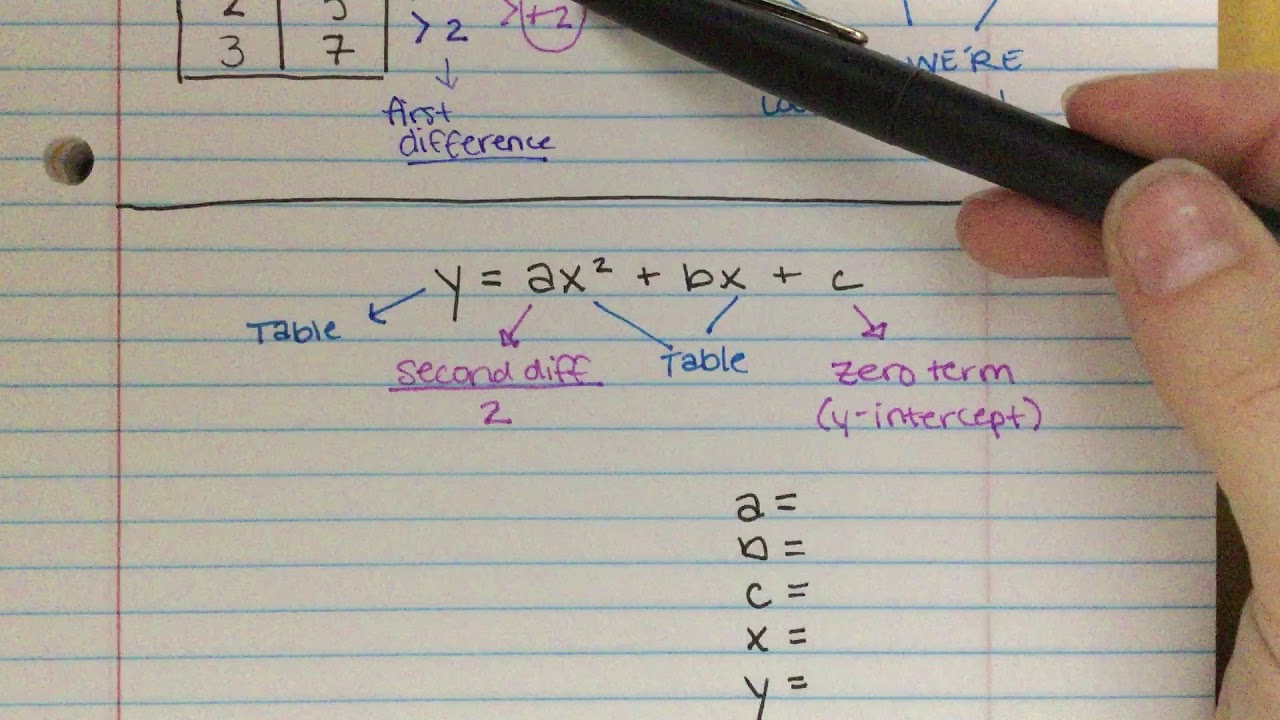
This video explains how to take a table of values and write a quadratic equation in standard form.
That should help
devout snowBOT
Channel closed
Closed by @pallid schooner
Use .reopen if this was a mistake.
Available help channel!
Send your question here to claim the channel.
Remember:
• Ask your math question in a clear, concise manner.
• Show your work, and if possible, explain where you are stuck.
• After 15 minutes, feel free to ping <@&286206848099549185>.
• Type the command .close to free the channel when you're done.
• Be polite and have a nice day!
Read #❓how-to-get-help for further information on how to ask a good question, and about conduct in the question channels.
 balmy aspen
I need help solving this
 devout snowBOT
balmy aspen
I need help solving this
exotic stump
devout snowBOT
balmy aspen
I need help solving this
exotic stump
what have you tried
balmy aspen
The first one
exotic stump
what did you try
balmy aspen
exotic stump
what did you try
Dividing it?
exotic stump
are you attempting to simplify logarithmic expressions without knowing log rules
balmy aspen
Oh you mean log rules
balmy aspen
exotic stump
are you attempting to simplify logarithmic expressions without knowing log rules
I’ve tried the power rule
exotic stump
you're gonna need more than that
balmy aspen
Any help?
exotic stump
google log rules
balmy aspen
 rustic epoch
hey u need help
rustic epoch
hey u need help
Nah I finished it
balmy aspen
.close
devout snowBOT
Channel closed
Closed by @balmy aspen
Use .reopen if this was a mistake.
Available help channel!
Send your question here to claim the channel.
Remember:
• Ask your math question in a clear, concise manner.
• Show your work, and if possible, explain where you are stuck.
• After 15 minutes, feel free to ping <@&286206848099549185>.
• Type the command .close to free the channel when you're done.
• Be polite and have a nice day!
Read #❓how-to-get-help for further information on how to ask a good question, and about conduct in the question channels.
 ember shard
Need gep
devout snowBOT
ember shard
Need gep
 rustic epoch
yes
 ember shard
.close
devout snowBOT
Channel closed
Closed by @ember shard
Use .reopen if this was a mistake.
devout snowBOT
Available help channel!
Send your question here to claim the channel.
Remember:
• Ask your math question in a clear, concise manner.
• Show your work, and if possible, explain where you are stuck.
• After 15 minutes, feel free to ping <@&286206848099549185>.
• Type the command .close to free the channel when you're done.
• Be polite and have a nice day!
Read #❓how-to-get-help for further information on how to ask a good question, and about conduct in the question channels.
restive river
I have the formulas log_a(1/2) and log a(2) for the half time and doubling time of a number. How do I utilize these in a question?
devout snowBOT
restive river
I have the formulas log_a(1/2) and log a(2) for the half time and doubling time ...
restive river
.close
devout snowBOT
Channel closed
Closed by @smoky hearth
Use .reopen if this was a mistake.
Available help channel!
Send your question here to claim the channel.
Remember:
• Ask your math question in a clear, concise manner.
• Show your work, and if possible, explain where you are stuck.
• After 15 minutes, feel free to ping <@&286206848099549185>.
• Type the command .close to free the channel when you're done.
• Be polite and have a nice day!
Read #❓how-to-get-help for further information on how to ask a good question, and about conduct in the question channels.
 hollow comet
I need help
devout snowBOT
hollow comet
I need help

 devout snowBOT
@hollow comet Has your question been resolved?
hollow comet
.close
devout snowBOT
Channel closed
Closed by @hollow comet
Use .reopen if this was a mistake.
Available help channel!
Send your question here to claim the channel.
Remember:
• Ask your math question in a clear, concise manner.
• Show your work, and if possible, explain where you are stuck.
• After 15 minutes, feel free to ping <@&286206848099549185>.
• Type the command .close to free the channel when you're done.
• Be polite and have a nice day!
Read #❓how-to-get-help for further information on how to ask a good question, and about conduct in the question channels.
 long hatch
can i please have some help on this?
 devout snowBOT
long hatch
can i please have some help on this?
long hatch
devout snowBOT
long hatch
can i please have some help on this?
long hatch
i know,
novel goblet
because both terms have x
long hatch
can i have an explaination as to why?
 torn vessel
factor out x
novel goblet
so you just need to factor out x
long hatch
oh i see
torn vessel
$(x+4)(x-4)=x^2-16$ but you forgot about the $x$ at the end
woven radishBOT
🙛𝕍ѳrtєx🙙
 torn vessel
you look for common factors
for example both terms have an $x,$ which means your instinct should be to factor out $x$ and obtain $x(x-16)$
long hatch
oh wait i think i got it
woven radishBOT
🙛𝕍ѳrtєx🙙
 long hatch
ok
torn vessel
Of course sometimes the first instinct may not be the right method or approach but you should at least see it as an option immediately
long hatch
ok
long hatch
then how would you solve something like this ?
 torn vessel
Firstly, what's ab+3b factored?
torn vessel
not exactly
if you have A groups of b and then you add 3 more groups of b you have a+3 groups of b
long hatch
no
torn vessel
hm?
long hatch
4b bc you al;ready have a group
dont u
?
oh wait
yeah
no i read the thing wrong
yeah a+3 groups of b
torn vessel
Good, so now you have $a(b+3)-a-3,$ right?
woven radishBOT
🙛𝕍ѳrtєx🙙
 long hatch
yeah
torn vessel
Do you agree that's equal to $a(b+3)-(a+3)?$
woven radishBOT
🙛𝕍ѳrtєx🙙
 long hatch
yeah
torn vessel
alright, so now what?
long hatch
put a into the bracket?
torn vessel
wait a minute
long hatch
(ab + a3) - (a + 3)
torn vessel
i wrote it wrong sorry
long hatch
o
torn vessel
when you factor ab+3b you should get b(a+3) right?
long hatch
yeah that makes sense, but how did u do that?
torn vessel
because of the distributive property of multiplication
also if you have A groups of b and another 3 groups of b you have A+3 groups of b in total
long hatch
yeah
torn vessel
so you end up with b(a+3)-a-3 as your equation which is equal to b(a+3)-(a+3)
following me?
long hatch
yep
torn vessel
now what does that equal?
long hatch
b(a+3)-(a+3)
with this there is are 2 (a+3)s
torn vessel
factoring means that you want common factors of terms to be factored out. For example, if you have "ab" and "3b," they share a common factor of b, and so you want to write it as b(a+3) for simplification
long hatch
can i cancel them?
torn vessel
long hatch
can i cancel them?
no, you can't
long hatch
torn vessel
no, you can't
oh yeah because b comes first
torn vessel
because the Order of Operation states that you multiply
torn vessel
yep
However, can you see anything else?
try to think in groups, i.e. "B groups of (A+3)" and "1 group of (A+3)"
long hatch
torn vessel
try to think in groups, i.e. "B groups of (A+3)" and "1 group of (A+3)"
b+1 groups (A+3)
right?
torn vessel
so would it be b+1 or b-1?
long hatch
b-1
long hatch
ohh i get it now
torn vessel
for these problems you just want to find different potential groupings of different pairs or terms
long hatch
torn vessel
for these problems you just want to find different potential groupings of differ...
yeah i got it
thank you so much]
torn vessel
no problem!
torn vessel
long hatch
yeah i got it
oh yeah you can type .close if you don't have any more questions
long hatch
.close
devout snowBOT
Channel closed
Closed by @long hatch
Use .reopen if this was a mistake.
torn vessel
👍
long hatch
tyty
devout snowBOT
Available help channel!
Send your question here to claim the channel.
Remember:
• Ask your math question in a clear, concise manner.
• Show your work, and if possible, explain where you are stuck.
• After 15 minutes, feel free to ping <@&286206848099549185>.
• Type the command .close to free the channel when you're done.
• Be polite and have a nice day!
Read #❓how-to-get-help for further information on how to ask a good question, and about conduct in the question channels.
restive river
Ok I need quick help
devout snowBOT
restive river
Ok I need quick help
restive river
so the half time of a material is 55,6 seconds
they are asking when only 3g of it are left (it had 10g to start with) aka they're asking when 30% will be left
so I just do a^55,6=0,5
then I get a
then I simply do f(t)=c*a^t
so I find out that it takes 96,575 seconds for 30% of it to be left
is that correct? am I calculating it correctly?
 distant harbor
devout snowBOT
distant harbor
devout snowBOT
@restive river Has your question been resolved?
devout snowBOT
Channel closed
Closed due to timeout
Use .reopen if this was a mistake.
Available help channel!
Send your question here to claim the channel.
Remember:
• Ask your math question in a clear, concise manner.
• Show your work, and if possible, explain where you are stuck.
• After 15 minutes, feel free to ping <@&286206848099549185>.
• Type the command .close to free the channel when you're done.
• Be polite and have a nice day!
Read #❓how-to-get-help for further information on how to ask a good question, and about conduct in the question channels.
 languid ocean
how do we calculate the fundamental group of a topological space
languid ocean
mainly i just want the details for R^2 \ (0,0)
i know it's Z and the equivalence classes of paths are based on the number of "loops" around the origin (does that make any sense?)
but, well, i still can't prove why 2 paths with different numbers of "loops" are not homotopic
devout snowBOT
@languid ocean Has your question been resolved?
languid ocean
<@&286206848099549185>
anyone home?
(this can probably just be reduced to proving that a loop where the origin is outside the loop and one where the origin is inside the loop are not homotopic)
 haughty torrent
devout snowBOT
haughty torrent
devout snowBOT
@languid ocean Has your question been resolved?
devout snowBOT
@languid ocean Has your question been resolved?
steel sage
languid ocean
how do we calculate the fundamental group of a topological space
First select a base point, WLOG,we let it be (1,0), then we construct a continuous map f from R^2 \ {0,0} to S^1={(x,y):x^2+y^2=1}, f((x,y))=(1/sqrt(x^2+y^2))(x,y)
This derives a homomorphism g from G=π_1(R^2 \ {0,0},(1,0)) to H=π_1(S^1,(1,0))
mapping an equivalence class of a path [λ] to an equivalence class of a path [f•λ]
You need to proof that g is both surjective and injective, it’s easy to prove
So g is an isomorphism.
After that H , the fundamental group of S^1, can be found in any textbook of algebraic topology. Read the details yourself, basically it’s calculated by constructing its covering space {(x,y,z)=(cos(t),sin(t),t/2π): t from R }
devout snowBOT
@languid ocean Has your question been resolved?
languid ocean
steel sage
First select a base point, WLOG,we let it be (1,0), then we construct a continuo...
oh okay thanks cogwheels
devout snowBOT
Channel closed
Closed by @languid ocean
Use .reopen if this was a mistake.
Available help channel!
Send your question here to claim the channel.
Remember:
• Ask your math question in a clear, concise manner.
• Show your work, and if possible, explain where you are stuck.
• After 15 minutes, feel free to ping <@&286206848099549185>.
• Type the command .close to free the channel when you're done.
• Be polite and have a nice day!
Read #❓how-to-get-help for further information on how to ask a good question, and about conduct in the question channels.
 steel comet
How to read math textbooks... Correctly??
devout snowBOT
steel comet
How to read math textbooks... Correctly??
 icy depot
Do you have an example?
 broken roost
steel comet
How to read math textbooks... Correctly??
broken roost
steel comet
How to read math textbooks... Correctly??
Read, reread, do exercises, go back reread, do exercises. Note reread doesn’t have to be the whole chapter. Ask question in parts your confused about.
For reading proof, if it’s difficult, I need to reread a couple times to digest it. Digest doesn’t always mean fully understanding it.
Most of the time, moving on and coming back to it later always works.
devout snowBOT
Channel closed
Closed by @steel comet
Use .reopen if this was a mistake.
Available help channel!
Send your question here to claim the channel.
Remember:
• Ask your math question in a clear, concise manner.
• Show your work, and if possible, explain where you are stuck.
• After 15 minutes, feel free to ping <@&286206848099549185>.
• Type the command .close to free the channel when you're done.
• Be polite and have a nice day!
Read #❓how-to-get-help for further information on how to ask a good question, and about conduct in the question channels.
 mystic oak
Got a problem from my linalg course:
devout snowBOT
mystic oak
Got a problem from my linalg course:
mystic oak
Given $W=Sp{u,v}$ where $u=\begin{bmatrix}2\-5\1\end{bmatrix}$ and $v=\begin{bmatrix}4\-4\2\end{bmatrix}$
a) Find orthogonal basis for $W$.
Found: $\begin{bmatrix}2\-5\1\end{bmatrix}\begin{bmatrix}2\1\1\end{bmatrix}$

 mystic oak
b) Find the standardmatrix $\begin{bmatrix}P_W\end{bmatrix}$ for the orthogonal projection $P_W : \mathbf{R}^3 \to \mathbf{R}^3$ onto $W$
woven radishBOT
Joachim
 mystic oak
Was totally asleep for the lectures about this, trying to make sense of it