#help-27
1 messages · Page 379 of 1
 zinc mirage
i think he mispelled it should be m lmao
zinc mirage
not at all
i'll give it a try
OHHHH my friends book is wrong
@polar chasm In my friends book

It says "f(x) is continous in all reel numbers"
 polar chasm
i see
 devout snowBOT
Channel closed
Closed by @zinc mirage
Use .reopen if this was a mistake.
 Available help channel!
Send your question here to claim the channel.
Remember:
• Ask your math question in a clear, concise manner.
• Show your work, and if possible, explain where you are stuck.
• Do not immediately ping people or roles. After 15 minutes, feel free to ping <@&286206848099549185> once.
• Type the command .close to free the channel when you're done.
• Be polite and have a nice day!
Read #❓how-to-get-help for further information on how to ask a good question, and about conduct in the question channels.
 opal basin
Can you help me to prove this
\exists x(\varphi(x) \lor \psi(x))
;;\Longleftrightarrow;;
(\exists x,\varphi(x)) ;\lor; (\exists x,\psi(x))
devout snowBOT
opal basin
Can you help me to prove this
\exists x(\varphi(x) \lor \psi(x))
\;\;\Longleftri...
opal basin

 steel sage
p<-> (q or r)
p->(q or r) , q->p, r->p. Do these three
opal basin
What is p
opal basin
steel sage
Equivalently
(p and not q)->r, q->p, r->p. Do these three
Im confused please use symbols
steel sage
$p=(\exists x(\varphi(x) \lor \psi(x))),
q=(\exists x,(\varphi(x))), r=(\exists x,(\psi(x)))$
 woven radishBOT
Cogwheels of the mind
 opal basin
P and not q?
steel sage
p and (not q)
devout snowBOT
@opal basin Has your question been resolved?
opal basin
steel sage
p and (not q)
Bro
When supposing
(There exist x , P(x) )to be true
We need to assume that P(x) is true for some x
no need to assume it to be true forall x right ?
steel sage
I don’t see how it is relevant, but yes
There exists x such that phi(x) or psi(x), since no y can make phi(y), then we have to have psi(x). This is (p and (not q))->r
opal basin
 opal basin
opal basin
opal basin
@steel sage
steel sage
p-> (q or r) is the same as (p and (not q))->r. Anyway I am reading yours. I don’t see why it becomes so big a deal
Formation seems weird. p is true meaning for some x, phi(x) or psi(x) is true, p takes no argument
Anyway, then phi(x) true implies q is true, psi(x) true implies r is true. If you want to do this directly
devout snowBOT
Channel closed
Closed due to timeout
Use .reopen if this was a mistake.
steel sage
I am out. It is supposed to be very simple
opal basin
.reopen
devout snowBOT
✅ Original question: #help-27 message
opal basin
steel sage
I am out. It is supposed to be very simple
My solution is wrongV
?
First direction
steel sage
You solution has parts that don’t make sense. I stoped reading when I spotted the first one. Like “p is true for some x”, p takes no argument
opal basin
I assume in the first to phi to be true
For some x then Q is true
Then phi or psi is true for some x
Which make P is true
steel sage
Yeah, this is right
steel sage
It really is simple, i can’t understand why it’s becoming more and more complicated for you
steel sage
steel sage
p<-> (q or r)
p->(q or r) , q->p, r->p. Do these three
I stick to this
steel sage
steel sage
There exists x such that phi(x) or psi(x), since no y can make phi(y), then we h...
This
steel sage
steel sage
Anyway, then phi(x) true implies q is true, psi(x) true implies r is true. If yo...
Or this
I have nothing to add
steel sage
Because I spotted an error “p is true for some x” and didn’t continue to read
opal basin
steel sage
Because I spotted an error “p is true for some x” and didn’t continue to read
Wait i write that?
My bad
Sorry
steel sage
Yeah. I always stop at the first error
steel sage
The other way around, p is true, then there exists x such that phi(x) is true or psi(x) is true
steel sage
If phi(x) is true then q is true, if phi(x) is not true then psi(x) is true then r is true
opal basin
opal basin
P is true and Q is true
What does this mean for you?
steel sage
Nothing
steel sage
What do you hope to deduce by assume (p and q)
I can’t make it any clearer. Find someone else
opal basin
steel sage
What do you hope to deduce by assume (p and q)
Not assumption
Its a result
opal basin
steel sage
I can’t make it any clearer. Find someone else
Thank you bro
<@&286206848099549185>
opal basin
opal basin
.
 inner ether
devout snowBOT
inner ether
devout snowBOT
@opal basin Has your question been resolved?
devout snowBOT
Channel closed
Closed due to timeout
Use .reopen if this was a mistake.
Available help channel!
Send your question here to claim the channel.
Remember:
• Ask your math question in a clear, concise manner.
• Show your work, and if possible, explain where you are stuck.
• Do not immediately ping people or roles. After 15 minutes, feel free to ping <@&286206848099549185> once.
• Type the command .close to free the channel when you're done.
• Be polite and have a nice day!
Read #❓how-to-get-help for further information on how to ask a good question, and about conduct in the question channels.
 simple willow
are maximal supposed to be greatest in value too
 devout snowBOT
simple willow
are maximal supposed to be greatest in value too
simple willow
devout snowBOT
simple willow
are maximal supposed to be greatest in value too
simple willow
is the maximal gonna be 25 according to this definition
 steel sage
There are more
simple willow
steel sage
There are more
no it's not the one that is the greatest in value?
steel sage
It is, and there are more maximal elements
steel sage
Take another look at 12 and 20
simple willow
yea but they are smaller than 25
steel sage
Then you asked the wrong question. Either those numbers are just names, or you made a wrong Hasse diagram
If those numbers are really numbers their Hasse diagram will only be a chain
simple willow
steel sage
Then you asked the wrong question. Either those numbers are just names, or you m...
are you saying that the largest number (by value) automatically gets placed at the top
steel sage
I am saying either those numbers are just names
Or you made a wrong Hasse diagram of those numbers in the usual sense of <=
simple willow
thats unlikely ig
simple willow
steel sage
I am saying either those numbers are just names
its from the lecture slides
i dont think there is a mistake
steel sage
Then those numbers are just names
simple willow
oh
simple willow
simple willow
are you saying that the largest number (by value) automatically gets placed at t...
so this is what you are saying
steel sage
Do you understand the definition of Hasse diagram
simple willow
thats what i know so far ig
 steel sage
Then x<=y if and only if x and y are placed in the diagram such that there is a polyline segment from below to above with x in the bottom and y in the top
No elements > 12, so 12 is maximal, same can be said to 20 too
simple willow
steel sage
No elements > 12, so 12 is maximal, same can be said to 20 too
alright
thx
.close
devout snowBOT
Channel closed
Closed by @simple willow
Use .reopen if this was a mistake.
devout snowBOT
Available help channel!
Send your question here to claim the channel.
Remember:
• Ask your math question in a clear, concise manner.
• Show your work, and if possible, explain where you are stuck.
• Do not immediately ping people or roles. After 15 minutes, feel free to ping <@&286206848099549185> once.
• Type the command .close to free the channel when you're done.
• Be polite and have a nice day!
Read #❓how-to-get-help for further information on how to ask a good question, and about conduct in the question channels.
 untold ravine
I wanted to verify my solution ask whether theres an easier way

 steel sage
What is y?
untold ravine
supremum of S
steel sage
Like sin(x-π) on [0,2π], x_0=3π/2, y=0, z=π/2, we don’t have f is positive on (y, x_0]
steel sage
sin(x-π)
untold ravine
oh
steel sage
Not sin(x)
steel sage
Oh. I keep reading
untold ravine
i skipped a few steps in the subsequent paragraphs
like the domain of g_n(x) is [y,x_0]
and the inequality result is by induction
steel sage
Brilliant. But for g_k(x_n) being bounded, should we assume maximal |f|<=1? It won’t affect anything
(f multiplied by 1/max of f
This way g_k(x_n)<=1)
untold ravine
steel sage
Brilliant. But for g_k(x_n) being bounded, should we assume maximal |f|<=1? It w...
wait i dont get it
oh yeah
but any continuous function is bounded in a closed interval
right?
steel sage
Any original thought is brilliant. I don’t like people rejecting other’s idea the first moment they see it
untold ravine
i second that
theres a lot of askers here who want their proofs verified while others just give their own idea instead
so thank you for taking the time to read and verify my proof
steel sage
Np. Again, brilliant, this g_n thing.
untold ravine
yeah basically i got like the idea for the last paragraph first
but i couldnt verify that K^n would converge
as K could be >1
so i thought of defining a function that could make K smaller
starter with 1/2 f(x), then f(x)^2 then finally sqrt(f(x))
anyways, thanks again!
.solved
devout snowBOT
Channel closed
Closed by @untold ravine
Use .reopen if this was a mistake.
devout snowBOT
Available help channel!
Send your question here to claim the channel.
Remember:
• Ask your math question in a clear, concise manner.
• Show your work, and if possible, explain where you are stuck.
• Do not immediately ping people or roles. After 15 minutes, feel free to ping <@&286206848099549185> once.
• Type the command .close to free the channel when you're done.
• Be polite and have a nice day!
Read #❓how-to-get-help for further information on how to ask a good question, and about conduct in the question channels.
 tired garden
Hi guys, what does it mean if there’s a -x in front of the polynomial.
I know just a - sign means curve down. But why is there an x?
Does it change the graph?
 devout snowBOT
tired garden
Hi guys, what does it mean if there’s a **-x** in front of the polynomial.
I kno...
devout snowBOT
tired garden
Hi guys, what does it mean if there’s a **-x** in front of the polynomial.
I kno...
 velvet fog
i need hlp
 trail eagle
The x is just another factor (x-a) where a=0
 uneven coral
velvet fog
i need hlp
uneven coral
velvet fog
i need hlp
!occupied
devout snowBOT
velvet fog
i need hlp
Someone else is already using this help channel. If you need help with a question, please open your own help channel/thread (see #❓how-to-get-help for instructions).
 versed juniper
tired garden
Hi guys, what does it mean if there’s a **-x** in front of the polynomial.
I kno...
versed juniper
tired garden
Hi guys, what does it mean if there’s a **-x** in front of the polynomial.
I kno...
you can think of it as -(x - 0) so a root at 0
tired garden
versed juniper
you can think of it as -(x - 0) so a root at 0
So does the graph need to cross at 0?
versed juniper
yeah
tired garden
Are these correct?
 polar chasm
tired garden
Are these correct?
polar chasm
tired garden
Are these correct?
the first one is def incorrect
tired garden
Ok, why
polar chasm
the second one seems fine
polar chasm
tired garden
Ok, why
near the origin it doesnt look right
tired garden
So how is it supposed to be
polar chasm
do u understand how multiplicity works
tired garden
No
polar chasm
dang, sorry, gtg. I'll either be back in few mins or someone else will explain
its basically that it should pass straight through the origin and not bounce back of
because its just -x, not -x^2


 frigid shale
tired garden
Uhhh
frigid shale
tired garden
Uhhh
erm you sure (3x-7)^2 that one is correct expanding?
tired garden
frigid shale
erm you sure (3x-7)^2 that one is correct expanding?
Yes, 9x^2 - 42x + 49?
frigid shale
tired garden
Uhhh
try to calculate the determinant
b^2-4ac first
like a=... b=.... c=....
frigid shale
alr now do the square root
tired garden
c = 392
frigid shale
you can do it step by step
you dont have to do all at once
math we talk about accuracy
tired garden
 frigid shale
denominator you sure is 2ac?
 frigid shale
yea that 392 is not suppose to be there
thats why you are doing it wrong
so thats why if u doing math
do it step by step
find the determinant
and then rewrite formula
if you plug wrong or smt, AT LEAST formula gives u half mark
for sympathy
i recommend this for new math beginners for mid school or high school
yall knowing this for like at the beginning DONT rush it
polar chasm
tired garden
Now its correct. To explain why, the shape around the roots depend on the exponent of the factor (aka multiplicit)y). If it's just e.g. just plain (x-1), it will pass through it roughly linearly. If it's (x-1)^2, it will pass through it rougly parabolically, so it will bounce back off. If it's (x-1)^3, it will go to 1, kinda flatten, and then continue in the same direction (just like y = x^3 does)


 devout snowBOT
@tired garden Has your question been resolved?
devout snowBOT
Channel closed
Closed due to timeout
Use .reopen if this was a mistake.
Available help channel!
Send your question here to claim the channel.
Remember:
• Ask your math question in a clear, concise manner.
• Show your work, and if possible, explain where you are stuck.
• Do not immediately ping people or roles. After 15 minutes, feel free to ping <@&286206848099549185> once.
• Type the command .close to free the channel when you're done.
• Be polite and have a nice day!
Read #❓how-to-get-help for further information on how to ask a good question, and about conduct in the question channels.
simple willow
how did they calculate the number of parameters
 devout snowBOT
simple willow
how did they calculate the number of parameters
devout snowBOT
simple willow
how did they calculate the number of parameters
 supple knot
it's specific to the input algorithm
simple willow
supple knot
it's specific to the input algorithm
there are total 6 filters

and f is 5
is it gonna be 5 * 5 * 6
but that is 150
no wait it'll be 5 * 5 * 3
and there are 6 filters so u got 5 * 5 * 3 into 6
supple knot

Baeldung on Computer Science
Learn how to count the parameters of a convolutional neural network by hand and in PyTorch.
simple willow
supple knot
https://www.baeldung.com/cs/cnn-parameter-count
i dont like reading
supple knot
simple willow
alright ig i should develop reading habits
thanks riemann
can you do the last one
why are there 850 params
84 * 10 is 840
 restive river
Woah
restive river
simple willow
how did they calculate the number of parameters
What is this doing here
simple willow
restive river
What is this doing here
what
its math boy
multiply the 84 into the 10
simple willow
restive river
What do u get?
why does the last layer not have 840 parameters
oh damn, i forgot the 10 biases for the last layer
that makes it 850
restive river
Now u get it?
simple willow
restive river
Now u get it?
yeah but what about the first layer then
5 * 5 * 3 * 6 is 456
nvm its 450
restive river
simple willow
oh damn, i forgot the 10 biases for the last layer
See when u think through the things with high focus things show up as they are and u catch the differences
devout snowBOT
Channel closed
Closed by @simple willow
Use .reopen if this was a mistake.
restive river
Mhmm
devout snowBOT
Available help channel!
Send your question here to claim the channel.
Remember:
• Ask your math question in a clear, concise manner.
• Show your work, and if possible, explain where you are stuck.
• Do not immediately ping people or roles. After 15 minutes, feel free to ping <@&286206848099549185> once.
• Type the command .close to free the channel when you're done.
• Be polite and have a nice day!
Read #❓how-to-get-help for further information on how to ask a good question, and about conduct in the question channels.
 lilac crescent
,, \lim_{n \to \infty} \frac{3^n +4^n}{5^n-2^n}
devout snowBOT
lilac crescent
,, \lim_{n \to \infty} \frac{3^n +4^n}{5^n-2^n}
woven radishBOT
 lilac crescent
how to evaluate this limit
 urban harbor
lilac crescent
how to evaluate this limit
urban harbor
lilac crescent
how to evaluate this limit
the short version is that the largest base in numerator and denominator are what end up taking over
you can try to factor out 4^n in numerator and 5^n in the denominator, see if that will help you apply the various limit rules
lilac crescent
urban harbor
the short version is that the largest base in numerator and denominator are what...
So the limit is 0?
 timber pebble
lilac crescent
So the limit is 0?
timber pebble
lilac crescent
So the limit is 0?
what have you tried 🦦
lilac crescent
timber pebble
what have you tried 🦦
i mean we'd get $\frac{3^n (1+\frac{4^n}{3^n})}{5^n(1-\frac{2^n}{5^n})}$
woven radishBOT
 lilac crescent
so they'd cancel out
and we'd have only 3^n/5^n
oh my bad
meant to factor 4^n
 devout grotto
why would they cancel out
devout grotto
my first reaction on seeing an inf/inf limit is to use l’hopital but i’m not sure that helps here
lilac crescent
maybe we just need to use the fact that $\lim_{n \to \infty} \frac{a^n}{b^n} = \frac{a}{b}$
woven radishBOT
 lilac crescent
idk how to prove it tho
i think its a property maybe ?
so the limit would be 7/3
devout grotto
limits are additive, does that help?
 winter patrol
lilac crescent
maybe we just need to use the fact that $\lim_{n \to \infty} \frac{a^n}{b^n} = \...
winter patrol
lilac crescent
maybe we just need to use the fact that $\lim_{n \to \infty} \frac{a^n}{b^n} = \...
Is incorrect
lilac crescent
winter patrol
Is incorrect
So how would we solve it
devout grotto
i forget whether $\lim (f(x) + g(x)) = \lim f(x) + \lim g(x)$ is true for limits to infty
woven radishBOT
Mirror
 devout grotto
my gut says no but i’ve forgotten how math works
winter patrol
try doing what soosh recommended
Factor out 4^n, instead of 3^n
winter patrol
Show what you have here
urban harbor
lilac crescent
maybe we just need to use the fact that $\lim_{n \to \infty} \frac{a^n}{b^n} = \...
this isn't right, but you're on the right track thinking about this kind of limit, you can write it as (a/b)^n and then consider various cases depending on the ratio of a and b (<1 , =1, > 1)
devout snowBOT
@lilac crescent Has your question been resolved?
devout snowBOT
Channel closed
Closed due to timeout
Use .reopen if this was a mistake.
Available help channel!
Send your question here to claim the channel.
Remember:
• Ask your math question in a clear, concise manner.
• Show your work, and if possible, explain where you are stuck.
• Do not immediately ping people or roles. After 15 minutes, feel free to ping <@&286206848099549185> once.
• Type the command .close to free the channel when you're done.
• Be polite and have a nice day!
Read #❓how-to-get-help for further information on how to ask a good question, and about conduct in the question channels.
 waxen steeple
im struggling to reason why if A is dense in B, then it does not have to follow that A is dense in every subset of B
devout snowBOT
waxen steeple
im struggling to reason why if A is dense in B, then it does not have to follow ...
waxen steeple
surely if every b in B is approximated by a sequence in A then every c in the subset is also approximated by a sequence in A ?
supple knot
What's your definition of dense
waxen steeple
for each b in B, for all eps > 0, there exists a in A s.t. |a - b| (or whatever norm / metric) < eps
supple knot
That's incomplete
waxen steeple
supple knot
That's incomplete
or for each b in B, there exists a sequence in A that converges to b ?
 misty crest
🤔
show your textbook definition
surely if A and B are disjoint then A isn't dense in B
 uncut crow
A is a subset of B because otherwise there is no reason to talk about density of A in B
that doesn't really need to be mentioned honestly
misty crest
oh a subset of B i mean
uncut crow
that definition is fine
waxen steeple
oh wait we had the closure defn which i do know
i just never used it after like week 1
since all the time we would show density by approximating sequences
waxen steeple
uncut crow
what is the statement you saw that you are skeptical about?
whether
if A is dense in B then A is dense in a subset of B
apparently it's not true
but idk why
uncut crow
waxen steeple
for each b in B, for all eps > 0, there exists a in A s.t. |a - b| (or whatever ...
seems very true immediately from this definition?
where did you hear it was false
waxen steeple
maybe i read it online somewhere lmao
misty crest
waxen steeple
maybe i read it online somewhere lmao
show
supple knot
Don't vibe make up math definitions
uncut crow
i don't think that's a vibe made up definition
it's a legitimate definition of dense for metric spaces
equivalent to whatever other standard definition
waxen steeple
the actual textbook defn is closure of A = B but like
ive literally never used that defn after like week 2
misty crest
waxen steeple
ive literally never used that defn after like week 2
well when you're in metric spaces equivalent definitions might be more useful
its like the difference between definitions of compactness
devout snowBOT
@waxen steeple Has your question been resolved?
Channel closed
Closed by @waxen steeple
Use .reopen if this was a mistake.
devout snowBOT
Available help channel!
Send your question here to claim the channel.
Remember:
• Ask your math question in a clear, concise manner.
• Show your work, and if possible, explain where you are stuck.
• Do not immediately ping people or roles. After 15 minutes, feel free to ping <@&286206848099549185> once.
• Type the command .close to free the channel when you're done.
• Be polite and have a nice day!
Read #❓how-to-get-help for further information on how to ask a good question, and about conduct in the question channels.
 north hound
If sin A = m sinB and tanA = n tanB, prove that (m^2 - 1)/(n^2 - 1) = cos^2 (A)
devout snowBOT
north hound
If sin A = m sinB and tanA = n tanB, prove that (m^2 - 1)/(n^2 - 1) = cos^2 (A)
 faint zinc
@north hound have you tried yet taking the second equation and rewriting tan as sin/cos?
north hound
Yes. From there I get cos(A)/cos(B) = m/n
faint zinc
Well, you have sinA/sinB = m, so m^2 - 1 = (sin^2 A / sin^2 B) - 1 = (sin^2 A - sin^2 B)/(sin^2 B) = (1 - 2 sin^2 B)/(sin^2 B)
@north hound ^ does the above make sense? Can you do something similar with tan (recall that tan and sec share a similar identity).
north hound
Wait what. (sin^2 A - sin^2 B)/(sin^2 B) = (1 - 2 sin^2 B)/(sin^2 B)?
faint zinc
Oh. Sorry, I'm a dum
It's past midnight here, that last step is completely wrong
(sin^2 A - sin^2 B)/(sin^2 B) should be correct though
My b
north hound
sec^2 = tan^2 + 1
devout snowBOT
@north hound Has your question been resolved?
north hound
<@&286206848099549185>
 turbid bane
Hi
north hound
Hi
turbid bane
Tan(A) = n*Tan(B)
Prove that
(m²-1) ÷ (n²-1) = Cos²(A)```Yes.
turbid bane
Hmmmm
 digital junco
Hello
 eager cobalt
turbid bane
```Sin(A) = m*Sin(B)
Tan(A) = n*Tan(B)
Prove that
(m²-1) ÷ (n²-1) = Cos²(A)```
eager cobalt
turbid bane
```Sin(A) = m*Sin(B)
Tan(A) = n*Tan(B)
Prove that
(m²-1) ÷ (n²-1) = Cos²(A)```
$\sin{x}=m\sin{y}, \tan{x}=n\tan{y}, $ then show that $\frac{m^2-1}{n^2-1}=\cos^{2}{x}$
woven radishBOT
☭
 devout snowBOT
@north hound Has your question been resolved?
turbid bane
woven radish
**☭**
Easier to understand this way
devout snowBOT
Channel closed
Closed due to timeout
Use .reopen if this was a mistake.
Available help channel!
Send your question here to claim the channel.
Remember:
• Ask your math question in a clear, concise manner.
• Show your work, and if possible, explain where you are stuck.
• Do not immediately ping people or roles. After 15 minutes, feel free to ping <@&286206848099549185> once.
• Type the command .close to free the channel when you're done.
• Be polite and have a nice day!
Read #❓how-to-get-help for further information on how to ask a good question, and about conduct in the question channels.
 green vault
 devout snowBOT
green vault
devout snowBOT
green vault
 sand quarry
,w integrate 2x/(x^2 +1) from 0 to sqrt(e^134-1)
woven radishBOT


 green vault
thanks
sand quarry
Guess so
green vault
.close
devout snowBOT
Channel closed
Closed by @green vault
Use .reopen if this was a mistake.

 modern lance
Not here
 dawn osprey
Oops
modern lance
This help channel is about to be locked
dawn osprey
Oh alright
modern lance
Choose an available one
dawn osprey
how do i open a new one lol
modern lance
hmm
modern lance
dawn osprey
how do i open a new one lol
By sending a message in one of these channels
 dawn osprey
alright
devout snowBOT
Available help channel!
Send your question here to claim the channel.
Remember:
• Ask your math question in a clear, concise manner.
• Show your work, and if possible, explain where you are stuck.
• Do not immediately ping people or roles. After 15 minutes, feel free to ping <@&286206848099549185> once.
• Type the command .close to free the channel when you're done.
• Be polite and have a nice day!
Read #❓how-to-get-help for further information on how to ask a good question, and about conduct in the question channels.
 copper prairie
What am i doing wrong
devout snowBOT
copper prairie
What am i doing wrong
copper prairie

I thought i got the implicit thing wrong but idk it seems fine

Did i integrate wrong?
I got pi/3 but my book says jts 19pi/3
Ok now what the shit
I got pi/3
book says 19pi/3
ai says 13pi/3
Yes i know dont use ai yaddayaddayadda
<@&286206848099549185>
 ebon coyote
!XY
devout snowBOT
Please show the original problem, exactly as it was stated to you, with the entire original context. A picture or screenshot is best. If the original problem is not in English, then post it anyway! The additional context might still be helpful. Do your best to provide a translation.

 cinder nova
here's a problem, you switched the y to x
 ebon coyote
?
No, he cancelled the y's out
He then cancelled the 2 in the denominator (which now makes it look like an x) with the 2 outside the integral
cinder nova
oh yeah mb, didn't see that
devout snowBOT
@copper prairie Has your question been resolved?
cinder nova
here's the actual problem, you didn't apply the cubing
it should be sqrt(9^3)
 copper prairie
cinder nova
here's the actual problem, you didn't apply the cubing
it should be sqrt(9^3)
copper prairie
cinder nova
here's the actual problem, you didn't apply the cubing
it should be sqrt(9^3)
Oh mt go
Okay that makes so muxh more sense
Okay thanks
So much
.close
devout snowBOT
Channel closed
Closed by @copper prairie
Use .reopen if this was a mistake.
Available help channel!
Send your question here to claim the channel.
Remember:
• Ask your math question in a clear, concise manner.
• Show your work, and if possible, explain where you are stuck.
• Do not immediately ping people or roles. After 15 minutes, feel free to ping <@&286206848099549185> once.
• Type the command .close to free the channel when you're done.
• Be polite and have a nice day!
Read #❓how-to-get-help for further information on how to ask a good question, and about conduct in the question channels.
 quasi jacinth
hey can someone explain what f_n means means in uniform convergance definition
devout snowBOT
quasi jacinth
hey can someone explain what f_n means means in uniform convergance definition
quasi jacinth
sand quarry
A list of functions
ok lets say i have the functions f1 f2 f3
why is this a sequencee
sand quarry
Like you can have f_n = x^n
quasi jacinth
yea
 sand dove
A sequence is just a list of things
sand quarry
So you now can represent a family of functions witn the sequence
sand dove
If you want a real numbered sequence, you just make a list of numbers
quasi jacinth
but like you get infinite points for every term of the sequencce
sand dove
If you want a sequence of functions, you just make a list of functions
sand dove
quasi jacinth
but like you get infinite points for every term of the sequencce
Just like any function yeah
 mystic scarab
Huh??
sand dove
More complicated than that
When you had a real numbered sequence, it converged when, when you make n bigger, it gets as close as you want from the limit
quasi jacinth
yes like this
sand dove
For functions, it's more complicated
sand dove
What does it mean "a function gets closer to another"
quasi jacinth
sand dove
What does it mean "a function gets closer to another"
idk
sand dove
Does it mean "each fn(x) gets independently closer to f(x)"?
This is a way to view it, it's called pointwise convergence
quasi jacinth
can you give an example
sand dove
Well
sand dove
say $f_n(x) = x^n$ on [0,1]
woven radishBOT
Raphaelisius Maximus MMIII
 quasi jacinth
ok this converges evenly?
sand dove
evenly?
 sand dove
This is uniform convergence
quasi jacinth
uniform convergence yes
sand dove
So yes, it's not the same as "each fn(x) converges to f(x)"
quasi jacinth
so f_n = x^n has uniform converganec?
sand dove
There's a certain sense of "even convergence"
sand dove
quasi jacinth
so f_n = x^n has uniform converganec?
It doesn't converge uniformly
quasi jacinth
does it cconverge at all?
quasi jacinth
wait 1 sec
sand dove
And x^n -> 1 if x = 1
quasi jacinth
what does it mean that x^n converges
mystic scarab
...
quasi jacinth
lim n-> oo
sand dove
quasi jacinth
what does it mean that x^n converges
It's a real numbered sequence
quasi jacinth
?
sand dove
So limit as n goes to infinity
sand dove
sand dove
if you fix a value of x
Yes
quasi jacinth
lim c^n = k
sand dove
k = 0 if c < 1, and k = 1 if c = 1
sand dove
Well we need to understand why the first example fails
sand dove
Uniform convergence means "every fn(x) converges at some even rate"
sand dove
Well that's a consequence
sand dove
Not necessarily a sufficient condition
quasi jacinth
so its not "evenly changing"
sand dove
Yeah, we made a gap
quasi jacinth
yea there is a theorem
sand dove
So, we can pick xn the nth root of 1/2 for example
quasi jacinth
its continious and at 0 its 0 and at 1 1 os it takes all values inbetween
sand dove
$x_n = \sqrt[n]{\frac 12}$
quasi jacinth
sand dove
So, we can pick xn the nth root of 1/2 for example
ok
woven radishBOT
Raphaelisius Maximus MMIII
 sand dove
?
quasi jacinth
oh wait yea the definition says for every x so if we find 1 x that it doesnt work for
its sufficient
sand dove
Yeah
quasi jacinth
ok
sand dove
So
quasi jacinth
because at the limit this is x=0 no ?
sand dove
It can depend on n too
quasi jacinth
how so
sand dove
x is introduced after n
quasi jacinth
isnt x a variable in the definition doesnt x_n make it a sequence
sand dove
quasi jacinth
isnt x a variable in the definition doesnt x_n make it a sequence
Idk what to tell you.
x is introduced after N and n, so it's allowed to depend on them
quasi jacinth
wdym its introduced after
sand dove
Ok, look at the statement:
For all n in N, there is an x in R such that n < x
It's true because we can take x = n+1
See that x depends on n
We're allowed to do so
quasi jacinth
wait a second im confused on the opposite statement
sand dove
quasi jacinth
wait a second im confused on the opposite statement
Do you know how to take the negation of statements?
quasi jacinth
well the statement says there is N
sand dove
The negation of "everyone is cool" is "someone is uncool"
sand dove
quasi jacinth
well the statement says there is N
So in the negation there will be "for all N, ..."
quasi jacinth
sand dove
So in the negation there will be "for all N, ..."
but why if a statement is true
then the negation is true also
sand dove
??????????????
The exact opposite is happening
If the negation is true, then the original statement is false
quasi jacinth
is this a theorem?
sand dove
Yes
quasi jacinth
ok so in this case the negation is
there is ε>0 for all N such that there is n>=N and x in A, that satisfy |f_n(x)-f(x)|< ε?
sand dove
there is ε>0 such that for all N there is n>=N and x in A, that satisfy |f_n(x)-f(x)| >= ε
We gotta take the negation of the final statement
sand dove
That would show that fn doesn't uniformly converge to f
quasi jacinth
ok so my problem is understanding how cacn we have x_n
if we say x in A doesnt that make it a specific x
like if A was (0,1)
the x= nth root at limit would even go out of A
sand dove
Wdym by specific x
quasi jacinth
like constant
sand dove
quasi jacinth
like if A was (0,1)
the x= nth root at limit would even go out of A
But we never truly reach the limit do we
For every finite n
quasi jacinth
what if it was (0.1,1)
quasi jacinth
ok
quasi jacinth
i just realised we restrict A as we want so its easier to find x
sand dove
quasi jacinth
i just realised we restrict A as we want so its easier to find x
A will be the set on which fn converges uniformly
quasi jacinth
yea but if we prove its not uniformly convergant at B <A
sand dove
woven radish
**Raphaelisius Maximus MMIII**
fn doesn't converge uniformly on A = [0,1]
quasi jacinth
doesnt taht mean its not on A too?
sand dove
quasi jacinth
doesnt taht mean its not on A too?
?
quasi jacinth
the thing im stuck on is like that when you use x(n) that means x moves
so we arent checking at a specific point
even though we want to show that its true for 1 x since the negation says x exists in A so that ..
sand dove
quasi jacinth
the thing im stuck on is like that when you use x(n) that means x moves
In the negation of uniform convergence, x is allowed to depend on n, so x can move in between different values of n
It can move, but it stays inside A
quasi jacinth
sand dove
In the negation of uniform convergence, x is allowed to depend on n, so x can mo...
when can you do that
sand dove
quasi jacinth
when can you do that
Wdym when
quasi jacinth
like when are you allowed to let x move
sand dove
When disproving uniform convergence... all the time?
sand dove
that is such a vague question
mystic scarab
Why don't you stick with one thing at a time? @quasi jacinth
quasi jacinth
like if a theorem says there is x
is showing there is x(n) enough
mystic scarab
Otherwise it's confusing for everyone and also it doesn't let you focus on what you ask, since you're changing questions continuously
quasi jacinth
mystic scarab
Why don't you stick with one thing at a time? <@601385567959384084>
im just trying to understand how choosing x to be dependent on n something that we ccan do
sand dove
When you're tasked to show "for all n, there exists x such that..."
The x is allowed to depend on n as it's introduced after
But if you have to show
"There exists x such that for all n..."
The value of x must work for EVERY value of n
quasi jacinth
oh yea now i get what introduced after means
sand dove
So it can't depend on n
quasi jacinth
so using x_n
covers for all n if its said before there exists x
but if we have the for all n afterwards then x must be constant
is that it?
sand dove
Yeah... like if you want it explained differently:
quasi jacinth
ok ok i am pretty sure i understand why you can here
sand dove
"Everyone eats some food"
That's true because you eat fries, I eat a salad, someone else eats grapes, etc...
"Some food is eaten by everyone"
quasi jacinth
yea i got it thanks
sand dove
I'm not sure if everyone eats fries, or everyone eats grapes..
quasi jacinth
damn this was a great explanation yea i can see how its the same for x and n
ok so we have

nvm forget that
sand dove
If fn did converge to f uniformly
quasi jacinth
|1/2 - f|
sand dove
Then for any epsilon > 0 I would eventually have |fn(xn) - f(xn)| < epsilon
But taking epsilon = 1/2
We would have |1/2 - 0| < 1/2
quasi jacinth
why -0?
sand dove
quasi jacinth
why -0?
Have you seen how the uniform limit must be the pointwise limit?
Like
sand dove
Call $f(x) = \lim_{n\to\infty}f_n(x)$
quasi jacinth
its the limit
woven radishBOT
Raphaelisius Maximus MMIII
 sand dove
It's the pointwise limit
quasi jacinth
yea thats what f is
quasi jacinth
sand dove
It's the pointwise limit
idk the definition of that
but it makes sense as in
we take 1 x at a time
and at the end we have created the function from the limit at each x
sand dove
quasi jacinth
we take 1 x at a time
Exactly
You take the limit point by point
So pointwise
Hope it helps understand the name
sand dove
Yes
sand dove
If fn converges uniformly, it must converge to f
sand dove
Otherwise we don't even have convergence point by point
sand dove
So f(nth root of 1/2) = 0
sand dove
Yes
sand dove
Technically you can even take epsilon = 1/2
quasi jacinth
so it doesnt converge uniformly
sand dove
1/2 >= 1/2
sand dove
quasi jacinth
a=1?
This time, we're taking a smaller domain
quasi jacinth
what for?
sand dove
Because uniform convergence failed on [0,1]
quasi jacinth
oh
sand dove
We're interested in knowing if maybe fn converges uniformly but on some smaller domain
quasi jacinth
ok
sand dove
You can guess that the problem was around x = 1
f was discontinuous at 1
And the counterexample we found, xn = nth root of 1/2
Eventually converges to 1
quasi jacinth
ok
sand dove
So what if we don't allow this example to work
quasi jacinth
so we are trying to show that for 0<a<1 it does satisfy the first statement
sand dove
So now, on [0,a], f(x) = 0 always
So the idea
Of uniform convergence
Is that |fn(x) - f(x)| is smaller that something that doesn't depend on x, the point you're on
quasi jacinth
that its smaller than every positive ε
so we will choose ε(N)?
i suppose
im not sure havent done sequence proofs
sand dove
No, not exactly that
quasi jacinth
ik on limits we choose ε(δ) maybe
sand dove
Think of |fn(x)-f(x)| for all x at the same time
So accounting for each possible worse scenario
quasi jacinth
|fn(x)|
sand dove
Well, even those bounds
Converge to 0
|fn(x)| <= something(n)
That something does not depend on x
And still something(n) converges to 0
sand dove
Well, x^n is an increasing function right
Its derivative is nx^(n-1) > 0
(Except at x = 0)
quasi jacinth
yes
sand dove
So the biggest (worst) value of |x^n| happens as far away as possible
sand dove
Exactly
And that doesn't depend on x does it
So all we have to do is hope that a^n converges to 0
quasi jacinth
how do we show that |a^n|< ε
sand dove
That way, |fn(x)| < eventually, no matter the x
quasi jacinth
for every ε
sand dove
quasi jacinth
for every ε
... have you at least done limits of real sequences?
sand dove
But before limits of functions, you must have seen limits of sequences
quasi jacinth
proofs no
sand dove
And computing limits of some sequences
quasi jacinth
sand dove
Both knowing definitions (maybe proofs) around real sequence limits
ik definitions
sand dove
quasi jacinth
proofs no
That's fine
quasi jacinth
i need to pick a N(ε)
sand dove
Like, limit of a^n
sand dove
quasi jacinth
i need to pick a N(ε)
If you know a^n ->0, you know that N(epsilon) exists
It's fine to build up from past knowledge
sand dove
Like you're not redoing the proof of why a^n -> 0
quasi jacinth
havent done it at all
but i think i see it
we can remove the absolute value
so we need a^n< ε
n> loga (ε)
N= loga(2ε)
this should be correct
sand dove
I'm not sure at all
sand dove
quasi jacinth
n> loga (ε)
You correctly used that loga is decreasing here
sand dove
quasi jacinth
N= loga(2ε)
But you forgot about it here
Just take N = floor(loga(epsilon)) + 1
Because you need N to be an integer
We would also need to worry about N being positive, but if epsilon is small enough it's fine
devout snowBOT
@quasi jacinth Has your question been resolved?
quasi jacinth
sand dove
Because you need N to be an integer
yea thanks
devout snowBOT
Channel closed
Closed by @quasi jacinth
Use .reopen if this was a mistake.
devout snowBOT
Available help channel!
Send your question here to claim the channel.
Remember:
• Ask your math question in a clear, concise manner.
• Show your work, and if possible, explain where you are stuck.
• Do not immediately ping people or roles. After 15 minutes, feel free to ping <@&286206848099549185> once.
• Type the command .close to free the channel when you're done.
• Be polite and have a nice day!
Read #❓how-to-get-help for further information on how to ask a good question, and about conduct in the question channels.
 zinc valve
Explain calculation part from 2nd equation
 devout snowBOT
zinc valve
Explain calculation part from 2nd equation
devout snowBOT
zinc valve
Explain calculation part from 2nd equation
 pseudo basin

the black bands on the top and bottom combined are 3x taller than the actual image 😭
pseudo basin
anyway do you mean like how we proceeded from (2)
zinc valve
Yeah
pseudo basin
ok
the handwriting makes it hard to tell apart u from v
but it looks like
v^2 sin^2(alpha) was replaced by u^2 cos^2(theta)
and then uhhhh
multiplied by tan^2(alpha) somehow?
oh no wait ok i get it
$v^2 \sin^2(\alpha) = v^2 \cos^2(\alpha) \tan^2(\alpha) = u^2 \cos^2(\theta)\tan^2(\alpha)$
woven radishBOT
Ann
 pseudo basin
we did this on LHS
zinc valve
Tan^2 how?? It's not sin^2/cos^2
My trigo basics are week tho. Can you write in a copy
It's hard to understand text
pseudo basin
paper? sure ig
zinc valve
Yeah
pseudo basin
 zinc valve
Did you write wrong in cos²alpha
pseudo basin
which line
pseudo basin
i started with LHS of (2)
also theta not thetha
anyway no, i meant what i wrote. i double-checked it and there are no typos here.
first line i multiply and divide by cos^2(alpha)
pseudo basin
pseudo basin
v^2 sin^2(alpha) was replaced by u^2 cos^2(theta)
this was the mistaken part
zinc valve
You substitute value of v² from equation 1, right?
pseudo basin
that happens in line 3 in my picture
zinc valve
Then what happened in first line . Where cos alpha came?
 glad garden
zinc valve
Then what happened in first line . Where cos alpha came?
glad garden
zinc valve
Then what happened in first line . Where cos alpha came?
just looks like multiplying denominator and numerator by cos^2 alpha for the sake of some simplification
zinc valve
glad garden
just looks like multiplying denominator and numerator by cos^2 alpha for the sak...
Ohh I see
pseudo basin
glad garden
just looks like multiplying denominator and numerator by cos^2 alpha for the sak...
right on the money
zinc valve
pseudo basin
right on the money
But isn't RHS got multiplied too??
pseudo basin
??
what do you mean
i am not working with equation (2)
i am fucking with its LHS only
i am not multiplying by cos^2(alpha) on both sides of (2)
zinc valve
Okiee got it. You're doing separately
Thank you!! I understood and solved again.
.close
devout snowBOT
Channel closed
Closed by @zinc valve
Use .reopen if this was a mistake.
Available help channel!
Send your question here to claim the channel.
Remember:
• Ask your math question in a clear, concise manner.
• Show your work, and if possible, explain where you are stuck.
• Do not immediately ping people or roles. After 15 minutes, feel free to ping <@&286206848099549185> once.
• Type the command .close to free the channel when you're done.
• Be polite and have a nice day!
Read #❓how-to-get-help for further information on how to ask a good question, and about conduct in the question channels.
 void sand
<@&286206848099549185>
devout snowBOT
void sand
<@&286206848099549185>
void sand
I want help in these differential calculus problems

 jaunty bane
void sand
<@&286206848099549185>
jaunty bane
void sand
<@&286206848099549185>
!15m please.
devout snowBOT
void sand
<@&286206848099549185>
Please only use the <@&286206848099549185> ping once if your question has not been answered for 15 minutes. Please do not ping or DM individual users about your question.
sand quarry
void sand
I want help in these differential calculus problems
Which one do you want to start with
void sand
Is this right?

 void sand
Thanx. What should I text if I need help again
sand quarry
void sand
Thanx. What should I text if I need help again
Just simply open a new channel
For now, close this one by typing .close
void sand
@close
jaunty bane
.close, not @close.
devout snowBOT
@void sand Has your question been resolved?
Channel closed
Closed by @void sand
Use .reopen if this was a mistake.
Available help channel!
Send your question here to claim the channel.
Remember:
• Ask your math question in a clear, concise manner.
• Show your work, and if possible, explain where you are stuck.
• Do not immediately ping people or roles. After 15 minutes, feel free to ping <@&286206848099549185> once.
• Type the command .close to free the channel when you're done.
• Be polite and have a nice day!
Read #❓how-to-get-help for further information on how to ask a good question, and about conduct in the question channels.
 dense rampart
any smart way to do this other than calculating a 5x5 det?
 dense rampart
at most i see that the 5th column has 3 zeros after setting up the characteristic equation
steel sage
It immediately becomes 3 times 3 once you expand in terms of the 5th column and add column 1 to column 3
 glacial ledge
dense rampart
any smart way to do this other than calculating a 5x5 det?
glacial ledge
dense rampart
any smart way to do this other than calculating a 5x5 det?
Did u try
Gauss-Jordan elimination?
dense rampart
glacial ledge
Did u try
Gauss-Jordan elimination?
im finding det tho
you mean finding the det of an rref?
dense rampart
 drifting sierra
And that 4x4 is actually a 3x3
drifting sierra
And that 4x4 is actually a 3x3
wouldnt it be that 4x4 has multiple 3x3s underneath it, and so on?
glacial ledge
dense rampart
im finding det tho
you mean finding the det of an rref?
No u dont need to calculate det
dense rampart
steel sage
It immediately becomes 3 times 3 once you expand in terms of the 5th column and ...
wdym adding columns? never saw such an operation in making dets
glacial ledge
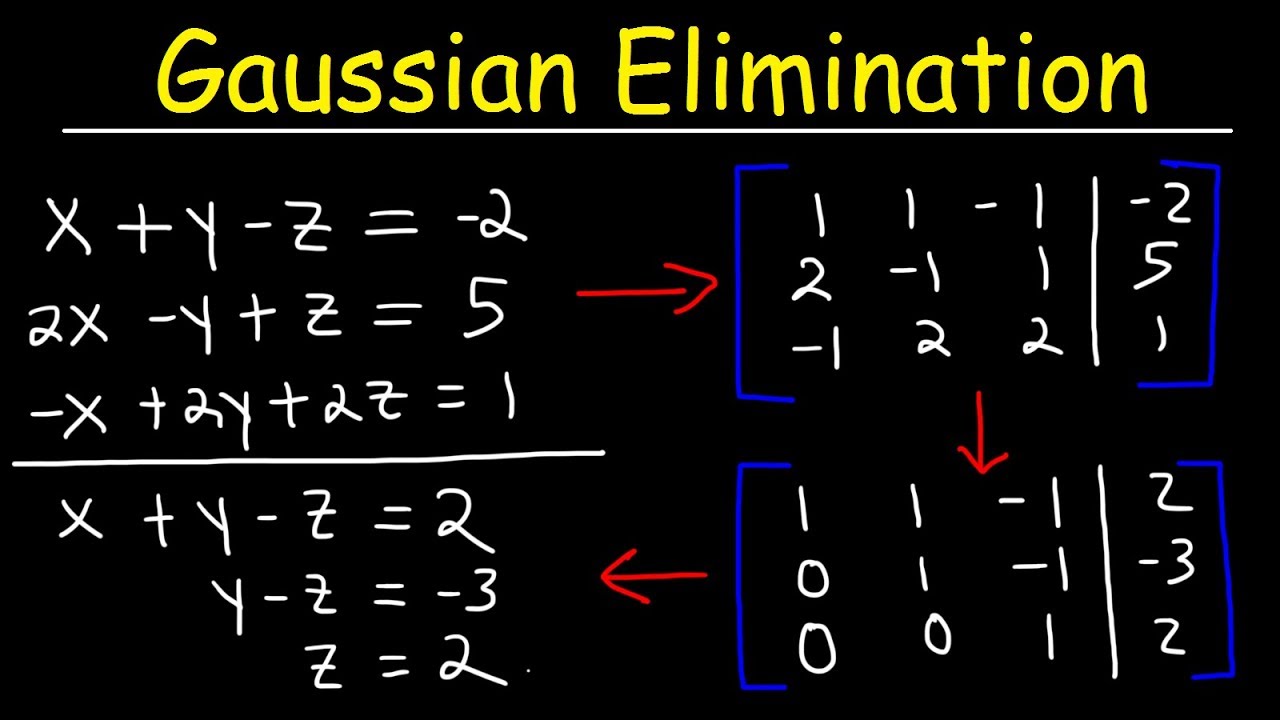
This precalculus video tutorial provides a basic introduction into the gaussian elimination - a process that involves elementary row operations with 3x3 matrices which allows you to solve a system of linear equations with 3 variables. You need to convert the system of equations into an augmented matrix and use matrix row operations to write it ...
steel sage
It is the property of determinant, it works on any commutative ring. Anyway I am too drunk so can’t follow up but I have stated the idea
 vast zenith
to find Eigenvalues/vectors I don’t see any easier way than direct calculation
drifting sierra
 dense rampart
whats a ring 😭
steel sage
-1 on (1,1) eliminate 1 on (1,3), this is the last sentence while I am sober
dense rampart
drifting sierra
i cant read this
also the diagonals should all subtract lambda beforehand no?
vast zenith
I believe most of the advice these people provided is to calculate just the determinant
You’re trying to find the characteristic equation
In that case I can’t see any simpler approach
But row reduction certainly doesn’t work
glacial ledge
dense rampart
any smart way to do this other than calculating a 5x5 det?
U can use
Det(A-alphaI)=0?
vast zenith
yes they were wondering if there was a simpler way though
dense rampart
glacial ledge
U can use
Det(A-alphaI)=0?
yes which is painful as of now
vast zenith
I’d say determinant from column 5 is the best bet, you’ll get a couple of nested determinants
dense rampart
😢
vast zenith
lol you could try guessing eigenvectors
but tbh thats also painful for large matrices
change of basis is also painful
dense rampart
alr ill just do it the normal way for now
glacial ledge
 dense rampart
yeah
glacial ledge

 devout snowBOT
@dense rampart Has your question been resolved?
dense rampart
<@&286206848099549185>
dense rampart
<@&286206848099549185>
dense rampart
damn
 wheat pawn
have you done what Nel mentioned at the very start?
dense rampart
dense rampart
I’m cryin
which got me here
 atomic thunder
dense rampart
I’m cryin
atomic thunder
dense rampart
I’m cryin
That polynomial is actually pretty simple to solve, but if you can't see it, have you tried to find the rational roots of it?
dense rampart
my calculator says its a messy number its not a clean (x+1)^3
a clean expression's signs are ++++ or +-+- right
atomic thunder
My bad i thought i saw a -1 on the last term
dense rampart
.close
devout snowBOT
Channel closed
Closed by @dense rampart
Use .reopen if this was a mistake.
atomic thunder
dense rampart
I’m cryin
I know it's already closed but it looks like you forgot a negtive sign in the first 3x3 determinant
devout snowBOT
Available help channel!
Send your question here to claim the channel.
Remember:
• Ask your math question in a clear, concise manner.
• Show your work, and if possible, explain where you are stuck.
• Do not immediately ping people or roles. After 15 minutes, feel free to ping <@&286206848099549185> once.
• Type the command .close to free the channel when you're done.
• Be polite and have a nice day!
Read #❓how-to-get-help for further information on how to ask a good question, and about conduct in the question channels.
 brisk finch
So
In the 1st example n changed the sign behind it because the brackets in front of it had an odd exponent
In the 2nd example b didn't change the sign behind it because the brackets in front of it had an even exponent
I remember how it works, but I don't remember why it works like this. Could you guys shred a light on this for me?
 devout snowBOT
brisk finch
So
In the 1st example n changed the sign behind it because the brackets in fron...
devout snowBOT
brisk finch
So
In the 1st example n changed the sign behind it because the brackets in fron...
@brisk finch Has your question been resolved?
brisk finch
<@&286206848099549185>
sand quarry
brisk finch
<@&286206848099549185>
x^3 is an odd function
x^2 is an even function
For even functions, f(x) = f(-x)
For odd functions,-f(x) = f(-x)
brisk finch
I haven't gotten to functions yet
Could you explain this by just doing the thing step by step?
sand quarry
brisk finch
Could you explain this by just doing the thing step by step?
Ill only focus on that part then
But your quwstion is basically how
(y-x)^3 = -(x-y)^3
And
(y-x)^2 = (x-y)^2
For that
Do you know the exponent distribution law
(ab)^n = a^nb^n
@brisk finch
brisk finch
sand quarry
Do you know the exponent distribution law
Now I do
Same thing as with x(a+b) = xa + ab, yeah?
But with exponents
brisk finch
Yes
sand quarry
brisk finch
Yes
Ok so
- is in reality (-1)*(...)
So we can write
(y-x)^3 = (-(x-y))^3 = ((-1)*(x-y))^3
Is this fine?
brisk finch
Yes
devout snowBOT
@brisk finch Has your question been resolved?
 sullen quarry
brisk finch
So
In the 1st example n changed the sign behind it because the brackets in fron...
sullen quarry
brisk finch
So
In the 1st example n changed the sign behind it because the brackets in fron...
Your question is like why (-1)^3 is negative but not (-1)^4 right
Wait I’m confused by the question could you be more specific
sullen quarry
sullen quarry
Your question is like why (-1)^3 is negative but not (-1)^4 right
I know it’s not this but I don’t understand what’s the question
devout snowBOT
@brisk finch Has your question been resolved?
brisk finch
sullen quarry
I know it’s not this but I don’t understand what’s the question
I'm not sure how to explain it otherwise
sullen quarry
The goal is to simplify that first expression right

 short hare
brisk finch
So
In the 1st example n changed the sign behind it because the brackets in fron...
short hare
brisk finch
So
In the 1st example n changed the sign behind it because the brackets in fron...
uhm,
(2)^2 = 4 and (-2)^2 = 4
(3)^2 = 9 and (-3)^2 = 9
you see, It doesn't matter if the number/quantity/wtv in the bracket is positive or negative because the output will ALWAYS be positive. that's for any even exponent.
also, 4-3 = 1 and 3-4 = -1
7-4 = 3 and 4-7 = -3
so notice how
a-b=-(b-a)
so if you have a bracket like (a-b)^2, the exponent here is even, meaning that if we alter the sign of the insides, the output will still be the same. so we can do (b-a)^2 because (b-a)^2 = (a-b)^2 due to a-b = -(b-a). basically what i explained above.
now for odd exponents, the negative sign does matter!
(3)^3 = 27 and (-3)^3 = -27
(4)^3 =64 and (-4)^3 = -65
but now, notice something different, that the difference between (a)^n and (-a)^n when n is an odd number is just the negative!
(-a)^n = -(a)^n for n is an odd number
I dont know what you meant by 'n changed and b didnt change' but I explained how and why
(x-y)^2 = (y-x)^2
coefficents that you dont know the sign of (like n and b in your example) cannot alter the sign of the bracket... so if you have a b(x-y)^2, that can be written as b(y-x)^2 not because of b, its because of the property i explained above.
holy text wall (sorry)
devout snowBOT
@brisk finch Has your question been resolved?
devout snowBOT
Channel closed
Closed due to timeout
Use .reopen if this was a mistake.
devout snowBOT
Available help channel!
Send your question here to claim the channel.
Remember:
• Ask your math question in a clear, concise manner.
• Show your work, and if possible, explain where you are stuck.
• Do not immediately ping people or roles. After 15 minutes, feel free to ping <@&286206848099549185> once.
• Type the command .close to free the channel when you're done.
• Be polite and have a nice day!
Read #❓how-to-get-help for further information on how to ask a good question, and about conduct in the question channels.
 hard ocean
Given b=[-2 -1 -2 1]^T, show that there is no answer to Ax=b using QR decomposition.
can someone help me piece the solution together I kinda don't understand pic 2 (which explains how to use QR decomp to solve the LS problem, even if it's economy QR).
translation for second pic:
The residue vector can be divided into two parts and the total residue is the sum of both the parts.
The first part can be brought to 0 using solution of reverse substitution (?).
The second part can't be changed - the sum of squares of the last part of Q^Tb decides the minimum height of the LS problem.
Note that we could use economy QR to compute solution.

 devout snowBOT
hard ocean
Given b=[-2 -1 -2 1]^T, show that there is no answer to Ax=b using QR decomposi...
hard ocean
devout snowBOT
hard ocean
Given b=[-2 -1 -2 1]^T, show that there is no answer to Ax=b using QR decomposi...
hard ocean
My work: I found economy Q, and R resulting from Q^TA
How do I continue to show that Ax=b which is Rx=Q^Tb has no solution ?
devout snowBOT
@hard ocean Has your question been resolved?
hard ocean
R is invertible so proving there's no solution depends on Q^Tb
In the second pic they split the vector Q^Tb and i dont understand why first part and second part behave that way/have that job
How does splitting even work when I'm solving the linear equation
Not computing the norm
Also they're working with a square matrix Q, how is it different with an economy Q
Is the second pic even helpful ?
devout snowBOT
@hard ocean Has your question been resolved?
devout snowBOT
@hard ocean Has your question been resolved?
devout snowBOT
@hard ocean Has your question been resolved?
steel sage
Do you have to use this QR? Because it doesn’t enter my mind firstly. Like you can either show that rank(A)<rank(A b), or show Pb doesn’t equal b where P=A(A^t A)^-1 A^t
hard ocean
I could yes but the question requires me to use QR
 sterile gust
hello could someone help me to understand this ? i don't understand how we pass + φ to − k
 hard ocean
sterile gust
hello could someone help me to understand this ? i don't understand how we pass ...
hard ocean
hard ocean
sterile gust
hello could someone help me to understand this ? i don't understand how we pass ...
,, -\frac{k}{\varphi} \cdot \varphi = -k
woven radishBOT
prograce
 hard ocean
Please claim a channel
hard ocean
@tawny nest 🖕
 cedar shale
hard ocean
cedar shale
hard ocean
.close
devout snowBOT
Channel closed
Closed by @hard ocean
Use .reopen if this was a mistake.
devout snowBOT
Available help channel!
Send your question here to claim the channel.
Remember:
• Ask your math question in a clear, concise manner.
• Show your work, and if possible, explain where you are stuck.
• Do not immediately ping people or roles. After 15 minutes, feel free to ping <@&286206848099549185> once.
• Type the command .close to free the channel when you're done.
• Be polite and have a nice day!
Read #❓how-to-get-help for further information on how to ask a good question, and about conduct in the question channels.
 hazy cypress
WHY is the radius of convergence 1?
 devout snowBOT
hazy cypress
WHY is the radius of convergence 1?
misty crest
devout snowBOT
hazy cypress
WHY is the radius of convergence 1?
misty crest
what was unclear?
hazy cypress
like, i get that maybe it's because of the ratio test, but it states that this series only converges when x is less than one
misty crest
where?
 misty crest
yes so they’re just applying the statement of the ratio test
hazy cypress
i assume the absolute value gives rise to the range -1,1 with the statement inside the absolute value squeezed in between?
misty crest
ratio test tells us the series converges if lim |a_{n + 1}/a_n| < 1
evaluating the limit just gave us |x - 2|
so it converges for all x such that |x - 2| < 1
if we’re just invoking the ratio test
we need to do more work for the endpoints
hazy cypress
the interval isn't -1,1 it's like 1,3 or something
misty crest
yes because it’s |x - 2| not |x|
hazy cypress
so the radius is dependent on the right side of the inequality?