#help-27
1 messages · Page 346 of 1
 dry leaf
 glossy dew
he admits that he did many mistakes
 restive river
Well the thing is not everything can be understood if u brainstorm it right from scratch
When I solved HC Verma it was very rigorous
But after I completed a lot of it following the correct steps and methods did i actually connect the dots to understand why and how
My suggestion is to correct your mistakes first and make the general approach a second nature and then try to understand the rest
As for how to solve this question i think the power= constant approach will be best
You find the v for block 1 and then v=d/t will do it
And a1=0??? Wtf is going on 😭😭
dry leaf
glossy dew
he admits that he did many mistakes
But you couldn't find the one that I'm looking for
dry leaf
restive river
Well the thing is not everything can be understood if u brainstorm it right from...
Yes I get it but I'm only trying to understand what's the mistake in my solution
glossy dew
dry leaf
Yes I get it but I'm only trying to understand what's the mistake in my solution
a lot of things
and im not sure if the isolated system method would work
 devout snowBOT
@dry leaf Has your question been resolved?
devout snowBOT
@dry leaf Has your question been resolved?
devout snowBOT
Channel closed
Closed due to timeout
Use .reopen if this was a mistake.
 Available help channel!
Send your question here to claim the channel.
Remember:
• Ask your math question in a clear, concise manner.
• Show your work, and if possible, explain where you are stuck.
• After 15 minutes, feel free to ping <@&286206848099549185>.
• Type the command .close to free the channel when you're done.
• Be polite and have a nice day!
Read #❓how-to-get-help for further information on how to ask a good question, and about conduct in the question channels.
 normal sigil
hi, can you explain how to prove whether a function is partially differentiable.
I am asked to prove it for this function, and so far i think i have proven that it is partially differentiable for IR without (0,0), but i dont understand how to do it for (0,0).
I only need to show that it is partially differentiable twice.
 devout snowBOT
normal sigil
hi, can you explain how to prove whether a function is partially differentiable....
devout snowBOT
normal sigil
hi, can you explain how to prove whether a function is partially differentiable....
 supple knot
Use limit definition of partial derivative
normal sigil
meaning this?

 runic prawn
normal sigil
meaning this?
runic prawn
normal sigil
meaning this?
yes
normal sigil
so if i show that all partiall derivatives of f(x,y) exist by calculating them i have proven that the function is partially differentiable?
devout snowBOT
@normal sigil Has your question been resolved?
Channel closed
Closed by @normal sigil
Use .reopen if this was a mistake.
Available help channel!
Send your question here to claim the channel.
Remember:
• Ask your math question in a clear, concise manner.
• Show your work, and if possible, explain where you are stuck.
• After 15 minutes, feel free to ping <@&286206848099549185>.
• Type the command .close to free the channel when you're done.
• Be polite and have a nice day!
Read #❓how-to-get-help for further information on how to ask a good question, and about conduct in the question channels.
 somber garnet

 devout snowBOT
Channel closed
Closed by @somber garnet
Use .reopen if this was a mistake.
devout snowBOT
Available help channel!
Send your question here to claim the channel.
Remember:
• Ask your math question in a clear, concise manner.
• Show your work, and if possible, explain where you are stuck.
• After 15 minutes, feel free to ping <@&286206848099549185>.
• Type the command .close to free the channel when you're done.
• Be polite and have a nice day!
Read #❓how-to-get-help for further information on how to ask a good question, and about conduct in the question channels.
 waxen steeple
i know it's principle by inclusion exclusion but im a little bit confused on how to find the probabilities of eg selecting at least a red and a yellow, why would it not just be (8C2) (1/4)^2 (3/4)^6 ?
 devout snowBOT
waxen steeple
i know it's principle by inclusion exclusion but im a little bit confused on how...
devout snowBOT
waxen steeple
i know it's principle by inclusion exclusion but im a little bit confused on how...
@waxen steeple Has your question been resolved?
devout snowBOT
@waxen steeple Has your question been resolved?
devout snowBOT
Show your work, and if possible, explain where you are stuck.
 lunar harbor
(Why would it be that?)
devout snowBOT
Channel closed
Closed due to timeout
Use .reopen if this was a mistake.
Available help channel!
Send your question here to claim the channel.
Remember:
• Ask your math question in a clear, concise manner.
• Show your work, and if possible, explain where you are stuck.
• After 15 minutes, feel free to ping <@&286206848099549185>.
• Type the command .close to free the channel when you're done.
• Be polite and have a nice day!
Read #❓how-to-get-help for further information on how to ask a good question, and about conduct in the question channels.
 fiery mist
help pls. i don't know how to get the domain and range

 autumn girder
!status
devout snowBOT
What step are you on?
1. I don't know where to begin.
2. I have begun but got stuck midway.
3. I got an answer but I was told that it's wrong.
4. I got an answer and would like my work checked.
5. I have a question about someone else's work/solution.
6. I have completed the problem and don't need help anymore. Thank you.
7. None of the above
1
autumn girder
Yes for both f and g the domains are restricted
fiery mist
yeah for f(x) range is [-8, oo), and g(x) range is [-7,oo)
autumn girder
Can you tell me what are the domains and ranges of f and g respectively?
Oh I didn't even need to ask lol
fiery mist
😭
autumn girder
Check again for g
fiery mist
the domain and range of g?
fiery mist
all g
autumn girder
Can you also state the domains though
autumn girder
Correct
Now, (f + g)(x) = f(x) + g(x), you know that from the note you have in the image
fiery mist
yeah
autumn girder
Good, But f(x) can't be defined for any x < 1
fiery mist
yeah..
fiery mist
no😭
autumn girder
Ok, why?
autumn girder
autumn girder
So by definition, (f + g)(x) should also be undefined
for x < 1
fiery mist
uhm so the domain and range of (f+g)(x) should be undefined?
autumn girder
?
No
I'm saying that the Domain of (f + g)(x) is going to be $x \in [1, \infty)$
 woven radishBOT
@autumn girder
 fiery mist
ohhh
autumn girder
Yea because it can't be below that, but it's defined for every number above that
autumn girder
Exactly
autumn girder
Wanna take a shot at it yourself?
fiery mist
i tried.. but i got the wrong answer
autumn girder
Ok well, so you see that they're both increasing functions right?
fiery mist
yeah
autumn girder
So we're pretty sure that the right bound for the range is gonna be infinity
because these functions will keep increasing infinitely
there's no denying that
fiery mist
uhuh
autumn girder
Ok cool
Also from the arrow on the top right
of both of the functions
we can tell that they never decrease
fiery mist
yeah
autumn girder
i.e. their lowest values are the ones we see on the graphs in front of us
aka their minima
fiery mist
-8 and -7??
autumn girder
Yes, those are each of their respective minimas
but those aren't the minima of (f + g)
recall that, (f + g)(x) is only defined in the range $[1, \infty)$
woven radishBOT
@autumn girder
 fiery mist
so i should add the values of f(1) and g(1)?
fiery mist
omg i get it now
autumn girder
Cool
autumn girder
Shoot
fiery mist
do u still have time? or
autumn girder
Yea I do have time
fiery mist
itd be great if u help me out with those 🥹
autumn girder
What are you confused about with them
fiery mist
for f(g(x))
do i only solve the domain and range for g(x)?? bc it's the input for f(x)??
idk im kinda confused tbh
i might not be understanding it well enough
autumn girder
$$f \colon [1, \infty) \to [-8, \infty)$$
$$g \colon [-9, \infty) \to [-7, \infty)$$
woven radishBOT
@autumn girder
 autumn girder
yea?
fiery mist
yeah
autumn girder
So, when we try to compute f(g(x))
we're pluggin in the output of g(x) into f(x)
Correct?
fiery mist
yeah..
autumn girder
So what we're doing is we're trying to map over the range of g using f
does this make sense?
autumn girder
Don't say sure, unless you are sure of it
fiery mist
no im not sure
autumn girder
Ok
So, output of g(x) can only be in $[-7, \infty)$, that is what range means, right?
woven radishBOT
@autumn girder
 fiery mist
yes
woven radishBOT
@autumn girder
 autumn girder
we're talking about domain of f, and range of g
fiery mist
okok
 tepid rover
Hi
autumn girder
woven radish
<@946379454056386560>
From this, can you find the sub-domain of g where $f \circ g$ will be defined?
tepid rover
I also need help
woven radishBOT
@autumn girder
 autumn girder
tepid rover
I also need help
autumn girder
tepid rover
I also need help
!help
devout snowBOT
tepid rover
I also need help
To ask for mathematics help on this server, please open your own help channel or help thread. See #❓how-to-get-help for instructions.
fiery mist
autumn girder
From this, can you find the sub-domain of g where $f \circ g$ will be defined?
sub domain?
never learned about that
autumn girder
fiery mist
sub domain?
subset of domain
autumn girder
What is the value of $g(1)$?
woven radishBOT
@autumn girder
 fiery mist
-2
autumn girder
Does -2 belong to the domain of f?
autumn girder
Correct
$f \circ g$ will be defined for all $x \ge 7$ because g is an increasing function and f has a continuous domain
woven radishBOT
@autumn girder
 fiery mist
right
woven radishBOT
@autumn girder
 autumn girder
And then f(x) is increasing
and continuous
so
you get the range
$[-8, \infty)$
woven radishBOT
@autumn girder
 autumn girder
making $f \circ g \colon [7, \infty) \to [-8, \infty)$
woven radishBOT
@autumn girder
 fiery mist
oh so we can find the range from the domain of f(g(x))?
autumn girder
Yes
fiery mist
ahh
autumn girder
Well you also require the procedure or the graph to get the minimum value
and the maximum value
and the values where it isn't defined
fiery mist
okok
autumn girder
but yea, if you have Domain, and either procedure to get to range or a graph showing the relation between Domain and range
you can get to it
autumn girder
Glad to be of help
autumn girder
fiery mist
i thought i was cooked for my finals
Best of luck for your finals
fiery mist
have a great rest of ur night/day!
fiery mist
tyty
autumn girder
!done
devout snowBOT
If you are done with this channel, please mark your problem as solved by typing .close
fiery mist
.close
devout snowBOT
Channel closed
Closed by @fiery mist
Use .reopen if this was a mistake.
devout snowBOT
Available help channel!
Send your question here to claim the channel.
Remember:
• Ask your math question in a clear, concise manner.
• Show your work, and if possible, explain where you are stuck.
• After 15 minutes, feel free to ping <@&286206848099549185>.
• Type the command .close to free the channel when you're done.
• Be polite and have a nice day!
Read #❓how-to-get-help for further information on how to ask a good question, and about conduct in the question channels.
 jagged lily
help.
“As more rectangles are added, the estimate increases, but is still an underestimate of the actual value. What does this say about f’(x) and f’’(x) over the interval?”
I can’t visualize this 😭 help
devout snowBOT
jagged lily
help.
“As more rectangles are added, the estimate increases, but is still an und...
jagged lily
Where do you even start
 drifting sinew
jagged lily
help.
“As more rectangles are added, the estimate increases, but is still an und...
drifting sinew
jagged lily
help.
“As more rectangles are added, the estimate increases, but is still an und...
This is very hard to do without some specialized knowledge, so I'll try my best to help you work through it.
First, assume that you're taking a lower RAM.
Then, what happens as you add more rectangles?
jagged lily
RAM?
drifting sinew
jagged lily
RAM?
RAM stands for Riemann Approximation Method. It's synonymous to using the different rectangles (and other shapes) to approximate integrals.
jagged lily
drifting sinew
RAM stands for Riemann Approximation Method. It's synonymous to using the differ...
Ok
jagged lily
drifting sinew
Then, what happens as you add more rectangles?
The estimate goes up
drifting sinew
jagged lily
The estimate goes up
And how will the estimate compare to the true value of the definite integral?
jagged lily
The estimate is always gonna be lower than the actual value
drifting sinew
jagged lily
The estimate is always gonna be lower than the actual value
Why?
drifting sinew
You are correct, I just want you to formalize the reason into words so we can use the same explanation later.
jagged lily
???????????
drifting sinew
jagged lily
Idk why
First, understand that the lower RAM simply uses the lower y-value of the rectangle's endpoints as the height of the rectangle.
jagged lily
Yes
drifting sinew
drifting sinew
First, understand that the lower RAM simply uses the lower `y`-value of the rect...
Now, can you try explaining why the lower RAM is always lower than the true value of the integral.
jagged lily
Because the RAM uses the lower y-value at the rectangle endpoints
drifting sinew
Cause:
- The lower RAM uses the lower
y-value at the rectangle endpoints. #help-27 message - We are adding more rectangles within an interval to estimate a definite integral. #help-27 message
Effect: - The estimate increases. #help-27 message
- The estimate stays below the true value of the definite integral. #help-27 message
It's good to understand that the effect is primarily caused because we use the lower y-value of the rectangle's endpoints.
drifting sinew
jagged lily
help.
“As more rectangles are added, the estimate increases, but is still an und...
!original
Some information seems to be is missing.
devout snowBOT
jagged lily
help.
“As more rectangles are added, the estimate increases, but is still an und...
Please show the original problem, exactly as it was stated to you, with the entire original context. A picture or screenshot is best. If the original problem is not in English, then post it anyway! The additional context might still be helpful. Do your best to provide a translation.
@jagged lily Has your question been resolved?
devout snowBOT
Channel closed
Closed due to timeout
Use .reopen if this was a mistake.
devout snowBOT
Available help channel!
Send your question here to claim the channel.
Remember:
• Ask your math question in a clear, concise manner.
• Show your work, and if possible, explain where you are stuck.
• After 15 minutes, feel free to ping <@&286206848099549185>.
• Type the command .close to free the channel when you're done.
• Be polite and have a nice day!
Read #❓how-to-get-help for further information on how to ask a good question, and about conduct in the question channels.
 frigid torrent
how do i solve (-1-i)^10 for complex numbers
devout snowBOT
frigid torrent
how do i solve (-1-i)^10 for complex numbers
frigid torrent
i already got the modulus which is route(2)
 soft umbra
Wdym, To simplify?
frigid torrent
sorry i didnt write the ^10 bit
just changed it
and I got to route(2)cis(x)
then i expanded which is just cos(x)+isin(x)
which is -1/route(2)
which is -45 degrees
now what?
im up to
 soft umbra
frigid torrent
im up to
soft umbra
frigid torrent
im up to
looks fine till now
frigid torrent
now what
soft umbra
are you struggling with how to proceed?
frigid torrent
how do i remove the exponetial
soft umbra
I see
frigid torrent
route 2 becomes 32
soft umbra
soft umbra
it's just -45* 10
and don't forget the length, which you have found already
soft umbra
frigid torrent
route 2 becomes 32
This
soft umbra
frigid torrent
that becomes -90
correct
soft umbra
yes, now convert it into polar form
frigid torrent
isnt it already polar form?
soft umbra
frigid torrent
the negative
Imagine you rotate clockwise about 90 degree
what would the coordinate be?
If the original coordinate is (32, 0)
frigid torrent
0,-32
frigid torrent
convert it to?
soft umbra
a+bi form
devout snowBOT
Channel closed
Closed by @frigid torrent
Use .reopen if this was a mistake.
Available help channel!
Send your question here to claim the channel.
Remember:
• Ask your math question in a clear, concise manner.
• Show your work, and if possible, explain where you are stuck.
• After 15 minutes, feel free to ping <@&286206848099549185>.
• Type the command .close to free the channel when you're done.
• Be polite and have a nice day!
Read #❓how-to-get-help for further information on how to ask a good question, and about conduct in the question channels.
 calm python
Fluid Mechanics Question: may I ask whats the difference between these 2? are they not both Velocity head?

 devout snowBOT
calm python
Fluid Mechanics Question: may I ask whats the difference between these 2? are th...
devout snowBOT
calm python
Fluid Mechanics Question: may I ask whats the difference between these 2? are th...
 thick ledge
In what context is the second formula written?
calm python
i just saw it here, im still trying to understand

 acoustic leaf
the second one is the change in velocity head
calm python
correct me if im wrong, so this formula is used when the water that is being pumped is along the Pump Centerline??
 thick ledge
calm python
correct me if im wrong, so this formula is used when the water that is being pum...
thick ledge
calm python
correct me if im wrong, so this formula is used when the water that is being pum...
Yeah
It's true for any flowing liquid
That is irrotational
calm python
ok thx both of you, ill give it a try
thick ledge
Also of course it should be incompressible and non viscous fluid
thick ledge
calm python
ok thx both of you, ill give it a try
No worries
devout snowBOT
@calm python Has your question been resolved?
calm python
thick ledge
No worries
may I ask why is Zd only measured at the centerline?

Isnt it suppose to be like this? since is Zd - Zs?
 devout snowBOT
@calm python Has your question been resolved?
devout snowBOT
Channel closed
Closed by @calm python
Use .reopen if this was a mistake.
devout snowBOT
Available help channel!
Send your question here to claim the channel.
Remember:
• Ask your math question in a clear, concise manner.
• Show your work, and if possible, explain where you are stuck.
• After 15 minutes, feel free to ping <@&286206848099549185>.
• Type the command .close to free the channel when you're done.
• Be polite and have a nice day!
Read #❓how-to-get-help for further information on how to ask a good question, and about conduct in the question channels.
 cyan hearth
im unable to find g(x), anyone has a hint?
 devout snowBOT
cyan hearth
im unable to find g(x), anyone has a hint?
cyan hearth
devout snowBOT
cyan hearth
im unable to find g(x), anyone has a hint?
cyan hearth
this is how i found p(x)

-p(x)=w'/w
so i had to find w'
but the left one im unsure
 meager sequoia
cyan hearth
im unable to find g(x), anyone has a hint?
meager sequoia
cyan hearth
im unable to find g(x), anyone has a hint?
you know a solution to the ODE (y_1 for instance) and you know p(x). Therefore, you can obtain an equation for g(x)
cyan hearth
yea yea i realised i was being a dum dum
its just rearranging
and plugging y=exp(6x)
meager sequoia
nice! glad it worked out
devout snowBOT
Channel closed
Closed by @cyan hearth
Use .reopen if this was a mistake.
devout snowBOT
Available help channel!
Send your question here to claim the channel.
Remember:
• Ask your math question in a clear, concise manner.
• Show your work, and if possible, explain where you are stuck.
• After 15 minutes, feel free to ping <@&286206848099549185>.
• Type the command .close to free the channel when you're done.
• Be polite and have a nice day!
Read #❓how-to-get-help for further information on how to ask a good question, and about conduct in the question channels.
 sick bolt
Can someone walk me through how my teacher got these answers

 fossil locust
sick bolt
Can someone walk me through how my teacher got these answers
fossil locust
sick bolt
Can someone walk me through how my teacher got these answers
similar triangles
sick bolt
fossil locust
similar triangles
Elaborate
fossil locust
sick bolt
Elaborate
https://www.youtube.com/watch?v=m9p37TE53SI - try watching this
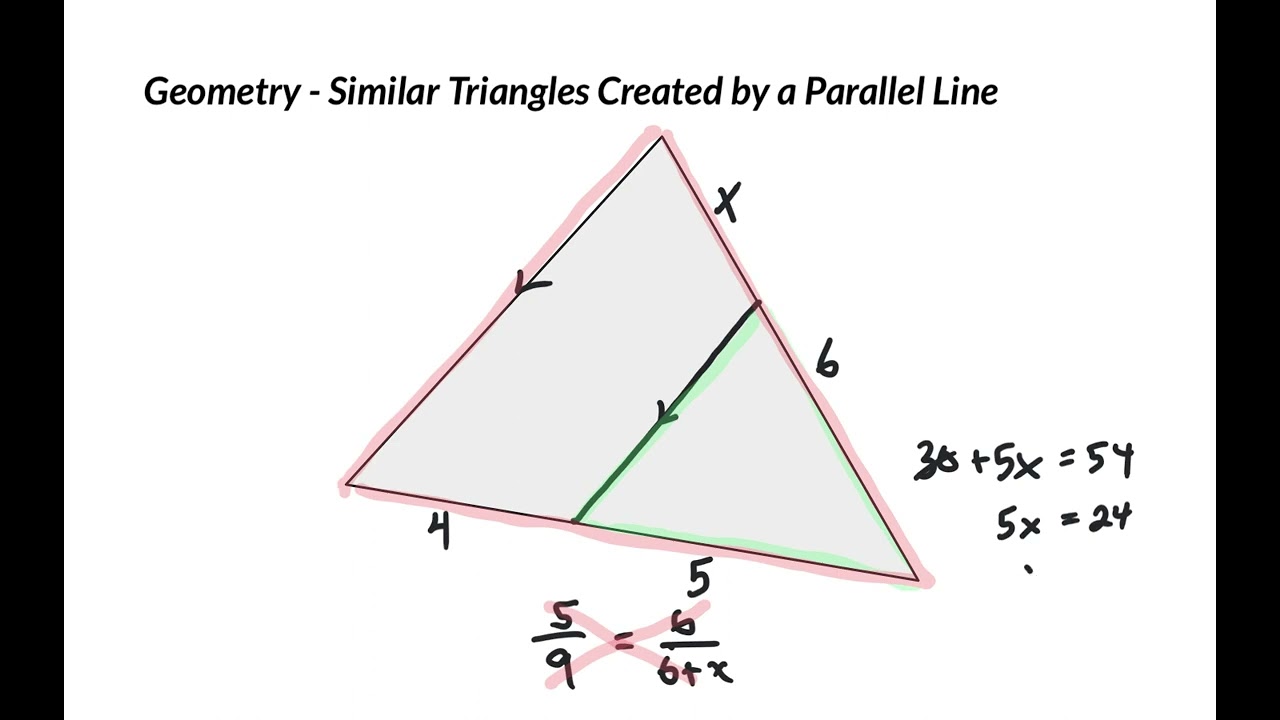
Like and subscribe for more math help! #geometry #similartriangles
sick bolt
fossil locust
https://www.youtube.com/watch?v=m9p37TE53SI - try watching this
Bruh I ain't got time I have a quiz in 5 min give me a summary
fossil locust
sick bolt
Can someone walk me through how my teacher got these answers
so for all of these triangles, the largest triangle is twice as big as the small one
because the large triangle has side length 2y, and the small triangle has side length y
so x is twice of 10 in the first question
sick bolt
fossil locust
because the large triangle has side length 2y, and the small triangle has side l...
How do you know it's 2 times larger
fossil locust
sick bolt
How do you know it's 2 times larger
I suspect you don't understand what the marks mean
sick bolt
Equal
fossil locust
ok so you do know
fossil locust
sick bolt
Equal
try drawing the small triangle on the top and the largest triangle separately
draw them as two triangles
sick bolt
Oh I think I see it
devout snowBOT
@sick bolt Has your question been resolved?
sick bolt
.close
devout snowBOT
Channel closed
Closed by @sick bolt
Use .reopen if this was a mistake.
devout snowBOT
Available help channel!
Send your question here to claim the channel.
Remember:
• Ask your math question in a clear, concise manner.
• Show your work, and if possible, explain where you are stuck.
• After 15 minutes, feel free to ping <@&286206848099549185>.
• Type the command .close to free the channel when you're done.
• Be polite and have a nice day!
Read #❓how-to-get-help for further information on how to ask a good question, and about conduct in the question channels.
 spring oasis
 devout snowBOT
spring oasis
thick ledge
devout snowBOT
spring oasis
thick ledge
@spring oasis translation please
spring oasis
is being done, beep beep boop boop
- Let ( B = {(0,1,1); (1,1,1); v} ) be a basis of ( \mathbb{R}^3 ) such that the coordinates of the vector ((4,6,4)) in the basis ( B ) are ((3,2,1)). Find ( v ) and the coordinates of the vector ((2,2,0)) in the basis ( B ).
woven radishBOT
938c2cc0dcc05f2b68c4287040cfcf71
 spring oasis
(4,6,4) = 3(0,1,1) + 2(1,1,1) + v
thick ledge
Yes
spring oasis
(4,6,4) - (0,3,3) - (2,2,2) = v
thick ledge
Yep
spring oasis
,w {4,6,4}-{0,3,3}-{2,2,2}
woven radishBOT


 Requested by 938c2cc0dcc05f2b68c4287040cfcf71
thick ledge
Requested by 938c2cc0dcc05f2b68c4287040cfcf71
thick ledge

spring oasis
v = (2,1,-1)
thick ledge
Yeah
spring oasis
(2,2,0) = a(0,1,1) + b(1,1,1) + c(2,1,-1)
thick ledge
Yeah
spring oasis
i) 2 = b + 2c
ii) 2 = a + b + c
iii) 0 = a + b - c
thick ledge
Yes
spring oasis
a + b = 1
thick ledge
True
spring oasis
b = 2 - 2c
thick ledge
Yes
thick ledge
Yes
spring oasis
a = 2c - 1
 lilac stone
thick ledge
Why take such a long route
lilac stone
thick ledge
Why take such a long route
and you reply him every line
thick ledge
 c is 1 from when you got a + b = 1
spring oasis
thick ledge
<:KEK:586240877358350341> c is 1 from when you got a + b = 1
right, I didnt noticed
because a+b = 1
 spring oasis
we got three unknowns and 3 equations
thick ledge
spring oasis
we got three unknowns and 3 equations
That doesn't always gurantee a unique solution
lilac stone
(determinant is not 0)
spring oasis
because the system is consistent
thick ledge
lilac stone
(determinant is not 0)
Again that isn't concrete
You can have 0 solutions as well
spring oasis
lilac stone
(determinant is not 0)
the matrix is non square
thick ledge
spring oasis
the matrix is non square
No it is
lilac stone
spring oasis
the matrix is non square
isn't it 3 by 3?
spring oasis
lilac stone
isn't it 3 by 3?
i thought it was a 3x3 augmented with 1 column
thick ledge
spring oasis
i thought it was a 3x3 augmented with 1 column
That's A augment B
Where A is 3 by 3
And B is column matrix
He's talking about B
Also btw my bad det not equal to 0 satisfies uniqueness
spring oasis
even if det(A) = non zero, we can still get no solutions because the system can be inconsistent
lilac stone
thick ledge
You can have 0 solutions as well
I mean, 0 determinant implies the whole vector space going down several dimensions, which could only have 0 or inf solutions
thick ledge
lilac stone
I mean, 0 determinant implies the whole vector space going down several dimensio...
Yes mb
thick ledge
spring oasis
even if det(A) = non zero, we can still get no solutions because the system can ...
Not really
spring oasis
thick ledge
That's A augment B
even if A is invertible, we can still have no solutions for A|B if the system is inconsistent mate
spring oasis
thick ledge
Not really
elaborate
thick ledge
spring oasis
thick ledge
https://math.stackexchange.com/questions/791750/how-do-we-know-that-if-ax-b-has-...
very informative mate
im upvoting the emily answer jjajaj
thick ledge
spring oasis
thick ledge
Can you tell me why we won't get infinite solutions for a, b, c?
why do you ask me this?
we were already done with the exercise, it was like extra question?
(2,2,0) = a(0,1,1) + b(1,1,1) + c(2,1,-1)
(a,b,c) = (1,0,1)
thick ledge
Yeah just so that you understood everything nicely
spring oasis
(2,2,0) = (0,1,1) + (2,1,-1)
(2,2,0) = (2,2,0)
spring oasis
thick ledge
Yeah just so that you understood everything nicely
i appreciate the help @lilac stone @thick ledge
thick ledge
lilac stone
When we consider a system of linear equations, we're basically finding the solution vector x in the equation Ax=b, where A is a square matrix with a bunch of constants, b is another vector.
spring oasis
what happens if det(A) = 0
lilac stone
Ax is the vector x after the space had transformed according to A
spring oasis
we have infinitely many solutions?
thick ledge
Then there's 2 cases it can either have zero solutions or infinite solutions according to rank of A augment B
devout snowBOT
Channel closed
Closed by @spring oasis
Use .reopen if this was a mistake.
lilac stone
if det(A)=0, this means that everything in the original space got volume multiplied by 0
and he left
devout snowBOT
Available help channel!
Send your question here to claim the channel.
Remember:
• Ask your math question in a clear, concise manner.
• Show your work, and if possible, explain where you are stuck.
• After 15 minutes, feel free to ping <@&286206848099549185>.
• Type the command .close to free the channel when you're done.
• Be polite and have a nice day!
Read #❓how-to-get-help for further information on how to ask a good question, and about conduct in the question channels.
 noble acorn
Hey quick question, how would you interpret this task; there are 3 million «personal cars» and half a million «business vans», 400k of the personal cars are hybrids, and 800k are electrics pick a car at random, given that you pick a personal car, what are the chances of that car being neither electric nor hybrid? Would you include the chances of pulling a personal car in the first place? Rounded the numbers for ease of handling
devout snowBOT
noble acorn
Hey quick question, how would you interpret this task; there are 3 million «pers...
thick ledge
No
Because they've given to you that you're choosing out of the personal cars
This is what is called conditional probability
 limber steppe
noble acorn
Hey quick question, how would you interpret this task; there are 3 million «pers...
limber steppe
noble acorn
Hey quick question, how would you interpret this task; there are 3 million «pers...
 noble acorn
Ok, task b phrases it slightly differently, within the business vans there are 40k electrics and 1800 hybrids, given that you pull an electric vehicle(either van or car) what are the chances its also a van
thick ledge
What's your doubt here
noble acorn
The math isnt the hard part honestly, its moreso the interpretation, since this is a question from uni level statistics course for engineers, i might be overthinking it
thick ledge
Drawing a Venn diagram or a tree diagram substantially helps
limber steppe
thick ledge
Drawing a Venn diagram or a tree diagram substantially helps
how about my answer?
thick ledge
limber steppe
That's correct
noble acorn
thick ledge
Drawing a Venn diagram or a tree diagram substantially helps
I know, i ended up making a tree, but the problem is that im not sure whether to use the cumulative probability or just the chances of conventional or alternative propulsion
thick ledge
What don't you get
limber steppe
thick ledge
That's correct
thanks, where are you from?
noble acorn
Btw task c is a bit more involved, if you pull 12 random vehicles, what is the probability that you get less than 4 electric cars
thick ledge
limber steppe
thanks, where are you from?
I'd like to not disclose that thanks
noble acorn
I tried binomial distribution, but im not 100% sure
thick ledge
First of all is your previous doubt cleared
limber steppe
thick ledge
I'd like to not disclose that thanks
cool if you have a lot of problems, I can help you, and how about?
noble acorn
Yeah ✅ already handed in my answer so i cant really do anything about it now
thick ledge
noble acorn
Yeah ✅ already handed in my answer so i cant really do anything about it now
Ah I see
thick ledge
limber steppe
cool if you have a lot of problems, I can help you, and how about?
No thanks
noble acorn
thick ledge
Ah I see
Just came home, im really beat, this was task one so i ended up overthinking it a lot, but regarding task C, how would you solve it?
thick ledge
noble acorn
Btw task c is a bit more involved, if you pull 12 random vehicles, what is the p...
Is this using the same data?
noble acorn
Yeah
thick ledge
Cuz 3 million cars, 12 vehicles seems strange
Anyways
Yes it is binomial distribution
P( X < 4)
noble acorn
Yeah, i forgot to specify that its directly hinted that the changes in probability over 12 cars wouldnt change much so i guess they accept fixed chance
thick ledge

noble acorn
1 sec i have a harder one i got fully stuck on
 lament kraken
limber steppe
cool if you have a lot of problems, I can help you, and how about?
lament kraken
limber steppe
cool if you have a lot of problems, I can help you, and how about?
bro what you on
noble acorn
Its clearly a neural network
lament kraken
can ya respect others privacy or smth
noble acorn
It has AI in the name
lament kraken
indeed
limber steppe
lament kraken
bro what you on
I am human. tell me your problem..
I like football and I like Vini very much.
sorry , in Eglish, give me problem.
lament kraken
shouldn't have disturbed you
lament kraken
limber steppe
sorry , in Eglish, give me problem.
skill issue
noble acorn
Lets call the largest distance(measured in cm) between two points on a potato as the length of the potato. As the table under shows, you have for given lengths of potatoes(x) picked five potatoes with weight given as y(in grammes)
Length x | 6.0 | 6.4 | 6.8 | 7.2 | 7.6|
Weight y | 82 | 77 | 88 | 100 | 100 |
Find the empirical correlation-coefficient to the data in the table what does it tell us about the length and weight?
lament kraken
🥔 yum
noble acorn
Sorry if it doesnt translate well, its given in a foreign language lol
thick ledge
I'm not well-versed in statistics enough to solve this sorry
I don't know what is an empirical correlation coefficient
limber steppe
 noble acorn
My guess is that its a pearson correlation coefficient
thick ledge
limber steppe
Are you just copy pasting chat gpt answers


 thick ledge
!nogpt
devout snowBOT
Please do not trust ChatGPT or similar AI tools for mathematical tasks, as they often generate output which "sounds correct" but has numerous factual or logical errors. Use of these AI tools to answer other people's help questions is strictly against server rules (see #rules).
limber steppe
Compute 𝑟 accurately to conclude how length and weight relate for potatoes. If you need assistance with any part of the calculation, let me know!
noble acorn
thick ledge
!nogpt

limber steppe
noble acorn
<:opencry:586078614865444865>
ok, you understand gpt answer is not correct? so I can help you by myselt.
myself.
thick ledge
noble acorn
<:opencry:586078614865444865>
I'm sorry I think you should ping helpers for this
limber steppe
and if I solve, can you pay about my answer?
noble acorn
thick ledge
I'm sorry I think you should ping helpers for this
Yeah no worries
<@&286206848099549185>
 oblique dune
Why is chatgpt selling answers in chat?
noble acorn
I have no clue
limber steppe
oblique dune
Why is chatgpt selling answers in chat?
I am human.
oblique dune
What is the question?
noble acorn
noble acorn
Lets call the largest distance(measured in cm) between two points on a potato as...
Here
devout snowBOT
@noble acorn Has your question been resolved?
devout snowBOT
Channel closed
Closed due to timeout
Use .reopen if this was a mistake.
devout snowBOT
Available help channel!
Send your question here to claim the channel.
Remember:
• Ask your math question in a clear, concise manner.
• Show your work, and if possible, explain where you are stuck.
• After 15 minutes, feel free to ping <@&286206848099549185>.
• Type the command .close to free the channel when you're done.
• Be polite and have a nice day!
Read #❓how-to-get-help for further information on how to ask a good question, and about conduct in the question channels.
 wispy geyser
am i right with A here?
 devout snowBOT
wispy geyser
am i right with A here?
lunar harbor
wispy geyser
am i right with C here?
devout snowBOT
wispy geyser
am i right with A here?
lunar harbor
wispy geyser
am i right with C here?
Yes
thick ledge
Yes (nobody saw that)
devout snowBOT
Channel closed
Closed by @wispy geyser
Use .reopen if this was a mistake.
devout snowBOT
Available help channel!
Send your question here to claim the channel.
Remember:
• Ask your math question in a clear, concise manner.
• Show your work, and if possible, explain where you are stuck.
• After 15 minutes, feel free to ping <@&286206848099549185>.
• Type the command .close to free the channel when you're done.
• Be polite and have a nice day!
Read #❓how-to-get-help for further information on how to ask a good question, and about conduct in the question channels.
 smoky locust
Can I have help and advice for maths gcse
devout snowBOT
smoky locust
Can I have help and advice for maths gcse
autumn girder
!da2a
devout snowBOT
No need to ask “Can I ask…?” or “Does anyone know about…?”—it’s faster for everyone if you just ask your question! See https://dontasktoask.com/
smoky locust
autumn girder
!da2a
I have gcses over the next few weeks what topics should I prepare for that are the hardest/more likely to come up
Don't know what country you are from so do you know gcses
smoky locust
I don't have any weaknesses strengths
I'm about a 7 right now aiming for 8
I'm about to do past paper shall i send when I'm done?
 south temple
sure
smoky locust
For an 8 I need about 180 marks over 3 papers
For a 7 I need about 145 over 3 papers
south temple
focus on the back questions for the higher marks
smoky locust
I'll let you know when I start and stuff
devout snowBOT
@smoky locust Has your question been resolved?
smoky locust
@south temple I've done the paper how can I send it
south temple
its best to mark yourself as it helps you to understand what the examiner is looking for
but send what you get wrong
smoky locust
Ok I will
@south temple if I got it right but with a different method do I get the marks
south temple
yes
smoky locust
Ok nice
south temple
for ervey wuetsion except one where the answer is given in the question


 south temple
smoky locust
south temple
smoky locust
For this one you can find the lengths of all the sides from the dimensions given as the triangles are isosceles. Then you can just add them all up
smoky locust
For which one
south temple
The first one
Part b
11b the 7-x multiplies by the k both parts so you get 7k-xk on the right
south temple
Nah you’re fine
smoky locust
I'm stupid I make so many mistakes
south temple
The best way to combat that is to just check over your answers once you are done
Try working out the other way if you can like expanding brackets of a factorise question
For 8 you got it very close. You just have to multiply the mean weight by the number of counters, add the three up and divide by 100 to get the mean
For 14 the only recurring digit is the one with the symbol above it so that would be 0.233333333 and so on
smoky locust
south temple
For 14 the only recurring digit is the one with the symbol above it so that woul...
I'm so stupid I didn't even notice that
south temple
It’s a mistake you won’t make in the exam
All practice is good practice
For 16 I tend to say let f(x) = y then solve for that to reduce complexity. If you do your method you also need to reverse order of operations so do the subtraction first
smoky locust
Hopefully but I'm quite stupid so maybe
south temple
In the end results aren’t everything
If you get what you want then that’s all that matters
smoky locust
How
south temple
There are always opportunities that open up in the future
In a few years no one will care what you get really
Just that you passed
south temple
If you do the best you can then nothing more can be expected
They probably did worse
Remember a 7 is an a
smoky locust
No they did very well they expect me to be really good and stuff
I'm just stupid overall
south temple
Half the country fail maths and English so I wouldn’t say your doing too bad
A 7 would be a great result
smoky locust
@south temple I'm going to do another paper thanks for the advice
smoky locust
@south temple instead realised I don't know how to do surface area to volume
devout snowBOT
@smoky locust Has your question been resolved?
devout snowBOT
Channel closed
Closed due to timeout
Use .reopen if this was a mistake.
Available help channel!
Send your question here to claim the channel.
Remember:
• Ask your math question in a clear, concise manner.
• Show your work, and if possible, explain where you are stuck.
• After 15 minutes, feel free to ping <@&286206848099549185>.
• Type the command .close to free the channel when you're done.
• Be polite and have a nice day!
Read #❓how-to-get-help for further information on how to ask a good question, and about conduct in the question channels.
 limber ravine

 devout snowBOT
limber ravine
limber ravine
devout snowBOT
limber ravine
limber ravine
please help on this!! gcse vectors and i can’t figure out what to do next
 small quartz
Hey
limber ravine
hey
small quartz
Familiar with the intercept theorem?
small quartz
I'm not sure, it's basic though
limber ravine
what is it i might know it
small quartz
Can you figure out the ratio MB:AC
limber ravine
5/6 b : x b?
that’s the only thing i can think of
is that right or wrong?
hellooo
 limber ravine
i’m really sorry no😭
small quartz
The intercept theorem, also known as Thales's theorem, basic proportionality theorem or side splitter theorem, is an important theorem in elementary geometry about the ratios of various line segments that are created if two rays with a common starting point are intercepted by a pair of parallels. It is equivalent to the theorem about ratios in s...
limber ravine
i don’t think that’s taught in the gcse course
limber ravine
uk exams my maths paper 1 is tomorrow 9am
i need to use other vectors to find the proof for AC and prob will be an algebraic simultaneous equation in there🙏
if that’s any help
i’ve got a bit further

 worn flax
find MN as a vector
then use similar triangles
NBM is similar to NAC (make sure you understand why)
oh tbh you don't even need to find OM as a vector i think
limber ravine
thank you!!
limber ravine
worn flax
NBM is similar to NAC (make sure you understand why)
would i need to find NC vector?
worn flax
dont think so
limber ravine
alright thank you!!!
limber ravine
worn flax
dont think so
actually thank you so much i could cry this is the first time ive understood a vector and my exams in literally 9 hours ❤️❤️
worn flax
good luck!
you mostly did the right thing trying to figure out the vectors of the individual line segments, that's always a good thing to do
 restive tide
ive been waiting for like 35 mins for help😭
worn flax
you just needed to look at the big picture here, and spot the similarity
restive tide

limber ravine
worn flax
you just needed to look at the big picture here, and spot the similarity
okk i’ll remember that for tomorrow🙏
limber ravine
worn flax
good luck!
thank you!!
worn flax
my friend says good luck (we're typing this from a uni in London)
limber ravine
haha thanks
limber ravine
worn flax
my friend says good luck (we're typing this from a uni in London)
that’s the goal 🙏🔥
devout snowBOT
@limber ravine Has your question been resolved?
Channel closed
Closed by @limber ravine
Use .reopen if this was a mistake.
devout snowBOT
Available help channel!
Send your question here to claim the channel.
Remember:
• Ask your math question in a clear, concise manner.
• Show your work, and if possible, explain where you are stuck.
• After 15 minutes, feel free to ping <@&286206848099549185>.
• Type the command .close to free the channel when you're done.
• Be polite and have a nice day!
Read #❓how-to-get-help for further information on how to ask a good question, and about conduct in the question channels.
 wraith pumice
can someone explain the steps for this
 devout snowBOT
wraith pumice
can someone explain the steps for this
wraith pumice
devout snowBOT
wraith pumice
can someone explain the steps for this
wraith pumice
all the bad handwriting stuff is me so it's not part of the problem I just didn't know how to do it
devout snowBOT
@wraith pumice Has your question been resolved?
Channel closed
Closed by @wraith pumice
Use .reopen if this was a mistake.
devout snowBOT
Available help channel!
Send your question here to claim the channel.
Remember:
• Ask your math question in a clear, concise manner.
• Show your work, and if possible, explain where you are stuck.
• After 15 minutes, feel free to ping <@&286206848099549185>.
• Type the command .close to free the channel when you're done.
• Be polite and have a nice day!
Read #❓how-to-get-help for further information on how to ask a good question, and about conduct in the question channels.
restive river
 devout snowBOT
restive river
restive river
devout snowBOT
restive river
restive river
Am i solving this right
drifting sinew
restive river
Does lg refer to the logarithm function?
 rare kernel
log x^2 = 2 log x

 pseudo basin
when you raise 10^(both sides) you have to write 10^LHS = 10^RHS without breaking either one up into individual terms.
drifting sinew
drifting sinew
This doesn’t work, sadly.
Do you want a hint as to what you can do instead?
restive river
pseudo basin
when you raise 10^(both sides) you have to write 10^LHS = 10^RHS **without** bre...
Wait what do u mean?
restive river
drifting sinew
Do you want a hint as to what you can do instead?
Yes please
drifting sinew
restive river
Yes please
If two logarithms are being added, you can commit them like this:
pseudo basin
restive river
Wait what do u mean?
$a+b=c$ becomes $10^{a+b} = 10^c$ and \textbf{not} $10^a + 10^b = 10^c$.
woven radishBOT
Ann
 drifting sinew
$$\log(a) + \log(b) = \log(ab)$$
woven radishBOT
@drifting sinew

 pseudo basin
that works too
i do feel like i need to re-emphasize my point though because it is something more general that you need to keep in mind when doing algebra
restive river
Yes please do
pseudo basin
when applying an operation to both sides, you have to apply it to the entire LHS and the entire RHS -- and in general you cannot do it term-by-term, though in some cases you can.
i remember explaining this to another helpee in the context of quadratic equations and rooting both sides -- give me a moment to find it again
 pseudo basin
and 10^x is also a nonlinear function and does not distribute over addition,
in the sense that 10^(a+b) is not the same thing as 10^a + 10^b
it does simplify to 10^a * 10^b, but that is a different matter.
devout snowBOT
Channel closed
Closed by @flint zealot
Use .reopen if this was a mistake.
devout snowBOT
Available help channel!
Send your question here to claim the channel.
Remember:
• Ask your math question in a clear, concise manner.
• Show your work, and if possible, explain where you are stuck.
• After 15 minutes, feel free to ping <@&286206848099549185>.
• Type the command .close to free the channel when you're done.
• Be polite and have a nice day!
Read #❓how-to-get-help for further information on how to ask a good question, and about conduct in the question channels.
 stable swift
 devout snowBOT
stable swift
stable swift
devout snowBOT
stable swift
stable swift
Okay so I don't undertnad where the fractions are coming in from?
factors of 5: 1,-1,5,-5
I get that
factors 2: 2,-2,1,-1
okay
 brave plaza
you might wanna read https://en.wikipedia.org/wiki/Rational_root_theorem
In algebra, the rational root theorem (or rational root test, rational zero theorem, rational zero test or p/q theorem) states a constraint on rational solutions of a polynomial equation
      a

        n


      x

        n


    +
...
fossil locust
stable swift
still not getting where the fractions are coming from
plusminus (factors of 2)/(factors of 5)
so plusminus (1, 2)/(1, 5)
stable swift
yeah I got that
stable swift
stable swift
Okay so I don't undertnad where the fractions are coming in from?
right here
but I guess I pick to do fraction with these two
by random?
fossil locust
fossil locust
so plusminus (1, 2)/(1, 5)
so you can choose any of 1, 2 for the numerator
 lilac crescent
stable swift
lilac crescent
stable swift
Is this the entire polynomial?
stable swift
whats the reasoning here I don't get it
fossil locust
and any of 1, 5 for the denominator
1/1, 1/5, 2/1, 2/5
and of course all of those but negative
stable swift
lilac crescent
Is this the entire polynomial?
yes
yeah like I don't understand where 2/1 is coming from at all
or 1/5
lilac crescent
stable swift
yes
How 2 is a zero of that polynomial?
stable swift
I have the two lines and now I am just making random fractions?
fossil locust
stable swift
I have the two lines and now I am just making random fractions?
you're making all possible fractions out of the factors
lilac crescent
I see
 winter patrol
lilac crescent
How 2 is a zero of that polynomial?
winter patrol
lilac crescent
How 2 is a zero of that polynomial?
its an unideally worded question
fossil locust
stable swift
these are all the possible candidates, i.e no other rational number can be a zero of f(X)
stable swift
Yeah I just don't get where the fractions are coming from or how to get them. Everything else is explained except that
lilac crescent
winter patrol
its an unideally worded question
Why
winter patrol
for what south just said.
fossil locust
to list all possible zeros
it's worded just fine
the context is clearly the rational root theorem
winter patrol
idelly the question should say
list all candidates for rational zeroes
fossil locust
winter patrol
idelly the question should say
list all candidates for rational zeroes
OH
yeah subtle difference but important
lilac crescent
winter patrol
idelly the question should say
list all candidates for rational zeroes
Make sens
fossil locust
stable swift
Yeah I just don't get where the fractions are coming from or how to get them. Ev...
how to get the fractions is the easy part
where the fractions comes from involves explaining the proof
fossil locust
I just told you?
fossil locust
fossil locust
so you can choose *any* of 1, 2 for the numerator
start from here
stable swift
Okay lets start over because I don't know what exactly you're responding to at any time
How do I get the fractions? Where are they coming from? Show me
fossil locust
you said you understand that the numerator can be the factors of 2, so 1 and 2 right?
and the denominator can be the factors of 5, so 1 and 5 right
stable swift
Okay but you said not to use the factors for the fractions
fossil locust
stable swift
Okay but you said not to use the factors for the fractions
I don't remember saying that
lilac crescent
 stable swift
too many cooks in the kitchen
lilac crescent
As south said , you get the multiples of the constant and the greatest term
fossil locust
lilac crescent
As south said , you get the multiples of the constant and the greatest term
you mean the factors
stable swift
Okay so I am making factors of first and last numbers
then making fractions out of those factors?
lilac crescent
Yep
devout snowBOT
@stable swift Has your question been resolved?
Channel closed
Closed by @stable swift
Use .reopen if this was a mistake.
Available help channel!
Send your question here to claim the channel.
Remember:
• Ask your math question in a clear, concise manner.
• Show your work, and if possible, explain where you are stuck.
• After 15 minutes, feel free to ping <@&286206848099549185>.
• Type the command .close to free the channel when you're done.
• Be polite and have a nice day!
Read #❓how-to-get-help for further information on how to ask a good question, and about conduct in the question channels.
 loud cave
need help with this
 devout snowBOT
loud cave
need help with this
devout snowBOT
loud cave
need help with this
 wind mason
loud cave
need help with this
wind mason
loud cave
need help with this
Do you know how to break it down into cases?
loud cave
yes
wind mason
So do it.
 wind mason
loud cave
i was a bit lost here
wind mason
loud cave
i was a bit lost here
Aha, there's also case(s) involving x=1
loud cave
wait could you elaborate?
wind mason
Its using the interval method
You take all of the roots (or asymptotes) of the function and make a sign chart
Usually that is for things > or < 0
But you're on the right track
loud cave
where does the x=1 come from?
wind mason
wind mason
You take all of the roots (or asymptotes) of the function and make a sign chart
^
 devout snowBOT
@loud cave Has your question been resolved?
devout snowBOT
Channel closed
Closed due to timeout
Use .reopen if this was a mistake.
Available help channel!
Send your question here to claim the channel.
Remember:
• Ask your math question in a clear, concise manner.
• Show your work, and if possible, explain where you are stuck.
• After 15 minutes, feel free to ping <@&286206848099549185>.
• Type the command .close to free the channel when you're done.
• Be polite and have a nice day!
Read #❓how-to-get-help for further information on how to ask a good question, and about conduct in the question channels.
 unique kelp
Is there any 1-1 mapping between R and R^2? Just out of curiosity
 sand dove
yeah there must exist some
acoustic leaf
we know it definitely exists, it's a bit tricky to explicitly write it down
supple knot
In mathematical analysis, a space-filling curve is a curve whose range reaches every point in a higher dimensional region, typically the unit square (or more generally an n-dimensional unit hypercube). Because Giuseppe Peano (1858–1932) was the first to discover one, space-filling curves in the 2-dimensional plane are sometimes called Peano cu...
acoustic leaf
not impossible, but all of the answers are inherently not very simple
supple knot
that?
unique kelp
Technically thats only a part of R^2, no? Or is that analogous in some way
unique kelp
acoustic leaf
not impossible, but all of the answers are inherently not very simple
Makes sense
 lilac moat
unique kelp
Technically thats only a part of R^2, no? Or is that analogous in some way
lilac moat
unique kelp
Technically thats only a part of R^2, no? Or is that analogous in some way
you can just compose with a map of R2 to a unit square though
sand dove
unique kelp
Technically thats only a part of R^2, no? Or is that analogous in some way
You can try to create a bijection between [0,1] and R
then if you have a bijection between [0,1] and [0,1] x [0,1]
it'll be easy to make one between R and R^2
unique kelp
sand dove
You can try to create a bijection between [0,1] and R
That seems difficult in its own right, though maybe that's just cause I have studied whatever field of math this is
Haven't*
sand dove
making a bijection between (0,1) and R is easy, take f(t) = tan(pi (t-1/2))
lilac moat
unique kelp
Is there any 1-1 mapping between R and R^2? Just out of curiosity
proving it exists is much easier, from the Cantor Bernstein Schroeder theorem
do you know it
unique kelp
sand dove
making a bijection between (0,1) and R is easy, take f(t) = tan(pi (t-1/2))
Oh valid didn't think of asymptotic functions
sand dove
sand dove
making a bijection between (0,1) and R is easy, take f(t) = tan(pi (t-1/2))
then for going between (0,1) and [0,1], you just need to store those extra end points inside
so make for example f(0) = 1/3, and f(1) = 2/3
unique kelp
lilac moat
proving it exists is much easier, from the Cantor Bernstein Schroeder theorem
No lol
sand dove
then f(1/3) = 1/9, f(1/9) = 1/27, etc...
and f(2/3) = 8/9, f(8/9) = 26/27, etc...
and f(x) = x for the others
lilac moat
unique kelp
No lol
for two sets A and B
If there is an injection from A to B
and an injection from B to A
then there is a bijection between A and B
unique kelp
Remind me what an injection is?
lilac moat
f(a)=f(b) implies a=b
sand dove
unique kelp
Remind me what an injection is?
no two different inputs have the same output
maybe better formulated that way
anyways
unique kelp
Cool
lilac moat
sand dove
no two different inputs have the same output
this is the contrapositive, if a!=b, then f(a)!=f(b), which can be more intuitive sure
sand dove
sand dove
making a bijection between (0,1) and R is easy, take f(t) = tan(pi (t-1/2))
so anyways with those
lilac moat
So, with that in mind, let's find an injection from R to R2, and from R2 to R
I'll do the hard part, you do the easy part
hard part:
R to R^2, f(x)=(x,0)
okay you do the easy part
sorry thats backwards
sand dove
lilac moat
hard part:
R to R^2, f(x)=(x,0)
that's not very injective
 wicked turtle
sand dove
then f(1/3) = 1/9, f(1/9) = 1/27, etc...
wicked turtle
sand dove
then f(1/3) = 1/9, f(1/9) = 1/27, etc...
another way, enumerate the rationals in (0,1), then right-shift that sequence by two slots in order to make room for 0 and 1 (and map each irrational to itself)
sand dove
unique kelp
Ok r to r2 would just be f(x) = (x,x)?
sure why not
unique kelp
You changed it
lilac moat
I was joking about it being hard, that direction is much easier than the other direction
lilac moat
you willing to accept that all real numbers have exactly 1 or 2 decimal expansions?
that's not a trivial fact, but it makes life easier for this
unique kelp
Wait lemme think
sand dove
they have exactly one decimal expansion that doesn't end with repeating 9s
unique kelp
I wanna see if I can get this
sand dove
try to go for that
lilac moat
yeah. that's not OBVIOUSLY true, but it is true, and if you're willing to accept it, this problem becomes significantly more manageable
unique kelp
Something like s_i is the ith digit of f(x,y)
Then s_i = x_(i/2) if i is even, y_(i/2-0.5) if i is odd?
Oop
Like just zipper in the digits sort of
lilac moat
unique kelp
Like just zipper in the digits sort of
yeah!
just have to figure out how to write that precisely
but you got it
lilac moat
unique kelp
This has been enlightening
if you want to learn more about this kind of stuff
the first chapter of Munkres's Topology is not about topology, it's about sets and logic
and deals with cardinality in a way that doesn't require cardinal arithmetic (arithmetic with infinite numbers)
devout snowBOT
Channel closed
Closed by @unique kelp
Use .reopen if this was a mistake.
devout snowBOT
Available help channel!
Send your question here to claim the channel.
Remember:
• Ask your math question in a clear, concise manner.
• Show your work, and if possible, explain where you are stuck.
• After 15 minutes, feel free to ping <@&286206848099549185>.
• Type the command .close to free the channel when you're done.
• Be polite and have a nice day!
Read #❓how-to-get-help for further information on how to ask a good question, and about conduct in the question channels.
 storm kiln
<@&268886789983436800>
devout snowBOT
Channel closed
Channel closed due to the original message being deleted.
If you did not intend to do this, please open a new help channel,
as this action is irreversible, and this channel may abruptly lock.
 eternal iris
Can mods not just ban them and auto remove all messages they sent?
wicked turtle
eternal iris
Can mods not just ban them and auto remove all messages they sent?
sometimes the bot fails to clean up all the messages
devout snowBOT
Available help channel!
Send your question here to claim the channel.
Remember:
• Ask your math question in a clear, concise manner.
• Show your work, and if possible, explain where you are stuck.
• After 15 minutes, feel free to ping <@&286206848099549185>.
• Type the command .close to free the channel when you're done.
• Be polite and have a nice day!
Read #❓how-to-get-help for further information on how to ask a good question, and about conduct in the question channels.
 hasty ether
idk if this counts as math in this server but it is propabilities, and im very confused on what this says and what is N and n... i tried searching up online but i cant even find my asnwer as idk what it is it about... sorry of my poor english
 devout snowBOT
hasty ether
idk if this counts as math in this server but it is propabilities, and im very c...
thick ledge
devout snowBOT
hasty ether
idk if this counts as math in this server but it is propabilities, and im very c...
thick ledge
N is the total number of outcomes for an event
n is the number of favourable outcomes for an event
hasty ether
what does that mean? favouruable outcomes? like what the question wants ?
thick ledge
Yep
 polar chasm
Event: even number is rolled on a 6 sided dice
Favorable outcomes: 2 is rolled, 4 is rolled, 6 is rolled
Total outcomes: 1 is rolled, 2 is rolled, ..., 6 is rolled
n = 3
N = 6
P(A) = n/N = 3/6 = 1/2
thick ledge

polar chasm
just an example
hasty ether
so the probability of an event is equal to OH ooooo okay
so
the multiplication rule
is refering to basically how we view the ratios
like the wanted value on top?
polar chasm
hasty ether
the multiplication rule
The one which says P(A and B) = P(A) * P(B)?
hasty ether
ah no its this one, i was super confused in linking both paragraphs but okok so its just how we do normal ratios
 thick ledge
polar chasm
The one which says P(A and B) = P(A) * P(B)?
thick ledge
polar chasm
The one which says P(A and B) = P(A) * P(B)?
That's only true for independent events no?
hasty ether
thick ledge
That's only true for independent events no?
aaa yes
im still trying to understand all of this still
polar chasm
hasty ether
ah no its this one, i was super confused in linking both paragraphs but okok so ...
Using the rolling dice analogy again, roll dice twice, so there are 2 components. Now you can create a table like this:

this table will have 6 rows for the first roll and 6 cols for the second roll
total of 6 x 6 = 36 outcomes
and it works similarly for higher dimensions
hasty ether
ooooo okay so this is just proper name for that process
okay yah!!! i got it, makes sense now, ty <3333
.close
devout snowBOT
Channel closed
Closed by @hasty ether
Use .reopen if this was a mistake.
devout snowBOT
Available help channel!
Send your question here to claim the channel.
Remember:
• Ask your math question in a clear, concise manner.
• Show your work, and if possible, explain where you are stuck.
• After 15 minutes, feel free to ping <@&286206848099549185>.
• Type the command .close to free the channel when you're done.
• Be polite and have a nice day!
Read #❓how-to-get-help for further information on how to ask a good question, and about conduct in the question channels.
 pearl grotto
yo
devout snowBOT
pearl grotto
yo
 devout snowBOT
@pearl grotto Has your question been resolved?
thick ledge
For which block
pearl grotto
thick ledge
For which block
B
thick ledge
Find the time of flight for B until it hits the ground
Then use the same time to find the velocity of A at that instant
devout snowBOT
@pearl grotto Has your question been resolved?
devout snowBOT
Channel closed
Closed by @pearl grotto
Use .reopen if this was a mistake.
Available help channel!
Send your question here to claim the channel.
Remember:
• Ask your math question in a clear, concise manner.
• Show your work, and if possible, explain where you are stuck.
• After 15 minutes, feel free to ping <@&286206848099549185>.
• Type the command .close to free the channel when you're done.
• Be polite and have a nice day!
Read #❓how-to-get-help for further information on how to ask a good question, and about conduct in the question channels.
 maiden bridge
https://projecteuler.net/problem=13
Is there any clever way to solve this problem?
A website dedicated to the fascinating world of mathematics and programming
devout snowBOT
maiden bridge
https://projecteuler.net/problem=13
Is there any clever way to solve this proble...
maiden bridge
print(str(sum(int(i) for i in nums.split()))[:10])
This is my approach
just took the sum of numbers and printed the first 10 digits
 kind tiger
i imagine if youre trying to be a mega sweat and doing it in C then you could speed it up in some ways
but otherwise i wouldnt say so, i could be wrong of course
maiden bridge
I was reading the problem thread on project euler
 kind tiger
yeah thats the most obvious thing you can do, but then theres some level of computation in taking only those last 10 digitis of each number
maiden bridge
also this method works just for this set of numbers. might not work for some other set of 50 digit numbers
 stone stump
you could easily have carries which change the result
kind tiger
huh?
kind tiger
maiden bridge
also this method works just for this set of numbers. might not work for some oth...
no it would work for any numbers
maiden bridge
kind tiger
no it would work for any numbers
no i am talking about this method
 maiden bridge
stone stump
you could easily have carries which change the result
maiden bridge
stone stump
you could easily have carries which change the result
this would cause problems if we use this method
kind tiger
if you write the numbers each as
a1 = b1 * 10^10 + c1
a2 = b2 * 10^10 + c2
....
then the sum of ai = (sum of bi) * 10^10 + (sum of ci)
so the last ten digits of sum of ai will be the same as the last ten of sum of ci, and ci are precisely the last 10 digits of each of the ai
and obv this can be generalised to the last n digits if you wanted, could even work in a different base etc etc
 mortal vale
yeah thats what im thinking
maiden bridge
yup
maiden bridge
yes the front ones
kind tiger
whoops 😅
maiden bridge
i submitted the 10 in the front and it worked
i did think of working with mod 10^n
but that would only work if we were talking about last n digits right
kind tiger
yeah
mortal vale
i think one approach is to add the the first digits of each number together, then the second, and so on. after the 12th digit of each number, you can then apply a check to see if the sum of the 13th digits of all the numbers can carry over
if it cant carry over, u can simply return the result
stone stump
given that you are adding 50 numbers you can at most have a carry of 4. so just some playing around with that will give you the result
mortal vale
maiden bridge
do you mean i should sum in reverse?
yes, but starting at the 13th digit, u can add a check that stops the calculation if it cant carry over, which can save on computation
but at this point its also relevant talking about how the numbers are stored
in memory
kind tiger
maiden bridge
no i am talking about this method
this can be made more general, i.e. not using the specific knowledge of the problem
maiden bridge
stone stump
much bigger carries are possible
highest would be 450 right
if all the digits are 9
no wait
there are 100 of these
so 900
maiden bridge
kind tiger
this can be made more general, i.e. not using the specific knowledge of the prob...
makes sense
stone stump
oh whoops 100 numbers
kind tiger
||if you have k numbers where the longest number has m digits and you are interested in the front n digits
the maximum value that the last l digits can add up to is k(10^l - 1) and we want that to be < 10^(m-n)
k(10^l - 1) < 10^(m-n)
10^l < 10^(m-n) / k + 1
l < log10 (1 + 10^(m-n) / k)
l = floor( log10 (1 + 10^(m-n) / k ) )
and you only need to worry about the m - l front digits||
stone stump
yeah 900 sum, so up to 90 carry
and of course that carry could apply to a 900
to give you 990, so a 99 carry to the next
kind tiger
applying that to this particular problem
||k = 100, m = 50, n = 10
so l = floor( log10 (1 + 10^40 / 100) ) = floor( log10 (1 + 10^38) ) = 38
so we only need to sum the front m - l = 12 digits, anything after the 12th (from the front) digit is not possible of affecting the front 10||
which pretty much lines up with what the post says (they only use 11 because my calculations assume worst case, i.e. the last digits of all numbers are 9s
maiden bridge
kind tiger
||if you have k numbers where the longest number has m digits and you are intere...
thats crazy
maiden bridge
stone stump
to give you 990, so a 99 carry to the next
yupp
maiden bridge
kind tiger
||if you have k numbers where the longest number has m digits and you are intere...
i kind of got overwhelmed on seeing this, but looks easy when i read it twice
mortal vale
kind tiger
applying that to this particular problem
||k = 100, m = 50, n = 10
so l = floor(...
keep in mind that the sum of the 13th digits can affect the 11th digit, which could cause it to carry over to the 10th digit
but this is not guranteed, so we check if it happens
kind tiger
oh right right
true
hm
you could just send n->n+1 and then itd affect even fewer cases
maiden bridge
mortal vale
keep in mind that the sum of the 13th digits can affect the 11th digit, which co...
oh yea in the case of 900 for example