#help-27
1 messages · Page 118 of 1
 desert yew
You will have to learn some CAD software, like AutoCAD or solidworks
Which, if you have a diagram of a wrench like this that you have to care about, then you should do anyway
But if you really want this particular wrench's CA, from this diagram, you can split it into rectangles using the dimensions given
Each rectangle will have CA from its length and width, and you can add them all up at the end

For instance, the area of the highlighted section will be approximately 0.5*(6.00-0.75) in whatever units those measurements are given in
@sacred whale
 sacred whale
desert yew
<@470147936345391104>
sacred whale
desert yew
<@470147936345391104>
wait can you explain to me how you got 0.5*?
or is it 0.5*(6.00-0.75) to get the area
desert yew
Yes, that's the area
And 0.5 is one of the dimensions of the highlighted portion
Of course, there's the curved bits that I'm neglecting
You would need cad for those
desert yew
If you're in engineering (I'm guessing mechE), I highly recommend learning CAD. \
sacred whale
yeah ill try to look more into it in the coming days
 devout snowBOT
@sacred whale Has your question been resolved?
Channel closed
Closed by @sacred whale
Use .reopen if this was a mistake.
 Available help channel!
Send your question here to claim the channel.
Remember:
• Ask your math question in a clear, concise manner.
• Show your work, and if possible, explain where you are stuck.
• After 15 minutes, feel free to ping <@&286206848099549185>.
• Type the command .close to free the channel when you're done.
• Be polite and have a nice day!
Read #❓how-to-get-help for further information on how to ask a good question, and about conduct in the question channels.
 hard apex
Yo
devout snowBOT
hard apex
Yo
hard apex
 devout snowBOT
@hard apex Has your question been resolved?
devout snowBOT
@hard apex Has your question been resolved?
devout snowBOT
@hard apex Has your question been resolved?
devout snowBOT
Channel closed
Closed due to timeout
Use .reopen if this was a mistake.
Available help channel!
Send your question here to claim the channel.
Remember:
• Ask your math question in a clear, concise manner.
• Show your work, and if possible, explain where you are stuck.
• After 15 minutes, feel free to ping <@&286206848099549185>.
• Type the command .close to free the channel when you're done.
• Be polite and have a nice day!
Read #❓how-to-get-help for further information on how to ask a good question, and about conduct in the question channels.
 blissful needle
2
 devout snowBOT
blissful needle
2
blissful needle
devout snowBOT
blissful needle
2
blissful needle
<@&286206848099549185>
this is what i got so far
pls ping me if u have a solution
devout snowBOT
@blissful needle Has your question been resolved?
blissful needle
<@&286206848099549185>
devout snowBOT
@blissful needle Has your question been resolved?
 slim mural
@blissful needle
Find angle B of the 2 known triangles then find angle B for the rightmost triangle.
Then get DE
Pretty simple actually
devout snowBOT
Channel closed
Closed due to timeout
Use .reopen if this was a mistake.
Available help channel!
Send your question here to claim the channel.
Remember:
• Ask your math question in a clear, concise manner.
• Show your work, and if possible, explain where you are stuck.
• After 15 minutes, feel free to ping <@&286206848099549185>.
• Type the command .close to free the channel when you're done.
• Be polite and have a nice day!
Read #❓how-to-get-help for further information on how to ask a good question, and about conduct in the question channels.
 restive river
I have two points A and B, the coordinates of which are known, there is a line between them, i want to extend the line from the point B to a point C by a distance of n units, how to calculate the coordinates of the point C
 devout snowBOT
restive river
I have two points A and B, the coordinates of which are known, there is a line b...
restive river
devout snowBOT
restive river
I have two points A and B, the coordinates of which are known, there is a line b...
restive river
Most approaches i have come across use the offset n as the x value and then calculate the y value using the slope
but as shown in the diagram i want the length n to be the extended length
 weak cove
yeah whatever the slope of the line between A and B is, (x3-x2)*slope will be the vertical distance y3-y2
so (x3-x2)*slope + y2 gives you y3
not really sure what you are asking though
maybe that is helpful
restive river
simply put i want to calculate x3 and y3 such that the distance between B and C is n units
 ripe mason
idk which way you wanna go about it (im sure there are loads)
one way i might suggest is using ratios?
ie ratio of ab:bc = ratio of x2-x1:x3-x2
alternatively find n using pythagoras and then go from there
restive river
n is known and so are coordinates of the point A and B
ripe mason
then you can find length ab
actually this is similar triangles if youve looked at them at all
restive river
hmm let me try that
ripe mason
 restive river
still unsure how we get x3 and y3 using this
@ripe mason can you please help?
<@&286206848099549185>
ripe mason
have you found AB length?
restive river
yes that's easy as we know the other two sides
ripe mason
AB length:x2-x1 = n:x3-x2
we know AB, x2 and x1 so we can find the ratio
idk there might be a nicer way of doing it
restive river
we can get AB using Pythagorean theorem
let say we have A as (0, 0) and B (3, 4)
so we get AB as 5
and let say n is 3
so how do we proceed from here using this approach? @ripe mason
ripe mason
if we say (x2-x1)/AB = (x3-x2)/n
in this case 3/5 = (x3-3)/3
then solve for x3
and repeat for y3
devout snowBOT
Channel closed
Closed by @kindred wagon
Use .reopen if this was a mistake.
Available help channel!
Send your question here to claim the channel.
Remember:
• Ask your math question in a clear, concise manner.
• Show your work, and if possible, explain where you are stuck.
• After 15 minutes, feel free to ping <@&286206848099549185>.
• Type the command .close to free the channel when you're done.
• Be polite and have a nice day!
Read #❓how-to-get-help for further information on how to ask a good question, and about conduct in the question channels.
 wispy seal
 devout snowBOT
wispy seal
devout snowBOT
wispy seal
 glacial basin
find f'(x) and set it equal to 0 for critical points. Use second derivative test to determine if they are mins or maxs
glacial basin
Ill give you one solution: x=1
wispy seal
glacial basin
f'(x) = 1 - 1/(x^2) is the derivative
Wait did you mean replace x with 0=
Or 0 = 1-1/(x^2)?
glacial basin
you are setting f'(x) = 0 and solving for the x that make that hold
yes the second one
wispy seal
OH okay
glacial basin
That is one of the x's that satisfy the equation 0 = 1-1/(x^2)
yes -1 is the other solution
glacial basin
do you need to identify which point is a local max or min or can you just state everything together?
if you don't need to identify which one is max/min, you don't have to take the second derivative
wispy seal
It says: Determine by calculation the coordinates of the function's local minimum and maximum points.
the coordinates to local minimum and maximum
Btw the question is in danish i google translated it
glacial basin
better safe than sorry so just take the second derivative
do you know how to take the derivative of f'(x)
wispy seal
nope
glacial basin
you should get f''(x) = 2/x^3
now plug in the x's you got. If f"(x) > 0, that value will be associated with a local min. If f"(x) < 0, that value will be associated with a local max.
wispy seal
Wait I dont think i should do that, cause I haven't had about f''(x) only f'(x)
teacher will be sus
glacial basin
then that means she doesn't want you to say if its a local min or max specifically
so then just plug in the values u got for x in f(x)
the y-coordinates will be the result of that
wispy seal
glacial basin
then that means she doesn't want you to say if its a local min or max specifical...
Hes a man lol but whatever
glacial basin
oops mixed up your teacher with mine lol
glacial basin
yep
glacial basin
so the points will be (1,2) and (-1,-2)
wispy seal
which is local max and min?
glacial basin
you would typically use second derivative for that BUT
since -2<2
obviously the first is the max
and the second is the min
wispy seal
Oh cause its smaller?
wispy seal
glacial basin
smaller isn't the best word to use
Mb not used to english

So its correct??
wispy seal
wait whats wrong?
wispy seal
Okayy
wispy seal
glacial basin
does your teacher allow graphing calc?
idk lol
glacial basin
another way to justify that its a max and min
is to plug in points really close
to -1 and 1
say -0.9, -1.1, 0.9, and 1.1
from that you can determine if -1 and 1 are associated with max or min
wispy seal
glacial basin
is to plug in points really close
So put the numbers you just said in that math program im using?
glacial basin
do that with f(x). Plug in those numbers for x and calculate f(x)
on paper so u can show ur work
wispy seal
But i dont need to do that now right?
glacial basin
well you asked which one was max and min. To answer that question and justify your answer you'd need to do what Im saying
if u dont care which one is max and min then ur done
wispy seal
glacial basin
if u dont care which one is max and min then ur done
Well i do care lol
So I'll just have to put -0.9, -1.1, 0.9, and 1.1 in x
glacial basin
then u need to plug in
wispy seal
for f(x)
glacial basin
yea
 glacial basin
look at the values for -0.9 and -1.1. Notice how both of them are LESS than -2. This tells you that the value for -1 is a local max since -2 > the values from -0.9 and -1.1
the same applies for 1 except the values are GREATER than 2. So value associated with 1 would be local miin
wispy seal
glacial basin
look at the values for -0.9 and -1.1. Notice how both of them are LESS than -2. ...
So values that are less than -2 is local max and values that are greater than 2 is local min?
glacial basin
(-1,-2) is local max, (1,2) is local min
wispy seal
glacial basin
look at the values for -0.9 and -1.1. Notice how both of them are LESS than -2. ...
wait isnt the values -0.9 and -1.1 greater than -2?
glacial basin
yeah
and keep in mind final answer should be (-1,-2) is local max, (1,2) is local min
wispy seal
Okay

@glacial basin Is this alright?
I didnt put in the last bit you talked about because i dont know how to phrase it, could you maybe do that for me?
@glacial basin
PLS TELL IF IT CORRENT
devout snowBOT
@wispy seal Has your question been resolved?
devout snowBOT
Channel closed
Closed due to timeout
Use .reopen if this was a mistake.
devout snowBOT
Available help channel!
Send your question here to claim the channel.
Remember:
• Ask your math question in a clear, concise manner.
• Show your work, and if possible, explain where you are stuck.
• After 15 minutes, feel free to ping <@&286206848099549185>.
• Type the command .close to free the channel when you're done.
• Be polite and have a nice day!
Read #❓how-to-get-help for further information on how to ask a good question, and about conduct in the question channels.
 agile dew
 devout snowBOT
agile dew
devout snowBOT
agile dew
What step are you on?
1. I don't know where to begin
2. I have begun but got stuck midway
3. I got an answer but I'm told it's wrong
4. I got an answer and would like my work checked
5. I have a question about someone else's worked solution
6. None of the above
i'd say between 1 and 2, i'm not really sure how to setup the integral to compare it to
evaluating is fairly easy but idk if im making the comparison right
devout snowBOT
Show your work, and if possible, explain where you are stuck.
agile dew
basically, the integral i have rn is (pi/2)/3x^2 evaluated from 1 to inf
it converges to pi/6 but i just dont know if that comparison is right
 lunar harbor
I mean $$\frac{\arctan(e^x)}{3x^2+2x+7}<\frac{\frac{\pi}{2}}{3x^2}$$ for $x>0$, so that's fine
 woven radishBOT
Civil Service Pigeon
 agile dew
i thought if the larger one converges then by default it has converge as well
lunar harbor
$-\infty$ is less than $\frac{\pi}{6}$
woven radishBOT
Civil Service Pigeon
 lunar harbor
but that would diverge
agile dew
how would it even go to negative infinity if the larger function is finite
lunar harbor
my point is that without establishing a lower bound, you're leaving the possibility that the integral goes to -infty wide open
agile dew
oh i see
lunar harbor
it may be obvious to you, but you still need to at least address it
agile dew
so the lower bound could be something like -pi/2/3x^2+2x+8
lunar harbor
Something tells me you meant $3x^2+2x+7$ in the denominator, but yes, that would be fine.
woven radishBOT
Civil Service Pigeon
 agile dew
well i meant to put +8 b/c i thought that would make sure the fracation is smaller
my prof didnt rly go over comparison theroem in class and all the videos online are on very basic examples so i dont fully understand how to set up the comparing integral/frac
lunar harbor
agile dew
well i meant to put +8 b/c i thought that would make sure the fracation is small...
I mean you don't rlly have to
lunar harbor
agile dew
my prof didnt rly go over comparison theroem in class and all the videos online ...
Setting up the comparison is more of a matter of algebra and understanding function behavior tbh
lunar harbor
lunar harbor
I mean you don't rlly have to
$-\frac{\pi}{2} \leq \arctan(e^x) \implies \frac{-\pi/2}{3x^2+2x+7}<\frac{\arctan(e^x)}{3x^2+2x+7}$
woven radishBOT
Civil Service Pigeon
 lunar harbor
I mean you could be rlly lazy and make the denominator just 3x^2 while you're at it
like you did for the upper bound
lunar harbor
test it for yourself
agile dew
woven radish
**Civil Service Pigeon**
couldnt the two fractions on the left be equal since arctan can be -pi/2
agile dew
lunar harbor
test it for yourself
ight
lunar harbor
agile dew
couldnt the two fractions on the left be equal since arctan can be -pi/2
actually you don't even need the equality there since $e^x>0 \implies \arctan(e^x) \in (0,\pi/2]$
woven radishBOT
Civil Service Pigeon
 lunar harbor
in fact I just realized you can say $0<\frac{\arctan(e^x)}{3x^2+2x+7}$
woven radishBOT
Civil Service Pigeon
 lunar harbor
so take that as you will lol
lunar harbor
,w integrate (pi/2)/(3x^2) from 1 to infty
woven radishBOT


 Requested by civil_service_pigeon
woven radishBOT
Requested by civil_service_pigeon
woven radishBOT

 lunar harbor
that's why we bound the integral to show converge
cause evaluating directly is a pain
lunar harbor
👍
agile dew
.close
devout snowBOT
Channel closed
Closed by @agile dew
Use .reopen if this was a mistake.
Available help channel!
Send your question here to claim the channel.
Remember:
• Ask your math question in a clear, concise manner.
• Show your work, and if possible, explain where you are stuck.
• After 15 minutes, feel free to ping <@&286206848099549185>.
• Type the command .close to free the channel when you're done.
• Be polite and have a nice day!
Read #❓how-to-get-help for further information on how to ask a good question, and about conduct in the question channels.
 dry oxide
,, \frac{1}{(5)^{\infty}(5(\infty+1)+5)}
devout snowBOT
dry oxide
,, \frac{1}{(5)^{\infty}(5(\infty+1)+5)}
woven radishBOT
yajatk07
 dry oxide
is this equal to 0?
lunar harbor
a bit of an abuse of notation, but sure
 arctic temple
@dry oxide
 little bronze
lunar harbor
a bit of an abuse of notation, but sure
little bronze
lunar harbor
a bit of an abuse of notation, but sure
what does the infinity sign represent?
like 5 infinity
arctic temple
It should be taken as a limit
 lyric hornet
dry oxide
,, \frac{1}{(5)^{\infty}(5(\infty+1)+5)}
lyric hornet
dry oxide
,, \frac{1}{(5)^{\infty}(5(\infty+1)+5)}
$\lim_{x\to\infty}\frac{1}{5^x(5(x+1)+5)}=0$ yes
woven radishBOT
FancyBredFries
 lyric hornet
arctic temple
It should be taken as a limit
lyric hornet
arctic temple
It should be taken as a limit

arctic temple
The limit is equal to zero
woven radishBOT
FancyBredFries
 lyric hornet

arctic temple
for intuition , you can say the limit is where the neighbourhood of x approaches to
lyric hornet
taking the limit is pretty much saying what the function is as we put in values really close to the a certain value but not at that certain value itself
devout snowBOT
Channel closed
Closed by @dry oxide
Use .reopen if this was a mistake.
lyric hornet
dry oxide
ty
devout snowBOT
Available help channel!
Send your question here to claim the channel.
Remember:
• Ask your math question in a clear, concise manner.
• Show your work, and if possible, explain where you are stuck.
• After 15 minutes, feel free to ping <@&286206848099549185>.
• Type the command .close to free the channel when you're done.
• Be polite and have a nice day!
Read #❓how-to-get-help for further information on how to ask a good question, and about conduct in the question channels.
 wild sand
help
devout snowBOT
wild sand
help
wild sand
(x^6)^2 * (x^3)^3 * x
 manic condor
!status
devout snowBOT
What step are you on?
1. I don't know where to begin
2. I have begun but got stuck midway
3. I got an answer but I'm told it's wrong
4. I got an answer and would like my work checked
5. I have a question about someone else's worked solution
6. None of the above
i dont know where to begin
 strong willow
begine with calculating this: (x^6)^2
blissful needle
slim mural
Pretty simple actually
is it 128?
i had to use trig, but was there a way to do it that doesnt involve trig?
wild sand
strong willow
begine with calculating this: (x^6)^2
12
strong willow
you mean x^12
wild sand
yeah
strong willow
ok then what we do ?
wild sand
now (x^3)^3
strong willow
good
wild sand
which is x^9
wild sand
so now do i do x^12 * x^9?
devout snowBOT
@wild sand Has your question been resolved?
 clever gorge
wild sand
so now do i do x^12 * x^9?
clever gorge
wild sand
so now do i do x^12 * x^9?
YEP
clever gorge
wild sand
nvm forget it
IDK WHATCHU MEAN BUT HERE
 wild sand
👍
devout snowBOT
@wild sand Has your question been resolved?
devout snowBOT
Channel closed
Closed by @wild sand
Use .reopen if this was a mistake.
devout snowBOT
Available help channel!
Send your question here to claim the channel.
Remember:
• Ask your math question in a clear, concise manner.
• Show your work, and if possible, explain where you are stuck.
• After 15 minutes, feel free to ping <@&286206848099549185>.
• Type the command .close to free the channel when you're done.
• Be polite and have a nice day!
Read #❓how-to-get-help for further information on how to ask a good question, and about conduct in the question channels.
 light blade
 devout snowBOT
light blade
light blade
devout snowBOT
light blade
light blade
this question got me stumped
 dense jay
what did you do
light blade
i seperated the different shapes
like the rectangle on top and the square in the middle
and the found the perimeter of each
then added them together
dense jay
when you did that did you add the sides that were connected to other shapes?
if so you shouldnt have counted those
dense jay
in this case i dont believe so
light blade
thats what i thought too
so i should add al the sides just leave out the parts connected to each other
dense jay
light blade
ig the main thing to calculate is the length of those little sections above the main rectangle
since thats the only length not directly given
after that you dont need to separate (i dont recommend doing so anyway unless youre calculating area) you can just go around the side and add
light blade
dense jay
ig the main thing to calculate is the length of those little sections above the ...
i added all the sides and the answer is still wrong

excluding the parts connected to the other shapes
dense jay
,w simplify (c+2f+2e+2d+3a+c-3a)
woven radishBOT

 Requested by aldrnari_
dense jay
Requested by aldrnari_
dense jay
oops
light blade
?
light blade
dense jay
anyway you should have 2c+2f+2e+2d
thats what i did and i added the 3a
i got 16.2 but it was wrong
dense jay
why add 3a
light blade
the a's goiing around the shape?
dense jay
any a's cancel, the two small bits sum to c-3a, and you have +3a from the tops, so its just c
dense jay
dense jay
,w simplify (c+2f+2e+2d+3a+c-3a)
thats what i was doing here
,calc 2(1.7+1.9+1+3.9)
woven radishBOT
Result:
17
hm
 dense jay
nw
light blade
.close
devout snowBOT
Channel closed
Closed by @light blade
Use .reopen if this was a mistake.
devout snowBOT
Available help channel!
Send your question here to claim the channel.
Remember:
• Ask your math question in a clear, concise manner.
• Show your work, and if possible, explain where you are stuck.
• After 15 minutes, feel free to ping <@&286206848099549185>.
• Type the command .close to free the channel when you're done.
• Be polite and have a nice day!
Read #❓how-to-get-help for further information on how to ask a good question, and about conduct in the question channels.
 paper radish
hello
devout snowBOT
paper radish
hello
paper radish

This is a probability question using the Fundamental Counting Principal.

That’s what i’ve done so far, but im not sure it’s right considering the restrictions: must be even and must be greater than 6000
 timber pebble
,w fundamental principle of counting
can wa do it
nope
so i think you can sort this a bit easier
how many numbers are valid to start with?
paper radish
paper radish
2,4,6,8,9
timber pebble
no
you can't start with 2
the resulting four-digit number will be less than 6000
paper radish
oh the 2 doesn’t represent the number 2, but instead the possibilities ex (6,8 = 2 possibilities)
timber pebble
paper radish
oh the 2 doesn’t represent the number 2, but instead the possibilities ex (6,8 =...
no
its like this
you can pick from that collection of digits, each one can only be used once
the task is to construct valid 4 digit numbers
the only requirement for a number to be valid is that it has to be greater than 6000
so for example, you could construct 2489, but this number is less than 6000, so its not counted
 timber pebble
youre not trying to solve the original question?
paper radish
timber pebble
so for example, you *could* construct 2489, but this number is less than 6000, s...
it also has to be even tho
paper radish
oh okok! thanks, but is the solution i did right?
 paper radish
yeahh that’s what i thought, i’m just not sure where 😬😬
timber pebble
I think on 9
whether its used or not
lemme get an answer here then we can talk about it
paper radish
okok
timber pebble
,calc 343*2
woven radishBOT
Result:
72
,calc 232
woven radishBOT
Result:
12
dont suppose you have the answer
paper radish
?
timber pebble
@paper radish so i could explain what i got, or if you want just give you a hint and you can puzzle with it yourself
cant be 100% im right 😬 due to the nature of things
paper radish
do you mind explaining please 🙏 my brain is fried
timber pebble
so here's the problem
🔲 6, 8, 9
🔲 2, 4, 6, 8, 9
🔲 2, 4, 6, 8, 9
🔲 2, 4, 6, 8
loosely, heres the requirements for the problem, from first to last digit
so first, we pick one of (6 8 9)
thats 3 options
then, we pick one of (2, 4, 6, 8, 9)
thats 4 options (one of 6 8 9 is missing)
again, one of 2, 4, 6, 8, 9
thats 3 options (2 will be missing)
but now how many even numbers are left?
paper radish
OH i see
timber pebble
spoiler is: ||you don't know, it depends on if you picked 9 or not||
paper radish
yeahhh so their would be two cases?
timber pebble
yea
in one case, you force yourself to choose 9 in one of the first 3 places
and in the other, you exclude 9 completely
youd have to convince yourself these two cases make up all the possibilities, and don't double count anything
paper radish
Thank you so much!! i think i understand. do you mind if i quickly solve and i run it by with you?
timber pebble
sure, the ,calc calls kinda spoil what i got lol
but feel free ill be around for another half hour or so
 timber pebble
this is where you have to convince yourself that youre not missing any cases, and youre not counting anything twice
paper radish
for instance, if i include 9 for first case, and save it to the end, it breaks the restriction
timber pebble
i mean youre not using 9 in any specific position
it can be in any of the first 3
all thats important is that it definitely will be used
paper radish
i see how it can be correct, but i feel like i should be subtracting a case where the last digit is 9.
what if do i do all possible cases over 6000- (subtract) all possible cases over 6000 ending with 9?
timber pebble
last digit cant be 9
paper radish
yeah, so by subtracting by second case, then i’m getting rid of all the possibilities that end with 9
timber pebble
you arent counting any cases that end with 9
so theres nothing to remove
im not sure i understand the way youre writing and counting up stuff
so i cant do anything other than assure you
paper radish
okok thank you for your help 😄!!
i think i understand how it’s correct, but just need to convince myself??
timber pebble
idk its unclear to me what your concern is
in the case where we are forced to choose 9
we have 3 options for the first digit
4 options for the second
3 options for the third
and then, since one of the previous options was 9, there remain 2 even numbers
paper radish
but isn’t there still possibility that you didn’t choose 9 and last number is actually 9?
paper radish
timber pebble
im not sure i understand the way youre writing and counting up stuff
sorry give me a second
timber pebble
paper radish
but isn’t there still possibility that you didn’t choose 9 and last number is ac...
no, this is not a possibility. we are forcing 9 to be chosen in the first 3 cases.
weve done this precisely so we know the remaining number of evens to use in the last spot
paper radish
paper radish
i tried it, but it still feels a bit questionable?
but if you do use 6 at the start, 8 at second digit, 2 at third digit, there’s a remainder of two possibilities (4 and 9). However, this would break the restriction because 9 is not a possibility. Therefore, that calculation is actually ALL the possibilities over 6000
 timber pebble
paper radish
but if you do use 6 at the start, 8 at second digit, 2 at third digit, there’s a...
timber pebble
paper radish
but if you do use 6 at the start, 8 at second digit, 2 at third digit, there’s a...
no, you cannot make those choices
you are forced to choose 9 for one of the first 3 digits
so the situation you've described doesnt arise
paper radish
but i didn’t write down any restriction for 9 to be in the first 3 digits at the start?
no i did actually, but that doesn’t prevent it from being used
timber pebble
it prevents it from not being used
it will not remain in the possibilities for the final digit
in the first 3 digits, you will use 9, and some 2 of the four even numbers
then, in the final digit, you will have 2 evens left to choose from
paper radish
ok how about if we write a solution for all four digit numbers greater than 6000, the first digits would be 6,8,9, right?
timber pebble
yea
paper radish
then the second would have 4 options, third would have 3, and last would have 2
paper radish
paper radish
i tried it, but it still feels a bit questionable?
but that’s the same equation as that
timber pebble
paper radish
then the second would have 4 options, third would have 3, and last would have 2
right
paper radish
where you “exclude” 9 from the end.
so aren’t you actually including 9 in that equation?
timber pebble
👀
paper radish
and therefore would have to subtract all possibilities where it ends with 9
timber pebble
i dont understand what you are saying
paper radish
let me right it down

so 3 x 4 x 3 x 2. However, that’s the same exact equation we formed when “excluding” 9
paper radish
nono but pretend that odd number are allowed
that would be the formula right?
solutoon*
solution*
timber pebble
no
we arent counting invalid numbers
theyre excluded by nature of the way were enumerating these things
for example: theres only 3 options for the first number
we aren't counting anything extra we need to remove later
paper radish
paper radish
but can you acknowledge that this one is correct?
where odd numbers are permitted
timber pebble
sure
paper radish
okay, but if it is correct, then doesn’t that disprove the original solution we came up with?
because how are they the exact same answers? when one allows odds and the other doesn’t
i have to go to sleep now 😭, regardless ofi’m right or wrong , thanks so much for your time!! 🙂🙂
timber pebble
paper radish
i have to go to sleep now 😭, regardless ofi’m right or wrong , thanks so much ...
i think were both tired and talking past each other
im sure youll figure it out
we can both be right
have a good one
paper radish
timber pebble
i think were both tired and talking past each other
yeah LOL
you too !
devout snowBOT
@paper radish Has your question been resolved?
Channel closed
Closed by @paper radish
Use .reopen if this was a mistake.
devout snowBOT
Available help channel!
Send your question here to claim the channel.
Remember:
• Ask your math question in a clear, concise manner.
• Show your work, and if possible, explain where you are stuck.
• After 15 minutes, feel free to ping <@&286206848099549185>.
• Type the command .close to free the channel when you're done.
• Be polite and have a nice day!
Read #❓how-to-get-help for further information on how to ask a good question, and about conduct in the question channels.
 cedar kraken
 devout snowBOT
cedar kraken
cedar kraken
devout snowBOT
cedar kraken
cedar kraken
,rotate
woven radishBOT
 cedar kraken
Is this question wrong?
 rich summit
You mean c?
cedar kraken
Ye
cedar kraken
So part i and ii don’t work?
rich summit
nvm, I read the question wrong
rich summit
What happens if you substitute u = ikv
cedar kraken
Wym
rich summit
u/v = ik, so u = ik * v
rich summit
then substitute that in the equation for (i)
rich summit
oh, but the conjugate of ikv is not -ikv, but -ik * v*, where v* is the conjugate of v
rich summit
no, the u also needs to be replaced by its conjugate
the conjugate is multiplicative so the conjugate of a * b, is con(a) * con(b)
cedar kraken
Kk
rich summit
but you only need to substitute for u
cedar kraken
How would I approach part ii?
rich summit
I think you should get each complex number on it's own side, by manipulating the equation
.reopen
rich summit
probably
unless you can assume what's said in a:
u/v = ik
in that case u = v * ik, and multiplying by i rotates 90 degrees
cedar kraken
Ok
So I have both conj/normal thing
What can I do from there
Substitute ?
Ans says differ by pi/2
devout snowBOT
@cedar kraken Has your question been resolved?
cedar kraken
.close
devout snowBOT
Channel closed
Closed by @cedar kraken
Use .reopen if this was a mistake.
devout snowBOT
Available help channel!
Send your question here to claim the channel.
Remember:
• Ask your math question in a clear, concise manner.
• Show your work, and if possible, explain where you are stuck.
• After 15 minutes, feel free to ping <@&286206848099549185>.
• Type the command .close to free the channel when you're done.
• Be polite and have a nice day!
Read #❓how-to-get-help for further information on how to ask a good question, and about conduct in the question channels.
 long elbow
can someone explain? i dont quite get the solution
 devout snowBOT
long elbow
can someone explain? i dont quite get the solution
long elbow
devout snowBOT
long elbow
can someone explain? i dont quite get the solution
long elbow
pls ping me
 eager lodge
isn't this just definition for e
long elbow
eager lodge
isn't this just definition for e
yea but i dont get the blue text
 frozen aurora
long elbow
yea but i dont get the blue text
frozen aurora
long elbow
yea but i dont get the blue text
to apply l'hôpital, you need to have an indeterminate form like $\frac{\infty}{\infty}$ or $\frac{0}{0}$
woven radishBOT
artemetra
 devout snowBOT
Channel closed
Closed by @long elbow
Use .reopen if this was a mistake.
devout snowBOT
Available help channel!
Send your question here to claim the channel.
Remember:
• Ask your math question in a clear, concise manner.
• Show your work, and if possible, explain where you are stuck.
• After 15 minutes, feel free to ping <@&286206848099549185>.
• Type the command .close to free the channel when you're done.
• Be polite and have a nice day!
Read #❓how-to-get-help for further information on how to ask a good question, and about conduct in the question channels.
 icy viper
An isosceles triangle the length of the its base is 20sqrt(3)
icy viper
If the both of the non base edges length is decreasing by 3cm per hour
Then get the triangles rate of change in size if all the edges were 20sqrt(3)
It gave me the answer as -60 cm per hour but I have to write down the steps
My steps got the answer close but wrong -45
@eager lodge
<@&286206848099549185>
 umbral raft
icy viper
Then get the triangles rate of change in size if all the edges were 20sqrt(3)
umbral raft
icy viper
Then get the triangles rate of change in size if all the edges were 20sqrt(3)
rate of change in size meaning?
i assume area?
icy viper
K
umbral raft
the base is staying constant here so the only thing varying will be height (half times base times height formula). so we know indeed that the decrease in area will be constant at all points. just something i found worth noting
icy viper
area = 1/2 base * height
When all triangles edges are equal
Area = 1/2 edge * (edge*sin(60))
Edge*sin(60) bieng the height
So if edge = x
And area =y
differentiating this using time will give us
dy/dt = (dx/dt) * 1/2 * (dx/dt) * sin(60)
We know that (dx/dt) = -3
Then dy/dt = -3/2 * -3 * sin (60)
This IS supposed to get the answer eight
But it dosent obv
icy viper
umbral raft
the base is staying constant here so the only thing varying will be height (half...
Did i make any error ?
Oh wait
What if
umbral raft
hmmm. so you're getting -45 now?
icy viper
X/2 * X sin (60)
Is X²/2 sin (60)
So that after differentiating we can substitute x by 20sqrt3
Wait let me try this
umbral raft
👍
 icy viper
umbral raft
👍
icy viper
umbral raft
👍
.
umbral raft
icy viper
Is X²/2 sin (60)
I think the area formula we're using here is causing the issue. We have all sides equal initially, so it works fine. But when the equal sides start decreasing, the sine will no longer be of 60 degrees...
write height solely in terms of equal side length. Treat the length of equal sides as variable. Treat the length of base as a constant.
icy viper
umbral raft
I think the area formula we're using here is causing the issue. We have all side...
Logarithmic formula ?
umbral raft
x^2/2 sin(60)
we're differentiating it, means the derivative will be when all 3 sides shrink equally. which is not the case in question
if edge is $x$ and if base is $10\sqrt3$ then we can write height $=\sqrt{x^2 - (10\sqrt3)^2}$.
woven radishBOT
n11
 devout snowBOT
@icy viper Has your question been resolved?
icy viper
umbral raft
if edge is $x$ and if base is $10\sqrt3$ then we can write height $=\sqrt{x^2 - ...
That was way too hard to differentiate but I got it as -20
I mean -60
devout snowBOT
@icy viper Has your question been resolved?
Channel closed
Closed by @icy viper
Use .reopen if this was a mistake.
Available help channel!
Send your question here to claim the channel.
Remember:
• Ask your math question in a clear, concise manner.
• Show your work, and if possible, explain where you are stuck.
• After 15 minutes, feel free to ping <@&286206848099549185>.
• Type the command .close to free the channel when you're done.
• Be polite and have a nice day!
Read #❓how-to-get-help for further information on how to ask a good question, and about conduct in the question channels.
 devout snowBOT
 dusk patrol
https://gyazo.com/0f3c74e72421f007f338e856d1a823fb
dusk patrol
dusk patrol
https://gyazo.com/0f3c74e72421f007f338e856d1a823fb
dusk patrol
Hi so i was thinking about this problem
for mvt it must be continous on the closed interval. and differientiable on the open.
So i believe it is continous on the closed interval
but I was not sure if it was diffrentiable on the open
i know theres a v shape at 2 because of the absolute value
But i was thinking it should still be diffrentiable since its on the open interval of 2
any help would be appreciated! Thanks!
 hybrid snow
It's on a closed interval containing 2
dusk patrol
but mvt states that its differentiable on the open interval (2,4)
so although 2 is not diffrentiable
its not included on the open interval
so mvt does apply right?
hybrid snow
Yup
devout snowBOT
Channel closed
Closed by @dusk patrol
Use .reopen if this was a mistake.
devout snowBOT
Available help channel!
Send your question here to claim the channel.
Remember:
• Ask your math question in a clear, concise manner.
• Show your work, and if possible, explain where you are stuck.
• After 15 minutes, feel free to ping <@&286206848099549185>.
• Type the command .close to free the channel when you're done.
• Be polite and have a nice day!
Read #❓how-to-get-help for further information on how to ask a good question, and about conduct in the question channels.
 red sparrow
How would i go on solving this
 devout snowBOT
red sparrow
How would i go on solving this
devout snowBOT
red sparrow
How would i go on solving this
@red sparrow Has your question been resolved?
 fallow flume
are thre any options?
red sparrow
no
fallow flume
use l=r(theta)
l=0.327(132.6)
l=43.3602
circumference= 2(pi)(0.327)=2.05 approx
addd 2.05 and 43.3602
is the answer 45.4102
?
red sparrow
Idk its just like a study guide for something I have coming up
and she dosent include the answers
fallow flume
why?
red sparrow
idk i really dont like her teaching
i shoudlve went on rate my proffesor before choosing
fallow flume
ok
red sparrow
ty tho hopefully thats the answer
also when u use l
l = length correct
or archlength
or something else
devout snowBOT
Channel closed
Closed by @red sparrow
Use .reopen if this was a mistake.
Available help channel!
Send your question here to claim the channel.
Remember:
• Ask your math question in a clear, concise manner.
• Show your work, and if possible, explain where you are stuck.
• After 15 minutes, feel free to ping <@&286206848099549185>.
• Type the command .close to free the channel when you're done.
• Be polite and have a nice day!
Read #❓how-to-get-help for further information on how to ask a good question, and about conduct in the question channels.
 sand jolt
Honestly, no clue where to start this proof.
 devout snowBOT
sand jolt
Honestly, no clue where to start this proof.
devout snowBOT
sand jolt
Honestly, no clue where to start this proof.
 low holly
what does |a| mean?
 supple knot
sand jolt
Honestly, no clue where to start this proof.
supple knot
sand jolt
Honestly, no clue where to start this proof.
^
Is it the order of the element
sand jolt
supple knot
Is it the order of the element
It is, apologies for the confusion.
devout snowBOT
@sand jolt Has your question been resolved?
 desert hemlock
let t=g^(-1) and let |a|=k
what is (gat)^k?
write it out and it'll be apparent
its gat * gat * gat * ... * gat (k times)
but t*g=e (neutral element)
so it reduces to
ga * a * a * ... * ag
write this as g * (a^k) * t
this is just g * e * t = e
to show that there exists no m<k such that (gat)^m = e, just do the same thing to conclude g (a^m) t =e
multiply by t on the left to get (a^m) t = t
then multiply by g on the right to get a^m = e
contradiction as m<k
@sand jolt
supple knot
!nosols
devout snowBOT
As a helper, please do not give out answers that could be copied as a homework solution. Have the student work through the problem themselves and guide them along the way.
devout snowBOT
@sand jolt Has your question been resolved?
devout snowBOT
Channel closed
Closed due to timeout
Use .reopen if this was a mistake.
Available help channel!
Send your question here to claim the channel.
Remember:
• Ask your math question in a clear, concise manner.
• Show your work, and if possible, explain where you are stuck.
• After 15 minutes, feel free to ping <@&286206848099549185>.
• Type the command .close to free the channel when you're done.
• Be polite and have a nice day!
Read #❓how-to-get-help for further information on how to ask a good question, and about conduct in the question channels.
 tulip estuary
can anyone just give me a hint to how to solve this
 tulip estuary
just a first step would be perfecrt
 humble ferry
log maybe
devout snowBOT
@tulip estuary Has your question been resolved?
tulip estuary
<@&286206848099549185>
tulip estuary
.close
devout snowBOT
Channel closed
Closed by @tulip estuary
Use .reopen if this was a mistake.
Available help channel!
Send your question here to claim the channel.
Remember:
• Ask your math question in a clear, concise manner.
• Show your work, and if possible, explain where you are stuck.
• After 15 minutes, feel free to ping <@&286206848099549185>.
• Type the command .close to free the channel when you're done.
• Be polite and have a nice day!
Read #❓how-to-get-help for further information on how to ask a good question, and about conduct in the question channels.
 bitter haven
friend is stuck with this and a few other questions, we have been trying for some time now and really need help
 devout snowBOT
bitter haven
friend is stuck with this and a few other questions, we have been trying for som...
devout snowBOT
devout snowBOT
bitter haven
friend is stuck with this and a few other questions, we have been trying for som...
devout snowBOT
Channel closed
Closed by @bitter haven
Use .reopen if this was a mistake.
Available help channel!
Send your question here to claim the channel.
Remember:
• Ask your math question in a clear, concise manner.
• Show your work, and if possible, explain where you are stuck.
• After 15 minutes, feel free to ping <@&286206848099549185>.
• Type the command .close to free the channel when you're done.
• Be polite and have a nice day!
Read #❓how-to-get-help for further information on how to ask a good question, and about conduct in the question channels.
 supple knot
did you type in your problem wrong
restive river
I don't think so
 stone stump
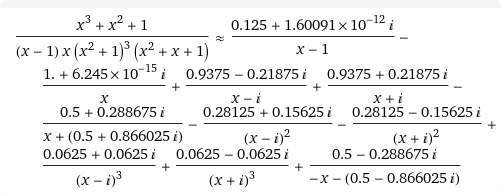
if you look at the approximate form it looks like they did it numerically and fucked up?
restive river
If we type the rational function in wolfram alpha without the apart function it gives the correct answer

So I guess apart is just a strange function
.close
devout snowBOT
Channel closed
Closed by @stuck coyote
Use .reopen if this was a mistake.
Available help channel!
Send your question here to claim the channel.
Remember:
• Ask your math question in a clear, concise manner.
• Show your work, and if possible, explain where you are stuck.
• After 15 minutes, feel free to ping <@&286206848099549185>.
• Type the command .close to free the channel when you're done.
• Be polite and have a nice day!
Read #❓how-to-get-help for further information on how to ask a good question, and about conduct in the question channels.
restive river
Hi, can someone help me find some resources for matrices?
restive river
Hi

Mathematics LibreTexts
If you need to you can go to the previous chapter "Systems of equations" by clicking on "contents" on the top left of the page
@restive river
devout snowBOT
@restive river Has your question been resolved?
devout snowBOT
Channel closed
Closed due to timeout
Use .reopen if this was a mistake.
Available help channel!
Send your question here to claim the channel.
Remember:
• Ask your math question in a clear, concise manner.
• Show your work, and if possible, explain where you are stuck.
• After 15 minutes, feel free to ping <@&286206848099549185>.
• Type the command .close to free the channel when you're done.
• Be polite and have a nice day!
Read #❓how-to-get-help for further information on how to ask a good question, and about conduct in the question channels.
 short cipher
 devout snowBOT
short cipher
devout snowBOT
devout snowBOT
short cipher
devout snowBOT
Channel closed
Closed by @hearty basin
Use .reopen if this was a mistake.
Available help channel!
Send your question here to claim the channel.
Remember:
• Ask your math question in a clear, concise manner.
• Show your work, and if possible, explain where you are stuck.
• After 15 minutes, feel free to ping <@&286206848099549185>.
• Type the command .close to free the channel when you're done.
• Be polite and have a nice day!
Read #❓how-to-get-help for further information on how to ask a good question, and about conduct in the question channels.
 robust cape
I dont know how to solve this


 devout snowBOT
robust cape
I dont know how to solve this
devout snowBOT
robust cape
I dont know how to solve this
@robust cape Has your question been resolved?
devout snowBOT
@robust cape Has your question been resolved?
robust cape
notation used to represent a function
restive river
f(x) is the function of x, for when you substitute a certain value of x inside it, it outputs a y value
so if it is asking to find f(1), it is asking you to find the y-value when x is equal to 1
so when x = 1 on graph 6, what does y equal
remember the form is (x,y) for a point in the graph
robust cape
-4
robust cape
so on question 5 the answer is 7?
robust cape
restive river
What is f(3)
0
restive river
Yes
restive river
robust cape
so on question 5 the answer is 7?
lemme check
Yes it is 7
f(5) = 7, because when x = 5, y = 7.
robust cape
what domain means?
robust cape
all the numbers I can use for x
restive river
yea
For graph 7 you have a minimum x value
Although i dont know what that arrow means, i wasnt taught that
But i know u have a minimum x value for graph 7
Because the function isn't going left forever
Write your Domain like this. D: (min,max)
devout snowBOT
@robust cape Has your question been resolved?
Channel closed
Closed by @robust cape
Use .reopen if this was a mistake.
Available help channel!
Send your question here to claim the channel.
Remember:
• Ask your math question in a clear, concise manner.
• Show your work, and if possible, explain where you are stuck.
• After 15 minutes, feel free to ping <@&286206848099549185>.
• Type the command .close to free the channel when you're done.
• Be polite and have a nice day!
Read #❓how-to-get-help for further information on how to ask a good question, and about conduct in the question channels.
 humble fractal
Can someone help me with this question please?
 devout snowBOT
humble fractal
Can someone help me with this question please?
devout snowBOT
humble fractal
Can someone help me with this question please?
@humble fractal Has your question been resolved?
devout snowBOT
@humble fractal Has your question been resolved?
devout snowBOT
Channel closed
Closed due to timeout
Use .reopen if this was a mistake.
Available help channel!
Send your question here to claim the channel.
Remember:
• Ask your math question in a clear, concise manner.
• Show your work, and if possible, explain where you are stuck.
• After 15 minutes, feel free to ping <@&286206848099549185>.
• Type the command .close to free the channel when you're done.
• Be polite and have a nice day!
Read #❓how-to-get-help for further information on how to ask a good question, and about conduct in the question channels.
 plain oriole
lets say we have a mass that isn't moving, attached to it are three different masses, we don't know anything about the masses or anything of the sort, other than the placement of them. Like mass A is perfectly West of the main mass, mass B is perfectly South of the main mass, and C is NE (45 degrees). this means F_A = F_Cx and F_B = F_Cy, right?
devout snowBOT
plain oriole
lets say we have a mass that isn't moving, attached to it are three different ma...
plain oriole
using this, how are we supposed to find the force on mass C in terms of the force on mass A, and then the relationship between the force exterted by mass A and B
It's all just going over my head completely right now
 plain oriole
ah, i should probably have clarified. this is all basically on a horizontal table, so there should be no other influencing forces other than what we have here
plain oriole
that's exactly what i was confused on, it's entirely stationary
plain oriole
i'm guessing only the centre mass is on the table and the other masses are hanging off?
it's the only thing that makes sense
 small raptor
could u post a pic of the question
plain oriole
Consider a mass and three masses, all lying on a horizontal table. The masses exert forces outwards on the mass as shown below (the diagram i drew). The centre mass does not move. What is the force on mass C in terms of the force on mass A? What is the relationship between the force exerted by mass A and the force exerted by mass B. this is what the question is
plain oriole
the only way for it to make any sense is for the outer masses to be.. dangling off of the table? while the center mass is on the table?
plain oriole
i'm just ignoring that because it makes no sense otherwise from what i'm understanding
plain oriole
might just want to class the external masses as forces rather than masses
fuck this man i gotta wake up in 5 hours. I appreciate the help you've offered me, i'll have to figure this out one way or another, and being tired af ain't gonna cut it
.close
devout snowBOT
Channel closed
Closed by @plain oriole
Use .reopen if this was a mistake.
Available help channel!
Send your question here to claim the channel.
Remember:
• Ask your math question in a clear, concise manner.
• Show your work, and if possible, explain where you are stuck.
• After 15 minutes, feel free to ping <@&286206848099549185>.
• Type the command .close to free the channel when you're done.
• Be polite and have a nice day!
Read #❓how-to-get-help for further information on how to ask a good question, and about conduct in the question channels.
 lunar mountain
Hey how do I do i
devout snowBOT
lunar mountain
Hey how do I do i
 small raptor
Do you know
how to expand
so if i said expand (x+y)(x+y)
you would know how to do it?
small raptor
as we can just times 4 and 2
small raptor
Multipliy
lunar mountain
4√7x5√2
lunar mountain
Ok
small raptor
Yea
So for our next term
4sqrt(7) * 5sqrt(2)
4 + 5 = 20
sqrt(7) * sqrt(2)
do you know what that is
small raptor
Easy
lunar mountain
?
small raptor
NEarly
its sqrt(14)
just like how sqrt(7) * sqrt(7) = sqrt(49)
but we know sqrt(49) is 7
sqrt(14) isnt that nice tho
Ok now we have this 20 sqrt(14)
we do -3sqrt(2) * 2sqrt(7)
You kow this one?
lunar mountain
Is it -6sqrt14
lunar mountain
-15sqrt4
small raptor
where did 14 ceom from?

 lunar mountain
Oh yea
devout snowBOT
Channel closed
Closed by @lunar mountain
Use .reopen if this was a mistake.
devout snowBOT
Available help channel!
Send your question here to claim the channel.
Remember:
• Ask your math question in a clear, concise manner.
• Show your work, and if possible, explain where you are stuck.
• After 15 minutes, feel free to ping <@&286206848099549185>.
• Type the command .close to free the channel when you're done.
• Be polite and have a nice day!
Read #❓how-to-get-help for further information on how to ask a good question, and about conduct in the question channels.
 jolly swan
What is rolle theorem and mean value theorem
devout snowBOT
jolly swan
What is rolle theorem and mean value theorem
 river gorge
rolle's theorem is basically saying that if a function is equal at some a and b ( so f(a) = f(b) ) then there exists some point c between a and b where f'(c) = 0
jolly swan
what is c
river gorge
some point between a and b
MVT is just a generalised version stating that even if f(a) not equal to f(b), there exists a point c where f'(c) = f(b) - f(a) / b-a
so there exists a point c where the gradient of the curve is = the slope of that whole segment
jolly swan
Oh okay , i dont understand why you need both
devout snowBOT
@jolly swan Has your question been resolved?
devout snowBOT
Channel closed
Closed due to timeout
Use .reopen if this was a mistake.
Available help channel!
Send your question here to claim the channel.
Remember:
• Ask your math question in a clear, concise manner.
• Show your work, and if possible, explain where you are stuck.
• After 15 minutes, feel free to ping <@&286206848099549185>.
• Type the command .close to free the channel when you're done.
• Be polite and have a nice day!
Read #❓how-to-get-help for further information on how to ask a good question, and about conduct in the question channels.
 rain hamlet
I don't get how to solve this equation. can anyone help?
 chilly sparrow
How do you learn parent graph functions
rain hamlet

 pale bolt
rain hamlet
pale bolt
rain hamlet
hint: you only need to check the numbers on the edges of the range
you only need 2 of these, and you might see why, but try a/b for
a = 3, b = 6
a = 3, b = 8
a = 6, b = 6
a = 6, b = 8
devout snowBOT
@rain hamlet Has your question been resolved?
devout snowBOT
Channel closed
Closed due to timeout
Use .reopen if this was a mistake.
Available help channel!
Send your question here to claim the channel.
Remember:
• Ask your math question in a clear, concise manner.
• Show your work, and if possible, explain where you are stuck.
• After 15 minutes, feel free to ping <@&286206848099549185>.
• Type the command .close to free the channel when you're done.
• Be polite and have a nice day!
Read #❓how-to-get-help for further information on how to ask a good question, and about conduct in the question channels.
 keen crane
 devout snowBOT
keen crane
devout snowBOT
devout snowBOT
keen crane
devout snowBOT
Channel closed
Closed by @keen crane
Use .reopen if this was a mistake.
Available help channel!
Send your question here to claim the channel.
Remember:
• Ask your math question in a clear, concise manner.
• Show your work, and if possible, explain where you are stuck.
• After 15 minutes, feel free to ping <@&286206848099549185>.
• Type the command .close to free the channel when you're done.
• Be polite and have a nice day!
Read #❓how-to-get-help for further information on how to ask a good question, and about conduct in the question channels.
 tame panther
Need to find a and b so that that function will be stable(idk whats the right word) from -inf to +inf
 devout snowBOT
tame panther
Need to find a and b so that that function will be stable(idk whats the right wo...
pale bolt
devout snowBOT
tame panther
Need to find a and b so that that function will be stable(idk whats the right wo...
pale bolt
does stable mean continuous?
it likely does, in which case the defintion is that
$\lim_{x->a}f(x) = f(a)$, which applied to your problem is making sure both parts of your piecewise function equal the same thing at x = 1
woven radishBOT
 tame panther
pale bolt
does stable mean continuous?
tame panther
pale bolt
does stable mean continuous?
Yeah
tame panther
pale bolt
it likely does, in which case the defintion is that
$\lim_{x->a}f(x) = f(a)$, wh...
I tried to do so and i dont know how to solve that equation
pale bolt
factor an (x-1) out of the top and bottom of the first one
devout snowBOT
@tame panther Has your question been resolved?
Channel closed
Closed by @tame panther
Use .reopen if this was a mistake.
Available help channel!
Send your question here to claim the channel.
Remember:
• Ask your math question in a clear, concise manner.
• Show your work, and if possible, explain where you are stuck.
• After 15 minutes, feel free to ping <@&286206848099549185>.
• Type the command .close to free the channel when you're done.
• Be polite and have a nice day!
Read #❓how-to-get-help for further information on how to ask a good question, and about conduct in the question channels.
restive river
 devout snowBOT
restive river
restive river
devout snowBOT
restive river
restive river
,rotate
woven radishBOT

 wooden wraith
restive river
Tf
wooden wraith
restive river
Tf
btw you can use the arrow reacts under the bot response to rotate it the right way
I tried but i think it only works for you because you're the one who called it
,rotate
woven radishBOT
 wooden wraith
your last vector C is backwards. The one you erased was in the correct direction
restive river
wooden wraith
your last vector C is backwards. The one you erased was in the correct direction
You sure
It says -C
Instead of +C
restive river
Alr
And question
Is resultant vector from the original vector?(A) or does it start from the last vector to origin
wooden wraith
From the tail of vector A to the head of vector C
restive river
Ok
wooden wraith
basically the vector that would go all the way from start to finish in one shot
wooden wraith
you can write each vector in component form and add/subtract them
restive river
wooden wraith
you can write each vector in component form and add/subtract them
Sorry for late response
But could you give me an example
wooden wraith
Do you know what I mean by component form? @restive river
restive river
wooden wraith
Do you know what I mean by component form? <@456226577798135808>
No not really
wooden wraith
like (x,y)
A vector that goes 3 units right and 4 units up would be (3,4)
In your case, vector A is the simplest since it just goes 5 units north
restive river
I see
restive river
wooden wraith
A vector that goes 3 units right and 4 units up would be (3,4)
And 7 would be a triangle
??