#help-26
226100 messages · Page 258 of 227
 trail trench
 thorny flameBOT
.,..
 trail trench
1
 chrome hinge
times what
trail trench
Times a/b
thorny flameBOT
.,..
 trail trench
1
chrome hinge
times what
trail trench
1 * 2/3
chrome hinge
how is this even lol
chrome hinge
chrome hinge
$\frac{a}{a}\cdot\frac{a}{b}$ is equal to..
so lets go back here
trail trench
Ok
chrome hinge
lets say that a=x-2 and b=3x
chrome hinge
yes
trail trench
But then what happens? Doesn’t that just keep x-2/3x the same?
chrome hinge
wdym
trail trench
Ok so 1 times anything is that number
So 1 times 2 is 2
So this fraction stays the same
chrome hinge
so what you are saying is that $\frac{(x-2)^2}{3x(x-2)}=\frac{x-2}{3x}$?
thorny flameBOT
.,..
 trail trench
Well I know that (x-2)^2/3x(x-2) = 1
chrome hinge
no
chrome hinge
What about that
trail trench
I’m confused about 1 * a/b
chrome hinge
ask
trail trench
Ok
Yes
I’m a little confused
So
I cancelled out the x-2s
I got 3x
That was equal to 1
And now we have 1 * a/b * a/b
Where do I go from there?
chrome hinge
wait
 chrome hinge
your numerator is wrong

 chrome hinge
you multiply $\frac{x-2}{3x}$ by $\frac{x^2}{x-2}$
thorny flameBOT
.,..
 trail trench
Where is x^2/x-2 coming from?
chrome hinge
the original question
chrome hinge
what
trail trench
Ok so for example
3x and X-2
There is like an invisible 1 next to the x
So 1-2 = -1
3x * -1
-3
chrome hinge
whens your exam
chrome hinge
who teaches you math?
trail trench
Myself because I have no teacher
Sometimes my brother and I work together but he’s just as confused as I
chrome hinge
and you both are homeschooled
trail trench
Yes
trail trench
X is a variable
trail trench
I see how what I said above doesn’t make sense tbh it was a shot in the dark
chrome hinge
math dont work like that
4x+5 is 4x+5 unless we know what x is
Why dont you go to public school btw
chrome hinge
ok so anyways I think I gotta guide you more through this
trail trench
Ok thank you for sticking with me for so long
 covert lion
Hi
chrome hinge
$\frac{x-2}{3x}\cdot\frac{x^2}{x-2}=\frac{x^2(x-2)}{3x(x-2)}$
thorny flameBOT
.,..
 chrome hinge
covert lion
Hi
chrome hinge
covert lion
Hi
hi
trail trench
I see
covert lion
How are you
chrome hinge
im good how hi are you
trail trench
So do I cancel the x-2s?
chrome hinge
Yes
covert lion
I am good too
chrome hinge
what do we get
trail trench
And now I have x^2/3x
covert lion
chrome hinge
what do we get
What is the question
chrome hinge
this
covert lion
Ok
trail trench
And x^2 is equal to x*x
chrome hinge
yes
chrome hinge
yes
trail trench
So then I have 3
covert lion
chrome hinge
yes
Is ur friend coping well
chrome hinge
covert lion
Is ur friend coping well
what friend
covert lion
@trail trench
chrome hinge
coping or copying
trail trench
So I cancel the x on the denominator of the left fraction and the numerator of the right fraction
covert lion
I simply mean if he is following along
chrome hinge
getting us what
trail trench
X/3
chrome hinge
good job mr rooster2005
trail trench
So I only cancel the 2 x’s
chrome hinge
covert lion
I simply mean if he is following along
somewhat
 pliant bobcat
hello im kind of new but I need help to study for an exam, anyone here can help me out?
chrome hinge
atleast he seems to be trying
chrome hinge
pliant bobcat
hello im kind of new but I need help to study for an exam, anyone here can help ...
covert lion
chrome hinge
atleast he seems to be trying
Ok
covert lion
pliant bobcat
hello im kind of new but I need help to study for an exam, anyone here can help ...
Is it a maths exam
pliant bobcat
covert lion
Is it a maths exam
yeah but not cheating at all
covert lion
Ok
pliant bobcat
just studying
chrome hinge
yeah but you gotta work on those
covert lion
Have u been studying past questions
trail trench
chrome hinge
good job mr rooster2005
Thank you ..,..
covert lion
pliant bobcat
just studying
So which topic seems hard for you
covert lion
mmmmh
pliant bobcat
binmoio raised to the power N
Pascal's triangle
language translation
1st degree equations
second degree equations (quadratic, factorization or general formula)
application problems
covert lion
Ok
chrome hinge
so 1st degree equations are y=ax+b?
pliant bobcat
ye
covert lion
I will try my best
pliant bobcat
covert lion
I will try my best
thank u
chrome hinge
you should ask specific questions
covert lion
I will start with Pascal triangle
pliant bobcat
ok
chrome hinge
covert lion
chrome hinge
1. 4. 6. 4. 1.
Thanks
 sweet shard
@trail trench are you done with this channeL?
chrome hinge
yes
covert lion
The main thing guiding Pascal triangle is that,1 stays out side for both sides
And also to get 1. 3. 3. 1
1+2= 3
2+1= 3
pliant bobcat
and which problems involve pascal triangle?
chrome hinge
no idea never used
covert lion
Also for 1. 4. 6. 4. 1
1+3= 4
3+3= 6
3+1 = 4
covert lion
pliant bobcat
and which problems involve pascal triangle?
When it comes to binomials
covert lion
Yes
It is when the variable x is squared
E.g x² + 2x+6
Which is also the quadratic equation
 topaz sinewBOT
@trail trench Has your question been resolved?
topaz sinewBOT
Channel closed
Closed due to timeout
Use .reopen if this was a mistake.
Please take a minute to participate in [our survey](#changelog message) if you haven't already!
 Available help channel!
Send your question here to claim the channel.
Remember:
• Ask your math question in a clear, concise manner.
• Show your work, and if possible, explain where you are stuck.
• After 15 minutes, feel free to ping <@&286206848099549185>.
• Type the command .close to free the channel when you're done.
• Be polite and have a nice day!
Read #❓how-to-get-help for further information on how to ask a good question, and about conduct in the question channels.
 floral rampart
How do I show that a sphere cannot have a nonzero vector field?
floral rampart
I tried taking a point P on the manifold and cutting a disc out of it and looking at the complementary disc
but i think im missing something
 ashen eagle
Yes, I think that's one of the most famous proofs
I'm sure it's explained in the Internet
Maybe if you find a source we all can try understanding it together
floral rampart
i see this which is trying to take the same approach as me
 ashen eagle
Maybe we have to look at the actual Lefschetz's proof
ashen eagle
Which part
floral rampart
most of it, the proof is far beyond what i know. i only really know about it since my teacher mentioned it and im looking into it
ashen eagle
Oh
floral rampart
mostly this part is confusing
 ashen eagle
Have you ever studied homotopy?
ashen eagle
okay
Its like a continuous transformation of a function to another function by a parameter continuously
That mantains a lot of topological properties
Since curves are functions one can apply homotopies to them
Well, but turning back to the photo
Take s in (-1,1) the plane given by <q,p>=s is like cuting the sphere with different angles
q1x+q2y+q3z=s
floral rampart
oh i see
ashen eagle
when s=0 the intersection is a great circle
floral rampart
yea, where is n coming from though?
ashen eagle
(it dives the sphere in two semispheres)
Because the curves have a rotation number
The number of rounds they do
floral rampart
so when s = 0, all thats being said with the n = -n = 0 is that we have two hemispheres, and if its approaching one, it barely cuts?
ashen eagle
with respect to the orientation
Well that part i don't perfectly understand
The orientation in one side of the sphere is opposite to the other
because of the election of the orientation in the sphere
It's like the right-hand rule
floral rampart
ah yea
ashen eagle
The normal vector in the opposite semispher is opposite
so the relative rotation of the curve is oppsite
I think it is something like that
I should read the proof with pencil and paper but I don't have here now
floral rampart
i think it mostly makes sense
ashen eagle
You have the same great circle but with two diffeerent parametrizations
which have opposite orientation (direction of rotation with respect to fixed orientation of the basis)
so in one hand the rotation number is n and on the other hand it is -n
but bc of homotopy the rotation number must be equal n=-n because one can homotopically pass from one parametrization to the other
n=-n implies n=0
floral rampart
ah yea
and i see the approach -1 and 1
when s approaches 1
so that leads to a range of n that cant happen
so we have an issue
which means there needs to be a place with a zero vector?
ashen eagle
yes
because you supposed there's no zero
and that gaves you n=0 and n=-1 or n=1 at the same time
floral rampart
mhm, thanks! this is so much more fun than functions class is, i cant wait to do more of this
floral rampart
ashen eagle
and that gaves you n=0 and n=-1 or n=1 at the same time
yea
ashen eagle
Sorry
The <p,q>=s I don't understand well because I don't have a piece of paper now but I hope I have helped you understand more the proof
maybe not perfectly since neither I do
floral rampart
i think they want p to be the positive normal
which is why they have it like that
ashen eagle
Yes i think so
floral rampart
alright that makes sense, ill try to work through it with pen and paper now. thank so much!
.close
topaz sinewBOT
Channel closed
Closed by @floral rampart
Use .reopen if this was a mistake.
Please take a minute to participate in [our survey](#changelog message) if you haven't already!
Available help channel!
Send your question here to claim the channel.
Remember:
• Ask your math question in a clear, concise manner.
• Show your work, and if possible, explain where you are stuck.
• After 15 minutes, feel free to ping <@&286206848099549185>.
• Type the command .close to free the channel when you're done.
• Be polite and have a nice day!
Read #❓how-to-get-help for further information on how to ask a good question, and about conduct in the question channels.
 tulip coyote
 topaz sinewBOT
tulip coyote
tulip coyote
topaz sinewBOT
tulip coyote
tulip coyote
Can I get some help with this pls, I am really confused
 neon iron
similar shapes have the same angles but their sides are increased or decreased according to a coefficient
topaz sinewBOT
@tulip coyote Has your question been resolved?
tulip coyote
neon iron
similar shapes have the same angles but their sides are increased or decreased a...
what would that be
neon iron
you can determine the ratio by dividing the sides that are in front of the same angles
tulip coyote
neon iron
you can determine the ratio by dividing the sides that are in front of the same ...
15.3/10.2?
1.5?
neon iron
yeah
tulip coyote
So what would I do with 1.5
tulip coyote
13.6?
neon iron
ye
neon iron
yep
neon iron
angles remain the same
tulip coyote
sorry what do u mean?
tulip coyote
How come they remain the same
neon iron
it is what it is?
neon iron
and how do i get it
topaz sinewBOT
@tulip coyote Has your question been resolved?
topaz sinewBOT
Channel closed
Closed by @tulip coyote
Use .reopen if this was a mistake.
Please take a minute to participate in [our survey](#changelog message) if you haven't already!
Available help channel!
Send your question here to claim the channel.
Remember:
• Ask your math question in a clear, concise manner.
• Show your work, and if possible, explain where you are stuck.
• After 15 minutes, feel free to ping <@&286206848099549185>.
• Type the command .close to free the channel when you're done.
• Be polite and have a nice day!
Read #❓how-to-get-help for further information on how to ask a good question, and about conduct in the question channels.
 slim folio
I have a question. Is it 15 days from now to June 28 at 5pm or is little over or?
topaz sinewBOT
slim folio
I have a question. Is it 15 days from now to June 28 at 5pm or is little over or...
 worthy storm
depends on the time zone
slim folio
I’m in USA in EST
worthy storm
so it's 11:08pm there yes?
sweet shard
Type ,w 15 days from now
worthy storm
nice, wolfram knows everything 😀
slim folio
Yea
15 days from now is 11:09pm on June 28th and I wanted 5pm on 28 so I think it would be 14 days and like 6 hours or so
So I guess I have to do is do the 29th at 5pm to have 15 days (little over it but it will work)
Ok I got the time now. So I’ll choose June 29 at 10pm and it will be 15 days 22 hours. Ok thanks for the help
topaz sinewBOT
@slim folio Has your question been resolved?
Channel closed
Closed by @slim folio
Use .reopen if this was a mistake.
Please take a minute to participate in [our survey](#changelog message) if you haven't already!
Available help channel!
Send your question here to claim the channel.
Remember:
• Ask your math question in a clear, concise manner.
• Show your work, and if possible, explain where you are stuck.
• After 15 minutes, feel free to ping <@&286206848099549185>.
• Type the command .close to free the channel when you're done.
• Be polite and have a nice day!
Read #❓how-to-get-help for further information on how to ask a good question, and about conduct in the question channels.
 orchid crow
A social studies class has 20 girls and 15 boys in it. If 3 girls and 2 boys are selected to form a five-member team to participate in a competition, how many possible teams could be created?
topaz sinewBOT
orchid crow
A social studies class has 20 girls and 15 boys in it. If 3 girls and 2 boys are...
orchid crow
So what I did was
20 nCr 3 = 1140
15 nCr 2 = 105
1140*105 = 119700
is that correct?
 mental remnant
Wouldn’t u add them?
topaz sinewBOT
Channel closed
Closed by @orchid crow
Use .reopen if this was a mistake.
Please take a minute to participate in [our survey](#changelog message) if you haven't already!
Available help channel!
Send your question here to claim the channel.
Remember:
• Ask your math question in a clear, concise manner.
• Show your work, and if possible, explain where you are stuck.
• After 15 minutes, feel free to ping <@&286206848099549185>.
• Type the command .close to free the channel when you're done.
• Be polite and have a nice day!
Read #❓how-to-get-help for further information on how to ask a good question, and about conduct in the question channels.
orchid crow
- Our three administrators want to take a group picture with twelve math teachers. If they all line up on a straight line and the administrators must stand next to one another, how many different arrangements are possible?
topaz sinewBOT
orchid crow
6. Our three administrators want to take a group picture with twelve math teache...
orchid crow
Would this be 3! * 12!
neon iron
yes
orchid crow
Thank you so much
neon iron
i think
mental remnant
@orchid crow I think it would be 3! x 13!
orchid crow
13! or 12!
mental remnant
13!
I belive cause the group of admin becomes one claim
Clump
In the 12 teachers
mental remnant
So 13 groups
topaz sinewBOT
Channel closed
Closed by @orchid crow
Use .reopen if this was a mistake.
Please take a minute to participate in [our survey](#changelog message) if you haven't already!
Available help channel!
Send your question here to claim the channel.
Remember:
• Ask your math question in a clear, concise manner.
• Show your work, and if possible, explain where you are stuck.
• After 15 minutes, feel free to ping <@&286206848099549185>.
• Type the command .close to free the channel when you're done.
• Be polite and have a nice day!
Read #❓how-to-get-help for further information on how to ask a good question, and about conduct in the question channels.
 neat flume
i dont understand how this works
 topaz sinewBOT
neat flume
i dont understand how this works
topaz sinewBOT
topaz sinewBOT
neat flume
i dont understand how this works
topaz sinewBOT
Channel closed
Closed by @neat flume
Use .reopen if this was a mistake.
Please take a minute to participate in [our survey](#changelog message) if you haven't already!
Available help channel!
Send your question here to claim the channel.
Remember:
• Ask your math question in a clear, concise manner.
• Show your work, and if possible, explain where you are stuck.
• After 15 minutes, feel free to ping <@&286206848099549185>.
• Type the command .close to free the channel when you're done.
• Be polite and have a nice day!
Read #❓how-to-get-help for further information on how to ask a good question, and about conduct in the question channels.
 hoary acorn
can anyone help with these 2 past paper question pleaseeee
 hoary acorn
yes but struggle .. a lot
 winged roost
can you quote it for me please
hoary acorn
it’s a method of estimating integrals . it’s usually done by splitting the area under a curve into trapezium shapes .
winged roost
ok can you tell me the width of your stripes
hoary acorn
that’s what i’m not sure of
winged roost
I suggest you try to find that out
hoary acorn
great help buddy 🙂
winged roost
hint: you are given h
and 4 seconds
you can determine it from that
what is h in this case
can you tell me what it represent
topaz sinewBOT
@hoary acorn Has your question been resolved?
Channel closed
Closed due to timeout
Use .reopen if this was a mistake.
Please take a minute to participate in [our survey](#changelog message) if you haven't already!
Available help channel!
Send your question here to claim the channel.
Remember:
• Ask your math question in a clear, concise manner.
• Show your work, and if possible, explain where you are stuck.
• After 15 minutes, feel free to ping <@&286206848099549185>.
• Type the command .close to free the channel when you're done.
• Be polite and have a nice day!
Read #❓how-to-get-help for further information on how to ask a good question, and about conduct in the question channels.
 versed moat
How to define matrics of real number?
topaz sinewBOT
versed moat
How to define matrics of real number?
 oak sequoia
Matrices containing real numbers?
versed moat
yes
thorny flameBOT
BeatriceBernardo

 tulip light
both should be fine as long as you clarify what it is
thorny flameBOT
BeatriceBernardo
 versed moat
er... which one don't need clarification haha?
tulip light
I'd seen this one before
 versed moat
tulip light
I'd seen this one before
versed moat
tulip light
I'd seen this one before
huh, where is it from?
tulip light
https://math.stackexchange.com/questions/412200/what-is-the-notation-for-the-set-of-all-m-times-n-matrices just googling

Mathematics Stack Exchange
Given that $\mathbb{R}^n$ is the notation used for n-dimensional vectors, is there an accepted equivalent notation for matrices?
there seems to be multiple but that's the one I'd seen before
versed moat
I see, thanks!
tulip light
tulip light
there seems to be multiple but that's the one I'd seen before
as with every single notation
versed moat
can't wait until Chineese characters become part of the standard notations lol
thanks!
topaz sinewBOT
@versed moat Has your question been resolved?
Channel closed
Closed by @versed moat
Use .reopen if this was a mistake.
Please take a minute to participate in [our survey](#changelog message) if you haven't already!
Available help channel!
Send your question here to claim the channel.
Remember:
• Ask your math question in a clear, concise manner.
• Show your work, and if possible, explain where you are stuck.
• After 15 minutes, feel free to ping <@&286206848099549185>.
• Type the command .close to free the channel when you're done.
• Be polite and have a nice day!
Read #❓how-to-get-help for further information on how to ask a good question, and about conduct in the question channels.
 silver valve
dy/dx is an operator or fraction?
topaz sinewBOT
silver valve
dy/dx is an operator or fraction?
 neon venture
yea you can, physicist love to do that lol
 knotty ledge
it is an operator, in one dimensions it acts like a fraction
silver valve
neon venture
yea you can, physicist love to do that lol
yeah yeah in the context of phy
neon venture
d/dx is an operator indeed
silver valve
how does that work?
if it is an operator, how can you take dx to the other side?
and integrate over different bounds?
knotty ledge
its basically notational shorthand for what is really going on behind the scenes
knotty ledge
moving around dy/dx like a fraction
 silver valve
ok?
neon venture
so i think thats why you can move them
knotty ledge
really youre integrating both sides wrt x from the start
the dx on the LHS "cancels" with the 1/dx
neon iron
its a simple trick used by physicists and linear DEQs
silver valve
wont another dv and dx come into picture when you apply integral?
neon iron
but its quite powerful
silver valve
neon iron
its a simple trick used by physicists and linear DEQs
what is the trick?
neon iron
to treat dv / dx like a fraction
silver valve
knotty ledge
really youre integrating both sides wrt x from the start
how do ik what the start is?
silver valve
neon iron
to treat dv / dx like a fraction
so dv and dx are just variables?
to integrate (v)(dv) i do int( (v dv) dv)?
topaz sinewBOT
Channel closed
Closed by @silver valve
Use .reopen if this was a mistake.
Please take a minute to participate in [our survey](#changelog message) if you haven't already!
topaz sinewBOT
Available help channel!
Send your question here to claim the channel.
Remember:
• Ask your math question in a clear, concise manner.
• Show your work, and if possible, explain where you are stuck.
• After 15 minutes, feel free to ping <@&286206848099549185>.
• Type the command .close to free the channel when you're done.
• Be polite and have a nice day!
Read #❓how-to-get-help for further information on how to ask a good question, and about conduct in the question channels.
@inner stump Has your question been resolved?
Channel closed
Closed due to the original message being deleted
Please take a minute to participate in [our survey](#changelog message) if you haven't already!
Available help channel!
Send your question here to claim the channel.
Remember:
• Ask your math question in a clear, concise manner.
• Show your work, and if possible, explain where you are stuck.
• After 15 minutes, feel free to ping <@&286206848099549185>.
• Type the command .close to free the channel when you're done.
• Be polite and have a nice day!
Read #❓how-to-get-help for further information on how to ask a good question, and about conduct in the question channels.
 lapis lava
Is 1.999... different from 1.999...99?
topaz sinewBOT
lapis lava
Is 1.999... different from 1.999...99?
Please don't occupy multiple help channels.
 inner oracle
Ye
 dire laurel
Yes.
 restive inlet
the latter implies a terminating decimal with an unspecified amount of 9s
lapis lava
How are they different?
worthy storm
lapis lava
Is 1.999... different from 1.999...99?
how many digits are represented by the ... in the second one?
worthy storm
no, there is no terminating fractional part with infinitely many digits...
worthy storm
not sure if there is any standard notation for that, you could always define your own if needed. one way that would be recognized by anyone is $1 + \sum_{n=1}^{28}\frac{9}{10^n}$
thorny flameBOT
OurBelovedBungo
 worthy storm
where 28 is the 5 displayed 9's and the 23 represented by the ...
lapis lava
That evaluates to something different though
worthy storm
what does it evaluate to
lapis lava
That's 1.9... with 27 9s
worthy storm
28 9s, no?
lapis lava
It's not 1.999...99
worthy storm
it's 1.999...99 assuming there are 28 9's
worthy storm
there is no number of the form 1.999...99 that has infinitely many digits and terminates
those two requirements are conflicting
if there are infinitely many digits then by definition of "infinite" there is no "last" digit
lapis lava
In a previous question I asked someone said this:
saying the error is 0.00...01 means you're truncating the number at 1.999...99, which is different than 1.999...
I didn't understand the meaning of it
worthy storm
both 0.00...01 and 1.999...99 have meaning only if ... represents finitely many digits
so presumably in that context, by ... in those two numbers they meant some unspecified but finite number of digits
lapis lava
@woeful drift
worthy storm
whereas for 1.999... they meant the non-terminating number with infinitely many 9's
which btw equals 2
lapis lava
Can you do other stuff with it if it didn't terminate?
worthy storm
like what?
lapis lava
Like 1.999...888...
worthy storm
you have to specify what you mean by those ...'s
worthy storm
the first ... in particular cannot represent infinitely many digits
the second ... could mean infinitely many 8's but I wouldn't automatically assume that unless the author said so
lapis lava
Like .777...888... where infinite 7 and infinite 8
worthy storm
no, there's no "after" when it comes to an infinite number
(different cardinalities of infinity aside, which doesn't apply here)
lapis lava
What about if I flip it the other way and do infinite left string digits in p-adic numbers?
777...888... .0
worthy storm
as soon as you put that ... after the .777 and you mean it to represent infinitely many 7's, you can't put other stuff after that
i don't know enough about p-adic numbers to comment on that, but if we are talking about real numbers then there's no real number of the form 777...888...0 if the dots represent infinitely many digits
there's not even a 888...0 if there are infinitely many digits represented by the dots
worthy storm
no, there is a notion of the extended real number system which allows +infinity and -infinity as "endpoints" of the real line
but that's not really relevant here
 hot furnace
real numbers can have infinitely many decimal points if that's what you mean?
worthy storm
there is a notion of infinitely many fractional digits of course
but not of infinitely many digits to the left of the decimal
lapis lava
I never seen anyone do 1.777...77 before. Is stuff like that common in math text books?
hot furnace
sure
worthy storm
you have never seen it because it's not defined if ... is supposed to represent infinitely many digits
hot furnace
what if the number is 1.777777777777777777777777777777777777777777777777777777777777777777777777777777777777777777777777777777777777777777777777777777777777777777777777777777777777777777777777777777777777777777777777777777777777777777777777?
worthy storm
you can't have a fractional part that has infinitely many digits and terminates
hot furnace
then 1.777...77 would be a compact form for it
basically we know there are a lot of 7's inbetween the decimal and the last digit
lapis lava
So it's always 1.7...7
hot furnace
... is standard for "lots of stuff i'm not writing here"
topaz sinewBOT
@lapis lava Has your question been resolved?
Channel closed
Closed by @lapis lava
Use .reopen if this was a mistake.
Please take a minute to participate in [our survey](#changelog message) if you haven't already!
topaz sinewBOT
Available help channel!
Send your question here to claim the channel.
Remember:
• Ask your math question in a clear, concise manner.
• Show your work, and if possible, explain where you are stuck.
• After 15 minutes, feel free to ping <@&286206848099549185>.
• Type the command .close to free the channel when you're done.
• Be polite and have a nice day!
Read #❓how-to-get-help for further information on how to ask a good question, and about conduct in the question channels.
 short spoke
Bamboo Plants Grow 91 centimeters per day what is the approximate growth of the plant, in inches per hour ?
topaz sinewBOT
short spoke
Bamboo Plants Grow 91 centimeters per day what is the approximate growth of the ...
Please don't occupy multiple help channels.
chrome hinge
how many hours are in a day
short spoke
It don't really know it doesn't tell me how many hours it wants me to know the approximate growth per hour
chrome hinge
what
short spoke
It grows 91 centimeters per day I cant Figure out the approximate growth per hour is
chrome hinge
well you have to convert 91cm to inches
short spoke
358.27 Inches right
chrome hinge
no shit
short spoke
Im stupid ok
topaz sinewBOT
@short spoke Has your question been resolved?
topaz sinewBOT
Channel closed
Closed due to timeout
Use .reopen if this was a mistake.
Please take a minute to participate in [our survey](#changelog message) if you haven't already!
Available help channel!
Send your question here to claim the channel.
Remember:
• Ask your math question in a clear, concise manner.
• Show your work, and if possible, explain where you are stuck.
• After 15 minutes, feel free to ping <@&286206848099549185>.
• Type the command .close to free the channel when you're done.
• Be polite and have a nice day!
Read #❓how-to-get-help for further information on how to ask a good question, and about conduct in the question channels.
 worldly temple
 topaz sinewBOT
worldly temple
topaz sinewBOT
worldly temple

 topaz sinewBOT
@worldly temple Has your question been resolved?
topaz sinewBOT
Channel closed
Closed by @worldly temple
Use .reopen if this was a mistake.
Please take a minute to participate in [our survey](#changelog message) if you haven't already!
Available help channel!
Send your question here to claim the channel.
Remember:
• Ask your math question in a clear, concise manner.
• Show your work, and if possible, explain where you are stuck.
• After 15 minutes, feel free to ping <@&286206848099549185>.
• Type the command .close to free the channel when you're done.
• Be polite and have a nice day!
Read #❓how-to-get-help for further information on how to ask a good question, and about conduct in the question channels.
worldly temple
 topaz sinewBOT
worldly temple
worldly temple
topaz sinewBOT
worldly temple
worldly temple
If you want, help me,
 empty sail
That question makes no sense
worldly temple
Which one
empty sail
The one you provided
empty sail
Apply the concept of the discriminant, I believe is what you need to do
empty sail
Nope
empty sail
This server is all volunteer based
worldly temple
You seem like a post sec student
empty sail
What does that have to do with anything?
 empty sail
That's valid, if your teacher wanted an equation that had no real roots
empty sail
You used math
worldly temple
Product and sum
 sturdy oracle
and show that its discriminant is less than 0
worldly temple
What
empty sail
worldly temple
Like descrimative
You mean discriminant ?
worldly temple
Yes
sturdy oracle
take, for example, $x^2+278929200892009022092902$
thorny flameBOT
Umbraleviathan
 sturdy oracle
that's never gonna touch the x axis
worldly temple
Look man i have 3 exams and work tmrw and just tryna pass
sturdy oracle
$$b^2-4ac$$
thorny flameBOT
Umbraleviathan
 empty sail
worldly temple
Look man i have 3 exams and work tmrw and just tryna pass
empty sail
worldly temple
Look man i have 3 exams and work tmrw and just tryna pass
Okay, still don't understand why you need to provide this, because everyone has life things, you're not the only one
worldly temple
Ik
empty sail
worldly temple
Discriminate
Could have Googled that, and would have given you the same exact thing
worldly temple
Im just lost hope
worldly temple
empty sail
Could have Googled that, and would have given you the same exact thing
Prolly not
Ok
sturdy oracle
it will
worldly temple
So i gotta make
empty sail
worldly temple
Prolly not
 worldly temple
4ac = 0
empty sail
Proof
sturdy oracle
worldly temple
4ac = 0
no
empty sail
Google is useful
thorny flameBOT
Umbraleviathan
 sturdy oracle
Dont even need to think about a, b and c
you remember your parent function for a quadratic?
 past kayak
empty sail
Could have Googled that, and would have given you the same exact thing
past kayak
empty sail
Could have Googled that, and would have given you the same exact thing
Gonna be honest, of all the things google will pull from "discriminate," I don't think the discriminant is one of them. The power of a single letter...
worldly temple
sturdy oracle
you remember your parent function for a quadratic?
Yes?
sturdy oracle
worldly temple
Yes?
remember how it only touches the x axis at (0, 0), and that's its minimum?
worldly temple
Yes
worldly temple
Do make it postive
sturdy oracle
So you can literally have $x^2+298769087690707689289082818828$ and itll be fine'
yes positive
worldly temple
Instead of neagtive
thorny flameBOT
Umbraleviathan
 worldly temple
So like
empty sail
past kayak
Gonna be honest, of all the things google will pull from "discriminate," I don't...
But it didn't as I proved
past kayak
empty sail
But it didn't as I proved
Because you googled discriminant, not discriminate, lol
sturdy oracle
worldly temple
X^2 + 377382919383783
yeah
worldly temple
Wow
sturdy oracle
or even just x^2 + 1
empty sail
past kayak
Because you googled discriminant, not discriminate, lol
Because discriminant is the proper spelling
worldly temple
U ppl are smart
empty sail
Not discriminate
sturdy oracle
you just need to show that the discriminant is less than 0
sturdy oracle
empty sail
Not discriminate
1950s moment
sturdy oracle
dont use that word
past kayak
empty sail
Because discriminant is the proper spelling
Ah, but if someone doesn't recall the spelling of discriminant, like the op, then googling may not be helpful, especially if how you think it's spelled turns out to be another actual word
sturdy oracle
So jadn just use $x^2+1$. What's its discriminant?
worldly temple
sturdy oracle
dont use that word
👍🏾
thorny flameBOT
Umbraleviathan
 worldly temple
Anything postive
sturdy oracle
it has to be less than 0 for the quadratic to have no real zeroes
worldly temple
thorny flame
**Umbraleviathan**
1
empty sail
past kayak
Ah, but if someone doesn't recall the spelling of discriminant, like the op, the...
Then be more specific, more specific the better and Google will figure it out
 sturdy oracle
worldly temple
1
sturdy oracle
worldly temple
1
buddy use the formula $b^2-4ac$
thorny flameBOT
Umbraleviathan
 past kayak
empty sail
Then be more specific, more specific the better and Google will figure it out
past kayak
empty sail
Then be more specific, more specific the better and Google will figure it out
Ah yeah I didn't think of that lol
sturdy oracle
Im asking for its discriminant and I feel like youre not even using the formula I gave you
worldly temple
thorny flame
**Umbraleviathan**
its anything over 0
sturdy oracle
no
worldly temple
wtf
sturdy oracle
for the quadratic to have no zeroes, the discriminant must be less than 0. That is what b^2-4ac means
worldly temple
so any neagtive
thorny flameBOT
Umbraleviathan
 worldly temple
ye
worldly temple
1x^2
empty sail
thorny flame
**Umbraleviathan**
Aka, identify a, b, c and plug it into
worldly temple
o
empty sail
And then simplify
sturdy oracle
ahsfosfjlfjlfjlaskjflkfaasfasf
worldly temple
a= x^2 b=1 c=0
empty sail
worldly temple
a= x^2 b=1 c=0
No
worldly temple
im so confused
empty sail
The general form of a quadratic is ax^2 + bx + c
restive inlet
a,b,c refer to certain coefficients and constants of your quadratic
worldly temple
yea
worldly temple
empty sail
The general form of a quadratic is ax^2 + bx + c
standard form
restive inlet
and NOT the terms in the order that is written
empty sail
For the function, x^2 + 1, what is a, b, and c?
empty sail
No
empty sail
a,b,c refer to certain coefficients and constants of your quadratic
As Ramonov stated
restive inlet
The general form of a quadratic is ax^2 + bx + c
look carefully at where a is and what it represents
empty sail
Is x^2 a coefficient or constant?
sturdy oracle
no
restive inlet
no
sturdy oracle
wait no
worldly temple
wtf
sturdy oracle
i thought you meant a was a coefficent
worldly temple
i said that
sturdy oracle
a would be a coeffeient of x^2
worldly temple
co............................eficiant
sturdy oracle
but x^2 is not a coefficient
worldly temple
why
sturdy oracle
because x is a variable
worldly temple
ts has 2
sturdy oracle
its the independant variable
worldly temple
i thoiught it was 1
sturdy oracle
the power to which x is raised has nothing to do with it being a coefficient or not
a is 1
empty sail
Read carefully, and understand
The general form of a quadratic is ax^2 + bx + c
a,b,c refer to certain coefficients and constants of your quadratic
For the example, x^2+1, what are a, b, and c?
worldly temple
x^2 = a cause ax^2 and 1 = c
empty sail
No
worldly temple
isnt that hw tis works
empty sail
$a \neq x^2$
thorny flameBOT
dldh06
 empty sail
a,b,c refer to certain coefficients and constants of your quadratic
worldly temple
is in the quad formual
empty sail
x^2 is not a coefficient or constant
empty sail
Do you know what a coefficient or constant is?
worldly temple
yes
empty sail
What is it?
empty sail
So is there a number before x^2?
empty sail
So then what is a?
worldly temple
coeff
empty sail
The value for a
empty sail
Where is the ^2 coming from?
worldly temple
x^2
empty sail
Is ^2 a coefficient or constant?
What is the coefficient or constant that is with x^2?
That coefficient or constant is a
worldly temple
constant
empty sail
The value for a
empty sail
Why are you doing 1 times 1?
empty sail
Seriously, are you even reading what I am telling you?
worldly temple
YES
empty sail
Is ^2 a coefficient or constant?
What is the coefficient or constant that is with x^2?
That coefficient or constant is a
worldly temple
i swaer
empty sail
What is a?
worldly temple
1
empty sail
Why are you doing ^2?
worldly temple
cause its part of the eq
empty sail
There is zero purpose for that
worldly temple
sorry
empty sail
I stated that the general form of a quadratic is ax^2 + bx + c
You were given x^2 + 1
worldly temple
ya
empty sail
Then you were told to find a, b, and c
worldly temple
ya
empty sail
So what is a, b, and c?
worldly temple
a is 1
empty sail
Are you continuing?
empty sail
No
worldly temple
b is 2
empty sail
No
empty sail
Where are you even getting these numbers from?
empty sail
worldly temple
b is 3
Still no
worldly temple
wait tell me the right answer
empty sail
ax^2 + bx + c
x^2 + 1
worldly temple
ill connect them
empty sail
worldly temple
wait tell me the right answer
No
empty sail
No
past kayak

empty sail
My suggestion, please review everything
worldly temple
if x is a variable
 past kayak
Consider that x² + 1 = x² + 0x + 1
empty sail
past kayak
Consider that x² + 1 = x² + 0x + 1
Wasn't trying to spoonfeed this, OP needed to understand what was wrong
past kayak
empty sail
Wasn't trying to spoonfeed this, OP needed to understand what was wrong
I know, I'm an advocate of trying to get op to find the answer on their own as much as possible, but I feel as though there's a point where there's an impasse and progress wont be made unless we give a slight nudge in the right direction.
worldly temple
empty sail
Wasn't trying to spoonfeed this, OP needed to understand what was wrong
do you think im dumb?
tell me the answer
trust me
empty sail
If you want my honest opinion, yes, because if you could not identify a, b, and c given x^2 + 1 and the general form of ax^2 + bx + c, where all you needed to do was line up the variables and determine what the coefficients are, after lining it up. It means you need to study basic equation forms again
worldly temple
empty sail
If you want my honest opinion, yes, because if you could not identify a, b, and ...
Just tell me the answer
was a= 1 b=x =1
TELLLL MEEE THE ANSWER
empty sail
worldly temple
was a= 1 b=x =1
Doesn't even make sense
empty sail
worldly temple
TELLLL MEEE THE ANSWER
No
worldly temple
yes it does
empty sail
What does a= 1 b=x =1 mean?
empty sail
worldly temple
which gard is this from?
I think middle school so about 12 - 14 year old material
empty sail

Khan Academy
Solving 6x²+3=2x-6 by rewriting in standard form and identifying the parameters a, b, and c, that can be used within the quadratic formula.
That will help you identity a, b, c
empty sail
Then why are you having trouble identifying a, b, and c for the expression x^2 + 1?
empty sail
It's not any different when there's 3 number and two. One term is just not there
worldly temple
yes it is
empty sail
No it's not
worldly temple
so the b = 0
empty sail
Concept is still the same
empty sail
Is it?
worldly temple
I DONT KNOW
i believe you want to be some type of tutor or teacher when you grow up
with the amount of patience u have
but understand one thing\
not everyone's brains work the same
for example
giving me the answer
i will easily find out what i did wrong
how i should get there
empty sail
Anyways, good bye
worldly temple
No
empty sail
worldly temple
tell me the answer
Still no
empty sail
Someone can if they feel like it but I'm not
worldly temple
no
topaz sinewBOT
@worldly temple Has your question been resolved?
topaz sinewBOT
Channel closed
Closed due to timeout
Use .reopen if this was a mistake.
Please take a minute to participate in [our survey](#changelog message) if you haven't already!
Available help channel!
Send your question here to claim the channel.
Remember:
• Ask your math question in a clear, concise manner.
• Show your work, and if possible, explain where you are stuck.
• After 15 minutes, feel free to ping <@&286206848099549185>.
• Type the command .close to free the channel when you're done.
• Be polite and have a nice day!
Read #❓how-to-get-help for further information on how to ask a good question, and about conduct in the question channels.
topaz sinewBOT
 warm crest
<@&286206848099549185>
topaz sinewBOT
@warm crest Has your question been resolved?
topaz sinewBOT
@warm crest Has your question been resolved?
Channel closed
Closed due to the original message being deleted
Please take a minute to participate in [our survey](#changelog message) if you haven't already!
Available help channel!
Send your question here to claim the channel.
Remember:
• Ask your math question in a clear, concise manner.
• Show your work, and if possible, explain where you are stuck.
• After 15 minutes, feel free to ping <@&286206848099549185>.
• Type the command .close to free the channel when you're done.
• Be polite and have a nice day!
Read #❓how-to-get-help for further information on how to ask a good question, and about conduct in the question channels.
 rare isle
given a start vector and a target vector, as well as 2 axis vectors i,j. the start vector rotates about axis i, then about axis j, such that it moves onto the target vector. what are the angles of rotation?
topaz sinewBOT
rare isle
given a start vector and a target vector, as well as 2 axis vectors i,j. the sta...
rare isle
i've been thinking about this problem for a while, and heres one of the solutions i have found:
assume all vectors are unit length. consider the 2 circles swept by the start and target vector when rotated about the axes, if they do not intersect, there are no solutions. if they do intersect then the intersection points mark valid stopping points of the starting vector around axis x, before rotating again around axis y. these points can be found by intersecting 2 planes with the unit sphere, then the angles may be measured to give the final solutions.
 warm sandal
If Y=-2x+3, find the covariance of (X, Y)
rare isle
i dont know what that is. explain?
ok youre just in the wrong channel
read #❓how-to-get-help @warm sandal
rare isle
rare isle
assume all vectors are unit length. consider the 2 circles swept by the start an...
while this solution is elegant in theory, not in practice. it takes way too much code to do this, and i feel like the answer to my problem should be simple.
what i've tried: algebra with rotation matrices, quaternions.
they seemed promising, but the issue is that my problem seems quadratic in nature due to the intersecting circles
i would be delighted to find if quaternions can be used to find intersection points of 2 circles on a sphere, but i doubt it is the case
<@&286206848099549185>
topaz sinewBOT
@rare isle Has your question been resolved?
topaz sinewBOT
@rare isle Has your question been resolved?
topaz sinewBOT
@rare isle Has your question been resolved?
topaz sinewBOT
@rare isle Has your question been resolved?
topaz sinewBOT
@rare isle Has your question been resolved?
sweet shard
.close
topaz sinewBOT
Channel closed
Closed by @sweet shard
Use .reopen if this was a mistake.
Please take a minute to participate in [our survey](#changelog message) if you haven't already!
topaz sinewBOT
Available help channel!
Send your question here to claim the channel.
Remember:
• Ask your math question in a clear, concise manner.
• Show your work, and if possible, explain where you are stuck.
• After 15 minutes, feel free to ping <@&286206848099549185>.
• Type the command .close to free the channel when you're done.
• Be polite and have a nice day!
Read #❓how-to-get-help for further information on how to ask a good question, and about conduct in the question channels.
 dusty perch
 dusty perch
before
and then after looks like

but i still apparently got something wrong
can someone please help
 ashen latch
lets say that section was something like f(x)=2x
then what would the second derivative be
ashen latch
derivative of a constant is zero
dusty perch
oooooooooooohhhhhhhhhhh
omg wait that makes so much sense
ahhh tysm!!
@ashen latch its apparently still not right

i understood what u said so far and i put that in
but something is wrong still apparently
open to advice or help from anyone!! ^^
ashen latch
E doesn't seem like an inflection point mb
f'(x) is still increasing before E and after E
since f'(x) is increasing f''(x) should be positive
topaz sinewBOT
Channel closed
Closed by @dusty perch
Use .reopen if this was a mistake.
Please take a minute to participate in [our survey](#changelog message) if you haven't already!
topaz sinewBOT
Available help channel!
Send your question here to claim the channel.
Remember:
• Ask your math question in a clear, concise manner.
• Show your work, and if possible, explain where you are stuck.
• After 15 minutes, feel free to ping <@&286206848099549185>.
• Type the command .close to free the channel when you're done.
• Be polite and have a nice day!
Read #❓how-to-get-help for further information on how to ask a good question, and about conduct in the question channels.
neon iron
hello i wanted to know what is the difference saying that Polynomial of degree n is not a vector space
but when its a subspace it is a vector space with respect to V
topaz sinewBOT
neon iron
hello i wanted to know what is the difference saying that Polynomial of degree n...
 odd pagoda
of degree exactly n or degree at most n
 drifting swift
neon iron
hello i wanted to know what is the difference saying that Polynomial of degree n...
drifting swift
neon iron
hello i wanted to know what is the difference saying that Polynomial of degree n...
this is word salad.
neon iron
let me link the 2 videos
https://www.youtube.com/watch?v=OK3Wn_47QPY&list=PLW3u28VuDAHJNrf3JCgT0GG_rjFVz0-j9&index=21 examples of vector spaces is F [x]
But then he writes a remark at 38:06 for polynomials of degree n that is not a vector space

Algebra 1M - international
Course no. 104016
Dr. Aviv Censor
Technion - International school of engineering
drifting swift
yes, the set of polynomials of degree exactly n is not a vector space, and denascite gave one reason above: the zero polynomial is not in it
neon iron
but here at https://www.youtube.com/watch?v=RG3DVZ6pQGc&list=PLW3u28VuDAHJNrf3JCgT0GG_rjFVz0-j9&index=22 3:50 he says its a subspace of V of F [x] And the subspace itself is vector space with respect to V but the previous video he said its not
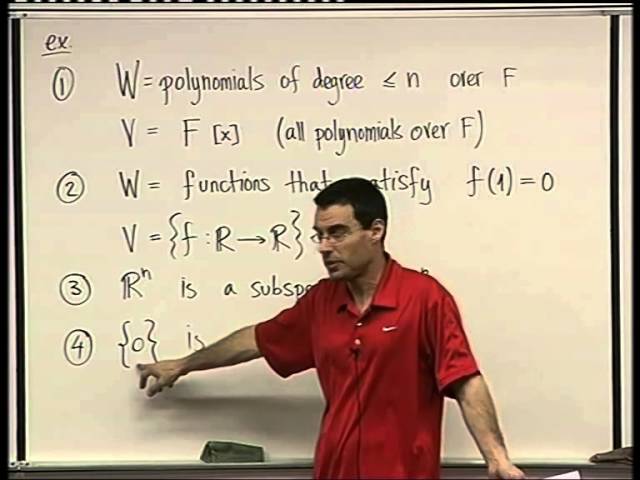
Algebra 1M - international
Course no. 104016
Dr. Aviv Censor
Technion - International school of engineering
odd pagoda
difference between =n and <= n
neon iron
i think im confusing something
drifting swift
yeah there is a big difference between 'polynomials of degree EXACTLY n' vs. 'polynomials of degree AT MOST n'
drifting swift
it's not in the set of all polynomials of degree exactly 7, yes.
topaz sinewBOT
Channel closed
Closed by @tough osprey
Use .reopen if this was a mistake.
Please take a minute to participate in [our survey](#changelog message) if you haven't already!
Available help channel!
Send your question here to claim the channel.
Remember:
• Ask your math question in a clear, concise manner.
• Show your work, and if possible, explain where you are stuck.
• After 15 minutes, feel free to ping <@&286206848099549185>.
• Type the command .close to free the channel when you're done.
• Be polite and have a nice day!
Read #❓how-to-get-help for further information on how to ask a good question, and about conduct in the question channels.
 lunar pond
 topaz sinewBOT
lunar pond
winged roost
topaz sinewBOT
lunar pond
winged roost
this is an inequality
you want to find the range of values of x for which this is satisfied
winged roost
do you know how to add fractions?
winged roost
show what you have so far
thorny flameBOT
IntelligentCake
 winged roost
this what you did?
lunar pond
made same denominator
winged roost
did you do this first?