#help-26
1 messages · Page 207 of 1
 magic atlas
 topaz sinewBOT
@magic atlas Has your question been resolved?
topaz sinewBOT
Channel closed
Closed due to timeout
Use .reopen if this was a mistake.
 Available help channel!
Send your question here to claim the channel.
Remember:
• Ask your math question in a clear, concise manner.
• Show your work, and if possible, explain where you are stuck.
• After 15 minutes, feel free to ping <@&286206848099549185>.
• Type the command .close to free the channel when you're done.
• Be polite and have a nice day!
Read #❓how-to-get-help for further information on how to ask a good question, and about conduct in the question channels.
 slim wind
Why c?
 topaz sinewBOT
slim wind
Why c?
slim wind
topaz sinewBOT
slim wind
Why c?
slim wind
Isn't it b?
slim wind
Vrais
 cedar wagon
Pourquoi ce devrait être b ?
slim wind
cedar wagon
Pourquoi ce devrait être b ?
La vrais reponse est c
Mais comment
Ce nest pas b?
cedar wagon
Et bien pourquoi penses tu que ce serait b ?
cedar wagon
Bien sur que si
slim wind
Mais la "bon reponse" cest c
cedar wagon
Regarde de plus près
slim wind
OOOO
Je nest pas vis
Vus
Le graphe
Bien
LOL
Mais pour quoi c?
F(x)-x=0
G(x)=0
cedar wagon
Trace juste la droite y = x
slim wind
Ouis elle admet 2 solution
Cest vrais
Cest 3 dans le matin je suis stupides dans cette moment merci bcp
🤣
cedar wagon
Rien de grave, maintenant tu sais
slim wind
.close
topaz sinewBOT
Channel closed
Closed by @slim wind
Use .reopen if this was a mistake.
topaz sinewBOT
Available help channel!
Send your question here to claim the channel.
Remember:
• Ask your math question in a clear, concise manner.
• Show your work, and if possible, explain where you are stuck.
• After 15 minutes, feel free to ping <@&286206848099549185>.
• Type the command .close to free the channel when you're done.
• Be polite and have a nice day!
Read #❓how-to-get-help for further information on how to ask a good question, and about conduct in the question channels.
 burnt swift
 topaz sinewBOT
burnt swift
burnt swift
topaz sinewBOT
burnt swift
burnt swift
let me translate it, gimme a second
topaz sinewBOT
@burnt swift Has your question been resolved?
burnt swift
Let S =<(1,-3,1,1),(0,0,1,0)> and T ={x in R4 | x1+x2+x3=0, x2+2x3-x4=0} subspaces of R4
Find if possible a subspace W of R4 such that
dim(W) = 2
(S+T)^⊥ ⊂ W
dim(W+S)=dim(W+T)=3
 opal vault
did you compute (S+T)^⊥
burnt swift
let me find a basis for T
i) x1+x2+x3=0 ==> x1 = -x2-x3
ii) x2+2x3-x4=0 ==> x4=x2+2x3
(x1,x2,x3x4)=(-x2-x3,x2,x3,x2+2x3)
(x1,x2,x3,x4)=x2(-1,1,0,1)+x3(-1,0,1,2)
T=<(-1,1,0,1),(-1,0,1,2)>
burnt swift
opal vault
did you compute (S+T)^⊥
how do I find a basis for S+T
S=<(1-3,1,1),(0,0,1,0)>
,w det {{-1,1,0,1},{-1,0,1,2},{1,-3,1,1},{0,0,1,0}}
 thorny flameBOT


 Requested by 938c2cc0dcc05f2b68c4287040cfcf71
opal vault
Requested by 938c2cc0dcc05f2b68c4287040cfcf71
opal vault
S+T is dimension 3
burnt swift
we have a linear dependency, dim(S+T)<4
opal vault
you can append one vector of the basis of S to the basis of T for example (or vice versa)
see what happens
burnt swift
opal vault
see what happens
can you elaborate
burnt swift
opal vault
S+T is dimension 3
how do you know that...
opal vault
burnt swift
how do you know that...
doing what I said
burnt swift
did you do any dimension counting
opal vault
take the basis of S
and the basis of T
say S = <s1,s2>
T = <t1,t2>
is (s1,s2,t1) linearly independent
burnt swift
what do you imply by "see what happens" see if they are linearly independent
opal vault
yeah
burnt swift
opal vault
is (s1,s2,t1) linearly independent
how do I check if LI
only possible by colspace, row space, Rank
burnt swift
can we use dot product maybe
opal vault
burnt swift
can we use dot product maybe
?
opal vault
burnt swift
only possible way is rank?
no, probably not
but that's the way I would have done it
burnt swift
,w rref {{-1,1,0,1},{-1,0,1,2},{1,-3,1,1},{0,0,1,0}}
thorny flameBOT
 Requested by 938c2cc0dcc05f2b68c4287040cfcf71
opal vault
Requested by 938c2cc0dcc05f2b68c4287040cfcf71
opal vault
or solve as1 + bs2 + ct1 = 0
burnt swift
what is the basis for S+T
opal vault
burnt swift
what is the basis for S+T
actually I'm not sure we need a basis of S+T necessarily
burnt swift
opal vault
did you compute (S+T)^⊥
.
opal vault
to find (S+T)^perp
we can just take a spanning family of S+T
and say that vectors of (S+T)^perp must be orthogonal to them
burnt swift
?
opal vault
burnt swift
?
even though (s1,s2,t1,t2) is not a basis of S+T
burnt swift
what is a spanning family of S+T
opal vault
it spans it
burnt swift
ok
opal vault
<s1,s2,t1,t2> = S+T
burnt swift
but we need the orthogonal complement of dat span
opal vault
burnt swift
but we need the orthogonal complement of dat span
yes
so
find vectors
that are orthogonal
to s1,s2,t1,t2
burnt swift
how do you know S+T is dim3
burnt swift
do you know that
if dim(S+T)=3, dim(S+T)^perp = 1
because they are complementary subspaces of R4
so orthogonal complement of S+T can be (S+T)^perp = <(1,0,0,0)>
burnt swift
burnt swift
so orthogonal complement of S+T can be (S+T)^perp = <(1,0,0,0)>
true or false?
burnt swift
so we need a basis of (S + T) then
opal vault
not all complementary subspaces are THE orthogonal complement
opal vault
burnt swift
so we need a basis of (S + T) then
no, the spanning of S+T is enough
(s1,s2,t1,t2)
find a vector that's orthogonal to all of those
burnt swift
ok
S+T=<(-1,1,0,1),(-1,0,1,2),(1,-3,1,1),(0,0,1,0)>
v in R4
v = (x1,x2,x3,x4)
i) v . (-1,1,0,1) = 0 <==> -x1+x2+x4=0
ii) v.(-1,0,1,2)=0 <==> -x1+x3+2x4=0
iii) v.(1,-3,1,1)=0 <==> x1-3x2+x3+x4=0
iv) v.(0,0,1,0)=0 <==> x3=0
burnt swift
opal vault
find a vector that's orthogonal to all of those
can you help
opal vault
sure
opal vault
burnt swift
S+T=<(-1,1,0,1),(-1,0,1,2),(1,-3,1,1),(0,0,1,0)>
v in R4
v = (x1,x2,x3,x4)
i) v ...
what does this give you
burnt swift
a system which I also need to rref
to find a basis for the orthogonal complement of S+T
burnt swift
opal vault
what does this give you
help
opal vault
uh
-x1+x2+x4=0
-x1+x3+2x4=0
x1-3x2+x3+x4=0
x3=0
so
-x1+x2+x4=0
-x1+2x4=0
x1-3x2+x4=0
x3=0
-x1+x2+x4=0
x1 = 2x4
x1-3x2+x4=0
x3=0
0 = 0
x1 = 2x4
x2 = x4
x3=0
burnt swift
opal vault
0 = 0
x1 = 2x4
x2 = x4
x3=0
?
opal vault
what step do you not get
opal vault
opal vault
-x1+x2+x4=0
x1 = 2x4
x1-3x2+x4=0
x3=0
is this fine
burnt swift
where did 0=0 happaen
opal vault
burnt swift
where did 0=0 happaen
well replace x1 and x2 by what they're equal to
I can add a step in between if it's not obvious enough
-x1+x2+x4=0
x1 = 2x4
x1-3x2+x4=0
x3=0
-2x4+x2+x4=0
x1 = 2x4
x2 = x4
x3=0
0 = 0
x1 = 2x4
x2 = x4
x3=0
burnt swift
ok I see now
you skipped a gazillion steps at first glance
x4 is free
(x1,x2,x3,x4)=(2x4,x4,0,x4)=x4(2,1,0,1)
(S+T)^(perp) = <(2,1,0,1)>
,w rref {{-1,1,0,1,0},{-1,0,1,2,0},{1,-3,1,1,0},{0,0,0,0,0}}
thorny flameBOT
 Requested by 938c2cc0dcc05f2b68c4287040cfcf71
burnt swift
Requested by 938c2cc0dcc05f2b68c4287040cfcf71
burnt swift
x1 = 2x4
x2=x4
x3=0
x4=x4
(x1,x2,x3,x4)=(2x4,x4,0,x4)=x4(2,1,0,1)
burnt swift
opal vault
did you compute (S+T)^⊥
any ideas for W, should be dim 2
opal vault
well we found a vector of W didn't we
burnt swift
what about the other one
burnt swift
dim(W+S) = 3 <==> dim(WnS)=1
dim(W+T) = 3 <==> dim(WnT)=1
opal vault
yep
burnt swift
opal vault
what do we know about <w1> + S and <w1> + T
idk
opal vault
burnt swift
dim(W+S) = 3 <==> dim(WnS)=1
dim(W+T) = 3 <==> dim(WnT)=1
wouldn't it be nice if it were the same vector in WnS and WnT
burnt swift
what is the dimension of SnT
opal vault
what's the dimension of S+T
burnt swift
dim(S+T)=dim(S)+dim(T)-dim(SnT)
dim(SnT) = dim(S)+dim(T)-dim(S+T)
burnt swift
opal vault
S+T is dimension 3
how do you know that
did you do any dimension counting, or is it a guess
oh, by rank, sorry
dim(SnT)=2+2-3
dim(SnT)=1
burnt swift
burnt swift
Let S =<(1,-3,1,1),(0,0,1,0)> and T ={x in R4 | x1+x2+x3=0, x2+2x3-x4=0} subspac...
S has dim 2 because one vector has many zeros and other vector doesnt have any zeros, they aren't multiples of each other
opal vault
burnt swift
dim(SnT)=1
so
maybe it would not be bad finding SnT
and then adding a vector of SnT to W
burnt swift
how do I find the intersection
opal vault
burnt swift
how do I find the intersection
like all the other exercises
vectors of SnT
are vectors of S for example
that are also in T
burnt swift
opal vault
like all the other exercises
wdym
burnt swift
S=<(1,-3,1,1),(0,0,1,0)>
s in S
a,b in R
s = a(1,-3,1,1)+b(0,0,1,0)
s = (a,-3a,a,a)+(0,0,b,0)
s = (a,-3a,a+b,a)
T={x in R4| x1+x2+x3=0, x2+2x3-x4=0}
i) a -3a + a + b = 0 ==> a = b
ii) -3a + 2a + 2b -a =0 ==> a=b
(a,-3a, a+b,a) = (a,-3a,2a,a) a(1,-3,2,1)
SnT=<(1,-3,2,1)>
burnt swift
opal vault
we did similar stuff before together
like this sir? W =<(1,-3,2,1),(2,1,0,1)>
I just checked and the answer is correct lmao, thank you for the help, hopefully I got the idea from the exercise because in the exam I wont have no one to help me
do you think I can make it rafilou?
last time I took this exam I got 20%

opal vault
well you need to remember the process to solve such exercices
if there is an intersection to find: take vectors of the first space, when is it in the second or vice versa
finding dimensions: dim(F+G) = ... may be interesting
figuring out dimensions can help us figure out how many vectors should be in a basis
if you want the orthogonal of a space T, write T = <t1,...,tn> and find the vectors v such that v * t1 = ... = v * tn = 0
if T = {v, av1 + bv2 + ... = 0}
then T^perp = <(a,b,...)>
etc
burnt swift
I will try for real but sometimes the exercises are too hard
Like i am not even joking, sometimes I loose hope
topaz sinewBOT
Channel closed
Closed by @burnt swift
Use .reopen if this was a mistake.
topaz sinewBOT
Available help channel!
Send your question here to claim the channel.
Remember:
• Ask your math question in a clear, concise manner.
• Show your work, and if possible, explain where you are stuck.
• After 15 minutes, feel free to ping <@&286206848099549185>.
• Type the command .close to free the channel when you're done.
• Be polite and have a nice day!
Read #❓how-to-get-help for further information on how to ask a good question, and about conduct in the question channels.
 deft holly
 topaz sinewBOT
deft holly
deft holly
topaz sinewBOT
deft holly
deft holly
am having trouble with b
i would understand if it was like this

but the 3^(n-1) doesnt make sense and 2^(r-1) especially
 coarse herald
you can write dowwn r* ncr as n*n-1cr-1
deft holly
coarse herald
you can write dowwn r* ncr as n*n-1cr-1
But then what does that do
coarse herald
n is a constant and the remaining is just another binomial expansion
deft holly
coarse herald
n is a constant and the remaining is just another binomial expansion
Im stuck on what to do with the other binomial expansion now
 pseudo horizon
what does it look like?
do you have the right limits on the sum and everything?
you might need a change of index
$\sum_{r=1}^{n} r \binom{n}{r} 2^{r-1} = n \sum_{r=1}^{n} \binom{n-1}{r-1} 2^{r-1} = n \sum_{s=0}^{n-1} \binom{n-1}{s} 2^{s}$
thorny flameBOT
Axe
 pseudo horizon
the idea is to make the sum look like the expansion from part (a)
topaz sinewBOT
@deft holly Has your question been resolved?
coarse herald
thorny flame
**Axe**
Did you get this
deft holly
sorry was out for a bit
so uh
idk how to explain whatever the before part was but i do get it i think?
and then

?
coarse herald
Yep this is correct
topaz sinewBOT
Channel closed
Closed by @deft holly
Use .reopen if this was a mistake.
topaz sinewBOT
Available help channel!
Send your question here to claim the channel.
Remember:
• Ask your math question in a clear, concise manner.
• Show your work, and if possible, explain where you are stuck.
• After 15 minutes, feel free to ping <@&286206848099549185>.
• Type the command .close to free the channel when you're done.
• Be polite and have a nice day!
Read #❓how-to-get-help for further information on how to ask a good question, and about conduct in the question channels.
 safe pine

topaz sinewBOT
safe pine
<:opencry:586078614865444865>
 olive ridge
?
 wispy pier
safe pine
<:opencry:586078614865444865>
wispy pier
safe pine
<:opencry:586078614865444865>
This is a sum
 odd forge
close this channel
wispy pier
safe pine
<:opencry:586078614865444865>
Find the area of blue shaded region 😭
 pseudo sonnet
safe pine
<:opencry:586078614865444865>
pseudo sonnet
safe pine
<:opencry:586078614865444865>
hello, do you have a question?
if not, I'll close this channel in a minute
.close
topaz sinewBOT
Channel closed
Closed by @pseudo sonnet
Use .reopen if this was a mistake.
Available help channel!
Send your question here to claim the channel.
Remember:
• Ask your math question in a clear, concise manner.
• Show your work, and if possible, explain where you are stuck.
• After 15 minutes, feel free to ping <@&286206848099549185>.
• Type the command .close to free the channel when you're done.
• Be polite and have a nice day!
Read #❓how-to-get-help for further information on how to ask a good question, and about conduct in the question channels.
 sharp dew
do you guys take note when watching 3blue1brown's video
 karmic mountain
who?
sharp dew
or any other math context creator on youtube

A primer on exponential and logistic growth
Help fund future projects: https://www.patreon.com/3blue1brown
An equally valuable form of support is to simply share some of the videos.
Special thanks to these supporters: http://3b1b.co/covid-thanks
Home page: https://www.3blue1brown.com
Excellent visualization of this kind of growth from Minuteph...
I used to take note but I have now become a test-oriented person that I consider taking note a waste of time and is of low benifit in terms of helping me gain a good grade.
can someone give me some advice
topaz sinewBOT
@sharp dew Has your question been resolved?
topaz sinewBOT
Channel closed
Closed due to timeout
Use .reopen if this was a mistake.
Available help channel!
Send your question here to claim the channel.
Remember:
• Ask your math question in a clear, concise manner.
• Show your work, and if possible, explain where you are stuck.
• After 15 minutes, feel free to ping <@&286206848099549185>.
• Type the command .close to free the channel when you're done.
• Be polite and have a nice day!
Read #❓how-to-get-help for further information on how to ask a good question, and about conduct in the question channels.
 random beacon
help
topaz sinewBOT
random beacon
help
 olive ridge
Well the slope is (y2 - y1)/(x2 - x1)
 fading owl
Oh were given (1, -3) and (-1, 5)
 waxen parrot
olive ridge
Well the slope is (y2 - y1)/(x2 - x1)
waxen parrot
olive ridge
Well the slope is (y2 - y1)/(x2 - x1)
 topaz sinewBOT
@random beacon Has your question been resolved?
olive ridge
waxen parrot
you're doing correct, why did you stop at last?
waxen parrot
i didn't wanna spoil it ^^;
topaz sinewBOT
Channel closed
Closed due to timeout
Use .reopen if this was a mistake.
Available help channel!
Send your question here to claim the channel.
Remember:
• Ask your math question in a clear, concise manner.
• Show your work, and if possible, explain where you are stuck.
• After 15 minutes, feel free to ping <@&286206848099549185>.
• Type the command .close to free the channel when you're done.
• Be polite and have a nice day!
Read #❓how-to-get-help for further information on how to ask a good question, and about conduct in the question channels.
 turbid linden
does component form of a vector a representation of position vector?
 neon iron
What?
Are you asking if the component form of a vector can be used to represent a position vector?
if that's the question. then the answer is a yes
turbid linden
neon iron
Are you asking if the component form of a vector can be used to represent a posi...
Wait component form of a vector != Position vector?
turbid linden
OK what does the component form of a vector represents
neon iron
THe component form
is just the representation of teh vector
using its coordinates in a particular space
$$\vec{v} = <1, 2, 3>$$
thorny flameBOT
Edmund Cloudsley
 turbid linden
thorny flame
**Edmund Cloudsley**
turbid linden
thorny flame
**Edmund Cloudsley**
The initial point of this is the origin right?
neon iron
This does not have any particular initial point
You can assume that the initial point is the origin
for convenience when plotting
however the initial point can be ANYTHING
for a position vector howevever, the initial point is always the origin
turbid linden
But usually it's assumed that the initial point is at the origin right?
neon iron
assumed yes
does it have to always be the origin?
no

All these 3 vectors represent the vector <1, 2, 3>
however they have different starting points/initial points
topaz sinewBOT
@turbid linden Has your question been resolved?
topaz sinewBOT
Channel closed
Closed due to timeout
Use .reopen if this was a mistake.
topaz sinewBOT
Available help channel!
Send your question here to claim the channel.
Remember:
• Ask your math question in a clear, concise manner.
• Show your work, and if possible, explain where you are stuck.
• After 15 minutes, feel free to ping <@&286206848099549185>.
• Type the command .close to free the channel when you're done.
• Be polite and have a nice day!
Read #❓how-to-get-help for further information on how to ask a good question, and about conduct in the question channels.
neon iron

 desert atlas
coefficients add to 0 so u=1 is a root
then just use long division to find the remainjng quadratic factor
neon iron
desert atlas
then just use long division to find the remainjng quadratic factor
Got it thanks
.close
topaz sinewBOT
Channel closed
Closed by @willow cedar
Use .reopen if this was a mistake.
topaz sinewBOT
Available help channel!
Send your question here to claim the channel.
Remember:
• Ask your math question in a clear, concise manner.
• Show your work, and if possible, explain where you are stuck.
• After 15 minutes, feel free to ping <@&286206848099549185>.
• Type the command .close to free the channel when you're done.
• Be polite and have a nice day!
Read #❓how-to-get-help for further information on how to ask a good question, and about conduct in the question channels.
 manic yew
3√3x - 2√3x^2 + 4√3x^3 - 5√3x^4 (i have no idea how to solve this) I tried to say that the common factor is √3x and i messed up from there
topaz sinewBOT
manic yew
3√3x - 2√3x^2 + 4√3x^3 - 5√3x^4 (i have no idea how to solve this) I tried t...
manic yew
one more thing i forgot to mention (I have to factor this not to just calculate)
wispy pier
Ok
manic yew
like i did √3x(3-2√3x +4√3x^2 - 5√3x^3) and from there you can factor it again right? and i did it until no more factoring was possible but the result is not correct
wispy pier
Is it (√3x)^2 and so on ?
manic yew
no. It ends at √3x^4 there is no more after
wispy pier
Or √ 3 * x
wispy pier
manic yew
like i did √3x(3-2√3x +4√3x^2 - 5√3x^3) and from there you can factor it again r...
Ok so this factoring is wrong !
manic yew
why
 echo egret
Can solve me ,
wispy pier
You take √3 common
manic yew
is x not a common factor to? since they all have x
echo egret
(2+8)89?
wispy pier
manic yew
is x not a common factor to? since they all have x
√3 is a common factor too
manic yew
echo egret
Can solve me ,
open your own ticket. read #❓how-to-get-help
so the common factor is √3 or √3x
wispy pier
√3x(3-2x +4x²-5x³)
wispy pier
manic yew
like i did √3x(3-2√3x +4√3x^2 - 5√3x^3) and from there you can factor it again r...
You wrote it wrong here
manic yew
yea i got that but i am confused what i did wrong there
 shut rampart
see first thing I notice is you can take out a root 3x term as mentioned by everyone else, then you're left with a cubic eq which clearly has x=-1 as a root. so just use that, divide the subic by x+1 and you'll get (root3 x)(x+1)(some quadratic) and i'm sure you could solve the quadratic further
nvm the root is 1
manic yew
i am not that advanced so i have no idea what quadratic you talk about as we did not learn that
shut rampart
still you get it right
wispy pier
shut rampart
see first thing I notice is you can take out a root 3x term as mentioned by ever...
x = ± 1 are roots
shut rampart
manic yew
i am not that advanced so i have no idea what quadratic you talk about as we did...
an equation of degree 2 so like if the highest power of x is 2 in an equation its a quadratic
neon iron
Nvm
shut rampart
wispy pier
x = ± 1 are roots
yeah so we can use either
 wispy pier
shut rampart
yeah so we can use either
wispy pier
shut rampart
yeah so we can use either
After knowing two roots
 mellow arrow
bames jond
wispy pier
Third root is easily predictable
shut rampart
manic yew
i am not that advanced so i have no idea what quadratic you talk about as we did...
based on this response idk what your level is so I'm sorry idk the easier method that's just how I'd do it
wispy pier
From product of roots or sum of roots
shut rampart
wispy pier
From product of roots or sum of roots
yes right
manic yew
shut rampart
based on this response idk what your level is so I'm sorry idk the easier method...
np
maybe someone else knows to explain it easier
desert atlas
could you resend the question
manic yew
3√3x - 2√3x^2 + 4√3x^3 - 5√3x^4 (i have no idea how to solve this) I tried to say that the common factor is √3x and i messed up from there i have to factor this
desert atlas
okay show me what youve tried
manic yew
manic yew
like i did √3x(3-2√3x +4√3x^2 - 5√3x^3) and from there you can factor it again r...
it's here
desert atlas
do you understand what factoring is
manic yew
ax + ad + ac = a(x+d+c)
desert atlas
$3\sqrt{3}x-2\sqrt{3}x^2 + 4\sqrt{3}x^3 - 5\sqrt{3}x^4$
thorny flameBOT
ashy!
 desert atlas
manic yew
ax + ad + ac = a(x+d+c)
desert atlas
manic yew
ax + ad + ac = a(x+d+c)
yeah so the common factor must be taken out of every single term
currently you are only taking it out of the first term
manic yew
the common factor here √3x
if we take it out from all of them don't we have 3-2x + 4x^2 - 5x^3
wait is this the answer?
manic yew
i don't see it
wispy pier
manic yew
i don't see it
You know what the factor theorem states ?
desert atlas
$\sqrt{3}x(3-2x + 4x^2 - 5x^3)$
thorny flameBOT
ashy!
 manic yew
in my answer sheet this is the correct answer
wispy pier
manic yew
in my answer sheet this is the correct answer
😭
wispy pier
manic yew
and no i have no idea the factor theorem state
NP this was all for your grade, maybe !!
manic yew
i am pretty sure
desert atlas
it definitely can be factored further
manic yew
my current chapter is just basic factoring
topaz sinewBOT
Channel closed
Closed by @manic yew
Use .reopen if this was a mistake.
topaz sinewBOT
Available help channel!
Send your question here to claim the channel.
Remember:
• Ask your math question in a clear, concise manner.
• Show your work, and if possible, explain where you are stuck.
• After 15 minutes, feel free to ping <@&286206848099549185>.
• Type the command .close to free the channel when you're done.
• Be polite and have a nice day!
Read #❓how-to-get-help for further information on how to ask a good question, and about conduct in the question channels.
 mighty ivy
helpppppppppppppppppppppppppp
 topaz sinewBOT
mighty ivy
helpppppppppppppppppppppppppp
topaz sinewBOT
topaz sinewBOT
mighty ivy
helpppppppppppppppppppppppppp
topaz sinewBOT
What step are you on?
1. I don't know where to begin.
2. I have begun but got stuck midway.
3. I got an answer but I was told that it's wrong.
4. I got an answer and would like my work checked.
5. I have a question about someone else's work/solution.
6. I have completed the problem and don't need help anymore. Thank you.
7. None of the above
haven’t been able to solve part c yet.
olive ridge
Draw the figure and send that in here.
topaz sinewBOT
@mighty ivy Has your question been resolved?
mighty ivy
here
 topaz sinewBOT
Channel closed
Closed due to timeout
Use .reopen if this was a mistake.
Available help channel!
Send your question here to claim the channel.
Remember:
• Ask your math question in a clear, concise manner.
• Show your work, and if possible, explain where you are stuck.
• After 15 minutes, feel free to ping <@&286206848099549185>.
• Type the command .close to free the channel when you're done.
• Be polite and have a nice day!
Read #❓how-to-get-help for further information on how to ask a good question, and about conduct in the question channels.
 minor bobcat
how do i construct a perpendicular from a to bc
 topaz sinewBOT
minor bobcat
how do i construct a perpendicular from a to bc
minor bobcat
topaz sinewBOT
minor bobcat
how do i construct a perpendicular from a to bc
minor bobcat
wdymn
 neat cedar
minor bobcat
then what do i do
neat cedar
minor bobcat
then what do i do
use the compass
put the sharp point of the compass on point A
then extend the compass til its able to intersect line BC at two different points
ofc, show the two points
you need them
done?
minor bobcat
when i put it on c it doesn't go around b then
i think i need the re do the parrelogram
neat cedar
i didnt say put it at C
neat cedar
no
i didnt necessarily state that
it should intersect both points B and C

this is what i meant
extend the compass with the sharp point at A until it intersects the line at two different points
not necessarily B and C
minor bobcat
oh ok sorry
neat cedar
tell me when youre done
minor bobcat
wait do i have to place the compass at exactly a or anywhere on the line of a
neat cedar
at A
cause we are trying to construct a perpendicular bisector of the segment formed of the two red points we constructed
since we want the perpendicular at A
then we can only start at A, if all this makes sense
minor bobcat
ok
neat cedar
minor bobcat
i think i need to re do it
just to verify, is the vertical line that is coming out of point B perpendicular to AB
minor bobcat
thats just for a 90 degree angle
neat cedar
so it is perpendicular?
minor bobcat
yea
neat cedar
neat cedar

mesure the length AM with your compass
and keep that mesure without changing it
and go put your your sharp point on B
and draw the arc from the left
on BC
minor bobcat
i have 2 points now l
neat cedar
L?
minor bobcat
bymistake
neat cedar
what
minor bobcat
i said l bymistake
neat cedar
oh
we will call our new point on BC the point L i guess
its okay
well there you have it, AL is perpendicular to BC
 neat cedar
2 x's?
 neat cedar
u mean which one?
minor bobcat
those are the 2 points
neat cedar
is L?
minor bobcat
yea which one pls
neat cedar
obviously the left one like i stated
minor bobcat
ok thanks
neat cedar
np
minor bobcat
ok thanks
topaz sinewBOT
@minor bobcat Has your question been resolved?
topaz sinewBOT
Channel closed
Closed due to timeout
Use .reopen if this was a mistake.
Available help channel!
Send your question here to claim the channel.
Remember:
• Ask your math question in a clear, concise manner.
• Show your work, and if possible, explain where you are stuck.
• After 15 minutes, feel free to ping <@&286206848099549185>.
• Type the command .close to free the channel when you're done.
• Be polite and have a nice day!
Read #❓how-to-get-help for further information on how to ask a good question, and about conduct in the question channels.
minor bobcat
how can i do this if my hand writing isnt clear tell me
 desert atlas
,rotate
thorny flameBOT
 minor bobcat
i have to find x tho
cus the triangle is (2x-1) each side
and rectangle is (2x-1) and (8-x)
and i need to make an equation ans solve x
desert atlas
its an equilateral trisngle
minor bobcat
yes
desert atlas
so whag does that mean

 topaz sinewBOT
@minor bobcat Has your question been resolved?
Channel closed
Closed by @minor bobcat
Use .reopen if this was a mistake.
topaz sinewBOT
Available help channel!
Send your question here to claim the channel.
Remember:
• Ask your math question in a clear, concise manner.
• Show your work, and if possible, explain where you are stuck.
• After 15 minutes, feel free to ping <@&286206848099549185>.
• Type the command .close to free the channel when you're done.
• Be polite and have a nice day!
Read #❓how-to-get-help for further information on how to ask a good question, and about conduct in the question channels.
 next rain
Can someone explain the red box please?
 topaz sinewBOT
next rain
Can someone explain the red box please?
next rain
topaz sinewBOT
next rain
Can someone explain the red box please?
next rain
Is it taking the phase shift and then adding an asymptote after every multiple of a period?
 loud oasis
we know that cot(x) has an asymptote at x = nπ so cot(x+π/4) must have an asymptote at x + π/4 = nπ
topaz sinewBOT
Channel closed
Closed by @next rain
Use .reopen if this was a mistake.
Available help channel!
Send your question here to claim the channel.
Remember:
• Ask your math question in a clear, concise manner.
• Show your work, and if possible, explain where you are stuck.
• After 15 minutes, feel free to ping <@&286206848099549185>.
• Type the command .close to free the channel when you're done.
• Be polite and have a nice day!
Read #❓how-to-get-help for further information on how to ask a good question, and about conduct in the question channels.
pseudo horizon
can i do an intersection of uncountably many sets?
 rigid ivy
pseudo horizon
can i do an intersection of uncountably many sets?
rigid ivy
pseudo horizon
can i do an intersection of uncountably many sets?
Yes
same with union
Let $\mathcal{F}$ be some family of sets. We define $\bigcap\mathcal{F}$ by $$x\in\bigcap\mathcal{F}\Leftrightarrow\forall(X\in \mathcal{F})(x\in X)$$
And we can also define $\bigcup\mathcal{F}$ by
$$x\in\bigcup\mathcal{F}\Leftrightarrow\exists(X\in\mathcal{F})(x\in X)$$
pseudo horizon
how do we define $\mathcal{F}$?

 pseudo horizon
we say family rather than a set of sets, right?
rigid ivy
thorny flame
**Axe**
It is simply a set whose elements are themselves sets
rigid ivy
pseudo horizon
we say family rather than a set of sets, right?
yup.
pseudo horizon
but we are allowed to have a set of sets if the number of sets are finite?
rigid ivy
thorny flame
**SWR**
An extra requirement for intersection: $\mathcal{F}$ must be non-empty. If $\mathcal{F}=\emptyset$, then $\forall(X\in\emptyset)(x\in X)$ would be vacuously true. This would make, surprisingly, $\bigcap\emptyset$ equal to "everything".
thorny flameBOT
SWR
 rigid ivy
pseudo horizon
but we are allowed to have a set of sets if the number of sets are finite?
rigid ivy
pseudo horizon
but we are allowed to have a set of sets if the number of sets are finite?
finite? Did you mean infinite?
pseudo horizon
is there a difference between a family and a set?
rigid ivy
In pure set-theoretic terms, no.
pseudo horizon
oh ok
rigid ivy
in which class are you currently learning about intersections?
rigid ivy
ah I see
arbitrary union and intersection are funny things
Almost always, they are taken over a finite family of sets
In the sporadic occasions where it is an infinite family, it's almost certainly countable
An intersection or union of an uncountably large family is exceedingly rare (in my experience), but is still perfectly valid.
pseudo horizon
i think i have a potentially uncountable family here
maybe i'll post the problem
i have an idea of what i want to say, but i'm confused on how to write it
rigid ivy
The set of all inetervals of $\bR$ is uncountable.
thorny flameBOT
SWR
 rigid ivy
pseudo horizon
i have an idea of what i want to say, but i'm confused on how to write it
rigid ivy
pseudo horizon
i have an idea of what i want to say, but i'm confused on how to write it
ahh. Welcome to maths 
pseudo horizon
lol
topaz sinewBOT
@pseudo horizon Has your question been resolved?
pseudo horizon
.close
topaz sinewBOT
Channel closed
Closed by @pseudo horizon
Use .reopen if this was a mistake.
rigid ivy
pseudo horizon
.close
Aw I was curious to hear your idea
pseudo horizon
.reopen
topaz sinewBOT
✅
pseudo horizon
i

this is what i have so far
i uh
i'm afraid of writing too many quantifiers
rigid ivy
pseudo horizon
Okay so $G$ is some specific group that already exists I assume? Is $G$ a finite group, or are we considering infinite groups too right now?
thorny flameBOT
SWR
 pseudo horizon
G is any group containing at least one subgroup of size s
what i want to say is... N is in i_g inverse of H so i_g[N] is in H
N is the intersection
 rigid ivy
What is $i_g[N]$?
thorny flameBOT
SWR
 pseudo horizon
$i_g[N]=\left{gng^{-1} | n\in N\right}$
thorny flameBOT
Axe
 rigid ivy
And what is $i_g^{-1}[H]$?
thorny flameBOT
SWR
 rigid ivy
I've forgotten too much group theory. maybe you can ask in #groups-rings-fields
pseudo horizon
i_g is a bijection so it should be ok
or i mean
i should say
i_g(x) = gxg^-1
so
i_g inverse of x is g^-1 x g
i think i'm ok as long as i'm using the families and the intersections right
thanks for the help 🙏
.solved
topaz sinewBOT
Channel closed
Closed by @pseudo horizon
Use .reopen if this was a mistake.
topaz sinewBOT
Available help channel!
Send your question here to claim the channel.
Remember:
• Ask your math question in a clear, concise manner.
• Show your work, and if possible, explain where you are stuck.
• After 15 minutes, feel free to ping <@&286206848099549185>.
• Type the command .close to free the channel when you're done.
• Be polite and have a nice day!
Read #❓how-to-get-help for further information on how to ask a good question, and about conduct in the question channels.
 radiant ledge
hey guys
so the definition of bounded function is there exists a constant M such that |fx| <= M
thats fine
but what if we have a function that is bounded between like y = 1 at the top, and y = -5 at the bottom. The example the teacher drew in this video is arctan which is bounded between y = pi/2 and y = -pi/2
but what if its bounded between two different values, then we cant use the definition of |fx| then right?
 topaz sinewBOT
radiant ledge
hey guys
so the definition of bounded function is there exists a constant M such...
rigid ivy
radiant ledge
hey guys
so the definition of bounded function is there exists a constant M such...
topaz sinewBOT
radiant ledge
hey guys
so the definition of bounded function is there exists a constant M such...
rigid ivy
radiant ledge
hey guys
so the definition of bounded function is there exists a constant M such...
If it's bounded between two values $a$ and $b$, then $\abs{f(x)}\le\max{\abs{a},\abs{b}}$.
thorny flameBOT
SWR
 radiant ledge
rigid ivy
If it's bounded between two values $a$ and $b$, then $\abs{f(x)}\le\max\{\abs{a}...
radiant ledge
rigid ivy
If it's bounded between two values $a$ and $b$, then $\abs{f(x)}\le\max\{\abs{a}...
yoooo i see what you mean now thank you
.close
topaz sinewBOT
Channel closed
Closed by @radiant ledge
Use .reopen if this was a mistake.
radiant ledge
this correct right?

this cant be bounded because no min/max even exist
because bounds only work for closed intervals [1,3] ?
topaz sinewBOT
Available help channel!
Send your question here to claim the channel.
Remember:
• Ask your math question in a clear, concise manner.
• Show your work, and if possible, explain where you are stuck.
• After 15 minutes, feel free to ping <@&286206848099549185>.
• Type the command .close to free the channel when you're done.
• Be polite and have a nice day!
Read #❓how-to-get-help for further information on how to ask a good question, and about conduct in the question channels.
radiant ledge
<@&286206848099549185>
topaz sinewBOT
radiant ledge
<@&286206848099549185>
 bold urchin
radiant ledge
this cant be bounded because no min/max even exist
bold urchin
radiant ledge
this cant be bounded because no min/max even exist
In fact, I would say this function when defined on the set [1,3] is bounded because if your f(x) axis is on the same scale as the x axis from your doodle I can choose M = 10 and eyeball that for any x in [1,3], |f(x)| <= 10. Furthermore there is a theorem saying a continuous real-valued functions on a closed and bounded interval are bounded.
radiant ledge
bold urchin
In fact, I would say this function when defined on the set [1,3] is bounded beca...
ye for closed intervals
not for open intervals right?
pseudo horizon
i think it's bounded on (1,3)
radiant ledge
pseudo horizon
i think it's bounded on (1,3)
hmmm how come? there is no min/max
maybe im missing something
radiant ledge
pseudo horizon
you only need it to be bounded
what would be my value of M then?
pseudo horizon
anything big enough
radiant ledge
pseudo horizon
anything big enough
so i can do |fx| <= f(3) ?
pseudo horizon
i can't say, because there's no labels on the y-axis
bold urchin
radiant ledge
ye for closed intervals
not for open intervals right?
yeah you did not specify values on your f(x) axis
pseudo horizon
no, f(3) is undefined
but you can say |fx| <= lim (x->3) f(x)
you can also just choose a bigger number
radiant ledge
pseudo horizon
but you can say |fx| <= lim (x->3) f(x)
oh yea true
rigid ivy
Bounded and max are different things
 tough nest
bounded just means there exists some number M for which |f(x)| <= M is true for all x
for all x in the interval
topaz sinewBOT
@radiant ledge Has your question been resolved?
topaz sinewBOT
Channel closed
Closed due to timeout
Use .reopen if this was a mistake.
topaz sinewBOT
Available help channel!
Send your question here to claim the channel.
Remember:
• Ask your math question in a clear, concise manner.
• Show your work, and if possible, explain where you are stuck.
• After 15 minutes, feel free to ping <@&286206848099549185>.
• Type the command .close to free the channel when you're done.
• Be polite and have a nice day!
Read #❓how-to-get-help for further information on how to ask a good question, and about conduct in the question channels.
manic yew
decompose using the formula of the difference of squares: (2x+1)^2 - 4
i said 2x+1 to be a and 4 to be b so it is (2x+1 +4)(2x+1 -4) but it is not the answer
topaz sinewBOT
manic yew
decompose using the formula of the difference of squares: (2x+1)^2 - 4
i said 2x...
 restive inlet
your b is incorrect
manic yew
awh i see it now it's 2
so we have [(2x+1) +2][(2x+1) -2] ?
and that is = (2x+1)^2 - 2^2 = (2x+1)^2 -4 so it should be right now
restive inlet
yeh
just simplify those factors
topaz sinewBOT
Channel closed
Closed by @manic yew
Use .reopen if this was a mistake.
manic yew
.reopen
topaz sinewBOT
✅
restive inlet
don't open
manic yew
oh
restive inlet
just simplify what's in between
manic yew
$[(2x+1) +2][(2x+1) -2]$
thorny flameBOT
Simon James B
 restive inlet
simplify
(2x+1) +2
and
(2x+1) - 2
 topaz sinewBOT
Channel closed
Closed by @manic yew
Use .reopen if this was a mistake.
topaz sinewBOT
Available help channel!
Send your question here to claim the channel.
Remember:
• Ask your math question in a clear, concise manner.
• Show your work, and if possible, explain where you are stuck.
• After 15 minutes, feel free to ping <@&286206848099549185>.
• Type the command .close to free the channel when you're done.
• Be polite and have a nice day!
Read #❓how-to-get-help for further information on how to ask a good question, and about conduct in the question channels.
 obtuse trellis
is this incorrect? the textbook says it should be 12/5?

 topaz sinewBOT
Channel closed
Closed by @obtuse trellis
Use .reopen if this was a mistake.
topaz sinewBOT
Available help channel!
Send your question here to claim the channel.
Remember:
• Ask your math question in a clear, concise manner.
• Show your work, and if possible, explain where you are stuck.
• After 15 minutes, feel free to ping <@&286206848099549185>.
• Type the command .close to free the channel when you're done.
• Be polite and have a nice day!
Read #❓how-to-get-help for further information on how to ask a good question, and about conduct in the question channels.
 dusky pebble
 topaz sinewBOT
dusky pebble
dusky pebble
topaz sinewBOT
dusky pebble
dusky pebble
Can you help me with this question??
I tried it but I'm only getting 2 answers apparently there's 4 answers
 coarse tusk
!show
topaz sinewBOT
Show your work, and if possible, explain where you are stuck.
dusky pebble
I did tan 2theta, used a cast diagram. I could only get 1.25 and 2.82
 coarse tusk
Looks like you had 4 solutions, why did you cross them out?
dusky pebble
The 4 solutions were from the mark scheme
coarse tusk
,w cot(2theta)=-4/3 for 0<=theta<=2pi
dusky pebble
I just wrote them down cause they were the answer
thorny flameBOT

 cedar wagon
cot(2x) = (cot²(x) - 1) / 2cot(x)
dusky pebble
How do u get these answers using the cast diagram tho
 torpid sparrow
0 <= 2x < 4pi
dusky pebble
I got 1.25 and 2.82 no idea where the other 2 answers come from
Cause I got those by obvious ly using the diagram
neon iron
[1/tan^2 x -1 ]/[2/tan x ] = -4/3
dusky pebble
?
neon iron
neon iron
[1/tan^2 x -1 ]/[2/tan x ] = -4/3
Multiply everything by tan^2 x
dusky pebble
I got 0.64 and multiplied it by 2
torpid sparrow
You add extra 2pi
dusky pebble
Why
torpid sparrow
Because 2x goes to 4pi
neon iron
torpid sparrow
Because 2x goes to 4pi
Yes
torpid sparrow
You have cot(2x)
dusky pebble
What so 1.25 plus 2pi
neon iron
If its only x then 0 < X < 2 pi
dusky pebble
Yes but I found the acute angle of tan 2theta
Which is 0.64
So u don't use cot anymore
dusky pebble
Are u using the double angle identity
torpid sparrow
(4pi-angle)/2
dusky pebble
Yh but ur not getting 4.39 and 5.96 using this
Those are the 2 answers that idk where they came from
torpid sparrow
Yes i am
torpid sparrow
,w (3pi-0.64)/2
thorny flameBOT

 Requested by _arkimond_
torpid sparrow
Requested by _arkimond_
torpid sparrow
Why do you multiply
torpid sparrow
!done
topaz sinewBOT
If you are done with this channel, please mark your problem as solved by typing .close
dusky pebble
.close
topaz sinewBOT
Channel closed
Closed by @dusky pebble
Use .reopen if this was a mistake.
topaz sinewBOT
Available help channel!
Send your question here to claim the channel.
Remember:
• Ask your math question in a clear, concise manner.
• Show your work, and if possible, explain where you are stuck.
• After 15 minutes, feel free to ping <@&286206848099549185>.
• Type the command .close to free the channel when you're done.
• Be polite and have a nice day!
Read #❓how-to-get-help for further information on how to ask a good question, and about conduct in the question channels.
 cosmic vector
Finished part i and got the correct GS of y = (A- 0.25x)cos2x + Bsin2x, but am unsure of how that corresponds to part ii and part iii - would really appreciate some help understanding how to interpret the GS's behaviour 🙏
 topaz sinewBOT
cosmic vector
Finished part i and got the correct GS of y = (A- 0.25x)cos2x + Bsin2x, but am u...
cosmic vector
topaz sinewBOT
cosmic vector
Finished part i and got the correct GS of y = (A- 0.25x)cos2x + Bsin2x, but am u...
cosmic vector
.close
topaz sinewBOT
Channel closed
Closed by @cosmic vector
Use .reopen if this was a mistake.
topaz sinewBOT
Available help channel!
Send your question here to claim the channel.
Remember:
• Ask your math question in a clear, concise manner.
• Show your work, and if possible, explain where you are stuck.
• After 15 minutes, feel free to ping <@&286206848099549185>.
• Type the command .close to free the channel when you're done.
• Be polite and have a nice day!
Read #❓how-to-get-help for further information on how to ask a good question, and about conduct in the question channels.
 lethal anchor
Assume you're transmitting three bits across a transmission channel, those bits could be of either 3 states, high distortion, medium distortion, and low distortion. Each having a probability of occurring in a bit as 0.01, 0.04, and 0.95 respectively. Suppose $X$ is the random variable denoting the amount of high distortion bits and $Y$ the amount of medium distortion bits.
\bigskip
Question asks to formulate $P_{XY}(x,y)$.
\medskip
I was under the impression that this would be nothing more than [
P_{XY}(x,y) = \4{3!}{x!y!(3-(x+y))!} 0.01^x 0.04^y 0.95^{3 - (x+y)}
]
But is this actually correct
topaz sinewBOT
lethal anchor
Assume you're transmitting three bits across a transmission channel, those bits ...
thorny flameBOT
Aero

 sweet shard
where does taht formula come from?
lethal anchor
multinomial distribution
sweet shard
looks right
lethal anchor
sweet shard
looks right
So, the question is now to prove if X and Y are independent of each other
I assume P_X(x) and P_Y(y) are the simple binomial versions of the above
but [
P_{XY}(x,y) = P_X(x) P_Y(y)
]
doesn't hold I'd imagine?
thorny flameBOT
Aero
 topaz sinewBOT
@lethal anchor Has your question been resolved?
topaz sinewBOT
Channel closed
Closed due to timeout
Use .reopen if this was a mistake.
topaz sinewBOT
Available help channel!
Send your question here to claim the channel.
Remember:
• Ask your math question in a clear, concise manner.
• Show your work, and if possible, explain where you are stuck.
• After 15 minutes, feel free to ping <@&286206848099549185>.
• Type the command .close to free the channel when you're done.
• Be polite and have a nice day!
Read #❓how-to-get-help for further information on how to ask a good question, and about conduct in the question channels.
 tame loom
hello, how do i solve this..
 topaz sinewBOT
tame loom
hello, how do i solve this..
rigid ivy
tame loom
hello, how do i solve this..
topaz sinewBOT
tame loom
hello, how do i solve this..
rigid ivy
tame loom
hello, how do i solve this..
First, identity all of the denominators that are present in this equation
tame loom
well, x and 2x
topaz sinewBOT
@tame loom Has your question been resolved?
Channel closed
Closed by @tame loom
Use .reopen if this was a mistake.
topaz sinewBOT
Available help channel!
Send your question here to claim the channel.
Remember:
• Ask your math question in a clear, concise manner.
• Show your work, and if possible, explain where you are stuck.
• After 15 minutes, feel free to ping <@&286206848099549185>.
• Type the command .close to free the channel when you're done.
• Be polite and have a nice day!
Read #❓how-to-get-help for further information on how to ask a good question, and about conduct in the question channels.
 trim pilot
 topaz sinewBOT
trim pilot
trim pilot
topaz sinewBOT
trim pilot
trim pilot
I have gotten to AM > GM
topaz sinewBOT
@trim pilot Has your question been resolved?
 prisma mesa
trim pilot
I have gotten to AM > GM
prisma mesa
trim pilot
I have gotten to AM > GM
so what's missing then?
 surreal mural
can you write down what you got?
 prisma mesa
I don't think this is gonna lead anywhere tbh
trim pilot
I have converted to this

 keen raptor
it will
trim pilot
Not sure it’s matters
trim pilot
keen raptor
now do more with the right side
What can I do
trim pilot
Could you give me an example
keen raptor
no
or sure
the way it was split up before
ab/(c-1) * ...
find a different way to split it into factors where the factors are easier to bound
trim pilot
Could you elaborate on like what do you mean make it easier to bound
keen raptor
We want to find a lower bound for the whole expression in the radical right
You can do that by splitting it up into pieces and finding a lower bound for each of the pieces
wispy pier
a = x+1, b= y+1 , c = z+1
so,
1/x+1/y +1/z + 2(x/y+y/z+z/x) + (xy/z + yz/x + xz/y)
Have i correctly expanded ?
keen raptor
looks unnecessary
surreal mural
no need to
wispy pier
surreal mural
no need to
I see !
surreal mural
trim pilot
Could you elaborate on like what do you mean make it easier to bound
||consider the function x²/(x-1)||
trim pilot
surreal mural
||consider the function x²/(x-1)||
x^2/x-1 >0?
surreal mural
sure, but you can do better
trim pilot
x^2/x-1 >4?
trim pilot
surreal mural
right
(x-2)^2>=0 that’s why?
surreal mural
hmm let's see, (x-2)² = x²-4x+4 >= 0, so dividing by x-1
trim pilot
So this is what chat GPT has been telling me but like I am still not sure how you get 4 straight off

I mean do you just go in and check numbers
surreal mural
dont use chatgpt
trim pilot
But could you explain to me like why it couldn’t be 5 or bigger
surreal mural
because you plug in x=2 and get 4
as I said, (x-2)² = x²-4x+4 >= 0, so x² >= 4x - 4
trim pilot
Why can’t it be like (x-3)^2 and so on
surreal mural
that won't bring you far
(x-3)² = x²-6x+9 >= 0, so x² >= 6x - 9
not much we can do from here
trim pilot
surreal mural
as I said, (x-2)² = x²-4x+4 >= 0, so x² >= 4x - 4
So this is the lowest bound?
surreal mural
4 is the greatest lower bound
$3\sqrt[3]{\frac{a^2}{a-1} \cdot \frac{b^2}{b-1} \cdot \frac{c^2}{c-1}}$
thorny flameBOT
rbit
 surreal mural
and now?
surreal mural
yeah
topaz sinewBOT
Channel closed
Closed by @trim pilot
Use .reopen if this was a mistake.
topaz sinewBOT
Available help channel!
Send your question here to claim the channel.
Remember:
• Ask your math question in a clear, concise manner.
• Show your work, and if possible, explain where you are stuck.
• After 15 minutes, feel free to ping <@&286206848099549185>.
• Type the command .close to free the channel when you're done.
• Be polite and have a nice day!
Read #❓how-to-get-help for further information on how to ask a good question, and about conduct in the question channels.
neon iron
Who can prove that the sinx function has a maclaurin series? sinx is not a polynomial function and i think their values cannot be found by taking derivatives at zero
topaz sinewBOT
neon iron
Who can prove that the sinx function has a maclaurin series? sinx is not a polyn...
 agile harness
neon iron
Who can prove that the sinx function has a maclaurin series? sinx is not a polyn...
agile harness
neon iron
Who can prove that the sinx function has a maclaurin series? sinx is not a polyn...
what
derivatives of sinx are just cosx sinx and their negations
what is wrong at 0
neon iron
agile harness
what
.
 mild hearth
taylor series can converge to things that aren't polynomials, yeah
agile harness
you create a polynomial with the same value of the function at the point as well as the same derivative and higher order derivatives
mild hearth
a polynomial in x has specifically finitely many terms that are powers of x
this is very important
if you allow infinite terms like in a taylor series then it can become whatever
1 + x^1/1! + x^2/2! + x^3/3! + ... just converges to e^x
topaz sinewBOT
@neon iron Has your question been resolved?
topaz sinewBOT
Channel closed
Closed due to timeout
Use .reopen if this was a mistake.
Available help channel!
Send your question here to claim the channel.
Remember:
• Ask your math question in a clear, concise manner.
• Show your work, and if possible, explain where you are stuck.
• After 15 minutes, feel free to ping <@&286206848099549185>.
• Type the command .close to free the channel when you're done.
• Be polite and have a nice day!
Read #❓how-to-get-help for further information on how to ask a good question, and about conduct in the question channels.
 limber summit
 topaz sinewBOT
limber summit
limber summit
topaz sinewBOT
limber summit
limber summit
Why does the coefficient of x become negative?
agile harness
limber summit
Why does the coefficient of x become negative?
always was
agile harness
3-x
agile harness
limber summit
Wasn't it positive?
try again
limber summit
It's not subtracting from 3?
agile harness
it is
and when you subtract 3 from both sides now it’s subtracting from 0
if it helps, think of it as 3 + (-x)
limber summit
So the subtraction turns the coefficient into a negative coefficient?
agile harness
always was negative brother
agile harness
agile harness
if it helps, think of it as 3 + (-x)
^
limber summit
I'm confused
 naive lion
 limber summit
agile harness
always was
limber summit
agile harness
always was
I still don't get this
agile harness
i should’ve thought of that
agile harness
limber summit
I still don't get this
because 3 - x is equivalent to 3 + (-x)
 topaz sinewBOT
Channel closed
Closed by @limber summit
Use .reopen if this was a mistake.
topaz sinewBOT
Available help channel!
Send your question here to claim the channel.
Remember:
• Ask your math question in a clear, concise manner.
• Show your work, and if possible, explain where you are stuck.
• After 15 minutes, feel free to ping <@&286206848099549185>.
• Type the command .close to free the channel when you're done.
• Be polite and have a nice day!
Read #❓how-to-get-help for further information on how to ask a good question, and about conduct in the question channels.
 ebon narwhal
from where did the -0.1 came from and why
 topaz sinewBOT
ebon narwhal
from where did the -0.1 came from and why
ebon narwhal
topaz sinewBOT
ebon narwhal
from where did the -0.1 came from and why
ebon narwhal
 sweet shard
ebon narwhal
from where did the -0.1 came from and why
sweet shard
ebon narwhal
from where did the -0.1 came from and why
common denominator
$0.5 + \frac{5z}{z-0.2} = \frac{0.5(z-0.2) + 5z}{z-0.2}$
thorny flameBOT
riemann
 topaz sinewBOT
@ebon narwhal Has your question been resolved?
topaz sinewBOT
Channel closed
Closed due to timeout
Use .reopen if this was a mistake.
Available help channel!
Send your question here to claim the channel.
Remember:
• Ask your math question in a clear, concise manner.
• Show your work, and if possible, explain where you are stuck.
• After 15 minutes, feel free to ping <@&286206848099549185>.
• Type the command .close to free the channel when you're done.
• Be polite and have a nice day!
Read #❓how-to-get-help for further information on how to ask a good question, and about conduct in the question channels.
 patent crane
need help with part d
 topaz sinewBOT
patent crane
need help with part d
topaz sinewBOT
patent crane
need help with part d
 topaz sinewBOT
@patent crane Has your question been resolved?
topaz sinewBOT
Channel closed
Closed due to timeout
Use .reopen if this was a mistake.
Available help channel!
Send your question here to claim the channel.
Remember:
• Ask your math question in a clear, concise manner.
• Show your work, and if possible, explain where you are stuck.
• After 15 minutes, feel free to ping <@&286206848099549185>.
• Type the command .close to free the channel when you're done.
• Be polite and have a nice day!
Read #❓how-to-get-help for further information on how to ask a good question, and about conduct in the question channels.
 daring karma
 topaz sinewBOT
daring karma
daring karma
topaz sinewBOT
daring karma
daring karma
How do I even begin to approach this 
Some stuff should cancel out prolly
I tried working thru it with desmos, idk what im looking at man

 craggy haven
daring karma
Some stuff should cancel out prolly
craggy haven
daring karma
Some stuff should cancel out prolly
yeah a lot of stuff will cancel out
this is a lot of busywork
just get a piece of printer paper and start writing stuff out
things like splitting that log_3(x) into logx / log3
 hasty knoll
sry but this question is horrible
daring karma
hasty knoll
sry but this question is horrible
I know, tryna help a friend out idk if I want to anymore 
daring karma
craggy haven
yeah a lot of stuff will cancel out
Alright I'll try working through it lol
daring karma
craggy haven
things like splitting that log_3(x) into logx / log3
What could I do with the tan(pi/16 x)?
thorny flameBOT
miku.in.a.teacup
Compile Error! Click the  reaction for more information.
(You may edit your message to recompile.)
 topaz sinewBOT
@daring karma Has your question been resolved?
topaz sinewBOT
@daring karma Has your question been resolved?
Channel closed
Closed by @daring karma
Use .reopen if this was a mistake.
Available help channel!
Send your question here to claim the channel.
Remember:
• Ask your math question in a clear, concise manner.
• Show your work, and if possible, explain where you are stuck.
• After 15 minutes, feel free to ping <@&286206848099549185>.
• Type the command .close to free the channel when you're done.
• Be polite and have a nice day!
Read #❓how-to-get-help for further information on how to ask a good question, and about conduct in the question channels.
 rustic pebble
.open
 rose idol
Trying to rref this. Where am I wrong? Calculator has a different answer

 frail reef
rose idol
Trying to rref this. Where am I wrong? Calculator has a different answer
frail reef
rose idol
Trying to rref this. Where am I wrong? Calculator has a different answer
It’s not fully reduced
rose idol
ah it needs to be 0 above the leading 1's as well?
frail reef
Yes
topaz sinewBOT
Channel closed
Closed by @rose idol
Use .reopen if this was a mistake.
topaz sinewBOT
Available help channel!
Send your question here to claim the channel.
Remember:
• Ask your math question in a clear, concise manner.
• Show your work, and if possible, explain where you are stuck.
• After 15 minutes, feel free to ping <@&286206848099549185>.
• Type the command .close to free the channel when you're done.
• Be polite and have a nice day!
Read #❓how-to-get-help for further information on how to ask a good question, and about conduct in the question channels.
 rotund yoke
Prove that all positive integres can be written as when a,b,c,...,z are positive untegrers
 topaz sinewBOT
rotund yoke
Prove that all positive integres can be written as when a,b,c,...,z are positive...
topaz sinewBOT
rotund yoke
Prove that all positive integres can be written as when a,b,c,...,z are positive...
@rotund yoke Has your question been resolved?
topaz sinewBOT
@rotund yoke Has your question been resolved?
topaz sinewBOT
Channel closed
Closed due to timeout
Use .reopen if this was a mistake.
Available help channel!
Send your question here to claim the channel.
Remember:
• Ask your math question in a clear, concise manner.
• Show your work, and if possible, explain where you are stuck.
• After 15 minutes, feel free to ping <@&286206848099549185>.
• Type the command .close to free the channel when you're done.
• Be polite and have a nice day!
Read #❓how-to-get-help for further information on how to ask a good question, and about conduct in the question channels.
 vivid zodiac
2-6:(79-8°)-213(76:78)
@nomoregoofy
2-6:(79-8°)-213(76:78)
 urban grove
vivid zodiac
2-6:(79-8°)-213(76:78)
@nomoregoofy
2-6:(79-8°)-213(76:78)
urban grove
vivid zodiac
2-6:(79-8°)-213(76:78)
@nomoregoofy
2-6:(79-8°)-213(76:78)
I'm not really sure what you're asking here. What's your question?
topaz sinewBOT
@vivid zodiac Has your question been resolved?
topaz sinewBOT
Channel closed
Closed due to timeout
Use .reopen if this was a mistake.
Available help channel!
Send your question here to claim the channel.
Remember:
• Ask your math question in a clear, concise manner.
• Show your work, and if possible, explain where you are stuck.
• After 15 minutes, feel free to ping <@&286206848099549185>.
• Type the command .close to free the channel when you're done.
• Be polite and have a nice day!
Read #❓how-to-get-help for further information on how to ask a good question, and about conduct in the question channels.
 maiden relic
I'm reading a book about grath theory, and here is a proof be left as an exercise. I'm wondering if the claim of the proof is true? If I let V={1,2,3,4} and E={(1,2),(2,3),(3,4)}, take w={(1,2),(3,4)} and w'={(2,3)}, then k(w∧w)+k(w∨w')=0+1 < k(w)+k(w')=3. Or did I get anything wrong?


 topaz sinewBOT
maiden relic
I'm reading a book about grath theory, and here is a proof be left as an exercis...
maiden relic
topaz sinewBOT
maiden relic
I'm reading a book about grath theory, and here is a proof be left as an exercis...
maiden relic
Oh, I think I found the problem. k({}) in this case is 4 and k({(2,3)}) is 3.
.close
topaz sinewBOT
Channel closed
Closed by @maiden relic
Use .reopen if this was a mistake.
topaz sinewBOT
Available help channel!
Send your question here to claim the channel.
Remember:
• Ask your math question in a clear, concise manner.
• Show your work, and if possible, explain where you are stuck.
• After 15 minutes, feel free to ping <@&286206848099549185>.
• Type the command .close to free the channel when you're done.
• Be polite and have a nice day!
Read #❓how-to-get-help for further information on how to ask a good question, and about conduct in the question channels.
 upper girder
I'm a first year trying to learn some basic linear algebra before school starts again. Any recommended yt channels other than prof Leonard & organic chem tutor?
topaz sinewBOT
upper girder
I'm a first year trying to learn some basic linear algebra before school starts ...
upper girder
=> list of topics
Week #1: vectors and coordinate representation; vector length, dot product, projection.
Week #2: determinants; cross product; lines in 2D, lines and planes in 3D. Week #3: geometry of solutions of linear systems; linear dependence and independence; solving linear systems, echelon form
Week #4: reduced row echelon form, rank; homogeneous equations.
Week #5: geometric applications; resistor networks.
Week #6: Exam #1, matrix multiplication; linear transformations.
loud oasis
i've heard the lectures by prof. gilbert strang are good. there are several semesters on youtube (you can also find lectures + exams, homework etc on mit opencourseware)
 ivory sorrel
Yeah, get a copy of strang's book
topaz sinewBOT
@upper girder Has your question been resolved?
upper girder
loud oasis
i've heard the lectures by prof. gilbert strang are good. there are several seme...
Is this suitable for beginners? I've only taken up to calc 2, so I have no idea what linear algebra is : (
upper girder
loud oasis
it's designed for a first course
Thank you so much 😭 I'll use that as a primary resource👍
topaz sinewBOT
Channel closed
Closed due to timeout
Use .reopen if this was a mistake.
Available help channel!
Send your question here to claim the channel.
Remember:
• Ask your math question in a clear, concise manner.
• Show your work, and if possible, explain where you are stuck.
• After 15 minutes, feel free to ping <@&286206848099549185>.
• Type the command .close to free the channel when you're done.
• Be polite and have a nice day!
Read #❓how-to-get-help for further information on how to ask a good question, and about conduct in the question channels.
 wispy gulch
is this a property?
 topaz sinewBOT
wispy gulch
is this a property?
topaz sinewBOT
wispy gulch
is this a property?
 flint stump
No, if it were a general property of an ellipse, then there would have been no restrictions on the eccentricity of the ellipse (which the problem clearly wants to show, implying only some specific ellipses can show this behaviour)
topaz sinewBOT
Channel closed
Closed by @wispy gulch
Use .reopen if this was a mistake.
Available help channel!
Send your question here to claim the channel.
Remember:
• Ask your math question in a clear, concise manner.
• Show your work, and if possible, explain where you are stuck.
• After 15 minutes, feel free to ping <@&286206848099549185>.
• Type the command .close to free the channel when you're done.
• Be polite and have a nice day!
Read #❓how-to-get-help for further information on how to ask a good question, and about conduct in the question channels.
 brazen inlet
Can someone explain how the inverse fourier transform works?
 whole geode
As in prove the inverse Fourier transform gives you back your original function?
whole geode
You know, that's a good question, I also don't have a good intuition on why the IFT is so similar to the FT.
brazen inlet
any leads?
whole geode
I suppose naively it's just because the exponential cancels out under the double integral
But that isn't really intuition
brazen inlet
yeah
from my understanding
if you think of the fourier transform as this sort of set of vectors in the complex plane, each vector having their own magnitude and phase, and if you kind of put another axis perpendicular to that plane, being the frequency domain, we kind of get this rotating motion of vectors as we slide along the frequency domain, with each vector being on its own plane with its own rotational frequency
and youre supposed to take that understanding and "add them all up"
and then theres some cancellation or something
heres a photo of what I mean

here
if this makes more sense
imagine the plane sliding along that frequency axis
whole geode
3b1b did a nice video on the intuition behind how a Fourier transform works.
Perhaps if you have a Fourier transform, which is to say, you have a map from frequencies to complex amplitudes, if you reverse that process and unwind the arrow around and add up the contributions, you somehow get back a small part of the function that generated the frequency map?
brazen inlet
whole geode
3b1b did a nice video on the intuition behind how a Fourier transform works.
Pe...
ive seen the video but dont see how to reverse it with the same idea
whole geode
I mean, obviously that is what happens, just it's hard to wrap the mind around
brazen inlet
mhmm
i mean it makes sense if i write it out
like they cancel i guess
the complex exponentials
but im trying to look at that in the context of that graph above
idk theres definitely a reason
heres the video i got the idea from if you wanna look
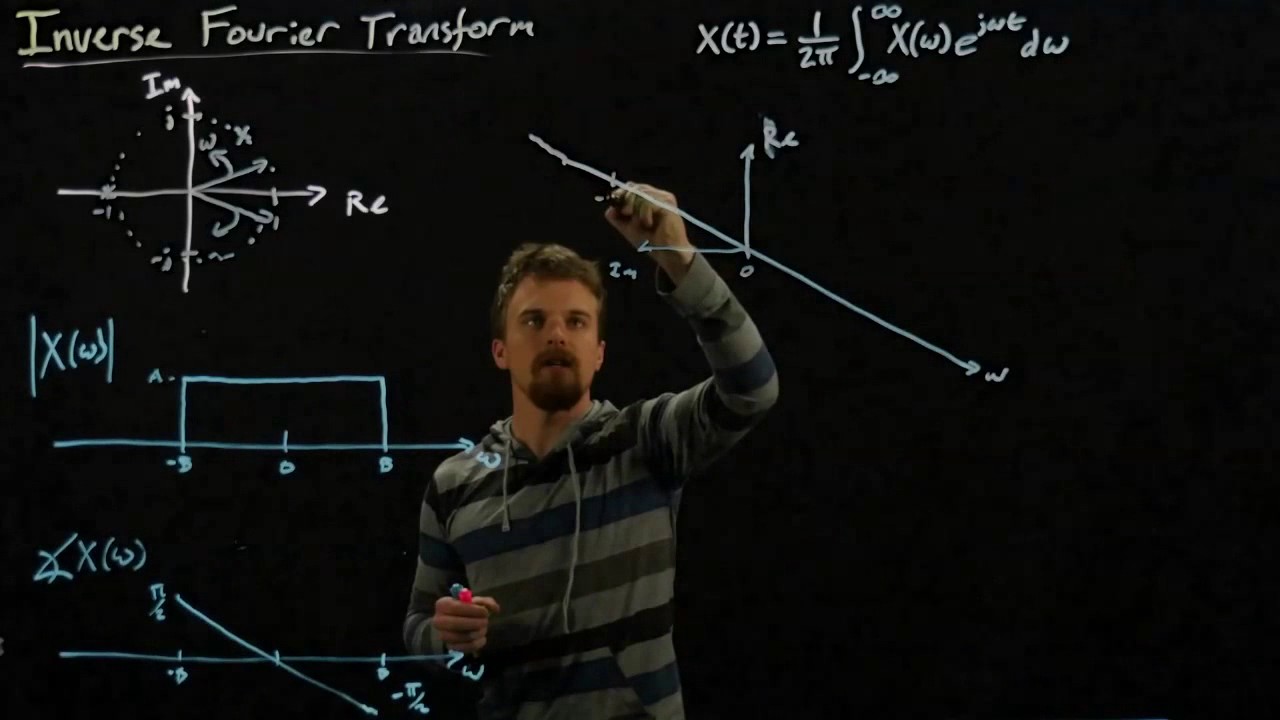
Zach introduces Inverse Fourier Transform, the reverse of the Fourier Transform.
if you wanna try and interpret what hes saying, I couldnt, and he even says its hard to make sense of without an animatioon
topaz sinewBOT
@brazen inlet Has your question been resolved?
topaz sinewBOT
@brazen inlet Has your question been resolved?
brazen inlet
<@&286206848099549185>
 inner willow
brazen inlet
<@&286206848099549185>
inner willow
brazen inlet
<@&286206848099549185>
What is your questions?
Where you stuck at?
topaz sinewBOT
@brazen inlet Has your question been resolved?
topaz sinewBOT
Channel closed
Closed due to timeout
Use .reopen if this was a mistake.
Available help channel!
Send your question here to claim the channel.
Remember:
• Ask your math question in a clear, concise manner.
• Show your work, and if possible, explain where you are stuck.
• After 15 minutes, feel free to ping <@&286206848099549185>.
• Type the command .close to free the channel when you're done.
• Be polite and have a nice day!
Read #❓how-to-get-help for further information on how to ask a good question, and about conduct in the question channels.
 bold totem
can someone tell me what i did wrong here
i got k=2 but the answers k=5


 cursive thorn
It should be (sum of degrees) = (number of edges) * 2
You had the 2 on the wrong side
bold totem
cursive thorn
It should be (sum of degrees) = (number of edges) * 2
k^2 - 2k + 5 = 20?
cursive thorn
Yes
topaz sinewBOT
Channel closed
Closed by @bold totem
Use .reopen if this was a mistake.
topaz sinewBOT
Available help channel!
Send your question here to claim the channel.
Remember:
• Ask your math question in a clear, concise manner.
• Show your work, and if possible, explain where you are stuck.
• After 15 minutes, feel free to ping <@&286206848099549185>.
• Type the command .close to free the channel when you're done.
• Be polite and have a nice day!
Read #❓how-to-get-help for further information on how to ask a good question, and about conduct in the question channels.
 fathom flint
If Z is a complex number that correlate to the equation Z|Z|+2Z+i=0 what is the imaginary part of Z when Z=a+bi and a,b ∈ R
topaz sinewBOT
fathom flint
If Z is a complex number that correlate to the equation Z|Z|+2Z+i=0 what is the ...
 sonic escarp
use Z = a+bi and expand the equation.
fathom flint
(a+bi)sqrt{a^2+b^2}+2(a+bi)+i=0