#help-26
1 messages · Page 192 of 1
 novel solar
I thought the probability part
like the 1/2^whatever
would be stronger than the numerator
and it would approach 0 at larger numbers
like for 4
it'd be bbgg or ggbb
but the prob of either is 1/16 and 1/16*2 = 1/8
so the 4 case happens with prob 1/8
4 * 1/8 = 1/2
1 + 1/2 + ...
i thought it'd keep getting smaller
and converge to something
can you walk me through this
 hearty turret
well equivalent it suffices to show that if X_n is a simple symmetric walk starting at 1
then setting N = first time we hit 0
E(N) = infinity
condition on your first step
so $\mathbb{E}[N] = \mathbb{E}[N \mid X_1 = 0]\mathbb{P}(X_1 = 0) + \mathbb{E}[N \mid X_1 = 2]\mathbb{P}(X_1 = 2)$
 thorny flameBOT
LY
 hearty turret
notice that E[N | X_1 = 2] = 1 + 2E[N]
so we have E[N] = 1 + E[N]
which only holds if E[N] is infinity
 topaz sinewBOT
@novel solar Has your question been resolved?
topaz sinewBOT
Channel closed
Closed due to timeout
Use .reopen if this was a mistake.
 Available help channel!
Send your question here to claim the channel.
Remember:
• Ask your math question in a clear, concise manner.
• Show your work, and if possible, explain where you are stuck.
• After 15 minutes, feel free to ping <@&286206848099549185>.
• Type the command .close to free the channel when you're done.
• Be polite and have a nice day!
Read #❓how-to-get-help for further information on how to ask a good question, and about conduct in the question channels.
 final swift
how is e^x^1/2 differentiated?
topaz sinewBOT
final swift
how is e^x^1/2 differentiated?
topaz sinewBOT
Channel closed
Closed by @final swift
Use .reopen if this was a mistake.
topaz sinewBOT
Available help channel!
Send your question here to claim the channel.
Remember:
• Ask your math question in a clear, concise manner.
• Show your work, and if possible, explain where you are stuck.
• After 15 minutes, feel free to ping <@&286206848099549185>.
• Type the command .close to free the channel when you're done.
• Be polite and have a nice day!
Read #❓how-to-get-help for further information on how to ask a good question, and about conduct in the question channels.
 green dock
Is there a way not to use number of Euler in these proofs
 topaz sinewBOT
Channel closed
Closed by @green dock
Use .reopen if this was a mistake.
topaz sinewBOT
Available help channel!
Send your question here to claim the channel.
Remember:
• Ask your math question in a clear, concise manner.
• Show your work, and if possible, explain where you are stuck.
• After 15 minutes, feel free to ping <@&286206848099549185>.
• Type the command .close to free the channel when you're done.
• Be polite and have a nice day!
Read #❓how-to-get-help for further information on how to ask a good question, and about conduct in the question channels.
 rocky salmon
4 points fall randomly into a circle, what is the probability that 4 point fall into a same semicircle
topaz sinewBOT
rocky salmon
4 points fall randomly into a circle, what is the probability that 4 point fall ...
rocky salmon
I could solve that for 3 points it is 3/4, but could not solve for 4
 eternal spoke
i found some youtube videos that can help you understand this problem

n points are chosen randomly on the circumference of a circle. What is the probability that all lie in the same semicircle ?
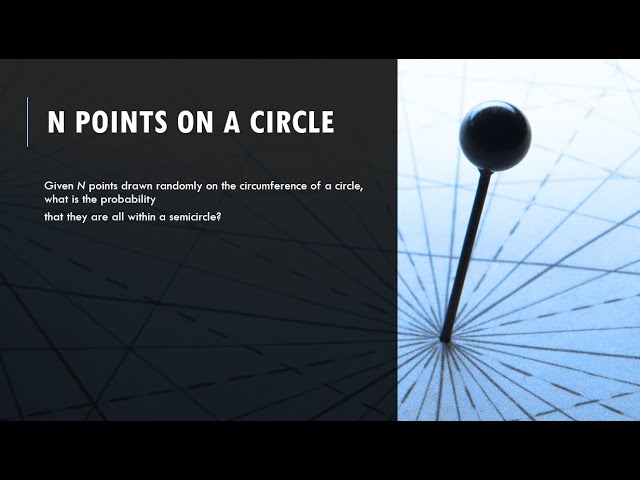
Given N points drawn randomly on the circumference of a circle, what is the probability
that they are all within a semicircle?
Donate to Channel(斗內一下): https://paypal.me/kuoenjui
Facebook: https://www.facebook.com/mathenjui
Instagram: https://www.instagram.com/mathphyen/
more video lists:
################
機率
Probability and discrete mathe...
this is for the general case but you can apply it when n=4
hope it helps
topaz sinewBOT
@rocky salmon Has your question been resolved?
topaz sinewBOT
Channel closed
Closed due to timeout
Use .reopen if this was a mistake.
Available help channel!
Send your question here to claim the channel.
Remember:
• Ask your math question in a clear, concise manner.
• Show your work, and if possible, explain where you are stuck.
• After 15 minutes, feel free to ping <@&286206848099549185>.
• Type the command .close to free the channel when you're done.
• Be polite and have a nice day!
Read #❓how-to-get-help for further information on how to ask a good question, and about conduct in the question channels.
rocky salmon
TYSM!!!!
topaz sinewBOT
rocky salmon
TYSM!!!!
rocky salmon
.close
topaz sinewBOT
Channel closed
Closed by @rocky salmon
Use .reopen if this was a mistake.
topaz sinewBOT
Available help channel!
Send your question here to claim the channel.
Remember:
• Ask your math question in a clear, concise manner.
• Show your work, and if possible, explain where you are stuck.
• After 15 minutes, feel free to ping <@&286206848099549185>.
• Type the command .close to free the channel when you're done.
• Be polite and have a nice day!
Read #❓how-to-get-help for further information on how to ask a good question, and about conduct in the question channels.
 silk tide
I'm trying to conceptualize how sequences diverge or converge.
I know if a sequence does not settle near a value, then it is divergent, and when it does, it's convergent.
Here's a problem i've done for example. an = 5 as n approaches infinity, but when i put the equation into a graph, it doesn't look anything like that.
Can anyone help me try to understand this?
topaz sinewBOT
silk tide
I'm trying to conceptualize how sequences diverge or converge.
I know if a seq...

 topaz sinewBOT
@silk tide Has your question been resolved?
Channel closed
Closed by @silk tide
Use .reopen if this was a mistake.
Available help channel!
Send your question here to claim the channel.
Remember:
• Ask your math question in a clear, concise manner.
• Show your work, and if possible, explain where you are stuck.
• After 15 minutes, feel free to ping <@&286206848099549185>.
• Type the command .close to free the channel when you're done.
• Be polite and have a nice day!
Read #❓how-to-get-help for further information on how to ask a good question, and about conduct in the question channels.
 unique moon
hi, need a little help with this
 topaz sinewBOT
unique moon
hi, need a little help with this
topaz sinewBOT
topaz sinewBOT
unique moon
hi, need a little help with this
topaz sinewBOT
@unique moon Has your question been resolved?
topaz sinewBOT
@unique moon Has your question been resolved?
topaz sinewBOT
Channel closed
Closed due to timeout
Use .reopen if this was a mistake.
Available help channel!
Send your question here to claim the channel.
Remember:
• Ask your math question in a clear, concise manner.
• Show your work, and if possible, explain where you are stuck.
• After 15 minutes, feel free to ping <@&286206848099549185>.
• Type the command .close to free the channel when you're done.
• Be polite and have a nice day!
Read #❓how-to-get-help for further information on how to ask a good question, and about conduct in the question channels.
 thick oyster
so if im trying to find where a function is increasing or decreasing, i took the first derivative of the function and found the x values but what if an x value isnt in the domain?
topaz sinewBOT
thick oyster
so if im trying to find where a function is increasing or decreasing, i took the...
thick oyster
sure. the problem is f(x) = x^2 / (x^2 - 4)
i derived it to get -8x/(x^2 - 4)^2
and i got x = 0, 2, -2
but the domain is (-inf, -2) U (-2, 2) U (2, inf)
do i just ignore the 2 and -2?
and test values of 1 and -1 (around 0)?
 loud oasis
so those are the 3 critical points of the function
thick oyster
ya thats what i mean
loud oasis
that means that the function is always increasing or always decreasing between those points
critical points don't have to be in the domain of the function
loud oasis
all we really care about is what happens between them
topaz sinewBOT
Channel closed
Closed by @thick oyster
Use .reopen if this was a mistake.
topaz sinewBOT
Available help channel!
Send your question here to claim the channel.
Remember:
• Ask your math question in a clear, concise manner.
• Show your work, and if possible, explain where you are stuck.
• After 15 minutes, feel free to ping <@&286206848099549185>.
• Type the command .close to free the channel when you're done.
• Be polite and have a nice day!
Read #❓how-to-get-help for further information on how to ask a good question, and about conduct in the question channels.
 fossil moss
I'm very much unsure how to even begin to solve 6 and 11
I was in hospital when the lectures for this part of the topic were on and I've too much to catch up on but this assignment is due really soon
Could someone please help?
 topaz sinewBOT
fossil moss
I'm very much unsure how to even begin to solve 6 and 11
I was in hospital when ...
topaz sinewBOT
fossil moss
I'm very much unsure how to even begin to solve 6 and 11
I was in hospital when ...
 olive birch
fossil moss
I'm very much unsure how to even begin to solve 6 and 11
I was in hospital when ...
olive birch
fossil moss
I'm very much unsure how to even begin to solve 6 and 11
I was in hospital when ...
Try to solve problem 6 graphically
That is, on a cartesian plane label the range of time of Sam as an x-axis and the range of time of Jane as an y-axis
fossil moss
olive birch
Try to solve problem 6 graphically
I'm trying rn
I'll get back to you
If I can do anything or no
I can't think of how the graph would look, cuz there's a probability Sam's there at 12 but not Jane
how can I have an x but no y unless its on the axis?
Or i draw y=x between 11:55 and 12:25?
Idk I suck at probability
olive birch
fossil moss
Or i draw y=x between 11:55 and 12:25?
And then find the area
olive birch
fossil moss
Above y=x means jane is there first and below means sam is there first?
Above $y=x$ means a point can be represented as $(x, x+\epsilon)$
thorny flameBOT
timuko
 fossil moss
I'm really sorry but that doesn't mean a thing to me at the moment
I absolutely cannot get a grasp on even basic probability
I don't understand it in a more intuitive way like say calculus or matricies
I can't see what to do
@olive birch can you pls solve the problem and show me how / why you did each step? If it doesn't make sense to me I'm just fucked for the rest of probability
olive birch

Here, point $(a,b)$ means that Sam showed up at $11:55 + a$ time and Jane showed up at $11:55 + b$ time
thorny flameBOT
timuko
 olive birch
Note that $10 \le b \le 20$
fossil moss
I have a diagram like that but I got the probability to be ½
thorny flameBOT
timuko
 fossil moss
I was being dumb
olive birch
fossil moss
I have a diagram like that but I got the probability to be ½
So 6a answer is .5
olive birch
Yes
For 6b, note that if the point lies below line $y=x-12$, the point can be represented as $(x, x-12-\epsilon)$ for $\epsilon > 0$. Because $x-(x-12-\epsilon) > 12$, it follows that Sam showed up more than 12 minutes after Jane arrived, so Jane will be already left.
thorny flameBOT
timuko
 olive birch
Thus, the chance that Same faces the angry Jane is the same as finding what fraction of area of a rectangle lies between lines $y=x$ and $y=x-12$
thorny flameBOT
timuko
 topaz sinewBOT
@fossil moss Has your question been resolved?
fossil moss
olive birch
Thus, the chance that Same faces the angry Jane is the same as finding what frac...
🙏
topaz sinewBOT
Channel closed
Closed due to timeout
Use .reopen if this was a mistake.
topaz sinewBOT
Available help channel!
Send your question here to claim the channel.
Remember:
• Ask your math question in a clear, concise manner.
• Show your work, and if possible, explain where you are stuck.
• After 15 minutes, feel free to ping <@&286206848099549185>.
• Type the command .close to free the channel when you're done.
• Be polite and have a nice day!
Read #❓how-to-get-help for further information on how to ask a good question, and about conduct in the question channels.
 clever shard
if a function has a (x-6) in the numerator and a (x-6) in the denominator, is the hole at x=6 or x=-6
topaz sinewBOT
clever shard
if a function has a (x-6) in the numerator and a (x-6) in the denominator, is th...
 torpid sparrow
Replace x with each value and evaluate
 true coral
In general for (x-n) the hole will be at n
Logically this makes sense as (n-n) will become 0
Hence making a function discontinuity
clever shard
x-n?
torpid sparrow
Why whould dividing by -12 would make a whole?
true coral
In the case of x-6 it would be at x=6
This is because the denominator would be 0 which makes the function undefined
topaz sinewBOT
Channel closed
Closed by @clever shard
Use .reopen if this was a mistake.
topaz sinewBOT
Available help channel!
Send your question here to claim the channel.
Remember:
• Ask your math question in a clear, concise manner.
• Show your work, and if possible, explain where you are stuck.
• After 15 minutes, feel free to ping <@&286206848099549185>.
• Type the command .close to free the channel when you're done.
• Be polite and have a nice day!
Read #❓how-to-get-help for further information on how to ask a good question, and about conduct in the question channels.
 limpid peak
my teacher is confusing me help pls
 topaz sinewBOT
limpid peak
my teacher is confusing me help pls
limpid peak
topaz sinewBOT
limpid peak
my teacher is confusing me help pls
limpid peak
finding reciproque or i think its inverse function in english
 hollow drum
limpid peak
my teacher is confusing me help pls
hollow drum
limpid peak
my teacher is confusing me help pls
What step are you confused at?
 torpid shard
its inverse function, what it basically tells you is to find the value of x in terms of y, instead of y in terms of x (which is usually how functions work)
once you solve, then switch y and x, and thats your inverse function}
limpid peak
hollow drum
What step are you confused at?
why is the answer the same as the question
torpid shard
you do that by moving terms / factors to the other side
defining f(x) as y
also, not all functions can be inversed
hollow drum
limpid peak
why is the answer the same as the question
Coincidence
torpid shard
hollow drum
Coincidence
i think his teacher did things wrong 💀
hollow drum
No it's right
limpid peak
limpid peak
my teacher is confusing me help pls
why did he move the 2 to the left, just to move it back to the right 😭
hollow drum
limpid peak
why did he move the 2 to the left, just to move it back to the right 😭
You want to solve the equation for x
limpid peak
torpid shard
i think his teacher did things wrong 💀
im hoping thats what it is
hollow drum
So the first step was the subtract 2
hollow drum
limpid peak
im hoping thats what it is
It's correct
limpid peak
 dim ruin
I believe he is confused at the moment x and y kind of switch places
dim ruin
I believe he is confused at the moment x and y kind of switch places
i get that part, but why did he move the 2 from the right to the left, then move it back to the right
hollow drum
As I mentioned, you're setting the equation equal to x, so the first step was the subtract 2
limpid peak
i got this from the way i learned but im doing it wrong somehow, my friend got this aswell
 hollow drum
That's where this came from
 limpid peak
hollow drum
As I mentioned, you're setting the equation equal to x, so the first step was th...
limpid peak
hollow drum
As I mentioned, you're setting the equation equal to x, so the first step was th...
alr
hollow drum
limpid peak
i got this from the way i learned but im doing it wrong somehow, my friend got t...
It's the same
As your teacher
dim ruin
they move the 2 to LHS so he can then divide all of that. If they didn't, you would have to divide by only y and you would get
1 = 3/y(x-2) + 2/y
and that's annoying
hollow drum
limpid peak
i got this from the way i learned but im doing it wrong somehow, my friend got t...
3/(x-2) + 2 is the same as 3/(x - 2) + 2(x -2)/(x - 2)
Method of getting a common denominator to add fractions
dim ruin
Note that if you have a = b/c you can algebraicly turn that equation into c = b/a (multiplied c/a on both sides)
hollow drum
limpid peak
i got this from the way i learned but im doing it wrong somehow, my friend got t...

You pretty much simplified yours to one fraction, your teacher did not combine the two
limpid peak
hollow drum
which one is the inversed function
 opaque hearth
hollow drum
opaque hearth
hollow drum
I'm in the same class as him, im lowkey trippin 😭

but they're
different from my perspective
hollow drum
I literally showed how they are the same, you are adding them together using a common denominator
torpid shard
like, they are almost the same, its -2 instead of +2
@hollow drum can you fact check this?
hollow drum
You realize it's $\frac{3}{x - 2} + 2$
thorny flameBOT
CaptainNova22
 hollow drum
You did x + 2
limpid peak
ohhh ok im starting to get it
hollow drum
limpid peak
which one is the inversed function
Both are equivalent
limpid peak
wait so was this alla coincedence or smth
usually when i find inverse functions they look way different yk\
torpid shard
oooh, thats why, mb mb
hollow drum
Your solution and the teacher's are the same
limpid peak
alr
hollow drum
limpid peak
wait so was this alla coincedence or smth
That's what I said at the beginning
hollow drum
hollow drum
Coincidence
.
torpid shard
hollow drum
Your solution and the teacher's are the same
yeah, i simply thought that the symbol was a +, not a -
 hollow drum
Where are you confused?
hollow drum
hollow drum
Where are you confused?
@limpid peak
 hollow drum
,rotate
thorny flameBOT
 hollow drum
limpid peak
are these the same
hollow drum
limpid peak
are these the same
Yes
If you're unsure, combine the terms that your teacher has, using a common denominator
limpid peak
alright thank you
topaz sinewBOT
@limpid peak Has your question been resolved?
Channel closed
Closed by @limpid peak
Use .reopen if this was a mistake.
Available help channel!
Send your question here to claim the channel.
Remember:
• Ask your math question in a clear, concise manner.
• Show your work, and if possible, explain where you are stuck.
• After 15 minutes, feel free to ping <@&286206848099549185>.
• Type the command .close to free the channel when you're done.
• Be polite and have a nice day!
Read #❓how-to-get-help for further information on how to ask a good question, and about conduct in the question channels.
 raven ledge
Bottom question @hollow drum
 topaz sinewBOT
raven ledge
Bottom question <@970137450959732756>
hollow drum
raven ledge
remainder is -6, how do i solve for d?
topaz sinewBOT
raven ledge
Bottom question <@970137450959732756>
hollow drum
raven ledge
remainder is -6, how do i solve for d?
You agree up to here, correct?

Your work isn't too clear so I rewrote it
raven ledge
hollow drum
You agree up to here, correct?
Yes
raven ledge
hollow drum
Your work isn't too clear so I rewrote it
Yea sorry ran out of space
hollow drum
So you know that the remainder is -6, meaning that when you subtract the last part, you should get -6, agreed?
raven ledge
Yea
hollow drum
Yep
topaz sinewBOT
@raven ledge Has your question been resolved?
Channel closed
Closed by @raven ledge
Use .reopen if this was a mistake.
topaz sinewBOT
Available help channel!
Send your question here to claim the channel.
Remember:
• Ask your math question in a clear, concise manner.
• Show your work, and if possible, explain where you are stuck.
• After 15 minutes, feel free to ping <@&286206848099549185>.
• Type the command .close to free the channel when you're done.
• Be polite and have a nice day!
Read #❓how-to-get-help for further information on how to ask a good question, and about conduct in the question channels.
 neon iron

 topaz sinewBOT
neon iron
<:trollge:1019657333737017424>
topaz sinewBOT
neon iron
<:trollge:1019657333737017424>
 rapid lake
lol what happened
neon iron
rapid lake
lol what happened
idk...
 agile harness
neon iron
<:trollge:1019657333737017424>
agile harness
neon iron
<:trollge:1019657333737017424>
g is not odd sir and h is not neither
neon iron
agile harness
g is not odd sir and h is not neither
exactly bro....
neon iron
agile harness
g would be odd if g(-x) = -g(x)
preciate dat...
agile harness
gotchu bro
agile harness
neon iron
preciate dat...<:reactcheckmark:1021392975449825322>
no need to be condescending sir
neon iron
agile harness
no need to be condescending sir
how is that condescending
agile harness
…
neon iron
u gotta touch grass bro
chronically online
bro thinks people thankin him got attitude now
.close
topaz sinewBOT
Channel closed
Closed by @azure oriole
Use .reopen if this was a mistake.
topaz sinewBOT
Available help channel!
Send your question here to claim the channel.
Remember:
• Ask your math question in a clear, concise manner.
• Show your work, and if possible, explain where you are stuck.
• After 15 minutes, feel free to ping <@&286206848099549185>.
• Type the command .close to free the channel when you're done.
• Be polite and have a nice day!
Read #❓how-to-get-help for further information on how to ask a good question, and about conduct in the question channels.
 full dagger
Im doing homework on chain rule and the problem is
f(x) = x*g(h(x))
g(4) = 2
g'(4) = 3
h(3)=4
h'(3)=-2
find f'(3)
topaz sinewBOT
full dagger
Im doing homework on chain rule and the problem is
f(x) = x*g(h(x))
g(4) = 2
g'(...
full dagger
The answer key given by the teacher is this, but I thought that there would be a parenthesis before the problem is multiplied by negative 2 instead of just multiplying the 3(g(4))

because i get that product rule adds multiplication in I just thought it would deal with that rather than multiplying just one side of the product rule
 maiden cipher
Too many parentheses can get a bit confusing.. have you tried leaving off the "(x)" from all your function labels and seeing if that makes more sense?

Honestly it looks like the only reason there are parentheses around the -2 is to isolate the negative sign along with the 2.. so it doesn't look like subtraction
full dagger
Yeah my problem is mainly that I thought there would be parenthesis around the term getting hit by the product rule
but there doesn't seem to be in the answer key, which my understanding of chain rule is that there should be based on past problems
maiden cipher
You can, but.. it's not mandatory, if your notation makes it clear that multiplication is taking place.. hence the use of the dots
Sorry.. what do you mean? What do you think it should look like?
full dagger
My belief is that instead of 2+3(3)(-2) near the end bit it should be (2+3(3))(-2)
because the term that becomes (2+3(3)) would be one term in the chain rule which is expanded by taking its derivative through product rule
maiden cipher
That splits things up incorrectly.. taking the product rule and part of the chain rule results while excluding other parts of the chain rule results
The + comes from your product rule, though
full dagger
So the product rule would completely split it up into 2 different terms?
maiden cipher
Yes
topaz sinewBOT
Channel closed
Closed by @full dagger
Use .reopen if this was a mistake.
topaz sinewBOT
Available help channel!
Send your question here to claim the channel.
Remember:
• Ask your math question in a clear, concise manner.
• Show your work, and if possible, explain where you are stuck.
• After 15 minutes, feel free to ping <@&286206848099549185>.
• Type the command .close to free the channel when you're done.
• Be polite and have a nice day!
Read #❓how-to-get-help for further information on how to ask a good question, and about conduct in the question channels.
 autumn plaza
 topaz sinewBOT
autumn plaza
autumn plaza
topaz sinewBOT
autumn plaza
autumn plaza
can someone pls help how do i keep getting non real in calc
 smoky sparrow
autumn plaza
can someone pls help how do i keep getting non real in calc
smoky sparrow
autumn plaza
can someone pls help how do i keep getting non real in calc
you can't use your GDC to find the derivative of an expression in an exam
the GDC only gives you a number
the derivative at a particular point
autumn plaza
smoky sparrow
you can't use your GDC to find the derivative of an expression in an exam
whats gdc
smoky sparrow
autumn plaza
whats gdc
graphing display calculator
autumn plaza
smoky sparrow
graphing display calculator
i think my calculator is broken
smoky sparrow
autumn plaza
i think my calculator is broken
it's not

 smoky sparrow
autumn plaza
smoky sparrow
autumn plaza
you're trying to do something your calculator can't do
autumn plaza
brb
smoky sparrow
you have no bounds on your integral
autumn plaza
Oh i didnt
smoky sparrow
that's the issue
autumn plaza
smoky sparrow
you have no bounds on your integral
how come their one does it?
smoky sparrow
autumn plaza
how come their one does it?
they have computer algebra mode on
you can't use that mode in the exam
autumn plaza
r u sure? because my teacher does it too
smoky sparrow
autumn plaza
r u sure? because my teacher does it too
you're doing HSC right
autumn plaza
WACE
autumn plaza
oh 😔😔
we on exam break im in the library by myself
i just finished my chem exam :D
autumn plaza
smoky sparrow
no idea
wait
do u think we're allowed assist mode in calculator
i just found assist mode
and it worked
smoky sparrow
autumn plaza
do u think we're allowed assist mode in calculator
you are allowed, my bad I forgot you were doing WACE
autumn plaza
wait
autumn plaza
smoky sparrow
you are allowed, my bad I forgot you were doing WACE
how u know
does it say in the syllabus
smoky sparrow
autumn plaza
how u know
you told me
yeah I checked your syllabus and indeed it says CAS allowed

It is assumed that candidates sitting this examination have a calculator with CAS capabilities for Section Two
topaz sinewBOT
@autumn plaza Has your question been resolved?
topaz sinewBOT
Channel closed
Closed due to timeout
Use .reopen if this was a mistake.
topaz sinewBOT
Available help channel!
Send your question here to claim the channel.
Remember:
• Ask your math question in a clear, concise manner.
• Show your work, and if possible, explain where you are stuck.
• After 15 minutes, feel free to ping <@&286206848099549185>.
• Type the command .close to free the channel when you're done.
• Be polite and have a nice day!
Read #❓how-to-get-help for further information on how to ask a good question, and about conduct in the question channels.
autumn plaza
how would i do iii?
 topaz sinewBOT
autumn plaza
how would i do iii?
agile harness
topaz sinewBOT
autumn plaza
how would i do iii?
agile harness
if A and B are independent then P(A) * P(B) = P(A and B)
autumn plaza
agile harness
if A and B are independent then P(A) * P(B) = P(A and B)
i wrote that done
down
agile harness
yea and what else should you use
autumn plaza
i have probability of A
autumn plaza
yea
thorny flameBOT
knief
 agile harness
thorny flame
**knief**
agile harness
thorny flame
**knief**
from P(A or B)
agile harness
^
agile harness
P(A) = 0.2
agile harness
$P(A \cup B) = P(A) + P(B) - P(A \cap B)$
P(A or B) = 0.68
P(A) = 0.2
we determined this
autumn plaza
can u use the U and n symbols instead pls?
agile harness
since they were independently
autumn plaza
this is kinda confusing me
agile harness
$\cap$


 autumn plaza
yea
agile harness
thorny flame
**knief**
does this make sense now
autumn plaza
hmm i started doing this
can this work as well?

bc if AUB = 0.68 P(B) has to equal 0.68 - P(A) -P(AnB)?
agile harness
yea i know how you got it
agile harness
thorny flame
**knief**
from here, $P(B) = P(A\cup B) - P(A) + P(A\cap B)$
thorny flameBOT
knief
 agile harness
@autumn plaza
autumn plaza
hi
autumn plaza
thorny flame
**knief**
oh what? how come?
agile harness
hi
autumn plaza
im trying to visualise with venn diagrams tho
if we have P(AuB) then its all of them then to get P(B) we subtract the middle and P(A)?
agile harness
autumn plaza
if we have P(AuB) then its all of them then to get P(B) we subtract the middle a...
no that’s B not A?
if we have P(AuB) then subtract P(A) we’d get rid of the intersection P(AnB)
so we have to add that back
autumn plaza
oh is probability of B also P(AnB)?
agile harness
yes because P(AnB) is in B
agile harness
autumn plaza
probability of A also includes P(AnB) so wouldnt there be 2 P(AnB)?
what
maybe you should draw it
autumn plaza
ok brb
agile harness
P(B) is just the B circle, we don’t care if it also happens to be in A
 agile harness
ok please erase the black shit though
autumn plaza
agile harness
ok please erase the black shit though
what do u mean
agile harness
it makes the image hard to look at
autumn plaza
huh how?
agile harness
i’ll draw it then
agile harness
,rotate
thorny flameBOT
 agile harness
if we just did AuB - A we’d exclude the green region
which is still part of B
so we have to add that back
to get all of B
agile harness
good
autumn plaza
i have trouble visualising things ):
agile harness
no worries
autumn plaza
how would we write only B?
agile harness
the purple?
autumn plaza
yes
autumn plaza
ohh ok
and if we want to include the sample space too we do BuA^c?
i mean the outside
agile harness
well no, because B or A^c would include the intersection of A and B
autumn plaza
oh
agile harness
and generally we assume the sample space is the same as AuB tbh
i just draw it in because it’s standard
the outside region is A^c n B^c though if you were curious
agile harness
nah
autumn plaza
yt?
agile harness
i self studied ap stats
but i also had some exposure in algebra 2
and i’m currently taking a second course in statistics rn for college
autumn plaza
Lol its 3 pm for me
agile harness
oh fire
agile harness
australia?
autumn plaza
yea
 autumn plaza
agile harness
new zealand accent is probably my favorite though
autumn plaza
agile harness
new zealand accent is probably my favorite though
yea its fire we have a lot of kiwis in australia
agile harness
unfortunate
autumn plaza
oh wait yes in a zoo
agile harness
fake aussie
autumn plaza
yea or country
agile harness
who wouldn’t want to pet them
they’d probably kill you though
they’re not very friendly i hear
i’ve seen videos of them stealing peoples dogs and shit
they’re huge
and they can fight
topaz sinewBOT
@autumn plaza Has your question been resolved?
topaz sinewBOT
Channel closed
Closed due to timeout
Use .reopen if this was a mistake.
Available help channel!
Send your question here to claim the channel.
Remember:
• Ask your math question in a clear, concise manner.
• Show your work, and if possible, explain where you are stuck.
• After 15 minutes, feel free to ping <@&286206848099549185>.
• Type the command .close to free the channel when you're done.
• Be polite and have a nice day!
Read #❓how-to-get-help for further information on how to ask a good question, and about conduct in the question channels.
 fresh adder
Do I use a^x formula or take log on both side? ( I need to find deravative)
 topaz sinewBOT
fresh adder
Do I use a^x formula or take log on both side? ( I need to find deravative)
topaz sinewBOT
fresh adder
Do I use a^x formula or take log on both side? ( I need to find deravative)
 little pine
is that $7^{x cosec x}$?
fresh adder
little pine
is that $7^{x cosec x}$?
Yes
thorny flameBOT
Sepdron
 little pine
you can do either
fresh adder
little pine
you can do either
Ik but what will be better to do? I have like 500 questions total homework and if I get 5 wrong I will have to do it all again
And if I do the way the teacher doesn't want me to then he will consider it as incorrect
So what's better?
little pine
fresh adder
Ik but what will be better to do? I have like 500 questions total homework and i...
daym, 500? that's a lot
taking ln on both sides is probably easier
little pine
fresh adder
And if I do the way the teacher doesn't want me to then he will consider it as i...
have you got teached both methods?
fresh adder
little pine
daym, 500? that's a lot
taking ln on both sides is probably easier
Both ways are easy but which would be the safer bet?
fresh adder
little pine
have you got teached both methods?
Yeah
little pine
fresh adder
Yeah
is your teacher currently teaching one of them?
fresh adder
little pine
is your teacher currently teaching one of them?
Nah currently implicit derivatives just got finished
Logarithmic trigonometric and inverse trigonometric were done before that
little pine
fresh adder
Both ways are easy but which would be the safer bet?
actually ig you're doing product rule anyway,
so doing it directly is probably safer because it has less steps
fresh adder
little pine
actually ig you're doing product rule anyway,
so doing it directly is probably s...
First the a^x then uv rule yeah
little pine
fresh adder
Nah currently implicit derivatives just got finished
then except if they have it on the question, it should be ok to do either no?
fresh adder
little pine
then except if they have it on the question, it should be ok to do either no?
I think so but the teacher is very strict so just to be safe
Thankss
.close
topaz sinewBOT
Channel closed
Closed by @fresh adder
Use .reopen if this was a mistake.
fresh adder
little pine
then except if they have it on the question, it should be ok to do either no?
How to do log base 10 sinx
Log base b a is log a/ log b then how to derive 1/log10
It's jus 0?
.reopen
topaz sinewBOT
✅
little pine
fresh adder
How to do log base 10 sinx
what are you trying to do with it?
fresh adder
little pine
what are you trying to do with it?
Y'
Difference wrt x
It's 1/log10
Not logW
 little pine
fresh adder
Y'
little pine
fresh adder
Y'
ah, just treat the 1/log 10 as a constant then
fresh adder
little pine
ah, just treat the 1/log 10 as a constant then
Ohh
Genus
Cause log of constant is co stant
Wow
fresh adder
little pine
ah, just treat the 1/log 10 as a constant then
Derivative of( 1+sinx)/cosx taken by quotient rule and taken by written 1/cosx as secx are different which one is correct or are both correct
little pine
fresh adder
Derivative of( 1+sinx)/cosx taken by quotient rule and taken by written 1/cosx a...
what're the results?
fresh adder
little pine
what're the results?
I did with quotient rule and got (1+sinx)/cos²x

This is with taking 1/cosx as secx
little pine
fresh adder
I did with quotient rule and got (1+sinx)/cos²x
how'd you get that?
fresh adder
little pine
how'd you get that?
 little pine
,rcw
thorny flameBOT
 fresh adder
little pine
,rcw
fresh adder
little pine
,rcw
?
little pine
fresh adder
you can transform that answer to yours
topaz sinewBOT
@fresh adder Has your question been resolved?
Channel closed
Closed by @fresh adder
Use .reopen if this was a mistake.
topaz sinewBOT
Available help channel!
Send your question here to claim the channel.
Remember:
• Ask your math question in a clear, concise manner.
• Show your work, and if possible, explain where you are stuck.
• After 15 minutes, feel free to ping <@&286206848099549185>.
• Type the command .close to free the channel when you're done.
• Be polite and have a nice day!
Read #❓how-to-get-help for further information on how to ask a good question, and about conduct in the question channels.
 static juniper
Let z1 and z2 be two complex numbers, such that 𝑧1 + i𝑧2 = 0 and arg (z1, z2) = 𝜋. Then find arg (z1)
topaz sinewBOT
static juniper
Let z1 and z2 be two complex numbers, such that 𝑧1 + i𝑧2 = 0 and arg (z1, z2) ...
static juniper
how would we do this
static juniper
im confused about it too
 fair thorn
you mean arg(z1) - arg(z2)?
static juniper
i dont know man in our assignment the question was given like that
does it mean the angle between z1 and z2?
 static juniper
explain
fair thorn
static juniper
explain
just fancy definition of arg
static juniper
static juniper
does it mean the angle between z1 and z2?
.
 buoyant horizon
could be
static juniper
fair thorn
just fancy definition of arg
oh but they didnt explain why its relevant
fair thorn
no it's just the piecewise definition of arg
since normal arctan doesn't quite hold up
you don't need to worry abt that tho
static juniper
@fair thorn
does the two inputs possibly mean the angle between the complex numbers?
like arg(z1) - arg(z2) i suppose
that would give the angle between them no?
i dont know man
topaz sinewBOT
@static juniper Has your question been resolved?
thorny flameBOT
ren
 fair thorn
which means that they have an argument of pi/2 between them
the issue is finding out what arg(z1, z2) means
@static juniper lmk if you get any updates
topaz sinewBOT
Channel closed
Closed by @static juniper
Use .reopen if this was a mistake.
topaz sinewBOT
Available help channel!
Send your question here to claim the channel.
Remember:
• Ask your math question in a clear, concise manner.
• Show your work, and if possible, explain where you are stuck.
• After 15 minutes, feel free to ping <@&286206848099549185>.
• Type the command .close to free the channel when you're done.
• Be polite and have a nice day!
Read #❓how-to-get-help for further information on how to ask a good question, and about conduct in the question channels.
 uneven ginkgo
how do I do b
 topaz sinewBOT
uneven ginkgo
how do I do b
topaz sinewBOT
uneven ginkgo
how do I do b
 opal vault
uneven ginkgo
how do I do b
opal vault
uneven ginkgo
how do I do b
law of total events, P(A) = P(B)P(A|B) + P(notB)P(A|notB)...
uneven ginkgo
opal vault
law of total events, P(A) = P(B)P(A|B) + P(notB)P(A|notB)...
how do u know
opal vault
uneven ginkgo
how do u know
i told you law of total events
opal vault
P(A) = P(A and B) + P(A and notB)
opal vault
opal vault
P(A) = P(A and B) + P(A and notB)
do we agree with that?
uneven ginkgo
let me try draw
opal vault
(A and B), (A and notB) are disjoint events
so sum of probabilities = probability of union
union = A
 opal vault
ok so
opal vault
opal vault
law of total events, P(A) = P(B)P(A|B) + P(notB)P(A|notB)...
now we use definition of conditional probability
opal vault
uneven ginkgo
what now?
does that still make sense?
P(A) = P(B)P(A|B) + P(notB)P(A|notB)
uneven ginkgo
opal vault
P(A) = P(B)P(A|B) + P(notB)P(A|notB)
how come we added all of this stuff?
opal vault
uneven ginkgo
how come we added all of this stuff?
wdym
what's the definition of P(A|B) for example?
uneven ginkgo
probability of a given that event b has already occured?
opal vault
no, the math definition
 opal vault
yes
so if P(A|B) = P(A and B)/P(B)
that means P(A and B) = ...
yes even though the question wasn't directed towards you 😅
uneven ginkgo
...
uneven ginkgo
opal vault
yes even though the question wasn't directed towards you 😅
yea what he said bc u multiply
opal vault
opal vault
P(A) = P(B)P(A|B) + P(notB)P(A|notB)
can you also see how the second term was replaced by P(notB)P(A|notB) now?
uneven ginkgo
how come the sum of those 2 gives us the p(a)
opal vault
uneven ginkgo
i think i got this part
I thought we agreed on this

 opal vault
yeye you can
 opal vault
or P(A|B)P(B)
 opal vault
you're still writing A and B instead of A|B
be careful
so
now there are a few unknowns
let's name p = P(B)
and let's try to express every unknown probability here in terms of p
opal vault
uneven ginkgo
first of all and easiest, how can we write P(notB)?
topaz sinewBOT
@uneven ginkgo Has your question been resolved?
topaz sinewBOT
Channel closed
Closed due to timeout
Use .reopen if this was a mistake.
Available help channel!
Send your question here to claim the channel.
Remember:
• Ask your math question in a clear, concise manner.
• Show your work, and if possible, explain where you are stuck.
• After 15 minutes, feel free to ping <@&286206848099549185>.
• Type the command .close to free the channel when you're done.
• Be polite and have a nice day!
Read #❓how-to-get-help for further information on how to ask a good question, and about conduct in the question channels.
fresh adder
 topaz sinewBOT
fresh adder
fresh adder
topaz sinewBOT
fresh adder
fresh adder
What is the difference between log base a sin x and the second one
thorny flameBOT
 topaz sinewBOT
@fresh adder Has your question been resolved?
fresh adder
 wooden osprey
this looks incomplete. what is it taking the log of?
wooden osprey
this looks incomplete. what is it taking the log of?
That's the whole question
topaz sinewBOT
Channel closed
Closed due to timeout
Use .reopen if this was a mistake.
Available help channel!
Send your question here to claim the channel.
Remember:
• Ask your math question in a clear, concise manner.
• Show your work, and if possible, explain where you are stuck.
• After 15 minutes, feel free to ping <@&286206848099549185>.
• Type the command .close to free the channel when you're done.
• Be polite and have a nice day!
Read #❓how-to-get-help for further information on how to ask a good question, and about conduct in the question channels.
 gleaming thunder
int lnx can be computed by IBP
topaz sinewBOT
Channel closed
Closed by @strong sable
Use .reopen if this was a mistake.
topaz sinewBOT
Available help channel!
Send your question here to claim the channel.
Remember:
• Ask your math question in a clear, concise manner.
• Show your work, and if possible, explain where you are stuck.
• After 15 minutes, feel free to ping <@&286206848099549185>.
• Type the command .close to free the channel when you're done.
• Be polite and have a nice day!
Read #❓how-to-get-help for further information on how to ask a good question, and about conduct in the question channels.
 zealous fable
 topaz sinewBOT
zealous fable
zealous fable
topaz sinewBOT
zealous fable
zealous fable
,rotate
thorny flameBOT

 barren marten
Area for 360deg circle is pir^2
Then area for thetadeg circle is (pir^2)*(theta/360)
Angle = arc length/radius
Use these two formulas to calculate the answers.
topaz sinewBOT
@zealous fable Has your question been resolved?

 static juniper
 zealous fable

@barren marten
on 6 how can i calculate diameter?
2pi r^2
right
should i just change the formula with that
static juniper
radius will be equal to 11
diameter = 2 * radius
so you can use the same formula
barren marten
Yeah
static juniper
theta/360 (pi * r * r)
barren marten
Or you could use
(theta/360)*(pi x d/2 x d/2)
zealous fable

@barren marten
for e.arch length
what formula do i need to use?
@apex
@static juniper
topaz sinewBOT
@zealous fable Has your question been resolved?
static juniper
send the question
zealous fable
thorny flame
on the last one
static juniper
they have given you the arc length
do you know radian system of angles @zealous fable
zealous fable
nope
topaz sinewBOT
@zealous fable Has your question been resolved?
topaz sinewBOT
Channel closed
Closed due to timeout
Use .reopen if this was a mistake.
Available help channel!
Send your question here to claim the channel.
Remember:
• Ask your math question in a clear, concise manner.
• Show your work, and if possible, explain where you are stuck.
• After 15 minutes, feel free to ping <@&286206848099549185>.
• Type the command .close to free the channel when you're done.
• Be polite and have a nice day!
Read #❓how-to-get-help for further information on how to ask a good question, and about conduct in the question channels.
 near laurel
Hello, I was re going over differentiation and was just looking for a little bit of checking
Would this not be Dv/dt?
Oh wait, that’s the volume
near laurel
 strong viper
do you mean the quantity 80pi cm3s-1?
strong viper
do you mean the quantity 80pi cm3s-1?
Oh sorry, I edited out the question on the second picture
strong viper
yeah, that seems right, option 2
barren marten
@zealous fable
Use Angle = arc length/ radius
You'll get angle in radian
After that multiply by 180/pi to convert it into degrees.
near laurel
.close
topaz sinewBOT
Channel closed
Closed by @near laurel
Use .reopen if this was a mistake.
topaz sinewBOT
Available help channel!
Send your question here to claim the channel.
Remember:
• Ask your math question in a clear, concise manner.
• Show your work, and if possible, explain where you are stuck.
• After 15 minutes, feel free to ping <@&286206848099549185>.
• Type the command .close to free the channel when you're done.
• Be polite and have a nice day!
Read #❓how-to-get-help for further information on how to ask a good question, and about conduct in the question channels.
 torn shoal
 topaz sinewBOT
torn shoal
torn shoal
topaz sinewBOT
torn shoal
torn shoal
I looked at this and had no idea what to do
 whole geode
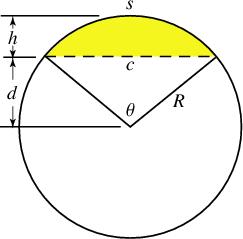
That's an equilateral triangle + 3 circle segments

In geometry, a circular segment or disk segment (symbol: ⌓) is a region of a disk which is "cut off" from the rest of the disk by a straight line. The complete line is known as a secant, and the section inside the disk as a chord.
More formally, a circular segment is a plane region bounded by a circular arc (of less than π radians by convention)...
torn shoal
what should i do?
whole geode
Draw the equilateral triangle. And then you have the three circular segments, you can calculate the area of the triangle and the segment.
each of the three segments are the same area.
torn shoal
Im sorry but I dont know what that means
whole geode
It would be helpful if you can let me know what you aren't understanding, in that case.
torn shoal
The "equilateral triangle" and "circular segments"
whole geode
equilateral triangle is a triangle that has all three of its sides the same length.
torn shoal
oh ok
whole geode
it has 60 degree angles
and you can use trigonometry to find the area based on a side length
"circular segment" I actually linked the wikipedia page for.
so please give it a read.
torn shoal
Oh, i get it now, so i basically have draw the triangle in the shaded area
whole geode
Basically
 mystic kraken
.close
whole geode
You can calculate it as "area of triangle" + 3 * "circular segment"
or you can calculate it as 3 * "circular sector" - 2 * "area of triangle"
you might find the latter more convenient.
(as 3 * a 60 degree circular sector is half a circle)

A circular sector, also known as circle sector or disk sector or simply a sector (symbol: ⌔), is the portion of a disk (a closed region bounded by a circle) enclosed by two radii and an arc, with the smaller area being known as the minor sector and the larger being the major sector. In the diagram, θ is the central angle, r the radius of the cir...
torn shoal
I dont understand how to calculate the segments because like if I would translate to my language it doesn't show and theres like words I never heard before being used in the wikipedia page
whole geode
what language?
torn shoal
swedish
whole geode
Segment inom geometri är en avskuren del av något större.
Ett linjesegment är en del av en linje som begränsas av två ändpunkter.
Ett cirkelsegment är en del av en cirkel som begränsas av en sekant eller korda. Halvcirkeln är ett specialfall av cirkelsegment, som begränsas av diametern, den längsta kordan.
Ett sfäriskt segment är en del av en ...


En cirkelsektor begränsas av två radier samt den cirkelbåge radierna avgränsar.
hope this helps
torn shoal
these equations looks kinda complex for 9th graders like me in my opinion
wait i think i found it
A = L.r /2
I dont know if its the same in the picture after drawing the triangle though
.close
topaz sinewBOT
Channel closed
Closed by @torn shoal
Use .reopen if this was a mistake.
torn shoal
.reopen
topaz sinewBOT
✅
topaz sinewBOT
@torn shoal Has your question been resolved?
topaz sinewBOT
@torn shoal Has your question been resolved?
topaz sinewBOT
Channel closed
Closed due to timeout
Use .reopen if this was a mistake.
Available help channel!
Send your question here to claim the channel.
Remember:
• Ask your math question in a clear, concise manner.
• Show your work, and if possible, explain where you are stuck.
• After 15 minutes, feel free to ping <@&286206848099549185>.
• Type the command .close to free the channel when you're done.
• Be polite and have a nice day!
Read #❓how-to-get-help for further information on how to ask a good question, and about conduct in the question channels.
 lilac folio
i've attempted to prove this inductively, but i dont know enough about the gamma function complete this, or so i think. what am i doing wrong?
im aware of the other path, but id like to try to complete it inductively. if its a lost cause, please tell me so
 topaz sinewBOT
lilac folio
i've attempted to prove this inductively, but i dont know enough about the gamma...
topaz sinewBOT
lilac folio
i've attempted to prove this inductively, but i dont know enough about the gamma...
 sweet shard
\gamma seems unnecessary
lilac folio
it comes from Gamma(z + 1) = zGamma(z). made it easier to reason
sweet shard
In "case k=n+1" you should be differentiating the nth derivative result
lilac folio
oh okay
sweet shard
finding the nth derivative of this shouldn't be too hard
 lilac folio
sweet shard
In "case k=n+1" you should be differentiating the nth derivative result
lilac folio
sweet shard
In "case k=n+1" you should be differentiating the nth derivative result
i actually had that earlier, but i couldnt figure out how to get the denominator to be right

if i even did it right
sweet shard
You need a formula for $\frac{d^n}{dt^n} (1-\beta t)^{-\alpha}$ first
thorny flameBOT
riemann
 sweet shard
E(Y^n) doesn't actually come into the calculations at all until you evaluate at t=0
lilac folio
ic, let me fix it
lilac folio
sweet shard
You need a formula for $\frac{d^n}{dt^n} (1-\beta t)^{-\alpha}$ first
it should look like this, correct?

though, i dont exactly get how the denominator contains Gamma(\alpha). still stuck on this step
 sweet shard
$\Gamma(\alpha + n) = (\alpha + n - 1) \cdot (\alpha + n - 2) \cdot \ldots \cdot 1$
thorny flameBOT
riemann
 sweet shard
your nth derivative stops at $\alpha$, not 1
thorny flameBOT
riemann

 topaz sinewBOT
@lilac folio Has your question been resolved?
 topaz sinewBOT
@lilac folio Has your question been resolved?
sweet shard
lilac folio
am i missing something still?
You're still getting the definition of Gamma wrong
sweet shard
thorny flame
**riemann**
.
lilac folio
sweet shard
You're still getting the definition of Gamma wrong
not trying being willfully ignorant, but i dont get it
isnt (a + n - 1)...(a+1)a...(1) the same as (a+n-1)(a+n-2)...?
it generates the same terms at the end of the day no?
in the case of the derivative, we would see a, (a+1) etc?
 lilac folio
 sweet shard
now it's just wrong
you take n derivatives, not alpha + n - 1 derivatives
do yourself a favor and just set alpha = 7, n = 3
see if you can take 3 derivatives
topaz sinewBOT
Channel closed
Closed by @lilac folio
Use .reopen if this was a mistake.
topaz sinewBOT
Available help channel!
Send your question here to claim the channel.
Remember:
• Ask your math question in a clear, concise manner.
• Show your work, and if possible, explain where you are stuck.
• After 15 minutes, feel free to ping <@&286206848099549185>.
• Type the command .close to free the channel when you're done.
• Be polite and have a nice day!
Read #❓how-to-get-help for further information on how to ask a good question, and about conduct in the question channels.
 west scarab
I am grade 12 doing adv functions, have a test on trig tomorrow and im currently doing a practice test
 topaz sinewBOT
west scarab
I am grade 12 doing adv functions, have a test on trig tomorrow and im currently...
west scarab
topaz sinewBOT
west scarab
I am grade 12 doing adv functions, have a test on trig tomorrow and im currently...
west scarab
Got stuck on this question
 visual monolith
,rotate left
thorny flameBOT
 topaz sinewBOT
Please only use the <@&286206848099549185> ping once if your question has not been answered for 15 minutes. Please do not ping or DM individual users about your question.
west scarab
<@&286206848099549185>
topaz sinewBOT
@west scarab Has your question been resolved?
topaz sinewBOT
Channel closed
Closed due to timeout
Use .reopen if this was a mistake.
Available help channel!
Send your question here to claim the channel.
Remember:
• Ask your math question in a clear, concise manner.
• Show your work, and if possible, explain where you are stuck.
• After 15 minutes, feel free to ping <@&286206848099549185>.
• Type the command .close to free the channel when you're done.
• Be polite and have a nice day!
Read #❓how-to-get-help for further information on how to ask a good question, and about conduct in the question channels.
 finite mural
Hi there How would you proof this ? Im havint troubles with it

 wheat kindle
Identity
Inverse
Associativity
Commutativity
What have you managed so far?
topaz sinewBOT
@finite mural Has your question been resolved?
topaz sinewBOT
Channel closed
Closed due to timeout
Use .reopen if this was a mistake.
Available help channel!
Send your question here to claim the channel.
Remember:
• Ask your math question in a clear, concise manner.
• Show your work, and if possible, explain where you are stuck.
• After 15 minutes, feel free to ping <@&286206848099549185>.
• Type the command .close to free the channel when you're done.
• Be polite and have a nice day!
Read #❓how-to-get-help for further information on how to ask a good question, and about conduct in the question channels.
 jovial girder
 topaz sinewBOT
jovial girder
jovial girder
topaz sinewBOT
jovial girder
jovial girder
My instructions are to find the work done by the force field as it moves a particle along the curve C, in the given orientation.

this is 1(h)
<@&286206848099549185> in some dire need of help
topaz sinewBOT
@jovial girder Has your question been resolved?
topaz sinewBOT
Channel closed
Closed due to timeout
Use .reopen if this was a mistake.
Available help channel!
Send your question here to claim the channel.
Remember:
• Ask your math question in a clear, concise manner.
• Show your work, and if possible, explain where you are stuck.
• After 15 minutes, feel free to ping <@&286206848099549185>.
• Type the command .close to free the channel when you're done.
• Be polite and have a nice day!
Read #❓how-to-get-help for further information on how to ask a good question, and about conduct in the question channels.
 rigid prawn
 topaz sinewBOT
rigid prawn
rigid prawn
topaz sinewBOT
rigid prawn
rigid prawn
why is the total number of upnos 2^9 and the total number of downnos 2^10?
Can somebody pls explain this to me
thanks
whole geode
@rigid prawn consider an upno
This number can only have up to 9 digits right?
Because digits are not allowed to repeat.
123456789 is the largest upno
 fading owl
rigid prawn
why is the total number of upnos 2^9 and the total number of downnos 2^10?
fading owl
rigid prawn
why is the total number of upnos 2^9 and the total number of downnos 2^10?
i did the exact same question today
omg
i was looking at aops too
whole geode
If we consider that each digit can only appear once
fading owl
and i got the same qn wrong
whole geode
And the order cannot be changed
fading owl
note that the digits cant be the same
whole geode
Then the only difference between any two given upnos are whether or not any given digit appears
fading owl
beacause the next digit is strictly less than the first digit
fading owl
whole geode
Then the only difference between any two given upnos are whether or not any give...
yeah
whole geode
There are 9 digits that can appear, and each has two possibilities, so that's 2^9
fading owl
cant believe i just did that paper as practise for amc 10/12
fading owl
whole geode
It's a shame, interesting question too
yes
i got it wrong js now 😭
reviewing answers rn 💀
got 112.5 exactly distinction 💀
Hey @rigid prawn
topaz sinewBOT
@rigid prawn Has your question been resolved?
topaz sinewBOT
Channel closed
Closed by @rigid prawn
Use .reopen if this was a mistake.
Available help channel!
Send your question here to claim the channel.
Remember:
• Ask your math question in a clear, concise manner.
• Show your work, and if possible, explain where you are stuck.
• After 15 minutes, feel free to ping <@&286206848099549185>.
• Type the command .close to free the channel when you're done.
• Be polite and have a nice day!
Read #❓how-to-get-help for further information on how to ask a good question, and about conduct in the question channels.
 leaden hatch
where did the y_0 and x_0 go at the bottom?
 topaz sinewBOT
leaden hatch
where did the y_0 and x_0 go at the bottom?
topaz sinewBOT
leaden hatch
where did the y_0 and x_0 go at the bottom?
 fickle mulch
leaden hatch
where did the y_0 and x_0 go at the bottom?
fickle mulch
leaden hatch
where did the y_0 and x_0 go at the bottom?
they equal zero so they just simply didn't write it
they could say y-0 but thats the same as y
leaden hatch
but it says x_0 not equal to 0
leaden hatch
😓
little pine
expand out the RHS
they'll cancel
topaz sinewBOT
Channel closed
Closed by @leaden hatch
Use .reopen if this was a mistake.
topaz sinewBOT
Available help channel!
Send your question here to claim the channel.
Remember:
• Ask your math question in a clear, concise manner.
• Show your work, and if possible, explain where you are stuck.
• After 15 minutes, feel free to ping <@&286206848099549185>.
• Type the command .close to free the channel when you're done.
• Be polite and have a nice day!
Read #❓how-to-get-help for further information on how to ask a good question, and about conduct in the question channels.
 toxic hill
 topaz sinewBOT
toxic hill
toxic hill
topaz sinewBOT
toxic hill
toxic hill
i understand that the second derivative of g(x) is the slope the first derivative of g(x)
agile harness
did you get part a
toxic hill
which is why i believe that g''(x) is negative between -3 and 0 and positive between 0 and 3 what im confused about is what to say when the slope is 0
when it comes to part a im also a little confused
agile harness
ok then let’s start at part a
toxic hill
i know g(x) is increasing when its slope is positive and decreasing when its slope is negative
but what if the slope is 0
is it increasing or decreasing?
(-inf,3) its 0 and (3,inf) slope is 0 as well
agile harness
toxic hill
is it increasing or decreasing?
neither
agile harness
toxic hill
(-inf,3) its 0 and (3,inf) slope is 0 as well
where are you getting this
agile harness
 agile harness
this is the graph of g’, if g is decreasing then g’ is negative, if g is increasing then g’ is positive
toxic hill
this is the graph of the derivative wherever it is negative the slope is negative
agile harness
from the graph, g’ seems to never be zero
toxic hill
my fault
toxic hill
it would be decreasing everywhere
toxic hill
ya
agile harness
because it’s not defined at 0 of course
toxic hill
decreasing (-inf,0)U(0,inf)
toxic hill
part b the slope of the actual graph matters right
agile harness
g’’ is positive means g’ is increasing, g’’ is negative means g’ is decreasing
agile harness
yep
agile harness
you’re welcome
toxic hill
.close
topaz sinewBOT
Channel closed
Closed by @toxic hill
Use .reopen if this was a mistake.
topaz sinewBOT
Available help channel!
Send your question here to claim the channel.
Remember:
• Ask your math question in a clear, concise manner.
• Show your work, and if possible, explain where you are stuck.
• After 15 minutes, feel free to ping <@&286206848099549185>.
• Type the command .close to free the channel when you're done.
• Be polite and have a nice day!
Read #❓how-to-get-help for further information on how to ask a good question, and about conduct in the question channels.
topaz sinewBOT
loud oasis
c is a quantity which depends on the shape and cross-sectional area of the object and the density of the fluid (air)
it can be experimentally determined, yes
topaz sinewBOT
Channel closed
Closed by @serene tangle
Use .reopen if this was a mistake.
topaz sinewBOT
Available help channel!
Send your question here to claim the channel.
Remember:
• Ask your math question in a clear, concise manner.
• Show your work, and if possible, explain where you are stuck.
• After 15 minutes, feel free to ping <@&286206848099549185>.
• Type the command .close to free the channel when you're done.
• Be polite and have a nice day!
Read #❓how-to-get-help for further information on how to ask a good question, and about conduct in the question channels.
 wispy mango
 topaz sinewBOT
wispy mango
wispy mango
topaz sinewBOT
wispy mango
wispy mango
can someone help me figure out how to go about solving this analytically? if there is a way?
or would it be more worth while to solve it numerically?
import numpy as np
from scipy.integrate import nquad

# Define the function to integrate
def integrand(z, y, x, b):
    return 1 / ((b - x)**2 + y**2 + z**2)

# Set limits of integration
a = 1  # Replace with your value of a
b = 2  # Replace with your value of b
limits = [[-a, a], [-a, a], [-a, a]]  # limits for x, y, z

# Perform the triple integral
result, error = nquad(integrand, limits, args=(b,))

print("Result of the integral:", result)
print("Estimated error:", error)
I got this from chatgpt (God bless ai)
<@&286206848099549185>
topaz sinewBOT
@wispy mango Has your question been resolved?
topaz sinewBOT
@wispy mango Has your question been resolved?
topaz sinewBOT
Channel closed
Closed due to timeout
Use .reopen if this was a mistake.
Available help channel!
Send your question here to claim the channel.
Remember:
• Ask your math question in a clear, concise manner.
• Show your work, and if possible, explain where you are stuck.
• After 15 minutes, feel free to ping <@&286206848099549185>.
• Type the command .close to free the channel when you're done.
• Be polite and have a nice day!
Read #❓how-to-get-help for further information on how to ask a good question, and about conduct in the question channels.
 mortal heart
The gradient of the curve y = x3 + ax2 + bx + 7 at the point (1, 5) is −5. Find the value of a and the value of b.
topaz sinewBOT
mortal heart
The gradient of the curve y = x3 + ax2 + bx + 7 at the point (1, 5) is −5. Find ...
true coral
mortal heart
The gradient of the curve y = x3 + ax2 + bx + 7 at the point (1, 5) is −5. Find ...
create 2 simul equations and solve
mortal heart
guys why am i wrong?
 true coral
substitute in (x,y) and (x, dy/dx)
true coral
mortal heart
guys why am i wrong?
you went from -5 to 5 it looks like
on the lines that are highlighted
in your sol
topaz sinewBOT
Channel closed
Closed by @mortal heart
Use .reopen if this was a mistake.
mortal heart
thanks again
topaz sinewBOT
Available help channel!
Send your question here to claim the channel.
Remember:
• Ask your math question in a clear, concise manner.
• Show your work, and if possible, explain where you are stuck.
• After 15 minutes, feel free to ping <@&286206848099549185>.
• Type the command .close to free the channel when you're done.
• Be polite and have a nice day!
Read #❓how-to-get-help for further information on how to ask a good question, and about conduct in the question channels.
 topaz sinewBOT
 glad sierra
Can you check if this is correct?
glad sierra
glad sierra
Can you check if this is correct?
glad sierra
I’m trying to find the 2nth derivative of (x^2-1)^n
 odd pagoda
you should write $u^{(2n)}$ instead of $u^{2n}$
thorny flameBOT
Denascite
 odd pagoda
but checks out
glad sierra
yes
I really mean, u^(2n)
My reasoning was after the first term
differentiating x^(2n-2) , 2n-2 times will give me (2n-2)!
But I still need to do two more differentiation to do it 2n times
ie the 2nth derivative is 0
Same applies to all other terms
Sounds correct ?
This is what my professor did,
 topaz sinewBOT
@glad sierra Has your question been resolved?
topaz sinewBOT
Channel closed
Closed due to timeout
Use .reopen if this was a mistake.
Available help channel!
Send your question here to claim the channel.
Remember:
• Ask your math question in a clear, concise manner.
• Show your work, and if possible, explain where you are stuck.
• After 15 minutes, feel free to ping <@&286206848099549185>.
• Type the command .close to free the channel when you're done.
• Be polite and have a nice day!
Read #❓how-to-get-help for further information on how to ask a good question, and about conduct in the question channels.
 wintry urchin
This is my table. How can I use Gomory's cutting plane algorithm to find an integer solution? I know by inspection that the answer is x = 2, but how do I show that using the method?
 topaz sinewBOT
wintry urchin
This is my table. How can I use Gomory's cutting plane algorithm to find an inte...
topaz sinewBOT
wintry urchin
This is my table. How can I use Gomory's cutting plane algorithm to find an inte...
@wintry urchin Has your question been resolved?
Channel closed
Closed by @wintry urchin
Use .reopen if this was a mistake.
Available help channel!
Send your question here to claim the channel.
Remember:
• Ask your math question in a clear, concise manner.
• Show your work, and if possible, explain where you are stuck.
• After 15 minutes, feel free to ping <@&286206848099549185>.
• Type the command .close to free the channel when you're done.
• Be polite and have a nice day!
Read #❓how-to-get-help for further information on how to ask a good question, and about conduct in the question channels.
 wild zephyr
 topaz sinewBOT
wild zephyr
topaz sinewBOT
topaz sinewBOT
wild zephyr
topaz sinewBOT
Please only use the <@&286206848099549185> ping once if your question has not been answered for 15 minutes. Please do not ping or DM individual users about your question.
fair thorn
please don't ping us immediately

