#help-26
1 messages · Page 179 of 1
 arctic sundial
arctic sundial
arctic sundial
Professor Sucks cancelled class on Monday and threw us 2 new Chapters to cover on our own
 agile harness
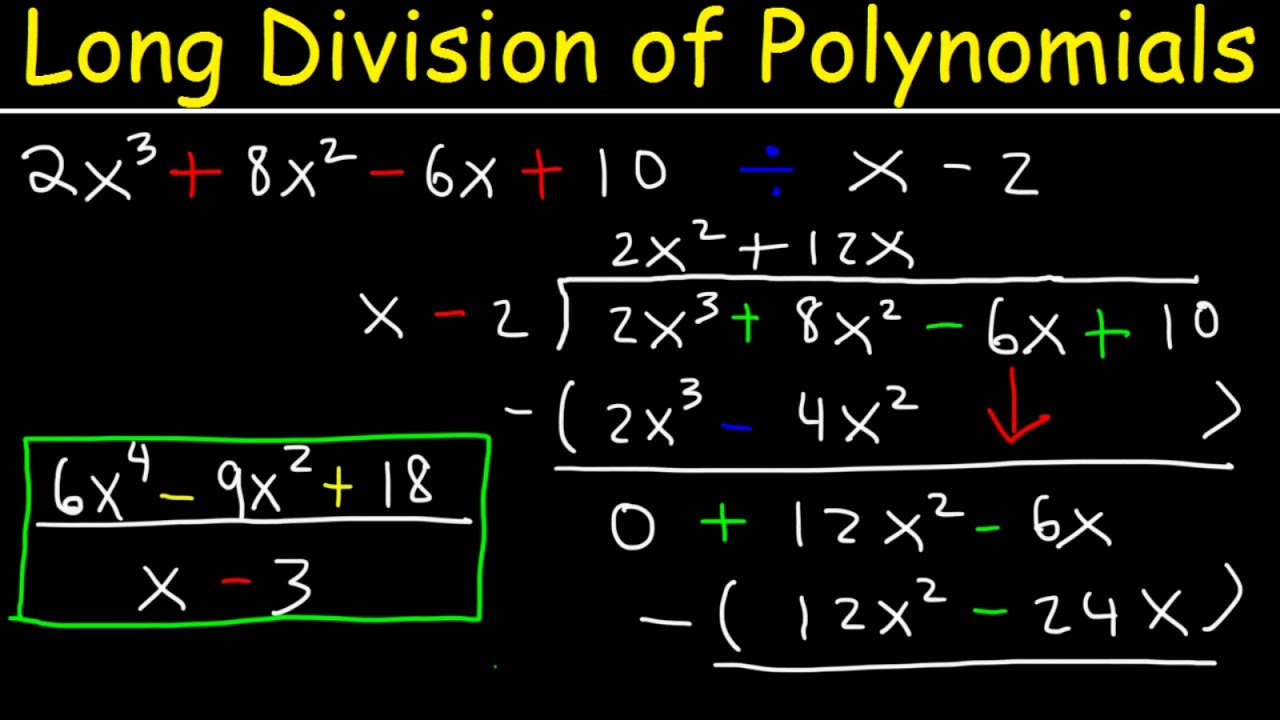
This video tutorial explains how to perform long division of polynomials with remainder and with missing terms.
Introduction to Polynomials: https://www.youtube.com/watch?v=Rxx4HepHI_E
Polynomials - Basic Operations:
https://www.youtube.com/watch?v=ZvL9aDGNHqA
Dividing Polynomials By Mo...
arctic sundial
Mind you it takes 2 days for us to cover one
agile harness
just go down the rabbit hole of these videos
arctic sundial
agile harness
just go down the rabbit hole of these videos
Wdym
arctic sundial
Bet that up lil bro
 topaz sinewBOT
@arctic sundial Has your question been resolved?
Channel closed
Closed by @arctic sundial
Use .reopen if this was a mistake.
 Available help channel!
Send your question here to claim the channel.
Remember:
• Ask your math question in a clear, concise manner.
• Show your work, and if possible, explain where you are stuck.
• After 15 minutes, feel free to ping <@&286206848099549185>.
• Type the command .close to free the channel when you're done.
• Be polite and have a nice day!
Read #❓how-to-get-help for further information on how to ask a good question, and about conduct in the question channels.
 sly abyss
Help
topaz sinewBOT
sly abyss
Help
sly abyss
Close
 wooden osprey
what is your question
sly abyss
I wanted help in understanding this logic problem
wooden osprey
...
 sweet shard
sly abyss
Close
sweet shard
sly abyss
Close
.close
topaz sinewBOT
Channel closed
Closed by @sweet shard
Use .reopen if this was a mistake.
Available help channel!
Send your question here to claim the channel.
Remember:
• Ask your math question in a clear, concise manner.
• Show your work, and if possible, explain where you are stuck.
• After 15 minutes, feel free to ping <@&286206848099549185>.
• Type the command .close to free the channel when you're done.
• Be polite and have a nice day!
Read #❓how-to-get-help for further information on how to ask a good question, and about conduct in the question channels.
 deft holly
 topaz sinewBOT
deft holly
deft holly
topaz sinewBOT
deft holly
deft holly
i got a as 4
from this, is there an easy way to find part b?
?

hello??
<@&286206848099549185>
deft holly
deft holly
so <@&268886789983436800> , trolled again

 crude trail
lol
deft holly
.close
topaz sinewBOT
Channel closed
Closed by @deft holly
Use .reopen if this was a mistake.
topaz sinewBOT
Available help channel!
Send your question here to claim the channel.
Remember:
• Ask your math question in a clear, concise manner.
• Show your work, and if possible, explain where you are stuck.
• After 15 minutes, feel free to ping <@&286206848099549185>.
• Type the command .close to free the channel when you're done.
• Be polite and have a nice day!
Read #❓how-to-get-help for further information on how to ask a good question, and about conduct in the question channels.
 sonic belfry
what is arctan(1)
topaz sinewBOT
sonic belfry
what is arctan(1)
 unique quarry
pi/4
 sudden temple
no
sonic belfry
😭
unique quarry
sonic belfry
so arctan(1) = cos(1)/sin(1)???
cos = 1 and sin = 1
 dry zenith
sonic belfry
so arctan(1) = cos(1)/sin(1)???
dry zenith
sonic belfry
so arctan(1) = cos(1)/sin(1)???
That's not the definition of arctan
sonic belfry
unique quarry
cos = 1 and sin = 1
oh
 lusty marsh
sonic belfry
so arctan(1) = cos(1)/sin(1)???
lusty marsh
sonic belfry
so arctan(1) = cos(1)/sin(1)???
nope
dry zenith
that's the definition of cot(x)
wooden osprey
sonic belfry
so arctan(1) = cos(1)/sin(1)???
lmao
dry zenith
tan(x) = sin(x)/cos(x)
cot(x) = cos(x)/sin(x)
sonic belfry
dry zenith
tan(x) = sin(x)/cos(x)
cot(x) = cos(x)/sin(x)
oh
wait
then whats arctan
inverse tan
what does that mean
1/tan(x)
wooden osprey
probably they thought $\tan = \frac1{tan^{-1}}$
 thorny flameBOT
 wooden osprey
sonic belfry
what does that mean
wooden osprey
sonic belfry
what does that mean
if $\tan x= a$, then $\arctan a = x$
thorny flameBOT
 sonic belfry
thorny flame
sonic belfry
thorny flame
oh
wooden osprey
no that is not true
sonic belfry
thorny flame
oh right-
wooden osprey
in more technical terms, arctan is the inverse function of tan, just like you said
sonic belfry
arctan(1) = tan(u) where u = something that would make tan(u) = 1????
sudden temple
sonic belfry
arctan(1) = tan(u) where u = something that would make tan(u) = 1????
arctan(1) = u is what you probably meant
sonic belfry
sudden temple
arctan(1) = u is what you probably meant
and how would you know that the answer is pi/4
 merry hill
sonic belfry
merry hill
sonic belfry
ok thanks also how do i make my calculator not give the answers in degrees
and radians(i think) instead
dry zenith
What's your calculator's type/model?
sonic belfry
ti30x
topaz sinewBOT
Channel closed
Closed by @sonic belfry
Use .reopen if this was a mistake.
topaz sinewBOT
Available help channel!
Send your question here to claim the channel.
Remember:
• Ask your math question in a clear, concise manner.
• Show your work, and if possible, explain where you are stuck.
• After 15 minutes, feel free to ping <@&286206848099549185>.
• Type the command .close to free the channel when you're done.
• Be polite and have a nice day!
Read #❓how-to-get-help for further information on how to ask a good question, and about conduct in the question channels.
 sinful harness
Can someone help me find pb
 topaz sinewBOT
sinful harness
Can someone help me find pb
sinful harness
topaz sinewBOT
sinful harness
Can someone help me find pb
sinful harness
helloooooo\
sinful harness
tbh im not really sure how to start this problem
the question is like this
let P be a point inside rectangle abcd. if pd = 12, pc = 7, pa = 10, find pb
 supple hinge
i think u should use trignometry
 odd forge
https://brilliant.org/wiki/british-flag-theorem/ @sinful harness

This can be proved by using the Pythagorean theorem and projecting point ...
I think this it it
supple hinge
use the British flag theorem, which states that for any point inside a rectangle, the sum of the squares of the distances from that point to two opposite corners is equal to the sum of the squares of the distances to the other two opposite corners. the formula is like this PA^2 +PC^2 = pb^2 +Pd^2
i was typin that
sinful harness
ohhhh wait ill try to understand let me see ill studyyy it thank youuuuu so much
.close
topaz sinewBOT
Channel closed
Closed by @sinful harness
Use .reopen if this was a mistake.
topaz sinewBOT
Available help channel!
Send your question here to claim the channel.
Remember:
• Ask your math question in a clear, concise manner.
• Show your work, and if possible, explain where you are stuck.
• After 15 minutes, feel free to ping <@&286206848099549185>.
• Type the command .close to free the channel when you're done.
• Be polite and have a nice day!
Read #❓how-to-get-help for further information on how to ask a good question, and about conduct in the question channels.
 hushed cliff
Can someone help me solve this question ?
 topaz sinewBOT
hushed cliff
Can someone help me solve this question ?
topaz sinewBOT
hushed cliff
Can someone help me solve this question ?
 silk delta
hushed cliff
Can someone help me solve this question ?
silk delta
hushed cliff
Can someone help me solve this question ?
hold up gimme one minute
hushed cliff
ok thanks
hushed cliff
no
hushed cliff
is it 90?
silk delta
by using the fact that the opposite andles of cyclic quadrilaterals are supplementary
silk delta
hushed cliff
is it 90?
I get what you mean, but since PR isn't the radius it isn't 90
hushed cliff
oww ok
silk delta
hushed cliff
Can someone help me solve this question ?
hmm wait you're Malaysian aren't you
hushed cliff
ya
silk delta
hushed cliff
ya
so you got the answer?
hushed cliff
98?
silk delta
hmm yeah seems like the 74 degrees is QPS
silk delta
np
hushed cliff
.close
topaz sinewBOT
Channel closed
Closed by @hushed cliff
Use .reopen if this was a mistake.
topaz sinewBOT
Available help channel!
Send your question here to claim the channel.
Remember:
• Ask your math question in a clear, concise manner.
• Show your work, and if possible, explain where you are stuck.
• After 15 minutes, feel free to ping <@&286206848099549185>.
• Type the command .close to free the channel when you're done.
• Be polite and have a nice day!
Read #❓how-to-get-help for further information on how to ask a good question, and about conduct in the question channels.
 dire mural
 topaz sinewBOT
dire mural
dire mural
topaz sinewBOT
dire mural
dire mural
Another weird one
There is a c part but that part is just pure word choice

oh way lemme fix b part

 neon iron
What have you done till now?
dire mural
part a?
 opal vault
is this done
 dire mural
nah not yet
i'm trying to prove f(x)>2024|f'(x)| wrong
if that is wrong
then part a is done

topaz sinewBOT
@dire mural Has your question been resolved?
topaz sinewBOT
@dire mural Has your question been resolved?
dire mural
.close
topaz sinewBOT
Channel closed
Closed by @dire mural
Use .reopen if this was a mistake.
Available help channel!
Send your question here to claim the channel.
Remember:
• Ask your math question in a clear, concise manner.
• Show your work, and if possible, explain where you are stuck.
• After 15 minutes, feel free to ping <@&286206848099549185>.
• Type the command .close to free the channel when you're done.
• Be polite and have a nice day!
Read #❓how-to-get-help for further information on how to ask a good question, and about conduct in the question channels.
 jolly urchin
 topaz sinewBOT
jolly urchin
https://media.discordapp.net/attachments/1181271232864337950/1293604079582449664...
jolly urchin
topaz sinewBOT
jolly urchin
https://media.discordapp.net/attachments/1181271232864337950/1293604079582449664...
jolly urchin
Could someone explain
neon iron
jolly urchin
https://media.discordapp.net/attachments/1181271232864337950/1293604079582449664...
caught the translation uptil here

do you know what natural numbers are?
jolly urchin
Yep!
neon iron
nice
jolly urchin
Positive integers
neon iron
they are represented by the Alphabet N
similarly we are now introducing a new set of numbers called rational numbers
they are denoted by Q
they are defining(saying saying that)Q as any number which can be written of the form p / q
$p/q$
thorny flameBOT
Cnidarian
 neon iron
where p can be any integer
and q is any integer except 0
this is what they meant over here

q not equals 0
they are also saying that all rational numbers can be added,subtracted,multiplied and divided
 jolly urchin
I See! Thank you a lot!
topaz sinewBOT
@jolly urchin Has your question been resolved?
topaz sinewBOT
Channel closed
Closed due to timeout
Use .reopen if this was a mistake.
Available help channel!
Send your question here to claim the channel.
Remember:
• Ask your math question in a clear, concise manner.
• Show your work, and if possible, explain where you are stuck.
• After 15 minutes, feel free to ping <@&286206848099549185>.
• Type the command .close to free the channel when you're done.
• Be polite and have a nice day!
Read #❓how-to-get-help for further information on how to ask a good question, and about conduct in the question channels.
 rocky sky
 rocky sky
Can someone explain to me why at step 3 we dont just get rid of the +9/16 and -9/16?
so that it would become 2(y^2-3/2y)
 cunning kayak
rocky sky
Can someone explain to me why at step 3 we dont just get rid of the +9/16 and -9...
cunning kayak
rocky sky
Can someone explain to me why at step 3 we dont just get rid of the +9/16 and -9...
to make it a perfect square
rocky sky
i still dont understand, normally with a completing a square we add the number outside the brackets?
 cunning kayak
c=0
rocky sky
ohh its just invisible so to say
cunning kayak
yeah
rocky sky
is it possible to use completing the square to simplify an expression?
such that we try find out what x is equal to?
rocky sky
i figured id use that sheet and try again from the start of one of my lines.
4x^2-x+0
4(x^2-1/4x+0/4
but its known that 0 cannot be divided with, right?
so instead would we try
4(x^2-1/4x)
cunning kayak
0/4 = 0
4/0 = undefined
rocky sky
oh...
cunning kayak
rocky sky
i figured id use that sheet and try again from the start of one of my lines.
4x...
yeah so here 0/4 would become 0
rocky sky
cunning kayak
yeah so here 0/4 would become 0
so it would then turn into 4(x-1/8x+0)
cunning kayak
rocky sky
so instead would we try
4(x^2-1/4x)
here u wrote 1/4
rocky sky
ill get it up
cunning kayak
4x^2 - x?
rocky sky
5X 2 −3X+4Y 2+2XY−6Y+7X 2
To simplify
12x^2-3x +4y^2 -6y +2xy
3(4x^2-x) +2(2y^2-3y) +2xy
To solve first part of x we should take
4x^2-x+0
4(x^2-1/4x+0)
4(x^2-1/8x+0)
4(x-1/8x+0 -1/64)
I added 0 in as the placeholder for c in the previous picture
rocky sky
cunning kayak
5X^2 −3X+4Y^2+2XY−6Y+7X^2
but this is in the question and it is asking us to simplify completely
cunning kayak
is it 7x^2?
rocky sky
yes
 topaz sinewBOT
@rocky sky Has your question been resolved?
rocky sky
4(x^2-x+0)
when attempting to complete the square
turns into something like 4(x-1/8x+0-1/64)?
<@&286206848099549185>
.close
topaz sinewBOT
Channel closed
Closed by @rocky sky
Use .reopen if this was a mistake.
topaz sinewBOT
Available help channel!
Send your question here to claim the channel.
Remember:
• Ask your math question in a clear, concise manner.
• Show your work, and if possible, explain where you are stuck.
• After 15 minutes, feel free to ping <@&286206848099549185>.
• Type the command .close to free the channel when you're done.
• Be polite and have a nice day!
Read #❓how-to-get-help for further information on how to ask a good question, and about conduct in the question channels.
 willow nest
hp
topaz sinewBOT
willow nest
hp
 agile harness
willow nest
how to start proving from the left side
agile harness
willow nest
how to start proving from the left side
 thorny flameBOT
 willow nest

agile harness
are you sure about the sin3x
agile harness
use angle sum then
sin(2x+x)
expand
sin2xcosx + cos2xsinx
then expand the double angle
 thorny flameBOT
 willow nest
heklp
topaz sinewBOT
@willow nest Has your question been resolved?
topaz sinewBOT
Channel closed
Closed due to timeout
Use .reopen if this was a mistake.
Available help channel!
Send your question here to claim the channel.
Remember:
• Ask your math question in a clear, concise manner.
• Show your work, and if possible, explain where you are stuck.
• After 15 minutes, feel free to ping <@&286206848099549185>.
• Type the command .close to free the channel when you're done.
• Be polite and have a nice day!
Read #❓how-to-get-help for further information on how to ask a good question, and about conduct in the question channels.
 wintry crater
what did i do wrong here?

 topaz sinewBOT
wintry crater
what did i do wrong here?
wintry crater
topaz sinewBOT
wintry crater
what did i do wrong here?
wintry crater
<@&286206848099549185>
sweet shard
wintry crater
<@&286206848099549185>
!15m
topaz sinewBOT
wintry crater
<@&286206848099549185>
Please only use the <@&286206848099549185> ping once if your question has not been answered for 15 minutes. Please do not ping or DM individual users about your question.
 cloud mango
,w sin 30
thorny flameBOT


 cloud mango
yeah i mean i'm failing to see the error here
 tacit osprey
wintry crater
<@&286206848099549185>
tacit osprey
wintry crater
<@&286206848099549185>
 both questions are different right
 cosmic silo
wintry crater
what did i do wrong here?
cosmic silo
wintry crater
what did i do wrong here?
it is quite right
wintry crater
the first pic is the problem, the second pic is my work
the online software's marking wrong idk why
tacit osprey
Your solution seems right
topaz sinewBOT
@wintry crater Has your question been resolved?
wintry crater
<@&286206848099549185>
tacit osprey
Bro your answer is correct
 toxic otter

tacit osprey
I even read vectors again to rechecked it
wintry crater
would you say there's something wrong with the software?
toxic otter
wintry crater
would you say there's something wrong with the software?
let me check
it is correct
the engine is shitty
 wintry crater
<@&286206848099549185>
tacit osprey
wintry crater
<@&286206848099549185>
Shit your system is shit
wintry crater
pls help me why the computer favors 2√27 over 6√3
tacit osprey
If you take the root of 27 if will be 3√3 and multiply it with 2
wintry crater
oh so they're equivalent?
tacit osprey
wintry crater
pls help me why the computer favors 2√27 over 6√3
Nothing will happen your answer is correct
tacit osprey
wintry crater
oh so they're equivalent?
Yrs
tacit osprey
No problem
wintry crater
.close
topaz sinewBOT
Channel closed
Closed by @wintry crater
Use .reopen if this was a mistake.
topaz sinewBOT
Available help channel!
Send your question here to claim the channel.
Remember:
• Ask your math question in a clear, concise manner.
• Show your work, and if possible, explain where you are stuck.
• After 15 minutes, feel free to ping <@&286206848099549185>.
• Type the command .close to free the channel when you're done.
• Be polite and have a nice day!
Read #❓how-to-get-help for further information on how to ask a good question, and about conduct in the question channels.
 quasi prairie
 topaz sinewBOT
quasi prairie
quasi prairie
topaz sinewBOT
quasi prairie
quasi prairie
can someone pls help me with this question
I'm struggling
<@&286206848099549185> 
neon iron
which one
can you type it pls cause im blind without my glasses
nvm
which question
neon iron
for b
it is a geometric series with a constant ratio of 1.02 (from the 2% interest). You can apply the geometric series formula to prove the total value of Phil’s savings after 20 years.
for c use the equation from part b and solve for P by equating the total value of his savings to the amount he owes after 20 years.
d.i use present value formula for an annuity
d.ii use perpetuity formula
these are hints btw not answers
quasi prairie
thank you!! i prefer hints so that's really helpful
quasi prairie
neon iron
d.ii use perpetuity formula
what is the perpetuity formula?
neon iron
quasi prairie
what is the perpetuity formula?
Present Value (PV) = Cash Flow (CF)/Interest Rate (IR).
quasi prairie
neon iron
Present Value (PV) = Cash Flow (CF)/Interest Rate (IR).
oh, I haven't learnt about cash flow
but this question was in my test 
neon iron
quasi prairie
oh, I haven't learnt about cash flow
ig its extra knowledge
quasi prairie
is that the only way to solve d?
quasi prairie
Wdym
you mentioned that i should use the perpetuity formula to solve dii
and the present value formula for di
neon iron
quasi prairie
is that the only way to solve d?
probably not but its the simplest way to do so
topaz sinewBOT
@quasi prairie Has your question been resolved?
topaz sinewBOT
Channel closed
Closed due to timeout
Use .reopen if this was a mistake.
Available help channel!
Send your question here to claim the channel.
Remember:
• Ask your math question in a clear, concise manner.
• Show your work, and if possible, explain where you are stuck.
• After 15 minutes, feel free to ping <@&286206848099549185>.
• Type the command .close to free the channel when you're done.
• Be polite and have a nice day!
Read #❓how-to-get-help for further information on how to ask a good question, and about conduct in the question channels.
 honest musk
How would I go on about turning this into standard form? (Nvm, I think I got it)
 topaz sinewBOT
honest musk
How would I go on about turning this into standard form? (Nvm, I think I got it)
honest musk
topaz sinewBOT
honest musk
How would I go on about turning this into standard form? (Nvm, I think I got it)
honest musk
.close
topaz sinewBOT
Channel closed
Closed by @honest musk
Use .reopen if this was a mistake.
topaz sinewBOT
Available help channel!
Send your question here to claim the channel.
Remember:
• Ask your math question in a clear, concise manner.
• Show your work, and if possible, explain where you are stuck.
• After 15 minutes, feel free to ping <@&286206848099549185>.
• Type the command .close to free the channel when you're done.
• Be polite and have a nice day!
Read #❓how-to-get-help for further information on how to ask a good question, and about conduct in the question channels.
 high quail
 topaz sinewBOT
high quail
high quail
topaz sinewBOT
high quail
high quail
(lemme see if I just forgot the bases
 alpine mist
the x^2 should be in the same log as the y and z terms
log(A) + log(B) = log(AB)
and yes, it should be log_7
high quail
alpine mist
the x^2 should be in the same log as the y and z terms
like this?
 alpine mist
oh, you also need to distribute the 2
high quail
alpine mist
oh, you also need to distribute the 2
Wdym
alpine mist
that 2 in front is multiplied onto everything. not just the first log
high quail
alpine mist
that 2 in front is multiplied onto everything. not just the first log
ohhhh
high quail
alpine mist
that 2 in front is multiplied onto everything. not just the first log
so would it just be x? and 2 next to the log
 alpine mist
no, you need to distribute it, and then use the power rules, and sum/difference rules
or use the power rule at the end.
high quail
ohh
high quail
alpine mist
no, you need to distribute it, and then use the power rules, and sum/difference ...
There we go it worked, Thanks!
.close
topaz sinewBOT
Channel closed
Closed by @high quail
Use .reopen if this was a mistake.
Available help channel!
Send your question here to claim the channel.
Remember:
• Ask your math question in a clear, concise manner.
• Show your work, and if possible, explain where you are stuck.
• After 15 minutes, feel free to ping <@&286206848099549185>.
• Type the command .close to free the channel when you're done.
• Be polite and have a nice day!
Read #❓how-to-get-help for further information on how to ask a good question, and about conduct in the question channels.
neon iron
 neon iron
How do you find an equation for 3.) a.) ?
Is it not 2x(16-x^2)?
What is this question talking about
 cedar sinew
Wait why 2x
Why not just x
Explain your Reasoning
Oh I See
The area of a rectangle is base times height
It seems to me that you wrote 2 times base times height
Remember
Rectangle is base times height
And triangle is half base times height
Very Imporant Theorem
@neon iron do you understand?
It’s a little complicated
topaz sinewBOT
@neon iron Has your question been resolved?
topaz sinewBOT
Channel closed
Closed due to timeout
Use .reopen if this was a mistake.
Available help channel!
Send your question here to claim the channel.
Remember:
• Ask your math question in a clear, concise manner.
• Show your work, and if possible, explain where you are stuck.
• After 15 minutes, feel free to ping <@&286206848099549185>.
• Type the command .close to free the channel when you're done.
• Be polite and have a nice day!
Read #❓how-to-get-help for further information on how to ask a good question, and about conduct in the question channels.
 vernal dawn
 topaz sinewBOT
vernal dawn
vernal dawn
topaz sinewBOT
vernal dawn
vernal dawn
So I have to find the derivative using the chain rule
So from my understanding for exponents
Its supposed to be (e^tsin2t) * g'(x)
So when I did the work, I got (e^tsin2t) * (tcos2t)
But the textbook answer shows this:

I'm just curious as to what I did wrong here
Since the derivative of sin should just be cos
neon iron
Pls help
 topaz sinewBOT
Someone else is already using this help channel. If you need help with a question, please open your own help channel/thread (see #❓how-to-get-help for instructions).
vernal dawn
Lemme check the textbook
I didn't see a product rule being mentioned
Yeah theres no mention of a product rule
And the prof didn't mention it

Yeah I went back to doublecheck to make sure.
Maybe I missed it because I was braindead from all the exams.
I'll ask them tomorrow and come back later.
Thank you.
.close
topaz sinewBOT
Channel closed
Closed by @vernal dawn
Use .reopen if this was a mistake.
neon iron
 topaz sinewBOT
Available help channel!
topaz sinewBOT
Available help channel!
Send your question here to claim the channel.
Remember:
• Ask your math question in a clear, concise manner.
• Show your work, and if possible, explain where you are stuck.
• After 15 minutes, feel free to ping <@&286206848099549185>.
• Type the command .close to free the channel when you're done.
• Be polite and have a nice day!
Read #❓how-to-get-help for further information on how to ask a good question, and about conduct in the question channels.
 proven narwhal
 topaz sinewBOT
proven narwhal
topaz sinewBOT
proven narwhal
 topaz sinewBOT
@proven narwhal Has your question been resolved?
proven narwhal
<@&286206848099549185>
proven narwhal
<@&286206848099549185>
proven narwhal
<@&286206848099549185>
 rocky flower
proven narwhal
<@&286206848099549185>
rocky flower
proven narwhal
<@&286206848099549185>
Yeah
proven narwhal
.close
topaz sinewBOT
Channel closed
Closed by @proven narwhal
Use .reopen if this was a mistake.
topaz sinewBOT
Available help channel!
Send your question here to claim the channel.
Remember:
• Ask your math question in a clear, concise manner.
• Show your work, and if possible, explain where you are stuck.
• After 15 minutes, feel free to ping <@&286206848099549185>.
• Type the command .close to free the channel when you're done.
• Be polite and have a nice day!
Read #❓how-to-get-help for further information on how to ask a good question, and about conduct in the question channels.
 tranquil birch
Heeeelp with this again
 topaz sinewBOT
tranquil birch
Heeeelp with this again
topaz sinewBOT
tranquil birch
Heeeelp with this again
 gray ridge
tranquil birch
Heeeelp with this again
gray ridge
tranquil birch
Heeeelp with this again
!status
topaz sinewBOT
tranquil birch
Heeeelp with this again
What step are you on?
1. I don't know where to begin.
2. I have begun but got stuck midway.
3. I got an answer but I was told that it's wrong.
4. I got an answer and would like my work checked.
5. I have a question about someone else's work/solution.
6. I have completed the problem and don't need help anymore. Thank you.
7. None of the above
Hint 1: area of APD + area of PBC = half the area of the paralleogram ABCD
tranquil birch
can i prove it?
gray ridge
sure
draw a line BD, compaer
area of APD + area of PBC
and
area of ABD
e.g. they are of same height with base on AB
tranquil birch
ooh i see
gray ridge
Hint 2: area of QBC is half of the area of parallelogram ABCD
tranquil birch
oooh so APD +PBC=QBC? and QBC=QPB +PCB?
tranquil birch
gray ridge
Hint 2: area of QBC is half of the area of parallelogram ABCD
it would be all But how i can prove this ?
gray ridge
tranquil birch
it would be all But how i can prove this ?
same base length, same height
just that one is parallelogram, one is triangle
tranquil birch
oh nicee i get this
topaz sinewBOT
Channel closed
Closed by @tranquil birch
Use .reopen if this was a mistake.
topaz sinewBOT
Available help channel!
Send your question here to claim the channel.
Remember:
• Ask your math question in a clear, concise manner.
• Show your work, and if possible, explain where you are stuck.
• After 15 minutes, feel free to ping <@&286206848099549185>.
• Type the command .close to free the channel when you're done.
• Be polite and have a nice day!
Read #❓how-to-get-help for further information on how to ask a good question, and about conduct in the question channels.
neon iron
I’m supposed to find the slope of the graph at (3,1). In another problem I did previously, I differentiated every term with respect to x, and then I isolated dy/dx terms to solve. However, I’m very stuck on the calculus portion and I’m confused on how to further differentiate this equation.
 topaz sinewBOT
neon iron
I’m supposed to find the slope of the graph at (3,1). In another problem I did p...
topaz sinewBOT
neon iron
I’m supposed to find the slope of the graph at (3,1). In another problem I did p...
 static viper
,rotate
thorny flameBOT
 static viper
Everything you have done is fine so far
 fading owl
Implicit differentiation?
neon iron
Yes
static viper
Which term do you have trouble differentiating?
static viper
Yup
fading owl
Yea
neon iron
Would I represent (x^2 +y^2) as one variable or would it be as a function of x
static viper
Function of x
fading owl
The latter i think
neon iron
So it would be u(x)= x^2 + y^2
static viper
It's similar to (sin x) ^2
fading owl
Uh yes
 static viper
Yup
static viper
Doesn't matter
neon iron
I just keep on doing it?
I’m confused
Every time I use the chain rule on that term it’s just giving me the same term
I keep getting d/dx[(x^2 + y^2)^2] and d/dx[x^2+y^2]
Would it be correct if I wrote that d/dx[(x^2+y^2)^2] is equal to 2(x^2+y^2) because of the power rule
static viper
neon iron
Would it be correct if I wrote that d/dx[(x^2+y^2)^2] is equal to 2(x^2+y^2) bec...
This is correct
static viper
neon iron
Sorry this was wrong didn't notice it wouldn't be whole square and it wouldnt be the derivative
2(X^2 + Y^2) * d/dx(x^2 + y^2)
static viper
Can you send where you are stuck
 static viper
You'll have to multiply but before that take 2 common and cancel with 100
neon iron
I can take 2 out of dy/dx[2y] ?
static viper
Yup
static viper
By 4
neon iron
So leave the coefficient of 3 alone then?
 static viper
neon iron
So leave the coefficient of 3 alone then?
static viper
neon iron
So leave the coefficient of 3 alone then?
Yup
neon iron
Ok
I will distribute and try to isolate now
Nevermind I will not the polynomials are too big
 static viper
Or
neon iron
I am confused how to get dy/dx out since there are added terms in the parentheses
static viper
You could put x = 1 and y = 3
static viper
It wouldn't be that hard to distribute
 sterile finch
,rotate
thorny flameBOT
 static viper
neon iron
I am confused how to get dy/dx out since there are added terms in the parenthese...
static viper
neon iron
I am confused how to get dy/dx out since there are added terms in the parenthese...
You'll be able to take dy/dx common between two terms
 sterile finch
,rotate
thorny flameBOT
 neon iron
This looks really weird I don’t know if I did it right
 thorny flameBOT
 neon iron
sterile finch
dy/dx(y^2) on the second to last line should by dy/dx (y^3)
neon iron
sterile finch
dy/dx(y^2) on the second to last line should by dy/dx (y^3)
Correct, my bad
I think I did something wrong in the last few lines

I used a calculator to get this answer
 sterile finch
,wolf f(x,y) = -(3xy^2 - 25y + 3x^3)/(3y^3 + 3x^2y - 25x) for (x,y)=(3,1)
thorny flameBOT


 Requested by kookiemon
topaz sinewBOT
Requested by kookiemon
topaz sinewBOT
@neon iron Has your question been resolved?
Channel closed
Closed by @ionic zenith
Use .reopen if this was a mistake.
Available help channel!
Send your question here to claim the channel.
Remember:
• Ask your math question in a clear, concise manner.
• Show your work, and if possible, explain where you are stuck.
• After 15 minutes, feel free to ping <@&286206848099549185>.
• Type the command .close to free the channel when you're done.
• Be polite and have a nice day!
Read #❓how-to-get-help for further information on how to ask a good question, and about conduct in the question channels.
quasi prairie
 topaz sinewBOT
quasi prairie
quasi prairie
topaz sinewBOT
quasi prairie
quasi prairie
How do they take it as an arithmetic sequence without any mention of it being one?
 night imp
quasi prairie
How do they take it as an arithmetic sequence without any mention of it being on...
night imp
quasi prairie
How do they take it as an arithmetic sequence without any mention of it being on...
Can you see the pattern?
123 then 130 then 137...
topaz sinewBOT
@quasi prairie Has your question been resolved?
Channel closed
Closed by @quasi prairie
Use .reopen if this was a mistake.
topaz sinewBOT
Available help channel!
Send your question here to claim the channel.
Remember:
• Ask your math question in a clear, concise manner.
• Show your work, and if possible, explain where you are stuck.
• After 15 minutes, feel free to ping <@&286206848099549185>.
• Type the command .close to free the channel when you're done.
• Be polite and have a nice day!
Read #❓how-to-get-help for further information on how to ask a good question, and about conduct in the question channels.
 strong sable
what does this come from? It looks like dot product but how can we turn g(x,y) into a dot product form like this?
 topaz sinewBOT
strong sable
what does this come from? It looks like dot product but how can we turn g(x,y) i...
topaz sinewBOT
strong sable
what does this come from? It looks like dot product but how can we turn g(x,y) i...
 loud oasis
in this situation $\langle a, b \rangle$ just denotes a vector with components $a$ and $b$, similar to $(a,b)$ or $\begin{pmatrix} a \ b \end{pmatrix}$
thorny flameBOT
cloud
 strong sable
then how did they decompose g into a vector like that?
topaz sinewBOT
Channel closed
Closed by @strong sable
Use .reopen if this was a mistake.
 thick lily
yup yw
topaz sinewBOT
Available help channel!
Send your question here to claim the channel.
Remember:
• Ask your math question in a clear, concise manner.
• Show your work, and if possible, explain where you are stuck.
• After 15 minutes, feel free to ping <@&286206848099549185>.
• Type the command .close to free the channel when you're done.
• Be polite and have a nice day!
Read #❓how-to-get-help for further information on how to ask a good question, and about conduct in the question channels.
@strong sable Has your question been resolved?
topaz sinewBOT
@strong sable Has your question been resolved?
topaz sinewBOT
@strong sable Has your question been resolved?
Channel closed
Channel closed due to the original message being deleted.
If you did not intend to do this, please open a new help channel,
as this action is irreversible, and this channel may abruptly lock.
Available help channel!
Send your question here to claim the channel.
Remember:
• Ask your math question in a clear, concise manner.
• Show your work, and if possible, explain where you are stuck.
• After 15 minutes, feel free to ping <@&286206848099549185>.
• Type the command .close to free the channel when you're done.
• Be polite and have a nice day!
Read #❓how-to-get-help for further information on how to ask a good question, and about conduct in the question channels.
neon iron
 neon iron
i don't know, that's why i asked.
 flint stump
can you type it? Does it say 5*pi/9 + 5*pi/18 (in radians?) + mcc(?) = pi?
 chilly walrus
i think it's m (for measure) of angle c
neon iron
measurement of angle C
flint stump
Ahh, alr
neon iron
and the is s = 5
flint stump
then it is just simple subtraction, after you move all the known angles on one side
topaz sinewBOT
Channel closed
Closed by @placid crag
Use .reopen if this was a mistake.
topaz sinewBOT
Available help channel!
Send your question here to claim the channel.
Remember:
• Ask your math question in a clear, concise manner.
• Show your work, and if possible, explain where you are stuck.
• After 15 minutes, feel free to ping <@&286206848099549185>.
• Type the command .close to free the channel when you're done.
• Be polite and have a nice day!
Read #❓how-to-get-help for further information on how to ask a good question, and about conduct in the question channels.
 fiery bluff
Hello guys, have a question about solution of this problem, recently found some explanation from one of the helpers towards my classmate, but I couldn't get to solution after reading and understanding of this explanation (will send it after this massage)
topaz sinewBOT
fiery bluff
Hello guys, have a question about solution of this problem, recently found some ...
fiery bluff


 topaz sinewBOT
@fiery bluff Has your question been resolved?
fiery bluff
<@&286206848099549185>
fiery bluff
<@&286206848099549185>
 orchid citrus
hi
fiery bluff
Hi
 charred moat
okay
charred moat
fiery bluff
I can't see a thing, zoom it in or type the question please
charred moat
assignnment
fiery bluff
Ok, give a sec, will send it as a text
fiery bluff
charred moat
assignnment
We have a rectangle with dimensions of m x n meters, on the surface of which there is a satellite at the initial position with coordinates (x, y) (where the initial position is not on any of the sides of the rectangle). It can move around the inside of the rectangle and bounce off its walls (see picture). Assume that the satellite has negligible dimensions and consider the angle a V in the range 0 < a < 360°
- We have specified the maximum distance D that the satellite can cover. As a function of D, determine how many different pairs (d,a) exist, where d < D denotes the distance traveled by the satellite at the angle at which it begins to move, such that the satellite stops at exactly one of the corners of the rectangle?
- We have specified the maximum number of reflections of the satellite N. Let us calculate that the reflection by the corner of the rectangle is counted as two reflections. How many different pairs (n,a) exist, where n < N denotes the number of reflections of the satellite on the edge of the rectangle and and the angle at which it starts to move, such that the satellite stops exactly at the corner of the rectangle after exactly n reflections?
As can be seen in the image below. if we have a 3 x 3 kilometer square, starting position as in the picture and allowing at most one bounce, there are 12 different solutions. The answer in this case is V, so 12.
This task is purely theoretical, in addition to the correctness of the solution, pay attention to the procedure and justification, why your procedure is correct - why the model can be described in a certain way, why some property or algebraic modification applies, etc. Without a proper explanation of the important non-trivial steps, you will not be awarded full points.
Since this assignment in not basically written in English but was translated by me from Czech, just in case something not gonna make sense feel free to ask I will translate it separately
And yeah r u still here ?
<@&286206848099549185>
<@&286206848099549185>
<@&286206848099549185>
fiery bluff
<@&286206848099549185>
fiery bluff
<@&286206848099549185>
dry zenith
Please don't ping helpers multiple time, It's a good idea to ask in one of the advanced channels too I think
fiery bluff
dry zenith
Please don't ping helpers multiple time, It's a good idea to ask in one of the a...
Okey sorry, just followed instructions that was given to me by bot, can u recommend some please?
dry zenith
fiery bluff
Okey sorry, just followed instructions that was given to me by bot, can u recomm...
I think #geometry-and-trigonometry might be fitting here
fiery bluff
Thanks, will ask there, appreciate it
topaz sinewBOT
@fiery bluff Has your question been resolved?
topaz sinewBOT
Channel closed
Closed due to timeout
Use .reopen if this was a mistake.
Available help channel!
Send your question here to claim the channel.
Remember:
• Ask your math question in a clear, concise manner.
• Show your work, and if possible, explain where you are stuck.
• After 15 minutes, feel free to ping <@&286206848099549185>.
• Type the command .close to free the channel when you're done.
• Be polite and have a nice day!
Read #❓how-to-get-help for further information on how to ask a good question, and about conduct in the question channels.
neon iron
 neon iron
there is no progress WHATSOEVER
 mortal steeple
Draw diagram and send
neon iron
okay

this should be visible
any direct aproach is not helping
Angle bisector theorem
what is its statement?
you can search on YouTube if you dont know how to use it
its best to learn early
 limber prairie
,w angle bisector theorem
thorny flameBOT

 Requested by moonguy257
 neon iron
mortal steeple
Here lol
neon iron
mortal steeple
Here lol
yes
 mellow breach
we have to find angle>
mortal steeple
jee thanks didn't realise
mortal steeple
Linear equations?
neon iron
Here are those:
sin(2A+B)/(sin(B)) = 2cosA
3A + 2B = pi
 neon iron
yes
mortal steeple
You can't use trig lol
neon iron
well these questions won't be asked in my exam
mortal steeple
Send you calculations
neon iron
the third case only gives positive values of A and B both
which is 0.2 pi and 0.2 pi, this implies A = B
now I think I am done
mortal steeple
Okk
neon iron
which gives our answer as 72 deg / 9 = 8
how fun
i didn't know geometry can be this non-ambiguous
That angle bisector theorem helped me
thanks
.close
topaz sinewBOT
Channel closed
Closed by @rough narwhal
Use .reopen if this was a mistake.
mortal steeple
She used some AI lol
topaz sinewBOT
Available help channel!
Send your question here to claim the channel.
Remember:
• Ask your math question in a clear, concise manner.
• Show your work, and if possible, explain where you are stuck.
• After 15 minutes, feel free to ping <@&286206848099549185>.
• Type the command .close to free the channel when you're done.
• Be polite and have a nice day!
Read #❓how-to-get-help for further information on how to ask a good question, and about conduct in the question channels.
neon iron
mortal steeple
She used some AI lol
wolfram alpha
topaz sinewBOT
neon iron
wolfram alpha
topaz sinewBOT
Channel closed
Closed by @rough narwhal
Use .reopen if this was a mistake.
topaz sinewBOT
Available help channel!
Send your question here to claim the channel.
Remember:
• Ask your math question in a clear, concise manner.
• Show your work, and if possible, explain where you are stuck.
• After 15 minutes, feel free to ping <@&286206848099549185>.
• Type the command .close to free the channel when you're done.
• Be polite and have a nice day!
Read #❓how-to-get-help for further information on how to ask a good question, and about conduct in the question channels.
 livid fox
 livid fox
I need help solving week 5 and 6 of this time series table using 0.2 to find smoothing values
sweet shard
livid fox
show the rest of the problem. nobody but you knows what alpha is supposed to be
livid fox
sweet shard
show the rest of the problem. nobody but you knows what alpha is supposed to be
The whole problem

 sweet shard
show the formula with exp. smoothing parameter you were taught
livid fox
 livid fox
The formula is up top
sweet shard
can you just type it here
livid fox
 sweet shard
how did you get 15.38
 sweet shard
livid fox
sweet shard
livid fox
seems like you already know how to calculate it since you got the first few weeks right
livid fox
Yea but what I think is the right answer isn’t right
livid fox
15.38 is just a guess, I’m just trying to put different numbers in there at this point. I’m on submission 5/10 and it’s still not working
 livid fox
I did it by myself but I messed up the table trying to figure out how to do week 5 and 6
Chatgpt getting it wrong too

Formula I used is up top
thorny flameBOT
PotatoCaleb

 livid fox
Brb
topaz sinewBOT
@livid fox Has your question been resolved?
topaz sinewBOT
Channel closed
Closed due to timeout
Use .reopen if this was a mistake.
Available help channel!
Send your question here to claim the channel.
Remember:
• Ask your math question in a clear, concise manner.
• Show your work, and if possible, explain where you are stuck.
• After 15 minutes, feel free to ping <@&286206848099549185>.
• Type the command .close to free the channel when you're done.
• Be polite and have a nice day!
Read #❓how-to-get-help for further information on how to ask a good question, and about conduct in the question channels.
 mortal patrol
I have a question again about fourier series. It's about calculating the sum of an even function
topaz sinewBOT
mortal patrol
I have a question again about fourier series. It's about calculating the sum of ...
mortal patrol
And I have a given fourier series

The function is even
This is the given fourier series

Now the question is to calculate the sum of this fourier series for t=0 and t=2
My first question, how do I confirm if the function is discontinous at t=0 or t=2?
sweet shard
why do you think f(t) is disctoninuous at t=0?
mortal patrol
I mean it seems like it's not connected with the other part
0 at t=0
and -t + 2 between 0 and 2
sweet shard
oh right
sweet shard
indeed it is
mortal patrol
So for t=2
sweet shard
for t=0
mortal patrol
It's continous?
sweet shard
t=2 looks continuous
mortal patrol
okay, now the question is
How do I calculate the sum of the fourier series
for t=0
and t=2
do I just do it manually, plug in t=0 in the fourier formula and t=2?
and add them together?
sweet shard
why are you adding f(0) + f(2)
mortal patrol
I'm realizing that the question is not asking for that
So I need to calculate each seperately
sweet shard
,w sum k=1 to inf (1-cos(2k))/k^2
thorny flameBOT

 sweet shard
pain
i doubt you're supposed to actually find the exact fourier series value at t=0 and 2
,w sum k=1 to inf (1-cos(2k)) * cos(2k) /k^2
thorny flameBOT
 sweet shard
maybe t=2
mortal patrol
sweet shard
i doubt you're supposed to actually find the exact fourier series value at t=0 a...
What do you suggest I do?
sweet shard
show the original question
mortal patrol
It's in a different language
hence why I translate it
But it says
''Determine the sum of the series for t=0, and t=2''
sweet shard
mortal patrol
you just use this
mortal patrol
What do I do with it?

 thick lily
wait a sec, the second line says -t+2 if 0<=t as well
thick lily
isn't there a theorem that the series converges to the average of the discontinuities
mortal patrol
thick lily
isn't there a theorem that the series converges to the average of the discontinu...
That's what I was about to ask
thick lily
so thinking it'd be 1
mortal patrol
If there is something we need to consider due to it being discontinous?
sweet shard
how do you find the average value of an ill-defined function
or does it not matter that f(0) is both 0 and 2
mortal patrol
I've seen part of a classmates solution, apparently he said something about due to it being discontinous we need to take the limit from both the positive and negative direction of 0
and add them together over 2
sweet shard
yea do that
mortal patrol
But I don't understand really why? if so is there a theorem for it?
thick lily
In mathematics, the Dirichlet–Jordan test gives sufficient conditions for a real-valued, periodic function f to be equal to the sum of its Fourier series at a point of continuity. Moreover, the behavior of the Fourier series at points of discontinuity is determined as well (it is the midpoint of the values of the discontinuity). It is one of man...
sweet shard
 thick lily
so yeah, they definitely messed up in defining f there
but the series is good enough to define if we just assume what they probably meant to put like < there instead
mortal patrol
The reason I'm confused is which part I'm supposed to consider? it's a split function
So at f(0)
is it 0 or is it 2?

since it says at t = 0 then it is 0
but between 0 and 2, it is 2
thick lily
the fourier series itself doesn't care
mortal patrol
What do you mean?
thick lily
it just converges to the average of the left and right hand limits to that discontinuity
thick lily
there are really two fs here
thick lily
one is the piecewise thing they defined (incorrectly at t=0) and then the other is the series
these aren't the same thing really
kind of like how 1/(1-x) and 1+x+x^2+... are not the same, they don't converge at the same points
thick lily
the piecewise function probably should have been defined to have 0<t<=2
mortal patrol
I assume they then assume that f(0) = 2
thick lily
mortal patrol
I mean the solution I saw, they said (2+2)/2
wait do you mean (0+2)/2 ?
 thick lily
since the left side is 0 and the right side is 2
that left hand limit is wrong, you agree with that?
mortal patrol
hmm it's approaching from negative
so it should be 0?
but if it is approaching from positive it should be 2
okay I think it's beginning to make sense to why they defined it wrong, should've been 0<t<=2
I should email the teacher and ask about it
But I mean, since it is defined as 0<=t<=2
thick lily
mortal patrol
so it should be 0?
yeah yeah exactly
mortal patrol
Isn't it 2+2?
I would assume that it should be 0, if we used the definition you said
thick lily
if you draw a graph it should be more apparent
mortal patrol
Stealing my classmate's graph
thick lily
well it's periodic so that section 2<=t<=pi is where it's 0 should be on the left
no that's a different graph
mortal patrol
hmm, let me graph it on desmos real fast
 mortal patrol
hmm okay
So you're stating that approaching from negative direction
it should be 0
looking at the graph, the evidence is strong that it is true yea
thick lily
yeah
mortal patrol
hmm
I'll email the teacher
Thanks for the help
But would it be the same even if it's continious on t=2?
sweet shard
mortal patrol
i don't get it, why are you asking if you know the whole solution
mortal patrol
sweet shard
i don't get it, why are you asking if you know the whole solution
I am avoiding to look at the solution
And I don't know
thick lily
maybe I am missing something
mortal patrol
if it is right even
sweet shard
you're looking at it anyway
mortal patrol
it's just a classmate's solution
sweet shard
oh i see
thick lily
I missed the part where you said it's an even function
sweet shard
yea i thought you meant your teacher's solutions
mortal patrol
thick lily
I missed the part where you said it's an even function
Does that change it?
thick lily
yeah I was assuming the function had a period of pi
and we were repeating this section every pi
sweet shard
mortal patrol
This is the given fourier series
is this your work or your classmates'?
thick lily
mortal patrol
but if it's even and they're saying it reflects across the y axis and this is the 2pi piece that's repeated, then this is correct
mortal patrol
mortal patrol
This is the given fourier series
This was in the assignment
sweet shard
i assumed it was right since you didn't ask about it
thick lily
there are no discontinuities at all
sweet shard
it'd be better next time to just show the entire given assignment
related to the problem
mortal patrol
I can, but it is in swedish
sweet shard
doesn't matter
thick lily
thick lily
there are no discontinuities at all
is this 100% clear why this is now
mortal patrol

 mortal patrol
thick lily
is this 100% clear why this is now
mortal patrol
thick lily
is this 100% clear why this is now
But how is it not discontinous?
sweet shard
mortal patrol
so you just typed the assignment wrong?
thick lily
mortal patrol
But how is it not discontinous?
well once you know it's that reflected piece then it's just a bunch of triangles
sweet shard
sweet shard
it'd be better next time to just show the entire given assignment
this is doubly true now
mortal patrol
I just flopped hard💀
 thick lily
thick lily
thick lily
just graphing the first 10 terms of the fourier series you gave lines up, now that we know it's supposed to be even of period 2pi, then this picture I drew is wrong cause it missed that extra info
mortal patrol
Makes sense yes
But is there still not some discontinouty? even if it's 2pi period?
should still be some hard cut in the middle
thick lily
where
mortal patrol
Wait
thick lily
the derivative is not continuous (or defined at every mulitple of 2pi)
but the function itself is continuous
mortal patrol
thick lily
https://www.desmos.com/calculator/brnyg4ngsx
So that's its shape?
so why do we use that theorom? of (2+2)/2, I thought that is only used when we find the function to be discontinous or maybe I misunderstood why we use that theorom?
thick lily
well it's true when it's continuous as well
it's really more of an added benefit that it gets you the value when it's discontinuous too
mortal patrol
no but it must be discontinous at t=0
because it jumps straight from 0 to 2 there and then it's -t + 2
thick lily
lol looking at it now I don' tknow what I was saying, I got mixed up at some point
trying to multitask my bad
mortal patrol
okay so let's repeat the same question, after I cleared up that I had copied my teacher's assignment wrong
if we approach the limit from negative direction of 0
do we get 0 or 2?😭
sweet shard
sweet shard
you have to use this to find f(0)
mortal patrol
Yea that's when we do this

That my classmate did
But is it really 2? for t-0 from negative direction
Shouldn't it be 0?
and from the positive direction it approaches 2
topaz sinewBOT
@mortal patrol Has your question been resolved?
Channel closed
Closed by @mortal patrol
Use .reopen if this was a mistake.
Available help channel!
Send your question here to claim the channel.
Remember:
• Ask your math question in a clear, concise manner.
• Show your work, and if possible, explain where you are stuck.
• After 15 minutes, feel free to ping <@&286206848099549185>.
• Type the command .close to free the channel when you're done.
• Be polite and have a nice day!
Read #❓how-to-get-help for further information on how to ask a good question, and about conduct in the question channels.
 patent quest
Linear algebra question
Hey so I have really problems understanding the change the basis/coordinates in linear algebra. So I have this slide. Can someone help me with understanding this with maybe some example?
 topaz sinewBOT
patent quest
**Linear algebra question**
Hey so I have really problems understanding the **c...
topaz sinewBOT
patent quest
**Linear algebra question**
Hey so I have really problems understanding the **c...
@patent quest Has your question been resolved?
topaz sinewBOT
@patent quest Has your question been resolved?
topaz sinewBOT
@patent quest Has your question been resolved?
topaz sinewBOT
Channel closed
Closed due to timeout
Use .reopen if this was a mistake.
topaz sinewBOT
Available help channel!
Send your question here to claim the channel.
Remember:
• Ask your math question in a clear, concise manner.
• Show your work, and if possible, explain where you are stuck.
• After 15 minutes, feel free to ping <@&286206848099549185>.
• Type the command .close to free the channel when you're done.
• Be polite and have a nice day!
Read #❓how-to-get-help for further information on how to ask a good question, and about conduct in the question channels.
 neat mist
For question 3, why would there be no zeroes?
 topaz sinewBOT
neat mist
For question 3, why would there be no zeroes?
topaz sinewBOT
neat mist
For question 3, why would there be no zeroes?
 whole geode
There should be one zero for 3. If I'm understanding the graph correctly
neat mist
would it be (5,0)?
 trim sable
Yea but I think there are 2 zeroes
one on the right of the asymptote and one on the left of the asymptote
whole geode
Oh I am dumb I missed the left of the graph entirely
topaz sinewBOT
@neat mist Has your question been resolved?
neat mist
trim sable
one on the right of the asymptote and one on the left of the asymptote
in my teachers answer key she puts "no zeroes"
idk how she got to that
trim sable
👍
neat mist
wait so how would i algebraically find the zero on the left?
 snow basalt
you dont have equations, so you can do it algebraically
trim sable
Idk the rules entirely about that but it might not have zeroes if it's not a function
technically speaking
neat mist
oh wait
snow basalt
your best bet would be to look that its somewhere between -2 and -4 and guess something like -2.5
neat mist
maybe she put no zeroes because the graph isnt a function?
trim sable
I think so
snow basalt
trim sable
Idk the rules entirely about that but it might not have zeroes if it's not a fun...
surely a sensible definition of "zero" for relations would just be places where the relation intersects the y-axis
doesn't need to be changed from the way its defined for functions
 winter egret
neat mist
For question 3, why would there be no zeroes?
winter egret
neat mist
For question 3, why would there be no zeroes?
If the relation is not a function then the concepts of functions don't apply. The graph in diagram 3 does not form a valid function
neat mist
winter egret
If the relation is not a function then the concepts of functions don't apply. Th...
so because it isnt a function, there would not be any zeroes?
winter egret
I think your teacher is doing something very nonstandard here because they're asking for the domain, range and zeros of a relation but those concepts don't typically make much sense for any arbitrary relation
snow basalt
idk
neat mist
shes a terrible teacher so im not suprised
snow basalt
when i was first taught the concept of a relation they defined said terms
but could be different
not zeroes admittedly
winter egret
Sorry, the domain and range of a relation are well-defined and standard concepts
but the zero probably is not
snow basalt
i think this is a very silly question if the answer is "there are no zeroes since its not a function" when the definition of a zero extends so obviously to arbitrary relations but i guess so
 trail meteor
trim sable
Google AI says otherwise
trail meteor
trim sable
Google AI says otherwise
bro is cooked
winter egret
I think it's an okay question because it forces the student to think about whether zeros do extend to arbitrary relations or not
and funnily enough I don't see at all why you would define such a concept
or actually
I don't see how you could
because even at best you could only define it for subsets of A x B where B contains some zero element
snow basalt
Would not a zero in a relation be an element (0,x) in the relation?
winter egret
but there's no guarantee that that would be the case in general
snow basalt
but we're looking specifically at relations on R here
the definition of zero for a function makes just as little sense if you dont take the function to be on R
winter egret
With functions it's very standard that the codomain is some "numeric" set
With relations, not so much
snow basalt
like {(a,c) (b,d)} qualifies as a function on the alphabet, but certainly there's no sensible notion of a zero
idk, for me there's not a difference enough to think this is some useful distinction
winter egret
but you're right that the zero of a function doesn't make sense for any general completely arbitrary function
I mean, the zero of a function is a useful concept for obvious reasons
because it allows you to standardize the procedure of solving polynomial equations for example
But there generally just is no need for a super niche concept that would only apply for all relations over R
Because for those relations that are functions, well you have the zero of a function
topaz sinewBOT
Channel closed
Closed due to timeout
Use .reopen if this was a mistake.
winter egret
and for those relations that are not functions, whether or not one of the elements is 0 is not usually so interesting that the concept should warrant its own terminology
topaz sinewBOT
Available help channel!
Send your question here to claim the channel.
Remember:
• Ask your math question in a clear, concise manner.
• Show your work, and if possible, explain where you are stuck.
• After 15 minutes, feel free to ping <@&286206848099549185>.
• Type the command .close to free the channel when you're done.
• Be polite and have a nice day!
Read #❓how-to-get-help for further information on how to ask a good question, and about conduct in the question channels.
winter egret
.So maybe in some sense -1 is a "zero" of <= because -1<=0 but how is that special at all, I don't know
snow basalt
but its not its own terminology, and despite the fact its not something you'll talk about a lot, there's no reason not to just have the exact same definition extend more generally for zero effort, it certainly holds nonzero utility! but this is more of a philosophical thing now lol
topaz sinewBOT
snow basalt
but its not its own terminology, and despite the fact its not something you'll t...
winter egret
I think it holds negative utility because teaching something that no mathematician would ever need or use is a waste of everyone's time
snow basalt
I guess so
But in the context of the question i still think asking the question is not right, i.e. "there are no zeroes" would be a sensible expected answer to a question where zeroes was a concept that doesn't make sense, rather than one where it just doesnt hold usefulness
winter egret
A definition (of this kind) is itself not math and thus a definition (of this kind) should only be taught if it helps you to reason about mathematical objects
snow basalt
True
winter egret
Well it doesn't make sense if no one's defined what it means
snow basalt
in the context of being surrounded by three functions, I don't think its fair to say it doesn't make sense. It doesn't fit exactly to a definition, but that's purely because we are working on a superset of something where it does work. I think to say this is a sensible question is bad pedagogy, if I see "find the x of y", but I only know how to find the "x of z", I'm gonna look back for where we defined the "x of y" in class, and go ask the professor if something specific is the definition failing that, and maybe try to extend the x of z to x of y - the language of the question has some degree of implication that "the zeroes of relation R" is a concept that makes sense imo.
topaz sinewBOT
@snow basalt Has your question been resolved?
Channel closed
Closed by @snow basalt
Use .reopen if this was a mistake.
Available help channel!
Send your question here to claim the channel.
Remember:
• Ask your math question in a clear, concise manner.
• Show your work, and if possible, explain where you are stuck.
• After 15 minutes, feel free to ping <@&286206848099549185>.
• Type the command .close to free the channel when you're done.
• Be polite and have a nice day!
Read #❓how-to-get-help for further information on how to ask a good question, and about conduct in the question channels.
 undone sluice
how do you find the least possible multiplicity of a root/zero by just looking at the graph of the polynomial
topaz sinewBOT
undone sluice
how do you find the least possible multiplicity of a root/zero by just looking a...

 topaz sinewBOT
Please show the original problem, exactly as it was stated to you, with the entire original context. A picture or screenshot is best. If the original problem is not in English, then post it anyway! The additional context might still be helpful. Do your best to provide a translation.
undone sluice
Answer the following questions about p(x).
(a) What are the end behaviours of p(x).
(b) How many turning points does p(x) have?
(c) What is the least possible degree of p(x)?
(d) Write down the roots of p(x) and their least possible multiplicities.
(e) Use the roots and the y-intercept of p(x) to write down a possible equation
for p(x).

I'm confused about question d
would it just be multiplicty of 1 for all the roots except 4 which would be 2?
 wary tulip
probably
wary tulip
this matches and you can't reduce the multiplicity on any of them
 undone sluice
Thank you so much
been stuck on this forever and had no clue what the graph equation even looked like
wary tulip
well you need a factor of (x+5) to have a root at -5 etc
wary tulip
just experimenting until it matches
topaz sinewBOT
Channel closed
Closed by @undone sluice
Use .reopen if this was a mistake.
topaz sinewBOT
Available help channel!
Send your question here to claim the channel.
Remember:
• Ask your math question in a clear, concise manner.
• Show your work, and if possible, explain where you are stuck.
• After 15 minutes, feel free to ping <@&286206848099549185>.
• Type the command .close to free the channel when you're done.
• Be polite and have a nice day!
Read #❓how-to-get-help for further information on how to ask a good question, and about conduct in the question channels.
 tacit turret
One message removed from a suspended account.
topaz sinewBOT
tacit turret
One message removed from a suspended account.
tacit turret
One message removed from a suspended account.
One message removed from a suspended account.
One message removed from a suspended account.
One message removed from a suspended account.
One message removed from a suspended account.
topaz sinewBOT
Channel closed
Closed by @tacit turret
Use .reopen if this was a mistake.
topaz sinewBOT
Available help channel!
Send your question here to claim the channel.
Remember:
• Ask your math question in a clear, concise manner.
• Show your work, and if possible, explain where you are stuck.
• After 15 minutes, feel free to ping <@&286206848099549185>.
• Type the command .close to free the channel when you're done.
• Be polite and have a nice day!
Read #❓how-to-get-help for further information on how to ask a good question, and about conduct in the question channels.