#help-23
1 messages · Page 353 of 1
 astral glacier
 desert pasture
$\Z_2 \times \Z_2 \times \Z_2 \times \Z_3 \times \Z_5$ and permutations of the same
astral glacier
Nope
 flat frigateBOT
wai
 astral glacier
Firstly permutations would fall into the same isomorphism class
desert pasture
and secondly?
astral glacier
So this is one of them
Secondly, think about how you can combine these to keep three elements of order 2
desert pasture
I could combine Z_3 and Z_5
desert pasture
2 and 15 feels off
astral glacier
As long as you only combine one 2
desert pasture
oh, nvm
astral glacier
desert pasture
2 and 15 feels off
2 and 3 and 5
desert pasture
yea , makes sense
desert pasture
I think we assume that here
this was in a quiz today
( that some other batch wrote)
desert pasture
The previous question was state the fundamental theorm
astral glacier
At least mention it in the question smh
 peak estuary
list all elements of order 2 that you found
desert pasture
for each isomorphism class?
astral glacier
We talked about other ones but yea, he only listed ons
desert pasture
fair
desert pasture
peak estuary
Z_2^3 times Z_3 times Z_5
(4,0,0)
peak estuary
thats not an element of that group
well ok I should have put () I guess
(Z_2)^3
not Z_8
desert pasture
(1,0,0,0,0)(1,1,0,0,0),(1,1,1,0,0)
peak estuary
what about (0,1,0,0,0) ?
desert pasture
that's equivalent to (1,0,0,0,0)
desert pasture
$Z_2 \times Z_2 \times Z_{10} \times Z_3$
flat frigateBOT
wai
 desert pasture
combine the same prime?
peak estuary
the other options are Z_8 times Z_3 times Z_5 or Z_4 times Z_2 times Z_3 times Z_5
the only question is how you distribute the 2's
2*2*2 or 4*2 or 8
desert pasture
In Z_4 \times Z_2 \times Z_3 \times Z_5 consider (2,0,0,0),(0,1,0,0),(2,1,0,0)
peak estuary
check for typos
desert pasture
I can't seem to find anything
 safe radishBOT
Channel closed
Closed by @desert pasture
Use .reopen if this was a mistake.
 Available help channel!
Send your question here to claim the channel.
Remember:
• Ask your math question in a clear, concise manner.
• Show your work, and if possible, explain where you are stuck.
• Do not immediately ping people or roles. After 15 minutes, feel free to ping <@&286206848099549185> once.
• Type the command .close to free the channel when you're done.
• Be polite and have a nice day!
Read #❓how-to-get-help for further information on how to ask a good question, and about conduct in the question channels.
 worn geyser
hi, i need help with letter (a).

 safe radishBOT
worn geyser
hi, i need help with letter (a).
safe radishBOT
worn geyser
hi, i need help with letter (a).
 frigid spruce
worn geyser
the y = 6 confuses mee
frigid spruce
worn geyser
the y = 6 confuses mee
graph of y = 6 is basically a straight line
worn geyser
frigid spruce
graph of y = 6 is basically a straight line
yes i know

 frigid spruce
yep
worn geyser
so this is the area i need to find?
okai
ohhh okai
well then i need to find the integral of y=6 from 0 to 2 and then the integral of f from 0 to 2 as well
and take the integral of y minus the integral of f
right?
or noo
i am not sure how to solve for (a)
frigid spruce
just use 1/2 lb
worn geyser
worn geyser
and take the integral of y minus the integral of f
but i can actually do this
i think
worn geyser
frigid spruce
just use 1/2 lb
what does lb mean?
frigid spruce
worn geyser
but i can actually do this
yeah, you can do that too
worn geyser
frigid spruce
just use 1/2 lb
but what do you mean by this?
worn geyser
frigid spruce
yeah, you can do that too
okie
frigid spruce
worn geyser
but what do you mean by this?
the basic formula to find the area of a triangle
half times length times breadth
1/2 * 2 * 6
ur gonna get the same answer
worn geyser
frigid spruce
the basic formula to find the area of a triangle
ohh
frigid spruce
yeah, both the methods work
worn geyser
worn geyser
but for (b), they want me to find the volume of this?
when the figure is rotated around the x-axis
frigid spruce
that would be a cone
worn geyser
yess
frigid spruce
did they specify that you’re supposed to solve the questions using calculus
worn geyser
frigid spruce
did they specify that you’re supposed to solve the questions using calculus
i am not sure, but i am supposed to find the volume using integrals
worn geyser
okie
 worn geyser
worn geyser
worn geyser
ohh they want this one it seems
then i need to find the volume of y
and then of f
and then take volume of y minus volume of f
i think thats it
wait let me try


 quick minnow
frigid spruce
quick minnow
frigid spruce
What is the name of this topic?
worn geyser
the first one is incorrect
worn geyser
quick minnow
What is the name of this topic?
i am doing integration
frigid spruce
quick minnow
What is the name of this topic?
applications of calculus ig
frigid spruce
worn geyser
this is what i found the volume of
oh okay, let me check your working
frigid spruce
why squared?
worn geyser
frigid spruce
why squared?
because we want to find the volume
i am not sure why the formula is like this but thats what we learned
worn geyser
frigid spruce
why squared?


they explain it here i believe
but i will take a closer look i to it later
@frigid spruce hope its ok i pinged youu
frigid spruce
yea it's okay

Why is the volume of a cone 1/3pir^2*h? Let me show you a proof with the disc method! This is a must-know integral application that you will encounter in your Calculus 1 class and AP Calculus AB class. Many students don't like the disc method but I think it's one of the coolest topics in your calculus class! Subscribe to @bprpcalculusbasics fo...
could you watch this video
your working isn't right. you're missing something deeper and this video explains it really well
it's pretty much the same thing, except in our case h = 2 and r = 6
worn geyser
frigid spruce
could you watch this video
sure
frigid spruce
similarly you can solve its second part too
safe radishBOT
@worn geyser Has your question been resolved?
worn geyser
frigid spruce
similarly you can solve its second part too
okie
i will take a look on it in a bit
but i struggle with letter (c) now
@frigid spruce
<@&286206848099549185>
frigid spruce
worn geyser
but i struggle with letter (c) now
it's the same thing but instead of integrating the volume of the small disks, you need to integrate the the surface area of the disks (excluding the surface area of the 2 flat surfaces)
ie, its perimeter
worn geyser
frigid spruce
it's the same thing but instead of integrating the volume of the small disks, yo...
oh really
okai
frigid spruce
yep
worn geyser
but why
not the small area
like i did for the volume
i took the volume of y minus the volume of f
wouldnt i do the same for the area?
area of y minus the area of f
 frigid spruce
worn geyser
i took the volume of y minus the volume of f
frigid spruce
worn geyser
i took the volume of y minus the volume of f
huh
did you not watch the video? 😭
worn geyser
frigid spruce
did you not watch the video? 😭
noo not yet
frigid spruce
damn ok
worn geyser
bahah i will do it now
frigid spruce
so you're supposed to do it the way the guy did in the video 😭
worn geyser
worn geyser
but it worked this way
frigid spruce
worn geyser
but it worked this way
i have no idea how that worked
it isn't supposed to be done like that for part b and c
frigid spruce
worn geyser
bahah i will do it now
yeah, pls
worn geyser
frigid spruce
i have no idea how that worked
i also checked the conclusion, and they did the same
frigid spruce
hm that's surprising
 frigid spruce
that's cool
worn geyser
riight
frigid spruce
i did not know it could be solved that way
worn geyser
and it makes sense
thats why i did it like that
but for letter (c) i thought i could do the same
but no

they did like this for c
 slow zodiac
worn geyser
slow zodiac
worn geyser
They wanted surface area
slow zodiac
worn geyser
This here is volume
worn geyser
slow zodiac
They wanted surface area
i know, but my question is why they didnt take Ay - Af
like they did for the volume
safe radishBOT
@worn geyser Has your question been resolved?
safe radishBOT
@worn geyser Has your question been resolved?
worn geyser
<@&286206848099549185>
 merry owl
worn geyser
i know, but my question is why they didnt take Ay - Af
merry owl
worn geyser
i know, but my question is why they didnt take Ay - Af
that is because the surface area when taking Ay-Af remains jagged even if you take the limit; in surface area, jaggedness does not dissapear in the limit like it does for volume
so you have to take the slant height , sqrt(1-f(x)^2)
safe radishBOT
@worn geyser Has your question been resolved?
safe radishBOT
Channel closed
Closed due to timeout
Use .reopen if this was a mistake.
Available help channel!
Send your question here to claim the channel.
Remember:
• Ask your math question in a clear, concise manner.
• Show your work, and if possible, explain where you are stuck.
• Do not immediately ping people or roles. After 15 minutes, feel free to ping <@&286206848099549185> once.
• Type the command .close to free the channel when you're done.
• Be polite and have a nice day!
Read #❓how-to-get-help for further information on how to ask a good question, and about conduct in the question channels.
 wide trellis
I need help with science if anyone got me
safe radishBOT
wide trellis
I need help with science if anyone got me
wide trellis
Science hw
astral glacier
safe radishBOT
@wide trellis Has your question been resolved?
 languid ermine
also, you may have better luck in one of our science servers! see #old-network
safe radishBOT
Channel closed
Closed due to timeout
Use .reopen if this was a mistake.
Available help channel!
Send your question here to claim the channel.
Remember:
• Ask your math question in a clear, concise manner.
• Show your work, and if possible, explain where you are stuck.
• Do not immediately ping people or roles. After 15 minutes, feel free to ping <@&286206848099549185> once.
• Type the command .close to free the channel when you're done.
• Be polite and have a nice day!
Read #❓how-to-get-help for further information on how to ask a good question, and about conduct in the question channels.
 frozen quarry
Can anyone help me?
safe radishBOT
frozen quarry
Can anyone help me?
frozen quarry
Sketch a graph in a coordinate system that clearly shows a function, and another graph that clearly does not show a function.
 warm warren
what have you tried?
frozen quarry
So for example I can do…
y = 3x^2 + 6x + 2
And that is a function?
When a function is like a line?

 molten acorn
frozen quarry
When a function is like a line?
molten acorn
frozen quarry
When a function is like a line?
A function is linear when it is in the form ax+b
molten acorn
frozen quarry
y = 3x^2 + 6x + 2
And quadratic ( a parabola) when it's in the form ax^2 + bx + c, this is an example
molten acorn
frozen quarry
Sketch a graph in a coordinate system that clearly shows a function, and another...
Also, the part of the question that asks "clearly does not show a function"... It's quite ambiguous since functions can really be almost anything (this is imo, I would be rlly happy if you could clarify this)
frozen quarry
molten acorn
A function is **linear** when it is in the form ax+b
so without ax^2 + b?
if its cubed then its like parabola one?
molten acorn
frozen quarry
if its cubed then its like parabola one?
If it's cubed, it's shaped like an s
molten acorn
frozen quarry
so without ax^2 + b?
Linear means it looks like a line
 frozen quarry
what is y = x^2 = 1 then?
molten acorn
That does not seem to be a function to me
 timid escarp
why are there two equal signs here?
molten acorn
That's more of an equation
frozen quarry
okay what needs to be a function?
What is considered as linear and parabolic?
molten acorn
frozen quarry
okay what needs to be a function?
What is considered as linear and parabolic?
Linear if its ax+b
Parabolic if it's ax^2 + bx + c
And a =/= 0
Well, if the function has the term x^2 then it's parabolic
frozen quarry
molten acorn
Well, if the function has the term x^2 then it's parabolic
so it an be y = x^2 + 1
molten acorn
frozen quarry
so it an be y = x^2 + 1
Yes
It can be anything with the term x^2 (but no x^3 or any higher powers)
timid escarp
as long as x^2 is the highest power, that works.
timid escarp
if there's only x and no other higher power around, then it's linear.
frozen quarry
fine.
okay.
Sketch a graph in a coordinate system that clearly shows a function, and another graph that clearly does not show a function
molten acorn
frozen quarry
can it also be y = x^2?
Mhmm
frozen quarry
molten acorn
Also, the part of the question that asks "clearly does not show a function"... I...
what is the question?
molten acorn
frozen quarry
what is the question?
Wdym?
frozen quarry
i mean what do you want?
frozen quarry
ill just send you whole page
molten acorn
Okay
frozen quarry
9.1 Functions
In mathematics we often encounter equations that contain numbers and variables, which are usually denoted by x and y. The simplest examples are equations of straight lines and parabolas. Now we want to define the relationship between these variables in such a way that it describes a function.
A function describes a relationship between two variables (e.g., x and y) such that for every single value of x that we put into the function, we obtain exactly one value of y from the function. The variable y depends on the value of x. Then we say that y is a function of x. The value that y takes is called the function value.
An example of this is the function
y = x^2 - 1.
If we choose x = 0, then the value of y is -1.
If we choose x = 2, then the value of y is 3, and so on.
An example of an equation that is not a function is
x = y^2 - 1.
If we choose x = 0, this gives two values of y: y = 1 or y = -1.
Since a single x-value corresponds to two different y-values, this is not a function.
A function is usually given a name, and f is the most common, though other names such as g and h are also used.
An example of a function is the straight line
f(x) = x + 1.
We say “f of x equals x plus 1.”
The name of the function is f, and x is the variable that takes on the values we evaluate in the function.
Thus we can write
f(2) = 2 + 1 = 3.
So far we have written functions in the form y = x + 1.
This tells us that y = f(x), and individual points on the graph of the function have coordinates
(x, f(x)) = (x, y).
⸻
Example 9.1
Which of these equations represent a function?
molten acorn
I see
 rare briar
Right, so from this text, can you see what makes an equation a function and what makes an equation not a function?
molten acorn
No that's not how it works
From the definition of your book, an equation is not a function if :
There can be 2 y values for a certain x value
frozen quarry
and is that true?
molten acorn
frozen quarry
and is that true?
Pretty much so
But as you go to higher levels of math this definition may change a little bit
frozen quarry
Sketch a graph in a coordinate system that clearly shows a function, and another graph that clearly does not show a function.
shows a function
so i can do
y = x^2 + 5x + 9
molten acorn
Yes

 velvet nebula
frozen quarry
y = x^2 + 5x + 9
velvet nebula
frozen quarry
y = x^2 + 5x + 9
You can always pick a simpler function
frozen quarry
why cant this be a function?
 velvet nebula
What would be the value at 0
rare briar
At x=0 I think they mean
velvet nebula
Yeah at x=0
frozen quarry
frozen quarry
why cant this be a function?
I’m too lazy to find it now
I have to calculate it
velvet nebula
You see two different values of y
Right?
But a function needs to have one output.
frozen quarry
f(x)?
So if we know x = 2
f(2)
y = x^2 + 5x + 9
Is that how functions work
It’s basically putting numbers in x?
frozen quarry
@velvet nebula do you know Geogebra?
How to use it
<@&286206848099549185> ?
.close
safe radishBOT
Channel closed
Closed by @frozen quarry
Use .reopen if this was a mistake.
safe radishBOT
Available help channel!
Send your question here to claim the channel.
Remember:
• Ask your math question in a clear, concise manner.
• Show your work, and if possible, explain where you are stuck.
• Do not immediately ping people or roles. After 15 minutes, feel free to ping <@&286206848099549185> once.
• Type the command .close to free the channel when you're done.
• Be polite and have a nice day!
Read #❓how-to-get-help for further information on how to ask a good question, and about conduct in the question channels.
 somber cape
having trouble showing if a < b < c < d then c - b < d - a
somber cape
feel like I have to do some translation hmm
by translation I mean using the fact c < d and that b < c and a < b
let me try that
 glacial cairn
You could just say c < d and -b < -a
somber cape
o that works too
somber cape
somber cape
by translation I mean using the fact c < d and that b < c and a < b
I was able to figure this one out also
thanks for the help
.solved
safe radishBOT
Channel closed
Closed by @somber cape
Use .reopen if this was a mistake.
safe radishBOT
Available help channel!
Send your question here to claim the channel.
Remember:
• Ask your math question in a clear, concise manner.
• Show your work, and if possible, explain where you are stuck.
• Do not immediately ping people or roles. After 15 minutes, feel free to ping <@&286206848099549185> once.
• Type the command .close to free the channel when you're done.
• Be polite and have a nice day!
Read #❓how-to-get-help for further information on how to ask a good question, and about conduct in the question channels.
frozen quarry
hey! so i need to learn on how to see if a equation is a function. Chatgpt says its either:
- Algebraically – check how many solutions y has for a given x
- Vertical Line Test (Graphical)
How do I do the 2nd one?
safe radishBOT
frozen quarry
hey! so i need to learn on how to see if a equation is a function. Chatgpt says ...
 night magnet
graph the the function in the xy plane. if a vertical line (perpendicular to x axis, or parallel to y axis) only passes the function graph once, it's a function with respect to x
 brave wolf
take the graph, if some vertical line intersects it at more than 1 point, then its not a function

The left one is a function, the right one isnt
another example, the left one isnt a function, the right one is

and one more

you get the point ig
 quasi bison
frozen quarry
hey! so i need to learn on how to see if a equation is a function. Chatgpt says ...
quasi bison
frozen quarry
hey! so i need to learn on how to see if a equation is a function. Chatgpt says ...
!noai btw
safe radishBOT
frozen quarry
hey! so i need to learn on how to see if a equation is a function. Chatgpt says ...
Please do not trust ChatGPT or similar AI tools for mathematical tasks, as they often generate output which "sounds correct" but has numerous factual or logical errors. Use of these AI tools to answer other people's help questions is strictly against server rules (see #rules).
frozen quarry
quasi bison
!noai btw
but in this case its correct
quasi bison
this was a general policy reminder
regardless if it is sometimes correct or not
if you dont know what is bullshit and what isnt -> you cant tell if AI has said bullshit
if you DO know what is bullshit and what isnt -> you dont need AI to parrot it to you
frozen quarry
brave wolf
take the graph, if some vertical line intersects it at more than 1 point, then i...
okay, the blue line is y and pink is x?
 elder moss
frozen quarry
okay, the blue line is y and pink is x?
elder moss
frozen quarry
okay, the blue line is y and pink is x?
not really
the vertical line represents a line parralel to y axis, as generally a function is expressed as y = f(x). the red lines/curve represents the equation
 left gyro
the blue vertical lines are not functions, because they have the equation x = number instead of the usual function equation that says y = f(x)
what you can think of is if you have a function y = f(x)
then that already shows theres one y for a given x
so at any x, you can only have one y
so if you drew a vertical line x = number, it can only cross the function once at the one y-value it has
so the vertical line crosses the graph once and so it passes the vertical line test
another way you can think of it is that:
if a vertical line crosses the graph twice or more,
that would mean theres at least two points with the same x-coordinate but different y-coordinates
call them (x1, y1) and (x1, y2)
then if you had y = f(x), that would mean f(x1) = y1 and f(x1) = y2
that would mean f(x1) is equal to two different numbers which cant happen
so the graph cant be a function
left gyro
doing good so far, try sticking to a definition closely to see what happens
frozen quarry
function =
x = number, becasuse it is a vertical line
 open wedge
frozen quarry
okay can you give me an equation that isn't a functiin
open wedge
frozen quarry
okay can you give me an equation that isn't a functiin
$y = x^2$
flat frigateBOT
1 divided by 0 equals Infinity
 frozen quarry
no, like full one
open wedge
$f(x) = x^2$ you mean?
flat frigateBOT
1 divided by 0 equals Infinity
 frozen quarry
x = y, why is it exactly there?
 open wedge
?
elder moss
frozen quarry
x = y, why is it exactly there?
can you elaborate
elder moss
frozen quarry
why isnt it for example 5?
eqn is y=x so the value of y will be equal to x , if you put x= 5 => y =5
open wedge
frozen quarry
why 0 exactly there?
so if you put x = 0, then y = 0
flat frigateBOT
1 divided by 0 equals Infinity
 open wedge
this one should do it
elder moss
frozen quarry
so why do they assume im gonna put 0
the eqn relates y with x, if you substitute a value of y in any equation you get corresponding y
frozen quarry
elaborate that this isnt a function @left gyro
 elder moss
eg define a function f(x) = x
which means it returns the x value we substitue
now if we plot the graph of f(x) as y=f(x) { assigning f(x) value to y coordinate}
we get the corresponding value for y ( y=x)
left gyro
this is a function nenni
pleas dont twist others' words
that function is y = x^2
y = f(x) = x^2
frozen quarry
he literally said it isnt
open wedge
frozen quarry
elaborate that this isnt a function <@489633029392957450>
can you try the equation $x = 1$?
flat frigateBOT
1 divided by 0 equals Infinity
 left gyro
let me look around and see what youve misread this time
open wedge
left gyro
let me look around and see what youve misread this time
i suggested y = x^2 but i used the wrong method for that equation
elder moss
flat frigate
**1 divided by 0 equals Infinity**
.
open wedge
i think she used my words to twist others
left gyro
open wedge
$y = x^2$
okay this is straight up a confusing way to say it
nenni hear the guy out, this is supposed to be a function
you couldve gone with like ±√x for a graph that isnt a function, or like x = y^2
this would be like the y = x^2 but sideways
if you draw a vertical line through it, it will cross x = y^2 twice, once above and once below
this is a way to see that when you square root something, you get two square roots, so you have to "pick one"
to find 4 = y^2, you end up with y = 2 or y = -2
frozen quarry
how to know how to wrtie y = x^2 in graph?
elder moss
frozen quarry
how to know how to wrtie y = x^2 in graph?
wdym
open wedge
i think she means how to graph $y = x^2$
flat frigateBOT
1 divided by 0 equals Infinity
 flat frigateBOT
heisenberg
 frozen quarry
what is like the difference between
y = x^2
x = y^2
open wedge
$y = x^2$ is a function while $x = y^2$ is not a function. easily proven using the vertical line method
flat frigateBOT
1 divided by 0 equals Infinity
 frozen quarry
and where is the "vertical line"
 open wedge
try the vertical line $x = 1$
flat frigateBOT
1 divided by 0 equals Infinity
 left gyro
frozen quarry
and where is the "vertical line"
left gyro
frozen quarry
and where is the "vertical line"
in the sense that if you drew one, itd cross the curve twice
the vertical line test says "not a function" if at least one vertical line crosses the graph twice
frozen quarry
left gyro
in the sense that if you drew one, itd cross the curve twice
YOU LITERALLY SAID that if it crossed twice, its a function but one time its not
open wedge
left gyro
the vertical line test says "not a function" if at least one vertical line cross...
at least twice
elder moss
 open wedge
frozen quarry
YOU LITERALLY SAID that if it crossed twice, its a function but one time its not
open wedge
frozen quarry
YOU LITERALLY SAID that if it crossed twice, its a function but one time its not
please don't twist other person's words
left gyro
frozen quarry
YOU LITERALLY SAID that if it crossed twice, its a function but one time its not
can you name the one time
frozen quarry
elder moss
so every parabole that is side ways is not function?
elder moss
frozen quarry
so every parabole that is side ways is not function?
yes if you take y =f(x)

let's make it simpler
do you know what f(x) is?
frozen quarry
frozen quarry
elaborate that this isnt a function <@489633029392957450>
But if we draw verticals lines, it will only cut one time the parabola
@left gyro
left gyro
which one
y = x^2 is a function
x = y^2 is not a function
if you look at just the blue curve,
any vertical line you draw will only go through the blue curve once
and so the blue curve is a function
if you look at just the red curve,
drawing a vertical line through it will go through the red curve twice
and so the red curve is not a function
frozen quarry
frozen quarry
elaborate that this isnt a function <@489633029392957450>
This is x^2
So is it y = x^2?
if I have x^2
Only
Is it always y = x^2?
@left gyro
left gyro
x^2 and y = x^2 commonly mean the same thing
this is because when we graph functions, we commonly treat them as y = f(x) = x^2
so the "y = f(x) =" part is usually left out
open wedge
frozen quarry
This is x^2
can you name an equation where using the vertical line method, there exists a vertical line that intersects at infinitely many points?
left gyro
if I want to "graph x^2 and x^3"
that means to graph two different curves: y = x^2 and y = x^3
frozen quarry
left gyro
y = x^2 is a function
x = y^2 is not a function
But what is the difference here in questions?
Why can’t y^2 be a upward parabola
frozen quarry
open wedge
can you name an equation where using the vertical line method, there exists a ve...
Not now
left gyro
frozen quarry
Why can’t y^2 be a upward parabola
youre saying to swap x and y and expect the same results?
a question like that sounds like saying "why cant x = y^2 be an upward parabola like y = x^2?"
as a reminder x is short for x-coordinate and y is short for y-coordinate
in most cases, if you swap the coordinates of your points, the point isnt going to be in the same place
swapping the coordinates flips the graph to look sideways
you can compare y = x^3 and x = y^3 for another example of this
frozen quarry
So function of y is always sideways?
frozen quarry
left gyro
swapping the coordinates flips the graph to look sideways
Isn’t that basically when delta < 0?
open wedge
frozen quarry
So function of y is always sideways?
can you elaborate please?
left gyro
frozen quarry
So function of y is always sideways?
if you take the function of x version as upright, the function of y version will both be sideways and mirrored
 burnt notch
frozen quarry
but theres no 0..
burnt notch
frozen quarry
but theres no 0..
Do you know how the Cartesian plane work?
Because from this it seems not at all ...
left gyro
this is part of a general pattern of where the point (x, y) ends up when you change it to (y, x)
it will be rotated then mirrored
frozen quarry
left gyro
if you take the function of x version as upright, the function of y version will...
F(x) = upward
f (y)) = sideways
burnt notch
Huh? Parabolas are only one among the infinite functions. Don't focus too much on the shape
left gyro
y = f(x)
x = f(y)
frozen quarry
left gyro
y = f(x)
x = f(y)
Function of y is is f(x)
burnt notch
No
left gyro
thats not correct
burnt notch
Function of y is f(y)
left gyro
the wording of y = f(x) is "y is a function of x"
be careful with where youre getting these words from
x = f(y) would be "x is a function of y" instead
frozen quarry
So function of y is sideways
left gyro
x = f(y) is sideways, assuming y = f(x) is upright
I think you should see more reasons than just repeating what exactly the magic words are
frozen quarry
left gyro
x = f(y) is sideways, assuming y = f(x) is upright
But you said if you said if something is sideways it isn’t a function
left gyro
yes, and thats because x = f(y) is not a function of x
its a function of y instead
I think youve got to recognize here:
you were already on relatively thin ice in the sense that youre just learning the bare basics on what can be considered a function
the moment we change something thats not in the school curriculum, everything becomes more complicated
left gyro
frozen quarry
But you said if you said if something is sideways it isn’t a function
sideways things are a function in some directions but not others
this sort of mess is very hard to get right
and it leads to active vs. alias which imo is one of the most tedious problems you can come across
frozen quarry
Ok that’s weird
elder moss
ig you need to work on basics of functions adn graphs
left gyro
upright things are also a function in some directions but not others, theyre just rotated versions of the sideways things
sideways or upright in this sense dont really mean anything other than to rotate the directions
you should ignore all this and just keep it simple
y = f(x), x is the input and y is the output
if you take a function y = f(x) and you rotate it sideways, it might not be a function of x anymore
like as you saw in y = x^2 turning into x = y^2
there are two ways you can see that x = y^2 is not a function
algebra: I put in an input like 4
I get 4 = y^2
this means y is either 2 or -2
functions shouldnt need me to choose a value
so this is not a function
graphing: I graph x = y^2 on the graphing calculator and see a < shape
if I drew or graphed a vertical line through it, it would cross the shape twice
so this is not a function
frozen quarry
,w x=3
flat frigateBOT


 charred jetty
frozen quarry
Why isn’t that a function
charred jetty
frozen quarry
Why isn’t that a function
You're looking at it through the view of y, I would say.
left gyro
algebra:
I put in an input like 3
3 = 3
this doesnt tell me a y-value
so this is not a function
graphing: if you drew a vertical line through x = 3,
It would completely overlap x = 3, so it doesnt "cross" it just once, it crosses everywhere
so this is not a function
burnt notch
frozen quarry
If y is 3
Where do you see that y = 3??
Too advanced now I'd say
Let's keep it simple for nenni
open wedge
i agree
frozen quarry
burnt notch
Too advanced now I'd say
I probably don’t need even learn it
University level
Guys I’m not undergraduate
x(x-3) = y
x^2 - 3x = y
How to know that it’s not a function
Because y will be Square rooted?
burnt notch
frozen quarry
How to know that it’s not a function
y = x(x - 3) IS a function!!!
Who told you it's not??
left gyro
frozen quarry
x^2 - 3x = y
this already solves for y
do you know what "solving for y" means
frozen quarry
Ik it
left gyro
as before, if you can solve for y, you have a function
frozen quarry
burnt notch
`y = x(x - 3)` IS a function!!!
Okay tell me how you did spot it
left gyro
you can see that y was solved for
since you know what solving for y means, you know what to look for
(you look for y = on one side and an expression that doesnt have y on the other)
frozen quarry
But where’s the “linear” method?
left gyro
its called the vertical line test, call it by its name
say that or say that you mean something else by the linear method
left gyro
first thing first
graph x^3 = y^2 by typing it into the graphing calculator
go screenshot what you see
frozen quarry
,w x^3 =y^2


 left gyro
there we go thats a graph
you can see its calling it an "implicit plot"
bit of a hint there that x^3 = y^2 is also called an implicit too, but thats not too related right now
frozen quarry
flat frigate
Why isn’t it a function ? If I draw a line it’s going though one point
left gyro
you need to be drawing vertical lines
and if at least one of those vertical lines goes through more than one point, its not a function
looking at this picture,
 frozen quarry
Okay but what is the reasoning that if a line crosses two points, it’s not a function?
left gyro
you dont seem to organize your questions very well
anyways
lets say you draw this vertical line and it crosses two points
lets call the two points (x1, y1) and (x1, y2)
one point is vertically above the other one
so they have the same x-coordinate
but their y-coordinates y1 ≠ y2
now as before, a function would be viewed as y = f(x)
so the y-coordinates would be our f(x1)
(x1, y1) would mean y1 = f(x1)
(x1, y2) would mean y2 = f(x1)
or y1 = f(x1) = y2
now you can see here y1 and y2 cant be the same
because we said it was two points instead of just one
elder moss
frozen quarry
Okay but what is the reasoning that if a line crosses two points, it’s not a fun...
you can start from 5:45
https://youtu.be/kvGsIo1TmsM?si=BlnSNaiQ96iysoYu

Courses on Khan Academy are always 100% free. Start practicing—and saving your progress—now: https://www.khanacademy.org/math/algebra/x2f8bb11595b61c86:functions/x2f8bb11595b61c86:evaluating-functions/v/what-is-a-function
Watch the next lesson: https://www.khanacademy.org/math/algebra2/functions_and_graphs/function-introduction/v/differenc...
left gyro
and so we know whatever this graph is, it cant be a function because it just tried to give two outputs (y1 and y2) for an input x1
left gyro
elder moss
you can start from 5:45
https://youtu.be/kvGsIo1TmsM?si=BlnSNaiQ96iysoYu
if you go to 5:45 here, itll give an example of my reasoning
with the not-function being x^2 + y^2 = 4
and with the two vertical points being (1, √3) and (1, -√3)
elder moss
this might clear some doubts
https://youtu.be/wbBY2tTqXDA?si=mpYigrrrjaSRvBhG
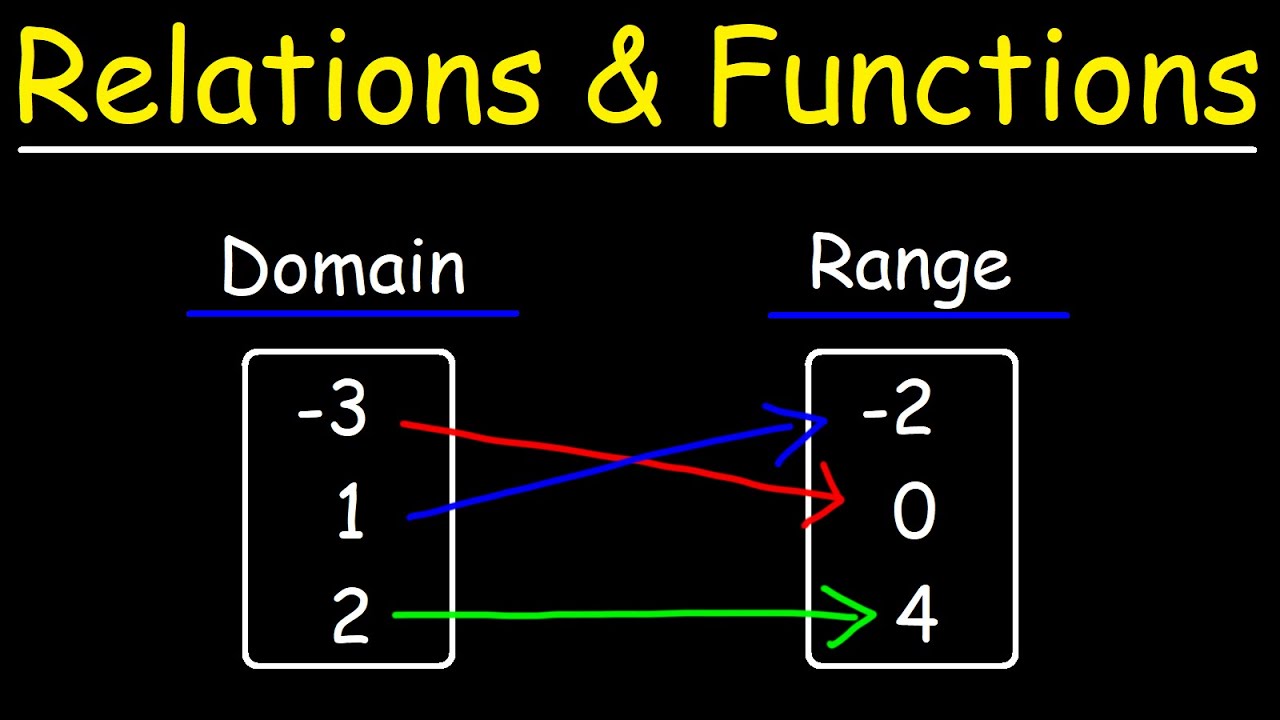
This Algebra video tutorial provides a basic introduction into relations and functions. It explains how to write the domain and range of a relation and how to determine if the relation is a function. It also explains how to draw a mapping diagram of the relation as well as a function table. Finally, this video explains how to use the vertical...
left gyro
yes
frozen quarry
Why
left gyro
theres no place to put an input, but the output is always 0
I put in x = 0, it gives out y = 0
I put in x = 1, it gives out y = 0
frozen quarry
How do you know if 0 is x?
left gyro
nenni what I am giving here are called "examples"
elder moss
frozen quarry
How do you know if 0 is x?
do you know independent variable?the x in f(x)
left gyro
I use them whenever I need to mention some values of x that dont have anything special to them, they can be anything but I like choosing simpler values
I can also put in other values of x if you want
but all of those values would give out y = 0 as an output
you can see here the function isnt doing much but its still doing its job of outputting a number
left gyro
elder moss
you can start from 5:45
https://youtu.be/kvGsIo1TmsM?si=BlnSNaiQ96iysoYu
its not trying to output two numbers at the same time (√3 and -√3)
so its a function, a very boring one
left gyro
hmmm I wonder
its almost like I told you exactly what you can do
lets go through both methods
first, the graphing one, its faster and easier
remind me what I said about how you use the graphing one?
frozen quarry
Hmmm
left gyro
whats step 1?
frozen quarry
Simplify the equation
left gyro
left gyro
first thing first
remember?
the graphing way is called the "vertical line test"
now whats the first step of the vertical line test?
left gyro
to graph it, theres no way you can draw this by hand
what does the computer say y - 2 = x/y looks like
frozen quarry
So I need to calculate it?
frozen quarry
left gyro
what does the computer say y - 2 = x/y looks like
Without the computer
I can’t use computer
left gyro
nenni I want to make sure you know both methods
elder moss
left gyro
so its a function, a very boring one
A relation
left gyro
just go do the easier one first and get it out of the way, answer what Im asking
then we go over to the harder way that youre expected to do for the problems
what was step 1 of the graphing way (the vertical line test) that I said to you?
@frozen quarry hello?
frozen quarry
Hold on
charred jetty
What is your main question?
Are you trying to understand vertical line test or just functions, in general?
frozen quarry
Honestly it’s so difficult to understand yall through text…
And it takes a lot of time reading this
And typing out
elder moss
frozen quarry
And it takes a lot of time reading this
Hmm.. better watch a lecture or ask f2f
charred jetty
😔
left gyro
frozen quarry
And typing out
honestly you shouldve said you preferred screensharing hours ago or we wouldnt be in this situation
I need to go to sleep
elder moss
left gyro
I need to go to sleep
Gn
frozen quarry
left gyro
honestly you shouldve said you preferred screensharing hours ago or we wouldnt b...
Gn
elder moss
Lit this been going on for a while
charred jetty
left gyro
I need to go to sleep
Diabetical dreams
safe radishBOT
@frozen quarry Has your question been resolved?
safe radishBOT
Channel closed
Closed due to timeout
Use .reopen if this was a mistake.
Available help channel!
Send your question here to claim the channel.
Remember:
• Ask your math question in a clear, concise manner.
• Show your work, and if possible, explain where you are stuck.
• Do not immediately ping people or roles. After 15 minutes, feel free to ping <@&286206848099549185> once.
• Type the command .close to free the channel when you're done.
• Be polite and have a nice day!
Read #❓how-to-get-help for further information on how to ask a good question, and about conduct in the question channels.
 keen moon
I'm suppose to do integration by parts I'm pretty sure but I forgot what we look for when picking for u or v
 safe radishBOT
keen moon
I'm suppose to do integration by parts I'm pretty sure but I forgot what we look...
safe radishBOT
keen moon
I'm suppose to do integration by parts I'm pretty sure but I forgot what we look...
 ornate wyvern
keen moon
I'm suppose to do integration by parts I'm pretty sure but I forgot what we look...
ornate wyvern
keen moon
I'm suppose to do integration by parts I'm pretty sure but I forgot what we look...
ilate
here
 keen moon
ornate wyvern
here
keen moon
ornate wyvern
here
you pick this for u right
ornate wyvern
keen moon
you pick this for u right
sure
safe radishBOT
Channel closed
Closed by @keen moon
Use .reopen if this was a mistake.
safe radishBOT
Available help channel!
Send your question here to claim the channel.
Remember:
• Ask your math question in a clear, concise manner.
• Show your work, and if possible, explain where you are stuck.
• Do not immediately ping people or roles. After 15 minutes, feel free to ping <@&286206848099549185> once.
• Type the command .close to free the channel when you're done.
• Be polite and have a nice day!
Read #❓how-to-get-help for further information on how to ask a good question, and about conduct in the question channels.
frozen quarry
How to write easy equations like x = y + 3
safe radishBOT
frozen quarry
How to write easy equations like x = y + 3
frozen quarry
on graph
elder moss
you are back
quasi bison

This Pre-Algebra video tutorial explains the process of plotting points on a coordinate plane and graphing ordered pairs using a coordinate system. An ordered pair is made up of a x-coordinate and a y-coordinate which is used to identify the location of a point on a graph. The domain is the set of x-coordinates and the range is the set of a y-...
(playlist)
safe radishBOT
@frozen quarry Has your question been resolved?
frozen quarry
frozen quarry
How to write easy equations like x = y + 3
Do is something like this straight line?
 mighty mango
frozen quarry
Do is something like this straight line?
mighty mango
frozen quarry
Do is something like this straight line?
rewrite the equation by making y "alone"
then plug in random valeus for x, get the values for y, then plot the points like (x , y) then connect them
if you dont know how to do that/didnt understand
mighty mango
quasi bison
https://www.youtube.com/watch?v=yaOf7ioCgFQ&list=PL0o_zxa4K1BVzbQjmhQxe5eQwuFQx2...
refer to this
elder moss
yes
safe radishBOT
@frozen quarry Has your question been resolved?
frozen quarry
elder moss
yes
But for x… we actually decide where it’s placed
The points for parabole
The equation doesn’t do anything
frozen quarry
…
elder moss
Wdym
burnt notch
You're asking totally nonsensical questions, fyi
I have the hunch you don't even know what you want to ask 😅
For example, what exactly do you want/need to do with the function x = y + 3
Also, if you have an original task written by your teacher, send it please. So that we understand better from the whole context
safe radishBOT
@frozen quarry Has your question been resolved?
 magic junco
quasi bison
https://www.youtube.com/watch?v=yaOf7ioCgFQ&list=PL0o_zxa4K1BVzbQjmhQxe5eQwuFQx2...
magic junco
quasi bison
https://www.youtube.com/watch?v=yaOf7ioCgFQ&list=PL0o_zxa4K1BVzbQjmhQxe5eQwuFQx2...
@frozen quarry Have you watched it yet??
safe radishBOT
Channel closed
Closed due to timeout
Use .reopen if this was a mistake.
Available help channel!
Send your question here to claim the channel.
Remember:
• Ask your math question in a clear, concise manner.
• Show your work, and if possible, explain where you are stuck.
• Do not immediately ping people or roles. After 15 minutes, feel free to ping <@&286206848099549185> once.
• Type the command .close to free the channel when you're done.
• Be polite and have a nice day!
Read #❓how-to-get-help for further information on how to ask a good question, and about conduct in the question channels.
 lean otter
\int_{-20}^{-10}\left(\frac{x^{2}-x}{x^{3}-3x+1}\right)^{2},dx
;+;
\int_{,1/21}^{,1/11}\left(\frac{x^{2}-x}{x^{3}-3x+1}\right)^{2},dx
;+;
\int_{,21/10}^{,11/10}\left(\frac{x^{2}-x}{x^{3}-3x+1}\right)^{2},dx
safe radishBOT
lean otter
\int_{-20}^{-10}\left(\frac{x^{2}-x}{x^{3}-3x+1}\right)^{2}\,dx
\;+\;
\int_{\,1/...
lean otter

 junior raven
what have you done so far
lean otter

Reduced them to these two integrals
And it's I1-I2
<@&286206848099549185>
Please help
merry owl
!show
safe radishBOT
Show your work, and if possible, explain where you are stuck.
 empty gyro
I think u-sub will make this easy
empty gyro
ooops wait nvm
I just put this in a calculator. You can't solve this integral without finding the roots to the cubic equation in the denominator, which makes this a rather tedious problem
Are you being asked to find the exact solution, or just a numerical approximation?
 low echo
lean otter
low echo
lean otter
You need value of I?
low echo
low echo
The sum of those 3
I'm asking if he just needs to find the sum of those 3
That's it
?
 quasi timber
They’ve waited.
as SWR as stated previously, you will need to find the roots of the cubic equation in the denominator.
@lean otter
low echo
My calculator is thinking for a long time
 fierce ravine
= 0
quasi timber
lean otter
There's supposed to be an easy way out

low echo
It gave the answer of the 1st 2 easily
It's thinking at the 2nd
yup math error
alright bye
quasi timber
also are you sure the integral even converges @lean otter.
quasi timber
Well i’d actually suggest taking another look at the last integral.
lean otter
It's a genuine question
quasi timber
I think you HAVE to find the zeros of 𝑥³-3𝑥+1
quasi timber
Yes.
 ivory flame
Try simplifying using partial fractions
lean otter
Nothing is useful man 😭😭
ivory flame
Ur lower bounds of the definite integral are greater than the upper too, which might be a problem
Also you should look at each integral separately as opposed to combining them as they are all different definite integrals
lean otter
I've tried everything man
Js give me the answer atp 😭😭
ivory flame
Calculate each integral separately
 brisk shard
lean otter
brisk shard
lean otter
put x = 1/(1-t) in second and x = 1-1/t in third
should make the limits identical as the first integral
safe radishBOT
@lean otter Has your question been resolved?
safe radishBOT
Channel closed
Closed due to timeout
Use .reopen if this was a mistake.
Available help channel!
Send your question here to claim the channel.
Remember:
• Ask your math question in a clear, concise manner.
• Show your work, and if possible, explain where you are stuck.
• Do not immediately ping people or roles. After 15 minutes, feel free to ping <@&286206848099549185> once.
• Type the command .close to free the channel when you're done.
• Be polite and have a nice day!
Read #❓how-to-get-help for further information on how to ask a good question, and about conduct in the question channels.
 kind beacon
 safe radishBOT
kind beacon
safe radishBOT
kind beacon
 quiet plume
!status
safe radishBOT
What step are you on?
1. I don't know where to begin.
2. I have begun but got stuck midway.
3. I got an answer but I was told that it's wrong.
4. I got an answer and would like my work checked.
5. I have a question about someone else's work/solution.
6. I have completed the problem and don't need help anymore. Thank you.
7. None of the above
Im trying to figur eout how to solve this
i am thinking of proving it is True first using hilbert
I will prove this first
⊢(A→(B→C))→(B→(A→C))
cuz hilbert doesnt allow assumptions
then i use deduction theorem
safe radishBOT
@kind beacon Has your question been resolved?
kind beacon
Did I do this right?
 safe radishBOT
@kind beacon Has your question been resolved?
safe radishBOT
@kind beacon Has your question been resolved?
 split kayak
kind beacon
split kayak
kind beacon
yeah, id swear thats correct
completely different approach, but you could argue that in boolean algebra, addition is associative and commutative.
safe radishBOT
@kind beacon Has your question been resolved?
Channel closed
Closed by @kind beacon
Use .reopen if this was a mistake.
Available help channel!
Send your question here to claim the channel.
Remember:
• Ask your math question in a clear, concise manner.
• Show your work, and if possible, explain where you are stuck.
• Do not immediately ping people or roles. After 15 minutes, feel free to ping <@&286206848099549185> once.
• Type the command .close to free the channel when you're done.
• Be polite and have a nice day!
Read #❓how-to-get-help for further information on how to ask a good question, and about conduct in the question channels.
 proven wharf
why is this wrong?

 safe radishBOT
proven wharf
why is this wrong?
safe radishBOT
proven wharf
why is this wrong?
 visual kraken
It looks like you used v^2 instead of v' when you were filling it out
proven wharf
visual kraken
It looks like you used v^2 instead of v' when you were filling it out
thankz
visual kraken
Otherwise I think your stuff looks good, just gotta fix that
safe radishBOT
@proven wharf Has your question been resolved?
safe radishBOT
Channel closed
Closed due to timeout
Use .reopen if this was a mistake.
Available help channel!
Send your question here to claim the channel.
Remember:
• Ask your math question in a clear, concise manner.
• Show your work, and if possible, explain where you are stuck.
• Do not immediately ping people or roles. After 15 minutes, feel free to ping <@&286206848099549185> once.
• Type the command .close to free the channel when you're done.
• Be polite and have a nice day!
Read #❓how-to-get-help for further information on how to ask a good question, and about conduct in the question channels.
 clear garnet
I need help this dont look correct
 safe radishBOT
clear garnet
I need help this dont look correct
safe radishBOT
clear garnet
I need help this dont look correct

 keen talon
yikes physics
 mossy lotus
well, your problem says the disc is parallel to the surface of the table
In your diagram, it doesnt look like that at
clear garnet
where u see this at
 mossy lotus
your alpha went inexplicably missing
 mossy lotus
also, why do you have two object's torques in same equation? The torque on one object should be balanced by the moments of all the forces on it. So I*alpha = T*r or smthn.
or maybe I am being a big dumdum, afterall it has been years since I had to solve this kind of a problem before
clear garnet
dont i have to calculate both of the disks inertia to find the angular velocity of the equation
 gaunt socket
is this rotational kinematics lmao
mossy lotus
also, considering that the two objects have different radii, you would have different angular accelerations for the disc and the pulley
gaunt socket
we were doing this shit in class today
mossy lotus
mossy lotus
also, considering that the two objects have different radii, you would have diff...
only the R*alpha products would be equal for the two
clear garnet
im confuzed
mossy lotus
well, the rope connects the pulley and the disk
so whatever rotation what takes place is imparted by the movement of the rope
so the tangential accelerations at the points of contact would have to match the acceleration experienced by the rope
so r_disc * alpha_disc which is the tangential acceleration is same as the acceleration a experienced by the mass mu and so on.
otherwise there would be slipping between the rope and pulley as well as rope and disc
safe radishBOT
@clear garnet Has your question been resolved?
safe radishBOT
@clear garnet Has your question been resolved?
Channel closed
Closed by @clear garnet
Use .reopen if this was a mistake.
Available help channel!
Send your question here to claim the channel.
Remember:
• Ask your math question in a clear, concise manner.
• Show your work, and if possible, explain where you are stuck.
• Do not immediately ping people or roles. After 15 minutes, feel free to ping <@&286206848099549185> once.
• Type the command .close to free the channel when you're done.
• Be polite and have a nice day!
Read #❓how-to-get-help for further information on how to ask a good question, and about conduct in the question channels.
 tardy lark
 safe radishBOT
tardy lark
https://cdn.discordapp.com/attachments/1077788560805089433/1439055254904635492/i...
tardy lark
safe radishBOT
tardy lark
https://cdn.discordapp.com/attachments/1077788560805089433/1439055254904635492/i...
tardy lark
Why does this system of equation have no solution
4 unknowns, 5 equations
I used 4 equations for the system. But it doesn’t work
A,B,C and D are the unknowns btw
safe radishBOT
@tardy lark Has your question been resolved?
 median vigil
tardy lark
Why does this system of equation have no solution
median vigil
tardy lark
Why does this system of equation have no solution
what makes you believe there are no solutions?
tardy lark
median vigil
what makes you believe there are no solutions?
I used an online matrix solver
I also used real values instead of the constants in an excel spreadsheet and it gave me an error
median vigil
hm yeah now that i look at it, it probably is statically indeterminate
tardy lark
median vigil
hm yeah now that i look at it, it probably is statically indeterminate
How can we solve this then?
There must be a solution
I’ve been thinking about, A=D and B=C since it’s symmetrical
However, what if c or b was slightly shifted to the right? There would be no solution?
And this example seems so simple, how would we solve complex beam supports
median vigil
well the issue is that you have too many supports
you have too many places where the moments have to sum to 0. if you had just 2 then you would be ok
actually now that i'm entering in the equations to my own calculator (using dummy numbers), i do get a solution?
median vigil
it should work regardless as long as you set up your equations correctly
tardy lark
To reduced echelon form or smth
median vigil
tardy lark
Is there a tool that can solve the matrix ?
any programming language with a linear algebra library
also most graphing calculators
tardy lark
I meant without replacing the variables with anything
Wait let me show you my excel

with =MMULT(MINVERSE(R8:U11),W8:W11)
median vigil
well i wouldn't expect it to be invertible
you have too many supports, so there will not be a unique solution for the forces
there are infinitely many different solutions
 median vigil
tardy lark
what if i say A=D and B=C
median vigil
tardy lark
what if i say A=D and B=C
if you do that, then you can enter those as two of the equations
tardy lark
alright let me try
median vigil
i would still not necessarily expect unique solutions, though
 safe radishBOT
@tardy lark Has your question been resolved?
safe radishBOT
Channel closed
Closed due to timeout
Use .reopen if this was a mistake.
Available help channel!
Send your question here to claim the channel.
Remember:
• Ask your math question in a clear, concise manner.
• Show your work, and if possible, explain where you are stuck.
• Do not immediately ping people or roles. After 15 minutes, feel free to ping <@&286206848099549185> once.
• Type the command .close to free the channel when you're done.
• Be polite and have a nice day!
Read #❓how-to-get-help for further information on how to ask a good question, and about conduct in the question channels.
 elder cypress
 safe radishBOT
elder cypress
safe radishBOT
elder cypress
 zealous ingot
elder cypress
zealous ingot
elder cypress
f''(x) = $x^2$ - f'(x) - f^2(x)
flat frigateBOT
donkey
Compile Error! Click the  reaction for more information.
(You may edit your message to recompile.)
 zealous ingot
you can assume P is some point ($x_0,y_0$)
flat frigateBOT
donkey
 zealous ingot
flat frigate
**donkey**
Compile Error! Click the <:errors:504266556054962196> reaction for mo...
zealous ingot
flat frigate
**donkey**
Compile Error! Click the <:errors:504266556054962196> reaction for mo...
plug in x_0 to that DE
elder cypress
x² - y² = y''
elder cypress
Yes
zealous ingot
a doesn't have to be 0
elder cypress
zealous ingot
a doesn't have to be 0
Yeah I got confused between x and x_o
zealous ingot
fair fair
elder cypress
Now I just need to apply properties of hyperbolae, right?
zealous ingot
you can write the condition for tangent passing through point
discriminant will give you the answer
safe radishBOT
Channel closed
Closed by @elder cypress
Use .reopen if this was a mistake.
safe radishBOT
Available help channel!
Send your question here to claim the channel.
Remember:
• Ask your math question in a clear, concise manner.
• Show your work, and if possible, explain where you are stuck.
• Do not immediately ping people or roles. After 15 minutes, feel free to ping <@&286206848099549185> once.
• Type the command .close to free the channel when you're done.
• Be polite and have a nice day!
Read #❓how-to-get-help for further information on how to ask a good question, and about conduct in the question channels.
 drowsy slate
Guys i need help in understanding how to do real life application of parabola and quadratic function.
safe radishBOT
drowsy slate
Guys i need help in understanding how to do real life application of parabola an...
 stoic saddle
drowsy slate
Guys i need help in understanding how to do real life application of parabola an...
stoic saddle
drowsy slate
Guys i need help in understanding how to do real life application of parabola an...
wires, projectile motion
drowsy slate
should i send the question screen shot?
stoic saddle
sure


 hard crest
okay, can you figure out the equation of this parabola? they've helpfully drawn the coördinate axes in
safe radishBOT
@drowsy slate Has your question been resolved?
Channel closed
Closed by @drowsy slate
Use .reopen if this was a mistake.
drowsy slate
.reopen
safe radishBOT
✅ Original question: #help-23 message
drowsy slate
hard crest
okay, can you figure out the equation of this parabola? they've helpfully drawn ...
no. pls help me
hard crest
can you identify any points that the parabola goes through? also have you done Q1 yet?
drowsy slate
yes
drowsy slate
hard crest
can you identify any points that the parabola goes through? also have you done Q...
do we need to?
hard crest
actually, what have you done on this?
 manic radish
don't ask jipidy
hard crest
Q1 isn't really a "solving" thing as much as it is a use your brain to think about how the world works thing
manic radish
What three relevant engineering challenges and safety concerns have you identified?
safe radishBOT
@drowsy slate Has your question been resolved?
drowsy slate
manic radish
What three relevant engineering challenges and safety concerns have you identifi...
ceiling height, tunnel width and turns
drowsy slate
hard crest
Q1 isn't really a "solving" thing as much as it is a use your brain to think abo...
bro stop being mean im in 9th grade ok idrk how to
quasi bison
drowsy slate
bro stop being mean im in 9th grade ok idrk how to
she's a girl. do not call her "bro".
hard crest
drowsy slate
bro stop being mean im in 9th grade ok idrk how to
no i'm not trying to be it's just -- there isn't really a right/wrong answer. your answer seems fine
hard crest
yeah so let's look at that curve. see how it has a highest point?
hard crest
we said the maximum height of the tunnel was what, 9.8m?
drowsy slate
hard crest
we said the maximum height of the tunnel was what, 9.8m?
yes
hard crest
drowsy slate
thats the vertex?
yep!
drowsy slate
hmm
hard crest
and then hmmm what else do we know about the tunnel, we know its width right?
hard crest
what points would that help us to find? it's okay if you ok perfect yes
drowsy slate
hard crest
what points would that help us to find? it's okay if you ok perfect yes
umm idrk
hard crest
no you got it
drowsy slate
oh
hard crest
what points have we identified that the parabola goes through?
the first was the vertex, we can write that as (0, 9.8)
hard crest
what about the points where it's at its widest?
drowsy slate
9.8,0?
hard crest
remember what you said about the axis of symmetry
hard crest
yep!
drowsy slate
YAY
hard crest
and (-4.9, 0) but that's going to be a bit annoying to use so we'll stick with (4.9, 0)
drowsy slate
ok
hard crest
now it wants us to write it in standard form, right?
do you know what that looks like?
drowsy slate
y= ax^2+bx+c ?
drowsy slate
i thimk so
hard crest
that's going to be easier to use here since we already have the vertex
hard crest
a times not plus, but yea
drowsy slate
oh ok
drowsy slate
how?
hard crest
well that's the vertex
For a parabola with vertex $(\blue h, \green k)$, its equation in vertex form is
$$y = \pink a(x - \blue h)^2 + \green k$$
flat frigateBOT
bug
 hard crest
what did we find for the vertex?
hard crest
that's okay
remember the highest point is the vertex
and we found that was at (0, 9.8)?
drowsy slate
yess
hard crest
okay great, so that's our h and k; let's plug those in and see where we get
hard crest
sure, but you could also just use ^2 for squared
it does look cool though :)
$y = a(x - 0)^2 + 9.8$
flat frigateBOT
bug
 drowsy slate
ok
hard crest
now we still have a bit of a problem, we don't know what a needs to be!
drowsy slate
so ax^2 + 9.8?
drowsy slate
yes
hard crest
we can use that other point we found
drowsy slate
4.9?
hard crest
point
points have an x and a y
they're written (like, this)
just like we found that the vertex was at (0, 9.8)
drowsy slate
mhm