#help-23
1 messages · Page 345 of 1
 shadow cloud
shadow cloud
shadow cloud
wait
 jagged belfry
its helpful to look at this, as this is your goal
x^2 + b/a*x + c/a     = 0
(x+d)^2 + h           = 0
x^2 + 2d*x + d^2 + h  = 0
then all you want is to solve b/a = 2d and c/a = d^2 + h
 flint vessel
try to do the completing the square part again
flint vessel
jagged belfry
its helpful to look at this, as this is your goal
```
x^2 + b/a*x + c/a = 0
...
 yup
yup
shadow cloud
jagged belfry
its helpful to look at this, as this is your goal
```
x^2 + b/a*x + c/a = 0
...
this really hurt my mind
flint vessel
shadow cloud
this really hurt my mind
the best way would be to turn the coefficient of the second degree term to 1
then try to complete the square
that should lower your error rate i think
shadow cloud
bro
how do i do it
tbh i can just ask my home teacher on saturday :(
i can only solve average quadratic equations but this no. I gotta ask my teacher cuz hes a master in math
jagged belfry
hold up i messed up
shadow cloud
do u mind if u solve it on a piece of paper and send me?
i asked google and chatgpt, both are the sames and idk how they do it.
jagged belfry
We get:
d = b/(2a)
c/a = d^2 + h => h = c/a - b^2/(4a^2)
Hence:
x^2 + b/a*x + c/a = (x+b/(2a))^2 + c/a + b^2/(4a^2)
                  = 0
so
(x+b/(2a))^2 = b^2/(4a^2) - c/a
             = (b^2 - 4ac)/(4a^2)
 dusk gyro
ur just confusing him atp
he doesn't even know the fundamentals of how to solve quadratics
based on what i've observed
shadow cloud
jagged belfry
We get:
`d = b/(2a)`
`c/a = d^2 + h` => `h = c/a - b^2/(4a^2)`
Hence:
```
x^2 +...
I dont know how to read those 😭
jagged belfry
oh my bad
dusk gyro
@shadow cloud i think you should just use the quadratic formula
shadow cloud
dusk gyro
he doesn't even know the fundamentals of how to solve quadratics
i know hot to solve but this no
shadow cloud
dusk gyro
<@1154306681426161674> i think you should just use the quadratic formula
that doesnt work
shadow cloud
I only use (a + b)^2 formula and (a-b)^2 formula and a^2-b^2 formula
flint vessel
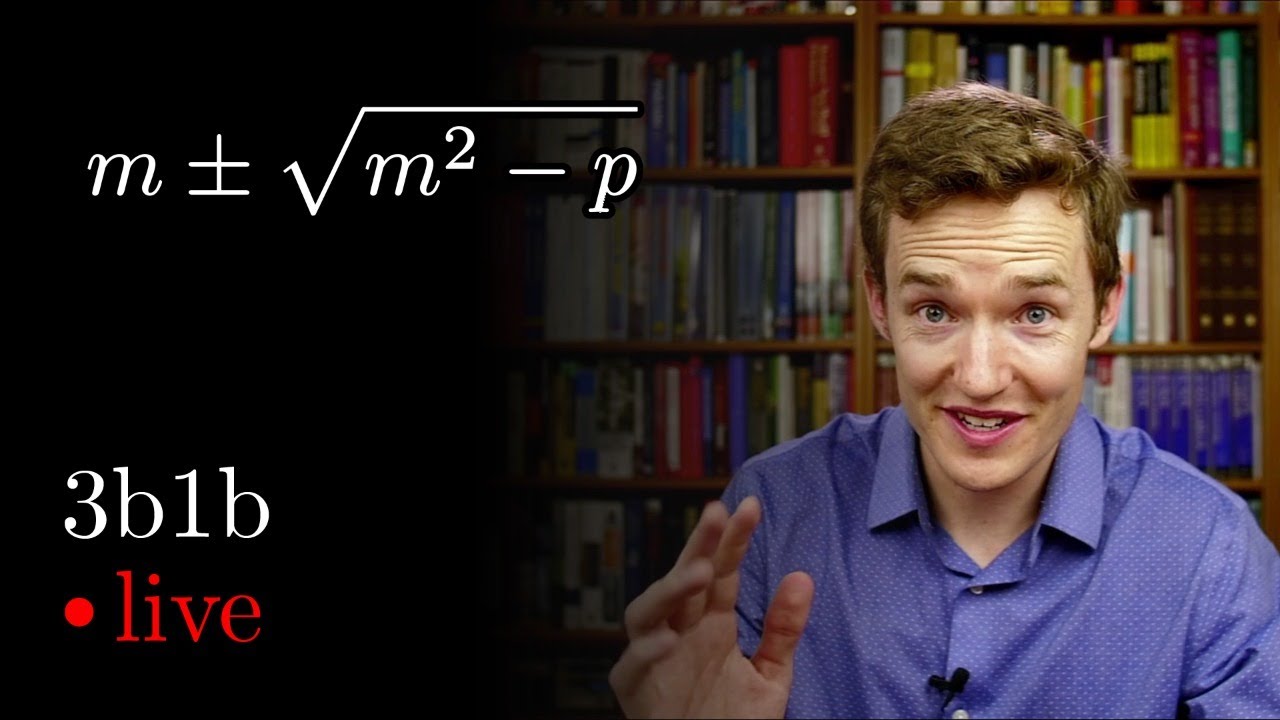
Another view on the quadratic formula.Full playlist: https://www.youtube.com/playlist?list=PLZHQObOWTQDP5CVelJJ1bNDouqrAhVPevHome page: https://www.3blue1bro...
here
jagged belfry
it works but you cant blindly apply it
shadow cloud
flint vessel
https://www.youtube.com/live/MHXO86wKeDY?si=_lbgmayHVfE6uosY
to solve quadratic equations
flint vessel
i dont think you have a good grasp on the basics
flint vessel
shadow cloud
to solve quadratic equations
ye
shadow cloud
U guys can giv eme a quadratic equation work and i try my way to solve it
 burnt notch
shadow cloud
I only use (a + b)^2 formula and (a-b)^2 formula and a^2-b^2 formula
burnt notch
shadow cloud
I only use (a + b)^2 formula and (a-b)^2 formula and a^2-b^2 formula
This is not the quadratic formula for solving second degree (aka quadratic) equations
flint vessel
shadow cloud
U guys can giv eme a quadratic equation work and i try my way to solve it
the video has some problems in it to
just pause and solve em
burnt notch
shadow cloud
U guys can giv eme a quadratic equation work and i try my way to solve it
Sure, x² - 3x = 0
shadow cloud
burnt notch
This is not the quadratic formula for solving second degree (aka quadratic) equa...
Hmm give me a work and i use the 3 formula
jagged belfry
i think if you solve this youre very close to derive the quadratic formula
flint vessel
trust , just watch the lecture , you gain nothing from mugging up formulas you dont understand
jagged belfry
in its generality
shadow cloud
burnt notch
Sure, x² - 3x = 0
thats easy bruh
dusk gyro
flint vessel
trust , just watch the lecture , you gain nothing from mugging up formulas you d...
he's kinda close, he already tried to complete the square just that his fundamentals are really weak
shadow cloud
x= 0. x=3
jagged belfry
what is the square of 5/2
burnt notch
shadow cloud
thats easy bruh
Well, what can I do lol? Better for you that I gave you an easier one 😅
jagged belfry
remember (x+y)^2 = x^2 + 2xy + y^2
shadow cloud
dusk gyro
he's kinda close, he already tried to complete the square just that his fundamen...
My home teacher havent teach me this but he teach me alot of quadratic equations that doesnt have 3x^2 or 4x^2
shadow cloud
jagged belfry
what is the square of 5/2
(radical 5/2)^2
dusk gyro
shadow cloud
My home teacher havent teach me this but he teach me alot of quadratic equations...
i can write out the proof of quadratic formula for you if you want
shadow cloud
 dusk gyro
ok how about i guide you through proving the quadratic formula
shadow cloud
Ok
shadow cloud
shadow cloud
this also useful solving quadratic equation
jagged belfry
shadow cloud
its wrong tho, it should be 5^2/2^2
shadow cloud
jagged belfry
its wrong tho, it should be 5^2/2^2
???
just cross it?

is the same way
jagged belfry
shadow cloud
???
you have x^2 + 5/4x
you want to complete the square
the square is (x+a)^2
shadow cloud
i can solve that
jagged belfry
(x+a)^2 = x^2 + 2ax+a^2
dusk gyro
@jagged belfry what are you doing rn
shadow cloud
jagged belfry
you have x^2 + 5/4x
equal 0?
jagged belfry
your 2a = 5/4
shadow cloud
bro what
jagged belfry
so a = 5/8
shadow cloud
write it on a piece of paper
jagged belfry
a^2 = 25/64
shadow cloud
jagged belfry
so a = 5/8
where does the 2 go?
dusk gyro
@jagged belfry gang what are you doing rn i dont wanna confuse him
jagged belfry
ok you are messing up fundamentals indeed
 dusk gyro
jagged belfry
ok you are messing up fundamentals indeed
dusk gyro
jagged belfry
ok you are messing up fundamentals indeed
are you just gonna continue ignoring me or what
shadow cloud
shadow cloud
<@316987702748774410> is it realte to this?
@dusk gyro
jagged belfry
shadow cloud
<@316987702748774410> is it realte to this?
yes
shadow cloud
jagged belfry
yes
can u do it on a piece of paper?
jagged belfry
 shadow cloud
yeah?
shadow cloud
so like (x-5/4)^2 - 25/16- 36/16???
shadow cloud
jagged belfry
if you follow as you already did with your teacher
yeah
I have 2 math teacher
jagged belfry
shadow cloud
so like (x-5/4)^2 - 25/16- 36/16???
no
shadow cloud
one is school teacher one is home teacher
shadow cloud
yeah
shadow cloud
@jagged belfry can u do the work on a piece of paper???
jagged belfry
no its your job to do the work
shadow cloud
I never use it
dusk gyro
jagged belfry
no its your job to do the work
clearly ur not working time for me to take over
@shadow cloud where are you at right now
jagged belfry
take a rest, sleep or walk a bit. you wont solve anything by force
shadow cloud
vyasa add me 😭
 safe radishBOT
@shadow cloud Has your question been resolved?
safe radishBOT
Channel closed
Closed due to timeout
Use .reopen if this was a mistake.
safe radishBOT
 Available help channel!
Send your question here to claim the channel.
Remember:
• Ask your math question in a clear, concise manner.
• Show your work, and if possible, explain where you are stuck.
• Do not immediately ping people or roles. After 15 minutes, feel free to ping <@&286206848099549185> once.
• Type the command .close to free the channel when you're done.
• Be polite and have a nice day!
Read #❓how-to-get-help for further information on how to ask a good question, and about conduct in the question channels.
 versed wave
for (a), is it possible to break down M into smaller statements?

 mossy lotus
well, it is exactly as small as it needs to be
any smaller and you would need many more logical steps, and any larger in scope, and it would be difficult to even write the statement
safe radishBOT
Channel closed
Closed by @versed wave
Use .reopen if this was a mistake.
versed wave
.reopen
safe radishBOT
✅ Original question: #help-23 message
versed wave
for (b), what should be my universe of discourse?
should it be the set of all people, or the set of all countries?
 wild copper
Well in this case, different quantifier quantifies different set
safe radishBOT
Channel closed
Closed by @versed wave
Use .reopen if this was a mistake.
safe radishBOT
Available help channel!
Send your question here to claim the channel.
Remember:
• Ask your math question in a clear, concise manner.
• Show your work, and if possible, explain where you are stuck.
• Do not immediately ping people or roles. After 15 minutes, feel free to ping <@&286206848099549185> once.
• Type the command .close to free the channel when you're done.
• Be polite and have a nice day!
Read #❓how-to-get-help for further information on how to ask a good question, and about conduct in the question channels.
 potent oar
"find out if these sequences are definitively monotone"
 potent oar
how the hell do i even approach it?
flint vessel
potent oar
"find out if these sequences are definitively monotone"
I'm pretty sure a montone sequence is one that either constantly increases , decreases or remains constant
potent oar
yeah the definition is clear, im not sure how to actually prove it if it is or not
flint vessel
so just differentiate it and check if the derivative is always positive , negative or zero
if not then no
potent oar
flint vessel
so just differentiate it and check if the derivative is always positive , negati...
right
what is "differentiating"?
i should mention this is the first excercise of the course, so idk if we need to imply such black wizardry
this is also n in N
flint vessel
potent oar
right
what is "differentiating"?
i should mention this is the first excercise of...
hmm then just try the values and check if the expression is constantly increasing or not
flint vessel
potent oar
this is also n in N
ohh that makes sense 
potent oar
also what the hell is this? why is it missing the fraction line??

 spark marlin
potent oar
also what the hell is this? why is it missing the fraction line??
spark marlin
potent oar
also what the hell is this? why is it missing the fraction line??
It's combinatorics
A combination, C(2n,n)
2n!/n!*n!
flint vessel
potent oar
also what the hell is this? why is it missing the fraction line??
you can also see it as 2nCn
ye
spark marlin
I hate that notation.
potent oar
right, ill take it as is for now
to get back on track, what do i need to do to say if a sequence like those are monotones?
definitively
spark marlin
"Easiest" way is if f(n+1)-f(n) is higher, lower or equal to 0
Actual easiest way is first degree differentiation, and compare the result with 0.
spark marlin
No
potent oar
oh
spark marlin
You have elementary functions
flint vessel
potent oar
like natural numbers N
just put in values and check in manualy
you dont need to diffrentiate here i think
potent oar
manually... damn
spark marlin
flint vessel
just put in values and check in manualy
I don't think that's accepted
potent oar
i hope it doesnt come up on the exam...
flint vessel
spark marlin
I don't think that's accepted
hmm
potent oar
it's a homework excercise not an exam drill so idk
flint vessel
potent oar
"find out if these sequences are definitively monotone"
another way to do it could be to check the sign of Tn+1 - Tn
that could tell you if it's a monotonous function
and it would be a valid method as well
i think
spark marlin
It is, but not always
It works if the function does not suddenly change how it works
flint vessel
spark marlin
It works if the function does not suddenly change how it works
i mean it is just a larger scale diffrentiation
but yes thats true
potent oar
flint vessel
another way to do it could be to check the sign of Tn+1 - Tn
how do you check the sign of a function then? like let's say for 1/n
then it's 1/(n+1) - 1/n
so that's
... no i got stuck
flint vessel
potent oar
how do you check the sign of a function then? like let's say for 1/n
then it's 1...
1/(n+1) - 1/n
now simplify it
-1/(n+1)(n)
right
now the denominator is always positive
but the numerator is -ve
so it will always decrease
so it's monotonous
potent oar
so the function is negative... okay i think i get this one, lets' see for another one
spark marlin
I solved the first one, it decreases, then increases
flint vessel
spark marlin
I solved the first one, it decreases, then increases
ye for values greater than root 10 its increasing
potent oar
spark marlin
I solved the first one, it decreases, then increases
it needs to be definitvely monotonous, not monotonous
flint vessel
potent oar
it needs to be definitvely monotonous, not monotonous
im pretty sure they are the same words
spark marlin
flint vessel
im pretty sure they are the same words
It's a very small change
For definitely monotonous there is a strict comparison, like greater or smaller
For monotonous, it's greater or equal or smaller or equal
It's the difference between > and >=
flint vessel
spark marlin
For monotonous, it's greater or equal or smaller or equal
no thats increasing and decreasing
potent oar
i think the professor explained it that "definitively monotonous is a function that is monotonous after a certain point and remains so"
flint vessel
potent oar
i think the professor explained it that "definitively monotonous is a function t...
ohh hmm
potent oar
and monotonous is a function that is always monotonous
like, anything that isnt periodic is definitvely monotonous
spark marlin
More like, definitively monotonous, has no points in which the first derivative is equal with 0
flint vessel
potent oar
like, anything that isnt periodic is definitvely monotonous
by the way the method i gave you should work then in most of em
potent oar
flint vessel
by the way the method i gave you should work then in most of em
ok imma try it with the first one and see where i get stuck
flint vessel
potent oar
ok imma try it with the first one and see where i get stuck
just check n+10/n
leave the ^7
spark marlin
Because it is an exponential function
It has some properties
It increases if the base is higher than 1
potent oar
no wait i didnt see the -
so the function is always decreasing in this case right?

so it's monotone
spark marlin
It's not monotone in N
Because you have the x in the denominator spot, for n=1, 2 or 3, it's smaller than 0, that would mean it is decreasing, but for n>4, it is increasing, that means it is not monotone in N
spark marlin
But it does not have the same behaviour in the entire N
You need the same behaviour over the entire N
potent oar
no i there to be an n0 so that for each n>n0, the sequence a(n) is monotone
that's how the professor defined definively
spark marlin
Yes, but you have numbers that do not have this property
As long as there is a single counter, the definition would not stand
Keyword: each
potent oar
again, it's not for the whole of N, only after a certain point is fine, like sin(n) would not be definitively monotone but |n-2| is, altho it's only after n = 2, but after that it's monotone for the remainder of N
like pretend this is a sequence, this would be not monotonous, but definitively monotonous

so it's monotonous after a certain point, that's how the professor explained it
this is translated
"we say a succession of variable sign is:
definitively positive if there exist an n0 so that a(n) > 0 for each n > n0"

so "eventually" it's postivie
you know what i mean?
potent oar
yeah i just made is as example to demonstrate what i meant by defintively
i think it's better if i just call it "eventually"
it's eventually monotonous
that's what the excercise wants
sorry for the language barrier
the course is not in english so it's a bit difficult for me
spark marlin
It's only in italian maths I've seen the use of "eventually monotonous"
potent oar
you've seen other examples of italian maths? or you mean just this?
spark marlin
Someone asked me a similar thing a couple of months ago
potent oar
right that's... small world i guess
safe radishBOT
@potent oar Has your question been resolved?
safe radishBOT
Channel closed
Closed due to timeout
Use .reopen if this was a mistake.
Available help channel!
Send your question here to claim the channel.
Remember:
• Ask your math question in a clear, concise manner.
• Show your work, and if possible, explain where you are stuck.
• Do not immediately ping people or roles. After 15 minutes, feel free to ping <@&286206848099549185> once.
• Type the command .close to free the channel when you're done.
• Be polite and have a nice day!
Read #❓how-to-get-help for further information on how to ask a good question, and about conduct in the question channels.
 lapis token
It says prove the blue statement by repeatedly applying the purple statement to the green one

 safe radishBOT
lapis token
It says prove the blue statement by repeatedly applying the purple statement to ...
safe radishBOT
lapis token
It says prove the blue statement by repeatedly applying the purple statement to ...
Please don't occupy multiple help channels.
lapis token
The colors are messed up on my screen
Blue is above green and purple is the lonely one
I think I understood how to determine something like A^3 but that’s kinda it
Especially the part where it’s asking me to repeatedly apply it is confusing
Am I supposed to make up random values and bruteforce the rule? How is that a proof?
lapis token
 near atlas
this is a recursive proof
near atlas
this is a recursive proof
You mean the green one?
near atlas
n will stay as n
near atlas
lapis token
You mean the green one?
yeah. take the determinant on both sides for the green expression
lapis token
Determinant?
near atlas
modulus
lapis token
Sorry I’m not familiar with English terms
My prof isn’t doing a great job either to be honest
lapis token
near atlas
modulus
|A|?
lapis token
They are referring to sets
near atlas
oh then its different. then the bars around the A mean the size of the set
near atlas
anyways if you do that. take the "modulus" on both sides of the green expression, then use the purple expression to simplify your right hand side
then you use the green expression again for A^(n-1)
and so on!
till n eventually gets reduced to 1!
lapis token
Isnt the purple expression the left side of the green one tho?
near atlas
|A^n|=|A×A^(n-1)| = |A| . |A^(n-1)|
look carefully. i used the purple to simplify the RHS
lapis token
Rhs?
near atlas
right hand side
lapis token
Also did you mean = |A| * |A^(n-1)|
lapis token
I still don’t really get how
|AxB|=|A|•|B|
==>
|A|•|A^(n-1)|
near atlas
lapis token
I still don’t really get how
|AxB|=|A|•|B|
==>
|A|•|A^(n-1)|
no the 1st doesn't imply the 2nd. we used the 1st to deduce the 2nd
its like say x + a + b =10 and a+b = 5
so we get x² = 25 but did we get x²=25 directly from a+b?
think abt it
lapis token
No but it implies x=5 does it not
near atlas
only if you're considering both expressions at the same time. not when you're considering one and not the other
lapis token
lapis token
I still don’t really get how
|AxB|=|A|•|B|
==>
|A|•|A^(n-1)|
How does this apply here?
Sorry I’m very slow
near atlas
we had something of this sort on our right hand, right? :
|A × A^(n-1)|
then we used |A × B| = |A| * |B| as an identity
lapis token
Identity?
near atlas
near atlas
we had something of this sort on our right hand, right? :
|A × A^(n-1)|
say we assumed A = A and A^(n-1) = B
lapis token
A^n= A•B
Is everything I can come up with
near atlas
lapis token
Identity?
an equation thats always true
lapis token
near atlas
an equation thats always true
Like x=y without anything else?
Or just 0x=0?
near atlas
lapis token
Or just 0x=0?
this
lapis token
This feels kinda pointless but I wrote this at least

I was hoping to understand something when doing that but no not really
near atlas
lapis token
This feels kinda pointless but I wrote this at least
see you're to prove the blue equation. so just forget about it for the moment. we can get to the blue just by using the green and the purple
lapis token
Alright
near atlas
1st two steps are okay
lapis token
 near atlas
now for the 3rd step, use the purple for the right hand side only. forget about the left side. focus on the right
on your right do you see something like |A × B|
?
 near atlas
can you see that |A × B| is in a similar form as |A × A^(n-1)|
lapis token
I meant the second part with |AxB|
I added the purple part on the right because I wasn’t sure if it’d be useful or not
Yeah because A^n-1 is now called B
near atlas
yup!
so now you can write that part as |A| * |B|
but replace your B with A^(n-1)
can you show your progress?
lapis token
 lapis token
near atlas
can you show your progress?
lapis token
near atlas
can you show your progress?
Sorry I was writing
near atlas
lapis token
perfect!
lapis token
So how do I prove it by repeatedly applying it?
Do I try smth like A * A * A^n-2?
near atlas
now do you remember the original green expression? this time we're gonna use that as an "identity" but only for the |A^(n-1)| part!
can you see that A^(n-1) is similar to the from A^n
and from the green expression we know that A^n = A * A^(n-1)
lapis token
near atlas
can you see that A^(n-1) is similar to the from A^n
It appears on the right side yes
near atlas
so its pretty simple that A^(n-1) = A × A^(n-1-1)
and n-1-1 is just n-2
however do note that your expression is still between those bars. so dont forget those bars
near atlas
lapis token
It appears on the right side yes
no not like that. they are similar in the sense that they're both A raised to a power. whatever that power might be
lapis token
 lapis token
near atlas
now what do you think should we do next?
lapis token
near atlas
now what do you think should we do next?
Maybe fix my definition of B
near atlas
note that the question stressed us to use the "original" green and purple expressions repeatedly
near atlas
lapis token
Maybe fix my definition of B
yup!
near atlas
yes. so your B wil be the 2nd term
near atlas
sure
can you see the pattern again? that this will be similar to the original purple expression
lapis token
 near atlas
yupp now sub back in your definition of C
lapis token
I thought I had it for a moment but this isn’t even what I’m supposed to prove
 near atlas
yess! exactly
lapis token
I’ve changed it a bit
 near atlas
now the next leap in our logic is that n here is a natural number like 1,2, 3... its an arbitrary natural number so if we keep subtracting 1 from n for a long time, we'll run out. we'll end up with 0
near atlas
lapis token
I’ve changed it a bit
nice. exactly what i meant to say
you can subtract 1 from a number n for n times untill you end up with 0
lapis token
 near atlas
lapis token
Do you know what my problem is tho
near atlas
lapis token
Do you know what my problem is tho
wdym?
lapis token
This was only 20% or something of the second page

And the deadline is tomorrow
But I feel bad asking you for more help
You’ve been really patient already
lapis token
near atlas
QED
?
near atlas
lapis token
?
its written at the end of Mathematical proofs to say "which was to be demonstrated" kinda like saying "hence, proved "
lapis token
near atlas
its written at the end of Mathematical proofs to say "which was to be demonstrat...
Ah I see
I’ve honestly never seen that
Maybe it’s not used in Germany
To be fair I started my lectures like 5 minutes ago
Today was my sixth day
near atlas
i see
near atlas
lapis token
This was only 20% or something of the second page
damn you've a lot left 😭
lapis token
near atlas
damn you've a lot left 😭
I mean it
I’m going insane
And I need to submit this HANDWRITTEN and per MAIL
My professor is an idiot
near atlas
lapis token
You’ve been really patient already
yeah. im sort of heading off now. but if you have any doubts in the future man, just dm
lapis token
near atlas
yeah. im sort of heading off now. but if you have any doubts in the future man, ...
Id highly appreciate it
Is it fine if I add you?
near atlas
sure!
near atlas
lapis token
And I need to submit this HANDWRITTEN and per MAIL
damn thats crazyy 😭
lapis token
lapis token
I’ll close the channel and hopefully find another savior
You did a lot tho
Thank you
near atlas
lapis token
You did a lot tho
Thank you
no worries 👌
safe radishBOT
Channel closed
Closed by @lapis token
Use .reopen if this was a mistake.
safe radishBOT
Available help channel!
Send your question here to claim the channel.
Remember:
• Ask your math question in a clear, concise manner.
• Show your work, and if possible, explain where you are stuck.
• Do not immediately ping people or roles. After 15 minutes, feel free to ping <@&286206848099549185> once.
• Type the command .close to free the channel when you're done.
• Be polite and have a nice day!
Read #❓how-to-get-help for further information on how to ask a good question, and about conduct in the question channels.
 trail rampart
In the Simplex Tableau Method (Linear optimization), we generally move along the borders of the domain to get to the next vertex.
From what I understood, the basic direction is the one corresponding to the variable entering the basis. So in the image attached,
it would be (1,1) as x1 will enter the basis. However 1,1 in this case, if you represent graphically, goes INSIDE the domain and not on the border to the next vertex.
Why is that so ?
 safe radishBOT
trail rampart
In the Simplex Tableau Method (Linear optimization), we generally move along the...
safe radishBOT
trail rampart
In the Simplex Tableau Method (Linear optimization), we generally move along the...
@trail rampart Has your question been resolved?
safe radishBOT
@trail rampart Has your question been resolved?
Channel closed
Closed by @trail rampart
Use .reopen if this was a mistake.
Available help channel!
Send your question here to claim the channel.
Remember:
• Ask your math question in a clear, concise manner.
• Show your work, and if possible, explain where you are stuck.
• Do not immediately ping people or roles. After 15 minutes, feel free to ping <@&286206848099549185> once.
• Type the command .close to free the channel when you're done.
• Be polite and have a nice day!
Read #❓how-to-get-help for further information on how to ask a good question, and about conduct in the question channels.
 indigo scaffold
 safe radishBOT
indigo scaffold
indigo scaffold
safe radishBOT
indigo scaffold
indigo scaffold
f(g(x))
3sqrtx^2 +2x + 3 -2
3sqrt x^2 + 2x +1
now i replace x by 3? to determine the value?
 split kayak
You can simplify it even more
indigo scaffold
how
indigo scaffold
= 0?
split kayak
indigo scaffold
= 0?
Yeah, you can do that
split kayak
Id advice you use the quadratic formula
indigo scaffold
what is it i forgot sorry been a year
split kayak
$\frac{-b\pm\sqrt{b^2-4ac}}{2a}$
 flat frigateBOT
∫ᴄ 𝐅·𝑑𝑟 = ∬ʀ ∇⨯𝐅 𝑑𝐴
 split kayak
Twice, right?
indigo scaffold
yeah
split kayak
I hope you remember that you can use this formula to also factorize a quadratic
indigo scaffold
ill remember
split kayak
So, if you have the same root twice
Youll have two equal factors, right?
(x+1)(x+1) here, right?
indigo scaffold
yeah
indigo scaffold
it is
split kayak
So:
$x^2 + 2x + 1 = (x+1)^2$
flat frigateBOT
∫ᴄ 𝐅·𝑑𝑟 = ∬ʀ ∇⨯𝐅 𝑑𝐴
 split kayak
Knowing that, go look back into the problem we had
split kayak
$3\sqrt{x^2 + 2x +1}$
flat frigateBOT
∫ᴄ 𝐅·𝑑𝑟 = ∬ʀ ∇⨯𝐅 𝑑𝐴
 split kayak
So how would that end up looking like?
indigo scaffold
3(x+1)
indigo scaffold
wait but why did we have to do the quadratic thing
just for practice?
wait how did u know it was (x+1) and not like (x+3) or something @split kayak
like why 1
indigo scaffold
alright
split kayak
for any given quadratic polynomial of the form $ax^2 + bx + c\$
you can also write it as $(x-x_1)(x-x_2)\\$
where $x_1$ and $x_2$ come from the solutions of $\frac{-b\pm\sqrt{b^2-4ac}}{2a}$
flat frigateBOT
∫ᴄ 𝐅·𝑑𝑟 = ∬ʀ ∇⨯𝐅 𝑑𝐴
 indigo scaffold
oh so (x -(-1))(x-(-1))
split kayak
You can always rewrite a quadratic as the product of (x- (the roots))
Since this polynomial is a perfect square
indigo scaffold
gotcha
indigo scaffold
gotcha
indigo scaffold
indigo scaffold
oh so (x -(-1))(x-(-1))
btw this gives (x+1)^2
split kayak
Yes, thats why i knew that the polynomial became (x+1)(x+1)
split kayak
Yes
indigo scaffold
gives 12
split kayak
Yep
 split kayak
Yeah, you could write down the calculation of it
indigo scaffold
what is it
split kayak
when you do $\sqrt{(x+1)^2}$
flat frigateBOT
∫ᴄ 𝐅·𝑑𝑟 = ∬ʀ ∇⨯𝐅 𝑑𝐴
 flat frigateBOT
∫ᴄ 𝐅·𝑑𝑟 = ∬ʀ ∇⨯𝐅 𝑑𝐴
 indigo scaffold
so its |x+1|
split kayak
For this particular case it doesnt really matter since x is > -1
safe radishBOT
Channel closed
Closed by @indigo scaffold
Use .reopen if this was a mistake.
safe radishBOT
Available help channel!
Send your question here to claim the channel.
Remember:
• Ask your math question in a clear, concise manner.
• Show your work, and if possible, explain where you are stuck.
• Do not immediately ping people or roles. After 15 minutes, feel free to ping <@&286206848099549185> once.
• Type the command .close to free the channel when you're done.
• Be polite and have a nice day!
Read #❓how-to-get-help for further information on how to ask a good question, and about conduct in the question channels.
 tranquil geyser

Reddit
Posted by Hurtbubble - 3 votes and 0 comments
safe radishBOT
tranquil geyser
https://www.reddit.com/r/UMD/s/3NLcrbLYcb
tranquil geyser
not sure if this counts but what even is this?? I’m actually really curious and have found nothing online
this has to be gibberish
safe radishBOT
@tranquil geyser Has your question been resolved?
safe radishBOT
@tranquil geyser Has your question been resolved?
safe radishBOT
Channel closed
Closed due to timeout
Use .reopen if this was a mistake.
Available help channel!
Send your question here to claim the channel.
Remember:
• Ask your math question in a clear, concise manner.
• Show your work, and if possible, explain where you are stuck.
• Do not immediately ping people or roles. After 15 minutes, feel free to ping <@&286206848099549185> once.
• Type the command .close to free the channel when you're done.
• Be polite and have a nice day!
Read #❓how-to-get-help for further information on how to ask a good question, and about conduct in the question channels.
 still charm
How do you rigorously prove that for a continuous 1 to 1 function f over [a,b]:
f^(-1)'(y) * f'(x) = 1
safe radishBOT
still charm
How do you rigorously prove that for a continuous 1 to 1 function f over [a,b]:
...
still charm
I mean it's intuitively obvious
But like?
I'm sure I did some illegal operations somewhere
 astral glacier
Well show what you did
still charm

 pine hornet
yall know about quadratic equations like finding roots and vertex??
still charm
@astral glacier
still charm
This is my channel lol
 empty forge
yea I was wondering why that person was there
pine hornet
empty forge
yea
i need help with understanding the steps it confuses me with inequality stuff
pine hornet
alr!
safe radishBOT
@still charm Has your question been resolved?
safe radishBOT
@still charm Has your question been resolved?
still charm
<@&286206848099549185>
safe radishBOT
@still charm Has your question been resolved?
 lilac totem
still charm
I'm sure I did some illegal operations somewhere
lilac totem
still charm
I'm sure I did some illegal operations somewhere
I think its legal if you show or mention that from continuity of f^-1 it follows when f(x)->f(c) then x->c
safe radishBOT
Channel closed
Closed due to timeout
Use .reopen if this was a mistake.
Available help channel!
Send your question here to claim the channel.
Remember:
• Ask your math question in a clear, concise manner.
• Show your work, and if possible, explain where you are stuck.
• Do not immediately ping people or roles. After 15 minutes, feel free to ping <@&286206848099549185> once.
• Type the command .close to free the channel when you're done.
• Be polite and have a nice day!
Read #❓how-to-get-help for further information on how to ask a good question, and about conduct in the question channels.
 west hedge
Does anyone
safe radishBOT
west hedge
Does anyone
 magic junco
Alright, gotten
west hedge
.close
safe radishBOT
Channel closed
Closed by @west hedge
Use .reopen if this was a mistake.
safe radishBOT
Available help channel!
Send your question here to claim the channel.
Remember:
• Ask your math question in a clear, concise manner.
• Show your work, and if possible, explain where you are stuck.
• Do not immediately ping people or roles. After 15 minutes, feel free to ping <@&286206848099549185> once.
• Type the command .close to free the channel when you're done.
• Be polite and have a nice day!
Read #❓how-to-get-help for further information on how to ask a good question, and about conduct in the question channels.
 silk cove
x^86=6 mod 29
safe radishBOT
silk cove
x^86=6 mod 29
 timid escarp
did you perhaps mean (x - sqrt(6)) (x + sqrt(6))?
 austere goblet
silk cove
x^2=6 mod 29
austere goblet
silk cove
x^2=6 mod 29
from here you can probably do a quick check of single-digit squares to see if they leave a residue of 6 mod 29
safe radishBOT
Channel closed
Closed by @silk cove
Use .reopen if this was a mistake.
austere goblet
don't forget +/-!
safe radishBOT
Available help channel!
Send your question here to claim the channel.
Remember:
• Ask your math question in a clear, concise manner.
• Show your work, and if possible, explain where you are stuck.
• Do not immediately ping people or roles. After 15 minutes, feel free to ping <@&286206848099549185> once.
• Type the command .close to free the channel when you're done.
• Be polite and have a nice day!
Read #❓how-to-get-help for further information on how to ask a good question, and about conduct in the question channels.
 thin oxide
uhh well my question is how to find an equation of a plane using a line equation and a point(x,y,z), and how do you find a equation when two planes are intersecting along a common line
safe radishBOT
thin oxide
uhh well my question is how to find an equation of a plane using a line equation...
 lost jewel
equation of a plane using a line equation and a point(x,y,z)
this first, you can assume the equation is ax+by+cz+d=0 and then find the relation for x,y,z from the line equation
thin oxide
assume for the plane yes and what if the line's given in vector form
 honest perch
a line and a point do not determine a plane
lost jewel
thin oxide
assume for the plane yes and what if the line's given in vector form
ehh doesn't matter really
lost jewel
honest perch
a line and a point do not determine a plane
It does if the point does not lie on that line
thin oxide
lost jewel
ehh doesn't matter really
but in cartesian form a point's already given so wouldnt we use that
im kinda lost in forms of lines
honest perch
how many planes pass through a given line?
thin oxide
uhh infinite
honest perch
yes
thin oxide
but since a point's given, we assume a general point and find direction ratios
is that basically it
honest perch
idk what ur saying
sub in points that lie on the line into the plane equation
and find relations between a b and c
thin oxide
uhh but we're not sure if the point is in the plane
thin oxide
honest perch
sub in points that lie on the line into the plane equation
can we do that
honest perch
thin oxide
uhh but we're not sure if the point is in the plane
you have to find such a plane
i.e. u have to find a,b,c
honest perch
thin oxide
can we do that
yes because the line lies on the plane
lost jewel
thin oxide
what about if 3 points are given or 2 lines are given
same thing bruh
honest perch
yeah u just sub in what ur given
thin oxide
ohh sure mb
thin oxide
thin oxide
uhh well my question is how to find an equation of a plane using a line equation...
uhh how about my other question
equation of a third plane i mean*
lost jewel
thin oxide
equation of a third plane i mean*
2 planes intersect don't determine a plane
thin oxide
lost jewel
2 planes intersect don't determine a plane
yes but how do you find one passing through the line of intersection
thin oxide
is there a formula or?
honest perch
thin oxide
yes but how do you find one passing through the line of intersection
aren't you already given two
lost jewel
thin oxide
is there a formula or?
If it is it would be lengthy
thin oxide
honest perch
aren't you already given two
yeah but we need a new one
thin oxide
lost jewel
If it is it would be lengthy
oh
honest perch
thin oxide
yeah but we need a new one
maybe like the find the general equation of a plane that passes through that line
thin oxide
so basically it depends on the question
lost jewel
honest perch
maybe like the find the general equation of a plane that passes through that lin...
Yeah, find the line of intersection and then do what we did for the first part
thin oxide
ohh alright
uhh for my final question, its a test question which had me confused for like a couple of days
 lost jewel
thin oxide
uhh for my final question, its a test question which had me confused for like a ...
lost jewel
thin oxide
uhh for my final question, its a test question which had me confused for like a ...
you can find 3 edges AB,AC,AD using areas given
thin oxide
lost jewel
you can find 3 edges AB,AC,AD using areas given
im lost as to how
we take the dot product of the pv ?
lost jewel
thin oxide
we take the dot product of the pv ?
nah
ABC, ACD and ADB are right triangles at A
Do you know what mutually perpendicular mean
safe radishBOT
Channel closed
Closed by @thin oxide
Use .reopen if this was a mistake.
Available help channel!
Send your question here to claim the channel.
Remember:
• Ask your math question in a clear, concise manner.
• Show your work, and if possible, explain where you are stuck.
• Do not immediately ping people or roles. After 15 minutes, feel free to ping <@&286206848099549185> once.
• Type the command .close to free the channel when you're done.
• Be polite and have a nice day!
Read #❓how-to-get-help for further information on how to ask a good question, and about conduct in the question channels.
 cobalt saddle
 safe radishBOT
cobalt saddle
magic junco
safe radishBOT
cobalt saddle
magic junco
,rccw
flat frigateBOT
 austere goblet
yes, the helper earlier already confirmed your answer
unless your doubt is something else, in which case please raise it now
magic junco
@cobalt saddle
cobalt saddle
austere goblet
unless your doubt is something else, in which case please raise it now
Just kinda bullshitted my way to a answer
So i do not really know how i got it...if that makes sense
austere goblet
first, show your method, bullshit or otherwise.
then we'll see if there's merit to your method that you just didn't get, or it's a lucky shot.
cobalt saddle
 austere goblet
ok, and what was your reasoning for this calculation?
cobalt saddle
austere goblet
ok, and what was your reasoning for this calculation?
See that is the problem...
austere goblet
I mean, surely you have at least some idea of what you were doing, right?
it's ok if it sounds weird or wrong
we can work with that
(who knows. maybe your reason is actually correct)
cobalt saddle
austere goblet
I mean, surely you have at least some idea of what you were doing, right?
Ok...well i divided the possible ways to allocate three people from a group of eight to the three positions by three people who must serve in three different positions to be left with left with possiblities where position is irrelevant?yeah i do not know what i am doing
austere goblet
and you got those answers from (1) and (2), yes?
cobalt saddle
🙌
cobalt saddle
austere goblet
and you got those answers from (1) and (2), yes?
Yeah
austere goblet
and that is the right reason
 alpine aurora
Do you know permutations and combinatorics
cobalt saddle
But again i do not know what i am doing
austere goblet
when doing (1), you care about their positions, but in (2) you found out how many different arrangements a given group of 3 can make
so if (1) picks out a group of 3 from 8 where we care about the different arrangements a group of 3 can make, and (2) gives us the number of arrangements any given group of 3 can make between themselves, then it must follow that if we don't care about the order, you can just divide by the number of arrangements any given group of 3 can make to cut down on the overcounting
and that's really it
cobalt saddle
Ok...thank you
austere goblet
nps. anything else?
cobalt saddle
austere goblet
nps. anything else?
Other question or...
austere goblet
whatever. it's your channel
well, of course they must be questions
this is a help channel after all
 austere goblet
I would recommend not sending random gifs in a help channel
cobalt saddle
This is a question i wanted to with yesterday


I want to understand it
Kinda used bullshit again
cobalt saddle
austere goblet
I would recommend not sending random gifs in a help channel
Are you sure i can ask again?
austere goblet
cobalt saddle
This is a question i wanted to with yesterday
austere goblet
cobalt saddle
Are you sure i can ask again?
why would I tell you to if you're not allowed to?
cobalt saddle
Ok...
austere goblet
though I will be doing other stuff for a bit, so you can ping Helpers once now if necessary
cobalt saddle
Ok,thanks
safe radishBOT
@cobalt saddle Has your question been resolved?
cobalt saddle
<@&286206848099549185>
cobalt saddle
<@&286206848099549185>
 balmy relic
What
cobalt saddle
cobalt saddle
This is a question i wanted to with yesterday
This
balmy relic
Let me do it rough
cobalt saddle
balmy relic
Let me do it rough
I only require a explanation
balmy relic
Nah I'll give u the soln
I'm done
Just wait a second
% 📘 Hotel Revenue Optimization
\textbf{Given:}\[4pt]
Total rooms = $72$, \quad Base rent = $R500$ per room.\
If rent increases by $R100$, ; 2 rooms become vacant.\[6pt]
Let new rent be $x$ ; (where $x > 500$).\[8pt]
\textbf{Rooms occupied:}
[
N = 72 - \frac{x - 500}{50}
]
\textbf{Total income:}
[
I(x) = x\left(72 - \frac{x - 500}{50}\right)
]
[
\Rightarrow I(x) = 82x - \frac{x^2}{50}
]
\noindent\rule{8cm}{0.4pt}
\textbf{Differentiate:}
[
I'(x) = 82 - \frac{x}{25}
]
Set $I'(x) = 0$:
[
82 = \frac{x}{25} \quad \Rightarrow \quad x = 2050
]
\noindent\rule{8cm}{0.4pt}
\textbf{Second derivative:}
[
I''(x) = -\frac{1}{25} < 0 \quad \Rightarrow \text{Maximum at } x = 2050
]
\textbf{Maximum income:}
[
I(2050) = 82(2050) - \frac{2050^2}{50} = \boxed{R84{,}050}
]
\noindent\rule{8cm}{0.4pt}
\textbf{✅ Therefore:}\[4pt]
The hotel achieves a \emph{maximum daily income of R84,050} when\
the rent per room is set at \boxed{R2050}.
flat frigateBOT
ÆΣρx
 cobalt saddle
Thank
.close
safe radishBOT
@cobalt saddle Has your question been resolved?
safe radishBOT
Channel closed
Closed due to timeout
Use .reopen if this was a mistake.
safe radishBOT
Available help channel!
Send your question here to claim the channel.
Remember:
• Ask your math question in a clear, concise manner.
• Show your work, and if possible, explain where you are stuck.
• Do not immediately ping people or roles. After 15 minutes, feel free to ping <@&286206848099549185> once.
• Type the command .close to free the channel when you're done.
• Be polite and have a nice day!
Read #❓how-to-get-help for further information on how to ask a good question, and about conduct in the question channels.
 cobalt wedge
I'm stuck here
 safe radishBOT
cobalt wedge
I'm stuck here
safe radishBOT
cobalt wedge
I'm stuck here
 quasi bison
,rccw
flat frigateBOT
 cobalt wedge
It's the 595 one (prove that the equation ex-1 = cosx/x has at least one root)

Idk if root is the right word for this but I mean that it touches the x'x line
Also it's e×
 carmine tulip
cobalt wedge
It's the 595 one (prove that the equation ex-1 = cosx/x has at least one root)
carmine tulip
cobalt wedge
It's the 595 one (prove that the equation ex-1 = cosx/x has at least one root)
I doubt that anyone here speaks Greek.
cobalt wedge
x is a power
cobalt wedge
carmine tulip
I doubt that anyone here speaks Greek.
I translated good sir.
I have to solve this using Bolzano's theory right?
cobalt wedge
Oh wait it's cosx
safe radishBOT
@cobalt wedge Has your question been resolved?
cobalt wedge
Can someone help 🥺🥺
 cobalt wedge
 silk herald
this is the result of being a third worlder with no access to education
silk herald
this is the result of being a third worlder with no access to education
Bawwww
safe radishBOT
@cobalt wedge Has your question been resolved?
 waxen cobalt
cobalt wedge
I have to solve this using Bolzano's theory right?
waxen cobalt
cobalt wedge
I have to solve this using Bolzano's theory right?
Define f(x) by manipulating the given equation to equal 0, then determine f(0) and f(1) and apply IVT/Bolzanos Thm
Also show the f(x) you obtain is continuous but this is straightforward
cobalt wedge
waxen cobalt
Define f(x) by manipulating the given equation to equal 0, then determine f(0) a...
Is that not what I've done?
waxen cobalt
cobalt wedge
Is that not what I've done?
My bad, didn't realize you already posted an attempt ; though your f(x) seems to be incorrect
cobalt wedge
It's just I can't find a solution for f(0) cause cos0/0 equals 1/0
waxen cobalt
You can multiply x to the other side first
Which gives you xe^x -x = cos x
And then subtract cos x from both sides and continue as before
magic junco
.solved
safe radishBOT
Channel closed
Closed by @magic junco
Use .reopen if this was a mistake.
Available help channel!
Send your question here to claim the channel.
Remember:
• Ask your math question in a clear, concise manner.
• Show your work, and if possible, explain where you are stuck.
• Do not immediately ping people or roles. After 15 minutes, feel free to ping <@&286206848099549185> once.
• Type the command .close to free the channel when you're done.
• Be polite and have a nice day!
Read #❓how-to-get-help for further information on how to ask a good question, and about conduct in the question channels.
 native flume
hi im trying to answer this, but im not sure if i am doing it right. for the first part which involves the operations (a) and (b), i deduced that it is always possible, since if we have m<n, we subtract m-1 from both sides, such that we get 1 and n-m+1, and then we can keep doubling 1 until if we double one more if becomes greater than n-m+1 (2^a < n-m+1), in which case we keep repeating the process of slicing both down to 1 and another number, eventually when we slice both numbers, one will be 1, and the other will be a power of 2, hence, we can double 1 up to that power of 2, and then slice both to 0. although, i don't think its possible with 3 balls, since u may be left with the same method, as you may be left with 1 in one bag, and 2 in the other bag, in which case its impossible afterwards? i was wondering whether this is right, and if this can be written more mathematically? thanks🙂
 safe radishBOT
native flume
hi im trying to answer this, but im not sure if i am doing it right. for the fir...
safe radishBOT
native flume
hi im trying to answer this, but im not sure if i am doing it right. for the fir...
@native flume Has your question been resolved?
 verbal cloud
native flume
hi im trying to answer this, but im not sure if i am doing it right. for the fir...
verbal cloud
native flume
hi im trying to answer this, but im not sure if i am doing it right. for the fir...
for the second one you can find a simple invariant
native flume
not sure what that means
verbal cloud
a quantity that doesn't change when you apply the operations
then you know when a state is impossible to reach if that quantity changes
in this case it has to do with the parity of a certain value
for the first question, your algorithm probably works but that would be tricky to prove I think. There's an easier method if instead of trying to reach 1 ball in one bag, you try to make it so the second bag has exactly double the amount of the first bag
native flume
ok il have a think thanks for ur help🙂
safe radishBOT
@native flume Has your question been resolved?
Channel closed
Closed by @native flume
Use .reopen if this was a mistake.
Available help channel!
Send your question here to claim the channel.
Remember:
• Ask your math question in a clear, concise manner.
• Show your work, and if possible, explain where you are stuck.
• Do not immediately ping people or roles. After 15 minutes, feel free to ping <@&286206848099549185> once.
• Type the command .close to free the channel when you're done.
• Be polite and have a nice day!
Read #❓how-to-get-help for further information on how to ask a good question, and about conduct in the question channels.
 safe radishBOT
 slender cloak
safe radishBOT
slender cloak
safe radishBOT
@slender cloak Has your question been resolved?
slender cloak
<@&286206848099549185>
 steep lily
You should really write e.g. the second line as [\mathbb P(A\cup B)=\mathbb P(A)+\mathbb P(B)-\mathbb P(A\cap B)] and similarly everywhere else you're using $+$ or $-$
flat frigateBOT
Edward II
 steep lily
Saying $A\cup B = A+B-X$ is meaningless; you can add/subtract the probabilities of the events but not the events themselves
flat frigateBOT
Edward II
 steep lily
flat frigate
**Edward II**
steep lily
flat frigate
**Edward II**
this isn't as simple as just putting Ps in everywhere by the way, since you're using these plus minus inside P in the sixth line, which you'd need to resolve
safe radishBOT
@slender cloak Has your question been resolved?
safe radishBOT
Channel closed
Closed due to timeout
Use .reopen if this was a mistake.
Available help channel!
Send your question here to claim the channel.
Remember:
• Ask your math question in a clear, concise manner.
• Show your work, and if possible, explain where you are stuck.
• Do not immediately ping people or roles. After 15 minutes, feel free to ping <@&286206848099549185> once.
• Type the command .close to free the channel when you're done.
• Be polite and have a nice day!
Read #❓how-to-get-help for further information on how to ask a good question, and about conduct in the question channels.
 barren geode
Hi, is this correct?
 safe radishBOT
barren geode
Hi, is this correct?
safe radishBOT
barren geode
Hi, is this correct?
 twilit spindle
barren geode
Hi, is this correct?
twilit spindle
barren geode
Hi, is this correct?
you duplicated negative signs
(a-b)^2=a^2-2(a)(b)+b^2
barren geode
twilit spindle
(a-b)^2=a^2-2(a)(b)+b^2
The term b is negative
twilit spindle
barren geode
The term b is negative
but we've already account for the negative sign on the middle term, in fact: ((a\pm b)^2=a^2\pm2ab+b^2)
flat frigateBOT
ΠαϳαμαΜαμαΛλαμα
 twilit spindle
where (\pm) can be plus or minus
flat frigateBOT
ΠαϳαμαΜαμαΛλαμα
 barren geode
Ok ty, and does this applies to more formulas?
 open wedge
barren geode
Ok ty, and does this applies to more formulas?
open wedge
barren geode
Ok ty, and does this applies to more formulas?
Depends
barren geode
open wedge
Depends
How can I know which formula follos this rule and which one not?
open wedge
barren geode
How can I know which formula follos this rule and which one not?
One example is $a^2 - b^2 = (a - b)(a + b)$
flat frigateBOT
1 divided by 0 equals Infinity
 open wedge
The plus version of it does not have a formula
barren geode
open wedge
The plus version of it does not have a formula
Why not?
Ok nvm
But is there any rule or any formula can have any rules?
open wedge
To figure out which formula corresponds to which
Just expand
For example: $(a \pm b)^2 = (a \pm b)(a \pm b) = a^2 \pm ab \pm ab + b^2 = a^2 \pm 2ab + b^2$
flat frigateBOT
1 divided by 0 equals Infinity
 safe radishBOT
Channel closed
Closed by @barren geode
Use .reopen if this was a mistake.
Available help channel!
Send your question here to claim the channel.
Remember:
• Ask your math question in a clear, concise manner.
• Show your work, and if possible, explain where you are stuck.
• Do not immediately ping people or roles. After 15 minutes, feel free to ping <@&286206848099549185> once.
• Type the command .close to free the channel when you're done.
• Be polite and have a nice day!
Read #❓how-to-get-help for further information on how to ask a good question, and about conduct in the question channels.
 ocean hamlet


 safe radishBOT
ocean hamlet
ocean hamlet
safe radishBOT
ocean hamlet
ocean hamlet
i understand the proof except some part
this part

i dont understand how all other matrices from the cofactor contain exactly k-2 times the polynomial variabele x
carmine tulip
@ocean hamlet türk müsün?
ocean hamlet
evt
safe radishBOT
@ocean hamlet Has your question been resolved?
safe radishBOT
@ocean hamlet Has your question been resolved?
 night magnet
ocean hamlet
i dont understand how all other matrices from the cofactor contain exactly k-2 t...
night magnet
ocean hamlet
i dont understand how all other matrices from the cofactor contain exactly k-2 t...
bc the x variable is only on the diagonal
so no matter which row or column you cofactor across, there's only one x in the chosen row/column. and that x will only be multiplied to one of the determinants when you cofactor
safe radishBOT
Channel closed
Closed due to timeout
Use .reopen if this was a mistake.
Available help channel!
Send your question here to claim the channel.
Remember:
• Ask your math question in a clear, concise manner.
• Show your work, and if possible, explain where you are stuck.
• Do not immediately ping people or roles. After 15 minutes, feel free to ping <@&286206848099549185> once.
• Type the command .close to free the channel when you're done.
• Be polite and have a nice day!
Read #❓how-to-get-help for further information on how to ask a good question, and about conduct in the question channels.
 spring glacier
I think it wants you to rewrite sec and csc as their 1/…
Then use cos(x) = sin(90-x)
you should have something like sin(...)=sin(...) after this
safe radishBOT
@drowsy vale Has your question been resolved?
safe radishBOT
Channel closed
Closed due to timeout
Use .reopen if this was a mistake.
Available help channel!
Send your question here to claim the channel.
Remember:
• Ask your math question in a clear, concise manner.
• Show your work, and if possible, explain where you are stuck.
• Do not immediately ping people or roles. After 15 minutes, feel free to ping <@&286206848099549185> once.
• Type the command .close to free the channel when you're done.
• Be polite and have a nice day!
Read #❓how-to-get-help for further information on how to ask a good question, and about conduct in the question channels.
 steep magnet
 safe radishBOT
steep magnet
safe radishBOT
steep magnet

 glacial cairn
|x| is continuous, and |0| = 0
safe radishBOT
Channel closed
Closed by @steep magnet
Use .reopen if this was a mistake.
Available help channel!
Send your question here to claim the channel.
Remember:
• Ask your math question in a clear, concise manner.
• Show your work, and if possible, explain where you are stuck.
• Do not immediately ping people or roles. After 15 minutes, feel free to ping <@&286206848099549185> once.
• Type the command .close to free the channel when you're done.
• Be polite and have a nice day!
Read #❓how-to-get-help for further information on how to ask a good question, and about conduct in the question channels.
 plain gull
helloo
safe radishBOT
plain gull
helloo
plain gull
ive tried factoring it out

 atomic gorge
$$\frac{a+b+c}{d} = \frac{a}{d} + \frac{b}{d}+ \frac{c}{d} $$
flat frigateBOT
Ryne___np
 spring glacier
plain gull
ive tried factoring it out
spring glacier
plain gull
ive tried factoring it out
actually factoring works here too, what did you do exactly, so we can check your work
or, more concretely, what issues are you even having?
safe radishBOT
@plain gull Has your question been resolved?
Channel closed
Closed by @plain gull
Use .reopen if this was a mistake.
Available help channel!
Send your question here to claim the channel.
Remember:
• Ask your math question in a clear, concise manner.
• Show your work, and if possible, explain where you are stuck.
• Do not immediately ping people or roles. After 15 minutes, feel free to ping <@&286206848099549185> once.
• Type the command .close to free the channel when you're done.
• Be polite and have a nice day!
Read #❓how-to-get-help for further information on how to ask a good question, and about conduct in the question channels.
 formal hazel
 safe radishBOT
formal hazel
formal hazel
safe radishBOT
formal hazel
formal hazel
genuinely how do i do these? i have a general idea but i’m just lost on the one with the square root and the fractions
 twilit moat
do you know the chain rule?
formal hazel
No wait what is that
twilit moat
when you have a function inside another function, there's a particular rule for finding the derivative of the expression (you need it for the square root)
still charm
the general form of the tangent line:
y = f'(x0)(x-x0) + y0
twilit moat
the derivative of $f(g(x) \text { is } f'(g(x))g'(x))$
flat frigateBOT
Gizmic
 twilit moat
or alternatively, $\frac{dy}{dx} = \frac{dy}{du} \times \frac{du}{dx}$
flat frigateBOT
Gizmic
 twilit moat
depending on your notation
twilit moat
formal hazel
for the fraction you then also have the quotient rule!
however, you can also write it say as $\frac{-10}{1-x} = -10(1-x)^{-1}$ as well
flat frigateBOT
Gizmic
 formal hazel
Ohh
Thst makes sense
To gwt the general answer we usually rewrite it similar to that
Its something along those lines
But for normal ones we use a formula
Its like f(x-h) - f(x) / h or something
twilit moat
formal hazel
Its like f(x-h) - f(x) / h or something
isn't this the first principle definition of the limit?
twilit moat
yeah sure
formal hazel

 twilit moat
formal hazel
twilit moat
formal hazel
yeah this is the derivative from first principles
for normal functions you shouldn't have to use it
this is more something you use at the start of calculus to justify the derivative for some simple functions
twilit moat
but the rules like power rule and stuff can just be used instead if you're given them
formal hazel
We went over it lightly in the beginning but he barely soent five minutes on it
Differwnt rules and stuff
Thank u so much though U helped lots
.close
safe radishBOT
Channel closed
Closed by @formal hazel
Use .reopen if this was a mistake.
safe radishBOT
Available help channel!
Send your question here to claim the channel.
Remember:
• Ask your math question in a clear, concise manner.
• Show your work, and if possible, explain where you are stuck.
• Do not immediately ping people or roles. After 15 minutes, feel free to ping <@&286206848099549185> once.
• Type the command .close to free the channel when you're done.
• Be polite and have a nice day!
Read #❓how-to-get-help for further information on how to ask a good question, and about conduct in the question channels.
 empty matrix
I need help with geometry and finding x for supplementary and complementary angles
safe radishBOT
empty matrix
I need help with geometry and finding x for supplementary and complementary angl...
empty matrix
It’s number 11 but idk how to crop on here 😭

 swift fjord
empty matrix
swift fjord
empty matrix
Oh I forgot to add the 180
split kayak
Same idea for the second part, but = 90 instead
empty matrix
okay
For the first one I got 10
And for the second I got 7
I do have one last one question
how would I solve this one

 empty matrix
Do I subtract 180-75? Since it’s a straight line
empty matrix
yeah
 swift owl
do you know the relationship between angle theta and the angle 7x
 vagrant ice
there's something special about all of these angles
 empty matrix
Vertical pair?
vagrant ice
yes, vertically opposite angles are... ?
empty matrix
ohh congruent
 vast comet
vagrant ice
there's something special about all of these angles
vast comet
vagrant ice
there's something special about all of these angles
since you already know the angle that's supplmentary to the angle that's 75 degrees, which is 7x...
vagrant ice
there's two other important facts:
- alternate angles are congruent
- corresponding angles are congruent
empty matrix
vagrant ice
there's two other important facts:
* alternate angles are congruent
* correspond...
thank you 🙏🏾
empty matrix
vast comet
since you already know the angle that's supplmentary to the angle that's 75 degr...
is that the 105 I got?
vagrant ice
empty matrix
thank you 🙏🏾
and corresponding angles are just vertically opposite angles, then alternate angles
vagrant ice
empty matrix
is that the 105 I got?
yes, 75 is supplementary to 105
vast comet
yeah
a good thing to remember is that you can find one of two angles that are supplementary by subtracting the other one from 180
empty matrix
okk thank you
vagrant ice
empty matrix
okk thank you
no worries! if you're done for now, type .close
empty matrix
.close
safe radishBOT
Channel closed
Closed by @empty matrix
Use .reopen if this was a mistake.
safe radishBOT
Available help channel!
Send your question here to claim the channel.
Remember:
• Ask your math question in a clear, concise manner.
• Show your work, and if possible, explain where you are stuck.
• Do not immediately ping people or roles. After 15 minutes, feel free to ping <@&286206848099549185> once.
• Type the command .close to free the channel when you're done.
• Be polite and have a nice day!
Read #❓how-to-get-help for further information on how to ask a good question, and about conduct in the question channels.
 upper beacon
 safe radishBOT
upper beacon
upper beacon
safe radishBOT
upper beacon
upper beacon
hello people
 molten acorn
you can usse isosceles triangle properties
upper beacon
huh
molten acorn
suppose there is a triangle ABC s.t. AB = BC (their lengths are equal), this implies the angles BAC and BCA are equal
try to find a way to show that EFG = EDH, also show that EHD = EGF
the rest should be easy
upper beacon
hm
molten acorn
upper beacon
cant
hint : EDF is an isosceles triangle
upper beacon
ohhhh
 silent nova
upper beacon
ohhhh
silent nova
upper beacon
ohhhh
What did you conclude?
 silent nova
upper beacon
silent nova
upper beacon
Didn't you prove it by SSS test?
upper beacon
silent nova
DE=FE
DG=HF
EH=EG
how did you get dg=hf
upper beacon
alright bro
safe radishBOT
@upper beacon Has your question been resolved?
Channel closed
Closed by @upper beacon
Use .reopen if this was a mistake.
Available help channel!
Send your question here to claim the channel.
Remember:
• Ask your math question in a clear, concise manner.
• Show your work, and if possible, explain where you are stuck.
• Do not immediately ping people or roles. After 15 minutes, feel free to ping <@&286206848099549185> once.
• Type the command .close to free the channel when you're done.
• Be polite and have a nice day!
Read #❓how-to-get-help for further information on how to ask a good question, and about conduct in the question channels.
 spring crater
 safe radishBOT
spring crater
spring crater
safe radishBOT
spring crater
spring crater
So for this problem I know that the area formula is A = 1/2absin(C). But I'm confused about angle C. Why is the supplementary angle of 28 degrees used for C and not 152 degrees?
Idk if this question makes sense
 frigid locust
spring crater
So for this problem I know that the area formula is A = 1/2absin(C). But I'm con...
frigid locust
spring crater
So for this problem I know that the area formula is A = 1/2absin(C). But I'm con...
tbh no clue but sin(180 - theta) = sin theta , so its all good
spring crater
So you don't know why they are using 28 degrees for C?
As opposed to using 152 degrees
quasi bison
... a better question would be: why is the 4 m measurement not used here
quasi bison
spring crater
So you don't know why they are using 28 degrees for C?
smaller number looks friendlier. otherwise if you're using a calculator it won't make a difference.
spring crater
quasi bison
... a better question would be: why is the 4 m measurement not used here
Yeah, maybe my professor messed up the answer
spring crater
quasi bison
smaller number looks friendlier. otherwise if you're using a calculator it won't...
So the two angles are interchangeable?
safe radishBOT
Channel closed
Closed by @spring crater
Use .reopen if this was a mistake.
safe radishBOT
Available help channel!
Send your question here to claim the channel.
Remember:
• Ask your math question in a clear, concise manner.
• Show your work, and if possible, explain where you are stuck.
• Do not immediately ping people or roles. After 15 minutes, feel free to ping <@&286206848099549185> once.
• Type the command .close to free the channel when you're done.
• Be polite and have a nice day!
Read #❓how-to-get-help for further information on how to ask a good question, and about conduct in the question channels.
 uneven veldt
What am I able to do, I recognise that when I fix a partition, the Upper sum of f2 >= Upper sum of f1,
how can I show that the inf Upper sum of f2 >= inf Upper sum of f1
 safe radishBOT
uneven veldt
What am I able to do, I recognise that when I fix a partition, the Upper sum of ...
safe radishBOT
uneven veldt
What am I able to do, I recognise that when I fix a partition, the Upper sum of ...
@uneven veldt Has your question been resolved?
 velvet nebula
uneven veldt
What am I able to do, I recognise that when I fix a partition, the Upper sum of ...
velvet nebula
uneven veldt
What am I able to do, I recognise that when I fix a partition, the Upper sum of ...
show that "inf upper sum of f1" is a lower bound of the set of upper sums of f2
safe radishBOT
Channel closed
Closed due to timeout
Use .reopen if this was a mistake.
Available help channel!
Send your question here to claim the channel.
Remember:
• Ask your math question in a clear, concise manner.
• Show your work, and if possible, explain where you are stuck.
• Do not immediately ping people or roles. After 15 minutes, feel free to ping <@&286206848099549185> once.
• Type the command .close to free the channel when you're done.
• Be polite and have a nice day!
Read #❓how-to-get-help for further information on how to ask a good question, and about conduct in the question channels.
 reef timber
confused, unsure where to start and how to continue. Finding the value of X
 safe radishBOT
reef timber
confused, unsure where to start and how to continue. Finding the value of X
safe radishBOT
reef timber
confused, unsure where to start and how to continue. Finding the value of X
 trim carbon
google log rules
 trim carbon
not sure what u need help with
reef timber
unsure of what to do for the next step
reef timber
do i sqr the x^2 and 48x
 bronze gust
The cube root can be also expressed as ^1/3
reef timber
bronze gust
The cube root can be also expressed as ^1/3
ohhhh
bronze gust
trim carbon
bro thats what im literally dssaying
Well you didn't say it outright
trim carbon

bronze gust
So I'm just saying it outright
trim carbon
thank u

 white ibex
reef timber
am i on the right track
white ibex
reef timber
am i on the right track
yep
reef timber
i think i got it!! thank you guys
 magic junco
reef timber
magic junco
reef timber
是的
reef timber
.close
safe radishBOT
Channel closed
Closed by @reef timber
Use .reopen if this was a mistake.
trim carbon
はい
safe radishBOT
Available help channel!
Send your question here to claim the channel.
Remember:
• Ask your math question in a clear, concise manner.
• Show your work, and if possible, explain where you are stuck.
• Do not immediately ping people or roles. After 15 minutes, feel free to ping <@&286206848099549185> once.
• Type the command .close to free the channel when you're done.
• Be polite and have a nice day!
Read #❓how-to-get-help for further information on how to ask a good question, and about conduct in the question channels.
 sand oyster
 safe radishBOT
sand oyster
sand oyster
safe radishBOT
sand oyster
sand oyster
I am not getting it help @everyone
 zealous ingot
you can't ping everyone man
sand oyster
@everyone help me plz tm I have exam
alpine aurora
sand oyster
I am not getting it help @everyone
Please don’t do that, after 15 mins of the help channel open you can ping the helper role ONCE
 wind laurel
sand oyster
wind laurel
sand oyster
we cant see the entire question
or can we idk i dont see a question mark 😭