
#help-23
1 messages · Page 75 of 1
 lean otter
 safe radishBOT
lean otter
lean otter
safe radishBOT
lean otter
lean otter
$\frac{5}{x-1}-\frac{5}{x+1}$
 flat frigateBOT
okokok
 lean otter
now what
safe radishBOT
@lean otter Has your question been resolved?
 sweet basin
it needs to be an equation
theres no way to evaluate x without the value of that formula
lean otter
.close
safe radishBOT
Channel closed
Closed by @storm dune
Use .reopen if this was a mistake.
 Available help channel!
Send your question here to claim the channel.
Remember:
• Ask your math question in a clear, concise manner.
• Show your work, and if possible, explain where you are stuck.
• After 15 minutes, feel free to ping <@&286206848099549185>.
• Type the command .close to free the channel when you're done.
• Be polite and have a nice day!
Read #❓how-to-get-help for further information on how to ask a good question, and about conduct in the question channels.
 chrome shale
 safe radishBOT
chrome shale
safe radishBOT
chrome shale
 plucky elk
that's a lot of terms
chrome shale
yes
not rly sure
what to do
since i was absent for like a week
from that class
plucky elk
chrome shale
since i was absent for like a week
In this section we define the derivative, give various notations for the derivative and work a few problems illustrating how to use the definition of the derivative to actually compute the derivative of a function.
read the first few paragraphs and do example 1
plucky elk
are you reading it?
chrome shale
Yea
i got it
thats cool doe
where
did you get
this website from?
its solved
WAIT
WAIT
naw nvm
im good
thanks man
I lied

just went on to the next quesiton
💀
chrome shale
nope
 sudden forum
Okay. Do you understand whats a derivative?
plucky elk
plucky elk
https://tutorial.math.lamar.edu/classes/calci/defnofderivative.aspx
this link teaches you how to find m
the rest is point slope form
,tex .point slope
flat frigateBOT
riemann
 safe radishBOT
@chrome shale Has your question been resolved?
safe radishBOT
Channel closed
Closed due to timeout
Use .reopen if this was a mistake.
safe radishBOT
Available help channel!
Send your question here to claim the channel.
Remember:
• Ask your math question in a clear, concise manner.
• Show your work, and if possible, explain where you are stuck.
• After 15 minutes, feel free to ping <@&286206848099549185>.
• Type the command .close to free the channel when you're done.
• Be polite and have a nice day!
Read #❓how-to-get-help for further information on how to ask a good question, and about conduct in the question channels.
 wise nova
find sa
safe radishBOT
wise nova
find sa

 misty bay
don't forget you need to worry about the circle that gets smashed in between them
wise nova
SA= (2x pi x 20^2)+ (2 x pi x 20 x 25) + (pi x 20 x 25)
orignally substituted into: 2pir^2 + 2pirh + pirl
calculated ans: 7225.66 (2.d.p)
is this it?
@misty bay
misty bay
why is it 2 pi r^2
wise nova
cuz there r two circles
misty bay
where
wise nova
the circle that get squahed and the one at the opposite end
misty bay
is the circle that gets squashed part of the surface area?
wise nova
oh no
then y did u say "don't forget you need to worry about the circle that gets smashed in between them
anyway thx
.close
safe radishBOT
Channel closed
Closed by @wise nova
Use .reopen if this was a mistake.
Available help channel!
Send your question here to claim the channel.
Remember:
• Ask your math question in a clear, concise manner.
• Show your work, and if possible, explain where you are stuck.
• After 15 minutes, feel free to ping <@&286206848099549185>.
• Type the command .close to free the channel when you're done.
• Be polite and have a nice day!
Read #❓how-to-get-help for further information on how to ask a good question, and about conduct in the question channels.
 stable pivot
Hello, I need some help on this math question. It on regression. So I haves solved for the y=mx+b and the answer was correct but on the second part of the question it has ask to estimate the sale in 2016. The question stated that x= 0 is 2011. As the table show year 4 is going to be year 2015. As x goes in order, I thought year 2016 is x= 5. So I plug it into the y=Mx+b formula to solve for the sale but my answer seem to be wrong. The answer I got is 16.865. I have round up to 2decimal places and have tried to leave it as 16.86 but somehow it still wrong. Did I do something wrong?
safe radishBOT
stable pivot
Hello, I need some help on this math question. It on regression. So I haves solv...


 oak wraith
THEY MADE U DO THE REGRESSION BY HAND?!
ahem sorry, anyways
hmm.....
16.865 rounded to 2 decimal places is 16.87
stable pivot
Haha yes, but I used the calculator, it would be too much for me to multiply decimals T^T
Yes that what I did but the answer doesn’t seem to work
oak wraith
oh interesting
flat frigateBOT
Result:
16.865
,calc 12.94+ (7.85*6)/10
flat frigateBOT
Result:
17.65
 oak wraith
yeah so basically, that's dumb
uh
hm..
it says ur part a is right and 2016-2011 is 5 for sure
so
,calc 12.94+ (7.85*(2016-2011))/10
flat frigateBOT
Result:
16.865
Yeah, maybe I can try not rounding it
Yeah, it was just not rounding the answer. ( smack my head) but thank you for your help!
 safe radishBOT
Channel closed
Closed by @stable pivot
Use .reopen if this was a mistake.
safe radishBOT
Available help channel!
Send your question here to claim the channel.
Remember:
• Ask your math question in a clear, concise manner.
• Show your work, and if possible, explain where you are stuck.
• After 15 minutes, feel free to ping <@&286206848099549185>.
• Type the command .close to free the channel when you're done.
• Be polite and have a nice day!
Read #❓how-to-get-help for further information on how to ask a good question, and about conduct in the question channels.
 misty coral

 safe radishBOT
misty coral
misty coral
safe radishBOT
misty coral
misty coral
this is just not clicking at all,
if we pick for example
S_3, then we would have 2 different choices of a cycle of length three, also for clarification what would the 1^0 represent in this case?
 quasi bison
nothing
quasi bison
no and it should never happen
misty coral
right
quasi bison
you cannot have a 3 cycle in S2 anyway
misty coral
of course
so my main trouble I guess is where the actual relationship is coming from? the wording is kind of throwing me off, ‘we can pick the elements in {i,j,k} 3 choose 3 ways, or 1 way. Which makes sense I guess, but how does that then relate to the TOTAL amount of ways we can make that three cycle
I have no idea if what im saying is garbage and im just confused.
would it be 3C3, * 2! ?
 final halo
Convince yourself that (i j k) and (i k j) are the only two distinct 3 cycles of the elements i,j,k
misty coral
I am absolutely convinced, I have stared at it for the past 30 minutes
final halo
Right then what exsctly is troubling you?
misty coral
the more general approach for n and not n=3
final halo
Everytime we pick 3 elements, we have two options for a 3 cycle
So we have nchoose3 * 2
misty coral
alright that’s fine
would you be able to mention how it would work for n=4? I guess you would have nC3? * amount of options for 3 cycles
quasi bison
yes
misty coral
ohhh thank god

so how do you work out the amount of options for 3 cycles of a s_n group
8 right
so it would be
ok I have no fucking clue

okokok
4C3 * (3-1)!

.close
safe radishBOT
Channel closed
Closed by @misty coral
Use .reopen if this was a mistake.
Available help channel!
Send your question here to claim the channel.
Remember:
• Ask your math question in a clear, concise manner.
• Show your work, and if possible, explain where you are stuck.
• After 15 minutes, feel free to ping <@&286206848099549185>.
• Type the command .close to free the channel when you're done.
• Be polite and have a nice day!
Read #❓how-to-get-help for further information on how to ask a good question, and about conduct in the question channels.
 safe radishBOT
 wise oyster
safe radishBOT
wise oyster
safe radishBOT
Channel closed
Closed by @wise oyster
Use .reopen if this was a mistake.
Available help channel!
Send your question here to claim the channel.
Remember:
• Ask your math question in a clear, concise manner.
• Show your work, and if possible, explain where you are stuck.
• After 15 minutes, feel free to ping <@&286206848099549185>.
• Type the command .close to free the channel when you're done.
• Be polite and have a nice day!
Read #❓how-to-get-help for further information on how to ask a good question, and about conduct in the question channels.
 vale folio
Can someone explain to me how to do this question?
safe radishBOT
vale folio
Can someone explain to me how to do this question?
vale folio

 hexed dune
vale folio
hexed dune
vale folio
do you have any ideas
vale folio
i move everything to the left and leave p on the right?
hexed dune
yh
hexed dune
yh
safe radishBOT
Channel closed
Closed by @vale folio
Use .reopen if this was a mistake.
Available help channel!
Send your question here to claim the channel.
Remember:
• Ask your math question in a clear, concise manner.
• Show your work, and if possible, explain where you are stuck.
• After 15 minutes, feel free to ping <@&286206848099549185>.
• Type the command .close to free the channel when you're done.
• Be polite and have a nice day!
Read #❓how-to-get-help for further information on how to ask a good question, and about conduct in the question channels.
lean otter
 safe radishBOT
lean otter
lean otter
safe radishBOT
lean otter
lean otter
Is this correct?
 split ether
Yeah, parenthesis around -1/sqrt2 tho
lean otter
The solutions have a different answer tho
 lean otter
split ether
Yeah, parenthesis around -1/sqrt2 tho
lean otter
split ether
Yeah, parenthesis around -1/sqrt2 tho
I’m lazy
split ether
Where did you get -pi/4 from?
lean otter
split ether
Where did you get -pi/4 from?
In my working out?
I added 2pi so the angle is in the principal argument range
split ether
Okay I see that the problem isn't in that
lean otter
Is there a problem in the solutions?
split ether
In part i) does it say arg(z) = tan^-1((1/2) / (1/2))?
lean otter
split ether
In part i) does it say arg(z) = tan^-1((1/2) / (1/2))?
Yes
There is no negative
split ether
arctan(-a) = pi - arctan(a) as far as I am aware
But here it's arctan(1), not arctan(-1)
So the argument should be pi/4
lean otter
split ether
arctan(-a) = pi - arctan(a) as far as I am aware
Do I always have to use this rule
lean otter
split ether
But here it's arctan(1), not arctan(-1)
It’s tan inverse negative 1
Half over negative half
split ether
lean otter
Do I always have to use this rule
Not necessarily
lean otter
In the solutions I think they added the negative after
lean otter
split ether
Not necessarily
So I don’t need to know it?
split ether
lean otter
It’s tan inverse negative 1
(1/2)/(1/2) is not equal to -1
lean otter
Wait are you talking about the solutions?
split ether
Yes
split ether
lean otter
So I don’t need to know it?
If you already know the value of arctan(-a), then no
If you don't, then you can use it
split ether
lean otter
Wait are you talking about the solutions?
Well, whatever is saying that the argument is 3pi/4
Cause it's wrong, it should be pi/4
lean otter
You mean -pi/4?
split ether
That's wrong too
 little blade
lean otter
little blade
lean otter
So where did I go wrong in my working out then?
lean otter
lean otter
.
lean otter
Yeah
split ether
Why would they divide 1/2 by 1/2?
lean otter
For the angle?
split ether
But the argument should be 3pi/4 because it indicates the correct quadrant
lean otter
I did tan inverse -1
split ether
The angle -pi/4 indicates the 4th quadrant, where x > 0 and y < 0
But here we have -1/2 + i/2
Which is in the 2nd quadrant
So instead we pick pi - pi/4
So that we flip the signs of x and y
While keeping the value of tan the same
Cuz the period of tan is pi
lean otter
split ether
But here we have -1/2 + i/2
Isn’t it second quadrant?
split ether
Ye, mb,
split ether
The point is still there though
lean otter
So we only add pi since it is a quadrant rule?
split ether
Yeah you have to check if the argument agrees with the quadrant
lean otter
split ether
Yeah you have to check if the argument agrees with the quadrant
Ahhhhh
So if it does agree it does not need to be changed
split ether
Right
lean otter
split ether
Right
Thank you for the help🙏
safe radishBOT
@lean otter Has your question been resolved?
safe radishBOT
Channel closed
Closed due to timeout
Use .reopen if this was a mistake.
Available help channel!
Send your question here to claim the channel.
Remember:
• Ask your math question in a clear, concise manner.
• Show your work, and if possible, explain where you are stuck.
• After 15 minutes, feel free to ping <@&286206848099549185>.
• Type the command .close to free the channel when you're done.
• Be polite and have a nice day!
Read #❓how-to-get-help for further information on how to ask a good question, and about conduct in the question channels.
 light lark
how do i do this
 safe radishBOT
light lark
how do i do this
lean otter
safe radishBOT
light lark
how do i do this
lean otter
@light lark Do you know the binomial formulas?
There is one about the difference of squares... wich helps tremendously in solving this problem.
Knowing about prime factors also helps.
The binomial formula I meant was: $a^2-b^2 = (a+b)\cdot(a-b)$
flat frigateBOT
Landau08
 lean otter
which you can check by multiplying out the brackets.
@light lark Let me know if you are still stuck in spite of the hints.
light lark
so a^2-b^2=65
light lark
(a+b)(a-b)=65
lean otter
can you also write 65 as a product?
lean otter
right
if a and b are the (positive) side lengths of the squares, does 5 correspond to a+b or to a-b?
light lark
a-b
lean otter
Correct, so you need to solve the linear system of equations a+b=13, a-b=5
lean otter
By the way: you also could have factored 65=65*1 but this will not lead to the smallest value of b (here, a+b=65 and a-b=1 leads to a=33, b=32).
light lark
lean otter
By the way: you also could have factored 65=65*1 but this will not lead to the s...
oh yeah
lean otter
What's your final result for the smaller square's side length?
light lark
a=14
lean otter
really?
light lark
b=9
lean otter
but a+b= 23 then
but a+b should be 13
Did you add the two equations a+b = 13 and a-b=5 to (incorrectly) get 2a=28 and a=14 from that, by any chance?
light lark
yeah
light lark
lean otter
13+5=...
i think i’ll just use substitution method but i dont really know whats wrong with this
lean otter
only a calculation error, your method was fine:
adding 13=a+b and 5=a-b leads to
13+5=18 (not 28) =2a so "a" should rather be 9, shouldn't it?
safe radishBOT
@light lark Has your question been resolved?
light lark
lean otter
only a calculation error, your method was fine:
adding 13=a+b and 5=a-b leads t...
yeah mb
safe radishBOT
Channel closed
Closed due to timeout
Use .reopen if this was a mistake.
Available help channel!
Send your question here to claim the channel.
Remember:
• Ask your math question in a clear, concise manner.
• Show your work, and if possible, explain where you are stuck.
• After 15 minutes, feel free to ping <@&286206848099549185>.
• Type the command .close to free the channel when you're done.
• Be polite and have a nice day!
Read #❓how-to-get-help for further information on how to ask a good question, and about conduct in the question channels.
 west elm
I have this graph
 safe radishBOT
west elm
I have this graph
west elm
safe radishBOT
west elm
I have this graph
west elm
is there only one strongly connected component {1,2,3,4}
or would it be 2 ? {1,2,3,4} and {5} ?
safe radishBOT
@west elm Has your question been resolved?
safe radishBOT
@west elm Has your question been resolved?
 simple drift
west elm
is there only one strongly connected component {1,2,3,4}
simple drift
west elm
is there only one strongly connected component {1,2,3,4}
<@&286206848099549185>
safe radishBOT
@west elm Has your question been resolved?
safe radishBOT
@west elm Has your question been resolved?
safe radishBOT
Channel closed
Closed due to timeout
Use .reopen if this was a mistake.
Available help channel!
Send your question here to claim the channel.
Remember:
• Ask your math question in a clear, concise manner.
• Show your work, and if possible, explain where you are stuck.
• After 15 minutes, feel free to ping <@&286206848099549185>.
• Type the command .close to free the channel when you're done.
• Be polite and have a nice day!
Read #❓how-to-get-help for further information on how to ask a good question, and about conduct in the question channels.
lean otter
 safe radishBOT
lean otter
https://media.discordapp.net/attachments/1074893788394299392/1077673350031212605...
lean otter
safe radishBOT
lean otter
https://media.discordapp.net/attachments/1074893788394299392/1077673350031212605...
lean otter
I am stuck on that
plucky elk
what's the question
plucky elk
lean otter
a friend sent me that as a challenge to solve
what are you solving for
lean otter
for him to get the answer.
plucky elk
lean otter
for him to get the answer.
answer to what question
plucky elk
lean otter
the entire thing
this isn't a question
plucky elk
lean otter
https://media.discordapp.net/attachments/1074893788394299392/1077673350031212605...
neither is this
plucky elk
no idea what you're given
plucky elk
lean otter
https://media.discordapp.net/attachments/1074893788394299392/1077673350031212605...
what are your instructions for this
lean otter
i have none
all i know is he worked on it for 4 days.
anywho let's close this i'll try to figure it out
plucky elk
lean otter
all i know is he worked on it for 4 days.
then go back and ask
lean otter
yes
plucky elk
great do .close
safe radishBOT
Channel closed
Closed by @quiet palm
Use .reopen if this was a mistake.
Available help channel!
Send your question here to claim the channel.
Remember:
• Ask your math question in a clear, concise manner.
• Show your work, and if possible, explain where you are stuck.
• After 15 minutes, feel free to ping <@&286206848099549185>.
• Type the command .close to free the channel when you're done.
• Be polite and have a nice day!
Read #❓how-to-get-help for further information on how to ask a good question, and about conduct in the question channels.
lean otter
 safe radishBOT
lean otter
lean otter
safe radishBOT
lean otter
lean otter
I divided and got them wrong I don’t know what to do
 tardy mango
Send your working
lean otter
I used a calculator
tardy mango
Send what you typed in the calculator then
lean otter
I did 2 divided by 12,000 and got “0.00016667”
lean otter
Well I figured since it was red I only had to use the one in red
tardy mango
yeah idk what the red is for, but I don't think that means you omit the rest
idk maybe you could hover your mouse over the red (if you're on a computer) and see if a message shows up?
tardy mango
Well just go with $P(t)=\frac{12000}{(1.01)^{12t}}$
flat frigateBOT
Civil Service Pigeon
 lean otter
Do I divide
tardy mango
Yeah, just set $t=2$ for (a), so you get $P(2)=\frac{12000}{(1.01)^{(12)(2)}}$.
flat frigateBOT
Civil Service Pigeon
 lean otter
Do I do anything else
 tardy mango
,w \frac{12000}{1.01^{24}}
flat frigateBOT


 Requested by Civil Service Pigeon#1465
tardy mango
Requested by Civil Service Pigeon#1465
tardy mango
,w 1.01^24
flat frigateBOT
 Requested by Civil Service Pigeon#1465
tardy mango
Requested by Civil Service Pigeon#1465
tardy mango
oh that's the denominator
As a general practice, I would advise just putting everything into the calculator at once
Because especially with larger quantities, intermediate rounding can affect the accuracy of your answer to a non-negligible degree.
 tardy mango
flat frigate
**Civil Service Pigeon**
tardy mango
flat frigate
**Civil Service Pigeon**
I'd just advise putting this entire thing in at once
tardy mango
send a picture of your calculator input
lean otter
 lean otter
Man
tardy mango
yeah just put the expression you need calculated into the calculator
don't bother will all of the other stuff
lean otter
I don’t understand
tardy mango
just put this.
 lean otter
I got 9450.79352
tardy mango
👍
lean otter
But it says to round it by 3 decimal places
tardy mango
then round it to 3 dp?
lean otter
0.794?
tardy mango
how did you get that?
lean otter
I don’t know
tardy mango
You know we're rounding 9450.79352, right?
Since we want to round this to 3 dp, we consider the fourth dp.
In general, the rules are
0 to 4: round down
5 to 9: round up
Since the fourth decimal place is a 5, we round up to 9450.794
Sometimes you may get stuff like 0.2699999....
If the digit you're rounding exceeds 10, then just round the digit before it as many times as necessary
lean otter
Uhm
tardy mango
perhaps a video instead of my word jargon would help lol
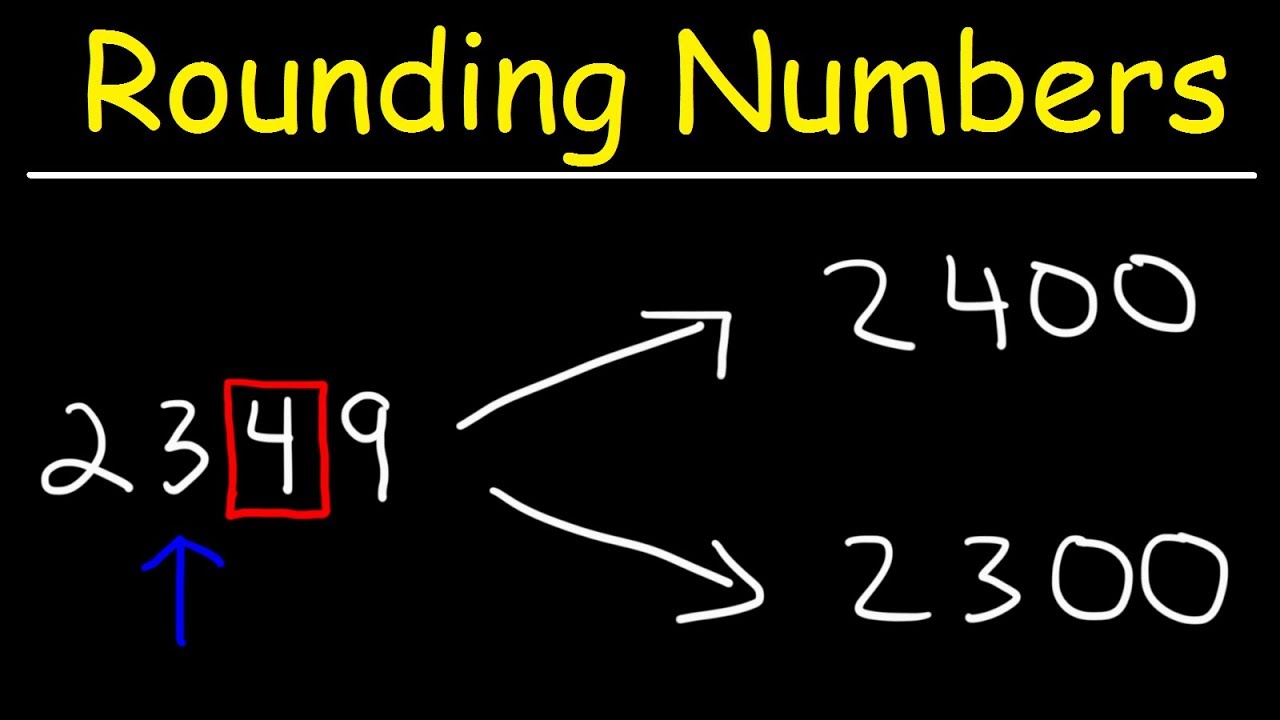
This math video tutorial provides a basic introduction into rounding. It explains the process of rounding numbers and rounding decimals.
Here is a list of topics:
- Rounding numbers to the nearest ten
- Rounding numbers to the nearest hundred
- Rounding decimals to the nearest whole number
- Rounding decimals to the nearest tenth
- R...
organic chemistry tutor is pretty good
safe radishBOT
@lean otter Has your question been resolved?
Channel closed
Closed by @gaunt venture
Use .reopen if this was a mistake.
lean otter
.close
safe radishBOT
Available help channel!
Send your question here to claim the channel.
Remember:
• Ask your math question in a clear, concise manner.
• Show your work, and if possible, explain where you are stuck.
• After 15 minutes, feel free to ping <@&286206848099549185>.
• Type the command .close to free the channel when you're done.
• Be polite and have a nice day!
Read #❓how-to-get-help for further information on how to ask a good question, and about conduct in the question channels.
 scenic valley
Why tho? I was taught to simply add them ?
 safe radishBOT
scenic valley
Why tho? I was taught to simply add them ?
tardy mango
safe radishBOT
scenic valley
Why tho? I was taught to simply add them ?
tardy mango
Please tell me you don't mean $\sqrt{a}+\sqrt{b}=\sqrt{a+b}$.
flat frigateBOT
Civil Service Pigeon
 scenic valley
Yes
I mean this
I thought to simply add the number
But this is transferring to other equation
tardy mango
scenic valley
I thought to simply add the number
yeah um ... that's wrong
very wrong.
who taught you that
safe radishBOT
@scenic valley Has your question been resolved?
flat frigateBOT
wravenwell
Compile Error! Click the  reaction for more information.
(You may edit your message to recompile.)

wravenwell
 safe radishBOT
Channel closed
Closed due to timeout
Use .reopen if this was a mistake.
Available help channel!
Send your question here to claim the channel.
Remember:
• Ask your math question in a clear, concise manner.
• Show your work, and if possible, explain where you are stuck.
• After 15 minutes, feel free to ping <@&286206848099549185>.
• Type the command .close to free the channel when you're done.
• Be polite and have a nice day!
Read #❓how-to-get-help for further information on how to ask a good question, and about conduct in the question channels.
lean otter
 safe radishBOT
lean otter
lean otter
safe radishBOT
lean otter
lean otter
I chose C because when I put it in the graph went to the left
 limpid bridge
Think about what's actually happening with the -1

 lean otter
 limpid bridge
ok so notice that the equation you entered is not the same as the one in the problem
lean otter
Oh
limpid bridge
yes it matters
sqrt(-x - 1) means move the graph one to the left
sqrt(-x) - 1 means move the graph one down
 plucky elk
lean otter
?????
plucky elk
lean otter
?????
it's easier to help if you ask a question
lean otter
Is this the right one
limpid bridge
I'm confused what you're asking
lean otter
Like
limpid bridge
Is this graph the right graph of the function? You entered it, yeah?
lean otter
Yea
lean otter
Mmmm
limpid bridge
example: these two graphs are reflected across the x-axis but not the y-axis
 lean otter
D?
limpid bridge
not sure, maybe you can tell me
lean otter
Yes
limpid bridge
np
lean otter
.close
safe radishBOT
Channel closed
Closed by @gaunt venture
Use .reopen if this was a mistake.
Available help channel!
Send your question here to claim the channel.
Remember:
• Ask your math question in a clear, concise manner.
• Show your work, and if possible, explain where you are stuck.
• After 15 minutes, feel free to ping <@&286206848099549185>.
• Type the command .close to free the channel when you're done.
• Be polite and have a nice day!
Read #❓how-to-get-help for further information on how to ask a good question, and about conduct in the question channels.
 tight heart
is this a valid decomposed function for this question?

 tight heart
Teacher has a different answer but he said they can vary and and all still be true but he wont get back to me
this is the answer he gave
 safe radishBOT
@tight heart Has your question been resolved?
safe radishBOT
Channel closed
Closed due to timeout
Use .reopen if this was a mistake.
safe radishBOT
Available help channel!
Send your question here to claim the channel.
Remember:
• Ask your math question in a clear, concise manner.
• Show your work, and if possible, explain where you are stuck.
• After 15 minutes, feel free to ping <@&286206848099549185>.
• Type the command .close to free the channel when you're done.
• Be polite and have a nice day!
Read #❓how-to-get-help for further information on how to ask a good question, and about conduct in the question channels.
 leaden onyx
if f(x)=ln(1/x)
what is f'(5)?
safe radishBOT
leaden onyx
if f(x)=ln(1/x)
what is f'(5)?
 devout shale
What have you tried?
leaden onyx
I just know if I have to use the limit definition of a derivative
leaden onyx
there's no full question
leaden onyx
leaden onyx
if f(x)=ln(1/x)
what is f'(5)?
this is the full question
I would need to find f' and then evaluate it at 5
leaden onyx
yes
devout shale
Do you need to use the limit definition because it is required or because you can't take the derivative the usual way
leaden onyx
what I know is
f'(x) = lim{x->x0} (f(x)-f(x0))/(x-x0)
leaden onyx
devout shale
Do you need to use the limit definition because it is required or because you ca...
it's required
yeah
devout shale
well you have the definition there, so plug in and get going on that
if you get stuck send your work here
and I'll try to help you out
safe radishBOT
@leaden onyx Has your question been resolved?
safe radishBOT
Channel closed
Closed due to timeout
Use .reopen if this was a mistake.
Available help channel!
Send your question here to claim the channel.
Remember:
• Ask your math question in a clear, concise manner.
• Show your work, and if possible, explain where you are stuck.
• After 15 minutes, feel free to ping <@&286206848099549185>.
• Type the command .close to free the channel when you're done.
• Be polite and have a nice day!
Read #❓how-to-get-help for further information on how to ask a good question, and about conduct in the question channels.
misty bay
what's the DFT version of this?
 safe radishBOT
misty bay
what's the DFT version of this?
safe radishBOT
misty bay
what's the DFT version of this?
@misty bay Has your question been resolved?
devout shale
Saccharine has been waiting for an answer for 7 years and 2 months and counting
 shut inlet
devout shale
Saccharine has been waiting for an answer for 7 years and 2 months and counting
shut inlet
devout shale
Saccharine has been waiting for an answer for 7 years and 2 months and counting
and still didn't find the answer

safe radishBOT
Channel closed
Closed due to timeout
Use .reopen if this was a mistake.
Available help channel!
Send your question here to claim the channel.
Remember:
• Ask your math question in a clear, concise manner.
• Show your work, and if possible, explain where you are stuck.
• After 15 minutes, feel free to ping <@&286206848099549185>.
• Type the command .close to free the channel when you're done.
• Be polite and have a nice day!
Read #❓how-to-get-help for further information on how to ask a good question, and about conduct in the question channels.
lean otter
How do I solve a 45-45-90 triangle if the hypotenuse’s value is 4?
 storm depot
need to find the derivative of the above, im using quotient and chain rule but the answer continues to be wrong
 lean otter
Uh
safe radishBOT
storm depot
need to find the derivative of the above, im using quotient and chain rule but t...
Please read #❓how-to-get-help
lean otter
Already took the channel 💀
How do I solve a 45-45-90 triangle if the hypotenuse’s value is 4?
shut inlet
lean otter
How do I solve a 45-45-90 triangle if the hypotenuse’s value is 4?
what are you trying to solve ?
lean otter
shut inlet
what are you trying to solve ?
I think the other values?
shut inlet
 ionic solstice
try pythagreon theorem
ionic solstice
try pythagreon theorem
Pythagoras
 worthy hemlock
You have that, you can use that into to find x
 lean otter
So uh replace x with 4?
ionic solstice
no
shut inlet
nope
lean otter
Where do I put 4 then
ionic solstice
replace hyp with 4
worthy hemlock
Solve
lean otter
How?
ionic solstice
shut inlet
Pythagoras
.
shut inlet
,tex \factoid sohcahtoa
worthy hemlock
Set $x \sqrt{2}$ equal to the value of the hypotenuse, and solve for x

 shut inlet
flat frigate
**Mehdi\_Moulati**
shut inlet
flat frigate
**Mehdi\_Moulati**
you have theta and hypotenuse
you need only opposite and adjacent
shut inlet
flat frigate
**Mehdi\_Moulati**
which could be calculated by those formulas
ionic solstice
storm depot
need to find the derivative of the above, im using quotient and chain rule but t...
for that the mistake is in what you did in the quotient rule
lean otter
“120 degrees long to short diagonal (it’s a rhombus)”
That’s what I wrote down if that makes any sense at all
worthy hemlock
ionic solstice
for that the mistake is in what you did in the quotient rule
That user opened their own channel #help-10
lean otter
lean otter
“120 degrees long to short diagonal (it’s a rhombus)”
Can someone see if they can help me with this
ionic solstice
I think you mean that the angle between the long diagonal and the short diagonal is 120:
?
lean otter
Yea that’s probably it
flat frigateBOT

 Requested by Mehdi_Moulati#1210
worthy hemlock
lean otter
Can someone see if they can help me with this
Requested by Mehdi_Moulati#1210
worthy hemlock
lean otter
Can someone see if they can help me with this
Is there a diagram with this?
lean otter
worthy hemlock
Is there a diagram with this?
Don’t got it xd
It was just a word problem
shut inlet
flat frigate
use this as reference
ionic solstice
lean otter
It was just a word problem
what do you want to find exactly?
safe radishBOT
Channel closed
Closed by @molten hedge
Use .reopen if this was a mistake.
Available help channel!
Send your question here to claim the channel.
Remember:
• Ask your math question in a clear, concise manner.
• Show your work, and if possible, explain where you are stuck.
• After 15 minutes, feel free to ping <@&286206848099549185>.
• Type the command .close to free the channel when you're done.
• Be polite and have a nice day!
Read #❓how-to-get-help for further information on how to ask a good question, and about conduct in the question channels.
 errant rain
Hello
safe radishBOT
errant rain
Hello
errant rain

I know y = 2 because
x = y^2 so 4 = y^2 so y = 2
and x is already given
<@&286206848099549185>
.close
safe radishBOT
Channel closed
Closed by @errant rain
Use .reopen if this was a mistake.
errant rain
Solved
safe radishBOT
Available help channel!
Send your question here to claim the channel.
Remember:
• Ask your math question in a clear, concise manner.
• Show your work, and if possible, explain where you are stuck.
• After 15 minutes, feel free to ping <@&286206848099549185>.
• Type the command .close to free the channel when you're done.
• Be polite and have a nice day!
Read #❓how-to-get-help for further information on how to ask a good question, and about conduct in the question channels.
lean otter
I dont know where to start on 88
 safe radishBOT
lean otter
I dont know where to start on 88
lean otter
safe radishBOT
lean otter
I dont know where to start on 88
lean otter
Please help
safe radishBOT
@lean otter Has your question been resolved?
safe radishBOT
Channel closed
Closed due to timeout
Use .reopen if this was a mistake.
Available help channel!
Send your question here to claim the channel.
Remember:
• Ask your math question in a clear, concise manner.
• Show your work, and if possible, explain where you are stuck.
• After 15 minutes, feel free to ping <@&286206848099549185>.
• Type the command .close to free the channel when you're done.
• Be polite and have a nice day!
Read #❓how-to-get-help for further information on how to ask a good question, and about conduct in the question channels.
 neat sonnet
Hello
safe radishBOT
neat sonnet
Hello


 mint holly
What part are you on
mint holly
Doesn’t it say length 1
neat sonnet
No its the uhmm symbol of length 'l'
neat sonnet
What happens next?
 neat sonnet
Yeah
mint holly
Are you asking for part b?
mint holly
Sorry what do you need help finding
mint holly
It’s not zero when r is greater than a tho
neat sonnet
It has solution? I have no idea where to start
neat sonnet
mint holly
It’s not zero when r is greater than a tho
Ohh, but inside its zero? Or nah?
mint holly
Yeah
Gauses law right
Electric field depends in enclosed charge
There is no charge when r is less than a
neat sonnet
How about outside?
mint holly
Yeah so the electric field is linear between a and b
But I think the first step is to find electric field when r is greater than b
mint holly
Yep for part b
neat sonnet
How about the part c?
mint holly
You need to do 0<b and b<r
mint holly
Sure
 mint holly
Yeah I think you made it a sphere
neat sonnet
Which part is wrong?
mint holly
You need to make charge enclosed a fraction of the total charge
neat sonnet
How do i it?
mint holly
mint holly
This is the total charge of the cylinder
neat sonnet
Ohh okay
mint holly
But uh this is pretty hard if you haven’t done much of gausses law
mint holly

I think this should be the charge enclosed
Yeah this is pretty bad
It’s easier to find the electric field outside the cylinder first
And also part c is easier than part b
mint holly
No not really
You should probably go from part c to part b
And then do electric field inside the cylinder last
neat sonnet
my teacher gave me a clue, he said i should use the formula of the electric flux to find the value of electric field and then use algebra
Will that do?
neat sonnet
mint holly
And then do electric field inside the cylinder last
Okay okay
mint holly
Yeah that’s what you do
But I mean that’s also what you wrote
Flux/SA is equal to the e field
I think do part c and find the total charge in the cylinder when a=0
It will make more sense
neat sonnet
Alright
Hello i chose to give up on this problem😭 im sorry you were great but my brain just cant understand😭 thank you for helping me
mint holly
Np I can do a part of it if you want me to
neat sonnet
thatll be too much
mint holly
No it will take a minute
neat sonnet
Can you really do that?😭
I want to clarify something, was there a flaw in the problem?
 mint holly
Wait
No my bad
2 sec

I forgot how to divide
It makes sense this way cuz the electric field goes down as r increases
It goes down by r^2 for a sphere
Like a point charge
Where it is kq/r^2
safe radishBOT
Channel closed
Closed by @neat sonnet
Use .reopen if this was a mistake.
neat sonnet
Solved
safe radishBOT
Available help channel!
Send your question here to claim the channel.
Remember:
• Ask your math question in a clear, concise manner.
• Show your work, and if possible, explain where you are stuck.
• After 15 minutes, feel free to ping <@&286206848099549185>.
• Type the command .close to free the channel when you're done.
• Be polite and have a nice day!
Read #❓how-to-get-help for further information on how to ask a good question, and about conduct in the question channels.
 remote flint
 safe radishBOT
remote flint
remote flint
safe radishBOT
remote flint
remote flint
the answer says the range is y > 0 but
doesn’t it touch 0 here?

sowhy isn’t it y >= 0?
safe radishBOT
@remote flint Has your question been resolved?
safe radishBOT
Channel closed
Closed due to timeout
Use .reopen if this was a mistake.
remote flint
.reopen
safe radishBOT
✅
safe radishBOT
@remote flint Has your question been resolved?
safe radishBOT
@remote flint Has your question been resolved?
safe radishBOT
@remote flint Has your question been resolved?
 empty gyro
It is neither y>0 nor y>=0
Hence why I am asking for the pic of the original question
There's insufficient information
safe radishBOT
Channel closed
Closed due to timeout
Use .reopen if this was a mistake.
Available help channel!
Send your question here to claim the channel.
Remember:
• Ask your math question in a clear, concise manner.
• Show your work, and if possible, explain where you are stuck.
• After 15 minutes, feel free to ping <@&286206848099549185>.
• Type the command .close to free the channel when you're done.
• Be polite and have a nice day!
Read #❓how-to-get-help for further information on how to ask a good question, and about conduct in the question channels.
chrome shale
need help
 safe radishBOT
chrome shale
need help
quasi bison
safe radishBOT
chrome shale
need help
quasi bison
!status
safe radishBOT
What step are you on?
1. I don't know where to begin
2. I have begun but got stuck midway
3. I got an answer but I'm told it's wrong
4. I got an answer and would like my work checked
5. I have a question about someone else's worked solution
6. None of the above
1
 brave wolf
First try to define f'(x) using produt rule
 mellow rune
remember to use product rule
chrome shale
how
brave wolf

 hallow cedar
so the product rule is d/dx f(x) * g(x) = f' (x)* g(x) + f(x) * g' (x)
brave wolf
Do you know this formula?
brave wolf
Notice that f(x) is actually product of x^8 and h(x)
hallow cedar
then also power rule, which is d/dx x^n = nx^n-1, which will be needed later with the product rule
safe radishBOT
@chrome shale Has your question been resolved?
safe radishBOT
Channel closed
Closed due to timeout
Use .reopen if this was a mistake.
safe radishBOT
Available help channel!
Send your question here to claim the channel.
Remember:
• Ask your math question in a clear, concise manner.
• Show your work, and if possible, explain where you are stuck.
• After 15 minutes, feel free to ping <@&286206848099549185>.
• Type the command .close to free the channel when you're done.
• Be polite and have a nice day!
Read #❓how-to-get-help for further information on how to ask a good question, and about conduct in the question channels.
lean otter
what does equivalent representation mean?
 safe radishBOT
lean otter
what does equivalent representation mean?
safe radishBOT
lean otter
what does equivalent representation mean?
 light shoal
you can draw the vector starting at any point you like
they're asking you to move it so it starts at the origin
light shoal
you have it pointing in the -z direction
that would imply that the x and y components are zero
but that's not the case, right?
lean otter
light shoal
but that's not the case, right?
oh so i should draw it slightly off first
then do this?
@light shoal
light shoal
try plotting the point (1, 0, -9) and then drawing an arrow from the origin to that point
that's what they're asking for
 dusk iron
lean otter
oh so i should draw it slightly off first
dusk iron
lean otter
oh so i should draw it slightly off first
R u our physics gandl
lean otter
no
safe radishBOT
@twilit galleon Has your question been resolved?
safe radishBOT
Channel closed
Closed due to timeout
Use .reopen if this was a mistake.
Available help channel!
Send your question here to claim the channel.
Remember:
• Ask your math question in a clear, concise manner.
• Show your work, and if possible, explain where you are stuck.
• After 15 minutes, feel free to ping <@&286206848099549185>.
• Type the command .close to free the channel when you're done.
• Be polite and have a nice day!
Read #❓how-to-get-help for further information on how to ask a good question, and about conduct in the question channels.
 random rivet
 safe radishBOT
random rivet
random rivet
safe radishBOT
random rivet
random rivet
ik i have to draw a tangent
that hits the point 2
but
like
i duno what to do after
how far do i create my triangle
 lapis shadow
The gradient of the tangent is the velocity
lapis shadow
random rivet
how far do i create my triangle
Ig as far as possible
lapis shadow
No the size of ur triangle doesn't change the slope
random rivet
but
lapis shadow
It doesn't matter
random rivet
okk
safe radishBOT
@random rivet Has your question been resolved?
Channel closed
Closed by @random rivet
Use .reopen if this was a mistake.
Available help channel!
Send your question here to claim the channel.
Remember:
• Ask your math question in a clear, concise manner.
• Show your work, and if possible, explain where you are stuck.
• After 15 minutes, feel free to ping <@&286206848099549185>.
• Type the command .close to free the channel when you're done.
• Be polite and have a nice day!
Read #❓how-to-get-help for further information on how to ask a good question, and about conduct in the question channels.
 cobalt raven
Please explain what the multiplicative Inverse of 550 mod 1769 is.
quasi bison
do you mean "Please explain what modular inverses are in general" or "Please explain how to find modular inverses in general" or "Please tell me what this particular modular inverse works out to be"?
cobalt raven
I want to understand how to calculate the multiplicative Inverse of 550 mod 1769.
@quasi bison
cobalt raven
In general please.
quasi bison
are you familiar with euclid's algorithm?
cobalt raven
Heard about it, but no.
quasi bison
then you might want to read up on it
it is an algorithm that lets you find the GCD of two numbers, but also, importantly, it lets you express said GCD as an integer linear combination of said numbers. and that is applicable directly to finding modular inverses.
cobalt raven
Can't I just calculate step by step until I have the answer of that particular problem?
"multiplicative Inverse of 550 mod 1769"
quasi bison
find gcd(1769, 550) and make sure it equals 1. if it doesn't equal 1 then the inverse doesn't exist.
otherwise, by any means you wish, find integers x and y such that 1769x + 550y = 1.
y is the inverse you're looking for.
cobalt raven
Thanks.
safe radishBOT
@cobalt raven Has your question been resolved?
safe radishBOT
Channel closed
Closed due to timeout
Use .reopen if this was a mistake.
Available help channel!
Send your question here to claim the channel.
Remember:
• Ask your math question in a clear, concise manner.
• Show your work, and if possible, explain where you are stuck.
• After 15 minutes, feel free to ping <@&286206848099549185>.
• Type the command .close to free the channel when you're done.
• Be polite and have a nice day!
Read #❓how-to-get-help for further information on how to ask a good question, and about conduct in the question channels.
lean otter
Help is it alr if someone helps me visualise this I don’t need help solving I just needs see how it looks like I’m bad at graph terms lol
 safe radishBOT
lean otter
Help is it alr if someone helps me visualise this I don’t need help solving I ju...
tardy mango
safe radishBOT
lean otter
Help is it alr if someone helps me visualise this I don’t need help solving I ju...
tardy mango
Desmos 
safe radishBOT
@lean otter Has your question been resolved?
safe radishBOT
Channel closed
Closed due to timeout
Use .reopen if this was a mistake.
Available help channel!
Send your question here to claim the channel.
Remember:
• Ask your math question in a clear, concise manner.
• Show your work, and if possible, explain where you are stuck.
• After 15 minutes, feel free to ping <@&286206848099549185>.
• Type the command .close to free the channel when you're done.
• Be polite and have a nice day!
Read #❓how-to-get-help for further information on how to ask a good question, and about conduct in the question channels.
 steady nest
The 21x21 matrice is orthogonal and symmetrical. Find the inverse B^(-1) to B=73A^(155)+27A.
safe radishBOT
steady nest
The 21x21 matrice is orthogonal and symmetrical. Find the inverse B^(-1) to B=73...
 safe radishBOT
What step are you on?
1. I don't know where to begin
2. I have begun but got stuck midway
3. I got an answer but I'm told it's wrong
4. I got an answer and would like my work checked
5. I have a question about someone else's worked solution
6. None of the above
@steady nest Has your question been resolved?
safe radishBOT
Channel closed
Closed due to timeout
Use .reopen if this was a mistake.
Available help channel!
Send your question here to claim the channel.
Remember:
• Ask your math question in a clear, concise manner.
• Show your work, and if possible, explain where you are stuck.
• After 15 minutes, feel free to ping <@&286206848099549185>.
• Type the command .close to free the channel when you're done.
• Be polite and have a nice day!
Read #❓how-to-get-help for further information on how to ask a good question, and about conduct in the question channels.
 lone arch
$\sum_{k = 0}^\infty (-1)^k = 1 - 1 + 1 - 1 + ...$ diverges after the divergence theorem, since $\lim_{k \to \infty} a_n = \lim_{k \to \infty} (-1)^k \neq 0$. \\
For $\frac{1}{x}$, after the Taylor Series, we have $\frac{1}{x} = \sum_{n = 0}^\infty \frac{f^{(n)}(a)}{n!}(x-a)^n$, for some $a \in D_f$, where $D_f$ is all $x \in \mathbb{R}$, $x \neq 0$. \\ $\left(\frac{1}{x}\right)' = -\frac{1}{x^2}$, $\left(\frac{1}{x}\right)'' = \frac{2}{x^3}$, $\left(\frac{1}{x}\right)''' = -\frac{6}{x^3}$.\\
For $\lim_{x \to 1} \frac{1}{x}$ and using $a = 1$, we have $\lim_{x \to 1} \frac{1}{x} = \lim_{x \to 1} f(1) + f'(1)(x-1) + \frac{f''(1)(x-1)}{2} + \frac{f'''(1)(x-1)}{6} + ... = \lim_{x \to 1} 1 - (x - 1) + (x - 1) - (x - 1) + ... = \lim_{x \to 1} 1 - x + 1 + x - 1 - x + 1 + ... = 1 - 1 + 1 + 1 - 1 - ... = 1 + (-1 + 1) + (1 - 1) + (-1 + 1) + ... = 1 + (1 - 1 + 1 - 1 + ...) = 1 + \sum_{k = 0}^\infty (-1)^k$.
Since $\lim_{x \to 1} \frac{1}{x} = 1$, this would mean that the series converges to $0$. Where is the mistake?
I assume it should be in taking away the 1, the sum has one term too less, right?
safe radishBOT
lone arch
$\sum_{k = 0}^\infty (-1)^k = 1 - 1 + 1 - 1 + ...$ diverges after the divergence...
lone arch

 peak estuary
you are switching the limit and the series
$\lim_{x\to c} \sum_{n=0}^\infty f_n(x) \neq \sum_{n=0}^\infty \lim_{x\to c} f_n(x)$ in general
flat frigateBOT
Denascite
 safe radishBOT
@lone arch Has your question been resolved?
lone arch
peak estuary
$\lim_{x\to c} \sum_{n=0}^\infty f_n(x) \neq \sum_{n=0}^\infty \lim_{x\to c} f_n...
Where?
peak estuary
when you just plug x=1 into the series
and I mean then you have the whole rearranging the brackets thing
lone arch
peak estuary
and I mean then you have the whole rearranging the brackets thing
Yeah
The rearranging shouldn't be wrong though, right?
peak estuary
well assuming it would converge, no
but it doesnt
from the start you can write 1-1+1-1+1-1=1+(-1+1)+(-1+1)+...=1
and at the same time 1-1+1-1+1-1+...=(1-1)+(1-1)+...=0
lone arch
peak estuary
well assuming it would converge, no
So rearranging the brackets like this is wrong here, since the series diverges.
lone arch
peak estuary
and at the same time 1-1+1-1+1-1+...=(1-1)+(1-1)+...=0
Yeah, we don't know if there are an odd or even amount of terms
Thank you
.close
safe radishBOT
Channel closed
Closed by @lone arch
Use .reopen if this was a mistake.
Available help channel!
Send your question here to claim the channel.
Remember:
• Ask your math question in a clear, concise manner.
• Show your work, and if possible, explain where you are stuck.
• After 15 minutes, feel free to ping <@&286206848099549185>.
• Type the command .close to free the channel when you're done.
• Be polite and have a nice day!
Read #❓how-to-get-help for further information on how to ask a good question, and about conduct in the question channels.
lean otter
 safe radishBOT
lean otter
lean otter
safe radishBOT
lean otter
lean otter
what is the best way of differentiating this?
i did the logarithmic differentiation but it isnt good because when i input 3pi/2, i get ln(x) which is undefined
quasi bison
show your work
 deep depot
Well if the input is undefined there then there's no real solution to that problem yes you could take limit of the f'(x) and if still the limit is undefined then the f'(x) is not really defined at that value and if you have any problems to determining the solution them you could ask
deep depot
lean otter
i did the logarithmic differentiation but it isnt good because when i input 3pi/...
And you don't really get ln(x) you get ln(and a large expression)
lean otter
deep depot
Well if the input is undefined there then there's no real solution to that probl...
yeah but that large expression = 0
deep depot
lean otter
yeah but that large expression = 0
How?
lean otter
by inputting 3pi/2
lean otter
quasi bison
show your work
$(sin(x)+1)^x(\ln(sinx+1)+\frac{xcos(x)}{sinx+1})$
flat frigateBOT
 deep depot
lean otter
by inputting 3pi/2
deep depot
lean otter
by inputting 3pi/2
I already have explained it that I'd it is 0 at that input then it is undefined at that value only but it is not undefined for all the values
lean otter
deep depot
I already have explained it that I'd it is 0 at that input then it is undefined ...
yeah ik
deep depot
flat frigate

lean otter
when i input 3pi/2, i get ln(x) which is undefined
i clearly said that
i never said all values
lean otter
deep depot
<:badtex:924222207251582996>
i cant be asked to do \sin and stuff
lean otter
 silver cliff
f'(3pi/2) = 0, ig youre differentiating wrong
silver cliff
f'(3pi/2) = 0, ig youre differentiating wrong
3pi/2
deep depot
silver cliff
f'(3pi/2) = 0, ig youre differentiating wrong
He said f'(3π/2) is undefined
silver cliff
lean otter
3pi/2
Yeah sori, f'(3pi/2) = 0 oop
lean otter
input it in the ln function
silver cliff
 lean otter
i cant understand ur handwriting
silver cliff
lean otter
input it in the ln function
You get rid of ln function after differentiating both sides
lean otter
this looks like a bird lol
 silver cliff
Youre supposed to differentiate on both sides
lean otter
silver cliff
You get rid of ln function after differentiating both sides
can u show in latex
silver cliff
Well im new here idk how to format...
lean otter
rip
lean otter
flat frigate
did u get this?
silver cliff
f'(x) = (sinx +1)^x times (xcosx + sinx +1)
silver cliff
lean otter
did u get this?
Hm lemme try
lean otter
silver cliff
f'(x) = (sinx +1)^x times (xcosx + sinx +1)
how did u get that
silver cliff
$f'(x)$
flat frigateBOT
hanzo
 silver cliff
Hm ok that works
 silver cliff
$(ln(f(x)) = x(sinx + 1))$
flat frigateBOT
hanzo
 silver cliff
You get this after taking log on both sides rite?
silver cliff
lean otter
Thats raised to power x
lean otter
i just follow the generalized power rule
silver cliff
Ok so you get this when you take one log on both sides you understand that rite?

 silver cliff
In this condition you can't directly apply that rule u(x) can be zero here
lean otter
ok
silver cliff
Do you know implicit differentiation? I can teach you my method
lean otter
so what is the alternative
lean otter
silver cliff
Do you know implicit differentiation? I can teach you my method
yeah i do kind of
like if ur finding y'
silver cliff
Ok
lean otter
u just multiply by y' whenever u differentiate y
silver cliff
flat frigate
**hanzo**
In my method you take log on both sides and then differentiate both sides w.r.t x
If I countinue from there I get
$f'(x)/f(x) = sinx + 1 + cosx$
$f'(x)/f(x) = sinx + 1 + xcosx$
flat frigateBOT
hanzo
 silver cliff
lean otter
silver cliff
lean otter
Then you get this
lean otter
flat frigate
**hanzo**
can u explain this step again
silver cliff
In this you take log on both sides,

The power on the expression on R.H.S comes down using property of log
lean otter
natural log, right
silver cliff
Yes
lean otter
silver cliff
The power on the expression on R.H.S comes down using property of log
didnt know that lol
what rule is that
silver cliff
$log(a^b) = blog(a)$
flat frigateBOT
hanzo
 silver cliff
Its ok
silver cliff
Oh, oh right then I was wrong my bad im very sorry, you are right then log will still be left and it will come out to be undefined
At 3pi/2
Im sorry for wasting your time
silver cliff
I wish you luck
lean otter
can any1 help me find f'(3pi/2)?

i differentiated and got this:

ln(0) is undefined and when i input 3pi/2, i get ln(0)
safe radishBOT
@lean otter Has your question been resolved?
lean otter
<@&286206848099549185>
 lone heron
lean otter
ln(0) is undefined and when i input 3pi/2, i get ln(0)
lone heron
lean otter
ln(0) is undefined and when i input 3pi/2, i get ln(0)
how is it so?
lean otter
lone heron
how is it so?
-1+1=0
lone heron
sin of 3pi/2 = 1
lean otter
lone heron
sin of 3pi/2 = 1
it equals -1...
lone heron
hmm and the cos term is 0
yeah you're right odd interval therefore -1
the derivative is correct though
did you solve it?
lean otter
ln(0)=undefined. how am i supposed to solve it? 🙃
lean otter
there is another way, which is why I'm asking for help
lone heron
okay i am going to try then
i tried using the property log(a+b) = loga + log(1+b/a)
still can't get rid of log(0)
i think there is no answer
the derivative of (sinx+1)^x at x = 3pi/2 is simply undefined
safe radishBOT
@lean otter Has your question been resolved?
lean otter
.close
safe radishBOT
Channel closed
Closed by @sleek badge
Use .reopen if this was a mistake.
safe radishBOT
Available help channel!
Send your question here to claim the channel.
Remember:
• Ask your math question in a clear, concise manner.
• Show your work, and if possible, explain where you are stuck.
• After 15 minutes, feel free to ping <@&286206848099549185>.
• Type the command .close to free the channel when you're done.
• Be polite and have a nice day!
Read #❓how-to-get-help for further information on how to ask a good question, and about conduct in the question channels.
lean otter
this is a past ib paper and i cant find out how to do this
lean otter
i tried implicit differntiation, and isolation of variables
but i cant do anythign

with implicit differentiation, i got $\frac{dy}{dx} = 2y\frac{dy}{dx}$
lean otter
lean otter
i tried implicit differntiation, and isolation of variables
what did u do for implicit differentiation
flat frigateBOT
ronniefan
 lean otter
um
what do i do
the derivative = 0
for the derivative being orizontal
so, soooo
i dont know what to do
misty coral
how did you derive your xy?
lean otter
^
product rule said byebye?
wait
did i just
do a blunder
bruhhh
i became stupid
sorry guys, rookie miastake
.close
safe radishBOT
Channel closed
Closed by @west jacinth
Use .reopen if this was a mistake.
lean otter
.reopen
safe radishBOT
✅
lean otter
i differentiated with product rule
and i got y + xdy/dx = 2y dy/dx
and then i got y/(2y-x) = dy/dx
did i do something wrong
wait, i think i know
if the denominator isnt 0, but the numerator is
someone help
how do i go from here
lean otter
,w differentiate implcitly xy = y^2 + 4
flat frigateBOT

 Requested by ronniefan#8354
hexed dune
Requested by ronniefan#8354
hexed dune
solve for the coordinates
-y/(x-2y) = 0
well you wont solve for coordinates, but youll get an xy equation for it
lean otter
0 = 4
lean otter
so no horizontal tangent
oh
i forget basic math when doing calculus, idk why
the second part of the question is to find the coordinates of thep oints where the tangent to the curve is vertical
i think i know
so find the value of the denominator of x, so that its 0
so then
x = 2y
and then 3y^2 = 4
and y = 2/$\sqrt(3)$
flat frigateBOT
ronniefan
 lean otter
anyone here to help verify?