#help-23
1 messages · Page 64 of 1
 lapis shadow
yeah
 brave narwhal
okay thanks so so much
lapis shadow
👍


 wintry condor
??
 wintry condor
brave narwhal
the one inside the root has to be defined
wintry condor
brave narwhal
the one inside the root has to be defined
Yes
 safe radishBOT
Channel closed
Closed by @brave narwhal
Use .reopen if this was a mistake.
 Available help channel!
Send your question here to claim the channel.
Remember:
• Ask your math question in a clear, concise manner.
• Show your work, and if possible, explain where you are stuck.
• After 15 minutes, feel free to ping <@&286206848099549185>.
• Type the command .close to free the channel when you're done.
• Be polite and have a nice day!
Read #❓how-to-get-help for further information on how to ask a good question, and about conduct in the question channels.
 frosty estuary
my set theory is a bit rusty : would (a without c) cut b be option 1 or option 2?


 safe radishBOT
frosty estuary
my set theory is a bit rusty : would (a without c) cut b be option 1 or option 2...
frosty estuary
safe radishBOT
frosty estuary
my set theory is a bit rusty : would (a without c) cut b be option 1 or option 2...
frosty estuary
or maybe even something different?
frosty estuary
lapis shadow
a without c cut b ?
this one
 lapis shadow
ok can u shade A \ C?
lapis shadow
lapis shadow
ok can u shade A \ C?
then find what part of this region "cuts" B
 quasi bison
lapis shadow
ok can u shade A \ C?
quasi bison
lapis shadow
ok can u shade A \ C?
wrong slash
quasi bison
yeah sure
frosty estuary
this would be a \ c, no?
 frosty estuary
so it would be only the middle part then, aka picture 2 i sent earlier?
lapis shadow
yeah picture 2
safe radishBOT
Channel closed
Closed by @frosty estuary
Use .reopen if this was a mistake.
safe radishBOT
Available help channel!
Send your question here to claim the channel.
Remember:
• Ask your math question in a clear, concise manner.
• Show your work, and if possible, explain where you are stuck.
• After 15 minutes, feel free to ping <@&286206848099549185>.
• Type the command .close to free the channel when you're done.
• Be polite and have a nice day!
Read #❓how-to-get-help for further information on how to ask a good question, and about conduct in the question channels.
safe radishBOT
Channel closed
Closed due to the original message being deleted
Available help channel!
Send your question here to claim the channel.
Remember:
• Ask your math question in a clear, concise manner.
• Show your work, and if possible, explain where you are stuck.
• After 15 minutes, feel free to ping <@&286206848099549185>.
• Type the command .close to free the channel when you're done.
• Be polite and have a nice day!
Read #❓how-to-get-help for further information on how to ask a good question, and about conduct in the question channels.
 pseudo peak
I'm using the definition of the directional derivative as
$$
f(\vec{x} + h\vec{v}) = f(\vec{x}) + hdf(\vec{x})(\vec{v}) + o(h)
$$
From this I can see why
$$
df(\vec{x})(\vec{v} + \vec{w}) = df(\vec{x})(\vec{v}) + df(\vec{x})(\vec{w})
$$
But I can't see why
$$
df(\vec{x})(\lambda \vec{v}) = \lambda df(\vec{x})(\vec{v})
$$
safe radishBOT
pseudo peak
I'm using the definition of the directional derivative as
$$
f(\vec{x} + h\vec{v...
 flat frigateBOT
Frisk17

 final halo
df(x)(v) is matrix multiplication right?
pseudo peak
final halo
df(x)(v) is matrix multiplication right?
I was actually trying to prove its linearity to do come to the conclusion that df(x) is a linear form / covector
final halo
Oh so you currently just have this thing df(x) defined as above and you want to prove its linear?
pseudo peak
final halo
Oh so you currently just have this thing df(x) defined as above and you want to ...
yeah
pseudo peak
final halo
Use the definition but with (hλ)v versus h(λv)
If I do that I'd get
(I'm omitting df as a function of x for clarity)
$$
h df(\lambda \vec{v}) + o(h) = \lambda df(h \vec{v}) + o(\lambda)
$$
I'd have $o(h)$ on one side and $o(\lambda)$ on another how'd that work?
flat frigateBOT
Frisk17
 safe radishBOT
@pseudo peak Has your question been resolved?
final halo
No the right hand side should be hλdf(v)
hλ is just some new number call it h' if you like
It also goes to 0 as h goes to 0 so perfectly fine to just replace with it in the definition
pseudo peak
final halo
No the right hand side should be hλdf(v)
Oh, that makes a lotta sense
Thanks a lot =)
.close
safe radishBOT
Channel closed
Closed by @pseudo peak
Use .reopen if this was a mistake.
Available help channel!
Send your question here to claim the channel.
Remember:
• Ask your math question in a clear, concise manner.
• Show your work, and if possible, explain where you are stuck.
• After 15 minutes, feel free to ping <@&286206848099549185>.
• Type the command .close to free the channel when you're done.
• Be polite and have a nice day!
Read #❓how-to-get-help for further information on how to ask a good question, and about conduct in the question channels.
 somber ingot
i think im gonna go mental
safe radishBOT
somber ingot
i think im gonna go mental
 safe radishBOT
@somber ingot Has your question been resolved?
safe radishBOT
Channel closed
Closed due to timeout
Use .reopen if this was a mistake.
Available help channel!
Send your question here to claim the channel.
Remember:
• Ask your math question in a clear, concise manner.
• Show your work, and if possible, explain where you are stuck.
• After 15 minutes, feel free to ping <@&286206848099549185>.
• Type the command .close to free the channel when you're done.
• Be polite and have a nice day!
Read #❓how-to-get-help for further information on how to ask a good question, and about conduct in the question channels.
 lean otter
 safe radishBOT
lean otter
lean otter
safe radishBOT
lean otter
lean otter
Any tips on where to go with this?
 plucky sequoia
what grade are u in
lean otter
What do you mean?
lean otter
Sorry to inconvenience you.
 pseudo scroll
Factor 3/4 out and then trig sub I suppose
pseudo scroll
$\frac{4}{3}\int_0^{2 \pi} \frac{dt}{(\frac{2t}{\sqrt{3}} - \frac{1}{\sqrt{3}})^2 + 1}$
flat frigateBOT
NEONPerseus
 lean otter
Yeah lots of replacement's
Gonna keep limits same and just replace back
Or is that a bad idea?
pseudo scroll
There's a better way actually
lean otter
Its Gonna be an arctan
pseudo scroll
Can I try
pseudo scroll
$\int \frac{d\theta}{1 + 1 - \sin \theta}$
lean otter

weierstrass substitution, intro,
a great way to integrate a rational expression that involves sin(x) and cos(x), check out my other videos for examples!
blackpenredpen
flat frigateBOT
NEONPerseus
 pseudo scroll

lean otter
Explains the sub
pseudo scroll
Oh the fancy sub
lean otter
Lol
pseudo scroll
$\int \frac{d\theta}{1 + (\sin^2 \frac{\theta}{2} + \cos^2 \frac{\theta}{2} - 2\sin \frac{\theta}{2} \cos \frac{\theta}{2})}$
Boy
lean otter
IDK if it's fancy or clever
flat frigateBOT
NEONPerseus
 pseudo scroll
$\int \frac{d\phi}{1 + (\sin \phi - \cos \phi)^2}$
phi is theta / 2 for convenience
Oh nvm this won't work :(
I spent far too much time on the latex
lean otter
That's the joke of it
pseudo scroll
Lmfao
lean otter
If you don't know this sub
flat frigateBOT
NEONPerseus
 lean otter
That's not taught and given on examz
flat frigateBOT
NEONPerseus
 pseudo scroll
Worked like a charm
lean otter
Can you please show me how this factorization works
pseudo scroll
Which one
 plucky elk
lean otter
plucky elk
lean otter
,w int 0 to inf ((t-1)^2+3/4))^(-1)
lean otter
flat frigate
**NEONPerseus**
This
flat frigateBOT


 Requested by riemann#2529
plucky elk
Requested by riemann#2529
plucky elk

pseudo scroll
$\int \frac{dt}{\frac{3}{4}[\frac{4}{3}(t - 0.5)^2 + 1]}$
flat frigateBOT
NEONPerseus
 lean otter
Ahhhhhhhhhhhh
pseudo scroll
3/4 is a constant multiple now so it comes out of the integral
And 4/3 is absorbed into the square
lean otter
That's because you first divide by 4
Then 3
When factoring that expression i think
Tyty
.close
safe radishBOT
Channel closed
Closed by @dusky steppe
Use .reopen if this was a mistake.
Available help channel!
Send your question here to claim the channel.
Remember:
• Ask your math question in a clear, concise manner.
• Show your work, and if possible, explain where you are stuck.
• After 15 minutes, feel free to ping <@&286206848099549185>.
• Type the command .close to free the channel when you're done.
• Be polite and have a nice day!
Read #❓how-to-get-help for further information on how to ask a good question, and about conduct in the question channels.
 lilac vapor
Hello, I'm trying to understand how to get 2root2 from this equation

 empty gyro
What happens when you multiply a negative by another negative
lilac vapor
It becomes positive, but that doesn't really help my thought process
My thinking is that (-root2)(-root2) = root2 but I think maybe that's wrong
 kindred tulip
negative root2 times negative root2
kindred tulip
lilac vapor
My thinking is that (-root2)(-root2) = root2 but I think maybe that's wrong
no
its true
lilac vapor
so then is (-root2)(-root2) = 2?
kindred tulip
yep
lilac vapor
lilac vapor
My thinking is that (-root2)(-root2) = root2 but I think maybe that's wrong
so this was wrong
I thought it was root 2
kindred tulip
yeah
lilac vapor
I see
kindred tulip
root has gone
lilac vapor
ok and ofc root8 = 2root2
I didn't realize it would take away the root when multiplying two roots like that
kindred tulip
its not going
root2 . root2 --> root(2.2)
root4 is 2
thats why
negative being positive because (-).(-)=(+)
safe radishBOT
Channel closed
Closed by @lilac vapor
Use .reopen if this was a mistake.
Available help channel!
Send your question here to claim the channel.
Remember:
• Ask your math question in a clear, concise manner.
• Show your work, and if possible, explain where you are stuck.
• After 15 minutes, feel free to ping <@&286206848099549185>.
• Type the command .close to free the channel when you're done.
• Be polite and have a nice day!
Read #❓how-to-get-help for further information on how to ask a good question, and about conduct in the question channels.
 tame onyx
I was wondering if I have |x| and if I am asked for it to be compressed or stretched in these ways would my provided answers be correct if not what am I doing wrong
Horizontally compressed by factor of 4 = |1/4x|
Vertically compressed by factor of 4 = 1/4|x|
Horizontally stretched by factor of 4 = |1/4x|
Vertically stretched by factor of 4 = 4|x|
safe radishBOT
tame onyx
I was wondering if I have |x| and if I am asked for it to be compressed or stret...
 obtuse jackal
Play around on desmos and find out
tame onyx
I am mostly just confused for when it says factor of 4 when I need to use 1/4 and 4 and wasn't sure if I was using them in the correct places
obtuse jackal
Follow the points
Fix a point and see where it goes
Like horizontally compressed by a factor 4: means f(1) should be found at g(1/4). So you replace x by 4x such that g(x) = f(4x), i.e. g(1/4) = f(1)
tame onyx
ok I think I understand that better now, I will test that out and close this now
.close
safe radishBOT
Channel closed
Closed by @tame onyx
Use .reopen if this was a mistake.
Available help channel!
Send your question here to claim the channel.
Remember:
• Ask your math question in a clear, concise manner.
• Show your work, and if possible, explain where you are stuck.
• After 15 minutes, feel free to ping <@&286206848099549185>.
• Type the command .close to free the channel when you're done.
• Be polite and have a nice day!
Read #❓how-to-get-help for further information on how to ask a good question, and about conduct in the question channels.
lean otter
Julia is starting her own on-line business selling jewelry that she makes. It cost her $3000 to buy a new computer, and her monthly expenses for internet service and materials average about 1790$ per month If her revenue for each month averages about $420, how long will it be before she starts to earn a profit?
safe radishBOT
lean otter
Julia is starting her own on-line business selling jewelry that she makes. It co...
lean otter
I need to solve this using the substitution and Elimination method
<@&286206848099549185>
safe radishBOT
@junior pulsar Has your question been resolved?
 misty bay
lean otter
Julia is starting her own on-line business selling jewelry that she makes. It co...
misty bay
lean otter
Julia is starting her own on-line business selling jewelry that she makes. It co...
are you sure your numbers are correct
julia will never turn a profit
safe radishBOT
Channel closed
Closed due to timeout
Use .reopen if this was a mistake.
Available help channel!
Send your question here to claim the channel.
Remember:
• Ask your math question in a clear, concise manner.
• Show your work, and if possible, explain where you are stuck.
• After 15 minutes, feel free to ping <@&286206848099549185>.
• Type the command .close to free the channel when you're done.
• Be polite and have a nice day!
Read #❓how-to-get-help for further information on how to ask a good question, and about conduct in the question channels.
lean otter
 lean otter
Is the average velocity for this question 90?

 junior smelt
safe radish
junior smelt
safe radish
Do you still need #help-39? If not then please close it, thank you 
ty 🫶
 final bay
lean otter
Is the average velocity for this question 90?
final bay
lean otter
Is the average velocity for this question 90?
seems right to me
plucky elk
have you learned definite integrals?
In this section we will formally define the definite integral, give many of its properties and discuss a couple of interpretations of the definite integral. We will also look at the first part of the Fundamental Theorem of Calculus which shows the very close relationship between derivatives and integrals.
lean otter
thx how do II apply it to this tho
plucky elk
lean otter
thx how do II apply it to this tho
there are examples in the link
this link is probably better: https://tutorial.math.lamar.edu/Classes/CalcI/ComputingDefiniteIntegrals.aspx
In this section we will take a look at the second part of the Fundamental Theorem of Calculus. This will show us how we compute definite integrals without using (the often very unpleasant) definition. The examples in this section can all be done with a basic knowledge of indefinite integrals and will not require the use of the substitution rul...
theorem and worked example

 pseudo scroll
lean otter
Is the average velocity for this question 90?
pseudo scroll
lean otter
Is the average velocity for this question 90?
This is odd  I've never thought of when you're meant to use the slope of the secant vs the integral
Do they give you the same result
plucky elk
slope of the secant line is just one definition of average for linear functions. the integral/derivative is more general
pseudo scroll
Slope of the secant for linear functions?
plucky elk
i'm confusing two concepts together, ignore me
plucky elk
lean otter
thx how do II apply it to this tho
did you follow example 2a i screenshotted
safe radishBOT
@lean otter Has your question been resolved?
lean otter
@plucky elk what’s the f(x)
plucky elk
lean otter
Is the average velocity for this question 90?
whatever it is in this formula
safe radishBOT
@lean otter Has your question been resolved?
safe radishBOT
Channel closed
Closed due to timeout
Use .reopen if this was a mistake.
Available help channel!
Send your question here to claim the channel.
Remember:
• Ask your math question in a clear, concise manner.
• Show your work, and if possible, explain where you are stuck.
• After 15 minutes, feel free to ping <@&286206848099549185>.
• Type the command .close to free the channel when you're done.
• Be polite and have a nice day!
Read #❓how-to-get-help for further information on how to ask a good question, and about conduct in the question channels.
 faint dew
how do i graph this function?
 safe radishBOT
faint dew
how do i graph this function?
faint dew
safe radishBOT
faint dew
how do i graph this function?
faint dew
.close
safe radishBOT
Channel closed
Closed by @faint dew
Use .reopen if this was a mistake.
Available help channel!
Send your question here to claim the channel.
Remember:
• Ask your math question in a clear, concise manner.
• Show your work, and if possible, explain where you are stuck.
• After 15 minutes, feel free to ping <@&286206848099549185>.
• Type the command .close to free the channel when you're done.
• Be polite and have a nice day!
Read #❓how-to-get-help for further information on how to ask a good question, and about conduct in the question channels.
lean otter
You and a friend are standing on balconies of nearby builings. Your balcony is 40 ft above the ground andd your friends is 28 ft above the ground. When you loo kat your friend the angle of declination is 18.5 degrees. When you look at the top of your friend's building the angle of inclination is 44.2. Note: These angles are also called the angles of depression and elevation respectively. Use right triangles to determine the height of your friend's building.
safe radishBOT
lean otter
You and a friend are standing on balconies of nearby builings. Your balcony is 4...
Please don't occupy multiple help channels.
safe radishBOT
Channel closed
Closed by @frail olive
Use .reopen if this was a mistake.
lean otter
.reopen
 frank glen
Could you focus on one channel?
safe radishBOT
✅
lean otter
Yeah, sorry. They weren't visible on my screen.
I just realized that it did that.

.close
safe radishBOT
Channel closed
Closed by @frail olive
Use .reopen if this was a mistake.
 light shoal
lean otter
Yeah, sorry. They weren't visible on my screen.
light shoal
lean otter
Yeah, sorry. They weren't visible on my screen.
make sure that the little arrow to the left of "MATH HELP (OCCUPIED)" is pointing downward, otherwise channels without new activity are hidden
 lean otter
light shoal
make sure that the little arrow to the left of "MATH HELP (OCCUPIED)" is pointin...
lean otter
light shoal
make sure that the little arrow to the left of "MATH HELP (OCCUPIED)" is pointin...
Why isn't it closing properly?
I typed the command but it wont like move

 compact ferry
takes a whle to process
light shoal
it's closed, i was just adding a comment in case that was why you couldn't see your original channel
lean otter
Ah, ok. Sorry for the confusion guys!
Should I just stick to this one for my question then?
light shoal
no use whichever one is currently open (21)
lean otter
Alright, thanks!
safe radishBOT
Available help channel!
Send your question here to claim the channel.
Remember:
• Ask your math question in a clear, concise manner.
• Show your work, and if possible, explain where you are stuck.
• After 15 minutes, feel free to ping <@&286206848099549185>.
• Type the command .close to free the channel when you're done.
• Be polite and have a nice day!
Read #❓how-to-get-help for further information on how to ask a good question, and about conduct in the question channels.
 tawdry fox
x sin(1/x) -> 0 as x->0 but why
safe radishBOT
tawdry fox
x sin(1/x) -> 0 as x->0 but why
safe radishBOT
Channel closed
Closed by @tawdry fox
Use .reopen if this was a mistake.
Available help channel!
Send your question here to claim the channel.
Remember:
• Ask your math question in a clear, concise manner.
• Show your work, and if possible, explain where you are stuck.
• After 15 minutes, feel free to ping <@&286206848099549185>.
• Type the command .close to free the channel when you're done.
• Be polite and have a nice day!
Read #❓how-to-get-help for further information on how to ask a good question, and about conduct in the question channels.
 tender furnace
Can pi be subset of pi?
safe radishBOT
tender furnace
Can pi be subset of pi?
 unique bison
pi is a number, not a set
 pseudo python
 plush saddle
Well if you consider pi as a dedekind cut, then it is a set. All sets are subsets of themselves.
safe radishBOT
@tender furnace Has your question been resolved?
Channel closed
Closed by @tender furnace
Use .reopen if this was a mistake.
Available help channel!
Send your question here to claim the channel.
Remember:
• Ask your math question in a clear, concise manner.
• Show your work, and if possible, explain where you are stuck.
• After 15 minutes, feel free to ping <@&286206848099549185>.
• Type the command .close to free the channel when you're done.
• Be polite and have a nice day!
Read #❓how-to-get-help for further information on how to ask a good question, and about conduct in the question channels.
 signal cove
help
safe radishBOT
signal cove
help
 signal cove
idk
 lusty spear
lol that woudl be a good thing to know
because thats what we wanna find out
my guess would be
whether or not these P_i are all equivalent
but thats onyl a guess
I think I could help you out, but I need to know what consistent means in this case
lusty spear
ahh alright thanks
so basically they are asking if the set that contains all the formulas is satisfyable
if thats what its calles in english
so
give me a moment
signal cove
kk
lusty spear
what I'd try to do would be tranfsorming them
so for example Y -> Z = ~Y v Z
thats more handy imo
and same for P3
and P4
then Idk how you guys exactly use these truth trees
I'd just go over the possibilities and conclude whether or not it works
do you have an example for a truth tree ?
signal cove
 lusty spear
ok sorry I have never really seen this before
what I'd do , maybe that helps you too is this
ok to keep it simple
I dont wanna use anything that you might not be using in your courser
so from P3 we know that Y has to be 1
therefore from P2 we know that Z has to be 1 aswell
because ~Y is going to be 0
then from P4 we know that ~Y will evaluate to 0 and therefore ~X has to be 1 so X has to be 0
then check that for P1
X = 0 => ~X = 1 done
also done for Y=1
so I'd say its consistent for X = 0, Y=1 and Z=1
but how youd show that with your tree idk I am sorry
I am not familiar with these trees
safe radishBOT
@signal cove Has your question been resolved?
safe radishBOT
Channel closed
Closed due to timeout
Use .reopen if this was a mistake.
Available help channel!
Send your question here to claim the channel.
Remember:
• Ask your math question in a clear, concise manner.
• Show your work, and if possible, explain where you are stuck.
• After 15 minutes, feel free to ping <@&286206848099549185>.
• Type the command .close to free the channel when you're done.
• Be polite and have a nice day!
Read #❓how-to-get-help for further information on how to ask a good question, and about conduct in the question channels.
signal cove
hell
safe radishBOT
signal cove
hell
signal cove
o
discrete math


from this the answer is yes but whhhhyyyy
please
<@&286206848099549185>
safe radishBOT
@signal cove Has your question been resolved?
signal cove
plz
safe radishBOT
@signal cove Has your question been resolved?
signal cove
help
safe radishBOT
@signal cove Has your question been resolved?
safe radishBOT
Channel closed
Closed due to timeout
Use .reopen if this was a mistake.
Available help channel!
Send your question here to claim the channel.
Remember:
• Ask your math question in a clear, concise manner.
• Show your work, and if possible, explain where you are stuck.
• After 15 minutes, feel free to ping <@&286206848099549185>.
• Type the command .close to free the channel when you're done.
• Be polite and have a nice day!
Read #❓how-to-get-help for further information on how to ask a good question, and about conduct in the question channels.
 fickle trail
 safe radishBOT
fickle trail
fickle trail
safe radishBOT
fickle trail
fickle trail
I don’t understand this
 spice grove
i never said x is a variable either.
It's you guessing.
But yes, same logic applies.
fickle trail
Hmmm so it’s kinda like substitution?
spice grove
It's an identity.
 devout needle
fickle trail
devout needle
fickle trail
use double angle formula
fickle trail
devout needle
use double angle formula
Can you explain?
 fickle trail
devout needle
he used the second one
fickle trail
devout needle
he used the second one
Which one would you recommend to see the logic easier?
I see difference of two squares or something from the first line but I don’t know I’d that could help or go in the reverse direction to make even more work this problem
lean otter
cos(2x)=cos^2(x)-sin^2(x), 2theta is used for x
lean otter
you only have to memorize cos(2x)=cos^2(x)-sin^2(x)
the others are just using the identity cos^2(x)+sin^2(x)=1
fickle trail
OK..
safe radishBOT
@fickle trail Has your question been resolved?
spice grove
I doubt they do.
 zinc token
then memorization is probably a good idea
spice grove
Could just derive using cos(A+B) formula
flat frigateBOT
What the hell am I doing here?
 safe radishBOT
Channel closed
Closed due to timeout
Use .reopen if this was a mistake.
safe radishBOT
Available help channel!
Send your question here to claim the channel.
Remember:
• Ask your math question in a clear, concise manner.
• Show your work, and if possible, explain where you are stuck.
• After 15 minutes, feel free to ping <@&286206848099549185>.
• Type the command .close to free the channel when you're done.
• Be polite and have a nice day!
Read #❓how-to-get-help for further information on how to ask a good question, and about conduct in the question channels.
lean otter
Find the value(s) x for which 3𝑥=2+2𝑥+√2−𝑥
safe radishBOT
lean otter
Find the value(s) x for which 3𝑥=2+2𝑥+√2−𝑥
 flint prawn
lean otter
Find the value(s) x for which 3𝑥=2+2𝑥+√2−𝑥
flint prawn
lean otter
Find the value(s) x for which 3𝑥=2+2𝑥+√2−𝑥
show your work...
lean otter
(x-2)^2=(x+2)
flint prawn
well why do you go for square terms anol
you can just simplify it directly
just go step by step
simplify rhs first
lean otter
1-2+x
pseudo scroll
Fancy x
lean otter
?
safe radishBOT
@lean otter Has your question been resolved?
safe radishBOT
Channel closed
Closed due to timeout
Use .reopen if this was a mistake.
Available help channel!
Send your question here to claim the channel.
Remember:
• Ask your math question in a clear, concise manner.
• Show your work, and if possible, explain where you are stuck.
• After 15 minutes, feel free to ping <@&286206848099549185>.
• Type the command .close to free the channel when you're done.
• Be polite and have a nice day!
Read #❓how-to-get-help for further information on how to ask a good question, and about conduct in the question channels.
 slow fern
Is there a way solve this using stars and bars?
 safe radishBOT
slow fern
Is there a way solve this using stars and bars?
quasi bison
safe radishBOT
slow fern
Is there a way solve this using stars and bars?
quasi bison
you are counting the integer solutions of p+q+r=27 subject to 1 ≤ p < q < r and p+q > r
slow fern
Yes
quasi bison
let x := p-1, y := q-p-1, z := r-q-1
the conditions p ≥ 1, q > p, r > q are equivalent to x ≥ 0, y ≥ 0, z ≥ 0 resp.
we get p = x + 1, q = y + p + 1 = x + y + 2, and r = z + q + 1 = x + y + z + 3
thus p+q+r = 27 becomes 3x + 2y + z + 6 = 27
and p+q > r becomes x + 1 + x + y + 2 > x + y + z + 3, or x > z...
does that help us any?
if the goal's to specifically employ the stars-and-bars method, i believe you'd be out of luck.
safe radishBOT
Channel closed
Closed by @slow fern
Use .reopen if this was a mistake.
Available help channel!
Send your question here to claim the channel.
Remember:
• Ask your math question in a clear, concise manner.
• Show your work, and if possible, explain where you are stuck.
• After 15 minutes, feel free to ping <@&286206848099549185>.
• Type the command .close to free the channel when you're done.
• Be polite and have a nice day!
Read #❓how-to-get-help for further information on how to ask a good question, and about conduct in the question channels.
 bold aurora
I tried ratio test to see if it converges absolutely, but I got a 1, not sure where to go next
 safe radishBOT
bold aurora
I tried ratio test to see if it converges absolutely, but I got a 1, not sure wh...
zinc token
safe radishBOT
bold aurora
I tried ratio test to see if it converges absolutely, but I got a 1, not sure wh...
zinc token
recall the theorem statement of the ratio test
plucky elk
should just be alternating series test
zinc token
ok yeah thats probably faster
bold aurora
plucky elk
should just be alternating series test
I thought of that too, but idk how to really show that this is monotone decreasing, I can’t really do derivatives with those factorials in the way
zinc token
have you checked with wolfie
bold aurora
zinc token
recall the theorem statement of the ratio test
The theorem says if the limit is one the test is inconclusive, no?
bold aurora
zinc token
have you checked with wolfie
I only plotted the sequence, which does seem to be eventually monotone decreasing which is enough to prove convergence, but I can’t take desmos with me to an exam
zinc token
,w (5^n + n!)/(3 + (n+2)!)
flat frigateBOT

 Requested by DerpZ#9141
zinc token
Requested by DerpZ#9141
zinc token
hmm
bold aurora
Maybe I did the ratio test wrong?
 zinc token
I really should not be trying to do analysis while this sleep but
it looks fine
you said it's monotone
bold aurora
I looked at the root test too but it looked pretty undoable. Integral test is out of the question with the factorials
zinc token
maybe we can try using the monotone convergence theorem here
just to prove its convergent
bold aurora
So maybe I’m missing a comparison?
zinc token
what would you compare it to though
bold aurora
If I knew that I wouldn’t be missing it 😛
bold aurora
If I get rid of the n! It will diverge by the ratio test
However, that’s not much use now that I think about it, it will be greater than this so it diverging isn’t useful :/
bold aurora
zinc token
intuitively n!/3+(n+2)! seems to be convergent
But then this is less than our series, so it converging isn’t useful. It’d be interesting if it diverged
bold aurora
Besides I don’t even know if I can show that that converges either, it’s the same ratio test 😦
zinc token
perhaps getting rid of the 3 from the denominator might help?
that would give us an upper bound
(I'm unrigorously ignoring the alternating series bit)
bold aurora
zinc token
perhaps getting rid of the 3 from the denominator might help?
Exactly the same in terms of the ratio test, notice how I just discard all of those constants and the slower growing exponential in the limit anyway 😭
zinc token
I'm not using the ratio test here
bold aurora
Then idk how to show that the new series we have converges either
zinc token
converges or absolutely converges
zinc token
we can actually
zinc token
the sequence of the partial sums on the right piece is most certainly monotone and bounded so it converges.
probably the same on the left piece too but to avoid saying something wrong I'm going to go to sleep
bold aurora
Left one converges by ratio test, right one converges by duh
zinc token
well "duh" is not an acceptable proof in an exam I'm guessing
try leaving it as an exercise to the grader 
flat frigateBOT
Mehdi_Moulati
 plucky elk
Mehdi's expression is very elegant. a lazier way is just to use p-series comparison test
 shut inlet
p-series is better tbh
safe radishBOT
@bold aurora Has your question been resolved?
bold aurora
flat frigate
**Mehdi\_Moulati**
hm, how does this work?
Oh, instead of the duh proof?
bold aurora
plucky elk
Mehdi's expression is very elegant. a lazier way is just to use p-series compari...
I left it as duh because it's just ~ 1/n^2 no?
 plucky elk
right
zinc token
eh still good to state it
bold aurora
Yeah, I'll write ~ 1/n^2, converges by asymptotic comparison test
Thanks everyone
.close
safe radishBOT
Channel closed
Closed by @bold aurora
Use .reopen if this was a mistake.
shut inlet
bold aurora
hm, how does this work?
,align
\sum_{k=1}^{\inf} \frac{k!}{(k+2)!}
&= \sum_{k=1}^{\inf} \frac{1}{(k+1)(k+2)} \
&= \sum_{k=2}^{\inf} \frac{1}{k(k+1)} \
&= \sum_{k=1}^{\inf} \frac{1}{k(k+1)} - \frac{1}{2}\
&= \lim_{n \to \inf} 1 - \frac{1}{n+1} - \frac{1}{2} \
&= \frac{1}{2}
flat frigateBOT
Mehdi_Moulati
 bold aurora
.reopen
safe radishBOT
✅
bold aurora
flat frigate
**Mehdi\_Moulati**
Hm, I have some trouble following line 2 -> 3
shut inlet
when k = 1 , 1/(k(k+1)) will be 1/2
so i add and subtract 1/2 to not change our sum
,align
\sum_{k=2}^{n} \frac{1}{k(k+1)}
&= \frac{1}{2*3} + \frac{1}{3*4} + \cdots + \frac{1}{n(n+1)} \
&= { \color{aqua} -\frac{1}{2} + \frac{1}{2}} + \frac{1}{2*3} + \frac{1}{3*4} + \cdots + \frac{1}{n(n+1)} \
&= \underbrace{{ \color{aqua} \frac{1}{2}} + \frac{1}{2*3} + \frac{1}{3*4} + \cdots + \frac{1}{n(n+1)}} {\color{aqua} -\frac{1}{2} }\
&= \hspace{2.5cm} \sum_{k=1}^{n} \frac{1}{k(k+1)} \hspace{2cm} {\color{aqua} -\frac{1}{2} }
flat frigateBOT
Mehdi_Moulati
 safe radishBOT
@bold aurora Has your question been resolved?
safe radishBOT
Channel closed
Closed due to timeout
Use .reopen if this was a mistake.
Available help channel!
Send your question here to claim the channel.
Remember:
• Ask your math question in a clear, concise manner.
• Show your work, and if possible, explain where you are stuck.
• After 15 minutes, feel free to ping <@&286206848099549185>.
• Type the command .close to free the channel when you're done.
• Be polite and have a nice day!
Read #❓how-to-get-help for further information on how to ask a good question, and about conduct in the question channels.
 neat onyx
There are three unknown numbers. The mean of these three numbers is 8. The mean of the first two numbers ls 5. One of the numbers ls the double of one of the other two numbers.
What are the three numbers?
safe radishBOT
neat onyx
There are three unknown numbers. The mean of these three numbers is 8. The mean ...
 safe radishBOT
@neat onyx Has your question been resolved?
neat onyx
2nd equation could be
X+y+z=24 I think but then idk what to make 3rd equation and I think I need one
<@&286206848099549185>
I think the numbers are 14, 7 and 3 but idk how to formally calculate it
Well fully
Or if there Is one or just logic
And shown by trial and error
 pallid spade
Um, so you have 3 numbers.
x + y + z = 24
x + y = 10
One of the numbers is double the other two and it cannot be x or y because they're both smaller than z. It can be both: z = 2y or z = 2x
2x + x + y = 24, so your answer is correct. All you can do is simplify it to 3x + y = 24 (just sum the two equal values).
If you have to find the numbers themselves, you already know that z is 14.
z = 2x
x = 7
And y = 3
Or if z = 2y then y = 7 and x = 3
Here's how you calculate it:
z = 2x
x = 7
x + y + z = 24
7 + y + 14 = 24 (plug in the values we know to find the unknown one)
21 + y = 24
y = 24 - 21
y = 3
safe radishBOT
@neat onyx Has your question been resolved?
safe radishBOT
Channel closed
Closed due to timeout
Use .reopen if this was a mistake.
safe radishBOT
Available help channel!
Send your question here to claim the channel.
Remember:
• Ask your math question in a clear, concise manner.
• Show your work, and if possible, explain where you are stuck.
• After 15 minutes, feel free to ping <@&286206848099549185>.
• Type the command .close to free the channel when you're done.
• Be polite and have a nice day!
Read #❓how-to-get-help for further information on how to ask a good question, and about conduct in the question channels.
 leaden scaffold
so basically im trying to calculate the 31st term in this sequence
 leaden scaffold
I was told that the formula an=a1+(n-1)d would work here..
but what even is my d?
I have both 3j and -4j...
 stray socket
Split it up
 lilac patio
you can split it, there's also special formulas for cubes and sqaures
stray socket
$\sum (A \pm B) = \sum A \pm \sum B$
flat frigateBOT
Umbraleviathan
 leaden scaffold
I was told that the formula an=a1+(n-1)d would work here..
leaden scaffold
leaden scaffold
I was told that the formula an=a1+(n-1)d would work here..
`Oh.....So wait, would I completely not use this formula then?
leaden scaffold
stray socket
$\sum (A \pm B) = \sum A \pm \sum B$
^
 ember sphinx
leaden scaffold
`Oh.....So wait, would I completely not use this formula then?
ember sphinx
leaden scaffold
`Oh.....So wait, would I completely not use this formula then?
Nope you will
leaden scaffold
flat frigate
**Umbraleviathan**
Okay, I'm confused on how this applies though...what law is this?
leaden scaffold
lilac patio
Laws of sums or something
Not sure how to work with the problem with the formula Umbrella gave..
leaden scaffold
lilac patio
just use your formula to find them separately
Find what separately?
lilac patio
value of each summation
leaden scaffold
lilac patio
value of each summation
Do you mean that I apply my formula to (3j)^2 and -4j separately?
lilac patio
mhm
leaden scaffold
lilac patio
mhm
And then I add my results together?
Anyone? Does that logic sound right or?
lilac patio
yep
leaden scaffold
lilac patio
yep
for my second summation, would it 5+(31-1)4 or -4?
leaden scaffold
leaden scaffold
so basically im trying to calculate the 31st term in this sequence
because here I see the function has -4j
lilac patio
not sure I forgot all the formulas
leaden scaffold
ember sphinx
Nope you will
Hey, do you know if I would put -4 or 4 for calculating this?
I don't know if 4 or -4 would be my d in an=a1+(n-1)d
lilac patio
positivw
leaden scaffold
lilac patio
positivw
why wouldn't it be negative though
lilac patio
The whole thing is negative though once you subtract it from the(3j)^2 part
lilac patio
leaden scaffold
why wouldn't it be negative though
because the term is 4j
leaden scaffold
OH
leaden scaffold
lilac patio
because the term is 4j
so im subtracting both summations, not adding them..
Damn it I'm getting this wrong
leaden scaffold
leaden scaffold
so basically im trying to calculate the 31st term in this sequence
Can anyone help? My answer to this is -465 but it's saying I'm getting it wrong..
I split it it using the arithmetic sequence formula and partial sums formula
I got 1612-2077
<@&286206848099549185>
 rich stratus
leaden scaffold
<@&286206848099549185>
rich stratus
leaden scaffold
<@&286206848099549185>
What's the problem buddy
leaden scaffold
rich stratus
What's the problem buddy
its this one

ignore the 20 I put as answer
leaden scaffold
rich stratus
I van just ignore that right
I don't think so..I personally got 5 when I plugged 1 back into the equation
rich stratus
I'll come back with the answer few minutes later
I am in bed so i can't use paper and pencil
leaden scaffold
rich stratus
I am in bed so i can't use paper and pencil
Okay, in the meantime I will work on it. Ping me when you can. 😃
rich stratus
@leaden scaffold is the answer 91760
leaden scaffold
rich stratus
<@415124030408884245> is the answer 91760
How did you get it?
...
I was working on it for 30 minutes
rich stratus
leaden scaffold
How did you get it?
Is it correct
leaden scaffold
ok
rich stratus
Do you know this formula @leaden scaffold

Just put in 31 for n
Then multiply it by 9
Because (3j)²=9j²
leaden scaffold
rich stratus
Then multiply it by 9
Because (3j)²=9j²
I thought we had to use sequence and partial sums formula?
rich stratus
leaden scaffold
I thought we had to use sequence and partial sums formula?
I don't know what those words mean
leaden scaffold
rich stratus
I don't know what those words mean
Do you know the formula an=a1+(n-1)d and formula sn=(a1+an/2)n?
rich stratus
Nope
rich stratus
rich stratus
Then multiply it by 9
Because (3j)²=9j²
Then i subtracted 4*(31*32/2)
ember sphinx
rich stratus
Do you know this formula <@415124030408884245>
You don’t need to know this
rich stratus
ember sphinx
You don’t need to know this
Yes, but EVERYBODY knows this
leaden scaffold
ember sphinx
You don’t need to know this
Can I show you my work?
ember sphinx
leaden scaffold
Can I show you my work?
If you want too
leaden scaffold
ember sphinx
If you want too
Nevermind. Can I just type what I did out?
I first substituted 1 into the equation (3j)^2-4j
I got 9-4=5
ember sphinx
Mk
leaden scaffold
I then took the 5 and chugged it into the formuma an=a1+(n-1)d
I got 5+(31-1)3
I got the 3 from the part of the function that said (3j)^2, btw
leaden scaffold
leaden scaffold
I got 5+(31-1)3
It equaled 95...
rich stratus
leaden scaffold
It equaled 95...
Was that the last step
Like did you submit 95 as the answer
ember sphinx
Yea no
You cannot use that formula for both
One is an arithmetic sequence
The other is geometric
You split your summation into 2
leaden scaffold
ember sphinx
You cannot use that formula for both
Wait, so I was doing it wrong? The chemistry tutor said that's howd you do it:https://www.youtube.com/watch?v=xavgv1m9feE
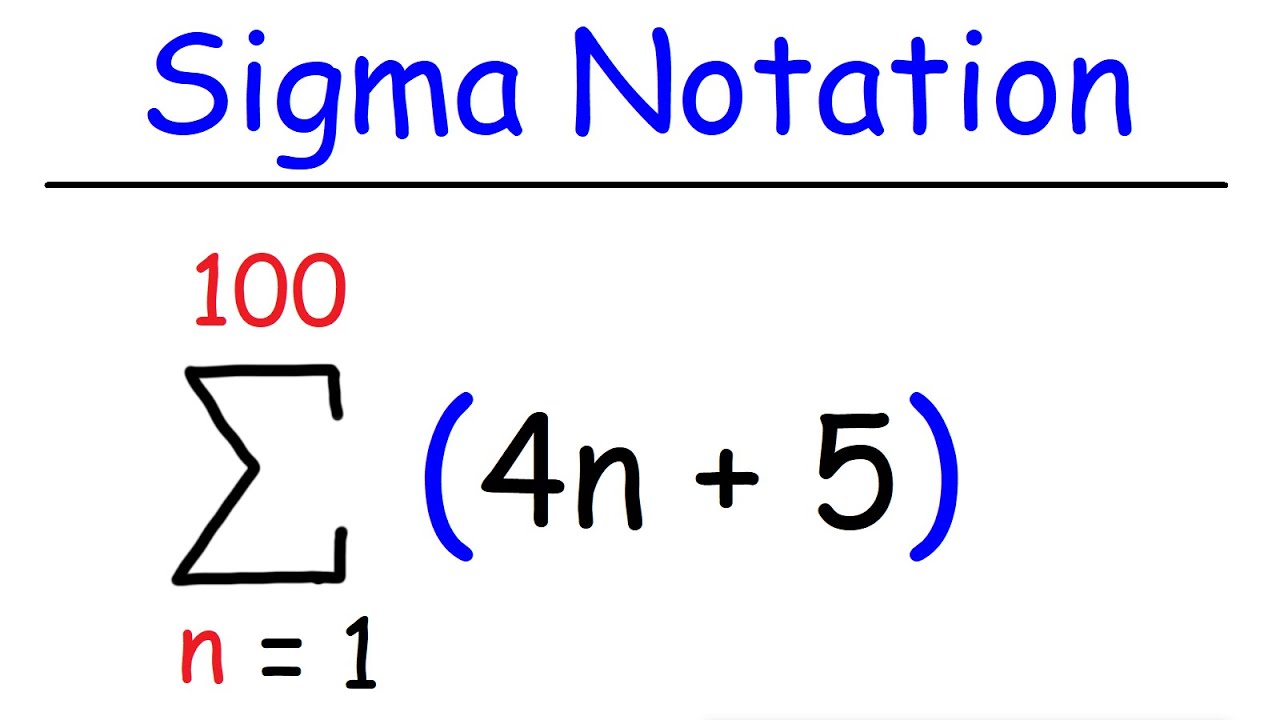
This algebra and precalculus video tutorial provides a basic introduction into solving summation problems expressed in sigma notation. It also explains how to find the sum of arithmetic and geometric sequences.
My Website: https://www.video-tutor.net
Patreon: https://www.patreon.com/MathScienceTutor
Amazon Store: https://www.amazon.com/shop...
leaden scaffold
ember sphinx
Yea no
I wasnt finished, I did the same process again for -4j..
ember sphinx
But it still be wrong
leaden scaffold
ember sphinx
But introduce an n^2
Wait what do you mean?
ember sphinx
leaden scaffold
Wait what do you mean?
The second you have the variable of the summation squared you can’t use arithmetic
leaden scaffold
ember sphinx
The second you have the variable of the summation squared you can’t use arithmet...
So after I get 5 from 3(1)^2-4(1) I don't do any additional math?
ember sphinx
leaden scaffold
So after I get 5 from 3(1)^2-4(1) I don't do any additional math?
Yea u do but not this maths
I would go about it a different way
leaden scaffold
ember sphinx
I would go about it a different way
What way?
ember sphinx
Split it firstly so
leaden scaffold
please break it down like I'm layman
ember sphinx
$\sum ((3j)^2) - \sum (4j)$
flat frigateBOT
Mortta
 leaden scaffold
ok
rich stratus
Handling the 9j² part and -4j part seperately is important
ember sphinx
Ok let’s focus on the right first coz it’s easier and you did it right
That’s just $4\sum_{j=1}^{31} j$
Agreed?
flat frigateBOT
Mortta
 flat frigateBOT
Mortta
 ember sphinx
This is equal to 496
Now put times it by 4 we have 1984
@leaden scaffold U with me?
Ready to move onto the left
leaden scaffold
I’m reading it all one moment
ember sphinx
$\sum_{n = 1}^{5} 2n$
flat frigateBOT
Mortta
 ember sphinx
Let’s use this example
This is just 2(1) + 2(2) + 2(3) + 2(4) + 2(5)
But that is also
The same as
2(1 + 2 + 3 + 4 + 5)
Put it in a calculator if you don’t BELEIVE me
And (1+ 2 + 3 + 4 + 5) is just
$\sum_{n=1}^{5}n$
flat frigateBOT
Mortta
 leaden scaffold
Ok
ember sphinx
You can take factors out of the summation as long as they’re not like the variable involved (in our case j)
Now for the left side
This is a bit more tricky
$\sum_{j=1}^{31} (3j)^2 = \sum_{j=1}^{31} 9j^2 = 9\sum_{j=1}^{31} j^2$
flat frigateBOT
Mortta
 ember sphinx
Agreed?
leaden scaffold
flat frigate
**Mortta**
Yes
leaden scaffold
ember sphinx
Agreed?
Why don’t we substitute 1 into j though to get just 9?
ember sphinx
leaden scaffold
Why don’t we substitute 1 into j though to get just 9?
We don’t need too
ember sphinx
Mhm gimme a sec
Ok now we’ll go with @rich stratus idea becuase it’s nice and simple

Which is using this formula in the middle
He posted it earlier on
Now deriving this is not fun so we’ll just use it
rich stratus
ember sphinx
Ok now we’ll go with <@699616980042252289> idea becuase it’s nice and simple
I agree
rich stratus
ember sphinx
By the way can we appreciate the fact that sigma k^3 formula is sigma k formula squared
Think about why that is the case
ember sphinx
We get $\frac{31(31+1)(2 \times 31 + 1)}{6}$
flat frigateBOT
Mortta
 ember sphinx
rich stratus
By the way can we appreciate the fact that sigma k^3 formula is sigma k formula ...
ember sphinx
rich stratus
By the way can we appreciate the fact that sigma k^3 formula is sigma k formula ...
Ooo I didn’t realise that wtf
ThTs pretty cool
rich stratus
ember sphinx
All these 3 formulas and the next ones can be proved easily using induction btw
ember sphinx
flat frigate
**Mortta**
Putting it in a calculator we get 10416
rich stratus
If you don't know the proves i recommend working them out yourself they are actually fun
ember sphinx
rich stratus
If you don't know the proves i recommend working them out yourself they are actu...
And timsing by the 9 we took out we get 93744
Ooops wrong reply but yea
Now we just do 93744 - 1984
@leaden scaffold
leaden scaffold
ember sphinx
Where did we get 6 from in denominator?
ember sphinx
leaden scaffold
Where did we get 6 from in denominator?
It’s just the formula
The derivation of it is not the best
But we just know it’s true
leaden scaffold
Oh, that’s the general formula?
leaden scaffold
ember sphinx
Yea general formula for summation of x^2
Is there general formulas for x^3, and x^4?
ember sphinx
leaden scaffold
Is there general formulas for x^3, and x^4?
X^3 is right below it
X^4 I can probably find for you gimme a sec

@rich stratus there is a pattern here
I wanna say pascals but I just can’t think of it
Do you know it?
leaden scaffold
Thank you for your help Mortta.
safe radishBOT
@leaden scaffold Has your question been resolved?
safe radishBOT
Channel closed
Closed due to timeout
Use .reopen if this was a mistake.
Available help channel!
Send your question here to claim the channel.
Remember:
• Ask your math question in a clear, concise manner.
• Show your work, and if possible, explain where you are stuck.
• After 15 minutes, feel free to ping <@&286206848099549185>.
• Type the command .close to free the channel when you're done.
• Be polite and have a nice day!
Read #❓how-to-get-help for further information on how to ask a good question, and about conduct in the question channels.
 solid verge
Hey, I am pretty sure I derived it correctly, but I am struggling with finding the common denominator. I get stuck at trying to do e^t * (ln t)^2
Do I have to do (ln t)(ln t) first? And if I need to do that, how can I do that?
 safe radishBOT
solid verge
Hey, I am pretty sure I derived it correctly, but I am struggling with finding t...
safe radishBOT
solid verge
Hey, I am pretty sure I derived it correctly, but I am struggling with finding t...

 thin bridge
can you identify the lcm of \
$\ln(t)$ and $t\cdot (\ln(t))^2$
flat frigateBOT
ℝamonov
 solid verge
ln(t)
solid verge
LCM = lowest common multiple?
solid verge
Ohhh
I would just multiple them together
So
I'm just gonna write it down

Would this be right?
thin bridge
that's a common multiple but not the lowest
solid verge
Hmm
thin bridge
consider what you do for this nicer example
$$\frac34 + \frac{1}{12}$$
flat frigateBOT
ℝamonov
 thin bridge
how would you (efficiently) combine those
solid verge
(1/4) / (12/4)
thin bridge
whut
solid verge
Im sorry 😭
thin bridge
what's the lcm of 4 and 12
solid verge
2
thin bridge
no
solid verge
Its 12
solid verge
Ohhh okay
thin bridge
and can you express 3/4 as an equivalent fraction with a denominator of 12
solid verge
9/12
thin bridge
yes, and proceed with combining the fractions since the denominators are now the same
flat frigateBOT
ℝamonov
 thin bridge
yeh
now bring that back to what i initially asked \
can you first identify the lcm of \
$\ln(t)$ and $t\cdot (\ln(t))^2$
flat frigateBOT
ℝamonov
 thin bridge
you'd multiply the numerator and denominator of the fraction on the left by t*ln(t)
Lcm would be t*(ln(t))^2
yes
solid verge
Ohhh okay
Okay im going to try that. Thanks a lot for your help. I really appreciate it!
I did it! Thanks again! 🙂
safe radishBOT
@solid verge Has your question been resolved?
Channel closed
Closed by @solid verge
Use .reopen if this was a mistake.
Available help channel!
Send your question here to claim the channel.
Remember:
• Ask your math question in a clear, concise manner.
• Show your work, and if possible, explain where you are stuck.
• After 15 minutes, feel free to ping <@&286206848099549185>.
• Type the command .close to free the channel when you're done.
• Be polite and have a nice day!
Read #❓how-to-get-help for further information on how to ask a good question, and about conduct in the question channels.
 pliant flicker
 safe radishBOT
pliant flicker
pliant flicker
safe radishBOT
pliant flicker
pliant flicker
<@&286206848099549185>
safe radishBOT
pliant flicker
<@&286206848099549185>
Please only use the <@&286206848099549185> ping once if your question has not been answered for 15 minutes. Please do not ping or DM individual users about your question.
pliant flicker
safe radish
Please only use the <@&286206848099549185> ping **once** if your question has no...
oksy
lean otter
do you know what the lines mean
the perpendicular lines mean congruent segments
with that in mind you know the width and length of the entire structure
pliant flicker
lean otter
with that in mind you know the width and length of the entire structure
width=1000+1500?
pliant flicker
1000+1000+1500?
lean otter
yes
safe radishBOT
@pliant flicker Has your question been resolved?
safe radishBOT
@pliant flicker Has your question been resolved?
safe radishBOT
Channel closed
Closed due to timeout
Use .reopen if this was a mistake.
safe radishBOT
Available help channel!
Send your question here to claim the channel.
Remember:
• Ask your math question in a clear, concise manner.
• Show your work, and if possible, explain where you are stuck.
• After 15 minutes, feel free to ping <@&286206848099549185>.
• Type the command .close to free the channel when you're done.
• Be polite and have a nice day!
Read #❓how-to-get-help for further information on how to ask a good question, and about conduct in the question channels.
 junior wagon

 safe radishBOT
junior wagon
junior wagon
safe radishBOT
junior wagon
junior wagon
Im having trouble proving if $\alpha + \beta > 2$ then $f$ admits a limit at $(0,0)$ direction
flat frigateBOT
KN


 dusk vapor
Cute handwriting ngl
 timid pasture
dusk vapor
Cute handwriting ngl
timid pasture
dusk vapor
Cute handwriting ngl
Didn't knew Diligent Clerk had an apprentice
dusk vapor

 solar hazel
i think this can be done easier with polar coordinates if you know how to do that
junior wagon
i've forgotten how to switch to polar coordinates tbh 😅
But i can try to learn that
solar hazel
otherwise, maybe like squeeze theorem
with a "base" case with small alpha and beta
but like if you can just prove that the limit is 0 when alpha = 1 and beta = 2
then it will still be 0 when you increase alpha and beta
junior wagon
solar hazel
then it will still be 0 when you increase alpha and beta
hm, why is that?
solar hazel
squeeze theorem?
you only need to look at (x,y) near (0,0) (so |x|,|y| < 1 or whatever)
so increasing the exponent will just make this smaller (or closer to 0 might be better to say)
 junior wagon
solar hazel
you only need to look at (x,y) near (0,0) (so |x|,|y| < 1 or whatever)
junior wagon
solar hazel
you only need to look at (x,y) near (0,0) (so |x|,|y| < 1 or whatever)
okok that is what i was trying to confirm lol
ill try that
thanks
solar hazel
np ^^
junior wagon

does this argument work?
I wanted to show |f(x,y) - L| = 0
where L is the limit
like, I know the limit of f(x,y) will be 0
and I think our prof actually mentions we can use that
junior wagon
junior wagon
I wanted to show |f(x,y) - L| = 0
so this is saying no matter from left/right, the distance of f(x,y) to 0 will be 0
hence the absolute value
safe radishBOT
@junior wagon Has your question been resolved?
safe radishBOT
Channel closed
Closed due to timeout
Use .reopen if this was a mistake.
Available help channel!
Send your question here to claim the channel.
Remember:
• Ask your math question in a clear, concise manner.
• Show your work, and if possible, explain where you are stuck.
• After 15 minutes, feel free to ping <@&286206848099549185>.
• Type the command .close to free the channel when you're done.
• Be polite and have a nice day!
Read #❓how-to-get-help for further information on how to ask a good question, and about conduct in the question channels.
 obtuse plover
more of a conceptual question, for the solution to part b, it states that the plane thru those points has the eqn y=-2 cuz they all have that in common. is it possible for there to be an equation of a plane that passes thru 3 points but none of the x,y,z are common between the three? 2nd question: also, how would one write the equation of a plane that is diagonal (not parallel to any of the axes) (just an example would suffice
 safe radishBOT
obtuse plover
more of a conceptual question, for the solution to part b, it states that the pl...
obtuse plover
safe radishBOT
obtuse plover
more of a conceptual question, for the solution to part b, it states that the pl...
obtuse plover
thanks in advance
 weary osprey
Do you mind explaining what you mean by none of the x,y,z are common between the three?
obtuse plover
yes,sorry, so i mean that no individual x, y, or z coordinate between the 3 coordinate pairs are the same, like for example: (1,2,3) (4,5,6) and (7,8,9) none of the x,y,z points are common between the 3 coordinate pairs
 neat shore
To answer the second question you can represent any plane in 3d in the form ax + by + cz = d. Where a,b,c and d are real numbers.
obtuse plover
neat shore
To answer the second question you can represent any plane in 3d in the form ax +...
i see
obtuse plover
obtuse plover
yes,sorry, so i mean that no individual x, y, or z coordinate between the 3 coor...
to expand, three points like (2,3,4) (5,3,9) and (10,3,23) share the y=3
 spiral crescent
obtuse plover
yes,sorry, so i mean that no individual x, y, or z coordinate between the 3 coor...
spiral crescent
obtuse plover
yes,sorry, so i mean that no individual x, y, or z coordinate between the 3 coor...
Any 3 points are always coplanar so should work right?
 normal folio
hi
obtuse plover
spiral crescent
Any 3 points are always coplanar so should work right?
oh, even tho this seems intuitive, i didnt really realize it
neat shore
Its a bit hard to give a concrete example where the dont share any coordinate, its much easier to find a diagonal plane (say x + y + z = 1) and then find 3 points on it that have no matching coordinates
So the plane through (1, 0, 0) , (0.2, 0.2, 0.6) and (3, -1, -1) satisfies your requirements.
obtuse plover
so like (5,4,-8) (5,7,-11) and (5,14,-18) would work?
neat shore
That should just be the plane x = 5
obtuse plover
neat shore
So the plane through (1, 0, 0) , (0.2, 0.2, 0.6) and (3, -1, -1) satisfies your ...
ohhhh i see
obtuse plover
neat shore
That should just be the plane x = 5
oh right lol
neat shore
When you get further in your mathematics studies you learn about cross products and that allows you to find these equations
spiral crescent
obtuse plover
more of a conceptual question, for the solution to part b, it states that the pl...
Not parallel to any axis hm.., the normal vector of the plane when dot product with direction vectors of the axes just needs to not be 0 ig?
neat shore
I doubt this person knows what a dot product is
judging from the question that goes along with this
spiral crescent
No he does, ive seen him here a lot
Also the solution to part b was cool, i would have just straight up gone to determinant form💀
obtuse plover
i took lin alg, but wasnt very strong with it, thus i didnt rlly understand the concepts and how they applied to things like this unfortunately, so ik how to calculate the dot product from the formula, but i dont rlly understand it conceptually
rn im just starting calc3
spiral crescent
obtuse plover
i took lin alg, but wasnt very strong with it, thus i didnt rlly understand the ...
Dot product of 2 vectors 0 means the vectors are perpendicular to each other, ur saying u dont want the plane to be parallel to the axes, so when plane parallel to axes, normal vector of plane is perpendicular to the axes, so just need to prevent dot product of normal vector with direction vector of the axes from being 0
neat shore
obtuse plover
rn im just starting calc3
My uni only has calc 1 and 2 so its a bit hard to visualise for me what it would be about
but ig its multivariable calculus
obtuse plover
spiral crescent
Dot product of 2 vectors 0 means the vectors are perpendicular to each other, ur...
sorry what do u mean by normal vector of plane
spiral crescent
Normal vector of plane means like a vector that is perpendicular to the plane
 honest shuttle
try to solve this question
 spiral crescent
neat shore
To answer the second question you can represent any plane in 3d in the form ax +...
spiral crescent
neat shore
To answer the second question you can represent any plane in 3d in the form ax +...
Here the normal vector would be a i+bj+ck
neat shore
Please open your own help channel @honest shuttle
honest shuttle
oh sry i'm new din't know
neat shore
nw
obtuse plover
ok yea thats what i figured, so how would one prevent the dot product of the normal vector with direction vector of the axes from being 0
this is the part where i explain my LA basics are severely lacking and i should really take a look at some ocw
spiral crescent
I might be wrong, but i think its just a,b,c,not equal 0?
Cuz like the x axis direction vector is just i+0j+0k right?
neat shore
Yeah I think you're right
spiral crescent
Btw my channel also has some vector and 3d questions if u guys are interested
obtuse plover
spiral crescent
Dot product of 2 vectors 0 means the vectors are perpendicular to each other, ur...
ok im slowly dissecting this message and understanding more and more lol, thank u Casper and idontsleepanymore for the help, ill read over this chat log a couple more times and see if i can comprehend further, thx again, my questions are answered
.close
safe radishBOT
Channel closed
Closed by @obtuse plover
Use .reopen if this was a mistake.
Available help channel!
Send your question here to claim the channel.
Remember:
• Ask your math question in a clear, concise manner.
• Show your work, and if possible, explain where you are stuck.
• After 15 minutes, feel free to ping <@&286206848099549185>.
• Type the command .close to free the channel when you're done.
• Be polite and have a nice day!
Read #❓how-to-get-help for further information on how to ask a good question, and about conduct in the question channels.
 ruby rapids
I want to merge models according to have a certain percentage at the end. However the limitation I am facing is that I can only ever merge 2 models at a time.
So for example if I do this in my head.
Model A 40 %
Model B 40 %
Model C 10 %
Model D 10 %
I would first merge
Model A+B 50/50% each
Then
Model C+D 50/50% each
And finally
Model AB 80% and Model CD 20%
To have Model ABCD with the percentages given above.
Now I am looking for a formula to calculate this in advance with a "arbitrary" amount of models.
Now when I do it in order like this
Model A 50% + Model B 50%
Model AB <90% + Model C >10% (I am looking to find out a formula to calculate this step)
Model ABC 90% + Model D 10%
An alternative problem would be this, where I can no longer do it in my head.
Model A 55%
Model B 15%
Model C 15%
Model D 10%
Model E 5%
safe radishBOT
ruby rapids
I want to merge models according to have a certain percentage at the end. Howeve...
@ruby rapids Has your question been resolved?
safe radishBOT
@ruby rapids Has your question been resolved?
empty gyro
I have no idea what you are describing
ruby rapids
hmm not sure how I can best describe it.
In decision theory, the weighted sum model (WSM), also called weighted linear combination (WLC) or simple additive weighting (SAW), is the best known and simplest multi-criteria decision analysis (MCDA) / multi-criteria decision making method for evaluating a number of alternatives in terms of a number of decision criteria.
I am basically doing this, but with the limitation, that I can only ever do 2 criteria at the same time, instead of doing everything in one go
ruby rapids
this might be easier to explain in voice, however I am currently not available. I should be in around 2h however. I would be fine closing this for now and reopening it then?
ruby rapids
.close
safe radishBOT
Channel closed
Closed by @ruby rapids
Use .reopen if this was a mistake.
Available help channel!
Send your question here to claim the channel.
Remember:
• Ask your math question in a clear, concise manner.
• Show your work, and if possible, explain where you are stuck.
• After 15 minutes, feel free to ping <@&286206848099549185>.
• Type the command .close to free the channel when you're done.
• Be polite and have a nice day!
Read #❓how-to-get-help for further information on how to ask a good question, and about conduct in the question channels.
 fossil vine
 safe radishBOT
fossil vine
fossil vine
safe radishBOT
fossil vine
fossil vine
this is what i drew
 safe radishBOT
@fossil vine Has your question been resolved?
fossil vine
<@&286206848099549185>
safe radishBOT
@fossil vine Has your question been resolved?
Channel closed
Closed by @fossil vine
Use .reopen if this was a mistake.
Available help channel!
Send your question here to claim the channel.
Remember:
• Ask your math question in a clear, concise manner.
• Show your work, and if possible, explain where you are stuck.
• After 15 minutes, feel free to ping <@&286206848099549185>.
• Type the command .close to free the channel when you're done.
• Be polite and have a nice day!
Read #❓how-to-get-help for further information on how to ask a good question, and about conduct in the question channels.
 uneven glade
Hey
safe radishBOT
uneven glade
Hey
uneven glade
I need help on this linear algebra problem


My work so far
Someone please help me with this
I got it wrong
 zinc berry
You cannot just assume A is symmetric.
zinc berry
leave it as a b c d as it was given in the question
zinc berry
and eventually you will have a system of equation to solve by equating each element of the 2x2 matrix with the matrix [-18, -21; -33, 0]
 zinc berry
yes
uneven glade
Thanks now ill work through it
 iron coral
@uneven gladeyo are u a sikh?
uneven glade
Family is sikh, though im not religous.
iron coral
uneven glade
Family is sikh, though im not religous.
oh
 uneven glade
 iron coral
uneven glade
iron coral
uneven glade
are u trying to use Gaussian Elimination?
uneven glade
Yeah
iron coral
oh
uneven glade
Im doing that rn
iron coral
k
safe radishBOT
@uneven glade Has your question been resolved?
uneven glade
Ill be back in 2 min

What i sokve the system, i get it wrong
I must be doing something wrong
safe radishBOT
@uneven glade Has your question been resolved?
safe radishBOT
Channel closed
Closed by @uneven glade
Use .reopen if this was a mistake.
safe radishBOT
Available help channel!
Send your question here to claim the channel.
Remember:
• Ask your math question in a clear, concise manner.
• Show your work, and if possible, explain where you are stuck.
• After 15 minutes, feel free to ping <@&286206848099549185>.
• Type the command .close to free the channel when you're done.
• Be polite and have a nice day!
Read #❓how-to-get-help for further information on how to ask a good question, and about conduct in the question channels.
 silver flare
anyone know how to do this? answers are 4, -44, and -80
 safe radishBOT
silver flare
anyone know how to do this? answers are 4, -44, and -80
safe radishBOT
silver flare
anyone know how to do this? answers are 4, -44, and -80
@silver flare Has your question been resolved?
silver flare
.close
safe radishBOT
Channel closed
Closed by @silver flare
Use .reopen if this was a mistake.
Available help channel!
Send your question here to claim the channel.
Remember:
• Ask your math question in a clear, concise manner.
• Show your work, and if possible, explain where you are stuck.
• After 15 minutes, feel free to ping <@&286206848099549185>.
• Type the command .close to free the channel when you're done.
• Be polite and have a nice day!
Read #❓how-to-get-help for further information on how to ask a good question, and about conduct in the question channels.
 uneven epoch
y=1-2x
x^2+y^2=2
safe radishBOT
uneven epoch
y=1-2x
x^2+y^2=2
 trim dune
Did you even try to do this?
wintry condor
!status
safe radishBOT
What step are you on?
1. I don't know where to begin
2. I have begun but got stuck midway
3. I got an answer but I'm told it's wrong
4. I got an answer and would like my work checked
5. I have a question about someone else's worked solution
6. None of the above
i managed to plug in the equation then im stuck
 misty coral
what did you get after plugging in
uneven epoch
x^2+(1-2x)^2=2
misty coral
oh so you dont know how to expand it?
uneven epoch
2-2x-2x+4x^2
misty coral
I would disagree
try expanding again carefully and then collecting like terms with the rest of the stuff in the equation then using the quadratic equation
uneven epoch
oh sorry i added the 1 instead of multiplying🤦♀️
wintry condor
So what did you get after expanding?
uneven epoch
1-4x-4x^2
wintry condor
Good
wintry condor
uneven epoch
x^2+(1-2x)^2=2
So what would this be when you expand it?
misty coral
check your signs
misty coral
gj
safe radishBOT
@uneven epoch Has your question been resolved?
safe radishBOT
Channel closed
Closed due to timeout
Use .reopen if this was a mistake.
Available help channel!
Send your question here to claim the channel.
Remember:
• Ask your math question in a clear, concise manner.
• Show your work, and if possible, explain where you are stuck.
• After 15 minutes, feel free to ping <@&286206848099549185>.
• Type the command .close to free the channel when you're done.
• Be polite and have a nice day!
Read #❓how-to-get-help for further information on how to ask a good question, and about conduct in the question channels.
 pliant merlin
how can i prove that this function is surjective?
 safe radishBOT
pliant merlin
how can i prove that this function is surjective?
pliant merlin
safe radishBOT
pliant merlin
how can i prove that this function is surjective?
pliant merlin
because i suppose i cannot use an inverse of this function
since i don't know if it is bijective on not
junior smelt
Take some random $(b_{2}, a_{2}) \in B \times A$, and find some $(a_{1}, b_{1}) \in A \times B$ such that $f(a_{1}, b_{1}) = (b_{2}, a_{2}) $
flat frigateBOT
chartbit
 pliant merlin
hmm
ok, so
if we have (a2, b2)
then the function have to be f((b2, a2)) = (a2, b2)
so tbh we've got what we started with, but now we've got a2 and b2 instead of a and b XD
pliant merlin
junior smelt
Take some random $(b_{2}, a_{2}) \in B \times A$, and find some $(a_{1}, b_{1}) ...
what can we actually do next? 🤔
junior smelt
pliant merlin
if we have (a2, b2)
That's pretty much it for surjectivity lol
For a given element in the range, you found something in the domain that maps to it
pliant merlin
junior smelt
For a given element in the range, you found something in the domain that maps to...
hmm
how could i actually put it in words?
junior smelt
Erm, like "given $(b,a)\in B\times A$, we have that $(a,b)\in A\times B$, and that $f(a,b) = (b,a)$" I guess?
flat frigateBOT
chartbit
 safe radishBOT
Channel closed
Closed by @pliant merlin
Use .reopen if this was a mistake.
Available help channel!
Send your question here to claim the channel.
Remember:
• Ask your math question in a clear, concise manner.
• Show your work, and if possible, explain where you are stuck.
• After 15 minutes, feel free to ping <@&286206848099549185>.
• Type the command .close to free the channel when you're done.
• Be polite and have a nice day!
Read #❓how-to-get-help for further information on how to ask a good question, and about conduct in the question channels.
junior wagon
would this be ${9+20-1 \choose 20}$
 safe radishBOT
junior wagon
would this be ${9+20-1 \choose 20}$
flat frigateBOT
safe radishBOT
junior wagon
would this be ${9+20-1 \choose 20}$
flat frigateBOT
KN
 junior wagon
and for part b ${ 9 \choose 9}{11 + 9 - 1\choose 11}$
flat frigateBOT
KN
 spiral crescent
flat frigate
**KN**
spiral crescent
flat frigate
**KN**
looks correct
spiral crescent
flat frigate
**KN**
looks correct
safe radishBOT
Channel closed
Closed by @junior wagon
Use .reopen if this was a mistake.
Available help channel!
Send your question here to claim the channel.
Remember:
• Ask your math question in a clear, concise manner.
• Show your work, and if possible, explain where you are stuck.
• After 15 minutes, feel free to ping <@&286206848099549185>.
• Type the command .close to free the channel when you're done.
• Be polite and have a nice day!
Read #❓how-to-get-help for further information on how to ask a good question, and about conduct in the question channels.
 full girder
let's say we have $f: R^{+} \rightarrow R^{+}$
safe radishBOT
full girder
let's say we have $f: R^{+} \rightarrow R^{+}$