#help-17
1 messages · Page 320 of 1
 vocal sleetBOT
Channel closed
Closed by @grand verge
Use .reopen if this was a mistake.
 Available help channel!
Send your question here to claim the channel.
Remember:
• Ask your math question in a clear, concise manner.
• Show your work, and if possible, explain where you are stuck.
• After 15 minutes, feel free to ping <@&286206848099549185>.
• Type the command .close to free the channel when you're done.
• Be polite and have a nice day!
Read #❓how-to-get-help for further information on how to ask a good question, and about conduct in the question channels.
 last hedge
if 9 is alone on the other side, it was originally being added right so if it moves to the other side, why is it not being subtracted?????
 vocal sleetBOT
last hedge
if 9 is alone on the other side, it was originally being added right so if it mo...
last hedge
vocal sleetBOT
last hedge
if 9 is alone on the other side, it was originally being added right so if it mo...
last hedge
 mighty nacelle
9 is currently being multiplied here
mighty nacelle
9 is currently being multiplied here
how
it is supposed to be subtracted from both sides
last hedge
mighty nacelle
are you talking about a previous step?
No
im saying that this guy who did x9 is wrong
he should minus from both sides
mighty nacelle
multiplying by nine is ok
the person isnt wrong, they are using a different method so they dont have denominators to deal with
last hedge
mighty nacelle
multiplying by nine is ok
so the rule accepts both subtracting by both sides and multiplying by both sides?
mighty nacelle
what rule?
mighty nacelle
this step is just used to clear the denominator
afterwards, the person will subtract 81
to get the right side to be 0
vocal sleetBOT
Channel closed
Closed by @last hedge
Use .reopen if this was a mistake.
vocal sleetBOT
Available help channel!
Send your question here to claim the channel.
Remember:
• Ask your math question in a clear, concise manner.
• Show your work, and if possible, explain where you are stuck.
• After 15 minutes, feel free to ping <@&286206848099549185>.
• Type the command .close to free the channel when you're done.
• Be polite and have a nice day!
Read #❓how-to-get-help for further information on how to ask a good question, and about conduct in the question channels.
 grand verge
I got the answer right but I wasted 10 minutes getting the quadratic circled and it gave me no real roots so I had to pivot to doing in terms of r instead of theta. Can someone explain why my circled part became wrong?
 vocal sleetBOT
grand verge
I got the answer right but I wasted 10 minutes getting the quadratic circled and...
vocal sleetBOT
grand verge
I got the answer right but I wasted 10 minutes getting the quadratic circled and...
Please don't occupy multiple help channels.
grand verge
ok bot
 ocean turtle
 outer warren
your 33.6 turned into 36.6
 sharp pilot

 twin meteorBOT


 Requested by shubham1029
vocal sleetBOT
Requested by shubham1029
vocal sleetBOT
@grand verge Has your question been resolved?
Channel closed
Closed by @grand verge
Use .reopen if this was a mistake.
grand verge
outer warren
your 33.6 turned into 36.6
 vocal sleetBOT
Available help channel!
vocal sleetBOT
Available help channel!
Send your question here to claim the channel.
Remember:
• Ask your math question in a clear, concise manner.
• Show your work, and if possible, explain where you are stuck.
• After 15 minutes, feel free to ping <@&286206848099549185>.
• Type the command .close to free the channel when you're done.
• Be polite and have a nice day!
Read #❓how-to-get-help for further information on how to ask a good question, and about conduct in the question channels.
 cunning yew
\begin{align*}
&C_6H_5COOH + H_20 \rightarrow C_6H_5COO^- + H_3O^+ \
&\text{the acide is weak , and im asked to prove that:} \
&pka = ph -\log(\frac{\alpha}{1-\alpha}) \
&\alpha = \frac{[C_6H_5COO^-]}{c} \
&\alpha : \text{ degree of ionization} \
&c: \text{the concentration of the acide and its derivative}
\end{align*}
vocal sleetBOT
cunning yew
\begin{align*}
&C_6H_5COOH + H_20 \rightarrow C_6H_5COO^- + H_3O^+ \\
&\text{th...
twin meteorBOT
<rajel />
 vocal sleetBOT
@cunning yew Has your question been resolved?
cunning yew
,, pka = -log(ka) , ka=[H_3O^+]\cdot \frac{[C_6H_5COO^-]}{[C_6H_5COOH]}
twin meteorBOT
<rajel />
 cunning yew
idk it doesnt seem like a chemical issue , i just dont seem to be doing the math right
and cant get alpha to appear
\begin{align*}
\text{so we have: } \
\text{p}K_a &= -\log(K_a) = -\log\left([H_3O^+] \cdot \frac{[C_6H_5COO^-]}{[C_6H_5COOH]}\right) \
&= -\left(\log([H_3O^+]) + \log\left(\frac{[C_6H_5COO^-]}{[C_6H_5COOH]}\right)\right) \
&= -\log([H_3O^+]) - \log\left(\frac{[C_6H_5COO^-]}{[C_6H_5COOH]}\right) \
&= \text{pH} - \log\left(\frac{[C_6H_5COOH]}{[C_6H_5COO^-]}\right)
\end{align*}
twin meteorBOT
<rajel />
 cunning yew
oh i see it now
,, [C_6H_5COOH]=c-[C_6HCOO^-] \text{ and we have: } [C_6HCOO^-] = \alpha \cdot c
twin meteorBOT
<rajel />
 cunning yew
.close
vocal sleetBOT
Channel closed
Closed by @cunning yew
Use .reopen if this was a mistake.
vocal sleetBOT
Available help channel!
Send your question here to claim the channel.
Remember:
• Ask your math question in a clear, concise manner.
• Show your work, and if possible, explain where you are stuck.
• After 15 minutes, feel free to ping <@&286206848099549185>.
• Type the command .close to free the channel when you're done.
• Be polite and have a nice day!
Read #❓how-to-get-help for further information on how to ask a good question, and about conduct in the question channels.
 crisp zenith
Does intristic characterization mean like finding a way to represet the set C in set notation or as a sentence in terms of A and C??
 vocal sleetBOT
crisp zenith
Does intristic characterization mean like finding a way to represet the set C in...
vocal sleetBOT
crisp zenith
Does intristic characterization mean like finding a way to represet the set C in...
@crisp zenith Has your question been resolved?
crisp zenith
I think I understand now
vocal sleetBOT
@crisp zenith Has your question been resolved?
vocal sleetBOT
Channel closed
Closed due to timeout
Use .reopen if this was a mistake.
vocal sleetBOT
Available help channel!
Send your question here to claim the channel.
Remember:
• Ask your math question in a clear, concise manner.
• Show your work, and if possible, explain where you are stuck.
• After 15 minutes, feel free to ping <@&286206848099549185>.
• Type the command .close to free the channel when you're done.
• Be polite and have a nice day!
Read #❓how-to-get-help for further information on how to ask a good question, and about conduct in the question channels.
 subtle lava
Yo
vocal sleetBOT
subtle lava
Yo
subtle lava
One sec
Que 9 and 10 anyone know how to solve this question without ap with exact answer as i get every time colse answer

,rotate
twin meteorBOT

 pallid zenith
without AP?
pallid zenith
whats AP. I might be dumb.
subtle lava
Arithmetic progression
pallid zenith
I guess I don't see it. My thought wouldn't be to use an arithmetic progression.
I would think that you would want to use Inclusion Exclusion
subtle lava
What was ur thoughts
pallid zenith
You count how many are divisible by 2
then you count how many are divisible by 5
then you subtract the overcount, where there is overlap
subtle lava
Ye i know minus multiple of 10
pallid zenith
so there's not much to do except count now
subtle lava
Let me resolve it or find me previously solution
pallid zenith
okay.
subtle lava
I can't find my book i resolve. It
pallid zenith
Let's just look at it
Do you know how to count how many multiples of 2 there are between 200 and 2023?
 pallid zenith
final answer for the problem? its hard to figure out whats going on here
subtle lava
First i divide 200/2
Then 2022/2
To find no b/w 200 to 2023
Then find 200/5 and 2020/5
pallid zenith
i get the same answer
subtle lava
Ye answer is 1094
If u do it with Arithmetic progression u get 1094 but i wanna do it with this as it can save my time
, rotate
twin meteorBOT
Couldn't find an attached image in the last 10 messages.
pallid zenith
ah you know i found my error
i counted one too few 2 multiples
i did it like this
2023 - 200 = 1823
but here i subtracted one to drop down to a multiple of 10 (also 2)
there are actually 2 new contributions here though, because 200 is included
pallid zenith
subtle lava
911 should be 912
subtle lava
How?
subtle lava
Ye to 2022
pallid zenith
right
but then the end actually looks like this
(200, 202, 204, 206, 208) then ... then (2010, 2012, 2014, 2016, 2018) then (2020, 2022)
subtle lava
Ye
pallid zenith
so, its an even number
subtle lava
Ye
pallid zenith
then it cant be 911
subtle lava
I didn't get it
pallid zenith
when you do it this way, youre not counting 2020 as a multiple of 2
thats how you get 911
subtle lava
For e.g ee have 2 4 6 8 10 the no of digit are odd in this too
pallid zenith
subtle lava
For e.g ee have 2 4 6 8 10 the no of digit are odd in this too
i dont think so
200 and 2022 are left out
then you have an even number of groups of 5 between
subtle lava
pallid zenith
when you do it this way, youre not counting 2020 as a multiple of 2
2020 is 1010 postion no in 200 to 2022
pallid zenith
subtle lava
For e.g ee have 2 4 6 8 10 the no of digit are odd in this too
like you wrote here, it'd start 202 204 206 208 ...
you know its true because you hit a multiple of 10 with every 5 you count
subtle lava
I think u are telling that we counted from 202 not 200
pallid zenith
2 4 6 8 10 12 14 16 18 20 22 ...
pallid zenith
subtle lava
I think u are telling that we counted from 202 not 200
its just an easy mistake to make
subtle lava
pallid zenith
its just an easy mistake to make
Is there any formula for solution
pallid zenith
i think that we actually make the same mistake with both 10 and 5
but because the mistake with 5 would add one
and the mistake with 10 would remove one
they cancel out
subtle lava
Ok i got that remove and add cuz of 5 and 10
pallid zenith
yea, were failing to count 200, or some number, in every case
but one of the mistakes will cancel out
subtle lava
I got that but if we had given 200 excluding
pallid zenith
the other one gets counted as missing a number
pallid zenith
subtle lava
I got that but if we had given 200 excluding
then youd have an odd number, yea
and, wed remove one from 5 and 10, say
so those would cancel
subtle lava
One minute
pallid zenith
okay
subtle lava
If we have to count 0 to 100 multiply for 5 and 2 let try for small set ok
2 to 10 ok
Not 0 to 200
subtle lava
2 to 10 counting both 2 and 10
pallid zenith
maybe to better match your problem
we say something like this
from 0 to 21, including both 0 and 21, how many multiples of 2 or 5?
subtle lava
It's an easy to write set and small to count
subtle lava
,rotate
twin meteorBOT
Couldn't find an attached image in the last 10 messages.
 twin meteorBOT
 subtle lava
Here 10 is common in three
subtle lava
I don't think so i took small e.g for better understanding as we can check our method and cross verify it
pallid zenith
maybe we can start by grouping?
subtle lava
For which question are u telling me
pallid zenith
pallid zenith
can i ask you to count how many multiples of 2
this one
subtle lava
pallid zenith
this one
And that question is of which question
pallid zenith
pallid zenith
from 0 to 21, including both 0 and 21, how many multiples of 2 or 5?
of this one
subtle lava
twin meteor
U can see it in my solution
If u want the last number odd we can do 2 to 11
pallid zenith
i just wanted to match your original problem, but it doesnt matter
subtle lava
Ok now what are we doing
pallid zenith
im not sure 
pallid zenith
okay
subtle lava
I am afk for some minutes
subtle lava
twin meteor
The solution will be like this i think so
vocal sleetBOT
@subtle lava Has your question been resolved?
subtle lava
pallid zenith
okay
Let was the mistake in new question
pallid zenith
what?
subtle lava
twin meteor
Mistake in this solution
pallid zenith
I'm not sure that I understand the way you are writing things.
were working on 0 to 11?
pallid zenith
and youre counting which multiple?
subtle lava
Ye 2 and 5
pallid zenith
how many did you get for 2
pallid zenith
okay
subtle lava
twin meteor
First see it
pallid zenith
i dont understand what you are practicing with this problem if im being honest
maybe you feel you understand better now though
having done it
subtle lava
I wanna know in including exclusing one or two term what we have yo add or remove
pallid zenith
well i think you said it right, multiples of 10
(multiples of 2) + (multiples of 5) - (multiples of 10)
subtle lava
Ye
pallid zenith
so in your case, 5 + 2 - 1
pallid zenith
subtle lava
But we but multiply of 2 4
I'm not sure what this sentence means lol
Are you able to clarify?
vocal sleetBOT
Channel closed
Closed by @subtle lava
Use .reopen if this was a mistake.
pallid zenith
subtle lava
Bye thank u btw
sure, good luck
vocal sleetBOT
Available help channel!
Send your question here to claim the channel.
Remember:
• Ask your math question in a clear, concise manner.
• Show your work, and if possible, explain where you are stuck.
• After 15 minutes, feel free to ping <@&286206848099549185>.
• Type the command .close to free the channel when you're done.
• Be polite and have a nice day!
Read #❓how-to-get-help for further information on how to ask a good question, and about conduct in the question channels.
 white palm
Show that if ${X_n}{n\in \mathbb{N}}$ is a discrete Markov chain and $n_1 < n_2 < \dots < n{k-1} < n_k < n$ are strictly increasing natural numbers then for states $j, i_k, i_{k-1}, \dots, i_2, i_1$,
\begin{align*}
\mbb{P}(X_n = j \mid X_{n_k} = i_k , X_{n_{k-1}}=i_{k-1} ,\dots , X_{n_2}=i_2 ,X_{n_1}=i_1) = \mbb{P}(X_n = j \mid X{n_k} = i_k )
\end{align*}
vocal sleetBOT
white palm
Show that if $\{X_n\}_{n\in \mathbb{N}}$ is a discrete Markov chain and $n_1 < n...
 atomic pine
try \{X_n\}_{n\in \mathbb{N}}
white palm
I made the horrible mistake of copy pasting carelessly and most of the underscore vanished somehow
atomic pine
what is the n for X_n on the bottom? you haven't specified what n u picked.\
white palm
oh it's strictly bigger than n_k
twin meteorBOT
pola_touche
 white palm
yeah for k=1 it's trivially true, induction on k?
atomic pine
should work
white palm
doing k=2 is probably a good idea, it will give a good feel for the general induction step
my intuition says that we'll need the markov property to make this work
but tbh i'm not too sure how to apply it here)
atomic pine
you can use law of total probability and bash like every other variable X_k with k<n im pretty sure
there might be a more clever way
white palm
yeah i tought of something like that but this will be notation hell
almost feels like an induction proof in the induction proof
atomic pine
you might be able to induct on the number of variables missing
white palm
yeah writting this in full will be something else

and you would spam this all the way up to n=0 to X_0 = j_0
i need to write more terms to get a feel for the pattern<
it's a bit much for a 23:00 polatouche
vocal sleetBOT
@white palm Has your question been resolved?
white palm

yeah i’m too sleepy for this
if someone has something clever to add, before this close this would be much appreciated, ima go sleep
white palm
white palm
yeah if i was doing some sort of strong induction i could apply induction hypothesis to the simpler versions of the problem that seems to appear here
dunno if that would be helpful though
atomic pine
you can try inducting on n-n_k
vocal sleetBOT
@white palm Has your question been resolved?
atomic pine
fix (n,m), and let $n_1<\cdots< n_k=m<n$ be a sequence, prove the statement for all $k$ proving it for $k=m$, and proving that it holds for $k-1$ when it holds for $k$.
twin meteorBOT
qwertytrewq
 vocal sleetBOT
Channel closed
Closed due to timeout
Use .reopen if this was a mistake.
Available help channel!
Send your question here to claim the channel.
Remember:
• Ask your math question in a clear, concise manner.
• Show your work, and if possible, explain where you are stuck.
• After 15 minutes, feel free to ping <@&286206848099549185>.
• Type the command .close to free the channel when you're done.
• Be polite and have a nice day!
Read #❓how-to-get-help for further information on how to ask a good question, and about conduct in the question channels.
 vast shale
I'm solving some problems on exponents, do NOT understand how this happened, how on earth is 1/2 smaller than 0 and also how is the power of the left hand side of the inequality x²-2x greater than 2???
 vocal sleetBOT
vast shale
I'm solving some problems on exponents, do NOT understand how this happened, how...
vocal sleetBOT
vast shale
I'm solving some problems on exponents, do NOT understand how this happened, how...
 heavy yoke
for 1/2, raising it to a bigger power makes a smaller number
the same is true for any number between 0 and 1
vast shale

 paper depot
vast shale
I'm solving some problems on exponents, do NOT understand how this happened, how...
paper depot
vast shale
I'm solving some problems on exponents, do NOT understand how this happened, how...
the function $f(x) = (1/2)^x$ is a decreasing function
twin meteorBOT
Ann
 paper depot
vast shale
paper depot
vast shale
should say less than 1 not less than 0
vast shale
heavy yoke
for 1/2, raising it to a bigger power makes a smaller number
Okay alright, idk why, even though I knew the property this inequality didn't make sense
Maybe I just needed someone to say it
Lol
Thanks
 bronze osprey
vast shale
Thabks
bronze osprey
vast shale
Thabks
.close
vocal sleetBOT
Channel closed
Closed by @bronze osprey
Use .reopen if this was a mistake.
vocal sleetBOT
Available help channel!
Send your question here to claim the channel.
Remember:
• Ask your math question in a clear, concise manner.
• Show your work, and if possible, explain where you are stuck.
• After 15 minutes, feel free to ping <@&286206848099549185>.
• Type the command .close to free the channel when you're done.
• Be polite and have a nice day!
Read #❓how-to-get-help for further information on how to ask a good question, and about conduct in the question channels.
 warped osprey
Hi what did i do wrong for 12b

 vocal sleetBOT
warped osprey
Hi what did i do wrong for 12b
vocal sleetBOT
warped osprey
Hi what did i do wrong for 12b
 vocal sleetBOT
Channel closed
Closed by @warped osprey
Use .reopen if this was a mistake.
vocal sleetBOT
Available help channel!
Send your question here to claim the channel.
Remember:
• Ask your math question in a clear, concise manner.
• Show your work, and if possible, explain where you are stuck.
• After 15 minutes, feel free to ping <@&286206848099549185>.
• Type the command .close to free the channel when you're done.
• Be polite and have a nice day!
Read #❓how-to-get-help for further information on how to ask a good question, and about conduct in the question channels.
 waxen hawk
I need a gentleman who is keen on linear algebra.
vocal sleetBOT
waxen hawk
I need a gentleman who is keen on linear algebra.
 paper depot
why do you need a gentleman specifically
waxen hawk
paper depot
why do you need a gentleman specifically
gentlelady will also fit my need
paper depot
it is just "lady" in English
waxen hawk
waxen hawk
the system in this picture
paper depot
but also you may want to... not introduce unnecessary gendered specification like this at all
waxen hawk
paper depot
but also you may want to... not introduce unnecessary gendered specification lik...
gentleperson
is the term you are asking
paper depot
"someone"
would have been just fine
anyway what about that system
does it say that it has no solutions?
waxen hawk
yes
And my quesion is!!!!!!!!!!!!!!!!!!!!!
is!!!!!!!!!!!
why if the determinant of vectors made of the coeffiecnt of these equations be zero, then the system would have either no solution or inf solution
that's my quesion!
paper depot
(i recognized the character 無 lol)
waxen hawk
paper depot
(i recognized the character 無 lol)
that's awesome, most of people cannot differentiate chinese letters
paper depot
waxen hawk
why if the determinant of vectors made of the coeffiecnt of these equations be z...
Why is it that if the determinant of the coefficient matrix of these equations is 0, then the system has either no or infinite solutions?
paper depot
waxen hawk
that's awesome, most of people cannot differentiate chinese letters
most people*
waxen hawk
paper depot
> *Why is it* that if the determinant of the coefficient matrix of these equatio...
thank you for refining my sentence.
paper depot
i tried to learn Japanese a few years ago so i think some knowledge of hanzi remained in my brain
anyway
i think i will link 3b1b's video
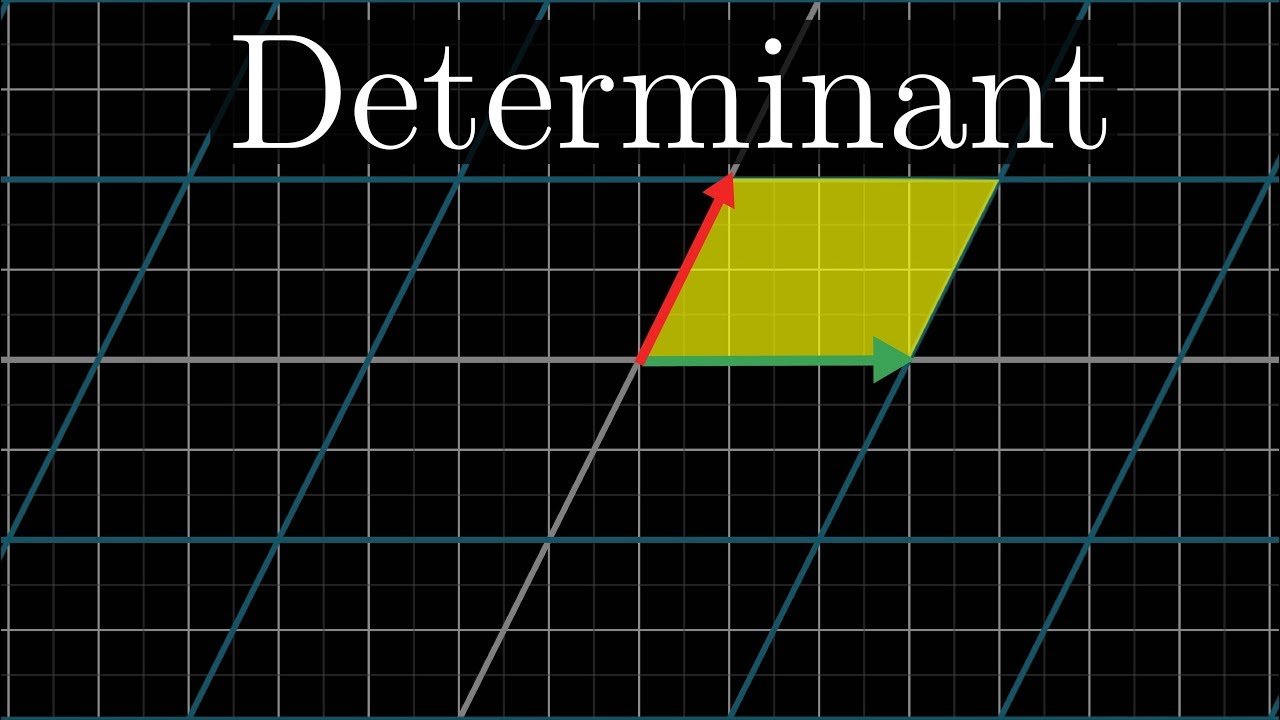
The determinant measures how much volumes change during a transformation.
Help fund future projects: https://www.patreon.com/3blue1brown
An equally valuable form of support is to simply share some of the videos.
Home page: https://www.3blue1brown.com/
Full series: http://3b1b.co/eola
Future series like this are funded by the community, throug...
waxen hawk
paper depot
i think i will link 3b1b's video
That's totally what i need.
waxen hawk
paper depot
https://youtu.be/Ip3X9LOh2dk
my old love
paper depot
there's another angle for it:
when solving the system by e.g. Cramer's rule, the determinant of the coefficient matrix will appear in the denominator. so when det(A) isn't zero you are guaranteed exactly one solution.
otherwise you will have either no solutions or at least two
but if there's two different solutions there's at least an entire LINE of them
waxen hawk
I cannot follow, I cleary have forgotten everything about cramer's rule.
paper depot
i will say watch the video
but also this is a very deep question and good job for asking it in the first place
 left portal
could a matrix be though as A ∈ R3x3 and x ∈ R^3 and b ∈ R^3, where the system of equations of the first picture is Ax = b, and then, could it be said that a linear transformation f(x) be represented with matrix multiplication as f(x) = Ax where A is the matrix representation of f and then, if det(A) ≠ 0 then f is injective, and thus, it has unique solution? or is this incorrect or using too much machinery?
maybe I am tripping though
vocal sleetBOT
@waxen hawk Has your question been resolved?
vocal sleetBOT
Channel closed
Closed due to timeout
Use .reopen if this was a mistake.
vocal sleetBOT
Available help channel!
Send your question here to claim the channel.
Remember:
• Ask your math question in a clear, concise manner.
• Show your work, and if possible, explain where you are stuck.
• After 15 minutes, feel free to ping <@&286206848099549185>.
• Type the command .close to free the channel when you're done.
• Be polite and have a nice day!
Read #❓how-to-get-help for further information on how to ask a good question, and about conduct in the question channels.
vocal sleetBOT
 prisma fjord
anyways.
prisma fjord
anyways.

 silk rampart
ur missing nothing
prisma fjord
silk rampart
ur missing nothing
whats c
silk rampart
idk
prisma fjord
wheres it from
silk rampart
if there's no data given
prisma fjord
silk rampart
idk
clearly me neither
silk rampart
the statement can be disregarded
silk rampart
oh wait
In mathematics, the mean value theorem (or Lagrange's mean value theorem) states, roughly, that for a given planar arc between two endpoints, there is at least one point at which the tangent to the arc is parallel to the secant through its endpoints. It is one of the most important results in real analysis. This theorem is used to prove statemen...
there you go

 prisma fjord
 peak matrix
what is mean value?
prisma fjord
peak matrix
name of the theorem
mhm.
prisma fjord
peak matrix
oh, mean value is also like an average value
mhm i see.
so for an f(x), there exists value c between a and b (inclusive) for which the integral of f(x) from b to a is f(c)(b-a)
but thats...
peak matrix
f has to be continuous tho
prisma fjord
dumb
peak matrix
why is it dumb?
prisma fjord
because, you are telling me
for f(x)=0 there is a result
well ofc there is
that given c, we dont know it tho.
peak matrix
prisma fjord
that given c, we dont know it tho.
Yeah, but we know that there is such a c
prisma fjord
peak matrix
Yeah, but we know that there is such a c
where is it useful?
peak matrix
its pretty useful theorem
peak matrix
prisma fjord
where is it useful?
Almost everywhere actually. This theorem basically captures our geometric intuition about integrals. Yeah, the theorem looks obvious, but it gives us a way to express what's obvious to us in formal language
pretty much everywhere, where we need to argue using our geometric intuition about integrals, we can use this theorem
prisma fjord
peak matrix
Almost everywhere actually. This theorem basically captures our geometric intuit...
thats what i was meaning, yes.
peak matrix
prisma fjord
c, isnt known.
Yeah, but you can compute it sometimes
prisma fjord
mhm thank you
prisma fjord
peak matrix
i mean f(c) is the mean value
but thats... the integral divided by the range
peak matrix
i.e. integral / (a-b)
peak matrix
prisma fjord
but thats... the integral divided by the range
Yes
prisma fjord
peak matrix
Yes
is there a way to find this c, without approximations?
peak matrix
What this theorem allows you to conclude is that this mean value appears somewhere on the graph
peak matrix
prisma fjord
is there a way to find this c, without approximations?
by computing that integral
mean value theorem isnt really helpful for computing integrals btw
prisma fjord
peak matrix
by computing that integral
but then i know the integral...
prisma fjord
peak matrix
mean value theorem isnt really helpful for computing integrals btw
i see.
peak matrix
mean value theorem is extremely helpful for proving other theorems about integral tho
prisma fjord
oh
damn thats interesting.
so the idea, is that if we have some mx+b, lets say its x+1
then some x exists, which times the range, results the integral
it is indeed a proof of some sort.
peak matrix
prisma fjord
then some x exists, which times the range, results the integral
*x exists, such that f(x) times the range results in the integral
prisma fjord
peak matrix
*x exists, such that f(x) times the range results in the integral
yes, sorry, my bad.
are there more convenient integral rules?
peak matrix
Are you learning calculus or real analysis?
prisma fjord
peak matrix
Are you learning calculus or real analysis?
not officially learning anything. so give me both.
peak matrix
Well, for calculus, you only need the stuff such as integration by parts, u-sub, trig sub, ...
calculus is mostly about computing integrals
real analysis on the other hand provides a more rigorous settings
it's more about proving theorems about integrals
prisma fjord
peak matrix
calculus is mostly about computing integrals
i dont want to get an estimate value, i want exact!
prisma fjord
peak matrix
it's more about proving theorems about integrals
give me real analysis here
peak matrix
prisma fjord
i dont want to get an estimate value, i want exact!
Calculus computes the exact values
prisma fjord
i need the why
peak matrix
calculus might suffice for that honestly, calculus gives basic non-rigorous proofs which are however easy to understand
prisma fjord
peak matrix
Calculus computes the exact values
i need the whys answered
peak matrix
Anyway, if you wanna learn real analysis, try the book "Understanding analysis" by Stephen Abott
it's a pretty good book, easier to understand than most of the rest
prisma fjord
peak matrix
Anyway, if you wanna learn real analysis, try the book "Understanding analysis" ...
mhm.
peak matrix
but I'd only recommend it if you have already taken some proof-based course
prisma fjord
peak matrix
it's a pretty good book, easier to understand than most of the rest
written down.
prisma fjord
peak matrix
but I'd only recommend it if you have already taken some proof-based course
minimal but yes
peak matrix
this is for calculus
it's more interactive, has videos, articles, exercises
and it also has proofs
prisma fjord
peak matrix
https://www.khanacademy.org/math/ap-calculus-bc
📝 🤔
peak matrix
not 100% rigorous ones, but they give you the sufficient intuition
and one more link
Mathematics with a distinct visual perspective. Linear algebra, calculus, neural networks, topology, and more.
this one
prisma fjord
peak matrix
not 100% rigorous ones, but they give you the sufficient intuition
i want solid proofs
prisma fjord
peak matrix
https://www.3blue1brown.com/topics/calculus
the guy is that famous?
peak matrix
prisma fjord
i want solid proofs
Then do real analysis, but it's gonna be tough.
peak matrix
prisma fjord
the guy is that famous?
He is pretty famous I'd say
prisma fjord
peak matrix
Then do real analysis, but it's gonna be tough.
if its interesting its not tough!
peak matrix
prisma fjord
if its interesting its not tough!
well, its sometimes interesting
sometimes its just boring
imo
prisma fjord
peak matrix
well, its sometimes interesting
ill learn it all if its the problem.
peak matrix
my personal biased opinion is that proof based calculus is more interesting
prisma fjord
peak matrix
my personal biased opinion is that proof based calculus is more interesting
i want the deepest understanding, uk?
peak matrix
peak matrix
https://www.3blue1brown.com/topics/calculus
This doesnt teach you how to compute integrals and derivatives, but it gives you an amazing intuition
prisma fjord
i dont want to stop at calculating
peak matrix
prisma fjord
i want the deepest understanding, uk?
Yeah, youll need real analysis then
prisma fjord
peak matrix
Yeah, youll need real analysis then
mhm. on it.
peak matrix
I'd do it in this order:
Khan academy supplied by 3b1b's vids (always watch 3b1b before doing the topic, then do the topic on khan academy)
and after that, real analysis
prisma fjord
do you recommend doing set theory?
peak matrix
it should take like 9 months btw
peak matrix
prisma fjord
do you recommend doing set theory?
depends on what's your goal
you'll certainly need some basic set theory
in any proof based course
up to cardinality at least
prisma fjord
peak matrix
depends on what's your goal
learning the deepest math concepts
prisma fjord
peak matrix
deepest is quite vague
i agree yes, but i want the base of it all
peak matrix
then the more complicated set theory is connected to the foundations
prisma fjord
i saw set theory as proof for many things, so thats why.
peak matrix
together with logic, set theory provides the foundation all of math is built on
peak matrix
prisma fjord
i saw set theory as proof for many things, so thats why.
Yeah, set theory is the foundation of all of math basically
thats why i said youll certainly need some of it
prisma fjord
peak matrix
Yeah, set theory is the foundation of all of math basically
how deep are these foundations?
how long till ill reach there?
peak matrix
prisma fjord
how deep are these foundations?
You can go as deep as you want
peak matrix
prisma fjord
how long till ill reach there?
There is too much mathematics to fully understand even one of its fields at this point
prisma fjord
peak matrix
There is too much mathematics to fully understand even one of its fields at this...
good! ill learn as much as i can then!
i took a 1 month break off learning, made me miss math a lot.
sounds funny to me. my math experience is traumatic and sad, but here i am, in love with math.
and this?

f(g(x)) = whatever
vocal sleetBOT
@prisma fjord Has your question been resolved?
vocal sleetBOT
@prisma fjord Has your question been resolved?
vocal sleetBOT
@prisma fjord Has your question been resolved?
vocal sleetBOT
@prisma fjord Has your question been resolved?
vocal sleetBOT
@prisma fjord Has your question been resolved?
vocal sleetBOT
Channel closed
Closed by @prisma fjord
Use .reopen if this was a mistake.
vocal sleetBOT
Available help channel!
Send your question here to claim the channel.
Remember:
• Ask your math question in a clear, concise manner.
• Show your work, and if possible, explain where you are stuck.
• After 15 minutes, feel free to ping <@&286206848099549185>.
• Type the command .close to free the channel when you're done.
• Be polite and have a nice day!
Read #❓how-to-get-help for further information on how to ask a good question, and about conduct in the question channels.
 sweet mural
Hi, a q on linear algebra
vocal sleetBOT
sweet mural
Hi, a q on linear algebra
sweet mural
By definition a basis for a vectorspace is a set that is 1. linearly independent, and 2. spans the vectorspace
Can I prove a set is a basis of the vectorspace by proving it is 1. linearly independent and 2. has same dimension as the vectorspace?
 tranquil trellis
Yes
 hard atlas
well the set doesnt have that dimension
the number of elements in the set has to be the dimension
sweet mural

My thoughts for this are
consider basis of V
by proof in (1), {Tv1, ... , Tvk} is also linearly independent
using the fact T is surjective and injective, and the rank nullity theorem I proved Dim(W) = Dim(V)
wait hold up my brain doesn't know what it is saying
hard atlas
(nothing says that V and W are finite dim)
hard atlas
you could also just prove the corresponding claim for spanning
sweet mural
You are right
sweet mural
I just wanted to know if there are other options out there since ive done the spanning thing a lot of times already
hard atlas
for finite dim
 vocal sleetBOT
Channel closed
Closed by @sweet mural
Use .reopen if this was a mistake.
Available help channel!
Send your question here to claim the channel.
Remember:
• Ask your math question in a clear, concise manner.
• Show your work, and if possible, explain where you are stuck.
• After 15 minutes, feel free to ping <@&286206848099549185>.
• Type the command .close to free the channel when you're done.
• Be polite and have a nice day!
Read #❓how-to-get-help for further information on how to ask a good question, and about conduct in the question channels.
 woven vault
 vocal sleetBOT
woven vault
woven vault
vocal sleetBOT
woven vault
woven vault
any hints are welcome
T(2) = T(1) + 3 * 2 = 9
T(3) = T(2) +6 * 2 = 21
T(4) = 21 + 2 * 12 + 3 * 1 = 48
i tried to find some relation this way but i couldnt
vocal sleetBOT
@woven vault Has your question been resolved?
Channel closed
Closed by @woven vault
Use .reopen if this was a mistake.
Available help channel!
Send your question here to claim the channel.
Remember:
• Ask your math question in a clear, concise manner.
• Show your work, and if possible, explain where you are stuck.
• After 15 minutes, feel free to ping <@&286206848099549185>.
• Type the command .close to free the channel when you're done.
• Be polite and have a nice day!
Read #❓how-to-get-help for further information on how to ask a good question, and about conduct in the question channels.
crisp zenith
trying to prove the conversely part, did some scratch work and i’m wondering if what I have is generally right
vocal sleetBOT
crisp zenith
trying to prove the conversely part, did some scratch work and i’m wondering if ...
crisp zenith

want to prove that if a is congruent to b mod n then they have the same remainder
here is an online answer which took a different approach and im wondering if my answer is also valid
"Conversely suppose 𝑛∣(𝑎−𝑏). Then 𝑎=𝑏+𝑛𝑘 for some integer 𝑘.
By the division algorithm, 𝑏=𝑞𝑛+𝑟 for some integers 𝑞 and 0≤𝑟<𝑛. Putting this value of 𝑏 into above 𝑎=𝑏+𝑛𝑘=(𝑞𝑛+𝑟)+𝑛𝑘=(𝑞+𝑘)𝑛+𝑟, so 𝑟 is also the remainder of 𝑎 divided by 𝑛."
tranquil trellis
You need to mention that $0 \leq v < n$
twin meteorBOT
Ari
 tranquil trellis
and also for c
Your equation $n(q-z) + v - c = nx$ doesn't tell you $v -c = 0$. It tells you that $v-c$ is divisible by $n$. So you need that inequality as a condition.
twin meteorBOT
Ari
 crisp zenith
tranquil trellis
Your equation $n(q-z) + v - c = nx$ doesn't tell you $v -c = 0$. It tells you th...
crisp zenith
tranquil trellis
Your equation $n(q-z) + v - c = nx$ doesn't tell you $v -c = 0$. It tells you th...
im confused at the part where you say that the equation doesnt tell me v - c = 0, whys that
wouldnt it have to be 0 if a - b is divisible by n
tranquil trellis
crisp zenith
wouldnt it have to be 0 if a - b is divisible by n
If you're assuming v and c are remainders, then yes
crisp zenith
oh are u saying I need to state that
tranquil trellis
yes
crisp zenith
ok thank you
wait idk if what I have is right
@tranquil trellis why would it be that v - c - 0?
if v -c appeared on the right size then it would make sense
but since its on the left side theres no rule that it has to be 0 right
a - b = n(q-z) + v - c
a - b = nx
n(q-z) + v - c = nx
what tells us that v - c should be 0 here again?
tranquil trellis
v - c = n(x - q + z), where 0 <= v, c < n
n | (v - c)
If 0 <= v, c < n, then
-(n-1) <= v - c <= n-1
so it has to be 0
crisp zenith
how did you get this part
-(n-1) <= v - c <= n-1
tranquil trellis
$0 \leq v, c \leq n-1$
twin meteorBOT
Ari
 tranquil trellis
So the maximum possible difference for $v-c$ is the maximum value of $v$ subtracted by the minimum value of $c$, which is $n-1$
twin meteorBOT
Ari
 tranquil trellis
And similar logic for the lower bound
crisp zenith
ok I see how you got -(n-1) <= v - c <= n-1 now
but im struggling to see how that implies v - c = 0
oh
wait
because
ehh nvm
tranquil trellis
What values in the set ${-(n-1), \dots, n-1}$ are divisible by $n$
twin meteorBOT
Ari
 tranquil trellis
only 0 right
tranquil trellis

crisp zenith
.close
vocal sleetBOT
Channel closed
Closed by @crisp zenith
Use .reopen if this was a mistake.
vocal sleetBOT
Available help channel!
Send your question here to claim the channel.
Remember:
• Ask your math question in a clear, concise manner.
• Show your work, and if possible, explain where you are stuck.
• After 15 minutes, feel free to ping <@&286206848099549185>.
• Type the command .close to free the channel when you're done.
• Be polite and have a nice day!
Read #❓how-to-get-help for further information on how to ask a good question, and about conduct in the question channels.
 hazy marlin
 vocal sleetBOT
hazy marlin
vocal sleetBOT
hazy marlin

 flat whale
hazy marlin
did i make a mistake
flat whale
hazy marlin
did i make a mistake
-1 + 12 = ?
vocal sleetBOT
@hazy marlin Has your question been resolved?
Channel closed
Closed by @hazy marlin
Use .reopen if this was a mistake.
Available help channel!
Send your question here to claim the channel.
Remember:
• Ask your math question in a clear, concise manner.
• Show your work, and if possible, explain where you are stuck.
• After 15 minutes, feel free to ping <@&286206848099549185>.
• Type the command .close to free the channel when you're done.
• Be polite and have a nice day!
Read #❓how-to-get-help for further information on how to ask a good question, and about conduct in the question channels.
 shadow berry
Is the r correct?
 vocal sleetBOT
shadow berry
Is the r correct?
flat whale
shadow berry
Is the r correct?
vocal sleetBOT
shadow berry
Is the r correct?
flat whale
shadow berry
Is the r correct?
Show the formula for r that you're following
 flat whale
Wut
 flat whale
shadow berry
Is the r correct?
flat whale
shadow berry
Is the r correct?
Looks fine if your sums are correct
shadow berry
flat whale
Looks fine if your sums are correct
really? ok
flat whale
shadow berry
really? ok

Calculator Online
The calculator shows step-by-step calculations of the correlation coefficients from the data.
Check your work here
 edgy gulch
shadow berry
Is the r correct?
edgy gulch
shadow berry
Is the r correct?
how is sum of y² 362
seems awfully low for your y values
twin meteorBOT

 Requested by downbadhoshiyomi
edgy gulch
Requested by downbadhoshiyomi
edgy gulch
^ is power
shadow berry
hmm
edgy gulch
5^2 = 5 * 5
shadow berry
this one?
 edgy gulch
* is multiply yes
shadow berry
alright
 ripe cedar
shadow berry
w?
ripe cedar
shadow berry
w?
The w is part of the command
,w to bring up wolframalpha it seems
edgy gulch
shadow berry
Is the r correct?
also i think you miswrote sum of xy
,w 1(12) + 2(25) + 3(18) + 4(10) + 5(15) + 6(22)
twin meteorBOT
 Requested by downbadhoshiyomi
vocal sleetBOT
Requested by downbadhoshiyomi
vocal sleetBOT
@shadow berry Has your question been resolved?
vocal sleetBOT
Channel closed
Closed due to timeout
Use .reopen if this was a mistake.
Available help channel!
Send your question here to claim the channel.
Remember:
• Ask your math question in a clear, concise manner.
• Show your work, and if possible, explain where you are stuck.
• After 15 minutes, feel free to ping <@&286206848099549185>.
• Type the command .close to free the channel when you're done.
• Be polite and have a nice day!
Read #❓how-to-get-help for further information on how to ask a good question, and about conduct in the question channels.
hazy marlin
how do i do this
 vocal sleetBOT
hazy marlin
how do i do this
hazy marlin
vocal sleetBOT
hazy marlin
how do i do this
hazy marlin
b)
how do i make sure it's a unit vector?
cuz i usually do v = [x,y,z] then do cross product
how do i make sure it's a unit vector
 scenic ravine
,rccw
twin meteorBOT
 vast shale
hazy marlin
how do i do this
vast shale
hazy marlin
how do i do this
13 ?
vast shale
hazy marlin
cuz i usually do v = [x,y,z] then do cross product
That’ll work I guess
vast shale
scenic ravine
You divide the vector by its magnitude
Yes
vocal sleetBOT
@hazy marlin Has your question been resolved?
 vocal sleetBOT
Channel closed
Closed due to timeout
Use .reopen if this was a mistake.
Available help channel!
Send your question here to claim the channel.
Remember:
• Ask your math question in a clear, concise manner.
• Show your work, and if possible, explain where you are stuck.
• After 15 minutes, feel free to ping <@&286206848099549185>.
• Type the command .close to free the channel when you're done.
• Be polite and have a nice day!
Read #❓how-to-get-help for further information on how to ask a good question, and about conduct in the question channels.
 woven cradle
I mainly need help figuring out a and b
 vocal sleetBOT
woven cradle
I mainly need help figuring out a and b
vocal sleetBOT
woven cradle
I mainly need help figuring out a and b
 kind light
woven cradle
I mainly need help figuring out a and b
kind light
woven cradle
I mainly need help figuring out a and b
gind WOE=arc(WE) and arc(WIE)=360-arc(WE)
 vocal sleetBOT
@woven cradle Has your question been resolved?
Channel closed
Closed by @woven cradle
Use .reopen if this was a mistake.
Available help channel!
Send your question here to claim the channel.
Remember:
• Ask your math question in a clear, concise manner.
• Show your work, and if possible, explain where you are stuck.
• After 15 minutes, feel free to ping <@&286206848099549185>.
• Type the command .close to free the channel when you're done.
• Be polite and have a nice day!
Read #❓how-to-get-help for further information on how to ask a good question, and about conduct in the question channels.
 karmic glen
 vocal sleetBOT
karmic glen
karmic glen
vocal sleetBOT
karmic glen
karmic glen
How is this wrong?
The vector should be around 6000
I used the bearing of 90 degrees to get the 57 degrees
Since 35 + 22 = 57
Then used law of cosine
I thought the resultant vector should be a value in-between the two other vectors
vocal sleetBOT
@karmic glen Has your question been resolved?
paper depot
karmic glen
How is this wrong?
you're finding the difference of the two force vectors instead of the sum
you actually have not drawn the resultant vector here at all yet
vocal sleetBOT
Channel closed
Closed due to timeout
Use .reopen if this was a mistake.
vocal sleetBOT
Available help channel!
Send your question here to claim the channel.
Remember:
• Ask your math question in a clear, concise manner.
• Show your work, and if possible, explain where you are stuck.
• After 15 minutes, feel free to ping <@&286206848099549185>.
• Type the command .close to free the channel when you're done.
• Be polite and have a nice day!
Read #❓how-to-get-help for further information on how to ask a good question, and about conduct in the question channels.
 shy sleet
This is borderline math but can someone just quickly tell me which Light bulbs are in parralel, I think the 3 obvious ones but my teacher says all of them for some reason
 vocal sleetBOT
shy sleet
This is borderline math but can someone just quickly tell me which Light bulbs a...
vocal sleetBOT
shy sleet
This is borderline math but can someone just quickly tell me which Light bulbs a...
 novel cliff
um
lets say the top one is A, the middle one is B, the bottom one is C, and the side one is D
A is in parallel with B is in parallel with C+D
shy sleet
novel cliff
A is in parallel with B is in parallel with C+D
I can see its in parallel with C but how d?
If you remove C, D wouldnt light up
novel cliff
usually a diagram like these you just trace from the positive to the negative
novel cliff
shy sleet
If you remove C, D wouldnt light up
that is the point
C AND D are parallel to A and are parallel to B
C and D themselves are in series
but combined, they are in parallel
removing A or B does not affect C AND D and they still light up
shy sleet
Alright
Thx
So if you can remove one but the other will still light up thye are parallel?
novel cliff
not neccessarily, think it this way:
IF you remove A, a set of light bulbs E,F,G,H,J still lights up
E,F,G,H,J COULD form series between them, but combined together, they MUST be parallel to A
novel cliff
it is not a sketch that is important, but the concept
let's say:
in a circuit there is light bulb A and B
if you remove A, B still lights up, you would agree that A and B are in parallel right?
shy sleet
yes
novel cliff
now if you were to replace B with light bulbs C and D
IF you remove A, C and D still lits up right?
shy sleet
yes
novel cliff
and due to the definition of a parallel circuit, C and D are thus parallel to A
shy sleet
yes
shy sleet
Why arent they indivisually parralel
vocal sleetBOT
@shy sleet Has your question been resolved?
vocal sleetBOT
Channel closed
Closed due to timeout
Use .reopen if this was a mistake.
Available help channel!
Send your question here to claim the channel.
Remember:
• Ask your math question in a clear, concise manner.
• Show your work, and if possible, explain where you are stuck.
• After 15 minutes, feel free to ping <@&286206848099549185>.
• Type the command .close to free the channel when you're done.
• Be polite and have a nice day!
Read #❓how-to-get-help for further information on how to ask a good question, and about conduct in the question channels.
 jagged cargo
 vocal sleetBOT
jagged cargo
jagged cargo
vocal sleetBOT
jagged cargo
jagged cargo
i managed to reduce AB into the following
$AB = 2019\begin{bmatrix}I_3 & -I_3\-I_3 & I_3\end{bmatrix}$
twin meteorBOT
 jagged cargo
but from here i'm not sure how to compute BA
novel cliff
It looks to me that one possible combination is
A
[2019,0,0]
[0,2019,0]
[0,0,2019]
[-2019,0,0]
[0,-2019,0]
[0,0,-2019]
         B
 [1,0,0,-1,0,0]
 [0,1,0,0,-1,0]
 [0,0,1,0,0,-1]
in this case, BA will be:
[4038,0,0]
[0,4038,0]
[0,0,4038]
I am not sure if this is a unique solution or if there is more than 1 solutions
And there probably is a smarter way to do this rather than eyeballing it
vocal sleetBOT
@jagged cargo Has your question been resolved?
vocal sleetBOT
@jagged cargo Has your question been resolved?
vocal sleetBOT
Channel closed
Closed due to timeout
Use .reopen if this was a mistake.
vocal sleetBOT
Available help channel!
Send your question here to claim the channel.
Remember:
• Ask your math question in a clear, concise manner.
• Show your work, and if possible, explain where you are stuck.
• After 15 minutes, feel free to ping <@&286206848099549185>.
• Type the command .close to free the channel when you're done.
• Be polite and have a nice day!
Read #❓how-to-get-help for further information on how to ask a good question, and about conduct in the question channels.
 eager forum
Confused with this part of the definition of a functor. Seems like gf would be a mapping from X to Z and F2 is supposed to take maps from X to Y but here we see gf as an input for F2. What am I missing?
 vocal sleetBOT
eager forum
Confused with this part of the definition of a functor. Seems like gf would be a...
vocal sleetBOT
eager forum
Confused with this part of the definition of a functor. Seems like gf would be a...
@eager forum Has your question been resolved?
 obsidian stream
This isn't really my area of mathematics so I am probably talking out of my butt, but the way I read that notation, I would interpret that as a mapping between mappings from A to A' and that it would only make sense if Z were an element of A.
flat whale
eager forum
Confused with this part of the definition of a functor. Seems like gf would be a...
#advanced-algebra is also a good place to ask
vocal sleetBOT
Channel closed
Closed due to timeout
Use .reopen if this was a mistake.
Available help channel!
Send your question here to claim the channel.
Remember:
• Ask your math question in a clear, concise manner.
• Show your work, and if possible, explain where you are stuck.
• After 15 minutes, feel free to ping <@&286206848099549185>.
• Type the command .close to free the channel when you're done.
• Be polite and have a nice day!
Read #❓how-to-get-help for further information on how to ask a good question, and about conduct in the question channels.
 near finch
Could somebody check if number 10 is correct I’m just not confident if the “for when “ part
 vocal sleetBOT
near finch
Could somebody check if number 10 is correct I’m just not confident if the “for ...
near finch
vocal sleetBOT
near finch
Could somebody check if number 10 is correct I’m just not confident if the “for ...
near finch
I only need (n) right not (n-1) since my firsg value is 0?
 fathom perch
near finch
Could somebody check if number 10 is correct I’m just not confident if the “for ...
fathom perch
near finch
Could somebody check if number 10 is correct I’m just not confident if the “for ...
the statement f(n) = f(n-1) * 2 is valid for all values of n (i.e., n belongs to R)
so the for when part is incorrect
vast shale
fathom perch
the statement f(n) = f(n-1) * 2 is valid for all values of n (i.e., n belongs to...
i think recursrive equations are better expressed in N
near finch
fathom perch
the statement f(n) = f(n-1) * 2 is valid for all values of n (i.e., n belongs to...
So would it be 1 instead of 5
near finch
vast shale
i think recursrive equations are better expressed in N
Wdym
vast shale
near finch
Wdym
executor means f(n) = 2 * f(n-1) is true for any real n
vast shale
near finch
I still don’t understand what your trying to say
what it means is that the function isn't defined properly
it should be f:N-->N in this case
near finch
I still don’t understand what part your saying is wrong
vast shale
near finch
I still don’t understand what part your saying is wrong
your solution is 
but it depends on your class/grade
fathom perch
vast shale
i think recursrive equations are better expressed in N
Oh true
wait, N or Z?
near finch
vast shale
but it depends on your class/grade
It’s 10/11th grade
vast shale
fathom perch
wait, N or Z?
usually recurive equations are used to define sequences which are only valid in N
most commonly
near finch
I’m just don’t know if I should use (n-1) or (n)
vast shale
near finch
It’s 10/11th grade
your solution is fine
vast shale
near finch
I’m just don’t know if I should use (n-1) or (n)
what do you mean
use anything you want
near finch
Because for an example for a expldoed arthmetic equation for when the first step is 0 they used only n and not (n-1)
fathom perch
vast shale
usually recurive equations are used to define sequences which are only valid in ...
oh interesting thanks for telling me, I hadn't formally learnt about this
vast shale
near finch
Because for an example for a expldoed arthmetic equation for when the first step...
wdym
i am not getting what u are trying to say
near finch
vast shale
use anything you want
So should my equation be f(n)=f(n)•2 or f(n)=f(n-1)•2
vast shale
$f(n) = 4 \cdot 2^{n-5}$ \
$f(n+1) = 4 \cdot 2^{n+1 - 5} = 4 \cdot 2 \cdot 2^{n-5} = 2 \cdot f(n)$
 dull bear
near finch
Because for an example for a expldoed arthmetic equation for when the first step...
dull bear
near finch
Because for an example for a expldoed arthmetic equation for when the first step...
(Do you mean explicit there?  )
)
fathom perch
near finch
So should my equation be f(n)=f(n)•2 or f(n)=f(n-1)•2
? how would f(n) = f(n)* 2
vast shale
near finch
So should my equation be f(n)=f(n)•2 or f(n)=f(n-1)•2
you mean f(n+1) = f(n). 2?
near finch
fathom perch
? how would f(n) = f(n)* 2
Idk 😭
I’m on the second page of two packets well one was classwork and it’s been like 3 hours of work time
twin meteorBOT
radiantmath
 near finch
That also includes the making of a referance sheet
fathom perch
vast shale
you mean f(n+1) = f(n). 2?
I think this one should be more accurate in notation than f(n)= f(n-1)*2 since recursive functions are usually about finding the next term
vast shale
twin meteor
**radiantmath**
see this
vast shale
fathom perch
I think this one should be more accurate in notation than f(n)= f(n-1)*2 since r...
there's no difference in accuracy it's just preference
fathom perch
fathom perch
I think this one should be more accurate in notation than f(n)= f(n-1)*2 since r...
actually scratch that
doesnt matter
yeah
near finch
twin meteor
**radiantmath**
Thats not what I mean I talking about the f to the right of the equal sign not to the left
vast shale
near finch
Thats not what I mean I talking about the f to the right of the equal sign not t...
huh?
lemme
give you an alternative solution
vast shale
$f(n-1) =4 \cdot 2^{n-1-5} = 4 \cdot 2^{n-1} \cdot \frac{1}{2} = \frac{f(n)}{2}$ \
$\rightarrow 2 \cdot f(n-1) = f(n)$
twin meteorBOT
radiantmath
 vast shale
near finch
I think I’m confusing recursive and explicit
vast shale
near finch
I think I’m confusing recursive and explicit
the equation is recursive if it gives a new term using some combination of old terms
explicit is just a direct formula
near finch
I just don’t undestand why you have f(n-1) to the left of the equal sign
Oh wait
I see
vast shale
near finch
I just don’t undestand why you have f(n-1) to the left of the equal sign
oh you mean that, equal sign means equal
you can have it left or right
wherever you want
it's just the reflexive property of the equal sign
vocal sleetBOT
@near finch Has your question been resolved?
vocal sleetBOT
Channel closed
Closed due to timeout
Use .reopen if this was a mistake.
Available help channel!
Send your question here to claim the channel.
Remember:
• Ask your math question in a clear, concise manner.
• Show your work, and if possible, explain where you are stuck.
• After 15 minutes, feel free to ping <@&286206848099549185>.
• Type the command .close to free the channel when you're done.
• Be polite and have a nice day!
Read #❓how-to-get-help for further information on how to ask a good question, and about conduct in the question channels.
 quiet echo
Use Overleaf
No
There is a paid option but its not like the paid version does too much
I've never used it and it turns out fine
flat whale
just click the link
vocal sleetBOT
Channel closed
Closed by @chilly burrow
Use .reopen if this was a mistake.
Available help channel!
Send your question here to claim the channel.
Remember:
• Ask your math question in a clear, concise manner.
• Show your work, and if possible, explain where you are stuck.
• After 15 minutes, feel free to ping <@&286206848099549185>.
• Type the command .close to free the channel when you're done.
• Be polite and have a nice day!
Read #❓how-to-get-help for further information on how to ask a good question, and about conduct in the question channels.
 wanton bloom
Find a closed form for this:
The sum from i = 1 to i = inf of:
1/i^2
paper depot
$\sum_{k=1}^{\infty} \frac{1}{k^2}$?
twin meteorBOT
Ann
 paper depot
finding the value of this sum was known as the Basel problem.
wanton bloom
Yes.
paper depot
you can go look it up
wanton bloom
It it hard?
paper depot
well it requires some nontrivial hoop-jumping with like taylor expansions or something
there isn't much point regurgitating wikipedia or a video
so i encourage you to look it up yourself
the answer's pretty unexpected, that much i'll say
wanton bloom
Okay.
vocal sleetBOT
Channel closed
Closed by @wanton bloom
Use .reopen if this was a mistake.
wanton bloom
I will return tomorrow.
vocal sleetBOT
Available help channel!
Send your question here to claim the channel.
Remember:
• Ask your math question in a clear, concise manner.
• Show your work, and if possible, explain where you are stuck.
• After 15 minutes, feel free to ping <@&286206848099549185>.
• Type the command .close to free the channel when you're done.
• Be polite and have a nice day!
Read #❓how-to-get-help for further information on how to ask a good question, and about conduct in the question channels.
 magic crescent
could someone mark this please
 vocal sleetBOT
magic crescent
could someone mark this please
vast shale
vocal sleetBOT
magic crescent
could someone mark this please
vast shale
Looks fine
outer warren
maybe 2 to 3 marks
surface area isn't correct
4pi r^2/2 only gives the curved area
but when the sphere is cut in half, there's another exposed surface
(the circle)
magic crescent
oh
outer warren
depending on generosity you may get a few marks for your algebra and application of volume after that initial mistake
vocal sleetBOT
@magic crescent Has your question been resolved?
Channel closed
Closed by @magic crescent
Use .reopen if this was a mistake.
Available help channel!
Send your question here to claim the channel.
Remember:
• Ask your math question in a clear, concise manner.
• Show your work, and if possible, explain where you are stuck.
• After 15 minutes, feel free to ping <@&286206848099549185>.
• Type the command .close to free the channel when you're done.
• Be polite and have a nice day!
Read #❓how-to-get-help for further information on how to ask a good question, and about conduct in the question channels.
 oblique lark
i feel like i’m doing all the right steps but I keep getting the wrong answer :(
 vocal sleetBOT
oblique lark
i feel like i’m doing all the right steps but I keep getting the wrong answer :(
oblique lark
vocal sleetBOT
oblique lark
i feel like i’m doing all the right steps but I keep getting the wrong answer :(
oblique lark
can someone help me out step by step with solving for the work? 🙏🏽
oblique lark
well F=ma so I plugged in 80 and 9.8 to get a force of 784
and then i do the integral to figure out the work. from 0 to 4 (784x) dx
then i got 6272
then i do another integral but from 4 to 10 (784 * 4)
and then whatever i got from there i added to 6272 and got 25088
which is wrong 😭
fathom perch
This is not a good approach to these sorts of questions
oblique lark
ohh ok
oblique lark
btw i’m only in calc 2 so this was the way i was taught 💔
fathom perch
(If the work is done by a conservative force)
oblique lark
to do the work function that way
fathom perch
oblique lark
btw i’m only in calc 2 so this was the way i was taught 💔
Oh, I'm talking from a physics perspective idk how you would do this with math
fathom perch
fathom perch
Ui-Uf= work required
So you take a reference level
In this case the ground the chain is on
So Ui=0
And then when the chain is raised
We see by how much height the com of the chain part is raised
And find Uf
oblique lark
so Uf= 4?
fathom perch
Uf= mgh
oblique lark
ohhh
fathom perch
Not just h
oblique lark
so kind of like how W=mg * distance ?
fathom perch
But i don't think you should be doing my method if this is for calc  what's the method taught to you
fathom perch
oblique lark
so kind of like how W=mg * distance ?
Yep kinda except U is potential energy not work
oblique lark
lolll all they told me is F= mass * acceleration, and Work= F* distance
oblique lark
oblique lark
lolll all they told me is F= mass * acceleration, and Work= F* distance
ohh ok i see
but the when the force is variable i’m supposed to use an integral to find the work
i feel like i’m doing it right but i’m not sure anymore lol
fathom perch
Ok lets do it by integration then ditch the physics shit
(Tho the physics shit is much easier ngl)
oblique lark
one day i’ll learn the physics way 🙏🏽
fathom perch
Firstly the force would be mg
That's not variable
To find the work its integral of mgdx
fathom perch
Yes how would force be dependent on height?
 warped relic
why is the force Not variable
warped relic
fathom perch
Firstly the force would be mg
whats m here?
oblique lark
i thought it was the whole thing where as you lift it up it gets lighter?
fathom perch
Oh wait yes it is variable but dependent on mass
oblique lark
sorry it’s hard to explain lol
fathom perch
Not height
oblique lark
ohhhh
fathom perch
warped relic
why is the force Not variable
Tyty
warped relic
nw
oblique lark
brb one sec 🙏🏽
fathom perch
fathom perch
Oh wait yes it is variable but dependent on mass
So to find the mass as a function of height (x)
fathom perch
What's a catenary
warped relic
the shape formed when
fathom perch
Ok i looked it up
warped relic
a chain, or wire, or rope is hanging from two ends
fathom perch
Its not that
warped relic
why not
fathom perch
They are assuming the chain is straight throughout
Otherwise the qn would be ridiculous
warped relic
right triangle..?
oblique lark
i’m back
fathom perch
In most chain problems they assume its straight
warped relic
that makes this so much less interesting
fathom perch
warped relic
right triangle..?
Yep
fathom perch
warped relic
that makes this so much less interesting
And so much more doable
warped relic
true
oblique lark
the easier the better 🙏🏽🥲
fathom perch
We need to firstly find the mass distribution of the chain
oblique lark
ohhh
fathom perch
And i already said force here doesn't depend on height, only on mass so x would not be there
fathom perch
fathom perch
We need to firstly find the mass distribution of the chain
Know how to do that?
fathom perch
Yes
Ok so one physics thing you need to know about chain problems is COM
All the weight of a chain is assumed to be acting at its COM
Are you aware of the concept
fathom perch
Center of mass
oblique lark
ohh, i’m not really familiar
fathom perch
Well see basically to find m=f(x) we need to assume that when the chain is lifted all the weight of the lifted part acts at a point on the midpoint of the lifted part
Does that make sense?
warped relic
question is fucked up even after assuming a right triangle..
there's no way to find, the length of the lifted part
oblique lark
is the question that bad 😭
warped relic
maybe Im just dumb
fathom perch
warped relic
there's no way to find, the length of the lifted part
Why not
warped relic
but, every time I think of something, I hit a road block with this question
fathom perch
isnt it just integrate from 0 to 2
oblique lark
why 2?
fathom perch
oblique lark
so that midpoint is the com?
Yes
fathom perch
oblique lark
why 2?
Com
oblique lark
ohhhhhhhhh
oblique lark
fathom perch
To find m= f(x)
i dont fully understand this part tho
so the mass isn’t constant?
warped relic
yea centre of mass cannot be at half the height,
it will be half way through the length of the lifted part
fathom perch
No, the mass being lifted isnt constant
fathom perch
warped relic
yea centre of mass cannot be at half the height,
it will be half way through th...
Is that not just half the height 
warped relic
🌚
fathom perch
Integrating it from 0 to 2
warped relic
fathom perch
Is that not just half the height <:sully:651816820122189834>
half the hypotenuse of the right triangle
not, half the perpendicular
4m is the perpendicular
now how do you figure out the length of the hypotenuse
oblique lark
so would it be 8*4 that i integrate?
warped relic
to get the height, of centre of mass
oblique lark
or am i still off
warped relic
God
fathom perch
warped relic
half the hypotenuse of the right triangle
The centre of mass of the part on the floor would not matter
Its virtually weightless for us
warped relic
Im talkimg about the lifted portion
to know the length of the lifted part, you need to know height of COM,
and to know heigjt of COM, you need the length of lifted part
okay I gotta bring out pen and paper for this shit
fathom perch
@oblique lark i think you should just try integrating mgdx where m= 8x
oblique lark
ok bet
fathom perch
Integrate it from x=0 to 2
warped relic
 oblique lark
i got 16
warped relic
this is feels bad 🌚
warped relic
fathom perch
<@636349241442304043> i think you should just try integrating mgdx where m= 8x
:O we came up with the same thing
warped relic
fathom perch
Integrate it from x=0 to 2
except the bounds of integration...
why not go all the way
fathom perch
COM
warped relic
no reason to consider that
fathom perch
My soul won't let me not
fathom perch
oblique lark
i got 16
What
oblique lark
did i integrate wrong 💔
warped relic
the maximim height it's lifted to is h=4
fathom perch
fathom perch
What
8 X 9.8 X x, integrate it from 0 to 2
oblique lark
OHHH
warped relic
considering COM here would be a mistake..
fathom perch
Ok if it doesnt work with 0 to 2 try 0 to 4
warped relic
warped relic
plug this in and check
try
627.84 as well
in case your teacher prefers 9.81 to be g
oblique lark
yeah
fathom perch
According to me it should be 156.8
oblique lark
warped relic
yea just try 627.2 then
this was right lol