#help-17
1 messages · Page 49 of 1
 paper depot
is X the headcount of cows that give milk or is X the fraction of cows that produce milk?

@deep cliff
 deep cliff
paper depot
deep cliff
paper depot
oh that is 8.75 sorry for my bad hand writing
paper depot
you should cross your sevens so that this handwriting mishap doesn't happen.
and it also doesn't explain 8.33
where did 8.33 come from?
deep cliff
paper depot
where did 8.33 come from?
it came from 35 x 1/3 which ive put into the calculator wrong, its meant to be 11.67
paper depot
35*1/3 is 11.67 yes (if you're rounding to two decimal places)
deep cliff
deep cliff
it came from 35 x 1/3 which ive put into the calculator wrong, its meant to be 1...
i did this cos thats the amount of cows that would not produce milk
oh ok so thats wat seems to caused the problem
deep cliff
paper depot
35*1/3 is 11.67 yes (if you're rounding to two decimal places)
thank u
.close
 vocal sleetBOT
Channel closed
Closed by @deep cliff
Use .reopen if this was a mistake.
vocal sleetBOT
 Available help channel!
Send your question here to claim the channel.
Remember:
• Ask your math question in a clear, concise manner.
• Show your work, and if possible, explain where you are stuck.
• After 15 minutes, feel free to ping <@&286206848099549185>.
• Type the command .close to free the channel when you're done.
• Be polite and have a nice day!
Read #❓how-to-get-help for further information on how to ask a good question, and about conduct in the question channels.
 digital shell
how do i get f3
 digital shell
w is this calculated
i don'te ven have multiple channels
how is f3's magnitude calculated
vocal sleetBOT
@digital shell Has your question been resolved?
vocal sleetBOT
Channel closed
Closed due to timeout
Use .reopen if this was a mistake.
Available help channel!
Send your question here to claim the channel.
Remember:
• Ask your math question in a clear, concise manner.
• Show your work, and if possible, explain where you are stuck.
• After 15 minutes, feel free to ping <@&286206848099549185>.
• Type the command .close to free the channel when you're done.
• Be polite and have a nice day!
Read #❓how-to-get-help for further information on how to ask a good question, and about conduct in the question channels.
 wary mantle
Show that when six people meet, either three of them know each other pairwise or don't know each other.
vocal sleetBOT
wary mantle
Show that when six people meet, either three of them know each other pairwise or...
wary mantle
So one of the six people can either know two others or not know three others
In the second case, we have three (even four) that don't know each other
In the first case, we have three that know each other pairwise, don't we?
vocal sleetBOT
@wary mantle Has your question been resolved?
 hard atlas
just because the first guy doesnt know three others tells you nothing about how these three know/not know each other
wary mantle
wary mantle
Show that when six people meet, either three of them know each other pairwise or...
Oh. But couldn't we from the start say that this is true because it's "event OR counter event"
 crimson jetty
i would approach by drawing graphs
idk
like drawing
could probably brute force that way
hard atlas
yes
wary mantle
.close
vocal sleetBOT
Channel closed
Closed by @wary mantle
Use .reopen if this was a mistake.
Available help channel!
Send your question here to claim the channel.
Remember:
• Ask your math question in a clear, concise manner.
• Show your work, and if possible, explain where you are stuck.
• After 15 minutes, feel free to ping <@&286206848099549185>.
• Type the command .close to free the channel when you're done.
• Be polite and have a nice day!
Read #❓how-to-get-help for further information on how to ask a good question, and about conduct in the question channels.
wary mantle
 vocal sleetBOT
wary mantle
wary mantle
vocal sleetBOT
wary mantle
wary mantle
Determine x
We could say that a lenght increase of 5.5 corresponds to a height increase of 1.1
Thus, a length increase of 0.5 corresponds to a height increase of 0.1
And so x = 3.5
Is there an alternative way?
 astral shadow
Are those line segments parallel?
 boreal star
wary mantle
Is there an alternative way?
boreal star
wary mantle
Is there an alternative way?
Yes
 vast shale
whats the question?

 twin meteorBOT
 boreal star
Using similar triangles, you can try to solve for x, and then eventually y
 river flame
boreal star
Using similar triangles, you can try to solve for x, and then eventually y
river flame
boreal star
Using similar triangles, you can try to solve for x, and then eventually y
can we use integration. just asking
boreal star
I'm not sure how
wary mantle
astral shadow
Are those line segments parallel?
yes
wary mantle
twin meteor
,w 2.3/x=3.4/(5.5+x)=y/(6+x)
wary mantle
boreal star
Also, I don't think your approach gives the correct answer
My approach seems to give the correct answer, then
vocal sleetBOT
Channel closed
Closed by @wary mantle
Use .reopen if this was a mistake.
Available help channel!
Send your question here to claim the channel.
Remember:
• Ask your math question in a clear, concise manner.
• Show your work, and if possible, explain where you are stuck.
• After 15 minutes, feel free to ping <@&286206848099549185>.
• Type the command .close to free the channel when you're done.
• Be polite and have a nice day!
Read #❓how-to-get-help for further information on how to ask a good question, and about conduct in the question channels.
 toxic inlet
If y=ln(1+sinx) why e^y=1 +sin x
vocal sleetBOT
toxic inlet
If y=ln(1+sinx) why e^y=1 +sin x
hard atlas
well thats what ln does
vocal sleetBOT
Channel closed
Closed by @toxic inlet
Use .reopen if this was a mistake.
Available help channel!
Send your question here to claim the channel.
Remember:
• Ask your math question in a clear, concise manner.
• Show your work, and if possible, explain where you are stuck.
• After 15 minutes, feel free to ping <@&286206848099549185>.
• Type the command .close to free the channel when you're done.
• Be polite and have a nice day!
Read #❓how-to-get-help for further information on how to ask a good question, and about conduct in the question channels.
 undone cedar
does someone know how to solve this?
vocal sleetBOT
undone cedar
does someone know how to solve this?
 vocal sleetBOT
@undone cedar Has your question been resolved?
vocal sleetBOT
Channel closed
Closed due to timeout
Use .reopen if this was a mistake.
Available help channel!
Send your question here to claim the channel.
Remember:
• Ask your math question in a clear, concise manner.
• Show your work, and if possible, explain where you are stuck.
• After 15 minutes, feel free to ping <@&286206848099549185>.
• Type the command .close to free the channel when you're done.
• Be polite and have a nice day!
Read #❓how-to-get-help for further information on how to ask a good question, and about conduct in the question channels.
 lofty ivy
On this problem, I am able to understand the first proof forward, but to prove that T is injective since ST forms identity map on V, I'm confused as to how it says that 'a_m' makes sense.
 vocal sleetBOT
lofty ivy
On this problem, I am able to understand the first proof forward, but to prove t...
lofty ivy
vocal sleetBOT
lofty ivy
On this problem, I am able to understand the first proof forward, but to prove t...
lofty ivy
.close
vocal sleetBOT
Channel closed
Closed by @lofty ivy
Use .reopen if this was a mistake.
Available help channel!
Send your question here to claim the channel.
Remember:
• Ask your math question in a clear, concise manner.
• Show your work, and if possible, explain where you are stuck.
• After 15 minutes, feel free to ping <@&286206848099549185>.
• Type the command .close to free the channel when you're done.
• Be polite and have a nice day!
Read #❓how-to-get-help for further information on how to ask a good question, and about conduct in the question channels.
 humble flame
Hi, I wanna know if this is the right way to proceed in this problem


 mild flower
seems good to me 
humble flame
I did some further work I think I’m stuck
 vocal sleetBOT
@humble flame Has your question been resolved?
humble flame
<@&286206848099549185>
 spark storm
Almost got it, where do you think you got stuck
vocal sleetBOT
@humble flame Has your question been resolved?
vocal sleetBOT
Channel closed
Closed due to timeout
Use .reopen if this was a mistake.
Available help channel!
Send your question here to claim the channel.
Remember:
• Ask your math question in a clear, concise manner.
• Show your work, and if possible, explain where you are stuck.
• After 15 minutes, feel free to ping <@&286206848099549185>.
• Type the command .close to free the channel when you're done.
• Be polite and have a nice day!
Read #❓how-to-get-help for further information on how to ask a good question, and about conduct in the question channels.
vast shale
in the first two functions, when you sum everything up, how are you supposed to get the actual sum, if they are in the negative?
 vocal sleetBOT
vast shale
in the first two functions, when you sum everything up, how are you supposed to ...
vast shale
vocal sleetBOT
vast shale
in the first two functions, when you sum everything up, how are you supposed to ...
vast shale
when you do f(x) * delta x, but f(x) on one half is negative and on the other half it is positive, it will equal zero
but that's not the actual approximation of the area
and in the formula, there is no "absolute value of"

to clarify my question, the left part of the interval is negative, how can I calculate it with Riemann sums?
if I just sum everything up, it wouldn't equal the true value, would it?
if for example the area of [0,1] is - 2/3, and of [1, 2] is +4/3, how do I add sum these up in the sigma notation?
do I need to do something like --> |x|
mild flower
"area under a curve" is kind of a simplification of an integral
yes negative area is a thing and that's okay, that's intentional actually
vast shale
mild flower
"area under a curve" is kind of a simplification of an integral
yes negative are...
but when I put it into the calculator and it gives me something like 0.2, because it combines - and +, is that supposed to be the answer?
mild flower
the integral of x from -1 to 1 is 0
sometimes integrals cancel out and that's again fine and intentional
the stuff below the x-axis will be negative
mild flower
that's the "signed area" which is again often what we're actually looking for
eg if our curve represents velocity then the integral represents how much our position changed
vast shale
mild flower
eg if our curve represents velocity then the integral represents how much our po...
but what if I use a curve to model a mountain or something
do I then take the |x| value
mild flower
vast shale
but what if I use a curve to model a mountain or something
then it probably wouldn't be negative 
vast shale
yeah I guess, depending on where I put the 0=y
vast shale
mild flower
then it probably wouldn't be negative <:eeveeThink:601029006418116608>
thank you so much
.close
vocal sleetBOT
Channel closed
Closed by @celest warren
Use .reopen if this was a mistake.
Available help channel!
Send your question here to claim the channel.
Remember:
• Ask your math question in a clear, concise manner.
• Show your work, and if possible, explain where you are stuck.
• After 15 minutes, feel free to ping <@&286206848099549185>.
• Type the command .close to free the channel when you're done.
• Be polite and have a nice day!
Read #❓how-to-get-help for further information on how to ask a good question, and about conduct in the question channels.
 random totem
 vocal sleetBOT
random totem
random totem
vocal sleetBOT
random totem
random totem
I feel as though my second and third answers are correct but would the first function be considered neither?
vocal sleetBOT
@random totem Has your question been resolved?
vocal sleetBOT
@random totem Has your question been resolved?
 somber yew
1,2,4 are all wrong
random totem
What about them considers them wrong?
somber yew
Explain why you think they are right
random totem
I think that they are right since every element of the codomain is the image of at least one element from the domain for 1 and 4
and 2 i thought the opposite with the elements of the codomain being the image of at most one element from the domain
The only thing I can think of is that I got my meanings of injective and surjective flipped
somber yew
Wait, how are you reading that notation? How is 5 the image of an element in 1?
random totem


These are the two different way Im looking at it. Im guessing the first depiction of it would be wrong
random totem
 somber yew
All right, so surjective means that an arrow should arrive everywhere at the right side
And this is obviously not the case here
random totem
Oh so surjective is when every element is at least one from the domain?
somber yew
And injective means that there is at most one arrow arriving at each node on the right
random totem
So it isn't either of them essentially?
twin meteorBOT
_daili
 somber yew
Graphically it just means that an arrow should arrive at every element on the right
somber yew
If you have a question, you should ask your question in a separate help channel, this one is occupied
 somber yew
This is injective and surjective and therefore bijective
random totem
So bijective is when it is both?
somber yew
Surjective = an arrow arrives on every element at the right, injective: at most one arrow arrives at every element on the right
bijective is per definition injective and surjective
random totem
Ohhh makes sense haha my apologies
somber yew
Note that for two sets with equal finite size only injective is impossible
Then injective automatically implies bijective
Can you now see what the answers should be to the original questions?
random totem
yeah most definitely, I see the answers to the original question. so the first two are deemed neither whilst 4 is seen as bijective as well
Thank you very much
.close
vocal sleetBOT
Channel closed
Closed by @random totem
Use .reopen if this was a mistake.
vocal sleetBOT
Available help channel!
Send your question here to claim the channel.
Remember:
• Ask your math question in a clear, concise manner.
• Show your work, and if possible, explain where you are stuck.
• After 15 minutes, feel free to ping <@&286206848099549185>.
• Type the command .close to free the channel when you're done.
• Be polite and have a nice day!
Read #❓how-to-get-help for further information on how to ask a good question, and about conduct in the question channels.
 hybrid fossil
 vocal sleetBOT
hybrid fossil
hybrid fossil
vocal sleetBOT
hybrid fossil
hybrid fossil
how come h must be a part of [G, G]
gy g^-1 y^-1 = h for which g and y
also if for any h, h is in [G,G] then how is [G,G] any different from G
ahh wait i am dumb
h is in [G, G] by assumption lol
.close
vocal sleetBOT
Channel closed
Closed by @hybrid fossil
Use .reopen if this was a mistake.
Available help channel!
Send your question here to claim the channel.
Remember:
• Ask your math question in a clear, concise manner.
• Show your work, and if possible, explain where you are stuck.
• After 15 minutes, feel free to ping <@&286206848099549185>.
• Type the command .close to free the channel when you're done.
• Be polite and have a nice day!
Read #❓how-to-get-help for further information on how to ask a good question, and about conduct in the question channels.
 viral galleon
Why is this wrong
vocal sleetBOT
viral galleon
Why is this wrong

 floral pike
viral galleon
Why is this wrong
floral pike
viral galleon
Why is this wrong
you aren't making it clear what the question given to you was, but I don't think you integrated correctly from line 3 to line 4.
presumably line 3 is the question as it was given to you?
viral galleon
line 1-3 is the question
line 3 is just reformmated
because its over a cube
so u write out the triple integrals
the rpoblam was originally line 1-2
floral pike
ok so they said integrate in x, y and z over those intervals.
floral pike
looks like you integrated x and y wrong
viral galleon
i didnt integrate x and y
i integrated with respect to z
because u have to do inside first
floral pike
then why is there still the differential dz?
and why are the other two missing?
in line 4
viral galleon
because i didnt differentiate in that line
ok check
second to last line
and last line
thats where integration was done
floral pike
how can you say you didn't integrate
when you removed the integrals and the differentials for x and y?
viral galleon
bro...
u have to do
one at a time
its a triple integral
u cant do all at oncwe
i didnt remove it
floral pike
no kidding
viral galleon
im doing inside first
floral pike
if you are doing the inside first
(as you should)
why did you leave dz were it is?
and remove the other integrals?
they are supposed to stay untouched
viral galleon
to remind myself to differentiate with respect to z
floral pike
if you were integrating wrt z, you did it wrong
floral pike
you should have a factor of sine
viral galleon
so what i did wrong
i do...

ok forget the triple integral
just look at the inside
cuz thats the issue
according to online
i have to change
the interval
to y+pi
and y
for some reason
but i am not sure why
u see at the end
of integration
it was sin
not cos
i always thought integration at the end was simply f(b)-f(a)
but apparently this problem is not supposed to be that way
that is what im trying to understand
Maybe this makes it more clear

This is what i think
Answer is
floral pike
viral galleon
because you can consider the y variable a constant in the first integration, you can get away with just ignoring it in the integration (the result you got implies this, and you will learn this the more integration you do)
you still had two more integrations to do.

What you really want to do is hold onto the integrals you aren't using
Until you are ready to use them
This is the same advice I give students who are learning Algebra. If something hasn't changed or isn't getting moved, leave it alone
You can do work in the margins but avoid shortcuts that will confuse you later (like not writing parts of the integral you aren't working yet)
viral galleon
how did you go from line 2
to line 3
i am with u
on line 2
just dont understand
why line 3 is that instead of what i got
because it should be f(b)-f(a)
floral pike
viral galleon
because it should be f(b)-f(a)
I plugged 0 into z
viral galleon

is the logic that x^4 is supposed to stay on the outside when we do f(b)-f(a) since it is respect to z
floral pike
yeah as long as it is to the right of the integral wrt x
viral galleon
i dont understand
floral pike
viral galleon
i dont understand
...because you got rid of your other two integrals
viral galleon
we are doing wrt z so im confused
floral pike
yes, we are integrating with respect to z
so the factor of x^4 can be safely nestled directly to the right of the integral the belongs to the x-business
(you can move it to the left of the z-integral)
look at my work
I did this.
or rather, I did it for the factors that will be integrated with respect to (wrt) y
the factors that are integrated with respect to y, I moved between the y-integral (on the left) and the x-integral (on the right)
line 4
For this problem, we could have nudged x^4 between the x-integral and the z-integral immediately.
viral galleon
Now i did
floral pike
the problem would not have been any different.
 viral galleon
will do after
viral galleon
i am not
floral pike
ALSO
 viral galleon
when i check on calculator
floral pike
...by dropping those integrals
floral pike
ok, go ahead and finish then
viral galleon
alright
ok
i got right answer
thanks
it was
-2474.4
that took
so long
so many numbers
been studying for 3 hours
i take break now
thanks again


this was my work btw
i like thinking in blocks rather than put everything inside each other
its confusing
one block is for z
then x
then y
if that makes sense
even if it is technically wrong its more clear in my head
if i think in steps
floral pike
I think you need to keep the integrals or you are going to make mistakes
it costs you very, very little to put a couple more symbols on the outside
it helps keep your work organized
but I am glad you could solve this
good job
viral galleon
floral pike
it costs you very, very little to put a couple more symbols on the outside
ok i can
thanks

Did one more easy one
I decided to just add one more integral sign like u said to keep track of number
now i actually take break
vocal sleetBOT
@viral galleon Has your question been resolved?
vocal sleetBOT
Channel closed
Closed due to timeout
Use .reopen if this was a mistake.
Available help channel!
Send your question here to claim the channel.
Remember:
• Ask your math question in a clear, concise manner.
• Show your work, and if possible, explain where you are stuck.
• After 15 minutes, feel free to ping <@&286206848099549185>.
• Type the command .close to free the channel when you're done.
• Be polite and have a nice day!
Read #❓how-to-get-help for further information on how to ask a good question, and about conduct in the question channels.
vast shale
can you really do that?
 vocal sleetBOT
vast shale
can you really do that?
vocal sleetBOT
vast shale
can you really do that?
 regal slate
do what?
 iron flame
its with respect to x
twin meteorBOT
brandon_hu
 vast shale
that is what he said 
twin meteorBOT
litely
 iron flame
vast shale
that is what he said <:hmmCat:831508801646755850>
iron flame
vast shale
that is what he said <:hmmCat:831508801646755850>
huh? what do you mean
iron flame
twin meteor
**brandon\_hu**
this isnt quite right
iron flame
yup, y is a function
vast shale
iron flame
this isnt quite right
oooooooo
yeah
i keep forgeting
that dx is on bottom not dy
iron flame
yupyup
if we say like y=g(x)
we ask you you do differentiate g(x)^3
you would know that to be 3g(x)^2*g'(x)
an application of the chain rule
vast shale
I see
But
isn't it
like
weird
to
reference a function inside itself
like
f(x) = 2f(x)
y = 2y +x 😭
y=-x
bad example
but anyways
Thank you for your help
iron flame
vast shale
f(x) = 2f(x)
well, you could re-arrange these to technically get f(x)=0
iron flame
vast shale
Thank you for your help
np
iron flame
vast shale
<@159004388944379905> how did you get bug hunter badge
read thru it has all the info https://dis.gd/bugs
Discord
🚧 Help center under construction! 🚧
What this article covers:
What is a Bug?
How do I Report a Bug?
What is Discord Testers?
Discord Testers FAQ
What is a Bug?
Bugs are unintended behavior of...
tho this is offtopic for a help channel, so you should probably go ahead and close whenever ure ready
 vocal sleetBOT
Channel closed
Closed by @torpid horizon
Use .reopen if this was a mistake.
vocal sleetBOT
Available help channel!
Send your question here to claim the channel.
Remember:
• Ask your math question in a clear, concise manner.
• Show your work, and if possible, explain where you are stuck.
• After 15 minutes, feel free to ping <@&286206848099549185>.
• Type the command .close to free the channel when you're done.
• Be polite and have a nice day!
Read #❓how-to-get-help for further information on how to ask a good question, and about conduct in the question channels.
 shell violet
 vocal sleetBOT
shell violet
vocal sleetBOT
shell violet
 shell violet
shell violet
shell violet
This was my attempted answer
 ornate ember
so first thing first I would recommend to use tech like they're saying. For example, a graphing calculator or something online like http://www.desmos.com/calculator

Desmos
here's what it looks like

so that's (a)
for (b), we just need to identify the x values for the intersections, which you can see from the screenshot
ornate ember
shell violet
This was my attempted answer
so what are they?
vocal sleetBOT
@shell violet Has your question been resolved?
shell violet
ornate ember
for (b), we just need to identify the x values for the intersections, which you ...
Yuh but what exactly is the shaded area? Is mine right?
shell violet
ornate ember
so what are they?
Um
Whatever I wrote idk if it’s right
The answer in the back of my textbook says it’s wrong
shell violet
ornate ember
so first thing first I would recommend to use tech like they're saying. For exam...
Also I did
vocal sleetBOT
@shell violet Has your question been resolved?
vocal sleetBOT
Channel closed
Closed due to timeout
Use .reopen if this was a mistake.
Available help channel!
Send your question here to claim the channel.
Remember:
• Ask your math question in a clear, concise manner.
• Show your work, and if possible, explain where you are stuck.
• After 15 minutes, feel free to ping <@&286206848099549185>.
• Type the command .close to free the channel when you're done.
• Be polite and have a nice day!
Read #❓how-to-get-help for further information on how to ask a good question, and about conduct in the question channels.
vast shale
huh?
 vocal sleetBOT
vast shale
huh?
vast shale
vocal sleetBOT
vast shale
huh?
vast shale
how did they decide to make the opposite side to $$\theta$$ x?
twin meteorBOT
brandon_hu

 lyric fossil
 oblique stone
it's just notation not that significant
twin meteorBOT
brandon_hu
 vocal sleetBOT
Channel closed
Closed by @torpid horizon
Use .reopen if this was a mistake.
Available help channel!
Send your question here to claim the channel.
Remember:
• Ask your math question in a clear, concise manner.
• Show your work, and if possible, explain where you are stuck.
• After 15 minutes, feel free to ping <@&286206848099549185>.
• Type the command .close to free the channel when you're done.
• Be polite and have a nice day!
Read #❓how-to-get-help for further information on how to ask a good question, and about conduct in the question channels.
 cedar bone
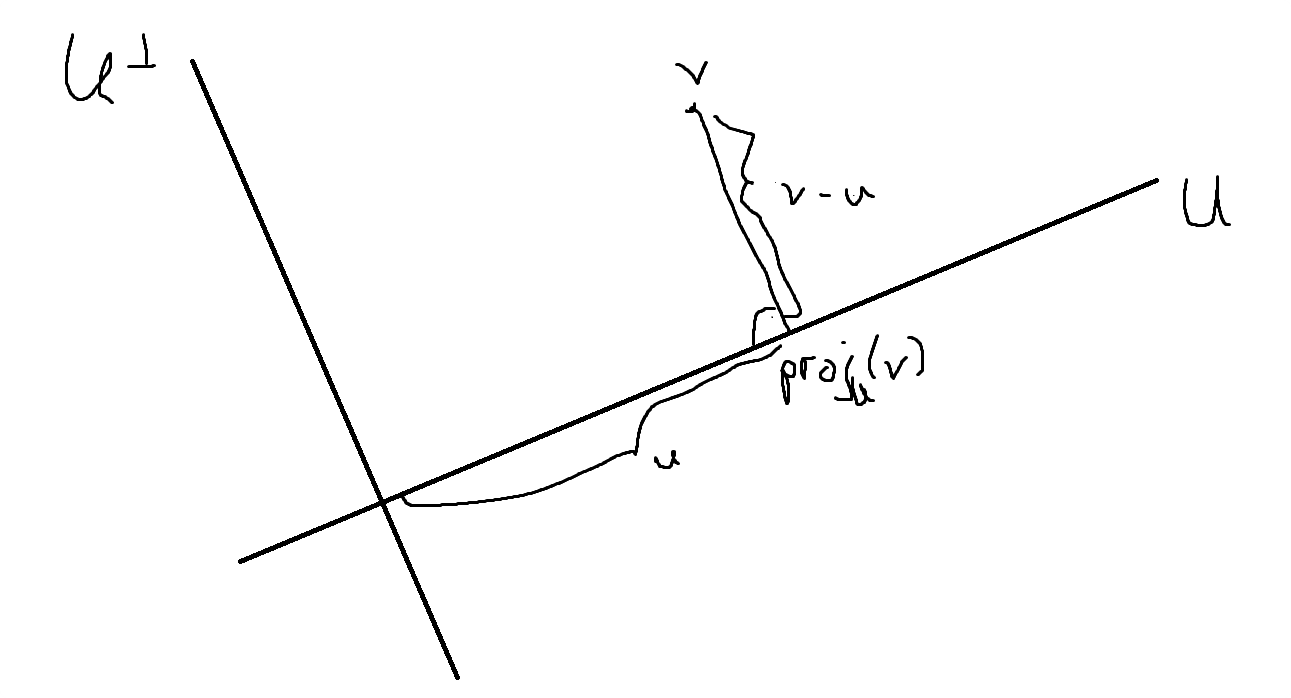
Here is a question and solution from an exam (whats cut off at the top of the solution is just dotting u_1 and u_2 to confirm that they are orthogonal). Can someone explain the solution to me? I'm not sure why u=proj_U(v) is a choice that confirms w=u-v will be in the orthog. complement of U.

 vocal sleetBOT
cedar bone
Here is a question and solution from an exam (whats cut off at the top of the so...
vocal sleetBOT
vocal sleetBOT
cedar bone
Here is a question and solution from an exam (whats cut off at the top of the so...
vocal sleetBOT
@cedar bone Has your question been resolved?
cedar bone
I'm sorry, I'm not exactly sure what sort of sketch you want me to make? and w*x=0, but this doesn't answer my question as far as I can see
Like yes, u=proj_U(v), w=v-u works, but why are they so sure when choosing u=proj_U(v) that w will end up being in the complement?
vocal sleetBOT
@cedar bone Has your question been resolved?
hard atlas
you want u = c1u1+c2u2 to be so that v-u is orthogonal
if you set up the equations you just end up with this specific choice of u
picking proj_U is something you do after knowing it will work
 vocal sleetBOT
@cedar bone Has your question been resolved?
Channel closed
Closed by @cedar bone
Use .reopen if this was a mistake.
cedar bone
ok that makes more sense now I think. Thanks
vocal sleetBOT
Available help channel!
Send your question here to claim the channel.
Remember:
• Ask your math question in a clear, concise manner.
• Show your work, and if possible, explain where you are stuck.
• After 15 minutes, feel free to ping <@&286206848099549185>.
• Type the command .close to free the channel when you're done.
• Be polite and have a nice day!
Read #❓how-to-get-help for further information on how to ask a good question, and about conduct in the question channels.
 patent nymph
Is there an algorithm to tell if a random permutation in one line notation(31675428, representing the cycle (136472)) is odd or even?
vocal sleetBOT
patent nymph
Is there an algorithm to tell if a random permutation in one line notation(31675...
patent nymph
Please ping when answering
 wraith venture
patent nymph
Please ping when answering
wraith venture
patent nymph
Please ping when answering
the length tells you that
patent nymph
wraith venture
the length tells you that
I mean if you only have the one line notation
wraith venture
because you can write it as a product of transpositions
(a b c) = (a b) (b c)
try to generalize that
patent nymph
What if you are given just 31675428
Would the fastest way be to compute the length of the cycles and then get the number of transpositions?
Or is there some way to tell based on the images of the numbers under the permutation
wraith venture
wraith venture
(a b c) = (a b) (b c)
that proves a formula that lets you find the signature in an instant
wraith venture
patent nymph
Or is there some way to tell based on the images of the numbers under the permut...
the numbers don't matter. There is only one group of bijections over n elements, up to an isomorphism
vocal sleetBOT
Please read #❓how-to-get-help
wraith venture
paper depot
don't troll.
patent nymph
<@&268886789983436800>
paper depot
at least open your own channel.
hard atlas
I suppose you could count the number of inversions but that also seems painful. just compute cycle notation. just start with an element and compute the relevant cycle and so on
 cyan talon
It's not like computing the cycle decomposition is slow, it's prolly O(n) if you're working in S_n
patent nymph
patent nymph
Is there an algorithm to tell if a random permutation in one line notation(31675...
Maybe I’ve fallen into the XY problem so I’ll ask the question I was trying to solve
I am trying to use code to make a random even permutation, the way I thought of was choose a random number from 1 to 8 for the first one, then a different number for the second one, and so on. Then I would just have to check if it were even, and then swap the last two numbers. That’s why I asked this question
vocal sleetBOT
@patent nymph Has your question been resolved?
vocal sleetBOT
Channel closed
Closed due to timeout
Use .reopen if this was a mistake.
Available help channel!
Send your question here to claim the channel.
Remember:
• Ask your math question in a clear, concise manner.
• Show your work, and if possible, explain where you are stuck.
• After 15 minutes, feel free to ping <@&286206848099549185>.
• Type the command .close to free the channel when you're done.
• Be polite and have a nice day!
Read #❓how-to-get-help for further information on how to ask a good question, and about conduct in the question channels.
 real gale
Let $P_1$ be the projection matrix onto the line spanned by the vector $a = \begin{pmatrix} 1 \ 2 \ 3 \end{pmatrix}$. Let $P_2$ be the
projection matrix that projects vectors onto the plane perpendicular to span of $a$. Find the determinant of $P_1 + P_2$
vocal sleetBOT
real gale
Let $P_1$ be the projection matrix onto the line spanned by the vector $a = \beg...
twin meteorBOT
 real gale
I can find the P_1
I don't know how to proceed further
$P_1 = \frac{1}{14} \begin{bmatrix} 1 & 2 & 3 \ 2 & 4 & 6 \ 3 & 6 & 9 \end{bmatrix}$
twin meteorBOT
 real gale
Maybe I should find a vector perpendicular to a and find the matrix that projects vectors on to the span of that perpendicular vector

patent nymph
is there only 1 projection matrix onto that line?
real gale
I think yes
 distant eagle
real gale
Let $P_1$ be the projection matrix onto the line spanned by the vector $a = \beg...
distant eagle
real gale
Let $P_1$ be the projection matrix onto the line spanned by the vector $a = \beg...
I think you don't need to compute anything
If you choose an orthonormal basis with one of the vectors being (1,2,3)/sqrt(1+4+9) then the matrix P_1 + P_2 becomes the identity
distant eagle
real gale
How?
If a vector v is either parallel or orthogonal to the span of (1,2,3) then P_1 v + P_2 v = v
If it is parallel then P_1 v = v and P_2 v = 0
And if it is orthogonal then P_1 v = 0 and P_2 v = v
 cobalt crypt
[ \R^3 = \spn_\R \set a \oplus \orth {(\spn_\R \set a)} ]
twin meteorBOT
 cobalt crypt
writing $x \in \R^3$ as
[
x = v + w, \quad v \in \spn_\R \set a, ; w \in \orth {(\spn_\R \set a)}
]
you have $P_1 x = v$ and $P_2 x = w$
real gale
I'm not yet introduced to direct sums
twin meteorBOT
 cobalt crypt
twin meteor
cobalt crypt
twin meteor
every vector in $\R^3$ can be written \emph{uniquely} as a sum
[
x = v + w \textqq{where} v \in \spn_\R \set a, ; w \in \orth {(\spn_\R \set a)}
]
twin meteorBOT
 cobalt crypt
the projection onto $\spn_\R \set a$ is just function which takes $x$ to $v$
twin meteorBOT
 cobalt crypt
and the projection onto the orthogonal $(\spn_\R \set a)^\perp$ is just the function which takes $x$ to $w$
twin meteorBOT
 real gale
cobalt crypt
every vector in $\R^3$ can be written \emph{uniquely} as a sum
\[
x = v + w \t...
real gale
cobalt crypt
every vector in $\R^3$ can be written \emph{uniquely} as a sum
\[
x = v + w \t...
How? Do we not just have 2 vectors that linearly independent? So, they can't span entire R^3?
cobalt crypt
*no, $v$ comes from $\spn_\R \set a$, which is a $1$-dimensional space, $w$ comes from $(\spn_\R \set a)^\perp$, which is a $2$-dimensional space
twin meteorBOT
 cobalt crypt
together they make up all of $\R^3$
twin meteorBOT
 twin meteorBOT
 cobalt crypt
so $P_1 + P_2 = \id_{\R^3}$
twin meteorBOT

 vocal sleetBOT
Channel closed
Closed by @real gale
Use .reopen if this was a mistake.
Available help channel!
Send your question here to claim the channel.
Remember:
• Ask your math question in a clear, concise manner.
• Show your work, and if possible, explain where you are stuck.
• After 15 minutes, feel free to ping <@&286206848099549185>.
• Type the command .close to free the channel when you're done.
• Be polite and have a nice day!
Read #❓how-to-get-help for further information on how to ask a good question, and about conduct in the question channels.
 molten coral
So you find the domain by knowing 1/x and making the bottom equal to 0 to find the holes. How do you find the range?
 vocal sleetBOT
molten coral
So you find the domain by knowing 1/x and making the bottom equal to 0 to find t...
vocal sleetBOT
molten coral
So you find the domain by knowing 1/x and making the bottom equal to 0 to find t...
 random peak
Range is basically the set of all values which f(x) can produce
A simple way to find it is to equate f(x) with some k, and then express x in terms of k. Then exclude the values of k for which x is not real
molten coral
So how do we determain what x's aren't real? Because it can't be we go through every number
random peak
Just like you did for f(x)
molten coral
set it to 0?
random peak
We know f(x) won't be defined if the denominator is 0
random peak
molten coral
set it to 0?
In this case, yes
Firstly express x in terms of k
And then you basically want to make sure x is defined
molten coral
.close
vocal sleetBOT
Channel closed
Closed by @molten coral
Use .reopen if this was a mistake.
Available help channel!
Send your question here to claim the channel.
Remember:
• Ask your math question in a clear, concise manner.
• Show your work, and if possible, explain where you are stuck.
• After 15 minutes, feel free to ping <@&286206848099549185>.
• Type the command .close to free the channel when you're done.
• Be polite and have a nice day!
Read #❓how-to-get-help for further information on how to ask a good question, and about conduct in the question channels.
 fiery crest
if H is subgroup of G and for a single g from G and for all h from H it is true that ghg^-1 is in H, does this mean gH=Hg?
vocal sleetBOT
fiery crest
if H is subgroup of G and for a single g from G and for all h from H it is true ...
 silk comet
try proving it
suppose you have gh where h in H, show that it is (something)g where something is in H
fiery crest

but how to do it other way around
Hg is subset of gH
if its possible

but this is for some random h1
not for every h1 from H
silk comet
hmm, i don't think the other direction is possible unless you have invariance under conjugation by g^-1
fiery crest
hmm
silk comet
can try in #groups-rings-fields too
fiery crest
is true that for all h in H
there exists a from H
such that
gag^-1=h
every element in H is of the form ghg^-1 ?
becouse when we take h from G and multiply with g and g^-1 we are again in H
and we have this

so we can make a map
from H in H
h -> ghg^-1
and it will be bijection

then maybe we can do something like this 😄
 pastel cedar
Are you still trying to show Hg is in gH?
If h is in H, so is h^-1, since it's a subgroup. You should then be able to see why g^-1hg is in H and then your first proof applies.
fiery crest
why g^-1hg is in H
pastel cedar
Subgroups are closed under inverses.
fiery crest
 vocal sleetBOT
@fiery crest Has your question been resolved?
Channel closed
Closed by @fiery crest
Use .reopen if this was a mistake.
vocal sleetBOT
Available help channel!
Send your question here to claim the channel.
Remember:
• Ask your math question in a clear, concise manner.
• Show your work, and if possible, explain where you are stuck.
• After 15 minutes, feel free to ping <@&286206848099549185>.
• Type the command .close to free the channel when you're done.
• Be polite and have a nice day!
Read #❓how-to-get-help for further information on how to ask a good question, and about conduct in the question channels.
 digital skiff
 vocal sleetBOT
digital skiff
digital skiff
vocal sleetBOT
digital skiff
digital skiff
So about question 30.
I get that u = -v - w - z
I plug that in for u in the original statement
I get 0 = 0
How would I actually find the unit vectors for this, as they have to have length one
digital skiff
I know of i, j, k
 flat whale
well it's the plane, so just i, j
digital skiff
ah
flat whale
yea just pick u,v,w,z in terms of those
digital skiff
so I could do say, u = i, v = j, w = -i, z = -j?
Okay that seems deceptively simple, appreciate you being helpful as always riemann
.close
vocal sleetBOT
Channel closed
Closed by @digital skiff
Use .reopen if this was a mistake.
vocal sleetBOT
Available help channel!
Send your question here to claim the channel.
Remember:
• Ask your math question in a clear, concise manner.
• Show your work, and if possible, explain where you are stuck.
• After 15 minutes, feel free to ping <@&286206848099549185>.
• Type the command .close to free the channel when you're done.
• Be polite and have a nice day!
Read #❓how-to-get-help for further information on how to ask a good question, and about conduct in the question channels.
Channel closed
Closed by @peak yacht
Use .reopen if this was a mistake.
Available help channel!
Send your question here to claim the channel.
Remember:
• Ask your math question in a clear, concise manner.
• Show your work, and if possible, explain where you are stuck.
• After 15 minutes, feel free to ping <@&286206848099549185>.
• Type the command .close to free the channel when you're done.
• Be polite and have a nice day!
Read #❓how-to-get-help for further information on how to ask a good question, and about conduct in the question channels.
 oak peak
 oak peak
Can somebody explain to me the definitions
flat whale
oak peak
Can somebody explain to me the definitions
it's better if you just do problems
oak peak
?
oak peak
but can you explain to me the definition
the nottation
at least
how to read it
WAIT
I SKIPPED LIKE 4 PAGES
 hushed valley

flat whale
oak peak
but can you explain to me the definition

Khan Academy
Learn for free about math, art, computer programming, economics, physics, chemistry, biology, medicine, finance, history, and more. Khan Academy is a nonprofit with the mission of providing a free, world-class education for anyone, anywhere.
vocal sleetBOT
@oak peak Has your question been resolved?
 foggy thunder

 vocal sleetBOT
Channel closed
Closed due to timeout
Use .reopen if this was a mistake.
Available help channel!
Send your question here to claim the channel.
Remember:
• Ask your math question in a clear, concise manner.
• Show your work, and if possible, explain where you are stuck.
• After 15 minutes, feel free to ping <@&286206848099549185>.
• Type the command .close to free the channel when you're done.
• Be polite and have a nice day!
Read #❓how-to-get-help for further information on how to ask a good question, and about conduct in the question channels.
hybrid fossil
 vocal sleetBOT
hybrid fossil
hybrid fossil
vocal sleetBOT
hybrid fossil
hybrid fossil
okay im pretty stumped on (a)
i tried relating it to Z/nZ then clearly for any g in Z/nZ, g^n is in 0 + nZ
hard atlas
ok but its asking about all g in Z
hybrid fossil
hard atlas
ok but its asking about all g in Z
g in G right?
hard atlas
I assumed in your example G=Z and H=nZ
hybrid fossil
oh yes
hard atlas
or do you want G=Z/nZ and then H some subgroup of that?
hybrid fossil
yeah thats what im trying to figure out
hard atlas
cause there actually is a multiplication in Z so lets not confuse that
hard atlas
ok so for g in Z you consider the element (g+nZ) in Z/nZ
hard atlas
no
hybrid fossil
no?
hard atlas
what about g=n
hard atlas
I dont really like working in Z here as an example because we are running into issues where n is both the index and possibly an element of the group itself
and the whole additive vs multiplicative notation
hybrid fossil
oh alright
perhaps better to work with the symmetric group as example
or maybe D_4
hard atlas
I think its better to just start abstractly from the start. but ok maybe thats just me
hybrid fossil
yeah thats probably even better
hard atlas
so we have G and we have H. we have an element g in G and the associated coset gH
we want to show g^n in H
can you express this using a coset
hard atlas
that will be a puzzle piece for sure
I just mean "g^n in H"
this written as a statement about cosets
hybrid fossil
well g^n is certainly in g^n H
hybrid fossil
ah yeah i see
only the index is assumed to be finite
okay so we have g^n is certainly in g^n H
so g^n must therefore also be in (gH)^n since (gH)^n = g^n H
 young blaze
hybrid fossil
young blaze
hybrid fossil
Uncertain, but to provide a conceptualization: (a) consider that $H$ is a normal subgroup of $G$ and $n=[G:H]$. This means that $G$ is partitioned into $n$ left cosets of $H$ (equivalently right cosets since $H$ is normal), say $g_1H, g_2H, ..., g_nH$. Let $g \in G$. We can express $g$ as $g = g_i h$ for some $1 \leq i \leq n$ and some $h \in H$. We have $g^n = (g_i h)^n = (g_i^n)(h^n)$. Because $H$ is normal, the index $n$ is also the number of different $gH$ for $g \in G$, and so $g_i^n \in H$. Since $H$ is a subgroup, it's closed under multiplication and thus $h^n \in H$ for all $h \in H$. Therefore, $g^n = (g_i^n)(h^n) \in H \ \ \blacksquare$. (b) consider $g = (123)$
twin meteorBOT
adzetto
 hard atlas
!nosols
vocal sleetBOT
As a helper, please do not give out answers that could be copied as a homework solution. Have the student work through the problem themselves and guide them along the way.
hard atlas
well ok that rather spoilt it
anyway
the simple statement I wanted was g^n in H iff g^nH = H as cosets
cause then we have g^nH = (gH)^n = ? = H
why does the last equality hold?
young blaze
hard atlas
!nosols
I just left the b part to the solver but I wanted to give the a part because the conversation is getting longer. ^^
hard atlas
do you want to use aH=bH iff a^-1 b in H?
hybrid fossil
yes
hard atlas
two options: either switch the role of a and b
or, consider that H is a subgroup and therefore closed under inverses
hybrid fossil
g^n H = H iff g^n is in H
but isnt that circular reasoning
you cant really conclude anything from that can you
hybrid fossil
hard atlas
why should it be circular?
it kind of sounds like g^n is in H because g^n is in g^n H which is equal to H because g^n is in H
hard atlas
if g^n H = H, then by the theorem with the a,b you have that g^n in H
and if g^n in H then clearly g^n H = (element in H)*H = H
both directions work on their own
hybrid fossil
oh yeah
hard atlas
ok, so to recap
our original goal was g^n in H
our new goal is to show that g^nH = H
you already noted that g^nH = (gH)^n
so we now need to argue that (gH)^n = H
why is that true
hard atlas
what does the index mean
hybrid fossil
its the number of different (left) cosets of H in G
we can omit left since H is normal
omit?
hybrid fossil
yes
hard atlas
(we use H being normal here to have a group)
hybrid fossil
thats not true for subgroups?
hard atlas
G/H is not a group for just subgroups H
hybrid fossil
good to know, ill check that later
hard atlas
yes, go through the proof of G/H being a group again and note where you used that H is normal and where you used that H is a subgroup
but ignoring that for a second
if you are in some group with n elements and you take an element a in that group and compute a^n
what is that
hybrid fossil
a
hard atlas
no
hard atlas
yes
the identity
we are in the group G/H here
we have the element a=gH
what is the identity in G/H
hybrid fossil
so therefore g^n H = (gH)^n = eH = H
hard atlas
yes
hard atlas
yeah I also really like it
going into the quotient group to conclude something about the big group
with in the end just a single line
vocal sleetBOT
Channel closed
Closed by @hybrid fossil
Use .reopen if this was a mistake.
Available help channel!
Send your question here to claim the channel.
Remember:
• Ask your math question in a clear, concise manner.
• Show your work, and if possible, explain where you are stuck.
• After 15 minutes, feel free to ping <@&286206848099549185>.
• Type the command .close to free the channel when you're done.
• Be polite and have a nice day!
Read #❓how-to-get-help for further information on how to ask a good question, and about conduct in the question channels.
wary mantle
How many points $(x, y)$ with $x, y \in \mathbb Z$ are there so that $|x| + |y| \leq 10$?
vocal sleetBOT
wary mantle
How many points $(x, y)$ with $x, y \in \mathbb Z$ are there so that $|x| + |y| ...
wary mantle
 vocal sleetBOT
What step are you on?
1. I don't know where to begin
2. I have begun but got stuck midway
3. I got an answer but I'm told it's wrong
4. I got an answer and would like my work checked
5. I have a question about someone else's worked solution
6. None of the above
We can set x to different values and find how many y satisfy, right?
hard atlas
yes
hard atlas
which ones?
wary mantle
0, 1, -1
hard atlas
yes
wary mantle
For x = -8, there are 5, right?
hard atlas
yes
hard atlas
well that only takes care of x=-10 up to x=0
wary mantle
hard atlas
well that only takes care of x=-10 up to x=0
Up to 20*
hard atlas
x=9?
wary mantle
So we just need the double
hard atlas
make sure not to count x=0 twice
wary mantle
 hard atlas
1+3+5+..+19+21+19+...+5+3+1
wary mantle
Is x = 0 counted twice there?
hard atlas
yes it is
wary mantle
hard atlas
its double counted
1 + 3 + 5 + ... + 21
We double that
The 1 counts x = 0
hard atlas
yes so we have the 21 two times
wary mantle
Oh
wary mantle
hard atlas
yes so we have the 21 two times
Once it's for x = 0, the second time it's for y = 0, no?
hard atlas
you fix x and then count the options for y
you can afterwards fix y and then count everything all over again
how about instead of |x|+|y|<=10 you do |x|+|y| <= 4
so you dont have to use ...
and mess up something with those
wary mantle
hard atlas
how about instead of |x|+|y|<=10 you do |x|+|y| <= 4
1 + 3 + 5 + 7 + 9 + 7 + 5 + 3 + 1
Right?
We we need to subtract off one 21
hard atlas
yes
vocal sleetBOT
Channel closed
Closed by @wary mantle
Use .reopen if this was a mistake.
Available help channel!
Send your question here to claim the channel.
Remember:
• Ask your math question in a clear, concise manner.
• Show your work, and if possible, explain where you are stuck.
• After 15 minutes, feel free to ping <@&286206848099549185>.
• Type the command .close to free the channel when you're done.
• Be polite and have a nice day!
Read #❓how-to-get-help for further information on how to ask a good question, and about conduct in the question channels.
 formal gazelle
Are -3^-x and x^-1 exponential functions?
vocal sleetBOT
formal gazelle
Are -3^-x and x^-1 exponential functions?
 glossy maple
$-3^{-x}$
twin meteorBOT
redstoneplayz09
 glossy maple
$x^{-1} = \frac{1}{x}$
twin meteorBOT
redstoneplayz09
 formal gazelle
Oh Tysm
formal gazelle
twin meteor
**redstoneplayz09**
This one is not a exponential
glossy maple
okay so you're right that 1/x is not exponential
formal gazelle
The other is a exponential
glossy maple
what
formal gazelle
Typo
glossy maple
what's the typo
formal gazelle
I typed na and it autocorrected to a
Sorry
So they both are not exponential expressions right?
glossy maple
-3^(-x) is exponential
formal gazelle
How doesn’t the number have to be positive
glossy maple
$-3^{-x} = -\parens{\frac{1}{3}}^x$
formal gazelle
The number should be positive right
twin meteorBOT
redstoneplayz09
 glossy maple
1/3 is positive..
formal gazelle
I mean yeah
glossy maple
did you mean to ask about (-3)^(-x)
glossy maple
ok
formal gazelle
.close
vocal sleetBOT
Channel closed
Closed by @formal gazelle
Use .reopen if this was a mistake.
Available help channel!
Send your question here to claim the channel.
Remember:
• Ask your math question in a clear, concise manner.
• Show your work, and if possible, explain where you are stuck.
• After 15 minutes, feel free to ping <@&286206848099549185>.
• Type the command .close to free the channel when you're done.
• Be polite and have a nice day!
Read #❓how-to-get-help for further information on how to ask a good question, and about conduct in the question channels.
 hidden niche
Factor
vocal sleetBOT
hidden niche
Factor
hidden niche

so
I have to find p , q, r, s values
and I know that
pq=8
(ps+qr)=-14
rs=-15
I don't really know what else to do
vocal sleetBOT
@hidden niche Has your question been resolved?
 floral ledge
hidden niche
floral ledge
hidden niche
How is PQRS releated to this qn?
hidden niche
floral ledge
How is PQRS releated to this qn?
I was following the instructions in the book

but maybe I misunderstood
floral ledge
i dont understand smth tho does this work? since (Ps+QR)=-14 by flipping them you get (Pq+rs)=-14 too does that work ?
floral ledge
 broken crystal
do we have to solve that
broken crystal
do we have to solve that
er no dont delete idk if im even correct....
floral ledge
bahahaha
broken crystal
okkk its iaght
floral ledge
does mine work not sure when i sub in tho its -7 instead of =14
broken crystal
floral ledge
i dont understand smth tho does this work? since (Ps+QR)=-14 by flipping them yo...
wait what
floral ledge
does it not work or? not suere
hidden niche
broken crystal
if so
p->-4, q->-2
s-> 5, r->-3
that works
but how do I find these numbers
broken crystal
thats because theres only two possible answers for each variables
or no
sigh
kms
im bad at explaining
ok
broken crystal
floral ledge
i dont understand smth tho does this work? since (Ps+QR)=-14 by flipping them yo...
whyd u do that
floral ledge
since ps=8 and rs=-15 by flipping ps+qr=-14 into Pq+qr=14 u can sub in the values of pq and rs now
but its =7 instead of =14 so yea smth is wrong with me or i just dont understand....
broken crystal
u mean pq and rs
floral ledge
ah yes
broken crystal
mmh
vocal sleetBOT
broken crystal
if so
p->-4, q->-2
s-> 5, r->-3
As a helper, please do not give out answers that could be copied as a homework solution. Have the student work through the problem themselves and guide them along the way.
broken crystal
but you cant flip them like that
floral ledge
why?
technically no matter which order you multipy wont u get the same value?
if the numbers are the same
broken crystal
because its not only multiplying its like also addition
its true that multiplication is commutative
but only if only multiplication is involved in the operation
floral ledge
ohh
broken crystal
you can try with different numbers
it wont give the same answers
its like (pq) + (rs)
broken crystal
mmh
well u can try with the different dividers (or wtv idk in english) of the products they give you
like
rs = -15
the possible answers for r are 1, 3, 5, and 15
and for s too
and we can assume that either r or s is negative
same with pq = 8
the possible values are 1, 2, 4 or 8
and they both have the same symbol
because the product is positive
HAHAHA im not pratical at all
(ps+qr) = -14
sigh
ok
so we can already see another possible equation which is the product of every variable pqrs which is -120 because -15*8= -120
and with every possible answers we find that 2x5x3x4 = 120
so we already know that each variable now has two possible values
so the 1, 15 and 8 values are eliminated
so with that
bruh im such a bad explainer
So
hidden niche
don't worry I think it's clear
broken crystal
ok imma make this quick
with every possible answer we can find that either ps or qr would be a negative answer because if they were both negative it would give a far too high number and if they were positive well the answer would be positive
vocal sleetBOT
Channel closed
Closed by @hidden niche
Use .reopen if this was a mistake.
hidden niche
👍👍👍
vocal sleetBOT
Available help channel!
Send your question here to claim the channel.
Remember:
• Ask your math question in a clear, concise manner.
• Show your work, and if possible, explain where you are stuck.
• After 15 minutes, feel free to ping <@&286206848099549185>.
• Type the command .close to free the channel when you're done.
• Be polite and have a nice day!
Read #❓how-to-get-help for further information on how to ask a good question, and about conduct in the question channels.
 quartz acorn
consider tossing 2 coins with the following random variable
x = number of heads when 2 coins are tossed.
vocal sleetBOT
quartz acorn
consider tossing 2 coins with the following random variable
x = number of heads ...
quartz acorn
the possibilities would be HH, TH, HT, and TT right?
ornate ember
for two coin tosses yes!
 soft walrus
for two independent coins? yes
soft walrus
ornate ember
for two coin tosses yes!
hey fancy seeing you Mellow 
quartz acorn
I have another question, if i were to make a probability distribution table would the x variables be (0,1,2) or (1,2)
 night radish
(0, 1, 2), possible for no heads
quartz acorn
ffs
vocal sleetBOT
@quartz acorn Has your question been resolved?
vocal sleetBOT
Channel closed
Closed by @quartz acorn
Use .reopen if this was a mistake.
Available help channel!
Send your question here to claim the channel.
Remember:
• Ask your math question in a clear, concise manner.
• Show your work, and if possible, explain where you are stuck.
• After 15 minutes, feel free to ping <@&286206848099549185>.
• Type the command .close to free the channel when you're done.
• Be polite and have a nice day!
Read #❓how-to-get-help for further information on how to ask a good question, and about conduct in the question channels.
 mortal dust
If a, b, c are distinct integers then does the equation a⁴ + b⁴ = c⁵ have any solutions? If yes, find them all.
vocal sleetBOT
mortal dust
`If a, b, c are distinct integers then does the equation a⁴ + b⁴ = c⁵ have any s...
 half imp
a = -1, b = 0, c = 1
half imp
finding all of them sounds hard though
there's probably an infinite number though
choose a and b such that 32 | a^4 + b^4
then set c = 2
now the equation is 32[(a^4 + b^4)/32] = (2)^5
to balance this, multiply a, b, and c all by (a^4 + b^4)/32
that procedure seems like it should generate infinitely many solutions
half imp
a = n^5, b = 0, c = n^4 forms an infinite family of solutions, any integer n other than 0 or 1 works
vocal sleetBOT
@mortal dust Has your question been resolved?
vocal sleetBOT
Channel closed
Closed due to timeout
Use .reopen if this was a mistake.
Available help channel!
Send your question here to claim the channel.
Remember:
• Ask your math question in a clear, concise manner.
• Show your work, and if possible, explain where you are stuck.
• After 15 minutes, feel free to ping <@&286206848099549185>.
• Type the command .close to free the channel when you're done.
• Be polite and have a nice day!
Read #❓how-to-get-help for further information on how to ask a good question, and about conduct in the question channels.
vast shale
The derivative of 1/x is -1/x^2 right ? So if I choose x=2 it’s 0.5 and suppose a change occur in time increased by 1 x became 3 (x=3), 1/3 it’s approximately 0.333 , and based on the change occurred y’-y=>0.333-0.5= it’s approximately 167. But based on derivative which is -1/x^2 => 1/(0.5)^2 it’s like -4
vocal sleetBOT
vast shale
The derivative of 1/x is -1/x^2 right ? So if I choose x=2 it’s 0.5 and suppose ...
vast shale
How is it possible
iron flame
vast shale
The derivative of 1/x is -1/x^2 right ? So if I choose x=2 it’s 0.5 and suppose ...
take smaller and smaller values for how much x increases by and you'll get -4