#help-13
428200 messages · Page 533 of 429
 velvet mortar
 deft hatch
Inequality?
velvet mortar
Yeah solve it
deft hatch
that wont give a definite answer right?
deft hatch
velvet mortar
Yeah solve it
Ah wha
pure inequaltiy?
30-3n<0
-3n<-30
n>10
fuck did i mess up answer is given
n>11
velvet mortar
Yeah
velvet mortar
Yes
velvet mortar
So T11 is the answer
 cedar kilnBOT
Channel closed
Closed by @deft hatch
Use .reopen if this was a mistake.
Please take a minute to participate in [our survey](#changelog message) if you haven't already!
 Available help channel!
Send your question here to claim the channel.
Remember:
• Ask your math question in a clear, concise manner.
• Show your work, and if possible, explain where you are stuck.
• After 15 minutes, feel free to ping <@&286206848099549185>.
• Type the command .close to free the channel when you're done.
• Be polite and have a nice day!
Read #❓how-to-get-help for further information on how to ask a good question, and about conduct in the question channels.
 broken night
hello, I was wondering if there is a formula to get the first digit of a 3 digit number no matter the number.
e.g. you have the number 678 I want to isolate the number 6.
cedar kilnBOT
broken night
hello, I was wondering if there is a formula to get the first digit of a 3 digit...
 crystal raptor
you can divide by 100 and then use the floor function
 fair geyser
i.e. floor(x/100)
 violet rapids
if this is a programming thing you can also just take the first character
cedar kilnBOT
Channel closed
Closed by @broken night
Use .reopen if this was a mistake.
Please take a minute to participate in [our survey](#changelog message) if you haven't already!
cedar kilnBOT
Available help channel!
Send your question here to claim the channel.
Remember:
• Ask your math question in a clear, concise manner.
• Show your work, and if possible, explain where you are stuck.
• After 15 minutes, feel free to ping <@&286206848099549185>.
• Type the command .close to free the channel when you're done.
• Be polite and have a nice day!
Read #❓how-to-get-help for further information on how to ask a good question, and about conduct in the question channels.
 warm pike
Question about Rubinstein bargaining in game theory and finding Nash Equilibrium and subgame perfect equilibrium
We have 2 players, p1 and p2 deciding how to divide a pie of size 1.
First p1 offers (x, 1-x) for 0<=x<=1
Then p2 can accept or reject
If accept, p1 gets x, p2 gets 1-x, game ends
else p2 can reject and offer (y,1-y) for 0<=x<=1
Then p1 can accept or reject
If accept, p1 gets d * y, p2 gets d * (1-y), game ends (for 0 < d < 1, d = discount factor)
Questions:
- Prove that (p1 plays (1,0), p2 accepts), (p1 plays (0,1), p2 accepts) are Nash equilibrium
- If player is indifferent between accept or reject, player accepts. Find subgame perfect equilibrium.
- If player is indifferent between accept or reject, player rejects. Prove that this has no subgame perfect equilibrium
cedar kilnBOT
warm pike
Question about Rubinstein bargaining in game theory and finding Nash Equilibrium...
warm pike
For 1) with (p1 plays (1,0), p2 accepts) is obvious. But for (0,1) I thought that p1 can switch to (1,0) and p1 is better?
So I thought of another solution
If p1 changes anything, p2 will not get the original payoff of 1, and p2 will reject and then p2 offers (0,1), meaning p1 has no incentive to switch.
And p2 obviously doesn't want to switch from accept to reject and get from 1 to d < 1
Meaning (p1 plays (0,1), p2 accepts) is Nash equilibrium?
For 2) I tried backward induction and got (p1 plays (x,1-x) then accepts, p2 rejects then plays (0,1)) to get (0,d) for 1-d < x <=1
And (p1 plays (1-d, d), p2 accepts) gives (1-d, d)
I need someone to check this
For 3) I tried and somehow found a subgame perfect equilibrium of (p1 plays (1,0) then rejects, p2 rejects then plays (0,1)) to get (0,0)
cedar kilnBOT
@warm pike Has your question been resolved?
cedar kilnBOT
@warm pike Has your question been resolved?
cedar kilnBOT
@warm pike Has your question been resolved?
cedar kilnBOT
Channel closed
Closed due to timeout
Use .reopen if this was a mistake.
Please take a minute to participate in [our survey](#changelog message) if you haven't already!
Available help channel!
Send your question here to claim the channel.
Remember:
• Ask your math question in a clear, concise manner.
• Show your work, and if possible, explain where you are stuck.
• After 15 minutes, feel free to ping <@&286206848099549185>.
• Type the command .close to free the channel when you're done.
• Be polite and have a nice day!
Read #❓how-to-get-help for further information on how to ask a good question, and about conduct in the question channels.
 fossil pewter
$\vec{x}_1= \left(\begin{array}{c} cos(t)\ -1 \ 2 \cdot sin(t) +3 \end{array}\right)$
cedar kilnBOT
fossil pewter
$\vec{x}_1= \left(\begin{array}{c} cos(t)\\ -1 \\ 2 \cdot sin(t) +3 \end{array}\...
fossil pewter
with t = [0,2 pi]
how do i know what shape this curve is?
i need someone to walk me through the steps to visualize that
 wraith daggerBOT
Mergintaim
 fossil pewter
is it a spiral?
 violet flume
I don't think it's a spiral 
probably ellipse if i had to guess
but there are no terms that decay to a constant in the limit
or grow large
so i think spiral would be out, but i could be wrong
fossil pewter
yeah its an ellipse, do you just know the formula for an elllipse by heart or how did you deduce that?
violet flume
you could try desmos and just look at the slice? since its a slice anyways
well its in a slice right since x2 is a constant
cost sint is your classic circle
but here sint is scaled by a constant
so im imagining what its squished inwards along x3?
and translated
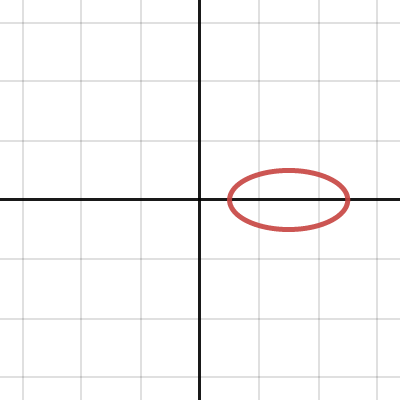
Desmos
fossil pewter
hhhm yeah, that makes sense, so basically a spiral would need a growing or shrinking term in there?
violet flume
yea probably something exponential
violet flume
fossil pewter
hhhm yeah, that makes sense, so basically a spiral would need a growing or shrin...
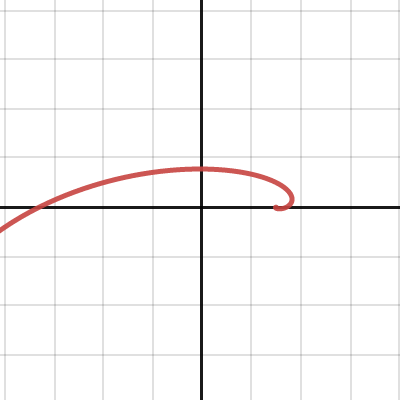
Desmos
compare to this
fossil pewter
allright that makes sense, thank you very much!
i was missing the knowledge of how a circle is made up
.close
cedar kilnBOT
Channel closed
Closed by @fossil pewter
Use .reopen if this was a mistake.
Please take a minute to participate in [our survey](#changelog message) if you haven't already!
cedar kilnBOT
Available help channel!
Send your question here to claim the channel.
Remember:
• Ask your math question in a clear, concise manner.
• Show your work, and if possible, explain where you are stuck.
• After 15 minutes, feel free to ping <@&286206848099549185>.
• Type the command .close to free the channel when you're done.
• Be polite and have a nice day!
Read #❓how-to-get-help for further information on how to ask a good question, and about conduct in the question channels.
 manic cradle
Hey, Im confused in what im supposed to do in general, What does the table represent and how could I solve it? any explanations?
 cedar kilnBOT
manic cradle
Hey, Im confused in what im supposed to do in general, What does the table repre...
cedar kilnBOT
manic cradle
Hey, Im confused in what im supposed to do in general, What does the table repre...
 wispy bronze
Try plugging in some values of x to see what y should be and notice the pattern
manic cradle
Okey! thanks ill try that
wispy bronze
You're welcome!
cedar kilnBOT
@manic cradle Has your question been resolved?
Channel closed
Closed by @manic cradle
Use .reopen if this was a mistake.
Please take a minute to participate in [our survey](#changelog message) if you haven't already!
Available help channel!
Send your question here to claim the channel.
Remember:
• Ask your math question in a clear, concise manner.
• Show your work, and if possible, explain where you are stuck.
• After 15 minutes, feel free to ping <@&286206848099549185>.
• Type the command .close to free the channel when you're done.
• Be polite and have a nice day!
Read #❓how-to-get-help for further information on how to ask a good question, and about conduct in the question channels.
Channel closed
Closed due to the original message being deleted
Please take a minute to participate in [our survey](#changelog message) if you haven't already!
cedar kilnBOT
Available help channel!
Send your question here to claim the channel.
Remember:
• Ask your math question in a clear, concise manner.
• Show your work, and if possible, explain where you are stuck.
• After 15 minutes, feel free to ping <@&286206848099549185>.
• Type the command .close to free the channel when you're done.
• Be polite and have a nice day!
Read #❓how-to-get-help for further information on how to ask a good question, and about conduct in the question channels.
cedar kilnBOT
@plain bridge Has your question been resolved?
wispy bronze
What are you still unsure about @plain bridge ?
cedar kilnBOT
Channel closed
Closed by @plain bridge
Use .reopen if this was a mistake.
Please take a minute to participate in [our survey](#changelog message) if you haven't already!
wispy bronze
Ok that is good to hear
cedar kilnBOT
Available help channel!
Send your question here to claim the channel.
Remember:
• Ask your math question in a clear, concise manner.
• Show your work, and if possible, explain where you are stuck.
• After 15 minutes, feel free to ping <@&286206848099549185>.
• Type the command .close to free the channel when you're done.
• Be polite and have a nice day!
Read #❓how-to-get-help for further information on how to ask a good question, and about conduct in the question channels.
 crimson sedge
 cedar kilnBOT
crimson sedge
cedar kilnBOT
crimson sedge
 tropic oxide
recognition of the sum as a riemann sum for a certain function
crimson sedge
sorry i didnt understand
what you saying
its a rule?
my bad ann
ill go watch what u typed and see if i can learn something useful
thanks @tropic oxide
.close
cedar kilnBOT
Channel closed
Closed by @torn drift
Use .reopen if this was a mistake.
Please take a minute to participate in [our survey](#changelog message) if you haven't already!
Available help channel!
Send your question here to claim the channel.
Remember:
• Ask your math question in a clear, concise manner.
• Show your work, and if possible, explain where you are stuck.
• After 15 minutes, feel free to ping <@&286206848099549185>.
• Type the command .close to free the channel when you're done.
• Be polite and have a nice day!
Read #❓how-to-get-help for further information on how to ask a good question, and about conduct in the question channels.
 gleaming jasper
 cedar kilnBOT
gleaming jasper
gleaming jasper
cedar kilnBOT
gleaming jasper
gleaming jasper
 cedar kilnBOT
@gleaming jasper Has your question been resolved?
 dawn junco
gleaming jasper
dawn junco
gleaming jasper
hi
are you sure you're solving the right problem?
the numbers on your figure seem completely off
cedar kilnBOT
Channel closed
Closed due to timeout
Use .reopen if this was a mistake.
Please take a minute to participate in [our survey](#changelog message) if you haven't already!
Available help channel!
Send your question here to claim the channel.
Remember:
• Ask your math question in a clear, concise manner.
• Show your work, and if possible, explain where you are stuck.
• After 15 minutes, feel free to ping <@&286206848099549185>.
• Type the command .close to free the channel when you're done.
• Be polite and have a nice day!
Read #❓how-to-get-help for further information on how to ask a good question, and about conduct in the question channels.
 white badge
Hello guys, anyone know how i can prove this? Im rubbish with some proof.
 cedar kilnBOT
white badge
Hello guys, anyone know how i can prove this? Im rubbish with some proof.
crimson sedge
white badge
Hello guys, anyone know how i can prove this? Im rubbish with some proof.
cedar kilnBOT
white badge
Hello guys, anyone know how i can prove this? Im rubbish with some proof.
crimson sedge
white badge
Hello guys, anyone know how i can prove this? Im rubbish with some proof.
Study the sign of f's derivative for unicity. For existence, use the mean value theorem
sorry, I meant the intermediate value theorem
 crimson delta
for all n there is a root a_n of f_n. the root will depend on n and it is unique for that specific n
 sage forge
Sorry, missread it
cedar kilnBOT
@white badge Has your question been resolved?
white badge
crimson sedge
Study the sign of f's derivative for unicity. For existence, use the mean value ...
study the sign of fs derivatives for unicity? i have no idea how to do that lmao
crimson sedge
white badge
study the sign of fs derivatives for unicity? i have no idea how to do that lmao
If a function is continuous and strictly monotone, then it's bijective, hence the unicity of the root (because 0 can't be mapped to by more than one element).
I assume you know how to calculate the derivative of f
white badge
crimson sedge
I assume you know how to calculate the derivative of f
yeah i think i can manage that part lmao.
okay so, if i prove its bijective it will have to be unique?
crimson sedge
white badge
okay so, if i prove its bijective it will have to be unique?
yes that's right, that's the definition of bijection
white badge
Alright sweet, so to prove its bijective i should use that intermidiate value theroem? is that where that part comes in
crimson sedge
white badge
Alright sweet, so to prove its bijective i should use that intermidiate value th...
nope, intermediate value theorem proves the existence part.
white badge
btw sorry im bad lmao, i know
white badge
okay to find the derivative of f do i have to fix n as a value beforehand? I struggle to find the derivative of xn +xn−1 +...+x−1 because its not jjst a set sequence? Think im trippin.
crimson sedge
yes n is fixed because we calculate the derivative with respect to x
everything is fixed except x
white badge
the part that confuses me tho is that we dont even know how many x terms there are yet. Like depending on what n was there could be a different amount of terms. Thats what coinfuses me when it comes to finding the derivative.
cant even remember how to differentiate an equation like that
crimson sedge
this shouldn't confuse you here, the terms are just the successive powers of x, you can imagine n being equal to 4 or 5 if that's helpful
start by writing the derivative of $x^n$
wraith daggerBOT
AimaneSN
 crimson sedge
yep that's correct
white badge
then like (n-1)(n-2)x^n-3 like thats ort of thing
and it will just ciontinute like that
so study its sign
nx^n-1 + (n-1)x^n-2 + (n-1)(n-2)x^n-3.... + 1
crimson sedge
white badge
then like (n-1)(n-2)x^n-3 like thats ort of thing
for the third one it's just $(n-2) \cdot x^{n-3}$
wraith daggerBOT
AimaneSN
 white badge
oh fr
crimson sedge
white badge
nx^n-1 + (n-1)x^n-2 + (n-1)(n-2)x^n-3.... + 1
yes, almost right
so what is its sign
crimson sedge
what is the sign of each term, don't forget that $x \in \mathbb{R}^{+}$
wraith daggerBOT
AimaneSN
 crimson sedge
white badge
well n>= 1
crimson sedge
white badge
well n>= 1
that's true but not enough to justify positivity, notice that terms like (n-5) multiplied by something will eventually appear for n>5, but of course if they do appear, that means n > 5. because n is also the number of terms in the sum
in other words $n-k $ is positive for $k=0,...,n-1$
wraith daggerBOT
AimaneSN
 white badge
the function is increasing?
white badge
well i know its continuous because as you increase the values every output will have an input (graph will have an x value at every single y value) however i struggle to write that i words that prove it well. Like to prove continousnous i usually just plot a grraph and analayse it lmao
crimson sedge
white badge
well i know its continuous because as you increase the values every output will ...
discontinuous functions also have an "output" for every input, this is the very definition of a function, has nothing to do with continuity. Here to prove it's continuous, you probably just need to say it's a polynomial function
polynomial functions are differentiable, therefore continuous
white badge
no i mean an input for every output
crimson sedge
white badge
no i mean an input for every output
this is surjectivity, not continuity
white badge
omg im an idiot i was thinking of surjectivity the whole time lmaop
thats makes way mroe sense lmao
crimson sedge
continuity is more like the behavior of the function, surjectivity and stuff is related to the domain and codomain of f
white badge
i was just doing surjectivity questions so thats what thats ion my mind lmao
crimson sedge
lol I see
white badge
okay so, ive proved its bijective, thus it must have unique values. Now you mentioned proving the existence part?
crimson sedge
yep, you should use the intermediate value theorem for existence
white badge
Okay let me look that up lmao
white badge
@crimson sedge ive seen the Intermediate value theroem and im still not getting it lmao. This really has been the question from hell for me. i keep seeing 𝑓(𝑎)<k<𝑓(𝑏) so im assuming ill be doing 𝑓(𝑎)<0<𝑓(𝑏)? its a struggle lmao
crimson sedge
white badge
<@456226577798135808> ive seen the Intermediate value theroem and im still not g...
yes that's right
you need to find the appropriate values of a and b
then calculate their iamges
white badge
okay, how do i know what values are the appropriate ones?
crimson sedge
what are the easiest values you can think of
for which we can easily calculate the image
white badge
-1 and 1
crimson sedge
white badge
-1 and 1
it's not clear that you can determine the sign of f(-1)
f(1) is easy tho
and you forgot f(0)
white badge
oh i thought it was 𝑓(𝑎)<0<𝑓(𝑏). im assuming it should be less or equal to then?
crimson sedge
white badge
oh i thought it was 𝑓(𝑎)<0<𝑓(𝑏). im assuming it should be less or equal to t...
why ?
we're not comparing 0 with a or b
we're comparing it with the image of a and b
white badge
oh, okay then. didnt think about that lmao. sweet
cedar kilnBOT
@white badge Has your question been resolved?
Channel closed
Closed by @white badge
Use .reopen if this was a mistake.
Please take a minute to participate in [our survey](#changelog message) if you haven't already!
Available help channel!
Send your question here to claim the channel.
Remember:
• Ask your math question in a clear, concise manner.
• Show your work, and if possible, explain where you are stuck.
• After 15 minutes, feel free to ping <@&286206848099549185>.
• Type the command .close to free the channel when you're done.
• Be polite and have a nice day!
Read #❓how-to-get-help for further information on how to ask a good question, and about conduct in the question channels.
 vernal pike
$\int^{}_{} \tan \left( x\right) dx$, use substitution $u=\cos(x)$
wraith daggerBOT
AuHasard
 vernal pike
what's the first step
crimson sedge
$\int^{}{} \tan \left( x\right) dx$ is of the form $\int^{}{} \frac{u'(x)}{u(x)} dx$ seems more straightforward than substitution
wraith daggerBOT
AimaneSN
 vernal pike
the problem asks me to use substitution explicitly 🙂
crimson sedge
ah I see
crimson sedge
vernal pike
what's the first step
the first step I guess is to rewrite $sin(x)$ as $\sqrt{1-cos(x)^2}$
wraith daggerBOT
AimaneSN
 vernal pike
why do we do that
crimson sedge
vernal pike
why do we do that
because we want to replace cos(x) by u, and $tan(x)=\frac{sin(x)}{cos(x)}$
wraith daggerBOT
AimaneSN
 vernal pike
$$\int^{}{} \tan \left( x\right) dx=\int^{}{} \frac{\sin \left( x\right) }{\cos \left( x\right) } dx$$
$$\cos \left( x\right) =u\rightarrow \int^{}_{} \frac{\sin \left( x\right) }{u} dx$$
wraith daggerBOT
AuHasard
 crimson sedge
$du=-sin(x)dx=-\sqrt{1-cos(x)^2}dx=-\sqrt{1-u^2}dx$ therefore $dx=-\frac{du}{\sqrt{1-u^2}}$
wraith daggerBOT
AimaneSN
 crimson sedge
vernal pike
$$\int^{}_{} \tan \left( x\right) dx=\int^{}_{} \frac{\sin \left( x\right) }{\...
crimson sedge
vernal pike
$$\int^{}_{} \tan \left( x\right) dx=\int^{}_{} \frac{\sin \left( x\right) }{\...
that's true but you have the annoying sin(x)
in the numerator
it's better to rewrite it as mentioned
I think the square root is going to be simplified anyway
crimson sedge
wraith dagger
**AimaneSN**
you also have to replace dx by this
because the integral is no longer with respect to x, but with respect to u
vernal pike
$\cos \left( x\right) =u\rightarrow \int^{}_{} \frac{\sqrt{1-u^{2}} }{u} dx$
wraith daggerBOT
AuHasard
 vernal pike
like that?
crimson sedge
vernal pike
$\cos \left( x\right) =u\rightarrow \int^{}_{} \frac{\sqrt{1-u^{2}} }{u} dx$
yes almost, you need to replace dx now
vernal pike
how did you get du = -sin(x) dx?
oh right
primitive function of cos(x) is -sin(x)?
crimson sedge
vernal pike
how did you get du = -sin(x) dx?
because $u=cos(x)$ if we differentiate : $du = d(cos(x))dx=-sin(x)dx$
wraith daggerBOT
AimaneSN
 crimson sedge
vernal pike
primitive function of cos(x) is -sin(x)?
crimson sedge
vernal pike
primitive function of cos(x) is -sin(x)?
you mean derivative
crimson sedge
yes
vernal pike
and why do we write dx in the LHS?
crimson sedge
where
crimson sedge
wraith dagger
**AimaneSN**
you mean here ?
vernal pike
wraith dagger
**AimaneSN**
here
crimson sedge
vernal pike
here
because we intend to replace dx by an expression that doesn't involve x
so it makes sense to isolate dx
since we intend to integrate wrt u
vernal pike
do you know how we get $\int^{}{} \frac{\sin \left( x\right) }{\cos \left( x\right) } dx=\boxed{-\int^{}{} \frac{1}{u} du}$?
wraith daggerBOT
AuHasard
 vernal pike
i think this is another approach from yours
crimson sedge
vernal pike
do you know how we get $\int^{}_{} \frac{\sin \left( x\right) }{\cos \left( x\r...
yes if you replace dx as above the square root $\sqrt{1-u^2}$ is simplified
wraith daggerBOT
AimaneSN
 vernal pike
$u=\cos \left( x\right) \rightarrow du=-\sin \left( x\right) dx\rightarrow dx=-\frac{du}{\sin \left( x\right) }$
crimson sedge
vernal pike
$\cos \left( x\right) =u\rightarrow \int^{}_{} \frac{\sqrt{1-u^{2}} }{u} dx$
here, you have the square root in the numerator, and by replacing dx you multiply it by te same square root in the denominator
wraith daggerBOT
AuHasard
 crimson sedge
vernal pike
$u=\cos \left( x\right) \rightarrow du=-\sin \left( x\right) dx\rightarrow dx=...
crimson sedge
vernal pike
$u=\cos \left( x\right) \rightarrow du=-\sin \left( x\right) dx\rightarrow dx=...
you still have x in the RHS
there should only be u
vernal pike
$\int\frac{\sin(x)}{\cos(x)}\cdot-\frac{du}{\sin(x)}$
wraith daggerBOT
AuHasard
 vernal pike
and we're left with $\int-\frac{du}{u}$
wraith daggerBOT
AuHasard
 vernal pike
$$dx=-\frac{du}{\sin \left( x\right) }$$
$$\int^{}{} \frac{\sin \left( x\right) }{u} \cdot -\frac{du}{\sin \left( x\right) } =-\int^{}{} \frac{du}{u}$$
wraith daggerBOT
AuHasard
 vernal pike
$$-\int^{}{} \frac{du}{u} \rightarrow -\int^{}{} \frac{1}{u} du=-\ln \left| u\right| +C$$
$$=-\ln \left| \cos \left( x\right) \right| +C$$
wraith daggerBOT
AuHasard
 crimson sedge
vernal pike
$$dx=-\frac{du}{\sin \left( x\right) }$$
$$\int^{}_{} \frac{\sin \left( x\right...
crimson sedge
vernal pike
$$dx=-\frac{du}{\sin \left( x\right) }$$
$$\int^{}_{} \frac{\sin \left( x\right...
here, I don't think it's appropriate to sin(x) in the RHS of dx=...
vernal pike
crimson sedge
here, I don't think it's appropriate to sin(x) in the RHS of dx=...
his solution https://www.youtube.com/watch?v=8TOEBQE0zvo

This calculus video tutorial explains how to find the integral of tanx as well as the antiderivative of cotx using u-substitution.
Subscribe: https://www.youtube.com/channel/UCEWpbFLzoYGPfuWUMFPSaoA?sub_confirmation=1
Next Video: "Integral of lnx/x"
https://www.youtube.com/watch?v=4oqOz2Q_zPQ
Previous Video: "Integral of Cos(2x)"
https://ww...
crimson sedge
just write $sin(x)$ as $\sqrt{1-cos(x)^2}$ and then replace by u
wraith daggerBOT
AimaneSN
 vernal pike
$$-\ln \left| \cos \left( x\right) \right| +C=\ln \left| (\cos \left( x\right) )^{-1}\right| +C=\ln \left| \frac{1}{\cos \left( x\right) } \right| +C$$
crimson sedge
vernal pike
his solution https://www.youtube.com/watch?v=8TOEBQE0zvo
idk, just doesn't sound rigorous to simply like that
crimson sedge
vernal pike
$$-\ln \left| \cos \left( x\right) \right| +C=\ln \left| (\cos \left( x\right)...
why ?
ah you got rid of the minus sign
wraith daggerBOT
AuHasard
 vernal pike
or ln|sec(x)| + C
crimson sedge
wraith dagger
**AuHasard**
yep that's true, but I think it's better to leave it as -ln (cos(x))
as cosine is more common than the secante function
vernal pike
Sometimes the questions want you to simplify all the way. I don't know what that means though, maybe getting rid of the minus sign for example.
crimson sedge
vernal pike
Sometimes the questions want you to simplify all the way. I don't know what that...
there is nothing left to simplify about -ln(cos(x)), but what you wrote is not wrong though
I would prefer -ln(2) as a final answer to ln(1/2)
but that's up to you ofc
cedar kilnBOT
@vernal pike Has your question been resolved?
cedar kilnBOT
Channel closed
Closed due to timeout
Use .reopen if this was a mistake.
Please take a minute to participate in [our survey](#changelog message) if you haven't already!
Available help channel!
Send your question here to claim the channel.
Remember:
• Ask your math question in a clear, concise manner.
• Show your work, and if possible, explain where you are stuck.
• After 15 minutes, feel free to ping <@&286206848099549185>.
• Type the command .close to free the channel when you're done.
• Be polite and have a nice day!
Read #❓how-to-get-help for further information on how to ask a good question, and about conduct in the question channels.
 analog zenith
 cedar kilnBOT
analog zenith
analog zenith
cedar kilnBOT
analog zenith
analog zenith
The the faded 10x^4dx in the back is the actual question
what i dont get is the formula we are using
 long arrow
analog zenith
what i dont get is the formula we are using
long arrow
analog zenith
what i dont get is the formula we are using
just follow the steps
of given example
long arrow
r is the exponent in this case
for example x^(120) then r = 120
or as they've mentioned in the example, x^6 --> r = 6
analog zenith
ohhhh ok
ty
the example was throughing me off for sure, appriciate the help
woohoo got it!
thanks 😄
.close
cedar kilnBOT
Channel closed
Closed by @analog zenith
Use .reopen if this was a mistake.
Please take a minute to participate in [our survey](#changelog message) if you haven't already!
Available help channel!
Send your question here to claim the channel.
Remember:
• Ask your math question in a clear, concise manner.
• Show your work, and if possible, explain where you are stuck.
• After 15 minutes, feel free to ping <@&286206848099549185>.
• Type the command .close to free the channel when you're done.
• Be polite and have a nice day!
Read #❓how-to-get-help for further information on how to ask a good question, and about conduct in the question channels.
 vagrant breach
Is there a way to prove proof by induction?
cedar kilnBOT
vagrant breach
Is there a way to prove proof by induction?
 torpid fulcrum
as in how proof by induction works?
vagrant breach
I can't seem to find a proof online
yeah
I understand the logic of it, and it seems to make sense, but is there an actual proof of the statement?
crimson delta

Mathematics Stack Exchange
I have a question from my textbook and wanted to make sure that I understood it. I have marked in a green box the question that I have.
you mean like this for example?
 wanton sail
vagrant breach
I understand the logic of it, and it seems to make sense, but is there an actual...
wanton sail
vagrant breach
I understand the logic of it, and it seems to make sense, but is there an actual...
do you mean, is there a way to prove that proof by induction is valid using other axioms?
crimson sedge
vagrant breach
Is there a way to prove proof by induction?
induction is equivalent to the well ordering principle
crimson sedge
other than that you have to go all the way down to Peano's axioms or something. You accept the well ordering principle and use it to prove induction
crimson delta
well you use that N can be well ordered. that seems quite a bit weaker than the well ordering principle
wanton sail
that's what the well-ordering principle is, in this context
crimson delta
oh wait I'm thinking of something else
wanton sail
also, this is from the stack exchange post
 vagrant breach
wanton sail
that's what the well-ordering principle is, in this context
vagrant breach
wanton sail
that's what the well-ordering principle is, in this context
So well ordering implies induction?
crimson delta
I'm thinking of the well ordering theorem. which is much stronger
crimson sedge
vagrant breach
So well ordering implies induction?
they are equivalent
wanton sail
vagrant breach
So well ordering implies induction?
yes, as long as you're working over the natural numbers
crimson sedge
yes it does imply induction, and induction in turn implies WOP
vagrant breach
crimson sedge
they are equivalent
right but then there must be a way to show that equivalence?
wanton sail
check the stack exchange post linked
vagrant breach
wanton sail
check the stack exchange post linked
will read it now, thank you
crimson sedge
vagrant breach
right but then there must be a way to show that equivalence?
yes ofc, I think they provided you with the link for that
crimson sedge
crimson delta
I'm thinking of the well ordering theorem. which is much stronger
sounds like there are lots of well ordering theorems out ther
cedar kilnBOT
Channel closed
Closed by @vagrant breach
Use .reopen if this was a mistake.
Please take a minute to participate in [our survey](#changelog message) if you haven't already!
crimson delta
I'm thinking of the one that says that every set can be well ordered. famously equivalent to choice or zorns lemma
crimson sedge
crimson delta
I'm thinking of the one that says that every set can be well ordered. famously e...
Ah, the kind of stuff that makes my brain stop working
crimson sedge
lol I always skipped these parts
cedar kilnBOT
Available help channel!
Send your question here to claim the channel.
Remember:
• Ask your math question in a clear, concise manner.
• Show your work, and if possible, explain where you are stuck.
• After 15 minutes, feel free to ping <@&286206848099549185>.
• Type the command .close to free the channel when you're done.
• Be polite and have a nice day!
Read #❓how-to-get-help for further information on how to ask a good question, and about conduct in the question channels.
 hollow hare
Why does it turn into 18-4m? wouldn't it stay "3-18+4m" instead?

 shell lance
cedar kilnBOT
shell lance
cedar kilnBOT
Channel closed
Closed by @hollow hare
Use .reopen if this was a mistake.
Please take a minute to participate in [our survey](#changelog message) if you haven't already!
Available help channel!
Send your question here to claim the channel.
Remember:
• Ask your math question in a clear, concise manner.
• Show your work, and if possible, explain where you are stuck.
• After 15 minutes, feel free to ping <@&286206848099549185>.
• Type the command .close to free the channel when you're done.
• Be polite and have a nice day!
Read #❓how-to-get-help for further information on how to ask a good question, and about conduct in the question channels.
 willow lion
 cedar kilnBOT
willow lion
willow lion
cedar kilnBOT
willow lion
willow lion
isnt the answer d? because this is a quartic function, and for those functions the fourth difference is constant
cedar kilnBOT
@willow lion Has your question been resolved?
cedar kilnBOT
Channel closed
Closed by @willow lion
Use .reopen if this was a mistake.
Please take a minute to participate in [our survey](#changelog message) if you haven't already!
Available help channel!
Send your question here to claim the channel.
Remember:
• Ask your math question in a clear, concise manner.
• Show your work, and if possible, explain where you are stuck.
• After 15 minutes, feel free to ping <@&286206848099549185>.
• Type the command .close to free the channel when you're done.
• Be polite and have a nice day!
Read #❓how-to-get-help for further information on how to ask a good question, and about conduct in the question channels.
 mellow nimbus
hello
cedar kilnBOT
mellow nimbus
hello
 cedar kilnBOT
@mellow nimbus Has your question been resolved?
cedar kilnBOT
Channel closed
Closed due to timeout
Use .reopen if this was a mistake.
Please take a minute to participate in [our survey](#changelog message) if you haven't already!
Available help channel!
Send your question here to claim the channel.
Remember:
• Ask your math question in a clear, concise manner.
• Show your work, and if possible, explain where you are stuck.
• After 15 minutes, feel free to ping <@&286206848099549185>.
• Type the command .close to free the channel when you're done.
• Be polite and have a nice day!
Read #❓how-to-get-help for further information on how to ask a good question, and about conduct in the question channels.
 haughty cloud
 cedar kilnBOT
haughty cloud
cedar kilnBOT
haughty cloud
 cedar kilnBOT
Channel closed
Closed by @haughty cloud
Use .reopen if this was a mistake.
Please take a minute to participate in [our survey](#changelog message) if you haven't already!
cedar kilnBOT
Available help channel!
Send your question here to claim the channel.
Remember:
• Ask your math question in a clear, concise manner.
• Show your work, and if possible, explain where you are stuck.
• After 15 minutes, feel free to ping <@&286206848099549185>.
• Type the command .close to free the channel when you're done.
• Be polite and have a nice day!
Read #❓how-to-get-help for further information on how to ask a good question, and about conduct in the question channels.
 old ether
I need help with this. I got it wrong a few times. No clue what i'm doing wrong
 cedar kilnBOT
old ether
I need help with this. I got it wrong a few times. No clue what i'm doing wrong
cedar kilnBOT
old ether
I need help with this. I got it wrong a few times. No clue what i'm doing wrong
 livid hound
do you have a clearer image of the original question
is that 2 at the margin part of the question or just the question number
are you starting with
$$2 - 5^3 - 4 - 5$$
wraith daggerBOT
ℝamonov

 fluid grove
okay i see what you did there
2 - 125 is -123, not 123
2 - 125 is not equal to 125 - 2
its not like addition
 fluid rain
-4-5 ≠ -(4-5)
livid hound
and for some reason you're multiplying the 4 with the 5 or something
cedar kilnBOT
@old ether Has your question been resolved?
cedar kilnBOT
Channel closed
Closed due to timeout
Use .reopen if this was a mistake.
Please take a minute to participate in [our survey](#changelog message) if you haven't already!
Available help channel!
Send your question here to claim the channel.
Remember:
• Ask your math question in a clear, concise manner.
• Show your work, and if possible, explain where you are stuck.
• After 15 minutes, feel free to ping <@&286206848099549185>.
• Type the command .close to free the channel when you're done.
• Be polite and have a nice day!
Read #❓how-to-get-help for further information on how to ask a good question, and about conduct in the question channels.
 austere slate
If I have two circles of equal radii such that both centres lie on the other circle, what fraction of the circumference lies inside the other circle?
This can be shown quite easily to be 1/3, and visually I'm pretty sure this fraction decreases if we up the dimension to spheres (now referring to fraction of surface area). I'm not sure how to actually approach solving it other than using integrals which seems a bit messy.
Does the fraction go to 0 as the dimension number increases? Is there some kind of relatively simple expression that generalises easily to show this?
cedar kilnBOT
austere slate
If I have two circles of equal radii such that both centres lie on the other cir...
 mighty drift
intuitively, I'd say because you have 1/3 of the circumference in each direction. So you should be able to say the (hyper)surface area inside the other hypersphere in n dimensions should be less than 1/3^(n-1)
austere slate
hmm
Looks like I'm going to need to do that integral on the spheres and see what I get!
A mess, probably
cedar kilnBOT
@austere slate Has your question been resolved?
Channel closed
Closed by @austere slate
Use .reopen if this was a mistake.
Please take a minute to participate in [our survey](#changelog message) if you haven't already!
cedar kilnBOT
Available help channel!
Send your question here to claim the channel.
Remember:
• Ask your math question in a clear, concise manner.
• Show your work, and if possible, explain where you are stuck.
• After 15 minutes, feel free to ping <@&286206848099549185>.
• Type the command .close to free the channel when you're done.
• Be polite and have a nice day!
Read #❓how-to-get-help for further information on how to ask a good question, and about conduct in the question channels.
 delicate ember
can a set contain itself?
cedar kilnBOT
delicate ember
can a set contain itself?
delicate ember
something like {X is a set : n(X) > 2}
 vernal palm
what is n(X)?
delicate ember
cardinality
delicate ember
it is?
fair geyser
it is
vernal palm
how
delicate ember
{X is a set : n(X) > 2} has infinite elements
vernal palm
it's a set containing another set
delicate ember
and so its cardinality is more than 2
delicate ember
so it contains itself
vernal palm
im dumb
crimson delta
under the standard rules of set theory a set cannot contain itself
delicate ember
ok so if sets can contain themselves then doesn't that break the definition of a set?
For example this set
{X is a set : X doesn't contain itself}
crimson delta
yes and this example is why the rules of set theory do not allow a set to contain itself
delicate ember
crimson delta
under the standard rules of set theory a set cannot contain itself
that would make sense hmm
.close
cedar kilnBOT
Channel closed
Closed by @delicate ember
Use .reopen if this was a mistake.
Please take a minute to participate in [our survey](#changelog message) if you haven't already!
Available help channel!
Send your question here to claim the channel.
Remember:
• Ask your math question in a clear, concise manner.
• Show your work, and if possible, explain where you are stuck.
• After 15 minutes, feel free to ping <@&286206848099549185>.
• Type the command .close to free the channel when you're done.
• Be polite and have a nice day!
Read #❓how-to-get-help for further information on how to ask a good question, and about conduct in the question channels.
old ether
livid hound
do you have a clearer image of the original question
so bassically the question is 2-5^3-4-5 / -5^2+3
cedar kilnBOT
old ether
so bassically the question is 2-5^3-4-5 / -5^2+3
old ether
fluid grove
2 - 125 is -123, not 123
oh i made a mistake
old ether
livid hound
and for some reason you're multiplying the 4 with the 5 or something
oh I thought you multiply the -4 with the -5 since it was x before
this is the question
 livid hound
this is very different from what you posted initially
and is still very different from what you're writing in
2-5^3-4-5 / -5^2+3
the necessary parentheses should be written immediately as you sub in your value
and NOT after several steps (and/or not at all)
write out the work properly and redo it
cedar kilnBOT
@old ether Has your question been resolved?
cedar kilnBOT
Channel closed
Closed due to timeout
Use .reopen if this was a mistake.
Please take a minute to participate in [our survey](#changelog message) if you haven't already!
cedar kilnBOT
Available help channel!
Send your question here to claim the channel.
Remember:
• Ask your math question in a clear, concise manner.
• Show your work, and if possible, explain where you are stuck.
• After 15 minutes, feel free to ping <@&286206848099549185>.
• Type the command .close to free the channel when you're done.
• Be polite and have a nice day!
Read #❓how-to-get-help for further information on how to ask a good question, and about conduct in the question channels.
gleaming jasper
what do i do? do i remove the ln?
 cedar kilnBOT
gleaming jasper
what do i do? do i remove the ln?
crystal raptor
cedar kilnBOT
gleaming jasper
what do i do? do i remove the ln?
crystal raptor
Seems like a good idea to me
gleaming jasper
so multiply both sides by e and got cos = 0
crystal raptor
Does multiplying by e cancel out the ln?
gleaming jasper
no its 1
livid hound
what exactly are you saying is 1
gleaming jasper
multiplying e and ln?
livid hound
ln is not a magical number
gleaming jasper
?
livid hound
$$e \times \ln$$
is nonsense
wraith daggerBOT
ℝamonov
 gleaming jasper
DNE?
 calm agate
No, it just doesn't mean anything. To get rid of a logarithm you have to use exponentiation
$$a^{\log_{a}x}=x$$
wraith daggerBOT
Andrea276
 gleaming jasper
so whats the a in my situation?
calm agate
What's the base of the natural logarithm (ln)?
gleaming jasper
e?
calm agate
Yep
gleaming jasper
so a =e?
calm agate
Yeah
gleaming jasper
simplified it to cos(theta) = 0
gleaming jasper
i multiply it to get both sides by ^
livid hound
multiply is NOT the correct word to use here
hence your error
and still feels like you're misunderstanding
you can raise $e$ to the power of each side. i.e.
$$e^{\ln|\cos(x)|} = e^0$$
I must insist on repeating, this is NOT the same as multiplication.
wraith daggerBOT
ℝamonov
 livid hound
what do you get after simplifying each side
gleaming jasper
cos(x) = 1
livid hound
how are you getting cos(x) on the left side
gleaming jasper
they dont cancel out?
 wicked badger
you missed the absolute value(|cos(x)|) but other than that you were right
gleaming jasper
ik. i just dk how to put abs on discord
gleaming jasper
would there be no solution? [0, 2pi)
livid hound
how are you getting no solution
gleaming jasper
cos(x) = 1 (= every 2pi)
livid hound
can you list any solutions to that?
gleaming jasper
for cos(x) = 1? Its every 2pi + k
livid hound
not quite
wdym by +k
are you saying 2pi + 1 is a solution
do you mean 2k * pi (where k is an integer)
gleaming jasper
yea
livid hound
note that any integer k will generate a solution
not just the positive integers
you should get a solution to cos(x) = 1 in the specified interval from that
gleaming jasper
so negative integers but restricted to [0,2pi)?
gleaming jasper
my solutions are restricted to [0,2pi)
livid hound
yes
you're over thinking this and missing an obvious solution
try finding an integer value of k that gives you something in that interval
you even said earlier that there'll be a solution every 2pi (or 360°)
you can even start with a solution you know and add/subtract integer multiples of 2pi to find a solution in that interval
and note that none of this should really be necessary
as you should know the simplest solution to that equation (is conveniently also in the specified interval)
since you're at a stage where you're being given this question
and even if you've really forgotten you can even resort to inverse trig
gleaming jasper
...
wanton sail
try envisioning the unit circle
check when |cos theta| = 1 on the unit circle
@gleaming jasper
(remember that cosine theta is the x coordinate of a point on the unit circle)
gleaming jasper
?
gleaming jasper
1
wanton sail
right it can be either 1 or..
what other number when you take the absolute value gives you 1
gleaming jasper
-1
gleaming jasper
cos theta = -1
gleaming jasper
pi
wanton sail
yep pi and 0
cedar kilnBOT
Channel closed
Closed by @gleaming jasper
Use .reopen if this was a mistake.
Please take a minute to participate in [our survey](#changelog message) if you haven't already!
cedar kilnBOT
Available help channel!
Send your question here to claim the channel.
Remember:
• Ask your math question in a clear, concise manner.
• Show your work, and if possible, explain where you are stuck.
• After 15 minutes, feel free to ping <@&286206848099549185>.
• Type the command .close to free the channel when you're done.
• Be polite and have a nice day!
Read #❓how-to-get-help for further information on how to ask a good question, and about conduct in the question channels.
 atomic zenith
hello, i want to calculate the surface of the area inside the blue and red lines. does anyone know how to get this done?
 cedar kilnBOT
atomic zenith
hello, i want to calculate the surface of the area inside the blue and red lines...
atomic zenith
cedar kilnBOT
atomic zenith
hello, i want to calculate the surface of the area inside the blue and red lines...
atomic zenith
i managed to calculate the red area from x is zero i think but i dont get how to calculate the whole area inside blue and red
 gaunt hamlet
You want to find the area between the red and blue curves?
vernal palm
first find the intersection points of the equations
atomic zenith
gaunt hamlet
You want to find the area between the red and blue curves?
yes
vernal palm
then you will use those x-values in your integral
atomic zenith
vernal palm
first find the intersection points of the equations
do you mean these?
 gaunt hamlet
Have you not learned yet how to find the area between two curves?
atomic zenith
 atomic zenith
gaunt hamlet
Have you not learned yet how to find the area between two curves?
atomic zenith
gaunt hamlet
Have you not learned yet how to find the area between two curves?
not yet
vernal palm
but you also need the area between the x-axis and ghe blue curve
so yeah let's teach you
bc that's necessary here
atomic zenith
atomic zenith
this is where i tried to do the area between red and x = 0
atomic zenith
vernal palm
so yeah let's teach you
thanks
crystal raptor
shift your red function up by 4
vernal palm
^
gaunt hamlet
For future reference, here: https://tutorial.math.lamar.edu/classes/calci/areabetweencurves.aspx
In this section we’ll take a look at one of the main applications of definite integrals in this chapter. We will determine the area of the region bounded by two curves.
vernal palm
yeah
atomic zenith
crystal raptor
shift your red function up by 4
i will try this rn and see if i can do it myself. thanks a lot everyone
vernal palm
ofc
atomic zenith
.close
cedar kilnBOT
Channel closed
Closed by @atomic zenith
Use .reopen if this was a mistake.
Please take a minute to participate in [our survey](#changelog message) if you haven't already!
cedar kilnBOT
Available help channel!
Send your question here to claim the channel.
Remember:
• Ask your math question in a clear, concise manner.
• Show your work, and if possible, explain where you are stuck.
• After 15 minutes, feel free to ping <@&286206848099549185>.
• Type the command .close to free the channel when you're done.
• Be polite and have a nice day!
Read #❓how-to-get-help for further information on how to ask a good question, and about conduct in the question channels.
 cyan ibex

 empty thunder
I believe it should be mu of 1st = mu of 2nd for h0
and mu of 1st not equal to mu of 2nd for h1
I may be wrong though
cyan ibex
empty thunder
I believe it should be mu of 1st = mu of 2nd for h0
and mu of 1st not equal to m...
what does the mu stand for?
empty thunder
mean iirc'
cyan ibex
iirc?
empty thunder
if I remember correctly
cyan ibex
so ho: should be not equal to?
empty thunder
should be equal
h1 should not be equal
cyan ibex
alright so what do you think of my answer earlier
cyan ibex
cyan ibex
h0: u = 120
h1: u is not 120
this one
empty thunder
what does u stand for in this case
cyan ibex
umm propotion of town voters I guess
empty thunder
you should compare the sample 1 to sample 2 instead
I guess it is partially right, though I feel it's a little lacking
empty thunder
is this further statistics?
cyan ibex
statistics
empty thunder
ah so not further
cyan ibex
hmm
empty thunder
then it should be fine ig
but signify the purpose of u
would be my recommendation
because it's not stated in the question
empty thunder
np glad I could be of assistance
cyan ibex
.close
cedar kilnBOT
Channel closed
Closed by @cyan ibex
Use .reopen if this was a mistake.
Please take a minute to participate in [our survey](#changelog message) if you haven't already!
Available help channel!
Send your question here to claim the channel.
Remember:
• Ask your math question in a clear, concise manner.
• Show your work, and if possible, explain where you are stuck.
• After 15 minutes, feel free to ping <@&286206848099549185>.
• Type the command .close to free the channel when you're done.
• Be polite and have a nice day!
Read #❓how-to-get-help for further information on how to ask a good question, and about conduct in the question channels.
mellow nimbus
hello
cedar kilnBOT
mellow nimbus
hello

 muted bear
So there is some number (x+1)(x+2)(x+3)...(x+N) where x is a 4 digit integer. What is the minimum value of N so that the product is divisible by 1060^2
muted bear
Try factoring 1060^2 first
muted bear
Yeah
mellow nimbus
How does this help tho?
muted bear
So what would be useful to have as a number in your product
mellow nimbus
53?
muted bear
We have a 53^2 so we should put that in one of the factors of the product
mellow nimbus
2809?
mellow nimbus
yea
muted bear
So which multiple of 2809 is closest to a multiple of 25?
mellow nimbus
2800?
muted bear
Multiples of 2809
muted bear
It has to be a 4 digit number so either 2809, 5618, or 8427
muted bear
Yes
mellow nimbus
so the answer is 3?
muted bear
8428 only has a factor of 4
So instead we look at the number below which is 8424
That has a factor of 8
mellow nimbus
4
muted bear
Yup
muted bear
Sure lol
 muted bear
Im in a car riding through the country so i might cut out
Lemme look for a video for you
mellow nimbus
okok
muted bear
https://youtu.be/GGYLSNX09CU this should help
Can you solve this problem that stumped many advanced math students?
References
https://io9.gizmodo.com/ready-this-simple-puzzle-once-stumped-96-of-americas-1698814691
https://www.theguardian.com/science/2017/jun/05/did-you-solve-it-are-you-in-the-smartest-10-per-cent
https://www.mapleprimes.com/posts/206713-Puzzle-Or-A-Simple-Exercise
http://p...
Better than me trying to explain it myself
 cosmic steppe
Clickbait
muted bear
Fresh toadwalker moment
 pseudo galleon
muted bear
https://youtu.be/GGYLSNX09CU this should help
pseudo galleon
muted bear
https://youtu.be/GGYLSNX09CU this should help
how do 90% of ppl fail this
muted bear
Its presh talwalkar he just does that
cedar kilnBOT
@mellow nimbus Has your question been resolved?
cedar kilnBOT
Channel closed
Closed due to timeout
Use .reopen if this was a mistake.
Please take a minute to participate in [our survey](#changelog message) if you haven't already!
Available help channel!
Send your question here to claim the channel.
Remember:
• Ask your math question in a clear, concise manner.
• Show your work, and if possible, explain where you are stuck.
• After 15 minutes, feel free to ping <@&286206848099549185>.
• Type the command .close to free the channel when you're done.
• Be polite and have a nice day!
Read #❓how-to-get-help for further information on how to ask a good question, and about conduct in the question channels.
analog zenith
 cedar kilnBOT
analog zenith
analog zenith
cedar kilnBOT
analog zenith
analog zenith
Only question i have on it is why is it an exact area under the curve as opposed to the other appoximate
I was told the more rectagles you have the more accurate it is
so is this just based off the notion that there are infinites rectangles there and so its as exact as you can get?
.clsoe
.close
cedar kilnBOT
Channel closed
Closed by @analog zenith
Use .reopen if this was a mistake.
Please take a minute to participate in [our survey](#changelog message) if you haven't already!
Available help channel!
Send your question here to claim the channel.
Remember:
• Ask your math question in a clear, concise manner.
• Show your work, and if possible, explain where you are stuck.
• After 15 minutes, feel free to ping <@&286206848099549185>.
• Type the command .close to free the channel when you're done.
• Be polite and have a nice day!
Read #❓how-to-get-help for further information on how to ask a good question, and about conduct in the question channels.
 manic acorn
 cedar kilnBOT
manic acorn
cedar kilnBOT
manic acorn


 cosmic steppe
Are you forced to use Taylor series
Otherwise I would use L'Hopital's (a theoretical 5 times)
manic acorn
cosmic steppe
Are you forced to use Taylor series
we are forced to use expansion for this assignment, im not sure if its taylor series or not cuz the teacher didnt use that name, he did use maclaurin expansion or something, also we havent gone to l hopital yet
cosmic steppe
I don't know what your teacher is doing if he taught you series expansions first before L'Hopital
manic acorn
ah well, but can u help me with doing this
cedar kilnBOT
@manic acorn Has your question been resolved?
 dry heart
cosmic steppe
I don't know what your teacher is doing if he taught you series expansions first...
dry heart
cosmic steppe
I don't know what your teacher is doing if he taught you series expansions first...
Idk but my teacher taught proof of l’hospital at very end of differential calc
cosmic steppe
Well that's kinda jank
cedar kilnBOT
@manic acorn Has your question been resolved?
cedar kilnBOT
@manic acorn Has your question been resolved?
cedar kilnBOT
@manic acorn Has your question been resolved?
cedar kilnBOT
Channel closed
Closed due to timeout
Use .reopen if this was a mistake.
Please take a minute to participate in [our survey](#changelog message) if you haven't already!
cedar kilnBOT
Available help channel!
Send your question here to claim the channel.
Remember:
• Ask your math question in a clear, concise manner.
• Show your work, and if possible, explain where you are stuck.
• After 15 minutes, feel free to ping <@&286206848099549185>.
• Type the command .close to free the channel when you're done.
• Be polite and have a nice day!
Read #❓how-to-get-help for further information on how to ask a good question, and about conduct in the question channels.
crimson sedge
I need help on proving the strong property of induction from Peano axioms
cedar kilnBOT
crimson sedge
I need help on proving the strong property of induction from Peano axioms
crimson sedge
as stated in Tao's analysis, a hint is given to assume that P(n) := Q(m) is true for all m: k<=m<n.
cedar kilnBOT
@crimson sedge Has your question been resolved?
cedar kilnBOT
@crimson sedge Has your question been resolved?
crimson delta
well I don't know what you mean with Q. but the trick is probably to use normal induction on P to prove strong induction for Q
cedar kilnBOT
@crimson sedge Has your question been resolved?
cedar kilnBOT
Channel closed
Closed due to timeout
Use .reopen if this was a mistake.
Please take a minute to participate in [our survey](#changelog message) if you haven't already!
Available help channel!
Send your question here to claim the channel.
Remember:
• Ask your math question in a clear, concise manner.
• Show your work, and if possible, explain where you are stuck.
• After 15 minutes, feel free to ping <@&286206848099549185>.
• Type the command .close to free the channel when you're done.
• Be polite and have a nice day!
Read #❓how-to-get-help for further information on how to ask a good question, and about conduct in the question channels.
 loud ermine
how do i solve this?
 cedar kilnBOT
loud ermine
how do i solve this?
mighty drift
cedar kilnBOT
loud ermine
how do i solve this?
mighty drift
sometimes, substitution can also be used to make things appear that make the integral solvable
instead of making things disappear
what substitution could be useful here ? In particular to simplify this exponential
 mighty drift
if you have dz in your integral, you should express everything in terms of z
then you should be able to integrate by parts
loud ermine
but didn't i do it
mighty drift
You have -2sqrt(x) in your last line, so it's not all in terms of z
loud ermine
oh ja
crimson delta
drück alles durch z aus
loud ermine
mein z ist ja dieses sqrt(x)
mighty drift
dann schrieben sie z, nicht sqrt(x)
loud ermine
Ohhh
crimson delta
z=-sqrt(x) aber sonst stimmts
loud ermine
then it looks like -2z?
mighty drift
yes
loud ermine
so what can i do after that?
mighty drift
xe^x is something you should know
crimson delta
integration by parts/partielle integration
mighty drift
mighty drift
xe^x is something you should know
i.e. it's good to remember it can be done that way
mighty drift
loud ermine
then it looks like -2z?
except there's no - actually
loud ermine
it wont change u mean?
mighty drift
because it goes into z
loud ermine
Oh yeah thats right my bad
mighty drift
loud ermine
it wont change u mean?
x e^x is something you'll see often
there's quite a few substitutions that end up being xe^x afterwards
loud ermine
mighty drift
x e^x is something you'll see often
sorry i dont quite remember
but if i do integration by parts
mighty drift
I don't say "know the result by heart", just "know that integration by parts works here"
in general, if you have a polynomial * (something not too bad to integrate), ibp will work
mighty drift
what is the integral of x e^x ?
loud ermine
2z * e^z - 2*e^z
mighty drift
in terms of x
mighty drift
you don't have z=x do you
loud ermine
ohh no
ahh okay wait
if i do in terms of x
and sum all up
I get -2*e^-sqrt(x) * (sqrt(x) + 1)
mighty drift
,w integral of e^-sqrt(x)
wraith daggerBOT


 Requested by themateo713#5303
mighty drift
loud ermine
how do i solve this?
Requested by themateo713#5303
mighty drift
loud ermine
how do i solve this?
you had bounds though
loud ermine
bounds?
mighty drift
0 and inf
loud ermine
oh yesss
have to put it in
but than kyou
really
helped me
🙂
when do i see I have to use substition?
mighty drift
- if you see that you're multiplying something by the derivative of some part of your integral, like x e^x² or tan x (= sin(x) / cos(x))
- if you have something in your formula that you want to simplify and whose derivative in terms of itself isn't too bad, like e^-sqrt(x)
- when you're out of ideas so you just try random things
loud ermine
what does it mean derivative
loud ermine
Yess i get it thanks
mighty drift
not actually german as you can guess
cedar kilnBOT
@loud ermine Has your question been resolved?
Channel closed
Closed by @loud ermine
Use .reopen if this was a mistake.
Please take a minute to participate in [our survey](#changelog message) if you haven't already!
Available help channel!
Send your question here to claim the channel.
Remember:
• Ask your math question in a clear, concise manner.
• Show your work, and if possible, explain where you are stuck.
• After 15 minutes, feel free to ping <@&286206848099549185>.
• Type the command .close to free the channel when you're done.
• Be polite and have a nice day!
Read #❓how-to-get-help for further information on how to ask a good question, and about conduct in the question channels.
 olive gazelle
 cedar kilnBOT
olive gazelle
cedar kilnBOT
olive gazelle
 sage forge
Yeah
sage forge
Replace all x with (-x)
olive gazelle
yeah
sage forge
olive gazelle
Not just the first one
 small isle
 cedar kilnBOT
@olive gazelle Has your question been resolved?
cedar kilnBOT
Channel closed
Closed due to timeout
Use .reopen if this was a mistake.
Please take a minute to participate in [our survey](#changelog message) if you haven't already!
cedar kilnBOT
Available help channel!
Send your question here to claim the channel.
Remember:
• Ask your math question in a clear, concise manner.
• Show your work, and if possible, explain where you are stuck.
• After 15 minutes, feel free to ping <@&286206848099549185>.
• Type the command .close to free the channel when you're done.
• Be polite and have a nice day!
Read #❓how-to-get-help for further information on how to ask a good question, and about conduct in the question channels.
 storm junco
hey are you allowed to do this?
 cedar kilnBOT
storm junco
hey are you allowed to do this?
storm junco
cedar kilnBOT
storm junco
hey are you allowed to do this?
storm junco
or do i need to always have something on the right side
could i like leave a 1 behnd or something
long arrow
,rotate
wraith daggerBOT
 long arrow
What are you asking about, cuz I don't know exactly
cedar kilnBOT
@storm junco Has your question been resolved?
Channel closed
Closed by @storm junco
Use .reopen if this was a mistake.
Please take a minute to participate in [our survey](#changelog message) if you haven't already!
cedar kilnBOT
Available help channel!
Send your question here to claim the channel.
Remember:
• Ask your math question in a clear, concise manner.
• Show your work, and if possible, explain where you are stuck.
• After 15 minutes, feel free to ping <@&286206848099549185>.
• Type the command .close to free the channel when you're done.
• Be polite and have a nice day!
Read #❓how-to-get-help for further information on how to ask a good question, and about conduct in the question channels.
 elder elm
Incredibly confused. If the lim of g(x) is approaching -1, then am I even supposed to plug the value in for any of those options? -1 is not less then -1, -1 is also not less then or equal to -1 which is less then equal to 0...
 cedar kilnBOT
elder elm
Incredibly confused. If the lim of g(x) is approaching -1, then am I even supp...
calm agate
cedar kilnBOT
elder elm
Incredibly confused. If the lim of g(x) is approaching -1, then am I even supp...
calm agate
The second option doesn't say less or equal than -1 and less than 0, but greater or equal to -1 and less of equal than 0; you can think of it as x in between -1 and 0
elder elm
calm agate
The second option doesn't say less or equal than -1 and less than 0, but greater...
I'm still confused. For the first option, it reads -1 is less then or equal to -1. How is this an option?
calm agate
Those are not options
-1≤x<0 means that x must be between -1 and 0, -1 and 0 included
elder elm
calm agate
Those are not options
So I disregard the 1/x for x<-1 and focus on the second option?
calm agate
Is x<-1 if x is equal to -1?
elder elm
No?
calm agate
No, so that's not the function you have to use
elder elm
calm agate
No, so that's not the function you have to use
Didn't know that 01 was included and 0 excluded
calm agate
It says -1≤x≤0, x is greater or equal than -1 and less or equal than 0
elder elm
You mean greater or equal than negative one?
calm agate
Yes
calm agate
'-1≤x≤0' is the same as 'x≥-1 and x≤0'
elder elm
totally skipped over that
calm agate
So now you can solve it👍
0 is also included btw, I didn't see that before
There's also ≤ for 0
 calm agate
Yeah, you need to solve for the first one, since 2 is included in the interval 0<x≤2
 calm agate
What does the explanation to the answer say??
elder elm
https://prnt.sc/P6tU5zk63Eyz apparently I needed to solve for the 2nd one
 calm agate
Then the question probably asked for the limit approaching 2 from the right
elder elm
Am I reading this correctly? It's asking for the limit approaching 2 from both the right and left, right?
 calm agate
Idk, I was asking whether there was another part of the question above maybe, but if there isn't, then the answer it gives you is just wrong
 violet jay
The limit doesn't exist since the left and right limits aren't equal.
elder elm
violet jay
The limit doesn't exist since the left and right limits aren't equal.
In order for it to not exist we'd also have to evaluate the 2nd option, which I thought I wasn't supposed to?
At this point, when am I supposed to evaluate both limits, and when am I supposed to evaluate just one?
violet jay
The limit exists if and only if the left and right limits exist and are equal. One way to prove a limit doesn't exist is by showing that the left limit does not equal the right limit (in that situation it's called a jump discontinuity, since you'll see the function jump at that point).
elder elm
elder elm
ok but wait, https://prnt.sc/jl0aHN1tS5oH
So wait, even though 2 is not greater then 2, I'd still evaluate the function in the screenshot?
violet jay
When talking about a limit, the value at the point itself does not matter. It doesn't even have to be defined.
To find the left limit we consider what the function looks like on the left, and see what it approaches as we get closer (but not equal to!) to 2. In this case it gets closer to ln(2). For the right limit, as we approach 2 from the right we get closer and closer to 4ln(2).
elder elm
violet jay
When talking about a limit, **the value at the point itself does not matter**. I...
I'm still confused. Are you saying that we are supposed to evaluate both limits in all cases before choosing an answer?
violet jay
If it's asking fora limit that's right in between two continuous parts of a function like this then yeah. Since you know the left and right limits exist and you can evaluate them by just plugging in the limit point.
Which you can do because each half is continuous, you just need to make sure that they join up nicely in the middle, i.e. the left and right limits are equal.
elder elm
I am brb pls don't close this thread i have more questions
cedar kilnBOT
@elder elm Has your question been resolved?
cedar kilnBOT
Channel closed
Closed due to timeout
Use .reopen if this was a mistake.
Please take a minute to participate in [our survey](#changelog message) if you haven't already!
Available help channel!
Send your question here to claim the channel.
Remember:
• Ask your math question in a clear, concise manner.
• Show your work, and if possible, explain where you are stuck.
• After 15 minutes, feel free to ping <@&286206848099549185>.
• Type the command .close to free the channel when you're done.
• Be polite and have a nice day!
Read #❓how-to-get-help for further information on how to ask a good question, and about conduct in the question channels.
haughty cloud
how can you solve 𝑓(𝑥) = cos(2𝑥) + cos(𝑥)=0
cedar kilnBOT
haughty cloud
how can you solve 𝑓(𝑥) = cos(2𝑥) + cos(𝑥)=0
haughty cloud
.close
cedar kilnBOT
Channel closed
Closed by @haughty cloud
Use .reopen if this was a mistake.
Please take a minute to participate in [our survey](#changelog message) if you haven't already!
Available help channel!
Send your question here to claim the channel.
Remember:
• Ask your math question in a clear, concise manner.
• Show your work, and if possible, explain where you are stuck.
• After 15 minutes, feel free to ping <@&286206848099549185>.
• Type the command .close to free the channel when you're done.
• Be polite and have a nice day!
Read #❓how-to-get-help for further information on how to ask a good question, and about conduct in the question channels.
 pure jackal
 cedar kilnBOT
pure jackal
pure jackal
cedar kilnBOT
pure jackal
pure jackal
i need help finding the domain and range
 balmy apex
what do you think
pure jackal
im not sure my friends are trying to challenge me with grade 12 work
so i came in here just looking for some answers
balmy apex
pure jackal
im not sure my friends are trying to challenge me with grade 12 work
this is grade 6/7 material
domain means all possible x values that you can put it
range means all possible y values that you can get out
balmy apex
domain means all possible x values that you can put it
range means all possible y values that you can get out
cedar kilnBOT
Channel closed
Closed by @pure jackal
Use .reopen if this was a mistake.
Please take a minute to participate in [our survey](#changelog message) if you haven't already!
Available help channel!
Send your question here to claim the channel.
Remember:
• Ask your math question in a clear, concise manner.
• Show your work, and if possible, explain where you are stuck.
• After 15 minutes, feel free to ping <@&286206848099549185>.
• Type the command .close to free the channel when you're done.
• Be polite and have a nice day!
Read #❓how-to-get-help for further information on how to ask a good question, and about conduct in the question channels.
balmy apex
@rotund mauve do you know how addition works
do you have class notes
nvm
<@&268886789983436800> troll
 fallow steppe
.close
cedar kilnBOT
Channel closed
Closed by @fallow steppe
Use .reopen if this was a mistake.
Please take a minute to participate in [our survey](#changelog message) if you haven't already!
cedar kilnBOT
Available help channel!
Send your question here to claim the channel.
Remember:
• Ask your math question in a clear, concise manner.
• Show your work, and if possible, explain where you are stuck.
• After 15 minutes, feel free to ping <@&286206848099549185>.
• Type the command .close to free the channel when you're done.
• Be polite and have a nice day!
Read #❓how-to-get-help for further information on how to ask a good question, and about conduct in the question channels.
 errant pewter
 cedar kilnBOT
errant pewter
errant pewter
cedar kilnBOT
errant pewter
errant pewter
how do i calculate this?
the first part is confusing me
and like how do i calculate that on my graphing calc
cedar kilnBOT
@errant pewter Has your question been resolved?
errant pewter
<@&286206848099549185>
wanton sail
errant pewter
do you mean the (14 0) part
this is called a binomial expression
it's short for $$\frac{14!}{0!(14-0)!}$$
wraith daggerBOT
Eric Tao (he/him)
 wanton sail
your calculator might have it as like 14 C 0
cosmic steppe
errant pewter
and like how do i calculate that on my graphing calc
Do you have a TI-84
In the button "stats", there should be nCr
wanton sail
I think you have to press the "math" button
and then go to PROB probably
and then press nCr
errant pewter
thanks!
cedar kilnBOT
@errant pewter Has your question been resolved?
cedar kilnBOT
Channel closed
Closed due to timeout
Use .reopen if this was a mistake.
Please take a minute to participate in [our survey](#changelog message) if you haven't already!
Available help channel!
Send your question here to claim the channel.
Remember:
• Ask your math question in a clear, concise manner.
• Show your work, and if possible, explain where you are stuck.
• After 15 minutes, feel free to ping <@&286206848099549185>.
• Type the command .close to free the channel when you're done.
• Be polite and have a nice day!
Read #❓how-to-get-help for further information on how to ask a good question, and about conduct in the question channels.
 silent hornet
 cedar kilnBOT
silent hornet
cedar kilnBOT
silent hornet
 autumn carbon
i don't sure but i have few options:
u(3n+1) = u(3n) + 3
u(3n+2) = u(3n) + 5
u(3n+3) = u(3n+1) + u(3n+2)
or
u(3n+1) = u(3n) + 3
u(3n+2) = u(3n) + 5
u(3n+3) = 3(u(3n))
but maybe the answer is not in the options
muted bear
i believe its
u(n+3)=2u(n)-u(n-3)+8
silent hornet
what does that mean
muted bear
the term in the sequence three steps ahead is 2 times the term we are looking at minus the term 3 units before +8
for example if we are looking at 13,
(29)=2(13)-(5)+8
cedar kilnBOT
@silent hornet Has your question been resolved?
silent hornet
sure 😤
cedar kilnBOT
Channel closed
Closed by @silent hornet
Use .reopen if this was a mistake.
Please take a minute to participate in [our survey](#changelog message) if you haven't already!
cedar kilnBOT
Available help channel!
Send your question here to claim the channel.
Remember:
• Ask your math question in a clear, concise manner.
• Show your work, and if possible, explain where you are stuck.
• After 15 minutes, feel free to ping <@&286206848099549185>.
• Type the command .close to free the channel when you're done.
• Be polite and have a nice day!
Read #❓how-to-get-help for further information on how to ask a good question, and about conduct in the question channels.
 normal cedar
 cedar kilnBOT
normal cedar
normal cedar
cedar kilnBOT
normal cedar
normal cedar
This was for a group but I still didn’t get it apparently it’s $4.97 but I don’t understand the concept
Do I just plug in 2018 for x and that’s it ? I might be overthinking it if that it
cosmic steppe
No
It's saying that x = 0 for 2002
So f(16) would be the price for 2018, since 2018-2002 = 16
cedar kilnBOT
@normal cedar Has your question been resolved?
Channel closed
Closed by @normal cedar
Use .reopen if this was a mistake.
Please take a minute to participate in [our survey](#changelog message) if you haven't already!
cedar kilnBOT
Available help channel!
Send your question here to claim the channel.
Remember:
• Ask your math question in a clear, concise manner.
• Show your work, and if possible, explain where you are stuck.
• After 15 minutes, feel free to ping <@&286206848099549185>.
• Type the command .close to free the channel when you're done.
• Be polite and have a nice day!
Read #❓how-to-get-help for further information on how to ask a good question, and about conduct in the question channels.
 honest charm
Help
cedar kilnBOT
honest charm
Help
honest charm
How to write decimals as a fraction
My question is express 0.29 as a fraction
But how
Can somebody teach me
 stuck hemlock
29/100
honest charm
How did you get that
stuck hemlock
honest charm
How to write decimals as a fraction
You know that the denominator is one right?
0.29÷1
stuck hemlock
Multiply by 100
stuck hemlock
honest charm
Oh ok
Depends upon where the decimal point is
If 2 digits are after the decimal point then two zeros therefore 100
Otherwise if it were 0.291 then 291/1000
BUT
Don't forget to simplify the fraction
e.g. 0.40
40/100
Simplified is 2/5
cedar kilnBOT
Channel closed
Closed by @honest charm
Use .reopen if this was a mistake.
Please take a minute to participate in [our survey](#changelog message) if you haven't already!
Available help channel!
Send your question here to claim the channel.
Remember:
• Ask your math question in a clear, concise manner.
• Show your work, and if possible, explain where you are stuck.
• After 15 minutes, feel free to ping <@&286206848099549185>.
• Type the command .close to free the channel when you're done.
• Be polite and have a nice day!
Read #❓how-to-get-help for further information on how to ask a good question, and about conduct in the question channels.
 ripe solar
<@&286206848099549185> How do we do this q?
 cedar kilnBOT
ripe solar
<@&286206848099549185> How do we do this q?
long arrow
ripe solar
<@&286206848099549185> How do we do this q?
cedar kilnBOT
ripe solar
<@&286206848099549185> How do we do this q?
long arrow
ripe solar
<@&286206848099549185> How do we do this q?
Which part
ripe solar
c
long arrow
so
from b) you have an equation which is satisfied by x - coords of A and B
notice that if x = p then:
p^3 - mp + mp - p^3 = 0
you can factor it now into linear and quadratic term
long arrow
then find sum of roots of the quadratic term, divide it by 2 and it will be x-coord of M
long arrow
stuck hemlock
Linear and Quadratic both together???
I meant form ( linear term ) * (quadratic term )
stuck hemlock
long arrow
I meant form ( linear term ) * (quadratic term )
OHHH
cedar kilnBOT
@ripe solar Has your question been resolved?
cedar kilnBOT
Channel closed
Closed due to timeout
Use .reopen if this was a mistake.
Please take a minute to participate in [our survey](#changelog message) if you haven't already!