#help-13
428200 messages · Page 529 of 429
 naive idol
not in the left, obtain Y, just Y as a function of x
 solar vector
So, when you plug in x=3 you can also find the value of y(3)
solar vector
Yes. You said x=3, y is a function of x.
 odd seal
 solar vector
So you can also find y at x=3.
solar vector
You forgot what you did lol
You differentiated both sides yeah?
Then you solved for y'
Then you computed y'(3) by subbing in x=3 (including computing y(3)).
You see why you're done right?
You just got sloppy and left off the equals signs and other stuff.
 solar vector
You forgot to write y'(3) equals basically
You started omitting = signs and stuff and confused yourself even though you made it to the end lol
solar vector
Yeah, the general strategy is to differentiate both sides, solve for y' and then sub in x=3 (including into y) to compute y'(3).
Nevoly was describing an alternative approach
Since sometimes you can solve for y first then differentiate then sub in x=3
Both ought to work.
odd seal
would nevoly's approach be easier?
solar vector
I think it just depends on how hard solving for y vs y' is and how tedious the derivatives you end up needing to compute are.
 cedar kilnBOT
@odd seal Has your question been resolved?
odd seal
eh sure
cedar kilnBOT
Channel closed
Closed by @odd seal
Use .reopen if this was a mistake.
Please take a minute to participate in [our survey](#changelog message) if you haven't already!
 Available help channel!
Send your question here to claim the channel.
Remember:
• Ask your math question in a clear, concise manner.
• Show your work, and if possible, explain where you are stuck.
• After 15 minutes, feel free to ping <@&286206848099549185>.
• Type the command .close to free the channel when you're done.
• Be polite and have a nice day!
Read #❓how-to-get-help for further information on how to ask a good question, and about conduct in the question channels.
 fluid rain
 cedar kilnBOT
fluid rain
fluid rain
cedar kilnBOT
fluid rain
fluid rain
sorry for using paint
but is this a correct way to find the second derivative of $9x^2 + y^2 = 9$
 wraith daggerBOT
jekek

 fluid rain
fluid rain
fluid rain
btw i differentiate both left and right twice in this picture
 vernal shell
fluid rain
vernal shell
fluid rain
Hello, what's d/dx ( 2y.y' )?
vernal shell
Use the product rule
 fluid rain
so where did i go wrong
 vernal shell
yes
fluid rain
what is it supposed to be?
vernal shell
fluid rain
what you did right here
fluid rain
but that's the first time i differentiate it


 vernal shell
No, that's not how derivatives work
fluid rain
lol xD
vernal shell
y'.y' is just (y')^2 , you can just leave it like that xd
cedar kilnBOT
Channel closed
Closed by @fluid rain
Use .reopen if this was a mistake.
Please take a minute to participate in [our survey](#changelog message) if you haven't already!
Available help channel!
Send your question here to claim the channel.
Remember:
• Ask your math question in a clear, concise manner.
• Show your work, and if possible, explain where you are stuck.
• After 15 minutes, feel free to ping <@&286206848099549185>.
• Type the command .close to free the channel when you're done.
• Be polite and have a nice day!
Read #❓how-to-get-help for further information on how to ask a good question, and about conduct in the question channels.
 ivory lodge
 cedar kilnBOT
ivory lodge
ivory lodge
cedar kilnBOT
ivory lodge
ivory lodge
How do I find e?
cedar kilnBOT
@ivory lodge Has your question been resolved?
 ocean badger
Do you have access to statcrunch?
cedar kilnBOT
@ivory lodge Has your question been resolved?
ivory lodge
ocean badger
Do you have access to statcrunch?
What is that?
ocean badger
It is a website that has almost all the entry level statistics calculators programmed into it.
looks like this:

@ivory lodge
 ivory lodge
Okay
ocean badger
Let me know what you get.
ivory lodge
What is f(x)?
ocean badger
pmf I believe
ivory lodge
I don’t know what that is either :/
Are you looking at question e?
I’m very confused
My professor never show formula like that
ocean badger
Let me check my earlier formula sheets
 obsidian coral
ocean badger
obsidian coral
ocean badger
Definitely not this formula
Use $$z = \frac{x - \mu}{\sigma}$$ Where x is the observed value, mu is the mean, and sigma is the standard deviation
wraith daggerBOT
dldh06

 ivory lodge
I’m supposed to do it by hand/with calculator but not excel
obsidian coral
Use that formula and a z table
obsidian coral
Yes
ivory lodge
Okay, that I know. I just don’t know what else I need to plug in?
Because it needs to become percentile
obsidian coral
You know the mean and STD
Find z and then use the z table
Do you knw how to use a z table?
ivory lodge
Mean is 4.06 and sd is 1.70?
obsidian coral
Yes
ivory lodge
obsidian coral
Do you knw how to use a z table?
No
 ivory lodge
Do I find the answer by plugging in the formula BEFORE using the z table? And yes have seen, but wasn’t taught it in depth
ivory lodge
Yes that’s what I was asking. I got -0.035 from formula. Is that right?
obsidian coral
Now use the z table
obsidian coral
Find the corresponding value
obsidian coral
No
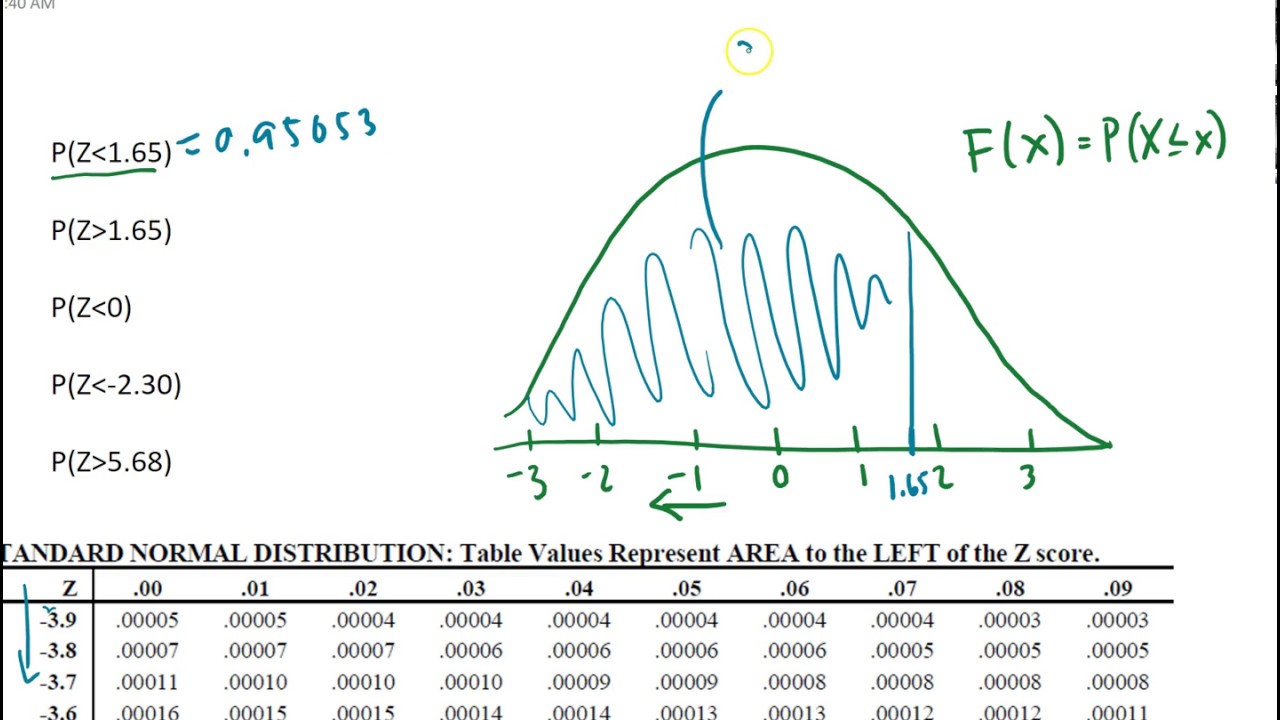
This is a basic video to show you how you can read the standard normal z table to find proportion of area under the standard normal curve.
ivory lodge
-1.8?
ivory lodge
Okay
ivory lodge
ivory lodge
Yes that’s what I was asking. I got -0.035 from formula. Is that right?
Was this correct?
ocean badger
Do you want me to post the answer for you to use if you can get it without statcrunch?
ivory lodge
The full answer was -0.035294118 but idk where I am suppose to round to. And yes please but I still want to figure the process
ocean badger

Move the decimal two places to get the %
so 48.59%
I hope you can figure it out with this information because the formulas I have and you have are different.
ivory lodge
I’m more comfortable with what I have because it is very specific but Ty. Idk what I am doing :/
ivory lodge
obsidian coral
I suggest watching that video if you don't know how to use the z table
I did but I’m still confused
obsidian coral
ivory lodge
The full answer was -0.035294118 but idk where I am suppose to round to. And yes...
That is the z value
ivory lodge
Okay. But I don’t see it on the table?
obsidian coral
Use the table to find the corresponding value
ivory lodge
I have but I don’t see anything exactly like it or close when it gets rounded
obsidian coral
The highlighted numbers are the z values, the numbers in the table are the corresponding value so for example, if you had a z = -3.03, you use the left column to find -3.0 then the top row to find 0.03, hence the corresponding value for a z value of -3.03 is 0.0012
 ivory lodge
So the 0.03…is the top highlight?
ivory lodge
I don’t know where all these numbers are coming from
If it is not explained to me step by step I can get very confused
obsidian coral
The z value you got was 0.03
ivory lodge
Yes
obsidian coral
You need to find 0.03 on the z table
ivory lodge
The rest of the numbers I got don’t matter?
ivory lodge
.0012?
ivory lodge
obsidian coral
Can you find -0.0352?
No
ivory lodge
obsidian coral
Can you find -0.0352?
That is not on the table
obsidian coral
ivory lodge
.0012?
Not exactly
ivory lodge
ivory lodge
That is not on the table
That is what I was trying to tell you
obsidian coral
You're looking for -0.03
obsidian coral
No
obsidian coral
Use the left column to find up to the first decimal point
ivory lodge
What decimal point?
ivory lodge
It’s not on there
obsidian coral
Use both the left column and top row to find it
obsidian coral
ivory lodge
I did
Then you did not find it right
obsidian coral
obsidian coral
The highlighted numbers are the z values, the numbers in the table are the corre...
Read my example again
ivory lodge
-.0013?
obsidian coral
No
obsidian coral
You are looking for the corresponding value that relates to -0.03
 obsidian coral
I provided a snippet as an example
ivory lodge
Okay but what am I looking for
obsidian coral
The value -0.03
ivory lodge
.3707?
obsidian coral
No
ocean badger
Here I am going to explain it
obsidian coral
Let's try a another example. If you have z = -1.37, you use the left column to find -1.3 then the top row to find 0.07 because combined you get -1.37
ocean badger
You start at the left hand side and move up the chart until you find the corresponding digit in the tens place. Then move to the right until you find the corresponding hundreths place
that is your answer.
So your z-score is -.03
the tens digit is -0.0
so you start at the bottom of the chart I sent
obsidian coral
Use the left column to find up to first decimal point, then top row to find 0.03
ocean badger
and -0.0 is the first one on the bottom
now move right until you get to 0.03 on the top list
whihc is .4880
obsidian coral
ocean badger
whihc is .4880
Let them find it
ocean badger
or approx. 48.80 percent
obsidian coral
It doesn't help if you tell them
obsidian coral
ocean badger
now move right until you get to 0.03 on the top list
You can tell them this and let them connect the dots
ocean badger
@obsidian coral I already showed the answer and the chart you provided doesn't even give the answer on the list.
obsidian coral
You don't need to give the value, they have eyes
obsidian coral
ocean badger
<@485903210272391178> I already showed the answer and the chart you provided doe...
I provided a snippet as an example
ocean badger
The answer was literally impossible on the chart you provided.
obsidian coral
Hence you can google teh chart
ivory lodge
.00336?
obsidian coral
It exists on the internet
ocean badger
Then find the correct one they need and send it.
obsidian coral
Or just google z table and tons of site pulls up
ivory lodge
I don’t see anything on the chart
obsidian coral
You start at the left hand side and move up the chart until you find the corresponding digit in the tens place. Then move to the right until you find the corresponding hundreths place
that is your answer.
So your z-score is -.03
the tens digit is -0.0
so you start at the bottom of the chart I sent
and -0.0 is the first one on the bottom
now move right until you get to 0.03 on the top list
As told from above
obsidian coral
ocean badger
Are you using this chart?
ivory lodge
.0003?
obsidian coral
No
obsidian coral
It was explained
You start at the left hand side and move up the chart until you find the corresponding digit in the tens place. Then move to the right until you find the corresponding hundreths place
that is your answer.
So your z-score is -.03
the tens digit is -0.0
so you start at the bottom of the chart I sent
and -0.0 is the first one on the bottom
now move right until you get to 0.03 on the top list
Literally the step by step
 ocean badger
I used colors and arrows to show what they did and looked for
ivory lodge
I did that already
obsidian coral
No you did not
ivory lodge
Yes I did
ocean badger
But do that for -0.03
obsidian coral
If you did, you would have gotten the correct answer
ocean badger
And the chart I sent
ivory lodge
Maybe if it was explained easy I would
obsidian coral
You did not do it right
ocean badger
 ivory lodge
You did not explain right
What is the number I look for on the LEFT side?
And what do I look for on the TOP
ocean badger
Since your number you calculated is -0.03
obsidian coral
the tens digit is -0.0
ocean badger
on the left side you look for -0.0
obsidian coral
Look for that
ivory lodge
Okay and top?
ocean badger
on the top you look for 0.03
ivory lodge
Ugh
ocean badger
connect the two numbers with lines
ivory lodge
I already did that
ocean badger
then you get .4880
ocean badger
yes
ivory lodge
Thank you
obsidian coral
You should look into learning how to use the z table
cedar kilnBOT
@ivory lodge Has your question been resolved?
Channel closed
Closed by @ivory lodge
Use .reopen if this was a mistake.
Please take a minute to participate in [our survey](#changelog message) if you haven't already!
cedar kilnBOT
Available help channel!
Send your question here to claim the channel.
Remember:
• Ask your math question in a clear, concise manner.
• Show your work, and if possible, explain where you are stuck.
• After 15 minutes, feel free to ping <@&286206848099549185>.
• Type the command .close to free the channel when you're done.
• Be polite and have a nice day!
Read #❓how-to-get-help for further information on how to ask a good question, and about conduct in the question channels.
Channel closed
Closed due to the original message being deleted
Please take a minute to participate in [our survey](#changelog message) if you haven't already!
Available help channel!
Send your question here to claim the channel.
Remember:
• Ask your math question in a clear, concise manner.
• Show your work, and if possible, explain where you are stuck.
• After 15 minutes, feel free to ping <@&286206848099549185>.
• Type the command .close to free the channel when you're done.
• Be polite and have a nice day!
Read #❓how-to-get-help for further information on how to ask a good question, and about conduct in the question channels.
 stiff delta
I should be using the product rule right ? Someone in my class used the chain rule instead and was wonder if I was wrong
 cedar kilnBOT
stiff delta
I should be using the product rule right ? Someone in my class used the chain ru...
stiff delta
cedar kilnBOT
stiff delta
I should be using the product rule right ? Someone in my class used the chain ru...
stiff delta
Or would this classify has a function within a function
 tropic oxide
it says very clearly there $h = f \circ g$
wraith daggerBOT
Ann
 tropic oxide
you know that this little circle denotes composition, right
 sacred stone
$$h(x) = f(g(x))$$
wraith daggerBOT
秋水
 stiff delta
so if it a circle that is filled in would be mean multiply ?
sorry have never seen that kind of notation really only f(g(x))
 velvet mortar
f(g(x) and f°g are same
sacred stone
In mathematics, function composition is an operation ∘ that takes two functions f and g, and produces a function h = g ∘ f such that h(x) = g(f(x)). In this operation, the function g is applied to the result of applying the function f to x. That is, the functions f : X → Y and g : Y → Z are composed to yield a function that maps x in domain ...
stiff delta
oh I see thought they had the same meaning in high school it was never denoted like that thanks for the clarification
.close
cedar kilnBOT
Channel closed
Closed by @stiff delta
Use .reopen if this was a mistake.
Please take a minute to participate in [our survey](#changelog message) if you haven't already!
cedar kilnBOT
Available help channel!
Send your question here to claim the channel.
Remember:
• Ask your math question in a clear, concise manner.
• Show your work, and if possible, explain where you are stuck.
• After 15 minutes, feel free to ping <@&286206848099549185>.
• Type the command .close to free the channel when you're done.
• Be polite and have a nice day!
Read #❓how-to-get-help for further information on how to ask a good question, and about conduct in the question channels.
cedar kilnBOT
 tribal pier
well, does this function grow at all?
(decay is just negative growth)
try plugging in some values to see
 delicate dagger
its always 25
delicate dagger
no
tribal pier
so what is the rate of growth when the growth is nothing?
tribal pier
is there a difference between having 0 growth and not having growth?
or are those just saying the same thing?
delicate dagger
they are the same thing right?
tribal pier
yep. It's growing (or decaying) at a rate of 0% per unit time
tribal pier
just staying still
tribal pier
always helps to see if you can explain it in words when you're not sure how to make the math start mathing
cedar kilnBOT
Channel closed
Closed by @delicate dagger
Use .reopen if this was a mistake.
Please take a minute to participate in [our survey](#changelog message) if you haven't already!
cedar kilnBOT
Available help channel!
Send your question here to claim the channel.
Remember:
• Ask your math question in a clear, concise manner.
• Show your work, and if possible, explain where you are stuck.
• After 15 minutes, feel free to ping <@&286206848099549185>.
• Type the command .close to free the channel when you're done.
• Be polite and have a nice day!
Read #❓how-to-get-help for further information on how to ask a good question, and about conduct in the question channels.
 vernal gorge
 cedar kilnBOT
vernal gorge
vernal gorge
cedar kilnBOT
vernal gorge
vernal gorge
I need to find the asymptotes and domain of the function
 spice tundra
vernal gorge
I need to find the asymptotes and domain of the function
spice tundra
vernal gorge
I need to find the asymptotes and domain of the function
you know what an asymptote is?
vernal gorge
I think so
spice tundra
an asymptote is a line that approaches zero but never reaches zero
vernal gorge
I think x=2 is the asymptote vertical
vernal gorge
That’s what I don’t understand I think it could be y=0 the horizontal asymptote but the line crossed it
Oh
Maybe y=-3 ?
Yeah
spice tundra
??
vernal gorge
What?
 lusty briar
nvm ask splooze
spice tundra
the turning point is at -3, there's no asymptote at -3
lusty briar
yea i havent done this in a while nvm
vernal gorge
Ok
 vernal gorge
But why
spice tundra
lets start with the bottom one
it approaches the x axis, but never actually touches it
do you know desmos @vernal gorge ?
vernal gorge
No I don’t
spice tundra
search it up, it'll help you a lot
vernal gorge
spice tundra
it approaches the x axis, but never actually touches it
But it does touch it

There?
vernal gorge
spice tundra
search it up, it'll help you a lot
Oh ok, but I don’t have the function the teacher only gave us the graphic
 vernal palm
are u in class
vernal gorge
Noup
vernal gorge
No I’m not xd
spice tundra
@vernal gorge , you don't need the function, i just want to teach you a concept
vernal gorge
Okk

 vernal gorge
Y=10
spice tundra
exactly
so the concept you need to understand is that
the smaller x is, the larger y will be

that's why in this graph, when x is very small, why is large
now think about this, when x = 30, y will be a very small number
because 1/30, is a tiny number
when x = 1000000000000000
y is basically zero, but it's not exactly zero
so what i want you to think about now is
if y = 1/x, when will y = 0?
vernal gorge
When x is 0 ?
 vernal gorge
Oh okay yeah like it isn’t in the domain right?
spice tundra
well basically
it's impossible for y to equal 0

no matter how big of a value you put for x, or how small of a value, you put for x, y will never be 0
it can be extremely close to 0, but will never ever touch the line
so, that's the main principle of an asymptote
it's a line in which approaches a certain value, but never ever touches that value
spice tundra
vernal gorge
now, this has you a little confused
vernal gorge
spice tundra
it's a line in which approaches a certain value, but never ever touches that val...
Okay I get that
spice tundra
how is it an asymptote if something is crossing the x axis, right?
vernal gorge
Yeah exactly
spice tundra
well, there can be multiple asymptotes in one graph
vernal gorge
Ohh
spice tundra
just because something crosses the x axis/y axis, it doesn't rule out every other asymptote
this is a getting a little more tricky, don't worry if you don't understand it right now but here's an example
I assume you've done polynomials?
something like this?
 vernal gorge
spice tundra
I assume you've done polynomials?
vernal gorge
spice tundra
I assume you've done polynomials?
Yeep
vernal gorge
spice tundra
this is a getting a little more tricky, don't worry if you don't understand it r...
Okay okay
spice tundra
spice tundra
so this graphed, looks like this

just a simple parabola
now, if we divide everything in this parabola by 1, we get this equation

make sense so far?
we're just dividing the entire thing by one
vernal gorge
Okay yeah
spice tundra
now prepare yourself
 vernal gorge
Wow
spice tundra
I'll give you a very brief run down of what's happening here
spice tundra
spice tundra
so this graphed, looks like this
what are the x intercepts of this graph?
vernal gorge
There aren’t I think

 spice tundra
Exactly
 vernal gorge
The vertical asymptotes are x=-3 and x=2 and the horizontal asymptote is y=0
spice tundra
There you go
The x intercepts of a graph, become the asymptotes of the reciprocated graph
When I say reciprocated, I'm referring to dividing the entire function/graph by 1
 vernal gorge
Okay okay
spice tundra
spice tundra
The x intercepts of a graph, become the asymptotes of the reciprocated graph
The x intercepts of a graph, become the asymptotes of the reciprocated graph
and why do you think this is?
vernal gorge
Honestly I have no idea
spice tundra
dw if it's a little tricky at first, once it clicks it'll make a lot more sense
it's simple, an x intercept means y = 0 right?
vernal gorge
Yes…
 vernal gorge
OHHHHH
spice tundra
everytime there is an x intercept, that means y must = 0... and 1/0 is undefined, hence we get an asymptote
vernal gorge
So it’s like (-3+3)(2-2)
spice tundra
close, very close
vernal gorge
spice tundra
everytime there is an x intercept, that means y **must** = 0... and 1/0 is undef...
Oh okay okay
spice tundra
vernal gorge
So it’s like (-3+3)(2-2)
you can't have two different x values
so lets just say x = -3
(-3 + 3)(-3 - 2)
that still equals just 0
vernal gorge
Yeah right
spice tundra

here are the graphs combined
when x = 0 on the og graph, bam, asymptote
anyway, it's getting a little late for me now, i'll leave it at that
but i hope i could've made the concept a little easier to grasp
spice tundra
awesome, have a good one ciao ciao
actually, one more thing before i get out
i'll help you with your original question
 vernal gorge
Oh okay
vernal gorge
Yeah I think so
spice tundra
lets say you have the function y = x
the domain for this function would be all real x
vernal gorge
(I don’t know if it’s the same in English cuz I speak Spanish xd)
spice tundra
because x is a possible value, all the way from negative infinity to positive infinity
vernal gorge
spice tundra
the domain for this function would be all real x
Yeah
Yeah it is the same
So it would be all x except 2 ?
spice tundra
right, so the thing with asymptotes is that they leave a little gap in your graph
spice tundra
vernal gorge
So it would be all x except 2 ?
exactly
vernal gorge
Oh okay
spice tundra
because that little part is undefined
because it would be 1 / 0
so to write it, it would be Domain: all real x, x not equal to 2
you can still write all real x, as long as you specify x is not equal to 2
and bam, that's your domain
spice tundra
shoot
spice tundra
no that is it
another quick little tip is that

asymptotes are very commonly drawn with dotted lines
spice tundra
thank you 😆 you have a good day/afternoon/night
vernal gorge
.close
cedar kilnBOT
Channel closed
Closed by @vernal gorge
Use .reopen if this was a mistake.
Please take a minute to participate in [our survey](#changelog message) if you haven't already!
Available help channel!
Send your question here to claim the channel.
Remember:
• Ask your math question in a clear, concise manner.
• Show your work, and if possible, explain where you are stuck.
• After 15 minutes, feel free to ping <@&286206848099549185>.
• Type the command .close to free the channel when you're done.
• Be polite and have a nice day!
Read #❓how-to-get-help for further information on how to ask a good question, and about conduct in the question channels.
 crimson sedge
 cedar kilnBOT
crimson sedge
crimson sedge
cedar kilnBOT
crimson sedge
crimson sedge
Hello
I was wondering if I could have help with B
I managed to solve it usingg a rather unconventional method and wanted to find a better method
DC = 12
if that helps
how did you solve it?
I used the
Area = a x base x sin(theta) / 2
method
yeah, that's what I would do too
I see, would there be any other way to solve it
We don't know anything about similarity, so there's nothing more we could do
I see
alright thanks
have a good day
.close
cedar kilnBOT
Channel closed
Closed by @stuck narwhal
Use .reopen if this was a mistake.
Please take a minute to participate in [our survey](#changelog message) if you haven't already!
Available help channel!
Send your question here to claim the channel.
Remember:
• Ask your math question in a clear, concise manner.
• Show your work, and if possible, explain where you are stuck.
• After 15 minutes, feel free to ping <@&286206848099549185>.
• Type the command .close to free the channel when you're done.
• Be polite and have a nice day!
Read #❓how-to-get-help for further information on how to ask a good question, and about conduct in the question channels.
crimson sedge
I'm bak
cedar kilnBOT
crimson sedge
I'm bak
crimson sedge
back
sorry

so for this triangle
where BC = 18
Can't I use the AB x sin(theta / 2) formula
for area
where A is 12, B = 18 and theta = 80
 buoyant latch
The way i would do it is using similar triangles
crimson sedge
buoyant latch
The way i would do it is using similar triangles
oh wait are they similar triangles
 dusty hazel
crimson sedge
oh wait are they similar triangles
dusty hazel
crimson sedge
oh wait are they similar triangles
If ED is parallel to AC
crimson sedge
yeah nah they're not similar
buoyant latch
it depends what topic this question is under tbh
crimson sedge
buoyant latch
it depends what topic this question is under tbh
Unit circle
buoyant latch
if you've been doing a bunch of similar triangles question then that's probably the path you should go down
if not that since it doesn't say it's not applicable i guess
but i mean
you cant actually find BE if it's not similar
E could literally be any point from A to B
crimson sedge
right
buoyant latch
it would just depend on the angle BDE
therefore i will assume they forgot to say that ED||AC
crimson sedge
buoyant latch
E could *literally* be any point from A to B
oh wait you can
i didn't think the info would be necessary since i'm trying to find the area of the bigger triangle
but the area of the smaller triangle is 13.5
velvet mortar
crimson sedge
Can't I use the AB x sin(theta / 2) formula
Of course you can
buoyant latch
unless ED || AC
crimson sedge
velvet mortar
Of course you can
I tried applying to formula but my answer doesn't match with the mark scheme
velvet mortar
But it's not sin (theta/2)
velvet mortar
It's 1/2 * ab * sin theta
buoyant latch
am i missing something obvious
crimson sedge
buoyant latch
how do you find BE
13.5 = X times 6 x sin(theta) x 0.5
buoyant latch
doesn't 1/2 ab sin theta solve for area
velvet mortar
,calc sin (80) * 1/2 * 18 * 12
wraith daggerBOT
Result:
-107.33997462372
180 - 60 - 40 = 80
velvet mortar
180 - 60 - 40
velvet mortar
,calc sin (80°) * 1/2 * 18 * 12
wraith daggerBOT
The following error occured while calculating:
Error: Syntax error in part "°) * 1/2 * 18 * 12" (char 8)
buoyant latch
and if it were you could use similar triangles
velvet mortar
,calc sin (80 degrees) * 1/2 * 18 * 12
wraith daggerBOT
Result:
106.35923732532
,w sin(80 deg) * 0.5 * 18 * 12
wraith daggerBOT


 Requested by Frosst#1111
buoyant latch
Requested by Frosst#1111
buoyant latch
so you were asking for help for a better method than using the area to find part B
and im telling you that if AC||ED then you can use similar triangles as the "better" method
and if you dont assume that (since it's not explicitly stated) then you can't find BE
you can only find it as a function of the angle BDE
crimson sedge
buoyant latch
and if you dont assume that (since it's not explicitly stated) then you can't fi...
can't you use just ab x sin (theta) x 0.5
= area
since the alreafy told us the area for the smaller triangle is 13.5
velvet mortar
Did you get 106?
crimson sedge
the correct answer was 95.5
crimson sedge
velvet mortar
Did you get 106?
yeah i got that at the beginning as well but when i checked the markscheme it was wrong
wraith daggerBOT
 Requested by Frosst#1111
velvet mortar
Requested by Frosst#1111
velvet mortar
Either BC you said is wrong or they are asking for something else
buoyant latch
,calc 9/2 csc(40 degrees)
wraith daggerBOT
Result:
7.0007572208719
let me double check what BC is
crimson sedge
velvet mortar
Either BC you said is wrong or they are asking for something else
oh yeah you were right my bad
BC = 16.2
yep ok nvm
i got it now
thanks
buoyant latch
,w sin(60 deg)/(6+x) = sin(40 deg)/12 solve for x
wraith daggerBOT
 Requested by Frosst#1111
buoyant latch
Requested by Frosst#1111
buoyant latch
,calc 6(3)^(1/2)*csc(40 degrees) - 6
wraith daggerBOT
Result:
10.167556264006
cuz it's the base
buoyant latch
wouldn't u just use sine rule to get the 2 sides then find the area of the big triangle - the small given triangle?
,w sin(60 deg)/x = sin(40 deg)/12 solve for x
wraith daggerBOT
 Requested by Frosst#1111
buoyant latch
Requested by Frosst#1111
buoyant latch
,w sin(80 deg)/x = sin(40 deg)/12 solve for x
wraith daggerBOT
 Requested by Frosst#1111
crimson sedge
buoyant latch
wouldn't u just use sine rule to get the 2 sides then find the area of the big t...
Requested by Frosst#1111
crimson sedge
buoyant latch
wouldn't u just use sine rule to get the 2 sides then find the area of the big t...
idk
I just used toe a * b * 0.5 * sin(theta) rule
it ended up wowrking
so is fine ig
thank you guys for your help
.close
cedar kilnBOT
Channel closed
Closed by @stuck narwhal
Use .reopen if this was a mistake.
Please take a minute to participate in [our survey](#changelog message) if you haven't already!
buoyant latch
,calc 1/2 * (12 * cos(10 degrees) * csc(40 degrees)) * (6 *(3)^(1/2) * csc(40 degrees)) * sin(40 degrees) - 13.5
wraith daggerBOT
Result:
82.031608536327
what the heck why isn't it right 😦
buoyant latch
that's the answer?
crimson sedge
no the answer is 95.5
but at the end of your thing you subtracted 13.5
so you were right
cedar kilnBOT
Available help channel!
Send your question here to claim the channel.
Remember:
• Ask your math question in a clear, concise manner.
• Show your work, and if possible, explain where you are stuck.
• After 15 minutes, feel free to ping <@&286206848099549185>.
• Type the command .close to free the channel when you're done.
• Be polite and have a nice day!
Read #❓how-to-get-help for further information on how to ask a good question, and about conduct in the question channels.
cedar kilnBOT
crimson sedge
so you were right
buoyant latch
doesn't the question ask to solve for the quadrilateral ACDE
shouldn't that be the big triangle - 13.5
buoyant latch
but you said the answer sheet says 95.5?
crimson sedge
buoyant latch
but you said the answer sheet says 95.5?
it said that for the area of the total triangle
buoyant latch
,w sin(60 deg)/x = sin(40 deg)/12 solve for x
solve for BC
buoyant latch
crimson sedge
it said that for the area of the total triangle
yes
,w sin(80 deg)/x = sin(40 deg)/12 solve for x
solve for BA
,calc 1/2 * (12 * cos(10 degrees) * csc(40 degrees)) * (6 (3)^(1/2) csc(40 degrees)) * sin(40 degrees) - 13.5
this is 1/2 * BC * BA * sin(40 deg) - triangle BED (13.5)
buoyant latch
wouldn't u just use sine rule to get the 2 sides then find the area of the big triangle - the small given triangle?
crimson sedge
.close
cedar kilnBOT
Channel closed
Closed by @stuck narwhal
Use .reopen if this was a mistake.
Please take a minute to participate in [our survey](#changelog message) if you haven't already!
crimson sedge
buoyant latch
`wouldn't u just use sine rule to get the 2 sides then find the area of the big ...
right didn't know you were referring to that
aight have a good day then
see ya
cedar kilnBOT
Available help channel!
Send your question here to claim the channel.
Remember:
• Ask your math question in a clear, concise manner.
• Show your work, and if possible, explain where you are stuck.
• After 15 minutes, feel free to ping <@&286206848099549185>.
• Type the command .close to free the channel when you're done.
• Be polite and have a nice day!
Read #❓how-to-get-help for further information on how to ask a good question, and about conduct in the question channels.
 lament kraken
int wrt x need a hint please
 cedar kilnBOT
lament kraken
int wrt x need a hint please
cedar kilnBOT
lament kraken
int wrt x need a hint please
 gaunt hamlet
What have you tried
lament kraken
multiplying by 1-cosx
didnt quite work
plus the answer says it has something with tan
so I want to try and solve it that route
gaunt hamlet
Gimme a sec to try it myself
 crimson delta
you could always do the weierstrass sub and then brute force it with partial fractions
obsidian coral
lament kraken
multiplying by 1-cosx
If you did this, the denominator would be 1 - cos^2, correct?
lament kraken
obsidian coral
If you did this, the denominator would be 1 - cos^2, correct?
mhm and then converted with pythag ident
gaunt hamlet
lament kraken
multiplying by 1-cosx
I didn't finish it but this seems to work
lament kraken
does it give an answer with tan or
gaunt hamlet
I end up with something I could integrate
lament kraken
ye
gaunt hamlet
lament kraken
does it give an answer with tan or
cot, is that close enough?
lament kraken
ye i got - cotx - 2ln(sinx) - int cot^2 x dx
but uh the answer was:

and im wondering how they got such a simple expression
gaunt hamlet
lament kraken
ye i got - cotx - 2ln(sinx) - int cot^2 x dx
Well, I didn't do the integration, but I don't think I would've gotten that
crimson sedge
what they did is probably partial fraction
obsidian coral

lament kraken
crimson sedge
what they did is probably partial fraction
uhhh a bit lost, how would you get to that?
lament kraken
gaunt hamlet
Well, I didn't do the integration, but I don't think I would've gotten that
the integral of csc^2 x is -cotx, the integral of -2cotx is -2ln(sinx)?
gaunt hamlet
I didn't have a -2cotx
lament kraken
gaunt hamlet
I didn't have a -2cotx
wait you sure?
gaunt hamlet
Yeah
dusty hazel
lament kraken
I just realised they used some random trig identity
ye compound angles.
gaunt hamlet
You have a -2cosx in the numerator and sin²x in the denominator
obsidian coral
Fyi, top notch website
https://www.integral-calculator.com/
Solve definite and indefinite integrals (antiderivatives) using this free online calculator. Step-by-step solution and graphs included!
lament kraken
gaunt hamlet
You have a -2cosx in the numerator and sin²x in the denominator
so csc cot
lament kraken
obsidian coral
Fyi, top notch website
https://www.integral-calculator.com/
I'll be abusing this from now on :)
obsidian coral
Shows work and everything
cedar kilnBOT
Channel closed
Closed by @lament kraken
Use .reopen if this was a mistake.
Please take a minute to participate in [our survey](#changelog message) if you haven't already!
Available help channel!
Send your question here to claim the channel.
Remember:
• Ask your math question in a clear, concise manner.
• Show your work, and if possible, explain where you are stuck.
• After 15 minutes, feel free to ping <@&286206848099549185>.
• Type the command .close to free the channel when you're done.
• Be polite and have a nice day!
Read #❓how-to-get-help for further information on how to ask a good question, and about conduct in the question channels.
 jovial prism
Using an example of a vector field related to your discipline, describe divergence or curl in your own words (provide a quick sketch and a brief 1-2 sentence description).
cedar kilnBOT
jovial prism
Using an example of a vector field related to your discipline, describe divergen...
jovial prism
my field of study is civil engineering and i could not think of anything that could relate to vector field
cedar kilnBOT
@jovial prism Has your question been resolved?
cedar kilnBOT
Channel closed
Closed due to timeout
Use .reopen if this was a mistake.
Please take a minute to participate in [our survey](#changelog message) if you haven't already!
Available help channel!
Send your question here to claim the channel.
Remember:
• Ask your math question in a clear, concise manner.
• Show your work, and if possible, explain where you are stuck.
• After 15 minutes, feel free to ping <@&286206848099549185>.
• Type the command .close to free the channel when you're done.
• Be polite and have a nice day!
Read #❓how-to-get-help for further information on how to ask a good question, and about conduct in the question channels.
crimson sedge
Hey all, I have a quick question. I have a sketch of a function and I want to know the equation for it with parameters that i can adjust. I can't find it anywhere. It starts with an exponential rise and then an exponential decay:
 cedar kilnBOT
crimson sedge
Hey all, I have a quick question. I have a sketch of a function and I want to kn...
crimson sedge
cedar kilnBOT
crimson sedge
Hey all, I have a quick question. I have a sketch of a function and I want to kn...
crimson sedge
<@&286206848099549185> Would you help me finding a function for this sketch?
 gleaming cloud
looks like planck's model for black body radiation
$I(\lambda) = \frac{2\pi c^2h}{\lambda^5}\frac{1}{e^{\frac{hc}{\lambda k_B T}}-1}$
wraith daggerBOT
giannis_money
 cedar kilnBOT
@crimson sedge Has your question been resolved?
cedar kilnBOT
@crimson sedge Has your question been resolved?
cedar kilnBOT
Channel closed
Closed due to timeout
Use .reopen if this was a mistake.
Please take a minute to participate in [our survey](#changelog message) if you haven't already!
Available help channel!
Send your question here to claim the channel.
Remember:
• Ask your math question in a clear, concise manner.
• Show your work, and if possible, explain where you are stuck.
• After 15 minutes, feel free to ping <@&286206848099549185>.
• Type the command .close to free the channel when you're done.
• Be polite and have a nice day!
Read #❓how-to-get-help for further information on how to ask a good question, and about conduct in the question channels.
cedar kilnBOT
Channel closed
Closed due to the original message being deleted
Please take a minute to participate in [our survey](#changelog message) if you haven't already!
Available help channel!
Send your question here to claim the channel.
Remember:
• Ask your math question in a clear, concise manner.
• Show your work, and if possible, explain where you are stuck.
• After 15 minutes, feel free to ping <@&286206848099549185>.
• Type the command .close to free the channel when you're done.
• Be polite and have a nice day!
Read #❓how-to-get-help for further information on how to ask a good question, and about conduct in the question channels.
 gray blade
 cedar kilnBOT
gray blade
gray blade
cedar kilnBOT
gray blade
gray blade
how could you know if any of them are equivalent without knowing any numbers?
I guess it's assumed they're all different numbers? if so, it's E?
wait no, there's (6 * 1/6) / (5 * 1/5)
huh?
 tawdry jay
I also think it E, it isn’t abt the nummers being equivalent but abt the formulas being equivalent. And A til D are all the same so equivalent
gray blade
 livid hound
consider solving for the same variable for each equation
livid hound
consider solving for the same variable for each equation
ooh I see it now, it's checking if the choices equal each other
so I solved for a and all of them are bc/f except A?
thanks
.close
cedar kilnBOT
Channel closed
Closed by @gray blade
Use .reopen if this was a mistake.
Please take a minute to participate in [our survey](#changelog message) if you haven't already!
Available help channel!
Send your question here to claim the channel.
Remember:
• Ask your math question in a clear, concise manner.
• Show your work, and if possible, explain where you are stuck.
• After 15 minutes, feel free to ping <@&286206848099549185>.
• Type the command .close to free the channel when you're done.
• Be polite and have a nice day!
Read #❓how-to-get-help for further information on how to ask a good question, and about conduct in the question channels.
 somber belfry
hello what does this mean? alpha and beta are real numbers
 somber belfry
I know $|| . ||$ is a norm
wraith daggerBOT
Eichhorst

 crystal raptor
So what exactly don't you understand
 wanton sail
Usually the norm of $(\alpha, \beta)$ means $\sqrt{\alpha^2 + \beta^2}$
somber belfry
but in what relation do alpha and beta stand here
wanton sail
(There are other norms but this is the most common)
somber belfry
wanton sail
Usually the norm of $(\alpha, \beta)$ means $\sqrt{\alpha^2 + \beta^2}$
thanks lol
wraith daggerBOT
Eric Tao
 wanton sail
it's basically the pythagorean theorem
somber belfry
we defined this as the standard norm in most cases
but we never used this style of notation yet
.close
cedar kilnBOT
Channel closed
Closed by @somber belfry
Use .reopen if this was a mistake.
Please take a minute to participate in [our survey](#changelog message) if you haven't already!
Available help channel!
Send your question here to claim the channel.
Remember:
• Ask your math question in a clear, concise manner.
• Show your work, and if possible, explain where you are stuck.
• After 15 minutes, feel free to ping <@&286206848099549185>.
• Type the command .close to free the channel when you're done.
• Be polite and have a nice day!
Read #❓how-to-get-help for further information on how to ask a good question, and about conduct in the question channels.
crimson sedge
I would like to know what y = ax^2 is on a graph?
 crimson sedge
wanton sail
Did you try graphing it on Desmos
crimson sedge
wanton sail
Did you try graphing it on Desmos
yes but i got a parabola
wanton sail
Yes
crimson sedge
also I got a 75% on my grade 10 academic math. im taking funcitons and applications next year, How would I be able to achieve a 90% in that course?
wanton sail
It is a parabola
crimson sedge
oh okok
crimson sedge
crimson sedge
also I got a 75% on my grade 10 academic math. im taking funcitons and applicati...
^
 trim sentinel
crimson sedge
also I got a 75% on my grade 10 academic math. im taking funcitons and applicati...
trim sentinel
crimson sedge
also I got a 75% on my grade 10 academic math. im taking funcitons and applicati...
Umm study ig
livid hound
ensure you have complete understanding of basic algebraic manipulation and and solving basic linear equations before going into it
and quadratics depending if that's part of what you already learned or whether it's in the upcoming class
cedar kilnBOT
Channel closed
Closed by @clever nest
Use .reopen if this was a mistake.
Please take a minute to participate in [our survey](#changelog message) if you haven't already!
cedar kilnBOT
Available help channel!
Send your question here to claim the channel.
Remember:
• Ask your math question in a clear, concise manner.
• Show your work, and if possible, explain where you are stuck.
• After 15 minutes, feel free to ping <@&286206848099549185>.
• Type the command .close to free the channel when you're done.
• Be polite and have a nice day!
Read #❓how-to-get-help for further information on how to ask a good question, and about conduct in the question channels.
 hushed badger
can someone pls help me with part iv?
 cedar kilnBOT
hushed badger
can someone pls help me with part iv?
hushed badger
cedar kilnBOT
hushed badger
can someone pls help me with part iv?
hushed badger
im thinking that I show that the distance from point A and B to the origin 0 0 0 is equal?
cedar kilnBOT
@hushed badger Has your question been resolved?
cedar kilnBOT
@hushed badger Has your question been resolved?
hushed badger
<@&286206848099549185>
cedar kilnBOT
@hushed badger Has your question been resolved?
cedar kilnBOT
Channel closed
Closed due to timeout
Use .reopen if this was a mistake.
Please take a minute to participate in [our survey](#changelog message) if you haven't already!
Available help channel!
Send your question here to claim the channel.
Remember:
• Ask your math question in a clear, concise manner.
• Show your work, and if possible, explain where you are stuck.
• After 15 minutes, feel free to ping <@&286206848099549185>.
• Type the command .close to free the channel when you're done.
• Be polite and have a nice day!
Read #❓how-to-get-help for further information on how to ask a good question, and about conduct in the question channels.
 scenic crest
 cedar kilnBOT
scenic crest
scenic crest
cedar kilnBOT
scenic crest
scenic crest
answer d
and it is correct
but i wanna ask is the function f(x) = 0....because that is what i got while solvin
tropic oxide
no
there exist nonzero functions f that satisfy f(1/x) + x^2 f(x) = 0
for example, f(x) = log(x)/x
scenic crest
look ... i used leibnitz on integration f(x) limits from sin y to cosec y and got the answer 0
so doesn't it mean that the f(x) = 0?
tropic oxide
just because a function integrates to 0 over some interval does not by itself mean it is identically zero
i mean... hm
you're essentially asked for its integral over [1/a, a] where a = csc(θ)
scenic crest
oh yeah okay ...but do you know how to find the function f(x)?
tropic oxide
well i first rewrote the functional equation to $\frac{1}{x} f(1/x) + x f(x) = 0$ and then took $g(x) = x f(x)$ to get $g(x) = -g(1/x)$
wraith daggerBOT
Ann
 tropic oxide
and this equation is satisfied by, for example, g(x) = log(x)
(but not just by that. it'll be satisfied by any odd function composed on the right with e^x)
taking g(x) = log(x) gives f(x) = log(x)/x
scenic crest
oh okay ...thank you so much.....
crimson sedge
scenic crest
just write f(x)=-f(1/x)*1/x^2 and plug it into the integral and solve you will get I=-I
scenic crest
tropic oxide
taking g(x) = log(x) gives f(x) = log(x)/x
without you always helping me ... i coudn't have leveled up myself in calculus...thank you
.close
cedar kilnBOT
Channel closed
Closed by @scenic crest
Use .reopen if this was a mistake.
Please take a minute to participate in [our survey](#changelog message) if you haven't already!
cedar kilnBOT
Available help channel!
Send your question here to claim the channel.
Remember:
• Ask your math question in a clear, concise manner.
• Show your work, and if possible, explain where you are stuck.
• After 15 minutes, feel free to ping <@&286206848099549185>.
• Type the command .close to free the channel when you're done.
• Be polite and have a nice day!
Read #❓how-to-get-help for further information on how to ask a good question, and about conduct in the question channels.
 tulip river
How do i solve $\sqrt{x}<\frac{1}{x}$?
cedar kilnBOT
tulip river
How do i solve $\sqrt{x}<\frac{1}{x}$?
wraith daggerBOT
Lyuka
 tulip river
I first considered as if we had $\sqrt{x}=\frac{1}{x}$ and got x=1
wraith daggerBOT
Lyuka
 tulip river
wraith dagger
**Lyuka**
tulip river
wraith dagger
**Lyuka**
Then if i put x=1 inside here i'm left with 0<0
tulip river
 rotund vine
x>=0
rotund vine
x>=0
You are referring to the condition of the sqrt number right?
rotund vine
yes
tulip river
Okay, then you are correct
tulip river
No i dont understand what you mean
rotund vine
for 1/x => x is not equal to 0
for sqrt(x) => x >=0
tulip river
Okay now i understand
rotund vine
great
tulip river
so x>0
tulip river
So now we have 2 values, 1 and 0
rotund vine
this x>0, is something that we need to keep in mind
cause the boundary values
and x=1 is the point when y=sqrt(x) and y=1/x meet
now are you familiar with graphs of sqrt(x) and 1/x
rotund vine
sure
tulip river
now that we have both values of the inequality, couldnt we just put them in this graph?

or is what i'm doing wrong?
rotund vine
1>x>0 looks good to me
tulip river
I got the answer by putting a number x>1 inside the first equation and checking the signs of the numerator and denominator
it was positive so i put a + after the 1
is my reasoning correct or did i just get lucky?
rotund vine
what do you mean by positive and negative
tulip river
give me a second, i'll show you
rotund vine
sure


 rotund vine
right good
but please take into note
that squaring sometimes will make the equation fail
consider x=-1
but we're lucky this time cause x>0
tulip river
I see, what should i do in that specific case then?
Could you please give me an example?
rotund vine
right
like try and find the points that 1/x^2 = x^2
you can make it an inequality but an equation works
tulip river
so we would have x^4=1
rotund vine
yeah
tulip river
isnt that correct?
rotund vine
yeah solve for x
tulip river
ohhh okay, now i understand what you meant
Basically whenever i do these types of equations i always have to begin by taking into account all the conditions
Thank you once again for helping me
.close
cedar kilnBOT
Channel closed
Closed by @tulip river
Use .reopen if this was a mistake.
Please take a minute to participate in [our survey](#changelog message) if you haven't already!
rotund vine
tulip river
Thank you once again for helping me
np
cedar kilnBOT
Available help channel!
Send your question here to claim the channel.
Remember:
• Ask your math question in a clear, concise manner.
• Show your work, and if possible, explain where you are stuck.
• After 15 minutes, feel free to ping <@&286206848099549185>.
• Type the command .close to free the channel when you're done.
• Be polite and have a nice day!
Read #❓how-to-get-help for further information on how to ask a good question, and about conduct in the question channels.
 simple flare
 cedar kilnBOT
simple flare
simple flare
cedar kilnBOT
simple flare
simple flare
Hi, I need help for finding the limit for triple integral

I found this from the internet but I’m not sure how does the limit come from
<@&286206848099549185>
And how to I get the limit for xyz first before I use spherical coordinates?
wanton sail
oh so for all of them?
simple flare
wanton sail
oh so for all of them?
Yea
simple flare
wanton sail
so x^2 + y^2 + z^2 = 9, what shape does that make?
It’s a sphere
simple flare
Oh, 0->3
wanton sail
yep!
wanton sail
so next step, "above the xy-plane", what value of phi corresponds to the xy-plane?
simple flare
Actually what does it meant by above the xy plane?
simple flare
wanton sail
it means the plane where z=0
Oh
wanton sail
what phi value corresponds to z=0?
simple flare
Pi/2?
wanton sail
yep! how did you get that
wanton sail
good! another way to think about it is that the xy-plane makes an angle of pi/2 with the z-axis
does that make sense visually or do you want me to draw it out
simple flare
wanton sail
does that make sense visually or do you want me to draw it out
Yea, I prefer drawing, can’t really visualise well
But why it starts from pi/4?
wanton sail
I'll get to that in a second but do you see how the plane drawn here is at a 90° angle with the z axis
 simple flare
Yeap
simple flare
I think for xyz plane, they all all 90degree
simple flare
wanton sail
and 90° is how much in radians
Pi/2
simple flare
wanton sail
what shape does z = sqrt(x^2 + y^2) make?
Not sure but I saw it’s bending inwards
It’s like a sheet bending inwards
wanton sail
if we make a substitution into cylindrical coordinates, this is also z=r
do you know what shape that is?
simple flare
wanton sail
do you know what shape that is?
No
wanton sail
Okay I think the main difficulty you're having then is being able to visualize these shapes
try plotting it on here https://www.geogebra.org/3d
and you'll see it forms a cone
 shell lance
Wait what's he visualizing sorry?
wanton sail
3d shapes
shell lance
Anything specific?
wanton sail
z = sqrt(x^2 + y^2)
shell lance
Oh I would think about that this way personally
sqrt(x^2 + y^2) is the distance from the origin
So as you get further from the origin in the xy plane, z increases
simple flare
wanton sail
and you'll see it forms a cone
Oh, this is a good app
I can see it’s a cone
simple flare
Isn’t that when see from the plot, I’ll get pi/2 immediately?
wanton sail
well pi/2 is the angle between the z axis and the xy plane right
what's the angle between the z axis and the cone
simple flare
wanton sail
well pi/2 is the angle between the z axis and the xy plane right
Yea
Oh
45degree
Btw, what is meant by inside and outside?
wanton sail
inside meaning inside the cone, phi < 45°
outside meaning outside the cone, phi > 45°
if you think about the picture, it makes more sense
so 45 degrees is how much in radians?
@simple flare
simple flare
wanton sail
so 45 degrees is how much in radians?
Pi/4
simple flare
What if I want to solve it in normal dxdydz method?
wanton sail
it's a lot harder I wouldn't recommend it
simple flare
Wait, let me write it out
wanton sail
something you can do though if you want an exercise is to solve it with cylindrical coordinates
which is also pretty straightforward
simple flare
I want to make sure I determine the limit correctly for the normal xyz
wanton sail
the limits if you do it in xyz coordinates are fairly complicated
I wouldn't recommend it
simple flare
wanton sail
I wouldn't recommend it
Yea, but I’m curious what the limit 😂