#help-13
428200 messages · Page 515 of 429
 crimson sedge
 tribal pier
crimson sedge
u can just use this fact
tribal pier
crimson sedge
u can just use this fact
but that fact doesn't apply here? there's no derivative involved
crimson sedge
tribal pier
but that fact doesn't apply here? there's no derivative involved
.... but it resembles that form
 reef venture
it does but there is no need to use it
crimson sedge
it's just faster using it ig
reef venture
when x just cancels
crimson sedge
rather than expanding
reef venture
x cancels in the numerator and denominator
crimson sedge
reef venture
x cancels in the numerator and denominator
ik
but ig using limit definition of derivative is faster method
tribal pier
it's faster, but it's circular. Learning calc 1 you need to use the limit definition of the derivative before using power rules or any other derivative rules because that's what all those rules come from.
you're putting the cart before the horse
reef venture
crimson sedge
but ig using limit definition of derivative is faster method
|| f(x)=x^3, and finding f'(3)? ||
crimson sedge
 actually wtf limits are taught before derivative
crimson sedge
reef venture
|| f(x)=x^3, and finding f'(3)? ||
ya
tribal pier
crimson sedge
<:AWOOKEN:559786743080157184> actually wtf limits are taught before derivative
yeah, that's how you learn the derivative
crimson sedge
tribal pier
it's faster, but it's circular. Learning calc 1 you need to use the limit defin...
also just a fact using power rule doesn't require that limit
there is another proof
so it's not circular reasoning
crimson sedge
tribal pier
yeah, that's how you learn the derivative
I think I first learned it as
$f'(x) = \frac{f(x+dx) - f(x)}{dx}$
 wraith daggerBOT
cos(x)=1-x^2/2!+x^4/4! -....
 reef venture
yeah but dx approaches 0
tribal pier
crimson sedge
also just a fact using power rule doesn't require that limit
differentiation requires that limit. it's the definition of the derivative.
crimson sedge
tribal pier
*differentiation* requires that limit. it's the definition of the derivative.
yes I know
and to find the derivative of x^3
you won't require solving that limit
neither to use power rule
tribal pier
which means it is circular to use derivative techniques to then find the solution of that limit.
reef venture
What you're basically doing is using a general rule that people found by solving that limit to solve the limit without actually doing it yourself
crimson sedge
tribal pier
which means it is circular to use derivative techniques to then find the solutio...
no it does not here
tribal pier
the question is asking you to solve the limit.
reef venture
crimson sedge
you won't require **solving** that limit
yes you do
 reef venture
this is still using limits (implied limits)
tribal pier
crimson sedge
d/dx is that limit by definition, you're using the limit to solve the limit.
 tall berry
confused
crimson sedge
tribal pier
d/dx is that limit by definition, you're using the limit to solve the limit.
can u tell me if I solve that particular limit
tall berry
guys im terrible at calculus
tribal pier
crimson sedge
can u tell me if I solve that particular limit
not here because you're jumping way ahead of the actual problem that's being worked on
tribal pier
tall berry
confused
where are you at rn?
crimson sedge
tribal pier
not here because you're jumping way ahead of the actual problem that's being wor...
it will require knowledge of calculus taught later chain rule and stuff
reef venture
crimson sedge
can u tell me if I solve that particular limit
What you're basically doing is using a general rule that people found by solving that limit generally to solve the limit without actually doing it yourself. All the rules of differentiation have been derived from the first principle.
tribal pier
crimson sedge
it will require knowledge of calculus taught later chain rule and stuff
then don't put it in here where we're just barely learning limits
crimson sedge
reef venture
> What you're basically doing is using a general rule that people found by solvi...
except the derivative of ln(x) which part has been derived from limits
tall berry
moved on to b
tribal pier
tall berry
moved on to b
ok, so we'll end up with an undefined again, which means we have to use our algebra trickery to shuffle around the impossible division again. What do you notice about the form of the numerator?
crimson sedge
tribal pier
then don't put it in here where we're just barely learning limits
then don't call my reasoning circular it looks circular at early layers of calculus
crimson sedge
reef venture
its just unnecessary here
but it's faster I mean
so if uk u can just do it faster
tribal pier
crimson sedge
so if uk u can just do it faster
but if you don't know why it works, then you don't have business using it
crimson sedge
tribal pier
but if you don't know *why* it works, then you don't have business using it
do u derive everything top to bottom on a test 
deriving is done in class not in practice I mean
or in explaination
but as he probably doesn't know that thing already [I am assuming] I think ur fair enough here
tribal pier
crimson sedge
do u derive everything top to bottom on a test <:monkaS:585602880434864138>
yes I already understand the why, so I use it. limits are important beyond just derivatives as well, and learning to remove discontinuities is a necessary step in understanding limits. math builds on itself. Using the stone on the top of the pyramid without the stones underneath it just leads to crushed toes and pain.
tall berry
im gonna try it myself thank you guys so much
crimson sedge
tribal pier
~~yes~~ I already understand the why, so I use it. limits are important beyond...
doesn't most people understand why  derivative of x^3 is 3x^2 but based on this mans words I don't think so which I already said in the following message
tribal pier
tall berry
im gonna try it myself thank you guys so much
best of luck, feel free to ping if you get stuck
 cedar kilnBOT
@tall berry Has your question been resolved?
cedar kilnBOT
Channel closed
Closed due to timeout
Use .reopen if this was a mistake.
 Available help channel!
Send your question here to claim the channel.
Remember:
• Ask your math question in a clear, concise manner.
• Show your work, and if possible, explain where you are stuck.
• After 15 minutes, feel free to ping <@&286206848099549185>.
• Type the command .close to free the channel when you're done.
• Be polite and have a nice day!
Read #❓how-to-get-help for further information on how to ask a good question, and about conduct in the question channels.
 spiral yacht
Hello I need some help in this question
 cedar kilnBOT
spiral yacht
Hello I need some help in this question
cedar kilnBOT
spiral yacht
Hello I need some help in this question
 crystal raptor
Where are you stuck?
spiral yacht
from the start. I am finding this problem confusing.
 dusty hazel
Do you know the integral for cos(x) or sin(x)?
crystal raptor
Can you do $\int_{0}^{\frac{\pi}{2}}\cos(x), dx$?
dusty hazel
\pi
wraith daggerBOT
ΣAC
 spiral yacht
dusty hazel
Do you know the integral for cos(x) or sin(x)?
spiral yacht
dusty hazel
Do you know the integral for cos(x) or sin(x)?
Sin X and -cos x
spiral yacht
dusty hazel
Then use that.
My answer coming one but the answer is shown to be two
dusty hazel
How did you get 1?
dusty hazel
Yes, you did it wrong. But how 1?
What did you get after you calculated the integral?

 delicate ember
also once the intergration symbol is gone no need for dx
 dusty hazel
Yeah.
delicate ember
mb I'm sleep deprived
spiral yacht
I see
wraith daggerBOT
What the hell am I doing here?
 spiral yacht
I see thank you
dusty hazel
You're welcome.
 cedar kilnBOT
@spiral yacht Has your question been resolved?
cedar kilnBOT
@spiral yacht Has your question been resolved?
 cosmic steppe
spiral yacht
cosmic steppe
spiral yacht
$\frac{dy}{dx} = \frac{dy}{dθ} \cdot \frac{dθ}{dx}$
wraith daggerBOT
Umbraleviathan
 cosmic steppe
Find $\frac{dy}{dθ}$ and $\frac{dx}{dθ}$
wraith daggerBOT
Umbraleviathan
 cedar kilnBOT
Channel closed
Closed due to timeout
Use .reopen if this was a mistake.
Available help channel!
Send your question here to claim the channel.
Remember:
• Ask your math question in a clear, concise manner.
• Show your work, and if possible, explain where you are stuck.
• After 15 minutes, feel free to ping <@&286206848099549185>.
• Type the command .close to free the channel when you're done.
• Be polite and have a nice day!
Read #❓how-to-get-help for further information on how to ask a good question, and about conduct in the question channels.
 fast pollen
How do I determine if the equillbirium solutions are stable?
fast pollen
my diff eq is y'=(y-1)(y-2)(y-3), so my equillibrium solutions are y=1, y=2, and y=3
which I have that graphed already, i am just confused. I know that it is a pretty simple operation I am just confused
I have it on my calculator and am looking at the table values, i can see that when y is less than 1 it is decreasing, and that when y is greater than 3 it is increasing
but at 1,2,3 its 0
so does that mean since 1,2,3 are 0, that 2 is stable. and since after 3 and below 1 its moving away from 0, that those are unstable?
 mighty drift
just look at the sign of the derivative on each side of each point. If any side it takes you away from that point, then that point is unstable
fast pollen
mighty drift
just look at the sign of the derivative on each side of each point. If any side ...
Okay so by that logic then 1,3 are unstable and 2 is stable.
That makes sense
mighty drift
yes
cedar kilnBOT
Channel closed
Closed by @fast pollen
Use .reopen if this was a mistake.
Available help channel!
Send your question here to claim the channel.
Remember:
• Ask your math question in a clear, concise manner.
• Show your work, and if possible, explain where you are stuck.
• After 15 minutes, feel free to ping <@&286206848099549185>.
• Type the command .close to free the channel when you're done.
• Be polite and have a nice day!
Read #❓how-to-get-help for further information on how to ask a good question, and about conduct in the question channels.
 sand cradle
A 10m long water tank has a diameter of 2m (=> radius of 1m).
The water height in the tank is 1.6m. To what percentage is the tank filled with water?
cedar kilnBOT
sand cradle
A 10m long water tank has a diameter of 2m (=> radius of 1m).
The water height ...
sand cradle

How do I approach this?
I saw that in the solution, they used trigonometry somehow
crimson sedge
maybe try taking the side view?
 crimson sedge
long
sand cradle
crimson sedge
long
its a rectangle basically
 sand cradle
crimson sedge
sand cradle
crimson sedge
How did you get that
sand cradle
oh
 shut reef
Figure out the volume of the full one
crimson sedge
yeah volume of cylinder right?
sand cradle
shut reef
Figure out the volume of the full one
V = 1² * pi * 10 = 10pi
V = (10pi) * m³
sand cradle
shut reef
now you find the volume of the empty space
how
crimson sedge
V = 1^2 * pi * 1.6 right?
 crimson sedge
(1.6pi) m3
sand cradle
shut reef
and - the triangle which has water
what triangle
shut reef
wait
sand cradle
crimson sedge
is the anwer 16%
the answer is "the tank is filled to about 85%"
shut reef
You figure out for example the angle CAE and multiply it by 2 so you get the sector

then you take away the area of the triangle and multiply it by height which is 10
sand cradle
shut reef
You figure out for example the angle CAE and multiply it by 2 so you get the sec...
How did you form that triangle
I don't see any triangle in the original figure
just a straight line
DE
crimson sedge
water height is clearly 1.6m but what is 10m?
sand cradle
crimson sedge
water height is clearly 1.6m but what is 10m?
the length of the water tank
crimson sedge
how is my answer wrong?
shut reef
How did you get to 16%?
crimson sedge
volume of cylinder = pi r^2 h
shut reef
sand cradle
I don't see any triangle in the original figure
The water height is the same everywhere so you can draw 2 lines from the center to the side at 1.6m height and connect the 2 dots
sand cradle
Area of the base circle = pi * 1^2 = 3.14
Area of the water filled part AT
cos(y) = 0.6/1, y = 53.13°, alpha = 360° - 2y = 253.74°
That's the beginning
I don't really understand it from the part where they started with cos(y)
shut reef
sand cradle
Area of the base circle = pi * 1^2 = 3.14
Area of the water filled part AT
cos(y...
they started from E or D from the picture I sent
crimson sedge
oh my bad, I thought of a vertical cylinder where in fact it is horizontal
shut reef
crimson sedge
so 10 pi
So you've calculated the volume of a cylinder which is 1pi and 1.6m high?
crimson sedge
i realized 1.6pi doesnt work
sand cradle
shut reef
The water height is the same everywhere so you can draw 2 lines from the center ...
But how does forming that triangle help?
shut reef
Horrible picture but anyways blue is water, red is also water and yellow is air

Woth the triangle you can find the area of the red and yellow
Then you take the red away so you are left with air
Then the volume of the empy part is the yellow area multiplied by 10
sand cradle
shut reef
Horrible picture but anyways blue is water, red is also water and yellow is air
yellow = circle - blue - red?
sand cradle
shut reef
yellow=sector-red
oh, the triangle includes both
sand cradle
shut reef
Have you gone over sectors yet?
yes, but not really anything like this, for example just calculating the sector of a circle with angle alpha and radius r
cedar kilnBOT
Channel closed
Closed by @sand cradle
Use .reopen if this was a mistake.
cedar kilnBOT
Available help channel!
Send your question here to claim the channel.
Remember:
• Ask your math question in a clear, concise manner.
• Show your work, and if possible, explain where you are stuck.
• After 15 minutes, feel free to ping <@&286206848099549185>.
• Type the command .close to free the channel when you're done.
• Be polite and have a nice day!
Read #❓how-to-get-help for further information on how to ask a good question, and about conduct in the question channels.
 ornate saffron
hi, I'm lost on a physical method, I would like to know the solid angle of the surface intersected by the cone so the angle alpha on the figure, the only thing I've got is the radius of the ball, coordinates of A and E but I'm kinda lost with solid angles
Thanks to the nice chad that can advise me for a method
cedar kilnBOT
ornate saffron
hi, I'm lost on a physical method, I would like to know the solid angle of the s...
ornate saffron
 cedar kilnBOT
@ornate saffron Has your question been resolved?
shut reef
I have no idea what you are asking so ig I'm not gonna be of any help
shut reef
Just woke up you probably explained it well but I just don't understand rn
ornate saffron
I'm trying to make a rendering algorithm for computer graphics, now I have to know how many watt is transmitted from my "bulb" to the point E, so I have to multiply total flux of my bulb to the solid angle (called alpha in my picture) but I have no idea of how doing it
ornate saffron
shut reef
Just woke up you probably explained it well but I just don't understand rn
yeah no worry take your time for the wake up
shut reef
so the ball is the bulb?
shut reef
We go through so much unnecessary theory unless we continue to become engineers
ornate saffron
u were studying light emission ?
ornate saffron
ho ok I understand, so thanks anyway, I'll keep searching, ty ``
cedar kilnBOT
@ornate saffron Has your question been resolved?
cedar kilnBOT
@ornate saffron Has your question been resolved?
cedar kilnBOT
@ornate saffron Has your question been resolved?
cedar kilnBOT
@ornate saffron Has your question been resolved?
cedar kilnBOT
@ornate saffron Has your question been resolved?
 solid quarry
ornate saffron
I'm trying to make a rendering algorithm for computer graphics, now I have to kn...
solid quarry
ornate saffron
I'm trying to make a rendering algorithm for computer graphics, now I have to kn...
sounds like you want the solid angle of the bulb visible at point E?
the solid angle here represents how much of the bulb is visible to point E, but that alone doesn't take into account inverse square law

this solid angle tells you how much light from (that section of) the bulb that reaches point E

in either case you can find the volume of the unit sphere sector giving the solid angle in steradians. correction** calculate the area on the surface using the proportion of volume of the unit sphere
ornate saffron
yeah I get it, so you are advising me to use the solid angle of the cone starting at E and then use a kind of law between beta * square radius and alpha* square radius ?
solid quarry
no, just use the solid angle subtended from point E, that takes care of inverse square law automatically
ornate saffron
so if I consider L the point intersecting the plane HGF and the line EA
solid quarry
btw heres a really good article which should help https://ciechanow.ski/lights-and-shadows/

Interactive article explaining how lights and shadows behave.
solid quarry
ornate saffron
so if I consider L the point intersecting the plane HGF and the line EA
doesn't matter. angle alpha or beta are all you need to find the solid angle
ornate saffron
solid quarry
doesn't matter. angle alpha or beta are all you need to find the solid angle
yeah I understand, alpha and beta are not just angles
they are the solid, but I can't represent it on the figure
the website is incredible dude
solid quarry
oh ok
well you just need to find the volume of the spherical sector, find the radius circle intersection and u can certainly do that
ornate saffron
sorry I was checking the website
solid quarry
once you know the volume of the spherical sector you may do: solid angle = (sector volume)/(volume of full sphere) * (area of unit sphere)
this tells you how much area it takes up on the unit sphere, of which steradians is the measure
solid quarry
ornate saffron
sorry I was checking the website
take ur time
ornate saffron
sector volume stand for the part of the A sphere defined on the figure by HGF ?
and "area of unit sphere" stand for what exactly ?
solid quarry
ornate saffron
sector volume stand for the part of the A sphere defined on the figure by HGF ?
yes
ornate saffron
how should I know the sector volume if I don't know solid angle ?
solid quarry
ornate saffron
and "area of unit sphere" stand for what exactly ?
thats how steradians are defined, 4pi steradians is the maximum solid angle
 ornate saffron
ho ok, so I'm a bit confused between sector volume and area of unit sphere
solid quarry
ornate saffron
how should I know the sector volume if I don't know solid angle ?
you can look up how to compute the sector volume typically without solid angle
ornate saffron
is area of unit sphere a constant that never change with any solid angle ?
ornate saffron
ok ty, so it's just usefull to convert units ?
solid quarry
well steradians are the best way to measure solid angle
by measuring the area on the unit sphere
similar to how radians are defined as the length on the unit circle
ornate saffron
do you agree that steradian is an area ?
or it's this value that multiplied with a square(radius) gives an area ?
solid quarry
yes steradian is the area on the unit sphere as seen from the center
ornate saffron
ok I finally get it
solid angle = (sector volume)/(volume of full sphere) * (area of unit sphere)
so how can I know the sector volume without the solid angle ?
iin my case
solid quarry
well theres some formulas here https://www.math10.com/en/geometry/sphere.html

apparently thats the area
ornate saffron
so good
ornate saffron
so resuming:
solid angle of the bulb= (area of unit sphere)*(2pi * radius * (EL+radius-EA) )/(4pi radius^2)
solid quarry
nah man its even simpler
ornate saffron
XD
solid quarry
you can literally just use the formula i circled in pic
ornate saffron
Yeah it's not still simplified, just to understand
solid quarry
solid angle = 2pi*Rh / R^2 steradians
ornate saffron
= 2pi(EL+R-EA)/R steradians
solid quarry
yup
solid quarry
whats EL, EA ?
ornate saffron
it's on the figure, EA is the distance (always positive) between the point E and the center of the A sphere
an EL is the distance (always positive) between the point E and point at the intersection of the line EA and the plane defined by HGF

the circle is for L
hum I think I've made a mistake,
solid quarry
im just gunna try it myself
ornate saffron
ok fine
 ornate saffron
what is d ?
ornate saffron
R is the radius ?
solid quarry
of the bulb, yes
ornate saffron
and s ?
solid quarry
thats just a scale factor so i could work out x
ornate saffron
ho ok
solid quarry
from this i can get the area visible from point p, but to get the solid angle from point p ill have to plug in the other way
ornate saffron
I'm sorry, I don't understand the system, can u tell me if I'm wrong with my drawing ?
 ornate saffron
solid quarry
ornate saffron
solid quarry
What does x stand for ?

 ornate saffron
ok I get it
solid quarry
solve it using similar triangles
ornate saffron
solid quarry
is it right to consider the same scalar s for x and R ?
I'm sorry it's kinda loosing me
solid quarry
ornate saffron
i solved for a cone that is tangent to the bulb
but i think thats what you actually want
ornate saffron
and about my formula of h I've I a mistake ? should I use oriented vectors instead of positive distances ?
yeah , the cone can't be in another direction
cedar kilnBOT
@ornate saffron Has your question been resolved?
cedar kilnBOT
Channel closed
Closed by @ornate saffron
Use .reopen if this was a mistake.
Available help channel!
Send your question here to claim the channel.
Remember:
• Ask your math question in a clear, concise manner.
• Show your work, and if possible, explain where you are stuck.
• After 15 minutes, feel free to ping <@&286206848099549185>.
• Type the command .close to free the channel when you're done.
• Be polite and have a nice day!
Read #❓how-to-get-help for further information on how to ask a good question, and about conduct in the question channels.
 lapis obsidian
How do i begin with this problem, I know it has something to do with the binomail distribution but i got no idea how to start: A smoker has 2 boxes with 10 matches each in his pocket. When he wants to smoke, he randomly takes a match from a box. Calculate the probability that when he takes the last match from a box, the other box contains just one match.
cedar kilnBOT
lapis obsidian
How do i begin with this problem, I know it has something to do with the binomai...
@lapis obsidian Has your question been resolved?
lapis obsidian
<@&286206848099549185> can you help me on how to start with this exercice?
cedar kilnBOT
@lapis obsidian Has your question been resolved?
cedar kilnBOT
Channel closed
Closed by @lapis obsidian
Use .reopen if this was a mistake.
Available help channel!
Send your question here to claim the channel.
Remember:
• Ask your math question in a clear, concise manner.
• Show your work, and if possible, explain where you are stuck.
• After 15 minutes, feel free to ping <@&286206848099549185>.
• Type the command .close to free the channel when you're done.
• Be polite and have a nice day!
Read #❓how-to-get-help for further information on how to ask a good question, and about conduct in the question channels.
crimson sedge
,help
cedar kilnBOT
crimson sedge
,help
wraith daggerBOT
A brief description and guide on how to use me was sent to your DMs!
Please use ,list to see a list of all my commands, and ,help cmd to get detailed help on a command!
 upper garnet
,help
wraith daggerBOT
A brief description and guide on how to use me was sent to your DMs!
Please use ,list to see a list of all my commands, and ,help cmd to get detailed help on a command!
crimson sedge
hi,
I have a problem as a sum trignometric terms upto some arbitrary integer N-1.
I can prove it for some particular N and have tried, but no idea how to proceed in case of general N-1 terms. I theorize I would need to use induction but don't know where to learn it again. The problem is:
$$\frac{1}{M} \sum_{j=0}^{N-1} \cos(j \theta) = cos\left(\frac{N-1}{2} \theta\right) $$
wraith daggerBOT
AdmiralHyperspace001 | Physics
 crimson sedge
please tell me which technique I should use and how to learn it
cedar kilnBOT
@crimson sedge Has your question been resolved?
cedar kilnBOT
Channel closed
Closed due to timeout
Use .reopen if this was a mistake.
Available help channel!
Send your question here to claim the channel.
Remember:
• Ask your math question in a clear, concise manner.
• Show your work, and if possible, explain where you are stuck.
• After 15 minutes, feel free to ping <@&286206848099549185>.
• Type the command .close to free the channel when you're done.
• Be polite and have a nice day!
Read #❓how-to-get-help for further information on how to ask a good question, and about conduct in the question channels.
 tardy jetty
 cedar kilnBOT
tardy jetty
cedar kilnBOT
tardy jetty
 wispy talon
tardy jetty
wispy talon
tardy jetty
Is there additional info?
 severe vault
Have you tried expanding out the expression on the right?
tardy jetty
wispy talon
Is there additional info?
i dont htink so
severe vault
Consider what happens for different values of x to find one of the values?
tardy jetty
do u mean make x=3
severe vault
Yes
tardy jetty
oh to find c =27 ?
severe vault
That gives u c
tardy jetty
ok ok ty
severe vault
np
tardy jetty
hmm for a and b tho idk
severe vault
Do you know what equating coefficients mean?
tardy jetty
i think so
severe vault
So as this equation must be true for all x
Meaning the x^3 coefficients in each equation are the same
And the x^2 and x and constants
tardy jetty
ok so i expaneded the expression on the right
and then i collected all the x^3 x^2 x coefficients
and then
i think i got it now ty
.close
cedar kilnBOT
Channel closed
Closed by @tardy jetty
Use .reopen if this was a mistake.
Available help channel!
Send your question here to claim the channel.
Remember:
• Ask your math question in a clear, concise manner.
• Show your work, and if possible, explain where you are stuck.
• After 15 minutes, feel free to ping <@&286206848099549185>.
• Type the command .close to free the channel when you're done.
• Be polite and have a nice day!
Read #❓how-to-get-help for further information on how to ask a good question, and about conduct in the question channels.
 rustic ridge
Given
cedar kilnBOT
rustic ridge
Given
rustic ridge
$f^\prime (x)=2xe^{-x}-f(x)$
wraith daggerBOT
mario
 wraith daggerBOT
mario
 crimson sedge
so u have the differential equation
crimson sedge
$\frac{dy}{dx}=2xe^{-x}-y$
wraith daggerBOT
dy/dx=sqrt(y+sqrt(x+...))
 rustic ridge
oh
 bitter reef
I think this is first degree linear diff eq. right?
so you can just multiply by the integrating factor thingy I think
rustic ridge
no clue i havent been taught differential equations
honestly with these types of problems what we do to solve them(atleast in our class) is
write them in a form where
$g\prime (x) = f\prime (x)$
$g^\prime (x) = f^\prime (x)$
wraith daggerBOT
mario
 bitter reef
$$y' + p(x)y = q(x)$$
$$y'e^{\int p \mathrm dx} + p(x)e^{\int p \mathrm dx}y = e^{\int p \mathrm dx}q(x)$$
LHS is derivative of a product, we can write it as such
$$\frac{\mathrm d}{\mathrm dx} \left( e^{\int p \mathrm dx}y \right) = e^{\int p \mathrm dx}q(x)$$
You can now integrate both sides and some algebra later you get your answer
rustic ridge
and bc of the MVT
wraith daggerBOT
Doggo
 bitter reef
let me see if I got my latex right
yeah it seems right
anyways this is something you can do
rustic ridge
ive never solved something like that
bitter reef
wraith dagger
**mario**
yeah let me see if I can solve it this way
 rustic ridge
im lost
bitter reef
bitter reef
you want to get it in this form right?
yeah I'm not sure if you can get it in this form
rustic ridge
bitter reef
you want to get it in this form right?
using this way i cant
cedar kilnBOT
@rustic ridge Has your question been resolved?
crimson sedge
@rustic ridge if you read this article and look through the examples you can learn how to solve these.
https://tutorial.math.lamar.edu/classes/de/Linear.aspx
In this section we solve linear first order differential equations, i.e. differential equations in the form y' + p(t) y = g(t). We give an in depth overview of the process used to solve this type of differential equation as well as a derivation of the formula needed for the integrating factor used in the solution process.
rustic ridge
thank u
crimson sedge
in general these notes are my go to reference for simple DE's
and calculus in general
rustic ridge
trying to not solve it differently bc these r problems from college entrance exams
and i dont rly wanna use a method thats not in our book
thats why i was trying to get it to the form f’(x) = g’(x)
crimson sedge
hmmm, then there must be a shortcut
the extra information given must be the key
you want to make a seperable equation that can be itegrated easily
btw once you practice intergating factor you can write the final form directly
crimson sedge
I mean you you just write the final integral thats your solution in one step
crimson sedge
becaise all the steps in between are super predictable
but there must be a trick to do this question without using de methods
rustic ridge
yes ill show u
crimson sedge
a bit busy sorry
rustic ridge
aw okay
@crimson sedge here it is

also @bitter reef if ur interested, sry for the ping
i forgot the plus c at one point oops
bitter reef
btw I suggest you write it as $f$ or $y$ instead of $f(x)$ cause it gets rid of a lot of mess (less space for confusion)
wraith daggerBOT
Doggo
 bitter reef
anyways your work seems correct
bitter reef
wraith dagger
**Doggo**
it's interesting that this is the same as what you'd get if you do this method

I wonder if there's a perspective on this integrating factor thing that I'm missing
cedar kilnBOT
@rustic ridge Has your question been resolved?
rustic ridge
bitter reef
I wonder if there's a perspective on this integrating factor thing that I'm miss...
ill probably start using y now it saves time and space
not sure what ur method was bc as i said i have 0 knowledge on DE
but thank u anyways!!
.close
cedar kilnBOT
Channel closed
Closed by @rustic ridge
Use .reopen if this was a mistake.
Available help channel!
Send your question here to claim the channel.
Remember:
• Ask your math question in a clear, concise manner.
• Show your work, and if possible, explain where you are stuck.
• After 15 minutes, feel free to ping <@&286206848099549185>.
• Type the command .close to free the channel when you're done.
• Be polite and have a nice day!
Read #❓how-to-get-help for further information on how to ask a good question, and about conduct in the question channels.
 north plaza
hiya how do i do this? this is revision i have answers just need an explanation to how ii is done 🙏
 cedar kilnBOT
north plaza
hiya how do i do this? this is revision i have answers just need an explanation ...
reef venture
north plaza
hiya how do i do this? this is revision i have answers just need an explanation ...
cedar kilnBOT
north plaza
hiya how do i do this? this is revision i have answers just need an explanation ...
reef venture
north plaza
hiya how do i do this? this is revision i have answers just need an explanation ...
look at whats given, rate of change of V is 8 m^3 per hour
meaning dV/dt is 8
they want you to find rate of change of height
or dh/dt
how can you get from dV/dt to dh/dt, (you know dV/dh)
reef venture
yes
north plaza
yeah i got dV/dh
reef venture
$\frac{dV}{dt} \times ? = \frac{dh}{dt}$
 north plaza
would i multiply by dh/dV?
reef venture
yes
north plaza
ah so i inverse the ans to part i?
reef venture
yup
reef venture
yup
cedar kilnBOT
Channel closed
Closed by @north plaza
Use .reopen if this was a mistake.
Available help channel!
Send your question here to claim the channel.
Remember:
• Ask your math question in a clear, concise manner.
• Show your work, and if possible, explain where you are stuck.
• After 15 minutes, feel free to ping <@&286206848099549185>.
• Type the command .close to free the channel when you're done.
• Be polite and have a nice day!
Read #❓how-to-get-help for further information on how to ask a good question, and about conduct in the question channels.
 tawdry swift
how do u make x the subject of this equation?
 cedar kilnBOT
tawdry swift
how do u make x the subject of this equation?
cedar kilnBOT
tawdry swift
how do u make x the subject of this equation?
 south tundra
What do you mean by the subject?
tawdry swift
we r working together
crystal raptor
It's a perfect square, try and write it as $(x-a)^2=0$
wraith daggerBOT
ΣAC
 crystal raptor
Your job is to find a
 opal arch
.close
tawdry swift
.close
cedar kilnBOT
Channel closed
Closed by @tawdry swift
Use .reopen if this was a mistake.
tawdry swift
.reopen
cedar kilnBOT
✅
cedar kilnBOT
Channel closed
Closed by @tawdry swift
Use .reopen if this was a mistake.
Available help channel!
Send your question here to claim the channel.
Remember:
• Ask your math question in a clear, concise manner.
• Show your work, and if possible, explain where you are stuck.
• After 15 minutes, feel free to ping <@&286206848099549185>.
• Type the command .close to free the channel when you're done.
• Be polite and have a nice day!
Read #❓how-to-get-help for further information on how to ask a good question, and about conduct in the question channels.
 storm junco
hey whats a good way to remember formulas in the long term?
 fickle trellis
Well, the best way would be using them daily in practice questions. Thats a very efficient way to remember them
storm junco
thats something i thought about, where would i find good varied practice problems?
 livid hound
the best way is to know where they come from and how they're derived
storm junco
yeah but i feel like forgetting that over time is very easy
cedar kilnBOT
@storm junco Has your question been resolved?
 trim sentinel
storm junco
hey whats a good way to remember formulas in the long term?
trim sentinel
storm junco
hey whats a good way to remember formulas in the long term?
Prove them
cedar kilnBOT
Channel closed
Closed by @storm junco
Use .reopen if this was a mistake.
cedar kilnBOT
Available help channel!
Send your question here to claim the channel.
Remember:
• Ask your math question in a clear, concise manner.
• Show your work, and if possible, explain where you are stuck.
• After 15 minutes, feel free to ping <@&286206848099549185>.
• Type the command .close to free the channel when you're done.
• Be polite and have a nice day!
Read #❓how-to-get-help for further information on how to ask a good question, and about conduct in the question channels.
 sharp crystal
 sharp crystal
I need to prove this by giving a story that verify the equation above
Mathematics discrete. Btw
crimson sedge
sharp crystal
I need to prove this by giving a story that verify the equation above
dude
listen to the bot
crimson sedge
cedar kiln
-_-
crimson sedge
yeah
sharp crystal
I close it😣
cedar kilnBOT
@sharp crystal Has your question been resolved?
cedar kilnBOT
Channel closed
Closed due to timeout
Use .reopen if this was a mistake.
Available help channel!
Send your question here to claim the channel.
Remember:
• Ask your math question in a clear, concise manner.
• Show your work, and if possible, explain where you are stuck.
• After 15 minutes, feel free to ping <@&286206848099549185>.
• Type the command .close to free the channel when you're done.
• Be polite and have a nice day!
Read #❓how-to-get-help for further information on how to ask a good question, and about conduct in the question channels.
 tribal token
a+b equals?
 cedar kilnBOT
tribal token
a+b equals?
cedar kilnBOT
tribal token
a+b equals?
Please don't occupy multiple help channels.
@tribal token Has your question been resolved?
 velvet mortar
what have you tried?
 cedar kilnBOT
@tribal token Has your question been resolved?
 dire geode
.close
cedar kilnBOT
Channel closed
Closed by @dire geode
Use .reopen if this was a mistake.
Available help channel!
Send your question here to claim the channel.
Remember:
• Ask your math question in a clear, concise manner.
• Show your work, and if possible, explain where you are stuck.
• After 15 minutes, feel free to ping <@&286206848099549185>.
• Type the command .close to free the channel when you're done.
• Be polite and have a nice day!
Read #❓how-to-get-help for further information on how to ask a good question, and about conduct in the question channels.
 plucky scarab
can someone help me prove by mathematical induction that 2^n > n^3 for all integer numbers n ≥ 10
cedar kilnBOT
plucky scarab
can someone help me prove by mathematical induction that 2^n > n^3 for all integ...
plucky scarab
i see one proof but i am confused why its like 2^k * 2^1 > k^3*2
dire geode
plucky scarab
i see one proof but i am confused why its like 2^k * 2^1 > k^3*2
Show the whole proof
plucky scarab
dire geode
Show the whole proof
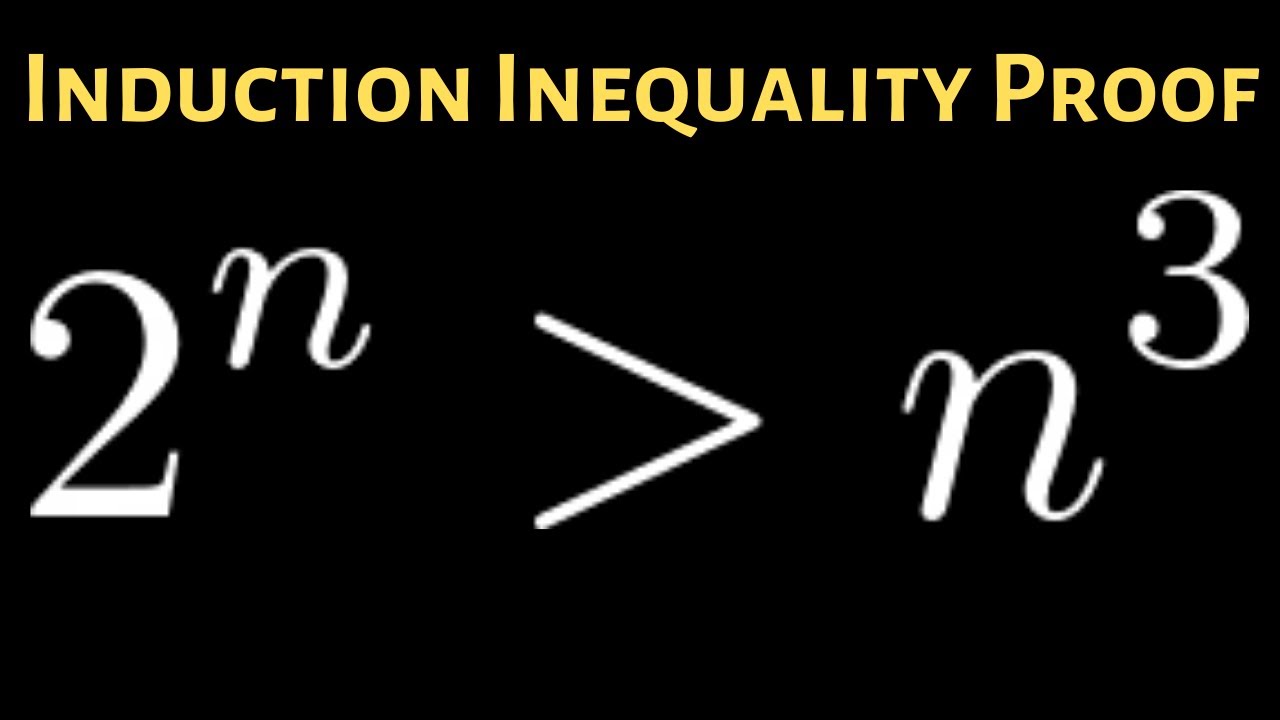
Induction Inequality Proof: 2^n greater than n^3
In this video we do an induction proof to show that 2^n is greater than n^3 for every integer n greater than or equal to 10.
If you enjoyed this video please consider liking, sharing, and subscribing.
Udemy Courses Via My Website: https://mathsorcerer.com
My FaceBook Page: https://www.faceb...
also in the problem it says u may find the identity k^3 - 1 = (k-1)(k^2 + k + 1) helpful
where would the identity fit in?
@dire geode u there?
uhh can anyone help
xd
 modern compass
plucky scarab
i see one proof but i am confused why its like 2^k * 2^1 > k^3*2
modern compass
plucky scarab
i see one proof but i am confused why its like 2^k * 2^1 > k^3*2
this is from the inductive hypothesis.
plucky scarab
modern compass
this is from the inductive hypothesis.
so why do they multiply k^3 by 2
and where does the identify fit in to solving the problem
modern compass
because you have 2^k * 2
you know 2^k > k^3
so 2^k * 2 > k^3 * 2
modern compass
and you use it to relate 2^(k+1) to a polynomial with k^3
plucky scarab
modern compass
and you use it to relate 2^(k+1) to a polynomial with k^3
oh can u show me
which part is that
modern compass
the part you're asking about
plucky scarab
oh
do u have to use the identity
it says its helpful
idk how to use it
in my problem i got k^3 + 3k^2 + 3k + 1
so i thought it would be k^3 + 1
not k^3 - 1
modern compass
i don't know why that identity would be helpful here
and I didn't see them use it anywhere in the video
plucky scarab
oh
me neither tbh
also for the mathematical induction problem of proving 1+5+9+...+(4n-3)=2n^2-n, at the k+1 step why do they do 1+5+9+...+(4k-3) + (4(k+1)-3)
why dont they just sub k+1 for 4n-3
 cedar kilnBOT
@plucky scarab Has your question been resolved?
cedar kilnBOT
@plucky scarab Has your question been resolved?
Channel closed
Closed by @plucky scarab
Use .reopen if this was a mistake.
cedar kilnBOT
Available help channel!
Send your question here to claim the channel.
Remember:
• Ask your math question in a clear, concise manner.
• Show your work, and if possible, explain where you are stuck.
• After 15 minutes, feel free to ping <@&286206848099549185>.
• Type the command .close to free the channel when you're done.
• Be polite and have a nice day!
Read #❓how-to-get-help for further information on how to ask a good question, and about conduct in the question channels.
plucky scarab
given any two complex numbers z and w, prove by LHS to RHS that (zw)* = z* x w*
z* is the complex conjugate of z
also i need help with this one: use mathematical induction for any complex number z and any integer n≥1, $(z^{})^{n} = (zn)^{}$
cedar kilnBOT
plucky scarab
given any two complex numbers z and w, prove by LHS to RHS that (zw)* = z* x w*
...
wraith daggerBOT
natremiae

 zenith sail
For the first one, I don't think there's any kind of special reasoning needed. Just define, for example, z=a+bi and w=c+di. Then find zw, take the conjugate, and factor it. The factors should be z* and w*
plucky scarab
zenith sail
For the first one, I don't think there's any kind of special reasoning needed. J...
so for that i have to define it
i can't just say z* w* = (zw)*
zenith sail
Well that's what you're trying to prove, so no you can't just claim it's true
plucky scarab
oh
then how does the a+bi help
i get ac + adi + cdi - bd
when i try to find zw
how do i say the factors
zenith sail
So now take it's conjugate. What is (zw)*?
plucky scarab
i forgot how
zenith sail
For a complex number x+yi, the conjugate is x-yi
So just multiply the imaginary parts by -1
zenith sail
Given what I said about the conjugate earlier, what should z* and w* look like?
zenith sail
Right
So we have four terms, so we probably want to factor in groups
Do you know what I mean by that?
zenith sail
That's what we want to show, yeah, but how did you get that?
plucky scarab
since the question asks for z* w*
zenith sail
The question is asking you to prove that (zw)* is equal to z* w*
plucky scarab
yea i know
zenith sail
plucky scarab
ac - adi - bci - bd
Wait, shouldn't this actually be ac-adi-bci-bd?
zenith sail
We want one of the factors to be a-bi, so if we factor in groups, we want to factor a out of the first two terms, and -bi out of the last two terms
$$ac-adi-bci-bd$$
$$=a(c-di)-bi(c-di)$$
$$=(a-bi)(c-di)$$
$$=z^* \cdot w^*$$
wraith daggerBOT
tatpoj
 zenith sail
I'll have to give the problem a shot myself first
zenith sail
wraith dagger
**natremiae**
did you mean $(z^n)^*$?
wraith daggerBOT
tatpoj
 zenith sail
not (zn)*, right?
plucky scarab
hmm
no
maybe it's a typo
haha
u might've figured something out for me
smh so many typos
zenith sail
Must be because as written it's definitely not true
plucky scarab
i was confused for ages on this lmao

at first i thought it used a power rule
but then i got confused
lol
like bringing the power down or something idk
zenith sail
I mean even if we just take n=2 it breaks
plucky scarab
ahha
plucky scarab
wraith dagger
**tatpoj**
probably meant that yea
otherwise makes no sense

Mathematics Stack Exchange
Prove by induction that $(z^n)^=(z^)^n$ for all positive integers of n.
My knowledge of proving things by induction is still growing, so I wasn't really too sure on how to tackle the question as...
i found this thing tho
but idk
zenith sail
Do you understand how induction works?
plucky scarab
zenith sail
Do you understand how induction works?
yea
basically what u do is
n = 1
then assume for k
then k+1
and then induce its true for all n
zenith sail
Yeah
Proving the base case n=1 is pretty straight forward
Have you tried the induction step?
plucky scarab
hmm yea
but for this problem im confused haha
this is as far as i was able to get
 cedar kilnBOT
@plucky scarab Has your question been resolved?
plucky scarab
@zenith sail
cedar kilnBOT
@plucky scarab Has your question been resolved?
 peak stirrup
It's all written out for you in the math stack exchange
plucky scarab
peak stirrup
It's all written out for you in the math stack exchange
yes i know
i just dont think its the same problem
peak stirrup
my b, I was being lazy
plucky scarab
lol
peak stirrup
lol def a typo
cedar kilnBOT
@plucky scarab Has your question been resolved?
cedar kilnBOT
Channel closed
Closed due to timeout
Use .reopen if this was a mistake.
Available help channel!
Send your question here to claim the channel.
Remember:
• Ask your math question in a clear, concise manner.
• Show your work, and if possible, explain where you are stuck.
• After 15 minutes, feel free to ping <@&286206848099549185>.
• Type the command .close to free the channel when you're done.
• Be polite and have a nice day!
Read #❓how-to-get-help for further information on how to ask a good question, and about conduct in the question channels.
delicate ember
if R increases, how does V decrease?
 cedar kilnBOT
delicate ember
if R increases, how does V decrease?
delicate ember
cedar kilnBOT
delicate ember
if R increases, how does V decrease?
delicate ember
it should increase right?
wraith daggerBOT


 Requested by snotdetectTentoes#2276
 wind glade
,w graph y=e^(-1/x)
wraith daggerBOT
 Requested by snotdetectTentoes#2276
wind glade
Requested by snotdetectTentoes#2276
wind glade
hmm
delicate ember
y increases when x increases
delicate ember
so this is wrong ?
 wind glade
yeah id say so
delicate ember
so um can you explain this

 wild badge
how ?

 obsidian coral
wild badge
how ?
delicate ember
wild badge
how ?
obsidian coral
wild badge
how ?
delicate ember
wild badge
how ?
create a new channel
obsidian coral
delicate ember
so this is wrong ?
This should be correct
Because R and C will be set values
wind glade
yuh
obsidian coral
And as time increase, Voltage decreases
wind glade
but we can think of the different values of R as just shifts of the graphs
obsidian coral
R and C aren't dependent on anything, besides the value we give it
obsidian coral
You can't
delicate ember
why not?, I need to compare 3 different Rs
obsidian coral
Time has to change
delicate ember
obsidian coral
Time has to change
ik that 🤦
obsidian coral
delicate ember
time doesnt matter
Yes it does
obsidian coral
Longer time goes, less capacitance current
delicate ember
obsidian coral
Longer time goes, less capacitance current
tf?
wind glade
definitely, as R increases the graph stretches to the right but it still has the same form
delicate ember
C is independent of time
delicate ember
wind glade
definitely, as R increases the graph stretches to the right but it still has the...
i cant understand why that is the case 😩
wind glade
but we see that V with respect to R increases right?
as in the graph i showed
however, the graph shown from your text is graphed with respect to time
therefore, changing R is treated as a stretch factor
cedar kilnBOT
Channel closed
Closed by @delicate ember
Use .reopen if this was a mistake.
delicate ember
ik that
obsidian coral
Then that's why as R goes up, V goes down
delicate ember
ic
cedar kilnBOT
Available help channel!
Send your question here to claim the channel.
Remember:
• Ask your math question in a clear, concise manner.
• Show your work, and if possible, explain where you are stuck.
• After 15 minutes, feel free to ping <@&286206848099549185>.
• Type the command .close to free the channel when you're done.
• Be polite and have a nice day!
Read #❓how-to-get-help for further information on how to ask a good question, and about conduct in the question channels.
wild badge
.reopen
 delicate bear
If I have an N probability and a selection of K then how do I find out the probability of the average being higher than M?
cedar kilnBOT
delicate bear
If I have an **N** probability and a selection of **K** then how do I find out t...
delicate bear
let's say for argument's sake that
N is unknown
K is 100
M is 30%
cedar kilnBOT
@delicate bear Has your question been resolved?
delicate bear
<@&286206848099549185> any additional info that may help?
delicate bear
sorry need to change N, but the question is what is the probability that N is higher than 30%
delicate bear
So the idea is that let's make up an example.
Let's say the average N percent of people get a question right
We know the probability of N
Now what is the probability that 30 of those 100 people get the quetion right
 fair geyser
ok
delicate bear
Sorry, formulating is hard when the question is abstract.
delicate bear
.close
cedar kilnBOT
Channel closed
Closed by @delicate bear
Use .reopen if this was a mistake.
cedar kilnBOT
Available help channel!
Send your question here to claim the channel.
Remember:
• Ask your math question in a clear, concise manner.
• Show your work, and if possible, explain where you are stuck.
• After 15 minutes, feel free to ping <@&286206848099549185>.
• Type the command .close to free the channel when you're done.
• Be polite and have a nice day!
Read #❓how-to-get-help for further information on how to ask a good question, and about conduct in the question channels.
 dapper wraith
When I did arctan of 1-root7 I got the values 1.3, 4.4, 7.6 but where on Earth did they get 2.1,5.3,8.4 from? And all my values that I got are for 1+root7 instead…
 cedar kilnBOT
dapper wraith
When I did arctan of 1-root7 I got the values 1.3, 4.4, 7.6 but where on Earth d...
dapper wraith
cedar kilnBOT
dapper wraith
When I did arctan of 1-root7 I got the values 1.3, 4.4, 7.6 but where on Earth d...
dapper wraith
When I do put 1+root7 it gives me 3.43, I don’t see 1.3

 vast anvil
velvet mortar
vast anvil
velvet mortar
Control + shift + S to take a screenshot in windows if you want to do that
Assuming you are here to help Akshay (Kumar)
 sacred stone
dapper wraith
When I do put 1+root7 it gives me 3.43, I don’t see 1.3
sacred stone
dapper wraith
When I do put 1+root7 it gives me 3.43, I don’t see 1.3
,w arctan(1+sqrt(7))
wraith daggerBOT

 dapper wraith
velvet mortar
Assuming you are here to help Akshay (Kumar)
dapper wraith
velvet mortar
Assuming you are here to help Akshay (Kumar)
Nah, asking for help instead
dapper wraith
sacred stone
,w arctan(1+sqrt(7))
How Tf did my calculator give those values
Do I need to change to specific mode?
sacred stone
I don't know, I didn't use that calculator
cedar kilnBOT
@dapper wraith Has your question been resolved?
cedar kilnBOT
Channel closed
Closed due to timeout
Use .reopen if this was a mistake.
Available help channel!
Send your question here to claim the channel.
Remember:
• Ask your math question in a clear, concise manner.
• Show your work, and if possible, explain where you are stuck.
• After 15 minutes, feel free to ping <@&286206848099549185>.
• Type the command .close to free the channel when you're done.
• Be polite and have a nice day!
Read #❓how-to-get-help for further information on how to ask a good question, and about conduct in the question channels.
crimson sedge
Any help pls
 crimson sedge
<@&286206848099549185> ?
cedar kilnBOT
@crimson sedge Has your question been resolved?
cedar kilnBOT
Channel closed
Closed due to timeout
Use .reopen if this was a mistake.
crimson sedge
.reopen
cedar kilnBOT
Available help channel!
Send your question here to claim the channel.
Remember:
• Ask your math question in a clear, concise manner.
• Show your work, and if possible, explain where you are stuck.
• After 15 minutes, feel free to ping <@&286206848099549185>.
• Type the command .close to free the channel when you're done.
• Be polite and have a nice day!
Read #❓how-to-get-help for further information on how to ask a good question, and about conduct in the question channels.
crimson sedge
velvet mortar
What have you tried?
I tried naming the individual sections of the graph x1, x2,x3
crimson sedge
So x1+x2+x3 = 300
But then I realised that when is accelerating its 0.5
And when its decelerating its 0.25
So I made x3 = 2x1
Idk if that's right or not
Then I got lost after that
@velvet mortar
cedar kilnBOT
@crimson sedge Has your question been resolved?
 crimson sedge
velvet mortar
its something like this right?
crimson sedge
velvet mortar
its something like this right?
Yeahh
So then what's next?
After that
 cedar kilnBOT
@crimson sedge Has your question been resolved?
velvet mortar
on
deceleration is also given in the question
it is asking to find the dseceleation time
V = V0 + at
can you do it @crimson sedge ?
cedar kilnBOT
Channel closed
Closed due to timeout
Use .reopen if this was a mistake.
crimson sedge
velvet mortar
can you do it <@456226577798135808> ?
Ohhh yeh i got it ty
cedar kilnBOT
Available help channel!
Send your question here to claim the channel.
Remember:
• Ask your math question in a clear, concise manner.
• Show your work, and if possible, explain where you are stuck.
• After 15 minutes, feel free to ping <@&286206848099549185>.
• Type the command .close to free the channel when you're done.
• Be polite and have a nice day!
Read #❓how-to-get-help for further information on how to ask a good question, and about conduct in the question channels.
crimson sedge
How would I know what polynomial expression to use for x
 cedar kilnBOT
crimson sedge
How would I know what polynomial expression to use for x
cedar kilnBOT
crimson sedge
How would I know what polynomial expression to use for x
@crimson sedge Has your question been resolved?
cedar kilnBOT
@crimson sedge Has your question been resolved?
cedar kilnBOT
@calm plinth Has your question been resolved?
 silk light
crimson sedge
How would I know what polynomial expression to use for x
silk light
crimson sedge
How would I know what polynomial expression to use for x
I don't want to explain it clearly but I hope these answers will help you understand.
 cedar kilnBOT
Channel closed
Closed due to timeout
Use .reopen if this was a mistake.
cedar kilnBOT
Available help channel!
Send your question here to claim the channel.
Remember:
• Ask your math question in a clear, concise manner.
• Show your work, and if possible, explain where you are stuck.
• After 15 minutes, feel free to ping <@&286206848099549185>.
• Type the command .close to free the channel when you're done.
• Be polite and have a nice day!
Read #❓how-to-get-help for further information on how to ask a good question, and about conduct in the question channels.
crimson sedge
Am I stupid? Do limits shrink?
 cedar kilnBOT
crimson sedge
Am I stupid? Do limits shrink?
crimson sedge
cedar kilnBOT
crimson sedge
Am I stupid? Do limits shrink?
crimson sedge
Is this legal?
What I am doing
Theoretically first one goes into
-inf - 2/e
And second goes into
inf
Hm
But graph diverges?
cedar kilnBOT
@crimson sedge Has your question been resolved?
cedar kilnBOT
Channel closed
Closed by @lapis mesa
Use .reopen if this was a mistake.
Available help channel!
Send your question here to claim the channel.
Remember:
• Ask your math question in a clear, concise manner.
• Show your work, and if possible, explain where you are stuck.
• After 15 minutes, feel free to ping <@&286206848099549185>.
• Type the command .close to free the channel when you're done.
• Be polite and have a nice day!
Read #❓how-to-get-help for further information on how to ask a good question, and about conduct in the question channels.
 steel ledge
hi! i was wondering how can i go from left side to right side ? if this is a specific method it's fine to simply tell me the name i'll look it up on my own !
 cedar kilnBOT
steel ledge
hi! i was wondering how can i go from left side to right side ? if this is a spe...
cedar kilnBOT
steel ledge
hi! i was wondering how can i go from left side to right side ? if this is a spe...
 west dome
complete the square in both x and y
velvet mortar
^
west dome
(leaving the 6 alone)
steel ledge
west dome
complete the square in both x and y
okay thank you !
cedar kilnBOT
@steel ledge Has your question been resolved?
Channel closed
Closed due to timeout
Use .reopen if this was a mistake.
Available help channel!
Send your question here to claim the channel.
Remember:
• Ask your math question in a clear, concise manner.
• Show your work, and if possible, explain where you are stuck.
• After 15 minutes, feel free to ping <@&286206848099549185>.
• Type the command .close to free the channel when you're done.
• Be polite and have a nice day!
Read #❓how-to-get-help for further information on how to ask a good question, and about conduct in the question channels.
 viscid jungle
I need help solving these inequalities generally

 rugged palm
What have you tried?
viscid jungle
Nothing really. I can always try inputting different numbers like x=2, but that's probably not efficient.
trim sentinel
Ye thats not how you wanna do it
First add the fractions
$$\frac{1}{x} + \frac{1}{1 - x} > 0$$
viscid jungle
its just >
wraith daggerBOT
Pluton
 trim sentinel
Theres no latex for it?
viscid jungle
I think > is just standard
trim sentinel
Ok so do you know how to add fractions
viscid jungle
Yeah sorry I haven't done this in a while. I'll just multiply the numerator and denominator by (1-x) and (x)
 balmy apex
trim sentinel
Theres no latex for it?
balmy apex
trim sentinel
Theres no latex for it?
just >
viscid jungle
I got 1... I'll show how I did it. (x)(1-x)(\frac{1}{x} + \frac{1}{1-x}) = (1-x)(1 + \frac{x}{1-x}) = 1
[ (x)(1-x)(\frac{1}{x} + \frac{1}{1-x}) = (1-x)(1 + \frac{x}{1-x}) = 1 ]
wraith daggerBOT
আত্মদর্শী
 viscid jungle
Oh I forgot to divide by 1-x and x
trim sentinel
$$\frac{a}{b} + \frac{c}{d} = \frac{ad + cb}{bd}$$
wraith daggerBOT
Pluton
 viscid jungle
I guess I'll just use your template since it's faster
trim sentinel
viscid jungle
Oh I forgot to divide by 1-x and x
I prefer rather than multiplying whole thing just multiply functions denominator and numerator
$$\frac{a}{b} = \frac{a * k}{b * k}$$
wraith daggerBOT
Pluton
 trim sentinel
This will "always" be true (k ≠ 0)
viscid jungle
[ \frac{1}{x} + \frac{1}{1-x} = \frac{(x-1) + x}{(x-1)(x)}]
wraith daggerBOT
আত্মদর্শী
 wraith daggerBOT
আত্মদর্শী
 viscid jungle
\frac{1}{(1-x)(x)}
trim sentinel
$$\frac{1}{x(1 - x)} > 0$$
wraith daggerBOT
Pluton
 trim sentinel
Well this looks way easier rn. Right
viscid jungle
Intuitively seems true when x>1
viscid jungle
I see
trim sentinel
So do you know what we could do rn
viscid jungle
What?
viscid jungle
When x=1 it becomes undefined
wraith daggerBOT
Pluton
 viscid jungle
When x>0 right?
trim sentinel
Ye
trim sentinel
wraith dagger
**Pluton**
And whats this
The thing is basically your x in that situation
trim sentinel
wraith dagger
**Pluton**
This just substitutes
$$x_{substitute} = x(1 - x)$$
wraith daggerBOT
Pluton
 viscid jungle
Guessing its when x<-1?
trim sentinel
viscid jungle
Guessing its when x<-1?
Dont guess
trim sentinel
viscid jungle
When x>0 right?
This is true for 1/x
Lets see whats for x(1 - x) > 0
$$x(1 - x) > 0$$
wraith daggerBOT
Pluton
 shut reef
viscid jungle
Guessing its when x<-1?
shut reef
viscid jungle
Guessing its when x<-1?
wouldnt work either
viscid jungle
So is it helpful to expand that?
trim sentinel
You dont need to
viscid jungle
It seems to work for examples like -2 or -3
trim sentinel
There are 3 methods that ik to solve this
viscid jungle
shut reef
-2*3 isnt >0
Hm my bad
shut reef
trim sentinel
There are 3 methods that ik to solve this
Guessing till something work
s
trim sentinel
Isnt one of them
shut reef
viscid jungle
Hm my bad
Have you established what x cannot be
trim sentinel
There are 3 methods
- Write bunch of inequalities
- Find roots
- Draw a prefix diagram
shut reef
And how did you get there
shut reef
We dont know if its right untill you prove it
viscid jungle
(x)(1-x) x has to be a positive decimal such that when you square it, the value of itself is smaller than x itself
trim sentinel
Like stop guessing and just solve the inequality
$$x(1-x) > 0$$
wraith daggerBOT
Pluton
 viscid jungle
[ -x^2 + x]
wraith daggerBOT
আত্মদর্শী
 trim sentinel
But just plugging in values wont get you anywhere
shut reef
$-x^2+x>0$
trim sentinel
$$-x^2 + x > 0$$
wraith daggerBOT
Pluton
 viscid jungle
Any number withing that range squared will produce a smaller number than its original self, and so the negative version of that smaller number added with the original number must be above 0
viscid jungle
$ x^2 < x $ for all $0 < x < 1$ so $ x - x^2 > 0$ since if x > y in the positive numbers then $x-y>0$
wraith daggerBOT
আত্মদর্শী
 trim sentinel
I mean everything you said is tehnically correct but not really how this is supposed to be solved
viscid jungle
How is this supposed to be solved?
shut reef
where did y come from
trim sentinel
First can you imagine the graph -x^2 + x
viscid jungle
shut reef
where did y come from
It's something I made up but I think it's ok.
trim sentinel
Like can you visualize it in your head
viscid jungle
I can see it as being a flipped parabola
trim sentinel
Ye exactly
So when is it higher than 0
If in between its roots
Its roots are 0 and 1
viscid jungle
So when it is greater than 0 and less than 1
trim sentinel
Ye when x is greater than 0 or less than 1
You can also do it like this

,rotate
wraith daggerBOT
 trim sentinel
Basically write where the 0's of x(1 - x) are
Then x for example when its less than 0 is negative and when higher positive
1 - x is neg at x > 1 and pos at x < 0
For multiplication to be pos it either has to be - - or + +
And you can see there is ++ in between 0 and 1
And the third
Most extreme methos is just write inequalities
$$x > 0$$
$$ 1 - x > 0$$ from this you get
$$x > 0$$
$$x < 1$$
Result is the intersect
$$0 < x < 1$$
Now for -- case
$$x < 0$$
$$1 - x < 0$$
From this you get
$$x < 0$$
$$x > 1$$
This has no intersect
The first case is if both are positive
And thats like all 3 ways to solve inequalities ik
viscid jungle
So you evaluated the inequalities individually, for greater than and less than. But isn't 1-x<0 = x> 1, so I'm not understanding that step
trim sentinel
viscid jungle
So you evaluated the inequalities individually, for greater than and less than. ...
Ye my mistake
wraith daggerBOT
Pluton
 viscid jungle
No problem. I see that it has no intersection
trim sentinel
Im telling you this methods because if you ever have
$$(x - 3)(x - 4) < 0$$
Or something like that
wraith daggerBOT
Pluton
 shut reef
x=3 or x=4
viscid jungle
I see
trim sentinel
Because when you plot it you will see the parabola is negative in between 3 and 4
And if theres a question where its > 0 its just
-infinity to 3 and 4 to +infinity
viscid jungle
wraith dagger
**Pluton**
Alright. But the fraction part is still messing with me.
$$\frac{1}{x(1 - x)} > 0$$
wraith daggerBOT
আত্মদর্শী
 viscid jungle
Now that I know where the denominator is positive, is that enough?
shut reef
viscid jungle
Now that I know where the denominator is positive, is that enough?
What values of x are definitely not the answer?
viscid jungle
It should be because if both numerator and denominator are <0, then the fraction should be <0
shut reef
Yes but what values of x are impossible
viscid jungle
shut reef
What values of x are definitely not the answer?
Well one example would be 1
shut reef
and the other
viscid jungle
0
shut reef
cool
viscid jungle
Okay, I believe I got it.
It is true for all values of x such that 0<x<1
Just need a bit of confirmation so I know I'm not insane.
trim sentinel
viscid jungle
Now that I know where the denominator is positive, is that enough?
Yes
$\frac{+}{+} > 0$
wraith daggerBOT
Pluton
 trim sentinel
Positive / positive is always positive
trim sentinel
viscid jungle
It is true for all values of x such that 0<x<1
Yes