#help-13
428200 messages · Page 456 of 429
 crimson sedge
 short heath
Thank you for helping, i am not good as the other ppl in this server. i am in th...
short heath
Thank you for helping, i am not good as the other ppl in this server. i am in th...
No problem
crimson sedge
Yeah
crimson sedge
I'm not sure, lemme search for you.
short heath
Ok
crimson sedge
short heath
i would like to learn about it
Do you know how to solve linear equations in 2 or 3 variables?
short heath
3
 keen elbow
ahh common core
crimson sedge
short heath
3
For these types of problems, you may use the concept of linear equations to solve em easily.
short heath
Ok, thank you for helping me
crimson sedge
short heath
Ok, thank you for helping me
If you are done, you may close the room by .close
short heath
.close
 cedar kilnBOT
Channel closed
Closed by @short heath
Use .reopen if this was a mistake.
cedar kilnBOT
 Available help channel!
Send your question here to claim the channel.
Remember:
• Ask your math question in a clear, concise manner.
• Show your work, and if possible, explain where you are stuck.
• After 15 minutes, feel free to ping <@&286206848099549185>.
• Type the command .close to free the channel when you're done.
• Be polite and have a nice day!
Read #❓how-to-get-help for further information on how to ask a good question, and about conduct in the question channels.
crimson sedge
Find the number of sides of a polygon which has 44 diagonals. How to solve this?
cedar kilnBOT
crimson sedge
```Find the number of sides of a polygon which has 44 diagonals.``` How to solve...
crimson sedge
Answer was given to be 11 but Is it possible for a polygon with odd number of sides to have diagonal? Like triangle has 3 sides, can we draw diagonals?
 dawn jetty
crimson sedge
Answer was given to be 11 but Is it possible for a polygon with odd number of si...
dawn jetty
crimson sedge
Answer was given to be 11 but Is it possible for a polygon with odd number of si...
how come?
a diagonal connects 2 distinct points with no common edge/side
thus creating a triangle
well at least it can create a triangle
crimson sedge
I'm not getting you
dawn jetty
in a triangle there are simply no such points so you can't define a diagonal
you're saying that a polygon of odd number of sides to hav ea diagonal
let me ask you this, what defines a diagonal?
crimson sedge
crimson sedge
```Find the number of sides of a polygon which has 44 diagonals.``` How to solve...
Answer to this problem is given to be 11. Im asking how can a polygon with odd number of sides have diagonal?
crimson sedge
dawn jetty
let me ask you this, what defines a diagonal?
Maybe a line segment which joins two opposite vertex of a polygon.
dawn jetty
2 opposite?
why necessarily opposite?
draw a pentagram
does it not have diagonals?
crimson sedge
dawn jetty
2 opposite?
https://www.cuemath.com/geometry/diagonals/ I've been taught that there must be 2 opposite vertices.

A line segment joining one corner to another but is not an edge is called a diagonal. In other words, a diagonal is a line that connects the opposite vertices of a polygon. Learn the definition, formula, examples & practice questions.
crimson sedge
dawn jetty
does it not have diagonals?
I think no.
 fallen heath
what.
dawn jetty
Oh okay I see
the use of the word Opposite is confusing
if you read the rest of the definition it says a diagonal is a line connecting 2 non adjacent vertices
Now consider a triangle
a triangle has no diagonals, because given the 3 points that form a triangle, every 2 points are adjacent to the third
crimson sedge
okay, so how many diagonals does a hexagon has? 3?
dawn jetty
well lets see
a hexagon has 6 sides
lets take 1 vertex
we can draw a diagonal to every vertex but the 2 adjacent to it correct?
that would give us 3 diagonals
crimson sedge
Yes
dawn jetty
now take vertex 2
crimson sedge
It will give 2 diagonals
fallen heath
can draw a diagonal to every vertex but vertex 1 and vertex 3 ( cause adjacent ), so 3 diagonals
what...
2..?
crimson sedge
From vertex 2
 wraith daggerBOT
Ansh
 crimson sedge
I got 9 diagonals in a hexagon
fallen heath
Yes which ones?
crimson sedge
Wdym?
fallen heath
...
crimson sedge
From V1 and V2, i got 3 diagonals each, from V3, i got 2 additional diagonals and from V4, I got 1 additional diagonal.
crimson sedge
I think I misinterpreted the word "Diagonal"
fallen heath
Count the diagonals :D
XD
Yes, I think just being able to count, would solve the problem for you..
crimson sedge
fallen heath
Now, consider a heptagon :o
15?
fallen heath
Can you write them? or tell me how many you got from which vertices?
crimson sedge
Ohh wait I think i did wrong
fallen heath
From V1 and V2, 4, V3 -> 3, V4 -> 2, V5 -> 1, total 14 :o
crimson sedge
Yeah exactly
fallen heath
Generalize this setup for n, solve for a general : no. of diagonals in an n-gon, and equate to 44
:D happy solving
crimson sedge
How can I relate the number of diagonals given by the first and second vertex with number of sides or total diagonal?
@fallen heath
fallen heath
Counting?
crimson sedge
n-2?
Ohh wait... the actual question was to be solved using combination. How can I do that?
fallen heath
Pick any 1 vertex - times the number of diagonals that can be drawn from the vertex and consider the number of times each diagonal is repeated
that's a hint :o
crimson sedge
I didn't understand
crimson sedge
nC1
crimson sedge
I can draw (n-2) diagonals from that vertex
crimson sedge
oh no, (n-3) xD
fallen heath
So, in how many ways can a diagonal be drawn within an n-gon?
smh, whichever article is used for "n-gon", my grammar sucks
fallen heath
fallen heath
So, in how many ways can a diagonal be drawn within an n-gon?
hmm?
crimson sedge
Idk 😕
wraith daggerBOT
Ansh
 fallen heath
crimson sedge
nC1
fallen heath
crimson sedge
nC1
.
fallen heath
crimson sedge
oh no, (n-3) xD
.
crimson sedge
I always get confuse with "How many ways" :(
crimson sedge
Yes
fallen heath
draw a diagonal from it
in (n-3)C1 ways
so the total number of diagonals you get is
nC1 times (n-3)C1
no?
crimson sedge
Yes
fallen heath
NO! Lmao
Because, when you pick vertex 1, and draw a diagonal from it to vertex 5, say,
and later, you pick vertex 5, and draw a diagonal from it to vertex 1
you count this particular diagonal twice >_<
crimson sedge
Oh yeah 🥲
fallen heath

crimson sedge
We can select 2 diagonals from n?
fallen heath
So, you've counted every single diagonal out there, twice
crimson sedge
nC2
crimson sedge
fallen heath
So, you've counted every single diagonal out there, twice
Yeah
fallen heath
No 😂 why would you do that
crimson sedge
Divide it by 2 😂
crimson sedge
fallen heath
n(n-3)
?
I'm not getting it, this chapter is really very confusing 😭😭
fallen heath
fallen heath
nC1 times (n-3)C1???
you don't understand how I got this?
crimson sedge
fallen heath
what's so confusing about that being n(n-3)
Ohh now got it.
Is there any property that nCr × mCr = nm?
fallen heath
XD whenever something like this happens... consider a short break to freshen up a bit
fallen heath
crimson sedge
Is there any property that nCr × mCr = nm?
no lol 😂 nC1 = n
crimson sedge
Ohh 🥲
fallen heath
So anyways
fallen heath
fallen heath
So what is the total number of Ds in an n-gon?
.
crimson sedge
How can I conclude that? Is it n(n-3)?
fallen heath
fallen heath
you count this particular diagonal twice >_<
.
fallen heath
crimson sedge
Oh yeah 🥲
.
fallen heath
crimson sedge
Divide it by 2 😂
.
crimson sedge
Is it the total number of diagonals in n sided polygon?
fallen heath
Yes
I'm asking for the total number of diagonals in an n-sided polygon
based on what you've understood so far about my explanation
crimson sedge
fallen heath
no?
But why is it n(n-3)? Isn't it counting twice? You said earlier.
fallen heath
Thanks heavens
Do you get that part?
how the total number of diagonals counted twice is n(n-3)?
crimson sedge
Yes
crimson sedge
🤔
fallen heath
If the number of apples in my hand counted twice is 4, what is the number of apples in my hand right now?
crimson sedge
2
fallen heath
0 actually cause I'm typing, but you got it
crimson sedge
So n(n-3)/2?
crimson sedge
fallen heath
0 actually cause I'm typing, but you got it
😂😂
fallen heath
crimson sedge
So n(n-3)/2?
Isn't it?
crimson sedge
Yes
fallen heath
So then the total number of diagonals in an n-gon is given as n(n-3)/2
now go ahead
use that formula wherever you want :o
crimson sedge
But ...
crimson sedge
n(n-3) is two times the total number of diagonals drawn from one vertex 🙂
fallen heath
No.
crimson sedge

fallen heath
(n-3) is the total number of diagonals drawn from one vertex
n(n-3) is the total number of diagonals you'd count, if you were to pick each vertex( in nC1 ways ), and draw a diagonal from it to the remaining vertices ( in (n-3)C1 ways )
crimson sedge
Okay 🙂
crimson sedge
I got it
crimson sedge
Thanks a ton, you are really very good at explaining things. Ig you are a teacher. 🙂
fallen heath
the total number of diagonals counted by picking one vertex each and drawing a diagonal from it to the remaining vertices is n(n-3) but you then realize that you're actually counting each diagonal twice
so you deal with it simply by writing 2D_n = n(n-3)
so D_n must be n(n-3)/2
crimson sedge
Ok
fallen heath
Now equate with 44, n² - 3n - 88=0, and solve it
fallen heath
crimson sedge
Thanks a ton, you are really very good at explaining things. Ig you are a teache...
Uni student but :o I just know coz I've had exact same problems as you in the past
crimson sedge
fallen heath
Now equate with 44, n² - 3n - 88=0, and solve it
n = 11
crimson sedge
Shukriya 
fallen heath
was a pretty ... counting method
realizing the trend in hexagon : 3 + 3 + 2 + 1, in heptagon : 4 + 4 + 3 + 2 + 1, ..., in n-gon : (n-3) + (n-3) + (n-2) + ... + 2 + 1 = n(n-3)/2
crimson sedge
fallen heath
realizing the trend in hexagon : 3 + 3 + 2 + 1, in heptagon : 4 + 4 + 3 + 2 + 1,...
Yeah
fallen heath
but it'd be a lot better if you can just get used to thinking that nC1.(n-3)C1 and along those lines as you'll get more such problems like counting the non-colinear points and stuff
crimson sedge
fallen heath
but it'd be a lot better if you can just get used to thinking that nC1.(n-3)C1 a...
Okay
.close
cedar kilnBOT
Channel closed
Closed by @mellow phoenix
Use .reopen if this was a mistake.
Available help channel!
Send your question here to claim the channel.
Remember:
• Ask your math question in a clear, concise manner.
• Show your work, and if possible, explain where you are stuck.
• After 15 minutes, feel free to ping <@&286206848099549185>.
• Type the command .close to free the channel when you're done.
• Be polite and have a nice day!
Read #❓how-to-get-help for further information on how to ask a good question, and about conduct in the question channels.
 marsh vapor
if the tangents drawn from the origin to the y=x^2-3x+a parabola are perpendicular to each other, what is a?
cedar kilnBOT
marsh vapor
if the tangents drawn from the origin to the y=x^2-3x+a parabola are perpendicul...
marsh vapor
here’s my attempt at solving the question above:
let there be two lines y=mx and y=(-1/m)x. these two lines are perpendicular to each other, and they are tangent to the parabola.
therefore: delta=0 for both x^2-3x+a=mx and x^2-3x+a=(-1/m)x.
we get: (m+3)^2-4a=0 and ((-1/m)+3)^2-4a=0
we’re asked to find a, so let’s solve for m first: (m+3)^2=((-1/m)+3)^2
aaand I’m stuck 
,w find m where (m+3)^2=((-1/m)+3)^2
wraith daggerBOT


 Requested by HeadShotCem#9237
 crimson sedge
I need help with my math @marsh vapor
marsh vapor
bro
 obsidian coral
crimson sedge
I need help with my math <@277133612812468224>
obsidian coral
crimson sedge
I need help with my math <@277133612812468224>
Don't try to take over an occupied channel
crimson sedge
Oops I thought it was under available, im blind clearly. Sorry
marsh vapor
no worries
cedar kilnBOT
@marsh vapor Has your question been resolved?
marsh vapor
<@&286206848099549185>
 dire geode
marsh vapor
how do we find that m=sqrt10-3 <:cowboyflonshed:833666829574471730>
dire geode
marsh vapor
how do we find that m=sqrt10-3 <:cowboyflonshed:833666829574471730>
haven't solved it yet, but a first start is to expand the square, move all terms to one side, and then multiple the whole equation by m^2 to get a fourth order polynomial in m
cedar kilnBOT
@marsh vapor Has your question been resolved?
cedar kilnBOT
Channel closed
Closed due to timeout
Use .reopen if this was a mistake.
Available help channel!
Send your question here to claim the channel.
Remember:
• Ask your math question in a clear, concise manner.
• Show your work, and if possible, explain where you are stuck.
• After 15 minutes, feel free to ping <@&286206848099549185>.
• Type the command .close to free the channel when you're done.
• Be polite and have a nice day!
Read #❓how-to-get-help for further information on how to ask a good question, and about conduct in the question channels.
 toxic carbon
 cedar kilnBOT
toxic carbon
toxic carbon
cedar kilnBOT
toxic carbon
toxic carbon
missed class today and i dont know what to do at all. teacher didnt give any notes. that first one is y = 105sinx btw.
dawn jetty
well do you know what amp and pd mean?
dawn jetty
well yea obv but i mean like the meaning behind the word lol
toxic carbon
lmao nope
dawn jetty
well then I advise you to look up the definitions which are not hard to understand
and try to figure it out for yourself
toxic carbon
okay thanks
dawn jetty
It's honestly not too bad, you'll have an overall better learning experience this way
remember that cosine and sine are bounded and periodic functions when you approach it
toxic carbon
ight. i just didnt know how to start. thanks a lot!
dawn jetty
getting to know what amplitude and period of a function means is the place, good luck !
cedar kilnBOT
Channel closed
Closed by @toxic carbon
Use .reopen if this was a mistake.
Available help channel!
Send your question here to claim the channel.
Remember:
• Ask your math question in a clear, concise manner.
• Show your work, and if possible, explain where you are stuck.
• After 15 minutes, feel free to ping <@&286206848099549185>.
• Type the command .close to free the channel when you're done.
• Be polite and have a nice day!
Read #❓how-to-get-help for further information on how to ask a good question, and about conduct in the question channels.
 gray vine
I am asking for my sister: write an expression for the amount of matches in figure n, if figure 1 has 5 matches and figure 2 has 9 matches.
cedar kilnBOT
gray vine
I am asking for my sister: write an expression for the amount of matches in figu...
dawn jetty
figure n?
gray vine
Yeah
dawn jetty
what topic does it relate to?
gray vine
figure n would be something like 4(n+1) i assume, but i am 1) unsure about this, and 2) don't know how to explain this in an elementary level to a 13 year old
it's algebra
gray vine
well then figure 1 would be 9 matches, but it's only 5
dawn jetty
fair enough , 4(n-1) + 5 would take care of the shift
but in any case this is simply asking you to construct an arithmetic sequence
and any such sequence is determined the the first term , a1, and the the difference between any subsequent terms , called d
gray vine
ok thanks
dawn jetty
in this case 4 would be the difference between each figure , and the first figure would be the other defining characteristic of the sequence
but then again if you're expected to solve it in a different way
if you want to explain it to your sister maybe show an elementary example where first you'd have 1 match to start with, that's how i'd do it with my nephew
cedar kilnBOT
Channel closed
Closed by @gray vine
Use .reopen if this was a mistake.
cedar kilnBOT
Available help channel!
Send your question here to claim the channel.
Remember:
• Ask your math question in a clear, concise manner.
• Show your work, and if possible, explain where you are stuck.
• After 15 minutes, feel free to ping <@&286206848099549185>.
• Type the command .close to free the channel when you're done.
• Be polite and have a nice day!
Read #❓how-to-get-help for further information on how to ask a good question, and about conduct in the question channels.
 stiff vigil
 cedar kilnBOT
stiff vigil
cedar kilnBOT
stiff vigil
Please don't occupy multiple help channels.
@stiff vigil Has your question been resolved?
cedar kilnBOT
Channel closed
Closed due to timeout
Use .reopen if this was a mistake.
Available help channel!
Send your question here to claim the channel.
Remember:
• Ask your math question in a clear, concise manner.
• Show your work, and if possible, explain where you are stuck.
• After 15 minutes, feel free to ping <@&286206848099549185>.
• Type the command .close to free the channel when you're done.
• Be polite and have a nice day!
Read #❓how-to-get-help for further information on how to ask a good question, and about conduct in the question channels.
 dusk gulch
help needed, thanks
 cedar kilnBOT
Channel closed
Closed due to timeout
Use .reopen if this was a mistake.
cedar kilnBOT
Available help channel!
Send your question here to claim the channel.
Remember:
• Ask your math question in a clear, concise manner.
• Show your work, and if possible, explain where you are stuck.
• After 15 minutes, feel free to ping <@&286206848099549185>.
• Type the command .close to free the channel when you're done.
• Be polite and have a nice day!
Read #❓how-to-get-help for further information on how to ask a good question, and about conduct in the question channels.
 open agate
How did he get from a to b:
 cedar kilnBOT
open agate
How did he get from a to b:
open agate
cedar kilnBOT
open agate
How did he get from a to b:
open agate
I'm so confused
 jaunty mural
I suspect context is needed?
open agate
it's from a midpoint circle drawing algorithm

Im not understanding how he got from a to b

it's at around 9:50
Please someone help
dawn jetty
oh, he just squared the terms then
((xk+1)+1)^2=(xk+1)^2+2(xk+1)+1
that's all there is to it
do you see it?
open agate
ok what about the other terms
open agate
Ah ok I get it now
cedar kilnBOT
@open agate Has your question been resolved?
cedar kilnBOT
Channel closed
Closed due to timeout
Use .reopen if this was a mistake.
Available help channel!
Send your question here to claim the channel.
Remember:
• Ask your math question in a clear, concise manner.
• Show your work, and if possible, explain where you are stuck.
• After 15 minutes, feel free to ping <@&286206848099549185>.
• Type the command .close to free the channel when you're done.
• Be polite and have a nice day!
Read #❓how-to-get-help for further information on how to ask a good question, and about conduct in the question channels.
 pastel grove
I'm taking a paractice test for a physical cosmology class, and the question that popped up is throwing me a curve ball. The question is
Say that you have a system of two nonlinear ODEs. Under which conditions in terms of the eigenvalues of the characteristic matrix are the solutions stable?
I don't remember going over this at all, at any point. I'm hoping someone can explain it to me , and I can go over it.
cedar kilnBOT
pastel grove
I'm taking a paractice test for a physical cosmology class, and the question tha...
pastel grove
I'm pretty sure. Eigenvectors of linear transformation are non-zero vectors that change by a scaling favor when that linear transformation is applied
I think that's right
wraith daggerBOT
Shuri2060
 jaunty mural
So lambda is the stretching constant in the direction of eigenvector x
Now, for stability around the equilibrium
You need all the points around it not diverging
If we take the equilibrium as the origin
jaunty mural
wraith dagger
**Shuri2060**
Can you see what lambda must be?
note we have
$$\dot{\boldsymbol{x}} = A\boldsymbol{x} = \lambda\boldsymbol{x}$$
wraith daggerBOT
Shuri2060
 cedar kilnBOT
@pastel grove Has your question been resolved?
Channel closed
Closed by @pastel grove
Use .reopen if this was a mistake.
cedar kilnBOT
Available help channel!
Send your question here to claim the channel.
Remember:
• Ask your math question in a clear, concise manner.
• Show your work, and if possible, explain where you are stuck.
• After 15 minutes, feel free to ping <@&286206848099549185>.
• Type the command .close to free the channel when you're done.
• Be polite and have a nice day!
Read #❓how-to-get-help for further information on how to ask a good question, and about conduct in the question channels.
 gentle lintel
 cedar kilnBOT
gentle lintel
gentle lintel
cedar kilnBOT
gentle lintel
gentle lintel
can someone explain why we need the second condition
gentle lintel
lol
 hollow osprey
is this like
fancy notation for commuting the limit and the function?
cuz the second condition is simliar to "needs to be decreasing/increasing" around the functoin but im not sure why it cant be constant
jaunty mural
$$LHS = \lim_{x\to a}f(g(x))$$
$$RHS = \lim_{t\to\left(\lim_{x\to a}g(x)\right)}f(t)$$
hollow osprey
one more }
after the second limit
3rd***
before g(x)
lmao what is that
wait so i was right
wraith daggerBOT
Shuri2060
 hollow osprey
it is just fancy notation for interchanging limit / function
jaunty mural
@gentle lintel I don't know what argument you want to hear
we've been through them all.
gentle lintel
can you give an example of g(x) near a
jaunty mural
If g(x) is constant, we have a problem.
gentle lintel
except for constant functions
gentle lintel
alright
jaunty mural
Like what example do you want me to pull out, exactly
gentle lintel
uhh
jaunty mural
I can pull out some wacky ones if you want, but idk what to say
all that matters is g cant be constant near a
jaunty mural
no.
gentle lintel
no?
jaunty mural
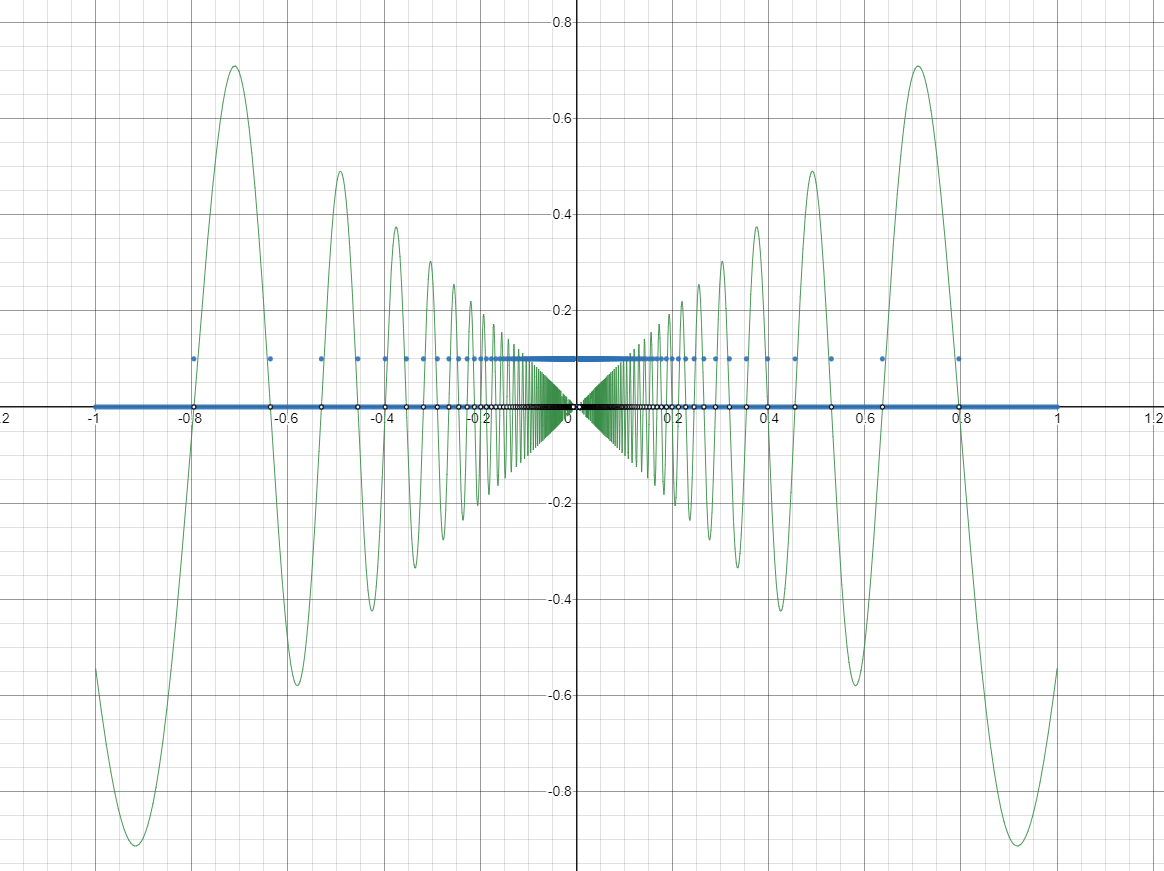
,w plot x^2 sin(1/x)
wraith daggerBOT

 Requested by Shuri2060#9525
jaunty mural
Requested by Shuri2060#9525
jaunty mural
oh ok.
yes.
This appears to be an example of g that satisfies the equation but not (2)?
Possibly
gentle lintel
yea
jaunty mural
If you could give me an f that convinces me?
gentle lintel
not sure tho
jaunty mural
if g(x) = 0 for x = 0 and x² sin 1/x otherwise
f(x) = x
let me see...
lim fg = lim g = 0
lim g = 0
lim f = 0
@gentle lintel sure
I think.
You appear to have given an example that demonstrates the 2nd condition is not necessary, but only sufficient.
@celest seal can u check ^
if g(x) = 0 for x = 0 and x² sin 1/x otherwise
f(x) = x
This is interesting 🤔
I think a necessary and sufficient condition might involve non-locally constant but unsure
===
Well the thing is, for non equal cases to happen, I think we need f discontinuous
Oh no wait
gentle lintel
then remove the 0 for x = 0?
jaunty mural
Your choice of g
does not work for all f
I will choose
f(x) = 0, x not 0
f(0) = 1
Now lim fg will not exist.
Can you see why?
$$\lim_{x\to0}f(g(x))$$
wraith daggerBOT
Shuri2060
 jaunty mural
As our x gets closer and closer to the origin, fg will continue to switch between 0 and 1
fg(x) = 1 when sin(1/x) = 0; 0 otherwise
gentle lintel
huh
jaunty mural
Consider carefully what the composition of f and g is.
f(x) = 0 for x ≠ 0; f(0) = 1
g(x) = x²sin(1/x) for x ≠ 0; g(0) = 0
===
@fallen heath ^ check the above lol
It appears that condition on g is completely necessary, provided we don't know anything about f.
cedar kilnBOT
@gentle lintel Has your question been resolved?
gentle lintel
lengthening the discussion lol
fallen heath
gentle lintel
can someone explain why we need the second condition
:o
cedar kilnBOT
@gentle lintel Has your question been resolved?
fallen heath
gentle lintel
(bruh)
I understand...
I think it would've been a lot easier to just present a rigorous proof from scratch
gentle lintel
nah im not hateful
fallen heath
Are you taking analysis courses?
gentle lintel
no
fallen heath
Anyways, if you did prove squeeze theorem using epsilon delta... I'm supposed to assume you know the basics of limit conversion into epsilon delta
gentle lintel
yea
fallen heath
can you try writing everything said above, in the theorem.. with the idea of epsilon delta?
fallen heath
gentle lintel

gentle lintel
which line
fallen heath
the main limit L.H.S. = R.H.S. line after variable change
exactly what does that thing fundamentally mean :o
gentle lintel
wait
fallen heath
break it into three parts
and show me what's meant by each of them... fundamentally
 fallen heath
- L = lim f(g(x)) as x tends to a
- M = lim f(g(x)) as g(x) tends to b
- N = lim f(t) as t tends to b
^
gentle lintel
huh
not sure what you want
idk how to write when two limit expressions are equal
if lim f(x) = L sure
fallen heath
fallen heath
1) L = lim f(g(x)) as x tends to a
2) M = lim f(g(x)) as g(x) tends to b
3) N =...
write those three according to the defintion of limit
fallen heath
gentle lintel
if lim f(x) = L sure
Yeah, go ahead
fallen heath
me too >_< but then this conversation won't move ahead
 wraith daggerBOT
 gentle lintel
something like this i guess
fallen heath
:o
Now forget the initial theorem >_<
And try equating the three of these implications using rigorous math
You'll come across some necessary conditions for that to happen :o
fallen heath
fallen heath
Now forget the initial theorem >_<
And try equating the three of these implicat...
this?
:o
gentle lintel
im confused by what you mean about rigorously equating these
gentle lintel
huh
fallen heath
wraith dagger
here, in line 2, put g(x) = t, and you get : |t-b| < delta => |f(t) - M| < epsilon
so you can conclude that limit of f(t) converges to M but from line 3 it also converges to N, so M must be N
Is that okay?
fallen heath
:o Not ok I guess
gentle lintel
fallen heath
here, in line 2, put g(x) = t, and you get : |t-b| < delta => |f(t) - M| < epsil...
why M must be N?
fallen heath
fallen heath
here, in line 2, put g(x) = t, and you get : |t-b| < delta => |f(t) - M| < epsil...
what's so confusing about this?
gentle lintel
fallen heath
Is that okay?
okay
fallen heath
I want you, to similarly deduce a relation between L and M
scratch your head if you have to, but at least attempt something (ヘ・_・)ヘ┳━┳
gentle lintel
gentle lintel
L = M = N?
idk, this is a guess
gentle lintel
fallen heath
here, in line 2, put g(x) = t, and you get : |t-b| < delta => |f(t) - M| < epsil...
i guess it’s similar to this one
fallen heath
Or is it?
gentle lintel
ejidjdoddididjxjxjdkddmfofktsd
fallen heath
the condition in 2)
says
specifically
that
$g(x) \neq b \forall x$ s.t. $|x-a| < \varepsilon$ is a necessary condition for L = M
wraith daggerBOT
Ansh
 fallen heath
huh?
You write the fundamental definition of the first limit L, you write the fundamental definition of the second limit M ... since you cannot, without assumptions jump from L to M, you have to study L, M to establish those assumptions...
Which part of this do you not understand?
fallen heath
It's 'since you cannot without assumptions jump from L to M'
You don't understand that?
fallen heath
wraith dagger
Can you trivially see L = M?
If not, you need to study under what assumptions can L be equal to M
cedar kilnBOT
@gentle lintel Has your question been resolved?
gentle lintel
hi
gentle lintel
fallen heath
Can you trivially see L = M?
cant we apply a similar approach as we did to show M = N
gentle lintel
<@&286206848099549185>
gentle lintel
gentle lintel
understanding why we need condition 2
 steep ingot
ok not to be that guy but what is this about
steep ingot
ok thanks
i cant wrap my head around this right now ik its simple but its kinda hurting my head
<@&286206848099549185>
dire geode
Need a help-the-helpers role
gentle lintel
yea
fallen heath
Lmao
gentle lintel
had enough of the pings
fallen heath
Hmm
gentle lintel
also, i know to little too help in general
fallen heath
chromium, I need to wrap my things around this as well, for a bit as my basics in analysis classes aren't very well brushed up
so give me some time
for the time being
just consider the function you weree given yesterday
gentle lintel
wraith dagger
can we use this
fallen heath
f(x) = 0, x \neq 0, f(x) = 1, x = 0
gentle lintel
seems to demonstrate better
keen elbow
gentle lintel
had enough of the pings
damn, what did pings ever did to you? guessing you're a high schooler?
fallen heath
near 0
say x_k
g(x_k) would be x_k^2 sin (1/x_k)
and not 0, because x or sin x = 0 only at x = 0
Now, I skipped my topology class for a sweet nap coz I'm too exhausted from this week's continuous classes (ヘ・_・)ヘ┳━┳
Is it understandable that g(x) is not 0 near x = 0 but rather the limiting value of g(x) is 0
gentle lintel
keen elbow
damn, what did pings ever did to you? guessing you're a high schooler?
i dont like that red thing on top of the app
fallen heath
if not, consider revising whatever you've done on your first few days of limit
gentle lintel
given any δ > 0
gentle lintel
we can always find h in (-δ, δ) such that g(h) = 0 right?
thats what near 0 means
i guess
fallen heath
gentle lintel
g(x) = 0 for x near 0
sure true for all x = 1/n(pi), but is that the only possible sequence near 0?
the solutions for g(x) = 0 would be x = 1/n(pi), n not 0, if I'm not wrong
gentle lintel
not sure what you mean
fallen heath
gentle lintel
but g suits the near 0 thing right
...
near 0 means
(0-∆, 0+∆)
and you're saying
1/n(pi) is the only possible numbers existing in that region
fallen heath
Yes
gentle lintel
where
fallen heath
gentle lintel
g(x) = 0 for x near 0
fallen heath
so you know now that your guess was wrong
gentle lintel
gentle lintel
we can always find h in (-δ, δ) such that g(h) = 0 right?
this
fallen heath
x near 0 literally means x in (-δ, δ)
that's it
delta can be as small as possible
give any number, delta can be still smaller than that
gentle lintel
so second limit states that ∃ δ > 0 such that ∄ h ∈ (a - δ, a + δ) such that g(h) = b
right
fallen heath
Yes!
gentle lintel
thats literally my guess
fallen heath
?
fallen heath
∄ h ∈ (a - δ, a + δ) such that g(h) = b
and you're saying
∃ h ∈ (a - δ, a + δ) such that g(h) = b
:/
Anyways
fallen heath
gentle lintel
so x² sin 1/x doesn’t satisfy this right
Yes
As g(x) = 0 for x_k = 1/k(pi)
gentle lintel
so how do we go on about the limit part
fallen heath
gentle lintel
so how do we go on about the limit part
you don't
first you have to settle on the part that you understand what near 0 means
gentle lintel
we’re trying to understand condition 2 right
fallen heath
or what near a means
gentle lintel
fallen heath
first you have to settle on the part that you understand what near 0 means
yea
fallen heath
Do you understand?
gentle lintel
yea
fallen heath
fallen heath
f(x) = 0, x \neq 0, f(x) = 1, x = 0
@gentle lintel
gentle lintel
huh
fallen heath
for this function, find the limits
$\lim \limits_{x\to 0} f(g(x))$ and $\lim \limits_{g(x) \to 0} f(g(x))$
wraith daggerBOT
Ansh
 fallen heath
g = f here
gentle lintel
what
fallen heath
fallen heath
for this function, find the limits
fallen heath
What are the limits?
fallen heath
wow
gentle lintel
isn’t it the same as this
fallen heath
wow
fallen heath
gentle lintel
$\lim \limits_{g(x) \to 0} f(g(x))$ as in $\lim \limits_{g(x) \to b} f(g(x))$
wraith daggerBOT
Ansh
 fallen heath
Are we trying to do mental math here? Do you even have pen n paper down atm?
gentle lintel
yea
fallen heath
gentle lintel
not sure what you mean by g(x) → 0
Then wdym by you're not sure abt this when we've just seen the same in the theorem and you seemed to have understood it just fine
gentle lintel
i translated it into a rigorous defn that algebraically makes sense
gentle lintel
wraith dagger
**Ansh**
here no
fallen heath
wraith dagger
**Ansh**
you mean, these two aren't the same? if g(x) converges to 0 instead of b, or simply if I put the value b = 0?
...?
Listen... if your book doesn't mention the proof of the theorem, and your teacher doesn't explain you that, you're not supposed to go ahead with it unless you have enough knowledge about the tools required
fallen heath
So just understand what the theorem says
Use it in a particular example to see what's wrong
gentle lintel
i’m trying to know why theres such a specific thing
fallen heath
and continue
fallen heath
gentle lintel
i’m trying to know why theres such a specific thing
Don't
gentle lintel
because it comes up in disproving a common ‘proof’ of the same rule
gentle lintel
yea i still dont understand why it’s there
fallen heath
fallen heath
f(x) = 0, x \neq 0, f(x) = 1, x = 0
gentle lintel
just what it is
fallen heath
Yeah it's okay
In future, when you're taking analysis courses, you'd be more than qualified to attempt this question once again
and to discuss on it
fallen heath
At least it requires involving sequences
gentle lintel
sequences are precalc
fallen heath
._.
gentle lintel
arent they
fallen heath
epsilon delta is also precalc?
gentle lintel
calc is based on precalc lol
gentle lintel
gentle lintel
sequences are precalc
they’re introduced in precalc
fallen heath
(ヘ・_・)ヘ┳━┳
gentle lintel
general terms etc
does it involve some advanced knowledge that isn’t taught in calculus books?
at least in understanding this
if not i want to understand
fallen heath
Why are you so hell bent on ... okay smh
Give me a day 🤦♂️
I'll try to find a proof
"rigorous" proof
epsilon delta, etc.
but for now, I'm not sure about one thing
fallen heath
wraith dagger
**Ansh**
can you evaluate these limits?
gentle lintel
gentle lintel
dne and 0??
these?
fallen heath
f(f(x)) here is clearly 0 at x = 0 and 1 at x !=0 so no
the left hand limit is actually 1
as x approaches 0, f(f(x)) remains 1,
so the limiting value
is 1
as for the right hand limit however
At f(x) approaching 0, say f(x) = t approaching 0
lim f(t) is 0
and 1 != 0
so, for this particular example, even though 1st conditon holds
second one doesn't and the limit doesn't equal
crimson sedge
gentle lintel
It is enough to Show(I'm sorry if I'm missing something here) that the thm won't be true if Second condition is false.Consider the constant function g(x)=b.Then this Change of Variable formula will hold iff f is continuous at b.Pick an f which is discontinuous at b and your statement will be false.So thus second condition is necessary
crimson sedge
crimson sedge
It is enough to Show(I'm sorry if I'm missing something here) that the thm won't...
Is this clear?
gentle lintel
no
crimson sedge
gentle lintel
So if g(x)=b at every point x,then f(g(x)) is the constant function f(b) which is continuous.Thus Lim x goes to a (f(g(x))=f(b)
crimson sedge
gentle lintel
The RHS of statement is lim t goes to b f(t)
So for that equality to hold we want lim t goes to b f(t)=f(b)
Or f to be continuous at b
crimson sedge
gentle lintel
no
Is it ok now?
gentle lintel
crimson sedge
So for that equality to hold we want lim t goes to b f(t)=f(b)
wdym by this
fallen heath
:o understandable
crimson sedge
gentle lintel
wdym by this
So we computed LHS of the statement and we got f(b) and RHS of it and we got lim t goes to b ,f(t) .Since LHS =RHS in given statement,this follows
crimson sedge
crimson sedge
So if g(x)=b at every point x,then f(g(x)) is the constant function f(b) which i...
This was the first step
crimson sedge
crimson sedge
So if g(x)=b at every point x,then f(g(x)) is the constant function f(b) which i...
Are you able to see this
fallen heath
Can you maybe take him on one of the VC channels?
crimson sedge
crimson sedge
It is enough to Show(I'm sorry if I'm missing something here) that the thm won't...
@fallen heath Did you understood this 😅.I can't do vc right now as I'm kind of close to the Library.If you understood this or if you have a different proof in your mind ,I think you can help him via VC.
fallen heath
Yes I did, and true, here, it's enough to prove that discontinuity of f at b is sufficient condition to follow with why second condition is important
and no ._. if I could, I would've already VC'd chromium
fallen heath
g is a constant function
and we start by assuming second condition is not needed but the theorem still holds
assuming
we do the equations based on a function "f" and pick a particular case where f is discontinuous at b
and conclude with a contradiction as the theorem doesn't really hold in this case
so, we say the second condition is necessary 💀
gentle lintel
fallen heath
we do the equations based on a function "f" and pick a particular case where f i...
huh
fallen heath
nope
where the heck are you
Right now the context changed
we're talking about what sreedev proposed
earlier we were talking about what shuri proposed
Dude we can't do this unless you're paying attention ._.
I'm srry
Ping me after only if you've absorbed everything that's been said so far ._. including the two examples n your own example and what we did on those and whatever
gentle lintel
oh
@fallen heath
is this condition here to be aware of oscillating into DNE scenarios?
 elfin hemlock
I don't understand this at all, you have been shown why 2nd condition is needed through some examples, what are you confused about?
Once you see a counterexample you have your reasoning why it is needed and you are done. So 2nd condition is clearly needed
cedar kilnBOT
@gentle lintel Has your question been resolved?
gentle lintel
gentle lintel
is this condition here to be aware of oscillating into DNE scenarios?
right..?
i just need to confirm thi
s
jaunty mural
wut is going on
gentle lintel
alright
jaunty mural
$$\lim_{x\to p}f(x)$$
wraith daggerBOT
Shuri2060
 jaunty mural
p being 'point'
For any open interval Y around f(p), no matter how small.
You are able to choose an open interval X around p so that f(X) = {f(x) : x in X} is in Y.
gentle lintel
this is my idea of defining this condition
gentle lintel
gentle lintel
is this condition here to be aware of oscillating into DNE scenarios?
led me to this
jaunty mural
yh
gentle lintel
and here, one may wrongly apply change of variables
and lead to wrong answer
hence, we require this
since the limit oscillates into dne
jaunty mural
Well this is one example, I guess
while g oscillates
the oscillations get smaller and smaller
taking the composition makes that no longer true
The condition needs to be written in a way to dodge this case
But I think a solid reason can be explained through this visualisation of limit
==========
For any open interval Y around f(p), no matter how small.
You are able to choose an open interval X around p so that f(X) = {f(x) : x in X} is in Y.
gentle lintel
you make a visualisation?!
gentle lintel
jaunty mural
==========
For any open interval Y around f(p), no matter how small.
You are a...
wait isn’t this literally the epsilon delta in layman’s terms
jaunty mural
Urgh I need to correct this
gentle lintel
holy shit
gentle lintel
ive been searching for this since i first learnt
i tried to understand it for 2 unholy weeks
jaunty mural
==========
If lim f(x) as x -> p is L. THEN we have:
For any open interval Y around L, no matter how small.
You are able to choose an open interval X around p so that f(X) = {f(x) : x in X} is in Y.
So like, try drawing on paper what this means
You give me an interval Y
I can give you an interval X
so that f(X) is contained in Y
And check continuous/non-continuous examples
The 2nd way of thinking about it is what some people like as well
Now, to consider this 2nd condition. How about drawing 2 separate graphs. One of f, the other g. However the y-axis of g graph corresponds to the x-axis of the f graph.
gentle lintel
alright
i’ll try to prove change of variables of limits i guess?
and see if that helps
idk
jaunty mural
Idk, I would use 2 pencils to point at what is going on with my limits
on each axis
jaunty mural
jaunty mural
I can give you an interval X
basically, you are going to fail f(X) in Y
In any of the counterexamples
f(X) is going to be miles away from f(p) because of the discontinuity
However much you shrink X
Due to the behaviour of G
(I'm describing lim fg, here)
 wraith crypt
Stuff looks interesting, anything for me to help out with?
wraith crypt
LOL
fallen heath
:o
 ancient grotto
👀
crimson sedge
anyone here good with exponential and logarithmic functions?
ancient grotto
get yourself a new channel if you want help @crimson sedge read #❓how-to-get-help
I am unable to get much out of the convo above
I don't see what you're stuck on exactly
but if you want a change of idea
fallen heath
Exactly XD
We've been there several times in last 36 hours
ancient grotto
I feel like sequential criteria would help here
jaunty mural
yes
wraith crypt
what exactly is the problem though?
ancient grotto
they want to understand a condition for a theorem from what I can tell :|
wraith crypt
i thought it was resolved yesterday
jaunty mural
but how do u propose to convince the sequential limit
is the same as continuous limit
if limit exists
ancient grotto
wdym by that
fallen heath
but the thing is, the book doesn't give a proof, and he's trying to prove the theorem ...
by sequence I suppose you mean defining a sequence x_n converging to x and then approaching this limit situation?
jaunty mural
thats what I mean.
ancient grotto
in sequential spaces you can define limits using sequences
and in this case that approach seems intuitive
to understand
wraith crypt
can we live in the real line for now HAHAHA
fallen heath
Yes... basics of real analysis :o
jaunty mural
u see, idk about getting into analysis here
ancient grotto
I am just proposing a change in idea I think they already have what they need to understand the theorem
jaunty mural
more analysis i mean
fallen heath
but I doubt he has the tools or the understanding / maturity of mind to be delving that deep atm when he's probably just trying to do precalc
heck whenever I was just given a theorem back then, I'd just understand it enough to stop myself from wasting my time over 60 questions long MCQ exam papers
ancient grotto
they've told me they're self studying so this approach won't make sense for them, I can see why they ask about these theorems here
fallen heath
Yes
jaunty mural
I can try later if one of u dont
in the entire conversations today yesterday so far no ones given pictures lol. makes it hard imo
ig hard to draw on like desmos
fallen heath
Take them on VC :o
wraith crypt
in this case i don't even know what picture to draw
gentle lintel
gentle lintel
i’ll try to prove change of variables of limits i guess?
i’ve no idea
crimson sedge
gentle lintel
i’ve no idea
I don't think you have to .
Like you just need to show second condition is necessary
So give an example were second condition is false and because of that thm fails to work
gentle lintel
crimson sedge
I don't think you have to .
also, what if i insist a proof lol
crimson sedge
gentle lintel
how do we show there are no other conditions?
We can't and we don't know 😅
gentle lintel
there has to be a proof somewhere
crimson sedge
crimson sedge
We can't and we don't know 😅
Like this may not be a perfect thm
gentle lintel
google gives calc 3 level proofs for mv limits
wraith crypt
well, yeah, we could always write a proof for the theorem, that's why it's a theorem
doesn't mean the theorem is the best possible, or there aren't other possible (maybe equivalent) conditions
crimson sedge
Yeah .Also sometimes it is better to take thms for granted untill you develop enough tools to prove it.
wraith crypt
at a glance it's just epsilon-delta, although i haven't actually tried writing it out on paper
jaunty mural
2 should be nsc on g
gentle lintel
wdym
jaunty mural
2 is a necessary and sufficient condition
on the function g
However, there are choices of f (continuous at the point) which make 2 unnecessary
This condition matters if f isn't continuous at the point
gentle lintel
i’m just concerned about proving this theorem
lol
not its conditions (which i’m sure will come up mid-proof)
jaunty mural
@gentle lintel u there?
gentle lintel
yes
jaunty mural
k i will try this visual representation
but its hard to do something like this with desmos
fg = blue 🔵
g = green 🟢
============
Green is like your x^2 sin (1/x) function (just the shape matters, not the actual function)
Blue will detect if green is 0 or not. If 0, output 0, if not 0, output something else.
Blue(0) = 0
Blue(not 0) = not 0
============
The numbers on the axes aren't relevant except for 0, more or less
ok?
gentle lintel
blue = fg you mean..?
gentle lintel
i guess?
jaunty mural

I'm then going to shift blue up (doesn't matter)
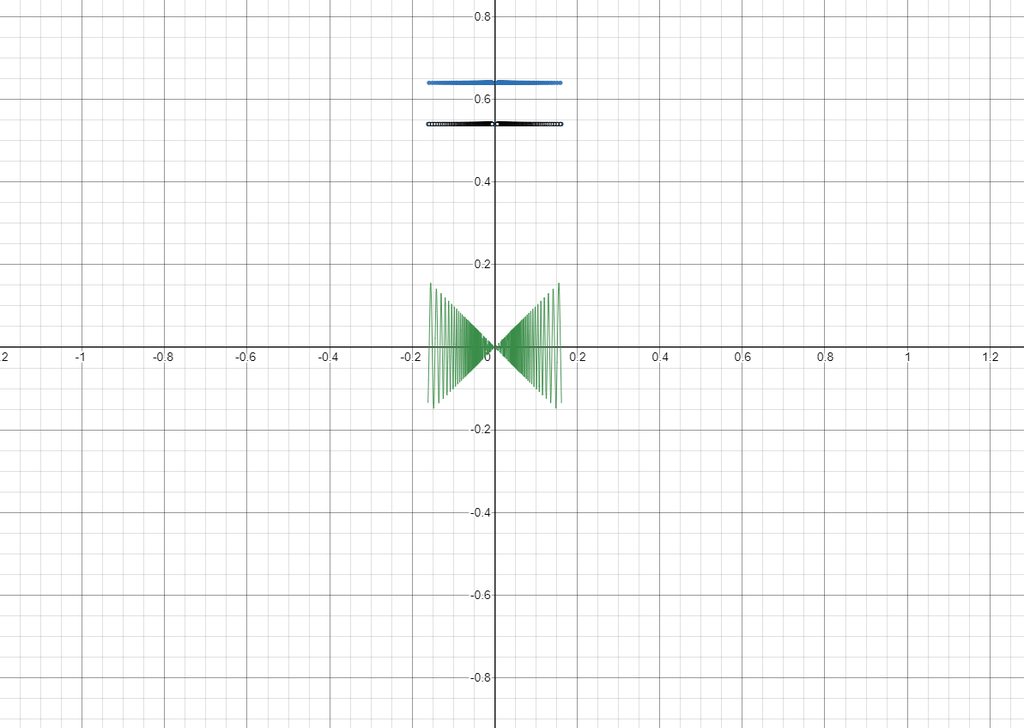
Can you see that gif?
if you open it qual is better
jaunty mural
Let's go back to the 'visual' definition of limit
======================
If lim f(x) as x -> p is L. THEN we have:
For any open interval Y around L, no matter how small.
You are able to choose an open interval X around p so that f(X) = {f(x) : x in X} is in Y.
If you require an open interval on the Y axis around 0 of whatever size
I can always pick an open interval on the X axis to contain the green graph
ok?
arghhh this is so hard to explain in words
fallen heath
O_O Imma save this chat as shuri lectures on limit visualization
jaunty mural
It would probably way easier
with a blackboard
cus u can point at the curve
@gentle lintel When you're back, you can think of discrete time as you're moving along the x-axis like this
$$f(x) = \begin{cases}0&x\neq0\1&x=0\end{cases}$$
$$g(x) = \begin{cases}x^2\sin\left(\frac{1}{x}\right)&x\neq0\0&x=0\end{cases}$$
wraith daggerBOT
Shuri2060
 jaunty mural
f(x -> 0) : [0, 0, 0, 0, 0, 0, 0, 0, 0, 0, 0, 0, 0, 0, 0, ...] (limit is 0)
g(x -> 0) : [1, 0, -1, -0.5, 0, 0.5, 0.25, 0, -0.25, 0, ...] (limit is 0)
(fg)(x -> 0) : [0, 1, 0, 0, 1, 0, 0, 1, 0, 0, 1, 0, 0, 1, ...] (limit is undefined)
f(x -> lim g) : [1, 1, 1, 1, 1, 1, 1, 1, 1, 1, 1, 1, 1, 1, 1, 1, 1, ...] (limit is 1)
========
The limit being L essentially means:
You give me an open interval on the y-axis around L
I have to find a cutoff point in the sequence where all the terms past it are contained in that interval
========
jaunty mural
Another way to think of it is if this is f
g determines how you approach the limit in the x axis

For a normal approach, you get arbritrarily close to x, but you don't actually get there.
However, if your g = x an unlimited number of times
Then your approach is going to continuously cross the point x, which is a problem here - your function will keep oscillating, and the limit won't exist.
Hence lim f(g) (and it won't be equal to the other way of evaluating the limit)
gentle lintel
gentle lintel
i’m just concerned about proving this theorem
it’s just this
jaunty mural
gentle lintel
yea i get all this
What I've shown is general.
It is quite a general argument for why condition 2 is necessary and sufficient if f is not continuous at that point.
gentle lintel
no thats not my focus anymore
jaunty mural
If f is continuous at that point, then it's clear you can do as the equation says.
Since there is no difference between taking the limit and just evaluating f
gentle lintel
i’m searching for a proof for why the change of variables work
jaunty mural
jaunty mural
Your approaching method towards the x doesn't matter
as long as you are going towards it
That is what that theorem summarizes
gentle lintel
yea
jaunty mural
Triangle inequality is commonly involved in proving limit stuff (maybe not here)
gentle lintel
im not sure how to prove using epsilon delta
jaunty mural
breh
lim x-> a g(x) = b
So we write
$$(\forall\varepsilon_1\in\bR^+)(\exists\delta_1\in\bR^+)(\forall x\in\bR)(0<|x-a|<\delta_1\implies|g(x)-b|<\varepsilon_1)$$
If lim t->b f(t) = c, we write
$$(\forall\varepsilon_2\in\bR^+)(\exists\delta_2\in\bR^+)(\forall t\in\bR)(0<|t-b|<\delta_2\implies|f(t)-c|<\varepsilon_2)$$
gentle lintel
huh
wraith daggerBOT
Shuri2060
 wraith daggerBOT
Shuri2060
 jaunty mural
If those statements are simultaneous
gentle lintel
just pick δ = min{delta_n}
jaunty mural
They are not necessarily the same
gentle lintel
size of epsilon doesn’t matter here either
jaunty mural
Then write the proof yourself lol
gentle lintel
idk just pointing things out
jaunty mural
It's not they don't matter
You justify they don't matter
There's nothing wrong with what I've written
As the starting statement
gentle lintel
it looks creepy but ok..?
jaunty mural
Now idk what's next, somehow you need to get t to be g(x)
I'm pretty sure you will want to set epsilon 1 = delta 2

$$(\exists\delta_1\in\bR^+)(\forall x\in\bR)(0<|x-a|<\delta_1\implies|g(x)-b|<\delta_2)$$
wraith daggerBOT
Shuri2060
 jaunty mural
By substitution, this is true.
gentle lintel
then t = g(x) then done?
jaunty mural
wraith dagger
**Shuri2060**
How do you make sense of 'for all g(x) in R'
gentle lintel
wraith dagger
**Shuri2060**
so can’t t = g(x) here?
wraith daggerBOT
Shuri2060
 jaunty mural
What is this quantifier supposed to mean, exactly?
Think the next step is this
$$(\forall\varepsilon_2\in\bR^+)(\exists\delta_1,\delta_2\in\bR^+)(\forall x, t\in\bR)$$
$$[(0<|x-a|<\delta_1\implies|g(x)-b|<\delta_2) \land$$
$$(0<|t-b|<\delta_2\implies|f(t)-c|<\varepsilon_2)]$$
gentle lintel
uhh so what do we do
wraith daggerBOT
Shuri2060
 gentle lintel
alright
jaunty mural

Now we want this implication to go like this
We CAN say that
because according to condition 2
g(x) won't take on b
for epsilon small enough
Hence, we ARE able to combine statements
$$(\forall\varepsilon_2\in\bR^+)(\exists\delta_1,\delta_2\in\bR^+)(\forall x, t\in\bR)$$
$$(0<|x-a|<\delta_1\implies|f(g(x))-c|<\varepsilon_2)$$
gentle lintel
huh
gentle lintel
jaunty mural
because according to condition 2
confused starting here
wraith daggerBOT
Shuri2060


 jaunty mural
Ok, the 3rd line
I want to use that implication
ok?
For t = g(x)
I cannot do this
With just the 2nd line
I only know that quantity is less than delta 2
I don't know it's greater than 0
However, I DO know it must be greater than 0 for sufficiently small epsilon_2
Because of condition 2
gentle lintel
jaunty mural
I only know that quantity is less than delta 2
which quantity