#help-13
1 messages · Page 143 of 1
 wraith daggerBOT
Akira

 teal magnet
I see on the cos the +- is inverted while for sin it's the same, is the inversion on purpose?
so is the tan denominator
 austere hull
teal magnet
I see on the cos the +- is inverted while for sin it's the same, is the inversio...
austere hull
teal magnet
I see on the cos the +- is inverted while for sin it's the same, is the inversio...
yes
teal magnet
Can I get the script you used to make that image?
austere hull
it's secret helper knowledge https://github.com/riemann-discord/math-discord/tree/main
teal magnet
I'm guessing you don'T want t oshare the latex you used.
austere hull
you need preamble for this
have you read the introductions?
all you need to add the preamble.tex file and replace it
you could add your own as well


teal magnet
ah, it's a bit more involved than I hoped. well thanks for the image.
I have a latex software and libre office math.
austere hull
do you use overleaf
never heard of those you said
I'd say overleaf is best for latex
I can tell you how you can make this in your preamble in #latex-testing
make sure you got the file
austere hull
no worries
teal magnet
I use TeXstudio, I'll check out overleaf.
Anyway perhaps someone else know a page that I can learn about the subject by small steps.
teal magnet
no, small steps for what you made the image about.
austere hull
it's about factoid
teal magnet
I have a bad memory, I need to learn bit by bit.
austere hull
austere hull
it's secret helper knowledge <https://github.com/riemann-discord/math-discord/tr...
you understand this by reading all this
on README.md
teal magnet
no
austere hull
it literally says
teal magnet
what you made the image about
austere hull
which image?
austere hull
I did not make this
teal magnet
wraith dagger
**Akira**
☝️
wraith daggerBOT
Akira
 austere hull
,tex .Psf
wraith daggerBOT
Akira
 teal magnet
That doesn't help with my question
teal magnet
☝️ my question....
it does, but slower would be better
it's why I'm asking here
more steps
or more details to the steps
teal magnet
also I noticed after posting it that the PDF is by the same authors, I'm assuming it's the same thing or a diferent version of it.
I was at khan academy, it ran through it, it made references to previous videos but there were no such videos in that course https://www.khanacademy.org/math/trigonometry/trig-equations-and-identities/xfefa5515:angle-addition-identities/v/trigonometry-identity-review-fun

Khan Academy
Learn for free about math, art, computer programming, economics, physics, chemistry, biology, medicine, finance, history, and more. Khan Academy is a nonprofit with the mission of providing a free, world-class education for anyone, anywhere.
I'm not studying to be a detective and have a super memory.
if you know of the videos he made reference to I'd be very happy to watch them.
or other videos that goes slower through it,.
austere hull
austere hull
it's secret helper knowledge <https://github.com/riemann-discord/math-discord/tr...
well the factoids for those who made this, it's pretty much khan academy video
and the pdf from here

it's a half angle
,tex .half angle
wraith daggerBOT
Akira
 austere hull
I'm not exactly sure what is your question
correct me if this is one example of your question
 teal magnet
This is all too quick for me.
I guess if no one replies, I'll look at more websited tomorrow.
austere hull
teal magnet
This is all too quick for me.
I mean there's a slow speed you can do on youtube no?
teal magnet
more steps
The video has a transcript, I could go supuer duper slow.
slower through the subject.
I guess I'm dumb as a monkey, oh well!
 chrome bluff
hello, I'm kira. I'm new here. can you guys help me with number 4?

<@&286206848099549185>
 cedar kilnBOT
chrome bluff
hello, I'm kira. I'm new here. can you guys help me with number 4?
cedar kilnBOT
chrome bluff
hello, I'm kira. I'm new here. can you guys help me with number 4?
Please read #❓how-to-get-help
Please only use the <@&286206848099549185> ping once if your question has not been answered for 15 minutes. Please do not ping or DM individual users about your question.
 crimson sedge
chrome bluff
hello, I'm kira. I'm new here. can you guys help me with number 4?
crimson sedge
chrome bluff
hello, I'm kira. I'm new here. can you guys help me with number 4?
okay , i can answer this question
do you want me to ?
chrome bluff
crimson sedge
do you want me to ?
sure, thank you
crimson sedge
chrome bluff
sure, thank you
okay so , here we go
these both Luca and Ian answering right are independent events ,
got it ?
chrome bluff
owh, there are independent events
crimson sedge
chrome bluff
owh, there are independent events
yeah ,
so , probability that atleast one of them answers the question correctly will be = 1 - ( neither of them answers it correctly)
Luca getting it wrong = 1-5/7 = 2/7 ; Ian getting it wrong = 1 - 5/9 = 4/9 ; thus , both getting it wrong = (2/7)(4/9)= 20/63 , we multiplied directly because they are independent
chrome bluff
crimson sedge
Luca getting it wrong = 1-5/7 = 2/7 ; Ian getting it wrong = 1 - 5/9 = 4/9 ; thu...
okay
so, the anwser to Qa is 43/63?
chrome bluff
crimson sedge
Luca getting it wrong = 1-5/7 = 2/7 ; Ian getting it wrong = 1 - 5/9 = 4/9 ; thu...
(2/7)(4/9)=8/63
 slate lintel
wraith dagger
**Akira**
slate lintel
wraith dagger
**Akira**
this looks cool
something's weird about the kerning on the Vertex line
@austere hull ^
crimson sedge
chrome bluff
(2/7)(4/9)=8/63
sorry , 8/63 , got electricity cut , so had to go
crimson sedge
chrome bluff
(2/7)(4/9)=8/63
thus , probability of getting at leat one correct answer = 1 - 8/63 = 55/63 , got it ?
this is the (i) part
chrome bluff
crimson sedge
thus , probability of getting at leat one correct answer = 1 - 8/63 = 55/63 , go...
got it
chrome bluff
crimson sedge
sorry , 8/63 , got electricity cut , so had to go
okay, thank you
crimson sedge
so , for the 2nd part
crimson sedge
chrome bluff
hello, I'm kira. I'm new here. can you guys help me with number 4?
probability of luca getting the answer correct is 5/7 , since the events are independent , the intersection of it with getting answer correct will also be the same , that is = 5/7
thus , if the question is answered correctly , the probability thatt Luca got the answer correct = (5/7)/(55/63)=9/11
got it ?\
similar goes for part c , for Ian , the answer will be = (5/9)/(55/63)=7/11
chrome bluff
got it
crimson sedge
and for the last part ,
intersection of being correct comes out to be = 25/63 , using the set theory-probability formula
thus , conditional probability comes out to be = (25/63)/(55/63) = 5/11
chrome bluff
got it, thank you @crimson sedge
crimson sedge
chrome bluff
got it, thank you <@456226577798135808>
always 🙂
cedar kilnBOT
@teal magnet Has your question been resolved?
teal magnet
Since some people decided I was done with my question and I'm not, I'll repeat it: Most of the pages on I found on trigonometric angle addition identities just list them and I can't remember that all straight through. I found the following page that seem to go through the material slower, do you know of something even slower through the subject? https://math.libretexts.org/Bookshelves/Precalculus/Book%3A_Precalculus__An_Investigation_of_Functions_(Lippman_and_Rasmussen)/07%3A_Trigonometric_Equations_and_Identities/7.02%3A_Addition_and_Subtraction_Identities

Mathematics LibreTexts
In this section, we begin expanding our repertoire of trigonometric identities.
 wanton sail
@chrome bluff This is someone else's help channel, please don't ask your question in it
 slim jasper
crimson sedge
okay , i can answer this question
slim jasper
crimson sedge
okay , i can answer this question
Please avoid engaging when someone asks their question in someone else's help channel (other than redirecting them to open a channel of their own).
wanton sail
teal magnet
Since some people decided I was done with my question and I'm not, I'll repeat i...
Personally I find it really helpful to start from the angle sum identities and derive the rest of the identities from there
Like for example if you know sin(a + b) = sin a cos b + cos a sin b
You can substitute in (-b) to get sin(a + (-b)) = sin a cos(-b) + cos a sin(-b)
or
sin(a - b) = sin a cos b - cos a sin b
I think KhanAcademy is a good resource for this sort of stuff, have you already tried it?
teal magnet
So if I manage to remember the 4 sin+- cos+- I'll manage to deduce the rest?
Khan Academy is my main source of information. It went too fast through it, you can look at the transcript on the tab for it; it's much too fast for me https://www.khanacademy.org/math/trigonometry/trig-equations-and-identities/xfefa5515:angle-addition-identities/v/trigonometry-identity-review-fun
Khan Academy
Learn for free about math, art, computer programming, economics, physics, chemistry, biology, medicine, finance, history, and more. Khan Academy is a nonprofit with the mission of providing a free, world-class education for anyone, anywhere.
wanton sail
Yeah I think the important ones to know are
Pythagorean
sin^2 x + cos^2 x = 1
Definition of tangent
tan x = sin x / cos x
Even/oddness
sin(-x) = -sin x, cos(-x) = cos x
Angle sum
sin(a+b) = sin a cos b + cos a sin b
cos(a+b) = cos a cos b - sin a sin b
Meaning of co-
sin x = cos(90 deg - x)
And then try to figure out the other ones (double angle identities, half angle identities, etc) based on these, and that'll help you remember them
wanton sail
teal magnet
Khan Academy is my main source of information. It went too fast through it, you ...
Ah okay, I think Paul's Online Notes might also have something on it?
teal magnet
I don't think I've seen that. I've started with Math if Fun, which I often like, but too fast as well.
is*
wanton sail
If you look up a specific identity on youtube, you'll probably find in depth videos on it too
You might've already tried that, but just in case you haven't yet
Feel free to also ask any specific questions/confusions you have
teal magnet
I did not look at each ones, I looked at the assition subject as a whole. Are you referring to https://tutorial.math.lamar.edu/Extras/AlgebraTrigReview/TrigFormulas.aspx ?
addition*
wanton sail
Yeah
I recommend spending some time on justifying why each one is true
That will help you remember them much better
Like for example sin^2 x + cos^2 x = 1 is just because of the pythagorean theorem
teal magnet
It's what I'd like, how come therE's no page for each one individual?
I must be the only one that think all at once is too fast.
or at least a whole section of a page
wanton sail
Maybe this page? https://wumbo.net/examples/derive-trigonometric-identities/
This example demonstrates how to derive the trigonometric identities using the trigonometric function definitions and algebra.
I just looked up derivation of trigonometric identities
And got a bunch of results
This was one of the first ones
teal magnet
I haven'T looked at the page completly since I'm tired but it looked very promising!
very indeed
wanton sail
Awesome!
teal magnet
Well, provided it's indeed it, I don't need help anymore. If I do realized it's not enough tomorrow, mind if I ping you?
Also if tomorrow I realize it'S enough, I think thereS' a bot command to thank you, what is it and in which channel to do it?
Well... if you decide you want to, @ or DM me.
!close
.close
cedar kilnBOT
Channel closed
Closed by @teal magnet
Use .reopen if this was a mistake.
 Available help channel!
Send your question here to claim the channel.
Remember:
• Ask your math question in a clear, concise manner.
• Show your work, and if possible, explain where you are stuck.
• After 15 minutes, feel free to ping <@&286206848099549185>.
• Type the command .close to free the channel when you're done.
• Be polite and have a nice day!
Read #❓how-to-get-help for further information on how to ask a good question, and about conduct in the question channels.
 crude scroll
 cedar kilnBOT
crude scroll
crude scroll
cedar kilnBOT
crude scroll
crude scroll
If we let (A) be f(x), then (C) would be f'(x) = g(x), and then (B) would be g'(x) = h(x) right
 short blade
yes
crude scroll
since for (C), the first third of the graph is positive, then negative, then positive
cedar kilnBOT
Channel closed
Closed by @crude scroll
Use .reopen if this was a mistake.
Available help channel!
Send your question here to claim the channel.
Remember:
• Ask your math question in a clear, concise manner.
• Show your work, and if possible, explain where you are stuck.
• After 15 minutes, feel free to ping <@&286206848099549185>.
• Type the command .close to free the channel when you're done.
• Be polite and have a nice day!
Read #❓how-to-get-help for further information on how to ask a good question, and about conduct in the question channels.
 winter sundial
I’ve been reading “How to Prove It” and I’ve been reading up logic. I understand that an open sentence is a sentence that has a free variable and the sentence can either be true or false depending on the value of the free variable. I also understand that in order to make an open sentence a statement all the free variables will have to be quantified. Say I had this open sentence:
x + 0 = x
In addition say the universe of discourse is the real numbers.
I understand that this is an open sentence because x is a free variable due to there not being a quantifier for x. Since the universe of discourse is the real numbers, I can determine the truth set. The truth set is the real numbers. So the universe of discourse and the truth set turn out to be the same. My confusion arises in the fact that this is an open sentence but no matter what value I substitute for x in the universe of discourse the statement will be true. Can someone please explain? Thank you in advance!
cedar kilnBOT
winter sundial
I’ve been reading “How to Prove It” and I’ve been reading up logic. I understand...
 upper abyss
I've not read "how to prove it" so take me with a grain of salt.
But if a sentence is always true, then it's definitely "either true or false"
Does Velleman require that there exists a value where the sentence is false?
winter sundial
In the book Velleman states: “When studying statements that do not contain variables, we can easily talk about their truth values, since each statement is either true or false. But if a statement contains variables, we can no longer describe the statement as being simply true or false. Its truth value might depend on the values of the variables involved. For example, if P(x) stands for the statement “x is a prime number,” then P(x) would be true if x = 23, but false if x = 22. To solve this problem, we will define truth sets for statements containing variables.”
 crystal raptor
an open sentence is one that may be either true or false depending on the inputs, but that doesn't disallow it from being true for all inputs
cedar kilnBOT
@winter sundial Has your question been resolved?
winter sundial
@wraith blaze So we need the quantifier to make it a quantified sentence but without it it still open.

 winter sundial
I understand it now! Thank you for that explanation
I know I asked you this question twice, I kept thinking about it and realized I didn’t quite understand it fully. Now I know we need to know the universe of discourse and how many “x’s” we are talking about
Right so if we choose all x in the universe of discourse or just one.
wraith daggerBOT
all lines are flat
 winter sundial
Could you explain the difference between the unique x and the for some x
wraith daggerBOT
all lines are flat
 winter sundial
I see that makes sense. Thank you!
wraith daggerBOT
all lines are flat
 winter sundial
That makes sense!
Thank you for that explanation
What book did you use to learn mathematical logic?
I’ll have to take a look at transition to advanced mathematics. Thank you for all the explanations! Thank you to everyone else who left a comment on my question!
.close
cedar kilnBOT
Channel closed
Closed by @winter sundial
Use .reopen if this was a mistake.
Available help channel!
Send your question here to claim the channel.
Remember:
• Ask your math question in a clear, concise manner.
• Show your work, and if possible, explain where you are stuck.
• After 15 minutes, feel free to ping <@&286206848099549185>.
• Type the command .close to free the channel when you're done.
• Be polite and have a nice day!
Read #❓how-to-get-help for further information on how to ask a good question, and about conduct in the question channels.
 vital valley
Why does e^lnx = x
cedar kilnBOT
vital valley
Why does e^lnx = x
 crimson delta
definition
vital valley
Of what
 dire bronze
let x > 0
e^lnx=x
ln(e^lnx)=lnx
ln(x) * ln(e) = ln(x)
ln(x) * 1 = ln(x)
ln(x) = ln(x)
x=x which is true
therefore e^lnx=x is true
cedar kilnBOT
Channel closed
Closed by @vital valley
Use .reopen if this was a mistake.
Available help channel!
Send your question here to claim the channel.
Remember:
• Ask your math question in a clear, concise manner.
• Show your work, and if possible, explain where you are stuck.
• After 15 minutes, feel free to ping <@&286206848099549185>.
• Type the command .close to free the channel when you're done.
• Be polite and have a nice day!
Read #❓how-to-get-help for further information on how to ask a good question, and about conduct in the question channels.
 naive zinc
I do not know where to begin on this problem other than both a and b are true
 cedar kilnBOT
naive zinc
I do not know where to begin on this problem other than both a and b are true
naive zinc
cedar kilnBOT
naive zinc
I do not know where to begin on this problem other than both a and b are true
naive zinc
The answer is d but idk why
crystal raptor
Did you send the right picture?
naive zinc
Yes, I moved answers but it is d
 rain drift
so what does the integral mean? What does the integral represent?
naive zinc
The area under a curve in this case From 0 3
Why can’t it be greater than 7?
Or equal 7 I mean
rain drift
bingo! Now when it says that f(c) = 2 is a maximum, what does that mean?
 quaint forge
it will be both incresing and decreasing in the interval [0,3] since the max value is at two the graph before it will be increasing and after it will be decrasing
rain drift
hint: What shape would give us a maximum area?
naive zinc
That it’s the highest y value on f from 0 3 and also the derivative is 0
Working backwards means it’s a 0 on the integral too I think ?
rain drift
yep! So is there a function you can think of that would give us the maximum area? Where every point in [0, 3] is the max?
naive zinc
Y=x?
rain drift
closeish. How about a constant?
naive zinc
Not quite sure what you mean “where every point is the max” that’s where im stumped
rain drift
naive zinc
Not quite sure what you mean “where every point is the max” that’s where im stum...
how about the integral of y = 2 from [0,3]. What would that be?
rain drift
that's the anti-derivative, but what about the area?
rain drift
naive zinc
Not quite sure what you mean “where every point is the max” that’s where im stum...
This is what I mean.
 rain drift
naive zinc
6
rain drift
naive zinc
6
right!
naive zinc
Thus it cannot be 7 but could be 5
rain drift
naive zinc
Thus it cannot be 7 but could be 5
yeah exactly. Literally if from [0, 3] the max value for f(x) = 2 at point c, we can get the max area by making very point c = 2
hence the constant funciton
so the max area we can have is 6
naive zinc
I think I follow
rain drift
it can be 5, it can be 5.999999999...., 6.
But not things ike 6.00000000000000001, 6.00000000000000000000001. Those are invalid
6 is the max we could possibly do
naive zinc
You use the info given to make a conclusion then work backwards anti differentiating right?
rain drift
Not work backwards per se. I just saw that the max value y could've been was y = 2, so if we were to set every point f(c) = 2, that is, the constant function f(x) = 2, then we have a maximum area we could possibly have 😉
hopefully they make sense
naive zinc
Also correct me if I’m wrong but we essentially made a bounded region on the graph, or would it just be a hypothetical rectangle of our possible area?
rain drift
naive zinc
Also correct me if I’m wrong but we essentially made a bounded region on the gra...
Yeah you can think of it as a "bound". f(x) = 2 would be our upper bound for y since f(c) = 2 is the maximum value we could have.
naive zinc
Thank you very much!
naive zinc
Yes actually if you’re willing

My conjecture was wrong I haven’t done any anti differentiation yet
And it’s the integral from -1 to 1 correct?
rain drift
one moment por favor
correct the bounds are -1 to 1
hmmm
it should be 0 me thinks
yeah it is 0!
naive zinc
I put 0 and it was incorrect 😭
naive zinc
The anti derivative is this yes?
rain drift
so if we were to solve this the old fashioned way, what method would we use to solve this integral?
 rain drift
yep exactly
naive zinc
Du= -2x
rain drift
yeah it's 0 lol
naive zinc
So we get a -1/2 constant
 naive zinc
I did not
rain drift
yeah it's totally 0
naive zinc

Perhaps an error on the page?
This seemed like a look and know problem
Same negative area as positive and so it must be 0
rain drift
yeah the only way that would be 2/3 is if it were the absolute value of that function
maybe they mean total area?
the integral represents the net area
whatever the case either it's wrong or the problem was written in a confusing way
 rotund fox
naive zinc
Perhaps an error on the page?
rotund fox
naive zinc
Perhaps an error on the page?
break the integral on 0 and then try.
rain drift
rotund fox
break the integral on 0 and then try.
it's 1/3 unfortunately :/
rotund fox
rain drift
it's 1/3 unfortunately :/
For 1 side?
naive zinc
Did I antidifferentiste properly btw?
rotund fox
rain drift
from -1 to 0 it'd be -1/3
I think we should add the area and also put absolute() on the broken integrals to get the area.
so that should give us 2/3
naive zinc
That’s one of the worst worded problems I’ve ever read lol
rotund fox
naive zinc
That’s one of the worst worded problems I’ve ever read lol
Its asking the area though. I suppose that if i were you i would not take that area as negative. might just be a me thing tho, i was taught to take abs when doing questions like these
rain drift
naive zinc
That’s one of the worst worded problems I’ve ever read lol
yeah indeed, lol.
I would put 2/3 for the credit, take a screenshot, and present it to your teacher that the problem might be incorrect or ask clarification for the problem.
rain drift
rotund fox
Its asking the *area* though. I suppose that if i were you i would not take that...
@naive zinc this is probably the most correct way to go about this
they more than likely mean "total area" rather than "net area". But I don't like that because the integral represents the net area lmao
rotund fox
rain drift
they more than likely mean "total area" rather than "net area". But I don't like...
oh thats a cool insight, they never asked to get the area by integral, which means that they 100% asked the total area
naive zinc
rain drift
yeah indeed, lol.
I would put 2/3 for the credit, take a screenshot, and prese...
Unfortunately it’s for the clep exam which is all multiple choice which means come test day it won’t matter sadly
Thank you both very much
naive zinc
For this problem I initially thought it was -1/12, in these types of questions is it always f(x)-g(x)?
I accidentally did x^4\4 - x^3/3 (integral from 0, 1 for both ofc)
rain drift
wait sorry which problem? Can you post a pic of the problem?
naive zinc

My bad
Does the rule of “greater minus lesser” apply in the area between two curved as well?
rain drift
yeah indeed. Whichever function is greater than is always first. If, for some reason the areas "switch", then you would have to do 2 separate integrals
so in this case, from [0, 1], x^2 is greater than x^3, so it would be
$\int_0^1 (x^2 - x^3) dx$
wraith daggerBOT
mellowdramallama
 rain drift
 naive zinc
Makes sense I remember now
This inverse function question is my last one, if you’re willing to help me one more time
rain drift
yep let's do it
naive zinc

H’ is 5x^4-2
And h’(0) is -2
So I tried doing where h’= -2
Whoops maybe I should do where it equals 0 instead?
 naive zinc
Or do you just change y and x?
rain drift
nah. My guess is that we can play around with something about the chain rule or something
give me a moment
unless someone else viewing this thread has any ideas lol
naive zinc
Since we need h’ inverse at 0 we could make our domain the relative max and min?
dire bronze
naive zinc
Note that the function is increasing as x goes to infinity and decreases as x goes to negative infinity
and the derivative is increasing on both sides
dire bronze
Also, the inverse is just the function flipped across the line x=y
crystal raptor
They probably want you to blindly use the inverse function derivative formula (ignoring woes about whether h inverse exists)
rain drift
crystal raptor
They probably want you to blindly use the inverse function derivative formula (i...
oh say what? We completely skipped this in my calculus class. I had no idea this existed! Lmao
naive zinc
So did I lol
crystal raptor
Yeah its neat, you don't need the full inverse, just the preimage of the point you want
naive zinc
So I take the inverse at 0?
f(0)=1
So inverse is F^-1(1)=0
Correct?
So I get 1/f’(f^1(0) ?
slate lintel
yes
 wet haven
naive zinc
Why not?
wet haven
naive zinc
Why not?
You have to see if the function is a one to one function
naive zinc
We did by restricting the domain to (-.795, .795)
I’m trying to find where f =0 but I’m struggling atm
slate lintel
try rational roots first
you have $x^5 - 2x + 1 = 0$ so rational roots are either 1 or -1
wraith daggerBOT
Hayley
 austere hull
slate lintel
<@362561562004946945> ^
austere hull
slate lintel
<@362561562004946945> ^
I'll fix it
cedar kilnBOT
@naive zinc Has your question been resolved?
cedar kilnBOT
@naive zinc Has your question been resolved?
cedar kilnBOT
Channel closed
Closed due to timeout
Use .reopen if this was a mistake.
Available help channel!
Send your question here to claim the channel.
Remember:
• Ask your math question in a clear, concise manner.
• Show your work, and if possible, explain where you are stuck.
• After 15 minutes, feel free to ping <@&286206848099549185>.
• Type the command .close to free the channel when you're done.
• Be polite and have a nice day!
Read #❓how-to-get-help for further information on how to ask a good question, and about conduct in the question channels.
 cinder crest
Hi there! I need help with a question from diff eq. The prompt is 3. Solve the IVP. Final answers should be real-valued (no i involved).
2y′′′ + 3y′′ − 12y′ + 7y = 0, y(0) = 1, y′(0) = 0, y′′(0) = 2
cedar kilnBOT
cinder crest
Hi there! I need help with a question from diff eq. The prompt is 3. Solve the I...
cinder crest
I have the general solution I just need some help with the ivp part of the question
of solving for c1, c2, and c3
I'm stuck
 bold vine
 cinder crest

I'm stuck on solving for A, B, and C
I've come up with numerous solutions that solve for the first 2 equations (y(0), and y'(0)) but I can never get the constants to fit all of the conditions (aka as well as the last equation of y''(0))
and I just don't know where to go from here
I thought that multiplying a 2 to all the constants in the 2nd equation and then subtracting that value from the last would let me solve for A, as I don't see any other way to solve for the other variables, as they aren't separable and I thought that -77/4 would work, as it fits all of the conditions, but it never ends up working, especially when I try and plug the values for A, B, and C back into the final equation
(basically I just need help with solving the constants of A, B, and C)
or just help to get a step into the right direction
cedar kilnBOT
@cinder crest Has your question been resolved?
cinder crest
<@&286206848099549185> caN i get some help please
 scenic python
cinder crest
<@&286206848099549185> caN i get some help please
scenic python
cinder crest
<@&286206848099549185> caN i get some help please
what?
 fleet eagle
scenic python
what?
fleet eagle
scenic python
what?
Yeah ?
cinder crest
scenic python
what?
with the problem above please
scenic python
can you increase the size of the letter?, I'm without glasses
scenic python
y
cinder crest
oh okay
yeah I gotchu
sorry about that
just gimme a second

is that any better?
scenic python
barely i can see
cinder crest
sorry I tried my best to resize the image
is there a way you can download the image on your pc/phone and just enlargen it from there?
scenic python
cinder crest
is there a way you can download the image on your pc/phone and just enlargen it ...
my sdd i almost full i i still can download
cinder crest
oh okay sweet
scenic python
is to see if are correct?
cinder crest
what?
scenic python
cinder crest
Hi there! I need help with a question from diff eq. The prompt is 3. Solve the I...
what you mean here
cinder crest
I need help solving for A, B, and C
and the prompt is there
like what I need to solve for etc.
I have the general equation and whatnot, I just need help solving for the constants of the IVP
scenic python
i will come later let me just find my glasses
cedar kilnBOT
Channel closed
Closed by @cinder crest
Use .reopen if this was a mistake.
Available help channel!
Send your question here to claim the channel.
Remember:
• Ask your math question in a clear, concise manner.
• Show your work, and if possible, explain where you are stuck.
• After 15 minutes, feel free to ping <@&286206848099549185>.
• Type the command .close to free the channel when you're done.
• Be polite and have a nice day!
Read #❓how-to-get-help for further information on how to ask a good question, and about conduct in the question channels.
 placid tendon
cinder crest
I've come up with numerous solutions that solve for the first 2 equations (y(0),...
placid tendon
cinder crest
I've come up with numerous solutions that solve for the first 2 equations (y(0),...
You have an system of 3 unknowns and 3 equations, just solve it
cinder crest
placid tendon
You have an system of 3 unknowns and 3 equations, just solve it
yeah I know that's what I'm supposd to do
but I need help solving it
thats what I was trying to get at
like what step do I take first
and is what I was doing valid?
 grand forge
placid tendon
You have an system of 3 unknowns and 3 equations, just solve it
grand forge
placid tendon
You have an system of 3 unknowns and 3 equations, just solve it
ODE's are a bit harder to solve than regular equations
cinder crest
^ facts
placid tendon
grand forge
ODE's are a bit harder to solve than regular equations
He’s referring to the coefficients
Not the ODE
placid tendon
cinder crest
^ facts
Can you write the system of equations here ? It’s hard to see
 dawn junco
we're already in #help-0 btw @placid tendon
you reopened the thing, but cart also opened another chan
I guess we can close that now
.close
cedar kilnBOT
Channel closed
Closed by @dawn junco
Use .reopen if this was a mistake.
Available help channel!
Send your question here to claim the channel.
Remember:
• Ask your math question in a clear, concise manner.
• Show your work, and if possible, explain where you are stuck.
• After 15 minutes, feel free to ping <@&286206848099549185>.
• Type the command .close to free the channel when you're done.
• Be polite and have a nice day!
Read #❓how-to-get-help for further information on how to ask a good question, and about conduct in the question channels.
 olive meteor
 cedar kilnBOT
olive meteor
olive meteor
cedar kilnBOT
olive meteor
olive meteor
I'm confused
cedar kilnBOT
@olive meteor Has your question been resolved?
cedar kilnBOT
Channel closed
Closed due to timeout
Use .reopen if this was a mistake.
Available help channel!
Send your question here to claim the channel.
Remember:
• Ask your math question in a clear, concise manner.
• Show your work, and if possible, explain where you are stuck.
• After 15 minutes, feel free to ping <@&286206848099549185>.
• Type the command .close to free the channel when you're done.
• Be polite and have a nice day!
Read #❓how-to-get-help for further information on how to ask a good question, and about conduct in the question channels.
 tulip harness
Consider the following system of differential equations $x'(t) = Ax(t)$, where $A\in \mathbb{R}^{n\times n}$ and $A^3 = 0$. Show that the following second-order Runge-Kutta method is exact:\
$x_n = x_{n-1} + \frac{h}{2}(k_1 + k_2)$, where\
$k_1 = Ax_{n-1}$, $k_2 = A(x_{n-1} + hk_1)$
cedar kilnBOT
tulip harness
Consider the following system of differential equations $x'(t) = Ax(t)$, where $...
wraith daggerBOT
casiel368
 cedar kilnBOT
@tulip harness Has your question been resolved?
 still barn
The idea is that if you write down a Taylor expansion of x(t_(n+1)) you see that the O(h^3) and higher-order terms vanish because A is nilpotent. It'll help if you write down that expansion and see how it relates to the terms in your proposed runge-kutta method.
tulip harness
Okay in the mean time I got that idea, but what comes next?
If they gave me the Taylor 2 method it would be fine, but I only know they share order of convergence
I know how to prove that, but I don't see exactly how one translates into the other
still barn
I don't think I understand what you are asking.
You should know the solution to x'(t) = Ax(t) as a series. Write down that series and compare what it looks like to the RK method
tulip harness
Oh I really messed up in the middle before
It seems a bit clearer now
So now I'd like to prove that tau=0
 still barn
It's been a little while since I've done anything like this so I don't know when it will all fall into place, but you can see that your hAx(t) is basically hk_1 and you can do a Taylor expansion on A^2 x(t) again to get something like A^2x(t) = Ax(t-1) + hA^2(x(t-1)) etc to get to your k_2. I think it's a bit early to just replace that with a tau.
An RK method really isn't that different from a Taylor method. You're just reapplying the Taylor method to your higher order derivatives like your A^2 x(t) and multiplying things all out. It's more of an annoyance than anything new.
tulip harness
Oh, I didn't know that
I knew that they share order because if you put the time into taking all multivariable derivatives it checks out, but that motivation seems cleaner
still barn
Yeah that's basically it. By rewriting it in this way, the Runge-Kutta method becomes a sort of weighted combination of the Ax(t) evaluated at a whole bunch of different points

 cedar kilnBOT
Channel closed
Closed by @tulip harness
Use .reopen if this was a mistake.
Available help channel!
Send your question here to claim the channel.
Remember:
• Ask your math question in a clear, concise manner.
• Show your work, and if possible, explain where you are stuck.
• After 15 minutes, feel free to ping <@&286206848099549185>.
• Type the command .close to free the channel when you're done.
• Be polite and have a nice day!
Read #❓how-to-get-help for further information on how to ask a good question, and about conduct in the question channels.
 reef sedge
 cedar kilnBOT
reef sedge
reef sedge
cedar kilnBOT
reef sedge
reef sedge
i dont understand for a,b
for a.)
why they do 2*4, the selection of number 4?, after choosing either a or i in the first letter of the word, you're left with 5 options, 4 constants ands 1 vowel
 eternal phoenix
because you can start with A and I or I and A
eternal phoenix
so double the cases
reef sedge
for b is it because 0 cant be the start of a number?
reef sedge
eternal phoenix
because you can start with A and I or I and A
can you elaborate
eternal phoenix
so you can start with A and end with I
or start with I and end with A
we know that because that’s what the problem is saying
so that leaves us D, R, W, and N in between
which means that we have to figure out how many ways we can arrange those letters between A and I or I and A
which is just four factorial
but because we can start with A and end with I or start with I and end with A
we have to double the amount we can have
hence why 2 x four factorial
reef sedge
eternal phoenix
so you can start with A and end with I
ohhhhhhhhhhhhhhh
i think i get it
since there are only two vowels
one must start with i or e
or start with e and end with i
if next letter is vowel, it doesnt meet the conditions
reef sedge
and for b
is it because
0 cannot be the start of a number
else if it was like 2,3,4,5,6
it would be
lets say it was digits 1,2,3,4,5,6
and we want odd 4 digit numbers
it woud be like
$6\cdot 5\cdot 4\cdot 3\cdot 3$
wraith daggerBOT
fwgx
 eternal phoenix
ngl i have no idea for b😭
reef sedge
oO
eternal phoenix
0 can’t be the start of a number because it’s just a three digit number then
0123=123
reef sedge
yes
eternal phoenix
but idk how you get the answer for b
i’m not as good as most of the people in this server at math
eternal phoenix
the last number being 3 makes sense
because there’s only three odd numbers
but idk why the rest are the way they are
reef sedge
6 because at the start
there are 6 numbers to choose from
and so on till the last 3
maybe it should be two
eternal phoenix
i understand
so basically
at the end there are only three possibilities
because there are only three odd numbers
at the start
we cannot use 0
and we already used an odd number at the end because we know we have to
so there are four possibilities at the start
for the second digit
we have already used the first and last digit
reef sedge
oh yes
eternal phoenix
so 3 at end
eternal phoenix
4 at start because we can’t use 0 or the one at the end
reef sedge
but it can be used in the middle 2
eternal phoenix
no 4 numbers can be used at the start
reef sedge
yes
eternal phoenix
then in second digit
eternal phoenix
we can’t use ending digit or starting
but now we CAN use 0 because it’s not at the start
reef sedge
but then that means 0 can still be used 0 cos not start
eternal phoenix
so we have four numbers to use again
eternal phoenix
and then third digit
we’ve already used three digits
so we can use any last three
and this can go in any order with the second and third digit because multiplication is commutative
so 4x4x3x3
reef sedge
whats commutative mean
eternal phoenix
we can change the places of numbers and it’s the same
reef sedge
ye
eternal phoenix
so if you choose last digit first, then first, you can go to the second or third digit and choose it next
doesn’t matter
eternal phoenix
idkkk
eternal phoenix
5x4x3x3 i think
three choices for last
five choices for first
four choices for second
three choices for third
reef sedge
isnt it 6 * 5 * 4 * 3
eternal phoenix
no
because the last has to be an odd digit
well
maybe
i’m not sure
i don’t think so because that would include the case where there’s three even numbers at the end
reef sedge
last one is *3 i think purely bc there are 3 odd numbers in 1,2,3,4,5,6
cedar kilnBOT
@reef sedge Has your question been resolved?
Channel closed
Closed by @reef sedge
Use .reopen if this was a mistake.
Available help channel!
Send your question here to claim the channel.
Remember:
• Ask your math question in a clear, concise manner.
• Show your work, and if possible, explain where you are stuck.
• After 15 minutes, feel free to ping <@&286206848099549185>.
• Type the command .close to free the channel when you're done.
• Be polite and have a nice day!
Read #❓how-to-get-help for further information on how to ask a good question, and about conduct in the question channels.
 verbal hazel
Open.
cedar kilnBOT
verbal hazel
Open.

 dire geode
What's in the exponential
verbal hazel
Arc tan x
dire geode
Did you try u sub with u=arctan(x)
verbal hazel
Doesn't work.
cedar kilnBOT
@verbal hazel Has your question been resolved?
verbal hazel
.close
cedar kilnBOT
Channel closed
Closed by @verbal hazel
Use .reopen if this was a mistake.
cedar kilnBOT
Available help channel!
Send your question here to claim the channel.
Remember:
• Ask your math question in a clear, concise manner.
• Show your work, and if possible, explain where you are stuck.
• After 15 minutes, feel free to ping <@&286206848099549185>.
• Type the command .close to free the channel when you're done.
• Be polite and have a nice day!
Read #❓how-to-get-help for further information on how to ask a good question, and about conduct in the question channels.
crimson sedge
Is there a formula for finding least common denomenator?
 stray otter
crimson sedge
Is there a formula for finding least common denomenator?
stray otter
crimson sedge
Is there a formula for finding least common denomenator?
LCM?
crimson sedge
How is that?
 crimson sedge
Don't understand this?
stray otter
crimson sedge
Don't understand this?
Try this
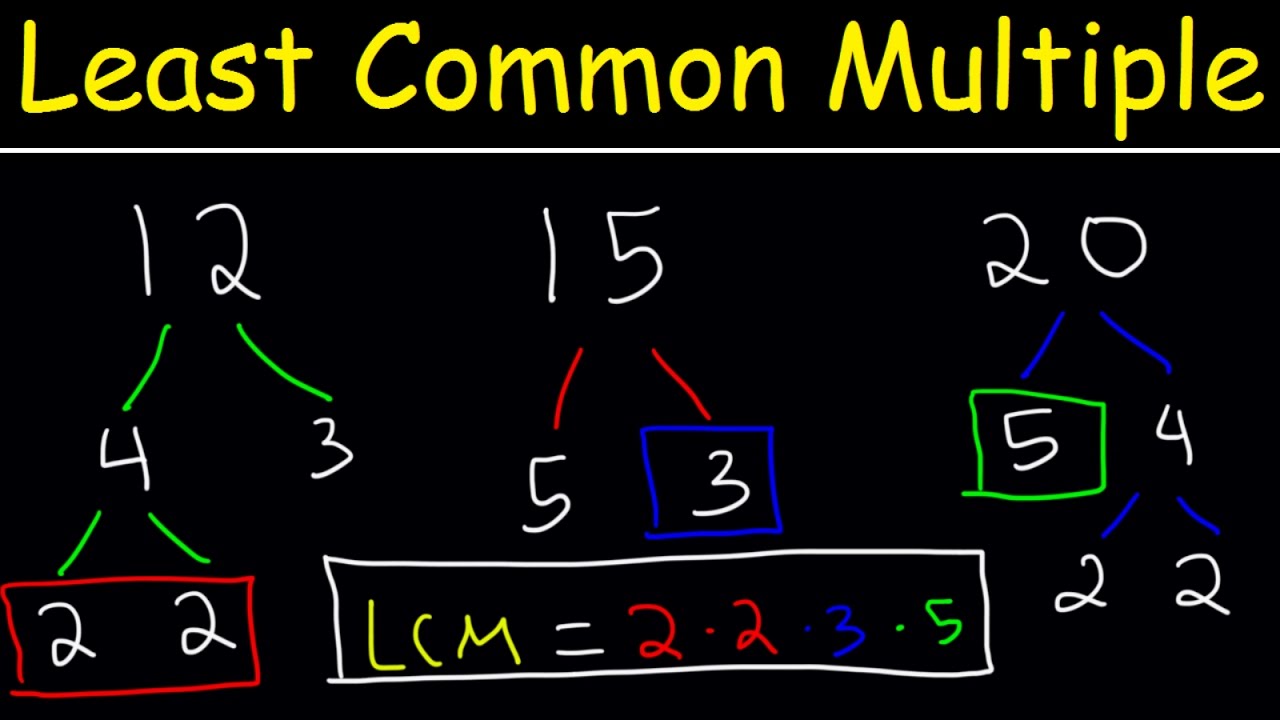
This math video tutorial explains how to find the least common multiple of 3 numbers using prime factorization. It contains plenty of examples and practice problems including finding the LCM of 2, 3 and 4 numbers.
How To Find The LCM Using Excel:
https://www.youtube.com/watch?v=BSLylzxozaA
cedar kilnBOT
@crimson sedge Has your question been resolved?
Channel closed
Closed by @midnight thorn
Use .reopen if this was a mistake.
Available help channel!
Send your question here to claim the channel.
Remember:
• Ask your math question in a clear, concise manner.
• Show your work, and if possible, explain where you are stuck.
• After 15 minutes, feel free to ping <@&286206848099549185>.
• Type the command .close to free the channel when you're done.
• Be polite and have a nice day!
Read #❓how-to-get-help for further information on how to ask a good question, and about conduct in the question channels.
 obtuse heart
 cedar kilnBOT
obtuse heart
cedar kilnBOT
obtuse heart
 drifting marlin
What must be true of a function for it to be a valid probability density function?
(They call it a distribution graph but that's stupid)
obtuse heart
drifting marlin
What must be true of a function for it to be a valid probability density functio...
im new to the topic so is it it cant be negative and the probabilty must be less than 1?
drifting marlin
The first is correct, the second is somewhat vague
What must the area under such a graph be?
obtuse heart
drifting marlin
What must the area under such a graph be?
the probability right?
drifting marlin
The area under the graph is related to probabilities, yes
But I mean the area under the entire curve. It must be equal to a particular number for the curve to model a probability distribution. What number must it be?
obtuse heart
1?
drifting marlin
1
obtuse heart
ahh ok
drifting marlin
Find the value of n that makes the area under that graph 1
drifting marlin
Find the value of 5?
drifting marlin
We aren't finding any probabilities
obtuse heart
oh
drifting marlin
Well I guess indirectly we are, since we're computing area
obtuse heart
so we find the area under 5
then we take 1- the area?
it will become n = 6 right?
obtuse heart
 obtuse heart
drifting marlin
n=6 does sound correct, sure
obtuse heart
drifting marlin
n=6 does sound correct, sure
ok thanks for helping me to understand lol
drifting marlin
No problem, good luck
cedar kilnBOT
@obtuse heart Has your question been resolved?
Channel closed
Closed by @obtuse heart
Use .reopen if this was a mistake.
Available help channel!
Send your question here to claim the channel.
Remember:
• Ask your math question in a clear, concise manner.
• Show your work, and if possible, explain where you are stuck.
• After 15 minutes, feel free to ping <@&286206848099549185>.
• Type the command .close to free the channel when you're done.
• Be polite and have a nice day!
Read #❓how-to-get-help for further information on how to ask a good question, and about conduct in the question channels.
 dense cargo
how is the (3,3) element not -2
 cedar kilnBOT
dense cargo
how is the (3,3) element not -2
cedar kilnBOT
dense cargo
how is the (3,3) element not -2
 royal loom
it very well should be if the operation being performed is what it says it is
so, a mistake was made
dense cargo
alright tysm
cedar kilnBOT
@dense cargo Has your question been resolved?
cedar kilnBOT
Channel closed
Closed due to timeout
Use .reopen if this was a mistake.
Available help channel!
Send your question here to claim the channel.
Remember:
• Ask your math question in a clear, concise manner.
• Show your work, and if possible, explain where you are stuck.
• After 15 minutes, feel free to ping <@&286206848099549185>.
• Type the command .close to free the channel when you're done.
• Be polite and have a nice day!
Read #❓how-to-get-help for further information on how to ask a good question, and about conduct in the question channels.
 vivid forge
Hi, I'm making an incremental game and I need some help with making a function that allows you to buy the max amount of the upgrade that you can afford with the current amount of currency you have. the series is demonstrated in the picture.
 cedar kilnBOT
vivid forge
Hi, I'm making an incremental game and I need some help with making a function t...
crimson delta
cedar kilnBOT
vivid forge
Hi, I'm making an incremental game and I need some help with making a function t...
crimson delta
what is the exponent?
vivid forge
1.3
crimson delta
is performance crucial? otherwise you could just write a for-loop which increments n until it cant anymore
hmm 1.3 is not nice
vivid forge
I have considered that, but I was wondering if there is a slightly more optimal solution, if I can't manage that I'll just have to stick with a for loop
crimson delta
you could probably interpret the sum as a riemann sum to an integral which will give you an approximation of the correct value which will then give you better starting point for the for-loop
not completely sure tho
what do you think will be the average value of n for this function
like a+3 or a+500
in what ballpark
vivid forge
Currently that is a problem the fuction itself doesn't scale fast enough so I need to change the values, as of right now it's on the order of 100 to 1000
I was considering making increments that just caps it at n=100 and n=1000 to make it simpler
 gritty viper
that's a strange price increase system
the more upgrades the user is buying at once, the more accurate an integral will be
so you could do the Riemann sum, then if the upgrade count turns out to be < 100, do a for loop for more accuracy
vivid forge
I see, also do you have a recommendation to change the price increase function perhaps?
crimson delta
exponential price increase system isnt really that strange
gritty viper
if it was ^2, there's a closed form formula for the sum of consecutive squares
gritty viper
crimson delta
exponential price increase system isnt really that strange
Its not really exponential, it's level^1.3
Exponential I would think of as 1.3^level
crimson delta
ah whoops misread. but ok still not strange
gritty viper
maybe if you don't play incrementals it doesn't seem strange
vivid forge
Yeah I see, the idea was the make it more flat so it wouldn't go too fast but I ended up on the oppsite side
crimson delta
well it depends on the rest of the game
gritty viper
there's nothing wrong with it from a game design perspective
crimson delta
if the rest of the game has exponential increases, then yes this is strange
way too slow
vivid forge
Yeah, I had a friend play for a bit and he got to 10^1345
gritty viper
price increase is usually exponential, sometimes linear
vivid forge
which well, would take years
gritty viper
If the upgrade buff is linear, you could get the same effect by making it compounding instead
vivid forge
Yeah I'll rework it a bit that sounds easier than the other workaround
gritty viper
does it give a linear buff to production currently?
vivid forge
Yeah this upgrade itself gives +1 to base value with each upgrade
gritty viper
well one thing you could do is make the power ^1 or ^2 and use closed form
vivid forge
I was thinking of changing most of them to geometric series since that has a summation formula
gritty viper
The other thing you can do (this could preserve the exact power scaling you have now) is make the price increase, say, 2^x, and make the power increase (2^(1/2.3))^x
,w 2^(1/2.3)
wraith daggerBOT


 gritty viper
so if the price doubles every upgrade you want a 35% compounding bonus
power = 1.35^level
vivid forge
Hmmm I see and then it won't ever exceed itself which I had a problem with as well
thanks a bunch for the help, I'll go think about it again and rework a few things
gritty viper
np, incremental game math is always interesting
vivid forge
.close
cedar kilnBOT
Channel closed
Closed by @vivid forge
Use .reopen if this was a mistake.
cedar kilnBOT
Available help channel!
Send your question here to claim the channel.
Remember:
• Ask your math question in a clear, concise manner.
• Show your work, and if possible, explain where you are stuck.
• After 15 minutes, feel free to ping <@&286206848099549185>.
• Type the command .close to free the channel when you're done.
• Be polite and have a nice day!
Read #❓how-to-get-help for further information on how to ask a good question, and about conduct in the question channels.
 half elk
$\lim_{n→\infty}e^{a_n} = e → \lim_{n→\infty}a_n = 1$
wraith daggerBOT
nigrumpapilionem
 half elk
Can I do this for convergence?
slate lintel
e^x is monotonic 
half elk
 red pumice
it works because e^x is continuous
red pumice
it works because e^x is continuous
Isn't deal of sequences is being defined only for natural numbers unlike functions?
red pumice
well yes
i mean to say that
suppose f is a continuous function
then $\lim_{n \to \infty} f(a_n) = f(\lim_{n \to \infty} a_n)$
wraith daggerBOT
heavy0201

 astral bay
...that's true if the limit on the right exists
but ``$\lim_{n\to\infty} f(a_n)$ exists" for $f$ continuous is not enough to conclude that $\lim_{n\to\infty} a_n$ exists
wraith daggerBOT
bee [it/its]
 red pumice
well yes that too
astral bay
i think it does work in the case of e^x but i'm not sure why exactly it's true
red pumice
astral bay
i think it does work in the case of e^x but i'm not sure why exactly it's true
i would guess because inverse exists
ye
slate lintel
inverse maybe needs to not have a cusp as well? not sure
astral bay
ah yeah you can use ln as the continuous function
astral bay
wraith dagger
**heavy0201**
in this
slate lintel
cusp is probably fine, log works and it's not uniformly continuous so
probably okay with a bunch of things
astral bay
$\lim_{n\to\infty} e^{a_n}=e \implies \lim_{n\to\infty} \ln(e^{a_n})=\ln(e) \implies \lim_{n\to\infty} a_n = 1$
wraith daggerBOT
bee [it/its]
 half elk
Does it work for every monotonic and continous function of a_n then?
But inverse of every monotonic function doesn't have to exist, right 
slate lintel
,w define monotonic function
wraith daggerBOT


 Requested by kitten.in.a.teacup#0
slate lintel
Requested by kitten.in.a.teacup#0
slate lintel
eh
i mean 'strictly increasing or strictly decreasing'
cedar kilnBOT
@half elk Has your question been resolved?
half elk
slate lintel
eh
i mean 'strictly increasing or strictly decreasing'
Since monotonic function doesn't rule out f(a) = f(b) for a<b
I meant that
slate lintel
yeah i mean f(x) = 1 is monotonic and continuous
and f(g(x)) -> 1 for any g
but g definitely doesn't always converge
cedar kilnBOT
Channel closed
Closed by @half elk
Use .reopen if this was a mistake.
Available help channel!
Send your question here to claim the channel.
Remember:
• Ask your math question in a clear, concise manner.
• Show your work, and if possible, explain where you are stuck.
• After 15 minutes, feel free to ping <@&286206848099549185>.
• Type the command .close to free the channel when you're done.
• Be polite and have a nice day!
Read #❓how-to-get-help for further information on how to ask a good question, and about conduct in the question channels.
 dreamy marsh
Can someone help me with this
 cedar kilnBOT
dreamy marsh
Can someone help me with this
cedar kilnBOT
dreamy marsh
Can someone help me with this

 livid hound
that's just the aribtrary rule they came up with
which part of their explanation of their setup don't you understand
 muted bear
I feel like this is far too few numbers for you to glom onto an alternating rule
dreamy marsh
livid hound
which part of their explanation of their setup don't you understand
Ah it's ok. I understand now. Ty btw
livid hound
||be psychic||
dreamy marsh
.close
cedar kilnBOT
Channel closed
Closed by @dreamy marsh
Use .reopen if this was a mistake.
Available help channel!
Send your question here to claim the channel.
Remember:
• Ask your math question in a clear, concise manner.
• Show your work, and if possible, explain where you are stuck.
• After 15 minutes, feel free to ping <@&286206848099549185>.
• Type the command .close to free the channel when you're done.
• Be polite and have a nice day!
Read #❓how-to-get-help for further information on how to ask a good question, and about conduct in the question channels.
 thin hedge
 thin hedge
i don't understand how this is factored
how is this factored correctly
how does the negative go to cos x
its at sin x?
crimson sedge
cos(x) - cos(x)sin^2(x) = cos(x)(1 - sin^2(x))
Let a = cos(x) and b = sin(x)
then we have a - ab^2
factoring out a, we have a(1-b^2)
thin hedge
ohhh
i see it
so how did they use the variation
of the pythagorean identity
to get cos^2x
crimson sedge
because $\sin^2(x) = 1 - \cos^2(x)$
wraith daggerBOT
kenfps
 thin hedge
is it j subsituting
crimson sedge
and $\cos^2(x) = 1 - \sin^2(x)$
wraith daggerBOT
kenfps
 crimson sedge
yes
it's just subtituting
these are the two variations of the pythagorean identity
cedar kilnBOT
@thin hedge Has your question been resolved?
cedar kilnBOT
Channel closed
Closed due to timeout
Use .reopen if this was a mistake.
cedar kilnBOT
Available help channel!
Send your question here to claim the channel.
Remember:
• Ask your math question in a clear, concise manner.
• Show your work, and if possible, explain where you are stuck.
• After 15 minutes, feel free to ping <@&286206848099549185>.
• Type the command .close to free the channel when you're done.
• Be polite and have a nice day!
Read #❓how-to-get-help for further information on how to ask a good question, and about conduct in the question channels.
cedar kilnBOT
 ebon grotto
!status
ebon grotto
ebon grotto
!status
ebon grotto
!status
cedar kilnBOT
What step are you on?
1. I don't know where to begin
2. I have begun but got stuck midway
3. I got an answer but I'm told it's wrong
4. I got an answer and would like my work checked
5. I have a question about someone else's worked solution
6. None of the above
what is the question
ebon grotto
Light travels at a speed of 3 x 10⁸ m/s. How far will light travel in the following times.
Give your answer in standard form
a) one hour b) one day c) one week
I want the
urm
working
for c part
scientific notation.
i need,
I wanna know how c part answer is 1.8144 * 10^14
ok
astral bay
(they said 6 "none of the above", not 5)
rotund fox
ebon grotto
I wanna know how c part answer is 1.8144 * 10^14
i think you could do 1 thing which is convert that speed into kmph or meter per hour and then solve it (easier method)
rotund fox
astral bay
(they said 6 "none of the above", not 5)
my bad
ebon grotto
I want working to know how c part is 1.8144 * 10^14 (scientific notation answers).
ebon grotto
rotund fox
i think you could do 1 thing which is convert that speed into kmph or meter per ...
Yeah no not allowed
rotund fox
ebon grotto
Yeah no not allowed
wait what
rotund fox
ebon grotto
Yeah no not allowed
in that case approximately convert week into seconds using scientific notations
rotund fox
ebon grotto
i need to convert day to week
1/7?
ebon grotto
question : 3x10^8x60x60x7x24
rotund fox
ebon grotto
question : 3x10^8x60x60x7x24
yep
ebon grotto
in scientific notation
rotund fox
take the 100 out, multply that 100 with 10^8 to get 10^10
ebon grotto
no understand
rotund fox
ebon grotto
no understand
604800 = 6048 x 100
= 3 x 10^8 x 10^2 x 6048
= 3 x 6048 x 10^10
ebon grotto
no
rotund fox
yes
rotund fox
ebon grotto
ty
type .close if problem solved
cedar kilnBOT
Channel closed
Closed by @ebon grotto
Use .reopen if this was a mistake.
Available help channel!
Send your question here to claim the channel.
Remember:
• Ask your math question in a clear, concise manner.
• Show your work, and if possible, explain where you are stuck.
• After 15 minutes, feel free to ping <@&286206848099549185>.
• Type the command .close to free the channel when you're done.
• Be polite and have a nice day!
Read #❓how-to-get-help for further information on how to ask a good question, and about conduct in the question channels.
tulip harness
Consider the system of differential equations $x'(t)=Ax(t)$ with an initial value $x(0)=x_0 \neq 0$, where $A=\begin{pmatrix}
0 & 1\
-1 & 0
\end{pmatrix}$\
Analyse the behavior of the solutions obtained from the following approximation:\
$x_{n+1} = x_n + hA(x_n + x_{n+1})$, where $h> 0$
cedar kilnBOT
tulip harness
Consider the system of differential equations $x'(t)=Ax(t)$ with an initial valu...
wraith daggerBOT
casiel368
 tulip harness
Okay so this exercise asked me to use Euler's method and implicit Euler before doing that and the norm of x goes to infinity or zero
I did prove that, and now I have to look at this new method
wraith daggerBOT
casiel368
 tulip harness
All of B eigenvalues have norm of 1
My intuition is that the DE describes the circular movement, because speed will always be a 90° rotation of the position vector, so using Euler or implicit Euler will over/undershoot the actual solution, but somehow the sum of both will be right on point, as shown by the fact that B is a rotation
The thing is, how do I finish this? What should I do next?
<@&286206848099549185>
cedar kilnBOT
@tulip harness Has your question been resolved?
cedar kilnBOT
@tulip harness Has your question been resolved?
cedar kilnBOT
@tulip harness Has your question been resolved?
tulip harness
<@&286206848099549185>
tulip harness
<@&286206848099549185>
cedar kilnBOT
@tulip harness Has your question been resolved?
cedar kilnBOT
Channel closed
Closed by @tulip harness
Use .reopen if this was a mistake.
cedar kilnBOT
Available help channel!
Send your question here to claim the channel.
Remember:
• Ask your math question in a clear, concise manner.
• Show your work, and if possible, explain where you are stuck.
• After 15 minutes, feel free to ping <@&286206848099549185>.
• Type the command .close to free the channel when you're done.
• Be polite and have a nice day!
Read #❓how-to-get-help for further information on how to ask a good question, and about conduct in the question channels.
 granite shuttle
 cedar kilnBOT
granite shuttle
granite shuttle
cedar kilnBOT
granite shuttle
granite shuttle
Hello I don't understand how to start this
am i adding -3 to 7 and ending with 4 as my first number
and -8 to 2i

am i just going to repeat this process on the -50
and then add the non square roots
 obsidian coral
granite shuttle
am i just going to repeat this process on the -50
obsidian coral
granite shuttle
am i just going to repeat this process on the -50
Yes
obsidian coral
granite shuttle
and then add the non square roots
Yes
granite shuttle
is there a formula i can follow for this that would make it easier to remember
obsidian coral
Not really, it's just adding/subtracting like terms
granite shuttle

wait oops
i didnt mean to put the negative on the 2i
is this right other than that
obsidian coral
granite shuttle
Is the i under the root?
obsidian coral
No it's not
granite shuttle
so then its just (a+bi)+(c+di)=(a+c)+(b+di)i
obsidian coral
Yes
granite shuttle
is it ok if i use the plus minus symbol
as i do it
wait no thats wrong
to do

i wanted to do this but i realized its done
obsidian coral
granite shuttle
Yes that plus/minus is wrong
 obsidian coral
Yes
granite shuttle
thank you
i have a test im gonna take in an hour and im allowed to use like post it notes
do you think it would be a good idea to write these down
 obsidian coral
Depends on what you know and don't know
granite shuttle
this is my first day with the material so i havent had much experience with it
im learning as i go
right now
cedar kilnBOT
@granite shuttle Has your question been resolved?
cedar kilnBOT
Channel closed
Closed by @granite shuttle
Use .reopen if this was a mistake.
cedar kilnBOT
Available help channel!
Send your question here to claim the channel.
Remember:
• Ask your math question in a clear, concise manner.
• Show your work, and if possible, explain where you are stuck.
• After 15 minutes, feel free to ping <@&286206848099549185>.
• Type the command .close to free the channel when you're done.
• Be polite and have a nice day!
Read #❓how-to-get-help for further information on how to ask a good question, and about conduct in the question channels.
 heady mountain
Find the area bounded by $r=7cos6\theta$
I have the integral $12 * 0.5 \int_{pi/12}^{3pi/12} (7cos6\theta)^{2} d\theta$ but I think this is wrong.
cedar kilnBOT
heady mountain
Find the area bounded by $r=7cos6\theta$
I have the integral $12 * 0.5 \int_{pi/...
heady mountain
bounds are from when cos6theta =0 so 3pi/2 and pi/2 divided by 6
wraith daggerBOT
kenny.xie
 cedar kilnBOT
@heady mountain Has your question been resolved?
heady mountain
<@&286206848099549185>
Ok so my “saved” answer in the software is the evaluation of this integral which got marked for credit
but the “solution” is 49pi/12
my integral evaluates to 49pi/2
.close
cedar kilnBOT
Channel closed
Closed by @heady mountain
Use .reopen if this was a mistake.
cedar kilnBOT
Available help channel!
Send your question here to claim the channel.
Remember:
• Ask your math question in a clear, concise manner.
• Show your work, and if possible, explain where you are stuck.
• After 15 minutes, feel free to ping <@&286206848099549185>.
• Type the command .close to free the channel when you're done.
• Be polite and have a nice day!
Read #❓how-to-get-help for further information on how to ask a good question, and about conduct in the question channels.
 azure stirrup
does anyone know how to do 7c and explain 11c

 cedar kilnBOT
azure stirrup
does anyone know how to do 7c and explain 11c
azure stirrup
cedar kilnBOT
azure stirrup
does anyone know how to do 7c and explain 11c
azure stirrup
i got this for 7a and b
 crimson sedge
ok
azure stirrup
when it asks for to sketch the curve is it the original curve or the differentiated equation
<@&286206848099549185>
cedar kilnBOT
@azure stirrup Has your question been resolved?
azure stirrup
<@&286206848099549185>
 tame heart
prob g(x)
azure stirrup
what abt the tangents
tame heart
all the tangents at those points youve found in part b ig
 tame heart
nah i think you have to draw all the tangents at those specific points
azure stirrup
wdym all the tangents
crimson sedge
the tangents at those points, you have to draw them
azure stirrup
like a line…?
 crimson sedge
yea but drawn to scale
azure stirrup
crimson sedge
Do you know what a tangent is
a straight line that touches the curve
crimson sedge
do you know how to write it's equation
azure stirrup
altho i’m not sure whether tje line is suppose to pass thru the curve like at 0,0 or 5,0
is that right?
azure stirrup
crimson sedge
do you know how to write it's equation
not too sure
crimson sedge
so at a point on the curve from where the tangent is draw, the slope of the curve at that point and the slope of the tangent will be the same
That's why it is a tangent
azure stirrup
icic
crimson sedge
so you know 2 things the slope at that point on the curve and you know the point where the tangent will touch it,
So you've got a point and the slope and you can write the equation of that line using that which is the tangent
crimson sedge
that's not the slope that is g'(x) but when you put a specific x-coordinate in it, it will tell you the slope at that point
azure stirrup
are the specific x-coordinates the coordinates from 7b?
crimson sedge
Yes
crimson sedge
no you solved for those slopes which were already given to find the points
You already know them, they are given in the question
no need to solve for them again lol
azure stirrup
crimson sedge
You already know them, they are given in the question
ohh the 1, -1 , 5 ,-5 and 0?
azure stirrup
and thats the gradient and i found the points so i put it into a formula