#help-10
1 messages · Page 593 of 1
 obtuse pebbleBOT
 bold bane
So the general form of the tangent function is
$f(x) = A \cdot \tan{( \frac{2\pi}{P}(x - H))} + V$
It looks like you already figured out what P is.
That leaves A, H, and V.
By observation, the graph appears to "turn" at (-0.75, 5).
 little shuttle
i have to turn it in in 3 mins lol, no rush
bold bane
$f(x) = A \cdot \tan{\left( \frac{\pi}{3}(x + 0.75)\right)} + 5$
 warm shaleBOT
Kookiemon
 bold bane
Now you just need to solve for the amplitude.
You know that at x=0, f(0) = 2.
Doing the math, A = -3.
little shuttle
agreed
bold bane
$-3 \cdot \tan{\left( \frac{\pi}{3}(x + 0.75)\right) + 5$
warm shaleBOT
Kookiemon
$-3 \cdot \tan{\left( \frac{\pi}{3}(x + 0.75)\right) + 5$
```Compilation error:```! Missing } inserted.
<inserted text>
}
l.56 ...\left( \frac{\pi}{3}(x + 0.75)\right) + 5$
I've inserted something that you may have forgotten.
(See the <inserted text> above.)
With luck, this will get me unwedged. But if you
really didn't forget anything, try typing `2' now; then
my insertion and my current dilemma will both disappear.``` bold bane
@molten holly -4.
little shuttle
-(2)^2 or (-2)^2
little shuttle
bold bane
$-3 \cdot \tan{\left( \frac{\pi}{3}(x + 0.75)\right) + 5$
thank you kookie!!
warm shaleBOT
Kookiemon
 bold bane
That should have been 2pi/p, not pi/p.
little shuttle
ah got it
 little shuttle
you were a big help, thank you for replying
bold bane
yw
little shuttle
.close
obtuse pebbleBOT
Channel closed
Closed by @little shuttle
Use .reopen if this was a mistake.
Please take a minute to participate in [our survey](#changelog message) if you haven't already!
 Available help channel!
Send your question here to claim the channel.
Remember:
• Ask your math question in a clear, concise manner.
• Show your work, and if possible, explain where you are stuck.
• After 15 minutes, feel free to ping <@&286206848099549185>.
• Type the command .close to free the channel when you're done.
• Be polite and have a nice day!
Read #❓how-to-get-help for further information on how to ask a good question, and about conduct in the question channels.
 dapper pumice
 obtuse pebbleBOT
dapper pumice
https://cdn.discordapp.com/attachments/486844829209198613/998435613432872980/IMG...
obtuse pebbleBOT
dapper pumice
https://cdn.discordapp.com/attachments/486844829209198613/998435613432872980/IMG...
Please don't occupy multiple help channels.
 past fog
dapper pumice
past fog
dapper pumice
no
no one is responding
is it that hard?
@past fog
<@&286206848099549185> can anyone please help me?
obtuse pebbleBOT
@dapper pumice Has your question been resolved?
bold bane
What does it mean for f(x) to be less than or equal to zero?
bold bane
f(x) = y
(f(x) = y) <= 0
y <= 0
That means the intervals you are looking for are where the function is at or below the x-axis.
obtuse pebbleBOT
Channel closed
Closed due to timeout
Use .reopen if this was a mistake.
Please take a minute to participate in [our survey](#changelog message) if you haven't already!
dapper pumice
.reopen
obtuse pebbleBOT
✅
dapper pumice
bold bane
That means the intervals you are looking for are where the function is at or bel...
do you know how to do it?
 bold bane
So there are three intervals.
The first one is (-∞, -3].
Do you understand why the left-side of that interval is -∞?
bold bane
Well, even though f(x) goes to -∞, the domain also goes infinitely far to the left.
 dapper pumice
so the next is (-3,-1]?
bold bane
Which is why the question gave you the instruction to indicate a point as [a,a].
dapper pumice
or (-oo,-1]
bold bane
No, notice the gray part of the graph is above the x-axis which means that f(x) > 0 along that interval.
From (-3, -1), the graph of f(x) is above the x-axis.
So far part C, you are not interested in that interval.
bold bane
No.

The colors will better illustrate what f(x) <= 0 means.
You are looking for the intervals of f(x) that are contained in the green part of the graph.
Which also contains the point at x = -1.
That is just a singular point that touches the x-axis at x=-1.
And the question states to indicate a singular point, write the interval as [a,a].
In this case, a = -1.
You still there?
obtuse pebbleBOT
@dapper pumice Has your question been resolved?
bold bane
When the question asks you for the interval, it is asking about the values of x.
bold bane
Did you ever learn about when a function bounces off of the x-axis, it has a linear root to some even power?
eg. (x + 1)^2n

If you look at the green and red lines, they indicate the values of x for which the condition f(x) <= 0 is true.
It's not specifically stated, you have to infer from the graph, that it touches the x-axis at (-1, 0).
obtuse pebbleBOT
Channel closed
Closed due to timeout
Use .reopen if this was a mistake.
Please take a minute to participate in [our survey](#changelog message) if you haven't already!
Available help channel!
Send your question here to claim the channel.
Remember:
• Ask your math question in a clear, concise manner.
• Show your work, and if possible, explain where you are stuck.
• After 15 minutes, feel free to ping <@&286206848099549185>.
• Type the command .close to free the channel when you're done.
• Be polite and have a nice day!
Read #❓how-to-get-help for further information on how to ask a good question, and about conduct in the question channels.
 severe dune
 obtuse pebbleBOT
severe dune
obtuse pebbleBOT
obtuse pebbleBOT
severe dune
obtuse pebbleBOT
@severe dune Has your question been resolved?
severe dune
<@&286206848099549185>
 tardy epoch

Mathematics Stack Exchange
Let $a,b,m \in \mathbb{Z}$. I want to prove: $$gcd(a,b) = gcd(a,b+ma)$$
First part: Let $c \in \mathbb{N}$ be the gcd of $a$ and $b$.
It's not hard to prove that $c$ is a divisor of $b+ma$.
Now ...
severe dune
.close
obtuse pebbleBOT
Channel closed
Closed by @severe dune
Use .reopen if this was a mistake.
Please take a minute to participate in [our survey](#changelog message) if you haven't already!
obtuse pebbleBOT
Available help channel!
Send your question here to claim the channel.
Remember:
• Ask your math question in a clear, concise manner.
• Show your work, and if possible, explain where you are stuck.
• After 15 minutes, feel free to ping <@&286206848099549185>.
• Type the command .close to free the channel when you're done.
• Be polite and have a nice day!
Read #❓how-to-get-help for further information on how to ask a good question, and about conduct in the question channels.
 proven zephyr
7x -10 < 4 + 5x < -6 + 10x
obtuse pebbleBOT
proven zephyr
7x -10 < 4 + 5x < -6 + 10x
 harsh remnant
?
 royal basin
this is two inequalities in a trenchcoat
proven zephyr
(not my work, this is someone's question)
 harsh remnant
It's simplification
proven zephyr
ye, im kinda stuck on how to do it
royal basin
this is two inequalities in a trenchcoat
proven zephyr
so.. i seperate them and do them one by one?
royal basin
solve 7x-10<4+5x
solve 4+5x<-6+10x
take intersection of resulting solution sets
obtuse pebbleBOT
Channel closed
Closed by @proven zephyr
Use .reopen if this was a mistake.
Please take a minute to participate in [our survey](#changelog message) if you haven't already!
Available help channel!
Send your question here to claim the channel.
Remember:
• Ask your math question in a clear, concise manner.
• Show your work, and if possible, explain where you are stuck.
• After 15 minutes, feel free to ping <@&286206848099549185>.
• Type the command .close to free the channel when you're done.
• Be polite and have a nice day!
Read #❓how-to-get-help for further information on how to ask a good question, and about conduct in the question channels.
 little forum
I need to find the inital velocity of a projectile with only the time and displacement.
obtuse pebbleBOT
little forum
I need to find the inital velocity of a projectile with only the time and displa...
little forum
I'm pretty sure I have to use a calculus approach.
I'll upload a photo of what I've tried so far

The displacement is 66.2 metres
The time is 2.83 seconds
<@&286206848099549185>
obtuse pebbleBOT
@little forum Has your question been resolved?
 quaint minnow
from the picture i’m guessing there’s no vertical displacement?
little forum
No
The only values I have are displacement, Time and acceleration in the y-axis
(We use -10 for grav)
little forum
Yes, that too
quaint minnow
ok
little forum
All results are from level ground
quaint minnow
well what do you know about how the horizontal component of the velocity changes?
quaint minnow
yup so just looking at how the projectile is travelling in the horizontal direction
it travels 66.2 m in 2.83 s
at a constant velocity
so the horizontal component is what?
(of the initial velocity)
little forum
The inital velocity is what i'm trying to find, I have neither horizontal nor vertical.
quaint minnow
quaint minnow
it travels 66.2 m in 2.83 s
no i’m asking you to calculate it; these two numbers are enough
little forum
I've got Vcos for the x component and -10t+Vsin for the y component
Oh, is it just 23.4 m.s?
quaint minnow
yeah that’s the horizontal component
little forum
Oh ok, didn't recognise that, that's on me
quaint minnow
ok now you have yo find the y component
we have the equation
v_y = v_y0 + gt
(v_y0 is the initial y component)
we know that v_y=0 when t = 2.83/2 s
since that’s halfway
so you can find v_y0!
little forum
So since y = o (because we know that v_y=0 when t = 2.83/2 s), so therefore gt is just, -10*2.83 = -28.3
Or am I jumping the gun
quaint minnow
well yes gt is -28.3
but plug numbers into the equation and solve for what we want—the initial y component
oh wait i’m sorry
little forum
v_y = v_y0 + gt
v_y = 0 + -10**2.83/2*
v_y = -14.15
quaint minnow
ope nvm you got it
little forum
No no you're all good. I see where I went wrong.
Yeah aha
I'm just a little sleepy aha
quaint minnow
oh you plugged it in a little wrong
little forum
So now I can find the inital velocity! (Using Pythagoras)
Was it the negative result?
quaint minnow
v_y = v_y0 + gt
0 = v_y0 + -10*2.83/2
0 = v_y0 - 14.15
14.15 = v_y0
you plugged in 0 for v_y0 instead of v_y
little forum
ohhhhhh I seeeeee
Oh that makes SO much more sense, The negative result really confused me
Thank you so much!
quaint minnow
yup no problem!
little forum
little forum
So now I can find the inital velocity! (Using Pythagoras)
NOW! We can find the inital velocity!
You're awesome! I was going crazy just waiting, Enjoy your day/night!
.close
obtuse pebbleBOT
Channel closed
Closed by @little forum
Use .reopen if this was a mistake.
Please take a minute to participate in [our survey](#changelog message) if you haven't already!
Available help channel!
Send your question here to claim the channel.
Remember:
• Ask your math question in a clear, concise manner.
• Show your work, and if possible, explain where you are stuck.
• After 15 minutes, feel free to ping <@&286206848099549185>.
• Type the command .close to free the channel when you're done.
• Be polite and have a nice day!
Read #❓how-to-get-help for further information on how to ask a good question, and about conduct in the question channels.
 timid silo
 obtuse pebbleBOT
timid silo
obtuse pebbleBOT
timid silo
 rigid pine
I'd try using an integrating factor.
obtuse pebbleBOT
@timid silo Has your question been resolved?
Channel closed
Closed by @eternal condor
Use .reopen if this was a mistake.
Please take a minute to participate in [our survey](#changelog message) if you haven't already!
obtuse pebbleBOT
Available help channel!
Send your question here to claim the channel.
Remember:
• Ask your math question in a clear, concise manner.
• Show your work, and if possible, explain where you are stuck.
• After 15 minutes, feel free to ping <@&286206848099549185>.
• Type the command .close to free the channel when you're done.
• Be polite and have a nice day!
Read #❓how-to-get-help for further information on how to ask a good question, and about conduct in the question channels.
 fervent girder
can someone help me explain the solution?
 obtuse pebbleBOT
fervent girder
can someone help me explain the solution?
fervent girder
obtuse pebbleBOT
fervent girder
can someone help me explain the solution?
fervent girder
I don't get how 10 integrate (x cos(3cos x^2) e^x^2) dx was found
timid silo
THere is a method called integration by parts
fervent girder
yup
wait lemme send my working

I only understood the solution till here

ohhh nvm I got it@timid silo
sorry, that was a silly qn
.close
obtuse pebbleBOT
Channel closed
Closed by @fervent girder
Use .reopen if this was a mistake.
Please take a minute to participate in [our survey](#changelog message) if you haven't already!
obtuse pebbleBOT
Available help channel!
Send your question here to claim the channel.
Remember:
• Ask your math question in a clear, concise manner.
• Show your work, and if possible, explain where you are stuck.
• After 15 minutes, feel free to ping <@&286206848099549185>.
• Type the command .close to free the channel when you're done.
• Be polite and have a nice day!
Read #❓how-to-get-help for further information on how to ask a good question, and about conduct in the question channels.
 next ravine
 obtuse pebbleBOT
next ravine
next ravine
obtuse pebbleBOT
next ravine
next ravine
Any idea how to solve these sort of questions?
royal basin
this is a linear equation
proven zephyr
try to isolate the x
 proven zephyr
that's not how yoou divide by p...
next ravine
Crap...is it because the other p is p^2?
next ravine
do I need to subtract it?
next ravine
do I need to expand 2p(jutst checking)
proven zephyr
ye (i thought the brackets)
next ravine
cuz then we have p^2 on both sides
warm shaleBOT
MarveI
 proven zephyr
try to isolate the p x's
 proven zephyr
nah
next ravine
ok
proven zephyr
kinda, but doesnt affect what we're doing rn
ok so anyways..
you -px both sides first
aand then -2 both sides
warm shaleBOT
MarveI
 proven zephyr
after that you just factor the x
warm shaleBOT
MarveI
 proven zephyr
still following so far?
next ravine
yeah o.O
proven zephyr
now just divide both sides by p^2 - p
warm shaleBOT
MarveI
 proven zephyr
simplify this
next ravine
A bit confused there
proven zephyr
factor 2 and p
next ravine
one moment to try to walk myself through it again
warm shaleBOT
MarveI
 proven zephyr
x = 2/p
 long peak
proven zephyr
now just divide both sides by p^2 - p
long peak
proven zephyr
now just divide both sides by p^2 - p
(small note: this is where you use p!=0 and p!=1 to make sure you're not dividing by 0)
proven zephyr
long peak
(small note: this is where you use p!=0 and p!=1 to make sure you're not dividin...
ok
next ravine

Thanks for the note Tom !!
Okay so this is where I got my brain around
but I am a bit confused what you did on the last step
proven zephyr
oh
i factorized the numerator and denominator
have you learned factorizing btw
just to make sure
next ravine
To some extend I do remember most of the part. 3-4 years ago
proven zephyr
ok good
next ravine
Okkayy
proven zephyr
so i factored p
next ravine
I misread it
proven zephyr
and get p
proven zephyr
np
 proven zephyr
ok so

if p = 1
the bottom will be 1(1 - 1)
which is 0
so you'll be dividing by 0
which is... undefined
or undetermined as a some might say
the same with 0
it will be 0(0 - 1) which is 0
next ravine
okayy, does it serve a purpose or is it there just to trick me ?
well not trick but to make me think its harder than it actually is
proven zephyr
np
next ravine
.close
obtuse pebbleBOT
Channel closed
Closed by @next ravine
Use .reopen if this was a mistake.
Please take a minute to participate in [our survey](#changelog message) if you haven't already!
Available help channel!
Send your question here to claim the channel.
Remember:
• Ask your math question in a clear, concise manner.
• Show your work, and if possible, explain where you are stuck.
• After 15 minutes, feel free to ping <@&286206848099549185>.
• Type the command .close to free the channel when you're done.
• Be polite and have a nice day!
Read #❓how-to-get-help for further information on how to ask a good question, and about conduct in the question channels.
 polar apex
Honestly not sure about this question and would like some help please
 proven zephyr
how did you get 36 d..
polar apex
Uhh pretty sure I subtracted 18 from 54 I don’t think that’s right though
warm shaleBOT
MarveI
 polar apex
Ok
 nocturne minnow
polar apex
Honestly not sure about this question and would like some help please
nocturne minnow
polar apex
Honestly not sure about this question and would like some help please
Given the 2 values, you can use the given formula, create two equations, then solve for d and t0
$t_n = t_0 + (n-1)d$
That's the given formula, you know $t_4 = 18$ and $t_{16} = 54$
warm shaleBOT
dldh06
 polar apex
Would 54=18+(16-1)d be one of the equations
warm shaleBOT
dldh06
 nocturne minnow
polar apex
Would 54=18+(16-1)d be one of the equations
nocturne minnow
polar apex
Would 54=18+(16-1)d be one of the equations
Still no
polar apex
It means it’s the 4th term in the sequence
nocturne minnow
Meaning n = 4, correct?
proven zephyr
polar apex
Isn’t n the term you are trying to determine?
no, we're trying to determine d
nocturne minnow
And t0
polar apex
proven zephyr
no, we're trying to determine d
Ohh
nocturne minnow
So with $t_4 = 18$, how can you plug in those values into $t_n = t_0 + (n-1)d$?
warm shaleBOT
dldh06
 polar apex
18=t0+(4-1)d?
warm shaleBOT
dldh06
 polar apex
54=t0+(16-1)d
nocturne minnow
18=t0+(4-1)d
54=t0+(16-1)d
You have 2 equations, 2 unknowns, you can find d and t0
polar apex
Yeah
nocturne minnow
Can you do that?
nocturne minnow
Sure, do whatever method you need to, to find d and t0
polar apex
How would you solve for t0?
nocturne minnow
Did you find d?
polar apex
18?
nocturne minnow
Not quite
18=t0+(4-1)d
54=t0+(16-1)d
Simplifies to
18=t0+(3)d
54=t0+(15)d
What do you get when you subtract the two?
polar apex
I wait I see what I did wrong d should be 3
polar apex
t0= 9
warm shaleBOT
dldh06
 nocturne minnow
Then find $t_{10}$
warm shaleBOT
dldh06
 polar apex
t10=9+(10-1)3 ?
nocturne minnow
Yes
polar apex
Okie thank you so much for taking the time to help me!
obtuse pebbleBOT
@polar apex Has your question been resolved?
Channel closed
Closed by @polar apex
Use .reopen if this was a mistake.
Please take a minute to participate in [our survey](#changelog message) if you haven't already!
Available help channel!
Send your question here to claim the channel.
Remember:
• Ask your math question in a clear, concise manner.
• Show your work, and if possible, explain where you are stuck.
• After 15 minutes, feel free to ping <@&286206848099549185>.
• Type the command .close to free the channel when you're done.
• Be polite and have a nice day!
Read #❓how-to-get-help for further information on how to ask a good question, and about conduct in the question channels.
 celest pulsar
how do I solve this?
 obtuse pebbleBOT
celest pulsar
how do I solve this?
obtuse pebbleBOT
celest pulsar
how do I solve this?
@celest pulsar Has your question been resolved?
tardy epoch
celest pulsar
how do I solve this?
Were you taught derivatives yet
celest pulsar
tardy epoch
Were you taught derivatives yet
no
tardy epoch
What about vertex of a parabola
R is an upside down parabola so there are formulas for its vertex.
celest pulsar
tardy epoch
What about vertex of a parabola
yes
obtuse pebbleBOT
@celest pulsar Has your question been resolved?
obtuse pebbleBOT
Channel closed
Closed due to timeout
Use .reopen if this was a mistake.
Please take a minute to participate in [our survey](#changelog message) if you haven't already!
Available help channel!
Send your question here to claim the channel.
Remember:
• Ask your math question in a clear, concise manner.
• Show your work, and if possible, explain where you are stuck.
• After 15 minutes, feel free to ping <@&286206848099549185>.
• Type the command .close to free the channel when you're done.
• Be polite and have a nice day!
Read #❓how-to-get-help for further information on how to ask a good question, and about conduct in the question channels.
 supple epoch
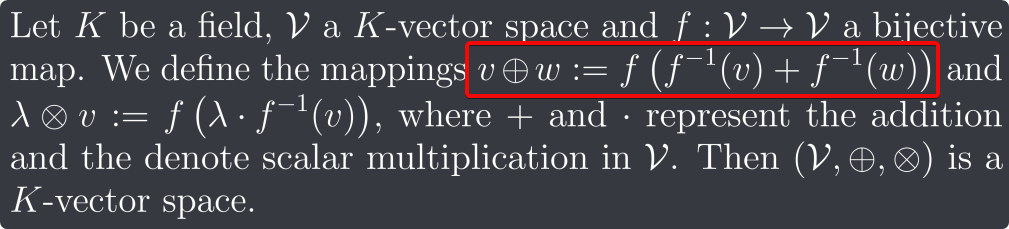
Let $K$ be a field, $\mathcal{V}$ a $K$-vector space and $f: \mathcal{V} \rightarrow \mathcal{V}$ a bijective map. We define the mappings $v \oplus w:=f\left(f^{-1}(v)+f^{-1}(w)\right)$ and $\lambda \otimes v:=f\left(\lambda \cdot f^{-1}(v)\right)$, where $+$ and $\cdot$ represent the addition and the denote scalar multiplication in $\mathcal{V}$. Then $(\mathcal{V}, \oplus, \otimes)$ is a $K$-vector space.
obtuse pebbleBOT
supple epoch
Let $K$ be a field, $\mathcal{V}$ a $K$-vector space and $f: \mathcal{V} \righta...
supple epoch
yes, let me correct myself
warm shaleBOT
Levens

 warm canopy
There are some vector spaces axioms you must check, have you tried checking any of them?
supple epoch
ok let me try and list the axioms
$$
- : \mathcal{V} \times \mathcal{V} \rightarrow \mathcal{V},; ; ; (v, w) \mapsto v + w, \textit{(Addition)}
$$
$$
\cdot : K \times \mathcal{V} \rightarrow \mathcal{V},; ; ; (\lambda, v) \mapsto \lambda \cdot v, \textit{(scalar multiplication)}
$$
and these rules:\
\
(1) (\mathcal{V}, +) is a commutative group.\
(2) For all $v, w \in R$ and $\lambda, \mu \in K$ the following applies:\
\
(a) $\lambda \cdot (\mu \cdot v) = (\lambda \mu) \cdot v$.\
(b) $1 \times v = v$.\
(c) $\lambda \cdot (v + w) = \lambda \cdot v + \lambda \cdot w$.\
(d) $(\lambda + \mu) \cdot v = \lambda \cdot v + \mu \cdot v$.\
warm shaleBOT
Levens
Compile Error! Click the  reaction for more information.
(You may edit your message to recompile.)

 kind hawk
so as one of the axioms we have to proof that $(u\oplus v)\oplus w = u\oplus (v\oplus w)$
warm shaleBOT
Denascite
 kind hawk
using the definition of \oplus, what does this mean
kind hawk
just substitute the definition of oplus into that equation
obtuse pebbleBOT
@supple epoch Has your question been resolved?
supple epoch
kind hawk
just substitute the definition of oplus into that equation
could u send me a link of a formal definition of oplus? im kind of stuck
 warm shaleBOT
Levens
 kind hawk
and now replace the other three \oplus aswell
supple epoch
kind hawk
and now replace the other three \oplus aswell
wait what how
kind hawk
in the same way
supple epoch
oh
kind hawk
to replace v \oplus w you substituted v and w into the definition of \oplus
kind hawk
and now do the same first with u and v. then the result of that and w. and on the RHS u and what you got from v \oplus w
supple epoch
$(f(f^{-1}(u) + f^{-1}(v)))\oplus w = u\oplus (f(f^{-1}(v) + f^{-1}(w)))$
warm shaleBOT
Levens
 supple epoch
$f(f^{-1}((f(f^{-1}(u) + f^{-1}(v)))) + f^{1}(w)) = u\oplus (f(f^{-1}(v) + f^{-1}(w)))$
warm shaleBOT
Levens
 supple epoch
$f(f^{-1}((f(f^{-1}(u) + f^{-1}(v)))) + f^{1}(w)) = f(f^{-1}(u) + f^{-1}((f(f^{-1}(v) + f^{-1}(w)))$
warm shaleBOT
Levens
 supple epoch
Like that?
kind hawk
not super sure with all the brackets but it should look something like that, yeah
and now use that f^-1 is the inverse of f
supple epoch
kind hawk
and now use that f^-1 is the inverse of f
how can that be used
kind hawk
it means that $f(f^{-1}(x))=x$
warm shaleBOT
Denascite
 kind hawk
and so it simplifies some stuff
supple epoch
oh okay
damn this is really confusing with latex, let me do it on paper
but at the end i imagine, you'd get something like this: u + v + w = u + v + w, right?
kind hawk
no it doesn't cancel that far
supple epoch
oh oksy
$f\left(f\left(f^{-1}(u)+f^{-1}(v)\right)+f^{-1}(w)\right)=f\left(f^{-1}(u)+f^{-1}\left(f\left(f^{-1}(v)+f^{-1}(w)\right)\right)\right)$
warm shaleBOT
Levens
 supple epoch
kind hawk
no it doesn't cancel that far
supple epoch
kind hawk
no it doesn't cancel that far
is it f(u + v) + w = u + v + w
supple epoch
Damn it
Oh yeah
There’s another f^-1 I missed
$f\left(f^{-1}(f\left(f^{-1}(u)+f^{-1}(v)\right))+f^{-1}(w)\right)=f\left(f^{-1}(u)+ f^{-1}(v)+f^{-1}(w)\right)\right)\right)$
warm shaleBOT
Levens
Compile Error! Click the reaction for more information.
(You may edit your message to recompile.)
 supple epoch
kind hawk
you can simplifiy the RHS one step further. and I think you messed up your LHS
supple epoch
kind hawk
you can simplifiy the RHS one step further. and I think you messed up your LHS
Like this?
kind hawk
you can also simplify the LHS one step further
supple epoch
kind hawk
you can also simplify the LHS one step further
$f\left(f^{-1}(u)+f^{-1}(v)\right)+f^{-1}(w)=f\left(f^{-1}(u)+ f^{-1}(v)+f^{-1}(w)\right)\right)\right)$
warm shaleBOT
Levens
Compile Error! Click the reaction for more information.
(You may edit your message to recompile.)
 supple epoch
After that, I have to do that same with multiplication, right
kind hawk
well not the same but something similar
supple epoch
kind hawk
so as one of the axioms we have to proof that $(u\oplus v)\oplus w = u\oplus (v\...
What’s the axiom I’d use for scalar multplicstipn?
kind hawk
well you have to prove 4 different ones
also we are not done yet in showing that (V, \oplus) is a commutative group
so far we have only shown that \oplus is associative
or well we stopped one step before that
obtuse pebbleBOT
@supple epoch Has your question been resolved?
obtuse pebbleBOT
@supple epoch Has your question been resolved?
supple epoch
.close
obtuse pebbleBOT
Channel closed
Closed by @supple epoch
Use .reopen if this was a mistake.
Please take a minute to participate in [our survey](#changelog message) if you haven't already!
Available help channel!
Send your question here to claim the channel.
Remember:
• Ask your math question in a clear, concise manner.
• Show your work, and if possible, explain where you are stuck.
• After 15 minutes, feel free to ping <@&286206848099549185>.
• Type the command .close to free the channel when you're done.
• Be polite and have a nice day!
Read #❓how-to-get-help for further information on how to ask a good question, and about conduct in the question channels.
 rain quest
Im trying to find the formula for getting the total amount after 365 days. If you recieve 500 on day 1 and every day lowers by 1.36, day 2 you get 498.6, so on day 365 you will get 1. Whats the total of all the days combined? I thought it might be as simple as taking the avg # of all the days, 250 and multiplying by 365 = 91250 is this right?
obtuse pebbleBOT
rain quest
Im trying to find the formula for getting the total amount after 365 days. If yo...
 heavy thicket
rain quest
Im trying to find the formula for getting the total amount after 365 days. If yo...
heavy thicket
rain quest
Im trying to find the formula for getting the total amount after 365 days. If yo...
Alright, you have an arithmetic sequence
I assume you’re trying to find the sum of all those numbers?
 royal shard
income: f(t)=500-1.36t
for the total accumulated income you want to take the integral
total: F(t)=-0.68t^2+500t
heavy thicket
^
rain quest
my calculation was close, online calculator says 92,155 if i typed it in right
royal shard
if we want the total, we need to find the day on which we get no more income
so f(t')=0
500-1.36t=0
t=500/1.36=367.647
F(368)=91911.7
rain quest
interesting how close each different calculation is
royal shard
wait ima check something
ok i was wrong
dunno where though
$$\sum_{i=0}^{367} (500-1.36i)=92161.9$$
warm shaleBOT
~Martin
 royal shard
no idea why my first approach was wrong
but i dont see how this one could be wrong, so my first one must be wrong
nocturne minnow
royal shard
dunno where though
Why 367?
nocturne minnow
But it's the amount after 365 days, not 367
royal shard
why dldh btw?
i always wondered that
oh 365 ok
$$\sum_{i=0}^{365} (500-1.36i)=92158.8$$
warm shaleBOT
~Martin
 nocturne minnow
,w sum from 0 to 365 (500 - 1.36x)
warm shaleBOT


 Requested by dldh06#2659
nocturne minnow
Requested by dldh06#2659
nocturne minnow
,w 460794/5
warm shaleBOT
 Requested by dldh06#2659
royal shard
Requested by dldh06#2659
royal shard
ohh that is nice
nocturne minnow
It might be 0 to 365, key word might
royal shard
rain quest
Im trying to find the formula for getting the total amount after 365 days. If yo...
also f(365)=3.6
rain quest
yall trippin me out with these equations lol
 lament sage
is it possible to do (500*365)-sum_{i = 1}^{365}(1.36i)
royal shard
$500\cdot 365 - \sum_{i=1}^{365} (1.36i)$
warm shaleBOT
~Martin
 royal shard
yes you can
royal shard
why 364?
nocturne minnow
0 is the first number, 1 is the second, etc so 364 is the 365th number
royal shard
but you have to include 365 no?
nocturne minnow
If you include 365, then the index number goes to 366
royal shard
uhm
lament sage
heh, i just put the thing into a python script, the script says 92158.80, or around that-
royal shard
that sounds weird
lament sage
 royal shard
my calculator says
$$\sum_{i=0}^{1}=1$$
warm shaleBOT
~Martin
 nocturne minnow
0 is the first number, 1 is the second, etc so 364 is the 365th number
nocturne minnow
nocturne minnow
0 is the first number, 1 is the second, etc so 364 is the 365th number
Because of this
lament sage
nocturne minnow
Because of this
this is tru
nocturne minnow
$$\sum_{i=0}^{365} (500-1.36i)$$
Vs
$$\sum_{i=1}^{365} (500-1.36i)$$
Is the amount of terms
warm shaleBOT
dldh06
 nocturne minnow
Top one is 366 terms, bottom is 365
royal shard
ah yes
i get that
but the value is the same
wait it isnt
if you exclude the 500
nocturne minnow
The only difference for the bottom, is you need to account for the shift
royal shard
then it is the same
obtuse pebbleBOT
@rain quest Has your question been resolved?
obtuse pebbleBOT
Channel closed
Closed due to timeout
Use .reopen if this was a mistake.
Please take a minute to participate in [our survey](#changelog message) if you haven't already!
obtuse pebbleBOT
Available help channel!
Send your question here to claim the channel.
Remember:
• Ask your math question in a clear, concise manner.
• Show your work, and if possible, explain where you are stuck.
• After 15 minutes, feel free to ping <@&286206848099549185>.
• Type the command .close to free the channel when you're done.
• Be polite and have a nice day!
Read #❓how-to-get-help for further information on how to ask a good question, and about conduct in the question channels.
 urban shoal
how do i find the derivative of a function that has another function within it shown as such
 obtuse pebbleBOT
urban shoal
how do i find the derivative of a function that has another function within it s...
obtuse pebbleBOT
urban shoal
how do i find the derivative of a function that has another function within it s...
 hybrid gull
Chain rule!
You can google it, and it'll give you the formula
h'(x) = f'(g(x)) * g'(x)
urban shoal
right i understand chain rule and i should have given the rest of the question as well but with the given it still doesnt provide me with the right answer
 urban shoal
the chain rule which gives me f'(-3)*(-3)
 cerulean tulip
urban shoal
the chain rule which gives me f'(-3)*(-3)
cerulean tulip
urban shoal
the chain rule which gives me f'(-3)*(-3)
u sure
urban shoal
wait
cerulean tulip
f'(g(x)) g'(x)
obtuse pebbleBOT
Channel closed
Closed by @urban shoal
Use .reopen if this was a mistake.
Please take a minute to participate in [our survey](#changelog message) if you haven't already!
Available help channel!
Send your question here to claim the channel.
Remember:
• Ask your math question in a clear, concise manner.
• Show your work, and if possible, explain where you are stuck.
• After 15 minutes, feel free to ping <@&286206848099549185>.
• Type the command .close to free the channel when you're done.
• Be polite and have a nice day!
Read #❓how-to-get-help for further information on how to ask a good question, and about conduct in the question channels.
 neon falcon
Hello, I need some help on this problem.
 obtuse pebbleBOT
neon falcon
Hello, I need some help on this problem.
obtuse pebbleBOT
neon falcon
Hello, I need some help on this problem.
 hybrid gull
Use these to help you
 neon falcon
hybrid gull
Use these to help you
neon falcon
hybrid gull
Use these to help you
alirghty
neon falcon
hybrid gull
Use these to help you
would it turn into this so far?

 hybrid gull
Show steps please
neon falcon
hybrid gull
Do you know what steps are?
i just looked at the
picture u sent me
and based it off that
i didnt use any steps
 hybrid gull
Try to work it out step-by-step - that's how math is done
neon falcon
hybrid gull
Try to work it out step-by-step - that's how math is done
i was plugging it in
to the thing u sent me
;-;
not much steps to do there

hybrid gull
Well it's wrong, so try something different
neon falcon
.close
obtuse pebbleBOT
Channel closed
Closed by @neon falcon
Use .reopen if this was a mistake.
Please take a minute to participate in [our survey](#changelog message) if you haven't already!
Available help channel!
Send your question here to claim the channel.
Remember:
• Ask your math question in a clear, concise manner.
• Show your work, and if possible, explain where you are stuck.
• After 15 minutes, feel free to ping <@&286206848099549185>.
• Type the command .close to free the channel when you're done.
• Be polite and have a nice day!
Read #❓how-to-get-help for further information on how to ask a good question, and about conduct in the question channels.
 small quartz
question is to integrate x/x-1
obtuse pebbleBOT
small quartz
question is to integrate x/x-1
small quartz
i dont get how the answer has just added 1/x-1 but didn't compensate for it anywhere else

OH WAIT
ahh im dumb
they did
😔
.close
obtuse pebbleBOT
Channel closed
Closed by @small quartz
Use .reopen if this was a mistake.
Please take a minute to participate in [our survey](#changelog message) if you haven't already!
Available help channel!
Send your question here to claim the channel.
Remember:
• Ask your math question in a clear, concise manner.
• Show your work, and if possible, explain where you are stuck.
• After 15 minutes, feel free to ping <@&286206848099549185>.
• Type the command .close to free the channel when you're done.
• Be polite and have a nice day!
Read #❓how-to-get-help for further information on how to ask a good question, and about conduct in the question channels.
obtuse pebbleBOT
@gritty nova Has your question been resolved?
Channel closed
Closed by @gritty nova
Use .reopen if this was a mistake.
Please take a minute to participate in [our survey](#changelog message) if you haven't already!
Available help channel!
Send your question here to claim the channel.
Remember:
• Ask your math question in a clear, concise manner.
• Show your work, and if possible, explain where you are stuck.
• After 15 minutes, feel free to ping <@&286206848099549185>.
• Type the command .close to free the channel when you're done.
• Be polite and have a nice day!
Read #❓how-to-get-help for further information on how to ask a good question, and about conduct in the question channels.
 maiden swift
anyone?
 obtuse pebbleBOT
maiden swift
anyone?
obtuse pebbleBOT
maiden swift
anyone?
 river kindle
maiden swift
river kindle
maiden swift
lmao just startin g out ranked the other day
but no, this is suppossed to be a log equation ik that
so it needs to be set up like one
but what goes where and why ig is my question
<@&286206848099549185>
nocturne minnow
Do you know the formula to use?
 maiden swift
ill look again rq
nocturne minnow
That's not the best one to use
nocturne minnow
nocturne minnow
That's not the best one to use
@cerulean tulip
cerulean tulip
hm idk then
nocturne minnow
Have you seen, $A = A_0 \cdot \left(\frac{1}{2}\right)^{\frac{t}{h}}$ before?
warm shaleBOT
dldh06
 maiden swift
i think so maybe with diff variables
nocturne minnow
You mean instead of A, it was something different?
maiden swift
yes
nocturne minnow
Because t and h are common, t standing for time and h for half life
nocturne minnow
maiden swift
anyone?
What is $A_0$?
warm shaleBOT
dldh06

 nocturne minnow
No not needed yet
maiden swift
warm shale
**dldh06**
then i have nothing given to me
nocturne minnow
maiden swift
anyone?
Then you didn't read this carefully, it gave you stuff
maiden swift
in the question itself?
nocturne minnow
Yes
nocturne minnow
Where is that coming from?
I gave you the formula $$A = A_0 \cdot \left(\frac{1}{2}\right)^{\frac{t}{h}}$$
warm shaleBOT
dldh06
 maiden swift
oh ok, im just nto entirely sure i can use that for this question
but lets try either way
nocturne minnow
You kinda have to because that's a half life equation, which this problem is about
maiden swift
ikik, it makes no sense to me because this course has no relevance to it but thank you either way
100 = 2000_0 *(1/2)^36/h
?
cerulean tulip
whyd u plug in 36 for t
nocturne minnow
maiden swift
100 = 2000_0 *(1/2)^36/h
Close, but not quite
cerulean tulip
shouldnt it be in the denominator
obtuse pebbleBOT
Channel closed
Closed by @maiden swift
Use .reopen if this was a mistake.
Please take a minute to participate in [our survey](#changelog message) if you haven't already!
obtuse pebbleBOT
Available help channel!
Send your question here to claim the channel.
Remember:
• Ask your math question in a clear, concise manner.
• Show your work, and if possible, explain where you are stuck.
• After 15 minutes, feel free to ping <@&286206848099549185>.
• Type the command .close to free the channel when you're done.
• Be polite and have a nice day!
Read #❓how-to-get-help for further information on how to ask a good question, and about conduct in the question channels.
obtuse pebbleBOT
 nocturne jungle
wait
nocturne jungle
wait

 austere heath
for the first question, how far have you gotten
nocturne minnow
nocturne jungle
i tried substituting into the formula
Tried means you did something, what was that something, aka the work you did
nocturne jungle
austere heath
for the first question, how far have you gotten
i substituted
i did the rise over run
austere heath
what did you substitute?
nocturne jungle
yep
austere heath
so you can solve for the linear equation
nocturne minnow
austere heath
so you can solve for the linear equation
Unnecessary to do
austere heath
eh I feel that it's easier to solve for the equation
imo its more straightforward but
if it works the other way then go for it
nocturne minnow
No, it's not
nocturne minnow
austere heath
imo its more straightforward but
There is a much more straightforward method
nocturne jungle
austere heath
if it works the other way then go for it
off topic u got to uoft?
austere heath
yea
nocturne jungle
i wanna go there when i graduate
austere heath
dope
nocturne minnow
Do you know the slope equation?
nocturne jungle
scarboraough or downtown
nocturne jungle
nocturne minnow
Do you know the slope equation?
rise over run
austere heath
gonna be downtown this semester
nocturne minnow
nocturne jungle
rise over run
In terms of x and y
nocturne minnow
And that equals?
nocturne jungle
the slope
warm shaleBOT
dldh06
 nocturne jungle
yes
nocturne minnow
You know m, and some of the coordinates, you have one unknown
Do you think you know what to do now?
nocturne minnow
And that's why I stated there was a much more straightforward method
obtuse pebbleBOT
Channel closed
Closed by @austere heath
Use .reopen if this was a mistake.
Please take a minute to participate in [our survey](#changelog message) if you haven't already!
Available help channel!
Send your question here to claim the channel.
Remember:
• Ask your math question in a clear, concise manner.
• Show your work, and if possible, explain where you are stuck.
• After 15 minutes, feel free to ping <@&286206848099549185>.
• Type the command .close to free the channel when you're done.
• Be polite and have a nice day!
Read #❓how-to-get-help for further information on how to ask a good question, and about conduct in the question channels.
obtuse pebbleBOT
Channel closed
Closed due to the original message being deleted
Please take a minute to participate in [our survey](#changelog message) if you haven't already!
Available help channel!
Send your question here to claim the channel.
Remember:
• Ask your math question in a clear, concise manner.
• Show your work, and if possible, explain where you are stuck.
• After 15 minutes, feel free to ping <@&286206848099549185>.
• Type the command .close to free the channel when you're done.
• Be polite and have a nice day!
Read #❓how-to-get-help for further information on how to ask a good question, and about conduct in the question channels.
 gray frigate
 obtuse pebbleBOT
gray frigate
gray frigate
obtuse pebbleBOT
gray frigate
gray frigate
solve for X and Y
proven zephyr
i'd say find AB first
 devout solar
I wouldnt
gray frigate
so…
devout solar
x first
proven zephyr
oh i think i get it
 cloud dove
devout solar
cloud dove
devout solar
you do know sin cos tan right? @gray frigate
obtuse pebbleBOT
Channel closed
Closed by @gray frigate
Use .reopen if this was a mistake.
Please take a minute to participate in [our survey](#changelog message) if you haven't already!
Available help channel!
Send your question here to claim the channel.
Remember:
• Ask your math question in a clear, concise manner.
• Show your work, and if possible, explain where you are stuck.
• After 15 minutes, feel free to ping <@&286206848099549185>.
• Type the command .close to free the channel when you're done.
• Be polite and have a nice day!
Read #❓how-to-get-help for further information on how to ask a good question, and about conduct in the question channels.
 proven condor
isn't this a strictly increasing function?
 obtuse pebbleBOT
proven condor
isn't this a strictly increasing function?
obtuse pebbleBOT
proven condor
isn't this a strictly increasing function?
 wanton tendon
Yeah it is
So just put increasing for all values then. However at one specific point there is no increase nor decrease
proven condor
which is the absolute point I'm guessing?
 hoary cargo
@proven condor yes it is an increasing function
proven condor
there's no relative max or min
but a plateau at 2, 10
do I call it it abs max or min, or neither?
hoary cargo
check at the end points of the given domain interval [0,5]
proven condor
I already did that
hoary cargo
then they are abs max and min.
proven condor
last thing, how do I find concavity and inflection points?
hoary cargo
use second order derivatives and look for conditions for concavity and infection pt
proven condor
2nd order derivative? so like derivative of the derivative?
hoary cargo
right, you should look for it
proven condor
P''(x)=0, so there is a POI
but how do I describe the concavity? (last question)
@hoary cargo
neither concave in or out?
hoary cargo
you can easily find condition for concavity, just google
obtuse pebbleBOT
Channel closed
Closed by @proven condor
Use .reopen if this was a mistake.
Please take a minute to participate in [our survey](#changelog message) if you haven't already!
obtuse pebbleBOT
Available help channel!
Send your question here to claim the channel.
Remember:
• Ask your math question in a clear, concise manner.
• Show your work, and if possible, explain where you are stuck.
• After 15 minutes, feel free to ping <@&286206848099549185>.
• Type the command .close to free the channel when you're done.
• Be polite and have a nice day!
Read #❓how-to-get-help for further information on how to ask a good question, and about conduct in the question channels.
 hushed rivet
Stuck on this
 obtuse pebbleBOT
hushed rivet
Stuck on this
obtuse pebbleBOT
hushed rivet
Stuck on this
 fickle turret
What did you try?
timid silo
hushed rivet
Stuck on this
Just expand it like any other
hushed rivet
Yea expansion doesn’t work like that lol
timid silo
It does
fickle turret
Rewrite the last part using a sum symbol
fickle turret
Then show what you did. It works
timid silo
fickle turret
Rewrite the last part using a sum symbol
$$(1-r)\sum_{i=0}^{n-1}r^i$$
timid silo
hushed rivet
1-r^n
That is correct
fickle turret
hushed rivet
My ans is
You don't need nitro
timid silo
hushed rivet
it says it exceeds limit
What do you mean
hushed rivet
@timid silo thanks
hushed rivet
Like the images exceeds limit
timid silo
Oh ok
hushed rivet
Yea thanks, I think the textbook has a printing mistake then
timid silo
Yeah
obtuse pebbleBOT
@hushed rivet Has your question been resolved?
obtuse pebbleBOT
Channel closed
Closed due to timeout
Use .reopen if this was a mistake.
Please take a minute to participate in [our survey](#changelog message) if you haven't already!
obtuse pebbleBOT
Available help channel!
Send your question here to claim the channel.
Remember:
• Ask your math question in a clear, concise manner.
• Show your work, and if possible, explain where you are stuck.
• After 15 minutes, feel free to ping <@&286206848099549185>.
• Type the command .close to free the channel when you're done.
• Be polite and have a nice day!
Read #❓how-to-get-help for further information on how to ask a good question, and about conduct in the question channels.
 hidden bluff
yoyoyo im doin summa school, tell me if this isnt allowed but could i have someone also do these problems and tell me if we got the same answer cus i haev a massive fear of being wrong lol
obtuse pebbleBOT
hidden bluff
yoyoyo im doin summa school, tell me if this isnt allowed but could i have someo...

 high lily
hidden bluff
high lily
hidden bluff
okay my work is god awful tho
this took longer to scan than it took to do

 when the only interaction you get is someone telling you you did something wrong
okay i redid it using components and got 6N [W4N] instead of 6N [S89W] what am i doing wrong
<@&286206848099549185>
obtuse pebbleBOT
@hidden bluff Has your question been resolved?
hidden bluff
<@&286206848099549185>
v easy component question that im for some reason messing up
obtuse pebbleBOT
@hidden bluff Has your question been resolved?
obtuse pebbleBOT
@hidden bluff Has your question been resolved?
obtuse pebbleBOT
@hidden bluff Has your question been resolved?
 umbral vale
how to solve square of trinomials? ;/
hidden bluff
bruh
 obtuse pebbleBOT
@hidden bluff Has your question been resolved?
 spare compass


 strong bay
you can consider a+b as one term and c as one term, then apply the normal formula
^by normal formula i mean (a+b)^2=a^2+2ab+b^2
obtuse pebbleBOT
Channel closed
Closed due to timeout
Use .reopen if this was a mistake.
Please take a minute to participate in [our survey](#changelog message) if you haven't already!
Available help channel!
Send your question here to claim the channel.
Remember:
• Ask your math question in a clear, concise manner.
• Show your work, and if possible, explain where you are stuck.
• After 15 minutes, feel free to ping <@&286206848099549185>.
• Type the command .close to free the channel when you're done.
• Be polite and have a nice day!
Read #❓how-to-get-help for further information on how to ask a good question, and about conduct in the question channels.
 hexed lintel
Show that if x ≡y (mod 12) and x′ ≡y′ (mod 12) then x + x′ ≡y + y′ (mod 12). This shows that
addition modulo n is well defined. Note that there is nothing special about 12; your proof should
work if 12 is replaced by any integer n > 1.
obtuse pebbleBOT
hexed lintel
Show that if x ≡y (mod 12) and x′ ≡y′ (mod 12) then x + x′ ≡y + y′ (mod 12). Thi...
 tardy stratus
Are you asking for help in proving this fact? Where are you stuck so far?
hexed lintel
I stuck at Suppose a ≡ b (mod n). Then, by definition, we have
a − b = nk
Am I doing right?
tardy stratus
This is indeed the definition
I agree that unrolling the definitions is a good start
So putting it in the notation of the question, we know so far that x - y = 12k
What else do we know?
hexed lintel
I don't have any thoughts, sorry
tardy stratus
Ok, I'm going to describe this systematically, and if there's anything that's unclear, please ask
the information we have is:
(1) x ≡ y (mod 12)
(2) x′ ≡ y′ (mod 12)
By definition, this means that there exist whole numbers k and k' such that:
— x - y = 12k and
— x' - y' = 12k' (this is the part I was wanting you to bring up next)
Our goal is to show that x + x′ ≡ y + y′ (mod 12), and by definition this means that we only need to show that (x + x') - (y + y') is a multiple of 12, yes?
(apologies, a small typo there)
I'm going to put this into a different form:
(x + x') - (y + y') = (x - y) + (x' - y')
Now how do you think we can show that this guy is a multiple of twelve, given the information we already have?
hexed lintel
Yes, I think
tardy stratus
Please go ahead
hexed lintel
just divide by 12?
tardy stratus
Division by twelve is unfortunately not the right approach here.
Look at the information I wrote out above. We have equations for certain quantities.
specifically, x - y = 12k and x' - y' = 12k'
We now want to show that (x + x') - (y + y') = 12x for some whole number x. We just have to find this number x.
Given my observation that (x + x') - (y + y') = (x - y) + (x' - y'), what do you think we can say?
hexed lintel
x=x'?
tardy stratus
No, that is not true in general.
For example, despite 1 not being equal to 13, we do have 1 ≡ 13 (mod 12).
We cannot assume that x = x'.
Let me give you a hint: if things are equal, we can substitute them into equations.
hexed lintel
0? in the second one
tardy stratus
Can you elaborate? I don't quite understand what you mean
hexed lintel
I mean if we solve second equation it will be 0
tardy stratus
This is an interesting understanding. None of the equations here are to be solved – there is nothing to solve for here.
The two equations that we got in the start are our starting information, and the second one is in fact an identity, meaning it is true no matter what values of x, x', y, and y' we choose.
Let me reiterate our goal again.
Our goal is to show that x + x′ ≡ y + y′ (mod 12).
To show this, by definition we need to show that there is some whole number b (we don't know what it is yet) such that (x + x') - (y + y') = 12b.
Ah – I see what you mean! My choice of name was bad. I will call this whole number b instead.
Are you with me so far? Do you agree with this?
hexed lintel
Yes
tardy stratus
Great stuff
Now I pointed out that (x + x') - (y + y') = (x - y) + (x' - y'), so maybe you can see a way to use this observation to find our number b in terms of our previous information
Do you think you can give this a shot?
hexed lintel
can you please give an answer? if no, I will try to do my best
tardy stratus
x - y = 12k and x' - y' = 12k'
So (x + x') - (y + y') = (x - y) + (x' - y') = 12k + 12k' by substitution
so (x + x') - (y + y') = 12(k + k')
By definition, this means that x + x' is congruent to y + y' mod 12, since k+k' is an integer.
hexed lintel
thank you
tardy stratus
Feel free to ask for clarification on any details.
 astral ivy
@tardy stratus I have a question regarding this
|| what is wrong with this proof? Let a(n) = n + x’, and then since
x ≡ y => f(x) ≡ f(y), we have
x + x’ ≡ y + x’ ≡ y + y’, by substitution||
tardy stratus
I'll be just a moment, sorry
astral ivy
||oh I suppose that conditional isn’t obvious
x = y (mod n)
n | x-y
…???…
n | f(x) - f(y)
f(x) = f(y) (mod n)||
tardy stratus
I'm sorry, I am a bit confused by your definition. Do you mean f(n) = n + x' or something else?
Can you please write out what you mean to prove explicitly?
tardy stratus
No problem
tardy stratus
OK
So let's say we're working just mod 12, right
you're saying that x ≡ y (mod 12) implies f(x) ≡ f(y) (mod 12)?
astral ivy
Yeah
tardy stratus
If we unroll that, you're claiming that x + x' ≡ y + x' (mod 12), which is true, but I think it needs proof.
astral ivy
Although now I realize that might not be true/easy or prove
tardy stratus
I don't think it's super hard actually
You can get it straight from the definition. Give it a shot!
astral ivy
x = y (mod n)
n | x-y
…???…
n | f(x) - f(y)
f(x) = f(y) (mod n)
astral ivy
Hmm
tardy stratus
Note that x - y + 0 = x - y + x' - x' = (x + x') - (y + x')
You see how I've added 0?
And now I think you can reinterpret this
astral ivy
Hmm
tardy stratus
If it's not clear, (x + x') - (y + x') = f(x) - f(y) :)
astral ivy
Oh I see what you’re saying
astral ivy
astral ivy
x = y (mod n)
n | x-y
…???…
n | f(x) - f(y)
f(x) = f(y) (mod n)
I was talking about proving this in the general case though
Like for any f
But I don’t know if that’s possible
tardy stratus
Oh, well it's certainly not true for any old function f
I think it's a good idea to try and come up with an example
tardy stratus
Not at all
astral ivy
Just make a piecewise that moves x down by 1 and y up by 1
Then they don’t divide each other
tardy stratus
Sure, for specific x and y that works yeah
astral ivy
Hmm
Then I wonder what kind of function f would preserve the divisibility
Probably some sort of polynomial or rational function maybe
Nah cause adding 1 messed things up
Hm that might be an interesting question
tardy stratus
Yeah I think so too
I agree, I think any polynomial will preserve divisibility, since we know that multiplication and addition do
I don't think there's any super nice description of these in general, unfortunately. They could be very wild.
tardy stratus
Oh yes, that's what I meant too lol
astral ivy
I think you’re right about that tho, it seems too vague to characterize
tardy stratus
Not vague I don't think, but certainly too permissive. There's too much that such a function can do.
Ah. You don't mean mod n for some specific n do you? Or do you mean for all n?
If you'd like we can talk in #elementary-number-theory about this – we've talked in this help channel for too long haha
obtuse pebbleBOT
@hexed lintel Has your question been resolved?
Channel closed
Closed by @hexed lintel
Use .reopen if this was a mistake.
Please take a minute to participate in [our survey](#changelog message) if you haven't already!
obtuse pebbleBOT
Available help channel!
Send your question here to claim the channel.
Remember:
• Ask your math question in a clear, concise manner.
• Show your work, and if possible, explain where you are stuck.
• After 15 minutes, feel free to ping <@&286206848099549185>.
• Type the command .close to free the channel when you're done.
• Be polite and have a nice day!
Read #❓how-to-get-help for further information on how to ask a good question, and about conduct in the question channels.
 spare sphinx
 obtuse pebbleBOT
spare sphinx
spare sphinx
obtuse pebbleBOT
spare sphinx
spare sphinx
Im a bit confused on how to ans this
cuz 2x2 would be
a b
b c ? How do i find the basis for it
 main cedar
A 2x2 symmetric matrix is of the form
a c
c b
Can you think of a way to write this as a linear combination of three matrices
(check the edit, mixed up symmetric and diagonal lol)
obtuse pebbleBOT
@spare sphinx Has your question been resolved?
spare sphinx
Ooh okay, let me try
Would it be
1 1 0
0 1 1
?
soo
1 0
0 1
?
thatd be the basis?
and dimension would be 2 ?
 brave bramble
That looks like a 2×3 and a 2×2
You're trying to come up with a basis of all 2×2 symmetric matricies, so the basis will be made of 2×2 symmetric matricies
The dimension will not be 2. However, note that the dimension will also not be 4, as the symmetric condition limits how many matricies there can be.
spare sphinx
🤔 umm
main cedar
$\left[\begin{array}{cc}a&c\c&b\end{array}\right]=a\left[\begin{array}{cc}1&0\0&0\end{array}\right]+\left[\begin{array}{cc}0&c\c&b\end{array}\right]$
warm shaleBOT
lirmirit
 spare sphinx
Oohhh
obtuse pebbleBOT
Channel closed
Closed due to timeout
Use .reopen if this was a mistake.
Please take a minute to participate in [our survey](#changelog message) if you haven't already!
spare sphinx
so
c | 0 1 |
| 1 0 |
?
main cedar
rip
spare sphinx
.reopen
obtuse pebbleBOT
✅
spare sphinx
b | 0 0 |
| 0 1 |
main cedar
$\left[\begin{array}{cc}a&c\c&b\end{array}\right]=a\left[\begin{array}{cc}1&0\0&0\end{array}\right]+c\left[\begin{array}{cc}0&1\1&0\end{array}\right]+b\left[\begin{array}{cc}0&0\0&1\end{array}\right]$
yes
warm shaleBOT
lirmirit
 spare sphinx
oh my so its 3 basis?
main cedar
yes dimension is 3