#help-10
1 messages · Page 441 of 1
 lusty plinth
oh i get it
it becomes half the factorial of the original number
had to use example of 2 4 6 8 10
.close
 obtuse pebbleBOT
Channel closed
Closed by @lusty plinth
Use .reopen if this was a mistake.
obtuse pebbleBOT
 Available help channel!
Send your question here to claim the channel.
Remember:
• Ask your math question in a clear, concise manner.
• Show your work, and if possible, explain where you are stuck.
• Do not immediately ping people or roles. After 15 minutes, feel free to ping <@&286206848099549185> once.
• Type the command .close to free the channel when you're done.
• Be polite and have a nice day!
Read #❓how-to-get-help for further information on how to ask a good question, and about conduct in the question channels.
 limpid pollen
how do you come up with (a-1)(b-1) when the question didnt give a hint
 obtuse pebbleBOT
limpid pollen
how do you come up with (a-1)(b-1) when the question didnt give a hint
limpid pollen
obtuse pebbleBOT
limpid pollen
how do you come up with (a-1)(b-1) when the question didnt give a hint
limpid pollen

the consider part
this is my teacher's handwriting
is there any alternative ways to do this question
 wooden cipher
its more your teacher skipping steps
limpid pollen
what
wooden cipher
oh you want to figure out alternate methods
limpid pollen
yes maybe if possible
wooden cipher
there arent really good alternate methods
this is a common trick in problems especially involving roots of quadratics
looks up SFFT or simons favorite factoring trick
it becomes second nature when you see this setup
wooden cipher
very similar, yes
limpid pollen
but i still dont understand where u get (a-1)(b-1)
do u js keep in mind there is a (a-1)(b-1) as a trick
or you can use SFFT to deal with it
wooden cipher
you want the p to cancel out so you are only working with a and b
so you subtract the second equation from the first to get ab+a+b=2002 which you can tell you might be on the right path because SFFT is useful
 solar stump
limpid pollen
but i still dont understand where u get (a-1)(b-1)
solar stump
limpid pollen
but i still dont understand where u get (a-1)(b-1)
It's a common trick
If you're dealing with Diophantine equations (i.e. equations for which you want to find integer solutions), say in x and y, and you're told what their sum and product are, a common thing to try is some variation of
(x + 1) (y + 1)
This is because you can expand this and regroup to obtain
[xy] + [x + y] + 1
solar stump
It's something that's picked up from when you learn to expand brackets
It's not explicitly taught, because it's really difficult to state
And in practice this is only clear to you now because you know about how expanding and factorising works; if you had this on the outset you'd just be confused why this should even work in the first place 
Which... fairs
Now, your teacher notices that both the product and the sum have a "p" in there
solar stump
solar stump
This is because you can expand this and regroup to obtain
[xy] + [x + y] + 1
Ideally we could cancel them out in this line, if we subtracted the sum from the product
And in fact we can, if, instead of "+1" in each bracket, we used "-1"
which leads us into this line

Now you've boiled this down to "two integers whose product is 2003"
I don't think you're told whether 2003 is prime, and it takes a while to check tbh, but then the rest of this question makes use of 2003 being in fact prime
limpid pollen
sooo complex
solar stump
Or the algebra part before this?
limpid pollen
just to think of there is a trick (a-1)(b-1) can solve this
in exam i probably couldnt think of (a-1)(b-1)
solar stump
Yeah, not complex, just hard to think of on the spot if you've never seen similar examples before
limpid pollen
o
solar stump
(those are two slightly different things btw)
limpid pollen
does this type of question have a name
solar stump
solar stump
If you're dealing with Diophantine equations (i.e. equations for which you want ...
^^^
limpid pollen
oo
solar stump
They're more common in Olympiad papers than in school exam papers tbh
limpid pollen
are there any other trick aside from a+1 b+1 and a-1 b-1
solar stump
Well, they vary, and they get quite technical in descriptions, ...
There is this though - https://www.youtube.com/watch?v=3U3PbYnkkAM

This video is about Solving Diophantine Equations. Theory and Practice.
My merch: https://teespring.com/stores/sybermath?page=1
Follow me: https://twitter.com/SyberMath
Subscribe!!!: https://www.youtube.com/SyberMath?sub_confirmation=1
If you need to post a picture of your solution or idea:
https://twitter.com/intent/tweet?text=@SyberMath
#Num...
limpid pollen
ahhh math is so scary
but hmm
anyways tysm for you both for helping me out
.close
obtuse pebbleBOT
Channel closed
Closed by @limpid pollen
Use .reopen if this was a mistake.
obtuse pebbleBOT
Available help channel!
Send your question here to claim the channel.
Remember:
• Ask your math question in a clear, concise manner.
• Show your work, and if possible, explain where you are stuck.
• Do not immediately ping people or roles. After 15 minutes, feel free to ping <@&286206848099549185> once.
• Type the command .close to free the channel when you're done.
• Be polite and have a nice day!
Read #❓how-to-get-help for further information on how to ask a good question, and about conduct in the question channels.
 last ore
Hi is this the most efficient method for this?
 obtuse pebbleBOT
last ore
Hi is this the most efficient method for this?
obtuse pebbleBOT
last ore
Hi is this the most efficient method for this?
 jaunty ocean
last ore
Hi is this the most efficient method for this?
jaunty ocean
last ore
Hi is this the most efficient method for this?
Well, you may know that a number is a unit mod n iff it is coprime to n. So, If n is prime, the only number not coprime to n is a multiple of n itself (i.e., 0).
last ore
Ohhh I see
So that also means
That any prime n
Would form a cyclic group asw?
Idk of that’s the best way to phrase it
Like
 compact shadow
U(Z/p^a Z) is cyclic for odd prime p, U(Z/2^a Z) is cyclic for a =1,2, and is Z/2Z direct sum another cyclic group for a>=3. It’s a classic result, can be found many places, for example basic algebra i by Jacobson, chap 4
(By CRT U(Z/nZ) can be factored as subgroups listed above)
compact shadow
I read it, I think it’s great but I didn’t read others to make a comparison
Some others might say Rotman, Lang, …
compact shadow
Enumerative combinatorics by Stanley is great, very beautiful
Probability no idea
last ore
Is it basic, like do I need prerequisite?
last ore
Alright, I shall save it on reading list
compact shadow
Like algebraic geometry/ differential geometry. Almost any other field doesn’t require background.
last ore
Oh alright
compact shadow
(Probability I heard some soviets wrote some good textbooks, not I am any familiar with. They might be old.
last ore
I’ll check some out, I’ve started an intro or probability course and I think it would be nice to see examples elsewhere
Alr tysm
.close
obtuse pebbleBOT
Channel closed
Closed by @last ore
Use .reopen if this was a mistake.
obtuse pebbleBOT
Available help channel!
Send your question here to claim the channel.
Remember:
• Ask your math question in a clear, concise manner.
• Show your work, and if possible, explain where you are stuck.
• Do not immediately ping people or roles. After 15 minutes, feel free to ping <@&286206848099549185> once.
• Type the command .close to free the channel when you're done.
• Be polite and have a nice day!
Read #❓how-to-get-help for further information on how to ask a good question, and about conduct in the question channels.
 rancid owl
 obtuse pebbleBOT
rancid owl
obtuse pebbleBOT
rancid owl
 warm shaleBOT
 rancid owl
<@&286206848099549185>
 versed stratus
rancid owl
<@&286206848099549185>
versed stratus
rancid owl
<@&286206848099549185>
!15m
obtuse pebbleBOT
rancid owl
<@&286206848099549185>
Please only use the <@&286206848099549185> ping once if your question has not been answered for 15 minutes. Please do not ping or DM individual users about your question.
 iron edge
Have you tried anything yet?
rancid owl
yes
like i am confused
on simplyfying f(x) you get sec(2x)
so according to that both should be continous
 stable halo
then you check the continuity of cos(2x) or smth I think
because 1/sec(2x) is cos(2x)
rancid owl
yes
by that i get both of them continous
but the answer key says discontnuous for i)
obtuse pebbleBOT
@rancid owl Has your question been resolved?
 valid hearth
rancid owl
but the answer key says discontnuous for i)
valid hearth
rancid owl
but the answer key says discontnuous for i)
check at pi/2
rancid owl
valid hearth
check at pi/2
the original function give undefined. but if i simplify the function first and then put the value i get defined value
idk why its showing discontinuous in the ans key
 coral yew
It seems pretty continuous to me
rancid owl
hmm
ig the ans key may be wrong
it shouldn't be but..
if anyone has some idea pls tell
valid hearth
hm.. it seems continuous
coral yew
coral yew
Then 1/f(x) is cos(2x)
And clearly cosine is everywhere continuous?
obtuse pebbleBOT
Channel closed
Closed by @rancid owl
Use .reopen if this was a mistake.
obtuse pebbleBOT
Available help channel!
Send your question here to claim the channel.
Remember:
• Ask your math question in a clear, concise manner.
• Show your work, and if possible, explain where you are stuck.
• Do not immediately ping people or roles. After 15 minutes, feel free to ping <@&286206848099549185> once.
• Type the command .close to free the channel when you're done.
• Be polite and have a nice day!
Read #❓how-to-get-help for further information on how to ask a good question, and about conduct in the question channels.
 solid yarrow
Exercise 12)
Do I understand correctly that the extra + we are left with at some point turns into +1?
 obtuse pebbleBOT
solid yarrow
Exercise 12)
Do I understand correctly that the extra + we are left with at some...
valid hearth
solid yarrow
Exercise 12)
Do I understand correctly that the extra + we are left with at some...
obtuse pebbleBOT
solid yarrow
Exercise 12)
Do I understand correctly that the extra + we are left with at some...
valid hearth
solid yarrow
Exercise 12)
Do I understand correctly that the extra + we are left with at some...
,rcw
warm shaleBOT
 valid hearth
solid yarrow
Exercise 12)
Do I understand correctly that the extra + we are left with at some...
valid hearth
solid yarrow
Exercise 12)
Do I understand correctly that the extra + we are left with at some...
why
 west nexus
solid yarrow
Exercise 12)
Do I understand correctly that the extra + we are left with at some...
west nexus
solid yarrow
Exercise 12)
Do I understand correctly that the extra + we are left with at some...
9² = 81 why did you write 82
 winter stump
Where is the "extra +"?

 calm wedge
 inner sierra
im confused if it's a 5 or a 3
inner sierra
im confused if it's a 5 or a 3
Looks more like an eight to me.
Who am I to judge. My 2 sometimes confuses me while looking like an 8.
calm wedge
solid yarrow
Exercise 12)
Do I understand correctly that the extra + we are left with at some...
Oh no no I see what happened.
Since - 9² = -81.
And you wrote -82.
You added a +1 to balance it out.
Because -82 + 1 = -81
valid hearth
why tho
calm wedge
Otherwise it should be written as -81 -27 + 64.
Which yields the same result as -44.
obtuse pebbleBOT
@solid yarrow Has your question been resolved?
obtuse pebbleBOT
Channel closed
Closed due to timeout
Use .reopen if this was a mistake.
obtuse pebbleBOT
Available help channel!
Send your question here to claim the channel.
Remember:
• Ask your math question in a clear, concise manner.
• Show your work, and if possible, explain where you are stuck.
• Do not immediately ping people or roles. After 15 minutes, feel free to ping <@&286206848099549185> once.
• Type the command .close to free the channel when you're done.
• Be polite and have a nice day!
Read #❓how-to-get-help for further information on how to ask a good question, and about conduct in the question channels.
 fallen flame
Hi ok so I was given f(x) = ln(9 - x^2)
And asked how to find:
domain of the function
min and max points
increase and decrease
how do i do that
i got e^y = 9 - x^2? but idk what else to do
obtuse pebbleBOT
fallen flame
Hi ok so I was given f(x) = ln(9 - x^2)
And asked how to find:
domain of the fu...
fallen flame
it has to be bigger than 0 right?
fallen flame
always?
fallen flame
Oh.
 safe mauve
which is less then 0
fallen flame
right
safe mauve
so solve for x: 9-x^2 > 0
fallen flame
x = 3
x = -3?
safe mauve
Those are the endpoints yes
we have -3 < x < 3 right?
because at x = -3 or x = 3, we'd have ln(0), which isn't possible
so the domain is (-3,3)
first question done
fallen flame
ohhhh
 fossil pendant
for min / max points and the intervals of which the function decreases and increases ---> find the critical points of the function.
do you know how to find that?
safe mauve
you could use derivatives
but I think it's easier just looking at the function and thinking logically
fossil pendant
fallen flame
derivative?
assuming you cant use the graph.
fossil pendant
safe mauve
but I think it's easier just looking at the function and thinking logically
this too
but do you know what a critical point IS?
fallen flame
when slope is equal to 0?
fossil pendant
that's 1 of the 3 types of critical points
fallen flame
im not sure
fallen flame
f(2) = 5?
safe mauve
well ln(5)
safe mauve
and how about f(1)
fallen flame
ln(8)
safe mauve
and f(-1)?
fallen flame
the positive numbers and their negative versions equal the same?
safe mauve
Yes, true
fossil pendant
fallen flame
the positive numbers and their negative versions equal the same?
notice that the value of ln(smth) grows if that smth grows. like ln(3) > ln(2) and ln(x) <ln(x+1) (with respect to the domain)
so the "max" of ln(9-x^2) is where 9-x^2 is the biggest it can ever be!
fallen flame
x = 2.999999?
fossil pendant
you can try to think of that! what value of x, with respect to the domain, which makes (9-x^2) as big as possible
 rapid fossil
hi
 silk ibex
rapid fossil
hi
silk ibex
rapid fossil
hi
hello
fossil pendant
!redir
obtuse pebbleBOT
This channel is only for on-topic discussion. Please take casual conversation to #discussion or #chill.
rapid fossil
i need someone who knows trigonometry its too hard for mo
fallen flame
fossil pendant
do you get what you did 😭
its equal to 0 when x = 3 and x = -3
so i had to find the midpoint?
fossil pendant
ah- what a weird way to do it?
I'm not sure if that always works
but the way i thought of it is
9 and x^2 are both positive
if you want the biggest possible value out of 9-x^2 that means you need the smallest value for x^2
rapid fossil
x should be 0 i think
fossil pendant
fallen flame
Hi ok so I was given f(x) = ln(9 - x^2)
And asked how to find:
domain of the fu...
now you recognize that the function reaches a maximum when x=0
when x=0, ln(9-x^2) =?
fossil pendant
please do not interrupt
rapid fossil
srry
fallen flame
no its ln(9) right
fossil pendant
rapid fossil
8
if you want help with your own question, #❓how-to-get-help
fossil pendant
fallen flame
no its ln(9) right
indeed
so that makes the point of which the max occurs be...?
rapid fossil
fossil pendant
if you want help with your own question, <#488120190538743810>
idk trigo can u explain it a lil bit
fallen flame
(0 , ln(9) ) ?
fallen flame
yippee
fossil pendant
now for the min... uhm-
im not sure how you can
"logically" do this
but yeah tis better for you to do the critical points test now
fossil pendant
critical points are 3, a point of which the derivative ismulti-valued (which usually only happens with piecewise functions so you dont have to worry about it) or the derivative = 0 (what we're gonna look for) or the derivative at a point is undefined (parallel to the y axis)
fossil pendant
fallen flame
the answer sheet says theres no min point
yes. the critical point tests would've let you know that yourself
fallen flame
oh
fossil pendant
so now
first of all
this is not a piecewise function
so we dont have to test for that type of critical points
so now get the derivative
to see if it could ever be undefined
fallen flame
wdym
fossil pendant
as I said earlier, there are two other types of critical points, ones where the derivative = 0 and ones where the derivative is undefined
a value is usually undefined if its divided by zero
so our goal here, to check for both critical points, find the derivative
and ask two questions
"can this =0, and if the answer is yes then solve for the point if the answer is no then neglect this test
and the second question is
"can this be undefined, if the answer is yes then solve for that point. if the answer is no neglect this test"
safe mauve
uhh did we do both max and min ?
fossil pendant
we did max
safe mauve
ah
fossil pendant
with your method
safe mauve
does he know why there is no min
fossil pendant
now im trying to explain how to find critical points to get the "decreasing/increasing" part and how that there is no min point
fossil pendant
safe mauve
does he know why there is no min
im trying to make him find that out himself with the critical points
I might not be doing a great job tho...
if you're willing to take over and propose a simpler apprach then sure!
fallen flame
umm the derivative of ln(X) is (1/X) right
safe mauve
true
fossil pendant
fallen flame
umm the derivative of ln(X) is (1/X) right
i mean- yeah
fallen flame
umm logically kind of
i dont understand the math behind it though
fallen flame
yeah
safe mauve
which is -12.0238....
now try 2.999999999999999999999999999999
which is still within -3 < x < 3
fallen flame
my calculator says 0
safe mauve
which is of course -60
fossil pendant
how did you get -60
fallen flame
safe mauve
pretty bad calculator then
ill try with google then
safe mauve

The point is, we can keep adding 9's behind the 2.9, which gives a lower and lower value
fallen flame
?
 safe mauve
you forgot the ln infront of it
so the minimum is -infinity, which really isn't a number
so we can just say there is no minimum
fossil pendant
yes because your calculator keeps approximating 2.999... as 3
thats what calculators usually do
safe mauve
yeah the calculator rounds off
fallen flame
i see
fallen flame
ohhhhh
fossil pendant
Nothing specific versus this problem but you'r sure gonna get stupid'er functions where logic may be hard to think of

This calculus video tutorial explains how to find the critical numbers of a function. These include trig functions, absolute value functions, rational functions, fractions, square roots and more. To find the critical number, find the first derivative of the function, set it equal to zero, and solve for x. If you have a fraction as a derivativ...
learn what a critical point is
learn how to find them
and then you can solve everything!
even the most disgusting functions!
fallen flame
ooo
fossil pendant
yeah infact, ciritcal points forces you to find "increase / decrease" before min/max
safe mauve
yeah for these cases that works really well
safe mauve
not sure if that's the point of the exercise but yea
fossil pendant
you'll learn all of that
fallen flame
I see
fossil pendant
safe mauve
not sure if that's the point of the exercise but yea
they do recognize f'(x)=0 so im assuming they are just learning about the behavior of functions
so yeah!
if you have anything to ask about the video itself
then you may
fallen flame
I bookmarked it, Ill watch it in a bit :)
fossil pendant
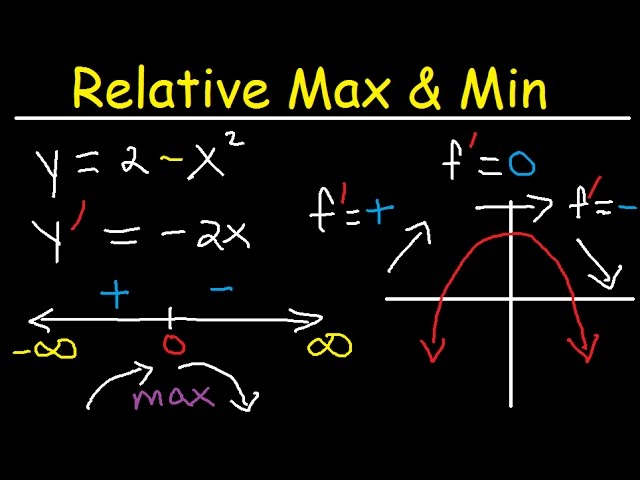
This calculus video tutorial explains how to find the relative extrema of a function such as the local maximum and minimum values using the first derivative test.
Calculus 1 Final Exam Review: https://www.youtube.com/watch?v=WmBzmHru78w
Derivative Applications - Free Formula Sheet:
https://www.video-tutor.net/calculus-formula-sheets....
this too
they're both the same videos but- both are important
the most important thing is that you understand what a critcal point is
fallen flame
fossil pendant
they do recognize f'(x)=0 so im assuming they are just learning about the behavi...
I think i just missed a good chunk of material in class a few years ago and I'm still paying for it by missing some basic knowledge
fossil pendant
because thats what we rely on to find EVERYTHING abouyt functions
well- not everything
safe mauve
it's pretty straightforward
fossil pendant
but the your-level and my-level everything
fallen flame
alright
obtuse pebbleBOT
If you are done with this channel, please mark your problem as solved by typing .close
safe mauve
I think you'll be fine kaz
obtuse pebbleBOT
Channel closed
Closed by @fallen flame
Use .reopen if this was a mistake.
obtuse pebbleBOT
Available help channel!
Send your question here to claim the channel.
Remember:
• Ask your math question in a clear, concise manner.
• Show your work, and if possible, explain where you are stuck.
• Do not immediately ping people or roles. After 15 minutes, feel free to ping <@&286206848099549185> once.
• Type the command .close to free the channel when you're done.
• Be polite and have a nice day!
Read #❓how-to-get-help for further information on how to ask a good question, and about conduct in the question channels.
 serene otter
how in the world do we deduce 4)c
 obtuse pebbleBOT
serene otter
how in the world do we deduce 4)c
obtuse pebbleBOT
serene otter
how in the world do we deduce 4)c
 royal basin
did you do 4b?
serene otter
royal basin
did you do 4b?
yes
royal basin
note that when you put $z=1$ in the left-hand side in 4a), the general term inside the product becomes $$2 - 2 \cos\paren{\frac{\alpha}{n} + \frac{2k\pi}{n}}$$ and you can simplify it via $2 - 2\cos(t) = 4 \sin^2(t/2)$
warm shaleBOT
Ann
 royal basin
@serene otter
serene otter
warm shale
**Ann**
if you put one in the first equation it gives 2-2cos(a) tho
oh wait
imma try to do smt I think I got it
yup I got it thanks so much @royal basin !!!
.close
obtuse pebbleBOT
Channel closed
Closed by @serene otter
Use .reopen if this was a mistake.
obtuse pebbleBOT
Available help channel!
Send your question here to claim the channel.
Remember:
• Ask your math question in a clear, concise manner.
• Show your work, and if possible, explain where you are stuck.
• Do not immediately ping people or roles. After 15 minutes, feel free to ping <@&286206848099549185> once.
• Type the command .close to free the channel when you're done.
• Be polite and have a nice day!
Read #❓how-to-get-help for further information on how to ask a good question, and about conduct in the question channels.
 radiant scarab
 obtuse pebbleBOT
radiant scarab
radiant scarab
obtuse pebbleBOT
radiant scarab
radiant scarab
How to solve 2nd part where Y is to be found
royal basin
it's easier to count the ways to select 3 points when there are two or more adjacent. this count will be X-Y (and so, as a bonus, you get to see immediately if D is correct or not)
for this i recommend separately counting the cases of 3 consecutive points vs. 2 adjacent points and the third not
radiant scarab
How to write 2 adjacent points and 3rd not adjacent
In mathematical terms
I don't understand what you mean by 3rd not
3 consecutive is 18c3, 2 adjacent is 17c3
.close
obtuse pebbleBOT
Channel closed
Closed by @radiant scarab
Use .reopen if this was a mistake.
radiant scarab
royal basin
for this i recommend separately counting the cases of 3 consecutive points vs. 2...
I got your help but I couldn't solve it as you told, I'll reopen the help channel
obtuse pebbleBOT
Available help channel!
Send your question here to claim the channel.
Remember:
• Ask your math question in a clear, concise manner.
• Show your work, and if possible, explain where you are stuck.
• Do not immediately ping people or roles. After 15 minutes, feel free to ping <@&286206848099549185> once.
• Type the command .close to free the channel when you're done.
• Be polite and have a nice day!
Read #❓how-to-get-help for further information on how to ask a good question, and about conduct in the question channels.
 karmic hedge
 obtuse pebbleBOT
karmic hedge
karmic hedge
obtuse pebbleBOT
karmic hedge
karmic hedge
Last question for tonight, then I can sleeeeeeeeeeeeeeeep finally
First of all idrk what this is

Is it a 3d shape or what
 hardy widget
karmic hedge
Is it a 3d shape or what
hardy widget
karmic hedge
Is it a 3d shape or what
It's the plane that "touches" a surface at a given point.
 karmic hedge
Ahhh ok I see, so what do we get by getting the derivative with respect to x and then with respect to yand subbing in the values
Here

What does that give us?
Wait I just got it
Thanks!
❤️
.close
obtuse pebbleBOT
Channel closed
Closed by @karmic hedge
Use .reopen if this was a mistake.
obtuse pebbleBOT
Available help channel!
Send your question here to claim the channel.
Remember:
• Ask your math question in a clear, concise manner.
• Show your work, and if possible, explain where you are stuck.
• Do not immediately ping people or roles. After 15 minutes, feel free to ping <@&286206848099549185> once.
• Type the command .close to free the channel when you're done.
• Be polite and have a nice day!
Read #❓how-to-get-help for further information on how to ask a good question, and about conduct in the question channels.
 leaden seal
Is this the correct way to factor this monomial
 obtuse pebbleBOT
leaden seal
Is this the correct way to factor this monomial
hardy widget
leaden seal
Is this the correct way to factor this monomial
obtuse pebbleBOT
leaden seal
Is this the correct way to factor this monomial
hardy widget
leaden seal
Is this the correct way to factor this monomial
You're missing the $x^3$ ones. What you have so far is good though!
warm shaleBOT
Civil Service Pigeon
 obtuse pebbleBOT
Channel closed
Closed by @leaden seal
Use .reopen if this was a mistake.
hardy widget
leaden seal
Oh okay got it, thank you

leaden seal
.reopen
obtuse pebbleBOT
✅ Original question: #help-10 message
leaden seal
One more question, when I am factoring a negative monomial are all the factors going to be positive, negative, or both?

 slate shoal
leaden seal
One more question, when I am factoring a negative monomial are all the factors g...
slate shoal
leaden seal
One more question, when I am factoring a negative monomial are all the factors g...
Yeah, factors of negative numbers do have negatives in them
leaden seal
slate shoal
Yeah, factors of negative numbers do have negatives in them
So all the factors are going to be negative?
slate shoal
leaden seal
So all the factors are going to be negative?
some, not all
-8 has factor of 4 and -4
etc.
leaden seal
So would -4 be 2 and -2, etc?
slate shoal
leaden seal
So would -4 be 2 and -2, etc?
yes
obtuse pebbleBOT
Channel closed
Closed by @leaden seal
Use .reopen if this was a mistake.
obtuse pebbleBOT
Available help channel!
Send your question here to claim the channel.
Remember:
• Ask your math question in a clear, concise manner.
• Show your work, and if possible, explain where you are stuck.
• Do not immediately ping people or roles. After 15 minutes, feel free to ping <@&286206848099549185> once.
• Type the command .close to free the channel when you're done.
• Be polite and have a nice day!
Read #❓how-to-get-help for further information on how to ask a good question, and about conduct in the question channels.
 brazen wedge
i understand how to graph the parts within the parenthesis but the exponenets are confusing me. i attempted to graph a pint at -8 and it says i need 2 points. im struggling to find where the other pint would be.
 obtuse pebbleBOT
brazen wedge
i understand how to graph the parts within the parenthesis but the exponenets ar...
obtuse pebbleBOT
brazen wedge
i understand how to graph the parts within the parenthesis but the exponenets ar...
@brazen wedge Has your question been resolved?
 polar fossil
brazen wedge
i understand how to graph the parts within the parenthesis but the exponenets ar...
polar fossil
brazen wedge
i understand how to graph the parts within the parenthesis but the exponenets ar...
the roots are where $\blue{(3x-6)^4}\green{(x+8)^3} = 0$
warm shaleBOT
clumsy
 polar fossil
which means that either $\blue{(3x-6)^4} = 0$ or $\green{(x+8)^3} = 0$
warm shaleBOT
clumsy
 obtuse pebbleBOT
Channel closed
Closed by @brazen wedge
Use .reopen if this was a mistake.
obtuse pebbleBOT
Available help channel!
Send your question here to claim the channel.
Remember:
• Ask your math question in a clear, concise manner.
• Show your work, and if possible, explain where you are stuck.
• Do not immediately ping people or roles. After 15 minutes, feel free to ping <@&286206848099549185> once.
• Type the command .close to free the channel when you're done.
• Be polite and have a nice day!
Read #❓how-to-get-help for further information on how to ask a good question, and about conduct in the question channels.
 pulsar shard
Hello! Good evening.
obtuse pebbleBOT
pulsar shard
Hello! Good evening.
pulsar shard
As you can see in the question. This is 101 Statistics. The example laid out is the way to find the probability which is found by first finding the z score and then using a table from the book to match and find the exact probability. This is made easier by using a formula in the calculator called NormalCDF. But when I use it, and input the exact same numbers, my answer is not a 100% accurate. The answer in the book is 0.7698
For me, using the calculator, it comes up as 0.7717.
Yes there almost similar but not quite. My professor has been no help. This is a winter course so I dont have alot of time to figure stuff like this with one on one help. Honestly regretting this course. I have shared my answer from the calculator.


My request is if any one can help me where this inconsistency is occurring? Or why is it. I am positive this formula is correct. Its literally in the previous page. Funnily enough that question had exactly matching answers.
 worn yoke
i think you included the wrong image from your book?

 crisp venture
Its what happens when you round off too early
Because the z values are in 3sf, there is a slight change in the final answer
pulsar shard
Should I stick to the table then?
pulsar shard
But it gets tedious you know. 2 days ago I did the midterm online and it was 75 minutes with 50 questions man. I barely got it done.
Check this out. The previous page is telling me to use the formula since it makes my life easier. And the answers matched as well on the calculator. Then this example comes and its not matching up again.

 latent bison
i think they are just showing you that you can either use table or use calculator as 2 methods
pulsar shard
The benefit if this formula is skipping the process of finding the z score first.
pulsar shard
latent bison
i think they are just showing you that you can either use table or use calculato...
Yes. But when I use the calculator which is quicker to do so, there is a disparity.
 zenith raft
what a name
pulsar shard
zenith raft
what a name
Appreciate it
latent bison
pulsar shard
Yes. But when I use the calculator which is quicker to do so, there is a dispari...
the disparity is because the table doesnt have enough space to account for more s.f.
crisp venture
pulsar shard
Yes. But when I use the calculator which is quicker to do so, there is a dispari...
What you could do to eliminate the disparity is round the z score to 5sf
pulsar shard
zenith raft
what a name
14 year old me is to thank hehe
 frail condor
 pulsar shard
latent bison
the disparity is because the table doesnt have enough space to account for more ...
pulsar shard
latent bison
the disparity is because the table doesnt have enough space to account for more ...
Right right. That makes sense now.
What i am worried about is my professor not recognizing that.
He is telling me not to fret.
 crisp venture
I would say to use 5sf answers for working, 3sf for final
I dont think they will penalise you for being more accurate
pulsar shard
crisp venture
I would say to use 5sf answers for working, 3sf for final
What is sf? Significant factor?
crisp venture
Significant figures
latent bison
π = 3.1415926535...
π to 3s.f. is 3.14
π to 5s.f. is 3.1416
pulsar shard
crisp venture
I dont think they will penalise you for being more accurate
What i am worried about is during the final, on pearson، I only have to input the answer in. So if it asks a specific decimal point like say round of to 4 decimal place then there is a difference between .67014 and .67019
crisp venture
A general rule is to put your working with 2 places more than what the answers want
So for example, if answers in 4dp, working should be in 6dp
pulsar shard
crisp venture
A general rule is to put your working with 2 places more than what the answers w...
I cant do that in Pearson. It has to be exact. Have you used Pearson before? Its like um like a blank that i have to fill in and in brackets on the side, it will mention it has to be this many decimal places.
And I am positive there is no set range to account for close answers.
Its either right or wrong.
crisp venture
pulsar shard
I cant do that in Pearson. It has to be exact. Have you used Pearson before? Its...
No I have not
crisp venture
Dog, I did my A Levels last year
latent bison
crisp venture
Dog, I did my A Levels last year
same here 🙂
pulsar shard
Oh your in the uk
crisp venture
No, somewhere else
latent bison
and we both know each other 🙂
pulsar shard
Ah right. British curriculum
crisp venture
pulsar shard
Ah right. British curriculum
Its not British
pulsar shard
What is it called then? I used to study in uae and there it was a/o levels as well. I thought it was called British curriculum
latent bison
crisp venture
Its not British
dont you dare tell him where we are from
crisp venture
@latent bison , do you want to say?
pulsar shard
LoL
Im from the States. Can't be worse bruh
Good ol 'Merica. Especially considering what's happening now.
Anyways. Appreciate the help guys. I'll just pray to god.
latent bison
crisp venture
<@1102451032384098324> , do you want to say?
i think we can roll off from here
pulsar shard
.close
obtuse pebbleBOT
Channel closed
Closed by @pulsar shard
Use .reopen if this was a mistake.
obtuse pebbleBOT
Available help channel!
Send your question here to claim the channel.
Remember:
• Ask your math question in a clear, concise manner.
• Show your work, and if possible, explain where you are stuck.
• Do not immediately ping people or roles. After 15 minutes, feel free to ping <@&286206848099549185> once.
• Type the command .close to free the channel when you're done.
• Be polite and have a nice day!
Read #❓how-to-get-help for further information on how to ask a good question, and about conduct in the question channels.
 round island
Where does the 36 inches fit into play here and how do I find the angle needed to solve the problem

 obtuse pebbleBOT
round island
Where does the 36 inches fit into play here and how do I find the angle needed t...
obtuse pebbleBOT
round island
Where does the 36 inches fit into play here and how do I find the angle needed t...
 formal island
you are asked about the angle of elevation from the child POV to the tip of the turret.
if the kid happened to measure 380 feet too then the angle would be 0 anyways
round island
…..huh
I’m asked about the angle of elevation from the child’s pov to the top of the turret
formal island
and youre given info about the position of the child itself
round island
So how do I find the angle from the child’s pov to the tip of the turret and would the 3 feet not cause this to not be a triangle anymore
 hollow mulch
Anyona have ap precalc answers?
formal island
you have to define a new triangle yourself using the position of the child eye's
round island
Fuckkkkk ok
formal island
hollow mulch
Anyona have ap precalc answers?
!occupied
obtuse pebbleBOT
hollow mulch
Anyona have ap precalc answers?
Someone else is already using this help channel. If you need help with a question, please open your own help channel/thread (see #❓how-to-get-help for instructions).
hollow mulch
!occupied
obtuse pebbleBOT
Someone else is already using this help channel. If you need help with a question, please open your own help channel/thread (see #❓how-to-get-help for instructions).
hollow mulch
formal island
!occupied
huh what does that mean?
formal island
read
round island
It means go get your own channel
obtuse pebbleBOT
Someone else is already using this help channel. If you need help with a question, please open your own help channel/thread (see #❓how-to-get-help for instructions).
round island
Ok so I adjusted the height- how do I find the angle
formal island
Just create your own help thread or consult math discussion, if you dont know how just go to how-to-get-help.
formal island
round island
Ok so I adjusted the height- how do I find the angle
you know all three sides formed by this new triangle, and more importantly, one is 90º since this is still a right triangle.
you could use law of sines here.
round island
I don’t know all 3 sides-
formal island
round island
I don’t know all 3 sides-
id advice you draw the problem as you carefully read
round island
…I did
formal island
well, you wouldnt know they hypotenuse instantly, but you can just do pythagoras.
round island
Oh true
Let me do that rq
Could I not just use the law of sins to find an equation for x-
Wait no not sins
formal island
using what pair of angle-side?
round island
Cosines
formal island
oh
round island
Using the adjacent and hypotenuse
formal island
yeah, you could too.
round island
I think that’s what’s being asked of me
formal island
But law of sines is just easier i guess, far shorter formula.
formal island
Do you remember how law of sines works?
round island
I don’t know what I’m doing tbh
This problem is formatted differently from the rest on the paper
And I’m confused
formal island
 round island
I don think that’s what this assignment is about
formal island
If law of sines is off limits, i would assume law of cosines also is.
You can do sohcahtoa too
round island
Idk what I’m talking about
formal island
in fact, soh is just a really specific case of law of sines for right triangles.
round island
I’m looking back at my notes and I don’t have anything that would suggest having to find the angle-
I’m very confused
formal island
what theorems / formulas you have noted down?
I like to believe pythagoras is there to start with
round island
This is just supposed to be trig ratio word problems with right triangles
round island
formal island
I like to believe pythagoras is there to start with
You could be right but nothing else on the page is like that-
formal island
formal island
what theorems / formulas you have noted down?
.
round island

 warm shaleBOT
 formal island
SOH CAH TOA is just 3 identities to find the angle based on pairs of sides of a right-triangle.
round island
Yeah
formal island
Here you have all 3 sides, so you can use any as long as you use the correct pair for your function
round island
But my question is why that’s on here if all of the other problems aren’t anything like that-
formal island
idk
round island
Idk it feels wrong to me
formal island
for the sake of convenience, we will use "TOA", would you be able to setup the equation?
round island
Tan(theta)= 377/160?
formal island
yep.
round island
And just divide that to find the angle?
formal island
You cant divide by tan.
round island
Oh yeah
formal island
You use its inverse trigonometric function
round island
Ugghhhh fuck
formal island
arctan
round island
Huh
formal island
or $\tan^{-1}(x)$
warm shaleBOT
 round island
So…….what does that imply
round island
Yes
formal island
Same deal.
round island
warm shale
Dumb it down- what do I do to make this happen
round island
So fun fact I can’t do that
I get a bullshit calculator and I’m not allowed to use anything except plus, minus, multiply, divide, and square root
formal island
you can just write theta = arctan(377/160)
round island
What in the ever loving fuck is arc tan- all I’ve ever heard is cotangent- is that the same thing?????
Ok so update after reading the assignment description I can’t use inverses on this
formal island
If this is a common ratio i have 0 clue
It clearly doesnt look like it.
Cotangent is the Multiplicative Inverse (1/x)
Arctangent is the Function Inverse
round island
I’m just going to ask her tomorrow I guess
obtuse pebbleBOT
@round island Has your question been resolved?
Channel closed
Closed by @round island
Use .reopen if this was a mistake.
Available help channel!
Send your question here to claim the channel.
Remember:
• Ask your math question in a clear, concise manner.
• Show your work, and if possible, explain where you are stuck.
• Do not immediately ping people or roles. After 15 minutes, feel free to ping <@&286206848099549185> once.
• Type the command .close to free the channel when you're done.
• Be polite and have a nice day!
Read #❓how-to-get-help for further information on how to ask a good question, and about conduct in the question channels.
 manic yarrow
 obtuse pebbleBOT
manic yarrow
manic yarrow
obtuse pebbleBOT
manic yarrow
manic yarrow
I mean I can use matrix notation and show equality it'll just take forever is there an easier way
obtuse pebbleBOT
@manic yarrow Has your question been resolved?
obtuse pebbleBOT
Channel closed
Closed due to timeout
Use .reopen if this was a mistake.
Available help channel!
Send your question here to claim the channel.
Remember:
• Ask your math question in a clear, concise manner.
• Show your work, and if possible, explain where you are stuck.
• Do not immediately ping people or roles. After 15 minutes, feel free to ping <@&286206848099549185> once.
• Type the command .close to free the channel when you're done.
• Be polite and have a nice day!
Read #❓how-to-get-help for further information on how to ask a good question, and about conduct in the question channels.
 brittle oracle
 obtuse pebbleBOT
brittle oracle
brittle oracle
obtuse pebbleBOT
brittle oracle
brittle oracle
calculator allowed
 leaden lion
You can eliminate options by putting values
Take roots of this eqn as -3 and -2 then c=6
And in another case take roots as -1 and 0
brittle oracle
is there an algebraic way to do it
or is it just sub and eliminate
i tried to break down b = uv and c = u + v
and then u = v + 1
idk it got very confusing
 red ice
brittle oracle
red ice
brittle oracle
$r_1 + r_2 = -b$ and $r_1 r_2 = c$
with $r_2 - r_1 = 1$ that becomes $1 + 2r_1 = -b$ and $r_1 (1 + r_1) = c$
warm shaleBOT
south
 red ice
yeah...
red ice
yeah so you just have to quadratic formula it
brittle oracle
frickk
red ice
$x^2 + x - c = 0 \implies x = \frac{-1 \pm \sqrt{1 + 4c}}{2}$
warm shaleBOT
south
 red ice
multiply that by 2 and add 1
brittle oracle
whered b go?
red ice
I just let $r_1 = x$ in $r_1 (1 + r_1) = c$
warm shaleBOT
south
 red ice
no worries!
 vestal bridge
brittle oracle
is there an algebraic way to do it
vestal bridge
brittle oracle
is there an algebraic way to do it
quadratic formula
the good news is a few terms fall off
obtuse pebbleBOT
@brittle oracle Has your question been resolved?
obtuse pebbleBOT
Channel closed
Closed due to timeout
Use .reopen if this was a mistake.
Available help channel!
Send your question here to claim the channel.
Remember:
• Ask your math question in a clear, concise manner.
• Show your work, and if possible, explain where you are stuck.
• Do not immediately ping people or roles. After 15 minutes, feel free to ping <@&286206848099549185> once.
• Type the command .close to free the channel when you're done.
• Be polite and have a nice day!
Read #❓how-to-get-help for further information on how to ask a good question, and about conduct in the question channels.
 soft scroll
is this question right
 obtuse pebbleBOT
soft scroll
is this question right
soft scroll
obtuse pebbleBOT
soft scroll
is this question right
soft scroll
im putting it in a calculator and either its wrong or this is wrong or im doing it wrong
 elder vale
What have you done ?
soft scroll
cause i got 5.49 grams/mol
elder vale
Do you know moles = Volume in litres/22.4
Or just use PV=nRT
Write n as given mass/molar mass
And substitute everything
soft scroll
ya let me retry doing it
soft scroll
ya i used the formula
elder vale
Alr let me cross check the calculation
I'm getting the answer as one of the options
So I'm assuming you made a silly mistake somewhere
elder vale
It's alright if you need help just ask
soft scroll
alright so how do you input the constant
r
i have a very loose understanding of what it is
soft scroll
elder vale
It's alright if you need help just ask
.
and are you allowed to multiply liters by atmospheres here
 silent flame
soft scroll
and are you allowed to multiply liters by atmospheres here
silent flame
soft scroll
and are you allowed to multiply liters by atmospheres here
Yes
R is in L atm
silent flame
soft scroll
ya i used the formula
!show
obtuse pebbleBOT
soft scroll
ya i used the formula
Show your work, and if possible, explain where you are stuck.
 silent flame
Ok lemme check
soft scroll
i dont know what to input for r
because the definition it has there has 4 different units
little confusing
silent flame
soft scroll
i dont know what to input for r
Put it as it is, you can see the units match, L atm/ mol K
latent bison
dimensional analysis
soft scroll
oh wait youre right
soft scroll
latent bison
*dimensional analysis*
what
 soft scroll
i thought n would be 1
since we're solving for grams per mol
you could just convert that couldnt you
silent flame
Nah it is not 1 every time, it changes wrt to others pressure etc..
silent flame
soft scroll
you could just convert that couldnt you
Yes
Specifically when we are solving for mass, n is not to be assumed it will depend on the volume etc.
soft scroll
does r change depending on the rest of the equation
latent bison
soft scroll
since we're solving for grams per mol
to get grams per mol
you can divide total mass by total amount
total amount n doesnt always have to be 1 mol
soft scroll
soft scroll
does r change depending on the rest of the equation
do you enter the values into r
for the answer
silent flame
soft scroll
does r change depending on the rest of the equation
Yes it can change for eg if they are in different units
silent flame
latent bison
*dimensional analysis*
We know no one takes that chapter seriously
soft scroll
soft scroll
do you enter the values into r
.
latent bison
silent flame
We know no one takes that chapter seriously
||
its self-explanatory, really
||
silent flame
soft scroll
do you enter the values into r
Yes n = PV/RT
latent bison
soft scroll
do you enter the values into r
before you enter values in physics you must always ensure the units match
if units dont match, then convert first
otherwise, just plug the values in
silent flame
latent bison
||
its self-explanatory, really
||
Indeed, has applications
soft scroll
latent bison
before you enter values in physics you must always ensure the units match
yes of course im just asking if i can plug the units ive gotten into the formula it gave
latent bison
do the units match?
soft scroll
yes
latent bison
so can you plug the values in?
silent flame
soft scroll
its just that PV=nRt, r is in the formula
So plug the value of r?
latent bison
yes you can plug the given R
soft scroll

what is the value
im not good with working in physics units
like for say atm in the formula do i plug in 0.95 or something else
in the formula for R
latent bison
0.95
soft scroll
so the units where it doesnt have a stated value i plug in from the rest ok
soft scroll
hardy widget
btw this doesn't rlly belong here
mb i was only in here
i'll join those for future ones

but for mol in the equation is it calling for molar mass
or i guess the 5.49g of gas
because theres no stated number of moles
oh wait you dont multiply volume by the 0.0821 L

mass/amount so
27.0044
.close
obtuse pebbleBOT
Channel closed
Closed by @soft scroll
Use .reopen if this was a mistake.
obtuse pebbleBOT
Available help channel!
Send your question here to claim the channel.
Remember:
• Ask your math question in a clear, concise manner.
• Show your work, and if possible, explain where you are stuck.
• Do not immediately ping people or roles. After 15 minutes, feel free to ping <@&286206848099549185> once.
• Type the command .close to free the channel when you're done.
• Be polite and have a nice day!
Read #❓how-to-get-help for further information on how to ask a good question, and about conduct in the question channels.
 plain badge
how to find primitive function in this example?
 obtuse pebbleBOT
plain badge
how to find primitive function in this example?
obtuse pebbleBOT
plain badge
how to find primitive function in this example?
 kind hawk
do you know how to find a primitive for e.g. 2^x ?
red ice
if so, then f(x) = 3^(-x) so then there's an extra - due to the *reverse chain rule
kind hawk
or (1/3)^x
plain badge
 plain badge
kind hawk
do you know how to find a primitive for e.g. 2^x ?
plain badge
kind hawk
do you know how to find a primitive for e.g. 2^x ?
this seems to be the final answer
 kind hawk
yes
my hope was more that you might realize that while 2^x might seem easier, its actually the same thing
if you write the original function as (1/3)^x
red ice
red ice
if so, then f(x) = 3^(-x) so then there's an extra - due to the *reverse chain r...
when you differentiate 3^(-x), you need to multiply by -1 due to the chain rule
so when you integrate it, you need to divide by -1 to undo the differentiation (so that you get 3^(-x) back)
I feel it's more important to realise the reverse chain rule (a shortcut for u-sub)
just cause it's so widely used, even though you don't necessarily need it here
obtuse pebbleBOT
Channel closed
Closed by @plain badge
Use .reopen if this was a mistake.
kind hawk
for all these more basic functions it is a good idea to differentiate the result you get again
obtuse pebbleBOT
Available help channel!
Send your question here to claim the channel.
Remember:
• Ask your math question in a clear, concise manner.
• Show your work, and if possible, explain where you are stuck.
• Do not immediately ping people or roles. After 15 minutes, feel free to ping <@&286206848099549185> once.
• Type the command .close to free the channel when you're done.
• Be polite and have a nice day!
Read #❓how-to-get-help for further information on how to ask a good question, and about conduct in the question channels.
 timid silo
pls help me with my homework
obtuse pebbleBOT
timid silo
pls help me with my homework
timid silo
 hardy widget
timid silo
timid silo
hardy widget
timid silo
timid silo
okay it didnt work so easy
ill do it by myself
sorry i have one more

thats too easy ig
i have so many time to solve this 2
homeworks
like 80 years
.close
obtuse pebbleBOT
Channel closed
Closed by @spark hedge
Use .reopen if this was a mistake.
Available help channel!
Send your question here to claim the channel.
Remember:
• Ask your math question in a clear, concise manner.
• Show your work, and if possible, explain where you are stuck.
• Do not immediately ping people or roles. After 15 minutes, feel free to ping <@&286206848099549185> once.
• Type the command .close to free the channel when you're done.
• Be polite and have a nice day!
Read #❓how-to-get-help for further information on how to ask a good question, and about conduct in the question channels.
 short crescent
i just have no clue how to set up the bounds of the integral
 short crescent
i know one of them have to be 0-2 and one have to be 0-(4-x)?
 daring ravine
can you draw it
short crescent
uhh i can try but im not sure how to graph z=4-x
is it just slanted with a slope of -1 and y-int 4?
or z-int i guess
 west stratus
daring ravine
can you draw it
west stratus
daring ravine
can you draw it
what is integration i know it is the inverse of differentiation
short crescent
west stratus
what is integration i know it is the inverse of differentiation
area under a curve ig
daring ravine
short crescent
uhh i can try but im not sure how to graph z=4-x
yeah its a plane
short crescent
ill just graph it on desmos
daring ravine
at least, draw the xy, yz, xz planes
west stratus
short crescent
ill just graph it on desmos
jee?
daring ravine
short crescent
ill just graph it on desmos
i highly recommend being able to draw it or sketch it yourself
desmos probably wont be on your test
if sketching 3d is hard (understandable) then the 3 planes is good enough too
short crescent
i probably would be able to its just hard for me to keep track of it because im not that good at 3d graphing
short crescent
daring ravine
if sketching 3d is hard (understandable) then the 3 planes is good enough too
wdym the 3 planes?
x-y, x-z, and y-z?
daring ravine
cross section at xy yz xz
short crescent
how do i graph that i think it just made it more confusing for me hold on let me try to graph it in 3d

this is my best interpretation of it
the parabola is along the x-y plane it just looks a bit tilted i think
so the z bounds are 0 to 4-x
y is 0 to 4-y^2
and x is 0-4?
@daring ravine
daring ravine
the final part includes 0 <= y <= 2 and 0 <= x <= 2
short crescent
oh right so it doesnt go all the way to the vertex of x=4-y^2 only halfway right?
daring ravine
 short crescent
yeah thats what i was thinking, i have a visual 3d image of it in my head i just cant put it to paper haha
but wait
daring ravine
now what order are you integrating though
short crescent
is the y bound 0 to 2 or 0 to 4-y^2?
daring ravine
it depends on the order of integration
short crescent
daring ravine
now what order are you integrating though
well whatever happens my outermost integral will be dx most likely
because the bounds are constant
so i could do
$\int_0^2 \int_0^{4-x} \int_0^{4-y^2} ydydzdx$ ?
warm shaleBOT
Krish
 daring ravine
Try the first inner integral and see what happens
warm shaleBOT
Krish
 daring ravine
well you have the same problem
generally if the bounds of a variable A is in terms of variable A, you got a problem
let's try to find a single order of integration and work out the bounds for it first
short crescent
oh wait i could just have y be 0-2 and x be 0-4-y^2
so same order of integrals, but change the variables to dzdxdy?
that would get rid of the y's at the end
daring ravine
sounds like a plan

 tardy epoch
short crescent
<@&286206848099549185>
tardy epoch
short crescent
<@&286206848099549185>
what is the question now?
tardy epoch
why do you think it's wrong
short crescent
WA gave me a different answer when i went to check
tardy epoch
show what wolfram gave


 short crescent
oh my god
that explains why i had an extra 12 because they cancel out
appreciate the help both of you
.close
obtuse pebbleBOT
Channel closed
Closed by @short crescent
Use .reopen if this was a mistake.
obtuse pebbleBOT
Available help channel!
Send your question here to claim the channel.
Remember:
• Ask your math question in a clear, concise manner.
• Show your work, and if possible, explain where you are stuck.
• Do not immediately ping people or roles. After 15 minutes, feel free to ping <@&286206848099549185> once.
• Type the command .close to free the channel when you're done.
• Be polite and have a nice day!
Read #❓how-to-get-help for further information on how to ask a good question, and about conduct in the question channels.
karmic hedge
 obtuse pebbleBOT
karmic hedge
obtuse pebbleBOT
karmic hedge
 obtuse pebbleBOT
Channel closed
Closed by @karmic hedge
Use .reopen if this was a mistake.
obtuse pebbleBOT
Available help channel!
Send your question here to claim the channel.
Remember:
• Ask your math question in a clear, concise manner.
• Show your work, and if possible, explain where you are stuck.
• Do not immediately ping people or roles. After 15 minutes, feel free to ping <@&286206848099549185> once.
• Type the command .close to free the channel when you're done.
• Be polite and have a nice day!
Read #❓how-to-get-help for further information on how to ask a good question, and about conduct in the question channels.
karmic hedge
 obtuse pebbleBOT
karmic hedge
karmic hedge
obtuse pebbleBOT
karmic hedge
karmic hedge
I did everything the same as what they did except this one step
Turning this

Into this using l'hopital

I just subbed the infinity directly in, which gave me -1 instead
Obviously this leads to a different answer so what was wrong with my method?
hardy widget
karmic hedge
I just subbed the infinity directly in, which gave me -1 instead
How (in general, trying to do "arithmetic" with infinity is a bad idea)
also I'd just do
$$\frac{b-2}{b+2}=\frac{1-\frac{2}{b}}{1+\frac{2}{b}}$$ tbh
warm shaleBOT
Civil Service Pigeon
 obtuse pebbleBOT
Channel closed
Closed by @karmic hedge
Use .reopen if this was a mistake.
hardy widget
karmic hedge
Ok thanks!
obtuse pebbleBOT
Available help channel!
Send your question here to claim the channel.
Remember:
• Ask your math question in a clear, concise manner.
• Show your work, and if possible, explain where you are stuck.
• Do not immediately ping people or roles. After 15 minutes, feel free to ping <@&286206848099549185> once.
• Type the command .close to free the channel when you're done.
• Be polite and have a nice day!
Read #❓how-to-get-help for further information on how to ask a good question, and about conduct in the question channels.
 worldly sky
hey, im having some trouble with memorizing or just understanding (bruh) the base changes of a coordinate matrix of a linear application. i do know there are some diagrams to help but i keep messing them up or switching the order of the bases, is there any way to "deduce" it if i forget about the general ""formula""?
(for example, let A be the matrix coordinates of B in C, and M the one from K to T, so its M=PAQ with P,Q inversable, but which bases im changing?)
obtuse pebbleBOT
worldly sky
hey, im having some trouble with memorizing or just understanding (bruh) the bas...
kind hawk
the diagram is good
you start with basic B. you have to translate to basis K. then apply M. then translate from T to C
worldly sky
im still not getting it 🥀
sorry for the messy drawing my handwriting aint rhe best either LOL but is this it? its wrong right?

then itd be.... C_BK • A • C_CT?
or TC?
kind hawk
I dont know the notation your course uses
C_BK takes vectors written in basis K and outputs vectors in basis B
yes?
worldly sky
M_BC is coordinates in base C of f(b_i)
kind hawk
so then M_TK = C_TC A_CB C_BK
you read from the right
and all the input and output bases have to much
worldly sky
its in opposite order for coord matrixes from base changes ones
kind hawk
this is just the kinda thing where notation is always awful, no matter what you do
kind hawk
kind hawk
you start with basic B. you have to translate to basis K. then apply M. then tr...
I personally always have to think like this
worldly sky
so, this? (i can explain the notation further if u want me to, it messes me up a lot bc it changes sides)
 kind hawk
you start in some basis, you have to translate to another basis, then you do your matrix in that basis, and then you translate back to yet another basis
worldly sky
kind hawk
you start in some basis, you have to translate to another basis, then you do you...
ill try to remember this 😵💫


kind hawk
worldly sky
its in opposite order for coord matrixes from base changes ones
are you sure that is true in your notation
kind hawk
worldly sky
M_BC is coordinates in base C of f(b_i)
and this
worldly sky
yeah, for coord matrix u read it as "coordinates in base C of f(B)" and in base changers "coordinates of base B of vectors of K"
its like mixed
worldly sky
worldly sky
left C inputs C and turns to T coords, middle M inputs f(b) in C coords, and right C inputs K and turns into B coordinates
idk i always mix them up 
i probably have to smash my head against this wall until i understand the notstion dont i 
kind hawk
I would try to stay away a bit from the notation. and just think about what P and Q are supposed to do etc
 upbeat plinth
worldly sky
i probably have to smash my head against this wall until i understand the notsti...
upbeat plinth
worldly sky
i probably have to smash my head against this wall until i understand the notsti...
maybe some arrows in subscripts would help?
$C_{B\leftarrow K}$ for change of basis $K$ to $B$ etc
warm shaleBOT
ロケット・ジャンプ
 upbeat plinth
arrows might help u keep the correct order of bases
worldly sky
im honestly so confused rn 💀
upbeat plinth
$M^f_{T\leftarrow K}=C_{T\leftarrow C}M^f_{C\leftarrow B}C_{B\leftarrow K}$
warm shaleBOT
ロケット・ジャンプ
 worldly sky
this is what my prof said in class, but some of the arrows are in the wrong way?
 worldly sky
this is what my prof said in class, but some of the arrows are in the wrong way?
worldly sky
worldly sky
this is what my prof said in class, but some of the arrows are in the wrong way?
first arrow from K to B should be from B to K...?
okay i think i got it with some other help from classmates
damn this is messy 😵💫
thanks for helping anyways!
.close
obtuse pebbleBOT
Channel closed
Closed by @worldly sky
Use .reopen if this was a mistake.
obtuse pebbleBOT
Available help channel!
Send your question here to claim the channel.
Remember:
• Ask your math question in a clear, concise manner.
• Show your work, and if possible, explain where you are stuck.
• Do not immediately ping people or roles. After 15 minutes, feel free to ping <@&286206848099549185> once.
• Type the command .close to free the channel when you're done.
• Be polite and have a nice day!
Read #❓how-to-get-help for further information on how to ask a good question, and about conduct in the question channels.


 obtuse pebbleBOT
 frozen coral
 neon sand
@frozen coral its better if i tell how i did it
frozen coral
go on
neon sand
what is the answer @frozen coral
frozen coral
lemme try
neon sand
as you wish i can give you the sol. if u want
 frozen coral
neon sand
as you wish i can give you the sol. if u want
frozen coral
neon sand
as you wish i can give you the sol. if u want
yeah please share the solution
neon sand
@frozen coral wait a sec then
i havent done the computation as its pure bs to do it again and i hadnt done it previously back then so yeah here's the sol.
@frozen coral
 obtuse pebbleBOT
As a helper, please do not give out answers that could be copied as a homework solution. Have the student work through the problem themselves and guide them along the way.
neon sand
silent flame
Bhai
he asked for it
frozen coral
im not copying don't worry
i think my answer was correct i just had to simplify it a bit more
i got it thanks
.close
obtuse pebbleBOT
Channel closed
Closed by @frozen coral
Use .reopen if this was a mistake.
silent flame
neon sand
he asked for it
Ok,na bol rha hu kyuki mods allow nahi karte
Mute wagera kr sakts he
Baki no worries
neon sand
oh sorry
obtuse pebbleBOT
Available help channel!
Send your question here to claim the channel.
Remember:
• Ask your math question in a clear, concise manner.
• Show your work, and if possible, explain where you are stuck.
• Do not immediately ping people or roles. After 15 minutes, feel free to ping <@&286206848099549185> once.
• Type the command .close to free the channel when you're done.
• Be polite and have a nice day!
Read #❓how-to-get-help for further information on how to ask a good question, and about conduct in the question channels.
 unreal tangle
Hello guys a basic question please:
I have f(x) = 1/x - 1+ ln(x)
how can I prove that I(2;f(2)) is an inflection point and what does it mean?
obtuse pebbleBOT
unreal tangle
Hello guys a basic question please:
I have f(x) = 1/x - 1+ ln(x)
how can I prov...
 trim portal
unreal tangle
Hello guys a basic question please:
I have f(x) = 1/x - 1+ ln(x)
how can I prov...
trim portal
unreal tangle
Hello guys a basic question please:
I have f(x) = 1/x - 1+ ln(x)
how can I prov...
Do you know how to differentiate stuff?
unreal tangle
yes
trim portal
and do you know what convexity / concavity is?
unreal tangle
no
trim portal

concave is when it's kinda bent upwards
convex is when its bent downwards
inflection point is where concave part changes to convex part
trim portal
a function is concave on some interval when f''(x) < 0 for x on that interval and convex if f''(x) > 0
inflection point happens when f''(x) changes sign, which happens when f''(x) = 0 (assuming that the second derivative is continuous at the desired point)
so we first find f''(x), then find points which are suspicious of being inflection points
those are the ones with f''(x) = 0, or where the function is discontinuous
now we need to check only 2, so we focus our attention on 2
unreal tangle
okay wait let me try
trim portal
we should expect to find that f''(2) indeed is 0
trim portal
trim portal
we should expect to find that f''(2) indeed is 0
after that, we should still check whether the concavity / convexity really changed. Because sometimes the function can go convex -> f''(x) = 0 -> still convex
we do that by picking a point slightly below 2 and another point slightly above 2 and checking their f''
unreal tangle
in 2
trim portal
unreal tangle
in 2
yep, thats the only root
and there are no relevant discontinuities in f''(x), so we should expect that the sign of f''(x) can change only at 2
so now we have to check whether it really changed
so try plugging in e.g. 1 and 3
find their second derivatives
unreal tangle
when x = 3 f''(x) <0
when x = 1 f''(x) >0