#help-10
1 messages · Page 316 of 1
 marsh geyser
marsh geyser
marsh geyser
|y| = sqrt(14) means y_1 = sqrt(14) and y_2 = -sqrt(14)
And without the absolute value you are forgetting one solution
 hybrid swan
 vivid lintel
can u continue pls
vivid lintel
can u continue pls
the next step would be to simplify the sqrt, but we can’t really with 14
so its done
hybrid swan
marsh geyser
|y| = sqrt(14) means y_1 = sqrt(14) and y_2 = -sqrt(14)
thank you samuel
hybrid swan
vivid lintel
answer is sqrt 14?
yep
vivid lintel
y= sqrt 14?
hybrid swan
yep
 obtuse pebbleBOT
Channel closed
Closed by @vivid lintel
Use .reopen if this was a mistake.
hybrid swan
np
obtuse pebbleBOT
 Available help channel!
Send your question here to claim the channel.
Remember:
• Ask your math question in a clear, concise manner.
• Show your work, and if possible, explain where you are stuck.
• After 15 minutes, feel free to ping <@&286206848099549185>.
• Type the command .close to free the channel when you're done.
• Be polite and have a nice day!
Read #❓how-to-get-help for further information on how to ask a good question, and about conduct in the question channels.
 limber token
 obtuse pebbleBOT
limber token
limber token
obtuse pebbleBOT
limber token
limber token
So I subtract 13 from both sides
Then divide that by 8
Then I log both sides, right?
 radiant bluff
Yes but you may need to use a calculator to get the exact answer
radiant bluff
So far it looks correct to me
 radiant bluff
What I was thinking was putting the exponential equation into log 3.5 with a base of 4 is equal to 6-2x
You can subtract -6 from both sides
And last divide each side by -2
I’ll check to make sure
 radiant bluff
Happy to help
obtuse pebbleBOT
@limber token Has your question been resolved?
Channel closed
Closed by @limber token
Use .reopen if this was a mistake.
Available help channel!
Send your question here to claim the channel.
Remember:
• Ask your math question in a clear, concise manner.
• Show your work, and if possible, explain where you are stuck.
• After 15 minutes, feel free to ping <@&286206848099549185>.
• Type the command .close to free the channel when you're done.
• Be polite and have a nice day!
Read #❓how-to-get-help for further information on how to ask a good question, and about conduct in the question channels.
 vivid cedar
 obtuse pebbleBOT
vivid cedar
vivid cedar
obtuse pebbleBOT
vivid cedar
vivid cedar
how does the 2nd step go to the third step
 royal basin
2/3 * 27/2 = 9?
vivid cedar
because sqrt2/sqrt3*3/sqrt2 doesnt equal 3/sqrt3
royal basin
how come it doesn't?
vivid cedar
royal basin
how come it doesn't?
 vivid cedar
royal basin
how come it doesn't?
vivid cedar
royal basin
how come it doesn't?
cause it becomes 3sqrt2/sqrt6
royal basin
3sqrt(2)/sqrt(6) can be simplified
 royal basin
this is like saying 1/3 * 3/7 is not equal to 1/7 bc it instead equals 3/21
are you sure you meant acoustic tho
 drifting roost
 lol
lol
 obtuse pebbleBOT
Channel closed
Closed by @vivid cedar
Use .reopen if this was a mistake.
obtuse pebbleBOT
Available help channel!
Send your question here to claim the channel.
Remember:
• Ask your math question in a clear, concise manner.
• Show your work, and if possible, explain where you are stuck.
• After 15 minutes, feel free to ping <@&286206848099549185>.
• Type the command .close to free the channel when you're done.
• Be polite and have a nice day!
Read #❓how-to-get-help for further information on how to ask a good question, and about conduct in the question channels.
 hazy karma
help w this homework? instructions top right
 obtuse pebbleBOT
hazy karma
help w this homework? instructions top right
hazy karma
obtuse pebbleBOT
hazy karma
help w this homework? instructions top right
hazy karma
digits 1 thru 9 to be used at most 1 for each color of box
increases w the arrows on the top and left sides
@analog vault
obtuse pebbleBOT
@hazy karma Has your question been resolved?
hazy karma
 crude comet
so all the black boxes will contian the same digit?
crude comet
so all the black boxes will contian the same digit?
no
so there's the number 1 thru 9
u can use each number at MOST one time for each color
crude comet
ok
the log function gets bigger as the stuff in the parenthesis gets bigger
that should help you a bit
hazy karma
yeah ik that but idk how im supposed to do it without guessing randomly
obtuse pebbleBOT
@hazy karma Has your question been resolved?
obtuse pebbleBOT
Channel closed
Closed due to timeout
Use .reopen if this was a mistake.
obtuse pebbleBOT
Available help channel!
Send your question here to claim the channel.
Remember:
• Ask your math question in a clear, concise manner.
• Show your work, and if possible, explain where you are stuck.
• After 15 minutes, feel free to ping <@&286206848099549185>.
• Type the command .close to free the channel when you're done.
• Be polite and have a nice day!
Read #❓how-to-get-help for further information on how to ask a good question, and about conduct in the question channels.
 slim mortar
 obtuse pebbleBOT
slim mortar
slim mortar
obtuse pebbleBOT
slim mortar
slim mortar
To solve this problem I did graphs, points meaning players and lines meaning that they have played each other

I tried proving it by contradiction, this is the only graph that I made that does not satisfy the problem
Why is that? I can’t find the problem to this
I mean, in order to satisfy the problem there must be a quadrilateral with its diagonals, but there isn’t
 polar fossil
would that graph work for the remaining days?
slim mortar
polar fossil
would that graph work for the remaining days?
Yes

U just play with everyone
slim mortar
polar fossil
wouldn't they need three days?
Three days?
polar fossil
yes?
slim mortar
Each player has 2 lines, which means that they play 2 days, right?
polar fossil
sure but like
every day 4 games are played in which all of the masters participate
if you play FG on the first red day then what is H doing?
slim mortar
Oh you are right
So if I am proving this, I just say that this case is not valid because of that and I am done?
polar fossil
if you've checked every other case... i guess so
that seems like a lot of cases to check
slim mortar
polar fossil
if you've checked every other case... i guess so
Yes, mostly they are symmetrical
Ok thank you very much Hayley!!
.close
obtuse pebbleBOT
Channel closed
Closed by @slim mortar
Use .reopen if this was a mistake.
obtuse pebbleBOT
Available help channel!
Send your question here to claim the channel.
Remember:
• Ask your math question in a clear, concise manner.
• Show your work, and if possible, explain where you are stuck.
• After 15 minutes, feel free to ping <@&286206848099549185>.
• Type the command .close to free the channel when you're done.
• Be polite and have a nice day!
Read #❓how-to-get-help for further information on how to ask a good question, and about conduct in the question channels.
 topaz prism
hi all, self-learning PDE now. how did the book come up with $u(x, t)$ (eq.6.7) by "after some trial and error"?
 obtuse pebbleBOT
topaz prism
hi all, self-learning PDE now. how did the book come up with $u(x, t)$ (eq.6.7) ...
obtuse pebbleBOT
topaz prism
hi all, self-learning PDE now. how did the book come up with $u(x, t)$ (eq.6.7) ...
 warm shaleBOT
yehuihe
 topaz prism
this is a problem. so in the solution the book come up with $u(x, t)=A(t)x+B(t)(1-x)+U(x, t)$, then proceed from there. Im wondering how do you suppose to get this? intuition?
 warm shaleBOT
yehuihe
 topaz prism
this is from the book partial differential equation for scientist and engineer by Farlow. page 50
page 46-48
obtuse pebbleBOT
@topaz prism Has your question been resolved?
obtuse pebbleBOT
Channel closed
Closed due to timeout
Use .reopen if this was a mistake.
Available help channel!
Send your question here to claim the channel.
Remember:
• Ask your math question in a clear, concise manner.
• Show your work, and if possible, explain where you are stuck.
• After 15 minutes, feel free to ping <@&286206848099549185>.
• Type the command .close to free the channel when you're done.
• Be polite and have a nice day!
Read #❓how-to-get-help for further information on how to ask a good question, and about conduct in the question channels.
 timid silo
Prove that the following is true for $n=3$ and $n=5$, and it is false for every $n > 2$ otherwise:
\vs{3 mm}
If $a_1,a_2,\dots,a_n$ are arbtrary real numbers then [
\sum_{i= 1}^n \prod_{j \ne i} (a_i - a_j) \ge 0
]
obtuse pebbleBOT
timid silo
Prove that the following is true for $n=3$ and $n=5$, and it is false for every ...
warm shaleBOT

 kind hawk
my first thought is to somehow use lagrange interpolation
seems weird that this should hold for n=3,5
 river helm
my first thought was to construct a polynomial f(x)=Π(x-ai)
kind hawk
if two of them are equal then most terms vanish which could maybe make it easy to construct a counterexample
river helm
1,2,2,2
will this be a counter example
(1-2)(1-2)(1-2)+(2-1)(2-2)(2-2)+(2-1)(2-2)(2-2)+(2-1)(2-1)(2-2)
=-1
hence disproved
timid silo
river helm
(1-2)(1-2)(1-2)+(2-1)(2-2)(2-2)+(2-1)(2-2)(2-2)+(2-1)(2-1)(2-2)
wdym?
thats not the right form
timid silo
kind hawk
if two of them are equal then most terms vanish which could maybe make it easy t...
,w expand (x - y)(x - z) + (y - x)(y - z) + (z - x)(z - y) - 1/2((x - y)^2 + (y - z)^2 + (z - x)^2)
warm shaleBOT


 river helm
i am talking about n=4 case
timid silo
river helm
i am talking about n=4 case
how do u have only 3 terms?
oh i see
ok
(will reopen later)
.close
obtuse pebbleBOT
Channel closed
Closed by @hoary lichen
Use .reopen if this was a mistake.
Available help channel!
Send your question here to claim the channel.
Remember:
• Ask your math question in a clear, concise manner.
• Show your work, and if possible, explain where you are stuck.
• After 15 minutes, feel free to ping <@&286206848099549185>.
• Type the command .close to free the channel when you're done.
• Be polite and have a nice day!
Read #❓how-to-get-help for further information on how to ask a good question, and about conduct in the question channels.
 golden night
you can do these using inequalities
or just imagine the graph
you CAN but before you do that
think a bit
yes
do you find it correct?
why not
enquire about it
think again
like i said
think with graphs
i am assuming you know basic graphs
x^2, x^3
e^x and so on
well
river helm
rules for inequality
river helm
Ok
golden night
imagine both the graphs
in the interval
and then overlap them
that is what the question demands right?
but keep in mind
the graph useful to us is the one where x is between [-1 and 1]
yep
but can it really be the whole area?
remember we want X to be between -1 and 1
not x^2
yesssir
you did it
without stupid rules
enjoy maths man, exams come later
ofc
oh
obtuse pebbleBOT
Channel closed
Closed by @south totem
Use .reopen if this was a mistake.
golden night
.reopen
@south totem
are u preparing for JEE by any chance?
i have some good resources for jee
if u want them
channels/books
obtuse pebbleBOT
Available help channel!
Send your question here to claim the channel.
Remember:
• Ask your math question in a clear, concise manner.
• Show your work, and if possible, explain where you are stuck.
• After 15 minutes, feel free to ping <@&286206848099549185>.
• Type the command .close to free the channel when you're done.
• Be polite and have a nice day!
Read #❓how-to-get-help for further information on how to ask a good question, and about conduct in the question channels.
royal basin
golden night
let him discover it
op has the he/him role, so
obtuse pebbleBOT
royal basin
op has the he/him role, so
obtuse pebbleBOT
Channel closed
Closed by @royal basin
Use .reopen if this was a mistake.
river helm
golden night
channels/books
i need
obtuse pebbleBOT
Available help channel!
Send your question here to claim the channel.
Remember:
• Ask your math question in a clear, concise manner.
• Show your work, and if possible, explain where you are stuck.
• After 15 minutes, feel free to ping <@&286206848099549185>.
• Type the command .close to free the channel when you're done.
• Be polite and have a nice day!
Read #❓how-to-get-help for further information on how to ask a good question, and about conduct in the question channels.
 vague isle
 obtuse pebbleBOT
vague isle
obtuse pebbleBOT
vague isle
 versed stratus
,rotate
warm shaleBOT
 vague isle

thanks!
how do i solve this? i am trying to read the solution but i'm stuck
if i set x=0 in the solution and solve for t
I get to
ln(-c2/c1)/2 = t
vague isle
so for t to be positive, -c2/c1>1
if i substitute c1 and c2 i am not able to solve for x'
obtuse pebbleBOT
@vague isle Has your question been resolved?
obtuse pebbleBOT
@vague isle Has your question been resolved?
obtuse pebbleBOT
@vague isle Has your question been resolved?
vague isle
<@&286206848099549185> help
obtuse pebbleBOT
@vague isle Has your question been resolved?
obtuse pebbleBOT
@vague isle Has your question been resolved?

 sharp forum
we increase the value of ω, the swinging motion of the saloon door becomes more pronounced. Eventually, when ω reaches a certain value, the solution becomes zero for some positive value of t.
@vague isle
x(t) = xo * cos(ω * t)
but for the solution to be zero
For the solution to become zero for some positive value of t, the cosine function must equal zero.
 brazen viper
@vague isle are you certain that this is the correct answer up to this point? The question seems to imply underdampened harmonic motion, but the solution you gave seems to be overdampened.
obtuse pebbleBOT
@vague isle Has your question been resolved?
vague isle
brazen viper
<@263039834958856195> are you certain that this is the correct answer up to this...
It's correct. Even if overdamped it can swing once before returning to zero asynthotically. This is what they want to know: what initial velocity it must have to cross the X axis once?
vague isle
sharp forum
we increase the value of ω, the swinging motion of the saloon door becomes more ...
There is no w
It's overdamped
timid silo
what
vague isle
what
if you want to check the entire thing it's here https://ocw.mit.edu/courses/18-03sc-differential-equations-fall-2011/resources/mit18_03scf11_ps3_ii_s13s/
vague isle
!status
obtuse pebbleBOT
What step are you on?
1. I don't know where to begin.
2. I have begun but got stuck midway.
3. I got an answer but I was told that it's wrong.
4. I got an answer and would like my work checked.
5. I have a question about someone else's work/solution.
6. I have completed the problem and don't need help anymore. Thank you.
7. None of the above
no im following the opencourseware
vague isle
i get to a similar point but then they do an inequality involving zero
and i don't understand why my reasoning is wrong
sharp forum
but what exactly is your reasoning
vague isle
i wrote it above
i was tryng to solve for t, then find out where t is positive and find x and x'
but i must be missing something important
sharp forum
have you tried taking the exponentiaal of both sides
because in your eq you need to siolate
ln(-c2/c1) = 2t(d)
find the values of c2/c1 that satisfy the equation you get
after solving
vague isle
no
sharp forum
ok
sharp forum
ok i didnt see mb
vague isle
so now i need to see for which x and x' the solution would cross the x
for positive t
so i want to find where t is positive.
than that is in terms of c1 c2
brazen viper
Well, this would require that c2 is negative and larger in magnitude than c1, just from inspection. So x0 also needs to be negative.
One possible pair of values is x'0 = 1 and x0 = -0.2. https://www.desmos.com/calculator/yrf56q4f5m
The inequality you want to set up in order to make this precise is c1 < -c2
c1 < -c2
5x0 + 2x'0 < x0 + 2x'0
x0 < 0
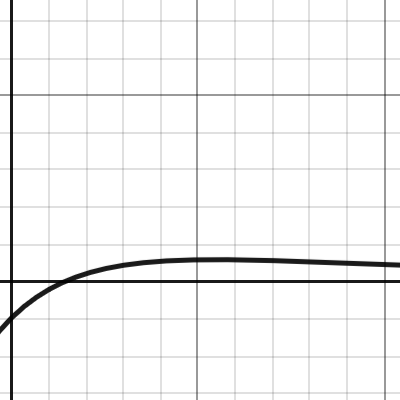
Desmos
I got the facts "from inspection" by knowing that exp(-5t/2) < exp(-t/2) for all t > 0
And as you can see, x'0 doesn't actually matter for the existence of zeroes.
Can you post the original question so I can verify that your solution to the DE is correct?
@vague isle ^
vague isle
brazen viper
Can you post the original question so I can verify that your solution to the DE ...
it's a bit involved but it comes with solutions for the various questions
this last passage is from inspection of the above inequality?
 vague isle
brazen viper
I got the facts "from inspection" by knowing that exp(-5t/2) < exp(-t/2) for all...
vague isle
brazen viper
I got the facts "from inspection" by knowing that exp(-5t/2) < exp(-t/2) for all...
i'm not following here, where that exp comes from?
vague isle
brazen viper
And as you can see, x'0 doesn't actually matter for the existence of zeroes.
I think it matters, you see if you change b in the graph, it changes the initial velocity and can or cannot cross zero
brazen viper
exp(x) = e^x. It comes from your general solution
vague isle
and where you get the -5/2 from?
brazen viper
The two exponents of e in the general solution
vague isle
vague isle
I think it matters, you see if you change b in the graph, it changes the initial...
if you set b=0.4 in your graph you'll see
vague isle
brazen viper
The two exponents of e in the general solution
oh.. ok let me read again
vague isle
brazen viper
I got the facts "from inspection" by knowing that exp(-5t/2) < exp(-t/2) for all...
but that's not enough, there are initial conditions that changes that from my understanding
brazen viper
Yes, but we need the sign of the expression to change
So in order for that to happen the two need different signs
I'm only explaining why I knew to look there, not a statement about all permutations of c1 and c2
vague isle
in the solution they actually find a range for x0'
brazen viper
Ah, I think I understand what I did wrong here. I don't quite have a proper constraint for t.
vague isle
but i don't understand the reasoning.

they pull out a triple inequality.
and manage to solve for x' as well
brazen viper
Right, I had half that inequality.
Ok, I understand the reasoning there.
So
Which part, the triple inequality?
vague isle
how you get there from the reasoning above?
if i have
-c2/c1>1
-c2>c1
brazen viper
So ask yourself here, is c1 positive or negative
You have to account for both possibilities
Because if c1 is negative you must change the direction of the inequality
That is why it split into two and why 0 suddenly appears
vague isle
wait wait
i get -c2/c1 >1 because t is positive when ln(-c2/c1) is >1
no i mean
the ln(x) is defined when x is positive.
and ln is positive when x >1
brazen viper
\begin{align*}
c2/c1 &< -1 \
-c2/c1 &> 1 \
-c2 &> c1 && \qq{If c1 is positive} \
-c2 &> c1 > 0 \
-c2 &< c1 && \qq{If c1 is negative} \
-c2 &< c1 < 0
\end{align*}
vague isle
so if c2 is positive, c1 is positive as well, cause there's a minus in front.
if c2 is negative same thing, c1 is negative because of the minus.
warm shaleBOT
OmnipotentEntity
 brazen viper
No
vague isle
i dont understand why i find this so difficult.
there is a part of my brain that is not trained with this.
brazen viper
In the second case c1 is negative, so -c2 is more negative, meaning that c2 itself is positive.
vague isle
let me try draw this on a number line to see if visually all makes more sense.
i know c1 and c2 must be opposite sign to be <-1
anyway thank you, i think you gave me the answer. I need to spend some time trying to figure it out.
it must be very simple, yet for some reason i'm struggling a lot.
vague isle
warm shale
**OmnipotentEntity**
how it's called / where do i study these things in math? where can i make more practice?
i must be missing a method of thinking about these things.
brazen viper
vague isle
how it's called / where do i study these things in math? where can i make more p...
This is just basic inequalities, you learn about this in Algebra 1 or 2, don't remember which. Any text on basic algebra will have information on this.
vague isle
sorry i have another doubt about the train of thoughts
when i go from
-c2/c1>1
to
-c2>c1
what i am doing is manipulating the previous, mutiplying by c1
im am not thinking about the ratio and creating a new inequality.
right?
 vast wraith
anyone please help me with this question-Consider that a, b, c, d are positive real numbers satisfying (a + c)(b + d) = ac + bd.
Find the smallest possible value of S=a/b+b/c+c/d+d/a
vague isle
this channel is occupied i'm still trying to figure out the solution
use one available please
brazen viper
vague isle
sorry i have another doubt about the train of thoughts
when i go from
-c2/c1>1 ...
Yes this is correct, you are simply multiplying both sides by c1, and adjusting the direction of the inequality if appropriate.
vague isle
i think i found the reasoning that can lead me to that inequality in an easier way for my brain:
i do have -c2/c1>1
If c1>0 then -c2>c1
so i can attach them -c2>c1>0
the other case if c1<0 then -c2<c1
and becomes -c2<c1<0
it's really hard for me to go from -c2>c1 form and justifying a change of sign for the other case.
does what i wrote makes sense / is a good way of thinking about it?
or were you doing all this in your head already? you had some sort of intuition, you could just see it. ? @brazen viper I'm just trying to understand sorry
vague isle
brazen viper
Yes this is correct, you are simply multiplying both sides by c1, and adjusting ...
adjusting the direction is where i'm not comfortable.
brazen viper
Ok
So this is a true statement: -1 < 2
We can manipulate this statement in various ways.
By adding the same value to each side: 3 < 6
By multiplying the same positive value to each side: -2 < 4
But if we multiply a negative value we get a wrong statement
1 < -2
So in order to compensate for this, whenever we multiply by a value that is negative, we must flip the direction of the inequality.
@vague isle ^ does this help?
vague isle
brazen viper
But if we multiply a negative value we get a wrong statement
this is the part i'm having trouble with. why am I multiplying?
if i had
-c2>c1>0
and mult by -1
wouldn't i get
c2<-c1<0 ?
brazen viper
This part is in two different cases
Lines 1 and 2 are common to both cases
Lines 3 and 4 are for the case c1 > 0
And lines 5 and 6 are for the case c1 < 0
@vague isle
The negative number we're multiplying by is only in the second case. And that number is c1 itself
vague isle
ok i see the structure. I just wouldn't think it would make a difference, because line 1 and 2 should be equivalent
so i have no reason to solve it twice
brazen viper
Line 1 and 2 are equivalent, I was just trying to be explicit about the steps
1 -> 2 --> 3 -> 4
       |-> 5 -> 6
sorry i'm taking lots of your time for such a simple thing
brazen viper
No worries, I wouldn't be helping if I didn't find it rewarding
vague isle
let me once more state the train of thoughts
i get to
-c2/c1>1
now i separate the 2 c
-c2>c1
ok ths is a fact, this means that (to make the inequality works) c2 is negative so it becomes -(-c2)>c1
now, it could have been also the other way around, since it's a division, the minus could have been on c1
c2>-c1
this could have both c1 and c2 positive and the inequality would still holds
brazen viper
c2 is negative so it becomes -(-c2)
Not quite
@vague isle if your c2 is negative then -c2 is a positive number
It just "looks" negative because it has a negative sign in front of it.
vague isle
but that's my point, -c2 needs to be positive to be bigger than c1, which is positive
brazen viper
Yes
vague isle
isn't it what i wrote?
c2 is negative so it becomes -(-c2) which is positive c2
the minus outside the parenthesis is the one from the formula, the minus inside is the one i've added to say that c2 is negative
so it cancels out
brazen viper
Let c2 = -3 for an example. So -c2 = -(-3) = 3. So -c2 is positive. But c2 is negative.
-(-c2) = -(-(-3)) = -3
vague isle
you've added an extra minus
when i wrote -c2 inside parenthesis i just "facctored out" the -1 which was implicit
my expression remains -c2 and that c2 is the one i would use when substituting a number.
the (-c2) i wrote was to mimic a smilar example as you did with (-3)
i wrote it to make it obvious
i should have used another variable name maybe.
c2 = -x
so it becomes
-(-x)
brazen viper
I didn't write an extra minus sign
brazen viper
vague isle
i should have used another variable name maybe.
Yeah, you definitely need to make a new variable if you're going to assign it a different value lol
vague isle
my bad
vague isle
i understand but doesnt help in the grand scheme
can you help me out with the train of thoughts here?

understand the red part.
i don't get the jump of the green part
i am not multiplying the entire thing by -1, or the minus would be on the other side.
vague isle
so you would think what if c2 is negative?
ok then i must swap the sign
vague isle
trying with number line. i think i'm going crazy.
if c1 is positive, c2 is negative

so -c2 becomes positive and > c1.
and this works

0<c1<-c2 Check
if c1 is negative, c2 must be positive

so -c2 becomes negative, for the inequality to hold it must be between c1 and 0

which does't check with what we did before.
c1<-c2<0
why is this wrong?
 hollow flint
vague isle
understood! i think! thank you for your energy!
hollow flint
vague isle
understood! i think! thank you for your energy!
you can then type .close
vague isle
.close
obtuse pebbleBOT
Channel closed
Closed by @vague isle
Use .reopen if this was a mistake.
obtuse pebbleBOT
Available help channel!
Send your question here to claim the channel.
Remember:
• Ask your math question in a clear, concise manner.
• Show your work, and if possible, explain where you are stuck.
• After 15 minutes, feel free to ping <@&286206848099549185>.
• Type the command .close to free the channel when you're done.
• Be polite and have a nice day!
Read #❓how-to-get-help for further information on how to ask a good question, and about conduct in the question channels.
 glossy ether
Is the part where I halved du legal or do I have to use integration by parts?
 obtuse pebbleBOT
glossy ether
Is the part where I halved du legal or do I have to use integration by parts?
obtuse pebbleBOT
glossy ether
Is the part where I halved du legal or do I have to use integration by parts?
 north cradle
you have to change the bounds
 hearty scaffold
can anyone recommend me some sources to study pre calculus?
glossy ether
Sorry what do you mean by change the bounds?
north cradle
glossy ether
Sorry what do you mean by change the bounds?
when doing u sub, the bounds change
glossy ether
What do they change to
obtuse pebbleBOT
@glossy ether Has your question been resolved?
obtuse pebbleBOT
@glossy ether Has your question been resolved?
 safe haven
glossy ether
Is the part where I halved du legal or do I have to use integration by parts?
safe haven
glossy ether
Is the part where I halved du legal or do I have to use integration by parts?
your integration bounds is x, but if you switched to du you also need to switch your integration bounds to u
so in this case: your substitution is u = -sin(2x), and your lower bound is x = 0
put x = 0 into u to get your new lower bound
do the same with the upper bound
although in this case you'll just be integrating from 0 to 0 which is 0 anyways
obtuse pebbleBOT
Channel closed
Closed by @glossy ether
Use .reopen if this was a mistake.
Available help channel!
Send your question here to claim the channel.
Remember:
• Ask your math question in a clear, concise manner.
• Show your work, and if possible, explain where you are stuck.
• After 15 minutes, feel free to ping <@&286206848099549185>.
• Type the command .close to free the channel when you're done.
• Be polite and have a nice day!
Read #❓how-to-get-help for further information on how to ask a good question, and about conduct in the question channels.
 strong forum
The answers says this is 2/3
 obtuse pebbleBOT
strong forum
The answers says this is 2/3
strong forum
obtuse pebbleBOT
strong forum
The answers says this is 2/3
strong forum
That's incorrect right?
marsh geyser
It’s correct
marsh geyser
Show your job and show the method used in exercise 8
obtuse pebbleBOT
@strong forum Has your question been resolved?
strong forum
marsh geyser
Show your job and show the method used in exercise 8
The method is to use another point on plane and project te vector spanning those points onto the normal vector of the plane
(2,-1,3) to a point that lies on plane (1,-1,0)
Therefore vector i+3k goes from plane to point
The normal vector to plane is -i+2j+2k
Length of projection is ((i+3k) . (-i+2j+2k))/3
(3 is the length of the normal vector so we divide by that)
And that gives us 5/3
obtuse pebbleBOT
@strong forum Has your question been resolved?
obtuse pebbleBOT
@strong forum Has your question been resolved?
obtuse pebbleBOT
@strong forum Has your question been resolved?
obtuse pebbleBOT
@strong forum Has your question been resolved?
obtuse pebbleBOT
Channel closed
Closed due to timeout
Use .reopen if this was a mistake.
obtuse pebbleBOT
Available help channel!
Send your question here to claim the channel.
Remember:
• Ask your math question in a clear, concise manner.
• Show your work, and if possible, explain where you are stuck.
• After 15 minutes, feel free to ping <@&286206848099549185>.
• Type the command .close to free the channel when you're done.
• Be polite and have a nice day!
Read #❓how-to-get-help for further information on how to ask a good question, and about conduct in the question channels.
 proven oar
 obtuse pebbleBOT
proven oar
warm shaleBOT
obtuse pebbleBOT
proven oar
warm shaleBOT
 obtuse pebbleBOT
@proven oar Has your question been resolved?
obtuse pebbleBOT
Channel closed
Closed by @proven oar
Use .reopen if this was a mistake.
obtuse pebbleBOT
Available help channel!
Send your question here to claim the channel.
Remember:
• Ask your math question in a clear, concise manner.
• Show your work, and if possible, explain where you are stuck.
• After 15 minutes, feel free to ping <@&286206848099549185>.
• Type the command .close to free the channel when you're done.
• Be polite and have a nice day!
Read #❓how-to-get-help for further information on how to ask a good question, and about conduct in the question channels.
 delicate tiger
I need help with a math project
obtuse pebbleBOT
delicate tiger
I need help with a math project

 tardy epoch
delicate tiger
tardy epoch
delicate tiger
How old are you
delicate tiger
I know that the rest of the chart for the red bird numbers are 45 40 abd 33
16
im not trolling
deadass
 jaunty oasis
tardy epoch
How old are you
jaunty oasis
tardy epoch
How old are you
this seems like a pretty standard alg 1 thing
just with angry bird presentation
jaunty oasis
delicate tiger
no we have to put it all the equation in standard form
yeah, standard alg 1
delicate tiger
axis of sym
tardy epoch
jaunty oasis
this seems like a pretty standard alg 1 thing
People younger than 12 take algebra 1
delicate tiger
and distance traveld
jaunty oasis
tardy epoch
People younger than 12 take algebra 1
but most people who take alg 1 are older than that
usually in 8th or 9th
tardy epoch
jaunty oasis
but most people who take alg 1 are older than that
So?
delicate tiger
tardy epoch
People younger than 12 take algebra 1
oh well i am taking this right now in my pre calc 11 class
delicate tiger
I know the red bird now I need help with the blue and black bird
here i can send the criteria maybe it will help you too
 jaunty oasis
delicate tiger
I know the red bird now I need help with the blue and black bird
jaunty oasis
delicate tiger
I know the red bird now I need help with the blue and black bird
have you put blue bird in vertex form
and do you have an equation for black bird
delicate tiger
jaunty oasis
have you put blue bird in vertex form
one sec
for the blue bird i got y=(x squared -20x +100) +36
i can probably be more factored down but for now i got this
jaunty oasis
delicate tiger
for the blue bird i got y=(x squared -20x +100) +36
do you know what vertex form is yet?
also how to complete the square
delicate tiger
yes, but my teacher wants it in standard
jaunty oasis
delicate tiger
yes, but my teacher wants it in standard
for step 1, you do all that with vertex form
it's already in standard
jaunty oasis
delicate tiger
y=-(x-10)squared +36
ok so for future reference, squared is usually typeset as ^2
cubed is ^3 etc
anyways that looks right
now what is the vertex
delicate tiger
i have no idea
jaunty oasis
well, what is the vertex
jaunty oasis
delicate tiger
like max meaning it opens down
the vertex is the place where the parabola intersects its axis of symmetry, and in the case where the axis is vertical, then it is the min or max
we want the max, and because this parabola opens down (and thus has a vertical axis of symmetry), the vertex will be the max
delicate tiger
the y?
jaunty oasis
?
jaunty oasis
what is the equation of the line
the axis of symmetry is a line (in this case, it's vertical, like i said above)
jaunty oasis
we know that it goes through the vertex, which is (10,36)
jaunty oasis
delicate tiger
but wait
?
delicate tiger
is this all for the blue bird
delicate tiger
okay so we have the max height then
isnt the axis of sym 10
?
and we also need the distance traveld
jaunty oasis
delicate tiger
isnt the axis of sym 10
10 is not a line
delicate tiger
so what is the axis of sym
jaunty oasis
delicate tiger
so what is the axis of sym
in this case, a vertical line that goes through (10,36)
what would the equation of that be
jaunty oasis
delicate tiger
and how do we calc. the distance traveld
im going to assume they want the horizontal distance
in which case that's just the difference of the roots
delicate tiger
so whhats step one
jaunty oasis
delicate tiger
so whhats step one
i just told you how to do it
up to you to compute it
since it's just quadratic formula
or factorization if you want to go that route
delicate tiger
i have no idea how to do that
hello?
im sorry
i need heeeeleppp
@jaunty oasis
 daring sorrel
Let me read everything rq
delicate tiger
okay
delicate tiger
yes
daring sorrel
And you are looking for distance travelled
delicate tiger
so the data wants me to find the max height, the aos, and distance traveld
yes
i am looking for that
I dont know how to start and what to do
daring sorrel
You need to find at which 2 distances the bird has a height of 0, and find how far apart those are
y=height and x=distance
So you need to solve -x^2+20x-64=0
Are you able to do this?
delicate tiger
yes, but does it matter which form i put it in
daring sorrel
Nah
You will have 2 values for x after solving, you need to find the distance between them
delicate tiger
i got y=-(x-10)^2 +36
daring sorrel
Ok this is good for finding the maximum height
delicate tiger
yea so the vertex is 10,36
delicate tiger
what do i do for distance teaveld
daring sorrel
daring sorrel
So you need to solve -x^2+20x-64=0
Find for what x values this equation is true
delicate tiger
i dont know what that means
daring sorrel
Like for example the equation x^2-1=0 is true when x=-1 or 1
delicate tiger
maybe intercept form is better? y=-(x-16) x (x-4) this has 2 values
daring sorrel
delicate tiger
maybe intercept form is better? y=-(x-16) x (x-4) this has 2 values
Yes this is good
What is the value of y when you plug 16 into that
daring sorrel
x
delicate tiger
0?
daring sorrel
Yeah so that is one of x intercepts, aka when the height is 0
What is another value you can plug into x so that y=0
delicate tiger
wait so the first one was 16
daring sorrel
Yeah
delicate tiger
cant we just do 0
daring sorrel
-(0-16)(0-4)=-64 so not quite
Consider x=4
That will make (x-4)=0, and anything multiplied by 0 is 0, so -(x-16)(x-4) together is 0
daring sorrel
Yeah and now just find the distance between them
daring sorrel
Yeah
daring sorrel
Yeah for distance traveled
daring sorrel
Yeah
Ok well the max height is given
So that is one of the 3 things done
You are also give the x intercepts (aka when the bird is on the floor)
Can you figure out the distance traveled
daring sorrel
To answer the questions you do not need to write it as an equation. If you wanted to though it would be easiest to put it in factored form since you are given the x intercepts
The distance traveled though is just the distance between the x intercepts, which are given
delicate tiger
so 17
so what is the 28 yards used for? why did they give us the height
oh i think that for the graph
since we also have to graph it
 daring sorrel
delicate tiger
so 17
daring sorrel
delicate tiger
so 17
This is a little off how did u get that
delicate tiger
i meant the aos is 17
daring sorrel
Yeah I think I see how u got that. You did 34/2 right
delicate tiger
yea
daring sorrel
delicate tiger
so isnt it from the point 4,0 to 38,0
The thing is that since you start at (4, 0) it will be shifted 4 units
The easier way to find the mid point is to take the average of 4 and 38 (if you know the midpoint formula you can use that too)
delicate tiger
oh i dont know how to do that
delicate tiger
but isnt it 4 and 38
daring sorrel
Yeah my bad
delicate tiger
so 21
daring sorrel
Yeah
Notice how 21 is 17 units away from 4 and 17 units away from 38
So its symmetric
daring sorrel
Yeah
delicate tiger
okay
wait but i am confused
I dont have to measure for the yellw and red right
or do
i
daring sorrel
You do
daring sorrel
Ok can you find its maximum height
delicate tiger
49
daring sorrel
jaunty oasis
we want the max, and because this parabola opens down (and thus has a vertical a...
Reminder
delicate tiger
okay so the vertex is 12,49
daring sorrel
Yeah
delicate tiger
so its a vertical line going throught 12,49
daring sorrel
Yup
daring sorrel
Nah you dont need to
daring sorrel
delicate tiger
so its a vertical line going throught 12,49
This is good but can u give the equation
daring sorrel
daring sorrel
x=21
As I did here
delicate tiger
isnt it 49/2
daring sorrel
The equation will be x=(number)
delicate tiger
daring sorrel
(4+38)/2
like you did
daring sorrel
delicate tiger
do i also calc do avg
That was for this
delicate tiger
oh
daring sorrel
But we do not need to do that here
The equation will just be x=(x coord of vertex)
delicate tiger
x=(12,49)
daring sorrel
Just the x coord
delicate tiger
x=12
daring sorrel
To find the distance traveled, remember you need to find the x intercepts
delicate tiger
6 and 16
daring sorrel
6 is one of them, 16 is not
delicate tiger
here i sent agaian so we dont have to go back up

 delicate tiger
daring sorrel
6 is one of them, 16 is not
delicate tiger
daring sorrel
6 is one of them, 16 is not
okay
daring sorrel
(You will need to extend the table)
daring sorrel
Yeah find another x value where the y value will be 0
Ok for now can you fill in the 3 missing values of the table
delicate tiger
45 40 33
delicate tiger
daring sorrel
Yeah find another x value where the y value will be 0
okay
daring sorrel
Perfect, extend the table and do the same thing
daring sorrel
Yeah
delicate tiger
so the x's are 0 and 18
daring sorrel
6 and 18
daring sorrel
Yeah
daring sorrel
There are two ways to find the aos
You can either look at the vertex, or you can average the x intercept x coordinates
The time we averaged them we were not given the x coordinate of the vertex so we couldnt use it
daring sorrel
daring sorrel
You can either look at the vertex, or you can average the x intercept x coordina...
Yeah
Did not mean to reply to that
daring sorrel
Yup
delicate tiger
so what do we do now
daring sorrel
What do u think
daring sorrel
Yeah
daring sorrel
Yeah I think u just have to estimate
daring sorrel
Yeah I think i thats fine
I would prob say more like 18 or 19 but it doesnt really matter
As long as its between 14 and 21
Ok how about distance traveled
daring sorrel
Yeah
daring sorrel
Yeah
delicate tiger
okay for step 2
i alredy have an idea
on how to do it
so i dont need help with that
but what about step 3
do i just anwser those noramlly
daring sorrel
You can look at the graph from part 2
delicate tiger
okay
i think i got it
thank you so mucchchchc
can i give u like a vouch or smt
daring sorrel
And use part 1 aswell
delicate tiger
yupp
daring sorrel
delicate tiger
can i give u like a vouch or smt
Lol I do not think so
drifting roost
obtuse pebbleBOT
@delicate tiger Has your question been resolved?
obtuse pebbleBOT
Channel closed
Closed due to timeout
Use .reopen if this was a mistake.
Available help channel!
Send your question here to claim the channel.
Remember:
• Ask your math question in a clear, concise manner.
• Show your work, and if possible, explain where you are stuck.
• After 15 minutes, feel free to ping <@&286206848099549185>.
• Type the command .close to free the channel when you're done.
• Be polite and have a nice day!
Read #❓how-to-get-help for further information on how to ask a good question, and about conduct in the question channels.
Channel closed
Closed by @brave wigeon
Use .reopen if this was a mistake.
obtuse pebbleBOT
Available help channel!
Send your question here to claim the channel.
Remember:
• Ask your math question in a clear, concise manner.
• Show your work, and if possible, explain where you are stuck.
• After 15 minutes, feel free to ping <@&286206848099549185>.
• Type the command .close to free the channel when you're done.
• Be polite and have a nice day!
Read #❓how-to-get-help for further information on how to ask a good question, and about conduct in the question channels.
obtuse pebbleBOT
 pulsar oriole
@timid silo second to last expression. last term.
obtuse pebbleBOT
Channel closed
Closed by @junior elm
Use .reopen if this was a mistake.
Available help channel!
Send your question here to claim the channel.
Remember:
• Ask your math question in a clear, concise manner.
• Show your work, and if possible, explain where you are stuck.
• After 15 minutes, feel free to ping <@&286206848099549185>.
• Type the command .close to free the channel when you're done.
• Be polite and have a nice day!
Read #❓how-to-get-help for further information on how to ask a good question, and about conduct in the question channels.
 young meteor
if
obtuse pebbleBOT
young meteor
if
young meteor
$x^2 - 3x + 1 = 0$
warm shaleBOT
Matter
 warm shaleBOT
Matter
 versed stratus
one way would be to simply find x and solve
young meteor
and another one?
versed stratus
re-write it as (x^2+1/x)^2-2
 smoky vigil
versed stratus
re-write it as (x^2+1/x)^2-2
smoky vigil
versed stratus
re-write it as (x^2+1/x)^2-2
wouldn't it be 1/x^2?
warm shaleBOT
Why am. I here
 versed stratus
then notice x^2+1=3x
smoky vigil
$\left(x^{2}+\f{1}{x^2}\right)^{2}-2$
golden night
correct madam
warm shaleBOT
🫎Mοοsey🫎: quantlice real #1 simp
 young meteor
hmm
versed stratus
now I personally would write this as $(( x+\frac{1}{x}))^2 -2)^2-2$
warm shaleBOT
Why am. I here
 versed stratus
then notice $x^2+1=3x$
warm shaleBOT
Why am. I here
 young meteor
yes
versed stratus
can you do it from here
obtuse pebbleBOT
Channel closed
Closed by @young meteor
Use .reopen if this was a mistake.
Available help channel!
Send your question here to claim the channel.
Remember:
• Ask your math question in a clear, concise manner.
• Show your work, and if possible, explain where you are stuck.
• After 15 minutes, feel free to ping <@&286206848099549185>.
• Type the command .close to free the channel when you're done.
• Be polite and have a nice day!
Read #❓how-to-get-help for further information on how to ask a good question, and about conduct in the question channels.
 sinful eagle
Hi
obtuse pebbleBOT
sinful eagle
Hi
obtuse pebbleBOT
Channel closed
Closed by @sinful eagle
Use .reopen if this was a mistake.
Available help channel!
Send your question here to claim the channel.
Remember:
• Ask your math question in a clear, concise manner.
• Show your work, and if possible, explain where you are stuck.
• After 15 minutes, feel free to ping <@&286206848099549185>.
• Type the command .close to free the channel when you're done.
• Be polite and have a nice day!
Read #❓how-to-get-help for further information on how to ask a good question, and about conduct in the question channels.
 solid cargo
Yo can someone explain the conditions required so that we can use L'hopitals rule for limits or we can use it for any question
obtuse pebbleBOT
solid cargo
Yo can someone explain the conditions required so that we can use L'hopitals rul...
versed stratus
it should be an indefinite form so 0/0 or infty/infty
solid cargo
versed stratus
it should be an indefinite form so 0/0 or infty/infty
u only use it on rational forms is this correct?
like f(x)/g(x)
my book also says that
for evaluation Lim x->a for f(x)/g(x) using L'hopital
f(a)= 0 and g(a)=0
i dont understand this
versed stratus

Mathematics Stack Exchange
I have seen easy geometrical argument why L'Hopital's rule ($\lim_{x \to a} \frac{f(x)}{g(x)} = \lim_{x \to a} \frac{f'(x)}{g'(x)}$) works (local linearization). But, I still don't understand this:...
solid cargo
versed stratus
see this :- https://math.stackexchange.com/questions/3749175/lhopitals-rule-cond...
ok i got it
thx
.close
obtuse pebbleBOT
Channel closed
Closed by @solid cargo
Use .reopen if this was a mistake.
Available help channel!
Send your question here to claim the channel.
Remember:
• Ask your math question in a clear, concise manner.
• Show your work, and if possible, explain where you are stuck.
• After 15 minutes, feel free to ping <@&286206848099549185>.
• Type the command .close to free the channel when you're done.
• Be polite and have a nice day!
Read #❓how-to-get-help for further information on how to ask a good question, and about conduct in the question channels.
 stray forge
The differential equation for this can also be x instead of strictly y right guys?
Because I found x = 1/(yC-y^2)
 obtuse pebbleBOT
stray forge
The differential equation for this can also be x instead of strictly y right guy...
stray forge
obtuse pebbleBOT
stray forge
The differential equation for this can also be x instead of strictly y right guy...
stray forge
There is probably a way to check for y as I used wolfram but it looks tedious to do
obtuse pebbleBOT
@stray forge Has your question been resolved?
obtuse pebbleBOT
@stray forge Has your question been resolved?
Channel closed
Closed by @stray forge
Use .reopen if this was a mistake.
Available help channel!
Send your question here to claim the channel.
Remember:
• Ask your math question in a clear, concise manner.
• Show your work, and if possible, explain where you are stuck.
• After 15 minutes, feel free to ping <@&286206848099549185>.
• Type the command .close to free the channel when you're done.
• Be polite and have a nice day!
Read #❓how-to-get-help for further information on how to ask a good question, and about conduct in the question channels.
 sour lantern
 obtuse pebbleBOT
sour lantern
sour lantern
obtuse pebbleBOT
sour lantern
sour lantern
does anyone know what even is this and how to look for it?
I'm talking about the ^A D notation
obtuse pebbleBOT
@sour lantern Has your question been resolved?
 pseudo swift
never really seen something like it
what class/subject does that come from ?
@sour lantern
pseudo swift
yeah you're better off rereading your book or something
it seems like notation special to robotics
pseudo swift
pseudo swift
yeah you're better off rereading your book or something
or finding a forum about robotics specifically
the best we could do is read the book with you tbh
@sour lantern
obtuse pebbleBOT
Channel closed
Closed by @sour lantern
Use .reopen if this was a mistake.
Available help channel!
Send your question here to claim the channel.
Remember:
• Ask your math question in a clear, concise manner.
• Show your work, and if possible, explain where you are stuck.
• After 15 minutes, feel free to ping <@&286206848099549185>.
• Type the command .close to free the channel when you're done.
• Be polite and have a nice day!
Read #❓how-to-get-help for further information on how to ask a good question, and about conduct in the question channels.
 lost widget
 obtuse pebbleBOT
lost widget
obtuse pebbleBOT
lost widget
 slate stream
lost widget
Any hint to start this integral
slate stream
lost widget
Any hint to start this integral
nope
 humble cobalt
Pray
slate stream
 humble cobalt
Jk
slate stream
where did u even get this from
humble cobalt
Could you try integrating by parts?
 alpine bison
maybe espilon want a quick ban for trolling?
slate stream
alpine bison
maybe espilon want a quick ban for trolling?
^^
lost widget
alpine bison
maybe espilon want a quick ban for trolling?
??
slate stream
it doesnt even look solvable
slate stream
lost widget
For 12th grade
i dont think 12 grade requires you to solve impossible integrals
lost widget
Idk man this is what I got
 upper shuttle
just don't comment if you aren't going to help...
lost widget
I will try with taylor series
slate stream
upper shuttle
just don't comment if you aren't going to help...
i did help
its
not
possible
alpine bison
upper shuttle
just don't comment if you aren't going to help...
trolling is not allowed.. just to remember
lost widget
alpine bison
trolling is not allowed.. just to remember
I am not trying to troll man
alpine bison
ok fine
slate stream
lost widget
I am not trying to troll man
can i have a screenshot of the whole page
 upper shuttle
not all integrals have an anti derivative
lost widget
Elementary anti derivative
versed stratus
You;d probably have to convert it to a sum or use rieman integrals
I can't help, I just know that all definite integrals can be evaluvated
slate stream
so this area
 lost widget
versed stratus
You;d probably have to convert it to a sum or use rieman integrals
lost widget
versed stratus
You;d probably have to convert it to a sum or use rieman integrals
Yes trying to calculate the anti derivative with series and then using Leibniz newton
Or just write it as a riemann sum or darboux sum idk
slate stream
lost widget
Or just write it as a riemann sum or darboux sum idk
so uh
wolfram crashed
i have no idea actually
this man is genius
lost widget
Yeah stupid problem. Idk why they put this type of problems for 12th graders
slate stream
😭
lost widget
.close
obtuse pebbleBOT
Channel closed
Closed by @lost widget
Use .reopen if this was a mistake.
Available help channel!
Send your question here to claim the channel.
Remember:
• Ask your math question in a clear, concise manner.
• Show your work, and if possible, explain where you are stuck.
• After 15 minutes, feel free to ping <@&286206848099549185>.
• Type the command .close to free the channel when you're done.
• Be polite and have a nice day!
Read #❓how-to-get-help for further information on how to ask a good question, and about conduct in the question channels.
 unreal nexus
How to put the matrix below into row echelon form?
 obtuse pebbleBOT
unreal nexus
How to put the matrix below into row echelon form?
upper shuttle
obtuse pebbleBOT
unreal nexus
How to put the matrix below into row echelon form?
upper shuttle

wikiHow
The row-echelon form of a matrix is highly useful for many applications. For example, it can be used to geometrically interpret different vectors, solve systems of linear equations, and find out properties such as the determinant of the...
 candid copper
Since we are back here, again use the similarity and the sequence like property of the matrix to simplify it
unreal nexus
 candid copper
unreal nexus
candid copper
unreal nexus
If you get a row of ones it definitely gives you more flexibility to deal with the matrix
unreal nexus
upper shuttle
https://www.wikihow.com/Reduce-a-Matrix-to-Row-Echelon-Form
Wait, can I swap rows?
candid copper
Yep
unreal nexus
candid copper
Yep
I will see what I can do with it
candid copper
unreal nexus
I will see what I can do with it
Yeah give it a try and let me know what you get
obtuse pebbleBOT
@unreal nexus Has your question been resolved?
unreal nexus
candid copper
Yeah give it a try and let me know what you get
Would it be good to replace row of ones with the first row?
candid copper
Uhm not necessarily but it really depends on where you are right now
obtuse pebbleBOT
@unreal nexus Has your question been resolved?
obtuse pebbleBOT
Channel closed
Closed by @unreal nexus
Use .reopen if this was a mistake.
Available help channel!
Send your question here to claim the channel.
Remember:
• Ask your math question in a clear, concise manner.
• Show your work, and if possible, explain where you are stuck.
• After 15 minutes, feel free to ping <@&286206848099549185>.
• Type the command .close to free the channel when you're done.
• Be polite and have a nice day!
Read #❓how-to-get-help for further information on how to ask a good question, and about conduct in the question channels.
 fallen zenith
hälp
 obtuse pebbleBOT
fallen zenith
hälp
fallen zenith
obtuse pebbleBOT
fallen zenith
hälp
fallen zenith
it has to be smth with a negative exponent
fallen zenith
u->inf
 lyric ember
and do you maybe know that limit?
fallen zenith
so its basically lim n-> inf(1-1/n)^n
fallen zenith
lyric ember
and do you maybe know that limit?
it would be 1 in my mind
but it obviously isnt
lyric ember
its a famous limit
 native inlet
(very famous  )
)
native inlet
yep so it's the same for yours but with 3n instead of n :)
lyric ember
let m = -n
lyric ember
okay first substitue -1/n for m
lyric ember
okay do you know how to continue?
fallen zenith
with (1+m)^(-1/m)
lyric ember
$\lim_{m \to 0} (1 + m)^{\frac{-1}{m}}$
fallen zenith
hm
warm shaleBOT
tobi
 fallen zenith
looks very similar to e
yes
you are right
hmmm
but m is still approaching -0
lyric ember
$\lim_{m \to 0} (1 + m)^{\frac{-1}{m}} = \lim_{m \to 0} ((1 + m)^m)^{-1}$
warm shaleBOT
tobi
 fallen zenith
is it still the same?
lyric ember
why can we do what exactly?