#help-10
1 messages · Page 312 of 1
 graceful stirrup
 obtuse pebbleBOT
Channel closed
Closed by @graceful stirrup
Use .reopen if this was a mistake.
obtuse pebbleBOT
 Available help channel!
Send your question here to claim the channel.
Remember:
• Ask your math question in a clear, concise manner.
• Show your work, and if possible, explain where you are stuck.
• After 15 minutes, feel free to ping <@&286206848099549185>.
• Type the command .close to free the channel when you're done.
• Be polite and have a nice day!
Read #❓how-to-get-help for further information on how to ask a good question, and about conduct in the question channels.
 west delta
 obtuse pebbleBOT
west delta
west delta
obtuse pebbleBOT
west delta
west delta
<@&286206848099549185>
 leaden ginkgo
!15m
obtuse pebbleBOT
Please only use the <@&286206848099549185> ping once if your question has not been answered for 15 minutes. Please do not ping or DM individual users about your question.
west delta
leaden ginkgo
!15m
o oops im new
 hexed zinc
west delta
hexed zinc
west delta
it’s 1
hexed zinc
buddy ur arguing with someone in calculus 3
west delta
or not
west delta
calc has nothing to do with
west delta
hexed zinc
what math is this
uhh number theory or alg
hexed zinc
west delta
waffling abt
i love you
hexed zinc
no one saw that bro
west delta
the uno reverse
 limber quartz
hexed zinc
buddy ur arguing with someone in calculus 3
limber quartz
hexed zinc
buddy ur arguing with someone in calculus 3
This ain't calculus
west delta
limber quartz
This ain't calculus
halp
hexed zinc
limber quartz
This ain't calculus
ok if this ain’t calculus then ur real analysis
west delta
hexed zinc
no one saw that bro
👁️
hexed zinc
i’m math 55
west delta
hexed zinc
i’m math 55
im math 69
hexed zinc
the hardest class at harvard
west delta
hardest class at clown school
limber quartz
I don't remember this stuff. You need somebody who's recently done Discreet or maybe Combinatorics
west delta
limber quartz
I don't remember this stuff. You need somebody who's recently done Discreet or m...
wait heres the solution
i jut need someone
to decipher it
limber quartz
I can't do that, there's too much unspoken
hexed zinc
limber quartz
I don't remember this stuff. You need somebody who's recently done Discreet or m...
are you a discrete function or continuous
limber quartz
But I recognize the series as being used to solve problems in Combinatorics
west delta
yeah its supposed to be a generating function
just no idea how he factored it
<@&286206848099549185>
limber quartz
west delta
yeah its supposed to be a generating function
There's the words
Generating functions
west delta
hexed zinc
how can i help
wow
west delta
west delta
halp
 wary trench
hi
 glacial crag
Hi
west delta
help
obtuse pebbleBOT
@west delta Has your question been resolved?
obtuse pebbleBOT
@west delta Has your question been resolved?
obtuse pebbleBOT
@west delta Has your question been resolved?
west delta
.close
obtuse pebbleBOT
Channel closed
Closed by @west delta
Use .reopen if this was a mistake.
obtuse pebbleBOT
Available help channel!
Send your question here to claim the channel.
Remember:
• Ask your math question in a clear, concise manner.
• Show your work, and if possible, explain where you are stuck.
• After 15 minutes, feel free to ping <@&286206848099549185>.
• Type the command .close to free the channel when you're done.
• Be polite and have a nice day!
Read #❓how-to-get-help for further information on how to ask a good question, and about conduct in the question channels.
 uncut parcel
How would you get f(-3^(1/2))
 obtuse pebbleBOT
uncut parcel
How would you get f(-3^(1/2))
obtuse pebbleBOT
uncut parcel
How would you get f(-3^(1/2))
 tardy epoch
uncut parcel
How would you get f(-3^(1/2))
tardy epoch
uncut parcel
How would you get f(-3^(1/2))
f is just made up of straight lines
Find h' with product rule first
obtuse pebbleBOT
@uncut parcel Has your question been resolved?
uncut parcel
<@&286206848099549185>
 hot harness
Look at the graph
f(x) is a line from x <0
So if you find the slope you can find f(-sqrt3)
hot harness
uncut parcel
h' is f(x) * 1/(1+(x/2)^2)^(1/2) + arcsin(x/2) * f'(x)
Do you mean *1/2 not ^1/2
uncut parcel
hot harness
So if you find the slope you can find f(-sqrt3)
ok
uncut parcel
.close
obtuse pebbleBOT
Channel closed
Closed by @uncut parcel
Use .reopen if this was a mistake.
Available help channel!
Send your question here to claim the channel.
Remember:
• Ask your math question in a clear, concise manner.
• Show your work, and if possible, explain where you are stuck.
• After 15 minutes, feel free to ping <@&286206848099549185>.
• Type the command .close to free the channel when you're done.
• Be polite and have a nice day!
Read #❓how-to-get-help for further information on how to ask a good question, and about conduct in the question channels.
 frosty brook
I need to prove this statemen
 obtuse pebbleBOT
frosty brook
I need to prove this statemen
obtuse pebbleBOT
frosty brook
I need to prove this statemen
 frosty brook
Here is my attempt with induction
frosty brook
frosty brook
Here is my attempt with induction
I tried to induct on number of edges. Denoted with n in the proof
obtuse pebbleBOT
@frosty brook Has your question been resolved?
obtuse pebbleBOT
@frosty brook Has your question been resolved?
obtuse pebbleBOT
Channel closed
Closed due to timeout
Use .reopen if this was a mistake.
Available help channel!
Send your question here to claim the channel.
Remember:
• Ask your math question in a clear, concise manner.
• Show your work, and if possible, explain where you are stuck.
• After 15 minutes, feel free to ping <@&286206848099549185>.
• Type the command .close to free the channel when you're done.
• Be polite and have a nice day!
Read #❓how-to-get-help for further information on how to ask a good question, and about conduct in the question channels.
 devout yarrow
I'm currently training for a math competition, and in several practise questions i found that it is required to be able to isolate a variable in a two variable quadratic equation (usually not factorable). One such example that I need help with understanding: Find all integer solutions to $x+y=x^2-xy+y^2$. The solution involved isolating y, and I do not know how to do so. Any help is appreciated.
obtuse pebbleBOT
devout yarrow
I'm currently training for a math competition, and in several practise questions...
 warm shaleBOT
everything_addict

 drifting roost
devout yarrow
I'm currently training for a math competition, and in several practise questions...
drifting roost
devout yarrow
I'm currently training for a math competition, and in several practise questions...
isn't the quadratic just:
x^2 - (y+1)x + (y^2-y) = 0
 tidal gazelle
those questions are written with the intention that you should not be able to isolate any of the variables, you solve them with other ways such as finding inequalities or in your quadratic finding the roots and setting them equal to zero to break it into smaller equations
obtuse pebbleBOT
@devout yarrow Has your question been resolved?
devout yarrow
tidal gazelle
those questions are written with the intention that you should not be able to is...
The solution in the book itself finds y in terms of x
tidal gazelle
could you show the equation the book has for y in terms of x
warm shaleBOT
everything_addict
 devout yarrow
here
tidal gazelle
yeah thats the same as finding the roots of the quadratic, in this case the quadratic is $y^2 + y(-x-1) - x + x^2 = 0$. Apply the quadratic formula and you will get the same equation.
warm shaleBOT
nova
 devout yarrow
ok
tidal gazelle
Now the term under the square root must be a perfect square in order for y to be an integer
devout yarrow
ill try manipulating to get that form
devout yarrow
tidal gazelle
Now the term under the square root must be a perfect square in order for y to be...
yep
its easy from there
thanks for ur help
i managed to manupulate it to a typical quadratic
.close
obtuse pebbleBOT
Channel closed
Closed by @devout yarrow
Use .reopen if this was a mistake.
Available help channel!
Send your question here to claim the channel.
Remember:
• Ask your math question in a clear, concise manner.
• Show your work, and if possible, explain where you are stuck.
• After 15 minutes, feel free to ping <@&286206848099549185>.
• Type the command .close to free the channel when you're done.
• Be polite and have a nice day!
Read #❓how-to-get-help for further information on how to ask a good question, and about conduct in the question channels.
 plain sparrow
Two mutually directed chords are drawn from one point of the circumference
obtuse pebbleBOT
plain sparrow
Two mutually directed chords are drawn from one point of the circumference
plain sparrow
how to draw this
obtuse pebbleBOT
@plain sparrow Has your question been resolved?
Channel closed
Closed by @plain sparrow
Use .reopen if this was a mistake.
obtuse pebbleBOT
Available help channel!
Send your question here to claim the channel.
Remember:
• Ask your math question in a clear, concise manner.
• Show your work, and if possible, explain where you are stuck.
• After 15 minutes, feel free to ping <@&286206848099549185>.
• Type the command .close to free the channel when you're done.
• Be polite and have a nice day!
Read #❓how-to-get-help for further information on how to ask a good question, and about conduct in the question channels.
 dim breach
i need help
obtuse pebbleBOT
dim breach
i need help
 final thunder
!da2a
obtuse pebbleBOT
No need to ask “Can I ask…?” or “Does anyone know about…?”—it’s faster for everyone if you just ask your question! See https://dontasktoask.com/
dim breach
hi
final thunder
hi
dim breach
can u dm me
final thunder
no
dim breach
i need personl help
final thunder
Just post your question here.
 polar fossil
eyebrow raised
 final thunder

final thunder
What do you know about a rhombus.
final thunder
What do you know about the lengths of the four sides?
dim breach
ig i gotta make triangel ccongurent
final thunder
right
dim breach
.close
obtuse pebbleBOT
Channel closed
Closed by @dim breach
Use .reopen if this was a mistake.
final thunder
obtuse pebbleBOT
Available help channel!
Send your question here to claim the channel.
Remember:
• Ask your math question in a clear, concise manner.
• Show your work, and if possible, explain where you are stuck.
• After 15 minutes, feel free to ping <@&286206848099549185>.
• Type the command .close to free the channel when you're done.
• Be polite and have a nice day!
Read #❓how-to-get-help for further information on how to ask a good question, and about conduct in the question channels.
 inner helm
Does anyone know how to answer these questions?
 obtuse pebbleBOT
inner helm
Does anyone know how to answer these questions?
obtuse pebbleBOT
inner helm
Does anyone know how to answer these questions?
 tender stratus
inner helm
Does anyone know how to answer these questions?
tender stratus
inner helm
Does anyone know how to answer these questions?
assuming those are functions, g/f seems to represent g(x)/f(x) for x in the intersection of their domains
 mossy adder
inner helm
Does anyone know how to answer these questions?
mossy adder
inner helm
Does anyone know how to answer these questions?
It does seem like you do have to intersect the domains, so do that first
I never encountered that being a thing, but I guess it is here
and then you can answer for each point x in the domain what f(x)/f(x) is
and that way you have a new function
inner helm
huh
inner helm
tender stratus
assuming those are functions, g/f seems to represent g(x)/f(x) for x in the inte...
I didn't get it
tender stratus
inner helm
I didn't get it
are you familiar with the concept of functions?
tender stratus
so if you think of f and g as functions, you can say stuff like f(3) = 2 and g(3) = 8
inner helm
yeah
tender stratus
and then we define g/f (a new function) as g(x)/f(x)
but we cant really allow x for which we have no outputs from g(x) or f(x)
so we restrict x to be in their common domain
inner helm
tender stratus
but we cant really allow x for which we have no outputs from g(x) or f(x)
what do you mean by "allow x"
inner helm
tender stratus
so we restrict x to be in their common domain
how
how did they get this

same here

I don't get how to answer these questions
tender stratus
oh so you didn't understand the + one too
inner helm
yes
tender stratus
might help to read on "function composition"
wait thats not the right term i think
one min
inner helm
I know how to find the composite of functions if they ask for (f(gx)) or g(f(x)
tender stratus
inner helm
I know how to find the composite of functions if they ask for (f(gx)) or g(f(x)
sorry, composition was the wrong word
when they say f + g it's just the sum of their individual outputs
inner helm
Sum and difference and product and quotient of function you mean
tender stratus
yes
inner helm
tender stratus
when they say f + g it's just the sum of their individual outputs
oh wait lemme try
Yah no Idk
tender stratus
suppose I want to find (f+g)(2)
this is f(2) + g(2)
by definition
can you find that in the second question?
inner helm
f(2)=-1
g(2)=-3
f(2)+g(2) = (-1)+(-3) = -4
tender stratus
thats correct
inner helm
ohhh
tender stratus
so now we add (2, -4) to our set
tender stratus
it's the same thing, except you do g(x)/f(x)
obtuse pebbleBOT
Channel closed
Closed by @inner helm
Use .reopen if this was a mistake.
Available help channel!
Send your question here to claim the channel.
Remember:
• Ask your math question in a clear, concise manner.
• Show your work, and if possible, explain where you are stuck.
• After 15 minutes, feel free to ping <@&286206848099549185>.
• Type the command .close to free the channel when you're done.
• Be polite and have a nice day!
Read #❓how-to-get-help for further information on how to ask a good question, and about conduct in the question channels.
 daring cairn
could anyone help me prove this
 obtuse pebbleBOT
daring cairn
could anyone help me prove this
obtuse pebbleBOT
daring cairn
could anyone help me prove this
 glossy basalt
daring cairn
could anyone help me prove this
glossy basalt
daring cairn
could anyone help me prove this
 daring cairn
glossy basalt
daring cairn
glossy basalt
uhh could u explain i am kinda confused
glossy basalt
sure
glossy basalt
daring cairn
uhh could u explain i am kinda confused
do you recall any theorem that relate the ? with theta?
daring cairn
uhh no
glossy basalt
oh ok,do you recall
angle at centre=2×angle at circumference
tender stratus
it's an isoceles triangle
glossy basalt
now that you notice that theta/2 you can try and notice which tan(theta/2) related to
specifically which right-angled triangle
do tell if you want to get the triangle highlighted
 obtuse pebbleBOT
Channel closed
Closed by @daring cairn
Use .reopen if this was a mistake.
Available help channel!
Send your question here to claim the channel.
Remember:
• Ask your math question in a clear, concise manner.
• Show your work, and if possible, explain where you are stuck.
• After 15 minutes, feel free to ping <@&286206848099549185>.
• Type the command .close to free the channel when you're done.
• Be polite and have a nice day!
Read #❓how-to-get-help for further information on how to ask a good question, and about conduct in the question channels.
inner helm
How do I solve this?
 obtuse pebbleBOT
inner helm
How do I solve this?
obtuse pebbleBOT
inner helm
How do I solve this?
 versed stratus
inner helm
How do I solve this?
versed stratus
inner helm
How do I solve this?
can you express 27sqrt7 as the product of two terms?
inner helm
yes
log(base 3) 27 + log(base 3) sqrt7
it'll be 3 +
idk how to get x/2
ohh
I got it
obtuse pebbleBOT
Channel closed
Closed by @inner helm
Use .reopen if this was a mistake.
obtuse pebbleBOT
Available help channel!
Send your question here to claim the channel.
Remember:
• Ask your math question in a clear, concise manner.
• Show your work, and if possible, explain where you are stuck.
• After 15 minutes, feel free to ping <@&286206848099549185>.
• Type the command .close to free the channel when you're done.
• Be polite and have a nice day!
Read #❓how-to-get-help for further information on how to ask a good question, and about conduct in the question channels.
final thunder
<@&268886789983436800>
 upbeat plinth
.close
obtuse pebbleBOT
Channel closed
Closed by @upbeat plinth
Use .reopen if this was a mistake.
Available help channel!
Send your question here to claim the channel.
Remember:
• Ask your math question in a clear, concise manner.
• Show your work, and if possible, explain where you are stuck.
• After 15 minutes, feel free to ping <@&286206848099549185>.
• Type the command .close to free the channel when you're done.
• Be polite and have a nice day!
Read #❓how-to-get-help for further information on how to ask a good question, and about conduct in the question channels.
daring cairn
could someone help me solve it i got a quadratic equation 11x²-78x-120=0 which doesn't solve to whole numbers
 obtuse pebbleBOT
daring cairn
could someone help me solve it i got a quadratic equation 11x²-78x-120=0 which...
obtuse pebbleBOT
daring cairn
could someone help me solve it i got a quadratic equation 11x²-78x-120=0 which...
 royal basin
show your work
maybe you made some kind of arithmetic error somewhere
also what are your pronouns?
daring cairn
anything i don't mind
daring cairn
royal basin
maybe you made some kind of arithmetic error somewhere
it's kinda messy u won't understand
royal basin
ok you can take off all pronoun roles except "any pronouns" for future ref
royal basin
daring cairn
it's kinda messy u won't understand
then rewrite it to make it not messy
otherwise it is impossible to diagnose where your error came from
daring cairn
alright is okay if i close the req now and reopen it in 10mins with same question or will this channel stay like this ?
royal basin
you'll get pinged after some time, press ❌ on the bot prompt to keep the channel open.
then ping me once you've got your work so i can look at it.
daring cairn
oh alright thanks
royal basin
i reproduced the thing and got almost the same equation as you though, except my x coefficient is different. mine doesn't seem to have any integer solutions either though.
although nobody said i didn't fuck up either
hang on
nevermind, my equation does have integer solutions (hopefully).
obtuse pebbleBOT
@daring cairn Has your question been resolved?
daring cairn
royal basin
i reproduced the thing and got almost the same equation as you though, except my...
on redoing it i have noticed i made a mistake
is the equation 11x²-98x-120=0
royal basin
matches mine now
obtuse pebbleBOT
Channel closed
Closed by @daring cairn
Use .reopen if this was a mistake.
Available help channel!
Send your question here to claim the channel.
Remember:
• Ask your math question in a clear, concise manner.
• Show your work, and if possible, explain where you are stuck.
• After 15 minutes, feel free to ping <@&286206848099549185>.
• Type the command .close to free the channel when you're done.
• Be polite and have a nice day!
Read #❓how-to-get-help for further information on how to ask a good question, and about conduct in the question channels.
 odd wraith
guys
 obtuse pebbleBOT
odd wraith
guys
odd wraith
obtuse pebbleBOT
odd wraith
guys
odd wraith
f(x) 9x^2-2x and g(x) = e^8x
for f(x) i did 3 derivatives
and for g(x) i did 3 integrals
in the final i got
this

but when i check an example, it wants an answer like this:

but i couldnt get the last part
odd wraith
odd wraith
but when i check an example, it wants an answer like this:
this one is from a differnet question
differnet*
different*
 inland matrix
odd wraith
but when i check an example, it wants an answer like this:
inland matrix
odd wraith
but when i check an example, it wants an answer like this:
Answer like that? Wdym?
odd wraith
I can't get it this way
 inland matrix
odd wraith
this
inland matrix
odd wraith
this
The first term, ig in the brackets it should be (9x²-2x) instead
odd wraith
yes
okay i got it this way

but im not sure is it correct or no
thank you
.close
obtuse pebbleBOT
Channel closed
Closed by @odd wraith
Use .reopen if this was a mistake.
Available help channel!
Send your question here to claim the channel.
Remember:
• Ask your math question in a clear, concise manner.
• Show your work, and if possible, explain where you are stuck.
• After 15 minutes, feel free to ping <@&286206848099549185>.
• Type the command .close to free the channel when you're done.
• Be polite and have a nice day!
Read #❓how-to-get-help for further information on how to ask a good question, and about conduct in the question channels.
 sinful eagle
Lg100-lg0.1
obtuse pebbleBOT
sinful eagle
Lg100-lg0.1
 sweet gulch
what is lg?
 meager aspen
Uhh hello?
 timid silo
sweet gulch
what is lg?
timid silo
sweet gulch
what is lg?
log most likely
sinful eagle
log
sweet gulch
ok
timid silo
the base though? couldnt tell u
sweet gulch
yeah, 10^2 = 100 and 0.1 = 10^-1
sinful eagle
base don’t matter
sweet gulch
not 10^-2
sinful eagle
ah so 3?
timid silo
log 1000
sinful eagle
.close
obtuse pebbleBOT
Channel closed
Closed by @sinful eagle
Use .reopen if this was a mistake.
timid silo
3 log 10
obtuse pebbleBOT
Available help channel!
Send your question here to claim the channel.
Remember:
• Ask your math question in a clear, concise manner.
• Show your work, and if possible, explain where you are stuck.
• After 15 minutes, feel free to ping <@&286206848099549185>.
• Type the command .close to free the channel when you're done.
• Be polite and have a nice day!
Read #❓how-to-get-help for further information on how to ask a good question, and about conduct in the question channels.
 deft torrent
 obtuse pebbleBOT
deft torrent
timid silo
obtuse pebbleBOT
deft torrent
timid silo
angular velocity is radians/time in seconds yes
mossy adder
go through the definitions and information over time
you know the length, so you can calculate the area of its circle
then you can calculate how frequently it goes through that circle
timid silo
Yeah u can calculate the amount of radians swept in the 8s using the area given and the area of the circle
then just divide by 8 to get rad/s
timid silo
deft torrent
why do you need the area of the circle ?
because your 50 square meter area thats been swept out is the area multiplied by some amount of radians
obtuse pebbleBOT
Channel closed
Closed by @deft torrent
Use .reopen if this was a mistake.
Available help channel!
Send your question here to claim the channel.
Remember:
• Ask your math question in a clear, concise manner.
• Show your work, and if possible, explain where you are stuck.
• After 15 minutes, feel free to ping <@&286206848099549185>.
• Type the command .close to free the channel when you're done.
• Be polite and have a nice day!
Read #❓how-to-get-help for further information on how to ask a good question, and about conduct in the question channels.
 fierce vale
what does this mean ??
 obtuse pebbleBOT
fierce vale
what does this mean ??
fierce vale
obtuse pebbleBOT
fierce vale
what does this mean ??
fierce vale
ik it's Laplacian but idk what this is :

 past sand
Just a vector
 kind hawk
problems with old books: old notation
fierce vale
kind hawk
problems with old books: old notation
prof is still using it till this day : (
.close
obtuse pebbleBOT
Channel closed
Closed by @fierce vale
Use .reopen if this was a mistake.
 wicked tree
fierce vale
ik it's Laplacian but idk what this is :
wicked tree
fierce vale
ik it's Laplacian but idk what this is :
no that’s a logarithm
probably functioned in with a square notation
obtuse pebbleBOT
Available help channel!
Send your question here to claim the channel.
Remember:
• Ask your math question in a clear, concise manner.
• Show your work, and if possible, explain where you are stuck.
• After 15 minutes, feel free to ping <@&286206848099549185>.
• Type the command .close to free the channel when you're done.
• Be polite and have a nice day!
Read #❓how-to-get-help for further information on how to ask a good question, and about conduct in the question channels.
deft torrent
 obtuse pebbleBOT
deft torrent
deft torrent
obtuse pebbleBOT
deft torrent
deft torrent
im having trouble with the rad/min
timid silo
imperial system… yikes
Basically the 65 miles per hour is your linear velocity
12 inches is your radius
do the conversions needed
then plug them into the formula
 hexed agate
timid silo
12 inches is your radius
hexed agate
timid silo
12 inches is your radius
*15
timid silo
hexed agate
*15
mb im dyslexic
obtuse pebbleBOT
Channel closed
Closed by @deft torrent
Use .reopen if this was a mistake.
Available help channel!
Send your question here to claim the channel.
Remember:
• Ask your math question in a clear, concise manner.
• Show your work, and if possible, explain where you are stuck.
• After 15 minutes, feel free to ping <@&286206848099549185>.
• Type the command .close to free the channel when you're done.
• Be polite and have a nice day!
Read #❓how-to-get-help for further information on how to ask a good question, and about conduct in the question channels.
 vernal void
The generating cone is inclined to the plane of the base at an angle ү. The distance from the top of the cone to the center of the sphere inscribed in it is equal to d. Determine the area of the lateral surface of the cone.
obtuse pebbleBOT
vernal void
The generating cone is inclined to the plane of the base at an angle ү. The dist...
vernal void

I think it looks something like this
so S= piRl
I need to find CB
and radius
idk how do it
obtuse pebbleBOT
@vernal void Has your question been resolved?
vernal void
<@&286206848099549185>
 frigid goblet
what DO you know ?
vernal void
vernal void
The generating cone is inclined to the plane of the base at an angle ү. The dist...
.
this
vernal void
vernal void
so S= piRl
and this
frigid goblet
it doesn't say if you know the value of anything
frigid goblet
are you trolling or do you actually need help?
vernal void
really need help
frigid goblet
ok
vernal void
I just gave an example that your question is not very precise
frigid goblet
do you know the value of mAB?
 celest halo
vernal void
The generating cone is inclined to the plane of the base at an angle ү. The dist...
celest halo
vernal void
The generating cone is inclined to the plane of the base at an angle ү. The dist...
this is the only information that the question gives?
vernal void
celest halo
this is the only information that the question gives?
yes
vernal void
frigid goblet
do you know the value of mAB?
m?
frigid goblet
mesure of point A to point B = mAB
vernal void
this is the diameter of the base
frigid goblet
!original:
obtuse pebbleBOT
Please show the original problem, exactly as it was stated to you, with the entire original context. A picture or screenshot is best. If the original problem is not in English, then post it anyway! The additional context might still be helpful. Do your best to provide a translation.
vernal void
it's in Ukrainian, can you translate it?
frigid goblet
yes, mostly with my phone
 frigid goblet
what grade are you in, cause i'm going to use university level stuff
 vernal void
so S= piRl
vernal void
vernal void
so S= piRl
not this?
frigid goblet
you are right my formula add the base under witch is out of the question
vernal void
I think we need to use trigonometric formulas here
 vernal void
so we have a circle inscribed in a cone and not a cone in a circle
oh
sry i blind
but I don’t quite understand how this will help us
frigid goblet
i showed you how to put a circle inside a triangle, all you have to do is the process inversed
vernal void
.close
obtuse pebbleBOT
Channel closed
Closed by @vernal void
Use .reopen if this was a mistake.
Available help channel!
Send your question here to claim the channel.
Remember:
• Ask your math question in a clear, concise manner.
• Show your work, and if possible, explain where you are stuck.
• After 15 minutes, feel free to ping <@&286206848099549185>.
• Type the command .close to free the channel when you're done.
• Be polite and have a nice day!
Read #❓how-to-get-help for further information on how to ask a good question, and about conduct in the question channels.
timid silo

 obtuse pebbleBOT
timid silo
warm shaleBOT
obtuse pebbleBOT
timid silo
warm shaleBOT
mj
 timid silo
also a valid solution?
warm shaleBOT


 Requested by kitten.in.a.teacup
polar fossil
Requested by kitten.in.a.teacup
polar fossil
why not?
polar fossil
they're not completely identical but they have the same properties listed in the question
obtuse pebbleBOT
Channel closed
Closed by @grizzled coral
Use .reopen if this was a mistake.
obtuse pebbleBOT
Available help channel!
Send your question here to claim the channel.
Remember:
• Ask your math question in a clear, concise manner.
• Show your work, and if possible, explain where you are stuck.
• After 15 minutes, feel free to ping <@&286206848099549185>.
• Type the command .close to free the channel when you're done.
• Be polite and have a nice day!
Read #❓how-to-get-help for further information on how to ask a good question, and about conduct in the question channels.
 molten fractal
The question is a+b+c+d=4. Prove abc+bcd+cda+dab<=4
But I worked out abc+bcd+cda+dab<4, can someone help pointing out what is wrong please, or tell me the correct way to solve this problem.
My approach is as followed:
4>=(a+d)(b+c)
16>=(a+d)(b+c)(a+b+c+d)
16>=(2×sqrt(ad)×(b+c)+2×sqrt(bc)×(a+d))(2(sqrt(ad)+sqrt(bc)))
4(abc+bcd+cda+dab+sqrt(abcd)×(a+b+c+d) 4-sqrt(abcd)×(a+b+c+d)>= abc+bcd+cda+dab
We can easily prove that 0<sqrt(abcd)<=1 so
4<abc+bcd+cda+dab
Which is wrong because 4 can equal abc+bcd+cda+dab.
obtuse pebbleBOT
molten fractal
The question is a+b+c+d=4. Prove abc+bcd+cda+dab<=4
But I worked out abc+bcd+cd...
 smoky vigil
try using (a+b+c+d)^3
molten fractal
smoky vigil
try using (a+b+c+d)^3
Can you explain more please?
warm shaleBOT
🫎Mοοsey🫎
 molten fractal
You wrote a^2+b^2+c^2+d^2>=4 before, isn't it correct?
smoky vigil
i was just overthinking, yeah its correct
assume all but one have magnitude less than one (only case where squaring gets smaller)
molten fractal
Yeah I mean I can prove it, you dont need to go further here, please continue with a^2+b^2+c^2+d^2>=4
smoky vigil
ah wait i was thinking wrong :I
molten fractal
So can you point out where my proof is wrong? Maybe we can work from there?
obtuse pebbleBOT
@molten fractal Has your question been resolved?
molten fractal
<@&286206848099549185>
devout yarrow
OK I might not be able to help you but first format it in latex
molten fractal
devout yarrow
OK I might not be able to help you but first format it in latex
Do you know a program that can do it automatically?
devout yarrow
Nah
molten fractal
.close
obtuse pebbleBOT
Channel closed
Closed by @molten fractal
Use .reopen if this was a mistake.
Available help channel!
Send your question here to claim the channel.
Remember:
• Ask your math question in a clear, concise manner.
• Show your work, and if possible, explain where you are stuck.
• After 15 minutes, feel free to ping <@&286206848099549185>.
• Type the command .close to free the channel when you're done.
• Be polite and have a nice day!
Read #❓how-to-get-help for further information on how to ask a good question, and about conduct in the question channels.
molten fractal
The question is a+b+c+d=4; a,b,c,d are positive real number. Prove abc+bcd+cda+dab<=4
But I worked out abc+bcd+cda+dab<4, can someone help pointing out what is wrong please, or tell me the correct way to solve this problem.
I worked out
4<abc+bcd+cda+dab
Which is wrong because 4 can equal abc+bcd+cda+dab.
 obtuse pebbleBOT
molten fractal
The question is a+b+c+d=4; a,b,c,d are positive real number. Prove abc+bcd+cda+d...
smoky vigil
obtuse pebbleBOT
molten fractal
The question is a+b+c+d=4; a,b,c,d are positive real number. Prove abc+bcd+cda+d...
smoky vigil
,rccw
warm shaleBOT
 molten fractal
Well there's a simple solution by changing the unknown
a=1+i+j+k
b=1-i
c=1-j
d=1-k
The inequality equals when i=j=k=0 but it's not the intended solution (the author explicitly told to use cauchy, cauchy might refers to the simple case, AM-GM, in my country)
molten fractal
smoky vigil
,rccw
thank you
 dim atlas
non equal cauchy
molten fractal
dim atlas
non equal cauchy
Can you explain in details please?
dim atlas
warm shale
i want to ask you about the question which used inequality cauchy
i can't understand cauchy
molten fractal
dim atlas
i want to ask you about the question which used inequality cauchy
So do you mean my solution is too messy or is there a line you don't understand?
dim atlas
I can't understand 4 >= abc +bcd +cda+ dab
molten fractal
dim atlas
I can't understand 4 >= abc +bcd +cda+ dab
Well it's what I'm trying to prove
molten fractal
Is there anythin else?
dim atlas
I'm afraid to bother you while you think
molten fractal
<@&286206848099549185>
obtuse pebbleBOT
@molten fractal Has your question been resolved?
timid silo
molten fractal
The question is a+b+c+d=4; a,b,c,d are positive real number. Prove abc+bcd+cda+d...
You should use AM - GM inequality
firstly , apply it to a , b , c , d
and you will get a relation
and then apply it to abc, bcd , cda, dab
timid silo
molten fractal
Can you give more hints please, I can't think of anything.
$$ \text{Given , a + b + c + d = 4} $$
warm shaleBOT
🎀 𝒫𝒶𝓃𝒾𝒸 🎀
 molten fractal
Please continue sir
timid silo
Using AM - GM inequality
$$ \frac{a + b + c + d}{4} \geq \sqrt[4]{abcd} $$
warm shaleBOT
🎀 𝒫𝒶𝓃𝒾𝒸 🎀
 timid silo
But we know that a + b + c + d = 4. So,
$$ 1 \geq \sqrt[4]{abcd} $$
$$ 1 \geq abcd $$
warm shaleBOT
🎀 𝒫𝒶𝓃𝒾𝒸 🎀
 timid silo
Now , we use the AM GM inequality on abc , bcd, cda , dab
$$ \frac{abc + bcd + cda + dab}{4} \geq \sqrt[4]{abc \cdot bcd \cdot cda \cdot dab} $$
warm shaleBOT
🎀 𝒫𝒶𝓃𝒾𝒸 🎀
 timid silo
molten fractal
Thank you so much
timid silo
molten fractal
Thank you so much
Welcome
obtuse pebbleBOT
Channel closed
Closed by @molten fractal
Use .reopen if this was a mistake.
obtuse pebbleBOT
Available help channel!
Send your question here to claim the channel.
Remember:
• Ask your math question in a clear, concise manner.
• Show your work, and if possible, explain where you are stuck.
• After 15 minutes, feel free to ping <@&286206848099549185>.
• Type the command .close to free the channel when you're done.
• Be polite and have a nice day!
Read #❓how-to-get-help for further information on how to ask a good question, and about conduct in the question channels.
 unreal cloud
How many two-digit numbers can Ahmet write on the blackboard such that the difference of any two of them is not a number consisting of two equal digits?
obtuse pebbleBOT
unreal cloud
How many two-digit numbers can Ahmet write on the blackboard such that the diffe...
unreal cloud
Ahmet is a name
royal basin
so in other words: how many 2-digit numbers can we write on the board so that no two of them differ by a multiple of 11
royal basin
do you know modular arithmetic?
if you do then my rephrasing of your question trivializes it
unreal cloud
royal basin
do you know modular arithmetic?
i know a little bit about it
royal basin
you want your numbers to not be congruent to each other modulo 11.
or in other words you want them all to have different remainders mod 11.
how many remainders are possible when dividing by 11?
unreal cloud
10
 obsidian isle
unreal cloud
obsidian isle
unreal cloud
1,2,3,4,5,6,7,8,9,10
royal basin
you forgot one
unreal cloud
0 ?
unreal cloud
.close
obtuse pebbleBOT
Channel closed
Closed by @unreal cloud
Use .reopen if this was a mistake.
obtuse pebbleBOT
Available help channel!
Send your question here to claim the channel.
Remember:
• Ask your math question in a clear, concise manner.
• Show your work, and if possible, explain where you are stuck.
• After 15 minutes, feel free to ping <@&286206848099549185>.
• Type the command .close to free the channel when you're done.
• Be polite and have a nice day!
Read #❓how-to-get-help for further information on how to ask a good question, and about conduct in the question channels.
fierce vale
$\frac{\partial f}{\partial x} \cdot \frac{\dd x}{\dd t}$
obtuse pebbleBOT
fierce vale
$\frac{\partial f}{\partial x} \cdot \frac{\dd x}{\dd t}$
warm shaleBOT
Adam Chebil
 fierce vale
can i simplify with partial x and dx ??
final thunder
What do you think?
royal basin
f_x dx/dt + f_y dy/dt can't really be simplified much further can it?
also differentiate* not derive
final thunder
fierce vale
i want to derive f(x,y) with respect to t
Simplify? I mean you would just find dx/dt and times it by del f/ del d
fierce vale
 fierce vale
final thunder
Simplify? I mean you would just find dx/dt and times it by del f/ del d
fierce vale
final thunder
Simplify? I mean you would just find dx/dt and times it by del f/ del d
they didn't use del operator here ?
final thunder
I meant partial
fierce vale
final thunder
I meant partial
i don't understand why we multiply by dx/dt ?
also shouldn't be written as partial f / partial t ??
 brazen gorge
fierce vale
i don't understand why we multiply by dx/dt ?
brazen gorge
fierce vale
i don't understand why we multiply by dx/dt ?
x changes as t changes
same with y
so we account for that (chain rule essentially)
brazen gorge
fierce vale
also shouldn't be written as partial f / partial t ??
no since f "depends" on x and y, and both x and y "depend" on t
also i see some other person was covering the exact same thing lol, maybe their notes will be helpful to you #help-7|zen1thxyz message
fierce vale
brazen gorge
so we account for that (chain rule essentially)
i don't see how we applied chain rule here : (
brazen gorge
fierce vale
i don't see how we applied chain rule here : (
let's make it a bit simpler and consider f(x)
1 variable
and we are looking for $\frac{df}{dt}$
warm shaleBOT
artemetra
 brazen gorge
where $x=x(t)$ - some function that outputs $x$ given $t$
warm shaleBOT
artemetra
 warm shaleBOT
artemetra
 warm shaleBOT
artemetra
 brazen gorge
we have composition of function hence chain rule
therefore, we also need to multiply by the derivative of x w.r.t t
hence, $\frac{df}{dt} = \frac{df}{dx}\frac{dx}{dt}$
warm shaleBOT
artemetra
 brazen gorge
you might also want to take a look at related rates, a very similar topic
@fierce vale does that make some sense?
obtuse pebbleBOT
@fierce vale Has your question been resolved?
fierce vale
brazen gorge
*$\frac{df}{dt} = \frac{df}{dx}$
why df/dt = df/dx here ?
brazen gorge
it's not
i put a * there in front
it's more of like the process yk
i think that image was extra, sorry
brazen gorge
warm shale
**artemetra**
start with this
fierce vale
warm shale
**artemetra**
here we differentiate the inside function which x(t) with respect to t
but why did we differentiate the outside function f with respect to x and not t ??
brazen gorge
fierce vale
but why did we differentiate the outside function f with respect to x and not t ...
that's what we are trying to find
df/dt is what we are looking for
fierce vale
brazen gorge
so $f(x)=f(x(t))$
shouldn't this be equal to : $x'(t)\cdot f'(x(t))$
warm shaleBOT
Adam Chebil
 warm shaleBOT
artemetra
 brazen gorge
$f'(x(t)) = \frac{df}{dx}$
warm shaleBOT
artemetra
 fierce vale
brazen gorge
$f'(x(t)) = \frac{df}{dx}$
fierce vale
brazen gorge
$f'(x(t)) = \frac{df}{dx}$
yeah this is what i don't understand
f'(x(t)) = df/ dt ? no?
fierce vale
how do i know which variable i put ?
brazen gorge
but $\frac{df}{dx} = f'(x(t))$ because it's the derivative of f as x changes, not t
warm shaleBOT
artemetra
 fierce vale
wait f here is a single variable function ??
brazen gorge
yes
fierce vale
oh ok
brazen gorge
brazen gorge
let's make it a bit simpler and consider f(x)
^
fierce vale
my problem is with multivariable fcts
brazen gorge
multivariable is the same just done twice essentially
fierce vale
do i write df/dx or df/dy ??
brazen gorge
$f(x,y) = f(x(t), y(t))$
warm shaleBOT
artemetra
 brazen gorge
fierce vale
do i write df/dx or df/dy ??
brazen gorge
fierce vale
do i write df/dx or df/dy ??
wdym?
fierce vale
$\frac{\dd f(x,y)}{\dd t}=x'(t)\frac{\dd f(x,y)}{\dd x}+y'(t)\frac{\dd f(x,y)}{\dd y}$ ?
how do i do this ?
brazen gorge
df/dt
warm shaleBOT
Adam Chebil
 fierce vale
brazen gorge
df/dt
fierce vale
brazen gorge
df/dt
i think i understand it now
can u explain when do should i write partial f or df ??
.close
obtuse pebbleBOT
Channel closed
Closed by @fierce vale
Use .reopen if this was a mistake.
Available help channel!
Send your question here to claim the channel.
Remember:
• Ask your math question in a clear, concise manner.
• Show your work, and if possible, explain where you are stuck.
• After 15 minutes, feel free to ping <@&286206848099549185>.
• Type the command .close to free the channel when you're done.
• Be polite and have a nice day!
Read #❓how-to-get-help for further information on how to ask a good question, and about conduct in the question channels.
timid silo
am i missing something? question asked about the stationary points, why are they doing the 2nd derivative? as far as im concerned f'(x) = 0 are the stationary points

 obtuse pebbleBOT
timid silo
am i missing something? question asked about the stationary points, why are they...
timid silo
obtuse pebbleBOT
timid silo
am i missing something? question asked about the stationary points, why are they...
timid silo
part b btw
i got x = 3 as a stationary point but i dont get why they did the 2nd derivative and found the minimum, someone explain if im missing something pelase
 median yacht
It's another method to classify stationary points
obtuse pebbleBOT
@timid silo Has your question been resolved?
timid silo
median yacht
It's another method to classify stationary points
how
also pls ping when u reply cuz i didnt see ur first message
anyways whats another method of classifying them
the 2nd derivative?
id understand if it was another method but its saying that the 2nd derivative has points yk
meaning i have to do both first derivative and second derivative to get the full grade
obtuse pebbleBOT
@timid silo Has your question been resolved?
obtuse pebbleBOT
@timid silo Has your question been resolved?
obtuse pebbleBOT
Channel closed
Closed due to timeout
Use .reopen if this was a mistake.
Available help channel!
Send your question here to claim the channel.
Remember:
• Ask your math question in a clear, concise manner.
• Show your work, and if possible, explain where you are stuck.
• After 15 minutes, feel free to ping <@&286206848099549185>.
• Type the command .close to free the channel when you're done.
• Be polite and have a nice day!
Read #❓how-to-get-help for further information on how to ask a good question, and about conduct in the question channels.
 mint arrow
 mint arrow
I would like to clarify my logic.
Zero Velocity = The object is stationary.
In this position vs. time graph, "B" is the stationary object, while A moves away from point of origin and C returns to origin.
Therefore, the letter on the chat that corresponds to zero velocity would be B.
If I am not on the right track, please redirect..
timid silo
mint arrow
In this position vs. time graph, "B" is the stationary object, while A moves awa...
Yeah with 0 velocity, the objects position doesnt change as it doesnt move
Objects stationary
B is at 0 velocity
 obtuse pebbleBOT
@mint arrow Has your question been resolved?
timid silo
mint arrow
C is moving toward the starting point right
yes C has a negative velocity
as its a straight line, velocity is constant
so C is where the velocity is constant towards the starting point
 obtuse pebbleBOT
Channel closed
Closed by @mint arrow
Use .reopen if this was a mistake.
Available help channel!
Send your question here to claim the channel.
Remember:
• Ask your math question in a clear, concise manner.
• Show your work, and if possible, explain where you are stuck.
• After 15 minutes, feel free to ping <@&286206848099549185>.
• Type the command .close to free the channel when you're done.
• Be polite and have a nice day!
Read #❓how-to-get-help for further information on how to ask a good question, and about conduct in the question channels.
 noble scroll
hello
obtuse pebbleBOT
noble scroll
hello
noble scroll

I made a mistake by clicking on the left-side in spyder, i can't go back to my codes lines 
I'm stuck, anyone can help me please
 lethal breach
Hey umm, this is a math server. Please keep your questions limited to that subject.
There are many other servers that'll help you with your coding and ide stuffs.
P.S. I would've still helped if I would've known this, but I don't.
Try going to the server that would actually help you out
obtuse pebbleBOT
@noble scroll Has your question been resolved?
obtuse pebbleBOT
Channel closed
Closed due to timeout
Use .reopen if this was a mistake.
Available help channel!
Send your question here to claim the channel.
Remember:
• Ask your math question in a clear, concise manner.
• Show your work, and if possible, explain where you are stuck.
• After 15 minutes, feel free to ping <@&286206848099549185>.
• Type the command .close to free the channel when you're done.
• Be polite and have a nice day!
Read #❓how-to-get-help for further information on how to ask a good question, and about conduct in the question channels.
 wanton kraken
my lecturer said that this is true
 obtuse pebbleBOT
wanton kraken
my lecturer said that this is true
wanton kraken
obtuse pebbleBOT
wanton kraken
my lecturer said that this is true
wanton kraken
but I think I lost the explanation of such property
was there such property?
I'm new to integrals
versed stratus
the derivative of ln(x) is 1/x, here d(ln(x)) simply acts as the element/variable wrt which you're integrating
wanton kraken
versed stratus
the derivative of ln(x) is 1/x, here d(ln(x)) simply acts as the element/variabl...
wrt?
versed stratus
with respect to
 buoyant zealot
have you heard of integrating by change of variable?
wanton kraken
uhh I think no
let me think this through
so
integral is basically f(x) is derivative of what
right?
[integral sign]1/x(dx)=ln(x)
ohhh
I see the tendency
wanton kraken
versed stratus
the derivative of ln(x) is 1/x, here d(ln(x)) simply acts as the element/variabl...
Ohhh so it's because

or these have to be the same

yes?
wanton kraken
buoyant zealot
have you heard of integrating by change of variable?
does that mean that these have to be the same?

(1/x)(dx)
versed stratus
no, I can integrate for instance dx/tan(x)
buoyant zealot
this is basically just integration by substitution (or change of variable)
you basically define u=lnx
substitute it in the integral
and that eliminates 1/x
versed stratus
but yes the variable has to be the same
wanton kraken
ohh
wanton kraken
buoyant zealot
this is basically just integration by substitution (or change of variable)
you b...
ohh
wait
so
buoyant zealot
if you understand integ by substitution itll be quite obvious what they did here
wanton kraken
buoyant zealot
if you understand integ by substitution itll be quite obvious what they did here
let me write this using paint
excuse my bad writing
buoyant zealot
but instead of actually replacing lnx by u
they just left it as it is
wanton kraken
buoyant zealot
but instead of actually replacing lnx by u
they just left it as it is
if we have it like that, we can use substitution

such so t=ln(x)
buoyant zealot
i mean you could replace ln x by t here mentally. but at this stage it isnt needed
wanton kraken
buoyant zealot
i mean you could replace ln x by t here mentally. but at this stage it isnt need...
but then why did this happen?
 buoyant zealot
because the boundaries are originally in x1 and x2
so when you change the variable you have to adjust the boundaries accordingly
wanton kraken
🤔
buoyant zealot
basically here you deifned t=lnx. and changed everything inside the integral to the variable t
but the boundaries also have to be changed since they were in x
wanton kraken
oh, right
wanton kraken
right
buoyant zealot
wanton kraken
if we have it like that, we can use substitution
at this point tho it isnt really necessary to use substitution
you use substitution when whatever you are integrating is in the form of a function multiplied by its derivative
you dont need to try to figure out how integ by substitution works from scratch.
there is a lot of content on it online.
its the type of idea that really clicks when you solve a couple examples
obtuse pebbleBOT
Channel closed
Closed by @wanton kraken
Use .reopen if this was a mistake.
Available help channel!
Send your question here to claim the channel.
Remember:
• Ask your math question in a clear, concise manner.
• Show your work, and if possible, explain where you are stuck.
• After 15 minutes, feel free to ping <@&286206848099549185>.
• Type the command .close to free the channel when you're done.
• Be polite and have a nice day!
Read #❓how-to-get-help for further information on how to ask a good question, and about conduct in the question channels.
 willow dust
 obtuse pebbleBOT
willow dust
willow dust
obtuse pebbleBOT
willow dust
willow dust
Someone help me solve this regularly without using the L’hopital’s rule
 spice rune
willow dust
Someone help me solve this regularly without using the L’hopital’s rule
spice rune
willow dust
Someone help me solve this regularly without using the L’hopital’s rule
1 - 2sin^2(x) = 2cos^2(x) - 1 = (2cos^2(x) - sin(2x)) + (sin(2x) - 1) = (2cos^2(x) - sin(2x)) - (cos(x) - sin(x))^2
can you continue from here?
willow dust
yes
I got 2 answers from doing it
first one is 1 and the second one is 0
Idk which one is correct
spice rune
willow dust
first one is 1 and the second one is 0
how did you get them?
 spice rune
willow dust
spice rune
willow dust
is that in any way related to what i wrote above?
 spice rune
willow dust
spice rune
willow dust
isn't it just the first step of the transformations i provided?
spice rune
willow dust
is it correct
yes
spice rune
how did you derive that?
 spice rune
willow dust
spice rune
willow dust
the denominator is incorrect
there you only multiply the first term by 2
but it should be both
willow dust
So its 2-2/2-1
spice rune
no
willow dust
can you solve it for me i will try to understand
spice rune
willow dust
So its 2-2/2-1
it's a 0/0 indeterminate form
spice rune
willow dust
can you solve it for me i will try to understand
the tricky part is transforming the numerator
that I've done above: #help-10 message
then just split it into two fractions and reduce each separately
willow dust
uhh
can u tell me the answer i will try to find solution to the answer
i dont really understand english math so its pretty difficult for me
spice rune
willow dust
i dont really understand english math so its pretty difficult for me
there's no such thing as "english math"
math is math
spice rune
spice rune
`1 - 2sin^2(x) = 2cos^2(x) - 1 = (2cos^2(x) - sin(2x)) + (sin(2x) - 1) = (2cos^2...
did you understand these transformations?
each step involves some formulas
spice rune
the second step is just adding and immediately subtracting sin(2x)
willow dust
I see
spice rune
we do this so that a part of the numerator exactly matches the denomirator
willow dust
What about the next step
spice rune
so we'll be able to reduce this part to 1
the last step is to transform sin(2x) - 1 into -(cos(x) - sin(x))^2
willow dust
Is it trigonometry formula
spice rune
spice rune
the last step is to transform `sin(2x) - 1` into `-(cos(x) - sin(x))^2`
you can derive it this way:
1 - sin(2x) = (sin^2(x) + cos^2(x)) - 2 sin(x) cos(x) = cos^2(x) - 2 cos(x) sin(x) + sin^2(x) = (cos(x) - sin(x))^2
we use the pythagorean identity and the double-angle formula for sine
spice rune
willow dust
i have no idea what that thing is
which one?
the pythagorean identity is sin^2(x) + cos^2(x) = 1
willow dust
phytagorean idenity
And double angle formula
do u memories all the formula or what
spice rune
willow dust
And double angle formula
there are formulas for sin(2x), cos(2x) etc
e.g. here we use that sin(2x) = 2sin(x)cos(x)
willow dust
in my country try we just memorize all of them
spice rune
you seem to have used it already judging by your denominator transformations
willow dust
but there are too many so i only memorize a few of them
do i dont really understand the formula
spice rune
willow dust
do u memories all the formula or what
jut the frequently used ones (like these)
willow dust
so if u transform it further its pretty hard to understand
spice rune
well, from this point everything is reduced pretty fast
spice rune
spice rune
you can derive it this way:
`1 - sin(2x) = (sin^2(x) + cos^2(x)) - 2 sin(x) cos(...
so did you understand this part?
willow dust
What are the frequently used formula for cos/sin 2x and cos/sin x^2
willow dust
spice rune
so did you understand this part?
I understand it now
spice rune
willow dust
What are the frequently used formula for cos/sin 2x and cos/sin x^2
there are actually just 3 main formulas that are used very often:
sin^2(x) + cos(^2x) = 1sin(2x) = 2 sin(x) cos(x)cos(2x) = sin^2(x) - cos^2(x)
by combining (1) and (3) you also getcos(2x) = 1 - 2sin^2(x) = 2cos^2(x) - 1
there also half-angle formulas (for sin(x/2), cos(x/2)) and formulas for things like sin(x + y), cos(x - y) etc
and many others but you don't see them too often
anyway, if you understand where they come from, you can always derive any of them even if you forget it
 lilac sun
spice rune
anyway, if you understand where they come from, you can always derive any of the...
lilac sun
spice rune
anyway, if you understand where they come from, you can always derive any of the...
I keep forgetting the sin(nx) formula so I just derive it using complex numbers and de moivre's theorem
spice rune
lilac sun
I keep forgetting the sin(nx) formula so I just derive it using complex numbers ...
lmao
don't mean that one lol
willow dust
Alright tysm
spice rune
willow dust
I understand it now
do you understand what to do next?
 spice rune
willow dust
I did it and got
spice rune
willow dust
I did it and got
good, i assume you mean 1 - lim ...
also it should be sin(2x) in the denominator
willow dust
What is 1 - lim ...
spice rune
not sin(x)
spice rune
willow dust
What is `1 - lim ...`
1 minus what's on your picture
spice rune
willow dust
why 1
because of the other part of the numerator
spice rune
not so fast
spice rune
spice rune
also it should be `sin(2x)` in the denominator
you have an error here
spice rune
well, 2cos^2(x) - sin(2x) for x = pi/4 is still 0
so in this form it's still 0/0
there's one additional step missing
maybe you've already done it and just not mentioning it?
willow dust
yea but there’s 1 minus the 0
willow dust
wait
spice rune
0/0 is not even a number
spice rune
because both numerator and denominator are 0 for x = pi/4
willow dust
is 2x1/2
spice rune
can you see how you can reduce the fraction?
and why such reduction would be legal (i.e. why you don't divide by 0)
willow dust
i dont really understand what u’re saying
can u write it down
thats what i meant “ english math “
spice rune
do you what reduction is?
willow dust
yes i know what reduction is
spice rune
can you figure out how that can help you simplify the fraction?
spice rune
it's not calculus, just basic algebra
do you see any common factors in numerator and denominator?
 willow dust
‘Cosx-sinx’ ?
willow dust
idk actually
spice rune
well, it would only be illegal if it could be equal to 0
the thing is though, it's only 0 when sin(x) = cos(x)
and as x approaches pi/4 it never actually gets to exactly pi/4
so sin(x) and cos(x) are always different
willow dust
by a small bit?
spice rune
yes
 spice rune
willow dust
‘Cosx-sinx’ ?
spice rune
willow dust
‘Cosx-sinx’ ?
what about reducing by that?
spice rune
wdym
willow dust
using a^2 - b^2
spice rune
i don't see a difference of squares anywhere here
why did you sugget cos x - sin x?
when i asked about common factors
willow dust
cuz i see it both has it
willow dust
numberator is the upper part and denomator is the bottom part right
spice rune
yes
numerator, not numberator
and denominator, not denomator
but otherwise you got it
 willow dust
so its equals to 1-1
spice rune
no
they only have a common factor of (cos x - sin x)
like 10 and 4 have a common factor of 2 but still not equal
willow dust
the thing is idk how to devide the denominator by that expression
spice rune
well you said it yourself that it is a common factor
to deduce that you'd need to factor the denominator (at least in your head) in the first place
 spice rune
still no
can you write the denominator for me such that it contains (cos x - sin x) as a factor?
willow dust
2cosx ( cosx-sinx )
 remote skiff
I know you've spent a long time on this problem going down this path for the last 2 hours (which works), but the clever trick for this kind of problem is to notice that a limit as x tends to pi/4 doesn't allow you to use a small angle approximation, nor does a substitution y = x-pi/4 make it easy to do so. So you use the substitution y = 2x-pi/2 which has y tend to zero as x tends to pi/4 and that immediately lets you simplify everything down into polynomials and calculate from there.
spice rune
other than that you forgot about the 1 at the beginning
so now the problem is almost solved
you just substitute
there's no 0/0 anymore
willow dust
remote skiff
I know you've spent a long time on this problem going down this path for the las...
I’ll try this method after i solved it this way

So this is the final aswer
Answer
spice rune
yes
spice rune
willow dust
its 2:35AM in my country
indonesia i guess?
willow dust
Cambodia
willow dust
remote skiff
I know you've spent a long time on this problem going down this path for the las...
Imma try this method

Is this how you do it
i use “t” instead of “y”
obtuse pebbleBOT
@willow dust Has your question been resolved?
willow dust
.close
obtuse pebbleBOT
Channel closed
Closed by @willow dust
Use .reopen if this was a mistake.
obtuse pebbleBOT
Available help channel!
Send your question here to claim the channel.
Remember:
• Ask your math question in a clear, concise manner.
• Show your work, and if possible, explain where you are stuck.
• After 15 minutes, feel free to ping <@&286206848099549185>.
• Type the command .close to free the channel when you're done.
• Be polite and have a nice day!
Read #❓how-to-get-help for further information on how to ask a good question, and about conduct in the question channels.
 silent furnace
 obtuse pebbleBOT
silent furnace
silent furnace
obtuse pebbleBOT
silent furnace
silent furnace
how’s this supposed to be done
 prisma hatch
!status
obtuse pebbleBOT
What step are you on?
1. I don't know where to begin.
2. I have begun but got stuck midway.
3. I got an answer but I was told that it's wrong.
4. I got an answer and would like my work checked.
5. I have a question about someone else's work/solution.
6. I have completed the problem and don't need help anymore. Thank you.
7. None of the above
im at the lcm part
prisma hatch
Can you send your work?
prisma hatch
silent furnace
(1+sin)^2+(cos^2y)/cosy+siny
Your denominator doesn't seem to be right
timid silo
expand (1+sin)^2
silent furnace
1+2sin+sin2
timid silo
prisma hatch
Your denominator doesn't seem to be right
^^
silent furnace
prisma hatch
Your denominator doesn't seem to be right
cosy+sinycosy
silent furnace
ok how do i get 2sec
prisma hatch
silent furnace
ok how do i get 2sec
Write cos2 in terms of sin2
silent furnace
2+2sin is?
timid silo
2* 1/cos is what?
silent furnace
2SEC
timid silo
yes
silent furnace
THANK U SO MUCH
timid silo
np
silent furnace
.close
obtuse pebbleBOT
Channel closed
Closed by @silent furnace
Use .reopen if this was a mistake.
Available help channel!
Send your question here to claim the channel.
Remember:
• Ask your math question in a clear, concise manner.
• Show your work, and if possible, explain where you are stuck.
• After 15 minutes, feel free to ping <@&286206848099549185>.
• Type the command .close to free the channel when you're done.
• Be polite and have a nice day!
Read #❓how-to-get-help for further information on how to ask a good question, and about conduct in the question channels.
 distant wasp
I've been learning a lot about the Discrete Fourier Transform lately, and though I'd try to recreate something in Desmos. What I came up with ends up flagging the correct frequencies, but also flags a bunch of incorrect frequencies as well. I'd be really grateful if someone could take a look at my Desmos thing, and I'd appreciate some pointers on how to fix it.
https://www.desmos.com/calculator/iiyzjtws9r
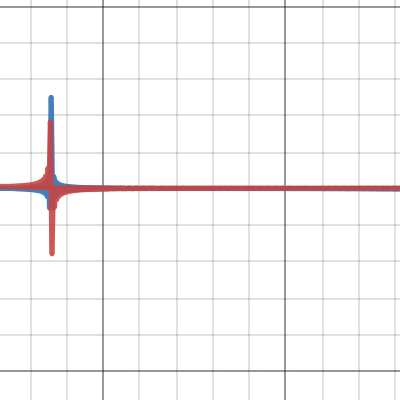
Desmos
obtuse pebbleBOT
distant wasp
I've been learning a lot about the Discrete Fourier Transform lately, and though...
distant wasp
Also, sorry this is a duplicate, but there was a misunderstanding with the original question that caused it to be buried
obtuse pebbleBOT
@distant wasp Has your question been resolved?
obtuse pebbleBOT
@distant wasp Has your question been resolved?
obtuse pebbleBOT
Channel closed
Closed due to timeout
Use .reopen if this was a mistake.
Available help channel!
Send your question here to claim the channel.
Remember:
• Ask your math question in a clear, concise manner.
• Show your work, and if possible, explain where you are stuck.
• After 15 minutes, feel free to ping <@&286206848099549185>.
• Type the command .close to free the channel when you're done.
• Be polite and have a nice day!
Read #❓how-to-get-help for further information on how to ask a good question, and about conduct in the question channels.
 lament atlas
 obtuse pebbleBOT
lament atlas
lament atlas
obtuse pebbleBOT
lament atlas
lament atlas
i did the integrals over dxdydz