#help-10
1 messages · Page 162 of 1
 tepid urchin
oh ok
 timid silo
you give them f(x)
tepid urchin
can you do an example?
timid silo
ok
take sine function
sin(x) = sin(0)+sin'(0) * x + sin''(0)/2x^2 + ..= sin(0) + x - x^2/2 + ...
by writing this sum using the sigma notation
you get this
timid silo
tepid urchin
how
there is no easy way to get it, it's the definition of taylor expansion.
tepid urchin
also how would I solve this without knowing that this was the taylor series of sinex
timid silo
tepid urchin
also how would I solve this without knowing that this was the taylor series of s...
I'm not sure there is any way. It's certainly not elementary math
especially that you have pi there
tepid urchin
im in calc || so if theres any method with that
tepid urchin
first it was derivitves then intagrals, now series
tepid urchin
its a past exam quesiron
timid silo
oh so it covers all calculus right ?
timid silo
it covers which part
 timid silo
tepid urchin
timid silo
tepid urchin
the other question is taylor's inequality hahaha
tepid urchin
;n;
timid silo
tepid urchin
they literally say power series, I can't imagine anyone taking a course in power series without knowing taylor expansion
if you check your notes you'll find them
tepid urchin
so do I just have to memorize a bunch of them?
timid silo
tepid urchin
so do I just have to memorize a bunch of them?
there are tricks to help you memorize, for example sine is an odd function, so it only has odd powers in its expansion
hence the 2n+1 in powers
tepid urchin
what ones should i memorize?
timid silo
tepid urchin
what ones should i memorize?
cosine and sine are pretty important, 1/(1-x) also (but you already know it)
you can also memorize the general formula, and then find the expansions with it
timid silo
Yw !
tepid urchin
can you help me with another problem?
timid silo
ok go ahead
tepid urchin
question 1 on the exam
timid silo
tepid urchin
question 1 on the exam
just factorize with 1/10 and use the expansion of 1/(1+x)
tepid urchin
whats that
 graceful pollen
timid silo
sin(x) = sin(0)+sin'(0) * x + sin''(0)/2x^2 + ..= sin(0) + x - x^2/2 + ...
graceful pollen
timid silo
sin(x) = sin(0)+sin'(0) * x + sin''(0)/2x^2 + ..= sin(0) + x - x^2/2 + ...
unrelated, but why was 0 used
timid silo
tepid urchin
whats that
 timid silo
graceful pollen
unrelated, but why was 0 used
timid silo
graceful pollen
unrelated, but why was 0 used
any number can be used i think, but 0 simplifies things
tepid urchin
why is the plus or minus sign upside dwon
timid silo
graceful pollen
unrelated, but why was 0 used
this probably depends on the radius of convergence, but this is another animal
graceful pollen
timid silo
any number can be used i think, but 0 simplifies things
ahh, that makes sense. Does that mean 180 can be used as well, since it would be equivalent
timid silo
tepid urchin
why is the plus or minus sign upside dwon
1/(1+x) = 1-x+x^2-x^3+x^4 - ...., upside down means we start with minus
timid silo
graceful pollen
ahh, that makes sense. Does that mean 180 can be used as well, since it would be...
yeah probably, but not with all functions I htink
graceful pollen
timid silo
yeah probably, but not with all functions I htink
yea, fair enough, thanks for clarifying
timid silo
tepid urchin
what would be an answer to the 1st question?
this need a pen and paper lol
tepid urchin
lol
timid silo
write the sum by writing the symbols (like you would with a pen)
timid silo
timid silo
write the sum by writing the symbols (like you would with a pen)
not using latex or some shit
timid silo
tepid urchin
but it looks very divergent bc the exponents keep getting bigger
convergence and divergence depend on the values of x
that's what a radius of convergence means
timid silo
tepid urchin
i plug in the numbers
you don't, they're asking your for the power series expansion ,and the interval of convergence
just keep x
interval of convergence = interval of x where the series is convergent
tepid urchin
ya
timid silo
this is a full course on power series, take your time
timid silo
wait i'll draw a solution in my computer, I am lazy bastard
tepid urchin
lol
 tardy epoch
tepid urchin
can you solve it on a piece of paper?
tardy epoch
tepid urchin
can you solve it on a piece of paper?
You should show your work rather than ask for a full on solution
timid silo
work out the rest
 tardy epoch
tepid urchin
I just need to see the full prosses
tardy epoch
tepid urchin
I just need to see the full prosses
Screenshot and upload and ask questions about it
If the professor gives a solution, you should understand it that way first
tepid urchin
?
tardy epoch
tepid urchin
?
Do you have a question
tepid urchin
timid silo
work out the rest
ok so you do this, then you plus a=10 into that equasion over there
then what
this is the answer btw
 timid silo
tepid urchin
this is the answer btw
timid silo
tepid urchin
this is the answer btw
this looks false, not sure though
tepid urchin
thats what my friends been saying
hes been working on this all night going crazy saying that this is wrong
timid silo
@tardy epoch am I allowed to post the full solutin
timid silo
tepid urchin
hes been working on this all night going crazy saying that this is wrong
wow it shouldn't be this hard but yeah he's right, this answer is false
timid silo
tepid urchin
this is the answer btw
who's the bastard who wrote this
timid silo
lol mr. lang is a bastard
tepid urchin
yes
timid silo
he bastardizes his students lol
timid silo
oh he should be in a bad mood then
tepid urchin
24/7
 timid silo
tepid urchin
how did you get that
timid silo
tepid urchin
how did you get that
get what ?
tepid urchin
the series
timid silo
taylor lol
timid silo
lol
tepid urchin
gimme a practice problem
timid silo
about taylor ym
tepid urchin
sure
timid silo
you can find this stuff in the internet
tepid urchin
ya
timid silo
with practice problems
timid silo
tepid urchin
how are you new and a helper?
they asked me to choose my role when i joined the forum
i mean the group
tepid urchin
oh lol
timid silo
it's probably a new thing
tepid urchin
nvm
timid silo
because I joined it before
 obtuse pebbleBOT
Channel closed
Closed by @tepid urchin
Use .reopen if this was a mistake.
 Available help channel!
Send your question here to claim the channel.
Remember:
• Ask your math question in a clear, concise manner.
• Show your work, and if possible, explain where you are stuck.
• After 15 minutes, feel free to ping <@&286206848099549185>.
• Type the command .close to free the channel when you're done.
• Be polite and have a nice day!
Read #❓how-to-get-help for further information on how to ask a good question, and about conduct in the question channels.
 vital frost
 obtuse pebbleBOT
vital frost
obtuse pebbleBOT
obtuse pebbleBOT
vital frost
obtuse pebbleBOT
Channel closed
Closed by @vital frost
Use .reopen if this was a mistake.
Available help channel!
Send your question here to claim the channel.
Remember:
• Ask your math question in a clear, concise manner.
• Show your work, and if possible, explain where you are stuck.
• After 15 minutes, feel free to ping <@&286206848099549185>.
• Type the command .close to free the channel when you're done.
• Be polite and have a nice day!
Read #❓how-to-get-help for further information on how to ask a good question, and about conduct in the question channels.
 lost wharf
 obtuse pebbleBOT
lost wharf
lost wharf
obtuse pebbleBOT
lost wharf
lost wharf
i'm not sure about my answer
lost wharf
 narrow fiber
Do you understand what the question is asking?
narrow fiber
Do you understand what the question is asking?
sort of
 lost wharf
ok
narrow fiber
Imagine "the lever" along with the square being rotated in the direction of the arrow (ccw)
They're basically asking how much do you need to rotate until the square reaches the 4th quadrant
lost wharf
ok
narrow fiber
How much do you think it needs to rotate?
lost wharf
about 90
lost wharf
so 180 so that it can reach the 4 quadrant
lost wharf
no
narrow fiber
Ah
lost wharf
doing my assignment
narrow fiber
I thought I'd tell you to try rotating your phone 180° and see where the square ends up
But you can't really do that on a pc
unless you rotate your head?
narrow fiber
obtuse pebbleBOT
Channel closed
Closed by @lost wharf
Use .reopen if this was a mistake.
Available help channel!
Send your question here to claim the channel.
Remember:
• Ask your math question in a clear, concise manner.
• Show your work, and if possible, explain where you are stuck.
• After 15 minutes, feel free to ping <@&286206848099549185>.
• Type the command .close to free the channel when you're done.
• Be polite and have a nice day!
Read #❓how-to-get-help for further information on how to ask a good question, and about conduct in the question channels.
 warm siren
 obtuse pebbleBOT
warm siren
warm siren
obtuse pebbleBOT
warm siren
warm siren
anyobody know how to get started on this
 robust sedge
Do you know the formulas for going back and forth between polar and cartesian coordinates?
warm siren
no i dont think i recall
robust sedge
I think that's where I would start
obtuse pebbleBOT
@warm siren Has your question been resolved?
Channel closed
Closed by @warm siren
Use .reopen if this was a mistake.
Available help channel!
Send your question here to claim the channel.
Remember:
• Ask your math question in a clear, concise manner.
• Show your work, and if possible, explain where you are stuck.
• After 15 minutes, feel free to ping <@&286206848099549185>.
• Type the command .close to free the channel when you're done.
• Be polite and have a nice day!
Read #❓how-to-get-help for further information on how to ask a good question, and about conduct in the question channels.
 pallid vapor
hi would it be possible to get some help here. im trying to see how the transfer function (marked 2) comes from its laplace transform above. i cant seem to understand. would be helpful if someone could show me the steps taken to reach the 2nd transfer function (marked 2)
 obtuse pebbleBOT
pallid vapor
hi would it be possible to get some help here. im trying to see how the transfer...
pallid vapor
obtuse pebbleBOT
pallid vapor
hi would it be possible to get some help here. im trying to see how the transfer...
pallid vapor
this one
 obtuse pebbleBOT
@pallid vapor Has your question been resolved?
obtuse pebbleBOT
Channel closed
Closed due to timeout
Use .reopen if this was a mistake.
Available help channel!
Send your question here to claim the channel.
Remember:
• Ask your math question in a clear, concise manner.
• Show your work, and if possible, explain where you are stuck.
• After 15 minutes, feel free to ping <@&286206848099549185>.
• Type the command .close to free the channel when you're done.
• Be polite and have a nice day!
Read #❓how-to-get-help for further information on how to ask a good question, and about conduct in the question channels.
 silent perch
A golf ball is struck from a point 23m to the left of the hole and lands at a point 17m to the right of the hole. It reaches a maximum height of 10m
-Determine an equation to represent the path of the golf ball
-When the ball is directly above the hole, how high in the air is it?
obtuse pebbleBOT
silent perch
A golf ball is struck from a point 23m to the left of the hole and lands at a po...
silent perch
if anyone could do step by step with me that'd be appreciated
obtuse pebbleBOT
@silent perch Has your question been resolved?
obtuse pebbleBOT
@silent perch Has your question been resolved?
 tranquil tide
silent perch
A golf ball is struck from a point 23m to the left of the hole and lands at a po...
tranquil tide
silent perch
A golf ball is struck from a point 23m to the left of the hole and lands at a po...
Is this all the question asks, is there like lore behind this
tranquil tide
can i see
tranquil tide
ok wait are you american
silent perch
Canadian
tranquil tide
is this mechanics
 silent perch
point on the left is 23,0 I think and point on the right is 17,0
tranquil tide
ok 1 sec
silent perch
ok
silent perch
Rip
tranquil tide
silent perch
Rip
i got it
😋

Ok my walk through was a bit messy tho
have you heard of completing the square


ok i hope you can read this
if u want a better step by step tell me before i go sleep ok bye
obtuse pebbleBOT
@silent perch Has your question been resolved?
obtuse pebbleBOT
Channel closed
Closed due to timeout
Use .reopen if this was a mistake.
Available help channel!
Send your question here to claim the channel.
Remember:
• Ask your math question in a clear, concise manner.
• Show your work, and if possible, explain where you are stuck.
• After 15 minutes, feel free to ping <@&286206848099549185>.
• Type the command .close to free the channel when you're done.
• Be polite and have a nice day!
Read #❓how-to-get-help for further information on how to ask a good question, and about conduct in the question channels.
 karmic vale
can i use universal generalization like this? I was trying to prove how a universal conditional statement is logically equivalent to its contrapositive and used universal generalization to do that
 obtuse pebbleBOT
karmic vale
can i use universal generalization like this? I was trying to prove how a univer...
obtuse pebbleBOT
karmic vale
can i use universal generalization like this? I was trying to prove how a univer...
@karmic vale Has your question been resolved?
karmic vale
<@&286206848099549185>
 next loom
this seems about right
obtuse pebbleBOT
@karmic vale Has your question been resolved?
obtuse pebbleBOT
Channel closed
Closed due to timeout
Use .reopen if this was a mistake.
obtuse pebbleBOT
Available help channel!
Send your question here to claim the channel.
Remember:
• Ask your math question in a clear, concise manner.
• Show your work, and if possible, explain where you are stuck.
• After 15 minutes, feel free to ping <@&286206848099549185>.
• Type the command .close to free the channel when you're done.
• Be polite and have a nice day!
Read #❓how-to-get-help for further information on how to ask a good question, and about conduct in the question channels.
 spark field
 obtuse pebbleBOT
spark field
spark field
obtuse pebbleBOT
spark field
spark field
how was this solved?
wdym
like create the riemann sum?
ah so
20-10/2
= delta x
@timid silo so upperestimate
would be
10+(k-1)deltax
and lower estimate
a+kdeltax
?
where n = 6
then just multiply it out and use the rules
and plug in n
how?
lower bound starts at 10 yea
wdym as height
you mean delta x?

top is
lower bound
bottom is upper bound
right ? @timid silo

are u sure?
the answer is -32
and 8
what
im so confused
how do we solve this
bro what
 warm shaleBOT
hannibal
 spark field
yea
wb it
delta x = 5
where did the 2 come from
and n = 2
so delta x = 5
yea
2 = n
not delta x
b-a/n is the formula
how?
oh yea ur right
the width is 2
mb
i mistakened that
oh i see
Oh
i get it now
we just multiply
it by delta x
and lower estimate would just be x= 18 and under
upper would be x = 20
obtuse pebbleBOT
@spark field Has your question been resolved?
spark field
yes it is
its from x=10 to x= 18
and its 8
for when
x = 10 to x= 20

this just means find the antidervative right?
obtuse pebbleBOT
Channel closed
Closed due to timeout
Use .reopen if this was a mistake.
Available help channel!
Send your question here to claim the channel.
Remember:
• Ask your math question in a clear, concise manner.
• Show your work, and if possible, explain where you are stuck.
• After 15 minutes, feel free to ping <@&286206848099549185>.
• Type the command .close to free the channel when you're done.
• Be polite and have a nice day!
Read #❓how-to-get-help for further information on how to ask a good question, and about conduct in the question channels.
spark field
 obtuse pebbleBOT
spark field
spark field
obtuse pebbleBOT
spark field
spark field
wb midpoint
how would this work
ik
so i start from 14?
im confused because we just estimated by f(x) * deltax
warm shaleBOT
hannibal
 spark field
oooh
so deltax = 1
then
wait no
18-10/5
ok so
18-10/5
then divide it agian
by 2
right
so delta x = .8
?
um what
?
subtract upper and lower
then divide by 2
-12
which sint correct
yea
but that wouldnt really work
💀
we are given f(x) number
wdym middle of interval
yea
wb it
ur not supposed to predicut f(x)
answer is -20
<@&286206848099549185>
any1 know
 fathom flicker
spark field
<@&286206848099549185>
fathom flicker
spark field
<@&286206848099549185>
go watch a video on how to do a midpoint riemann sum
for example the video that you linked a screenshot of
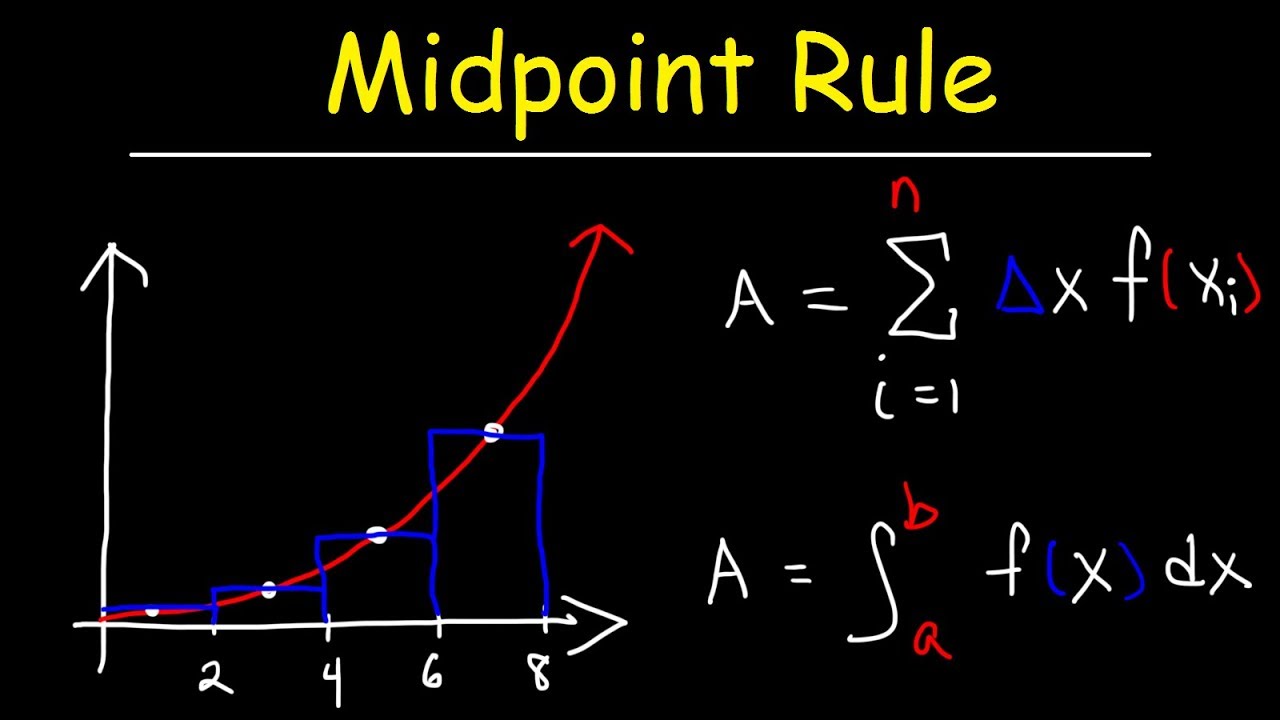
This calculus video tutorial provides a basic introduction into the midpoint rule which is used to approximate the area under the curve. This video explains how to use the midpoint rule to estimate the area of a region using rectangles and how to confirm the approximate integration by evaluating the definite integral over the closed interval. ...
spark field
fathom flicker
go watch a video on how to do a midpoint riemann sum
true i forgot he does it using this way
organic chem
the formula is diff when we have f(x) so i didnt know how to do it when we are giving the value of f(x)
fathom flicker
It's not different
for each rectangle f(x) is the height
so like just looking at the picture for the video above
f(x_i)
say i=1
this means f(1)
which is the height of the rectangle at x=1
which is just given in your table
but if it wasn't, you would just plug x=1 into your function
yet the formula remains the same
Watching the video should clear up your confusions.
obtuse pebbleBOT
@spark field Has your question been resolved?
obtuse pebbleBOT
@spark field Has your question been resolved?
obtuse pebbleBOT
@spark field Has your question been resolved?
obtuse pebbleBOT
Channel closed
Closed due to timeout
Use .reopen if this was a mistake.
Available help channel!
Send your question here to claim the channel.
Remember:
• Ask your math question in a clear, concise manner.
• Show your work, and if possible, explain where you are stuck.
• After 15 minutes, feel free to ping <@&286206848099549185>.
• Type the command .close to free the channel when you're done.
• Be polite and have a nice day!
Read #❓how-to-get-help for further information on how to ask a good question, and about conduct in the question channels.
timid silo
how do i solve this question?
 obtuse pebbleBOT
timid silo
how do i solve this question?
timid silo
obtuse pebbleBOT
timid silo
how do i solve this question?
timid silo
i know A is circle and B is ellipse
i understand they are asking in which points they will intersect
 trim portal
both are centered at (0, 0). So you dont even need to perform calculations
timid silo
but how do i know where they will intersect what if circle is bigger and doesn't intersect at all
 haughty coyote
You know their equations so you know them. Most notably the radii so you can draw them
trim portal
timid silo
but how do i know where they will intersect what if circle is bigger and doesn'...
not one of the possible answers, but if you want you can do some calculations and see that they do intersect
 royal basin
you can just treat this as a system of equations lmfao
timid silo
trim portal
not one of the possible answers, but if you want you can do some calculations an...
how do i do that ?
trim portal
royal basin
you can just treat this as a system of equations lmfao

You can either use substitution, or subtract/add those equations
timid silo
i don't know much about in these circles and ellipses so can u explain more?
 leaden ginkgo
are you familiar with solving simultaneous equations? using substitution/subtraction?
trim portal
x^2+y^2=25, this is the circle
x^2+9y^2=144, this is the ellipse
To find the intersection, you need to find points (x, y) such that they lie on both the circle, and ellipse. I.e. they satisfy those equations
so just solve system of those equations
timid silo
leaden ginkgo
are you familiar with solving simultaneous equations? using substitution/subtrac...
no
ok first i will learn about solving these eqs
trim portal
sorry my battery is at 5% and I cant charge it rn, bye
leaden ginkgo
what’d they teach you in school, before they gave you this problem?
timid silo
this question is not from a school i am just self studying rn
leaden ginkgo
look up how to solve systems of equations
obtuse pebbleBOT
Channel closed
Closed by @pure yarrow
Use .reopen if this was a mistake.
Available help channel!
Send your question here to claim the channel.
Remember:
• Ask your math question in a clear, concise manner.
• Show your work, and if possible, explain where you are stuck.
• After 15 minutes, feel free to ping <@&286206848099549185>.
• Type the command .close to free the channel when you're done.
• Be polite and have a nice day!
Read #❓how-to-get-help for further information on how to ask a good question, and about conduct in the question channels.
 dry arrow
hello, is there any way to solve this aside from multiplying everything first then finding lcm?
 obtuse pebbleBOT
dry arrow
hello, is there any way to solve this aside from multiplying everything first th...
royal basin
obtuse pebbleBOT
dry arrow
hello, is there any way to solve this aside from multiplying everything first th...
royal basin
well you could break the 6^1 into 2^1 * 3^1
so that the first number there is actually factored into primes and doesnt just appear as such
dry arrow
so it would be 2^3, 3^5, 2^4, 5^1, 3^2
then what?
oh nvm i got it
thanks for that saved me
.close
obtuse pebbleBOT
Channel closed
Closed by @dry arrow
Use .reopen if this was a mistake.
Available help channel!
Send your question here to claim the channel.
Remember:
• Ask your math question in a clear, concise manner.
• Show your work, and if possible, explain where you are stuck.
• After 15 minutes, feel free to ping <@&286206848099549185>.
• Type the command .close to free the channel when you're done.
• Be polite and have a nice day!
Read #❓how-to-get-help for further information on how to ask a good question, and about conduct in the question channels.
 faint ore
hello
obtuse pebbleBOT
faint ore
hello
faint ore
i need a little bit of helping differentiating these types of problems
for example f(x) = 3x/(x^2+16)^1/2
leaden ginkgo
do you know about the various rules of differentiation
faint ore
yes
leaden ginkgo
what do you need help with then
faint ore
i guess just executing them properly
here we go
so 3x * (x^2+16)^-1/2
product rule
leaden ginkgo
or just quotient rule
faint ore
u think thats better?
leaden ginkgo
i mean you won’t have to work with a negative power
faint ore
thats true
okay so [1/2 * (x^2 +16)^-1/2 *2x (3x) ] - [3(x^2+16)^1/2]
all over x^2+16
correct so far?
leaden ginkgo
you’re doing product rule?
leaden ginkgo
quotient rule is minus
leaden ginkgo
and it’s $\frac {f’(x)g(x) - f(x)g’(x)}{g(x)^{2}}$
warm shaleBOT
! saad
 faint ore
yes
okay so after simplifying a little further i get 3x/sqrt(x^2+16) - 3sqrt(x^2+16)
over x^2 +16
leaden ginkgo
use more brackets or type in latex or on a piece of paper
faint ore
how do u do the texit thing
leaden ginkgo
enclose in $
faint ore
$\frac{3(x^2+16)^{1/2}- 3x^{2}(x^2+16)^{-1/2}}{x^2+16}}$
royal basin
\sqrt not /sqrt
also \sqrt{...} not \sqrt(...)
also i think you forgot to take the derivative of the root at one point
leaden ginkgo
enclose powers in {}
leaden ginkgo
warm shale
**! saad**
.
f’(x)g(x) - f(x)g’(x)
you didn’t differentiate the sqrt properly either
 timber island
Isn't f'(x) 2x in this case? If f(x) = x^2
faint ore
oh dang
leaden ginkgo
it’ll be chain rule and power rule
faint ore
one moment while i redo this
leaden ginkgo
timber island
Isn't f'(x) 2x in this case? If f(x) = x^2
f(x) = 3x, i think
timber island
Oh
leaden ginkgo
faint ore
for example f(x) = 3x/(x^2+16)^1/2
this is the original function
yes, 3x
faint ore
okay here we go
leaden ginkgo
you forgot chain rule, again
faint ore
leaden ginkgo
you forgot chain rule, again
no i simplified
leaden ginkgo
stop skipping steps, i can’t follow your logic
write out the quotient rule as you would
then you can simplify
faint ore
alrighty
warm shaleBOT
Blackbeard
Compile Error! Click the  reaction for more information.
(You may edit your message to recompile.)
 faint ore
look good?
leaden ginkgo
yes
you could’ve separated the 3 earlier actually
constant multiple rule
easier to differentiate
leaden ginkgo
you can get rid of the negative power
faint ore
by square root right
leaden ginkgo
it just goes to the denominator and becomes square root $\frac {1}{2 \sqrt{x^{2}+16}}$
warm shaleBOT
! saad
 faint ore
why a 2
timber island
Question: is the final answer
$$\frac{3-3x}{\sqrt{x^2 + 16}}$$
leaden ginkgo
$\frac {1}{2} \cdot (x^{2} + 16)^{- \frac {1}{2}}$

 leaden ginkgo
$\frac {1}{2 \sqrt{x^{2}+16}}$
warm shaleBOT
! saad
 faint ore
since theres a 2x after it the 1/2 and 2 cancel out
faint ore
and the 1/2
leaden ginkgo
so you’ll just have 3x^2 in the numerator
faint ore
yup
warm shaleBOT
Blackbeard
okay so now i have $\frac{{3}{/sqrt{x^{2}+16}}$
```Compilation error:```! File ended while scanning use of \frac .
<inserted text>
                \par
<*> 786751657316581406.tex

I suspect you have forgotten a `}', causing me
to read past where you wanted me to stop.
I'll try to recover; but if the error is serious,
you'd better type `E' or `X' now and fix your file.``` leaden ginkgo
yes
timber island
faint ore
where could i go to further simplify
Got the correct answer (confirmed on mathway) u can simplify by letting sqrt (x2 + 16) = u
faint ore
what do u mean = u
 wooden marten
declare a new variable u
timber island
U substitute u for sqrt (x^2 + 16)
faint ore
why would i do that?
wooden marten
simplifies the fraction, ig
faint ore
you cant just multiply by the denominator or something
timber island
faint ore
why would i do that?
A simpler to write and b simpler to use laws to simplify
I can send a pic of my simplification procedure if u want
timber island
Yeah
obtuse pebbleBOT
Channel closed
Closed by @faint ore
Use .reopen if this was a mistake.
Available help channel!
Send your question here to claim the channel.
Remember:
• Ask your math question in a clear, concise manner.
• Show your work, and if possible, explain where you are stuck.
• After 15 minutes, feel free to ping <@&286206848099549185>.
• Type the command .close to free the channel when you're done.
• Be polite and have a nice day!
Read #❓how-to-get-help for further information on how to ask a good question, and about conduct in the question channels.
 night lotus
Calculate the double integral with A limited by x^2=4-2y
obtuse pebbleBOT
night lotus
Calculate the double integral with A limited by x^2=4-2y
warm shaleBOT
rainy
 night lotus
So far, ive graphed it

Dont understand what limits you fill in for what integral :\
 open forge
HELP
 night lotus
open forge
HELP
night lotus
open forge
HELP
Can you use other channel pls
 clear condor
!help
obtuse pebbleBOT
Please read #❓how-to-get-help
clear condor
you get help
night lotus
Calculate the double integral with A limited by x^2=4-2y


Need help with the limits of integration
obtuse pebbleBOT
@night lotus Has your question been resolved?
obtuse pebbleBOT
Channel closed
Closed due to timeout
Use .reopen if this was a mistake.
obtuse pebbleBOT
Available help channel!
Send your question here to claim the channel.
Remember:
• Ask your math question in a clear, concise manner.
• Show your work, and if possible, explain where you are stuck.
• After 15 minutes, feel free to ping <@&286206848099549185>.
• Type the command .close to free the channel when you're done.
• Be polite and have a nice day!
Read #❓how-to-get-help for further information on how to ask a good question, and about conduct in the question channels.
 gusty tartan
 obtuse pebbleBOT
gusty tartan
clear condor
obtuse pebbleBOT
gusty tartan
clear condor
what would you sub?
obtuse pebbleBOT
Channel closed
Closed by @gusty tartan
Use .reopen if this was a mistake.
gusty tartan
.reopen
obtuse pebbleBOT
✅
clear condor
so what is y' in x and v
gusty tartan

thats where im up to
well the confident up to
i did stuff past that but i have no idea waht i was doing
timber island
U can divide both sides by x and integrate
gusty tartan
timber island
U can divide both sides by x and integrate
y' = 2-(y/x)?
timber island
Mhm
U can treat as x as a constant, then integrate (btw not sure if this turns into a double integral)
@gusty tartan still stuck?
obtuse pebbleBOT
@gusty tartan Has your question been resolved?
obtuse pebbleBOT
Channel closed
Closed by @gusty tartan
Use .reopen if this was a mistake.
obtuse pebbleBOT
Available help channel!
Send your question here to claim the channel.
Remember:
• Ask your math question in a clear, concise manner.
• Show your work, and if possible, explain where you are stuck.
• After 15 minutes, feel free to ping <@&286206848099549185>.
• Type the command .close to free the channel when you're done.
• Be polite and have a nice day!
Read #❓how-to-get-help for further information on how to ask a good question, and about conduct in the question channels.
timid silo
what will be the explicit form of this?
 obtuse pebbleBOT
timid silo
what will be the explicit form of this?
obtuse pebbleBOT
timid silo
what will be the explicit form of this?
 drifting wraith
is that multiplication?
timid silo
yeah the dot symbolises multiplication
warm shaleBOT
! saad

 royal shard
drifting wraith
royal shard
drifting wraith
 timid silo
my first thought was that its the product of i and j taken two at a time (i not equal to j) subtracted from the square of the sum of the first n natural numbers
timid silo
drifting wraith
could u tell me how you got to this?
 warm lark
Who can help me pythagorean theorem
obtuse pebbleBOT
Please read #❓how-to-get-help
timid silo
drifting wraith
i didn't i asked wolfram
ah i see... i shall try to get to this result
 timid silo
could u tell me what is the exact question is? i can try to help
warm shaleBOT
fäf

 jolly ginkgo
Try it first cuz I'm not entirely sure
You must be knowing the last two sums
I assume
 cobalt plover
timid silo
jolly ginkgo
You must be knowing the last two sums
cobalt plover
timid silo
jolly ginkgo
You must be knowing the last two sums
yes... i tried it... im getting rlly close so ig its right
jolly ginkgo
Alright
jolly ginkgo
timid silo
yes... i tried it... im getting rlly close so ig its right
It's easy from there
timid silo
yes i got it
timid silo
jolly ginkgo
It's easy from there
yeah turns out i made a silly mistake
timid silo
thanks a lot!!
 timid silo
.close
obtuse pebbleBOT
Channel closed
Closed by @slender chasm
Use .reopen if this was a mistake.
obtuse pebbleBOT
Available help channel!
Send your question here to claim the channel.
Remember:
• Ask your math question in a clear, concise manner.
• Show your work, and if possible, explain where you are stuck.
• After 15 minutes, feel free to ping <@&286206848099549185>.
• Type the command .close to free the channel when you're done.
• Be polite and have a nice day!
Read #❓how-to-get-help for further information on how to ask a good question, and about conduct in the question channels.
 mental cosmos
can someone put me in the right direction?
 obtuse pebbleBOT
mental cosmos
can someone put me in the right direction?
mental cosmos
obtuse pebbleBOT
mental cosmos
can someone put me in the right direction?
mental cosmos
its supposed to be solved with graph theory
obtuse pebbleBOT
@mental cosmos Has your question been resolved?
obtuse pebbleBOT
@mental cosmos Has your question been resolved?
Channel closed
Closed by @mental cosmos
Use .reopen if this was a mistake.
Available help channel!
Send your question here to claim the channel.
Remember:
• Ask your math question in a clear, concise manner.
• Show your work, and if possible, explain where you are stuck.
• After 15 minutes, feel free to ping <@&286206848099549185>.
• Type the command .close to free the channel when you're done.
• Be polite and have a nice day!
Read #❓how-to-get-help for further information on how to ask a good question, and about conduct in the question channels.
 toxic hollow
Just to double check. {h(1),h(2)}={1,2}
obtuse pebbleBOT
toxic hollow
Just to double check. {h(1),h(2)}={1,2}
toxic hollow
Means all the pairing between the two sets right including h(1)=2
 sage geode
That implies h(1) = 1 and h(2) = 2 or h(1) = 2 and h(2) = 1
So, no, h(1) = 2 is not impossible
Oh I read that as "excluding" 
Yeah, anyways, h(1) = 2 is possible
obtuse pebbleBOT
@toxic hollow Has your question been resolved?
obtuse pebbleBOT
Channel closed
Closed due to timeout
Use .reopen if this was a mistake.
Available help channel!
Send your question here to claim the channel.
Remember:
• Ask your math question in a clear, concise manner.
• Show your work, and if possible, explain where you are stuck.
• After 15 minutes, feel free to ping <@&286206848099549185>.
• Type the command .close to free the channel when you're done.
• Be polite and have a nice day!
Read #❓how-to-get-help for further information on how to ask a good question, and about conduct in the question channels.
 gloomy glen
Hello,
I am currently watching 3b1b's video on eigenvectors and values, but my question is regarding change of basis matrices.
In the video he uses the new basis vectors directly as his change_of_basis_matrix, but isnt it needed to first setup a system of linear equations with the ( new basis on the left | old basis on the right ) and solving that as shown in the second image?
Im still not a 100% percent sure on how to obtain the transformation matrix needed.

 obtuse pebbleBOT
gloomy glen
Hello,
I am currently watching 3b1b's video on eigenvectors and values, but my q...
obtuse pebbleBOT
gloomy glen
Hello,
I am currently watching 3b1b's video on eigenvectors and values, but my q...
 warm canopy
sure but in the 3b1b video his "old" basis is the standard basis and the eigenvectors are already written in this standard basis so you're skipping that step because there's nothing to do
obtuse pebbleBOT
@gloomy glen Has your question been resolved?
gloomy glen
warm canopy
sure but in the 3b1b video his "old" basis is the standard basis and the eigenve...
so what exactly is the old and new basis? in this case?
warm canopy
in 3b1b vid its the standard basis and the eigenbasis
gloomy glen
warm canopy
in 3b1b vid its the standard basis and the eigenbasis
so the new basis = eigenbasis is
(1 -1)
(0 1) ?
warm canopy
(-1 1) but yeah
gloomy glen
yes
gloomy glen
warm canopy
(-1 1) but yeah
and where is the
(3 1)
(0 2)
coming from?
if
(1 0)
(0 1)
already is the old basis
warm canopy
gloomy glen
and where is the
(3 1)
(0 2)
coming from?
thats the matrix representing the linear map with respect to the standard basis
gloomy glen
warm canopy
thats the matrix representing the linear map with respect to the standard basis
youre right, im sorry
I totally forgot that there is still a difference between the matrix representing the linear map and the basis which defines how vectors are formed based on given coordinates
warm canopy
once you fix a basis, the columns of the matrix are telling you what happens to those basis vectors under the transformation
gloomy glen
Yes.
So I use the current basis and the new basis to calculate a transformation Matrix B.
Then I multiply the current Matrix A:
B-1 * A * B and get the Matrix A' for the new basis, right?
warm canopy
a couple seconds after that screenshot he'll say that product is equal to (3 0 ; 0 2) which is precisely telling you the eigenvectors (a basis now) get scaled up by their eigenvalues
correct
B will take you "from the new basis to the old" (this at first seems kind of backwards but it is the correct way)
this makes sense, B takes you back to your old basis, A is the matrix of the map in terms of the old basis, and then B^-1 takes you back to the new basis
gloomy glen
This topic is a lot to keep in mind and connect haha
but thank you
warm canopy
change of basis is notoriously one of the hardest things to get your head around in linear algebra
gloomy glen
warm canopy
this makes sense, B takes you back to your old basis, A is the matrix of the map...
and in which order do i multiply these matrices?
warm canopy
the order they're written
B^-1AB
(because transformations get applied right to left)
gloomy glen
so first B * A? and then that * B^-1.
The last thing im struggling with atm is:
"B takes you back to your old basis, A is matrix in terms of the old basis, and then B^-1 takes you back to the new basis"
warm canopy
appplying the matrix X and then the matrix Y is the same as applying the matrix YX
things are applied from right to left
multiplication is associative so it doesnt matter how you actually compute ZYX as long as its in that order
gloomy glen
One last question 😅 .
The way i understood it in lectures was actually this way. With B^-1 we transform coordinates from the new basis into the old. Than we put these values into the matrix "from the old basis" and then we use B to turn the old coordinates into the ones in the new basis
 gloomy glen
warm canopy
multiplication is associative so it doesnt matter how you actually compute ZYX a...
gloomy glen
warm canopy
multiplication is associative so it doesnt matter how you actually compute ZYX a...
does it make sense this way around? Or should i try to understand it in another way.
B^-1 A B is the same as B A B^-1 right?
warm canopy
gloomy glen
One last question 😅 .
The way i understood it in lectures was actually this way...
this is correct and agrees with what I have been saying
warm canopy
gloomy glen
does it make sense this way around? Or should i try to understand it in another ...
this is not correct, those are two different matrices because XY is not YX in general
gloomy glen
warm canopy
this is correct and agrees with what I have been saying
because u said B^-1 takes me back to my new basis, but i said B^-1 transforms from new basis to old basis. And in 3b1b screenshot B^-1 is the matrix on the left not on the right.
im sorry im just a bit confused
warm canopy
ehh this is subtle
it depends on what you have defined B to be
either its "the new basis vectors written in terms of the old" and then what I said is correct
or its "the old basis vectors written in term of the new" and then its what you said
gloomy glen
warm canopy
or its "the old basis vectors written in term of the new" and then its what you ...
Im sry to waste ur time,
But somehow the way i think seems to be flipped haha.
In these screenshots we have A (old base) and B (new base). We make a set of linear equations with B on the left and A on the right. In the end we get TA->B. This Matrix shows coordinates in base B in terms of coordinates in base A right?


Now what I want to do is:
TA->B * L * TB->A = TA->B * L * TA->B^-1
warm canopy
your issue here is that A and B are not bases
in R^3 you need 3 vectors for a basis and then your change of basis matrix will be 3x3
gloomy glen
Lets think of it as R^2 then. I just want to know about my concept
Maybe I should just stop for today and take another look tomorrow
.close
obtuse pebbleBOT
Channel closed
Closed by @gloomy glen
Use .reopen if this was a mistake.
obtuse pebbleBOT
Available help channel!
Send your question here to claim the channel.
Remember:
• Ask your math question in a clear, concise manner.
• Show your work, and if possible, explain where you are stuck.
• After 15 minutes, feel free to ping <@&286206848099549185>.
• Type the command .close to free the channel when you're done.
• Be polite and have a nice day!
Read #❓how-to-get-help for further information on how to ask a good question, and about conduct in the question channels.
 azure anchor
do you know what g'(x) and g''(x) represent?
you have to know general behaviors of square and cubic functions. and also the general patterns that derivatives follow.
whats the derivative of f(x)=x^3
obtuse pebbleBOT
@magic goblet Has your question been resolved?
azure anchor
do you know what the graphs of x^3, x^2, and wave (trig) functions look like? this should be pretty recognizable if you are familiar.
and if you understand the pattern that derivatives take and what they represent, it just takes a little bit of thought to imagine what the derivatives would be with just these graphs.
you really don't know what b could be?
obtuse pebbleBOT
@magic goblet Has your question been resolved?
obtuse pebbleBOT
@magic goblet Has your question been resolved?
obtuse pebbleBOT
@magic goblet Has your question been resolved?
obtuse pebbleBOT
@magic goblet Has your question been resolved?
obtuse pebbleBOT
@magic goblet Has your question been resolved?
 crystal solstice
Thus is mostly correct. Look at a.iii and c.i again
Not sure what #4 is asking you to do
crystal solstice
0 isn't an option. You have to say if it's a min/max/inflection
Is the function going up or down for ci
Increasing or decreasing?
 rustic harbor
I think he was talking about at the point
obtuse pebbleBOT
Channel closed
Closed due to timeout
Use .reopen if this was a mistake.
obtuse pebbleBOT
Available help channel!
Send your question here to claim the channel.
Remember:
• Ask your math question in a clear, concise manner.
• Show your work, and if possible, explain where you are stuck.
• After 15 minutes, feel free to ping <@&286206848099549185>.
• Type the command .close to free the channel when you're done.
• Be polite and have a nice day!
Read #❓how-to-get-help for further information on how to ask a good question, and about conduct in the question channels.
 stone gorge
f(x)=2x^3+1/x
find f(-x)
find -f(x)
obtuse pebbleBOT
stone gorge
f(x)=2x^3+1/x
find f(-x)
find -f(x)
obtuse pebbleBOT
@stone gorge Has your question been resolved?
stone gorge
<@&286206848099549185>
 rigid crystal
for the first one, plug in -x to f(x)
stone gorge
-2x^3-1/x?
stone gorge
is it the same?
stone gorge
alright thank you so nova
stone gorge
.close
obtuse pebbleBOT
Channel closed
Closed by @stone gorge
Use .reopen if this was a mistake.
Available help channel!
Send your question here to claim the channel.
Remember:
• Ask your math question in a clear, concise manner.
• Show your work, and if possible, explain where you are stuck.
• After 15 minutes, feel free to ping <@&286206848099549185>.
• Type the command .close to free the channel when you're done.
• Be polite and have a nice day!
Read #❓how-to-get-help for further information on how to ask a good question, and about conduct in the question channels.
 little lava
 obtuse pebbleBOT
little lava
obtuse pebbleBOT
obtuse pebbleBOT
little lava
obtuse pebbleBOT
Channel closed
Closed by @little lava
Use .reopen if this was a mistake.
Available help channel!
Send your question here to claim the channel.
Remember:
• Ask your math question in a clear, concise manner.
• Show your work, and if possible, explain where you are stuck.
• After 15 minutes, feel free to ping <@&286206848099549185>.
• Type the command .close to free the channel when you're done.
• Be polite and have a nice day!
Read #❓how-to-get-help for further information on how to ask a good question, and about conduct in the question channels.
 karmic reef

obtuse pebbleBOT
karmic reef
<a:wap:886858171933659157>
karmic reef
how do you find the tangent line of y^2(y^2-1)=x^2tan(y) at (0,1)
tangent line equation
y-y1=f'(x1)(x-x1)
 teal turret
what have u tried @karmic reef
warm shaleBOT
Stephen
 karmic reef
teal turret
what have u tried <@668331059724943380>
karmic reef
teal turret
what have u tried <@668331059724943380>
Sorry was in the restroom
I mean ill try implicit differentiation
D/dx(y^2(y^2-1))=d/dx(x^2tan(y)
Left hand side product rule
teal turret
nah dont do product rule on the left, just distribute the y^2, makes it easier
karmic reef
Oh lol
I didn’t think to
D(y)^2/dx =d/dx(x^2tan(y))
Right hand side product rule
teal turret
can u do the whole thing on paper so i can just look it over all at once
or using latex
karmic reef
Can u refoward ur latex but using back ticks
Or a way so the bot doesnt embed it
So i can copy the syntax
teal turret
$y^2(y^2-1)=x^2 \tan(y)$
$\frac (dy^2) (dx)=d/dx(x^2 \tan(y))$
warm shaleBOT
HeccinTech
 wooden marten
karmic reef
$\frac (dy^2) (dx)=d/dx(x^2 \tan(y))$
wooden marten
karmic reef
$\frac (dy^2) (dx)=d/dx(x^2 \tan(y))$
$\frac{dy^2}{dx} = \frac{d}{dx}x^2\tan(y)$
warm shaleBOT
zfnQRZJT
 wooden marten
?
karmic reef
No no
I mean
Yes
But i mean this is wrong in context of the work i posted like with my hand writing
Not what i posted
Thank u though
wooden marten
alr
teal turret
do u still need help?
wooden marten
take your time
karmic reef
 wooden marten
it seems you lost a y^2 - 1 on the left side
also for implicit differentiation d/dx of something that involves y remember you need the chain rule
karmic reef
wooden marten
it seems you lost a y^2 - 1 on the left side
Thats because i distributed the y^2
wooden marten
y^4 - y^2?
wooden marten
well you just
didn't write that
karmic reef
teal turret
nah dont do product rule on the left, just distribute the y^2, makes it easier
He told me here
To do it that way
wooden marten
(also, just a notational thing, dy^2 usually means (dy)^2)
as in the denominator of the 2nd derivative operator
teal turret
yea by distributing the y^2, i meant to do y^2 multiplied by y^2 -1, which is y^4 - y^2
karmic reef

wooden marten
karmic reef
Wait was i supposed to do chain rule
yep
teal turret
karmic reef
<:hmmCat:831508801646755850>
im confused lol. how did u interpret my message?
karmic reef
 wooden marten
you still aren't getting the y^4 - y^2 on the left
teal turret
teal turret
nah dont do product rule on the left, just distribute the y^2, makes it easier
distribute the y^2 as i suggested here
karmic reef
Oh i thought they simplified
wooden marten
wh

 karmic reef
Thanks
Wouldnt i write it as

No wait
Why would I differentiate the left side again
I dont think u can differentiate y with the derivative respect to x as in apply any rules besides it being dy/dx
Im only taking the first derivative
So its already differentiated
wooden marten
karmic reef
what is d/dx of y^4
power and chain rule
karmic reef
Is it dy/dx *4y^3
 wooden marten
yee
karmic reef
Now how can i get dydx on its own side
My guess is subtract the x^2sec^2(y)*dy/dx and factor out dy/dx and divide by the inside on the other side
But that still leaves me with ys on one side
Can you plugin ys

 wooden marten
now you can finish

 obtuse pebbleBOT
Channel closed
Closed by @karmic reef
Use .reopen if this was a mistake.
Available help channel!
Send your question here to claim the channel.
Remember:
• Ask your math question in a clear, concise manner.
• Show your work, and if possible, explain where you are stuck.
• After 15 minutes, feel free to ping <@&286206848099549185>.
• Type the command .close to free the channel when you're done.
• Be polite and have a nice day!
Read #❓how-to-get-help for further information on how to ask a good question, and about conduct in the question channels.
obtuse pebbleBOT
 tiny seal
lets look at c first
gimme one sec while i write it out
+2e^x
wait

forgot to distrbute the -, whoops
there is a continuation of ibp, the di method
it makes these repeated ibps faster
integrals?
you can learn them rn, its very easy actually
just an area function
i highly recommend khan academy if you want to
well, if you know derivatives, you can already solve integrals with the fundamental theorems of calculus
obtuse pebbleBOT
@timid silo Has your question been resolved?
obtuse pebbleBOT
Channel closed
Closed by @fluid sandal
Use .reopen if this was a mistake.
Available help channel!
Send your question here to claim the channel.
Remember:
• Ask your math question in a clear, concise manner.
• Show your work, and if possible, explain where you are stuck.
• After 15 minutes, feel free to ping <@&286206848099549185>.
• Type the command .close to free the channel when you're done.
• Be polite and have a nice day!
Read #❓how-to-get-help for further information on how to ask a good question, and about conduct in the question channels.
timid silo
Can someone help with this one?
 obtuse pebbleBOT
timid silo
Can someone help with this one?
timid silo
obtuse pebbleBOT
timid silo
Can someone help with this one?
timid silo
You don't have to solve the entire problem, I just need a procedure or hints
tiny seal
what is z in this context?
this looks like a typical line integral, so we can just parameterize C
what i dont get is why we do a . on a scalar
z=(x,y)?
there has to be some context about z somewhere
timid silo
tiny seal
there has to be some context about z somewhere
Z = x+iy
This is problem is from Complex Integration
(Please ping me when you reply)
tiny seal
@timid silo
heres a hint, we know (a(theta-sin(theta)) , a(1-cos(theta)) goes from (0,0) to (2pi a,0)
it is not too hard to solve for theta here and find bounds a and b, we are also parameterized
let z=x+yi, then we may use the following picture with u(t)=x(theta), v(t)=y(theta)
 timid silo
tiny seal
<@456226577798135808>
heres a hint, we know (a(theta-sin(theta)) , a(1-cos(thet...
timid silo
tiny seal
<@456226577798135808>
heres a hint, we know (a(theta-sin(theta)) , a(1-cos(thet...
I think this means that we should substitute x = a(theta-sin theta) and y = ...... in the problem right?
tiny seal
yeah
timid silo
But
tiny seal
you do d theta
timid silo
It becomes very lengthy by doing that
tiny seal
its an integral theta dtheta, sin(theta)dtheta, dtheta, cos(theta)dtheta, these arent that long
the only lengthy one is solving for theta's bounds
but we are given 0,0 which is easy to solve, only solving the upper bound will be lengthy
timid silo
I think upper bound for theta is 2pi
Maybe that wasn't the lengthy part
Expanding z^3 then substituting x and y in it goes long
timid silo
I tried writing x = sin alpha = a(theta-sin theta)
But it doesn't work
Such alpha doesn't exist
<@&286206848099549185>
obtuse pebbleBOT
@timid silo Has your question been resolved?
obtuse pebbleBOT
@timid silo Has your question been resolved?
obtuse pebbleBOT
@timid silo Has your question been resolved?
obtuse pebbleBOT
@timid silo Has your question been resolved?
obtuse pebbleBOT
@timid silo Has your question been resolved?
 glacial obsidian
timid silo
Can someone help with this one?
glacial obsidian
timid silo
Can someone help with this one?
You could use Cauchy's theorem
obtuse pebbleBOT
Channel closed
Closed due to timeout
Use .reopen if this was a mistake.
Available help channel!
Send your question here to claim the channel.
Remember:
• Ask your math question in a clear, concise manner.
• Show your work, and if possible, explain where you are stuck.
• After 15 minutes, feel free to ping <@&286206848099549185>.
• Type the command .close to free the channel when you're done.
• Be polite and have a nice day!
Read #❓how-to-get-help for further information on how to ask a good question, and about conduct in the question channels.
obtuse pebbleBOT
@timid silo Has your question been resolved?
Channel closed
Closed by @fluid sandal
Use .reopen if this was a mistake.
Available help channel!
Send your question here to claim the channel.
Remember:
• Ask your math question in a clear, concise manner.
• Show your work, and if possible, explain where you are stuck.
• After 15 minutes, feel free to ping <@&286206848099549185>.
• Type the command .close to free the channel when you're done.
• Be polite and have a nice day!
Read #❓how-to-get-help for further information on how to ask a good question, and about conduct in the question channels.
 tall bramble
 obtuse pebbleBOT
tall bramble
tall bramble
obtuse pebbleBOT
tall bramble
tall bramble

this is solution idk from the red line how they set up that equation
<@&286206848099549185>
 trail musk
Define collinear
trail musk
What does that mean in terms of the arithmetic
trail musk
Ok great!!!
tall bramble
so CB = kAB
trail musk
Or in other words, the RATIO between components is constant
trail musk
So like how about this just to show you what I mean
Lets say we have the two vectors (1,2) and (2,4)
tall bramble
1:2
trail musk
Wouldn't any collinear vector satisfy:
y component is ALWAYS twice x component
tall bramble
ok
trail musk
So then
tall bramble
ok
trail musk
I was just using the (1,2) as an example
tall bramble
alight
trail musk
(a component of CB) / (b component of CB) =
(a component of AB) / (b component of AB)
tall bramble
ok
trail musk
Plug in the numbers now
trail musk
Do you know what I mean by components?
tall bramble
no
trail musk
don't vectors in 2D have to be described by two numbers
trail musk
in this case we're treating a and b as our basis VECTORS
So what multiplies the a is the a component, and what multiplies the b is the b component
The a component of CB is -3k
tall bramble
how is it over -2
tall bramble
yes i understnad that
trail musk
trail musk
(a component of CB) / (b component of CB) =
(a component of AB) / (b component ...
Use this equation
Now that you hopefully understand what the word component means
tall bramble
still dont understand the 2 and -2
i undersntad the numerators now
but denominators
dk
trail musk
What are the a and b components for the vector AB
tall bramble
2- 9k and -3k
trail musk
what multiplies the a is the a component, and what multiplies the b is the b component