#help-10
1 messages · Page 88 of 1
 austere hamlet
 timid silo
so in the diagram, you are given 2 points that line p runs through right
austere hamlet
Yes
austere hamlet
Hmmm
austere hamlet
Well yes
timid silo
that means that the point is the y intercept right
since it intercepts with the y axis
austere hamlet
I mean yeah
timid silo
so in the equation y=mx+b
where b is the y intercept
do you see how you can use that point to fill out b
austere hamlet
Wait, I just noticed this was a graph💀
Okay so
We are going to give y a number
Right
It's either 0 or 2?
Assuming it's 2 tho
austere hamlet
Ye
austere hamlet
Yes
austere hamlet
Wouldn't that be y = m6+4
austere hamlet
Yeah
austere hamlet
Oh
timid silo
does that make sense
austere hamlet
Omg
timid silo
rich becomes 2=6m right
timid silo
yess
so you know m and b in the equation y=mx+b
so you just have to replace m and b
with 1/3 and 2
timid silo
so the final function becomes y=1/3x+2
austere hamlet
That's like the answer?
timid silo
austere hamlet
Wait do I fill the x?
no, the general form of a line has both y and x
timid silo
austere hamlet
That's like the answer?
ye
timid silo
so basically to sum up, because the y intercept was given, you can find b in the equation y=mx+b, and you can plug in a second point to find m
austere hamlet
Yeah
I understand well now
Thank you
Anyways there is one more
- Express the deviation of the line p from the 15th problem from the coordinate axis x with a relation
austere hamlet
austere hamlet
17. Express the deviation of the line p from the 15th problem from the coordinat...
@timid silo
austere hamlet
Oof
@tacit spade since we are here, can I get help for one more question

I need to get the area of the rectangle
So here is what I think
a = ?
b = 50
a = b/sin(ß)
a = 50/sin(50°)
a = 70,71
c² = a²+b²
c = 86.60
S = a•b
S = 2598.08
 vernal yarrow
but you can solve this using sine law
where a/sin A = b/sin B
a/sin 100 = 50/sin50
vernal yarrow
a = 70.71 x 0.9848
austere hamlet
damn so my calculation was wrong?
austere hamlet
austere hamlet
c² = a²+b²
c = 86.60
couldnt this work?
vernal yarrow
so a=69.635, 69.635 x 30 = 2089 around
if i did my calculations correctly
<@&286206848099549185> can you check my work
austere hamlet
well technically your method is correct, but mine should be too... or not
vernal yarrow
you cannot use the pythagorean theorem
it's not a right triangle
it's a 50:30:100 degree triangle
<@&286206848099549185> hopefully someone may help check
austere hamlet
okay but we know that one side is 50 and now that we found out that the other one is 70,71 wouldnt it be possible to use pythagorean theorem?
austere hamlet
vernal yarrow
a = 70.71 x 0.9848
from what did you get 0,9848
since we are here
i need more help

-
Specify the scope of the function
-
The graph of the quadratic function for x € R is a parabola, determine the coordinates of its vertex
-
The graph of the quadratic function for x € R is a parabola, determine its range of values
 obtuse pebbleBOT
@austere hamlet Has your question been resolved?
austere hamlet
Pls
austere hamlet
<@&286206848099549185> uhh
austere hamlet
.close
obtuse pebbleBOT
Channel closed
Closed by @austere hamlet
Use .reopen if this was a mistake.
 Available help channel!
Send your question here to claim the channel.
Remember:
• Ask your math question in a clear, concise manner.
• Show your work, and if possible, explain where you are stuck.
• After 15 minutes, feel free to ping <@&286206848099549185>.
• Type the command .close to free the channel when you're done.
• Be polite and have a nice day!
Read #❓how-to-get-help for further information on how to ask a good question, and about conduct in the question channels.
 fervent nacelle
Linear Algebra
Hey guys, my linear is pretty rusty and I'm a little confused:
I have a symmetric bilinear form, which I've converted into a matrix;
Now, I've supposedly found a base where the matrix is diagonalized:
The base being the rows of the left-hand matrix, and the diagonalized matrix being the result at the end.
My friend has reached a different result.
Does this make sense? Or can both of us be right?
 obtuse pebbleBOT
fervent nacelle
**Linear Algebra**
Hey guys, my linear is pretty rusty and I'm a little confused...
obtuse pebbleBOT
fervent nacelle
**Linear Algebra**
Hey guys, my linear is pretty rusty and I'm a little confused...
 mighty geyser
how did you find the eigenvectors?
mighty geyser
hold on, no eigenvectors, let me check
fervent nacelle
"Matrix congruence" is what I used
mighty geyser
did your friend get the same values on the diagonal?
fervent nacelle
Nu uh
Diag(1, 0.25, -0.25) is what they got
I thought a given matrix only has a single diagonal form (well not for, the values can be in different order), then again intuitively this feels wrong
mighty geyser
say you multiply by diag(2, 1, 1)
fervent nacelle
Yeah?
mighty geyser
left and right multiply your result by diag(2, 1, 1)
it should result in a congruent matrix
fervent nacelle
I'm not sure I follow
I'm not looking for a congruent matrix, the matrix in the middle of the equation and the resulting matrix are congruent already
I simply don't know if the rows of the matrix on the left of the equation are indeed the base I'm looking for
I don't think it's possible we got different results, but I don't really know
mighty geyser
but if you left multiply by a matrix and right multiply by the transpose, you get a new matrix which is congruent to the original matrix right?
fervent nacelle
Seems so, yeah
As in, I've found a a matrix M which indeed fulfills:
M^t * A * M = diag(4,1,-1/4)
Oh and Det(M) != 0
mighty geyser
yeah, invertible
fervent nacelle
Yeah that
mighty geyser
So let's do it again with diag(2, 1, 1)
that should get another matrix congruent to the original matrix right?
fervent nacelle
As in, M = diag(2,1,1)?
mighty geyser
Okay this might be easier, instead of M, use 2M now
mighty geyser
see what result you get
mighty geyser
yeah, but now you have different numbers
fervent nacelle
Oh
mighty geyser
so it is possible to get different numbers
fervent nacelle
Yeah but like, the ratios are the same
mighty geyser
now take M*diag(2, 1, 1)

 fervent nacelle
Like M * diag(2,1,1) * A * (M * diag(2,1,1))^t?
fervent nacelle
mighty geyser
instead of using M on the original matrix, use M*diag(2, 1, 1)
I'm just not sure what you mean by this, basically
It's what I wrote just now, isn't it?
mighty geyser
fervent nacelle
Like `M * diag(2,1,1) * A * (M * diag(2,1,1))^t`?
(M * diag(2,1,1))^t * A * M * diag(2,1,1)?
thought you put the M on the right side
fervent nacelle
Yeah you do, it doesn't erally matter though
This is the convention, I just defined M to be (what is traditionally) M^t
I swapped the two's roles, basically.
Uh, it's a little hard to do with a calculator
Could you just tell me if it's possible that we got different results?
We were simply supposed to find a base for A to be diagonal in, there are (quite evidently, as you've just shown me) multiple bases - it's just that the ratios between our two matrices aren't the same. That's the weird part
As in Diag(4,1,-0.25) and Diag(1,0.25,-0.25). The value in the middle on the first matrix is "-4 times bigger" than the last value. His isn't though
mighty geyser
imagine scaling one of the basis vectors
fervent nacelle
mighty geyser
imagine scaling one of the basis vectors
Like this??

Very cool
I apologize, my intuition on the subject matter might as well be nonexistent
mighty geyser
yeah, i'm just giving concrete calculations to give some examples
fervent nacelle
So essentially, there are many different forms and bases in order to diagonalize* some matrices?
mighty geyser
Actually one can prove something regarding the forms
It's known as Sylvester's Law of Inertia
but I think it would be more educational to try to discover it yourself
Can you make it into the identity matrix? (Is A congruent to the identity matrix?)
If not, how close can you get?
fervent nacelle
I probably could, but I'm afraid I've already spent 3 hours on this silly exercise
Wouldn't you reckon that this is something I'll encounter during the course?
Within the context of subspaces even
Oh, and the diagonalized matrix of eigenvalues is specifically for Q^-1 * A * Q
I see now.
Which is why there's only a single "variant" of an eigenvalue matrix, but many (infinite?) forms of those M matrices.
That makes a lot of sense in all honesty
I appreciate the help
Seems like I've lost you
Sorry for any language barrier frustrations, have a nice day 🙂
.close
obtuse pebbleBOT
Channel closed
Closed by @fervent nacelle
Use .reopen if this was a mistake.
Available help channel!
Send your question here to claim the channel.
Remember:
• Ask your math question in a clear, concise manner.
• Show your work, and if possible, explain where you are stuck.
• After 15 minutes, feel free to ping <@&286206848099549185>.
• Type the command .close to free the channel when you're done.
• Be polite and have a nice day!
Read #❓how-to-get-help for further information on how to ask a good question, and about conduct in the question channels.
 silk shell
I've tried so many different ways to get x, but i genuinely don't understand how to do this question.
 obtuse pebbleBOT
silk shell
I've tried so many different ways to get x, but i genuinely don't understand how...
timid silo
obtuse pebbleBOT
silk shell
I've tried so many different ways to get x, but i genuinely don't understand how...
timid silo
i'd assume you use the property
where if a quadrilateral is inside a circle
the opposite angles of the quadrilateral are supplementary
so i think how you'd go about doing that is
silk shell
thats what i thought too
timid silo
basically, angle ABF is 180-x right
silk shell
but when i started inputting the values nothin made sense
silk shell
timid silo
basically, angle ABF is 180-x right
yeah
timid silo
then you can figure out the value of angle AFB right
in terms of x
since angle baf is 54, angle abf is 180-x
angle afb is 180-54-180+x
since it's 180 - (54) - (180-x)
silk shell
that makes sense
timid silo
timid silo
angle afb is 180-54-180+x
so this simplifies to x-54 right
silk shell
yeah
timid silo
using vertical angles
you can know angle DFE right
since vertical angles are congruent
silk shell
timid silo
so this simplifies to x-54 right
cant we say that x = 54?
timid silo
but the angle isn't 0
silk shell
ohh true
timid silo
but since we know the value of angle AFB
using vertical angle definition angle DFE is congruent and also x-54
silk shell
yeah
timid silo
so then you can know the value of angle FDE
which is 180 - (x-54)-(32)
since a triangle adds up to 180
silk shell
yeah
timid silo
and angle FDE is 202-x then right
so we can figure out angle FDC
since FDC and FDE form a line
so FDC is 180 - (FDE)
which is 180 - ( 202 -x )
which simplifies to x-22
and coming back to
timid silo
timid silo
the opposite angles of the quadrilateral are supplementary
this
x-22 and x are opposite angles of a quadrilateral in a circle
meaning they add up to 180
so x-22+x=180
2x=202
x=101
silk shell
oh my god
thanks a ton
that makes so much sense but i just doubt i would ever think of that in an exam
timid silo
sometimes just playing around with angles work
silk shell
let me show you what i done
timid silo
tbh there was a more efficient way to do this i realized half way
silk shell
you're going to be shocked
timid silo
but even if ways are slightly inefficient
just playing around with numbers and angles sometimes work
silk shell
i mean if you get the same answer, its fien with me tbh

sorry this might be easier to look at
silk shell
i got it wrong because i was assuming what an angle would be
mighty geyser
yeah the 90 degrees is off
timid silo
yh it's better never to assume an angle
unless you are extra extra extra extra desperate
silk shell
i assumed that because i can form 2 semi-circles with a line (that i drew, meaning i doubt its through the diameter) both angle suspended from that would be 90 degrees
which is where i made the BIG mistake
timid silo
ah i see
silk shell
i didnt even think of making an equation
timid silo
a method that seems to work for me and most people is filling out blank angles using all the knowledge you have
mighty geyser
you can label all the angles and write down all the relations you can think of between them
timid silo
it often helps you come up with equations and things like that
timid silo
mighty geyser
you can label all the angles and write down all the relations you can think of b...
yh exactly
anyways idk when your exam is but gl :)
obtuse pebbleBOT
Channel closed
Closed by @silk shell
Use .reopen if this was a mistake.
Available help channel!
Send your question here to claim the channel.
Remember:
• Ask your math question in a clear, concise manner.
• Show your work, and if possible, explain where you are stuck.
• After 15 minutes, feel free to ping <@&286206848099549185>.
• Type the command .close to free the channel when you're done.
• Be polite and have a nice day!
Read #❓how-to-get-help for further information on how to ask a good question, and about conduct in the question channels.
 hardy swan
 obtuse pebbleBOT
hardy swan
obtuse pebbleBOT
obtuse pebbleBOT
hardy swan
obtuse pebbleBOT
Channel closed
Closed by @hardy swan
Use .reopen if this was a mistake.
obtuse pebbleBOT
Available help channel!
Send your question here to claim the channel.
Remember:
• Ask your math question in a clear, concise manner.
• Show your work, and if possible, explain where you are stuck.
• After 15 minutes, feel free to ping <@&286206848099549185>.
• Type the command .close to free the channel when you're done.
• Be polite and have a nice day!
Read #❓how-to-get-help for further information on how to ask a good question, and about conduct in the question channels.
 frank crag
What is the inverse function of ln(3x) ?
obtuse pebbleBOT
frank crag
What is the inverse function of ln(3x) ?
 trail cloak
$e^{\ln(x)} = x$
 warm shaleBOT
VulcanOne
 warm shaleBOT
VulcanOne
 trail cloak
So when you want to find the inverse of y = ln(3x)
You do the usual
Replace x with y
$x=\ln(3y)$
warm shaleBOT
VulcanOne
 frank crag
hmmmmmmmm
trail cloak
You then take $e^{x} = e^{\ln(3y)}$
warm shaleBOT
VulcanOne
 frank crag
b) f(x) = e^3x ; h(x) = ln = (3x)
f^-1 (x) = 1/3 ln (x)
so the term h(x) is not the inverse function of f(x). It would be right if f(x) = ?what?
This is the task
frank crag
warm shale
**VulcanOne**
this is right?
trail cloak
Yep
frank crag
hm
trail cloak
You use this trick when you want to cancel out the natural log
trail cloak
warm shale
**VulcanOne**
Because this works
obtuse pebbleBOT
Channel closed
Closed by @frank crag
Use .reopen if this was a mistake.
trail cloak

obtuse pebbleBOT
Available help channel!
Send your question here to claim the channel.
Remember:
• Ask your math question in a clear, concise manner.
• Show your work, and if possible, explain where you are stuck.
• After 15 minutes, feel free to ping <@&286206848099549185>.
• Type the command .close to free the channel when you're done.
• Be polite and have a nice day!
Read #❓how-to-get-help for further information on how to ask a good question, and about conduct in the question channels.
frank crag
 obtuse pebbleBOT
frank crag
frank crag
obtuse pebbleBOT
frank crag
frank crag
now... topic: Definition of the derivatives
task: determine f´(0), f´(2) and f´(3)
f´(0) means the x value = 0
and there should be no slope there

but the solution says 2
 sage geode
I'd try deriving the equation of the graph by assuming that it's a parabola
sage geode
frank crag
and there should be no slope there
Why?
You can still draw the tangent line to the graph at x = 0
sage geode
Yes f'(x) is the slope of the tangent line to the graph at the point x = 0
frank crag
OOOOOOOOHh
so if I drew the tangent line from x=0
it would reach y=2, x=1
2/1 = 2
sage geode
Yeah but just for the safety I'd not do such task only visually
frank crag
sage geode
Yeah but just for the safety I'd not do such task only visually
yeah
makes sense 😄
thanks!
.close
obtuse pebbleBOT
Channel closed
Closed by @frank crag
Use .reopen if this was a mistake.
Available help channel!
Send your question here to claim the channel.
Remember:
• Ask your math question in a clear, concise manner.
• Show your work, and if possible, explain where you are stuck.
• After 15 minutes, feel free to ping <@&286206848099549185>.
• Type the command .close to free the channel when you're done.
• Be polite and have a nice day!
Read #❓how-to-get-help for further information on how to ask a good question, and about conduct in the question channels.
 valid lodge
Hi can someone tell me where my teacher gets - √ 2 from?
 obtuse pebbleBOT
valid lodge
Hi can someone tell me where my teacher gets - √ 2 from?
obtuse pebbleBOT
valid lodge
Hi can someone tell me where my teacher gets - √ 2 from?
 pallid sphinx

 distant moth
valid lodge
Hi can someone tell me where my teacher gets - √ 2 from?
distant moth
valid lodge
Hi can someone tell me where my teacher gets - √ 2 from?
Well square rooting both sides, would give you |x| less than equals sqrt(2)
That gives x belongs to [- sqrt(2), sqrt(2)]
valid lodge
distant moth
Well square rooting both sides, would give you |x| less than equals sqrt(2)
I dont see where the - sqrt(2) is coming from
distant moth
valid lodge
I dont see where the - sqrt(2) is coming from
do you know the graph of abs(x)
draw that, and then draw y= sqrt 2
then see for which x, the inequality is satisfied
valid lodge
distant moth
do you know the graph of abs(x)
i understand more clearly now but in which cases does this apply?
im guessing that its with symmetrical graphs, but when can I know it is symmetrical and isnt then
 unreal musk
What may make it become more apparent, would be to graph 2 - x^2, find where it intercepts the x-axis, and consider where the graph is >=0
distant moth
valid lodge
i understand more clearly now but in which cases does this apply?
Drawing graphs to check for inequalities? Always as long as you can draw it
distant moth
valid lodge
im guessing that its with symmetrical graphs, but when can I know it is symmetri...
It doesnt have to be symmetrical
For inequalities tho, for stuff like this, drawing graphs would take too much time, google wave curve algorithm, there should be videos of that on yt
valid lodge
no i mean in which cases are both the zeros of the function the same like -x and x
distant moth
valid lodge
no i mean in which cases are both the zeros of the function the same like -x and...
What
valid lodge
here -sqrt(2) and sqrt(2)
distant moth
sqrt(2) and - sqrt(2) are not the same
But i think what youre asking about refers to even functions
obtuse pebbleBOT
Channel closed
Closed by @valid lodge
Use .reopen if this was a mistake.
Available help channel!
Send your question here to claim the channel.
Remember:
• Ask your math question in a clear, concise manner.
• Show your work, and if possible, explain where you are stuck.
• After 15 minutes, feel free to ping <@&286206848099549185>.
• Type the command .close to free the channel when you're done.
• Be polite and have a nice day!
Read #❓how-to-get-help for further information on how to ask a good question, and about conduct in the question channels.
 sour granite
Im doing numerical integration with simpson's rule, and the order of the error should be 4 (the slope of ln|error| against N, the number of intervals). However, for some functions, the slope is smaller (around 3.4), could anyone help explain why?
obtuse pebbleBOT
sour granite
Im doing numerical integration with simpson's rule, and the order of the error s...
sour granite
All i can see is that the function is relatively flat in that interval
Here's the plot when integrating one function

And this is for the "flatter" function

 kind hawk
intuitively I would say that for flatter functions getting more intervals doesn't change the error as much because you can't approximate the function that much better. extreme cases would be constant functions I guess
also maybe you are just generally running into accuracy issues?
obtuse pebbleBOT
@sour granite Has your question been resolved?
Channel closed
Closed by @sour granite
Use .reopen if this was a mistake.
Available help channel!
Send your question here to claim the channel.
Remember:
• Ask your math question in a clear, concise manner.
• Show your work, and if possible, explain where you are stuck.
• After 15 minutes, feel free to ping <@&286206848099549185>.
• Type the command .close to free the channel when you're done.
• Be polite and have a nice day!
Read #❓how-to-get-help for further information on how to ask a good question, and about conduct in the question channels.
 untold yarrow
how to calculate the force to compress an object to a given dimension<
obtuse pebbleBOT
untold yarrow
how to calculate the force to compress an object to a given dimension<
 sharp pecan
untold yarrow
how to calculate the force to compress an object to a given dimension<
sharp pecan
untold yarrow
how to calculate the force to compress an object to a given dimension<
thats physics innit?
what type of material do you have
untold yarrow
I want to do it for any material
sharp pecan
untold yarrow
I want to do it for any material
the formula depends on the type of material, temperature and state of matter
sharp pecan
untold yarrow
ok can zou show me the formula<
shouldn't you have one from where ever the task is from
I don't think its that simple to have a universal one
for gasses you can use compression-density formula
untold yarrow
ok let's say i have a wooden cube with a density of 70 cm3
sharp pecan
okay thats insane
basically you need to look up what pressure what material needs to compress by 10 or 100 percent, and wood has a ton of different ones
whats your actual task?
sharp pecan
untold yarrow
ok let's say i have a wooden cube with a density of 70 cm3
even worse, wood has a crushing strenght limit, meaning at some point it will splinter
whats the actual task you have to doi
untold yarrow
i'm just asking im been interested with pressure machines
sharp pecan
untold yarrow
i'm just asking im been interested with pressure machines
why are you asking in a math discord though
 alpine raven
you apply a pressure on the material which formula is the force divided by the surface where the force is applied
obtuse pebbleBOT
@untold yarrow Has your question been resolved?
obtuse pebbleBOT
Channel closed
Closed due to timeout
Use .reopen if this was a mistake.
Available help channel!
Send your question here to claim the channel.
Remember:
• Ask your math question in a clear, concise manner.
• Show your work, and if possible, explain where you are stuck.
• After 15 minutes, feel free to ping <@&286206848099549185>.
• Type the command .close to free the channel when you're done.
• Be polite and have a nice day!
Read #❓how-to-get-help for further information on how to ask a good question, and about conduct in the question channels.
 silver plover
say u have f(x)
obtuse pebbleBOT
silver plover
say u have f(x)
silver plover
if u find f(kx)
will it have same minimum value as before

my lect says it does
but it doesnt look like it
cuz clearly the x coordinate will be divided by k
so surely the minimum value cant be the same
 cold thistle
I think it depends on the actual function
silver plover
cold thistle
I think it depends on the actual function
but is it always the same
it isnt right?
cold thistle
The function f(x) = ax^2 preserves its critical value for all a in reals
But ax^2 + ax for example doesn't
I think critical points would have the same x-value but not necessarily the same y
obtuse pebbleBOT
@silver plover Has your question been resolved?
Channel closed
Closed by @silver plover
Use .reopen if this was a mistake.
Available help channel!
Send your question here to claim the channel.
Remember:
• Ask your math question in a clear, concise manner.
• Show your work, and if possible, explain where you are stuck.
• After 15 minutes, feel free to ping <@&286206848099549185>.
• Type the command .close to free the channel when you're done.
• Be polite and have a nice day!
Read #❓how-to-get-help for further information on how to ask a good question, and about conduct in the question channels.
 fossil garden
i need help on how to do the long division version of it (somehow my teacher didn’t teach us how so 😭) also may i ask for an example on paper 😭
translation : “divide the following polynomials”
 obtuse pebbleBOT
fossil garden
i need help on how to do the long division version of it (somehow my teacher did...
obtuse pebbleBOT
fossil garden
i need help on how to do the long division version of it (somehow my teacher did...
 fossil garden
 teal turret
Si
idrk spanish much but i understand
teal turret
Isn’t ur problem in Spanish?
fossil garden
yea but like my parents put me into a spanish school (cause i moved to spain) and i dont understand anything thats why i need help ;-; long story it sucks
fossil garden
but yes like that i have a problem doing long division with it cause it has 3 terms i think its called- like its “2x2^ + x + 4” instead of “2x + 3”
fossil garden
teal turret
So first set it up like regular division problem
okay okay
fossil garden
teal turret
So first set it up like regular division problem
how do we do that ;-;
teal turret
So if we had something like 56x/4, how would we set it up in a long division problem
teal turret
teal turret
Or just refer to this as an example
 nocturne minnow
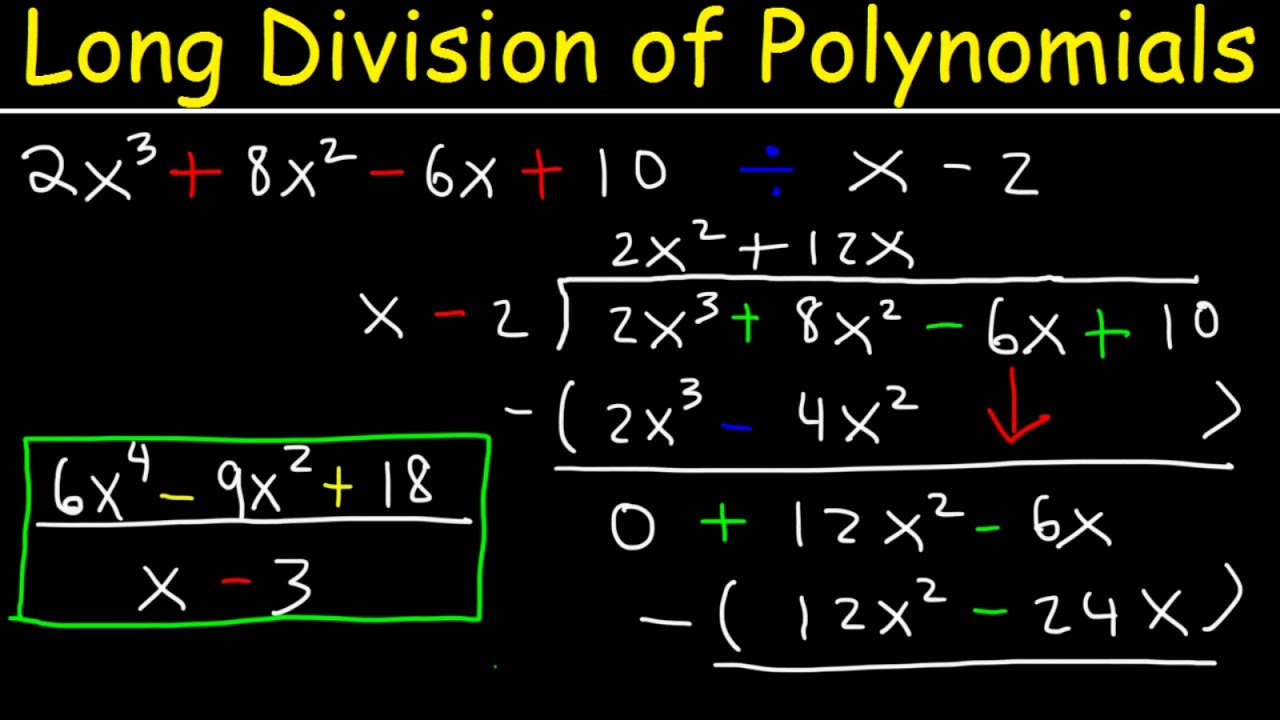
This video tutorial explains how to perform long division of polynomials with remainder and with missing terms. It's explains how to do long division easily and it provides the step by step process to get it done. Basically, there are 3 steps that you have to repeat. 1. Divide 2. Multiply 3. Subtract This video contains plenty of ex...
Or that
obtuse pebbleBOT
Channel closed
Closed by @fossil garden
Use .reopen if this was a mistake.
Available help channel!
Send your question here to claim the channel.
Remember:
• Ask your math question in a clear, concise manner.
• Show your work, and if possible, explain where you are stuck.
• After 15 minutes, feel free to ping <@&286206848099549185>.
• Type the command .close to free the channel when you're done.
• Be polite and have a nice day!
Read #❓how-to-get-help for further information on how to ask a good question, and about conduct in the question channels.
timid silo
Can anyone explain Euler's Identity?
obtuse pebbleBOT
timid silo
Can anyone explain Euler's Identity?
 rigid lintel
i dont think just discord text can do eulers identity justice
theres great videos on youtube
that explain it better than anyone here

 wooden cipher
It also may help if youre familiar with taylor series
obtuse pebbleBOT
@timid silo Has your question been resolved?
 hollow harness
can you help me ?
obtuse pebbleBOT
Channel closed
Closed due to timeout
Use .reopen if this was a mistake.
Available help channel!
Send your question here to claim the channel.
Remember:
• Ask your math question in a clear, concise manner.
• Show your work, and if possible, explain where you are stuck.
• After 15 minutes, feel free to ping <@&286206848099549185>.
• Type the command .close to free the channel when you're done.
• Be polite and have a nice day!
Read #❓how-to-get-help for further information on how to ask a good question, and about conduct in the question channels.
 narrow fiber
Is there another way to solve this without graphing?
"Find the equation of the circle that touches the two axes and touches the line y=6"
obtuse pebbleBOT
narrow fiber
Is there another way to solve this without graphing?
"Find the equation of the c...
 loud tangle
graphing would help but you can consider the general form of the circle equation
if it touches the line at y = 6 that means it has a radius of 3
loud tangle
idrk proof wise since some countries have it different
cold thistle
I assume by "touches" it means touches exactly once without intercepting, otherwise you could just make a circle about the origin with radius >= 6
loud tangle
btw it said it touches both axies too
narrow fiber
cold thistle
I assume by "touches" it means touches exactly once without intercepting, otherw...
Yeah that's the inteded meaning
loud tangle
meaning its not at the origin
you can have 2 cases
one where its origin is in the upper right quadrant and one where its in the upper left one
at exactly (3, 3) and (-3, 3)
since you said it is touching both axis
narrow fiber
I feel like this relies on graphing
loud tangle
visualisation is basically your way of intuition but you can prove it without a graoh
graph
narrow fiber
You imagined the line y=6 and you got
2r = 6 => r = 3
And then the rest is simple
that's the part that I want to know if there's another way to do it
loud tangle
you can deduce from.the fact tbat its touching the line ar y = 6 that the function's maximum is 6
and since its tangent minimum is 0
then work with that
and since its a circle equation you know the distance between the maximum and minimum is 2r so you get r = 3
then as u said ez
narrow fiber
loud tangle
and since its a circle equation you know the distance between the maximum and mi...
This captured my intuition well
Btw
How would we do it if it gave any line instead of y=6 ?
loud tangle
wdym any line
narrow fiber
How do we solve it in the general case
loud tangle
you deduce its maximum value is the y value of the line
same goes for minimum
since y value of OX = 0
narrow fiber
loud tangle
you deduce its maximum value is the y value of the line
You can't use that if it gave the line x-y=2
Because then which y value do you choose?
narrow fiber
y=1x-2
loud tangle
i dont think you have a choice but to draw it out to help visualise there
intuitiokn has to come from graph
 narrow fiber
Yeah I know i'm just kidding
I'll write the question
Then do the drawing with 2 circles and the line
And then first line of text is 2r = 6
loud tangle
look man i kinda gtg
narrow fiber
.close
obtuse pebbleBOT
Channel closed
Closed by @narrow fiber
Use .reopen if this was a mistake.
obtuse pebbleBOT
Available help channel!
Send your question here to claim the channel.
Remember:
• Ask your math question in a clear, concise manner.
• Show your work, and if possible, explain where you are stuck.
• After 15 minutes, feel free to ping <@&286206848099549185>.
• Type the command .close to free the channel when you're done.
• Be polite and have a nice day!
Read #❓how-to-get-help for further information on how to ask a good question, and about conduct in the question channels.
 spice chasm
 obtuse pebbleBOT
spice chasm
spice chasm
obtuse pebbleBOT
spice chasm
spice chasm
is this right
 forest sinew
 lethal egret
facts
obtuse pebbleBOT
@spice chasm Has your question been resolved?
Channel closed
Closed by @spice chasm
Use .reopen if this was a mistake.
Available help channel!
Send your question here to claim the channel.
Remember:
• Ask your math question in a clear, concise manner.
• Show your work, and if possible, explain where you are stuck.
• After 15 minutes, feel free to ping <@&286206848099549185>.
• Type the command .close to free the channel when you're done.
• Be polite and have a nice day!
Read #❓how-to-get-help for further information on how to ask a good question, and about conduct in the question channels.
 rapid relic
so I was wondering do 2 mutually exclusive events always have to equal 1
obtuse pebbleBOT
rapid relic
so I was wondering do 2 mutually exclusive events always have to equal 1
rapid relic

I had a question here
and I know 1-0.43 =0.57 is one of the solutions
right
but i'm not sure why that's the case
it's x+0.57
 civic zealot
no
civic zealot
they can sum to 1, but they do not have to sum to 1
rapid relic
oh ok
But then why in this case do I do 1-0.43
I thought P(A)+P(A') =1
and I use that formula
Why do I use b here?
civic zealot
rapid relic
I thought P(A)+P(A') =1
that's true, because A U A' is the whole set, which has probability 1
But just because A and B are mutually exclusive does not mean that B = A'
civic zealot
since P(B') = .43, the P(B) = .57 by the property you gave
so P(A U B) = P(A) + P(B)
because they are mutually exclusive.
rapid relic
Ohhhh ok
ty that actually makes sense to me now
That's a lot simpler than I thought
tyty I appreciate the help
.close
obtuse pebbleBOT
Channel closed
Closed by @rapid relic
Use .reopen if this was a mistake.
Available help channel!
Send your question here to claim the channel.
Remember:
• Ask your math question in a clear, concise manner.
• Show your work, and if possible, explain where you are stuck.
• After 15 minutes, feel free to ping <@&286206848099549185>.
• Type the command .close to free the channel when you're done.
• Be polite and have a nice day!
Read #❓how-to-get-help for further information on how to ask a good question, and about conduct in the question channels.
 storm temple
 obtuse pebbleBOT
storm temple
storm temple
obtuse pebbleBOT
storm temple
storm temple
are either of my solutions correct? 😭
 fierce lagoon
,calc Sin(17 Pi/12)
warm shaleBOT
The following error occured while calculating:
Error: Undefined function Sin
warm shaleBOT


 Requested by Umbraleviathan#3607
storm temple
Requested by Umbraleviathan#3607
storm temple
Oop
storm temple
My bottom solution is correct?
fierce lagoon
Ye
storm temple
Yayyyyyy thanks lol
fierce lagoon
You have the mathematical equivalent
storm temple
.close
obtuse pebbleBOT
Channel closed
Closed by @storm temple
Use .reopen if this was a mistake.
Available help channel!
Send your question here to claim the channel.
Remember:
• Ask your math question in a clear, concise manner.
• Show your work, and if possible, explain where you are stuck.
• After 15 minutes, feel free to ping <@&286206848099549185>.
• Type the command .close to free the channel when you're done.
• Be polite and have a nice day!
Read #❓how-to-get-help for further information on how to ask a good question, and about conduct in the question channels.
timid silo


 obtuse pebbleBOT
timid silo
timid silo
timid silo
obtuse pebbleBOT
timid silo
timid silo
timid silo
first picture is the question, second picture is my work, third picture is the answer key
I know my work is hard to read but basically what I did was set u=e^x whilst in the answer key its u=1+e^x
why this and not that?
(u-substitution)
warm shaleBOT
Stephen
 teal turret
Those two aren’t equal if the != wasn’t clear
timid silo
wait so I just made an algebra mistake?
teal turret
Yea, from that step yes, I didn’t look into the rest of ur work
timid silo
warm shale
**Stephen**
oh fuck I'm an idiot I split it up the denominator as if it was the numerator lmaoo
man fuck finals week
well, thanks
let me see if this fixes the problem
teal turret
Np, I think u coulda done that u = e^x sub
teal turret
Rip
Yea u coulda used u = e^x but u would have to use another sub after that
Using u = e^x + 1, u skip that step
timid silo
do you have any advice for how to pick the most efficient u
teal turret
Hmm
Good question
Honestly it just comes with experience, lots of practice with integration techniques and such. I’ve just searched on google and saw a video (I haven’t watched) but I’ll link because it looks promising. Additionally, I’ve also seen something that says u-sub is just chain rule in reverse, so if you’re able to think about it like that, that might be helpful. But overall I’d just recommend practice with different types of problems, and when practicing, try different u-sub’s in the same problem to see if they work well, u may notice some trends which may help u to determine the most efficient paths. Here’s the link: https://m.youtube.com/watch?v=evdYUQnHrBo

How to choose u in u-substitution - Integration by Substitution Choosing u | Jake's Math Lessons
Figuring out what to make your u when you are doing a u-substitution problem or integration by substitution, can be the hardest part those problems sometimes.
I know when I was first learning how to do u-substitution, that was the thing that I had ...
teal turret
Good luck
obtuse pebbleBOT
@timid silo Has your question been resolved?
Channel closed
Closed by @midnight sequoia
Use .reopen if this was a mistake.
obtuse pebbleBOT
Available help channel!
Send your question here to claim the channel.
Remember:
• Ask your math question in a clear, concise manner.
• Show your work, and if possible, explain where you are stuck.
• After 15 minutes, feel free to ping <@&286206848099549185>.
• Type the command .close to free the channel when you're done.
• Be polite and have a nice day!
Read #❓how-to-get-help for further information on how to ask a good question, and about conduct in the question channels.
 ancient stag
can someone explain to me why it's important to take care of the fact that the cos function will oscillate between positive and negative?
 obtuse pebbleBOT
ancient stag
can someone explain to me why it's important to take care of the fact that the c...
ancient stag
obtuse pebbleBOT
ancient stag
can someone explain to me why it's important to take care of the fact that the c...
ancient stag
so my lecturer has decided to put a modulus around the expression
and we're considering the limit as it approaches 0
and im confused because if the h term is tending towards 0 then the whole function would tend to 0?
so why would it matter if it oscillates between +/- as it gets close to 0
obtuse pebbleBOT
@ancient stag Has your question been resolved?
ancient stag
<@&286206848099549185>
 nimble dew
hes just being super careful about the proof using the squeeze theorem
ancient stag
.close
obtuse pebbleBOT
Channel closed
Closed by @ancient stag
Use .reopen if this was a mistake.
Available help channel!
Send your question here to claim the channel.
Remember:
• Ask your math question in a clear, concise manner.
• Show your work, and if possible, explain where you are stuck.
• After 15 minutes, feel free to ping <@&286206848099549185>.
• Type the command .close to free the channel when you're done.
• Be polite and have a nice day!
Read #❓how-to-get-help for further information on how to ask a good question, and about conduct in the question channels.
 distant rampart
The complex number 𝑢 is given by the following equality: 𝑢 = 16𝑖. Solve the equation 𝑧⁴ = 𝑢, and represent its solutions in a complex number plane.
obtuse pebbleBOT
distant rampart
The complex number 𝑢 is given by the following equality: 𝑢 = 16𝑖. Solve the e...
distant rampart
i've got r, which is 16
but i dont know how to get 𝛉
and i dont know how to get the - angles inside cos and sin

 tardy epoch
distant rampart
but i dont know how to get 𝛉
tardy epoch
distant rampart
but i dont know how to get 𝛉
Imagine instead of 16i, you're just looking for z^4=i
Do you know how to write i as a complex exponential?
distant rampart
The complex number $i$ is defined as the square root of $-1$. It can be written as a complex exponential using Euler's formula, which states that for any real number $x$:
$$e^{ix} = \cos(x) + i \sin(x)$$
Therefore, we can write $i$ as a complex exponential by setting $x = \frac{\pi}{2}$:
$$i = e^{i \frac{\pi}{2}} = \cos\left(\frac{\pi}{2}\right) + i \sin\left(\frac{\pi}{2}\right) = 0 + i 1 = i$$
So $i$ can be written as a complex exponential as $e^{i \frac{\pi}{2}}$. Note that this representation of $i$ as a complex exponential is only one possible representation; there are many other ways to write $i$ using complex exponentials.
warm shaleBOT
dgh
 distant rampart
@tardy epoch This is what ChatGPT gave me.
Is it right?
In the complex plane, the complex number $i$ is represented by a point on the vertical axis, above the origin. This means that $i$ is pointing directly upwards on the complex plane. To find the angle of the complex number $u = 16i$, we can use the fact that $i$ is pointing upwards on the complex plane. The angle of $u$ is then simply the angle that $u$ makes with the positive real axis, which in this case is $\frac{\pi}{2}$ radians or $90^\circ$.
warm shaleBOT
dgh
 distant rampart
How do we get the - angles, or why do we write it like that?

 daring rock
Lol don't ask an AI to do your homework
tardy epoch
daring rock
Lol don't ask an AI to do your homework
.
 narrow vault
from what i've seen chatgpt is pretty good at homework as long as the user has enough awareness to extract the useful and correct parts of it
tardy epoch
distant rampart
<@261933205387477002> This is what ChatGPT gave me.
If you understand it, then go for it. I'm not reading all that
daring rock
narrow vault
from what i've seen chatgpt is pretty good at homework as long as the user has e...
I've asked it quite a few questions about math. Sometimes it's surprisingly accurate, and sometimes it's complete nonsense
narrow vault
ye it's hit and miss and you have to figure out when it's missing lol
distant rampart
tardy epoch
If you understand it, then go for it. I'm not reading all that
I did, but this one is more simpler #help-10 message
distant rampart
distant rampart
How do we get the - angles, or why do we write it like that?
Can someone explain this?
tardy epoch
I'm still not reading all that nonsense
distant rampart
Yeah I understood that the first time
daring rock
distant rampart
Can someone explain this?
Do you recognize that 9pi/8 for example is coterminal to -7pi/8
in the case of z_3 there
distant rampart
Hmm, I know that in the polar form of a complex number, the angle 𝛉 can be any value between -π and π.
But I've lost memory of the reason why we prefer the negative angle.
Is it because we subtract 2π?
daring rock
Yes, if you add or subtract 2pi, you get a coterminal angle
distant rampart
I see!
daring rock
As for why we prefer angles between -pi and pi, I think it's mostly convention, It plays nicely with the arctan function
distant rampart
So if we have z^4, we want two plus angles, and two minus angles?
i.e. distributing it evenly?
daring rock
That will generally be true for even exponents, yes
but just make sure they're on (-pi, pi]
daring rock
distant rampart
So if we have z^4, we want two plus angles, and two minus angles?
you don't really need to memorize a rule like this
distant rampart
Is this true?
"if we used an angle outside of the range -π to π, the arctan function might not return a value that is consistent with the angle of the complex number in the complex plane. For example, if we used the angle 5π/4 to represent the complex number -1 + i, the arctan function would return a different value:
angle = atan(imaginary part / real part) = atan(1 / -1) = 3π/4
This result is not consistent with the angle of the complex number in the complex plane, because it is not between -π and π."
daring rock
It should say -5pi/4, not 5pi/4
-5pi/4 and 3pi/4 are coterminal but -5pi/4 is not in the interval (-pi,pi]
distant rampart
I see, I have a exam in 3 hours, so I'm cramming lol
So for coterminal angles we only consider the angles in the range (-π, π]
daring rock
for complex numbers, you should typically only express them by angles in that range
distant rampart
Ok ok
daring rock
but yeah I think that's basically what you meant
distant rampart
Another thing, on the notation ( and ]
The notation (-π, π) is often used to indicate the range of values that are not included in the range of coterminal angles, because coterminal angles are defined as angles that differ by a multiple of 2π and that are within the range (-π, π]. In other words, coterminal angles are not in the range (-π, π).
This is wrong right? Because π is a coterminal of -π
Oh nvm, it's not lmao
daring rock
no you're right, pi and -pi are coterminal
distant rampart
But why did it say "In other words, coterminal angles are not in the range (-π, π)."
daring rock
was this from the ai?
distant rampart
Yea
daring rock
that's why
distant rampart
Okay lol
daring rock
it is not really a reliable source
mighty geyser
i think it means something
if x, y are coterminal and in the range (-pi, pi), then x=y
i.e. x cannot be different from y
although it's not very clearly stated
daring rock
mighty geyser
if x, y are coterminal and in the range (-pi, pi), then x=y
isn't this also true for (-pi, pi] ?
mighty geyser
yes, it is also true for that
distant rampart
btw, how do i best memorize the trig values up to π/2?
for cos, sin, and tan
i don't have the best memory of that
i remember there was a triangle you could look at

 daring rock
Btw, if you needed a reason not to use chat GPT for math help, here's one

 lost tree
daring rock
Btw, if you needed a reason not to use chat GPT for math help, here's one
lost tree
daring rock
Btw, if you needed a reason not to use chat GPT for math help, here's one
x^4 = x?
mighty geyser
yeah - this is why we don't typically let chatgpt posts here
still more efficient to type out ourselves
and ,w for definitions
,w involution
warm shaleBOT

 Requested by Element118#2437
mighty geyser
Requested by Element118#2437
mighty geyser
,w involution function
warm shaleBOT
 Requested by Element118#2437
mighty geyser
Requested by Element118#2437
mighty geyser
well that didn't work out
daring rock
lost tree
lol
I've never seen someone with both the "active" role and the newbie leaf
lost tree
lol
well idk lol i keep finding myself returning to discord since i joined this community
obtuse pebbleBOT
@distant rampart Has your question been resolved?
obtuse pebbleBOT
Channel closed
Closed due to timeout
Use .reopen if this was a mistake.
obtuse pebbleBOT
Available help channel!
Send your question here to claim the channel.
Remember:
• Ask your math question in a clear, concise manner.
• Show your work, and if possible, explain where you are stuck.
• After 15 minutes, feel free to ping <@&286206848099549185>.
• Type the command .close to free the channel when you're done.
• Be polite and have a nice day!
Read #❓how-to-get-help for further information on how to ask a good question, and about conduct in the question channels.
 lone viper
for sine how was it 7/5/2
 obtuse pebbleBOT
lone viper
for sine how was it 7/5/2
lone viper
obtuse pebbleBOT
lone viper
for sine how was it 7/5/2
lone viper
and for cosine how was it 3/5/2
 frosty tiger
obtuse pebbleBOT
frosty tiger
obtuse pebbleBOT
Channel closed
Closed by @lone viper
Use .reopen if this was a mistake.
Available help channel!
Send your question here to claim the channel.
Remember:
• Ask your math question in a clear, concise manner.
• Show your work, and if possible, explain where you are stuck.
• After 15 minutes, feel free to ping <@&286206848099549185>.
• Type the command .close to free the channel when you're done.
• Be polite and have a nice day!
Read #❓how-to-get-help for further information on how to ask a good question, and about conduct in the question channels.
timid silo
Trying to solve this initial value problem:
[
x^2y'' -xy' +2y = 0 \quad y(1) = 5 \quad y'(1) = -1
]
obtuse pebbleBOT
timid silo
Trying to solve this initial value problem:
\[
x^2y'' -xy' +2y = 0 \quad y(1) = ...
warm shaleBOT
♡LexQa♡
 timid silo
i get
[
y = x(5\cos(\ln(x)) - 6\sin(\ln(x))
]
but i am not sure \thonk
warm shaleBOT
♡LexQa♡
 timid silo
 wild swallow
you closed your other channel ig
wild swallow
you closed your other channel ig
oh someone actually came and explained it
wild swallow
was it before or after approximately 8 hours ago
timid silo
it was pretty interesting
wild swallow
because i also saw some stuff there
timid silo
wild swallow
was it before or after approximately 8 hours ago
yes, he posted it immediately after i slept 
wild swallow
this is one of those DEs which have a name
which im forgetting
but iirc you can guess a power of x
timid silo
yeah it was with euler's equations
timid silo
i am not good with odes and pdes okay 😵💫
 zenith raft
you cn always check it
wild swallow
,w r(r-1) - r + 2 = 0
warm shaleBOT

 timid silo
zenith raft
you cn always check it
timid silo
zenith raft
you cn always check it
i actually inputted that into the system, and it turned to be wrong, and i am just clueless now 
zenith raft

 warm shaleBOT
 wild swallow

 next reef

wild swallow

timid silo
zenith raft
it wanted an extra parenthesis or the correct amount of parentheses? 😁
okay...just because you can see through me doesn't mean you can get to expose me like that 😔
zenith raft
sowwy 😭
wild swallow

timid silo
wild swallow
<:catGiggle:912459497954500659>
oh yeah snow, i actually have another GF question
it is more of...a question about someone's else explanation
what the hell does this sign mean
 zenith raft
msg
wild swallow
zenith raft
i hear that’s bad
wild swallow
monosodium glutamate
zenith raft
monosodiumsodium glutamate
wild swallow
timid silo
omg im having the biggest brain fart i forgot how to latex
just basically saying that
[ma = \delta \to m\dv[2]{x}{t}]
[\to m\dv[2]{G}{t} = \delta ]
and then
warm shaleBOT
♡LexQa♡
 zenith raft

timid silo
then we defined
[ G = {\color{cyan} \int}\mathscr{G} ={\color{cyan} \int} \frac{1}{m s^2}]
warm shaleBOT
♡LexQa♡
 timid silo
warm shale
**♡LexQa♡**
timid silo
warm shale
**♡LexQa♡**
i am pretty sure this is called...a Bromwich integral?
timid silo
yep
timid silo
curious, but where would this kind of stuff go to in this server? kind of want to dig deeper into it
#odes-and-pdes i guess?
wild swallow
likely
obtuse pebbleBOT
Channel closed
Closed by @native knoll
Use .reopen if this was a mistake.
wild swallow

zenith raft
i did nothing again 🥰
timid silo
zenith raft
i did nothing again 🥰
its okay ur presence is helpful
obtuse pebbleBOT
Available help channel!
Send your question here to claim the channel.
Remember:
• Ask your math question in a clear, concise manner.
• Show your work, and if possible, explain where you are stuck.
• After 15 minutes, feel free to ping <@&286206848099549185>.
• Type the command .close to free the channel when you're done.
• Be polite and have a nice day!
Read #❓how-to-get-help for further information on how to ask a good question, and about conduct in the question channels.
zenith raft
i’m just here to look pretty
obtuse pebbleBOT
zenith raft
i’m just here to look pretty
wild swallow

timid silo
zenith raft
i’m just here to look pretty
goals ✨
zenith raft
.close
obtuse pebbleBOT
Channel closed
Closed by @zenith raft
Use .reopen if this was a mistake.
wild swallow
lex quick
timid silo
wait wot
timid silo
awww
wild swallow
or maybe that doesnt work after the channel's been claimed
timid silo
i already did it twice and thats what matters 😎
wild swallow
timid silo
the funniest thing is to send a message and the bot immediately transferring that channel to the hidden section
so the bot has a brain freeze for like 5 seconds and then opens it again lmao
wild swallow
obtuse pebbleBOT
Available help channel!
Send your question here to claim the channel.
Remember:
• Ask your math question in a clear, concise manner.
• Show your work, and if possible, explain where you are stuck.
• After 15 minutes, feel free to ping <@&286206848099549185>.
• Type the command .close to free the channel when you're done.
• Be polite and have a nice day!
Read #❓how-to-get-help for further information on how to ask a good question, and about conduct in the question channels.
 frozen quest
Find the variance of 15,16,17....45?
obtuse pebbleBOT
frozen quest
Find the variance of 15,16,17....45?
frozen quest
By using consecutive formula that is (n^2 - 1)/12
I can't get the answer
Is there something i am missing
 royal basin
can we see the problem exactly as stated
 frozen quest
frozen quest
frozen quest
49th question
royal basin
and what value are you using for n?
frozen quest
I am getting first 14 number variance and then first 45 and then subtracting them
frozen quest
royal basin
variance does not work that way unfortunately
Oh
royal basin
,calc ((45-15+1)^2 - 1)/12
warm shaleBOT
Result:
80
Last term - first term
Always?
Or is it number of terms
 brave bramble
royal basin
brave bramble
royal basin
we suffer
the general formula for variance is mean square minus square mean, to put it in a way that isn't symbol soup
obtuse pebbleBOT
Channel closed
Closed by @frozen quest
Use .reopen if this was a mistake.
obtuse pebbleBOT
Available help channel!
Send your question here to claim the channel.
Remember:
• Ask your math question in a clear, concise manner.
• Show your work, and if possible, explain where you are stuck.
• After 15 minutes, feel free to ping <@&286206848099549185>.
• Type the command .close to free the channel when you're done.
• Be polite and have a nice day!
Read #❓how-to-get-help for further information on how to ask a good question, and about conduct in the question channels.
 mighty crown
 obtuse pebbleBOT
mighty crown
obtuse pebbleBOT
mighty crown

 obtuse pebbleBOT
@mighty crown Has your question been resolved?

 winged aspen
mighty crown
My work
winged aspen
mighty crown
My work
Your Japanese only should be the people studying both French and Greek. So 2x + x = Japanese only
obtuse pebbleBOT
@mighty crown Has your question been resolved?
Channel closed
Closed by @mighty crown
Use .reopen if this was a mistake.
Available help channel!
Send your question here to claim the channel.
Remember:
• Ask your math question in a clear, concise manner.
• Show your work, and if possible, explain where you are stuck.
• After 15 minutes, feel free to ping <@&286206848099549185>.
• Type the command .close to free the channel when you're done.
• Be polite and have a nice day!
Read #❓how-to-get-help for further information on how to ask a good question, and about conduct in the question channels.
 lost radish
Hello
obtuse pebbleBOT
lost radish
Hello
 timid silo
,rotate
warm shaleBOT
 obtuse pebbleBOT
@lost radish Has your question been resolved?
 acoustic elbow
lost radish
Ok?<@456226577798135808>
acoustic elbow
lost radish
Ok?<@456226577798135808>
Use your answer in part 1.
Let's keep those matrices as A and B. What other (non 0) matrix can you multiply them both by to get the 0 matrix?
acoustic elbow
lost radish
What's else
Hint: ||try another matrix that has 0s as 3 entries and a 1||
lost radish
.close
obtuse pebbleBOT
Channel closed
Closed by @lost radish
Use .reopen if this was a mistake.
Available help channel!
Send your question here to claim the channel.
Remember:
• Ask your math question in a clear, concise manner.
• Show your work, and if possible, explain where you are stuck.
• After 15 minutes, feel free to ping <@&286206848099549185>.
• Type the command .close to free the channel when you're done.
• Be polite and have a nice day!
Read #❓how-to-get-help for further information on how to ask a good question, and about conduct in the question channels.
 past solar
what's the largest possible k where 12^k divides 2022!? need help, can't seem to find a way to use legendre or anything.
obtuse pebbleBOT
past solar
what's the largest possible k where 12^k divides 2022!? need help, can't seem to...
sage geode
Prime factorisation of 2022 perhaps?
Oh, there's no need though
Cuz 2022 isn't divisible by 4
How'd it be divisible by 12 anyways?
rigid lintel
2022!
wild swallow
its just legendre
past solar
wild swallow
its just legendre
how do you apply cause legendre only works on prime?
wild swallow
realise that there will be more factors of 2 in 2022! than 3
warm shaleBOT
 wild swallow
wait that might not be needed
warm shaleBOT
 warm shaleBOT
 wild swallow
then you can work out like
warm shaleBOT
 wild swallow
warm shale
wild swallow
warm shale
the first inequality might not be true tho
warm shaleBOT
 wild swallow
dont want to use my brain to figure it out rn 
wild swallow
legendre
warm shaleBOT
 past solar
so a is 2014.
warm shaleBOT
 wild swallow
 what
what
past solar
and b is 1006.
wild swallow
,w sum k=1 to 20 floor(2022/2^k)
warm shaleBOT
 wild swallow
,w sum k=1 to 20 floor(2022/3^k)
warm shaleBOT
 wild swallow
guess so

 wild swallow
past solar
the one with the factor with lowest exponent divided 2022! ?
warm shaleBOT
 past solar
ohhhh, how do you know it don't divide?

 obtuse pebbleBOT
Channel closed
Closed by @past solar
Use .reopen if this was a mistake.
Available help channel!
Send your question here to claim the channel.
Remember:
• Ask your math question in a clear, concise manner.
• Show your work, and if possible, explain where you are stuck.
• After 15 minutes, feel free to ping <@&286206848099549185>.
• Type the command .close to free the channel when you're done.
• Be polite and have a nice day!
Read #❓how-to-get-help for further information on how to ask a good question, and about conduct in the question channels.
timid silo
Can i do this?
 obtuse pebbleBOT
timid silo
Can i do this?
timid silo
obtuse pebbleBOT
timid silo
Can i do this?
timid silo
Thank u in advance
rigid lintel
yes that works
sage geode
a = log(e^a) in general
rigid lintel
,w sqrt(3) = log(e^sqrt(3))
warm shaleBOT

 Requested by Gijs#0201
sage geode
Requested by Gijs#0201
sage geode
So why not sqrt(3) = log(e^sqrt(3))?
obtuse pebbleBOT
@timid silo Has your question been resolved?
obtuse pebbleBOT
Channel closed
Closed due to timeout
Use .reopen if this was a mistake.
Available help channel!
Send your question here to claim the channel.
Remember:
• Ask your math question in a clear, concise manner.
• Show your work, and if possible, explain where you are stuck.
• After 15 minutes, feel free to ping <@&286206848099549185>.
• Type the command .close to free the channel when you're done.
• Be polite and have a nice day!
Read #❓how-to-get-help for further information on how to ask a good question, and about conduct in the question channels.
 sturdy ibex
Is this graph correct?
 obtuse pebbleBOT
sturdy ibex
Is this graph correct?
sage geode
obtuse pebbleBOT
sturdy ibex
Is this graph correct?
sage geode
Yes
obtuse pebbleBOT
Channel closed
Closed by @sturdy ibex
Use .reopen if this was a mistake.
 halcyon badger
.close
sturdy ibex
bruh
obtuse pebbleBOT
Available help channel!
Send your question here to claim the channel.
Remember:
• Ask your math question in a clear, concise manner.
• Show your work, and if possible, explain where you are stuck.
• After 15 minutes, feel free to ping <@&286206848099549185>.
• Type the command .close to free the channel when you're done.
• Be polite and have a nice day!
Read #❓how-to-get-help for further information on how to ask a good question, and about conduct in the question channels.
 shell prairie
 obtuse pebbleBOT
shell prairie
obtuse pebbleBOT
shell prairie
<@&286206848099549185>
obtuse pebbleBOT
shell prairie
obtuse pebbleBOT
shell prairie
<@&286206848099549185>
Please only use the <@&286206848099549185> ping once if your question has not been answered for 15 minutes. Please do not ping or DM individual users about your question.
shell prairie
a
obtuse pebbleBOT
@shell prairie Has your question been resolved?
obtuse pebbleBOT
@shell prairie Has your question been resolved?
obtuse pebbleBOT
Channel closed
Closed due to timeout
Use .reopen if this was a mistake.
Available help channel!
Send your question here to claim the channel.
Remember:
• Ask your math question in a clear, concise manner.
• Show your work, and if possible, explain where you are stuck.
• After 15 minutes, feel free to ping <@&286206848099549185>.
• Type the command .close to free the channel when you're done.
• Be polite and have a nice day!
Read #❓how-to-get-help for further information on how to ask a good question, and about conduct in the question channels.
 white summit
Hello everybody. I am currently stuck on this integration problem. Namely I am given two points Pinflection(2,2) and Porigin(0,0) and a tangent line of a cubic function at x=2.
I have tried to integrate my function y=-3x+8 (as it should be my second derivative of my main function) and then plug in my two points twice to find the parameters c and d that I receive from integrating. However, I do not get the same result as the solutions.
obtuse pebbleBOT
white summit
Hello everybody. I am currently stuck on this integration problem. Namely I am g...

 obtuse pebbleBOT
@white summit Has your question been resolved?
white summit
uhh I hope it's fine to ping again. <@&286206848099549185>
obtuse pebbleBOT
@white summit Has your question been resolved?
obtuse pebbleBOT
Channel closed
Closed by @white summit
Use .reopen if this was a mistake.
Available help channel!
Send your question here to claim the channel.
Remember:
• Ask your math question in a clear, concise manner.
• Show your work, and if possible, explain where you are stuck.
• After 15 minutes, feel free to ping <@&286206848099549185>.
• Type the command .close to free the channel when you're done.
• Be polite and have a nice day!
Read #❓how-to-get-help for further information on how to ask a good question, and about conduct in the question channels.
 woven quartz
help me with this, please. this was given in an exam a while back, and i got zero on this question, i got zero as the result but our teacher says there's supposed to be two answers

 obtuse pebbleBOT
woven quartz
help me with this, please. this was given in an exam a while back, and i got zer...
tardy epoch
obtuse pebbleBOT
woven quartz
help me with this, please. this was given in an exam a while back, and i got zer...
tardy epoch
,rotate
warm shaleBOT

 woven quartz
shouldn't that give a zero anyway?
tardy epoch
woven quartz
shouldn't that give a zero anyway?
no
integral of a positive function is greater than zero
rigid lintel
you cant really integrate implicit functions like youre used to with explicit functions
tardy epoch
(over a domain of nonzero length)