#help-10
1 messages · Page 5 of 1
 lusty cedar
 elfin tangle
i had a day to prepare for this question lol im doing math online
elfin tangle
lusty cedar
simple harmonic motion?
im not sure
elfin tangle
okay
lusty cedar
i won't teach cuz don't wanna mess it up for you
elfin tangle
omg i need it taught tho 😭 im rlly struggling-
elfin tangle
ummm ANYWAYS
lusty cedar
yea
i dunno if i can teach it
a good listener i am, not too good to speak
i thought you knew it
cuz it is basically an SHM
elfin tangle
lusty cedar
i thought you knew it
im in gr11 university math
for an online course
and this is the one thing i cannot graps
grasp
😭
lusty cedar
alr wait
i'll send something that might help

Get Your Crash Course Physics Mug here: https://store.dftba.com/products/crashcourse-physics-mug
Bridges... bridges, bridges, bridges. We talk a lot about bridges in Physics. Why? Because there is A LOT of practical physics that can be learned from the planning and construction of them. In this episode of Crash Course Physics, Shini talks to us...
might help
try
elfin tangle
wtf was that 😭
elfin tangle
im so confused
lusty cedar
oh no
told you i'm not a good teacher
can you search something yourself and try
wiki or something
it sometimes works for me if i don't get stuf
i'm not sure why you are getting this question
cuz i believe it is from SHM
elfin tangle
r u sure it has smt to do with shm?
 warm canopy
you can learn about trig functions without knowing about SHM
SHM is described by trig
lusty cedar
warm canopy
you can learn about trig functions without knowing about SHM
i'm sure, but the problem would have been easuer
warm canopy
ehh, they just need to know about transformations of graphs
warm canopy
right but you asked them and they didn't, it's really not needed here
lusty cedar
agreed
i asked so that it becomes easy
i thought a simple video can fix that
i'd say i was wrong
warm canopy
you need to think about what happens to a function f(x) under the transformation f(ax) for some number a
elfin tangle
wait what
elfin tangle
can you help pls 😭 im still like rusty
 wet citrus
this might be a little bit of a dumb question but i had a brain fart 💀
whats 3 3/8 divided by 9 wholes or 9/1?
elfin tangle
wet citrus
this might be a little bit of a dumb question but i had a brain fart 💀
whats 3 ...
open a chatroom pls
wet citrus
elfin tangle
open a chatroom pls
oh alright sorry
 obtuse pebbleBOT
@elfin tangle Has your question been resolved?
obtuse pebbleBOT
@elfin tangle Has your question been resolved?
 tardy epoch
elfin tangle
can you help pls 😭 im still like rusty
tardy epoch
elfin tangle
can you help pls 😭 im still like rusty
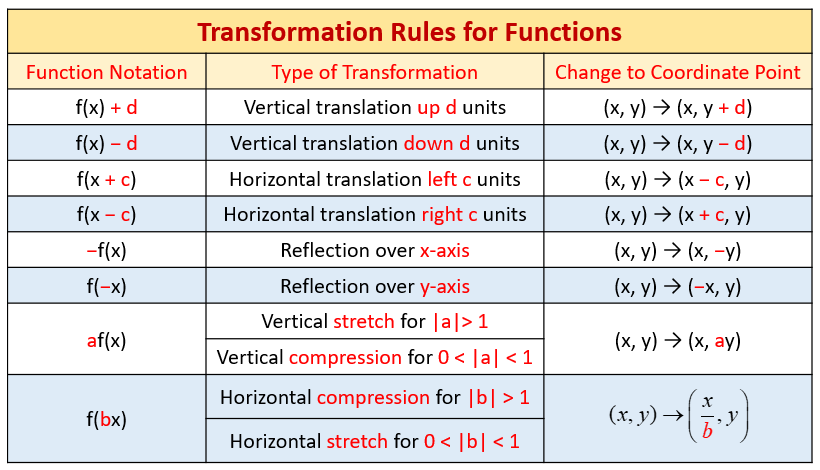
www.onlinemathlearning.com
What are the effects on graphs of the parent function when: Stretched Vertically, Compressed Vertically, Stretched Horizontally, shifts left, shifts right, and reflections across the x and y axes, Compressed Horizontally, PreCalculus Function Transformations: Horizontal and Vertical Stretch and Compression, Horizontal and Vertical Translations, ...
obtuse pebbleBOT
@elfin tangle Has your question been resolved?
obtuse pebbleBOT
Channel closed
Closed due to timeout
Use .reopen if this was a mistake.
Please take a minute to participate in [our survey](#changelog message) if you haven't already!
 Available help channel!
Send your question here to claim the channel.
Remember:
• Ask your math question in a clear, concise manner.
• Show your work, and if possible, explain where you are stuck.
• After 15 minutes, feel free to ping <@&286206848099549185>.
• Type the command .close to free the channel when you're done.
• Be polite and have a nice day!
Read #❓how-to-get-help for further information on how to ask a good question, and about conduct in the question channels.
 vivid flicker
Can
 obtuse pebbleBOT
vivid flicker
Can
vivid flicker
obtuse pebbleBOT
vivid flicker
Can
vivid flicker
Can someone help me rewrite this in polar coordinates
Idk what to do with the integrals
 vivid flicker
That didn't Cross my mind, I'll try it out
Só I got that, but what do I do about the 0->1 integral?
So*
Idk what it means in polar
 rigid pine
Basically you can convert the integral you have in the question to a double integral over a region R.
You can show this double integral is equal to another iterated integral but this time using a polar system.

Here. We are between the circles r = 0* and r = 1 and between the rays theta = 0 and theta = pi/2.
Not getting into the proof of why. You should be able to set up the iterated integral now.
 rigid pine
What do you mean? The purple text is just my translation to the notation you're probably used to seeing.
vivid flicker
Mb if I'm slow, I Just picked up tua subject
I'm my mind you talked about 2 different circles
rigid pine
I'm not sure how to explain things if you're fresh to the topic. It would seem you need to learn some more.
rigid pine
vivid flicker
I'm my mind you talked about 2 different circles
Ah ok. Polar coordinates do not include the pole (the origin) so what you are meant to do when you see 0 in the lower bound is replace it with a and let a go to zero. But in your bound you would just write it as 0, where this limiting process is meant.
Let me annotate the plot further.
I've used a near the origin but you just let it go to zero to get the region you're interested in. This is just to show you are really between two circle, since r = 0 is just a point and between the rays theta = 0 and theta = pi/4.
 obtuse pebbleBOT
Channel closed
Closed by @vivid flicker
Use .reopen if this was a mistake.
Please take a minute to participate in [our survey](#changelog message) if you haven't already!
Available help channel!
Send your question here to claim the channel.
Remember:
• Ask your math question in a clear, concise manner.
• Show your work, and if possible, explain where you are stuck.
• After 15 minutes, feel free to ping <@&286206848099549185>.
• Type the command .close to free the channel when you're done.
• Be polite and have a nice day!
Read #❓how-to-get-help for further information on how to ask a good question, and about conduct in the question channels.
 forest wedge
i need some statistics help pls
obtuse pebbleBOT
forest wedge
i need some statistics help pls
forest wedge
Assume that women's weights are normally distributed with a mean given by 𝜇=143lb and a standard deviation given by 𝜎=29lb.
(a) If 1 woman is randomly selected, find the probabity that her weight is above 179
(b) If 5 women are randomly selected, find the probability that they have a mean weight above 179
(c) If 53 women are randomly selected, find the probability that they have a mean weight above 179
i have no idea where to start, ive been working on it for so long
obtuse pebbleBOT
@forest wedge Has your question been resolved?
forest wedge
<@&286206848099549185>
 oblique sage
Hannah Baker from 13 reasons why?
tardy epoch
forest wedge
Assume that women's weights are normally distributed with a mean given by 𝜇=143...
look up the z score formula
forest wedge
that's what i've been using, but i keep getting a z score that's way too high, im having the same issue for about half of the problems in this set
tardy epoch
show your work
forest wedge
alright just give me a second
oh wait, i just did it again and it worked. i think i was using the wrong formula. thank you for your help
obtuse pebbleBOT
@forest wedge Has your question been resolved?
obtuse pebbleBOT
Channel closed
Closed by @forest wedge
Use .reopen if this was a mistake.
Please take a minute to participate in [our survey](#changelog message) if you haven't already!
Available help channel!
Send your question here to claim the channel.
Remember:
• Ask your math question in a clear, concise manner.
• Show your work, and if possible, explain where you are stuck.
• After 15 minutes, feel free to ping <@&286206848099549185>.
• Type the command .close to free the channel when you're done.
• Be polite and have a nice day!
Read #❓how-to-get-help for further information on how to ask a good question, and about conduct in the question channels.
 tacit briar
how to find adjoint matrix of 2 x 2 matrix?
obtuse pebbleBOT
tacit briar
how to find adjoint matrix of 2 x 2 matrix?
tardy epoch
is the matrix real?
if so, it's just the transpose
https://en.wikipedia.org/wiki/Conjugate_transpose
In mathematics, the conjugate transpose (or Hermitian transpose) of an m-by-n matrix
      A


{\displaystyle {\boldsymbol {A}}}
with complex entries is the n-by-m matrix obtained from
      A


{\displaystyle {\boldsymbol {A}}}
by takin...
tacit briar
tardy epoch
is the matrix real?
how to figure out if the matrix is real?
find the determinant of it?
tardy epoch
do you know the difference between real numbers and complex numbers?
tacit briar
in terms of what?
tardy epoch
 you can say no
tacit briar
ig no
tardy epoch
go through this lesson
https://www.khanacademy.org/math/algebra-home/alg-complex-numbers
tacit briar
you could just tell me if the determinant isnt a real number than the matrix isnt real
whats so hard about that
why would i go through that
your not even answering my question
tardy epoch
tacit briar
you could just tell me if the determinant isnt a real number than the matrix isn...
i didn't tell you that because that's wrong
tardy epoch
tacit briar
your not even answering my question
you need to understand complex numbers to know what adjoint of a matrix is
tardy epoch
tacit briar
why would i go through that
so you don't want your question answered?
 cedar lichen
tardy epoch
i didn't tell you that because that's wrong
cedar lichen
tardy epoch
i didn't tell you that because that's wrong
Is it wrong? I can't envision a case where the determinant isn't real but the matrix is. The converse is clearly false, though
tardy epoch
tacit briar
how to figure out if the matrix is real?
@cedar lichen this was the original question
tacit briar
tacit briar
how to find adjoint matrix of 2 x 2 matrix?
no this @tardy epoch
that was just a follow up question for your question
warm canopy
whats your definition of the adjoint? the one you make when finding inverses?
there is conflicting terminology
tardy epoch
In linear algebra, the adjugate or classical adjoint of a square matrix is the transpose of its cofactor matrix.[1] It is also occasionally known as adjunct matrix,[2][3] though this nomenclature appears to have decreased in usage. The adjugate[4] has sometimes been called the "adjoint",[5] but today the "adjoint" of a matrix normally refers to its corresponding adjoint operator, which is its conjugate transpose.
well that's just stupid
warm canopy
agreed
 obtuse pebbleBOT
@tacit briar Has your question been resolved?
Channel closed
Closed by @tacit briar
Use .reopen if this was a mistake.
Please take a minute to participate in [our survey](#changelog message) if you haven't already!
Available help channel!
Send your question here to claim the channel.
Remember:
• Ask your math question in a clear, concise manner.
• Show your work, and if possible, explain where you are stuck.
• After 15 minutes, feel free to ping <@&286206848099549185>.
• Type the command .close to free the channel when you're done.
• Be polite and have a nice day!
Read #❓how-to-get-help for further information on how to ask a good question, and about conduct in the question channels.
 marsh frost
How do I find the first couple of these? I don't understand my books explanation and I don't want to cheat
 obtuse pebbleBOT
marsh frost
How do I find the first couple of these? I don't understand my books explanation...
obtuse pebbleBOT
marsh frost
How do I find the first couple of these? I don't understand my books explanation...
@marsh frost Has your question been resolved?
marsh frost
<@&286206848099549185>
 fierce lagoon
marsh frost
How do I find the first couple of these? I don't understand my books explanation...
fierce lagoon
marsh frost
How do I find the first couple of these? I don't understand my books explanation...
Do you know your Taylor series for e^x?
Or your Maclaurin for that matter since it's centered at 0
marsh frost
I have a calculator for the Maclaurin but unfortunately I don’t understand my book at all about this and I have no lectures to go off of…
fierce lagoon
marsh frost
I have a calculator for the Maclaurin but unfortunately I don’t understand my bo...
You don't have the maclaurin series for e^x memorized?
marsh frost
No
fierce lagoon
Alright so it's $\sum_{n=0}^{\infty}\frac{x^n}{n!}$
 warm shaleBOT
Umbraleviathan
 fierce lagoon
Write the first 5 terms of those down
marsh frost
ok, also yeah my book doesnt even mention maclaurin in this chapter
fierce lagoon
marsh frost
ok, also yeah my book doesnt even mention maclaurin in this chapter
Maclaurin series are just Taylor series centered at a = 0
fierce lagoon
warm shale
**Umbraleviathan**
Write the first 5 terms of this
marsh frost
okay
marsh frost
im literally just plugging in for n right? like a series?
so just x, x^2/2, x^3/6, x^4/24, and x^5/120?
fierce lagoon
Yeah so those are your 5 terms
marsh frost
ok
fierce lagoon
Remember it's a summation
So for $e^x, P_5(x) = x + \frac{x^2}{2!} + \frac{x^3}{3!} + \frac{x^4}{4!} + \frac{x^5}{5!}$
warm shaleBOT
Umbraleviathan
 fierce lagoon
The thing is that your function is not e^x, but similar to e^x
marsh frost
omg im so sorry i went to reopen the question and it changed to 2e^-x
this program is gonna be the death of me
fierce lagoon
That doesn't matter lol it's fine
marsh frost
ok good lol
fierce lagoon
warm shale
**Umbraleviathan**
This still applies
If we let $g(x) = e^x$, then your $f(x) = 2e^{-x} = 2g(-x)$
warm shaleBOT
Umbraleviathan
 fierce lagoon
warm shale
**Umbraleviathan**
fierce lagoon
warm shale
**Umbraleviathan**
And you would apply those transformations to P_5(x) here
marsh frost
Can you explain that a tiny bit more? I'm confused
fierce lagoon
marsh frost
Can you explain that a tiny bit more? I'm confused
Yeah hold on I ate too fast and I think im gonna like ralph everything out so like
Gimmie a sec
fierce lagoon
Lmao I'm fine now I just needed a lot of water
marsh frost
literally about to do the same thing tho. got pizza and pasta delivered😌
fierce lagoon
If we let $g(x) = e^x$, then your $f(x) = 2e^{-x} = 2g(-x)$. The Taylor polynomial for $e^x$ is $P_5(x) = x + \frac{x^2}{2!} + \frac{x^3}{3!} + \frac{x^4}{4!} + \frac{x^5}{5!}$.
$$\text{ }$$
Therefore, if $f(x) = 2g(-x)$, then 5th-degree polynomial for $f(x)$ will be $2P_5(-x)$.
warm shaleBOT
Umbraleviathan
 marsh frost
why is the 2 in front of the p5? and so for p1(x) am i just doing 2(-x)?
sorry im super not great at this stuff lol
fierce lagoon
Read the top statement
All I'm doing is applying the transformation from $e^x \rightarrow 2e^{-x}$ and applying it to the $P_5(x)$ for $e^x$
warm shaleBOT
Umbraleviathan
 marsh frost
ok so is there anyway you can walk me through the first one because im still a bit confused
fierce lagoon
Wdym the first one
marsh frost
so i need p1, p2, p3... and so individually but im still a bit confused
fierce lagoon
p1, p2 and so on for 2e^(-x) right
marsh frost
right
marsh frost
yeah so for p1 its just x?
fierce lagoon
Yup

But note that "x" is the p1 for e^x, NOT 2e^(-x)
What happens is that the transformation from $e^x \rightarrow 2e^{-x}$ will also happen to x, x^2/2!, x^3/3!, etc
warm shaleBOT
Umbraleviathan
Compile Error! Click the  reaction for more information.
(You may edit your message to recompile.)

 brave bramble
Worth saying that this is an approximation for e^x. That is,
e^x ≈ 1 + x + x²/2! + x³/3! + ... xⁿ/n!
It gets better as you make n larger
obtuse pebbleBOT
@marsh frost Has your question been resolved?
obtuse pebbleBOT
Channel closed
Closed due to timeout
Use .reopen if this was a mistake.
Please take a minute to participate in [our survey](#changelog message) if you haven't already!
obtuse pebbleBOT
Available help channel!
Send your question here to claim the channel.
Remember:
• Ask your math question in a clear, concise manner.
• Show your work, and if possible, explain where you are stuck.
• After 15 minutes, feel free to ping <@&286206848099549185>.
• Type the command .close to free the channel when you're done.
• Be polite and have a nice day!
Read #❓how-to-get-help for further information on how to ask a good question, and about conduct in the question channels.
 livid merlin
Consider the domain of a continuous and of a discrete function. What are the similarities between the domains? How are they different?
Can somone help me sorta explain this, with a continious function isnt the points infinite so there would be no proper domain?
obtuse pebbleBOT
livid merlin
Consider the domain of a continuous and of a discrete function. What are the sim...
livid merlin
Grade 11 functions
 void pelican
have you discussed sets in that class?
livid merlin
this part of the unit we mainly discussed sequences
then they kinda just threw this question out here
void pelican
hmm okay
so first off the domain does exist for a continuous function
like consider f(x)=x²
its domain is all real numbers
yes it is infinite but it is still a "well-behaved" domain
livid merlin
but a domain for continous is all numbers including ones like decimals?
void pelican
yes
so there's this really important theorem that says that between any two real numbers is another real number
 bleak maple
what's your definition of a discrete function?
are we considering it to be a function whose domain is countable at most
void pelican
I believe so
void pelican
void pelican
so there's this really important theorem that says that between any two real num...
anyway, this is important because you can keep finding more and more real numbers between two real numbers and there isn't a 'smallest' one
@livid merlin everything makes some sort of sense so far?
livid merlin
void pelican
<@423476992319422485> everything makes some sort of sense so far?
yeah i think so
livid merlin
void pelican
anyway, this is important because you can keep finding more and more real number...
just quick question is this reffering to continous domain or not?
livid merlin
void pelican
alright so have you ever heard the word "countable" in class?
and no I have not
void pelican
livid merlin
just quick question is this reffering to continous domain or not?
this is just real numbers in general, which is a continuous set
so if a function has a domain that is all (or a portion of) the real numbers then it is continuous
alright so let's discuss infinity briefly
livid merlin
okay
void pelican
there are two major kinds of infinite sets: countable and uncountable
does it make sense to you that there are more real numbers than integers?
livid merlin
void pelican
does it make sense to you that there are more real numbers than integers?
yes because integers are numbers like 1 and 2 and real numbers can be whats in between 1 and 2 right?
or am I completly wrong
void pelican
yes you're right
so quick definition: the size of a set is the number of elements (items) it has
so the size of the set {1,5,3} is 3 because it has 3 elements
makes sense?
livid merlin
yes
void pelican
alright so the size of an infinite set gets a lil sketchy
bc the size of the integers is clearly bigger than the size of the real numbers but they are both infinity
which means there are different sizes of infinity
which is a pretty weird concept to think about
do you know what rational numbers are?
livid merlin
void pelican
do you know what rational numbers are?
Yes we learned about rational numbers
void pelican
alright good
actually before I get into that
there's a major difference between the integers and reals
you can easily order the integers but not the reals
integers: 0, 1, -1, 2, -2, 3, -3,... (pretty easy right)
real numbers are challenging because there isn't a smallest real number
livid merlin
void pelican
real numbers are challenging because there isn't a smallest real number
real numbers are almost infinite with the smaller numbers
void pelican
what comes after 0? you might say 0.0000000001, but I could say "just add another 0" and thats even smaller
livid merlin
void pelican
what comes after 0? you might say 0.0000000001, but I could say "just add anothe...
yeah not easy to order lol
void pelican
yeah so in fact
you can't order them
it's literally impossible
so we call these sets that we can order "countable" and the ones that we can't are called "uncountable"
so the natural number (positive integers) are countable while the complex numbers (if you know what those are) are uncountable
does that make sense?
livid merlin
yes it does
void pelican
alright so what about rational numbers? they're kind of in between the integers and real numbers, so are they countable? uncountable? neither? both?
do you have a guess?
essentially can you find a way to order the rational numbers?
 glass granite
Uncountable?
livid merlin
I thought they woud be both but Im not completly sure
void pelican
they really can't be both actually
so actually they are countable
there's a really clever way to order them
livid merlin
okay
void pelican
first list all rational numbers with numerator 1, then all of them with numerator 2, etc.
so
1/1, 1/2, 1/3,...
2/1, 2/2, 2/3,...
3/1, 3/2, 3/3,...
glass granite
I think I’ve seen a vid on it
void pelican
and sure there are some duplicates (like 2/2 and 3/3, which are both just 1), but they don't matter much
glass granite
Prob by Veritasium don’t remember though
livid merlin
Id honestly assume you would list it based of the denomator
void pelican
probably
oh yeah you could do that too
either way, same thing
so the set of rational numbers are countable
livid merlin
so rational is countable integers are countable and real numbers are uncountable
void pelican
yes
so now the question is, where's the line that separates countable from uncountable? is there something in between?
glass granite
How about complex numbers?
void pelican
and in fact this was not proven true, it was not proven false, it was actually proven that it is impossible to find an answer
which is insane
glass granite
Lol is it because they go on forever?
void pelican
glass granite
How about complex numbers?
well the complex numbers are bigger than the real numbers (since the real numbers are a subset of complex numbers) and since the set of reals is uncountable, so is the set of complexes
glass granite
void pelican
im not sure actually
Oh heard there is a lot of inconsistencies within the bottom of mathematics
That cannot be proven true or false
void pelican
the reasons why im telling you all of this is:
- I think it's really cool and worth sharing
- it helps you understand discrete vs continuous sets & functions
@livid merlin ^
so
the similarities are that they are both sets of infinite sizes
glass granite
Which class do you learn this?
void pelican
but the differences are that discrete sets are countable, meaning you can list out the elements with a particular order to them, while continuous sets are uncountable, meaning you can't list out all of the elements in a particular order
now earlier I said something like "you can't order the reals" but I misspoke since obviously you can (e.g. π>3)
but really it's when you list them out that you cant order them
does that make sense?
livid merlin
yes it does
honestly was a complicated question based off what i was taught lol
leanred more here than from my lessons
obtuse pebbleBOT
@livid merlin Has your question been resolved?
obtuse pebbleBOT
Channel closed
Closed due to timeout
Use .reopen if this was a mistake.
Please take a minute to participate in [our survey](#changelog message) if you haven't already!
Available help channel!
Send your question here to claim the channel.
Remember:
• Ask your math question in a clear, concise manner.
• Show your work, and if possible, explain where you are stuck.
• After 15 minutes, feel free to ping <@&286206848099549185>.
• Type the command .close to free the channel when you're done.
• Be polite and have a nice day!
Read #❓how-to-get-help for further information on how to ask a good question, and about conduct in the question channels.
 opal birch
i need help
obtuse pebbleBOT
opal birch
i need help

 south inlet
positive and negative means that the function is above or below the x axis
increasing means that the slope of the function is positive, decreasing means that the slope of the function is negative
opal birch
south inlet
increasing means that the slope of the function is positive, decreasing means th...
so is it a?
south inlet
no
because of the first statement
the function is negative from -3 to 1
so thats not right
try again
opal birch
south inlet
so thats not right
for the first statement right?
opal birch
because x is in between?
opal birch
why tho
opal birch
ok
south inlet
you can see it is touching the x axis
opal birch
yeah its one of the roots
south inlet
so, everything before it is positive
because the function was decreasing at that point
you can see in the graph that everything before x = -3 is positive
south inlet
yeah, try finding the interval for the negative
opal birch
x>1
south inlet
no, after x =1 it becomes positive again
south inlet
i see what ur saying
its not x
its f(x) that we are evaluating
we are basically checking if f(x) > 0 or if f(x) < 0
opal birch
then what is f(x)?
south inlet
its the y value at that x point
opal birch
ok
south inlet
so if the y value is negative, it is under the x axis
south inlet

the blue is the positive, the x is negative
you can see that the x values for the negative y values range from -3 to 1
so -3 < x < 1
obtuse pebbleBOT
Channel closed
Closed by @opal birch
Use .reopen if this was a mistake.
Please take a minute to participate in [our survey](#changelog message) if you haven't already!
Available help channel!
Send your question here to claim the channel.
Remember:
• Ask your math question in a clear, concise manner.
• Show your work, and if possible, explain where you are stuck.
• After 15 minutes, feel free to ping <@&286206848099549185>.
• Type the command .close to free the channel when you're done.
• Be polite and have a nice day!
Read #❓how-to-get-help for further information on how to ask a good question, and about conduct in the question channels.
 timid silo
which one
obtuse pebbleBOT
@timid silo Has your question been resolved?
Channel closed
Closed by @snow merlin
Use .reopen if this was a mistake.
Please take a minute to participate in [our survey](#changelog message) if you haven't already!
Available help channel!
Send your question here to claim the channel.
Remember:
• Ask your math question in a clear, concise manner.
• Show your work, and if possible, explain where you are stuck.
• After 15 minutes, feel free to ping <@&286206848099549185>.
• Type the command .close to free the channel when you're done.
• Be polite and have a nice day!
Read #❓how-to-get-help for further information on how to ask a good question, and about conduct in the question channels.
 minor current

 harsh remnant
...?
minor current
.close
obtuse pebbleBOT
Channel closed
Closed by @minor current
Use .reopen if this was a mistake.
Please take a minute to participate in [our survey](#changelog message) if you haven't already!
obtuse pebbleBOT
Available help channel!
Send your question here to claim the channel.
Remember:
• Ask your math question in a clear, concise manner.
• Show your work, and if possible, explain where you are stuck.
• After 15 minutes, feel free to ping <@&286206848099549185>.
• Type the command .close to free the channel when you're done.
• Be polite and have a nice day!
Read #❓how-to-get-help for further information on how to ask a good question, and about conduct in the question channels.
 serene flume
Is there a way to break any number down into a certain range of numbers with a relatively even distribution?
like, some method or algorithm, that when applied to for example every number between 100 and 1000 would always result in a number between 1 and 6.
obtuse pebbleBOT
serene flume
Is there a way to break any number down into a certain range of numbers with a r...
 royal basin
not in this example no
the range 100:1000 has 901 numbers, which isn't divisible by 6.
 grizzled shore
He didn’t say that had to be Integers
royal basin
maybe let OP clarify
serene flume
integers would be prefered but i can work with either
grizzled shore
You take your number between 100 and 1000, then divide it by 1000-100 then multiply it by 5 and add 1
What that is doing is basically saying it’s like the nth percentile within the 100-1000 range
And the nth percentile number in 1-6 is when you multiply it back
serene flume
interesting, that could work great! would this be an inclusive percentile?
serene flume
whats that?
grizzled shore
You take your number between 100 and 1000, minus 100 from it then divide it by 1000-100 then multiply it by 5 and add 1
So 1000 becomes 900 then it’s divided by 1000-100
So 900/900 = 1
x5 gives you 5
Add 1 = 6
So 1000 becomes 6
The biggest number in both range
Take the middle of 100 and 1000
,calc (1000-100)/2
warm shaleBOT
Result:
450
Result:
0.38888888888889
Multiply it by 5 and add 1
serene flume
2.94r
grizzled shore
,calc (350/900*5)+1
warm shaleBOT
Result:
2.9444444444444
What’s the middle of 1 and 6
serene flume
3
grizzled shore
Wait something ain’t right
Oh
The middle number isn’t 450
It’s 550
Lmao
450 is 350 away from 100
But 550 away from 1000
550 is the middle of 100 and 1000
serene flume
,calc (550/900*5)+1
warm shaleBOT
Result:
4.0555555555556
,calc (550-100)/900*5+1
warm shaleBOT
Result:
3.5
What
Oh that’s right
3.5 is 2.5 away from 1
And 2.5 away from 6
It’s in the middle
3 is the middle of 0 and 6 not 1 and 6
serene flume
,calc (500)/1000*5+1
warm shaleBOT
Result:
3.5
,calc (500)/1000*5
warm shaleBOT
Result:
2.5
srry i am paying attention, just testing modifications in between
grizzled shore
You go (n-(b-a))/(b-a) * (d-c) + c
serene flume
,calc (500)/1000*6
warm shaleBOT
Result:
3
The first part makes your number go from 0-something
And divides it to get the percentile
Second part figures out what that percentile is in the 2nd range
serene flume
range (a,b)
into range (c,d)
n = number from range a,b
(n-(b-a))/(b-a) * (d-c) + c
so the above works for any range into any range? are there limits other than the return usually being a decimal?
grizzled shore
Uh
Might not work if it’s got an imaginary part
Although it probably could if you applied the scaling to the imaginary part as well
obtuse pebbleBOT
Channel closed
Closed by @serene flume
Use .reopen if this was a mistake.
Please take a minute to participate in [our survey](#changelog message) if you haven't already!
obtuse pebbleBOT
Available help channel!
Send your question here to claim the channel.
Remember:
• Ask your math question in a clear, concise manner.
• Show your work, and if possible, explain where you are stuck.
• After 15 minutes, feel free to ping <@&286206848099549185>.
• Type the command .close to free the channel when you're done.
• Be polite and have a nice day!
Read #❓how-to-get-help for further information on how to ask a good question, and about conduct in the question channels.
 plush dragon
how do I know how many m³ a sphere has by only knowing it's diameter?
obtuse pebbleBOT
plush dragon
how do I know how many m³ a sphere has by only knowing it's diameter?
 spark hinge
So by m^3 you mean volume yes?
plush dragon
yus
 heavy beacon

 haughty coyote
Who uses tau seriously
heavy beacon
or 4/3pi*
heavy beacon
haughty coyote
Who uses tau seriously
hey man tau exists
haughty coyote
Haven't seen it in years
plush dragon
so its diameter times 1/3 times pi?
heavy beacon
plush dragon
so its diameter times 1/3 times pi?
V=4/3pi r^3
spark hinge
heavy beacon
hey man tau exists
Not quite
haughty coyote
Since there's a cube, the relation between diameter and radius needs to be studied carefully
Before saying the factor is 1/3
plush dragon
heavy beacon
V=4/3pi r^3
so 4/3pi+r^3?
heavy beacon
times
plush dragon
ooh
heavy beacon
r^3
obtuse pebbleBOT
Channel closed
Closed by @plush dragon
Use .reopen if this was a mistake.
Please take a minute to participate in [our survey](#changelog message) if you haven't already!
plush dragon
.reopen
obtuse pebbleBOT
✅
heavy beacon
.close
obtuse pebbleBOT
Channel closed
Closed by @plush dragon
Use .reopen if this was a mistake.
Please take a minute to participate in [our survey](#changelog message) if you haven't already!
obtuse pebbleBOT
Available help channel!
Send your question here to claim the channel.
Remember:
• Ask your math question in a clear, concise manner.
• Show your work, and if possible, explain where you are stuck.
• After 15 minutes, feel free to ping <@&286206848099549185>.
• Type the command .close to free the channel when you're done.
• Be polite and have a nice day!
Read #❓how-to-get-help for further information on how to ask a good question, and about conduct in the question channels.
 obtuse hatch
 obtuse pebbleBOT
obtuse hatch
obtuse pebbleBOT
obtuse pebbleBOT
obtuse hatch
obtuse pebbleBOT
Channel closed
Closed by @obtuse hatch
Use .reopen if this was a mistake.
Please take a minute to participate in [our survey](#changelog message) if you haven't already!
Available help channel!
Send your question here to claim the channel.
Remember:
• Ask your math question in a clear, concise manner.
• Show your work, and if possible, explain where you are stuck.
• After 15 minutes, feel free to ping <@&286206848099549185>.
• Type the command .close to free the channel when you're done.
• Be polite and have a nice day!
Read #❓how-to-get-help for further information on how to ask a good question, and about conduct in the question channels.
 peak hamlet
 obtuse pebbleBOT
peak hamlet
warm shaleBOT
obtuse pebbleBOT
peak hamlet
warm shaleBOT

 warm shaleBOT
 timid silo
peak hamlet
timid silo
peak hamlet
,rotate
warm shaleBOT
 royal basin
you almost definitely did something wrong, either for finding k or for the long division
show us your work for finding k
 random ocean
isnt k 27
peak hamlet
 royal basin
,rcw
warm shaleBOT
 royal basin
(-3)^3 isn't 9.
 obtuse pebbleBOT
Channel closed
Closed by @peak hamlet
Use .reopen if this was a mistake.
Please take a minute to participate in [our survey](#changelog message) if you haven't already!
Available help channel!
Send your question here to claim the channel.
Remember:
• Ask your math question in a clear, concise manner.
• Show your work, and if possible, explain where you are stuck.
• After 15 minutes, feel free to ping <@&286206848099549185>.
• Type the command .close to free the channel when you're done.
• Be polite and have a nice day!
Read #❓how-to-get-help for further information on how to ask a good question, and about conduct in the question channels.
timid silo
So I’m coding something and I need to know this to make it more efficient
Is there a single formula that could calculate
R=up to which number
0^x+1^x+2^x… until the number your exponentiating is r
obtuse pebbleBOT
timid silo
So I’m coding something and I need to know this to make it more efficient
Is th...
timid silo
Sry if I didn,t explain it well idk
timid silo
timid silo
So I’m coding something and I need to know this to make it more efficient
Is th...
a general formula for
$\sum_{i=0}^{r} i^x$?
warm shaleBOT
Normal Cat
 timid silo
I have no idea what that means lol I’m not that good at math
random ocean
warm shale
**Normal Cat**
yea
timid silo
timid silo
I have no idea what that means lol I’m not that good at math
ok dw i will speak without that notation
we do have it
i think
wait
nah
?
Oh wait I wrote it wrong
i havent seen a formula for it
I meant to say
x^0+x^1…
I accidentally wrote the exponent and the first number reversed
random ocean
i dont think there's any general simplified formula for it
timid silo
timid silo
I meant to say
x^0+x^1…
I accidentally wrote the exponent and the first numbe...
then we have it
x^0+x^1+....+x^r like that right?
random ocean
its gp
timid silo
timid silo
I meant to say
x^0+x^1…
I accidentally wrote the exponent and the first numbe...
I’ve tried (x^r)*(1/(x-1))
timid silo
timid silo
x^0+x^1+....+x^r like that right?
Yes
timid silo
random ocean
its gp
ya
timid silo
timid silo
Yes
lets say
random ocean
whats the last term
timid silo
u=x^0+x^1+...+x^r
Ok
x*u=x^(0+1)+x^(1+1)+...+x^(r+1)
=x^1+x^2+...+x^(r+1)
It is? I’ve tested and it was a bit off
I’ve tried plugging in numbers I’m not sure
random ocean
ok lemme verify
random ocean
its (x^r+1)-1 in the numerator
random ocean
timid silo
u-x*u=1-x^(r+1)
u get
u=(1-x^(r+1))/(1-x)
yes, when x is less than 1
timid silo
I have no idea who is correct here lol
timid silo
random ocean
yes, when x is less than 1
this is not a infinite sum
warm canopy
timid silo
I have no idea who is correct here lol
listen to cat
timid silo
timid silo
u-x*u=1-x^(r+1)
u get
u=(1-x^(r+1))/(1-x)
This?
timid silo
timid silo
Ok so cat tell me the equation again
$\frac{1-x^{r+1}}{1-x}$
random ocean
timid silo
this is not a infinite sum
yes
warm shaleBOT
Normal Cat
 timid silo
Ok wait I’m testing it rn
If it’s wrong then cat is bad
Ok it passed first test
Hmm
Cat
Wait nvm I thought it didn,t work but I entered wrong
Time to test 100 times
timid silo
timid silo
Time to test 100 times


 misty terrace
timid silo
u-x*u=1-x^(r+1)
u get
u=(1-x^(r+1))/(1-x)
misty terrace
timid silo
u-x*u=1-x^(r+1)
u get
u=(1-x^(r+1))/(1-x)
@timid silo this is the proof of it
timid silo
misty terrace
<@456226577798135808> this is the proof of it
im not smart i dont get what that maens
but ok

 timid silo
$$u=x^0+x^1+...+x^r$$
$$xu=x^{0+1}+x^{1+1}+...+x^{r+1}=x^1+x^2+...+x^{r+1}$$
$$u-xu=1-x^{r+1}$$
$$u=\frac{1-x^{r+1}}{1-x}$$
misty terrace
lemme align*
\begin{align*}
u&=x^0+x^1+ \cdots +x^r \\
x \cdot u&=x^{0+1}+x^{1+1}+ \cdots +x^{r+1}=x^1+x^2+\cdots +x^{r+1} \\
u-x\cdot u&=1-x^{r+1} \\
u&=\frac{1-x^{r+1}}{1-x}
\end{align*}

 timid silo
ok it seems to work thx for ur help
timid silo
timid silo
ok it seems to work thx for ur help

misty terrace
lmao
timid silo
timid silo
both used online compilers lol
yes its a pain to to search python idle open it lmao
rather just use gdb compilor

misty terrace
In[16]:= AllTrue[
 Flatten[Table[{Sum[x^k, {k, 0, r}], (1 - x^(r + 1))/(1 - x)}, {x, 2,
    100}, {r, 0, 100}], 1], SameQ @@ # &]

Out[16]= True
yay lol
in fact
 obtuse pebbleBOT
@spark patio Has your question been resolved?
obtuse pebbleBOT
Channel closed
Closed due to timeout
Use .reopen if this was a mistake.
Please take a minute to participate in [our survey](#changelog message) if you haven't already!
Available help channel!
Send your question here to claim the channel.
Remember:
• Ask your math question in a clear, concise manner.
• Show your work, and if possible, explain where you are stuck.
• After 15 minutes, feel free to ping <@&286206848099549185>.
• Type the command .close to free the channel when you're done.
• Be polite and have a nice day!
Read #❓how-to-get-help for further information on how to ask a good question, and about conduct in the question channels.
random ocean
(199 / 180 ) into pi
obtuse pebbleBOT
@timid silo Has your question been resolved?
Channel closed
Closed by @sullen delta
Use .reopen if this was a mistake.
Please take a minute to participate in [our survey](#changelog message) if you haven't already!
Available help channel!
Send your question here to claim the channel.
Remember:
• Ask your math question in a clear, concise manner.
• Show your work, and if possible, explain where you are stuck.
• After 15 minutes, feel free to ping <@&286206848099549185>.
• Type the command .close to free the channel when you're done.
• Be polite and have a nice day!
Read #❓how-to-get-help for further information on how to ask a good question, and about conduct in the question channels.
 pliant spear
hello, i am trying to numerically integrate a laplace transformed decay function using a trapezoidal integration method on python but I am having trouble, does someone have any experience with it?
obtuse pebbleBOT
pliant spear
hello, i am trying to numerically integrate a laplace transformed decay function...
pliant spear

The goal is multi component decay analysis using a transformation
<@&286206848099549185>
<@&268886789983436800>
 obtuse musk
why are you pinging moderators?
obtuse musk
no, questions arent a moderation issue
obtuse pebbleBOT
@pliant spear Has your question been resolved?
obtuse pebbleBOT
@pliant spear Has your question been resolved?
obtuse pebbleBOT
Channel closed
Closed due to timeout
Use .reopen if this was a mistake.
Please take a minute to participate in [our survey](#changelog message) if you haven't already!
Available help channel!
Send your question here to claim the channel.
Remember:
• Ask your math question in a clear, concise manner.
• Show your work, and if possible, explain where you are stuck.
• After 15 minutes, feel free to ping <@&286206848099549185>.
• Type the command .close to free the channel when you're done.
• Be polite and have a nice day!
Read #❓how-to-get-help for further information on how to ask a good question, and about conduct in the question channels.
 worn wharf
Ive been trying to figure this out for the last hour, theres about 5 more questions after this. Im not quite sure what to do. Ive used desmos but everytime i put the equation in there it is not exponential.
 obtuse pebbleBOT
worn wharf
Ive been trying to figure this out for the last hour, theres about 5 more questi...
warm canopy
obtuse pebbleBOT
worn wharf
Ive been trying to figure this out for the last hour, theres about 5 more questi...
warm canopy
your pic is unreadable lol
 royal basin
this is still unreadable
worn wharf
one moment sorry
im not sure but may i just copy and paste the questions?
f(x) = -3(4)^x+1
For each of the following exponential functions below, state the base function and then describe the transformations which have been applied to produce the function.
 weary delta
$f(x) = -3(4)^{x+1}$
warm shaleBOT
Learath2
 worn wharf
yup thats the one
weary delta
Hm, I’m not really sure what you are having an issue with this is clearly exponential :/
,w plot (-3)(4)^(x+1)
warm shaleBOT


 Requested by Learath2#2281
worn wharf
Requested by Learath2#2281
worn wharf
one moment ill send a print screen of my desmos
Ok i got that actually sorry mines just more zoomed in
but how do i go about finding the base function?
weary delta
I’ll let someone else have that. I have no idea how to describe it
obtuse pebbleBOT
@worn wharf Has your question been resolved?
obtuse pebbleBOT
@worn wharf Has your question been resolved?
obtuse pebbleBOT
@worn wharf Has your question been resolved?
obtuse pebbleBOT
Channel closed
Closed by @worn wharf
Use .reopen if this was a mistake.
Please take a minute to participate in [our survey](#changelog message) if you haven't already!
Available help channel!
Send your question here to claim the channel.
Remember:
• Ask your math question in a clear, concise manner.
• Show your work, and if possible, explain where you are stuck.
• After 15 minutes, feel free to ping <@&286206848099549185>.
• Type the command .close to free the channel when you're done.
• Be polite and have a nice day!
Read #❓how-to-get-help for further information on how to ask a good question, and about conduct in the question channels.
 celest goblet
I found the maclurin series of this function but I couldn't do more... I just don't understand what to do.
 obtuse pebbleBOT
celest goblet
I found the maclurin series of this function but I couldn't do more... I just do...
royal basin
obtuse pebbleBOT
celest goblet
I found the maclurin series of this function but I couldn't do more... I just do...
royal basin
do you know how to write down the maclaurin series of a function in terms of its derivatives
celest goblet
yes I know
royal basin
ok write it out right here and now
celest goblet
ok let me do that

İs this what you asked?
And here is what have I done for this question
 royal basin
the derivative of cos(x^2) is not -sin(2x).
royal basin
celest goblet
so all of this can go in the garbage essentially
celest goblet
royal basin
so all of this can go in the garbage essentially
Ok 😭
royal basin
celest goblet
from this
random ocean
just use expansion of cosx
royal basin
you should know that the $x^9$ term in the maclaurin series is $\frac{f^{(9)}(0)}{9!}x^9$
warm shaleBOT
Ann
 royal basin
whence you can now set out to find the x^9 term in the expansion of (cos(5x^2) - 1)/x^3.
$\cos(5x^2) = \sum_{n=0}^{\infty} \frac{(-1)^n (5x^2)^{2n}}{(2n)!}$, thus $\cos(5x^2) - 1 = \sum_{n=1}^{\infty} \frac{(-1)^n 5^{2n} x^{4n}}{(2n)!}$...
random ocean
do uk the ans?
warm shaleBOT
Ann
 celest goblet
ah yes
celest goblet
yep that was the question 😄
random ocean
is it like -5^6 into 12!/2*6!
celest goblet
oh I was probably wrong by putting x^3 in the denominator
random ocean
or its 0
royal basin
yours is $\sum_{n=1}^{\infty} \frac{(-1)^n 5^{2n} x^{4n-3}}{(2n)!}$
random ocean
💀
warm shaleBOT
Ann
 celest goblet
warm shale
**Ann**
celest goblet
warm shale
**Ann**
is this correct or wrong?
random ocean
random ocean
is it like -5^6 into 12!/2*6!
oh no wait
9 into 8 into 7 into 5^6 into -1?
celest goblet
Umm, can you explain what is the question really asks? I really didn't understand what it is asking
royal basin
what's "into"
royal basin
celest goblet
is this correct or wrong?
i mean, it's something i wrote, so unless i fucked up massively it should be correct
i gave the maclaurin series for your function
taking the term for n=3 gives you 9 in the exponent on x
random ocean
ye
royal basin
@random ocean with all due respect you have not really contributed anything of use to the conversation
random ocean
sad
royal basin
royal basin
taking the term for n=3 gives you 9 in the exponent on x
hence (-1)^3 * 5^6/6! is the coefficient on x^9
celest goblet
so to find 9th derivative I should look the term with x^9 am I right?
celest goblet
random ocean
can i send my method ? on paper?
yes please
random ocean
celest goblet
yes please
okay
celest goblet
I understand but it is ok to look for some other explanations
celest goblet
royal basin
as i said earlier
Sorry, I'm new at the series so I might not get it fast
but thank you so much
random ocean
 celest goblet
yep got it
random ocean
oka
obtuse pebbleBOT
Channel closed
Closed by @celest goblet
Use .reopen if this was a mistake.
Please take a minute to participate in [our survey](#changelog message) if you haven't already!
Available help channel!
Send your question here to claim the channel.
Remember:
• Ask your math question in a clear, concise manner.
• Show your work, and if possible, explain where you are stuck.
• After 15 minutes, feel free to ping <@&286206848099549185>.
• Type the command .close to free the channel when you're done.
• Be polite and have a nice day!
Read #❓how-to-get-help for further information on how to ask a good question, and about conduct in the question channels.
 hasty linden
 obtuse pebbleBOT
hasty linden
hasty linden
obtuse pebbleBOT
hasty linden
hasty linden
this question has me pretty damn confused
timid silo
where are the questions?
hasty linden
find the values of a and b
random ocean
a+b=1, a^2-b^2+a^3+b^3=0?
tardy epoch
random ocean
a+b=1, a^2-b^2+a^3+b^3=0?
@hasty linden do this
hasty linden
why this in paticular
tardy epoch
hasty linden
why this in paticular
do you see that it's the result of plugging in x=0 into your function
tardy epoch
then do the other equation you have
random ocean
a=1/3 b=2/3
obtuse pebbleBOT
Channel closed
Closed by @hasty linden
Use .reopen if this was a mistake.
Please take a minute to participate in [our survey](#changelog message) if you haven't already!
tardy epoch
random ocean
a=1/3 b=2/3
don't give away answers
random ocean
tardy epoch
don't give away answers
but why?
tardy epoch
read the rules
random ocean
oh
obtuse pebbleBOT
Available help channel!
Send your question here to claim the channel.
Remember:
• Ask your math question in a clear, concise manner.
• Show your work, and if possible, explain where you are stuck.
• After 15 minutes, feel free to ping <@&286206848099549185>.
• Type the command .close to free the channel when you're done.
• Be polite and have a nice day!
Read #❓how-to-get-help for further information on how to ask a good question, and about conduct in the question channels.
timid silo
 obtuse pebbleBOT
timid silo
timid silo
obtuse pebbleBOT
timid silo
timid silo
Remind me, why does a divide bcy?
tardy epoch
a divides bc
obtuse pebbleBOT
@timid silo Has your question been resolved?
obtuse pebbleBOT
Channel closed
Closed by @warm burrow
Use .reopen if this was a mistake.
Please take a minute to participate in [our survey](#changelog message) if you haven't already!
Available help channel!
Send your question here to claim the channel.
Remember:
• Ask your math question in a clear, concise manner.
• Show your work, and if possible, explain where you are stuck.
• After 15 minutes, feel free to ping <@&286206848099549185>.
• Type the command .close to free the channel when you're done.
• Be polite and have a nice day!
Read #❓how-to-get-help for further information on how to ask a good question, and about conduct in the question channels.
 main cedar
,w is sqrt(x) continuous at x=0
obtuse pebbleBOT
main cedar
,w is sqrt(x) continuous at x=0
warm shaleBOT

 Requested by lirmirit#1212

 hollow plank
Well fact 1 is incorrect as stated
Because indeed, when a is a boundary point of the domain of definition, at least one of the left and the right limit just doesn't exist.
So if f: [a,b]->R, f is continuous at a iff lim(x->a+) f(x)=f(a), f is continuous at b iff lim(x->b-) f(x)=f(b), f is continuous at c for some a<c<b iff both left and right limit exist and are equal to f(c).
main cedar
hmm, because when I was trying to apply the existence theorem of differential equations to $\frac{dy}{dt}=\sqrt{yt}$ when $y(0)=1$, my professor said that $\sqrt{yt}$ is not continuous when $y_0=1$ and $t_0=0$
warm shaleBOT
lirmirit
 main cedar
is this because the existence theorem looks at an open rectangle in the t-y plane?
hollow plank
Maybe your professor meant not differentiable? Because the derivative of sqrt(t) is 1/2sqrt(t), so when t=0 it's a problem
It's been too long since I did differential equations, sorry
main cedar
hollow plank
So if f: [a,b]->R, f is continuous at a iff lim(x->a+) f(x)=f(a), f is continuou...
its fine, this definition was helpful tho
main cedar
main cedar
is this because the existence theorem looks at an open rectangle in the t-y plan...
<@&286206848099549185>
obtuse pebbleBOT
@main cedar Has your question been resolved?
obtuse pebbleBOT
@main cedar Has your question been resolved?
fierce lagoon

Mathematics Stack Exchange
If a function has a limit from the right but not from the left, is it still continuous?
Goes into some crazy shit
Not too crazy
main cedar
so continuity just depends on definition?
fierce lagoon
Might be
warm canopy
the definition you have works fine for an open interval (a,b), but like has been said. for a closed interval [a,b] its a bit more subtle. The sequential definition of continuity avoids having to make this distinction
fierce lagoon
sqrt(0) = 0 boom easy wapow kaboom Michael bay explosion effect
obtuse pebbleBOT
Channel closed
Closed by @main cedar
Use .reopen if this was a mistake.
Please take a minute to participate in [our survey](#changelog message) if you haven't already!
Available help channel!
Send your question here to claim the channel.
Remember:
• Ask your math question in a clear, concise manner.
• Show your work, and if possible, explain where you are stuck.
• After 15 minutes, feel free to ping <@&286206848099549185>.
• Type the command .close to free the channel when you're done.
• Be polite and have a nice day!
Read #❓how-to-get-help for further information on how to ask a good question, and about conduct in the question channels.
 vast scarab
Hello, is anyone here familiar with using MATLAB to solve a harmonic balance method problem? I have already solved the harmonic balance problem manually but I need to plot it via MATLAB and draw a graph, can anyone help?
obtuse pebbleBOT
vast scarab
Hello, is anyone here familiar with using MATLAB to solve a harmonic balance met...
@vast scarab Has your question been resolved?
harsh remnant
Physics?
vast scarab
harsh remnant
Physics?
There is some mechanics in there but also a lot of mathematical analysis too.
vast scarab
If anyone can help that would be really appreciated.
obtuse pebbleBOT
@vast scarab Has your question been resolved?
 restive ridge
vast scarab
Hello, is anyone here familiar with using MATLAB to solve a harmonic balance met...
restive ridge
vast scarab
Hello, is anyone here familiar with using MATLAB to solve a harmonic balance met...
what exactly are you having trouble with
obtuse pebbleBOT
Channel closed
Closed due to timeout
Use .reopen if this was a mistake.
Please take a minute to participate in [our survey](#changelog message) if you haven't already!
Available help channel!
Send your question here to claim the channel.
Remember:
• Ask your math question in a clear, concise manner.
• Show your work, and if possible, explain where you are stuck.
• After 15 minutes, feel free to ping <@&286206848099549185>.
• Type the command .close to free the channel when you're done.
• Be polite and have a nice day!
Read #❓how-to-get-help for further information on how to ask a good question, and about conduct in the question channels.
 night star
How do i make a repeating arcsin equation?
obtuse pebbleBOT
night star
How do i make a repeating arcsin equation?
night star

^ Basically this
got it lol

Maybe a bit overdone, but it works
Btw, if I wanted to do this, is there an easier way of saying it?:

And a way that would allow me to specify how many recurssions I want with a variable
 blazing sentinel
a periodic function is one where many different x values map to the same y value
and that's what this is
not sure on specific phrasing though
night star
Well what I mean is, I did arcsin(x)/0.5pi like 4 times in that equation, all nested inside eachother, could I make an equation that does that for me if I give it a recurrsion value of 4
and then recurrsion value of 6 would be 6 nested arcsin(x)/0.5pi
fierce lagoon
night star
^ Basically this
I mean
Do you want the arcsine curve?
Or just something that repeats using arcsine?
blazing sentinel
night star
Well what I mean is, I did `arcsin(x)/0.5pi` like 4 times in that equation, all ...
I understand what you're saying but Im not sure
seems like there should be something
obtuse pebbleBOT
@night star Has your question been resolved?
night star
blazing sentinel
I understand what you're saying but Im not sure
I was using for code anyway, so i just made that a for loop 😅
obtuse pebbleBOT
Channel closed
Closed by @night star
Use .reopen if this was a mistake.
Please take a minute to participate in [our survey](#changelog message) if you haven't already!
Available help channel!
Send your question here to claim the channel.
Remember:
• Ask your math question in a clear, concise manner.
• Show your work, and if possible, explain where you are stuck.
• After 15 minutes, feel free to ping <@&286206848099549185>.
• Type the command .close to free the channel when you're done.
• Be polite and have a nice day!
Read #❓how-to-get-help for further information on how to ask a good question, and about conduct in the question channels.
 noble kindle
 obtuse pebbleBOT
noble kindle
noble kindle
obtuse pebbleBOT
noble kindle
noble kindle
I dont know how to prove this question.
Its obvious that A5 cannot have a subgroup of orders 16-19 by lagrange theorem since |A5| = 60
obtuse pebbleBOT
@noble kindle Has your question been resolved?
noble kindle
<@&286206848099549185>
obtuse pebbleBOT
@noble kindle Has your question been resolved?
 forest sinew
noble kindle
Its obvious that A5 cannot have a subgroup of orders 16-19 by lagrange theorem s...
forest sinew
noble kindle
Its obvious that A5 cannot have a subgroup of orders 16-19 by lagrange theorem s...
i always post this but #groups-rings-fields is probably more helpful than question channels
noble kindle
forest sinew
i always post this but <#496784958430380033> is probably more helpful than quest...
I will do that tmrw since I think ill sleep soon, thanks for the advice
forest sinew
i wish i could help but i forgot all my AA 
noble kindle
that will happen to me in probably 3 weeks when im done my exam and I will never use this ever again
.close
obtuse pebbleBOT
Channel closed
Closed by @noble kindle
Use .reopen if this was a mistake.
Please take a minute to participate in [our survey](#changelog message) if you haven't already!
Available help channel!
Send your question here to claim the channel.
Remember:
• Ask your math question in a clear, concise manner.
• Show your work, and if possible, explain where you are stuck.
• After 15 minutes, feel free to ping <@&286206848099549185>.
• Type the command .close to free the channel when you're done.
• Be polite and have a nice day!
Read #❓how-to-get-help for further information on how to ask a good question, and about conduct in the question channels.
obtuse pebbleBOT
Channel closed
Closed due to the original message being deleted
Please take a minute to participate in [our survey](#changelog message) if you haven't already!


 cedar lichen
If Q is the bandicoot population, then dQ/dt is the rate of change of the population
cedar lichen
That, and your solution.
 hidden bronze
how
cedar lichen
Since you need to know Q since dQ/dt is being defined based on Q
Since it's given as -0.013(Q - 300), you need to know Q at the given time
And you've got an equation for Q, so that's nice
hidden bronze
oh so i just sub 3163 in
which is the amount after one year
to find the rate
hmm
smart man

anyone know how to solve this question
obtuse pebbleBOT
Available help channel!
Send your question here to claim the channel.
Remember:
• Ask your math question in a clear, concise manner.
• Show your work, and if possible, explain where you are stuck.
• After 15 minutes, feel free to ping <@&286206848099549185>.
• Type the command .close to free the channel when you're done.
• Be polite and have a nice day!
Read #❓how-to-get-help for further information on how to ask a good question, and about conduct in the question channels.
hidden bronze
 obtuse pebbleBOT
hidden bronze
tardy epoch
obtuse pebbleBOT
hidden bronze
tardy epoch
It's separable
hidden bronze
how
tardy epoch
Factor out an x
obtuse pebbleBOT
Channel closed
Closed by @hidden bronze
Use .reopen if this was a mistake.
Please take a minute to participate in [our survey](#changelog message) if you haven't already!
 finite galleon
j9y
obtuse pebbleBOT
Available help channel!
Send your question here to claim the channel.
Remember:
• Ask your math question in a clear, concise manner.
• Show your work, and if possible, explain where you are stuck.
• After 15 minutes, feel free to ping <@&286206848099549185>.
• Type the command .close to free the channel when you're done.
• Be polite and have a nice day!
Read #❓how-to-get-help for further information on how to ask a good question, and about conduct in the question channels.
 meager granite
 obtuse pebbleBOT
meager granite
meager granite
obtuse pebbleBOT
meager granite
meager granite
(1) why did the integral disappear
 native nexus
meager granite
(1) why did the integral disappear
native nexus
meager granite
(1) why did the integral disappear
definite integral gives a constant answer, when we take the derivative it is equivalent to 0
obtuse pebbleBOT
@meager granite Has your question been resolved?
obtuse pebbleBOT
Channel closed
Closed due to timeout
Use .reopen if this was a mistake.
Please take a minute to participate in [our survey](#changelog message) if you haven't already!
obtuse pebbleBOT
Available help channel!
Send your question here to claim the channel.
Remember:
• Ask your math question in a clear, concise manner.
• Show your work, and if possible, explain where you are stuck.
• After 15 minutes, feel free to ping <@&286206848099549185>.
• Type the command .close to free the channel when you're done.
• Be polite and have a nice day!
Read #❓how-to-get-help for further information on how to ask a good question, and about conduct in the question channels.
 quaint basin
Help, my brother give me his homework for 20 bucks and I’m lazy

 devout solar
quaint basin
Help, my brother give me his homework for 20 bucks and I’m lazy
devout solar
quaint basin
Help, my brother give me his homework for 20 bucks and I’m lazy
why would I help you get paid
obtuse pebbleBOT
@quaint basin Has your question been resolved?
quaint basin
devout solar
why would I help you get paid
Cuz cool
devout solar
oh you bak
 versed cave
quaint basin
Cuz cool
versed cave
quaint basin
Cuz cool
bruh just do them, or even better help your brother do them
obtuse pebbleBOT
@quaint basin Has your question been resolved?
quaint basin
versed cave
bruh just do them, or even better help your brother do them
Hmm good idea
obtuse pebbleBOT
Channel closed
Closed by @quaint basin
Use .reopen if this was a mistake.
Please take a minute to participate in [our survey](#changelog message) if you haven't already!
quaint basin
Ty Ig
obtuse pebbleBOT
Available help channel!
Send your question here to claim the channel.
Remember:
• Ask your math question in a clear, concise manner.
• Show your work, and if possible, explain where you are stuck.
• After 15 minutes, feel free to ping <@&286206848099549185>.
• Type the command .close to free the channel when you're done.
• Be polite and have a nice day!
Read #❓how-to-get-help for further information on how to ask a good question, and about conduct in the question channels.
Channel closed
Closed due to the original message being deleted
Please take a minute to participate in [our survey](#changelog message) if you haven't already!
Available help channel!
Send your question here to claim the channel.
Remember:
• Ask your math question in a clear, concise manner.
• Show your work, and if possible, explain where you are stuck.
• After 15 minutes, feel free to ping <@&286206848099549185>.
• Type the command .close to free the channel when you're done.
• Be polite and have a nice day!
Read #❓how-to-get-help for further information on how to ask a good question, and about conduct in the question channels.
timid silo
can ab-4a+3b=36 be factored?
 obtuse pebbleBOT
timid silo
can ab-4a+3b=36 be factored?
royal basin
obtuse pebbleBOT
timid silo
can ab-4a+3b=36 be factored?
royal basin
you can "complete the rectangle"
(a+3)(b-4) = ab - 4a + 3b - 12
so subtract 12 from both sides of your equation to get (a+3)(b-4) = 24
timid silo
I see, and I found that the factor of 24 is 2^3 * 3, can I say (a+3)=2^3, (b-4) = 3?
royal basin
not necessarily
you will need to run through all possible products that multiply to 24
a+3 = 24, b-4 = 1
a+3 = 12, b-4 = 2
a+3 = 8, b-4 = 3
and so on...
timid silo
oh okay, so [24, 1] [12, 2] [8, 3] [4, 6], and times 2 cause they go for a and b, and the pairs can be negative so 4 * 2 * 2 = 16 solutions?
royal basin
you are asked to list them not just to count them
obtuse pebbleBOT
@timid silo Has your question been resolved?
timid silo
I think I would just find every pairs and list the pairs that are non-negative
thanks btw
.close
obtuse pebbleBOT
Channel closed
Closed by @misty kite
Use .reopen if this was a mistake.
Please take a minute to participate in [our survey](#changelog message) if you haven't already!
obtuse pebbleBOT
Available help channel!
Send your question here to claim the channel.
Remember:
• Ask your math question in a clear, concise manner.
• Show your work, and if possible, explain where you are stuck.
• After 15 minutes, feel free to ping <@&286206848099549185>.
• Type the command .close to free the channel when you're done.
• Be polite and have a nice day!
Read #❓how-to-get-help for further information on how to ask a good question, and about conduct in the question channels.
obtuse pebbleBOT
 delicate lion
What is the dot in the middle of $\forall s.P(s)$ means? Thank you
warm shaleBOT
Kin
 delicate lion
 obtuse pebbleBOT
Channel closed
Closed due to the original message being deleted
Please take a minute to participate in [our survey](#changelog message) if you haven't already!
Available help channel!
Send your question here to claim the channel.
Remember:
• Ask your math question in a clear, concise manner.
• Show your work, and if possible, explain where you are stuck.
• After 15 minutes, feel free to ping <@&286206848099549185>.
• Type the command .close to free the channel when you're done.
• Be polite and have a nice day!
Read #❓how-to-get-help for further information on how to ask a good question, and about conduct in the question channels.
 hot wing
 hot wing
why is O_2 = (2.16) shouldn't it be 32
 kind hawk
dunno if it has a special name
hot wing
so none?
random ocean
hot wing
why is O_2 = (2.16) shouldn't it be 32
maybe it was an editing error
he probably meant 2*16
kind hawk
some people genuinely use 2.16 as notation for 2*16. not a mistake
random ocean
kind hawk
some people genuinely use 2.16 as notation for 2*16. not a mistake
oh like dot product?
type of
kind hawk
well like $2\cdot 16$ but just $2. 16$
warm shaleBOT
Denascite
 random ocean
okay
 forest yacht
kind hawk
some people genuinely use 2.16 as notation for 2*16. not a mistake
forest yacht
kind hawk
some people genuinely use 2.16 as notation for 2*16. not a mistake
wonder how do they write decimals then
kind hawk
I've seen them use the middle dot for decimals
it's a whole mess
or they use a comma for decimals
so $2\cdot 16=216/100$ but $2.16=32$
warm shaleBOT
Denascite
 forest yacht
kind hawk
it's a whole mess
forest yacht
kind hawk
it's a whole mess
a middle dot? then how about dot product. it just becomes more confusing lmao
kind hawk
dunno. maybe they write dot products as $\langle u, v\rangle$
warm shaleBOT
Denascite
 kind hawk
or probably just as u.v
random ocean
kind hawk
or they use a comma for decimals
arent commas used to represent places like thousands?
for eg $200,000
kind hawk
sometimes, yeah
but for example in german you use commas for decimals and dots for thousands. so 200.000,3 instead of 200,000.3
you just have to know which one and everything is fine
switching between commas and dots for decimals is not a big deal
obtuse pebbleBOT
@hot wing Has your question been resolved?
Channel closed
Closed by @hot wing
Use .reopen if this was a mistake.
Please take a minute to participate in [our survey](#changelog message) if you haven't already!