#serious-discussion
1 messages · Page 464 of 1
 crystal stone
I think the honors pure math courses are just designed for a challenge for those who are up to it
It's geared towards making you into a pure mathematician
 atomic cypress
I don't think anyone is implying this
I'm implying it
 swift steeple
crystal stone
I think the honors pure math courses are just designed for a challenge for those...
swift steeple
crystal stone
I think the honors pure math courses are just designed for a challenge for those...
imma take em
i've never seen a single proof in school
and i wanna see rigor and abstractness
crystal stone
Cool
 velvet dagger
@atomic cypress I mean let's put it this way
I'm happy to have theory LA and practical LA
And both split as regular + honors
Honors will cover more in each case but the emphasis is different
Maybe practical honors emphasizes more advanced matrix factorizations, coding, numerical stuff, algorithm analysis
Theory honors will do stuff like modules, determinant as a multilinear form, etc
So that's my point when I say practical vs theory in my mind should be orthogonal to the question of regular vs honors
Because there are classes which will be, perhaps on the upper level of "reasonable intensity" for normal students
And which will be boring for others
But having an available honors class allows you to push the more advanced students to something closer to their potential
atomic cypress
Right, I don't care about honors classes, I mean creating a select group of students called honors students is irksome. Elitism is a pest, unless it's me, in which case it's cool.
velvet dagger
Lol. Idk what I think of elitism
I guess like
It has too much potential that "the elite" at X extrapolate from being skilled at X to simply "being better™️"
crystal stone
I didn't see in math ppl saying they're elite for taking honors courses
Instead I saw "Yeah I dunno why I chose this"
 pale orchid
what are honors courses?
crystal stone
It varies from school to school
But in general honors math course means in someway it will challenge you
e.g. in honors real analysis at UCLA we used Rudin's principles and had harder exams and problem sets
Honors Linear Algebra covered significantly more material
atomic cypress
I think they're a waste of time frankly, just skip calculus and do real analysis.
Or alternatively do calculus like the rest of us plebs.
There's no point doing shitty real analysis instead of calculus.
That way you get neither the computational training of calculus nor the rigor training of real analysis.
crystal stone
well what if I took an honors calculus sequence that gave me both
Through spivak's calculus, you get good at computation
and you get rigor
 rich bay
Isn’t Spivak like the calcbook that teaches u proof
 somber aspen
atomic cypress
somber aspen
atomic cypress
Through spivak's calculus, you get good at computation
and you get rigor
Unless you felt that Spivak let you skip Rudin Principles for Real and Complex, I'm not sure one gets rigor from Spivak.
Or sufficient practice in rigor, at least.
 neat lintel
Hello All. Where can I find information on the financial viability of doing a Masters Degree on Pure Maths? Thanks in advance.
 vast surge
neat lintel
vast surge
neat lintel
ty
 leaden skiff
also #❓how-to-get-help is for hw problems mostly no?
 stable oar
yeah, this question feels reasonable for discussions
 devout nacelle
@neat lintel This channel should be fine. It would help if you explain your background with respect to education, why you'd like to pursue a math degree, and your particular interests (if any) within maths.
velvet dagger
@atomic cypress you could jump to Royden from Spivak
Maybe not big Rudin
Because big Rudin wants you to know metric spaces
Spivak is basically like
How to put it
Let's say you haven't seen computational calculus or any sort of proof-based math before
Unless you're really clever, you do not want Rudin to simultaneously be your intro to calculus and your intro to proofs
Spivak can function as such
And then you do smth like Royden to get metric spaces, measure theory, and baby functional
neat lintel
Thanks @devout nacelle I'm an Industrial Engineer. I have completed online courses in Abstract Algebra, Number Theory, Topology, Probability Theory, Real & Complex Analysis, and Differential Equations. My particular interest is Analysis and Topology. However, I seem to have learned all these subjects for practically free, buying the reccommended books on the areas (Rudin, Jacobson, Willard, Hoffman and Kunze, Rosen, Dummit and Foote, etc.) and searching online whenever I get stuck. My question is how to make Maths my daily job without having to pay for $50k+ Degrees.
atomic cypress
Yeah this is kind of what I mean. You can read Spivak -> Abbot/Royden/whatever -> Big Rudin or Any Calculus Textbook -> Baby Rudin -> Daddy Rudin
You end up learning the proofs anyways but at least on the latter path you have more calc practice
velvet dagger
Not quite
Royden is basically half of big Rudin lol
Plus some metric spaces
Abbott is basically Spivak + epsilon
So I'm saying you either do Spivak -> Royden + complex analysis
Or Stewart -> Rudin -> Big Rudin
devout nacelle
neat lintel
Thanks <@!697848465819959388> I'm an Industrial Engineer. I have completed onlin...
Have you looked into masters programs that are willing to take in students who did not major in math? I don't think a masters in math should cost as much, although I don't know much about the specifics of the place you're at.
neat lintel
Will do, @devout nacelle Thanks for the help.
 eager crescent
Some applied maths masters may be recruiting non maths majors, if your major had sufficient maths. As an industrial engineer it shouldn't be a problem
Might be trickier with pure maths but you can still try
neat lintel
Thanks @eager crescent . Boy do I love pure Maths 🤓
hi
hi
how are you
i also like pure maths
but cant understand
any part of it
like really
 primal crater

velvet dagger
That's how people start
neat lintel
@neat lintel . Do you know how to do proofs?
well there is the difference of not being able to learn well and overthinking too much and getting burned out too much and die and respawn
 bronze pelican
i remember when every math wikipedia page was absolute gibberish
neat lintel
neat lintel
<@456226577798135808> . Do you know how to do proofs?
well i know types of proofs but not every
bronze pelican
then slowly over the course of undergrad, i was like, hey this is actually readable
neat lintel
well when did you start your undergrad
bronze pelican
4 yrs ago?
neat lintel
and do you want to become the greatest mathematician of all time
bronze pelican
no
neat lintel
bronze pelican
4 yrs ago?
i am sorry but your age
leaden skiff
how old are you 
leaden skiff
isn't undergrad first year of college?
bronze pelican
yes
neat lintel
i am 15 just 3 yrs behind joining in an undergrad
velvet dagger
Most people don't want to be the best
And if they do it gets beaten out of them fast
neat lintel
then they started with motivation and not curiosity
 neat lintel
what
then why arent yo still in your doctorate program
how many years will it take to complete undergrad
bronze pelican
i finished this year
bronze pelican
5 years from now?
neat lintel
bronze pelican
5 years from now?
what
you will be 30 by them
then
where do you study
bronze pelican
yes 22 +5 = 30
 limber perch
atomic cypress
Yeah this is kind of what I mean. You can read Spivak -> Abbot/Royden/whatever -...
limber perch
atomic cypress
Yeah this is kind of what I mean. You can read Spivak -> Abbot/Royden/whatever -...
Big Rudin -> Baby Rudin
???
surely you just switched them
velvet dagger
Put a parenthesis between Big Rudin and (or any calculus...)
crystal stone
I dunno, I feel like papa rudin is hard to learn from without guidance
Like there's a part where he just states that every open set can be written as a countable union of rectangles
velvet dagger
Probably, he meant more the level than the book
atomic cypress
surely you just switched them
Actually one should start with Stein's monograph on singular integrals before even attempting Principles of Analysis
 delicate knoll
There is a definition of "continnuos function" with predicate logic?
Good,pal...good...
neat lintel
what is a simple region?
 deep mango
usually means something like connected and simply connected?
so
every loop contracts to a point inside the region, there are no holes
 vivid halo
if this is in the context of vector calculus it usually means contractable as well
since you don't want higher dimensional holes either
 patent wind
 leaden torrent
???
 cold needle
lmao
 visual hearth
Has anyone studied Optimisation here?
deep mango
rudin is garbie
terrible
pugh is the five guys of analysis books, messy but delicious
cold needle
tao is homophobic, even.
deep mango
rudin is actually more like in n out tbh
like
fine, and good value, but not actually very good if you look at it in a human way instead of as an accountant
velvet dagger
Pugh chapter 2 is not good is the problem
I haven't read 3 and 4 but heard they're solid
But 2 is just
velvet dagger
Worst treatment on metric topology
deep mango

velvet dagger
Problem is it doesn't really have a clear delineation about what's going on with sequences vs open sets vs continuous functions
It just kinda does everything at the same time
No real organization
devout nacelle
 light needle
I dont like anyone who goes to tao
light needle
I dont like anyone who goes to tao

leaden skiff
do you need to study more than any one analysis text?
im using abbot, is that enough?
or should i like, read rudin after?
crystal stone
leaden skiff
do you need to study more than any one analysis text?
in general it depends on what you wanna do
If you want to learn more analysis then yes
If you get a taste from abott
And you don't like it
Just learn abbott and put it away
devout nacelle
(I personally feel revisiting the same subject again with different texts after an interval of time helps me understand stuff better)
crystal stone
The key thing being after an interval of time
A non-trivial one
At least a few months
leaden skiff
crystal stone
in general it depends on what you wanna do
I mostly just kinda wanna get to the good stuff. like complex analysis. and differential forms
 fringe needle
For complex analysis you need a complex analysis textbook, and differential forms it seems tend to be treated in a rush at the end of intro analysis textbooks
I say it seems because I don’t have much experience with differential forms
vast surge
So I decided to sit down and finally listen to an album by the Clash, having only previously heard a bunch of their songs. I guess I was expected a bit less reggae, honestly.

 toxic schooner
light mode 🤢
vast surge
bronze pelican
Who talks like this
@light needle does
But also honestly comparing something to chick-fil-A is actually a genuinely good insult and one that I will add to my repertoire.
deep mango
what is the point of chic fil a now that so many other quality fast food chicken sandwiches exist
do they need to exist anymore
 thorn brook
Why do I constantly want to drink coffee?
thorn brook
Coffee just tastes so good
 ashen river
As long as I don't overdo it
thorn brook
Ye it just doesn’t feel right to drink like more than 4 cups a day
Imma just make some tea instead
But then I fall asleep
ashen river
For a while i had a medical reason that i couldn't drink coffee
It was horrible
Never again pls God
thorn brook
Ouuf that sounds harsh
pale orchid
coffee and calm nerves should only go together with a negation in between
ashen river
Nah it's kind of like how cigarettes calm ppls nerves. I dont smoke but i see it in my friends faces after they do
pale orchid
i'm just talking physiologically
ashen river
Also the taste and the "roundness" of the coffee are so calming, i can't describe it
pale orchid
coffee is a stimulant and is linked to increased anxiety
thorn brook
I honestly might get some caffeine free coffee
pale orchid
once you drink it often enough that it doesn't tickle you anymore, then sure
thorn brook
And just drink that all day
pale orchid
just enjoy the taste 😛
ashen river
Without caffeine it's not as addictive :-( you stop making the mental association
thorn brook
But I’m like drinking coffee for the taste anyway it feels like
When I’m reading I just want to sip on something
And that something is always coffee
neat lintel
I don't drink coffee I drink tea my dear
thorn brook
Tea is way too hot tho
ashen river
But it staves off the headaches I'd get if i drank <5 cups a day
thorn brook
You have to wait like 4 years before you can finally drink it in peace
neat lintel
It's a song
ashen river
@deep mango do you drink coffee
deep mango
not really
ashen river
And are you snobbish about it at all?
deep mango
i like tea better
ashen river
Aww damn
neat lintel
I used to drink coffee and now I drink water
And sometimes tea, with milk
ashen river
It's expensive tho
 deep mango

thorn brook
Ahhh I was about to send that
 frail lagoon
owo
toxic schooner
OwO
 warm estuary
Hey i need friends. pls add me
neat lintel
Hmm. No
warm estuary
Hey i need friends. pls add me
neat lintel
moniker plsss add him
 spring crypt
Just dropped by to say I'm writing about what I've learnt this week for my master's thesis and I love it! I haven't felt so motivated since... well, forever!
also I love summing diagrams lol
 vast surge
I just realized, despite the ongoing global pandemic and the lockdown, I know more people who died in (totally unrelated) car crashes since the pandemic began than people who have died of covid.
pale orchid
seatbelts don't work confirmed
eager crescent

 halcyon basin
so many questions
like what does a square root do to a number and why
and why do we need it
why do exponents multiply a number by itslf

 wild jay
yeah man
 chrome vault
yeah man
 fathom cedar
nah man
 crystal dagger
spring crypt
Just dropped by to say I'm writing about what I've learnt this week for my maste...
crystal dagger
spring crypt
Just dropped by to say I'm writing about what I've learnt this week for my maste...
Whats it about? Roughly
spring crypt
crystal dagger
Whats it about? Roughly
Thanks for asking! Here goes 😛
So firstly I don't know yet where we're going to end up with this but the starting point is a paper where the aim is to construct a topological quantum field theory (which to my understanding is a topological invariant like homology but the properties are a bit different) for a class of surfaces, and said TQFT is constructed with the help of a coxeter group and its associated hecke algebra (so more or less like you fix a base abelian group for homology)
oh and by triangulating the surfaces and that's how those squares come about, the invariant is preserved by swapping diagonals on the triangulation and that's what that expression proves 😄
 alpine adder
can you please walk me through W=x+xyz for z?
spring crypt
crystal dagger
Sounds pog
extremely! oh and in the paper there's also some interpretation of those algebras that allow the authors to compute stuff with drawings and it's so nice lmao
I don't know much yet tho, haven't really reached that yet
but it's like performing some operations on the drawings is equivalent to performing operations on the algebra and it's apparently easier

like how can I not like this right away? it's just like undoing knots or something (like the 2nd one)
it's so neat 😂
 untold sapphire
yeah string diagrams are weird as shit
 meager sonnet
string diagrams 
I want to learn them but like
it's hard to do examples when it's more drawing
vast surge
Oh god I forgot what it's like to struggle to learn a new computer algebra system. I'm trying to pick up Macaulay2 for my commalg class right now and I'm half inclined to just compute these Groebner bases by hand.
Maybe it'll be easier tomorrow when I'm less tired.
leaden torrent
 devout cypress
Help in <#409596215697866773>
devout cypress
Help in <#409596215697866773>
when you posted this in #discussion , you were met with the following message:
 quasi jettyBOT
From
Rule 3
Stick to one channel and don't post the same question in multiple channels. Please don't ask for help in other channels if no one is responding in the one you have posted your question in.
leaden torrent
seems you didnt listen.
cold needle

leaden torrent
i suggest you do in the future.
neat lintel
(Daman)x+c
neat lintel

 modest steppe
b
1+1
=2
2x2
=4
actually c
cuz it says Hint
is this a part of multi variable
I only know multi variable
dang
 last oxide
modest steppe
is this a part of multi variable
last oxide
modest steppe
is this a part of multi variable
to some extent
 dapper pivot
is anthropology a controversial field ? i see a lot of theories on it but no strong answer
neat lintel
dapper pivot
is anthropology a controversial field ? i see a lot of theories on it but no str...
This is not math I think.
 limber thunder
neat lintel
This is not math I think.
limber thunder
neat lintel
This is not math I think.
this channel is for general discussion
limber thunder
dapper pivot
is anthropology a controversial field ? i see a lot of theories on it but no str...
about as controversial as any other social science really, it's got its own methods which are validated by the community
neat lintel
dapper pivot
is anthropology a controversial field ? i see a lot of theories on it but no str...
Any topic humans are involved is controversial.
limber thunder
that's to say, not controversial at all except for like hardline scientists who like to give social science a hard time lol
dapper pivot
limber thunder
that's to say, not controversial at all except for like hardline scientists who ...
i read into anthropology a bit more and i think i can draw a conclusion that humans are vastly different in everything
bruh and it says we are closely related to apes and stuff but how come all most apes look a like but we don’t
leaden torrent
do apes not look alike? or are you more sensitive to the differences because you are a human?
that said, we do have a fair amount of differences because humans diverged from apes longer ago than apes themselves did
human ancestors branch off from, say, chimps and other primates with the Australopithecine subtribe
the rest of this subtribe is entirely extinct
plenty of members of it in the fossil record are fairly human-like
but it seems humans outcompeted with them all (or in some cases, like neanderthals, interbred)
its unclear why humans outcompeted other lines so well.
the old hypothesis was simply that we were smarter and more energy-efficient (required less food, could hunt longer)
and cooking food let us optimize even more energy
but AFAIK most anthropologists think this theory is a bit limited (our pre-human ancestors left behind evidence of tool and fire use, after all)
its not particularly uncommon for an entire evolutionary branch except one member to go extinct, though
humans are special but not THAT special
dapper pivot
leaden torrent
its unclear why humans outcompeted other lines so well.
will we ever find strong evidence on why?
or is it too hard
leaden skiff
dapper pivot
will we ever find strong evidence on why?
probably eventually.
 bold carbon
Do you want to do mathematics research? Or are you just looking for quantitative finance? Or are you looking for statistics?
neat lintel
Umm... wdym fractals
You can study self-similar sets
And it's not as easy as it seems
Why would I want to motivate you to pursue math research?
bold carbon
@neat lintel
assuming you already done calculus and linear algebra, but if you haven't that's definitely part of the math curriculum
well, there's group theory which leads to representation theory, which is something you might want to look into
and there's metric spaces and topological spaces
and there's differential equations, ordinary and partial
beyond that there's set theory where they cover ZFC rigourously and ordinals
and more...
combinatorics
number theory but not just modular arithmetic
number fields
numerical analysis
and there's two main routes afterwards, algebraists and analysts, algebraists typically focuses on structure to prove stuff and analysts are more of bounding and inequalities to prove stuff
 wheat crater
group theory leads to a lot of things, representation theory is only one of them and by no means is it the best of the bunch
neat lintel
What do you find appealing in pursuing a math degree
 latent forge
homelessness impending
bold carbon
yeah there's other stuff in group theory too but I just know representation theory
maybe stuff about homotopy and homology groups tho
latent forge
math degree is impressive to almost everyone
it shows that most people dont care what you learn for the most part
thats a good sign
shit is boring af
bold carbon
honestly, you should ask yourself that question first, does math drive you
latent forge
you are essentially learning arithmetic right now
bold carbon
don't worry if the answer is no
you might be interested in computing or physics or other related stuff that uses math
latent forge
if you want to learn why things work the way to do and being able to show that then math is for you
bold carbon
see the numbers? well some math has almost no numbers
neat lintel
Oh, sad, calculus is what interested me into math
bold carbon
then, maybe it's philosophy you might be into
latent forge
you should try and learn about proofs too
bold carbon
then maybe topology might pique your interest
bold carbon
not your standard coffee cup stuff, no, we have topological spaces and open sets here
latent forge
if you like counter intuitive results topology is probably best bet
neat lintel
Topology and analysis?
latent forge
oh yea true
cantor sets are pretty counter intuitive
abstract algebra is another branch of math
where you talk about algebraic structure of sets of objects including numbers
its pretty much everything youve done until now and more
but you formalize which rules are allowed
it gets more interesting the more math you learn
neat lintel
I loved abstract algebra when I first learned the basics of it
If you want to have more fun with calculus you can try to learn symbolic integration
Algorithms for calculating indefinite integrals and stuff
It has a lot of abstract algebra in it
 river linden
@neat lintel calculus is fun when you find different paths to the same answer
optimization and approximation are also fun, newtons method & gradient descent are nifty
like try approximating n! by approxomating ln(n!) with an integral (since it is a series)
[strlings formula basically]
neat lintel
sitrling's formula 
river linden
sush tterra I'm still amazed by baby math
latent forge
neat lintel
sitrling's formula <:catThink:526983414226747393>
what are prereqs for AG mr ttera
dont wanna invest time into reading over my head if that makes sense
latent forge
i thought u were geometry guy
neat lintel
differential geometry, yes
latent forge
oh thats still good for mee
neat lintel
even if it's been a while since i've done any classes in it
latent forge
what ur classes now innit
neat lintel
measure theory, analytic nt, and control theory
last one might do some subriemannian geometry (DG) at the end
neat lintel
i kind of spaced out during the lecture explaining what it is
seems like optimization on crack
neat lintel
analytic number theory so far just feels like proving a bunch of random identities and estimates
without really any focus
that should change soon
latent forge
hmm
online says i should be ok to learn AG
but I would benefit from learning comm algebra
neat lintel
ask like
shamrock or chmonkey or someone
they can probably tell you what you need to start ag
 neat lintel
look you're the AG guys in my mind
 jovial ember
@ someone
My recommendation is that being fluent in commutative algebra before starting is incredibly helpful if you can stomach just learning commutative algebra without knowing why you’re learning it
latent forge
i probably cant
jovial ember
I wasn’t able to really like commutative algebra until I saw how you use it in AG
But it was incredibly painful to do AG without it
latent forge
so rn im taking a grad algebra sequence
when will i learn com alg
i think second sem maybe?
latent forge
yea
jovial ember
Does it state what you learn in each semester somewhere
latent forge
im learning it in second sen
jovial ember
Ah
jovial ember
Do you have a copy of the description
latent forge
and learn something else in meantime that relates to what im learning rn
jovial ember
The thing is there’s ways to learn AG that aren’t comm alg heavy
It’s just like… you can’t really do everything
jovial ember
Hmmm
What school is this or if u don’t wanna dox is ur school good
Lol
Because if you’re at a decent school the comm alg you learn will probably be sufficient for a while
But if not it could be a crapshoot
latent forge
nothing spectacular
warm estuary
hi i need friends. pls add me
 odd narwhal
Well it's a topics course so it's not gonna be super in depth
ashen river
This is just a bit too advanced to put in questions, but far too stupid to put in any advanced channel.
How do you find upper and lower bounds for $T(0) = O(1), T(n) = T(n / 3) + T(n / 2) + O(n)$ ?
 fathom swallowBOT
jcob_the_student
 ashen river
my classmate swears that its bound above and below by a linear function O(n)
not swears
but thinks
I don't know...
 tawny spoke
thoughts on making a discord server for a math class? i'm debating whether or not it'll be worth it to run one this quarter
crystal stone
tawny spoke
thoughts on making a discord server for a math class? i'm debating whether or no...
For a single class it's usually not that useful
If it's a discord for a cohort of students at the school where there are specific channels for different classes
That's more useful
Oh anyone know a topic that would be good for analysis noobs to explore PDEs?
I'm writing some proposal for a mini-REU, but the math background of students is lack-luster
untold sapphire
jovial ember
My recommendation is that being fluent in commutative algebra before starting is...
this is so much easier said than done loool
idk i think i just have really low tolerance for this stuff.
jovial ember
That’s why I said
“If you can stomach it”
And immediately qualified it by saying I was not
untold sapphire
Yeah, yeah, i get it. i'm just groaning
jovial ember
Yeah
untold sapphire
as soon as I see shit i don't understand i basically close the book
i mean the purpose
 blazing pawn
woke approach is to read szamuely which has no details and then read comm alg to understand all the details
untold sapphire
this is something of an exaggeration, i just have a really low tolerance for wading through derivations i don't understand the point of.
jovial ember
Yeah I don’t really mind them
untold sapphire
i've been trying to read this chapter on derived categories for like 2 weeks and made zero progress
jovial ember
I just didn’t get comm alg until I saw it in use a bit
untold sapphire
because i keep just going "but why"
jovial ember
It helps that I like algebra a lot so I now enjoy learning CA for its own sake
jovial ember
Idk I just like it
untold sapphire
what have you studied that most gave you a taste for it
blazing pawn
Chmonkey has no motivation but unending masochism
jovial ember
True
jovial ember
I basically did AG because I liked algebra
And this was the first algebraic ___
I did
And I was like “ok I do this now”
To an extent 
untold sapphire
if anyone wants to discuss Spanier's Algebraic Topology with me, i'd be down lol
hahaha. gotcha
yeah grad school kinda blew my doors off in terms of exposure to new ideas, i thought i was just going to study computability and model theory and shit
together with like, more philosophical questions in logic
What i've liked most in commutative algebra is like, the chain of results that culminates in Hilbert's Nullstellensatz. and here i'll include as part of that chain the krull-cohen-seidenberg 'goingup' stuff
those chapters in altman-kleiman were most interesting to me.
i feel like i've asked this before, but idk if i've asked you
if i have no intuition for DVRs and know zero number theory
what is the best way to gain intuition for them
also is there any motivation for regular local rings other than smoothness?
or do we exclusively study them because they code smoothness
are they of any a priori interest from a purely CA POV
this is probably a lot of questions lol
deep mango
its based i would never support piracy in accordance with the discord TOS and server guidelines®
 surreal sapphire
the quality varies
there is some science on the effect of technology on learning and it seems to have a negative effect (if its not a purely work computer)
blazing pawn
untold sapphire
what is the best way to gain intuition for them
okay unironically a neat one is that if you fix a field k and an extension K of k with transcendence degree 1 then the set of DVRs of containing k with field of fractions K forms a 1 dim scheme, say X
and if you pick some f in K transcendental over k then normalizing k[f] and k[f^{-1}] in K (meaning take the curve coming from the integral closure of each in K) gives you two affine dim 1 schemes say X^+ and X^- covering X, with X - X^+ containing exactly the points of X coming from prime ideals above (f^{-1})
this happens because every ideal will contain either f or f^{-1}
This is my intuition for them anyway and i think historically how they came about, its a kind of abstract projective analogue
oh over C this will look pretty much like gluing together noncompact riemann surfaces to get a compact one
like let k be a field, K = k(t), then normalizing k[t] and k[t^{-1}] will get you two copies of the affine line C and they are glued together in exactly the same way we glue together riemann surfaces C to get the riemann sphere
untold sapphire
blazing pawn
okay unironically a neat one is that if you fix a field k and an extension K of ...
are you saying that if you take all these DVR's there's some canonical way to glue them together into a scheme, based on like, the prime ideals in their common intersection or something
i'm not sure I get how this construction would work. a superficial sketch is fine
untold sapphire
wait, is the rest of your message sketching the construction
blazing pawn
Uh not really
untold sapphire
ok.
blazing pawn
kind of but i can do it explicitly
the topology on X has closed sets be finite ones not containing K itself
the local ring at a DVR R is R itself
so the sheaf is given by taking intersections
like the sheaf on U is the intersection of all DVRs R in U
untold sapphire
this is truly weird. i assume this identification of rings with points works somewhat because the dvr only has one nonzero prime so it's fine to think of it as a point?
untold sapphire
Hahaha.
blazing pawn
this is called a zariski riemann space and its like
in dim 2 theyre all trivial
in dim 3 theyre not
shit like that
and for dim higher than 1 theyre not even schemes
But for dim 1 they are!
if its any help like if X is an integral affine normal curve over k with function field K(X) and coord ring O(X)
then the local rings of X are exactly the DVRs with field of fractions K(X) containing O(X)
so this is sort of expanding the net a bit and making the local rings all the ones containing the base field k
blazing pawn
blazing pawn
and if you pick some f in K transcendental over k then normalizing k[f] and k[f^...
in dim 1 theyre all going to contain either k[x] or k[x^{-1}] for some x transcendental which is what i talked about here
untold sapphire
wait, if K is transcendental over k, is it necessarily infinite
Sorry, nvm, i misread "subsets of (DVRS in) K" as "subsets of K" for a minute. the question is irrelevant.
blazing pawn
Ah
Over C these are equivalent to riemann surfaces so this is a nice lower tech way to start working with etale things 
untold sapphire
Yeah. I'm still digesting this but certainly Riemann surfaces were the example I was working out.
i'm stuck on something basic, maybe somebody can help me out. Say I have a point x in a Riemann surface, X. The stalk of the sheaf of holomorphic functions at x should be a DVR. And I think that the big field K we are supposed to be thinking of is the field of meromorphic functions on X. But I am thinking that a locally defined holomorphic function does not extend, necessarily, to a global holomorphic function. For example if X is the punctured complex plane, and x is, say, 1, I can take the germ of a branch of the natural logarithm. This should not extend to any global meromorphic function. So the DVR associated to x is not a subring of the field of functions.
I suppose in the Zariski topology, since every open subset is cofinite, this issue does not occur. So it is more a hangup of being overly literal about the classical interpretation.
blazing pawn
untold sapphire
i'm stuck on something basic, maybe somebody can help me out. Say I have a point...
Fwiw it should correspond to compact riemann surfaces
idk enough complex geometry to answer if this problem still occurs in that case
untold sapphire
Hmm, I see. That is helpful. The issue I am describing seems to arise more from a nontrivial fundamental group than compactness. I could be wrong about this. I don't know of any good examples wrt an elliptic curve structure on the torus off the top of my head.
I suppose this question is something like: is the sheaf of meromorphic functions on a compact Riemann surface flasque?
 slim meadow
No?
The meromorphic functions on the riemann sphere is only rational functions, but there are a lot more meromorphic functions on the complex plane
blazing pawn
im not actually sure that the sheaf of holomorphic functions should be equivalent to the sheaf on the zariski riemann space though it... sounds like it should
or like
to be clear the closed points will form a compact riemann surface
untold sapphire
slim meadow
The meromorphic functions on the riemann sphere is only rational functions, but ...
Ok, thank you, good counterexample.
blazing pawn
But anyway i hope thats neat enough motivation for DVRs
untold sapphire
I think probably it will be once I finish parsing it. I'll let you know
It definitely seems interesting. Thank you
untold sapphire
Over an integral variety, one can define a sheaf of fields of rational functions. But actually all the restriction maps would be isomorphisms, right? As a consequence of the space being irreducible. I am not sure if the same thing is true if the variety is not irreducible, but that's fine, I don't mind that assumption.
So there's a slight obstacle with me trying to think of the field of rational functions over a variety as being too much like meromorphic functions.
Every inclusion of an open subset is a birational equivalence.
And something analogous isn't true for meromorphic functions.
neat lintel
If you stay in category of projective things analogy is almost perfect though.
If variety is not irreducible than it's not true, think about variety=two points, say. I know that you emphasized that you are not interesting in this case, just side remark
untold sapphire
Ok, I think I understand the basic idea. That's cool.
bronze pelican
 untold sapphire
I'm not your Guy, pal.

 untold sapphire
Ok. I remember from the first chapter of hartshorne that one can associate to every finitely generated field K/k a variety which has K as its field of functions, and we can take this variety to be affine, because every variety is birationally equivalent to an affine one.
So this construction is something similar, but it's more fine grained and doesn't involve arbitrary choices.
And it won't be affine in general.
neat lintel
which construction?
untold sapphire
The construction that Moth sketched above. It associates to a field K of transcendence degree 1 a scheme whose points are exactly the DVRS in K whose field of fractions is K, and the field of functions on this scheme is K.
neat lintel
ok I see
 rare pond
bronze pelican
rare pond
bronze pelican
Where is this from?
deep mango
 sick burrow
Than you ryc
vivid halo
Why do set theorists keep buying up land owned by the Catholic Church?
They’re interested in large cardinal properties
limber thunder

 dawn orchid
I'm studying analysis
using Marsden elementary classical analysis
does anyone prefer a different textbook/suggestions?
vivid halo
Not Rudin
deep mango
a lot of people like abbot's understanding analysis
i like pugh's analysis but it's a bit goofy
dawn orchid
deep mango
a lot of people like abbot's understanding analysis
oh I didn't know about that one thanks
I mostly heard about marsden and tao
bronze pelican
rare pond
Where is this from?
100 years of Frobenius Uniqueness Conjecture by Aigner
Not enough people know about Markov's theorem
light needle
Pi_1 is a functor from Top* to Grp that preserves products, so it maps group objects in Top* to group objects in Grp. So fundemental groups of topological groups are abelian
so cursed lol
bronze pelican
light needle
Pi_1 is a functor from Top* to Grp that preserves products, so it maps group obj...
that's fkin cursed
light needle
Ikr lol.
warm estuary
Hey i need friends. pls add me
neat lintel
Hey i need cup of twinings tea. pls do not add sugar to it
 buoyant grove
hey i need a back massage
neat lintel
i need a bear
devout nacelle

 shut sapphire
anyone know where to practice like good derivative questions (that use like chain, product, quotient, power, trig functions type of stuff)
neat lintel
obligatory khan academy recommendation
you could also just come up with your own functions to differentiate
you can check answers on wolframalpha
shut sapphire
They don’t seem that difficult
shut sapphire
neat lintel
you could also just come up with your own functions to differentiate
Not a bad idea thanks
toxic schooner
shut sapphire
anyone know where to practice like good derivative questions (that use like chai...
pauls online notes have many if need
neat lintel
Hello there
thorn brook
yo what is the difference between the direct sum and the direct product?
they seem identical to me
 deep mango
thorn brook
yo what is the difference between the direct sum and the direct product?
deep mango
thorn brook
yo what is the difference between the direct sum and the direct product?
The difference is when you have an infinite collection of stuff
The direct sum says "all but finitely many of the terms should be 0/e/1, whatever the identity is"
The direct product says the terms can be anything at all
So you should think of direct sums like finite sequences (of any length), and direct products like infinite sequences.
E.g. the direct sum of infinitely many copies of Z is all the sequences like (a_1, a_2, ..., a_n, 0, 0, 0, ...) while the direct product of infinitely many copies of Z is just all sequences of integers
thorn brook
yeee okay I see I see
deep mango
The point is that direct sums are algebraically a lot easier to work with (cause algebraic operations are finitary)
But once you have a topology and can take limits, suddenly direct products are a lot easier to work with (because I want to be able to say that the limit of the sequence of sequences with n 1's and then 0's is the sequence of all 1's)
thorn brook
yee okay now I get it. Thank you so much! 
Kind of reminds me of like the box and product topology
thorn brook

 candid cosmos
@dusk relic
 dusk relic
mmmm
neat lintel
Where can I study "graph collisions"?
Or "stream interaction"?
I need to study other subjects really bad but I just can't get this collision idéa out of my head
bronze pelican
@slim meadow are you submitting an abstract to JMM?
fringe needle
ive determined my lin alg teacher uses pruposefully weird notation
untold sapphire
deep mango
i like pugh's analysis but it's a bit goofy
yeah i looked at this recently and it's pretty casual
very informal, i can see it being a bit rough for the student who is new to this stuff. it flies through the initial stuff pretty fast.
 whole copper
dapper pivot
had string theory been proven yet
whole copper
dapper pivot
had string theory been proven yet
No such thing as a
deep mango
a...?
neat lintel
What does that symbol even mean?
sick burrow
vivid halo
 latent forge
Nyone have time
Explaining taking integrals on manifolds
I poorly understand partition of unity
but that seems like its essential
slim meadow
i can try
latent forge
ok
slim meadow
what exactly are you confused about
slim meadow
are you reading Lee?
latent forge
I should be
but ive been going off lecture mostly
we are just starting chapter 3
but went through 2 very quickly
three is tangent spaces
on manifolds
and I followed the entire construction in class
partition of unity sort of alludes me
slim meadow
tbh, I've never used the construction of partiton of unity. You really only use its properties once you construct it
latent forge
why do we want functions from the manifold to 0,1
and what does compact support mean
slim meadow
Well, you can think of the functions as being to R, but the image is contained in [0,1]
latent forge
locally finite means every neighborhood instersects finitely open sets iirc
slim meadow
Compact support means the support is compact lmao
latent forge
support of f is all the inputs not sent to 0
and you want that to be a compact set for some reason?
not sure what this corresponds to
slim meadow
You want each function to be bounded is how I think about it
latent forge
oh wait wtf
slim meadow
and by bounded, I mean like, outside of some closed set, its 0
latent forge
So we cant havr support being bounded since support contains points on manifold
So the only form of boundedness we can get is having it being compact
Finiteness*
slim meadow
yeah exactly
latent forge
why do we care about the support though
slim meadow
I mean, in some sense the function will tell us things about the set its supported on
and be 0 outside of its support
Like, if we have a function f on the manifold
and we multiply it by the function with compact support, this new function tells us about f on the support
and you can replace function with vector field or anything on your manifold really
latent forge
So if we have f:M->M and compactly supported q:M->[0,1] ?
when you mean function on manifold
you mean from manifold to reals?
slim meadow
not like chart
slim meadow
yes
latent forge
oh wait
im piecing it together
slowly though
Hmm
So like
say we have a function on manifold f
slim meadow
no its good you're asking good questions
latent forge
We have our partition of unity being a collection of continuous compactly supported functions f_alpha(x) with the sum of f_alpha(x) equal to 1
oh rip lol
slim meadow
Yep
latent forge
but pretty much
bad choices wtf
multiplying each f_i by f
is a way to talk about the values of f we care about at small sections
slim meadow
Yeah thats right
latent forge
and if you sum f*f_i you sort of get the values you should care about for f
latent forge
so you arent trying to sum ff_i but talk about individual f_if
how exactly is partition of unity used from here
i sort of understand why we want compactly supported instead of having f_i have compact preimages
slim meadow
so one of the important things is that you can actually choose your partitions of unities with respect to some covering of your manifold
So if you choose some covering of your manifold by charts
latent forge
yea
slim meadow
It's usually called choosing a partition of unity subordinate to this covering
latent forge
ive heard that phrasing
latent forge
and paraconpact
slim meadow
You first define the integral on a coordinate chart
And that's easy because you just pull back the function so its a function on R^n and just take the usual integral
Then, partition of unities allow you to extend this definition to functions on any open set
latent forge
pull back like with category theory pullbacks?
slim meadow
no
latent forge
or do you just mean the coordinate function
slim meadow
pullback is like a functor in this sense
latent forge
from Rn to M
slim meadow
what I mean is that
slim meadow
if you have some chart from U \subseteq R^n to some open set V on your manifold M
and you have a function from V to R
then you can precompose with your chart to get a function from U to R
latent forge
precompose just means left compose?
slim meadow
sure, I'm letting the image of that be U
I mean you can let charts go in either direction
since charts are diffeomorphisms
latent forge
ok lol can i clear something up really quick
So one book i read said charts/coordinate maps/coordinate functions are diffeomorphisms from U to Rn where U is a neighborhood of a point x in M. It gave a name to the inverse chart and called it coordinate somethings
is there a name for the inverse of a chart?
slim meadow
Coordinate functions?
slim meadow
Because you have a function from some open subset of R^n to U
latent forge
yeah
slim meadow
and you can think of it like laying coordinates onto U
latent forge
the convention for whatever god forsaken reason is x^i
i still see no reason for it
slim meadow
cause of Einstein summation conventions mostly
latent forge
i definitely need to review that
it was used when we differential I think
or derivative
can’t remember which one anymore
slim meadow
i have no clue how it works either tbh
latent forge
tysm
i feel like intuition is super important for this topic atleast right now
also im a little weird on the entire smooth mappings/atlas/smooth structures on manifolds idea
so like
every topological manifold I can think of
slim meadow
yeah its important to understand that stuff well first
latent forge
has a smooth structure
i was given examples in my class
about people who won fields medals for proofs about which dimensions had topological manifolds with no smooth structures
latent forge
i dont even think there is intuition to be had
like apparently R4 or R5 have no smooth structure
latent forge
or wait
slim meadow
R4 and R5 definitely have smooth structures
slim meadow
yeah I believe that
slim meadow
Right that
latent forge
this sorta sucks thoug
slim meadow
yea i have 0 intuition for this too
latent forge
because I can’t visualize past 3
i dont think anyone can lol
i also can barely visualize 3
So i sorta have no quick and easy pathological examples
and nothing worth computing ig
Also when you need to show a function on a manifold is smooth
you need to show psi o f o phi-1 smooth for different charts phi and psi?
but isnt f:M->R and psi M toRn?
slim meadow
So what that formula is for
latent forge
no
slim meadow
is when you have a function between manifolds
latent forge
ok
slim meadow
when f : M -> N
latent forge
that makes more sense yea
latent forge
you need to only check f o psi^-1 is smooth
slim meadow
Technically when f is from M -> R you can still do this, but charts on R are trivial
latent forge
so ig this is where i get tripped up
i have an easier time telling for good examples when a function isnt smooth
how do I in general show a function is smooth, differentiate and then induction or something lol?
slim meadow
Uh I'm not sure what you're really asking
Almost all the time, you just check the definition
Choose charts for your manifold, compute the composition of f with the charts, check that this is smooth
latent forge
yes
the last part
how do you check every partial is infinitely differentiable
do you just write them out?
but if its smooth you shouldnt run out
latent forge
ig this is a problem carried over from analysis
slim meadow
ig, but none of these really come up in practice
latent forge
ic ic
latent forge
in learning they shouldnt come up often
slim meadow
so this implies that like, e^x is smooth and stuff idk
latent forge
what topics are usually after defining a derivative on manifolds
integral*
in a first sem diftop
slim meadow
the whole like, differential form/de rham cohomology story probably
thats what Lee does ig
neat lintel
you could also go onto riemannian geometry from there (not dt though)
slim meadow
riemannian geo
I find diff top really interesting and hate riemannian geo im not gonna lie
latent forge
i want to learn geometry eventually
latent forge
you are def right
latent forge
I want to atleast touch algebrsic geometry
neat lintel
god i love riemannian geometry so much
slim meadow

slim meadow
I just don't get riemannian geo
latent forge
lol
slim meadow
idk, everything in diff top is relatively nice and neat
latent forge
actually you know that scuffed wojak meme
slim meadow
and then riemannian geo gets so messy
latent forge
he is embodiment
neat lintel
what's wrong with messy things
 slim meadow
i mean maybe if ur a messy person
neat lintel
i am
slim meadow
makes sense
latent forge
are you saying messy because notation looks crank
slim meadow
not really, Einstein notation is actually really helpful
christoffel symbols are terrible though
its just more than idk
latent forge
woah
slim meadow
So riemannian geometry allows you to add a metric onto your manifold
slim meadow
and with that metric, things get a lot more analysisy imo
you get a lot more arguments with approximations and stuff like analysis
so imo it gets a lot messier
I'm not sure what you mean by that
the spaces in algebraic geometry aren't usually hausdorff so you definitely can't put a metric on them lmao
latent forge
i guess its just that im not sure what key objects in geometry are
my guess is topologies
slim meadow
i dont think anyone knows lmao
latent forge
is there a study of geometry on things that arent topologies?
 cerulean kernel
i just learned about k vectors 5 minutes ago
neat lintel
the key objects in geometry are geometries just as the key objects in topology are topologies
cerulean kernel
or that they are a thing
leaden torrent
graph theory
slim meadow
No everything in geometry is a topology at least I think
but a topology is way way way too general to do anything close to geometry I think
leaden torrent
what is a k vector
neat lintel
dnt sully me
latent forge
i wish a geometry was an object
slim meadow
a line of ket nami
latent forge
id probably get excited
cerulean kernel
vectors have a magnitude and direction, a bivector has area and orientation, then there is trivectors etc. There is different products with them too, the video I am watching is related to Clifford Algebra
neat lintel
what can you do with k vectors
cerulean kernel
https://www.youtube.com/watch?v=60z_hpEAtD8 no kinda a quirky vid i thought it was a meme or fake at first XD
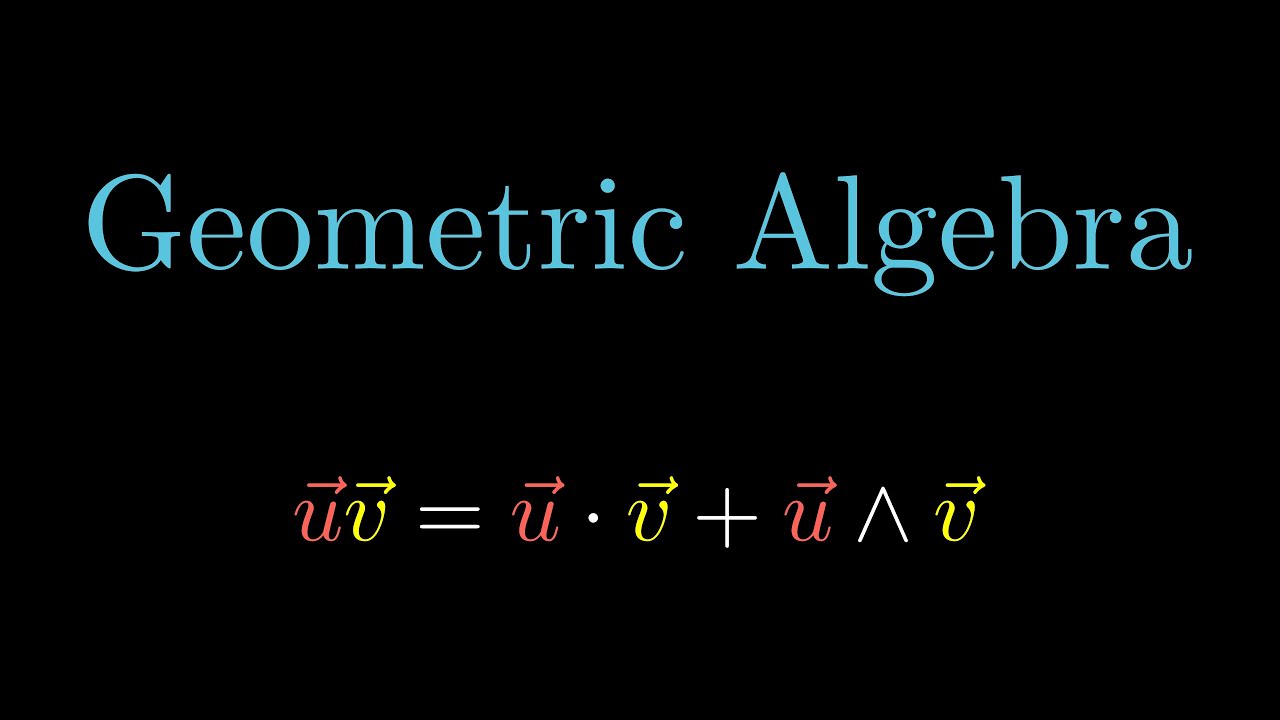
This video is an introduction to geometric algebra, a severely underrated mathematical language that can be used to describe almost all of physics. This video was made as a presentation for my lab that I work in. While I had the people there foremost in my mind when making this, I realized that this might be useful to the general public, so I ...
slim meadow
is there a mathematical explanation of k vectors tbh
i still dont know what physicists mean when they say these things
neat lintel
100%.
leaden torrent
oh so they just mean k as a variable
cerulean kernel
physics is based on falsificationism i believe
leaden torrent
here
latent forge
like math is probably 10% unfounded bullshit somewhere
leaden torrent
damn i got excited
K is my favourite letter
but here its just being a dumb variable
leaden torrent
i havent watched it but so many people have asked about it that i get the gist
geometric algebra is a weird thing used by physicists thats arguably a bit more convenient than vector calculus
mathematicians dont really use it much at all
cerulean kernel
i am interested in physics too so i was watching it 😛
latent forge
hmm
leaden torrent
i dont know the exact details but apparently physicists find it handy for multivar
so i cant judge
multivar is kind of dumb anyway so anything that makes it easier im cool with
latent forge
i heard from some excited undergrad last yesr that tensors are important when describing quantum entanglement
cerulean kernel
yeah im in multivar calc rn
latent forge
how?
leaden torrent
tensors are important in all of physics
leaden torrent
to the point where "important when describing quantum entanglement" is really vague
leaden torrent
idk im not a physicist lmao
latent forge
physiciast student
leaden torrent
i think theyre usually first introduced informally in a QM course
latent forge
o
leaden torrent
or maybe relativity
latent forge
reference frames lol
toxic schooner
in one of those 2 yeah
latent forge
sounds like pseudoscience
toxic schooner
or if u take a grad level course on CM
latent forge
Celestial mechanics?
leaden torrent
how tf does reference frame sound like pseudoscience
you learn about them in high school physics
cerulean kernel
lol
latent forge
i get the concept
leaden torrent
"if youre in a bus moving forward, and you throw a baseball backwards, what happens?"
vivid halo
as soon as you study GR tensors come up in a completely unavoidable way
they do come up in QM and QFT as well
maybe less so in early QM
latent forge
if the earth is rotating why we no fly off
i get the concept
but ive always felt like its one hypothesis of many if that makes sense
vivid halo
if the sun is traveling quickly with respect to the galactic center why don't the planets fly off?
cerulean kernel
thing is, the planets formed around the sun
latent forge
but its not completely irrational
cerulean kernel
it was already going fast
latent forge
like there is always the question in science, what if more reasons?
leaden torrent
i dont follow
toxic schooner

leaden torrent
are you implying the universe ought to have a canonical reference frame
if so, how fast am i moving in it
latent forge
i think you mean like every object in the universe has its own properties independent of which situation its in if that makes sense
sick burrow
Ooh do we have some relativity crankery
leaden torrent
i mean sure, one of those properties is mass
latent forge
is it not normal to have doubts
vivid halo
yea so I mean the solution to this is to consider reference frames
latent forge
pfft
leaden torrent
but yes plenty of things change depending on situation
thats why we have ways of modelling situations
latent forge
i agree they are useful but why I called it pseudoscience was partially meme
cerulean kernel
maybe at one point in the universe there was only 1 reference frame, like big bang or something