#book-recommendations
1 messages · Page 14 of 1
 cedar flume
Book recommendation for real analysis pls
 cedar ridge
Spivak/Apostol
 loud cradle
cedar flume
Book recommendation for real analysis pls
loud cradle
cedar flume
Book recommendation for real analysis pls
at what level? there is a pinned message with recommendations for lebesgue-enabled analysis
 grave thorn
what level book?
grave thorn
cedar flume
Book recommendation for real analysis pls
as bungo mentioned, specify the level; if undergraduate Rudin is always a good pick
cedar flume
loud cradle
at what level? there is a pinned message with recommendations for lebesgue-enabl...
This are the topics I've
 cedar ridge
This ain’t Rudin content 🥸
 versed cypress
Has anyone tried Calculus from the Ground Up (Jonathan Bartlett)
Or has anyone gone through it and how did they find it
 fast wasp
cedar ridge
Spivak/Apostol
fast wasp
cedar ridge
Spivak/Apostol
Great, but that's what I meant

 fast wasp
 vital bane
a book full of integrals
vital bane
a book full of integrals

vital bane
"Inside Interesting Integrals: A Collection of Sneaky Tricks, Sly Substitutions, and Numerous Other Stupendously Clever, Awesomely Wicked, and Devilishly Seductive Maneuvers for Computing Nearly 200 Perplexing Definite Integrals From Physics, Engineering, and Mathematics (Plus 60 Challenge Problems with Complete, Detailed Solutions)" that's the actual title

fast wasp
hahahahaha tks bro
 hallow oriole
devilishly seductive 😈
fast wasp

fast wasp
hallow oriole
devilishly seductive 😈
so sexy
 sage kelp
cedar flume
Book recommendation for real analysis pls
sage kelp
cedar flume
Book recommendation for real analysis pls
The way of Analysis
 icy knot
cedar flume
Book recommendation for real analysis pls
icy knot
cedar flume
Book recommendation for real analysis pls
Beginner: Understanding Analysis
 fierce hedge
@remote sparrow Did you buy the gamelin and greene book?
grave thorn
cedar ridge
This ain’t Rudin content 🥸
It quite literally is
icy knot
Intermediate: Introductory Real Analysis, Kolmogorov
 remote sparrow
fierce hedge
<@254820329124265984> Did you buy the gamelin and greene book?
remote sparrow
fierce hedge
<@254820329124265984> Did you buy the gamelin and greene book?
not yet
cedar flume
Ok thank you
 limpid gazelle
What's a good book on zfc?
 late plinth
vital bane
a book full of integrals
late plinth
vital bane
a book full of integrals
that looks like a fun book
idk how practical but def interesting
vital bane
late plinth
that looks like a fun book
idk how practical but def interesting
I mean it's not for math students though, they dont really evaluate integrals that often, they're more worried about how to integrate like idk a functor or something lmao 
but it'd be useful for physics and engineering students
which a part of me is 
 fluid bay
integrating a functor
 late plinth
vital bane
I mean it's not for math students though, they dont really evaluate integrals th...
late plinth
vital bane
I mean it's not for math students though, they dont really evaluate integrals th...
i mean ya, thats what i meant
vital bane

late plinth
idt i touched an integral in a while but it just seems like one of those cool things to have on ur shelf
vital bane
fluid bay
>integrating a functor
<:stare:826920038623346729>
those measure theorists are wild 
they'll turn anything into a measurable space
remote sparrow
limpid gazelle
What's a good book on zfc?
enderton's set theory book
for an undergraduate treatment
hrbacek and jech i've heard is also good
limpid gazelle
Oh I'm looking for something that talks about zfc using model theory, not just the axioms and rigorous set theory
Sorry should've specified
 manic cape
vital bane
I mean it's not for math students though, they dont really evaluate integrals th...
manic cape
vital bane
I mean it's not for math students though, they dont really evaluate integrals th...
As a math student, i could definitely use a book like this
integration is too hard
vital bane
yea knowing how to integrate stuff using special functions and hypergeometric functions would be pretty cool
late plinth
manic cape
integration is too hard
Symbolab is too op
hallow oriole
fuck symbolab
we stan my boy https://www.integral-calculator.com/
Solve definite and indefinite integrals (antiderivatives) using this free online calculator. Step-by-step solution and graphs included!
easily the best free integration solver
and it's not even close
well
ig wolfram alpha is better
but that's not rly a fair comparison imo
 onyx tide

 crimson leaf
hallow oriole
ig wolfram alpha is better
crimson leaf
hallow oriole
ig wolfram alpha is better
Disagree this one has steps for free which makes it better
hallow oriole
the thing is that wolfram does more things that js integration
and wolfram can evaluate some integrals that this can't
 cobalt maple
Hey, could anyone recommend a book for algebraic geometry that covers the following:
Algebraic sets, affine and projective varieties, fundamental properties
of varieties. Sheaves and locally ringed spaces. Morphisms of varieties, birational maps and blow-ups. Smoothness and singularities. Hilbert polynomials and Bezout's theorem.
 indigo mesa
cobalt maple
Hey, could anyone recommend a book for algebraic geometry that covers the follow...
indigo mesa
cobalt maple
Hey, could anyone recommend a book for algebraic geometry that covers the follow...
https://www.mathematik.uni-kl.de/~gathmann/de/alggeom.php the 2014 version covers all of that
cobalt maple
Oh wow, I'd actually been looking at the newest version of that
Ah, I see the 2014 version doesn't require prior knowledge of commutative algebra
indigo mesa
yes
his commutative algebra notes are pretty neat as well tho
in case you're looking for something there as well
cobalt maple
I see. I'd like to learn some commutative algebra before the course too. Do you think it would be better to learn it separately or in the context of one of these notes maybe?
(A friend said he fiends it easier to learn comm alg in the context of other stuff)
indigo mesa
You should definitely take a look at his comm alg notes then
 stray veldt
you can also check out the algebraic geometry book by Perrin
proving bezouts theorem in full generality is not that easy and this book basically sets out to do it from scratch
indigo mesa
I've been reading them and they motivate the connection between geometric and algebraic objects a lot
cobalt maple
I see. Thanks. I'll try both.
 dawn mirage
hey guys, now that the illegal z-lib is gone, what other ways that I can get free math books, asking for legal advice kinda, been a while since I've last tried to read.
 grand thistle
dawn mirage
hey guys, now that the illegal z-lib is gone, what other ways that I can get fre...
grand thistle
dawn mirage
hey guys, now that the illegal z-lib is gone, what other ways that I can get fre...
the other one is still up ||library genesis||
 orchid mortar
dawn mirage
hey guys, now that the illegal z-lib is gone, what other ways that I can get fre...
orchid mortar
dawn mirage
hey guys, now that the illegal z-lib is gone, what other ways that I can get fre...
From a library if your library has them. Also depending on topic it might not be impossible to get good free resources
dawn mirage
grand thistle
the other one is still up ||library genesis||
 I see, I'll be sure to avoid that.
dawn mirage
orchid mortar
From a library if your library has them. Also depending on topic it might not be...
Sadly, no good libraries around me  .
.
grand thistle
dawn mirage
<:thonk:406575732563902485> I see, I'll be sure to *avoid* that.
yeah stay safe on the internet make sure not to do any illegal things
dawn mirage
 low marsh
guys im new to this server and just look the doubts of other people for fun but 90% of them just seem to pass over my mind....any book which can help me cover these?
i mean i think that the language used in the questions in my country is really different from the one thats used in others..
 paper ice
You mean the help channels?
Naturally they cover a large amount of mathematical topics so you are not going to be able to help with every unless u are really advanced
 mossy flume
^^
If you want to learn more math, of course you're in the right place
@low marsh what sort of math have you covered thus far?
paper ice
I'm liking this book so far, it's a fun one
mossy flume
Jay Cummings has a nice Twitter acct
paper ice
I hope that's not sarcasm, enough things have been ruined to me beacuse of political or otherwise shady backstories, lmao
 gray gazelle
hi
 tawny copper
dawn mirage
hey guys, now that the illegal z-lib is gone, what other ways that I can get fre...
tawny copper
dawn mirage
hey guys, now that the illegal z-lib is gone, what other ways that I can get fre...
I use libgen, works fine for me
 slender cargo
Going through Abbott's Understanding Analysis and I am appreciating this book much more than when I was in college 
 slender cargo
oh I heard of that book
it's like 600 pages long
a lot more motivation than usual
 foggy relic
for analysis i like browder
vital bane
slender cargo
Going through Abbott's Understanding Analysis and I am appreciating this book mu...
yea it's very nice 
which chapter are you at?
vital bane
slender cargo
going through the problems in that now
nicee im goinf through problems in 1.2 gonna come to 1.3 maybe we can dp abbott together
slender cargo
vital bane
nicee im goinf through problems in 1.2 gonna come to 1.3 maybe we can dp abbott ...
remote sparrow
vital bane
abbott is more of a gentle introduction to analysis
in the rectum? i mean where else would anal be
vital bane
slender cargo
vital bane
abbott is more of a gentle introduction to analysis
gentle is what I want. I'm just self studying for fun now
vital bane
I'm self studying too but for becoming a serious math student one day 
remote sparrow
but i mean is cummings similar to abbott
vital bane
and do stuff like fun anal, harm anal
vital bane
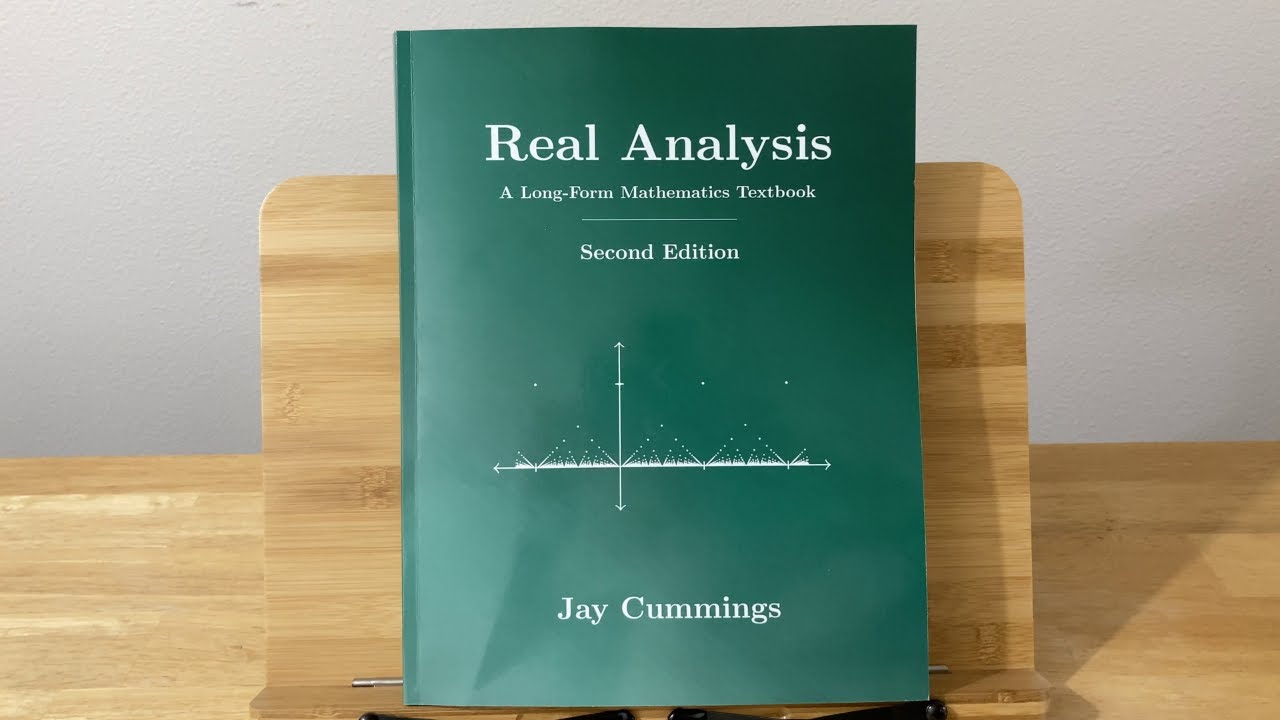
In this video I will show you a very interesting real analysis book. This book is excellent for anyone who wants to learn Real Analysis on their own, or anyone who is taking an Undergraduate level course on Advanced Calculus/Real Analysis. The book is titled Real Analysis: A Long-Form Mathematics Textbook and it was written by Jay Cummings.
Her...
Lol yea
I havent watched it yet
 fickle whale
I've read cummings
vital bane
is it similar to abbott?
vital bane
abbott is very good for beginners and self-learners, and I'm in the intersection of those two things
fickle whale
I liked Cummings but I don't have anything else to compare it against
fickle whale
I'd say it's good for those two things
vital bane
remote sparrow
@vital bane have you heard of zorich
his analysis volumes have many physical examples
vital bane
no
vital bane
remote sparrow
his analysis volumes have many physical examples
huh
vital bane
Lol that's good
remote sparrow
fickle whale
Cummings has a lot of great jokes in it
i have a draft pdf of his proofs book. the jokes are pretty corny but some are cool
fickle whale
Using social media logos to number equations in a proof
vital bane
fickle whale
It's a good laugh and it makes you double check what you're reading
remote sparrow
cummings is a young guy too
foggy relic
remote sparrow
could cummings be an abbott contender?
contender for worst book in analysis?
fickle whale
vital bane
dual of a geometric algebra
That topic has some nuance I shan't discuss in this channel
 remote sparrow
it's reasonable. abbott is just pitched lower than tao or rudin
fickle whale
sure, I can get fact checked there too. Just like last time
remote sparrow
doesn't make abbott a bad book
vital bane
name 3 things that make it bad
vital bane
mfw u sound like geogristle
slender cargo
? you might as well say that Rudin covers no content. might as well skip to a highly condensed paper on measure theory
vital bane
this
vital bane
abbott + apostol is for me 😌
slender cargo
if I keep enjoying this I'll do Munkres Analysis on Manifolds later
vital bane
slender cargo
will learn about metric spaces eventually
vital bane
apostol has metric spaces
remote sparrow
i doubt invictus has read cummings
but it's probably not up their alley either given their comments on abbott
remote sparrow
slender cargo
if I keep enjoying this I'll do Munkres Analysis on Manifolds later
hubbard and hubbard also covers multivariable analysis. lacks some theoretical exercises since it's also meant for a rigorous multivariable calculus course (though all the sophisticated proofs are also in the appendix), but it's good.
remote sparrow
yep
slender cargo
tbh I got the feeling it was trying to do everything at once. it felt confusing
but I've no idea
remote sparrow
vital bane
huh <:catThink:526983414226747393>
yeah you can google his two analysis books or search zorich in the discord search bar
gray gazelle
I read, but I have this feeling that I'll forget what I'm reading anyway
And that gives me an existential crisis
grave thorn
slender cargo
? you might as well say that Rudin covers no content. might as well skip to a hi...
Idk whether a "highly condensed paper on measure theory at the level of Baby Rudin" exists
gray gazelle
Bogachev Measure theory?
slender cargo
grave thorn
Idk whether a "highly condensed paper on measure theory at the level of Baby Rud...
I was just trying to make a point that having a lot of motivation in a book isn't necessarily bad
even if the content of the book could be fit in 1/10th the size
grave thorn
Rudins measure theory section is bad lmao
gray gazelle
Oh I misunderstood the question
slender cargo
yeah I've heard. I'm going through Abbott's Understanding Analysis now and I'm really liking it. another might claim that it's low level and deficient in how much material it covers, but that's okay to me
 pale quarry
Book recs for olympiads guys?
From scratch
Just assume I don't know anything
I'm a 10 year old with no capability of articulating olympiad problems, assume that
 sturdy shore
excluding the chapters that people generally skip in rudin (like the measure theory one), the difference in material covered between Abbott and Rudin shouldn't be so significant...
of course, how it is covered is, but saying Abbott has no content is weird af
pale quarry
And give me book recommendations for the math olympiads
slender cargo
sturdy shore
excluding the chapters that people generally skip in rudin (like the measure the...
that's the impression I had. Abbott doesn't cover metric spaces until a section near the end, but that's the main difference
 wispy timber
book rec for levy processes?
remote sparrow
a possibly apocryphal story i heard about rudin was that he wanted to add more pictures to PMA but the publishers said that would drive up the costs, so he decided not to do it
and watching a rare video lecture by rudin himself, it doesn't seem like he was opposed to motivation and meeting pedagogical needs
also evidenced in the 3rd ed. of rudin, where he defers the dedekind cut construction of R to the end of chapter 1, citing that this way was more pedagogically effective, albeit not logical
vital bane
gray gazelle
I read, but I have this feeling that I'll forget what I'm reading anyway
but remember you can just glance at what you've read to remember it, it's not like completely wiping your memory
vital bane
sturdy shore
of course, how it is covered is, but saying Abbott has no content is weird af
I know right
grave thorn
wispy timber
book rec for levy processes?
Schilling has nice notes on levy processes
You can find them on arxiv
 remote ginkgo
pale quarry
I'm a 10 year old with no capability of articulating olympiad problems, assume t...
remote ginkgo
pale quarry
I'm a 10 year old with no capability of articulating olympiad problems, assume t...
LMAO
mods
wispy timber
grave thorn
Schilling has nice notes on levy processes
tyvm 
pale quarry
My capabilities match that of a 10 y/o
pale quarry
 hasty turret
Solving them is not
hasty turret
Solving them is not
Same difference
remote sparrow
articulating fermat's last theorem is easy. proving it is not. a problem statement and its solution are distinct.
remote sparrow
you can google evan chen. he has made some material for olympiads
though i'm not sure why you want to go into an olympiad with that sort of defeatist attitude
olympiad problems are designed to be solved in a fixed amount of time
these competitions don't take geniuses, just plenty of practice
if this is to stand out on your college applications or whatever, then i would discourage you from participating
foggy relic
remote sparrow
i doubt invictus has read cummings
i have not
but if you're comparing it along the lines of abbot i have little reason to think its any good lol
remote sparrow
i have not read cummings
i am asking if it is like abbott
cummings' style is more conversational and informal based on reviews and reading a draft copy of his proofs book
foggy relic
looking at the toc, it seems like the bare minimum
pale quarry
remote sparrow
if this is to stand out on your college applications or whatever, then i would d...
?¿? You can put that on your college application? I don't even wanna pursue maths I just like the challenge
I'm planning on doing law why would I put a math competition on my application
gray gazelle
😭 someone call the police pls lol
dawn mirage
tawny copper
I use libgen, works fine for me
 Icic, thanks!
hallow oriole
dawn mirage
hey guys, now that the illegal z-lib is gone, what other ways that I can get fre...
anna's archive
note: i cannot personally verify that it is completely legitimate
use at your own risk
i have downloaded a book and virus scanned it and it came out fine
use at your own risk
be safe on the internet
hallow oriole
oh yeah btw for anyone who didn't know generatingfunctionology has a legal free pdf online maintained by the author
it's a really nice book!
crimson leaf
Yes very thankful to upenn for hosting it this many years after his passing
hallow oriole
yes!!
- wilf is one of my fav mathematicians for no reason besides his book and that he helped make the calkin-wilf tree!
low marsh
mossy flume
<@786836941672546334> what sort of math have you covered thus far?
in 10tg grade at the moment and covered algebra and geometry... functions and calculus and various topics such as limits, matrices etc still remain untouched
i mean i really want to dive very deep into math so from where should i start?
gray gazelle
vital bane
but remember you can just glance at what you've read to remember it, it's not li...
True
 sudden dock
low marsh
in 10tg grade at the moment and covered algebra and geometry... functions and ca...
sudden dock
low marsh
in 10tg grade at the moment and covered algebra and geometry... functions and ca...
you can start from a College Algebra or Trigonometry book. If you don't like books, you can go for Khan Academy
vital bane
low marsh
i mean i really want to dive very deep into math so from where should i start?
do everything in khan academy calc ab, bc -> linear algebra -> multivariable calc
then a proofs book, then analysis, algebra and topology
after that you can start diving deep into math
low marsh
@vital bane @sudden dock to be honest..i prefer books over videos so thanks for your recommendation
vital bane
why not both
sudden dock
low marsh
<@972513292042010674> <@726085794414198924> to be honest..i prefer books over vi...
Now, If you are looking for an Algebra book, I would suggest College Algebra by Robert Blitzer, It's good written, the text is not very hard to understand, Questions at the end of each section are not very hard, good for improving basic concepts. P.S Don't waste a lot of time on questions, they are repeating
 hazy elk
You can try AOPS books too
vital bane
low marsh
<@972513292042010674> <@726085794414198924> to be honest..i prefer books over vi...
"multivariable mathematics" by ted shiffrin
it has both linear algebra and multivariable calculus in n-dimensions and a bit more
sudden dock
low marsh
in 10tg grade at the moment and covered algebra and geometry... functions and ca...
.
@vital bane You can't suggest a 10th grader multivariable calculus and linear algebra
 gentle arrow
honestly i would do proofs concurrently idk
vital bane
I guess?
gentle arrow
basically a requirement to read higher math textbooks
vital bane
unless it's written for physicists
vital bane
putnam
 tawny breach
Hey guys. I've spent the past half year refreshing myself on Algebra 1-2, Trig, Geometry. I'm now looking to get into calculus. After a bit of research it seems many people suggest moving past pre-calc, directly into calc 1. I'm not looking to rush my learning would this be advised? and if so what calc books can anyone recommend to start with as there seems to be a lot of options?
gentle arrow
good algebra/trig skills pretty much allows you to skip precalc
hazy elk
I think if I had a choice as a highschooler, I would probably read Axler and Abbott
hasty turret
I guess AoPS is a good starting point
low marsh
sudden dock
Now, If you are looking for an Algebra book, I would suggest College Algebra by ...
Actually my concepts for algebra and quad eqn are pretty solid so I'm looking looking for a book that has questions which require high thinking
grand thistle
low marsh
Actually my concepts for algebra and quad eqn are pretty solid so I'm looking lo...
ive seen people recommend serge lang's "Basic mathematics"
low marsh
hazy elk
You can try AOPS books too
i did solve aops questions available on their website (i know those questions are different from the books your referring to) when i was preping for olympiad so...yeah i did like the difficulty of those questions
sudden dock
low marsh
Actually my concepts for algebra and quad eqn are pretty solid so I'm looking lo...
Watch this video https://youtu.be/OmJ-4B-mS-Y

The entire field of mathematics summarised in a single map! This shows how pure mathematics and applied mathematics relate to each other and all of the sub-topics they are made from.
#mathematics #DomainOfScience
If you would like to buy a poster of this map, they are available here:
North America: https://store.dftba.com/products/map-of-math...
low marsh
grand thistle
ive seen people recommend serge lang's "Basic mathematics"
Ok now im noting all these books and imma try them all to see which one fits the best
low marsh
sudden dock
Watch this video https://youtu.be/OmJ-4B-mS-Y
Ookay.
yea i watched it... i think im only aware of the numerical mathematics and that too...only around 40% knowledge of each topics..
gray gazelle
vital bane
"multivariable mathematics" by ted shiffrin
Ted Shiffrin
low marsh
gray gazelle
Ted Shiffrin <:catthumbsup:614540188747563008>
i think the book he was talking about is called multivariable calculus and not multivariable mathematics right?
 sleek canopy
godel escher bach is a thinking man's book
remote sparrow
hubbard and hubbard's multivariable calculus book is also good if you want a hard copy that's cheaper than shifrin
 random roost
It would be nice to have books recommended here be cleanly organized by topics over at https://learnawesome.org/
vital bane
low marsh
i think the book he was talking about is called multivariable calculus and not m...
no no it is called multivariable mathematics, it's called that because it teaches you linear algebra and multivariable calculus (in n-dimensions a.k.a in R^n) cocurrently, ted shiffrin says that's how it should be taught, which I kind of agree with
low marsh
vital bane
no no it is called multivariable mathematics, it's called that because it teache...
ah i see..my bad
 gray jungle
Whats a topology book with cool exercises
gray gazelle
gray jungle
Whats a topology book with cool exercises
Engelking's General topology has cool exercises
hazy elk
How are the excercises in Dugundji like?
Is it too terse for a first read?
@gray gazelle
gray gazelle
hazy elk
Is it too terse for a first read?
well I didn't say you should read it, but the exercises are cool
hazy elk
Oh I thought it was your canonical suggestion for a general topology book?
You're talking about Dugundji right
gray gazelle
hazy elk
Oh I thought it was your canonical suggestion for a general topology book?
ah no. It's reference text and it's hard
and terse
gray gazelle
hazy elk
You're talking about Dugundji right
yes but it's still challenging to read
even though more relaxed than Engelking
that's why for example Munkres created his books, as an introductory text to oppose the existing ones
to be more introductory
I recommend starting with something about metric spaces tbh
gray gazelle
hazy elk
You're talking about Dugundji right
oh wait.
I thought you were talking about Engelking, I misread
gray gazelle
hazy elk
How are the excercises in Dugundji like?
exercises are okay but they can be a bit boring imo
I don't think it's too terse, but it's probably better to start off with something like metric spaces
hazy elk
I see, even the ones in Munkres are kinda boring no?
gray gazelle
I think so. I guess there's not much fun in doing exercises from topology unless it's something harder than usual
vital bane
infinite dimensional point set topology then
 void pasture
Is there a book or guide on trigonomtric functions and identities aimed at first year uni students? My book only covers sin, cos, tan, sinh, cosh, tanh and some of their identities. For instance, today I was challenged with the integral $\int{\frac{1}{\sqrt{1+x^2}}dx}$ which was solved by using the identity that $1 + \tan^2(x) = \sec^2(x)$, which my textbook does not cover, it doesn't even cover sec(x)), yet there have been several integrals that can't easily be done using these identities that it does not cover. On a side note, the identity are easily derived based on the content htat the book has provided, but it doesn't help when I get questions like this where knowing the identities straight up helps a lot
 hasty eagleBOT
Chippotle Maths
 gray gazelle
vital bane
infinite dimensional point set topology then <:realshit:586078783002509313>
gray gazelle
vital bane
infinite dimensional point set topology then <:realshit:586078783002509313>
that exists already
well, infinite-dimensional topology exists
 lapis sundial
void pasture
Is there a book or guide on trigonomtric functions and identities aimed at first...
lapis sundial
void pasture
Is there a book or guide on trigonomtric functions and identities aimed at first...
tbh you might be better served just by looking at trig substitutions
remote sparrow
void pasture
Is there a book or guide on trigonomtric functions and identities aimed at first...
csc = 1/sin and sec = 1/cos. (sin x)^2 + (cos x)^2 = 1. you can easily derive 1 + (tan x)^2 = (sec x)^2 by dividing through that identity by (cos x)^2. you just need to remember what csc and sec mean.
you can look at paul's online math notes for trig and his trig cheat sheet if you need it
 willow pecan
It's fine
void pasture
remote sparrow
csc = 1/sin and sec = 1/cos. (sin x)^2 + (cos x)^2 = 1. you can easily derive 1 ...
Thank you, Sour Drop. I'll check Paul's notes now. I wish you a sweet day, Sour Drop.
remote ginkgo
vital bane
infinite dimensional point set topology then <:realshit:586078783002509313>
tychonoff product
remote sparrow

the person running the blog archives some soviet-era math books published by mir
fierce hedge
We used to have maths seminars using Mir titles. Good books
fierce hedge
remote sparrow
https://mirtitles.org/
Also, is it just me or is everything in French for some reason?
remote sparrow
fierce hedge
Also, is it just me or is everything in French for some reason?
just recent blog posts indicating a french copy of a mir book has been uploaded
gotta scroll down
a very small number of titles is texified
mainly the physics titles
 neon tiger
need a book on geometry with ques going from easy olympiad level to very difficult ques
remote sparrow
neon tiger
need a book on geometry with ques going from easy olympiad level to very difficu...
evan chen wrote a book on olympiad geometry that could help
 brave yew
i'm going through paul eccles introduction to mahematical reasoning
what books should i go over next to further mathematical maturity?
 dense glen
 steady orchid
is gud book
steady orchid
is gud book
Yes it is good book
remote sparrow
brave yew
what books should i go over next to further mathematical maturity?
You can go anywhere you like once you've finished an intro to proofs type of book. An intro to proofs course is somewhat like an English composition class, a class primarily to learn how to read and write effectively. You may be assigned some light readings to respond to, but the substance of the content is given less attention than in how you respond to it. So after finishing an intro to proofs book, you should move on to studying topics more deeply, keeping in mind how to communicate your ideas with appropriate rigor. Given you mentioned that you failed real analysis twice, you can choose to postpone it for something else if you'd like to build more confidence. However, gentle books on real analysis could be those by Abbott or Cummings. Maybe you could do linear algebra, elementary number theory, or combinatorics.
brave yew
i've gone over the topic, it feels like i'm not qualified
it's the difference between going over an intro to proofs class and going through a weeder class
being able to say, read HOTT comfortably is different than reading an intro to proofs book
remote sparrow
Well, I've heard a lot of praise for Cummings, and I'm wondering if I should add it to my library. $15 seems like a pretty reasonable price, and I'd love to hear a review from you if you feel like you succeeded with it.
brave yew
so this?

This textbook is designed for students. Rather than the typical definition-theorem-proof-repeat style, this text includes much more commentary, motivation and explanation. The proofs are not terse, and aim for understanding over economy. Furthermore, dozens of proofs are preceded by "scratch work...
i mean i have polya, but math books are traditionally so concise
remote sparrow
cummings' real analysis book
but you can pick up his proofs book if you want
i liked reading a draft copy i found on the internet
That said, you can go wherever you want after finishing an intro to proofs book. You do not need to keep reading these books if you can competently complete them, and you should not stay stuck there. If needed, you can always turn back and review these books. But there is no royal road to science; you have to struggle with the material. Mathematical maturity is not built by idling on introductory material (not to be confused with revisiting material from a fresh or more advanced perspective); it's by actively engaging with new ideas.

This textbook is designed for students. Rather than the typical definition-theorem-proof-repeat style, this text includes much more commentary, motivation and explanation. The proofs are not terse, and aim for understanding over economy. Furthermore, dozens of proofs are preceded by "scratch work...
Failing twice is not an indication that you can't gain mathematical maturity. Part of maturing is failing. There are all sorts of reasons people can fail a class, and it is almost never, if at all, because they are inherently stupid. You can succeed.
orchid mortar
remote sparrow
Failing twice is not an indication that you can't gain mathematical maturity. Pa...
fml I failed at my econometrics class because I can't math stats and linear algebra properly 
 formal kernel
orchid mortar
fml I failed at my econometrics class because I can't math stats and linear alge...
formal kernel
orchid mortar
fml I failed at my econometrics class because I can't math stats and linear alge...
its okay bro
 shadow magnet
grand thistle
shadow magnet
grand thistle
has anyone tried halmos's "Linear Algebra Problem Book"? I'm looking for a mostly problem based book that will drill into my head a lot of the linear algebra i forgot
 mystic orbit
steady orchid
48 laws of power
mystic orbit
steady orchid
48 laws of power
LOL
@ TTeppa
Can you elaborate btw?
I'm bored so I was looking at the pins
Wanna chess?
Bruh
Turbo nurd doesn't know chess?
Wtf
I should prolly ping Nami if I want an answer lol
But he mod so
W/e, I'll ask later
I wanna know why doe
Especially since tterra swears by the book
Ye, everyone knows rudin goes to shit after chapter 8
Some stop at chapter 7
Got incredible exercises tho
It's the book i was using before taking a break
Lmao
Yeah, the proof for the inverse function theorem was fucking despicable
 minor knot

 sage python
Yohan's assessment is likely correct. I haven't gone in detail through Spivak for differential forms but since the book is short in general it's likely on the quick end.
Rudin's proof of inverse function theorem I thought was fine no?
Like Rudin chapter 9 overall is a bit awkward, like he sorta does this thing where he includes the bare minimum of linear algebra he needs within the chapter and... eh
fierce hedge
How's apostol compared to Rudin?
sage python
But Rudin chapter 10 indicates to me that Walter Rudin did not understand differential forms
Probably fine?
vital bane
what is the dummit and foote equivalent for analysis?
like a huge 1000 page analysis reference book starting out from intro analysis and going to more advanced topics like diff geo(yes not exactly analysis), measure theory etc.?
im just curious if such a thing exists
stray veldt
amann escher
vital bane
oh I see it's split into 3 books?
stray veldt
yes
vital bane
okay thanks
 placid pollen
vital bane
like a huge 1000 page analysis reference book starting out from intro analysis a...
placid pollen
vital bane
like a huge 1000 page analysis reference book starting out from intro analysis a...
I know a 5 book series, I will tell you later since I can't remember
vital bane
simon?
"a comprehensive course in analysis" by barry simon? ryc and slurp (or gmod) or someone else were talking about it a few months ago
placid pollen
vital bane
"a comprehensive course in analysis" by barry simon? ryc and slurp (or gmod) or ...
No that's grad analysis damn looks good tho
 scarlet steeple
what is the best abstract algebra book out there?
gray gazelle
opinion based
 sudden thorn
guys
can anyone Suggest me a combinatorics book?(I want it to prepare for AMO)
(I totally mastered the basics and rn I am looking for problems of a similar level to the jbmo)
But most of what I found The author does not explain the motivation that helped him solve the problems
vital bane
scarlet steeple
what is the best abstract algebra book out there?
but yea there's no absolute "best" it's subjective
 heady ember
vital bane
heady ember
vital bane
Dummit and Foote more like damnit it thick
placid pollen
scarlet steeple
what is the best abstract algebra book out there?
My plan is this. I would get an easy intro and applications book and a grad level exposition. Thomas Judson for the first (currently using for undergrad, but the professor uses others), Lang's Algebra for the second thing. So undergrad intro and grad reference, then if you're interested in a particular topic, you grab something about that particular topic and check Lang as a second view or summary on the same topic. If you feel lacking severely in a particular undergrad topic you check the undergrad book to get a warm up.
Dummit and Foote as far as I know covers both purposes, which is why I'm not interested in it. A book should serve only one purpose if it's going to sit at my book shelf, otherwise I have internet
scarlet steeple
placid pollen
My plan is this. I would get an easy intro and applications book and a grad leve...
why? is Langs Algebra not sufficient as a main text?
I was going to do an intro book and then use langs book for more advanced alegbra
placid pollen
scarlet steeple
why? is Langs Algebra not sufficient as a main text?
You can try, it's probably the only algebra book you will need. It's just that if you feel tired or don't want to put in the time of checking by yourself, because his exposition is brief, then maybe you need motivation from an undergrad course to be seriously interested.
And by "motivation" I mean knowing specific algebraic structures and examples which are elementary. In Lang's algebra I've seen him use analysis examples which you might not know so the example wouldn't land as enlightening yet
So I'm not saying just algebra books are gonna land you in Lang's algebra, you need some grad analysis to realize why some algebraic structures are cool. (Banach algebras? I'm out of my depth here. It's just the way I see it as an undergrad)
scarlet steeple
Ok I see interesting...
like how much analysis
i know real analysis
up too real analysis*
do i need functional, harmonic e.t.c?
placid pollen
scarlet steeple
do i need functional, harmonic e.t.c?
Inspiration from functional analysis a little, but not strictly needed since you're going to work the algebra rather than the topological or analytical properties; harmonic it's actually something people study once they get the basics of grad algebra and analysis. Topology, Analysis and Algebra are usually the main courses you take at the same time in grad school because each one appears as an example or inspiration for the other, they are very related to each other.
I mean first semester is usually real analysis, algebra and topology afaik, so you can get the basics of algebra without the other two, but it's assumed you took undergrad courses about the other two.
scarlet steeple
@placid pollen thanks for all this advice, ill put it to good use
icy knot
I’m going to go against the grain and offer Hoffstein’s Mathematical Cryptography book. @scarlet steeple
 pine sun
 broken meadow
crimson leaf
sudden thorn
guys
can anyone Suggest me a combinatorics book?(I want it to prepare for AMO) ...
broken meadow
crimson leaf
sudden thorn
guys
can anyone Suggest me a combinatorics book?(I want it to prepare for AMO) ...
Guichards book is free and isn't hard if you want something more difficult you could try Bona walkthrough combinatorics or combinatorics graph theory by Harris et all. If you really want a challenge there's Stanley but afaik that's usually a first grad level course in enumeration
sudden thorn
crimson leaf
Guichards book is free and isn't hard if you want something more difficult you c...
thnxx
remote sparrow

Here are the math books and who they are for. I hope this helps you decide which one is best for you.
How to Prove It: https://amzn.to/3VnYS9Q
(learn to write proofs with this with almost no background)
All The Math You Missed
(overview of tons of math, knowing some math is helpful before reading, it's awesome)
Advanced Engineering Mathematic...
icy knot
Glad to see Professor G getting recognition. #The Math Sorcerer Amazing instructor!
remote sparrow
icy knot
Glad to see Professor G getting recognition. #The Math Sorcerer Amazing instruc...
you had a class with him before?
 turbid pasture
:))
sudden dock
Doing Seeing and Understanding Geometry.
~ Harold R. Jacobs
Is this book any good? Is geometry worth 700 pages? My goal is to be able to do competition level problems.
fluid bay
i think the standard geometry text for olympiads is evan chens book
"euclidean geometry in mathematical olympiads"
sudden dock
fluid bay
i think the standard geometry text for olympiads is evan chens book
even though Evan Chen mentions that there are no prerequisite for reading his book but I have read some reviews which say that its better to have some basic geometry knowledge before reading Evan Chen's book.
so I'm a little bit confused now
gray gazelle
sudden dock
> **Doing Seeing and Understanding Geometry.**
> ...
two pages aren't equal
one might take you a minute
another an hour or two
sudden dock
gray gazelle
two pages aren't equal
I didn't understand.
icy knot
remote sparrow
you had a class with him before?
Yes. I took calculus and differential equations with him. Professor Gabilondo.
 vagrant sedge
Hi. What is a good book that has chapters talking about open sets of regular boundaries (like Lipschitz boundaries, C^1 boundaries, etc), Green's theorem, and things like that?
 fringe kayak
Hi,
I have to pick a general topic for a year three of bachelor's projet.
I've been particularly interested in the Commutative Algebra and Galois classes I've taken. I Also particularly enjoyed differential geometry and its applications on topology via the Poincaré-Hopf theorem, although I have not fully completed this class yet.
These classes were very introductive and the project's goal is to allow me to dive further into one of them 💕
In Commutative Algebra I've read about flatness. In Galois I've loved Galois's transcendant extensions but I also started reading about differential fields ; while the topic seemed quite complicated I found very exciting the idea of bringing differentiation into algebra.
I would like to hear about your opinion as an Algebra and Geometry enjoyer, of what you think would be an interesting general concept of study for my project. And if you have any books/editor that have made you love those topics 🙂
I think I would love to see how commutative algebra and Galois could do when put together but I'm not sure they can come together
gray gazelle
Make a logical argument before pinging me thrice. You’ve communicated 0 things in English that are worthy of being interpreted.
gray gazelle
Which is what I have been doing in the ~2 weeks you have been seething over my message.
Ok.
orchid mortar
fringe kayak
Hi,
I have to pick a general topic for a year three of bachelor's projet.
I've...
You can try #math-discussion and actually the advanced topics channels instead. I don't think #book-recommendations is the right place for this
fringe kayak
orchid mortar
You can try <#359052581022203914> and actually the advanced topics channels inst...
thanks for your advice, i hope copy pasting my message won't spam
orchid mortar
fringe kayak
thanks for your advice, i hope copy pasting my message won't spam
It isn't but uhh, don't get your hopes up for replies I think #groups-rings-fields is the relevant advanced math channel but don't tell them I sent you because I know 0 pure math
remote ginkgo
gray gazelle
Which is what I have been doing in the ~2 weeks you have been seething over my m...
ur a freak dude
gray gazelle
sudden dock
even though Evan Chen mentions that there are no prerequisite for reading his bo...
Evan Chen’s Euclidean Geometry can be read by anyone with eyes that are capable of reading this message.
remote ginkgo
evan chen is not good
because he didnt practice enough or spend time on interesting topics
bad parenting ig
gray gazelle
This is not about his napkin book. Basic comprehension skills would have told you that. IMO Gold is enough of a feat to show that he practiced enough Euclidean Geometry.
remote ginkgo
nope
remote ginkgo
gray gazelle
This is not about his napkin book. Basic comprehension skills would have told yo...
once again as always u completely miss the point
gray gazelle
As always? I do not know you, and I forgot you exist until I saw you mentioning me.
remote ginkgo
well, i'm afraid that's not true
who cares
the question should be whether the pedagogy is good
gray gazelle
brave yew
what books should i go over next to further mathematical maturity?
Jech “Set Theory” can be read profitably by anyone who can read
The ZFC stuff gets a bit hairy, but the good student can read it with basic proof knowledge.
gray gazelle
remote sparrow
You can go anywhere you like once you've finished an intro to proofs type of boo...
I doubt you can go from proofs to P Adic Hodge Theory
gray gazelle
gray jungle
Whats a topology book with cool exercises
Your other recommendation is a bad recommendation. Use Munkres.
gray gazelle
vital bane
after that you can start diving deep into math <:KEK:586240877358350341>
This is a biased roadmap. It’s whatever though, I do not care.
gray gazelle
manic cape
integration is too hard
I would recommend doing very difficult integrals as found on the stack. You can find them on the stack exchange, past Putnam or MIT Harvard competitions, and graduate Physics textbooks.
A good book would be Boas’s book for Engineers and Physicists.
Then doing the “math methods” version for physics fields if you want to be an “integral master”
gray gazelle
vital bane
a book full of integrals
Good recommendation for once +1
orchid mortar

sturdy shore
he is blessing us, the pedestrian mathematicians
gray gazelle
If you wish to quickly dive into Hartshorne, just use Atiyah. Eisenbud makes elliptical insinuations on what is elementary and what is required from a CA book, it is the Vakil of CA books, except, unlike Vakil, it does nothing well.
mystic orbit
what's a good intro to algebra book btw?
gray gazelle
mystic orbit
what's a good intro to algebra book btw?
D&F or Artin (if you have not seen Linear Algebra or you are not confident). Mostly DF, but Artin is for high schoolers to first year undergraduates.
Otherwise, I would argue that I dislike the concrete approach by Artin, when looking back
It still works though.
I have never read it, unfortunately.
My friend has learned Algebra from it, and she knows her stuff
So I’m sure it is usable
mystic orbit
gray gazelle
I have never read it, unfortunately.
how about aluffi?
I saw it mentioned a couple of times
gray gazelle
mystic orbit
how about aluffi?
I’ve actually learned Category Theory before I learned any other pure maths, so I didn’t see the need to read something like this
I didn’t check anything it
mystic orbit
I see 
gray gazelle
The only Algebra books I’m familiar with are: D&F, Artin, Lang, Bourbaki and that is the order I recommend them, although some nuances are lost with this simplistic orderings which I will elaborate below 👇
gray gazelle
D&F is great for the motivated student who wants fun, engaging problems on strictly Abstract Algebra, and it is a good encyclopedic reference. Out of all these books it has the best basic Algebra & Galois Theory.
Artin. The first book I learned Abstract (& Linear) Algebra from. I’d say the problems are just right below D&F due to the nature of them, but he does fun things with matrices and has a novel view. I recommend this to any highschooler who knows proofs.
Lang. The first step into chaos. My third book on Algebra. The text itself was easy enough, pretty succinct and gets a lot done. However, the exercises are beyond boring and, although nontrivial, felt forced. I learned Homological Algebra here as I worked through Weibel’s Hom Alg book.
Bourbaki. Do not read this book. You will die. I knew infinity categories, 4x algebra courses, and I still found it weird with notation and style. I’m not sure who this book was written for
hazy elk
gray gazelle
Your other recommendation is a bad recommendation. Use Munkres.
Even Hatcher thinks Munkres is a pedestrian treatment, Dugundji ftw
gray gazelle
hazy elk
Even Hatcher thinks Munkres is a pedestrian treatment, Dugundji ftw<:catKing:81...
Hatcher’s AT is the definition of Pedestrian.
May’s AT book is much better
Especially if you include both volumes, it covers much more
indigo mesa
They just have different approaches
Hatcher is better for people who haven't had a first exposition to AT imo
gray gazelle
Honestly, I think Hatcher didn’t work out for me because of the groundwork I did before even approaching it
I didn’t do the classical Algebra + Topology —> Alg Top roadmap
I still used Hatcher for simplistic viewpoints on things May finds nontrivial, but he is too Russian in writing style if that makes sense
indigo mesa
It does make sense to me, and i agree but i disagree with generally calling may a better book
 viral roost
gray gazelle
D&F is great for the motivated student who wants fun, engaging problems on stric...
viral roost
gray gazelle
D&F is great for the motivated student who wants fun, engaging problems on stric...
everyone, bourbaki set the standard for basically every mathematics book in existence
its role is historical, whether you should read it is another discussion
viral roost
viral roost
its role is historical, whether you should read it is another discussion
the lie groups and lie algebras volume still holds up
gray gazelle
indigo mesa
as a first AT text
For sure. For reference I knew AG & Higher Topos Theory before AT, so that definitely might have played a role in why I was annoyed with his writing style, so I redact my original statement because it’s not fair I judge it as pedestrian because it wasn’t written for someone with the background that I had
 fallow cypress
anyone have recs for papers on stochastic blockmodeling
viral roost
gray gazelle
For sure. For reference I knew AG & Higher Topos Theory before AT, so that defin...
how does that work, the HTT book relies heavily on knowledge of simplicial sets and results from AT like classifying spaces
gray gazelle
viral roost
how does that work, the HTT book relies heavily on knowledge of simplicial sets ...
I knew simplical sets, but not AT.
fallow cypress
I'm trying to figure out where to start learning about it
gray gazelle
viral roost
how does that work, the HTT book relies heavily on knowledge of simplicial sets ...
I went from ordinary category Theory to simplical sets & model category to infinity categories to higher topos and im currently on higher algebra
indigo mesa
gray gazelle
For sure. For reference I knew AG & Higher Topos Theory before AT, so that defin...
Well yeah with these prerequisites the groundwork in Hatchers book becomes fairly trivial i suppose
viral roost
indigo mesa
AT?
stochastic block modeling probably
indigo mesa
Oh i didn't see that message
viral roost
indigo mesa
Well yeah with these prerequisites the groundwork in Hatchers book becomes fairl...
Hatcher often dominates the reccs, I'd like to present some alternatives so people know they exist:
Bott and Tu differential forms in algebraic topology
Rotman algebraic topology
Munkres algebraic topology
Whitehead elements of homotopy theory
May a concise course in algebraic topology
gray gazelle
tawny breach
Hey guys. I've spent the past half year refreshing myself on Algebra 1-2, Trig, ...
Learn any algebra you need while doing Calculus
viral roost
from what little I've referenced of Brown's topology and groupoids it's also interesting
indigo mesa
Bott and Tu as a first AT course?
viral roost
well yeah, it teaches poincare duality, char classes, homotopy theory, spectral sequences
if you manage to get past the intro
indigo mesa
Maybe add Tammo Tom Diecks text
gray gazelle
If I ever want to review elementary algebraic manipulations, I would do impossible integrals.
viral roost
AT is inspired heavily by differential forms and electromagnetism
so you can come up with explicit calculus representatives of AT invariants
that's also why physics produces so much AT, even currently with TQFT
indigo mesa
viral roost
well yeah, it teaches poincare duality, char classes, homotopy theory, spectral ...
It has a lot of great content i agree but i'm not sure if i would recommend this to someone who hasn't done any AT
viral roost
indigo mesa
It has a lot of great content i agree but i'm not sure if i would recommend this...
why not
it is just calculus
it doesn't assume any AT at all
indigo mesa
But my opinion there is limited tbf i only read small parts of it for the seminar report of a friend
viral roost
well consider reading more of it
if you are familiar with the subject it shouldn't be a huge time investment
indigo mesa
It's not quite what i'm interested in rn but i'll probably get back to it at some point
gray gazelle
To learn Physics just open any book on QFT and do all the exercises.
Prerequisites: Advanced Quantum Mechanics, Advanced Math Methods, All of Undergraduate Physics
gray gazelle
gray gazelle
To learn Physics just open any book on QFT and do all the exercises.
Prerequisi...
I recommend Zee for a more elementary outlook. I recommend Schroeder for a legitimate course, and Weinberg if you want to get your feet dirty
Admittedly, I did not do Weinberg because I am not a mathematical physicist
viral roost
Everything he just said is wrong lol
gray gazelle
How?
Ahlfors Complex Analysis
Honestly, if I had to pick one book to give you, and no other book, it HAS to be Gritth Harris’s book.
Honestly, I think brilliant.org is better than khan for developing problem solving
 dense seal
Anyways this has been fun, but please stop giving advice... You've clearly followed a highly nonstandard path through mathematics. this path is not only extraordinary narrow but potentially discouraging to younger inexperienced students so we will not condone it.
gray gazelle
I got introduced to Mathematics via Mac Lane Saunders “Categories for the Working Mathematician”, but my best friend read “HoTT” and he is more in love with maths than me. Any foundations book is fine.
gray gazelle
gray gazelle
Honestly, if I had to pick one book to give you, and no other book, it HAS to be...
So I’ve been skimming through intros and such of most of which I was given and so far yours has actually been the clearest intro lmao
hasty turret
gray gazelle
To learn Physics just open any book on QFT and do all the exercises.
Prerequisi...
Wait this is not a meme?
 cinder trellis
gray gazelle
How?
cinder trellis
gray gazelle
How?
“I’ve seen some terrible recommendations by people who have no credentials to give those recommendations. This is a rather pedestrian discord for pedestrian mathematicians it seems.” -Shrooberry
gray gazelle
gray gazelle
So I’ve been skimming through intros and such of most of which I was given and s...
Thank you
I really like how he sets it up for complex Algebraic Geometry
mystic orbit
gray gazelle
To learn Physics just open any book on QFT and do all the exercises.
Prerequisi...
this has to be pin worthy
gray gazelle
gray gazelle
I really like how he sets it up for complex Algebraic Geometry
After Griffiths Harris, you can get to the cool stuff
Like Voisin’s book
 restive falcon
mystic orbit
this *has* to be pin worthy
restive falcon
mystic orbit
this *has* to be pin worthy
not here
sturdy shore
definitely here
cinder trellis
Shrooberry the type of person to numerically label their cereal so that they can eat them in an arithmetic progression
restive falcon
they probably don't know what that is
mystic orbit
👋
restive falcon
restive falcon
not here
specifically because it looks like actual advice
cinder trellis
RIP whoever your boss is lol
sturdy shore
it is funny how he said the good student can read Jech - Set Theory with basic proof knowledge and everyone skipped over it like that is a normal thing to say
hasty turret
What's the difference between a "normal" mech book and a "math methods" book
So do you just add rigor in the latter?
restive falcon
math methods is not mechanics lmao
orchid mortar
sturdy shore
it is funny how he said the good student can read Jech - Set Theory with basic p...
The introduction textbook was meant I suppose?
restive falcon
remote ginkgo
hi heliogristle
we finally meet
hasty turret
airgristle
gray gazelle
hasty turret
What's the difference between a "normal" mech book and a "math methods" book
Math methods in classical mechanics is a springer textbook. I am not sure if the PDF is legal, but it exists.
sturdy shore
orchid mortar
The introduction textbook was meant I suppose?
I am very confident that is not the one they meant
gray gazelle
remote ginkgo
that books good shrooberry
It is
remote ginkgo
some.
orchid mortar
sturdy shore
I am very confident that is not the one they meant
Well it goes in with the flavour I suppose. Just ask people to read the absolute latest
remote ginkgo
im looking for a cheap place to buy arnolds Dynamical Systems IV
if you know somewhere
amazon is over $100
gray gazelle
sturdy shore
I am very confident that is not the one they meant
No, I meant the graduate textbook.
hasty turret
So a math methods book won't teach me mechanics?
orchid mortar

remote ginkgo
wrong
orchid mortar
Why do you want to be taught mechanics
hasty turret
orchid mortar
Why do you want to be taught mechanics
I mean I want a rigorous formulation of mechanics and I just want to know if math methods is supposed to be that
restive falcon
i would advise you not to listen to anything geogristle, ker, or shrooberry says
orchid mortar
I think any analytical mechanics textbook should be rigorous enough for their needs
remote ginkgo
dont listen to heliogristle they literally obsess over antagonizing me
arnold is a master
yep
the pictures are great
viral roost
remote ginkgo
arnold is a master
arnold is the foremost classical mechanist in history
hasty turret
I see
remote ginkgo
its not hard to follow him though
remote ginkgo
the hardest thing he will say is something like
orchid mortar
viral roost
he created symplectic geometry
so now I know who to blame for all this symplectic manifold nonsense on Wikipedia
gray gazelle
Almost any book for Arnold is a banger.
remote ginkgo
"newtonian laws are invariant under action of the galilean group"
if you know what a group action is, ur fine
u will be ok.
viral roost
or if you can write down the matrices of them
hasty turret
I see
hasty turret
I know
orchid mortar
This sounds like Landau but worse
dense seal
restive falcon
i would advise you not to listen to anything geogristle, ker, or shrooberry says
.pin
 hybrid sparrowBOT
restive falcon
i would advise you not to listen to anything geogristle, ker, or shrooberry says
restive falcon
remote ginkgo
they exist to stifle us
hybrid sparrowBOT
restive falcon
i would advise you not to listen to anything geogristle, ker, or shrooberry says
restive falcon
remote ginkgo
they exist to stifle us
you know i have a life outside of mathematics
viral roost
also why am I on that list
remote ginkgo
i do too
viral roost
he seems like he doesn't but it's all rigorous
remote ginkgo
viral roost
also why am I on that list
you just got cancel cultured
 steel viper
Drake what is your mathematical background
hasty turret
Linear algebra
 flat lantern
came to watch the circle jerk
steel viper
and physics background
hasty turret
And abstract algebra
gray gazelle
I think Landau Lifschitz would serve as a good course in Classical Mechanics.
remote ginkgo
im here to rotate the circle jerk and observe its symmetry
restive falcon
moth thank fuck you're here
slender cargo

remote ginkgo
^ this is an unsocialized behavioral activity
slender cargo
these recommendations
 forest sleet
hasty turret
I mean I want a rigorous formulation of mechanics and I just want to know if mat...
forest sleet
hasty turret
I mean I want a rigorous formulation of mechanics and I just want to know if mat...
Math methods is probably like Bender Orszag, not a specific physics topic
remote ginkgo
just get arnold its good
forest sleet
for classical mechanics you can try Arnold's classical mechanics (should probably be on SpringerLink) or Spivak physics for mathematicians
hasty turret
Physics ,I am familiar with Newtonian mech
remote ginkgo
not spivak
hasty turret
I have no idea what else exists
gray gazelle
hasty turret
I have no idea what else exists
After Classicsl Mechanics, I recommend dipping your toes into Sakurai’s QM books.
remote ginkgo
u can read landau 1 simultaneously if u want
flat lantern
if you're reading books rather than papers then you will never learn anything
remote ginkgo
wrong
hasty turret
hasty turret
And abstract algebra
I mean I know what group,group actions,rings and ring actions are
gray gazelle
I pick up new books because I don't want to read what I already am reading 
flat lantern
flat lantern
if you're reading books rather than papers then you will never learn anything
journal articles are acceptable but you're on thin fuckin ice
gray gazelle
flat lantern
if you're reading books rather than papers then you will never learn anything
I don’t recommend this at all.
slender cargo
flat lantern
if you're reading books rather than papers then you will never learn anything
if you're not learning things in complete generality then what are you even doing
flat lantern
call me the moon lord cause there's some lunatics in here
gray gazelle
How are you supposed to learn from papers without doing books?
orchid mortar
Shrooberry do you have an econometrics recommendation
steel viper
hasty turret
Physics ,I am familiar with Newtonian mech
Landau is probably fine from what ive seen
hasty turret
Ok,ig I will try Arnold
steel viper
With arnold i think people often recommend an intermediate mechanics course beforehand but ymmv
remote ginkgo
arnold is a good supplement for landau
hasty turret
If it's too hard, I will do Landau
remote ginkgo
bc it makes explicit some things
i think landau is a bit harder than arnold
bc u have to actually think about the physics
hasty turret
Learning mech for fun
forest sleet
quantum mech is fun
gray gazelle
I think no undergraduate physics textbook is worth looking at
orchid mortar
My econometric request was denied
steel viper
gray gazelle
I think no undergraduate physics textbook is worth looking at
coincidentally i think the same except about your messages
hasty turret
Latter
flat lantern
gray gazelle
I think no undergraduate physics textbook is worth looking at
I agree. I recommend watching "SciShow" videos for physics knowledge and revision
hasty turret
I know there exists Lagrange shit. I have literally no idea what that means
restive falcon
flat lantern
I agree. I recommend watching "SciShow" videos for physics knowledge and revisio...
i would instead recommend not doing physics
gray gazelle
it means you study physics using Lagrangian
orchid mortar
flat lantern
I agree. I recommend watching "SciShow" videos for physics knowledge and revisio...
IDK if this is supposed to be troll but I really like Action Lab's vids
hasty turret
Wtf are there a million mech books
gray gazelle
Goldstein has some very annoying exercises.
and Hamiltionian mechanics means you study physics using Hamiltionian
easy
remote ginkgo
yes, theyre all bad except arnold and landau
remote ginkgo
i always have good takes
indigo mesa
indigo mesa
I'm just enjoying the show
restive falcon
you literally recommend lang algebra I don't have to give justification
dense seal
your takes are extremely narrow and pointed to one particular branch of mathematics and one particular application of mathematics
flat lantern
remote ginkgo
no refutation, just angry emojis
 remote ginkgo
if u could give me some real constructive feedback i can fix it
no we are discussing the meta aspect of book recommendations
gray gazelle
this is an equivalent of a burning trash can
restive falcon
remote ginkgo
i really dont think thats true
for example, you include almost nothing related to logic on your reading list
remote ginkgo
yes a burning trash can containing dummit & foote
indigo mesa
nice hat blitz
remote ginkgo
restive falcon
for example, you include almost nothing related to logic on your reading list
wut
flat lantern
I agree with gristle on this one
remote ginkgo
my reading list is not "for the general mathematician"
gray gazelle
indigo mesa
nice hat blitz
thanks, you too
viral roost
if helio could stop harassing and gaslighting us that would be great
flat lantern
you guys can't just claim something's bad without explaining why
indigo mesa
thank you
hasty turret
Who is your reading list aimed at?
steel viper
harassing
gaslighting
orchid mortar
can I ask for econometrics recommendations
gray gazelle
Learn Differential Geometry from the latter two of the Lee series and “Riemannian Geometry and Geometric Analysis”
remote ginkgo
hasty turret
Who is your reading list aimed at?
mathematically-heavy engineering & dynamics adjacent ppl
flat lantern
getting gaslit by a highschooler
intellectual giants
remote ginkgo
im pretty sure they have been a highschooler for 10 years now
flat lantern
true...
gray gazelle
gray gazelle
Learn Differential Geometry from the latter two of the Lee series and “Riemannia...
Lee’s book is rather rudimentary, so if you finish it quickly then ask me again for my secret collection of DG books.
remote ginkgo
lee is bad
 orchid mortar
of all things I didn't expect #book-recommendations to become #chill
flat lantern
I agree with gristle on this one
gray gazelle
remote ginkgo
lee is bad
I agree
flat lantern
I disagree with shrooberry on this one
gray gazelle
If he just wants something demotivated to learn General Relativity, that is easy and quick though
restive falcon
i cannot believe you continue to allow yourself to be trolled by a 16 year old
remote ginkgo
your words look the same as an 80 year olds
steel viper
Lees smooth manifolds is quick? 
gray gazelle
Learn PDES. I recommend Evans book, but others recommend Taylor’s 3 vol series.
forest sleet
I like Lee's smooth manifolds
remote ginkgo
i hate it
dense seal
remote ginkgo
mathematically-heavy engineering & dynamics adjacent ppl
exactly, but you no where acknowledge this, instead you pass off your list as being "the fast track" for mathematics, when there is a painful lack of combinatorics, tcs, advanced topics in ring theory, probability & statistics, etc.
forest sleet
nice reference for differentiable manifolds
 slim nacelle
Lee has a lot of issues
remote ginkgo
dense seal
exactly, but you no where acknowledge this, instead you pass off your list as be...
we chose to omit certain things on purpose
the intent is not to be comprehensive
gray gazelle
you mean errors? Those are just on the pirated copies I'm pretty sure
slim nacelle
Lee is the Vakil of DG
restive falcon
remote ginkgo
your words look the same as an 80 year olds
your words look like they've been thoroughly checked to make sure they're contrarian enough
steel viper
I think the reality for most physicists is that they hack in the diff geo needed as they go and then backfill with increasing rigor later
steel viper
like
gray gazelle
“Curvature in mathematics and physics” is another decent one
hasty turret
Ok,I guess 2nd stage is where I am at
steel viper
if you're goal is just to learn the requisite diff geo for GR
hasty turret
Thanks
steel viper
why not just read carroll or wald
slim nacelle
imo Tu's differential geometry is maybe better if you're looking towards GR
remote ginkgo
sternberg
gray gazelle
forest sleet
for GR there is O'Neill semiriemannian geometry
https://www.elsevier.com/books/semi-riemannian-geometry-with-applications-to-relativity/oneill/978-0-12-526740-3
I was going to mention this
Purchase Semi-Riemannian Geometry With Applications to Relativity, Volume 103 - 1st Edition. Print Book & E-Book. ISBN 9780125267403, 9780080570570
steel viper
slim nacelle
imo Tu's differential geometry is maybe better if you're looking towards GR
is this the intro to manifolds book
restive falcon
remote ginkgo
well if you dont have anything non-straightforward to say
so you waste time reading my messages
steel viper
or does he have a separate diff geo
gray gazelle
remote ginkgo
sternberg
Yes
dense seal
remote ginkgo
we chose to omit certain things on purpose
you have not addressed my main concern. you litterally claim:
Whether you are a student in STEM, an industry professional, or an academic researcher, the knowledge we emphasize will elevate your capabilities to new, otherwise unreachable heights. We seek to curate pure-mathematical resources that have been historically demonstrated to have real-world ramifications
And yet these other fields of math have real-world ramifications. You present your list as the end-all-be-all but that is excruciatingly not the case.
slim nacelle
steel viper
is this the intro to manifolds book
"Differential Geometry (Connections, Curvature, and
Characteristic Classes)"
steel viper
i see
gray gazelle
Sternberg’s Curvature book is top tier.
remote ginkgo
thats not on the same page
remote ginkgo
dense seal
you have not addressed my main concern. you litterally claim:
> Whether you are ...
:/
we have a discord where we talk about other topics
that arent on the list
the list isnt that...
this is a strawman
dense seal
I know you banned me from it for talking about other topics 
gray gazelle
What list?
restive falcon
remote ginkgo
thats not on the same page
the only other thing on the website is the fast track
remote ginkgo
i didn't ban you
steel viper
personally if i spent all my time arguing with high schoolers about book recommendations and losing i would simply stop running a math themed cult but idk thats just me
remote ginkgo
restive falcon
the only other thing on the website is the fast track
it is, but wasn't
flat lantern
steel viper
personally if i spent all my time arguing with high schoolers about book recomme...
weak grindset, moth
gray gazelle
gristle i was hoping that as someone else who enjoys differential geometry you'd be a little more based than this
remote ginkgo
than what
restive falcon
remote ginkgo
it is, but wasn't
wow you are still responding to my messages I'm impressed
steel viper
i dont think anyone cares abt ur existence in the abstract
gray gazelle
lets follow the channels topic next time, aight?
steel viper
they just get mad that ur annoying
flat lantern
keep yo head up high king....
restive falcon
remote ginkgo
ppl get mad i exist
I'm not mad I'm just wasting your time
flat lantern
fight fight fight fight
gray gazelle
Stop disturbing this channel and move to a more pedestrian channel
if you guys want to argue, do so about books and their recommendations please
#chill
steel viper
and that u misrepresent mathematics in a way that could probably actually harm someones math education if they get duped into following ur """"fast track""""
remote ginkgo
steel viper
and that u misrepresent mathematics in a way that could probably actually harm s...
you are being willfully ridiculous
restive falcon
remote ginkgo
you are being willfully ridiculous
who is the maths cult leader here
viral roost
what exactly is the cult
gray gazelle
@dense seal can you calm those people down please
viral roost
shut up and read?
 bold knoll
gray gazelle
Learn Differential Geometry from the latter two of the Lee series and “Riemannia...
bold knoll
gray gazelle
Learn Differential Geometry from the latter two of the Lee series and “Riemannia...
Thanks!
restive falcon
hi ker how's the cult
gray gazelle
bold knoll
Thanks!
No problem!
gray gazelle
If you finish it quickly, then let me know so I can introduce you to some more rigorous books.
restive falcon
viral roost
what exactly is the cult
sheafification
remote ginkgo
now i see what ur doing
flat lantern
my favourite STEM cult is "kurzgesagt" I buy all their calendars and I'm building a little shrine to the bird
remote ginkgo
ur procrastinating studying for your finals
 zealous light
I think a concern people are having is the ambiguity on your anticipated audience for your list. I’m not really at liberty to say anything about the validity of the list or anything, but the definition of “mathematical scientist” on that page may not strictly mean someone interested in math physics like it seems the fast track is suggesting people learn
remote ginkgo
shameful, heliogristle
flat lantern
I'm procrastinating learning block theory
viral roost
zealous light
I think a concern people are having is the ambiguity on your anticipated audienc...
it's not really ambiguous
flat lantern
but who has finals in decemember dawg
viral roost
you learn calculus, you learn linear algebra, you can approach more general things
remote ginkgo
^
restive falcon
remote ginkgo
ur procrastinating studying for your finals
my predictor exams are in like may
restive falcon
what are you talking about
lapis sundial
Yeah
gray gazelle
flat lantern
I'm procrastinating learning block theory
bruh just play minecraft frfr
flat lantern
gray gazelle
bruh just play minecraft frfr
true!
lapis sundial
Minecraft is applied block theory
remote ginkgo
you literally cant make a reading list without 50 people creating a lynch mob and coming to cancel you @viral roost
fallow cypress
Can we use this channel for book recommendations
lapis sundial
So it is worse
gray gazelle
zealous light
I think a concern people are having is the ambiguity on your anticipated audienc...
I read this list. It is bad, but it is not the worst I’ve seen. I would maybe add some infinity categories and more pure math, but that wouldn’t be useful for the average scientist. Eh. It does what it does.
crimson leaf
flat lantern
but who has finals in decemember dawg
Me omw to my final right now
flat lantern
crimson leaf
Me omw to my final right now
freako creepo schooling
viral roost
remote ginkgo
you literally cant make a reading list without 50 people creating a lynch mob an...
they are really putting a lot of interpretation into it
very creative
remote ginkgo
yeah, all of it silly
crimson leaf
Gotta get a 10% on this final and I'll get an A
gray gazelle
flat lantern
but who has finals in decemember dawg
i have a quantum final in like 30 minutes
flat lantern
"decomposition of non-semi simple modules" is the one sentence description
restive falcon
remote ginkgo
you literally cant make a reading list without 50 people creating a lynch mob an...
maybe there's a reason people don't like your reading list
viral roost
I think it's just you
remote ginkgo
yeah
crimson leaf
lapis sundial
Lol
Thanks it's gonna be a lot of work hope I don't forget my name
gray gazelle
I think I should make a reading list
viral roost
go for it
restive falcon
viral roost
I would like it if you left us alone though
we would all like it if you left this server alone
viral roost
I have been here before you
restive falcon
but you don't seem to be doing that
gray gazelle
Wait, who even is heliogristle?
remote ginkgo
i would like it if i had some caffeine
slim nacelle
people point out that gristle's list comes off as annoying because it's inappropriately overconfident and self-important
gristle responds to this criticism by being inappropriately overconfident and self-important
gray gazelle
I thought they were a geogristle friend
viral roost
slim nacelle
>people point out that gristle's list comes off as annoying because it's inappro...
I thought we were cool
what's up
flat lantern
KILL!!!!
hasty turret
Is this a right moment to ping Moderators
zealous light
I’m not trying to be a part of the lynch mob as much as trying to parse the argument people are making in some coherent way.
The ambiguity I was referring to was after what would be considered the basics of a second year undergrad (algebra/complex analysis) because it seems to be primarily focused on math phys
gray gazelle
Is geogristle, not friends with heliogristle, why do they have similar names?
viral roost
I think it's a form of attempted bullying
gray gazelle
to build a minecraft beacon of height h you need $\sum_{i=0}^{h}(2i+1)^2$ total blocks
 hasty eagleBOT
arthur-caruso
 indigo mesa
lmfao
flat lantern
bullies u
restive falcon
viral roost
I think it's a form of attempted bullying
it's a good joke
gray gazelle
hasty turret
Is this a right moment to ping Moderators
they already know
flat lantern
I am a moderator
lapis sundial
Hydrogristle
stray veldt
lets get back to the topic of this channel; you can take your personal argument to DMs
viral roost
I was on topic, there is no argument other than my request people leave me alone
fallow cypress
Anyone familiar with stochastic block modeling?
Looking for expository paper recs
gray gazelle
I could make a case for Zorich being a better book than Rudin to be fair
that message is so old
Reply to comment earlier that I lost track of:
I don’t think proof courses offer anything novel. If you want to learn proofs open any book on intro-level books and solve appropriately. Or just read Halmos in about 3 hours and that is a decent profit
Blitz, thank you for upvoting, but your recs seriously need revision
I didn't ask you. I know they aren't the best
Do any of you know some good books on stoicism
gray jungle
gray gazelle
Your other recommendation is a bad recommendation. Use Munkres.
I've used munkres before and so far Engelking had much more interesting exercises which is what i was asking for sir
 stoic hedge
Hi, does anyone have a recommendation for a book to study math,( I want to advance, my class's pace is very slow) with some interesting questions which challenge your thinking and are not like school textbooks(I'm in 8th grade)?
gray gazelle
What kind of math. School math you mean?
stoic hedge
Sort of
fallow cypress
Not a book but I am very fond of Khan Academy
stoic hedge
stoic hedge
Sort of
But a book which also challenges your logic, and doesn't require you to simply solve the same question 100 times
gray gazelle
So, maybe you'll feel comfortable trying to solve some olympiad questions? It seems like you want a challenge
stoic hedge
fallow cypress
Not a book but I am very fond of Khan Academy
I studied physics with it, it was nice, but I can't be consistent if something is online
stoic hedge
gray gazelle
So, maybe you'll feel comfortable trying to solve some olympiad questions? It se...
Maybe, can you recommend websites/books to get questions from?
gray gazelle
nah I never did it myself. But people here will gladly recommend you some books on the topic of mathematical olympiads, I'm sure
remote sparrow
gray gazelle
I pick up new books because I don't want to read what I already am reading <:ble...
Relatable 
mystic orbit
gray gazelle
Do any of you know some good books on stoicism
I was recced marcus aurelius's "meditations"
haven't read enough to give my own opinion tho
fallow cypress
Do you want to do stuff of a topic related to what you are learning in school or completely different?
stoic hedge
gray gazelle
nah I never did it myself. But people here will gladly recommend you some books ...
Ok ty anyway, so anyone, if you've got any suggestions of such books, pls send them
mystic orbit
oh, there is a timer now, I guess that's a good idea but it's a little annoying
stoic hedge
fallow cypress
Do you want to do stuff of a topic related to what you are learning in school or...
Not necessarily something which is related to school, but can be related to it
gray gazelle
mystic orbit
I was recced marcus aurelius's "meditations"
haven't read enough to give my own ...
Reced?
mystic orbit
recommended lel
gray gazelle
Oh ok
fallow cypress
Any intro number theory or discrete math book would probably be interesting if you want something to challenge your logic, won't be related at all to what you're doing in school though
stoic hedge
Ok thanks
remote sparrow
apparently this place sells some mir books, at least according to someone in math sorcerer's comment section
the website is pretty poorly organized though, no option to search for english titles only
the older catalog items tend to be in english though
the newer ones in spanish
slender cargo
stoic hedge
Hi, does anyone have a recommendation for a book to study math,( I want to advan...
I feel like advancing through Khan Academy would be good? Just keep going until you get through Calculus, and then proceed from there. Basically skipping grades if you're that motivated
 spare ridge
steel viper
personally if i spent all my time arguing with high schoolers about book recomme...
spare ridge
steel viper
personally if i spent all my time arguing with high schoolers about book recomme...
aren't you in high school
willow pecan
Moth is no longer in high school
spare ridge
aight
mystic orbit
spare ridge
he will always be in 9th grade in my mind
it's they. it's right there next to their name :headslap:
oh, the slow down is lifted?
nice
cedar ridge
jadore math dissy drama
gray gazelle
does anyone know a good place to buy walter rudin's principles of mathematical analysis for cheap? I tried on buying on amazon and waited for weeks and still didn't get it so i refunded.
remote sparrow
sounds like you were just unlucky, but you could try abebooks
 warped cedar
Does anyone know any books that do a good job covering least squares regressions? Looking for something to help some kiddos
 solemn forge
fallow cypress
Anyone familiar with stochastic block modeling?
solemn forge
fallow cypress
Anyone familiar with stochastic block modeling?
A colleague of mine works on that sort of stuff. I asked him a lot of questions about community detection and so forth once and with respect to stochastic block modelling he said the following looked like a pretty comprehensive review (I think this is the one he linked me to, but I can't find the original email): https://appliednetsci.springeropen.com/articles/10.1007/s41109-019-0232-2

SpringerOpen
There have been rapid developments in model-based clustering of graphs, also known as block modelling, over the last ten years or so. We review different approaches and extensions proposed for different aspects in this area, such as the type of the graph, the clustering approach, the inference approach, and whether the number of groups is select...
fallow cypress
solemn forge
A colleague of mine works on that sort of stuff. I asked him a lot of questions ...
ooooh omg thank you so much!!!!
solemn forge
Cheers
 somber basin
Six of Crows by Leigh Bardugo
placid pollen
gray gazelle
does anyone know a good place to buy walter rudin's principles of mathematical a...
Use bookfinder.com to get a list of prices for different stores. I bought his Functional Analysis textbook for 40$ which might be a bit overpriced for some but I just love his style. (biblio.com I find it better than abebooks if you're from outside the US, I will say there's a bit of policy problems in eBay and some US based stores, a bit justified since some people in need exploit the refund option from Mexico)
crimson leaf
addall is a good site as well as a kind of a search engine for used book
gray gazelle
You can always borrow something from your uni's library.
placid pollen
I've gathered a good reading list+guide for basic undergrad, advanced undergrad and basic grad. But I'm going to use it selectively when someone asks about a topic to make an interactive impression.
[<--- really needs friends ^^^^^^]
willow pecan
Uh huh ok
remote sparrow
just dump the entire thing here and it might get pinned by mods
willow pecan
Might being the operative word
 fathom monolith
I would look at it. I studied CS with an emphasis on the C and not the S, so I like looking at resources where people collect a bunch of what they see as "Important" resources. Lets me feel like im getting the math degree I really wanted 😌
placid pollen
alright I'll post it, I was afraid of editing it a bit more but I forgot you can edit discord messages anyways
gray gazelle
placid pollen
I've gathered a good reading list+guide for basic undergrad, advanced undergrad ...
Don't we all
Friends are nice when you don't have them you know
When they live in your imagination
hasty turret
fathom monolith
I would look at it. I studied CS with an emphasis on the C and not the S, so I l...
So like Computer Engineering?
Or was it software engineering?
hallow oriole
placid pollen
I've gathered a good reading list+guide for basic undergrad, advanced undergrad ...
best way to get friends is to be sm1 worth being friends with! dropping the whole list is the best way to prove that!
you know what to do ^-^
placid pollen
Sorry, I started the list because it was fun, but it ended up being an essay.
Sounds very pretentious, but it's because I don't want to be responsible for burned out intelligent kids.
The more I think about it, the more I think it's irresponsible to just put a list out there without much of a guide.
I love the MAA guides for example, I recommend checking their book reviews before trying to read something. I feel much more at peace just redirecting people there if they want to read book 'x' than redirecting them to books 'yz' which I like.
But still, I don't feel at ease being responsible for recommending MAA guides just like that. I will too expose the common pitfalls those guides could have.
One of the authors (I don't know if it's only one or many) is more of a software engineer than a Mathematician, he (IIRC) says he's a Math book reviewer by hobby. Which might be easier than having to work through a book in the heat of a grad education, so he might overlook the perspective an undergrad or grad school might have. I don't think he lacks the 'empathy' though (I think there was a better word for 'being in your shoes', but I will just say empathy.) That 'pre-perspective' is important when trying to read a book. It's not the same to read as a reference, as a first read, or as a problem book, or as a `cool book' (Halmos and Rudin enter in this last category with some of their books.)
There are also reviews from old mathematical magazines which I find very, very on-point every time I check one even if they are probably different magazines. Reviews of old mathematical magazines have been just good in my experience.

(I will probably post the essay/guide when it's done, but it's green as of now. It will show personal biases that I will be ashamed to have shown later. Alternatively I could just polish reviews of individual books and let the essay sit there as a long-term project.)
fallow cypress
Plus, if you have any reviews of individual books, you can submit them to be published in #books :)
remote sparrow
fast track guide
where else have i seen those words before

best not to label these sorts of guides as a streamlined curriculum
choosing books is a highly personal process
maa reviews are good
one small thing for anyone reading this, BLL+ (basic library list) doesn't necessarily mean they're right for you
those are just books that maa thinks libraries should acquire, and libraries generally want books that meet some criterion for longevity
for example maa favorably reviews tao's analysis books but it's not a BLL+ book