#math-pedagogy
1 messages · Page 46 of 1
 winged urchin
If one only has one vector, one idea, that describes a meaningful direction to us and we have the potential to forget that vector, or idea, then we're sunk
If we, however, are aware of multiple vectors that essentially describe the same direction then forgetting one or two doesn't sink you. You can use the others to reinforce the ones you forget
On a much simpler level I often show my students how one can get certain identities from others so they don't needdd to memorize all perfectly.
Like how tan^2x + 1 = sec^2x can be obtained from dividing sin^2x + cos^2x = 1 by cos^2x
But I get the sense at times that we think it's clearer for students to just show them one way of doing something
Like how a student might lose marks because they didn't do a problem in the way that the teacher showed them
 faint yarrow
I wish I could convince more students it is cool to be able to do the same question more than one way. Usually that aesthetic appreciation seems to set in about Calc II
Where I can get some buy in that showing them multiple ways to integrate secant is exciting
 wise onyx
Calc 2 is really where you can start showing off some cool things about math
 tidal drum
Calc 2 is when I decided I really want to do math
 boreal yacht
calc 3 for me. Stokes, divergence, & stuff about conservative vector fields were the coolest things, and the (handwavy) proofs the professor gave of them fascinated me.
still haven't gotten around to learning differential geometry tho 🙃
faint yarrow
I think showing off teh logic behind integral approximation methods and error terms is my favorite calc 2 topic
but calc II really has a lot of good stuff
 quasi musk
Calc 2 is a wonderful course
So many techniques and methods can be covered in a short period of time
 novel kraken
yeah cal 2 for sure, I remember really enjoying the integral of e^x sinx, and at the time learned of at least 3 ways to do it
winged urchin
I imagine that's in no small part to calc 2 being decidedly less formulaic
In both sums and integrals you don't just trudge through step by step
Oh now I use chain rule... Now I use product rule... Etc etc
Instead it's... Look at the integral, do you notice anything? Look at the sum... Do you notice anything?
It's more... Creative I suppose in how you can approach the problems
 meager bronze
I'm running into this exact issue now -- my students want calc 2 to be that
I'm telling them explicitly "that's not how it works" but they don't seem interested in changing their ways :(
winged urchin
Ya you run into that problem too in tutoring students.
And I have to agree that on the surface it 'feels' like you're shorting them when you tell them "You have to try somethings. What do you see about the problem?" and so forth
And when push comes to shove and they are a day away from a midterm I kind of have to just concede and show them at least some way they might be able to gain marks
Because you can sorta make calc II more formulaic, kinda
I will say something like...
Here's your list of integration techniques in the order you should think about them
- Elementary integrals
Is it currently in the form on your formula sheet?
- u-substitution
Do you see a function and it's derivative? (In the proper way)
2-4. Trig. Int. // Trig. Sub. // Partial Fractions
Is it just trig functions // Does it have things like x^2-a^2, x^2+a^2, a^2-x^2? // Is it a rational function with multiple factors in the denominator?
- Integration by parts
Basically last resort. Though take note of forms like xsinx, xe^x, xcosx, xlnx....
Of course there are subtle elements in there of course and it isn't 'as' formulaic as derivatives
But if it means the difference between them failing their midterm and them passing... I'll sacrifice my ideals for them
 lethal leaf
Teaching definitely falls on a spectrum of "ok lets make sure they understand the what how and why of everything" and "damn midterm tomorrow you gotta get marks"
you try as hard as you can to be on the side of understanding
but at some points you have to transition to the side of getting marks
I do also struggle with what @vagrant meadow was talking about though
sometimes there's such a large gap in understanding/fundamentals
and it's like "wow literally can't teach all this to you + the material for the course you're currently taking in the 1 hour a week we meet"
winged urchin
True. I have often wondered what it might look like if students kept a formula sheet throughout courses so they could look at it to see if anything on that matches what's going on in their current course
A mathematical toolbox as one might imagine
Though I think the comment about laziness is also true.
Like, some students just look at it and don't make any effort to play with it
Whether that's through laziness... nervousness from being uncomfortable with the material... anxiety because they don't want to be wrong
lethal leaf
well yea part of it is laziness
but there is also the reality for most students that math is not their only course
and most teachers assign work like that one course is their only course
so that balance is hard
winged urchin
Ya, many facets to the problem of course. And the skill ceiling is only getting higher as we become more and more advanced
Sometimes I wonder whether we need to put more pressure on the elementary/secondary side of things
As awful as that sounds... I tutor those students as well and honestly... they repeat a lot of material over and over again
And of course if we spend 8-12 years kinda... slacking on pushing their knowledge to their max (in my assumption here) then of course we would have to feel like we need to rush in the following years of education
But I think I should be taken with like.. a pound of salt there... just my unresearched, personal opinions from tutoring younger students
 vagrant meadow
@winged urchin The dimension of the column/row space. That's the definition and I think the most important aspect of it at least imo
lethal leaf
@winged urchin they repeat material alot yes
but look at how many HS/College students still miss fundamentals
imagine how many more there would be without repitition
I mean the underlying issue is that if you are good at math you can make alot more money teaching something other than elementary/middle school
vagrant meadow
The way the professor of the course deals with testing is interesting. No time limits, you can open and close it over the days its available, open note/open book, and its just a few questions which focus more on conceptual understanding. So there isnt that problem of people coming for tutoring so that I can give them EVERYTHING they need to get a high score on the test
They sometimes come in to ask questions that are like... adjacent to quiz/test questions
Which are usually impossible because the test question is very specific in that conceptual knowledge makes it pretty easy
One was "how many 3 dimensional subspaces does P2 have"
They came in and asked how many 2 dimensional subspaces P2 has or how to count them all lmao
winged urchin
@lethal leaf Now this is just a theory of mine. But... my supervisor would sometimes draw this 'learning curve' graph for me. Time on the horizontal, % of material learned on the vertical. The graph starts slowly from 0 since you're completely out of your depth. Then it increases more rapidly but then levels off much like a logistic curve. So eventually you need to spend considerably more time to get even a little better. If I take that idea and run with it, along with the previous ideas that I personally believe a sort of... web of different interpretation and understanding is a more solid foundation than a single well cemented thread of understanding... Then perhaps, perhaps as contrary to our expectation as it might be, maybe students would gain more by covering 80% of possible subjects at 40% the depth rather than 40% of possible subjects at 80% the depth...
lethal leaf
well with a poor foundation
that curve would level off faster than with a good foundation
winged urchin
That's not something I hold very strongly, it's more a plaything I consider sometimes... but it is an interesting thought
lethal leaf
ye
vagrant meadow
i would say id rather spend a little time on many concepts than a lot of time on a few
vagrant meadow
like in DE you can waste weeks going over all the nitty gritty aspects and cases of series solutions, and series solutions are great, but imo the laplace transform is way more worth the time
right i mean as a teacher
as a tutor its much more supplemental
lethal leaf
I've never full taught a class but I'd imagine finding that balance is hard
winged urchin
Yeah I'm the same way. I'm only a tutor as well. And I don't come into the session with a plan. I let them work through problems and then correct misunderstandings as they come up
vagrant meadow
agreed
same tbh
well similar at least
with subjects im more familiar with i sometimes treat it like a mini lecture
like in linear algebra you have a ton of brand new concepts that can be confusing. the teacher only gets 75 mins a class with is far too short a time. so i try to go over the concepts with a different perspective that better illustrates how things are interconnected.
thats if they dont have specific questions tho
and also sometimes its better to just go over the basics of matrix multiplication because i mean if you dont get that then oof gl with the later stuff
lethal leaf
I wonder how the advent of asyncronous classes will change math teaching
cause like my intro to proofs class is fully async
and my teacher himself says "here are the written notes. It will take 5-6 hours to give a good careful read of all of them and fully understand them"
but if the class was in person it would only be 3 * 45 minutes a week
so I don't know how we'd learn all the material we'd need in the week
if it was just in person with no online extra time
vagrant meadow
if i was teaching an async class id probably put lectures or notes online and then have office hours
because that kind of material is hard to teach in person with lectures
so letting the students take their own time and at their own pace read your notes is probably better
but if they have questions its probably better to do it in real time with talking rather than over email
lethal leaf
that's what my class is
vagrant meadow
plus its hard to teach people how to do proofs. you just need a lot of practice
lethal leaf
video lectures and online notes (notes come out before the lectures), weekly HW, and then office hours
I'll see how my linear algebra class is next semester
vagrant meadow
that sounds like a good structure at least on paper. hows your experience with it been so far?
lethal leaf
It's very well run. I actually really like the format alot
it helps that my teacher's notes are typed up and nicely formatted with exercises and solutions
my friend in Real Analysis has to deal with his teacher's chicken scratch
vagrant meadow
oof yeah thats rough
my writing is also god awful because i have dysgraphia. so id definitely have to type up my notes
i wouldnt mind that tho i like typing up math stuff to help people learn
but thats great that it works for you. i wonder if its really difficult for other students though.
math can be difficult online
maybe not an intro to proofs class but basic algebra and lower level stuff is probably especially challenging
lethal leaf
For sure
I'm tutoring some of my friends in calc and they're struggling
And part of the issue is that it's the teacher's first time teaching calc
But also the online format isn't helping
 turbid zenith
So I made this last night

Google Drive
I'm hoping to start making more of these for flipped lessons
So any feedback would be welcome
Trying to get the format down, etc
wise onyx
This is cool
 manic stream
Nice! very intuitive explanations
turbid zenith
Okay pacing and visuals?
 unreal ledge
When I get home I'll take a look
 next relic
Thank you for sharing the video with us. @turbid zenith
I find the pacing pretty good. Considering this is a mandatory course (please correct me if I'm wrong), however, some students might need more time to understand the content.
The poker example is a pretty good example of combinatorics, but if this is the first time they encounter these concepts or they are not familiar with poker/the standard 52-card deck they'll have a hard time understanding the example.
From Full House to Three of a Kind you used the same colour to represent two different scenarios, a pair or two loners. I suggest using a different colour to minimise the potential confusion for students.
turbid zenith
@next relic It is sort of a mandatory course? But it's a terminal course actually, and the content is actually secondary in this case
It's a liberal-arts math class where I'm introducing them to a lot of topics
They were introduced to combinatorics during class using lotteries and then we briefly looked at poker but I realized we didn't have enough time in class to go into all of the hands
So I told them I'd make a video explaining how to calculate how many there were
Good feedback though I'm definitely going to keep it in mind
This is a forma I want to use for future videos so I was kinda trying it out on this one
next relic
Oh I see, yeah that makes more sense. If they've just been introduced to the concept, I think some of them will struggle.
Because it's a liberal arts maths class I'm more concerned about accessibility.
 halcyon light
Im tutoring a yr 7 student who's reaaally behind on maths and didnt go through 80% of the topics in school this year
does anyone have advice for how address these kinds of situations and what kinds of topics to focus on? we went through adding/subtracting/multiplying fractions and ordering fractions already but not much else
should i focus on stuff like learning her multiplication table/mental maths skills or on uh actually interesting topics like algebra
next relic
I'd go for a mix of both. You can introduce to algebra right away, and the nth term of a sequence is usually on y7 scheme of work, but you need to make sure they can do basic adding/subtracting/multiplying/dividing numbers and give them nice numbers.
Avoid '7's, use 2 or 5 or 3, the numbers that are easier.
 frosty flame
Avoid '7's, use 2 or 5 or 3, the numbers that are easier.
I strongly disagree with this. And I genuinely don't see why some numbers should get preference to others. You want them to be able to implement the ideas regardless of the numbers.
 civic tree
i agree with this sentiment but i also dont like having to work out stuff that has nasty large and/or prime numbers or stuff that i cannot easily work with for sake of time or demonstration
theres a good balance of using numbers that are convenient and numbers that may not be as convenient
next relic
I'd argue that you want students to focus on the algebra more than "what's 7 times 9", but ofc you want to give them a wide range of examples/exercises later on.
next relic
Let's say you wanna teach laws of indices.
Examples should be relatively straightforward.
(1) 3^4 x 3^5 = 3^9
(2) 3^2 x 3^5 = 3^7
(3) 4^2 x 4^5 = 4^7.
In the exercises you can give them stuff like 97^[] x 97^3 = 97^100.
(fill in the blank)
 severe night
@halcyon light In my opinion when you teach him new things you need to make sure he assimilates things giving Exercices that gradually get harder so when solving new things he is actually learning new methods
turbid zenith

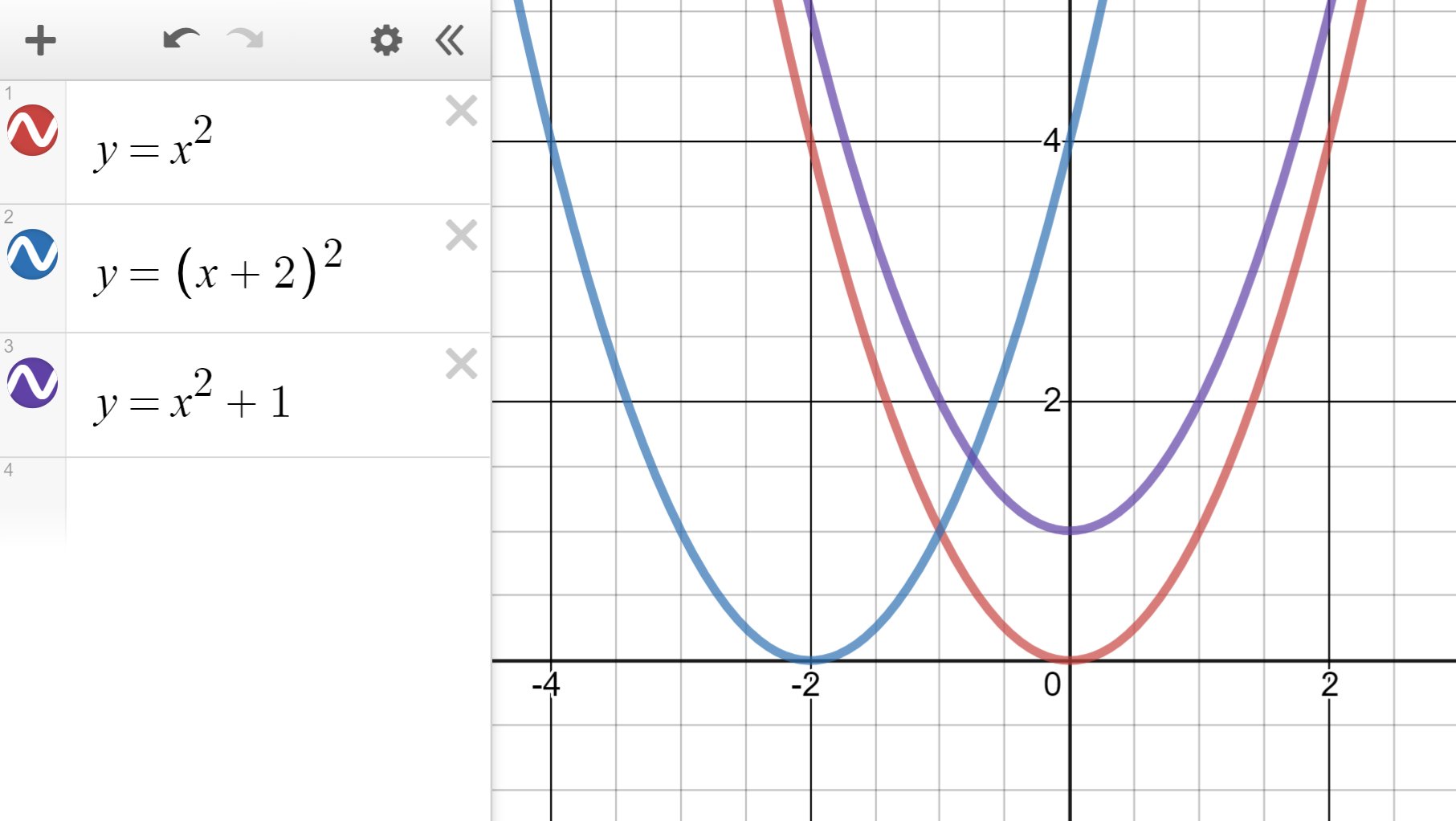
What's your pithiest explanation of "why do inside transformations go backwards?"
 Twitter
·
Twitter
·
Would love y'all's insights. This is something I struggle with.
 round robin
for me the way i imagined&explained it is just plug in x=0 notice you get the value at say x=2, so the graph kinda shifts backwards (i think in general hs students from my experience would find it a lot easier if they start substitutes simple values into anything seems like a lot doesn't really go through a "sanity check" even when unconfident about their work)
 frigid crest
x values that are 2 less that the original x values give you the y values of the original function.
frigid crest
((a-2)+2)^2=(a-2+2)^2=a^2
turbid zenith
I'm thinking of making a video on this next semester for my precalc class
And this is something that so many people struggle with
I'll also add that a big "a-ha" moment for me was seeing that ALL transformations could be written in that "backwards" (passive) way.
But sadly I have found that this does not quite translate to an equal "a-ha" moment for my students.
 Twitter
·
Twitter
·
(I'm linking the tweets because I"m too lazy to re-type or re-paste everything :P)
frosty flame
I think in terms of defining a new variable. If you have y = f(x_old), and you want to translate 2 units to the right, then you are defining x_new = x_old + 2, so x_old = x_new - 2. This works for any kind of transformation, but it's not a short explanation.
frigid crest
The point is that you compensate using subtraction to get the old values from/using the new values.
 molten urchin
Can one reintroduce an adult learner(in a non-mathematical field) to mathematics by skipping school mathematics? There's a friend of mine who studies psychology, and although they admire maths, they haven't been particularly good at it back when they studied it at school. I was wondering if a direct introduction to basic proofs and mathematical reasoning could work, as opposed to reintroducing them to typical school algebra, calculus and stuff.
Also, if there are any resources which can introduce abstract mathematics to the layman, I would like to know about them.
frosty flame
I would say the main problem is that examples of proofs require previous knowledge. Calculus and trig aren't definitely necessary, but they will have to be okay with order of operations and using variables. I don't know any resources though.
molten urchin
Combinatorics(in particular Miklos Bona's A Walk Through Combinatorics) really captured my attention. When I started with that book, I found that combinatorics has very simple foundations, is intuitive, but also shows how simple, intuitive arguments can be used to prove extremely unobvious results. It is also gentle in terms of proof writing. But I'm kinda clueless if this is the best place to start(or should I start with a typical discrete math sequence instead?).
As far as concerns about previous knowledge of mathematics goes, I admit they are justified, but I also feel that once a person has better appreciation for how maths works, algebra and everything else will start making much more sense. I might be getting too idealistic here.
Regardless, I'd like to hear from anyone who has tried using a similar approach to presenting mathematics and their experience in doing so.
frigid crest
Combinatorics is very self-contained at first and then it becomes increasingly algebraic after passing the novice level.
Combinatorics is fine but graph theory might be a more grounded starting point.
@molten urchin
molten urchin
I see. I will keep that in mind. Other than that, do you suggest any references to introduce a layman to proofs and mathematical reasoning?
frigid crest
Yes. My top recommendation is Mathematical Proofs: A Transition to Advanced Mathematics by Chartrand, Polimeni and Zhang.
For graph theory, I recommend Diestel. https://www.amazon.com/Graph-Theory-Graduate-Texts-Mathematics/dp/3662536218
@molten urchin
molten urchin
Thank you!
turbid zenith
Suggestions for additions welcome.
lethal leaf
Those are good but it seems like you're discouraging people saying "I don't get it"
sometimes that's all people can say, they don't even know what they don't understand
just that they don't understand it
turbid zenith
I am absolutely discouraging people from only saying "I don't get it" because that's not a helpful comment
It's a very valid feeling to have, sure
But if that's all you say then how do you even help someone
lethal leaf
hm
turbid zenith
So the entire point is to give them a framework so that they can drill down into what they don't get
lethal leaf
I think it's a useful skill to have to be able to figure out what someone else doesn't get
but I see your point
if that's the goal then it's fine
turbid zenith
It is. But it's also a useful skill for the student to be able to figure out what they don't get.
lethal leaf
yea
turbid zenith
A lot of people forget that.
meager bronze
yeah students are bad at that
lethal leaf
I mean the way I deal with students saying "I don't get it" is starting a dialogue of figuring out what they don't get
meager bronze
I also try to get my students to think in this way
I really like the way you've laid it out for them
turbid zenith
Math class should be a conversation.
lethal leaf
rather than putting all the weight on the student or teacher to figure out what they don't get
meager bronze
I think the issue with that spamakin is that there are going to be times when students are working by themselves and they get stuck
and you want to try to give them the tools to at the very least figure out what they are stuck on
turbid zenith
lethal leaf
I mean the way I deal with students saying "I don't get it" is starting a dialog...
I get that but "I don't get it" "What don't you get" as a constant beginning to the conversation wastes time
Because if they say "I don't get it" my first response is going to be "What don't you get"
turbid zenith
What do you respond with?
lethal leaf
turbid zenith
What do you respond with?
It depends on the context but usually when I'm teaching I'll go back to a prior problem/example that I showed them and then using that I'll ask if they understood a particular step and work backwards/forwards from there
 light pond
turbid zenith
Suggestions for additions welcome.
light pond
turbid zenith
Suggestions for additions welcome.
Kinda late response but I notice that I usually get a lot out of asking/being asked "How are you thinking about {thing}?"
Helps to squeeze out little details/parts of intuition that you might gloss over when teaching normally
next relic
A helpful advice I've heard is skipping lines between steps in the working out because you might need to explain further or add an extra step to make your work explicit.
 tawdry venture
does anyone use "hard inequality" and "soft inequality" for > and ≥ respectively or is it just shit i came up with on my own that has no relevance to actual educational practice?
novel kraken
I want to say I've heard "strict inequality" used to describe > like you're saying, at least if I heard you say either of those I would know exactly what you were talking about and wouldn't think it was abnormal in the slightest.
 stark pine
tawdry venture
does anyone use "hard inequality" and "soft inequality" for > and ≥ respectively...
stark pine
tawdry venture
does anyone use "hard inequality" and "soft inequality" for > and ≥ respectively...
one of my profs uses "hard" and "strict" inequality interchangeably
never heard soft thoug
tidal drum
FWIW I would understand what you meant if you said soft
 austere inlet
inequality check
😡 hard 👍 soft
winged urchin
For me I just use the word strict (or strictly) in front of inequality-like expressions
Strictly positive vs. positive for instance
I do find it's annoying when there is no distinction between them. Sometimes student questions will say positive and allow 0 and sometimes they will say positive and not allow 0
 strange bronze
Strictly positive vs. positive for instance
are you french?
winged urchin
No, though I had a French professor that mentored me since like... first year undergrad to end of my masters
Whatever that says about me haha
Is strictly positive a french thing?
strange bronze
yes, in french "positif" means nonnegative
so they use "strictly positive" where an english speaker would typically just say "positive"
winged urchin
Interesting! Thanks for the tidbit 🙂
winged urchin
That's kind of interesting to think about... the sorta little differences between cultures and how they teach certain subjects
For something that can be as particular as math I wonder how bad that can mess a student up
It sorta leads naturally to thinking about a theoretic "international" standard
turbid zenith
How do you relate linear/log/exp/quad/rat'l functions; review equation-solving, graphing, and data analysis techniques; gently hint at a bit of calculus; and wrap it all into one big relevant semester-long modeling problem on the last day of college algebra?
Logistic growth. 😁
 Twitter
·
Twitter
·


 halcyon light
@next relic @quasi musk @severe night tysm for your input for that q i asked ages ago
never thanked you peeps
halcyon light
it was from mid nov hahaha
next relic
yw!
 left folio
Would introducing limits and derivatives and integration to 8th grades be advisable?
strange bronze
with rare exceptions, no.
quasi musk
it depends on how you do it
You can introduce ideas to most students with no harm done
The question is when they go on will this make a difference?
Most likely not
lethal leaf
I honeatly think the current math progression of topics from like K-12 is fine
it's just that on average
lower age math teachers (like elementary/middle school) suck
like the vast majority of my friends in college have math holes that can be traced back to math classes in middle school/HS
next relic
I think the concept of limit and differentiation can be introduced fairly early on, but only when they're ready for it. Let's take polynomial functions for example. Because it's continuous on R, students do not need to manipulate much to get the idea of limit and derivative. Integration, on the other hand, is harder to introduce imo. It certainly is possible, but you have to be conscientious of what they're able to understand and whether the prereqs are satisfied.
Such prereqs would be manipulating algebraic expressions, understanding rate of change, having a number sense (eg 5 divided by a very small positive number tends to infinity) and knowing composition of functions. This list is definitely not exhaustive.
One big benefit of introducing limits and derivatives early on is to give students some pointers of the maths they're going to learn later down the line. However, as I said, it's only desirable when they're ready to take it in, otherwise you're gonna scare them off and it'd be A LOT harder for them to study later on because of their perhaps misleading understanding of the topic.
You can add more functions into the mix later on, and ideally it'd make the link between functions and calculus a lot stronger because you go back to it so often.
A sample sequence would be
polynomials --> differentiation (and integration, if appropriate) --> chain rule, product rule (and quotient rule) --> periodic functions --> derivative of periodic functions --> exponential and logarithmic functions --> derivative of exponential and logarithmic functions
and so on. Applications of derivatives can be introduced after derivatives of polynomial functions or at the end of techniques of differentiation. Implicit differentiation may go after chain rule or after derivative of exponential and logarithmic functions, depending on what makes more sense to you.
lethal leaf
This isn't exactly math specific but what do you guys do for tutoring students when they don't show up
like rn this student I'm supposed to tutor
sent the call link
dude hasn't shown up
blocked out the time for him already
 deft sparrow
lethal leaf
This isn't exactly math specific but what do you guys do for tutoring students w...
deft sparrow
lethal leaf
This isn't exactly math specific but what do you guys do for tutoring students w...
Be kind and forgiving the first occasion. On the second occasion, send a notice that they will be charged if it happens again. Done.
Any maths teachers (highschool or secondary) here?
lethal leaf
ok cool that's what I was planning on doing @deft sparrow
turbid zenith
Yeah agreed. I always give one freebie.
Also @deft sparrow I teach university but I used to teach high school.
 crystal mortar
left folio
Would introducing limits and derivatives and integration to 8th grades be advisa...
crystal mortar
left folio
Would introducing limits and derivatives and integration to 8th grades be advisa...
would you introduce real analysis to 8th grades students?
turbid zenith
Oh hey I was going to get into this conversation but I forgot lol
I agree that the ideas behind calculus can be introduced much earlier than we currently do. We treat it as if you have to have completed all of algebra and trigonometry before you even get a whiff of what calculus is.
I know that in certain other countries than the US, students are introduced to basic calculus a little bit earliier. They know how to take derivatives of polynomial functions before they know much about trigonometric functions at all, for example.
At the very least Israel is like that.
next relic
It's the case in the UK as well.
lethal leaf
I honestly think the current progression
is fine
and introducing calc earlier would only make it worse
because the #1 issue I see with people taking calc and struggling is a lack of foundation in Algebra/Precalc
and introducing calc earlier would only make those problems worse
 shy lily
@lethal leaf I agree
how would you understand how calculus works without learning the prerequisites
quasi musk
I don't think it'd necessarily make it worse - the main question you have to answer is
How will it actually benefit students?
Does learning something earlier mean that you will know it better?
Will that carry on to improved grades?
Or better conceptual understanding?
next relic
I don't think the solution is waiting for kids to finish precalc before introducing calculus, but rather filling gaps in their foundation as they emerge.
turbid zenith
So, let's say you were trying to come up with homework problems about spherical geometry for non-math-majors at a liberal arts school. Something not too plug and chung, but not like full prooofs. More like an exploration-y sweet spot.
What would you suggest?
civic tree
can you make some guided problems about forming different surfaces in spherical coordinates
or sth
like the first problem might be like
hold rho constant and let phi and theta vary freely and see how it makes a sphere or sth
then go up and up into different surfaces or sth
idk
turbid zenith
Ooooh interesting idea. Didn't even think of coordinates.
 rapid kettle
@turbid zenith i guess something with triangles on sphere would be also nice
like that you can have sum of angles more that 180 degs if triangle is on the sphere
or that parallel lines also behave interestingly
or with respect to coordinates you can kinda show relation between sphere and plane, i.e riemann projection
turbid zenith
Here's what I ended up coming up with.
next relic
What font(s) do you usually use for maths notes/worksheets?
strange bronze
computer modern.
turbid zenith
I'm starting to use Lato
lethal leaf
whatever is the default in Overleaf lmao
 mint lark
what do yall think about the hot take that discrete math + graph theory stuff should replace calc
turbid zenith
Replace? No. Be there in addition? Hell yes.
There need to be non-calculus pathways for sure, and discrete math needs more love.
winged urchin
I've always preferred breadth to depth at least at the younger levels
lethal leaf
I think calculus is good
Has a good amount of abstraction
relevent to the most amount of people going into stem
I wish discrete math and graph theory and combo was intersperesed more into Algebra 1 - Precalc
Rather than months of trig identities
next relic
I think it should be a standalone course taken as an elective.
lethal leaf
Ok but like think about 99% of high schoolers
No one is gonna take a math elective like that
The only math electives at my old high school were AP Stats and AP Computer Science
People only took those cause of college credit
next relic
Fun fact: Quebec teaches graph theory as part of grade 11 basic mathematics course.
strange bronze
When you say "teaches graph theory", how much actual theory are they teaching?
I know programmers who claim to "know graph theory" when they only really know definitions
And like, maybe a couple basic theorems on the size of graphs satisfying certain criteria
austere inlet
austere inlet
next relic
Fun fact: Quebec teaches graph theory as part of grade 11 basic mathematics cour...
not all HS programs though, do they?
 golden pagoda
mint lark
what do yall think about the hot take that discrete math + graph theory stuff sh...
golden pagoda
mint lark
what do yall think about the hot take that discrete math + graph theory stuff sh...
Depends on what exactly those are, but I personally think calc should remain as it's a good amalgamation of all the other math you will have learned
strange bronze
that seems backwards, in the sense that lots of things are in the curriculum just because of calculus
eg the predilection of high school curricula with discussing "specific types of functions" like rational functions and exponential functions and whatnot
strikes me as a very calculus-ey slant
since algebraically theres not much special going on there; it's just that they have fairly distinct behaviour when you take derivatives and whatnot
hell, the entirety of "how to graph logarithmic/rational/trigonometric functions" type stuff could easily be dropped if calc wasnt the end goal
quasi musk
Yeah, most of the core curriculum around the world is a race to Calculus
strange bronze
if you wanted to build to discrete math instead youd drop like half the high school curriculum and add in stuff on proof by induction (not that the math courses have to be proof-sey but basic induction is a very useful tool just for simple reasoning - e.g. when applying hensel's lemma)
that said i think part of the problem is that mathematics is seen as a linear "monolith" for many students
like you get high schoolers here asking "what do you do in university math" when basically every field does a different mix of courses
and who believe that calculus is some sort of holy grail of mathematical achievement
like, i guess adding an alternate mathematics course to high school curricula would be "special treatment" in the sense that no other subject really gets that
but at the same time, no other high school subject has as much interdisciplinary use as mathematics
golden pagoda
I'd personally be fine with an intro proof unit somewhere in HS curriculum (Probably grade 11/12)
austere inlet
I had propositional logic and set theory in grade 11 and really liked it, though it felt kind of disconnected from y'know, actual maths. It should be accompanied by motivating problems and puzzles (logic ones are especially fun)
turbid zenith
golden pagoda
Depends on what exactly those are, but I personally think calc should remain as ...
That's only because almost the entirety of the math curriculum is already designed to get to calculus.
turbid zenith
strange bronze
that seems backwards, in the sense that lots of things are in the curriculum jus...
Oh there you go
Oops 😅
turbid zenith
Little thing I made for my class next semester. Enjoy.
(Should say "how numbers work". Bleh typos.)
 wise onyx
since all your lesson plans are so imaginative, all you have to do is create some characters, make a story line, get an artist to draw all these situations and then have the puzzles be the math problems
turbid zenith
Maybe at some point!
 steady gorge
Well, that will cost too much.
frigid crest
@wise onyx Hi. I'm working on one.
winged urchin
How are you supposed to answer those? Hmmm
7/12 is 1/2 + 1/12
So what.. you break the first... 4 cookies into halves ..?
And then you break the remaining 3 into twelveths?
Wait I keep mixing up the numbers
For a)... You'd have the 7/12 = 1/2 + 1/12. Then you have 7 cookies for 12 people so you break the first six cookies into halves. And the last you break into twelveths
A twelveth is kind of difficult to break into right? Since it has the factor of 3... Usually splitting something into three groups is not as exact as halves
lethal leaf
But it's easier than splitting something into 7ths
So you split 6 cookies into clean halfs
Alot easier
And then yes you gotta deal with the 12ths
But easier than 7ths imo
I like that worksheet
turbid zenith
You'd never have 7ths
So yeah you split 6 cookies into halves and then split the last one into twelfths, and give each person a half and a twelfth
Rather than splitting ALL SEVEN COOKIES into twelfths and giving each person 7
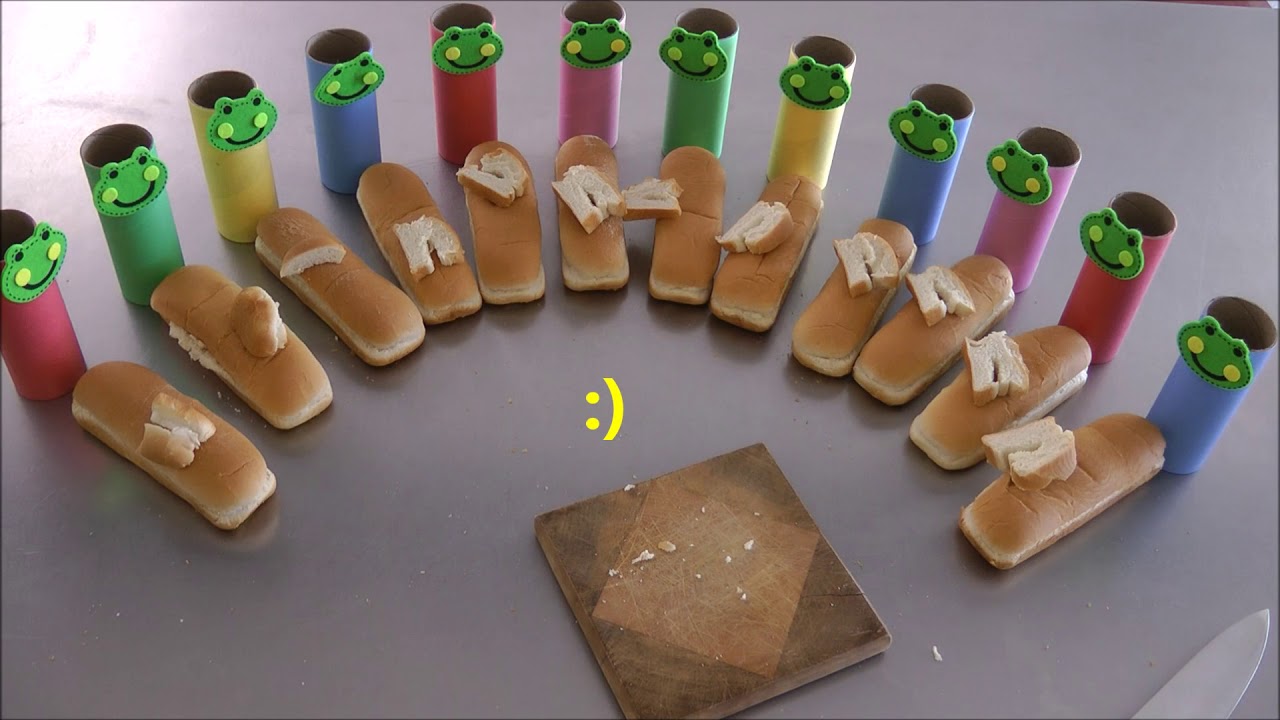
This is an experimental video to try to motivate a need for adding fractions with unlike denominators. (It also leads into the historical questions and deep mathematical questions of Egyptian fractions.)
This video might be odd without context or a possible lesson structure presented with it. Or maybe it stands alone just fine to evoke interest...
turbid zenith
 cerulean cairn
do you guys know paul lockhart
idk if y'all know him but he was my math teacher in high school
quasi musk
Pics or didn't happen
quasi musk
From the internet
Not from you
And I learned from terry tao lololll
Only in our dreams
cerulean cairn
alright lemme find another pic then smh
 frosty flame
The fact that he tried to send a picture from the internet should be proof he is full of shit? Or why would you do that?
quasi musk
I'm teasing
frosty flame
Oh, is it not from the internet? Then why did he so readily accept it lol
quasi musk
It might be, but either way it doesnt matter
Still pretty cool
Also the other joke is I actually took a course from terry tao
cerulean cairn
i was gonna find another pic in my camera roll
i always was takin pics of the board
frosty flame
Oh, yeah, terry would have made you smart
quasi musk
I didn't like the way terry runs his course
 vestal hawk
Let's make a math learning web application. I'm happy to help with the programming part.
vestal hawk
oh, cool
turbid zenith
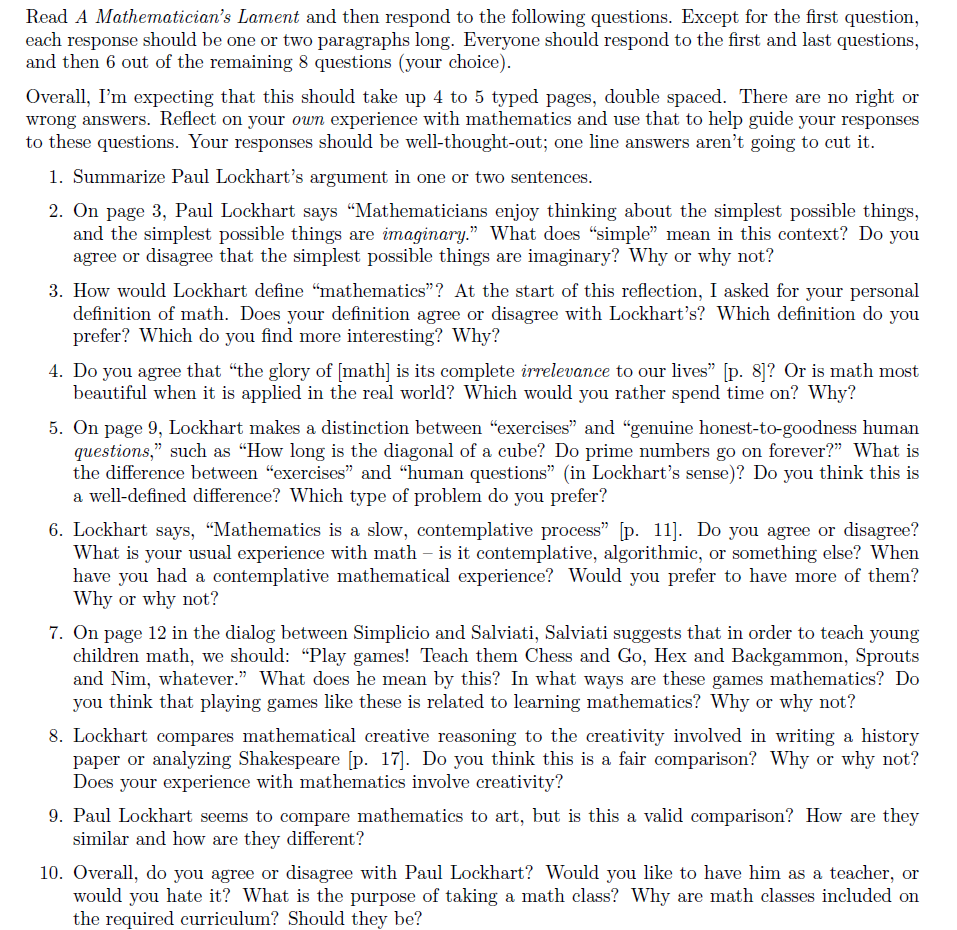
@cerulean cairn I'm giving my students an assignment where they discuss his "A Mathematician's Lament"
cerulean cairn
turbid zenith
<@!137315327263506433> I'm giving my students an assignment where they discuss h...
that’s really cool that you guys know him lol
meager bronze
@turbid zenith I've done that before as well
idk if you have but most of the students really like it
I had a really good class discussion one here where about 2/3 of the class agreed with his main premise and 1/3 disagreed
really interesting to hear what they have to say about it
did you give them any prompts?
meager bronze
ah okay
wise onyx
Oh he teaches in brooklyn?
meager bronze
I asked my students to write like 4-5 pages
and then we did an in-class discussion
here are my questions http://prntscr.com/waeslj
sorry one sec let me make it bigger
 turbid zenith
Nice
I have other assignments where i'm having my students write more, but this isn't one of them
Their three big assignments are :
- A mathematical autobiography
- An analysis of bias in math and elsewhere by watching a movie about mathematics
- An expository article on a topic of their choice (think like Pi in the Sky, Quanta Magazine, etc)
rapid kettle
@turbid zenith are u sure that first one is good?
i mean they are studens
and afaik, not even of pure math speciality
so kinda expected biography would be "went to school, learnt a bit of maff, now learn maff here"
meager bronze
they still have experiences with math
they've had good and bad experiences, good and bad teachers
they have feelings about it and I think having them talk about it is good
deft sparrow
Any UK maths teachers here? Secondary preferably.
frigid crest

See full episode (Lex Fridman Podcast): https://www.youtube.com/watch?v=-t1_ffaFXao
PODCAST INFO:
Podcast website: https://lexfridman.com/podcast
Apple Podcasts: https://apple.co/2lwqZIr
Spotify: https://spoti.fi/2nEwCF8
RSS: https://lexfridman.com/feed/podcast/
Full episodes playlist: https://www.youtube.com/playlist?list=PLrAXtmErZgOdP_8Gztsu...
frigid crest
Projects will leverage key ideas from Stephen Wolfram's A New Kind of Science and the Wolfram Physics Project. Intended for advanced, research-oriented students in mathematics and physics, as well as those with a strong background in algorithmic programming.
turbid zenith
@mint lark This was the thing I was talking about in voice chat last night that makes me almost slightly not hate two column proofs
mint lark
that's neat yeah!
oh also as for explaining quantifiers to students
I find it helpful if I make them "play against" each other
the idea being that say you have a statement like for all x there exists a y such that P(x, y)
then the format of the game is one player plays for truth and one player plays for false
the player who plays for truth picks there exists
the player who plays for false picks for alls
you go left to right and look at P(x, y) after you're done picking and see if it's true
to determine the winner
if you have them play this a bit and then say "a winning strategy for a player is a proof that the statement is true or false, depending on which player it is"
this helps them a lot
also helps when you want them to negate quantifiers and being careful about that
turbid zenith
True for any kind of teacher.
mint lark
turbid zenith
Interesting
there's a formal interpretation of this that's like game semantics for logic or something lol
super good
quasi musk
I think these kinds of issues are true of most jobs, just having different things to worry and think about
 clever jetty
What do you guys think is the best way to introduce the matrix product?
 twin lichen
If you can get away with it, as the composition of linear maps.
If they have no idea what an abstract vector space is, or a linear transformation, this is a bit harder.
 wispy slate
I also think doing a super explicit example in R^2 works well to help get across the mixing of terms that come from thinking of it has a composition of linear maps
If you think about the standard basis, if you put this in matrix I, AI gives you a matrix where the first colum is where the first vector goes and the second column is where the second vector goes. Then multiply each column individually by some other matrix. Then compare this to matrix multiplication.
turbid zenith
It depends on the course.
I taught it in precalculus, and I showed how it's like multiple dot products
At least procedurally, I use Falk's Scheme
And as for conceptually, I put it in the context of really simple linear transformations in R²
Like a rotation followed by a dilation or something
deft sparrow
Any Maths teachers from the UK here?
next relic
I don't think so, sorry. However I'd be happy to have a chat if you want.
deft sparrow
next relic
I don't think so, sorry. However I'd be happy to have a chat if you want.
Was this a reply to me?
next relic
Yes.
deft sparrow
next relic
Yes.
Do you teach Maths in any setting?
 limber latch
Hello, I was wondering whether there is such a thing as "too much explanation" is there anything bad in explaining every detail even though it may seem obvious for some people? Is there anything "wrong" with it?
I don't see anything wrong but idk about others' view
strange bronze
time
in a group theory course for example, facts about normal subgroups become so ingrained that explicitly mentioning them when they are invoked would just be a waste of time typically
strange bronze
in general i do try and lean on the side of "overexplaining" when lecturing
although this depends on the mood of the audience, if that makes sense
clever jetty
limber latch
Hello, I was wondering whether there is such a thing as "too much explanation" i...
Why do you think some people dislike d and f?
strange bronze
if the class tends to be one that readily asks questions about what they dont understand, i might play a bit looser with that and expect them to ask if they need the details filled in
whereas if the class is quieter and harder to gauge how much they understand, i'd explain more details more explicitly
"adaptive" lecturing is really important (and one of the greatest casualties of online schooling)
limber latch
Ohh I get what you mean
limber latch
clever jetty
Why do you think some people dislike d and f?
D and F?
clever jetty
Dummit and foote
limber latch
Oh, I haven't read that Abstract algebra book
Do they explain too much or something
limber latch
I see
austere inlet
limber latch
Hello, I was wondering whether there is such a thing as "too much explanation" i...
Absolutely, it shifts the focus away from what's important at the given moment. It's good to recall stuff within the context of a lecture (especially if it's something your students must understand well) but I wouldn't overdo it.
turbid zenith
I'd say it's a balance. When I'm writing math, I try to include enough to make sure I'm being clear, but keep it from getting too distracting.
So I'll include something that seems "obvious" if I think it's important to others' understanding.
turbid zenith
Yeah. Not particularly "friendly." Really about as friendly as a dictionary.
 dusky elbow
turbid zenith
Yeah. Not particularly "friendly." Really about as friendly as a dictionary.
dusky elbow
turbid zenith
Yeah. Not particularly "friendly." Really about as friendly as a dictionary.
No that's Lang
turbid zenith
It can be more than one! :V
turbid zenith
Something new I'm trying this semester: Extension Problems, either going further into applications or exploring concepts deeper, to tie things together. Group work encouraged, lots of explaining/reasoning instead of just answer-getting.
What do y'all think? Any suggestions?
 Twitter
·
Twitter
·
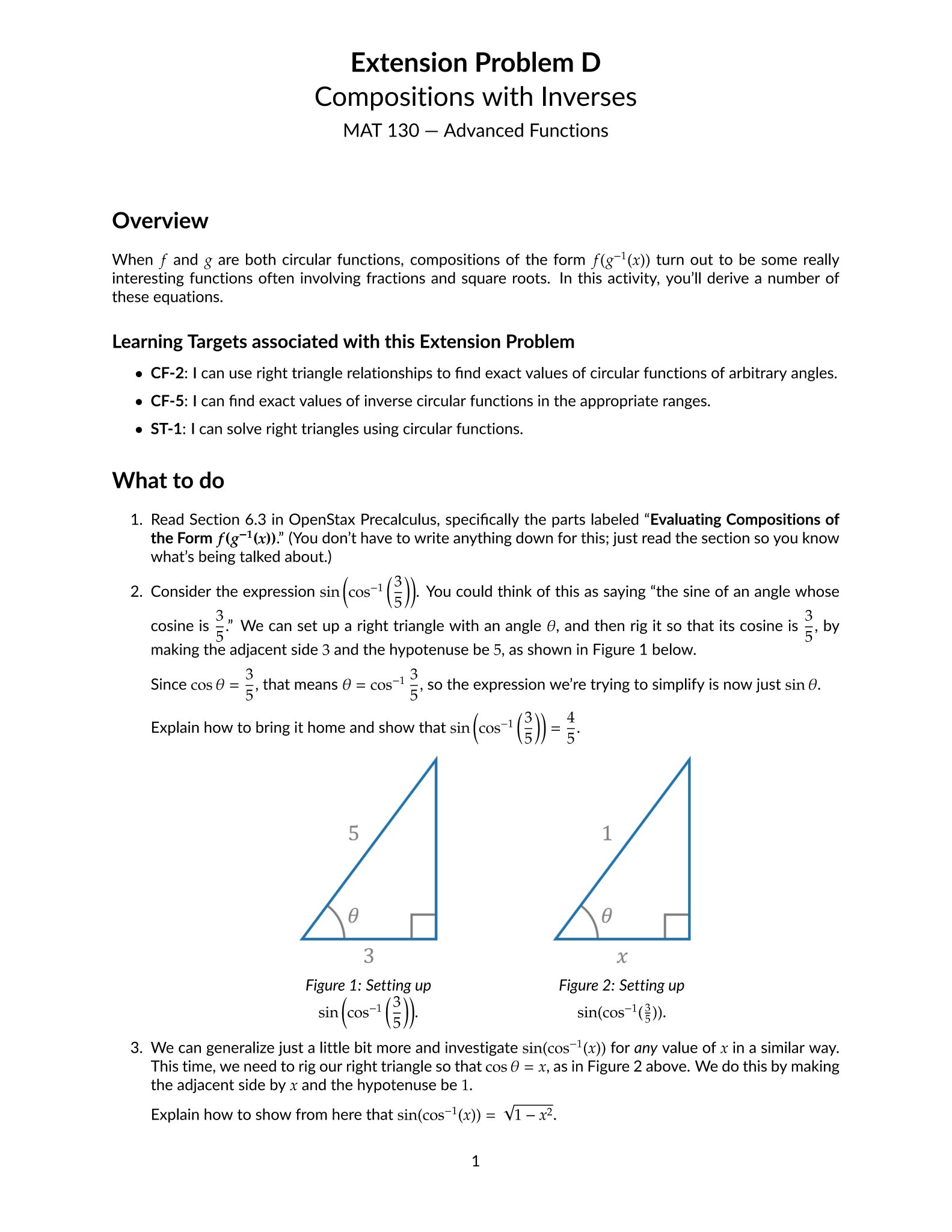

Would appreciate feedback!
 ocean oracle
I like the exercises presented and the goals you set. Do you teach university?
turbid zenith
Yup yup
dusky elbow
I got totally confused for a second because "extension problems" has an unrelated meaning https://en.wikipedia.org/wiki/Group_extension#Extension_problem
strange bronze
turbid zenith
dusky elbow
I got totally confused for a second because "extension problems" has an unrelate...
🤣
 agile leaf
Ok so I've got a question for the teachers/professors here.
What kind of students do you like the most to work with?
Conversely, which students do you hate the most to work with?
Also, what can a student do to track your attention?
"tracking your attention" in the sense that somehow showing he's got a talent or something in these lines.
winged urchin
Students who are curious are up there as my favourites
When they ask questions about the material and seem genuinely interested
I love being able to expand on topics beyond what I would normally
What do I dislike more? Students who just want the answer
If they stop me as I'm trying to explain the core idea of something and just ask for how they solve a particular problem
I'm still a little unclear with the track your attention thing
If you mean like, you believe that they're good at the subject and want them to sorta mentor you more... possibly do research and such if you're at university
Then hmmm
Doing work outside of classes or tutoring sessions
I have a couple students who'll tell me they looked up something by themselves and/or tried to figure something else on their own
That really makes me want to encourage them to go further and give them problems to test them more
And if I were a professor, that would also make me believe that perhaps they could do research with me
Just showing that you have that self-sufficiency and that you put in work
frigid crest
Students that get my attention are those that receive a problem, get to work on it, and arrive at a solution seemingly overnight.
 azure hazel
I really like students (say, in an upper-level) that "get it". I've seen this manifest concretely as writing concise, more intuitive-style proofs on exams. If they've included pictures in their proofs that didn't originate from my lecture or the book, bonus points. That's the ideal, for me. If your exams are actually enjoyable for me to grade, that student would "track my attention" , for sure.
Else, the ones who clearly give a shit. Like, they're generally mentally present in lecture, or when they come to my office hours (often regularly), they already have a concise list of things they don't understand (e.g., "where did that shift by [-1] go in the proof of [Theorem blah]?").
The opposite of this (which is my least favorite): students who visibly don't give a shit in lecture, but semi-frequently come to office hours (usually the day before an exam) with questions like "I didn't understand all of [some important topic from very beginning of semester], could we go over that again?"
I suppose those are just in-class responses to your question, though. I haven't yet properly advised any students.
In general, my philosophy in one-on-one interactions with a student is to try to reciprocate whatever effort I see put forth by the student. Real recognize real.
dusky elbow
@agile leaf
"like to work with?" Ones who have questions that show they're thinking about the material, whether or not they have a strong grasp on things or things come easy to them.
"hate to work with?" Ones whose struggles I can't fix. Like they don't have the support/home stability/whatever that they need to succeed - I could be the best at teaching math in the world and it still wouldn't put me in a position to help them. To be clear, that doesn't mean I don't help or put the effort in for the things I can control. It's just not always fun when there are limitations beyond my control.
"which students get your attention as showing talent?" Ones who both generally do well ask questions that go beyond the core material, whether that's correcting me or a textbook, asking logical followups about where a mathematician would look next, etc.
round robin
frigid crest
Students that get my attention are those that receive a problem, get to work on ...
tbh i dont rlly care if i see a solution if i see them asking a question like is this roughly right direction/why doesnt this work i get excited haha
turbid zenith
@agile leaf
"Like to work with": Kind of varies! On one hand I love working with the students who like ... live and breathe math, the ones who are really interested in it and want to dive deep and really investigate things. On the other hand, I love working with students who have historically really struggled in math but are open to seeing things in a different way. It's fun to lead them to those "aha moments" where things suddenly make sense.
"Hate to work with": The students who just want to learn "the formula" and regurgitate it for the test, without caring about WHY anything is true. I've had some students who have actively resisted learning the "why" behind anything, and it was incredibly frustrating.
agile leaf
Wow
So many answers
Thank you guys so much for the attention
These are some quite interesting opinions
turbid zenith
No problem!
Also: Just finished an activity.
https://twitter.com/solidangles/status/1349771627513446402
What do y'all think?
Here's what I ended up coming up with for an activity about rhodonoids. 🌹
Tried to strike a balance between asking specific questions connected to what students are learning and still giving enough room for playful exploration.
Any thoughts/suggestions?
 Twitter
·
Twitter
·
 next relic
Very interesting activity, especially questions 3 and 6. If the course covers a little bit about derivatives and slope, I think it can be a good idea to briefly cover horizontal and vertical tangent lines here. :D
turbid zenith
No calculus unfortunately! This is all precalc.
turbid zenith
So here's a thought
What do you think of the idea of designing an activity for precalc students about vectors, by linking it to scalable vector graphics?
What kind of stuff would you ask?
austere inlet
maybe you can relate the scalar product to, well, scaling a SVG file to display it in different media.
turbid zenith
Here's what I ended up with.
austere inlet
seems good, more or less the idea I had except you executed it a ton better than I could have (:
mint lark
@turbid zenith this is a great activity!!!
I need to steal your thinking :)
I think that extension K is really good but students unfamiliar with coding (and even some that are familiar) will find 2 really hard
might be best to just talk about that one. Although I understand why you wrote it so that they figure it out :)
wise onyx
Yeah this is exactly the kind of thing you have to do if you wanna make svg in a programming language
turbid zenith
Woo
@mint lark I figured at least people would be like "oh I've at least SEEN some of these words" XD
mint lark
Yeah. Personally I think a lot of students would see code and their eyes would glaze over. Such is life
(I do this for the record even though I can program)
deft sparrow
If there are any Maths secondary school teachers from the UK, let me know please. I'd love your feedback and professional input.
wise onyx
this is interesting
strange bronze
i stopped reading after
someone who dances daily with triple integrals, Fourier transforms, and that crown jewel of mathematics, Euler’s equation.
wise onyx
oh lmao i started reading in the middle
euler's identity is a mathematical cliche at this point
i do think gaining a fluency with the mathematical definitions and terms you are working with is a step 0 to understanding
yes you have to 'memorize' those, or learn those
 storm tangle
Hello I'm a TA grading exams for the first time ever and I never knew there would be such extreme edge cases, and I find it really hard to grade these exams. Is there any advice you could offer me?
frosty flame
It's tough. I started marking last year. When I first started, I was like "I'm going to keep track of all the odd cases and what I did so I can be consistent", but that stopped very quickly because it takes forever. You're not getting paid a lot, and it's incredibly unlikely that someone will be unsatisfied with your marking. Just do your best to be consistent and don't stress it too much. It's impossible for it to be consistent across multiple markers. Where possible, decide early on your will give marks for this and this, and where it's not, just assign what you think is fair. I've found that if I mark in one or two consecutive days , I'm able to be more consistent because I can remember what I decided to do in similar cases.
storm tangle
Yes, consistency is very hard for me, and I've been doing exactly this: "I'm going to keep track of all the odd cases and what I did so I can be consistent"
But turns out these odd cases are still very different
Ughhh it's such a pain! Why can't everyone just do these questions normally and motivate their damn answers :p
Thank you for your help anyways 🙂
frosty flame
You're probably being more consistent than you think, and if the cases are different anyway, then it's fine to mark them differently.
Even lecturers are like "Is this a 3 or a 4 out of 7? Eeny, meeny,...
storm tangle
As an example. The question is to find the maximum positive slope of the function f, so basically maximize f'. Many people forget to motivate that the point they're finding is actually a max, and that it couldn't be a minimum. Some totally forget to motivate and some try to motivate but very poorly
For example this person understands that you should maximize the derivative function, but doesn't motivate that x=0 is actually the maximum. And then what is this final answer? Do I mark off for this crazy final answer?
frosty flame
Just decide on a blanket rule, and implement it as best as you can. -2 for no motivation, -1 for bad motivation.
Yes, mark off for crazy answers 😂
storm tangle
I just feel like I get harsher and harsher the more crap they write
frosty flame
I mean, same. As long as you are trying to be consistent, you're fine. No one marks perfectly.
storm tangle
Thanks for allowing be to basically vent I suppose lol
frosty flame
😂 I asked the lecturer a few times what I should do, but they clearly didn't care. Just do your best unless you really don't know. That's why you're getting paid, so they don't have to deal with it.
austere inlet
storm tangle
Hello I'm a TA grading exams for the first time ever and I never knew there woul...
Been there. What worked for me was reading some of the solutions beforehand and based on that and the actual answer, create an answer sheet with detailed grading, e.g. you could give this optimization problem 10 points and detail it as 2pt for finding f', 4pt for finding the maximum and 4pt for arguing why it's the maximum. (These gradings are 100% arbitrary, there's no "fair" way to grade.) Then follow that as best as you can and hope the edge cases are few (this is why you skim through some of the answers beforehand).
The answer sheet needn't be public. There's arguments both for and against making these public; students obviously appreciate them but they don't always have in mind that your solution is only a possible solution, and they might not fully understand the process behind that solution. Also if you include the detailed grading that might lead to some of them bargaining points afterward. Here's a SE discussion https://matheducators.stackexchange.com/questions/13763/does-education-research-support-the-idea-that-answer-keys-are-bad
(that about the answer sheets is also relative to your country/institution's academic culture etc. -- in my country answer sheets are expected in most unis, while apparently it's not wherever that SE post's author resides)
golden pagoda
Im a 1st year concurrent education student and my winter term project for my teaching course is self inquiry. The topic I chose is how effective the high school math curriculum is at preparing students for the next steps, while not showing preference for those going to post-secondary over those going into the workplace.
If anyone has input on their thoughts that'd be much appreciated!! ❤️
(General idea is does the curriculum prepare everyone equally, and if not how can it be changed to do so?)
 lucid monolith
As a high school student whose interested in math, I’d say the biggest failing of schools is advertising math as (1) purely practical skill (e.g. students will usually think “when will I use this”— despite not thinking this about other classes since classes like history and chemistry aren’t marketed as only practical) and (2) presenting math as constraining and algorithmic. I think the fact that people who hated math in high school commonly come back to math and fall in love with it attests to the fact that math is inherently interesting. My opinion is that very few people in high school are shown the beautiful and elegant parts of math, instead the vast majority of curriculums focus on rote memorization of steps with minimal creative aspects. Of course, there no expectation that mathematics manages to excite the imagination of every student, but I think schools need to strive to at least capture some people’s interest. Either way, the skills of rote memorization is hardly useful past high school and analytical thinking skills and mathematic creativity are wonderful skills to pass on to students. That’s just my two cents though, hopefully it’s helpful!
wise onyx
Well said
vagrant meadow
Does anyone have any tips or techniques to write/generate interesting/challenging integrals? I'm exploring some ideas on my own but I'd be interested if anyone has anything.
winged urchin
Uhhh... you can sometimes take simple or easy integrals and use u-subs to actually make it more complicated
Oh, and don't forget the ole trick of using an odd function over a symmetric interval
austere inlet
trig subs 
 grave elbow
 marsh thistle
Does anyone else find it strange that Stewart deems a function discontinuous at points outside of its domain? For example he claims half a dozen times in the section on continuity that various rational and trigonometric function "are discontinuous at...". To me this is nonsense but I have to teach out of it
frosty flame
It's very common in calculus classes. I guess just go with it but lay emphasis in class that it's not standard in higher math, or just contradict the book.
But yes, it's strange, dumb, annoying, etc.
marsh thistle
Yeah I plan to emphasize that it doesn't even make sense to ask the question of whether a function is continuous somewhere that it isn't defined, I was just surprised to see Stewart's definition and thought I'd rant about it for a minute lol
Unfortunately I'm sure that contradicting the book will cause a little bit of confusion
 next pumice
Just mention offhand like a few details of limit points and that should hopefully intrigue a couple math students
wispy slate
are there any resources to teach symbolic logic to programmers?
 long pelican
This discussion led me to think about whether 1/x^2 is differentiable from the R to the projective line at 0
It would seem it has a sharp cusp at 0
But amazingly it is differentiable
1/x is quite obviously smooth because it’s just a diagonal line around a cylinder
to figure it out you just have to identify the projective line with R/Z by the tangent function (appropriately scaled)
wispy slate
@strange bronze yo I've seen your notes posted here some time ago , would you mind sending the latex code for those notes (or at least of a one page or sth). It looks super clean and it'd probably be the fastest way for me to learn formatting that way
strange bronze
pinned in #math-discussion
frosty flame
Omg, I'm stealing it too. Nami so kind.
mint lark
ooo neat
I've found a nice template I like rn that I'll keep for a bit
but this is definitely something to note
frosty flame
mint lark
I've found a nice template I like rn that I'll keep for a bit
Share that too. Gays have to help each other out 👀

 real mauve
oh this is pretty neat
frosty flame
Thanks
 blissful plover
Has anyone here tried giving a virtual chalk talk over zoom, or something like that? Would you care to comment on how you did it, what worked well or didn’t?
austere inlet
blissful plover
Has anyone here tried giving a virtual chalk talk over zoom, or something like t...
I've been participating in seminar-type stuff (as well as TA stuff last year) but using a graphics tablet, tbh that's what everyone does and there's really cheap ones
though using an actual chalkboard is also an option; but you need to consider that Zoom might apply video compression and that participants might not have a good connection
Zoom seems to prioritize video quality to sharing screen (e.g. when you use a tablet to draw in a program or the in-built whiteboard) rather than cameras
another option would be to setup a phone camera to record yourself drawing w/pen and paper.
an example of what a chalkboard livestream might look like: https://www.youtube.com/watch?v=PKmxArBkPAY
an example of what a pen+paper livestream might look like: https://www.youtube.com/watch?v=Is3rLrfcVIs
turbid zenith
Hey y'all. Just wanted to show a thing I made for my classes starting soon. 😄
https://www.solidangl.es/2021/02/spr21-mat130-unit-circle.html
mint lark
austere inlet
I've been participating in seminar-type stuff (as well as TA stuff last year) bu...
do you know of a good graphics tablet to get, compatible with linux?
I've been looking into it ^^
austere inlet
from my experience pretty much any tablet should work with generic drivers, I've used my sisters Huion H610PRO and another very generic cheap one in Manjaro and never had to install anything
but if you want to use other features like programmable buttons etc etc it's a bit of a hassle and you'll need to install unofficial drivers
start looking here http://digimend.github.io/tablets/
DIGImend - digitizer mending. Improving Linux support for graphics tablets.
mint lark
👍
austere inlet
turbid zenith
Hey y'all. Just wanted to show a thing I made for my classes starting soon. 😄
...
nice animations, as well as that about the circle being the only shape with that property (would've never thought of making that point myself)
 brisk ruin
Something that I've seen a lot of people do is join a Zoom call from multiple accounts so they can take through their normal device and screen share on the tablet so you don't need to connect the tablet and your computer
blissful plover
Thank you for the suggestions!
As much as I enjoy virtual talks and so forth, I find myself missing proper chalk talks
This should help bring the feeling back; rather not continue using Beamer for everything
golden pagoda
turbid zenith
Hey y'all. Just wanted to show a thing I made for my classes starting soon. 😄
...
"important angles" yet 17pi/22 isnt on there \j
turbid zenith
XD
lethal leaf
Students really be skipping the whole setup of a problem, try to do half of it in their head, and then wonder why they got the problem wrong 😔
round robin
omg ya
 tired wedge
lethal leaf
Students really be skipping the whole setup of a problem, try to do half of it i...
tired wedge
lethal leaf
Students really be skipping the whole setup of a problem, try to do half of it i...
bruh marking stuff right now is this. there's no explanation just the answer. PLEASE!! I want to give marks!!
 real verge
...
real verge
I'm free ...
brisk ruin
?
round robin
if i dont get food after the class i'll protest
stark pine
turbid zenith
everything here is a sandwich except for that pathetic triple decker club, whoever made that should be ASHAMED
austere inlet
a food item is a sandwich iff it has bread
austere inlet
turbid zenith
what is the lesson precisely about though
strange bronze
quotienting under the relation "a-b is a sandwich" obviously
turbid zenith
austere inlet
what is the lesson precisely about though
It's for my math-for-liberal-arts class
And the main objective is to get them to see (1) just what goes into making a definition and how difficult that can be to be precise, and (2) the fact that even then those definitions are kind of relative and we just choose the one that best fits what we want to talk about
mint lark
turbid zenith
And the main objective is to get them to see (1) just what goes into making a de...
This is an excellent activity :o
need to write it in a "Future teaching advice to myself" document lol
golden pagoda
Lasagna isnt a sandwich and if anyone says it is i will be disappointed
brisk ruin
Lasagna is a pasta sandwich
austere inlet
turbid zenith
And the main objective is to get them to see (1) just what goes into making a de...
thought so but had a tough time putting that into words lol
looks like it was a success
one old prof. on my dept. likes to make a similar point about definitions in math courses for liberal arts or education students through a game: one student in the classroom is chosen at random and thinks of an object. Then the rest must come up with yes-no questions until they can guess what it is.
the point being that the answers to these questions are all properties that define the object with increasing precision
golden pagoda
brisk ruin
Lasagna is a pasta sandwich
disappointed
brisk ruin

wispy slate
i'm tutoring my friend in calc 1 and i'm wondering if you guys know of any putnam-level limit evaluation problems
strange bronze
...putnam-level?
that might be a bit much for calc 1 lmao
but i mean this is literally from a putnam
2016 A2
this is also kind of a limit evaluation problem
same year
i would not recommend attempting to teach calculus through putnam problems, however.
(if you can't do them yourself without help, you certainly shouldn't be showing them to your students)
civic tree
o.0 those look mad hard wtf
brisk ruin
Shockingly, the putnam is hard
 tawny slate
so something interesting came up in another channel
that made me think

someone asked for help on these questions but when i asked them whether or not they knew how to plot coordinates on the plane
they said no
putting aside this specific person and case, this made me wonder
is there any alternative to teaching how to plot coordinate points before teaching any of these other concepts
the immediately intuitive answer is no, since the visualization is kind of the point of using the coordinate plane, but we don't necessarily have to visualize the number line to do arithmetic and everyone has their own subjective way of understanding concepts
perhaps there is a student with some learning disability that makes it really difficult to visualize graphical concepts, kind of like dyslexia or something (not well versed in this subject matter, merely expressing an example of the subjectivity point)
there's always turning to algebraic geometry or just treating the coords as just a pair of numbers, but then it makes a lot of concepts like perpendicular lines seem weirdly obtuse to explain and understand
brisk ruin
What about linear algebra?
strange bronze
yeah if you really have to do this i'd imagine the most natural angle would be the idea of a basis
considering cartesian coordinates are the usual prototypes of bases of a space
but... still doesnt seem very good
 worthy locust
@tawny slate You could learn basic transformations, like translation, rotation, mirroring, scaling without knowing anything about coordinates.
tawny slate
right, but learning the algebra behind those ideas still seems to require an understanding of how to visualize it first
brisk ruin
Yeah a lot of linear algebra concepts are taught in ways that rely heavily on visual intuition
tawny slate
im asking if there's way to teach the intuition of those concepts without the need to visualize them
tawny slate
brisk ruin
Lasagna is a pasta sandwich
brisk ruin
tawny slate
cuberule.com
What
tawny slate
According to the cube rule, lasagna is actually a cake
brisk ruin
Therefore cake is a sandwich
tawny slate
not according to the cube rule no
lucid monolith
From my own experience, I’ve always had a really hard time visualizing shapes, and any sort of physical/spatial intuition. In calculus, I struggled with shapes of revolution. At least for me, it helped me visualize what was going on by making the problem more accessible and less demanding on my spactial reasoning. I wrote a program to draw the shapes in 3D, and I could drag around those shapes to see what they looked like. This helped me get a really good feel for what was going on, and eventually I didn’t need to use the graphing after I had a good feel for what’s going on.
In short, it might help to decrease the barriers of entry to starting to understand what’s going on. If you give your students tools to start understanding a problem, it opens the door for them to start deepening their understanding. In your case, showing some animations of how to draw points, or what reflecting does, etc. might help them understand what’s going on better. (I’m just one student though, so take this advice with a grain of salt)
stark pine
strange bronze
this is also kind of a limit evaluation problem
this one looks disgusting
worthy locust
@lucid monolith I think GeoGebra is really good for setting up problems that students can "fiddle" with to get a feel for their properties. Here's an example I made where you need to find the maximum ratio of green vs red area. You can move the dot labelled C to get a much better visual understanding of the problem. https://www.geogebra.org/m/e238dp84

 obsidian hornet
Is this a good place to ask questions regarding learning mathematics generally, or is this restricted to questions of pedagogy from the perspective of educators? If not, what would be an appropriate channel for questions of general learning (i.e. not concerning a specific subject but the learning process generally)
brisk ruin
You can always ask in #math-discussion
 left vault
heyo, I've been doing private math tutoring for a while now and was wondering if there are any good evidence based resources I can use to improve
I'm mostly helping people in their final year(s) of high school
I know it's a pretty broad request, but if there are some good/fundamental/agreed upon ways to teach math that would be awesome 🙂
quasi musk
I think the best thing to do is to ask leading questions and try to get the students to answer things for themselves
That's hard to do in time sensitive situations though
left vault
I mean, that's kind of what I try and do already
Since it's much more satisfying when the student kinda "knuckles down" and does some logical steps (which end up resulting in the correct answer)
e.g. When someone is working through a tricky algebra manipulation problem, I get them to verbalise why what they're doing is legit (and isn't just symbol juggling)
tawny slate
So here is my personal take, something a little bit different
I view each tutoring session or class with my students and every problem I hand them as an active learning opportunity
Sure, the material to us seems easy, intuitive, and obvious at face value, but trying to place yourself in the students' shoes and actively analyzing the problem allows you to find new ways to explain and understand it, thus increasing your toolbox and methods
What works for one student may not work for another
Keep track of key problems that allow you to understand the nuances of one way of viewing the problem versus another
Some example principles and example problems:
Technical definitions are important
|-x| simplifies to |x|, not x
Find concise explanations to concepts
|-x| = |x| because the distance from 0 to -x is the same as the distance from 0 to x
Be able to explain why something is defined the way it is or the motivation behind it
"Why is slope defined as rise over run and why is it called slope?"
"Why is the order of operations the order that it is and not a different order?"
Try to break down exactly how something works on a more atomic level for students that cannot immediately grasp the intuition
Solving 2(x+2)=2x+2 for x leads to the result 4=2. What does this mean? Did we do something wrong? What is going on "under the hood"?
Almost every single math problem you can find crumbs that you can use to look at something differently, and every once in a while a student may even surprise you with a method you didn't consider, even on a very elementary problem!
@left vault ping in case you forget about this and it gets buried, you're welcome to ping back if you have any further questions or discussion points
As for my own personal question, does anyone know of an elegant basic intuition for the angle bisector theorem?
I can prove it and explain it but it never quite really made sense in a way that is "obvious"
It always felt like one of those things that at first seems like it makes sense, you think about it carefully and it doesn't seem to make sense, then you prove it and you accept it's true but it isn't super satisfying
It's also easily overlooked and people forget it exists sometimes, yet it is often a very useful abstraction
quasi musk
A lot of times what I'll do is feign ignorance so I can solve with the students
left vault
quasi musk
A lot of times what I'll do is feign ignorance so I can solve with the students
Lmaoo I do this to
turbid zenith
What do y'all think of this exposition of right triangle trig
From the point of view of having introduced sine, cosine, etc as "circular functions" already
 stone tusk
tawny slate
As for my own personal question, does anyone know of an elegant basic intuition ...
stone tusk
tawny slate
As for my own personal question, does anyone know of an elegant basic intuition ...
how's this? Basically I just force-fit a reflected similar triangle, then you can see that the remainder is an isosceles triangle
tawny slate
Oh WOW that's good
I like that, nice one @stone tusk
Collaboration in mathematics is awesome, even for the simple stuff
tawny slate
turbid zenith
From the point of view of having introduced sine, cosine, etc as "circular funct...
Pretty good, but it seems you haven't yet explained the angle arguments outside of 0-90 degrees? Im assuming that's next?
turbid zenith
tawny slate
Collaboration in mathematics is awesome, even for the simple stuff
Also I cannot agree more with this
turbid zenith
How do you know him XD
 burnt frost
Quantum Computing for High School Students
https://arxiv.org/pdf/1905.00282.pdf
wispy slate
One thing I came across a while back are these two videos about mathematical maturity, the target audience was K-12 teachers but it talks about developing it through the course of ones life

Mathematical maturity is a key concept for the professional life of a mathematician. The term "mathematical maturity" is often used by college and university mathematicians. As I have discovered in the last few weeks at PCMI, it is not a common term among K-12 teachers, though few have any problem in recognizing what it basically means. This i...

Mathematical maturity is a key concept for the professional life of a mathematician. The term "mathematical maturity" is often used by college and university mathematicians. As I have discovered in the last few weeks at PCMI, it is not a common term among K-12 teachers, though few have any problem in recognizing what it basically means. This i...
(he's also the one who wrote All The Mathematics You Missed But Need To Know For Grad School)
wise onyx
Great lecture thanks for sharing
turbid zenith
So I've had an interesting time writing lessons recently.
I originally had stuff like explanations of how the sine and cosine graphs differ, and why they're periodic ... but then when I started writing the Preview Activity questions at the bottom, I ended up pushing that stuff into the questions, so that the students have to do more explaining and putting things together.
tawny slate
So someone asked how to find the determinant of a 3x3 matrix
I'm a little rusty on my linear algebra. I know the basics, in that the determinant is by what factor the magnitude is scaled by after the matrix is multiplied and treated as a transformation
What's the most barebones most intuitive way of understanding the formula for calculating the determinant?
winged urchin
Hmmm
tawny slate
Without just spoon-feeding the formula and offering some insight
brisk ruin
The formula for the determinant is a hot mess
tawny slate
Yeah
winged urchin
Yeah I agree with Angetenar
A 'nice intuitive' explanation doesn't leap to my mind
brisk ruin
The recursive matrix expansion formula has no intuitive explanation
brisk ruin
Lol good luck with that
Educators have surely spend decades trying to explain the formula and what it means
winged urchin
If you really want to take a crack at it CosmoVibe
I'd recommend starting with the 2x2 matrix
;P
But yeah, good luck ahah
brisk ruin
Also there are definitely other formulas that are easier to explain
The determinant as the product of the eigenvalues is much nicer
tawny slate
Yeah I was thinking along those lines
Maybe there isn't a super simple hyper elegant way but there is almost definitely a decent method someone has figured out already
lucid monolith
tawny slate
What's the most barebones most intuitive way of understanding the *formula* for ...
Heres a good answer: https://math.stackexchange.com/questions/668/whats-an-intuitive-way-to-think-about-the-determinant.
I think I agree with the general strategy here of emphasizing the properties that the determinant as a more intuitive way to understand it

Mathematics Stack Exchange
In my linear algebra class, we just talked about determinants. So far I’ve been understanding the material okay, but now I’m very confused. I get that when the determinant is zero, the matrix doesn’t
winged urchin
Also I think you can pull apart the understanding from the calculation too
 astral oar
tawny slate
What's the most barebones most intuitive way of understanding the *formula* for ...
astral oar
tawny slate
What's the most barebones most intuitive way of understanding the *formula* for ...
if it’s just 3 x 3 you can talk about signed volume
proving that is difficult, but it’s not the worst to tell someone to take that bit on faith and check some simpler examples
winged urchin
As long as they can look at the results and make sense of it then I'm personally okay if the calculation itself was a bit opaque
astral oar
that makes it intuitive that det =/= 0 is equivalent to invertible
 safe marten
lucid monolith
Heres a good answer: https://math.stackexchange.com/questions/668/whats-an-intui...
safe marten
lucid monolith
Heres a good answer: https://math.stackexchange.com/questions/668/whats-an-intui...
This is one concept I’ve had a hard time communicating in a way that students can understand.
Definitely stealing this. Excellent and inspiring answer.
mint lark
safe marten
This is one concept I’ve had a hard time communicating in a way that students ca...
wait, there are more math twitter cameos?
turbid zenith
If you do, share this one instead: https://www.desmos.com/calculator/bucdgp916o

Desmos
lucid monolith
Desmos is awesome, definitely spent way to long building random stuff
 frank isle
Hi everyone, I'm about to finish my Ph.D. in pure math, and I've been making videos for my students: https://www.youtube.com/watch?v=rbmUqseGOOM

Given any conversation between two mathematicians in which π is discussed, sooner or later, Euler’s number e comes up. In this video, we want to address the question of whether Euler’s number admits a geometric interpretation. That is, in the sense that π is geometric, is Euler’s number geometric?
This is part 1 of a short series of videos in w...
 versed oasis
kinda 3blue1brownish vibes to it, i like it
turbid zenith
Things I wish math books did more often: put things into perspective about what we should expect of students. It's not worth it to memorize everything — and understanding is often the more important thing.
(This is from my pre-class notes for Friday: https://t.co/hj130FVSuF)
 Twitter
·
limber latch
Twitter
·
limber latch
Exactly
turbid zenith
So this is a little random perhaps
Say a student asks you "What are the graphs of tan/cot/sec/csc used for?". What would you say?
real mauve
to help understand phenomena that happen periodically, perhaps?
like rainfall patterns, sun spots, etc.
you can show plots of those and show the look sine-y
or do you mean specifically of the ones you wrote up there?
real mauve
tbh the first thing that comes to mind is electricity and electromagnetism (or really any wave phenomenon) in which you often have to deal with ratios of trig functions in general. a common one is the so-called "loss tangent" in which you want the wave to keep a specific phase, and anything that changes its phase (e.g. becomes a sine instead of staying as a cosine) is a "loss". so the amount of the wave that was lost is sin/cos of some quantity, and you want to keep the ratio close to 0. same with AC power delivery, where you have losses that behave as a sine wave and useful stuff that behaves as a cosine, and you want to ideally keep the tangent close to 0.
so the tangent plot is kinda directly converted into how much you pay in taxes 😛
all those asymptotes in the plots might be seen as weird for many students, but in the applications above, the goal is to stay away from those "weirdly-behaving things"
round robin
tbh i would jus go from right angke tringle defibitopn
real mauve
well, they did ask what they are "used" for
i (possibly mistakenly) took that as real world examples
round robin
ohhh used
graphs are to visualize isnt it
the function itself it is sometimes useful to "simplify" expressions with sin and cos everywhere
tan^-1 appears in like
first i can think off is min coefficient of friction to prevent object from sliding down a slope
given by tan^-1(θ) or smt
turbid zenith
Cool responses.
Yeah, when it comes to "what are these used for", students are often looking for "real world examples"
Which ... I don't believe those are always possible to find, nor should they be
strange bronze
what's wrong with saying "tan/etc come up in many real-world situations, [list some examples], and understanding its graph allows us to better understand how to use and manipulate it in these situations"
i think thats the most honest answer
there arent many "real" phenomena where you absolutely need to know what a tangent curve looks like
but you do need to know how tangent works
and graphing a function is a very very powerful tool for understanding it
tawny slate
I think there are two separate questions being asked here
One is what real world applications there are and one is about how we can better understand a concept
Students should understand that these things are both important and tied together
Graphing helps us understand trig functions better, and we care about trig functions because of their real world application, but in order to do things with those real world applications, we need to know how to manipulate them by understanding them better
Highlight this by demonstrating to students how they may never need to put numbers onto a number line in the real world, but it is a great visual concept that helped them understand which numbers are bigger and smaller and how operations on numbers change them
quasi musk
wispy slate
khan academy strangely has a video just like this one
copy right infringement lol
wispy slate
ive found that when teaching anyone about trig functions anything that uses waves is a good example
like drawing out mains voltage and giving a story how it basically dances between your home and a power station 50 times a second at 230 RMS volts
engineering examples how rotary energy can be translated into linear etc
winged urchin
My god the notation I see from some instructors when I tutor students
Just venting off a little but they used the transpose not to mean transpose but just as part of the notation to kind of what.. remind themselves that it's a row vector or something
Basically it's a third year optimization course and they wanted to talk about the rows of a matrix A that has dimensions n by m
And so they just said...
a_i^T is defined to be the ith row of A
And the questions/notes are pretty dense anyways and made it very confusing
Like... what's wrong with just saying a_i is the ith row of A
I guess they were thinking that a_i * x would what... look like two column vectors being multiplied o.O
Among other problems like saying F* = {A}
and
A = F* later on
Maybe I'm just a little heated after having to wade through notation that made no sense from the statement of the questions and then later when I saw the lecture notes and how things were defined...
Anyway
Thank you for coming to my VENTtalk
winged urchin
Hmm, now that I've cooled off a bit, I maybe see their line of thinking with a_i^T
Like... I guess their thinking might be that if we write a_i it is usually talking about the columns of A
And so they might have meant like... consider B = A^T
Then the column b_i relates to the ith row of A
So they kinda meant like... (A^T)_i kinda... though that notation isn't as clear as I'd like either
Makes me want to use MATLAB notation ahaha
At least that'd be unambiguous
A_:,i to represent the ith column of A
and
A_i,: to represent the ith row
Or just A(:,i) or A(i,:) I suppose
winged urchin
Sorry again but now that I'm on this topic I have other examples that came to mind from other students ahaha
Though these are more forgiveable since it was a highschool student, grade 12
So I can forgive a teacher there not being 100% on math terms
But in the problem, for example, they said
"The rate of change of the volume of a crystal with (some shape I forget) is described by
V = ..."
In terms of x, the side length of this (regular) shape
And then it asked for the rate of change of the volume when the side length was 2 micrometers
Given the question statement, the answer should just be V(2) lol
But of course V was the volume NOT the rate of change
Also... later on they said the rate of change had units of micrometers cubed...
smh
Though it did let me have an interesting discussion about what the units 'should' be
Like... micrometers cubed of volume per micrometer of side length.... basically
Which kind of feels like an area, and in a sense it is... kinda
I gave the example of painting something... you think of painting an area, but you are really adding volume to thewall.... lol
austere inlet
I hate tutoring linear algebra for the same reason, so many profs teaching it in such a confusing manner. Makes me doubt if they as instructors even understand the subject
wise onyx
i really want to teach linear algebra
its a beautiful story
at least when I was learning it from Linear Algebra Done Right, i felt that way
winged urchin
I think a part of this particular case with the third year course is that... early on you can teach more.... hand-wavey and students don't need to do so much unfolding of definitions and theorems and such in earlier years
But as you climb into higher levels of math, students need to dive into the nitty gritty of terminology
And that's where little typos or misunderstandings of notation can really bite them
austere inlet
not even handwaviness justifies using potentially misleading notation though
or that's what I'd like to think
winged urchin
I think instructors do need to somehow balance ambiguity vs. symbolic density to an extent though
You could be completely unambiguous but have incredibly dense notation
Or have very simple notation but the potential for ambiguity
Like functional notation for instance
Some students do misunderstand sinx to be multiplication between sin and x
Or say, misunderstand (2,3) since it is ambiguous without context (or the understanding of that context) as to whether that's a point or an interval
Of course there are many factors involved too... Like to go heavily against convention can lead to confusing situations later even if it resolves ambiguity at the moment
Like say, instead of writing f(x) (which could... maybe be misunderstood to be multiplication between f and x...) we could write f<x> or something else
austere inlet
even conventions are not entirely rigid, so it's a very contextual thing
winged urchin
Right, that's true
I do think Math should be taught more like a language sometimes...
You really do need to know how to write, understand, and unfold mathematical language to be able to work with it
And be confident in how you're understanding the 'words' so to speak
austere inlet
winged urchin
I do think Math should be taught more like a language sometimes...
a ton more emphasis should be put in teamwork, presentations and problem solving, yeah
and not just on college or even HS level
I'm always reminded of this article when I think of that https://educhatter.wordpress.com/2018/10/25/quebec-mathematics-prowess-why-do-quebec-math-students-soar-above-the-crowd/
winged urchin
That's an interesting link, thanks!
I think students teaching each other is great, yeah. You know what they say, you don't really understand something until you have to teach it ahah
It's funny, I also help tutor kids in younger grades when they're just figuring out times tables
And I'll tell them that later on they'll just have to multiply 'nice' numbers like one or two digits
Not four digit times three digit mind numbing machinery
And if a student ever tries hand calculate a multiplication or division problem I'll stop them. If it comes down to that, they can use a calculator. But in almost all cases they could've thought of the problem in a way where such a calculation was unnecessary
austere inlet
I wish I was taught to distribute earlier to simplify these multiplication problems
though I'm not sure what's the best moment to introduce that. elementary school?
clever jetty
winged urchin
That's an interesting link, thanks!
I think students teaching each other is gre...
That's a reason,why I love this server. I don't have any irl friends studying math.
brisk ruin
Math is always done better with friends
winged urchin
I think elementary school can be more advanced than it is now certainly.
Though it's not clear. Things like BEDMAS do help as memory devices but the exercises lead students to only think about problems in one way
Students need to take a step back from the calculation and think of how the problem can be manipulated
I see it all too often that when given a problem like...
12/5 * 25/14 * 35/5
Students leap to multiplying the tops and bottoms
And then deal with horrible calculation problems
And they just don't see that they can think of it all as one fraction and move around the terms to cancel
Greatly simplifying the calculations required
I've thought sometimes that maybe a question like...
"Give me as many expressions as you can come up with that have the same value as 5/2"
Or like with variables even
Might help them see there is a more playful, creative side to math. It's not just one thing or one procedure they have to follow
austere inlet
winged urchin
"Give me as many expressions as you can come up with that have the same value as...
that's a cool kind of question
next relic
austere inlet
I'm always reminded of this article when I think of that <https://educhatter.wor...
I am in Quebec, can confirm. Our exams in secondary school were mostly extended response compared to many US state tests.
 grand laurel


In my in-person sessions with students today (for m hybrid courses), they were telling me about their experience using proctoring software and lockdown browsers for OTHER courses (I could never...). Here are some of the things that they just said casually:
Retweets
27228
Likes
111982
Twitter
·
austere inlet
did read that, it's a pretty depressing thread, goes to show how common power tripping is in our education system
and how even without a pandemic it was an unfitting ambient for proper learning —people getting e.g. breakdowns was common even back then—, and with most institutions just hastily replicating that system it's even clearer that it's not working for a ton of people
grand laurel
covid amplified a lot of problems that were already present
lethal leaf
I hate lockdown browser so much
It's so invasive
Hell I hate having to use my phone as a camera for some exams just because it ends up pointing at my roommate's desk
And I just feel bad
vagrant meadow
Things like proctorio or forcing students to turn their cameras on during an exam just hurts the students who don't cheat more than it stops the students who will cheat imo
I think it's a waste of time and resources. People are going to cheat no matter what. If they choose to that's their problem and it shouldn't be the problem of their classmate who worked their ass off studying.
Just design the test to be open book/open note. Give questions that can't just be googled or put into wolfram alpha. 
winged urchin
I don't think we can act like it's that easy though all the time
There is a lot of controversy over stopping cheating and test creation because it is a difficult to do correctly, at least in my opinion
Like what, are you not going to have a part of a calculus II exam test their ability to do some integration?
Or not have a part of a linear algebra exam test their ability to solve a system or calculate a determinant?
Combined with the fact too that I do believe exams should have questions designed at different skill levels so you can effectively differentiate students
Yes, some questions can be less procedural, but ultimately those are the questions for the top students in the class. Students who are just in the class but don't really care will complain that those questions were worded in a bad way (because they are not fluent in the mathematical language)
The students at the lower end of the bell curve in a given class need those simpler
What is the integral of x exp(x^2)?
Kind of questions in order to get a passing grade
Or at least that's my half-baked, drinking my 'morning' coffee now, thoughts =p
And as long as grades are important for scholarships and acceptance in higher programs, then it will be ultimately unfair to the non-cheaters to let cheaters get good grades and compete for those prizes
austere inlet
vagrant meadow
Just design the test to be open book/open note. Give questions that can't just b...
While I agree 100%, that implies a bit of extra effort on the instructor's behalf, and bluntly speaking most won't even bother thinking beyond "simple" questions. Plus most "engineering" type courses are mostly computational anyway
vagrant meadow
winged urchin
Like what, are you not going to have a part of a calculus II exam test their abi...
For sure. You inevitably have to put questions that you can put into wolfram, but my point was more that those kind of questions shouldnt be the whole test. One professor at my college has some pretty incredibly creative test questions and doesn't require cameras on or proctorio. He just sends out the test as a pdf and asks for pictures of your work/answers. Regardless, the average score for his first Diff Eq test this semester was under 47%.
austere inlet
plus, pretty much any calc/linalg exam question can be cheesed if you know how to use WA or your favorite CAS properly. I think a good way to deter people going directly to WA and to make sure they actually comprehend the subject matter is to ask stuff indirectly: one example I came across once was something like
"Consider this matrix A. Find
a) its characteristic polynomial,
b) show that A=PDP^{-1} for some diagonal matrix D and change of basis matrix P, and
c) calculate A^7."
Here a) and b) are the sort of "easy" computational questions that everyone needs, but b) is a thinly veiled diagonalization question. c) is an even more thinly veiled way of asking "use the diagonal matrix you just obtained to easily calculate A^7".
however as I said, coming up with that sort of question involves some extra effort and I think that's why many instructors prefer to stick to the typical uninspired questions, which they can afford do if their institution vouches for the invasive anti-cheat methods described in that Twitter thread
vagrant meadow
austere inlet
plus, pretty much any calc/linalg exam question can be cheesed if you know how t...
i think that's a fantastic question for a linear exam. anyone who understands the material/has done homework for diagonalization will know how to breeze through that problem. only problem is that wolfram alpha can do all three parts (it even does the first two automatically just by putting in the matrix :/). Proofs seem like they may not have that problem, but any proof is bound to be online and accessible through google. Only thing I can think of off the top of my head is maybe a word problem that requires you to construct a Markov Chain. I can't think of a way to BS creating that matrix. But yeah idk. It is really hard to google-proof a test.
That said, I still think it's wrong for professors to be lazy with their exam questions because they're allowed to use obnoxious anti-cheating resources. Too bad they're the ones who will get relatively positive reviews on ratemyprof because the questions are lazy so getting an A is not difficult.
I was a tutor for one Linear Algebra prof who structured their exams to be online with no time limit, and you could stop/start attempting it at your leisure for a couple days. But the questions were very conceptual and hard to google. Like "how many three dimensional subspaces are there of P2". It was quite interesting, but seemed way too easy to cheat by collaborating. Either way I thought it was a well structured class.
austere inlet
ooh I had a similar combinatorial sort of question in my own linalg course years ago
it's probably good to give a reasonable deadline to avoid "cheating by collaborating"
tawny slate
I've been trying to develop a custom framework that allows teachers to program their own problems
So each student would get a randomized set based on the programming the teachers set
It doesn't fix all the problems but I was hoping a tool like this would help
It at least makes cheating harder in the sense that you can't just copy someone else's answers, you still need someone to put the effort into doing those problems
It also helps the teachers, because they only need to maintain their code and they can pump out all of their problems and answers with the click of a button
austere inlet
pretty sure some paid services already do this, but best of luck with that
a FOSS tool would be cool
tawny slate
Yeah but I wanted something open source, not a paid service
I have heard lots of horror stories about some of these services
austere inlet
oof
winged urchin
austere inlet
plus, pretty much any calc/linalg exam question can be cheesed if you know how t...
An unfortunate consequence of using the A^7 question though is some students will complain that the test took way too long because they only thought to multiply A by itself 7 times
And so you might get complaints that the test was badly designed in that way =p
novel kraken
yeah you should make it A^100 so that it's impossible to do by hand the wrong way
grand laurel
or just add a (hint: this shouldn't take long)
i am kinda happy that i have not heard of proctorio or lockdown browsers (i actually had to google it) before that tweet
austere inlet
using something like that on linux must be a pain
austere inlet
novel kraken
yeah you should make it A^100 so that it's impossible to do by hand the wrong wa...
that's a good option
grand laurel
this is kinda off-topic, but my computer died this week and i have an online exam tomorrow, so i only have a laptop with linux available and had to spend some time to make sure my audio interface (for mic) and drawing tablet work so i can actually take it
next relic
A method that could be effective that my linalg prof used last year is having some common questions for all students BUT having several versions for other questions to catch the cheaters.
This of course involves more work for the instructor to identify the version of the test that each student has, but it could be very effective. Even more powerful when the different-version questions are near the end of the exam.
 spark thorn
Hello there instructors / TAs / math teaching human
I have a question regarding introduction to group theory for high school newcomers
Should I teach it using permutations & motivating it through Cayley Theorem ? \newline
Cayley theorem being :
$$\forall (G,\ast) \text{ a group }, \exists K \text{ subgroup of } (\mathfrak{S}(G),\circ) \text{ st } (G,\ast) \simeq (K,\circ)$$
 burnt vesselBOT
 strange bronze
thats the historical motivation but i fear that it may be a bit too abstract
let me clarify my phrasing
the historical development of group theory WAS as subgroups of permutation groups
i think this is a good way to introduce groups
and how they connect a bunch of different behaviours (e.g. the isomorphism between D_3 and S_3, and the fact that that isomorphism fails for D_4 and S_4; trying making the students justify that D_4 and S_4 are isomorphic, and if they come up with complicated arguments, just show that they have different orders)
(maybe dont use the term "isomorphism")
cayley's theorem, however, is a bit weird in the sense that
historically the "purpose" of cayley's theorem is justifying this outlook in the first place
that is
cayley's theorem says that our abstract definition of a group agrees with the historical motivation as subgroups of permutation groups
if you want the most intuitive possible introduction to students without much mathematical maturity, im unconvinced they'd care about this
or about the abstract definition in general
so i wouldnt go beyond implying that Cayley's theorem exists without much justification
that isnt to say you cant introduce the abstract definition, but I'd recommend handwaving away Cayley's theorem explicitly
if you introduce the definition of the group, i'd only do it after the subgroup-of-permutation-groups idea, and just sort of say "how do we capture this idea mathematically? via the abstract definition of a group" without explaining that Cayley's justifies this correspondence
if that makes sense
also, a good tip is to motivate group theory through molecular symmetry
some high school students have already seen very informal molecular geometry stuff before
(see VSEPR)
so you can mention that groups provide a way for chemists to describe molecular symmetry
i wouldnt emphasize this example too much (it's really more representation theory than group theory) but it's good to mention since its one of the most direct "applications" of groups
spark thorn
strange bronze
thats the historical motivation but i fear that it may be a bit too abstract
I get what you are saying here,
but this is for freshpersons (freshman being sexist, I heard) students of maths
when would it be apropriate to introduce isomorphisms
strange bronze
hold on, what age are the students? theyre just entering high school?
in what context is group theory coming up
spark thorn
strange bronze
hold on, what age are the students? theyre just entering high school?
nope they're 19
approx
spark thorn
strange bronze
in what context is group theory coming up
first exposition
brisk ruin
1st year uni students?
spark thorn
yep
strange bronze
hmm, then you should introduce ideas more abstractly
since they probably have a bit more mathematical maturity at that point
sorry, i assumed you were teaching like, 15 year olds
spark thorn
well they've never seen the notion of set before, rigourously
spark thorn
whence this introduction
strange bronze
well you can introduce abstract isomorphisms something like this:
give some examples of groups that are isomorphic (S_3 and D_3 for example) and some that arent despite having the same size (eg Z/4Z vs (Z/2Z)^2)
but rather than using the term "isomorphic" at first
just say "the same" or "the same, but relabelled" or something like that
or "having identical structure"
then ask students how they'd try and formalize this "same-ness"
explain to them that they'd need a way to "relabel" elements that "preserves the structure" of the group
spark thorn
yeah, I've done a course (comp sci)for 3rd year student this way, worked