#math-pedagogy
1 messages · Page 16 of 1
 tight star
 wind ginkgo
Well uhhh you have to already explain sets
tight star
Only very informally
tight star
Like
I understand this is the rigorous def
But I'm not gonna be rigorous just for the sake of it
wind ginkgo
I mean, you are doing the same thing tbh when you explain it as input output
Because you have to say a function is a machine that for each input has to output a single thing
And then you can very logically reach this
After you explain a relation as something that takes inputs and spits out outputs
tight star
I mean...
You can try this
But I probably wouldn't go the relations route
It's too much overhead
wind ginkgo
I would have been much happier had someone done that. They tried and failed in our butchered foundations class.
tight star
Tried and failed what?
Also, I'm not really using this in a foundations class
I mean using functions to explain other math concepts
wind ginkgo
Ah
wind ginkgo
tight star
Tried and failed what?
Well the foundations class I had as an undergrad went something like very brief intro to logic => sets => relations => functions => groups
But it was done poorly
Imagine someone rushing through this while giving zero connection between each subject and no intuition.
tight star
Mhm…
wind ginkgo
By the end you were left wondering
"Why did I learn all of this?" and you would then have to scramble to fill in holes left by this.
tight star
Right, right
I’m honestly not sure how I’d do a foundations class
I’m a physicist..
wind ginkgo
Hmm...
tight star
How would you do it?
wind ginkgo
Maybe with concrete examples?
wind ginkgo
Probably by making it involved
Having the class build it
After basic logic
And very barebones set theory
Which would be the first class
tight star
wind ginkgo
Probably by making it involved
How do you do that
wind ginkgo
Well
tight star
How do you teach logic even
wind ginkgo
tight star
How do you teach logic even
Well do some simple true, false, negation, and or, p,q =>, <=>,for all, for some. Recursion and the rest of the techniques can be built along the way and during homework
wind ginkgo
I would start with boolean algebra (in spirit)
So first explain truth valued and propositions
Then do and and or
Then implies by the classical example
Negation and for all/ for some
tight star
The classic example?
wind ginkgo
It rained => The floor is wet
tight star
I see
wind ginkgo
But this first lecture would be the most boring
For the rest I would do something guided discovery-esque
So prepare questions that naturally lead the people solving them to build the set theory themselves
And leave the unsolved stuff as homework
 visual trout
I like this philosophy

the "coming to interesting results as soon as possible" part
tight star
Hmm I might need to change my approach, but I’m not sure how
I was trying to show someone that the converse of FTC part 1 fails
But I couldn’t seem to…
And now it seems I’ve made them upset
I’m not sure what I did wrong :(
 minor turtle
tight star
I’m not sure what I did wrong :(
minor turtle
tight star
I’m not sure what I did wrong :(
well what did you do
tight star
You can see over in #real-complex-analysis
I wonder if maybe conflicting variable names might’ve caused confusion
This has definitely been like
My toughest challenge yet as a person who wants to explain math
 gritty tundra
hey guys i built a network graph representing all the topics from pre-algebra to trigonometry that are needed for calculus

what are your thoughts?
minor turtle
gritty tundra
what are your thoughts?
i was about to freak out until i noticed that arrows went up
lol
arithmetic sequences aren’t required to talk about linear functions idt
this image is very aesthetically pleasing btw
these topics seem a bit more independent than what the diagram suggests, but i think one could in theory build a curriculum based on this
 dapper flume
gritty tundra
hey guys i built a network graph representing all the topics from pre-algebra to...
dapper flume
gritty tundra
hey guys i built a network graph representing all the topics from pre-algebra to...
If you are in the USA, I have found this site to be extremely useful. It creates a networked graph of every Common Core math standard from kindergarten through high school, giving great insight into what prerequisites a teacher should consider when teaching a standard.
Also, I like to build a progress map with my students throughout the year that looks like this. I get the sense that my students often feel like they are in the dark regarding their progress, and seeing it in the style of a "skill tree" seems to help
gritty tundra
dapper flume
If you are in the USA, I have found this site to be *extremely* useful. It creat...
wait what site are you referring ot?
dapper flume
gritty tundra
wait what site are you referring ot?
Oh i meant to include the link LOL
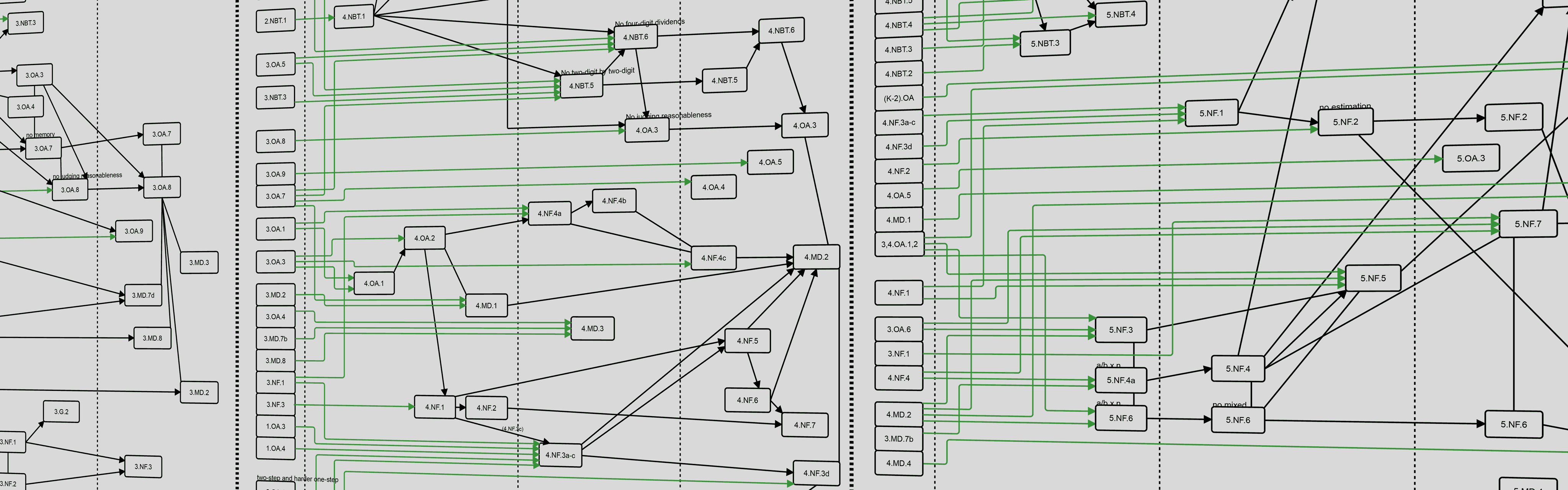
The Coherence Map shows the connections between Common Core State Standards for Mathematics.
gritty tundra
oh i see
i'm actually working on a bigger project too which is to map a bunch of undergrad math classes to that too
dapper flume
Do you have a goal for doing this, or is it just something you were interested in mapping out?
gritty tundra
dapper flume
Do you have a goal for doing this, or is it just something you were interested i...
i have an end goal to get people to build a long-term project to map out a network graph for every field of study
and basically everything
i built a react app to do this with
this is what i uploaded to it
dapper flume
gritty tundra
i have an end goal to get people to build a long-term project to map out a netwo...
That's interesting, and a very nice project on your part. What do you think that will bring to the academic community?
minor turtle
gritty tundra
i have an end goal to get people to build a long-term project to map out a netwo...
this is way harder than the other two things you mentioned
especially since most fields are usually not very self-contained at all (unlike undergrad classes whose prerequisites and motivations for study are usually very clear)
maybe an approximation is still useful but i doubt that such a thing could be mapped without people disagreeing what is even in the tree, let alone what’s dependent on another (it might end up as a much more tangled graph without nice properties if you’re trying to be pedagogically useful or even consider motivations)
tight star
What struggles do people have with the idea of substitution? And what usually fixes those?
For example, i have heard that sometimes people struggle with the idea of what it means to evaluate a function
To me, substitution is really baked into the concept of a variable, so it’s challenging to understand what other people find difficult about it
minor turtle
this is one of the primary struggles i find that people have with algebra
tight star
I see
And if I want to try a more functional approach to teaching
I need to overcome this struggle
minor turtle
yeah, it’s actually a really hard problem tbh. i still don’t have a set way that i deal with it if i’m teaching someone that stuff
like it’s one of the things i’m the least opinionated about because i’m afraid to touch it
:P
minor turtle
like how do i get into the mind of someone who is trying to create a conception of what a variable is and how it relates to a function
i want to either start with someone who is earlier or later because both types of people have “easy” to evaluate problems
i find myself drilling fundamentals with them very often when i’m teaching stuff about variables, like i learned it. i want to be very hands-on, not worry about functions, try literally showing them unknown quantities (via stones in a bag) and letting them see what’s going on with equations with a physical scale
and then students will learn what a variable/unknown is that way
this approach could be extended to functions, though it feels a bit sloppy to do so
maybe we don’t have to extend it to functions, i don’t hate the “machine that follows a rule” analogy, i was being prepped to hear that analogy pretty much my whole life anyways (albeit i was very lucky i think, since the assignments that we did during math class in elementary school were essentially implementations of functions but without the notation)
but if one doesn’t have that upbringing, then that’s fine, we could just start with that analogy without any notation
i’m unsure about all of this
btw
but i feel like this is an approach that i would feel comfortable using on an algebra student, provided that they can add numbers together, and do other basic operations (the four basic arithmetic operations are really all that’s required i think, obviously there is a bit more to elementary education than that but this topic specifically is quite narrow when you think about it for the first time)
minor turtle
tight star
To me, substitution is really baked into the concept of a variable, so it’s chal...
you can do this with physical objects (maybe)
put two bags of marbles labeled into a box named y for example
but substitution and functions at first are likely different enough concepts at this point that they’re learning how to do it
i do want more perspectives tbh, i’m really taking some shots in the dark
tight star
minor turtle
i do want more perspectives tbh, i’m really taking some shots in the dark
yeah me too!
 cosmic ibex
tight star
You can see over in <#576508782637744130>
cosmic ibex
tight star
You can see over in <#576508782637744130>
That was painful to read.
I think the underlying trouble (which never got resolved, but I can't blame you for that) is that they understand "necessary condition" wrong.
They started with the true facts that:
forall f( P(f) & Q(f) -> R(f) ) is true and provable
forall f( P(f) -> R(f) ) is false
and conclude "therefore the assumption that Q(f) is a necessary condition for R(f)".
That's actually not crazy based just on an everyday understanding of the word "necessary" -- it's just not how the word is used in mathematics, and they cut you off with "don't teach me logic" when you tried to engage with it.
minor turtle
get a student who’s willing to learn
tight star
i mean as a teacher
cosmic ibex
I think at a certain point they had gotten so worked up that they were not going to concede no matter how well you explained anything.
You're talking to someone who's not even agreeing which way the student-teacher relationship between you goes, and salvaging that is not just a matter of pedagogy.
tight star
hmm
then what is it a matter of?
or - how could i make sure we don’t get to that stage of being too worked up?
minor turtle
tight star
or - how could i make sure we don’t get to that stage of being too worked up?
it’s not entirely dependent on you here, you had a disagreement with someone where you happened to be right, maybe it’s possible to step back from the mathematics that you want to talk about (ex your counterexample) and establish what their claims are at that point, to make sure that you’re disagreeing on the right thing
tight star
hm, i thought i did that, but perhaps i could've done it better...
like they said it was an iff multiple times
minor turtle
tight star
like they said it was an iff multiple times
yes but later in the conversation it ended up being more clear what they were claiming
cosmic ibex
I mean, sometimes you just have to cut your losses.
From their point of view it wasn't a matter of them learning from you -- it was "Pseudo is wrong and I'm very patiently explaining to them why they're wrong".
I think that kind of impedance mismatch is impossible to completely avoid in the social context where we're all just people talking on the internet without any hierarchy defined between us in advance.
tight star
i see...
this is difficult for me to accept, i think
i've always been able to reach people with my explanations
minor turtle
tight star
i've always been able to reach people with my explanations
the first time i disagreed with someone in a similar way it happened to be someone with a little bit of status, and she didn’t understand that she was making a dichotomy where there wasn’t one, and no matter how much i explained it to her she wouldn’t listen to me, and it was really really frustrating.
it sucks to be the person on that end of it
but it literally can’t be avoided
minor turtle
cosmic ibex
That was painful to read.
I think the underlying trouble (which never got resolv...
this was something that i used to struggle with when i started calculus and first learned about the FTC as well even
tight star
that it's not an if and only if?
minor turtle
no specifically dealing with the phenomenon that tropo said
like coping with it
or i felt like i had to cope with it for a while
cosmic ibex
To be fair, "only if" is a super confusing phrasing if you try to understand it based on its individual words.
It simply needs to be learned as a piece of mathematicianese with a conventional meaning.
wind ginkgo
That convo in #real-complex-analysis was painful to read
cosmic ibex
My exact words. 
wind ginkgo
Oh and @tight star mayhaps a good idea for that foundation-esque class you wanted to teach is adopting the teaching philosophy of Kenneth P. Bogart. The introduction to this book has always been very nice to read for me and a great inspiration. https://bogart.openmathbooks.org/
 tawny slate
tight star
i've always been able to reach people with my explanations
tawny slate
tight star
i've always been able to reach people with my explanations
you are assuming that humans are all rational creatures
society if everyone was rational and reasonable or something
 wind ginkgo

 midnight scarab
tawny slate
society if everyone was rational and reasonable or something
midnight scarab
tawny slate
society if everyone was rational and reasonable or something
The fact that the guy is walking a robot dog is so sad
 vocal phoenix
Living animals were inefficient so they were sacrificed on the altar of progress
tawny slate
midnight scarab
The fact that the guy is walking a _robot_ dog is so sad
i legit never noticed that
the resolution is so low
gritty tundra
minor turtle
maybe an approximation is still useful but i doubt that such a thing could be ma...
you could implement this as a graph database, but just focus on the concept at hand and have a weight on what to learn next that's dependent on the percentage of people who believe it's the best choice
minor turtle
i see where you’re coming from, i think such an approximation might be useful and would definitely be very cool
 sharp hawk
I proved it in all details
But he came with the initial insight
 signal estuary
gritty tundra
hey guys i built a network graph representing all the topics from pre-algebra to...
signal estuary
gritty tundra
hey guys i built a network graph representing all the topics from pre-algebra to...
This kind of highlights something that I think schools don’t do very well regarding math class
The fact that they teach a lot of very specific content and methods for solving certain problems
I think it would be far better to decrease the number of specific content/methods that are taught and instead focus most of the time in math class on general problem solving techniques and just solving a lot of problems that are new enough so that you really have to think about how to solve it
But that’s mostly because I learned math that way and it worked very well
tawny slate
gritty tundra
what are your thoughts?
so there was a guy who made a good point about how this is highly subjective from person to person, i also want to point out some things that imo were kinda weird about this
it seems like you start with real numbers here, and then from that learn simplifying expressions
dont think real numbers need to be introduced until irrationals are needed, and for some reason simplifying expressions is before add/sub both sides of an equation?
i would imagine if those steps are that granular, "simplifying expressions" is much more difficult than you might be estimating
and exponents are learned in parallel? i would only teach exponents after multiplication and addition properties are well understood, which isnt exactly mentioned anywhere
i would imagine this tree is much more interconnected
but otherwise good start
i think these kinds if diagrams are less an objective thing and more of a reflection of your personal style of teaching and your gathered experiences
results are more important i think, because at the end of the day, i think the reason we use this is to map out and target the students' weak points
tawny slate
it is pretty cool to see everything laid out like that though
gritty tundra
yea most people see this as a straight line from algebra 1 to the end of precalc
also i put the laws of exponents down there because the concepts mainly center around expressions and not equations
especially at the pre-algebra level
but when you solve exponential equations, it's algebra 2

 long pelican
I’ve gone back and forth in my mind about whether I think people are rational, and at this stage I think people are best explained as rational, but mostly acting on incomplete information all the time
tawny slate
i disagree
i used to feel the same way, but i think after being exposed to some neuroscience, i think humans are social first, emotional second, rational last
long pelican
Rational traditionally restricts itself to measurable things like money (as in economics) but I have a much broader view of aspects one can be rational in
Social things like responding to pressure to fit in are included
If you don’t allow that, then, by all means, humans are irrational, sure
tawny slate
here is my interpretation of "rational"
the reason why i put social in front of rational is because i think, given two test scenarios where the same person has to make the exact same decision, one clearly rational and one clearly irrational, humans will almost always choose the irrational decision given enough social pressure, and will almost always choose the rational decision absent that social pressure
tawny slate
responding to social pressure is not necessarily rational, especially if they are pressuring you to do something you rationally oppose
the question is when these forces come into conflict, which prevails?
and in this sense, this is what makes humans incredibly fallible and easily exploited
long pelican
I think you'll find it makes more sense to include social pressure in what is considered the decision making process, rather than apart from it
Once you adopt this, the social pressure changes the calculus of what you want to get out of a decision -- it adds a factor you need to consider
Doing something out of fear of getting ridiculed is very rational
midnight scarab
Not if you're worse off in the end
long pelican
Hmm but
- Worse off on the thing without considering desire to avoid humiliation might total to better off overall
- Even if you regret it later, doesn't mean you were irrational in the moment
Rational decisions made with incomplete information are bound to sometimes be wrong
midnight scarab
You usually decide based on what is (or what you feel is) more important for you at the moment, which is often an issue of feelings rather than rationality
long pelican
You can view that as lack of information, namely the information about what you will eventually settle on as the proper weightings of the various factors in the far future
cosmic ibex
Actions are not "rational" or not in isolation. It's always relative to what your goal is.
midnight scarab
long pelican
Rational decisions made with incomplete information are bound to sometimes be wr...
Regretting because it ends up spiraling for example is a different issue from regretting it because you just gave in to the pressure or the fear of humiltiation
midnight scarab
cosmic ibex
Actions are not "rational" or not in isolation. It's always relative to what you...
True. And also one's goal is often at least partly a matter of feelings (+ social construct/influence)
long pelican
Obviously I'm challenging the modern-traditional idea that humans are fundamentally irrational
Partly the definition of what is rational is way too narrow, and partly we don't give our subconscious brains enough credit
e.g.
you just gave in to the pressure
under the hood if you examine what the brain is doing here, it's a lot more complicated than that
 daring gulch
Hmm I think you're operating under a few too many assumptions.
long pelican
Would you like to say more?
daring gulch
You never precisely defined what is "rational," for one. Rational in the sense of making the best choices for the individual? Under specific circumstances? Short term decisions vs. long-term decisions?
long pelican
I did mention, though, that the current definition of what is rational is too narrow and it causes lots of problems
making the best choices for the individual
can't be the definition, as this requires knowing information one doesn't have most of the time
Short term decisions vs. long-term decisions
Both can be perfectly rational, even at the same time
 ashen verge
midnight scarab
You usually decide based on what is (or what you feel is) more important for you...
ashen verge
midnight scarab
You usually decide based on what is (or what you feel is) more important for you...
The goal itself is subjective, inherently, but actual actions can be "rational" in the sense that they make progress towards the goal
midnight scarab
ashen verge
The goal itself is subjective, inherently, but actual actions can be "rational" ...
Exactly
minor turtle
does anyone here have experience writing expository notes? why did you do it, and are there any things that you would want to do differently if you could do it for the first time again?
tawny slate
ok but at this point the conversation is devolving into semantics about what should be defined as "rational", but not about human nature and how we make decisions and think. thats why i was very technical when i defined what i meant
lets make this explicit with a hypothetical scenario:
you're not exactly poor but you certainly are looking to not waste money, as you need it in the short and long term. rationally, this means you should not be gambling at a casino, because you've studied probability and expected value. your friends invite you to come to the casino with them, and if you go you know they will strongly peer pressure you into gambling, and that you will probably gamble anyways and regret it
here, we have two forces coming into conflict, a "rational" choice that says to not go because not only is it not in your monetary interest, but if there is any social cost to not joining your friends, they should not be your friends in the first place as they dont respect you enough, so you should be assertive and decline, and a "social" choice, which is that the person wants a sense of belonging and acceptance within a group, even at the cost of short- or even long-term goals
you can argue all you want that it is in the person's self-interest to be sociable, as there is some abstract experience that makes them find the monetary cost to be worth it, but firstly, the example is to point out the difference between "rational" and "social", not to pick at a specific case, and secondly, by this logic every decision that every human being makes is rational, what does being irrational even mean? you're evaluating the decision by post-hoc and not prior to the decision being made. and thirdly, i could have chosen stronger, more explicit examples like addiction but that might be construed as cherry picking
i dont deny that it helps to have a more broad definition of "rational" in the sense that because we are human, our feelings and abstract thoughts and intuition are sometimes critically important and we cannot separate ourselves from them, and i dont deny that in the real world you can never have perfect information and that you can make decisions that benefit you both short and long term, thats not the point
the point is that once you separate decision-making factors into the categories of social, emotional, and logical, the human tendency is to vastly prioritize the factors in that order, even if the logical one is the most correct one and the person making the decision believes it. it is baked into our neuroscience from the moment we are born
this distinction is important to me as an educator because sometimes your students might hold strong emotional attachments to certain framing of certain problems or react to the classroom setting externally, and being aware of the way our neuroscience and psychology works helps reach the student better and guide them properly
ive had students have viscerally emotional reactions to the fact that we say .9 repeating is equal to 1, despite being shown 3-4 different explanations for it, ive had one student that got extremely argumentative when i brought up a hypothetical problem where some rich guy was being taxed by a fraction of his wealth rather than a flat tax which prevented him from engaging with the math and was disruptive, and almost all of the students ive ever come across will at some point change their answers to a math problem if they find out they are in the small minority to match the answers of their peers, even when they did the scratch work and verified the correct answer themselves
these are all disruptive to the goal of actually learning math, which is why we show kids weird and interesting math to hone intuition, why we try to not bring up controversial topics if it is not the focus of the lesson, and why we explicitly guide the students to build confidence in their own logic and own work rather than following the masses
the point is NOT that emotions or peer pressure is never "rational", and im certainly not going to define "rational" here as "following your heart"
tawny slate
actually, just as a broader definition can sometimes help reframe an idea in a new light, sometimes a more specific definition can help us see important differences and nuance
long pelican
If we are to separate the social, emotional, and rational spheres, all this suggests is that the "virtue" of being rational is simply the act of narrowing your decision making to a single goal, rather than multiple goals at the same time
Is ignoring social aspects of a decision a virtue?
I like to abstract away "social" and "emotional" since there is nothing inherently special about these goals
We might hold 10 or more goals in our brain at the same time
Most of them very hard to communicate
tawny slate
long pelican
I like to abstract away "social" and "emotional" since there is nothing inherent...
i 100% disagree
a human being in extreme emotional distress will make decisions and think things that normal human beings will not
emotions can strongly strongly impact your thinking and decision making
therefore, it makes sense to separate it from some other form of "logicalness" or "rationality"
how many times in your life have you done something because you were angry or upset and then regretted it later?
once again, to be perfectly clear, i am NOT saying that we should never take our emotions or social aspects out of our decision-making, its not a good thing nor is it possible, so it most certainly is not a virtue
long pelican
What's the last emotional decision you know of (yourself or someone else) and how complicated do you think the decision making was?
tawny slate
but there is a massive difference between "i think vaccines are generally safe based on the available scientific evidence" and "my friends all told me vaccines cause autism and will kill us all"
long pelican
Oh that's a good example to discuss
tawny slate
the last emotional decision i made was to decide to eat this bread
i ate it because i wanted to eat it
the decision making was not complicated in this case
long pelican
Even in the bread case, if you were doing something at the time, then you had to decide whether you want to eat the bread now or finish part of what you're doing...
Not consciously, mind you
Even if emotional, it factors in
tawny slate
once again, i am not disagreeing with you
long pelican
tawny slate
but there is a massive difference between "i think vaccines are generally safe b...
The information accessible to anyone pondering vaccines isn't quite "the scientific evidence," it's "what I hear, what I read, with regards to scientific evidence" and trust of what you hear and what you read is very dependent on prior context and experiences
tawny slate
not disagreeing, but there is a difference between teaching someone a math concept by providing them with a logical understanding and telling them it is because i said so or by emotionally pressuring them to
you keep bringing up things that i dont disagree with but have no relevance to the point i made
long pelican
That's not surprising since the point I'm making about rationality isn't directly a response to you
tawny slate
long pelican
Even if emotional, it factors in
you clearly understand what i mean when i say something is emotional, you simply take issue with the semantics of me using the word "rational" in this context
ah
ok then i have a different question
can you provide me of the most concrete examples of a rational decision and an irrational decision
for contrast and clarity
and follow-up question: given your definition of rationality, does your point relate to math pedagogy in some way
long pelican
Mmm, well, my view of irrational is that calling a decision irrational implies I don't understand the reasons behind it
However, I'm open to using the narrow definition of "rational" for the purposes of this discussion
In that case, a rational decision would be the decision to major in CS after hearing that jobs in CS are hot
An irrational decision would be deciding on a restaurant and then changing last minute just because you like randomness (here, enjoyment of spontaneity would make it rational but not from the point of view of the goal of maximizing what you were originally maximizing)
tawny slate
ok two issues
tawny slate
long pelican
In that case, a rational decision would be the decision to major in CS after hea...
why is this rational
long pelican
Oh I did miss necessary context
tawny slate
long pelican
An irrational decision would be deciding on a restaurant and then changing last ...
and by this logic, how can anyone ever make an irrational decision? it sounds like no one would ever do anything irrational ever
long pelican
for this person, their ultimate goal is to make good money after graduation
tawny slate
ok and i argue this is not necessarily rational
i may have the goal and context but i do not see why that assertion/decision is rational
long pelican
tawny slate
and by this logic, how can anyone ever make an irrational decision? it sounds li...
Yes if you completely understand a person and can completely explain what a brain is doing, nothing it does is irrational. Just like nothing a computer program does is irrational if you understand its code completely
but "irrational" can be useful to communicate that you have no idea why they did what they did
in an informal setting
tawny slate
ok it sounds like the word "rational" has basically almost no meaning informally, it just amounts to "i understand" vs "i dont understand" (irrational)
why bother using the term "rational" at all then?
long pelican
I was getting to that!
In the rationality community, there is a general goal of figuring out how to best arrive at true beliefs and then to teach that to the public. Traditionally (2010s-ish to now) the view is that rationality is the best way to approach having true beliefs, where rationality means using logic and reason over emotions and other things. I think it makes the fundamental mistake of explaining away those other factors as irrational, when in reality the brain is doing complex decision making involving all these other factors, not being irrational. Another complicating issue is that those other factors are often uncommunicable, so they cannot themselves explain what went into the decision because they don't have the practice of communicating that.
tawny slate
feels like we are looping again
tawny slate
again, thats just semantics, i dont know what you mean by either word and im trying to get clarification
long pelican
it's the same way half the general public views vaccine denial as stupid
tawny slate
ok but according to your definitions, it sounds like you would not label them as irrational
long pelican
Right, vaccine denial at its core is about distrust of sources, not ignoring facts
tawny slate
and thats the point
by separating emotions from "rationality" or "logic"
you make formal claims about these kinds of issues
whereas if you lump them all together nothing has any meaning anymore
long pelican
Distrust of sources isn't emotional
It's inferential
based on knowledge and past experience
Prejudice is also inferential
that's something a lot of people get wrong too
tawny slate
are "emotional" and "inferential" not separate axis of categorization?
can i not have inferential logical arguments?
long pelican
Fine, but for distrust of sources, there's no reason to assume emotion is involved
tawny slate
but the point is that by lumping them all together it is being reductive
first of all, let me say that i am going to use the word "reasonable" for your definition of "rational" and "logical" for my definition of "rational" so they dont get mixed up
long pelican
Sounds reasonable
tawny slate
i can make an argument to say, for instance, that both of the statements:
- there are an infinite number of primes
- i like tomatoes
are both reasonable
but i would not call the second statement "logical"
because it does not involve any [significant] form of formal arguments
the first statement is reasonable regardless of who is interpreting it or how it is interpreted
the second statement is necessarily contingent on my felt experience
there is something massively qualitatively different here
and that is the point of making this distinction
long pelican
Neither one is making a inference of any kind... (well, the second one is inferring your messy brain configuration into "likes tomatoes" I guess)
tawny slate
if you break "rationality" down into such tiny amorphous brain experiences, then yes all lived experiences are also made up of tiny inferences that you cant totally explain
why do i think i like the taste? because i have felt this before and i would prefer it
tawny slate
so basically the word is just as useless as your interpretation of "rational" if you take it that far
its reasonable because i think its reasonable
i cant explain it but i feel it so its reasonable
long pelican
Only if we can reflect and communicate that far (and we can't)
tawny slate
ok so now we are getting somewhere
i would agree that one of the motivations of this distinction is whether or not we can explain it
communicate it
why do i like tomatoes? because i do
sure, i can communicate it, but like, not in a way that will make others agree
long pelican
In practice I'm completely fine with treating likes as atomic
tawny slate
however, there are statements, like those in math, that once communicated can be completely understood
those are fully communicable ideas
where as my feelings towards tomatoes are only partially communicable
there is no way i can transfer my qualia to someone else
long pelican
Suppose we're treating likes as atomic, then a decision to eat tomatoes or not eat tomatoes when presented with this binary decision is nearly fully communicable too
Of course there's the factor of "I'm full" that I thought of that can complicate that decision
tawny slate
but the reasons for it are not fully communicable too
you are now arbitrarily deciding that that is an atomic statement
which, sure, i guess we do the same thing in math
long pelican
Well, I'm also claiming that likes being atomic is a good idea for now
tawny slate
the point is that each like statement is not only its own atomic statement
it is also a personal atomic statement
you cannot understand what i feel when i bite into a tomato
i cannot understand what you feel when you bite into a tomato
this is why this is a fundamentally emotional thing
im not saying its not reasonable, it absolutely is
but these are separate axis
each of these words have their own meaning and function
i think the word "rational" in the way you use it is not useless, its just highly highly generalized and abstracted and not applicable to many scenarios in practice
im saying there is a lot of value in the specificity to break down these different types of motivators, you seem to disagree
long pelican
Perhaps? But I noticed in many scenarios a stupid decision actually had reasons behind it and understanding those reasons is very powerful
tawny slate
sure, again, i totally agree
long pelican
But calling those reasons emotional is reductive
tawny slate
but that brings me to question 2, how does this relate to math pedagogy
all language is reductive
long pelican
The actual reasons, broken down into likes and whatnot
is better information than "You just acted on emotion"
long pelican
Um
tawny slate
i am not saying that emotions cant be more well understood either
long pelican
But calling those reasons emotional is reductive [and there is a better way]
tawny slate
long pelican
The actual reasons, broken down into likes and whatnot
is that breaking it down gives more information
nowhere in any of my claims did i ever imply that emotions cant be broken down or understood better
i made a point that generally speaking, humans are strongly wired to prioritize in a certain way
it is not an absolute statement and it most certainly is reductive
but so is the statement "labels are reductive"
because sometimes labels, and language in general, can help elucidate an idea
the only way to communicate is to start with something that has some kind of meaning, even if it is reductive, and build ideas with them
all language is reductive
long pelican
ok this discussion about reductiveness was not helpful, I didn't use that when you said abstracting away emotions is reductive
tawny slate
ok i see what youre saying
that does sound like im using a double standard here, let me first apologize
i guess im just saying that even though i understand and agree with you in the abstract, i disagree that there is no value in separating social, emotional, rational
i think sometimes you want to be more general, sometimes you want to be more specific
long pelican
Yes, in this part of the discussion I was saying being more specific is virtuous, while previously I was saying that "emotional" and "social" are not special labels
for that bit, what I meant is that "emotional" and "social" are just 2 of 10 possible categories
7 unnamed
(or more)
tawny slate
sure
long pelican
So decision making will first be approximately: how much do you value social, how much do you value emotional, how much do you value money, how much do you value physical health, etc, etc... then after those weightings you calculate (not consciously) the course of action
Rationality folk would have you believe that if you don't pick a single goal and effectively consciously optimize it, you aren't being rational
tawny slate
i think the bulk of the community does give that vibe/impression, and i do feel you
i do agree with you that full robot-mode rationalizing every decision and choice does not necessarily give you the best outcomes, because humans are fallible
i agree that not going full robot doesnt mean youre irrational
long pelican
I like how robot is being used as a synonym of having a single goal 😛 I was about to discuss how that idea has infected AI research
tawny slate
and this is coming from someone who obssessively rationalizes everything by second nature
like, this is a cool abstract thing i took away from model theory
given some basic axioms it seems like you can only do so much
but if you ponder that some nonstandard models exist, you realize you get a lot of weirdness
there are all kinds of existing frameworks built into your brain
and when you try to be hyper-rational, the danger is not realizing when you're using that framework that isnt rational, but you think it is
things you take for granted on a deep subconscious level
im with you here
but look, im just trying to explain how best to teach math here

long pelican
I did have some thoughts about the relationship between rationality and what you said about teaching math earlier but I will have to scroll up to recall it...
brb
By the way, new thought: you all are undoubtedly familiar with the experience of deciding whether you should ask a question now, or wait until the end of class, or just figure it out on your own. Complex decision making process that is, interesting to ponder how it works
I'm already seeing quite a few layers of inference being used
(also very practical for math-pedagogy since maximizing the chances your students will decide to ask the question now is one of the best things you can try to do)
tawny slate
oh yes, in that case this is actually a good example of my original point
students are worried about the embarrassment or shame from asking questions during class rather than asking immediately to get the most out of the class
hence social/emotional > rational
i want the students to ask questions and ask as soon as possible
long pelican
tawny slate
hence social/emotional > rational
Hmm I figured out that what I would like to see here instead of that is
tawny slate
the students act differently in the class setting than they would in private
long pelican
social/emotional > goal of understanding math
tawny slate
in this case sure, but i claim something stronger than that
for instance, even if one knows they are right and believes it by logic and reasoning, can be strayed away by peer pressure or public ridicule
you can unconvince someone of the answer they know is right by bullying them
long pelican
Asch experiment right?
Unlike the popular conclusion from that experiment, my conclusion is that doubting yourself when you're doing against literally everyone else in your social group can actually be pretty rational
for the goal of having a true belief about that thing
being new increases the chances of self-doubt, being senior decreases it
I think that's a universal experience 😛
tawny slate
and thats basically part of what i was getting at, yep
tawny slate
minor turtle
does anyone here have experience writing expository notes? why did you do it, an...
sorry for burying this, but is there a more specific context for why youre asking? like i write scripts for math videos on youtube, but idk if that answer would be of use to you
minor turtle
tawny slate
sorry for burying this, but is there a more specific context for why youre askin...
i’m just writing for myself really, i’m organizing my thoughts and want them to be comprehensible enough for a reader to be able to follow along with it, but also i don’t just want to copy the book (which so often happens when i’m doing pencil/paper notes, and in some poorly typed papers on the internet) , but honestly i do want to know a bit about what your writing process is like even if it’s not the exact same format
like how do you talk to a reader
or viewer in your case
is it any different knowing that readers can’t ask questions in real time
tawny slate
its a little different
when im writing for viewers of the video, there is a much higher standard i think
because it isnt solely the exposition and the facts being presented
youre essentially also telling a kind of story
you need a hook, a motivation, you need to connect with the viewer about why they should care, and then you have to follow up on that promise
as for the writing process, i have to make sure that all of that is planned out and strucutred before i draft up the script
and the script has to be in presentation form, not just some notes i can pull out at any time
once i go through several revisions, i test the script with some people close to me to see if it does hit the goals i want
like a checklist
it needs to not only be easy to understand and clear, it needs to be motivated, it needs to be interesting, it has to inspire them and they feel like they took something of value, and ideally it is memorable and leaves an impression
and then the cherry on top is the balancing act with the clickbait thumbnail and title, like i want people to see it, but i also dont want to make it so ridiculous and dishonest that i feel gross and lowers my integrity
feel free to ask if you want any more details or if you want to see my channel
i can show you videos that worked well and videos that bombed
 tardy ember
long pelican
Rationality folk would have you believe that if you don't pick a single goal and...
tardy ember
long pelican
Rationality folk would have you believe that if you don't pick a single goal and...
...i think you're misunderstanding their position here
or at least this doesn't accurately describe the position of rationalists i've seen
in particular, "a single goal" is a technical term here, it means a mapping of world states to real numbers
which definitely can include what looks from a human perspective like a very complicated system of several different things that you want
long pelican
Ya, I have seen weighted averages of "what you want"
I think pretending you have a single goal is quite common though
for organized groups like a company even more so
tardy ember
tardy ember
which definitely can include what looks from a human perspective like a very com...
if you care about social stuff a thousand times more than the state of the world, that is a coherent utility function (if you think it describes what you want, you're probably actually wrong i think, but that's a separate issue)
long pelican
(for a company it'll be, for example, profit, for a charity based on EA, it'll be something like QALY per dollar)
long pelican
tardy ember
if you care about social stuff a thousand times more than the state of the world...
So this is like adding an extra level of indirection, isn't it
Which can be inaccurate
tardy ember
"irrationality" looks like deciding that buying an apple for £5 is worth it, and selling it for £3 is also worth it, (and also assigning £ positive value), which means someone can make money off of you by just repeatedly buying and selling you an apple, because your preferences are inconsistent
long pelican
It's exactly in these thought experiments that I noticed that rationalists work with single goals
tardy ember
long pelican
Which can be inaccurate
oh yeah, deciding that you've found the entirety of your utility function when in fact you're missing huge amounts of it is a common mistake by people who don't get it i think
tardy ember
long pelican
It's exactly in these thought experiments that I noticed that rationalists work ...
well it's a simpler way to demonstrate the mathematics than listing out everything a human could possibly want
the same ideas still generalise: even if "what you want" is actually extremely complicated, it's still pretty obviously stupid to have preferences that aren't transitive
but you aren't going to find anything in the maths that says you can't "want multiple things" as long as you have some defined rate of what you do when there's a tradeoff
you can want a lot of things, just don't do something where you can rearrange to get more of all of it simultaneously, because that's irrationality
a utility function cannot be irrational, that's a type error
(although thinking you have a certain utility function can be, in the sense that it's a belief and beliefs can be wrong)
long pelican
Why is nontransitive preferences stupid?
I know abstractly it is illogical
but why in a human is it stupid
Or maybe my real question is
What if they just appear nontransitive
tardy ember
...how would they "appear nontransitive" without actually being nontransitive
but ok if you have states A B C, and you expend effort to get from A to B, and to get from B to C, and then to get from C to A, because your preferences are A < B < C < A rather than some more complicated reason like "because you like variety" ...then what are you doing
to make it a better example let's say what you're actually doing is changing which of these events will occur at some fixed future time
so by changing A to B to C to A you have accomplished literally nothing
tardy ember
ok yes fine, let's say you don't benefit from doing this except in the sense that you changed the outcome
long pelican
In the workplace the appearance of doing something has positive utility, in the gym the thought of you getting healthier by exercise has positive utility
tardy ember
tardy ember
ok yes fine, let's say you don't benefit from doing this *except* in the sense t...
if the outcome wasn't changing, and only you knew this and nobody else would ever find out, you wouldn't decide to do it anyway
long pelican
Another scenario is you are exploring
and you end up at B then C then A due to influx of new information
tardy ember
long pelican
In the workplace the appearance of doing something has positive utility, in the ...
in both of these examples, you're indifferent between A B C, and you get value from changing it regardless of what it's changed to, so still transitive
long pelican
Actually the constant dynamic of new information means nothing can be nontransitive tbh
tardy ember
long pelican
and you end up at B then C then A due to influx of new information
[what you originally thought A was] < [B + value of information] < [C + value of information] < [what you eventually found out A was], or something along those lines
long pelican
tardy ember
in both of these examples, you're indifferent between A B C, and you get value f...
You don't even need to be indifferent
The value from changing it can just outweigh nontransitivity
tardy ember
it can outweigh your preferences between A B C
there's no nontransitivity happening here
but yes, that's also possible
long pelican
Well if changing has value then you'll always climbing while being at the same place
talking about transitivity won't be very useful anymore
tardy ember
long pelican
Well if changing has value then you'll always climbing while being at the same p...
indeed, if the only thing you value about the world is the binary switch "are things changing / are they not changing", which you prefer to be at "things are changing", that's a strategy that... sort of works?
long pelican
Why the singular goal thinking lol
You don't need to do that
It still works
Another way to think about it, you can never truly return to your original state
tardy ember
but at some point you would want to stop moving in order to sleep otherwise you'll become less effective at changing things in the long-term
tardy ember
long pelican
Why the singular goal thinking lol
well because otherwise you would end up doing something else that you value more that also achieves that things are changing, like talking to your friends - which changes the state of the channel you're talking to them in by adding messages to it, and is also valuable because social whatever
long pelican
regardless it allows A B C A with no rational contradictions
and no assumption of singular goal necessary
tardy ember
it allows A B C A'
but yes it is true that essentially any behaviour is the rational way to achieve some goal
long pelican
long pelican
Another way to think about it, you can never truly return to your original state
sure every ABCA is actually ABCA' due to this
long pelican
tardy ember
but yes it is true that essentially any behaviour is the rational way to achieve...
Ya, so that's why I (0.2-tongue-in-cheek) said rationality is basically "Reduce your goals to something singular/measurable!"
tardy ember
tardy ember
but yes it is true that essentially any behaviour is the rational way to achieve...
just a lot of those goals are extremely overcomplicated and are weird things to claim as your actual values
tardy ember
long pelican
Ya, so that's why I (0.2-tongue-in-cheek) said rationality is basically "Reduce...
i'd say more just, have goals that make sense?
long pelican
Instead of using your brain's subconscious processing on hundreds of internal goals, estimate them with a couple of quantifiable goals and use conscious processing instead
tardy ember
like if you do genuinely reflect on it and conclude that you value the opinions of your friends a billion times more than anything else, then sure go for it
long pelican
Don't think the brain will weigh friends' opinions at 1 billion times anything else for length of time more than 0.5 seconds
tardy ember
if you decide that's not how your goals work, then giving in to peer pressure when you know that isn't in your interests is irrational and you should do it less
tardy ember
long pelican
Instead of using your brain's subconscious processing on hundreds of internal go...
ok yeah that is just wrong for unrelated reasons
"rationality" is whatever works best, you don't get to look at a strategy that would perform really well and declare that instead you're going to use the "rational" strategy that works less well
long pelican
Isn't the contention of rationality that what "works best" is measured by those estimated quantifiable goals
what else can one mean by "works best" in that context
tardy ember
your subconscious mind is fairly stupid but it is also an extremely useful tool and you should find the best way to use it to achieve your goals
tardy ember
long pelican
Isn't the contention of rationality that what "works best" is measured by those ...
what "works best" is measured by... your goals, whatever those are
replacing your goals with some other set of goals that's easier to achieve, does not achieve your goals, so don't do that
long pelican
You're at a local maximum for whatever your goals are almost tautologically
getting out of that requires doing something against your goals for a bit
long pelican
yep, local is important
tardy ember
i would prefer if i was immortal, and i'm not
long pelican
That's a singular goal and not what you have
and all paths to being immortal while not compromising on your other goals are not accessible to you at the moment
tardy ember
that... is true...?
i don't see why it's relevant at all?
why do we care about local maximums
long pelican
Challenging the assumption that the subconscious brain is stupid
And that what you should do is achieve your goals better
What you're actually doing when applying rationality is either pretending your goals are different or changing your goals or going against your goals (temporarily)
tardy ember
i would absolutely take something that would be a huge inconvenience for a month and then make me immortal*, so it doesn't really look like i care about local maximums?
long pelican
But not if you didn't know about the outcome
tardy ember
*(i do have more conditions on what would make this desirable than literally just "unable to die", but still)
long pelican
The anticipation of the outcome is definitely increasing your utility
tardy ember
?????
no it isn't
i do not intrinsically value thinking that i'm going to be immortal
long pelican
Then why are you doing it? 😎
You're doing singular goal thinking again
Utility is not just being immortal
Happiness counts too
tardy ember
oh the fact that we're talking about one particular outcome that i think is good means i'm doing "singular goal thinking", ok
long pelican
I mean you wouldn't climb that hill if you had no idea you'd be immortal at the end (even if it was the case you'd be immortal at the end)
tardy ember
long pelican
Happiness counts too
it... does, with a significantly lower weight
tardy ember
long pelican
I mean you wouldn't climb that hill if you had no idea you'd be immortal at the ...
if i knew i would be immortal at the end and was sad about that because of mind-affecting drugs or something i would still climb the hill
long pelican
Knowledge of being immortal at the end makes your brain shape the hill so it's not a hill anymore
tardy ember
also i actually think that "incorrectly thinking i'm going to be immortal" is by itself net-negative
tardy ember
long pelican
Knowledge of being immortal at the end makes your brain shape the hill so it's n...
well if that didn't happen (because i knew i would become immortal but my brain was just inexplicably being weird) i would still climb the hill because it would achieve my values??
you're acting like i'm a local optimiser when i'm just not?
long pelican
Sounds like there's the map that your brain encodes internally and there's the map that you are aware of and/or talk about and they are two different things
tardy ember
???
we're not arguing about the world or about how i perceive the world, we're arguing about what my utility function is
long pelican
I'm not talking map of the world
tardy ember
map of what then
tardy ember
ok so you're saying that my intuition doesn't perfectly match what i'd say my utility function is?
yeah obviously
long pelican
Yes. and I've been discussing the "true" utility function encoded by your brain this whole time
tardy ember
well that's not the "true" one
tardy ember
ok then this hypothetical is about someone else who isn't me and behaves nothing like me and i don't see what your point is
long pelican
You think that doing a month's work in anticipation of immortality is an example of leaving a local maximum in utility
tardy ember
yes
long pelican
I'm saying, actually, your utility is increasing during that process
tardy ember
well "utility over all futures" does, in the sense that a world where i'm closer to immortality is "better" because i want to be immortal
but utility of that particular timeslice... no??
long pelican
Yes, but we already know the brain's utility function isn't just about the given instant in time at each time
err
Like
I'll phrase it differently
Anticipation of something really good in the future affects utility now
tardy ember
yes in the sense of consequentialism, no in the sense that i think you mean it
long pelican
Not consequentialism!
tardy ember
expecting something good to happen and being wrong can actually be net-negative imo
long pelican
I'm talking about the brain's utility function, not some "ground truth" utility function
To the brain, not knowing it's wrong, there cannot be an effect of being wrong on its utility function
until that knowledge enters
tardy ember
ok wait so why are we talking about this "brain's utility function" thing
long pelican
I've been explaining that we are at local maxima for our utility function
or rather settle into one
tardy ember
well this "brain's utility function" isn't my utility function
long pelican
That's exactly the crux I think
Rationality says, use a different utility function than your brain's utility function
That's all, I think
Well, that + try to make it understandable and measurable and consciously optimize it
avoid fallacies, etc
tardy ember
long pelican
Rationality says, use a different utility function than your brain's utility fun...
well yes of course it does, my "brain's utility function" is a mess of moral intuitions that don't cohere with each other or with themselves and seems like a rather stupid thing to be optimising?
like what this actually means is "think about what you want instead of just going with whatever sounds best in the moment"
tardy ember
long pelican
Well, that + try to make it understandable and measurable and consciously optimi...
"make it understandable and measurable", not in the sense that you should change what you want because that's never correct, but in the sense that you should try to better understand the values you already have, because that will help you achieve them
long pelican
yes so for example if money is just one of the things you want, but now you've decided you'll focus on money as a singular goal (!) (ok, can be money along with a couple other goals) that's an example of the first step to applying rationality
long pelican
tardy ember
"make it understandable and measurable", not in the sense that you should change...
This is good, but is the way that it helps you achieve them not just by leaving a local maximum to find a better one?
tardy ember
long pelican
yes so for example if money is just one of the things you want, but now you've d...
that's a really stupid first step because it's changing what you want
tardy ember
long pelican
This is good, but is the way that it helps you achieve them not just by leaving...
well once you understand more of what you want and also how the world works you can do things like avoid taking actions that would actually be bad
long pelican
This "what you want," is this not already encoded by the brain's utility function?
I assume no
Then it's either a subset of it or something different from it
That's changing right?
tardy ember
it's "encoded" in the sense that it's in there somewhere
but like
my "brain's utility function" ...isn't a utility function
it's a mess
long pelican
It's behaviors but a utility function is the main component of it (in my opinion)
something like happiness, satisfaction, peace
and then things feed into that
tardy ember
tardy ember
it's a *mess*
it's the pile of puzzle pieces that you assemble together to get more information on what your values actually are
long pelican
Ya so my viewpoint is getting your values into something communicable in language is losing information, not gaining information
tardy ember
long pelican
something like happiness, satisfaction, peace
and yet it's also the moral intuition that just focusing on my own happiness is the wrong path, because i should care about other people too
long pelican
That is part of what feeds into the part labeled "satisfaction"
tardy ember
tardy ember
and yet it's *also* the moral intuition that just focusing on my own happiness i...
you see? it's not a premade coherent system that i then decided to change, it's a mess of components that don't quite fit together
tardy ember
long pelican
That is part of what feeds into the part labeled "satisfaction"
but then there's also the intuition that bad things are bad whether or not i find out about them
tardy ember
long pelican
Ya so my viewpoint is getting your values into something communicable in languag...
oh yeah my values are absolutely not communicable in language lol
long pelican
Yeah contradictory values happen a lot, usually when you learn them from different social groups (parents and then peers, for example)
but those just feed into utility function indirectly, I think?
tardy ember
tardy ember
oh yeah my values are *absolutely* not communicable in language lol
on multiple occasions i have just spent several minutes poking at my basic moral intuitions trying to work out what my values actually are
because that's what rationality is, achieving whatever your values already are
and i don't think my intuitions are the full story there but they are also in a sense the only information i can possibly get about what really matters, so it would be stupid to ignore them
long pelican
I do know the Sequences phrase "finding what your values actually are" in terms of discovery
But I increasingly cannot avoid realizing that it's modification or pretense
example, if you had contradictory values the rational thing is to modify them
tardy ember
if i had contradictory values, then the rational thing is to go "wait what" and introspect further
long pelican
in the end, something will change though?
Ok to be clear I was never talking about "arbitrary" modification
tardy ember
well it will "change" in the sense that gaining knowledge always changes the state of your brain
my moral intuitions respond to arguments in the same way that my causal intuitions about the world do
i might introspect further and realise that actually the "contradiction" is a complete illusion, because the two intuitions apply to subtly different scenarios or give outputs that are in fact compatible or etc.
or i might realise that one or both of them really should have some extra condition because the reasoning behind it breaks down in some particular weird case
or i might realise that one or both of them is just plain wrong
because while some of these intuitions do just report themselves as primitives requiring no justification, like "suffering is bad", a lot of them, when poked, will unfold into an argument of some kind
because they know that they are simple approximations, and, not always but sometimes, they will look at a logical argument and say "ok yeah you're right, i was wrong"
long pelican
If you show some stats on how safe vaccines are and after that, they say "well, nah I still think vaccines are unsafe", are they illogical and/or irrational?
let's say studies, not stats
tardy ember
well, depends on their priors
and also their goals if they have some reason other than "because they think it's true" to say that vaccines are unsafe
long pelican
I would go as far as to say that being shown some studies or stats on something should not move your needle very much
*sociological studies
tardy ember
well, again, depends on your priors
long pelican
Well not even that
tardy ember
if someone thinks science is generally trustworthy and just somehow managed to not find out that the scientific consensus is that vaccines are safe, then seeing a load of studies saying vaccines are safe probably should update them
long pelican
Just that 80% of people who show you a study or stat on something have an agenda and have had the ability to select studies/stats
tardy ember
...ok yes fair that is true
...although if you have the (incorrect) prior that all studies always give exactly the objectively correct result, then seeing studies that show vaccines are safe would update you more than they would if you had a more accurate picture of how accurate studies are
long pelican
Of course
 regal beacon
Hello how are you
minor turtle
long pelican
Just that 80% of people who show you a study or stat on something have an agenda...
I would know, i have a study to prove it!
 coral copperBOT
regal beacon
Hello how are you
coral copperBOT
regal beacon
Hello how are you
This channel is only for on-topic discussion. Please take casual conversation to #discussion or #chill.
regal beacon
Hello how are you
 tawdry venture
regal beacon
Hello how are you
tawdry venture
regal beacon
Hello how are you
you're in the wrong channel, go to #discussion for casual chat.
tawny slate
that dude banned
 rapid tusk
ignores redirects
refuses to elaborate
leaves
wind ginkgo
rapid tusk
> ignores redirects
> refuses to elaborate
> leaves
You forgot repeats the same message
Anyways question: Would a guided discovery format work for topology at least to some extent?
tight star
What are you suggesting specifically?
tawny slate
i think it can absolutely work, depending on how its executed
so yeah, what did you have in mind
wind ginkgo
Something like students naturally coming to generalize the notion of open and closed sets from analysis, maybe through first generalizing the idea of a distance.
tight star
How does one generalise the idea of a distance?
wind ginkgo
Well I meant the usual distance on R
tight star
I’m interested because I feel like I haven’t satisfactorily answered for myself how one gets from metric to topological spaces
wind ginkgo
I am still thinking about that. Possibly it has to go through the idea of sequences.
Or being close to a point rather.
Approaching a point with some regularity.
This is key.
If you get to the idea of open balls and convergence you can naturally do away with the open balls at that point.
So something similar to the local basis idea. And then you can build the axioms from there like Hausdorff did.
cosmic ibex
It feels like a rather big expectation to have students invent the point-set definition of topology from scratch just by generalizing from R^n. There's a lot of different generalization one could equally well end up with -- for example, should topological spaces be required to be Hausdorff? Or first countable? Learning how those choices are settled is not as much a question of figuring out what works (they all do, for different purposes), but just of learning which one, mostly by historical accident, got to have the name of "topological space".
And that's even before we consider how to discover for oneself that the "right" formalization is by axiomatizing open sets, rather than, say, the concept of "interior point", or neighborhood systems, or closure operators, or even closed sets.
tight star
You’ve also gotta emphasise what makes thinking topologically actually useful, I think
Cause its still a while before they meet any non-metrizable topologies (aside from the obvious ones like indiscrete)
 tight star
I don’t see how this is a generalisation..
cosmic ibex
Try #math-discussion.
 remote jacinth
thank you
 cloud zealot
wind ginkgo
Anyways question: Would a guided discovery format work for topology at least to ...
cloud zealot
wind ginkgo
Anyways question: Would a guided discovery format work for topology at least to ...
I suspect a guided discovery format would not work unless you taught topology very slowly. Since point-set topology is supposed to cover a broad range of topics for a broad audience with varying backgrounds and interests, teaching with this format might preclude you with from assigning exercises that might extend or illustrate facets of core theorems in the interest of maintaining reasonable workloads if you decide to mainly focus on "reinventing" theorems. One thing you should keep in mind is that using theorems to solve problems can lead to insight into theorems aside from reproving them.
minor turtle
wind ginkgo
Something like students naturally coming to generalize the notion of open and cl...
they should already know about metric spaces if they’re taking a topology course. there’s enough time for the eager topology student to do plenty of exploration if they want to, the subject is just too deep to not allow for it, and at that point the students should have enough mathematical maturity that the discovery part will come whether you decide to actually teach them or make them do it themselves
 modern trench
tight star
I’m interested because I feel like I haven’t satisfactorily answered for myself ...
modern trench
tight star
I’m interested because I feel like I haven’t satisfactorily answered for myself ...
I stand by #advanced-lounge message
tight star
modern trench
I stand by https://discord.com/channels/268882317391429632/917213985365983253/12...
I’ve seen this before but the last axiom is always weird to me
vocal phoenix
That last one is only needed if your definition of "neighborhood" isn't limited to "open neigbhorhood"
Opinion seems divided over which definition of "neighborhood" is superior; I've always preferred the open one.
Although without open you'll probably still need something like the last axion; just saying if nbd(x,S), then for every y in S we have nbd(y,S)
tight star
yeah idk im not sure if ive ever found a topology definition that felt satisfactory
vocal phoenix
The metric one 😄
tight star
i mean for general topology
vocal phoenix
I know I know
modern trench
vocal phoenix
That last one is only needed if your definition of "neighborhood" isn't limited ...
Limiting to open nbds breaks the previous axioms though
modern trench
This axiomitization is how I justify open sets are important anyway
I think there's a closure axiomatization too
vocal phoenix
There is and it's even worse.
tight star
im not sure I’ll ever find a nice axiomatization of topology
vocal phoenix
I don't mind the one with open sets
modern trench
Open sets are easiest to work with
But usually one would need to get motivation from studying the R^n or metric space cases
Whereas I feel closure and neighbourhood system are motivated on their own
vocal phoenix
Yes, which is why I'm a great proponent of introducing topology in that order.
First in R/R^n, then metric, then general
Which is an interesting contract with measure theory, where I feel starting with the context of R and the Lebesgue measure specifically, is counterproductive
You should start with the general language, but of course repeatedly bring up the specific example of R and Lebesgue
 wispy ridge
What program is used to make figures like these?

This is from DoCarmo differential geometry
I know he probably just drew it on paper, but what tools people use today to male those images?
cloud zealot
wispy ridge
I know he probably just drew it on paper, but what tools people use today to mal...
TiKZ is one option
tawdry venture
TikZ
 noble hare
Interested in peoples opinions on color coding equations/expressions. Motivated by seeing the image below and finding it somewhat harder to parse than if there were no colour. (But this could also be due to the fact that I hadn't read the previous context, along with various other factors like number of and choice of colours). I imagine there is a good middle ground where its very effective.
 vocal phoenix
In general it's probably useful, and I sometimes do that in lectures, but I don't think this particular example is great.
noble hare
Yeah I wanna stress that the OP was using it for their own use rather than to explain to someone else, so it clearly worked for them. But made me wonder about effective use to convey things to someone else
vocal phoenix
I do sometimes color-code things in more complex expressions, based on the role of individual parts or relationships between them.
Although I do that in lectures, my own notes are monochromatic.
cosmic ibex
I went through a phase in high school where I used different pen colors in my homework to encode typefaces -- red for italic letters, blue for upright.
My poor teachers must have cursed me ...
tawny slate
basically i think color-coding is one particular way to "highlight" something, putting the reader's attention on it
cognitive science has shown that directed attention is a required component to learning, so in order to help the reader see the parts that are important or relevant, it can help to highlight them
in this particular case, the different colors add so much information that it doesnt focus the attention but detracts attention from where it should go, which is why it doesn't work as well here
ofc, this is also pretty contextless
you could also use color-coding as some kind of key, making the diagram or expression some kind of reference rather than some part of exposition
but in many instances of this kind of use case, i would rather a different approach be used if possible, as it can be difficult for colorblind people and there might be more illuminating ways to direct attention to the main ideas
i can only think of niche situations where this is a good idea imo
daring gulch
noble hare
Interested in peoples opinions on color coding equations/expressions. Motivated ...
Colors are definitely helpful but use them very sparingly imo, only where the most emphasis is needed. Otherwise, you risk distracting both you (from obsessing over coloring) and your audience ("The COLORS, what do they MEAN?!").
Your image in particular uses very high contrast (bright?) colors, which may be why it's harder to read. The light red 1 and other more muted colors would be better.
 drowsy otter
Sorry to distract from the subject, but I have a question about teaching.
I'm planning on teaching functional skills maths to adults who may or may not have English as their first language.
I've read the learning objectives of Entry Level 1, and the ones pictured in the screenshot below seem to be basic-level skills that I believe everyone should know. Too basic, if you ask me. However, I don't want to assume anything about these students' prior knowledge, or neglect to teach them this if they do not know.
Keep in mind these students will be adults who aren't working, so I don't want to insult them by teaching them content they would already know, but I don't want to assume that they do either. After all, these adults may or may not have English as their first language, so may need to understand numbers before going on to more complicated stuff. However, it's debatable (at least to me) whether or not I should skip this very basic part of the module.
Thank you guys for your help. It may sound silly, but I want to do what's best for my audience, especially since they're not grade-school kids, but adults who do not quite yet have access to GCSE's. Therefore, I don't want to treat them like kids.

 long pelican
This is typically uncommon advice but I would suggest finding more about what they know and what they don't know, as much as you can, and then use that knowledge to help craft a syllabus. This avoids the problem of having to guess what's level appropriate for them based on little to no information
modern trench
wispy ridge
I know he probably just drew it on paper, but what tools people use today to mal...
Export inkscape
dapper flume
noble hare
Interested in peoples opinions on color coding equations/expressions. Motivated ...
Color is a clarifying tool which can be used against that fact. I took classes in design before I got into math and education, and we did a lot related to color psychology and how to emphasize a subject. When it comes to equations,
- Color only what needs to be colored. I think generally 3 distinct colors is a soft upper limit unless you know what you are doing.
- Keep colors consistent as the equation evolves
- Saturated colors only really work on light backgrounds most of the time. Consider pastel for dark backgrounds for readability.
dapper flume
drowsy otter
Sorry to distract from the subject, but I have a question about teaching.
I'm p...
If there's a language barrier, diagrams are your friend. Any tool you know works - I would personally just make basic visuals that look like manipulatives.
And the other guy makes a good point. Maybe start with an open-ended exploratory activity where you can take note of everyone's strengths without doing a pre-test.
And good luck!
midnight scarab
The "up to 20" is killing me. Especially for adults
And like after 20 it's all smooth sailing, it's just twenty-one ...
dapper flume
midnight scarab
And like after 20 it's all smooth sailing, it's just twenty-one ...
When it comes to comparing, ordering, and adding/subtracting, I think keeping it below 20 at first is generally a good idea for tangibility. For example, it's not too cumbersome to move a group of 8 objects and a group of 5 objects together to count 13 objects (8+5=13), but doing the same thing with something like 48+92 is just intangible to a beginner. For adults it might not take long to get to this point, but remember that for the most foundational learners, even large numbers are too abstract to tackle right away.
tawny slate
fun somewhat related fact: the idea that any two consecutive integers differ by 1 is actually not something humans innately know
it is explicitly a concept that has to be taught
there are neuroscience studies that explain how these kinds of ideas are mapped out and learned in the brain and there are indigenous tribes of people who dont know this
tight star
is it related to how we naturally think multiplicatively rather than additively?
tawny slate
probably, in the sense that:
- we do know that we tend to think larger numbers are closer together (99 and 100 are closer together than 9 and 10)
- i dont know if we can technically say this is a "multiplicative" mode of thinking or if it, for instance, has more to do with spatial or symbolic thinking
- not sure if this idea is explicitly related to the differ by 1 idea, but seems like it is
cosmic ibex
Well 99 and 100 are closer together than 9 and 10, relatively speaking. I've seen this being characterized as a misperception, but to me it feels completely rational and desired to have intuition about relative differences rather than strictly about absolute subtraction results. The former seem to matter a lot more in real-life situations.
midnight scarab
tawny slate
probably, in the sense that:
- we do know that we tend to think larger numbers a...
I think Pseudonium is referring to the fact that human perception is logatithmic. Also a curious fact is that reportedly the "natural" average is actually a geometric mean
tawny slate
yes i get what you guys are referring to, but in response to pseudonium im referring to a cognitive phenomenon, not a mathematical one: https://www.sciencedirect.com/science/article/pii/S0960982204004476
which is why i do believe it is logarithmic but i come just short of asserting that it is (maybe it is, but i am personally not well-versed enough to declare it)
cosmic ibex
Yes, what I was reacting to was mostly the notion (I don't recall if it was here I saw it, tbh) that this cognitive phenomenon is somehow a shortcoming of our intiution about numbers.
daring gulch
drowsy otter
Sorry to distract from the subject, but I have a question about teaching.
I'm p...
cosmic ibex
They did.
dapper flume
tawny slate
fun somewhat related fact: the idea that any two consecutive integers differ by ...
This is deeply interesting to me. Sounds like it has to do with "primary" and "secondary" knowledge as it was defined in cognitive load theory. If so, then the mechanics are evolutionary, and the same mechanics are thought to explain why spoken language acquisition seems to be way easier for people to learn than written language (because we were evolved to do vocalized communication).
 cursive schooner
noble hare
Interested in peoples opinions on color coding equations/expressions. Motivated ...
cursive schooner
noble hare
Interested in peoples opinions on color coding equations/expressions. Motivated ...
bleh the blue is horrible
 pastel ledge
wispy ridge
I know he probably just drew it on paper, but what tools people use today to mal...
pastel ledge
wispy ridge
I know he probably just drew it on paper, but what tools people use today to mal...
inkscape
 lethal leaf
noble hare
Interested in peoples opinions on color coding equations/expressions. Motivated ...
lethal leaf
noble hare
Interested in peoples opinions on color coding equations/expressions. Motivated ...
this would be good if there was some sort of clear context of why certain things are colored a certain way
tight star
So something interesting i came across, to do with issues people have with variables
The yoneda lemma came up in a number theory problem
Specifically we were trying to prove that, for integers m, n, $m | n \iff \forall d \in \mathbb{Z}, d | m \implies d | n$
 burnt vesselBOT
Pseudonium
 tight star
There was no issue with the $\implies$ direction which I thought would be the harder direction
burnt vesselBOT
Pseudonium
 tight star
It follows from transitivity of divisibility
But the $\impliedby$ direction actually caused a fair bit of issues
burnt vesselBOT
Pseudonium
 tight star
We eventually got to it but i had to really walk them through it
It turns out that they’d thought of the step “substitute d = m” pretty quickly, but thought they weren’t allowed to do it
They didn’t know they were allowed to change variables like that
Though they weren’t able to articulate why they thought this step was disallowed
I wonder how one could fix this misconception…
tawdry venture
what has yoneda got to do with this
you can phrase it as
"we know that for any integer d which divides m, d also divides n. in particular this is true when d is taken to be m itself."
thats how i have always thought of it.
tight star
oh this is just the yoneda lemma applied to an appropriate category
the category theory isn’t the main part here
tight star
tight star
It turns out that they’d thought of the step “substitute d = m” pretty quickly, ...
It’s this
tight star
tawdry venture
you can phrase it as
"we know that for any integer d which divides m, d also div...
I did try to phrase it like this, but they still had issues I think
tawdry venture
maybe try showing some problems where the key step is to instantiate a forall'd variable with a specific number like 5
tawdry venture
tight star
the category theory isn’t the main part here
why bring it up at all?
tight star
yeah I did that afterwards
tight star
tawdry venture
why bring it up at all?
it was useful for the problem
tight star
cause we were using universal properties
tawdry venture
show me the lemma itself and exactly how you are applying it and why this is useful pedagogically in a NT context
tight star
and then yoneda naturally comes up
tight star
tawdry venture
show me the lemma itself and exactly how you are applying it **and why this is u...
ok sure!
so, here’s the first problem we used it for
let $a, b \in \mathbb{Z}$ such that $\text{gcd}(a, b) = 1$
burnt vesselBOT
Pseudonium
 tight star
Then show that $\text{gcd}(a - b, a + b)$ is either 1 or 2
burnt vesselBOT
Pseudonium
 tight star
We used universal properties to help with this
like you can use the universal property of gcd as part of solving this
tawdry venture
i get your argument with divisibility as a universal property, phrased entirely in terms of divisibility itself.
tawdry venture
what i'm objecting to is: why dress it in dozens of previously unknown words of category theory jargon?
what good does that do?
tawdry venture
how did you state the yoneda lemma
tight star
well
tight star
tight star
Specifically we were trying to prove that, for integers m, n, $m | n \iff \foral...
This
Though that was actually after the problem
We used it in a more specific way for the problem itself
I can show you how we solved the problem?
the only new words were really “Yoneda lemma” and “universal property”
everything else was just standard NT
tawdry venture
tight star
the only new words were really “Yoneda lemma” and “universal property”
and again why
tight star
cause it worked?
tawdry venture
if you are not planning to tie them in with anything at all in the future then why introduce them at all
feels like an overcomplication to the extreme
tight star
tight star
I can show you how we solved the problem?
.
I just cared about finding a nice way to solve the problem
and I happened to find a nice way using universal properties and yoneda
that’s all?
tight star
tight star
It turns out that they’d thought of the step “substitute d = m” pretty quickly, ...
anyway i really think this is the more important part
you can disagree with my use of category theory, that’s fine
 halcyon glade
I usually try to come up with solutions that the helpee would be able to get on their own, without introducing any sort of jargon
And then the jargon can be introduced as a "bonus" at the end if you really want
tight star
hm, right
i mean i guess I could’ve avoided using yoneda lemma
like those words
but - how else would you call the universal property of gcd?
 twin lichen
tight star
but - how else would you call the universal property of gcd?
twin lichen
tight star
but - how else would you call the universal property of gcd?
the concept of "meet of two elements in a partially ordered set" is sufficient here.
the set of natural numbers is partially ordered by divisibility. The meet in this poset is the GCD.
tardy ember
do you think they would've known what a universal property was?
tardy ember
...if you wanted to avoid "new jargon" then why did you call it a "universal property"
tight star
(and again, the category theory really isn’t the important part here)
tight star
tardy ember
...if you wanted to avoid "new jargon" then why did you call it a "universal pro...
I didn’t want to avoid new jargon
but I was told I should
so im asking what I should’ve done instead
but anyway this was just a question about teaching variables
I guess everyone latches on to the category theory instead of engaging with that
vocal phoenix
If you brought in Galois theory we'd have latched onto that as well
twin lichen
The language of category theory is unnecessarily general to treat this, in my opinion. Posets deal with relations - is a <= b? Categories deal with hom-sets: there is a set of morphisms from a to b.
Relations and propositions can be recast as sets, by making a proposition into a set that has either 0 or 1 elements, but this is occasionally confusing and makes it harder to parse statements.
For example, saying that
a <= gcd(x,y) if and only if a <= x and a <= y
is equivalent to saying that
Hom(a, gcd(x,y)) \cong Hom(a, x) \times Hom(a, y)
but then one has to decipher that
- bijection of sets is being used as a stand-in for logical equivalence of propositions
- the Cartesian product of sets is being used as a stand-in for logical conjunction
In both cases i think this is unnecessarily complicated if we are talking about propositions. Posets are only degenerate categories and the language of categories is poorly adapted to discussing the theory of posets.
tight star
Like
All I used was
$\forall d \in \mathbb{Z}, d | m \wedge d | n \iff d | \text{gcd}(m, n)$
burnt vesselBOT
Pseudonium
 vocal phoenix
I'm not sure it needs a specific term in the context of this particular problem, although throwing in "we call this kind of thing universal property" isn't a problem in my opinion.
tight star
well
it’s a mess of symbols, so it’d be convenient to have a name for it
I used the name “universal property of gcd”
if you have an alternative suggestion, im open to hearing it
tight star
tight star
$\forall d \in \mathbb{Z}, d | m \wedge d | n \iff d | \text{gcd}(m, n)$
this essentially uniquely defines gcd
I did not mention categories or morphisms or anything like that
twin lichen
it is the meet.
tight star
so I should’ve said “gcd is the meet of m and n”?
im not exactly sure how this is better or worse than what I already did
this is someone who was trying to learn some proofs through NT
I doubt they would’ve met meet before (hehe)
especially since, uh, I didn’t see that word until my category theory course actually
i don’t remember directly working with posets
anyway, lesson learned, next time I won’t mention that what im talking about is in any way related to category theory
because for some reason people will just tunnel-vision on that
I’d appreciate anyone who has something to say about the actual Q I wanted answered
vocal phoenix
I probably would have talked generally about what we're actually doing when we use letters and quantifiers.
vocal phoenix
And in particular that the letters aren't important as such, and the "m" represents "any integer number you want"
tight star
mhm, right
vocal phoenix
It's a bit hard to say what I would do since I don't have the other side of how that conversation would have gone, but that would have been the gist of it.
vocal phoenix
I'd have focused on how the letters are "placeholders" and in particular since you can put any number in the place of "d", you can also put "m" there, because that is a number
tight star
i see i see
i think i might’ve tried to phrase this using functions then
but yeah - if im going to be using meets/universal properties, i should make sure the student understands the quantifiers properly
that makes sense
vocal phoenix
I think I wouldn't bring in any "outside" concepts such as functions, posets, categories, general algebra, what have you.
tight star
vocal phoenix
I think I wouldn't bring in any "outside" concepts such as functions, posets, ca...
vocal phoenix
If someone struggles with the concept of "variable", I think it's best to stick to specifics
tight star
If you’re curious, that was the convo
tight star
vocal phoenix
If someone struggles with the concept of "variable", I think it's best to stick ...
Right
Though - we do need to talk variables if we’re using gcd(a, b) right
vocal phoenix
I sort of get why you love category theory, because it's so general
tight star
im not sure i could avoid them..
tight star
vocal phoenix
I sort of get why you love category theory, *because* it's so general
well the main reason i like it is that it feels like physics
vocal phoenix
But in my experience as a teacher, getting too general too early is often not as great as talking in terms of very concrete objects
tight star
but yes, it’s quite general
vocal phoenix
(one notable exception being the Lebesgue integral, because it makes no sense to start with the Lebesgue measure and integral on its own instead of going full measure theory immediately)
vocal phoenix
tight star
Though - we do need to talk variables if we’re using gcd(a, b) right
Variables absolutely, but I'm not surprised that mentioning Yoneda's Lemma raised so many eyebrows in here.
Even if on a more advanced level that would be the best approach
tight star
i mean im curious how you’d approach the problem
To me the way via using gcd as a meet felt the most natural
vocal phoenix
Number theory is a bit outside of my experience but as I say, I'd try to stick to the "domain of knowledge" I can expect the student to have.
For the same reason I wouldn't bring in general measure theory if someone asked me why a function that's undefined at a or b has an integral on [a,b] anyway.
I'd stick to the framework of Riemann integration even though I would hate it
tight star
sure
vocal phoenix
Although I'd definitely mention that there's a language and toolset that makes this sort of thing much easier to handle
tight star
i would say that I don’t think I really brought in much category theory
I didn’t define categories or functors or natural transformations or Hom functors or anything
I just used yoneda as a name for this result about divisibility
twin lichen
but yoneda is a more advanced concept than categories, functors, natural transformations and hom functors so somebody who tries to actually understand what you meant would have to understand all those concepts before they can understand the Yoneda lemma
tight star
I mean
I can just give the result of yoneda
and that’s understandable
I don’t have to give all the prerequisites
also I gave a talk about the yoneda lemma in the category of matrices
I did not define categories, functors, natural transformations, Hom functors
but people understood it just fine
like, people can understand specific instantiations of a theorem without having to understand the full theorem
is the point im making, I think
and indeed, usually when I use category theory in my explanations here, im using specific instantiations of general results
tawny slate
ok so as someone who had once planned to learn category theory but has not yet found the time
can you either eli5 or roleplay this instruction with me
i tried to follow the help channel but i got lost the moment yoneda was mentioned
tight star
tawny slate
can you either eli5 or roleplay this instruction with me
Wait so do you wanna go through the problem?
tawny slate
tight star
Though - we do need to talk variables if we’re using gcd(a, b) right
sure
prove that gcd(2a+b, a+2b)= 1 or 3
i can see that whenever a and b are congruent mod 3 we get the gcd is 3
tight star
tawny slate
prove that gcd(2a+b, a+2b)= 1 or 3
Ok so
Have you met the universal property of gcd
tawny slate
im not sure how to show that this is the only way to get a gcd other than 3
tawny slate
tight star
Have you met the universal property of gcd
whats that?
tight star
It’s this:
Let $m, n \in \mathbb{Z}{\geq 0}$. Then $\text{gcd}(m, n) \in \mathbb{Z}{\geq 0}$ is the unique integer satisfying $\forall d \in \mathbb{Z}_{\geq 0}, d | m \wedge d | n \iff d | \text{gcd}(m, n)$
burnt vesselBOT
Pseudonium
 tight star
Does that make sense?
It lets you interconvert between two divisibility statements and one
So for example, gcd(6, 9) = 3
This means that d | 6 and d | 9 if and only if d | 3
tawny slate
ok, i see that
tight star
Do you want to spend more time on this, or should we get to the problem?
tawny slate
i am not totally clear about why its called a "universal property", i imagine it has to do with the fact that this property, no matter how you define divisibility, as long as it satisfies this property, will get you basically the standard gcd definition
tight star
tawny slate
i am not totally clear about why its called a "universal property", i imagine it...
The idea is
tawny slate
but i suppose its not relevant to this problem specifically
tight star
We haven’t specified what the gcd “is” directly
Instead
We’ve specified what it “does”
How to use it
How it relates to every other integer in the “universe”
What it lets us do is interconvert between two divisibility statements and one
That’s the idea behind a universal property - instead of directly specifying what something is (through a construction), you specify what you want it to do
In particular, I haven’t actually shown that such a gcd exists
It turns out it does though - the usual def of gcd satisfies this property
Is that ok?
tawny slate
tight star
What it lets us do is interconvert between two divisibility statements and one
no clue what you mean by two and one
tight star
So like
The gcd of 6 and 9
It lets us convert 2 divisibility statements
d | 6 and d | 9
tawny slate
the rest seems fine, although not rigorously demonstrated but i get the idea
tight star
Into a single statement
d | 3
And we can also convert back - given d | 3, we can get d | 6 and d | 9
That’s what I mean?
tight star
Ok cool
tawny slate
now whats the next step
tight star
So we want to show $\text{gcd}(2a + b, a + 2b)$ is either 1 or 3
burnt vesselBOT
Pseudonium
 tight star
Let’s start with the universal property
So, $\forall d \in \mathbb{Z}_{\geq 0}, d | \text{gcd}(2a + b, a + 2b) \iff d | 2 a + b \wedge d | a + 2b$
burnt vesselBOT
Pseudonium
 tight star
Is that fine?
tawny slate
yep
tight star
Then, if d | 2a + b and d | a + 2b
Then d | 2(2a + b) - (a + 2b)
So d | 3a
Is that fine?
tawny slate
ok yeah i follow
tight star
So, we can show that $d | 2a + b \wedge d | a + 2b \implies d | 3a \wedge d | 3b$
burnt vesselBOT
Pseudonium
 tight star
Then, we can use the universal property again
So $d | 3a \wedge d | 3b \iff d | \text{gcd}(3a, 3b)$
burnt vesselBOT
Pseudonium
 tight star
Is that fine?
tight star
Wait is that good or
tawny slate
yes very good
tight star
Ok cool
Now
We had as an assumption that gcd(a, b) = 1, right?
It turns out this implies gcd(3a, 3b) = 3, you can argue using Bezout’s lemma
Is that ok, or would you like to see how that’s done?
tawny slate
so the rest of it is i think very intuitive, i could probably prove from first principles without bezouts
bezouts, like, i dont even remember offhand
ok so this works, i now understand this problem
tight star
Ok sure
tawny slate
so now the question is
i could have gotten here with the hint:
if d|a and d|b, then d| (any linear combination of a and b)
tawny slate
assuming the basics there, like ignoring degen cases involving zero and non-integers
sure
but my next question is
what was the point of bringing in the language of "universal property"
i feel like, from a student's perspective, i didnt need that
tight star
Well, I haven’t quite finished the problem..
tight star
So
If we chain together our equivalences
We’ve shown that $\forall d \in \mathbb{Z}, d | \text{gcd}(a + 2b, 2a + b) \implies d | 3$
Right?
burnt vesselBOT
Pseudonium
 tight star
This holds for any nonnegative integer
So in particular
It holds for $d = \text{gcd}(a + 2b, 2a + b)$
burnt vesselBOT
Pseudonium
 burnt vesselBOT
Pseudonium
 tight star
Meaning the gcd is either 1 or 3 - those are the only factors of 3
And that finishes it!
Does that make sense?
tawny slate
yeah
tight star
This step is essentially where we apply the yoneda lemma
tawny slate
ok whoa