#linear-algebra
2 messages · Page 310 of 1
 boreal wadi
$\forall \bm{x} = [x_1,x_2] \in \mathbb{R}^2 , \bm{y} = [y_1, y_2] \in \mathbb{R}^2
\\
\langle \bm{x}, \bm{y} \rangle = x_1y_1 - ( x_1y_2 + x_2y_1) + 2(x_2y_2)$
 stoic pythonBOT
melling
Compile Error! Click the  reaction for more information.
(You may edit your message to recompile.)
 boreal wadi
Exercise 3.1 from this book asks me to prove it: https://mml-book.github.io
Mathematics for Machine Learning
Companion webpage to the book “Mathematics for Machine Learning”. Copyright 2020 by Marc Peter Deisenroth, A. Aldo Faisal, and Cheng Soon Ong. Published by Cambridge University Press.
Any suggestions on something that I can read that will explain why the second formula is an inner product? Do i need to prove that it’s bilinear?
 zinc timber
try to prove all the axioms of an inner product
or you can show the bilinear form is symmetric and positive definite
@boreal wadi
boreal wadi
zinc timber
or you can show the bilinear form is symmetric and positive definite
Thanks
 plain robin
Can there be a Linear Transformation that goes from, for example R^6 to R^9?
 tribal willow
yes i believe so
e.g. something like (x1,x2,x3,x4,x5,x6) |-> (x1, x2, x3, x4, x5, x6, 0, 0, 0)
you would just need to define a function which does so
plain robin
I thougjt Linear Transformations dont increase dimensions
tribal willow
alternatively, something like f(x) = (x,x) will map from V to V^2
a linear functional does not increase dimension
a linear functional is a linear transformation which maps onto itself
e.g. T: V -> V
essentially the dimension of the codomain can be larger than the dim of the domain
but the dim of the image cannot be larger
plain robin

In that case is the dim(Im) langer tho
Or is it because its not a Linear functional
tribal willow
in this case, dim(codomain) is larger
image =/= codomain
but dim(im) is not larger
plain robin
Ah okay
 winter harbor
Yes, in fact, the whole mathematical formulation of the standard model of particles is based on the representation theory of lie algebras. There's also a lot of lie theory machinery used in the study of quantization of classical systems. A good book to learn a bit about these topics after learning some linear algebra would be "Quantum Theory for Mathematicians" by Brian C. Hall.

 tribal willow
winter harbor
Yes, in fact, the whole mathematical formulation of the standard model of partic...
tribal willow
winter harbor
Yes, in fact, the whole mathematical formulation of the standard model of partic...
this is so sexy. thank you so much
what timing too
i was just looking for a replacement for mcintyre
winter harbor
tribal willow
what timing too
Wdym by timing?
winter harbor
tribal willow
i was just looking for a replacement for mcintyre
Hmmm idk mcintyre
 winter harbor

Yeah, idk I personally like Brian C. Hall tho
I do not like reading physics textbooks written with the physicist in mind 
tribal willow
agreed
well
taylor classical mechanics was an enjoyable read
mcintyre is a painful read
so i stopped
winter harbor
So Hall doss a nice thing by presenting a sort of exposition to QM is more friendly to the mathematician.
It in fact introduces a lot of the relevant notion from classical mechanics through the textbook.
Which is good
tribal willow
music to my ears
 fleet sun
I've been trying to learn from that book. It seems good but be warned, if you're not up on your functional analysis, it will be hard
as soon as they start talking about domains of self adjoint bounded operators, which is early, it's rough going (for me anyway)
zinc timber
winter harbor
So Hall doss a nice thing by presenting a sort of exposition to QM is more frien...
which book?
tribal willow
winter harbor
Yes, in fact, the whole mathematical formulation of the standard model of partic...
this one
@zinc timber
why are cyclic subspaces called cyclic
 wintry steppe
you're cycling through the powers of an operator acting on a vector
tribal willow
ah ok
 fresh obsidian
How I tell if these have inverses? (And find them if they do)
 zinc timber
not a place to ask but it has something to do with Bezout
fresh obsidian
zinc timber
not a place to ask but it has something to do with Bezout
where shall I ask it then? fwiw my linear algebra prof. is going into this stuff bcz he seems to think crypto falls under the same umbrella :P
tribal willow
,w is 1001 prime
stoic pythonBOT


 Requested by anamono#1010
fresh obsidian
tribal willow
1001 seems like the kinda number to be prime
Requested by anamono#1010
fresh obsidian
tribal willow
1001 seems like the kinda number to be prime
yeah lol
fresh obsidian
zinc timber
not a place to ask but it has something to do with Bezout
thx! that's just the hint I needed ;)
 errant mist
Can someone tell me which types of matrices are corresponding to the case where the geometric multiplicities are not equal to the algebraic multiplicities for the matrix? I believe I heard something about Jordan normal form matrices displaying this behavior for example
Thats where you have eigenvalues on the diagonal and at least one 1 right above the diagonal I believe if I am not mistaken?
wintry steppe
the geometric multiplicity of an eigenvalue is the number of jordan blocks corresponding to an eigenvalue, and so the geometric multiplicity equals the algebraic multiplicity for that eigenvalue if and only if the jordan blocks corresponding to the eigenvalue are all trivial (i.e. 1x1 jordan blocks consisting of just the eigenvalue). you should compare this with the statement "a matrix is diagonalizable if and only if its characteristic polynomial splits and all the geometric and algebraic multiplicities coincide")
so non-trivial jordan form matrices are exactly the matrices for which the geometric multiplicities do not agree with the algebraic multiplicities (at least for matrices with splitting characteristic polynomials - those which actually have jordan forms)
 bright shale
Hello everyone, i know the picture has german language in it but i will try to translate it, maybe someone can help our group

we need to find the matrix M of the projection on the line with and angle of 1.9696 [Rad] to the first axis (x-axis) using the mirror matrix for the x axis
errant mist
@wintry steppe would the following matrix be such a case I presume $$\begin{equation*}
\begin{pmatrix}
2 & 1 & 0 & 0 \
0 & 2 & 0 & 0 \
0 & 0 & 3 & 0 \
0 & 0 & 0 & 3 \
\end{pmatrix}
\end{equation*}$$
stoic pythonBOT
Fredrikpiano
Compile Error! Click the reaction for more information.
(You may edit your message to recompile.)
 wintry steppe
yeah
errant mist
Here the eigenvalues give a algebrac multiplicity of 4
wintry steppe
the geometric multiplicity of 2 is 1, but the algebraic multiplicity of 2 is 2
errant mist
while the geometric multiplicity is not equal
wintry steppe
be careful to say geometric/algebraic multiplicity of what eigenvalue
errant mist
oh, right. What do you mean by splitting characteristic polynomials exactly?
wintry steppe
you may write them as a product of linear factors
anyone know LA reading groups or sth like that
for example, x^2 + 1 does not split over R, but it does split over C as (x - i)(x + i)
every matrix whose characteristic polynomial splits has a jordan form
think of it as the next best thing after diagonalization (indeed, diagonalization is a special case of jcf)
errant mist
@wintry steppe ok , I think I got that part thanks. Could you explain more what you mean by trivial Jordan blocks?
wintry steppe
1 x 1 jordan blocks
 true musk
I am stuck on proving that the algebraic multiplicity of an Markov matrix's eigenvalue 1 is one
errant mist
Isnt that just the diagonal though if the dimension is 1?
wintry steppe
if the dimension of what?
errant mist
the Jordan blocks being 1x1
wintry steppe
if you have a jordan block that's 1x1 it's a diagonal entry of the matrix (with no other entries in its row or column)
#chill
ah yes very cool matrix manipulation
errant mist
yeah, thats what I thought. Like a 1x1 matrix if you will
wintry steppe
"jordan form" means a block diagonal matrix consisting of jordan blocks
all matrices whose characteristic polynomials split are similar to jordan form matrices (which are unique up to permuting the blocks)
errant mist
hmm, interesting
wintry steppe
so although you may not be able to diagonalize a matrix whose characteristic polynomial splits, you can always put it into jordan form
errant mist
And then the trivial form is just when you have the "regular" case if you will of diagonal eigenvalues on the diagonal meaning the alg. mul. = geo. mul
wintry steppe
<@&268886789983436800>
 frosty vapor
banned
wintry steppe
thanks metal
wintry steppe
errant mist
And then the trivial form is just when you have the "regular" case if you will o...
pretty much
but note that you could have a non-trivial jordan block and a trivial jordan block for the same eigenvalue, which still wouldn't be diagonalizable
frosty vapor
also banned
wintry steppe
for example, $$\begin{pmatrix} 2 & 1 & 0 & 0 \ 0 & 2 & 0 & 0 \ 0 & 0 & 2 & 0 \ 0 & 0 & 0 & 3 \end{pmatrix}$$ has two jordan blocks corresponding to the eigenvalue $2$, namely $$\begin{pmatrix} 2 & 1 \ 0 & 2 \end{pmatrix}, \begin{pmatrix} 2 \end{pmatrix}$$
stoic pythonBOT
TTerra
 wintry steppe
so although you have a 2 on the diagonal (being the only one in its row and column), you still aren't diagonalizable
errant mist
So, its good to think almost diagonalizable for these Jordan forms
errant mist
good , Im learning
wintry steppe
the idea for constructing jordan forms follows that
a matrix fails to be diagonalizable because the eigenspaces are "too small" (captured by "diagonalizable if and only if algebraic, geometric multiplicities coincide"), so to get the jordan form we "enlarge" the eigenspaces to what are called "generalized eigenspaces"
errant mist
What about this matrix where I have $$
\begin{equation*}
\begin{pmatrix}
0 & 1 & 0 & 0 \
0 & 0 & 1 & 0 \
0 & 0 & 0 & 1 \
0 & 0 & 0 & 0\
\end{pmatrix}
\end{equation*} $$
stoic pythonBOT
Fredrikpiano
Compile Error! Click the reaction for more information.
(You may edit your message to recompile.)
 wintry steppe
and those happen to be large enough, in the sense that our underlying vector space is a direct sum of them (and so we can get block diagonal matrix forms where the blocks come from bases for the generalized eigenspaces)
then one proves that generalized eigenspaces have nice bases in which you get the jordan blocks you see
that's the general story, at a basic level
errant mist
I will pause and read slowly what you wrote thanks)
wintry steppe
the more high-brow view is that it follows from the decomposition theorem for finitely-generated modules over principal ideal domain (if you have an operator T on a finite-dimensional vector space over a field k, then you get a f.g. k[x]-module to which the big theorem applies), but you don't need to think about this if it's your first time
wintry steppe
stoic python
**Fredrikpiano**
Compile Error! Click the <:errors:504266556054962196> reaction ...
this is a 4 x 4 jordan block with eigenvalue 0
errant mist
we get a singular eigenvalue of 0 and if we calculate the null space we get a multiplicity of 4. How do you count the Jordan blocks?
 little crater
Does someone have a nice set of theormes that discusses pivot rows and pivot columns regarding what it means about a linear system Ax=b, Ax=0, and maybe stuff regarding span and linear (in)dependennce of a set of vectors made up of the columns of A?
wintry steppe
in general, a jordan block is a matrix of this form:

that's how to count it off of a matrix in jordan form
if you aren't in jordan form, then counting the jordan blocks is a little trickier
generally, you get the jordan blocks for a specific eigenvalue by constructing a certain kind of basis for the corresponding generalized eigenspace
errant mist
So if there is a corresponding 1 above the diagonal we count it as a jordan block if it is in this form?
wintry steppe
i should probably say now: if $T\colon V \to V$ is a linear operator on a finite dimensional vector space $V$ over a field $F$, then the generalized eigenspace corresponding to a $\lambda \in F$ is the subspace $$G_\lambda = {v \in V : (T - \lambda I)^k v = 0 \text{ for some } k \in \bZ_{\geq 0}}$$
stoic pythonBOT
TTerra
 errant mist
yes, we compute and evaluate the multplicity by finding the null space
wintry steppe
this generalized eigenspace has dimension precisely the algebraic multiplicity of \lambda, and you can find a basis of it consisting of (geo. mult.) many distinct cycles {v, Tv, ..., T^{k-1}v}, where v is an eigenvector with eigenvalue \lambda. if you compute how the operator T looks in such a basis, you'll see that you get a block diagonal consisting of jordan blocks with eigenvalue \lambda
that's exactly how jordan form works
(proving you can actually do all this is the hard part)
wintry steppe
errant mist
yes, we compute and evaluate the multplicity by finding the null space
it's not quite so simple, at least at first glance. G_\lambda looks instead like the union of a bunch of null spaces, right? and the union of subspaces need not be a subspace
but it does turn out that, if the algebraic multiplicity of \lambda is m, say, then G_\lambda is the kernel of (T - \lambda I)^m
which tells you how to find the generalized eigenspaces
errant mist
Well I computed the kernel for the eigenvalues of 2 and 3 for the first matrix I posted.
$$\begin{equation*}
ker(\mathbf{A}- 2 \mathbf{I}) = \begin{pmatrix}
-1 \
0 \
0\
0
\end{pmatrix},
ker(\mathbf{A}- 3 \mathbf{I}) = \begin{pmatrix}
0 \
0 \
0 \
1 \
\end{pmatrix} , \begin{pmatrix}
0 \
0 \
1 \
0 \
\end{pmatrix}
\end{equation*}$$
stoic pythonBOT
Fredrikpiano
Compile Error! Click the reaction for more information.
(You may edit your message to recompile.)
 errant mist
so the first eigenvalue 2 has geometric multiplicity equal to 1 and eigenvalue 3 has geometric multiplicity equal to 2
wintry steppe
yes
and note that there's one jordan block corresponding to 2, and two jordan blocks corresponding to 3
 slim geyser
I have this exercise on bilinear/quadratic form and the Sylvester theorem. Q(u,v)=uˆ2-vˆ2 and g((u1,u2),(v1,v2)) = u1v1-u2v2. So that means that we have (p,q)=(1,1) but then my prof says that two vectors, a and b form a Sylvester basis for Q iff a1ˆ2-a2ˆ2=1 , b1ˆ2-b2ˆ2=-1 and (and this is the part i don't understand why) a1b1-a2b2=0.
So my question is why does a1b1 - a2b2 have to be equal to 0?
 little crater
wintry steppe
little crater
wintry steppe
#calculus or #precalculus would probably be the channel you are looking for
more than likely #calculus
wintry steppe
Thank you
plain robin
,tex Why cant i replace here rk $(f \circ g) \le min(rk (f), rk (g))$ the less than equal with a = ?
stoic pythonBOT
Herakles
 plain robin
why does it have to be ≤
 wet stratus
I assume rk is the rank of a linear map and f, g are linear maps?
let f, g be two linear maps such that f "eliminates half the space V and leaves the other half fixed" and g does the "opposite, ie leaves the stuff f eliminates and eliminates the rest". then fg is the 0 map but each has rank n/2
 zealous onyx
Let's say A and B are quadratic matrices such that AB=BA. Also there exist natural numbers m and k such that A^m=0 and B^k=0. prove that det(A+B)=0
Hello
how would you prove this?
slim geyser
zealous onyx
how would you prove this?
Hint: calculate the determinant of (A+B)^s where s:=max{m,k}
Using the binomial expansion
zealous onyx
ooof
slim geyser
also important to note is that det(Aˆk)=det(A)ˆk
zealous onyx
but how do I find max m k?

 frozen trellis
 tribal willow
this does not look like linear algebra
i think you're looking for #prealg-and-algebra
wet stratus
zealous onyx
Does that look convincing?
You cannot divide by A^i. First A is a matrix so you can't divide. And second A is not even invertible
slim geyser
zealous onyx
should I still care about the division?
Yes but A is a matrix, not a scalar
wet stratus
You could multiply by A^-1 if A was invertible. But it isn't
slim geyser
Also the whole proof is in that binomial expansion. In the expansion use the AB=BA to always get something in the form of A^mB^something to make that always equal to zero since A^m =0
zealous onyx
yeah I get that
slim geyser
After that you will have that tou have a series of 0+0+...
wet stratus
But not every term will be of that form A^mB^something
(A+B)^2=A^2+2AB+B^2=2AB for m=k=2. But now?
 vestal magnet
Hey guys, any idea regarding this?
 slim geyser
vestal magnet
Hey guys, any idea regarding this?
slim geyser
vestal magnet
Hey guys, any idea regarding this?
Can you explain the notation?
zealous onyx
also why max?
zealous onyx
wet stratus
(A+B)^2=A^2+2AB+B^2=2AB for m=k=2. But now?
here they are equal
k and m
wet stratus
So?
vestal magnet
slim geyser
Can you explain the notation?
Need to prove that if S is none negative then Phi is also none Negative
wet stratus
I assume non negative means something like xSx>=0 ?
slim geyser
vestal magnet
Need to prove that if S is none negative then Phi is also none Negative
What is T*?
tribal willow
i assume the dual space of T
slim geyser
zealous onyx
k and m
Ill try to find my proof, wait a min
vestal magnet
tribal willow
dual transform
Yes indeed
wintry steppe
what does "non-negative" mean?
slim geyser
all eigenvalues are non negative i think
wet stratus
<TST^*w, w>=<S(T^*w),T^*w>=<Sv,v> >= 0 with the substitution T^*w=v. I assume probably like that
And with the inner product <,>. Or rather inner products as there are two different ones used here
First in W, the other ones in V
slim geyser
zealous onyx
k and m

so instead of taking the maximum, we actually take the sum of the two orders
zealous onyx
Thank you so much!
slim geyser
np, lmk if u dont understand sm
wintry steppe
isnt $E_{rs} = I + I_{rs} +I_{sr}-I_{rr}-I_{ss}$
 stoic pythonBOT
Jester
 wintry steppe
cant see shi
 wintry steppe
what is the q?
wintry steppe

 fickle mica
Nvm i got it
slim geyser
 wintry steppe
slim geyser
wintry steppe
slim geyser
^
slim geyser
Its a seperate condition from what i've read, not something you dedjce from the fiest 2 because the first two can both be equal to + or - 1
 distant schooner
from spivak's calculus on manifolds, 1-7... the solution i saw was much more complicated


am i missing something
wintry steppe
are you proving (b)?
your argument looks fine. you might want to point out after the last line that every element of R^n is of the form Tv, which gives that T^{-1} is inner product preserving
little crater
Can anyone comment on my solution for the following question?
My attempted Solution:
B => A:
because if the columns of A only have the trivial solution for Ax=b (definition of linearly independent), then applying theorem 1.6 ("The structure of solution sets") would tell us that Ax=b has at most 1 solution because Ax=b is made up of a particular solution vector, p, plus any vector solution of the homogenous equation Ax=0, v_h. Since Ax = 0 only has the trivial solution and p + v_h = p+ 0 = p, then b only has at most one solution.
A =>B:
because if we let b = 0 and know that for any matrix A that A(0)= 0, then there can be no more solutions to Ax=0 given (a) is true that any b in R^m has at most one solution. Since Ax=0 has one solution, then by definition the columns of A are linearly independent.
C=>A:
because by theorem 1.2 (“Existence and Uniqueness Theorem”) if you have no free variables which is equivalent to saying there is a pivot in every column of A, then you have 1 unique solution if the system is consistent or no solution at all.
A => C:
because have having at most 1 of the equation Ax=b for each b in R^m, this means you would have no free variables in your columns of A and that means you have a pivot in each column of A.
Since B=>A, A=>B, C=>A, A=>C, then A <=> B <=> C
Question

2 theorems mentioned


definition from book

 dusky epoch
whats your definition of an affine subset?
uh huh
which direction are you struggling to prove in char 2?
alright, so take a nonempty set A in a space V over a field of characteristic 2
take an arbitrary point u ∈ A
we wish to show A-u is a subspace
that is, we wish to show that for every v, w ∈ A-u and λ ∈ F we have v + λw ∈ A - u
so we have v + u in A and w + u in A and our goal is v + λw + u in A
ok wait too many symbols lets prove closure under addition and closure under scaling separately
we want v+w+u in A
...hm

vestal magnet
wet stratus
<TST^\*w, w>=<S(T^\*w),T^\*w>=<Sv,v> >= 0 with the substitution T^\*w=v. I assum...
Can you assume that you could use the inner product?
I mean, I do understand why this - <TST^*w, w>=<S(T^*w),T^*w>=<Sv,v> >= 0 . is true considered you have a given inner product, but can you just define one?
vestal magnet
or am I missing something else?
wet stratus
I assumed there was an inner product already defined on W. Not sure how you would define T^* in the first place otherwise
vestal magnet
wet stratus
I assumed there was an inner product already defined on W. Not sure how you woul...
Sorry but I’m confused with this part, I know S(v) is non-negative but why the inner product is non-negative
 wet stratus
I thought per assumption we have <Sv, v> >= 0 for all v
otherwise you have to say what S being non-negative means
vestal magnet
Our definition for that was,
S=S^* , and S eigenvalues are real non-negative. also theres exist another transformation T where S = T*T
vestal magnet
Yeah cuz from here, S is the 0 transformation
Sorry for didnt mentioning that earlier
wet stratus
well first $(TST^)^ = T^{**}S^* T^= T ST^$.
stoic pythonBOT
Denascite
 wet stratus
let $S=V^V$. Then $TST^=TV^VT^=(VT^*)^VT^=Z^Z$ with $Z=VT^$
stoic pythonBOT
Denascite
 wet stratus
not sure about the eigenvalues right now. the problem is that speaking about matrices, all eigenvalues positive does not mean that the matrix is positive definite in general
but well your definition for some reason includes S=S^* which in matrix terms would be called symmetric (at least over R) and which is enough for matrices
so you can work with that. not sure yet how tho
wet stratus
\begin{align*} \lambda ||v|| = \lambda \langle v, v\rangle = \langle v, \lambda v\rangle = \langle v, TST^* v\rangle = \langle v, Z^* Z v\rangle \= \langle Zv, Zv\rangle = ||Zv|| \geq 0 \end{align*} for an eigenvalue $\lambda$ with eigenvector $v$ of $TST^*$.
stoic pythonBOT
Denascite
 wet stratus
you might need to worry about conjugation if you work over C. so first show that lambda is actually real
vestal magnet
wet stratus
you might need to worry about conjugation if you work over C. so first show that...
I'll dive deeper into that soon, sorry had a class
Thanks a lot 🙂
 tribal moss
is a linear map from V to V always surjective? (so linear maps from a vectorspace to the same vectorspace)?
dusky epoch
no
 golden pelican
Hi I'll be in my freshman year (high school) next year and i was trying a couple of questions to get my basics sorted
There are around 45 questions and I doubt in most of em
Could anyone help me out?
I sorted my way out but still have doubt in 30 questions
So, if you could help me, I'd really be grateful 🙏
It's really important for me🙏
They're basic HS questions
I just wanna verify
tribal moss
dusky epoch
no
Then I'm wondering, how the one before last equivalence holds. I know that if it's not injective then it's not an iso but I don't know why it doesn't hold to the other direction (this is a proof to show that you can compute eigenvalue calculating the determinant)
 dusky epoch
a map from a vector space to itself is either both inj and surj or neither
tribal moss
Ah yes now I get it, I found the theorem, thanks
 molten pilot
little crater
My attempted Solution:
B => A:
because if the columns of A only have the trivia...
molten pilot
little crater
My attempted Solution:
B => A:
because if the columns of A only have the trivia...
ok, first thing I'm noticing is that you're proving more then you need: you only need to prove A=>B, B=>C, C=>A (can you see why?)
second, A=>B and B=>A and C=>A look fine to me but A=>C it seems to me you're just restating the problem
hmm
molten pilot
little crater
2 theorems mentioned
Thm 2 is written a bit vaguely: does "when there are no free variables" means "if and only if there are no free variables"?

 tacit pelican
tribal moss
Then I'm wondering, how the one before last equivalence holds. I know that if it...
tacit pelican
tribal moss
Then I'm wondering, how the one before last equivalence holds. I know that if it...
why does it say "isomorfism" tho
is it not "isomorphism"
or is that also used
tribal moss
tacit pelican
is it not "isomorphism"
Nooo I'm sure you're right it's with ph, I just translated it quickly from my language where it is with f my bad
tacit pelican
oh right i see
 short eagle
how do i find the base change matrix, when i am given B and C.

B is {u1 , u2, u3} and C is {v1, v2, v3}
from C to B or even the other way around
wintry steppe
Follow the definition of change of basis
Write each vector in one basis as a linear combination of the others
short eagle
So by this do you mean i should make a Matrix consisting of [u1|u2|u3] and then find the basis for that matrix
haha of course you meant, finding the basis of the space spanned by the set of vectors
so i found the basis {[1,0,1,1]', [0,1,1,2]', [0,0,-1,0]'}, what do you mean
by 'as a linear combination of the others'?
 grave kettle
how do row operations preserve pivot columns
grave kettle
<@&286206848099549185>
 tranquil steeple
wintry steppe
Why is this true?
tranquil steeple
wintry steppe
Why is this true?
google tridiagonal symmetrization
wintry steppe
tranquil steeple
google tridiagonal symmetrization
Thanks
molten pilot
grave kettle
how do row operations preserve pivot columns
what do you mean by that?
you mean they remain linearly independent?
grave kettle
molten pilot
what do you mean by that?
for any matrix, the pivot columns remain unchanged when row operations are applied
molten pilot
each matrix has a unique reduced row echelon form
grave kettle
i was trying to understand why row equivalent row echelon forms have the same pivot columns
grave kettle
grave kettle
for any matrix, the pivot columns remain unchanged when row operations are appli...
ig we should prove this first?
molten pilot
pivot columns for matrices that're not in echelon form are defined to be the pivot columns of their respective reduced row echelon form
molten pilot
grave kettle
ig we should prove this first?
there's nothing to prove, it's by definition
grave kettle
definition of what
molten pilot
pivot columns for matrices that're not in echelon form
grave kettle
i thought pivot columns are defined to be columns which contain a pivot (in ref)
molten pilot
oh, I think I get what you're asking now
molten pilot
grave kettle
for any matrix, the pivot columns remain unchanged when row operations are appli...
row operations are reversible
grave kettle
yea
so there doesn’t exist a row operation that changes the pivot columns
idk what to do
contradiction?
molten pilot
so you can be sure that applying a row operation to a matrix doesn't change its rref
grave kettle
molten pilot
so you can be sure that applying a row operation to a matrix doesn't change its ...
now that you put it that way, i can’t immediately see how ;-;
row equivalent matrices have the same rref
molten pilot
since the original matrix and the matrix with row operations on it have the same rref they then have the same pivotal columns
does that make sense now?
molten pilot
grave kettle
row equivalent matrices have the same rref
ye
grave kettle
molten pilot
since the original matrix and the matrix with row operations on it have the same...
this doesn’t really make sense still

 molten pilot
suppose $M$ is a matrix, the columns which have a pivotal 1 in $rref(M)$ are the pivotal columns of $M$
stoic pythonBOT
DarQ
 molten pilot
that's how we define pivotal columns for matrices that are not already in rref
grave kettle
i don’t understand how they remain unchanged through row operations then
molten pilot
let $M$ be a matrix and $M'$ be the $M$ matrix with some row operations applied to it. We know that $rref(M)=rref(M')$
stoic pythonBOT
DarQ
 molten pilot
we know that because rref(M) is unique
no matter what row operations you apply to M the final result will always be rref(M)
are you asking why that is?
grave kettle
i’m still confused about why M, M’ have the same pivot columns 😦
molten pilot
please be more specific on which step you don't understand
grave kettle
(same rref) -> ??? -> (same pivot cols)
i don’t see how the uniqueness of rref is related
and by pivot cols, i admit to being a bit unclear
according to the definition you’ve given, the pivot columns of a non-ref matrix is the same as its rref form
molten pilot
molten pilot
suppose $M$ is a matrix, the columns which have a pivotal 1 in $rref(M)$ are the...
.
grave kettle
grave kettle
and by pivot cols, i admit to being a bit unclear
according to the definition yo...
i think i’m looking for justification in your definition
molten pilot
you're looking for justification for why they're defined like that?
molten pilot

molten pilot
molten pilot
suppose $M$ is a matrix, the columns which have a pivotal 1 in $rref(M)$ are the...
this definition is mathematician's attempt for generalizing the idea of pivot columns
pivot columns don't really make sense for matrices that aren't in rref
molten pilot
it's justified because rref is unique
no matter what row operations you use you'll always arrive at the same pivotal columns
grave kettle
hm so let me rephrase
suppose M_1, …, M_n are row equivalent matrices in rref
according to your definition, they should have the same pivot columns
but pivot columns can already be seen from any ref matrix
molten pilot
yeah
grave kettle
like if M_1 follows from your definition, the columns that we can see are pivotal should match the columns that follow from the definition
i’m just looking to verify this for every ref matrix i guess
molten pilot
is M_1 in rref?
grave kettle
row echelon form
molten pilot
what's the difference between row reduced echelon form and row echelon form?
molten pilot
I'm sorry but I'm not really sure how to help you
wintry steppe
lol darq
molten pilot
I tried, I swear 
grave kettle
i am dumb

question: how to verify all row-equivalent row echelon form matrices have the same pivot columns
grave kettle
wintry steppe
verify that row operations don't change the pivots
yea this is what i’m stuck on lol
 halcyon spindle
hint: row operation.
wintry steppe
okay
you have three row operations
they all have extremely explicit forms
check that they don't change where the pivots are in a ref matrix
what part are you stuck on?
grave kettle
wintry steppe
check that they don't change where the pivots are in a ref matrix
here
i don’t even know how to begin
wintry steppe
why not try a few examples
grave kettle
mainly i don’t know how to represent a general ref matrix
wintry steppe
fair
that's probably the hardest part
if you just want to convince yourself, try a few different examples
grave kettle
i’m fairly convinced
wintry steppe
maybe a really careful proof would do something like induction on the size of the matrix or something
 gray dust
grave kettle
gray dust
grave kettle
how to do ;-;
wintry steppe
honestly
for something like this, just convincing yourself is enough. writing an actual, rigorous, full proof of this probably isn't gonna be very insightful
if you've convinced yourself with a few examples that you could do so, that's probably good enough
... unless this is homework
grave kettle
pivot of a matrix in ref form is the first non zero entry of a row
pivot column is a column containing a pivot
wintry steppe
I have a generic question about orthogonality
In mathematics, an orthogonal polynomial sequence is a family of polynomials such that any two different polynomials in the sequence are orthogonal to each other under some inner product.
The most widely used orthogonal polynomials are the classical orthogonal polynomials, consisting of the Hermite polynomials, the Laguerre polynomials and the ...
"In mathematics, an orthogonal polynomial sequence is a family of polynomials such that any two different polynomials in the sequence are orthogonal to each other under some inner product."
At the moment I'm trying to understand legendre polynomials
so if I'm interpreting this correctly i could take the polynomial associated with n=2 and relate it to the polynomial associated with n = anything else by an inner product and it would be orthogonal?

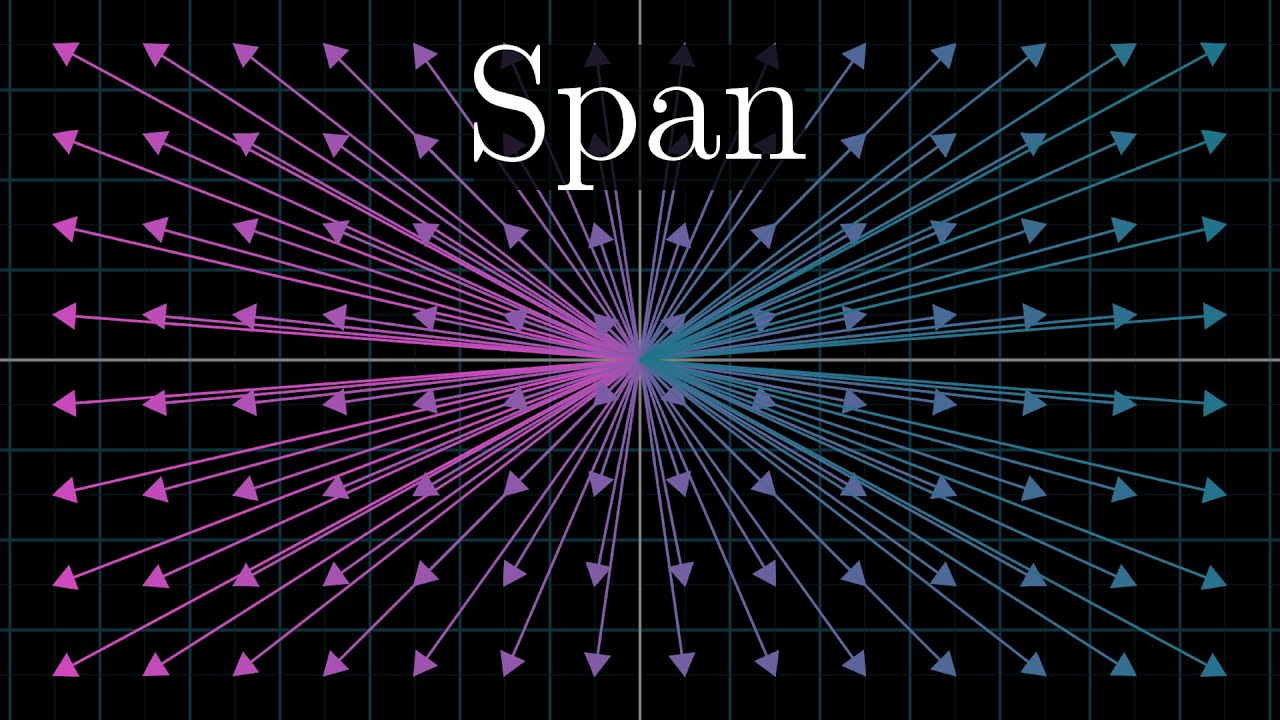
The fundamental concepts of span, linear combinations, linear dependence, and bases.
Help fund future projects: https://www.patreon.com/3blue1brown
An equally valuable form of support is to simply share some of the videos.
Home page: https://www.3blue1brown.com/
Full series: http://3b1b.co/eola
Future series like this are funded by the commun...
 rustic salmon
oh thanks
wintry steppe
np
wet stratus
so if I'm interpreting this correctly i could take the polynomial associated with n=2 and relate it to the polynomial associated with n = anything else by an inner product and it would be orthogonal?
yes. but you have to use the correct inner product. this is not true for some arbitrary inner product, it's just true for the one used to construct these polynomials. or a multiple of that if you don't care if the polynomials have norm 1
grave kettle
wintry steppe
for something like this, just convincing yourself is enough. writing an actual, ...
i’m also concerned about the motivation of defining free/basic variables as those corresponding to non-pivot/pivot columns
like is there some sort of ‘proof’ behind this as well
in fact, it’s this that led to what i was asking
perhaps ‘for a system Ax = b, the i-th column of A is a non-pivot column iff there exists a solution with x_i = r for all r ∈ R’
(x = [x_1 … x_n]^T)
wintry steppe
wet stratus
> so if I'm interpreting this correctly i could take the polynomial associated w...
Gotcha, well at least my rough intution is pointed in the right direction. Thanks @wet stratus !
grave kettle
<@&286206848099549185>
grave kettle

vestal magnet
Hey guys, any help regarding this?
 wintry steppe
is there a nxn matrix where AB=I but BA!=I?
wintry steppe
no
it's a good exercise in basic linear algebra to figure out why
the only technical fact you need is rank-nullity
vestal magnet
vestal magnet
Hey guys, any help regarding this?
Any idea regarding this guy? 🙏🏻
wintry steppe
do you know any way to show that operators have roots? i think there's a long list of equivalent statements in axler you could use
but i dont know what rank nullity is
 fringe fjord
Google it and see if the statement sounds like something you know with different words.
wintry steppe
wintry steppe
but i dont know what rank nullity is
do you know at least that "injective" and "surjective" are the same for square matrices?
i know what injective/surjective functions are.
i asked if you knew this specific fact about them
if you know it, you can prove the thing you asked about
matricies can be injective?
i mean the matrices, thinking of them as linear maps R^n -> R^n (or replace R with whatever field)
wintry steppe
wintry steppe
do you know at least that "injective" and "surjective" are the same for square m...
you prove this fact (appropriately stated) by using the rank-nullity formula. if you're uncomfortable with that, see tropo's message
is there no easy way to prove it?
rank nullity is easy
but let me think
vestal magnet
wintry steppe
do you know any way to show that operators have roots? i think there's a long li...
I need to find another operator with the sqrt of the same eigenvalue?
wintry steppe
maybe a row reduction argument works
AB = I implies A has full rank, so you can do a bunch of row operations to A to get the identity I (why?). that is, there's a matrix E which is a product of elementary row matrices that gives EA = I. now show that AB = I and EA = I imply E = B
and then that proves what you want
vestal magnet
wintry steppe
maybe a row reduction argument works
not speaking to me, right?
wintry steppe
i am not.
wintry steppe
wintry steppe
AB = I implies A has full rank, so you can do a bunch of row operations to A to ...
@wintry steppe is this okay? i'm willing to clarify anything written here
grave kettle
out of curiosity, any necessary/sufficient conditions for matrices A and B to commute?
wintry steppe
wintry steppe
maybe a row reduction argument works
why would AB=I and EA=I imply E=B
wintry steppe
grave kettle
out of curiosity, any necessary/sufficient conditions for matrices A and B to co...
at least for diagonalizable matrices, commuting is equivalent to the matrices sharing a basis of eigenvectors. if your matrices have splitting characteristic polynomials, then you might be able to drop "diagonalizable" and put "generalized" before the word eigenvectors. only thing off the top of my head
wintry steppe
wintry steppe
why would AB=I and EA=I imply E=B
E = EI = E(AB) = (EA)B = IB = B
ah
I see thank you
I guess I will fully understand when I learn ranks and stuff
grave kettle
grave kettle
perhaps ‘for a system Ax = b, the i-th column of A is a non-pivot column iff the...
any idea?
wintry steppe
wintry steppe
I guess I will fully understand when I learn ranks and stuff
rank-nullity is usually how this is proved for linear operators on vector spaces, but it's nice that it wasn't really needed here
it's probably hiding behind the scenes somehow lol

 grave kettle
looks good
just have to show au - v ≠ 0 with u, v being independent
shouldn’t be hard
little crater
True I was just thinking about that
wintry steppe
the classic rubber duck moment
little crater
grave kettle
also, where this problem from
my problem set
umm so either from

or the prof made it up
or found it somewhere

grave kettle
everyone uses that book lmao
grave kettle
little crater
wait, you have the fifth edition pdf?
little crater
just googled [book name].pdf
little crater
grave kettle
is it possible you could share it to me
not originally where I found it but seems someone posted it on github
seems to be complete
wintry steppe
Can someome help me, can someone explain to me how spatial covariance matrix is made for 2D arrays
Like a gridded dataset plotted on world map
 fair wren
let f be an endomorphism from a vector space E of finite dimension such that f^(2) = -id; the second composition of f, assuming f has no real eigenvalues.
prove that the dimension of E is even

is this valid for an answer to this question ?
 slow scroll
fair wren
is this valid for an answer to this question ?
slow scroll
fair wren
is this valid for an answer to this question ?
no, that is not the char poly
fair wren
slow scroll
no, that is not the char poly
i picked for example dimE = 3
slow scroll
cubics always have a real root, so if lambda^3 + 1 is the char poly, then f has a real eigenvalue. Besides, since f^2 + id = 0, lambda^2 + 1 divides the char poly, but lambda^2 + 1 does not divide lambda^3 + 1
fair wren
slow scroll
cubics always have a real root, so if lambda^3 + 1 is the char poly, then f has...
i don't understand
whats the charpoly then
also how does f² + id = 0 relate to the charpoly
slow scroll
its a 2n degree polynomial for some positive integer n
fair wren
what?
slow scroll
fair wren
what?
that's basically what you have to prove. the degree of the char poly is equal to the dimension of E
slow scroll
fair wren
also how does f² + id = 0 relate to the charpoly
do you know about the minimal polynomial?
fair wren
slow scroll
that's basically what you have to prove. the degree of the char poly is equal to...
yes i need to prove that
fair wren
slow scroll
do you know about the minimal polynomial?
no
slow scroll
probably no need to worry about it actually. My reasoning there is slightly wrong
wintry steppe
one way to do this is to show that such an f defines a complex vector space structure on E
i think you can guess how a complex scalar a + bi should act on a vector v in E
fair wren
dont overcomplicate it
wintry steppe
this is not overcomplicating it
wintry steppe
it just means a vector space over C
fair wren
ye still idk
fair wren
on what?
wintry steppe
f^2 = -id
fair wren
how do u even do a determinant on that?
wintry steppe
they're linear operators on finite dimensional vector spaces, so the determinants are defined
defined by picking a matrix representation and proving that determinant is preserved up to similarity, if you like
the specifics don't matter for this problem
all you need to know is that all of the properties of the determinant you know for matrices carry over to operators on finite dimensional vector spaces
fair wren
how do u pick a matrix representing the operator?
also i'd like if u do the charpoly method
wintry steppe
by choosing a basis. you don't need to for this problem
fair wren
much better
fair wren
wintry steppe
by choosing a basis. you don't need to for this problem
we have that in the later question
they asked to prove that for any x in E, (x, f(x)) is stable by f
wintry steppe
that has nothing to do with choosing a basis and taking matrix representations of operators on E
fair wren
wintry steppe
that has nothing to do with choosing a basis and taking matrix representations o...
it does
wintry steppe
it's not like it's the reason you can pick matrix representations of operators
fair wren
since there exists (e_1, .., e_n) such that (e_1, f(e_1), ..., e_n, f(e_n)) forms a basis for E
wintry steppe
that's not what i'm talking about
i'm talking about the fact that if you have a linear map T: V -> W of finite-dimensional vector spaces, and if you choose bases of V and W, then you can represent T by a matrix in terms of these bases
fair wren
idk what u talkin about either tho
wintry steppe
if you take V = W and you take the bases to be the same, then you get a square matrix. you can take the determinant of this, and this is how the determinant of an operator on a finite dimensional vector space is defined
allowing you to take determinants of both sides of f^2 = -id
you must have seen this if you've defined the characteristic polynomial of operators on vector spaces
fair wren
no i haven't seen it
wintry steppe
then how did you define the characteristic polynomial
fair wren
wintry steppe
then how did you define the characteristic polynomial
det(A - lamda I_n)
but when i try to extract the A, the operator is already very explicitly expressed
so i can extract basis and stuff
but here its confusing for me
wintry steppe
so if you want to use the characteristic polynomial of f (which is defined on an abstract vector space E, hence f is not necessarily a matrix), you need to know how the determinant of operators E -> E is defined
and it is defined how i wrote above
the determinant of an operator T: V -> V is defined, in general, by choosing a basis of V and taking the determinant of the corresponding matrix representation of T
you do not need to worry about finding a specific matrix representation. you only need to know that facts such as "det(AB) = det(A)det(B)" and "det (cA) = c^n det A" and "det I = 1" carry over
fair wren
wintry steppe
the determinant of an operator T: V -> V is defined, *in general*, by choosing a...
what basis do we take for E then
wintry steppe
any
but you do not have to. you only need to use the properties of the determinant that i wrote
fair wren
which
wintry steppe
the ones that i wrote
fair wren
wintry steppe
but you do not have to. you only need to use the properties of the determinant t...
on what f² = -id?
fair wren
but f is an operator not a matrix
wintry steppe
i've told you a few times now how to define the determinant of an operator
for all intents and purposes you may pretend that everything is a matrix
fair wren
wintry steppe
for all intents and purposes you may pretend that everything is a matrix
ok
but det(f^2) = det(f(f(v)) != det (f * f)
wintry steppe
f^2 is the composition f o f, and composition corresponds to matrix multiplication
fair wren
wintry steppe
f^2 is the composition f o f, and composition corresponds to matrix multiplicati...
i see
det(f)^2 = - det(id) = -1 hm
wintry steppe
det(-id) is not necessarily -det(id)
you need to be careful with pulling scalars out of the determinant
fair wren
wintry steppe
you do not need to worry about finding a specific matrix representation. you onl...
det(cA)
wintry steppe
equals?
fair wren
= c^n detA?
wintry steppe
c^n det A
fair wren
wintry steppe
the dimension of the vector space
lol
how do we know the dimension when we are already looking for it
fair wren
wintry steppe
the vector space *has* a dimension
ofc
wintry steppe
it's not like we know it, all we know is that it's an integer n that must satisfy det(cA) = c^n det(A)
fair wren
yes
wintry steppe
it is using this property that we can figure out that the dimension is even
back to the problem
fair wren
hm
wintry steppe
so det(f)^2 = det(-id), which equals...?
fair wren
det(f)² = (-1)^n det(id) = (-1)^n
wintry steppe
correct
now why should this imply that n is even?
hint: compare the signs of the two side. what if n is odd?
fair wren
but det(f) can be complex?
wintry steppe
can you post a screenshot of the original problem?
fair wren
wintry steppe
can you post a screenshot of the original problem?
No i don't have the paper on me
i only remember the question
why
fair wren
fair wren
but det(f) can be complex?
the determinants is always a real number?
@wintry steppe r u still here?
fair wren
wintry steppe
what field is E a vector space over?
the field
wintry steppe
which
wintry steppe
is it the real numbers or something else?
fair wren
wintry steppe
is it the real numbers or something else?
i mean since f has no real eigenvalues
then it can't be over the real
wintry steppe
every single version of this problem i've seen very explicitly states that E is a real vector space
and note that an operator f with f^2 = -id can't have real eigenvalues anyways, since if f(v) = cv for a non-zero v, then (c^2 + 1)v = 0, which implies that c^2 + 1 = 0, not true for any real number
so that assumption is redundant
fair wren
yes i did this in the question before
fair wren
wintry steppe
so that assumption is redundant
which?
wintry steppe
"f has no real eigenvalues"
fair wren
yes but can be used ig
wintry steppe
sure
i'm just wondering about the specific statement of the problem as it appeared on your question sheet
fair wren
wintry steppe
i'm just wondering about the specific statement of the problem as it appeared on...
wym?
btw i have a question
wintry steppe
wintry steppe
every single version of this problem i've seen very explicitly states that E is ...
i would like to compare
wintry steppe
would you give me more time to type?
fair wren
ye sure
wintry steppe
the problem is false if you assume E is a complex vector space. take E = C^3 and T: E -> E given by T(x, y, z) = (ix, iy, iz). this satisfies T^2 = -id, but the dimension of E (as a complex vector space) is 3, which is odd. therefore, you need to ask that E is a real vector space.
i had assumed in the solution that i was guiding you through earlier with determinants that E was real. the determinant of an operator on real vector spaces is always real, but the determinant of an operator on a complex vector space may be a complex number (not real)
so now, if you assume E is a real vector space, you have det(f)^2 = (-1)^n, and you can actually talk about the sign of the left-hand side
fair wren
wintry steppe
the problem is false if you assume E is a complex vector space. take E = C^3 and...
dim_C (E) = 3 but also dim_R(E) = 6
wintry steppe
sure, but if you assume E is a complex vector space, it having even real dimension is trivial
there is no problem to solve there
the interesting problem statement (and the one that's more likely to have been assigned to you) is the one that if E is a real vector space with an operator f with f^2 = -id, then E has even dimension
fair wren
ye i see
fair wren
wintry steppe
the *interesting* problem statement (and the one that's more likely to have been...
E being attributed "real" wasn't mentioned
wintry steppe
it should have been
fair wren
wintry steppe
it should have been
 wintry steppe
it should have been
fair wren
yes but u can't deduce that from f having no real eigenvalues?
wintry steppe
did you read anything i wrote above?
fair wren
yes
wintry steppe
i deduced that from the problem being false (or trivial, if you ask for its real dimension) if E is complex
fair wren
wintry steppe
i deduced that from the problem being false (or trivial, if you ask for its real...
no im saying can't u deduce that E is a real vector space from the fact the f has no real eigenvalues?
wintry steppe
from only that fact? no
fair wren
wintry steppe
from only that fact? no
Is there something else?
wintry steppe
what do you mean?
wintry steppe
yes
you must assume this at the start
and once you do this, you can extend the scalar multiplication action of R on E to one of C on E (i.e. giving E a complex vector space structure) by making i act by f. that's how you should think of this problem
so now that we have that E is a real vector space, we know that det(f) is a real number, and det(f)^2 = (-1)^n, where n is the dimension of E. what does this say about n?
this finishes the problme
fair wren
wintry steppe
so now that we have that E is a real vector space, we know that det(f) is a real...
yes i see so n must be even
wintry steppe
exactly
fair wren
wintry steppe
exactly
determinant can be applied to vectors?
wintry steppe
nope
unless you want to call endomorphisms vectors (since they're elements of a vector space)
fair wren
wintry steppe
unless you want to call endomorphisms vectors (since they're elements of a vecto...
assuming dimE = 2n , and there exist vectors (e_1, .., e_n) such that (e_1, f(e_1), ..., e_n, f(e_n)) forms a basis for E, what is the matrix representation of f in that basis
wintry steppe
you tell me
fair wren
we have M(f^2) = M(-id) = (-1 0 .. 0) / ( 0 -1 0 .. 0) / ... / (0 .. -1)
@wintry steppe is this correct tho ^
wintry steppe
well sure, but this is the matrix representation of f^2, not of f
wintry steppe
you should compute M(f) by seeing how f acts on (e_1, f(e_1), ..., e_n, f(e_n))
finding M(f) from a matrix equation sounds a little hard
fair wren
wintry steppe
you should compute M(f) by seeing how f acts on (e_1, f(e_1), ..., e_n, f(e_n))
f((e_1, f(e_1), ..., e_n, f(e_n))) = (f(e_1), -e_1, ..., f(e_n), -e_n)
right?
wintry steppe
maybe i should have said "how f acts on the elements of (...)"
you have computed that correctly
wintry steppe
i don't see how that first fact helps us and i don't see how the second follows
fair wren
wintry steppe
i don't see how that first fact helps us and i don't see how the second follows
first fact : (x, f(x)) stable by f?
wintry steppe
so you have the basis (e_1, f(e_1), ..., e_n, f(e_n)), and you know how f acts on its elements, which tells you what the columns of the matrix representation will be
wintry steppe
fair wren
first fact : (x, f(x)) stable by f?
that is what i meant. it's true, but i don't see how in particular it helps us find the matrix representation
i guess it gives you a hint as to what the representation will be, but you can just write it down
fair wren
wintry steppe
i guess it gives you a hint as to what the representation will be, but you can j...
well M(f) = (1 0 .. 0) / (0 -1 0 .. 0) / .. / (0 .. 1 0) / (0 .. -1)
wintry steppe
that doesn't even make sense, how are the entries of your matrix representation elements of E?
they need to be scalars
fair wren
wintry steppe
that doesn't even make sense, how are the entries of your matrix representation ...
ye i was dazed
check again
wintry steppe
it's not correct
for example the first column should be (0, 1, 0, 0, ..., 0, 0), since f acts on the first element of the basis by sending it to the second
fair wren
wintry steppe
for example the first column should be (0, 1, 0, 0, ..., 0, 0), since f acts on ...
what i don't get it
wintry steppe
then you should review how matrix representations are defined
wintry steppe
what about what i wrote was unclear?
fair wren
wintry steppe
for example the first column should be (0, 1, 0, 0, ..., 0, 0), since f acts on ...
i mean how did u even calculate the first column?
 wintry steppe
i calculated it using the definition of matrix representations
i don't understand what this picture means without further context
fair wren
 wintry steppe
i still don't understand it, sorry
fair wren
yeah i see what u mean
so M(f) = (0 1 0 .. 0) / (-1 0 ... 0) / .. / (0 .. 0 1) / (0 ... -1 0)
right?
wintry steppe
are these the columns? because if so, that's correct
fair wren
wintry steppe
are these the columns? because if so, that's correct
something like this

right?
same structure for other n-tuples
wintry steppe
i don't understand the picture, but what you wrote just before it looked right
wintry steppe
fair wren
so M(f) = (0 1 0 .. 0) / (-1 0 ... 0) / .. / (0 .. 0 1) / (0 ... -1 0)
i just want to make sure this is listing the columns (in which case it is correct)
fair wren
lemme draw it
wintry steppe
you don't need to draw it, i understand what you are writing
 wintry steppe
that is not correct
fair wren
why
wintry steppe
because it's not
wintry steppe
that would be the matrix with respect to the basis (f(e_1), e_1, ..., f(e_n), e_n)
fair wren
@wintry steppe
 wintry steppe
that is correct
fair wren
finally
 wintry steppe
sure
fair wren

for which values a,b,c is A diagonalizable
so det(A - yI_3)
= (1 - y)² (c - y)
= 0 iff y = 1 or y = c
how would i extract the eigenspaces for these eigenvalues
for example y =1
(A-I_3)X = 0
X = (x,y,z) in R^3
i get
(ay +z) / (bz) / ((c-1)z) = 0
this gives a solution (1, 0 , 0) = x_1
is this right @wintry steppe ?
wintry steppe
that is indeed an eigenvector
fair wren
for y= c it gets complicated
wintry steppe
that it does
 pallid rampart
So a matrix is diagonalizable iff it has a full basis of eigenvectors. As you already noticed the eigenvalues are 1 and c. Since we know eigenvectors of different eigenvalues are linearly independent so it makes sense to treat the case of c=1 and c≠1 differently. First if c=1 then to be diagonalizable you'd need 3 independent eigenvectors, meaning the null space of A-I must have 3 basis vectors (and you continue from here). For the case of c≠1, you're already guaranteed an eigenvector with eigenvalue c, so you need 2 eigenvectors with eigenvalue 1, meaning the null space of A-I must have 2 basis vectors and you continue from here
 wintry steppe
maybe use part a
 serene solstice
wintry steppe
maybe use part a
serene solstice
wintry steppe
maybe use part a
Tried to. It didn't work.
 slender patio
serene solstice
Tried to. It didn't work.
slender patio
serene solstice
Tried to. It didn't work.
Try to compute $A(x)^2$ with the formula given in a)
stoic pythonBOT
Twentycents
 serene solstice
slender patio
Try to compute $A(x)^2$ with the formula given in a)
serene solstice
slender patio
Try to compute $A(x)^2$ with the formula given in a)
Okay. Did exactly that, and still scrambling at higher powers of $A$.
stoic pythonBOT
Jonathan Phan
 vestal magnet
Would appreciate any help with this 🙂
 molten pilot
sorry but I have no idea what that means 
maybe if you showcase what you've tried and explain precisely what you don't get people will be more willing to help
wet stratus
well for starters, how did you define the sqrt operator on matrices. can you just check that P satisfies that condition?
vestal magnet
wet stratus
well for starters, how did you define the sqrt operator on matrices. can you ju...
We did that using eigenvalues
like sqrt(eigenvalue)
wet stratus
well sqrt(eigenvalue) would be a number
I assume here you still have a matrix
can you please work with us and give us the complete definitions of what you are working with
vestal magnet
wet stratus
can you please work with us and give us the complete definitions of what you are...
They just gave us an example of how to find S if we know S^2 = T
sorry
and for that we used eigenvalues
 wet stratus
and e_i are eigenvectors of T which span V ?
vestal magnet
e_i are the vectors for the some B orthonormal base, and the eigenvalues are lambda_i
was trying to work with inner product but maybe I did something wrong cuz didn't get the desired result
wet stratus
wait your definition of non-negative included P^*=P right?
so $T^T = (UP)^UP = P^ U^ U P = P^* P = P^2$
stoic pythonBOT
Denascite
 wet stratus
if your course had defined the sqrt to just be a matrix which squares to what we want we would be done
now if $Pe_i = \sqrt{\lambda} e_i$, then clearly $T^*T e_i = P^2 e_i = \lambda e_i$ so if $\sqrt{\lambda}$ is an eigenvalue of $P$, then $\lambda$ is an eigenvalue of $T^*T$. Sadly that doesn't yet show the other direction
stoic pythonBOT
Denascite
 wet stratus
we would be done if we could for example show that P has n eigenvalues
vestal magnet
wet stratus
wait your definition of non-negative included P^*=P right?
yeah
wet stratus
or that there are eigenvectors of P which span V
maybe you have shown something like that in the past in your course?
using your definition of non-negative?
vestal magnet
wet stratus
we would be done if we could for example show that P has n eigenvalues
our full definition was:
1. T=T* and T eigenvalues are real non-negative or
2. There's S which T = S*S or
3. T=T* and for each v in V, <Tv,v> >= 0
can't think of a case we used in the course anything from those
sorry
wintry steppe
May I ask a question
dusky epoch

wintry steppe
Is my understanding of this text from the book correct?

 dusky epoch
yes
wintry steppe
Thank you ^^
 torpid moat
How does one show the following:
Given $T$ is a bounded linear operator, if $\innerproduct{\psi}{T\psi}=1$ for all $\norm{\psi}=1$ then $T=I$.
stoic pythonBOT
thestonethatrolled

 zinc timber
is f linear map?
 steep sandal
Don't know
zinc timber
I'm assuming it's not then
steep sandal
Ok
zinc timber
for simplicity, why don't you look in lR instead of lR^3
can you think of a function f such that |f(x)| = |x|
there are few obvious choices
steep sandal
Can u explain??
zinc timber
explain what?
I'm asking you to think of some function of R to R such that |f(x)| = |x|
which is not linear
zinc timber
(say f is linear then f(x) = cx, so |f(x)| = |x| = |cx| means |c| = 1 or c=+-1)
this is not the example I am interested in
zinc timber

steep sandal
@zinc timber if u have doubt in it I can send u my solution
Do anyone know how to check if two matrices are similar
Plz don't say just the definition ik that but it will be very lengthy
Then
dusky epoch
compute their JNFs and see if they're the same
steep sandal
Bruh
I think we have something to do with eigen values
Got it on Google @dusky epoch
steep sandal
steep sandal
Do anyone know how to check if two matrices are similar
Plz don't say just the ...
Nvm got it
Is there anyone who is free tomorrow or today's night
I really need your help
Bruh I m just a beginner can u explain in simple language
wet stratus
hmm. where is my mistake then. consider f(x) on R such that f(x)=x if 2n+1 <= |x| <= 2n+2 and f(x) = -x if 2n < |x| < 2n+1 each for some n(so essentially we are either flipping or not flipping each interval (n, n+1) depending on which endpoint is even). f is not linear but preserves the absolute value
zinc timber
steep sandal
<@468830761261203476> if u have doubt in it I can send u my solution<:whatcanisa...
f(x) = |x|
it's not linear yet |f(x)| = |x|

winter harbor
Oh shit, yeah 
winter harbor
We have to impose restrictions in order for a norm preserving map in general to be affine
Damn
Ok, what I said before was pretty dumb 
But works for inner product preserving maps tho.
zinc timber
ye so affine map with the condition f(0) = 0
steep sandal
I assumed f=Ax to be true and got A to be orthogonal
zinc timber
steep sandal
everything is included except f linear
steep sandal
But don't know how to show first part
steep sandal
steep sandal
I really need your help
Anyone??
zinc timber
dusky epoch
compute their JNFs and see if they're the same <:opencry:586078614865444865>
^^
steep sandal
zinc timber
^^
🤣
torpid moat
torpid moat
How does one show the following:
Given $T$ is a bounded linear operator, if $\in...
👀
steep sandal
Where are you guys from??
zinc timber
Here's a sexy proof $\ip{x, \phi x} = 1 = \ip{x, x} \implies \ip{x, x-\phi(x)} = 0$ for all $|x|=1$
@torpid moat
stoic pythonBOT
 zinc timber
try to show <x, x- \phi(x)> = 0 for all x
wet stratus
well that part is easy. but how do you show from that that this implies x=phi x
wet stratus
btw is there a list of commands we can use in this server? like the \ip ?
well but y depends on x
zinc timber
^ || just take x=y, then <y, y> = |y|^2=0 so y=0 ||
zinc timber
wet stratus
well but y depends on x
true
wet stratus
and it's only true for all x with norm 1
zinc timber
wet stratus
and it's only true for all x with norm 1
not a problem since you can always do x/|x|
gimme a minute
$\ip{Tx-x, Tx-x} = \ip{Tx, Tx} - 1 = \ip{Tx, Tx} - \ip{Tx, x} = \ip{Tx, Tx-x}$
stoic pythonBOT
 zinc timber
ip is a custom command
tribal willow
oh
zinc timber
you can use $\innerproduct{a}{b}$
stoic pythonBOT
 zinc timber
@torpid moat is our space real or complex?
it it's complex then <x, Tx-x> = 0 means Tx-x == 0 or Tx=x
don't think it's true for reals, T(x, y) = (x-y, x+y) then T(x, y) *(x, y) = x^2+y^2 = 1
 cunning violet
dunno what kind of linear algebra calculation that is
wet stratus
that's not how you subtract two matrices
cunning violet
oh i think i got it lol , its matrix a - matrix b
yeee 😄
15min thinking got me nowhere, once i post it i see the mistake lol
 zinc timber
start with {} and keep adding vectors to it
until you hit a point where you can't include any more linearly indep vectors to it
steep sandal
Can u send a picture??
zinc timber
no
fringe fjord
You'll need to prove that the list stays linearly independent all the way and that you cannot continue adding vectors forever.
For the latter part, perhaps you already have a proof that a set of n+1 vectors in R^n is automatically linearly dependent.
 quaint mango
I need some help with finding a solution to the matrix equation AX = B - 2X. I know how to do normal ones like AX = B, but when they throw more than 2X in I kinda get confused
fringe fjord
First add 2X to both sides.
Then on the left you'll have AX+2X which is the same as AX+2IX which is the same as (A+2I)X.
wintry steppe
Deadlines in 2 hours, just gimme the answers.. I'm exhausted from working whole day

 fringe fjord
And now the equation has the form you know, just with a slightly different matrix.
Deadlines in 2 hours, just gimme the answers..
We're not going to help you cheat.
quaint mango
fringe fjord
Then on the left you'll have AX+2X which is the same as AX+2IX which is the same...
I'm gonna process that one a bit. I understand kinda what you mean but I'm gonna write it down on paper quickly
fringe fjord
(You didn't see my sign error!)
wintry steppe
Broski then explain it idc tbh 🤕
zinc timber
wintry steppe
Deadlines in 2 hours, just gimme the answers.. I'm exhausted from working whole ...
7
quaint mango
just quickly so I understand. AX + 2X = B - 2X
quaint mango
and that can be written to (A+2I)X = B
fringe fjord
Yes.
quaint mango
thanks for your help. Might be back in a few minutes haha, but gonna give it a try now
quaint mango
am I supposed to first calculate the matrix (A + 2I) and call it matrix d, am I supposed to get the inverse of this then and move it so X = (D^-1)B?
fringe fjord
Yeah, that is one way that will work.
 quasi delta
I got a question. I was looking over Determinants, and was wondering what they are. They give area of a parallelepiped figure, show if a matrix is invertible, and is the product of the eigenvalues, but i don't understand the idea of a determinant anyone got some input?
quaint mango
so first calculate 2 * identity matrice, then just add matrix A I guess?
torpid moat
zinc timber
$\ip{Tx-x, Tx-x} = \ip{Tx, Tx} - 1 = \ip{Tx, Tx} - \ip{Tx, x} = \ip{Tx, Tx-x}$
how did you go from here to <x,x-Tx>?
torpid moat
zinc timber
it it's complex then <x, Tx-x> = 0 means Tx-x == 0 or Tx=x
yeah, it's complex
fringe fjord
quasi delta
I got a question. I was looking over Determinants, and was wondering what they a...
The determinant function has a lot of nice properties that can look quite different, and it's the combination of having all of them at once that makes it particularly useful. Until you've gotten a fair number of them internalized, it might be better just to think of it as "that one weird function that somehow does all the amazing things" than to try to stick to a single more concrete intuition for what it does.
quasi delta
fringe fjord
The determinant function has a lot of nice properties that can look quite differ...
well, i got through my linear algebra class, and now im trying to remember and understand that black box
fringe fjord
Then my best advice is to think of the determinant as the thing that has all those properties.
tribal willow
whats the significance of parentheses around i in the superscript
 wintry steppe
it means you should treat it as an index instead of as an actual matrix power
(this isn't standard notation for "thing in brackets in superscript" it's just what it means here)
tribal willow
ty
wintry steppe
is it true that $\langle x+y, x+y\rangle = \langle x, x\rangle + \langle x, y\rangle + \langle y, x\rangle + \langle y, y\rangle$? why?
stoic pythonBOT
mate

 proud island
Hey guys I need help in vectors
here is my question
A small plane, A, flies at an azimuth of 283 at 200km/h: Another, B, flies at an azimuth of 071 at 140km/h. Determine the direction and magnitude of the vector speed of A relative to B.
winter harbor
wintry steppe
is it true that $\langle x+y, x+y\rangle = \langle x, x\rangle + \langle x, y\r...
It is, it follows from the bilinearity of <•,•>.
wintry steppe
winter harbor
It is, it follows from the bilinearity of <•,•>.
do you assume x and y are real numbers?
winter harbor
Uhhh, <•,•> is a bilinear form on a vector space V, right? So I am implicitly assuming x and y have to be vectors in V.
wintry steppe
winter harbor
Uhhh, <•,•> is a bilinear form on a vector space V, right? So I am implicitly as...
okay thank you. i believed only left-linearity holds.
 ocean galleon
With A = LU factorization, what is the relationship between L and U? The lower triangular and upper triangular
Like is one of them the inverse of the other, transposed?
little crater
can someone explain to me how what I did even shows that T is a linear transformation? I mean I found the mapping

shouldn't I need to check T(0) also?
I feel like I would have to use the definition of a linear transformation but I know this problem doesn't require that
also I notice the they just list entries so would it be wrong to say they are vectors?
like to say T(x) = T(x1, x2)
that wouldn't be correct, would it?
i guess my question is are n tuples and vectors interchangable?
I feel like
(x1, x2) != [x1 x2] but idk
wintry steppe
any function R^n -> R^m given by matrix multiplication is linear
there's no point checking that T(0) = 0, that follows from the definition of "linear transformation"
little crater
wintry steppe
there's no point checking that T(0) = 0, that *follows* from the definition of "...
sure but we don't know it is one
little crater
so I would assume I should check T(0)?
wintry steppe
no
"T(0) = 0" is not part of the (standard) definition of a linear transformation
you do not need to check it
little crater
I suppose but what would I say if they had a constant in the T(x1,x2) = (..., ..., 1, ...)
wintry steppe
then it wouldn't be linear
little crater
yeah
wintry steppe
because all linear maps satisfy T(0) = 0 (as a corollary of the definition of "linear map") and that map does not
little crater
idk this question just seemed very "algorithmic" like I understand that the matrix itself would be linear transformation but whatever. But regarding the notation are the T(x1,x2) is that okay to just say T(x)?
like how they are just written as tuples
wintry steppe
you can pretend tuples and column vectors are the same if it bothers you
many authors do
little crater
yeah i just didn't know because my other question seemed to wish between it
wintry steppe
it's just easier to write tuples in-line rather than make the formatting ugly and write big ass column vectors each time
little crater

okay nvm
I checked back in the book

seem that is exactly what it means but just didn't know if such rules apply in general regarding tuples/points and vectors
fair wren
how do i determine which columns -vectors- is linearly dependent?

i've done the reduce row method
on the rank of A

is this already reduced or do i need to go further?
i found that rank(A) = 2 already but idk which column i had in A -before being reduced- was linearly dependent.
 hollow finch
fair wren
how do i determine which columns -vectors- is linearly dependent?
hollow finch
fair wren
how do i determine which columns -vectors- is linearly dependent?
the pivot columns give you the ones that are linearly independent. so since your rref matrix has pivots in the first and second column, then the first and second column of your original matrix forms a basis for the column space.
nonpivot columns are linearly dependent with the pivot columns. the third column of your rref matrix tells you that col3=-2col1-2col2 so its linearly dependent
fair wren
hollow finch
the pivot columns give you the ones that are linearly independent. so since your...
can you tell me what are the pivot/nonpivot columns in myexample?
hollow finch
like i said, columns 1 and 2 are pivot columns
a pivot column is a column with a pivot in the rref form. and if it doesnt have a pivot when in rref then it's not a pivot column
id probably google "pivot column" if you're not sure what it is


