#linear-algebra
2 messages · Page 291 of 1
 native rampart
Yea,but there will be exactly one term which will be nonzero
 novel needle
so the only term is eijkeijk where ijk are not the same
yeah i fully understand now, thanks :))
 primal fable
nvm
my dumbass forgot trace you add, not multiply 
 wintry steppe
 native rampart
- No
wintry steppe
So a Vector Space is an algebraic structure of n-dimensional vectors over a Finite Field F with a set of operations, satisfying certain properties?
native rampart
You are assuming
1)the dimension is finite
2) the field is finite
wintry steppe
So no. 1 should be true?
native rampart
(Z/2Z) is a vector space over (Z/2Z)
 nocturne jewel
wintry steppe
nocturne jewel
wintry steppe
any R-vector space with dim(V)=n will be isomorphic to R^n

 quartz compass
 frank hedge
do we have to get parametric equations somehow ?
frank hedge
do we have to get parametric equations somehow ?
nope not necessary
first, what is the equation of the xy plane?
 fiery pike
Determine the image of the point P(1, 3, 2) under the orthogonal reflection with respect to the plane
with equation x+ y+ 2z = 3 via the matrix formalism and afterwards check your result geometrically.
wintry steppe
Is this proof okay?

 coral temple
Hello, I'm trying to prove that if $u, v$ are vectors in $\mathbb{R}^n$, so that $\left<u,v\right>>0$, then there is a symmetric positive definite matrix $A$ so that $Au=v$. Any hints on how to do this?


 zinc timber
@coral temple think about a LT s.t. Au=v similar to projection
coral temple
Okay, you can do a composition of a dilation and an orthogonal projection, so that Au=v. But the resulting matrix is only positive semi-definite. Is there a way to make it positive definite?
zinc timber
yea actually
as a hint say you have a diagonal [1 1 0 0 0]
you can add ϵ [ 0 0 1 1 1] to make it pd
starting with $A=\frac{vv^T}{v^Tu}$
 stoic pythonBOT

 exotic vector
$A = span{(1,1,1)}$ what is $A^{\circ}$ (the orthogonal of $A$).
stoic pythonBOT
Salah
 zinc timber
note that eigen values are ||v||²/⟨u,v⟩ and 0 with multiplicity n-1
so it's diagonalizable
exotic vector
sorry guys if i disturb
zinc timber
now pick orthonormal basis and add the P\eps P^-1 thing and that might work
@exotic vector there's an easier way and there's a hard one
 mystic dagger
a canonical basis is an orthonormal basis for any given dot product?
zinc timber
I prefer the easy one
zinc timber
mystic dagger
a canonical basis is an orthonormal basis for any given dot product?
by canonical basis, I only know e_i's
exotic vector
yep show me
zinc timber
but sure you can always find one given any inner product
zinc timber
exotic vector
yep show me
like since you are in lR³, A\perp has dim 2
so you can pick any 2 LI vector which is orthogonal to (1,1,1)
and then conclude A\perp is the span of those 2
@exotic vector
exotic vector
LI?
zinc timber
Linear Independent
mystic dagger
zinc timber
by canonical basis, I only know e_i's
for this inner product
and the basis is the canonical basis from vector space of the the 2x2 matrices
 exotic vector
ok but the issue we just cover what the perpondicular is and we don't know yet its dim
mystic dagger
i mean, no matter how you define the inner product, it's always orthonormal if it's the canonical basis of that vector space, right?
exotic vector
I think we gotta do it the hard way
zinc timber

zinc timber
mystic dagger
i mean, no matter how you define the inner product, it's always orthonormal if i...
i don't think that's what canonical means
or it could be
idk

count me out
it depends on what you want 'canonical' to mean
exotic vector
the canonical basis of $\bR^2$ is ${(1,0),(0,1)}$
stoic pythonBOT
Salah
 exotic vector
you can say it's the obvious basis
zinc timber
@coral temple does that work?
coral temple
I didnt fully understand the construction
mystic dagger
zinc timber
i don't think that's what canonical means
${ \begin{pmatrix}
1 & 0 \
0 & 0 \
\end{pmatrix}, \begin{pmatrix}
0 & 1 \
0 & 0 \
\end{pmatrix}, \begin{pmatrix}
0 & 0 \
1 & 0 \
\end{pmatrix}, \begin{pmatrix}
0 & 0 \
0 & 1 \
\end{pmatrix} }$
stoic pythonBOT
leonardomoura
 mystic dagger
this is the canonical basis for the vector space of the 2x2 matrices
idk the proper definition, i just see as the simplest basis
for the usual inner product, it's orthonormal
but i wanna make sure it's orthonormal for any given inner product
zinc timber
we start with $A=\frac{vv^T}{v^Tu}$
stoic pythonBOT
 coral temple
Ok
zinc timber
since Au=v
but it's not +ve definite
since it's eigen values are ||v||²/⟨u,v⟩ and 0 (n-1 multiplicity)
is this clear?
zinc timber
ok so can you see why A is diagonalizable
coral temple
Yeah
zinc timber
yeah not 1
coral temple
Something
zinc timber
mb
replace it with 1
anywau
take E= diag[0, 1,1..1]
then B=P ΛP' + PEP' then we get B= A+PEP'
it's+ve def as all eigen values are 1
ok let's add 2 and not 1
does it work?
or anything
zinc timber
P is orthonormal
coral temple
Oh ok
 exotic vector
@zinc timber dude do you have any resource to learn duality and bilinear and quadratic forms?
zinc timber
ok there's a problem with my sol, it not longer has Bu=v @coral temple
because it doesn't guarantee u to be a eigen vector
coral temple
Right right
zinc timber
for that I think we can choose P to be an orthonormal basis with first entry u
gram schmidt

zinc timber
yes we are not taking the same P anymore
just making sure that our modification does not mess up Au
for that we are choosing an orthonormal basis starting with u
zinc timber
exotic vector
<@!468830761261203476> dude do you have any resource to learn duality and biline...
textbooks are good enough, like LADR kr LADW
coral temple
Wait so how is the matrix defined this time?
zinc timber
it's not explicit this time ig
exotic vector
send me the amazon link please
coral temple
Well how is it defined anyway? Explicit or not, I don't fully understand
zinc timber
exotic vector
send me the amazon link please
just google
 spare widget
exotic vector
send me the amazon link please
spare widget
exotic vector
send me the amazon link please
Linear algebra done right/wrong
zinc timber
no like say b=[u, e1 e2 .. en-1] s.t. it's a basis
exotic vector
ah yeah i have it thank you
zinc timber
then we use gram schmidt/ QR
then choose the Q to be our P in the previous calc
i.e. u and some basis of u\perp
coral temple
What? What's QR?
coral temple
Hmmm
zinc timber
it's much more convoluted this time
there should be a simple one
A + (I-uu'/u'u)
how about this one?
coral temple
It's still symmetric so that's nice
zinc timber
ye just removed the whole basis part
coral temple
It should work I think
zinc timber
feels like so
coral temple
Yeah it works, because the extra factor is pd except for span u, and there the matrix A is pd
zinc timber
yes
mystic dagger
it's asking for the eigenvectors of that matrix, i don't know how to solve it by hand without taking hours on this question, any ideas?

 lavish jewel
it's not asking for the eigenvectors
it's asking you which of the given vectors are eigenvectors
the latter is a lot easier to check: just plug them into the definition
sadly, if there is no evident pattern, it does mean you need to do 5 matrix-vector multiplications
 tough oxide
If two subspace are complementary they are necessarily a direct sum ?
 gray dust
tough oxide
If two subspace are complementary they are necessarily a direct sum ?
gray dust
tough oxide
If two subspace are complementary they are necessarily a direct sum ?
this is in fact the definition of complement
mystic dagger
lavish jewel
the latter is a lot easier to check: just plug them into the definition
but i would need their eigenvalues right? so anyway i would have to find the characteristic polynomial?
lavish jewel
you don't
you only need to test the definition
it doesn't matter what the eigenvalue is
mystic dagger
but the definition of eigenvectors doesn't depend on eigenvalues?
mystic dagger
oh
lavish jewel
if x is only scaled by A, then it is an eigenvector
mystic dagger
A is the matrix i have
 meager harness
 meager harness
idk how to do the whole thing
😂
for a) i was thinking of just doing a matrix like with f(a1) down
wintry steppe
you can also use the help channels if ya want

 blissful vault
meager harness
blissful vault
meager harness
Looks good to me. You encoded T with respect to your two chosen basis lists.
meager harness
blissful vault
Looks good to me. You encoded T with respect to your two chosen basis lists.
do u know how to do part b
 mossy coral
meager harness
do u know how to do part b
mossy coral
meager harness
do u know how to do part b
do you know how to find the image?
mossy coral
yep
meager harness
how do i get the column space tho
mossy coral
set your matrix to 0(so add a 0 column), row reduce. The rows that has a pivot are the column space
meager harness
but like the matrix has up to degree n so i feel like row reducing it
is gonna be nasty
mossy coral
sorry I am new to linear alg as well so im not quite sure. But i feel like there is an abstract way to do this
like you can reason it without actually row reduce
 grim leaf
"if we have three vectors in R3, and we made a matrix where each row was one vector, if that matrix can be row-reduced to an identity matrix, then the three vectors form a basis for R3"
is that right?
stoic pythonBOT
totally not anamono
 blissful vault
meager harness
do u know how to do part b
blissful vault
meager harness
do u know how to do part b
My initial thought is to show that M(T) (your encoding) is invertible, since that would show that M(T) is surjective. M(T) is invertible follows if its determinant is non-zero.
meager harness
blissful vault
My initial thought is to show that M(T) (your encoding) is invertible, since tha...
wouldnt the determinant be 0 if any a1 = ...an
native rampart
meager harness
Just show this is invertible
 halcyon spindle
grim leaf
"if we have three vectors in R3, and we made a matrix where each row was one vec...
halcyon spindle
grim leaf
"if we have three vectors in R3, and we made a matrix where each row was one vec...
Hmm, shouldn’t the column of the matrix be those vectors? If it is then your statement is right.
native rampart
In linear algebra, a Vandermonde matrix, named after Alexandre-Théophile Vandermonde, is a matrix with the terms of a geometric progression in each row, i.e., an m × n matrix
    V
    =


        [


              1
...
This whole exercise is basically proving the vandermonde matrix
smh
native rampart
meager harness
do u know how to do part b
nvm it's Lagrange interpolation
You can always find a polynomial f such that f(x_i)=a_i for i in {0,1,2...n-1}
a_i should all be distinct for this to work
grim leaf
halcyon spindle
Hmm, shouldn’t the column of the matrix be those vectors? If it is then your sta...
this solution I found online seems to use the vectors as the rows


here is thm 12
 native rampart
grim leaf
"if we have three vectors in R3, and we made a matrix where each row was one vec...
native rampart
grim leaf
"if we have three vectors in R3, and we made a matrix where each row was one vec...
Yea that's equivalent to saying "You can get (1,0,0) ,(0,1,0),(0,0,1)" from your row vectors with just linear combinations
Since every elementary operation is just some linear combination of row vectors
native rampart
Yea
grim leaf
dope
 lime zinc
any hint ?
 wintry steppe
lime zinc
any hint ?
wintry steppe
lime zinc
any hint ?
Suppose A_n is a sequence that converges to A. You have to prove that A_n^T A_n converges to A^TA
lavish jewel
here, multivar calc and computational math should all be ok
 rotund verge
okie
Aling Amy is a reseller of black t-shirts, and is lucky to have found a supplier who
offers her wholesale quantity discounts. Everytime Aling Amy purchases 1-100 shirts
in a transaction, she pays Php 20 per shirt. If she purchases 101-200 shirts in a
transaction, she pays Php 18 per shirt. If she purchases 201 shirts or more, she pays
Php 17 per shirt. Aling Amy can only purchase a maximum of 300 sh
does this problem violate certainty assumption of linear programming?
 dusky epoch
what is the certainty assumption, in your own words?
rotund verge
all the coeffcients of the decision variables, constrabts and the rhs are constants and known?
and that it will not chanhe
dusky epoch
okay great
and are there any coefficients here that have some uncertainty or error bars attacked to them?
rotund verge
idk yet how to constract the variables tho
 mellow island
hello can i seek help for my basic geometry activity here?
 subtle walrus
probably try #geometry-and-trigonometry or a help channel
wintry steppe
wintry steppe
Is this proof okay?
Pls check anyone
 icy totem
hellp
 icy totem
all of them , I'll compare own solutions
dusky epoch
what do you mean?
you already have written up solutions to these problems and want to know whether or not they are correct?
and to do that you're trying to make someone else do the same problems for you?
icy totem
I just learned about the subject. I'm solving questions, but I want to be sure if I'm solving correctly. Unfortunately I don't have the solutions or answers.
icy totem
icy totem
hellp
6,7,8,9,10 questions priority
 tranquil steeple
Ask your teacher.
Since you have solved them, hand them in and get the grade you deserve.
icy totem
icy totem
6,7,8,9,10 questions priority
I couldn't solve them
spare widget
icy totem
I couldn't solve them
try checking the definition for symmetric matrix for 6
for 7 try using (A+B)^2 = A+B and the fact that A^2 = A, B^2 = B (expand (A+B)^2, careful with the non-commutativity of matrix products)
for 8) a)try proving that I = (I-A)^{-1}(I-A) = (I+A+A^2)(I-A) and I = (I-A)(I+A+A^2)
8b) is clear
and you can try to guess what the form of 8c) is
- compute the determinant of the matrix, a matrix is regular when the determinant is non-zero
- use A * A^{-1} = I to figure out the inverse, it is regular when det !=0, try to figure out what the determinant is of a diagonal matrix
 stark quiver
how to construct linear map T given subspace S, such that kernel of T is equal to S?
subtle walrus
what have you tried?
stark quiver
creating a matrix that will map basis of S to zero
spare widget
If A is a representation of T and B is a basis for S, then AB = 0.
What I would have done is solve B^Tv1 = 0 looking for any v1!=0 that solves the potentially underdetermined system. Then add v1 as a last row to B^T forming B1^T. Then solve B1^Tv2 = 0 requiring v2!=0, etc. Once the null space of Bk^T becomes {0} you are done.
This should produce vectors that are orthogonal to the column vectors of B and that are orthogonal with each other.
 neon lake
The exercise asks to discuss the system depending on the value of lambda, but I can't seem to get it right doing echelon form. Also, the solutions are done employing the determinant method instead of the one I mentioned
 lavish jewel
i'm under the impression you could reach the result either way
neon lake
The critical values according to solutions are -1 and -3/4
When I reduce the original matrix/system I get this, from which I don't know how to extract these critical values
 lavish jewel
it's asking for which lambda the system has some number of solutions, right?
lavish jewel
what is it asking you for, exactly? which lambda make the system have unique sol?
neon lake
By discuss, it means that depending on what value lambda takes, then if the system has one unique solution, either infinite solutions (with 1 or 2 degrees of freedom) or it is impossible.
lavish jewel
all right
 hexed urchin

in this problem I set up the general polynomial a + bx +cx^2 +dx^3 and put it into the matrix and substituted 1+c,2+c or 3+c for x depending on where it was in the matrix. I then simplified it expected to get the matrix [p(1), p(2), p(3)] + [c,c,c] where I could then move on to scalar multiplication to see if it is a linear transformation. Did I do something wrong?
my figure did not simplify to anything workable when I did that
mossy coral
Is there a calculator where I can plug in a transformation and a input and output basis, and it will give me a matrix?
 gentle pumice
do your lecturer not give examples of how to do these kind of stuff?
you can find alot of examples from youtube.
 stoic pythonBOT
totally not anamono

 slow scroll
grim leaf
just want to check my understanding
slow scroll
grim leaf
just want to check my understanding
This could be kind of confusing.
Lets say your basis $B$ is $v_1, v_2$. Then in general,
$$[\alpha]_B = [v_1 ; v_2]^{-1} \alpha$$
where $[v_1 ; v_2]$ is the matrix whose columns are the vectors in your basis. Here we have,
$$\begin{bmatrix} \cos \theta & \sin \theta \ -\sin \theta & \cos \theta \end{bmatrix} =\begin{bmatrix} \cos \theta & -\sin \theta \ \sin \theta & \cos \theta \end{bmatrix}^{-1} = [v_1 ; v_2]^{-1}$$
stoic pythonBOT
kxrider
 grim leaf
i see
i think
ah yeah ok
so what is the significance of multiplying the inverse of the basis and the vector?
 knotty saffron

i dont understand why simply putting pi/2 into the function proves linear independency.
 soft burrow
there's a theorem that says if the Wronskian of two functions is nonzero on an open set, then the functions are linearly independent on that open set
you can take them to be nonzero except at isolated points, which is what happens in this case
the Wronskian vanishes exactly at points k\pi for k in Z, but these are isolated points so sin(x) and sin(2x) are linearly independent as differentiable functions on R
soft burrow
knotty saffron
i dont understand why simply putting pi/2 into the function proves linear indepe...
so this doesn't really suffice, you have to check the Wronskian at each point in the domain
lavish jewel
if the columns were lin dep, the determinant would be 0 for all values of x
choosing a few values of x cleverly lets you check that this is in general not true
slow scroll
grim leaf
so what is the significance of multiplying the inverse of the basis and the vect...
the idea is that v1 and v2 are written in terms of some ambient basis. v1 in its own basis is (1,0) and v2 in its own basis is (0,1). Therefore the change of basis matrix to go from B to the ambient (e.g. standard) basis is
[v1 v2] since v1 v2 = v1 and v1 v2 = v2. Thus, to go the other direction, we take the inverse of [v1 v2]
grim leaf
i see, thank you
slow scroll
npnp
grim leaf
is there a formal name for the expression $[\alpha]_B$?
stoic pythonBOT
totally not anamono
 grim leaf
this is all i have in my notes
 slow scroll
"alpha in the basis of B"
grim leaf
gotcha
grim leaf
kk ty guys
knotty saffron
soft burrow
so this doesn't really suffice, you have to check the Wronskian at each point in...
thanks I understand now 🙂 Is the picture I uploaded wrong ? shouldnt it be W(sinx,sin2x) = the rest?
soft burrow
knotty saffron
thanks I understand now 🙂 Is the picture I uploaded wrong ? shouldnt it be W(si...
you're right
knotty saffron
soft burrow
so this doesn't really suffice, you have to check the Wronskian at each point in...
I feel like I want to evaluate at pi/2 and 0 - would that be correct?
 dusky wadi
could you say $\det M = \lVert\bigwedge\limits_{v \in\mcl{C}(M)} v\rVert$ where $\mcl{C}(M)$ is the column space of M
stoic pythonBOT
all functions are alison
 soft burrow
knotty saffron
I feel like I want to evaluate at pi/2 and 0 - would that be correct?
soft burrow
knotty saffron
I feel like I want to evaluate at pi/2 and 0 - would that be correct?
evaluating at two points isn't enough - you want to check that sin(x) and sin(2x) are linearly independent on their domain (R)
so you have to check that W(sin(x), sin(2x)) is nonzero for all x in R, except possibly at isolated points
x=k*pi, for k in Z are isolated points
grim leaf
in solving part b, where did the b3 = 2b1 go?


also i dont understand this step-by-step progression 

actually i think i get the last three statements
just dont know what happened to b_3=2b_1
mossy coral
gentle pumice
do your lecturer not give examples of how to do these kind of stuff?
Late response, but I know how to do it. Just want a fast way to double check my work
gentle pumice
ahhh
it's okay
typically you can calculator at then end of what you want to find it.
native rampart
grim leaf
in solving part b, where did the b3 = 2b1 go?
You just eliminate b3 and replace with b1
grim leaf
native rampart
You just eliminate b3 and replace with b1
then where does 2b1 go?
native rampart
All vectors will be of the form
x(1,0,2,0)+y(0,1,0,0)+z(0,0,0,1)
If you substitute and compare ,you get x=b1,y=b2 and z=b4
So it's b1p1+b2p2+b4p3
grim leaf
i see
 pseudo cairn
 wintry steppe
What does the C stand for here?
 pseudo cairn
Can someone help me with this question ? I will send my working now
Frankn is this channel taken ? I’m not sure how the subject specific channels work
wintry steppe
Does c have some predefined value which I'm not aware of? Because as I currently understand the problem, it has not been assigned any value.
wintry steppe
pseudo cairn
Frankn is this channel taken ? I’m not sure how the subject specific channels wo...
occupied/unoccupied does not apply to subject channels.
issa freeforall
pseudo cairn
Got it, are we allowed to post linear alg questions on the help chats too ?
wintry steppe
Yes
pseudo cairn
Thanks


I just needed to know whether I am doing the right thing here. I think I’m doing what my lecturer suggested but I’m finding it counterintuitive
Please ping me if u can help
zinc timber
not linear algebra tho
zinc timber
wintry steppe
What does the C stand for here?
anchor points
nah I'm not sure anymore, ignore
 weak root
hey guys can yall help me out????
A sprinkler system is used to water two areas. If the total water flow is 920 L/h, and the flow
through one sprinkler is 85 % as much as the other, what is the flow of each?
lavish jewel
weak root
A sprinkler system is used to water two areas. If the total water flow is 920 L/...
try a help channel or #prealg-and-algebra
wintry steppe
Is any Vector space subspace of itself?
 teal grotto
yes, similar to how any set is a subset of itself
wintry steppe
Thank you 👍
 kindred hinge
Is this the channel to make r the subject
lavish jewel
hmm?
spare widget
that would probably be #computing-software
if you mean R as in the R project for statistical computing
 normal void
This is not adequate proof, right?


 normal void
This is the original function that we have to show is linear
 spare widget
normal void
This is not adequate proof, right?
spare widget
normal void
This is not adequate proof, right?
why not
You should do alpha * B + beta * C for linearity though
Theh take out alpha out front, and beta out front
Remember the definition of linearity
L(x+y) = L(x) + L(y), L(alpha x) = alpha L(x)
Or more concisely L(alpha x + beta y) = alpha L(x) + beta L(y)
In fact if you vectorize w_{ij} and O_{ij} you can write the kernel application as p = W o
o = vec(O), p =vec(P)
And W a suitable matrix with coefficients made up of the w
You can always flatten a 2d arrays into a 1d one using [i][j] -> [i *m + j] (here I assume i in [0,m-1], j in [0,n-1])
It's clear that matrix-vector multiplication is linear
dusky epoch
stoic python
**FantaSkink**
\times, not X
 chrome radish
how can I do this?
 spare widget
find x such that A x = (0 0 6)^T
chrome radish
you can't do RREF?
spare widget
idk what rrefis
chrome radish
row echelon form
spare widget
You can
chrome radish
to show that it only has one solution?
spare widget
you're supposed to solve the augmented system not show that it has only one solution
Find x such that Ax = b
chrome radish
spare widget
you're supposed to solve the augmented system not show that it has only one solu...
yeah, but if you reduced it to row echelon form and showed that the last column consists of only zeros. Then <0, 0, 6> are in R(T), but if the last column has a 1 at the end then it's a contradiction, because 0 isn't equal to 1, right?
@spare widget I solved the following systems of equations: $\begin{cases} 4x+y-2z-3w=0 \ 2x+y+z-4w=0 \ 6-9z+9w=6 \end{cases}$
stoic pythonBOT
John doe
 chrome radish
and got x = w, y = w and z = w
 frigid kettle
Would someone mind suggesting a beginner level Linear Algebra course I felt hard to solve problems on Computer Vision and Image Processing course of mathematical and physical underpinnings..
 lavish tusk
The LCM of two numbers is 15 times of HCF. The sum of HCF and LCM is 480. If both number are smaller than LCM. Find both the numbers.
can anyone help me with this problem
dusky epoch
phi isn't even a linear map 
wintry steppe
dusky epoch
phi isn't even a linear map <:sully:651816820122189834>
?
lavish jewel
the +2 and +1 terms make the transformation affine
 grave kettle
how is the current definition of linearity motivated
spare widget
Study some simple linear spaces, e.g. line passing through the origin, plane passing through the origin
Notably if you take two vectors from those, then linear combinations of those stay within the space
grave kettle
spare widget
Notably if you take two vectors from those, then linear combinations of those st...
rephrased my q
spare widget
By generalizing what I just mentioned
You take the same property and try to see how it works with other spaces than R^n
Then you come to the conclusion that finite dimensional real vector spaces are isomorphic to R^n
and note that the theorems that you have can thus be generalized
It's a standard approach to take properties of something known and look for conditions such that some of those properties hold elsewhere
It took some time to get from Descartes to modern linear algebra, if you'reinterested in how the concept evolved I would suggest reading history of mathenatics
spare widget
Maybe this will help you: https://youtu.be/kYB8IZa5AuE
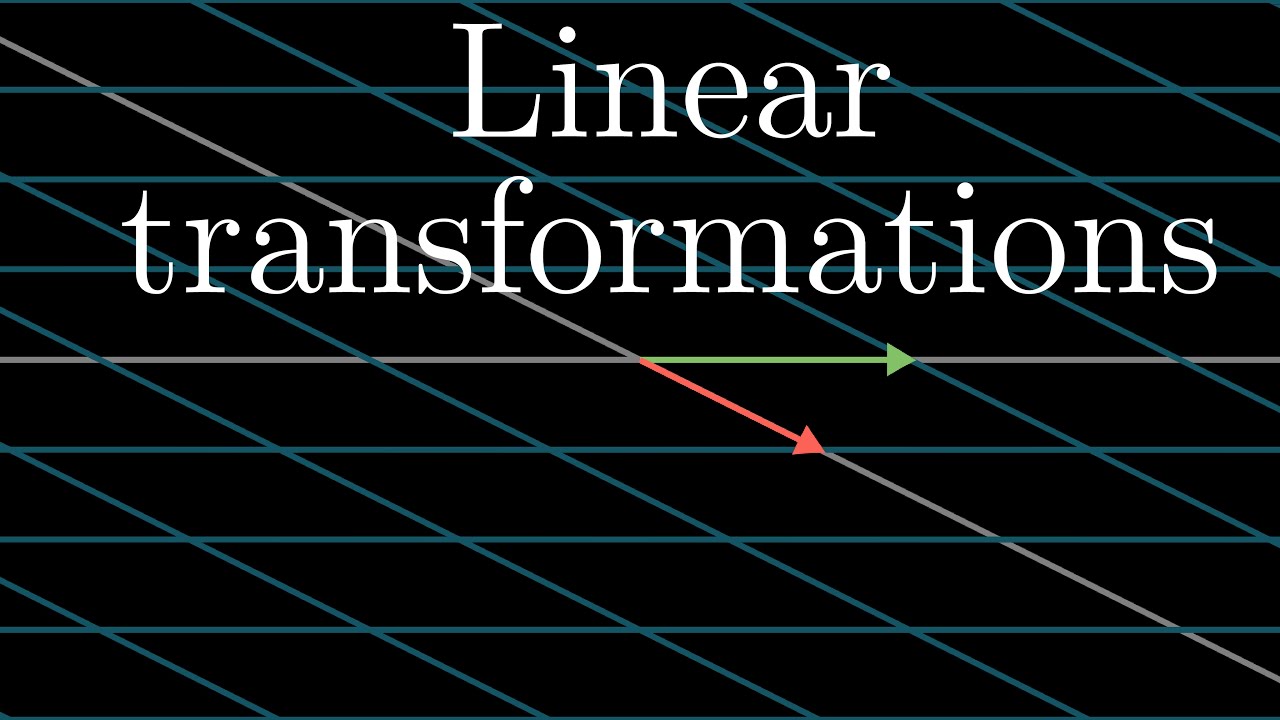
Quite possibly the most important idea for understanding linear algebra.
Help fund future projects: https://www.patreon.com/3blue1brown
An equally valuable form of support is to simply share some of the videos.
Home page: https://www.3blue1brown.com
Full series: http://3b1b.co/eola
Future series like this are funded by the community, through P...
grave kettle
spare widget
Maybe this will help you: https://youtu.be/kYB8IZa5AuE
i watched that like 3 times
even the last episode, mentioning the question of why lin transforms are linear
i remember you sending that 
grave kettle
grave kettle
even the last episode, mentioning the question of why lin transforms are linear
i don’t think he answered that
lavish jewel
if you think about it geometrically in R^n
spare widget
He shows geometrically what linear transformations do
lavish jewel
an expression of the form a v + (1-a) u, with a real between 0 and 1, defines a line segment between v and u
spare widget
L(ax + by) = aL(x) + bL(y) is just the algebraic counterpart.
lavish jewel
then we call a transformation "linear" if it satisfies that T( a v + (1-a) u) = a T(v) + (1-a) T(u), which is now a line segment between T(v) and T(u)
this generalizes to more abstract vectors though, which is why the axiomatization is so useful
spare widget
Already for R^4 it's probably harder to imagine geometrically
However the algebraic version remains the same
You basically take a concept that you have some intuition about and know what it means for some spaces and try to generalize it to other spaces which you may even be unable to imagine geometrically
This is a standard approach and doesn't apply only to linearity
Taking a concept and checking the conditions necessary so that it applies to other settings
 fringe fjord
lavish jewel
then we call a transformation "linear" if it satisfies that T( a v + (1-a) u) = ...
fringe fjord
lavish jewel
then we call a transformation "linear" if it satisfies that T( a v + (1-a) u) = ...
Doesn't this define the class of transformations usually called "affine" rather than the "linear" ones?
lavish jewel
i jumped a few steps and took artistic liberties here and there, recalling that the person asking the question has already asked it before and was dissatisfied will all the explanations we provided before
i thought i had been careful to only use consequences of homogeneity and additivity though, do tell me what i missed :x (admittedly i make mistakes and miss stuff often)
fringe fjord
Your identity is true for all linear transformations, but not everything that satisfies it is a linear transformation -- consider e.g. translations.
lavish jewel
ah, certainly, yes
fringe fjord
In fact I'm not sure there is any compelling reason why the word "linear" has ended up attached to the property we know and love under that name. It just happened, and the word is now everywhere and far too late to second-guess. So students just have to deal with the fact that f(x)=5x+7 is a "linear function" in high school, but stops being "linear" in higher math ...
lavish jewel
yeah, chromium might be too hung up on that. last time we had used "nice" or "well behaved" and they didn't like it though
spare widget
fringe fjord
Your identity is true for all linear transformations, but not everything that sa...
inb4 homogeneous coordinates translations 😂
on a serious note, in plenty of engineering papers people use linear and affine interchangeably and it's clear from the context what they mean
off the top of my head they call the affine elements in FEM linear
grim leaf
does anyone have some good resource that just really dumbs down the algebra of linear transformations? i watched 3b1b's video but it's more conceptual than algebraic
spare widget
Just solve some matrix systems I guess
grim leaf
i'm struggling with things like proving something is a linear transformation, finding conditions that would make some vector be in a null space/range/rank
i guess but i'm just trying to understand the connection between the algebra and the concept of linear transformations
spare widget
For those you need to know the definitions and then verify those
Being in the null space means that the map sends it to 0
For example imagine a projection onto a line through the origin in 2D
Then infinitely many points get projected to (0,0)
All vectorscorresponding to those are in the null-space
grim leaf
ic
spare widget
Now consider the range it is made up of all vectors that you can get as output
So that would be the whole line
in the above example
grim leaf
ic
spare widget
finally your column rank is the number of linearly independent columns and the row rank is thenumber of linearly independent rows
Imagine a rectangular matrix
In 3D say you have a plane
And vectors v1, v2, v3 are in that plane
grim leaf
ye ik what column and row rank are, i don't know what "rank" alone means
as in "What is the rank of T?"
spare widget
The column and row rank are equal
grim leaf
oh true
spare widget
So the rank is the number of linearly independent rows/columnsof your matrix
Geometrically the meaning is clear
Say you are in 3d
And your matrix maps vectors to a line
scratch that
grim leaf
ah ok
spare widget
Assume your matrix maps 2D vectors to a plane in 3D
grim leaf
e.g. R2 -> R3?
spare widget
$\begin{bmatrix} \vec{v}_1 & \vec{v}_2 \end{bmatrix} \begin{bmatrix} x\ y \end{bmatrix} = \vec{v}(x,y)$
stoic pythonBOT
criver
 spare widget
Where v1 and v2 are linearly independent vectors - theyform a basisfor the plane
It's clear then that the matrix has rank 2
You may not be as lucky, andsomeone may give you a frame - more than 2 vectors, but at least two are linearly independent
Then the rank is still 2, but you have something like this
$\begin{bmatrix} \vec{v}_1 & \vec{v}_2 & \ldots & \vec{v}_n \end{bmatrix} \begin{bmatrix} x_1\ x_2 \ \ldots \ x_n \end{bmatrix} = \vec{v}(x_1, x_2, \ldots,x_n)$
stoic pythonBOT
criver
 spare widget
The rank being 2 means that still results in a plane
Because n-2 of the vectors are linearly dependent, i.e. you have infinitely many ways to write the same point
If the rank was 1 then it would have been a map to a line through the origin
If the rank is m then it is a map to an m-dimensional hyperplane
grim leaf
ohhh i see
spare widget
Whether youspan that hyperplane with m vectors or with more results inyou havingabasis or a frame/overcompletebasis
Thenice thing about abasis isthat a point can be represented inaunique way
 peak plinth
For my row reduced thingy I got this, and now I have to find the basis for the eigenvector

But I’m so confused
spare widget
This is not thecase for frames, but sometimes thisis an advantage: e.g. noisy data
grim leaf
what's the significance of defining i =/= q and i=q as two separate things?
 slow scroll
grim leaf
what's the significance of defining i =/= q and i=q as two separate things?
slow scroll
grim leaf
what's the significance of defining i =/= q and i=q as two separate things?
The idea is that you want to enumerate mn distinct linear transformations and show that they are linearly independent. This is basically like listing out the matrices $\begin{bmatrix} 1 & 0 \ 0 & 0 \end{bmatrix}, \begin{bmatrix} 0 & 1 \ 0 & 0 \end{bmatrix}, \begin{bmatrix} 0 & 0 \ 1 & 0 \end{bmatrix}, \begin{bmatrix} 0 & 0 \ 0 & 1 \end{bmatrix}$
stoic pythonBOT
kxrider
 grim leaf
ah i see
 solid leaf
Has anyone here worked through “Linear Algebra Done Right” by Sheldon Axler? If so, was there any place to find solutions for the many times he asks you to prove something? I’m not sure how to start some of these or if I’m doing them correctly.
slow scroll
you can always just ask here. I think quite a few people here are probably familiar with axler
solid leaf
Oh ok great
In that case


I’ve been stuck on this for quite some time
I understand the actual theorem now i think
But I don’t understand how to do the proofs
How to prove that F^S is a vector space over F
slow scroll
you have to check each axiom for a vector space. For example, you would have to check that F^S has an additive identity
solid leaf
Oh so just the 10 axioms
slow scroll
yeah. A few of them should be pretty clear like commutativity for example f + g = g + f
solid leaf
Like closure under addition and scalar multiplication?
When I first did this earlier this year those were the big two ^
slow scroll
solid leaf
Like closure under addition and scalar multiplication?
sure, we need our operations to be well-defined. However this is pretty much claimed in 1.23. f + g is defined to be the function (f+g)(x) = f(x) + g(x), so we are pretty much automatically closed under addition for example
solid leaf
Ok yeah
I figured I was just making sure I’m thinking of the correct axioms
One thing I’m confused about In this case
I understand that like fundamentally in math to prove something is incorrect you only need one example
In this case, how would I actually prove for all examples
Idk how to word this to explain what I mean
slow scroll
solid leaf
I understand that like fundamentally in math to prove something is incorrect you...
this is not exactly true. It depends on the statement. the negation of the statement "for all x, P(x)" is indeed "there exists x such that not P(x)," but not all statements are of the form "for all x, P(x)"
like if I asked you to prove "there exists a real number x such that x^2 = -1" is false, you would have to show that for all real numbers x, x^2 is not -1
solid leaf
Could I not square root both sides and show that x=i and then say that there are no real numbers x that are i?
slow scroll
My point is that any proof of this is going to require some kind of manipulation to an arbitrary real number x. For a proof, it would obviously not suffice to say "Counterexample: 2^2 = 4 != -1. qed."
so proving that a statement is false is not always just "providing a counterexample"
solid leaf
Oh yeah that I understand I think
So my question is like
How do I do this proof
Without using a counter example
slow scroll
like the example i gave?
solid leaf
solid leaf
Could I not square root both sides and show that x=i and then say that there are...
Like for what you said would this be an acceptable statement proving your statement
slow scroll
showing that x=i is not showing that x is not real unless you've already proven that i is not real.
solid leaf
Ok sorry I’m not trying to sound like
Idk what the word is
But
Isn’t that the definition of i?
Like it’s not a real number
By definition
slow scroll
eh, i is just a solution to the equation x^2 + 1 = 0.
solid leaf
Ok I’m not gonna argue I assume you’d know better lol
But like let’s say I want to prove that
Uhh
T(x,y+x) is a linear transformation
I can just take a vector and prove it using two variables and the four axioms that define a linear transformation
solid leaf
solid leaf
How can I do that with this
slow scroll
do you mean T(x,y) = (x,y+x)?
solid leaf
Yeah sorry
Forgot the notation lmao
I can just take a vector (x1,y1) and prove that
What would I use instead of like
x1 or y1 to prove my thing
Just an arbitrary f(x)?
slow scroll
Alright, so we know linear means T(v + w) = Tv + Tw and T(cv) = cTv for v,w in V and c in F
vectors in F2 look like ordered pairs (x,y). So you can write v = (x1, y1), w = (x2, y2).
Then v + w = (x1 + x2, y1 + y2) and cv = (cx1, cy1) by the definition from above, and you can check that T(v+w) = Tv + Tw and T(cv) = cTv hold
slow scroll
solid leaf
Ok I’m not gonna argue I assume you’d know better lol
also about this, you can formally "adjoin" i to the real numbers, so it seems like it should not be real, but in technically speaking, there could be some funky way to combine real numbers together to get back i. For real numbers though, you can show that x^2 >= 0, and so i can't be a real number since i^2 < 0.
solid leaf
slow scroll
Alright, so we know linear means T(v + w) = Tv + Tw and T(cv) = cTv for v,w in V...
And this is verifying the
First thing I sent
That F^S is a vector space over F?
slow scroll
no, this is verifying that T is a linear transformation
solid leaf
Ok yeah I was gonna say that didn’t make sense for the first thing
I understand all of that
Everything we’ve done so far
But I still don’t understand like
solid leaf
solid leaf
That F^S is a vector space over F?
To verify this
I need to verify that F^S is a vector space
First off
Can I ignore the
Over F part
Or does that actually require more verification
Than just proving if it is a vector space
slow scroll
the "over F" part just means that your scalars come from the field F. When we define c(x1, y1) = (cx1, cy1), we want to make sure that cx1, and cy1 actually make sense. That's the only thing about the "over F" part
solid leaf
OH
ok thanks
That cleared a bit up
So what I’m actually confused about now is what I can use to verify it. Obviously I need to use vectors but can I just use variables or do I actually need to use functions in the vectors? And if I had to use functions how would that work?
If you need more clarification I can try to send an example
slow scroll
im not sure what you mean by "variables" here
do you mean like (x1, x2, ..., xn) vs a function f : S --> F?
slow scroll
yes. and so is F^{1,..., n} = F^n = {(x1, ...., xn) : xi is in F for all 1 <= i <= n}
slow scroll
yes in a sense. We normally just write (x1, x2) for an element of R2, but this the same as the function f : {1,2} --> F defined by f(1) = x1 and f(2) = x2. This is how we extend the cartesian product of sets to products of infinitely many sets
so for example showing that F^S is a vector space for any set S shows that R2 is a vector space for S = {1,2} and F = R
solid leaf
Ok this is gonna take me a minute to wrap my head around
Quick question about what you said
Are the 1 and 2 important
Could I say like
slow scroll
solid leaf
So what I’m actually confused about now is what I can use to verify it. Obviousl...
honestly not sure if ive answered this question though 
grim leaf
solid leaf
Has anyone here worked through “Linear Algebra Done Right” by Sheldon Axler? If ...
https://linearalgebras.com/ you may find luck here
Solutions to Linear Algebra Done Right
Below, you can find links to the solutions of linear algebra done right 3rd edition by Axler. Please only read these solutions after thinking about the problems carefully. Do not just copy th …
didnt mean to interrupt just thought id drop that
solid leaf
Lol I have that already thanks though
grim leaf
ah kk
solid leaf
It only has solutions to the exercises
So @slow scroll could I say f:{3,2} —> F defined by f(3)=x1 and f(2)=x2 is the same as (x1,x2)
Like did the 1 matter at all or was it just an arbitrary value
I know this isn’t normal this is just to help me understand
slow scroll
If you are consistent with this convention, then sure. yea, Rn can be identified with functions f : S --> F where S is any n-element set. But typically we like {1,2, ..., n} because we can say f(1) is the first coordinate, f(2) is the second coordinate, and so on.
solid leaf
Yeah ok
But technically the 1 and 2 don’t actually matter, they could be any number as long as the functions are defined correctly?
It’s just easier to go in order
slow scroll
yes
solid leaf
slow scroll
honestly not sure if ive answered this question though <:thOwOnk:894922237814128...
So
For this specifically
I just prove it using vectors
Say like
(x1,y1,…)
But what dimension vectors would I use
Cause if it was say F^4 ik it’d be 4 dimensional
But idk how to do it with the S
Let me resend the problem real quick
 slow scroll
solid leaf
But idk how to do it with the S
slow scroll
solid leaf
But idk how to do it with the S
you can't order the coordinates the same way you do with F^n. If f : S --> F, you just know that f(x) is the xth coordinate, and that we want to add coordinate-wise: (f + g)(x) = f(x) + g(x)
like for F^n, (x1, y1) + (x2, y2) := (x1 + x2, y1 + y2) is the same as saying (f + g)(1) := f(1) + g(1) and (f + g)(2) := f(2) + g(2)
 left grail
heyy whats up linear algebra peeps
im in cryptology right now and i learned about the hill cipher, and one aspect of it is calculating the inverse of a matrix in mod 26 with something called reduced row echelon form
now heres the thing
i have never taken linear algebra in my life before and did a crash course on matrices before learning the hill cipher and i feel so lost
my main problem is just knowing the steps to calculating the inverse in mod 26 and know how to proceed from each step
slow scroll
solid leaf
And so on?
yes
solid leaf
So basically you can always define a vector as a function? This is still a weird concept to me
nocturne jewel
vectors are just stuff in the vector space that arent scalars
functions, coordinates, sequences, matrices, etc are all vectors if you look at their spaces
solid leaf
Lmao maybe I need to better understand what a vector is
slow scroll
solid leaf
So basically you can always define a vector as a function? This is still a weird...
elements of F^S are functions, and F^n is canonically identified with F^{1,2,...,n}
nocturne jewel
F^n is FxFxF...xF
slow scroll
a vector is just "an element of a vector space" though, and we don't always think of vectors as functions
nocturne jewel
ie the n-tuples with entries from F
slow scroll
later on, you'll see that every vector space is isomorphic to F^S for some set S, so it does come full circle lmao
solid leaf
nocturne jewel
F^n is FxFxF...xF
Yeah so like if n is a set that’s what’s confusing me
nocturne jewel
It's just notation
like how $\int f(x)\dd{x}$ is just notation for all functions that differentiate to $f$
stoic pythonBOT
Mosh
 nocturne jewel
$\mathbb{K}^S:={f|f:S\to\mathbb{K}}$
stoic pythonBOT
Mosh
 solid leaf
Just wondering is this topic
Like the idea of F^S usually in an introductory lin alg course
If you know
nocturne jewel
like how $\mathbb{K}^n:={(k_1,...,k_n)|k_i\in\mathbb{K}}$ is also notation
stoic pythonBOT
Mosh
 solid leaf
Oh ok
nocturne jewel
F^S and abstract vector spaces is usually 2nd half of a LinAl course
solid leaf
Ohh ok
nocturne jewel
1st half is in concrete Euclidean space
solid leaf
I’m currently in an intro Lin alg course but it’s year long so
nocturne jewel
so yeah, 2nd term you should see this
slow scroll
solid leaf
Like the idea of F^S usually in an introductory lin alg course
When S is an infinite set, the vector space that example 1.24 defines is infinite dimensional. Intro lin alg courses usually don't leave finite dimensions
solid leaf
slow scroll
When S is an infinite set, the vector space that example 1.24 defines is infinit...
Ok yeah cause I was gonna say I’ve never seen this stuff before
Most of the stuff we’ve learned so far has used a lot of determinants and matrices but I liked his idea of not using determinants
But it’s definitely harder
meager harness
idk how to do part c and d
 meager harness
@atomic oasis
 atomic oasis
meager harness
idk how to do part c and d
atomic oasis
meager harness
idk how to do part c and d
lmfao
is AM2 = AM1 guys
Oh this is algebra sorry
grim leaf
how did they get the A11 -> A11-4A21 stuff? i assume it has something to do with the matrix B, but i can't draw the connection

 nocturne jewel
grim leaf
how did they get the A11 -> A11-4A21 stuff? i assume it has something to do with...
nocturne jewel
grim leaf
how did they get the A11 -> A11-4A21 stuff? i assume it has something to do with...
Compute T[A_11]
then write that matrix in terms of the basis vectors

 stoic pythonBOT
totally not anamono

 blazing moss
grim leaf
why is $b_1\alpha_1 + b_2\alpha_2 + b_3\alpha_3 \ne 0$?
blazing moss
grim leaf
why is $b_1\alpha_1 + b_2\alpha_2 + b_3\alpha_3 \ne 0$?
The alphas are a basis. If one of the b’s is not zero, and the three vectors are linearly independent, the resultant cannot be 0
grim leaf
ohhh righttt
wintry steppe
Hello, for $x \in \mathbb{R^{n}}$ can I always write $x=\sum_{i=1}^{n} <v_i, x> v_i $ ?
stoic pythonBOT
kaz
 nocturne jewel
if {v1,...,vn} forms an orthonormal basis of R^n
nocturne jewel
Well whether the basis is orthonormal depends on which IP you chose
wintry steppe
oh alright thanks
nocturne jewel
orthogonality is determined by the IP
wintry steppe
yeah yeah
 thick rain
can someone please give me the Texit commands for linear algebra please
 thick rain
Thank you
 amber osprey
Ax,Ay = choice(CR[0,:], CR[1,:])
how can I do something like this I want to randomly choose points but if I do
    Ax.append(choice(CR[0,:],))
    Ay.append(choice(CR[1,:]))
I call choice twice which will not give me corresponding x and y
 undone hedge
hello
wintry steppe
I still don't understand how the set {(1 0),(0 1), (2 3)} is linearly dependent. Like I understand the notion when exactly the given set of vectors is linearly dependent or independent, but consider it as a linear combination:
(a b) = a(1 0) + b(0 1) + 2(2 3)
(a b) will only become zero vector when a and b become zero, but the equation will then become:
(0 0) = 2(2 3)
Which is not correct
And I know that (2 3) can be represented as a linear combination of vectors (1 0) and (0 1)
But I just can't get my head around it
lavish jewel
i think you misunderstand the definition of linear (in)dependence
you are rather looking for the existence of not all zero a,b,c, so that (0 0) = a(1 0) + b(0 1) + c(2 3)
by subtracting c(2 3) and dividing by -c both sides, and after some substitutions, this is the same as asking whether there exist not all zero numbers m and n so that (2 3) = m(1 0) + n(0 1)
which is what you said is possible
so this means the set of vectors is lin dep
this here: (a b) = a(1 0) + b(0 1) + 2(2 3)
has nothing to do with linear independece of the set of vectors
wintry steppe
Thank you 👍
 halcyon spindle
 radiant viper
idk where to post this
radiant viper
idk where to post this

 ember pagoda
Guys, in my clg, we just started linear algebra, so any resources for that?
halcyon spindle
ember pagoda
Guys, in my clg, we just started linear algebra, so any resources for that?
Interactive linear algebra.
ember pagoda
tnx
wintry steppe
lavish jewel
this here: (a b) = a(1 0) + b(0 1) + 2(2 3)
So according to my understanding now:
To prove any set of vectors to be linearly dependent, we can do so:
- If the given scalars a, b, c are not all zero
- We can represent a vector from that set of vectors, by the linear combination of the other vectors in that same set, where m and n are not all 0.
lavish jewel
for 3 vectors, sure. it generalizes to however many you want (sort of)
wintry steppe
Thank you once again
lavish jewel
the usual definition you find in books is that the vectors ${v_1, v_2, \dots, v_n}$, are linearly dependent if there exist constants $c_i$ not all zero such that $\boldsymbol{0} = \sum_{i=1}^n c_i v_i$, where $\boldsymbol{0}$ is a 0 vector
stoic pythonBOT
Edd
 wintry steppe
Yes
Ah so there is also a non trivial solution of the system such that we get the zero vector, showing linear dependence of the given set of vectors
stoic pythonBOT
Edd
 lavish jewel
where V is the matrix whose columns are the v_i vectors, c is a vector of the c_i
so if a nontrivial c exists, the matrix V has a nontrivial kernel
wintry steppe
Oooh
lavish jewel
idk if you've seen rank-nullity yet
wintry steppe
Well I haven't, but I've heard about trivial/non trivial kernels
lavish jewel
ok. well, you can ignore it for now, it'll pop up eventually
wintry steppe
👍
grave kettle

Mathematics Stack Exchange
I recently started studying linear algebra, and I learnt that the definition of linear function is different than that of elementary algebra.
T is linear if:
T(a + b) = T(a) + T(b)
T(cv) = c T(v) is
can anyone help answer this
blazing moss
grave kettle
https://math.stackexchange.com/questions/4409972/motivation-for-definition-of-li...
Everything is locally linear. In multivariable calculus you use a matrix called the jacobian, which tracks the partial derivatives of of a function and allows you to change your system of coordinates, as this set of derivatives described everywhere how the function is changing
grave kettle
blazing moss
Everything is locally linear. In multivariable calculus you use a matrix called ...
have you seen what i’ve been exposed to
blazing moss
In polar coordinates in single variable calculus, rdtheta being a viable differential is due to the same reason
lavish jewel
chromium, no one can help you
grave kettle
lavish jewel
chromium, no one can help you
why not
lavish jewel
because we already tried
there is nothing special about the name. people noticed these properties appeared fairly often in different fields, and so they sought to come up with a description that covered all of them
and that's all
native rampart
Didn't linear algebra come into existence because physicists needed a convenient way to model physical phenomena
grave kettle
lavish jewel
there is nothing special about the name. people noticed these properties appeare...
i’d like to know the specifics
lavish jewel
that's one thing, but one of the main motivations behind it was war and the assignment of resources
grave kettle
like a story
lavish jewel
dude, go read and look it up yourself then
we already gave you the history a while back
did you just forget it or ignore it?
stop wasting people's time here
grave kettle
here?
native rampart
lavish jewel
dude, go read and look it up yourself then
Send a link
grave kettle
lavish jewel
did you just forget it or ignore it?
neither
lavish jewel
scroll back to the beginning of the month
when you asked the same thing and several people gave you examples, definitions, and historical context
native rampart
In this channel?
lavish jewel
yes
chromium has been asking the same thing over and over and rejecting everyone's answers
all month
blazing moss
Better that than shudders… studying more linear algebra
native rampart
Funny I will try once
native rampart
You know what a line is?
grave kettle
native rampart
You know what a line is?
yea
native rampart
You know what a linear equation is?
grave kettle
ax + by = c
native rampart
Not that alone
grave kettle
i’m not sure what answer you expect
grave kettle
native rampart
So you know what elementary row operations are?
i haven’t touched matrices
native rampart
Ok,so you can't expect an answer
lavish jewel
they want a motivation behind the name
which doesn't really exist
as for the field itself, name aside, it's just something that happened to pop up time and time again
if you want more details, read the links i sent and continue the search yourself
linalg includes problems in assignment of resources, solutions to differential equations in physics, and can be abstracted to be applied more generally as well
some people just saw many problems and realized they were all the same at a more abstract level
native rampart
Linear algebra originated as an abstraction of way of solving linear systems I think
spare widget
grave kettle
i haven’t touched matrices
touch matrices then, once you solve enough problems you may understand what this is about
native rampart
You can't talk about foundations of linear algebra without linear equations and matrix algebra
grave kettle
don’t matrices come from transformations
lavish jewel
you would know this if you would read your linalg book
native rampart
No,matrix algebra existed pre Linear algebra
Matrices originated as a convenient way of bookkeeping variables in linear equations
 limber sierra
perhaps itd help if, instead of 'linear', you imagined it said 'particularly-easy-to-work-with' or similar
lavish jewel
we already explained it like this at the beginning of the month, nami
grave kettle
limber sierra
perhaps itd help if, instead of 'linear', you imagined it said 'particularly-eas...
and i’d like to know how
lavish jewel
it's a lost cause
spare widget
grave kettle
don’t matrices come from transformations
solve some problems, and you'll understand it
take something from analytic geometry, e.g. intersection of planes in 3D
limber sierra
most applications of LA are reframing questions about continuous functions as about linear ones
spare widget
solve several problems and it will become clearer
no wonder nobody's explanation made sense to you since you haven't touched matrices
limber sierra
or actions of generating sets as bases but thats beyond you
blazing moss
grave kettle
and i’d like to know how
Find a parabola that goes through the point (2,5) and has its vertex at (-1, -4).
Not as easy as a linear equation?
Boom, there you have it.
grave kettle
spare widget
solve several problems and it will become clearer
can i have one
just as an example
spare widget
find the intersection of planes in 3D
limber sierra
open your textbook
spare widget
$\vec{n}_1 \cdot (\vec{p}-\vec{o}_1) = 0 \ \vec{n}_2 \cdot (\vec{p}-\vec{o}_2)= 0 \ \vec{n}_3 \cdot (\vec{p}-\vec{o}_3) = 0$
stoic pythonBOT
criver
 spare widget
where n1, n2, n3 are the normals of the 3 planes, o1, o2, o3 are points respectively on each of the planes
studying the solutions of the above naturally leads to matrices and determinants
you get multiple cases depending on the rank - e.g. all 3 planes are parallel and there is no intersection or they coincide, 2 planes intersect in a line, or 3 planes intersect in a point
limber sierra
heres another example
open a derivative practice pdf
you will apply linearity of the derivative many times
you might know it as the two rules, 'sum rule' and 'constant multiple rule'
collectively these rules are linearity
try doing derivatives without them
it might take a while and a lot of limits.
grave kettle
i see many problems showing some transformation is linear, then tell us to use linearity properties
but i can’t find ones that emphasise the easy-to-work-with-ness of linear transformations
spare widget
consider A *x = b, there are plenty of methods for finding a solution (even if the system is incompatible we can find the least squares "solution")
limber sierra
i mean... thats the point
once you have linearity properties you can use them
theyre quite handy
spare widget
now consider a1(x) = b1, ..., am(x) = bm where a1, ..., am are arbitrary nonlinear functions
this is a pain to solve
limber sierra
i dont know what youre after
"use linearity properties" IS emphasizing the easiness to work with them
thats literally the entire point
spare widget
limber sierra
i dont know what youre after
probably motivation to study linear algebra 😛
limber sierra
do you just think we shouldnt bother having a name for this topic?
grave kettle
so it turns out these properties are ultra useful
limber sierra
spare widget
probably motivation to study linear algebra 😛
i mean, if they care this much about motivation, it seems weird to me that starts with a text that introduces abstrac tlinearity before it introduces matrices or vectors
read an engineering LA text instead if you want motivation
¯_(ツ)_/¯
limber sierra
or alternatively read a group theory text and realize how much nonlinear stuff sucks
spare widget
I recommend analytical geometry
limber sierra
and then get to the chapter thats like
"oh yeah actions of generators are like vector spaces"
and realize it makes every problem 10000x easier
grave kettle
limber sierra
"oh yeah actions of generators are like vector spaces"
generators?
limber sierra
you can ignore that quip, was semi-sarcastic
im referring to the more "mathematical" (specifically an algebraist's) motivation for linear algebra
spare widget
I can't recommend you an analytical geometry book unfortunately since the one I used is from the 60s
grave kettle
hm so
limber sierra
namely that it's often best to study structures using their generating sets, and for most generating sets we just look at them as a vector space
limber sierra
the generating set analogue in linear algebra itself is a basis
lavish jewel
it is defined the way it is because it represents linear combinations in a succinct way, and makes function composition simple
spare widget
grave kettle
why is matrix multiplication the way it is
read the first chapter of hoffman and kunze
they explain it in there
should be in the first few pages
blazing moss
grave kettle
why is matrix multiplication the way it is
Read your entire linear algebra book
limber sierra
there are many many ways to frame an answer to this yeah
lmao
the naive first year's approach is that it just so happens to coincide with function composition
which is the "why" but not really the "how"
 languid sphinx
grave kettle
why is matrix multiplication the way it is
languid sphinx
grave kettle
why is matrix multiplication the way it is
Do you want to generalise it or just perform it
blazing moss
And Google your question
limber sierra
the "how" comes from, i suppose, looking at how matrices act on just column vectors
and thinking "how do i generalize this"
languid sphinx
limber sierra
the naive first year's approach is that it just so happens to coincide with func...
I think function comp is a lot more general though?
limber sierra
and then noticing that it coincides with function composition as desired
limber sierra
languid sphinx
I think function comp is a lot more general though?
linear function composition
spare widget
probably too advanced for him
limber sierra
where the dimensions work
spare widget
he should just read the first pages of a practice oriented linear algebra book
lavish jewel
wdym that's so constrained
limber sierra
do you have a less "constrained" explanation?
lavish jewel
that basically means that whenever the multiplication is defined, it is a composition
so, always
blazing moss
How convenient!
lavish jewel
this whole thing is a failure to google and to read a book, let's not clog up the channel
it's like the 3rd or 4th time this month
languid sphinx
I mean it's very constrained on the composition
I think of functions as mapping from arbitrary places
so iterating different functions map to/from even more arbitrary places
functions can be anything you want them to be
spare widget
well yes matrix multiplication is composition of linear stuff
grave kettle
so matrices (can) come independently of vectors
wikipedia said multiplication originated from composition of linear maps
grave kettle
grave kettle
wikipedia said multiplication originated from composition of linear maps
how do i get the composition if i don’t get linear mapping at all lol
spare widget
grave kettle
how do i get the composition if i don’t get linear mapping at all lol
by reading the first few pages of Hoffman and Kunze
grave kettle
that’s fields
languid sphinx
lavish jewel
and what do you call "iterating different functions"
composition?
spare widget
if you have questions once you read it and try to solve the problems, then that would be much more fruitful. Conversely if you're unwilling to read a few pages then I don't think people here can help you
lavish jewel
languid sphinx
composition?
precisely
and at least in the finite dimensional case, you can pick a basis and define a matrix for your transformation
so the two are equivalent
saying it is "limited" is weird because the limiting component there is not in the matrices
grave kettle
when do we multiply matrices outside the context of linear transforms
native rampart
Pointwise multiplication is a well defined operation
spare widget
grave kettle
when do we multiply matrices outside the context of linear transforms
whether you interpret those as linear transforms or not is up to you
a matrix is just a representation, so what specific meaning you attach to it is application dependent
native rampart

In mathematics, the Hadamard product (also known as the element-wise product, entrywise product: ch. 5 or Schur product) is a binary operation that takes two matrices of the same dimensions and produces another matrix of the same dimension as the operands, where each element i, j is the product of elements i, j of the original two matrices. It ...
spare widget
I don't think they are asking for more products
To not be as vague I can give you some examples: You can write image blurring as W * v where the matrix W contains some discretisation of a blurring kernel, and v is an image in vector form. Of course this is a linear transform, but thinking in terms of rotations and scaling is not very useful here.
On the other hand in computer graphics you may want to scale and rotate some object in which case you will have R * S * p, where p is a point of the object, S is the scaling matrix, and R is the rotation matrix
For discretisations of PDEs you may have something like:
Cu + (I-C)W^m u = f, where W is some discretisation of the Laplacian
 flint pivot
does discretisation mean some kind of approximation/loss of precision?
spare widget
while all of those constitute linear maps, it's not very useful to think of those in the usual geometric setting of a linear transformation
flint pivot
flint pivot
does discretisation mean some kind of approximation/loss of precision?
I should say imply not mean
spare widget
flint pivot
does discretisation mean some kind of approximation/loss of precision?
in the above case it means going from the continuous to the discrete setting
e.g.
$\partial_x u(x,y) \approx \frac{u(x+h,y) - u(x,y)}{h} + O(h)$
stoic pythonBOT
criver
 spare widget
it's how you get linear equations from linear PDEs
flint pivot
I'm not too familiar with PDEs but is that a numerical matrix method?
spare widget
the standard ones are the finite element method, the finite volume method, and the finite difference method
they produce a system of linear euqations out of linear PDEs
e.g. the finite element method projects the continuous problem on a finite dimensional subspace
flint pivot
spare widget
e.g. the finite element method projects the continuous problem on a finite dimen...
does it involve matrix operations or is that useful after it's in linear equation form?
spare widget
you get linear systems once you discretise
then you apply numerical solvers to solve those linear systems
flint pivot
got it
spare widget
it's a similar story with variational methods
and you also have a ton of linear algebra in machine learning
flint pivot
ah yes that I know
 small cosmos
 small cosmos
small cosmos
small cosmos
Can someone please help me with number 5
halcyon spindle
small cosmos
what are you thinking of to approach it?
small cosmos
halcyon spindle
what are you thinking of to approach it?
I don't even know how or where to start
thick rain
You will get help faster in one of the helper channels, so maybe try that.
spare widget
start with the conditions for something to be a subspace
(check that it's closed under scalar multiplication, vector addition, and that 0 is in it)
this type of question is really meant to have you practice verifying those conditions
 summer topaz
Could anyone please help me with this problem ? My teacher said it is a vector space but didn't explain why and im very confused, maybe i just didn't know how to check the axioms...?
 blazing moss
summer topaz
Could anyone please help me with this problem ? My teacher said it is a vector s...
blazing moss
summer topaz
Could anyone please help me with this problem ? My teacher said it is a vector s...
Check inverses, Identity, closure, etc
grave kettle
blazing moss
Check inverses, Identity, closure, etc
or just notice that it’s a plane lol
planes are subspaces
summer topaz
blazing moss
Check inverses, Identity, closure, etc
Thank you
wintry steppe
Hello. Could I please get some help with part c please
 spare widget
compute the adjugate of X
and then multiply it with X
I suppose [A] should actually read [X] where [X] = det(X)
In linear algebra, the adjugate or classical adjoint of a square matrix is the transpose of its cofactor matrix. It is also occasionally known as adjunct matrix, though this nomenclature appears to have decreased in usage.
The adjugate has sometimes been called the "adjoint", but today the "adjoint" of a matrix normally refers to its correspondi...
note that the above is true for general matrix X in R^nxn
then adj(X) X = X adj(X) = det(X)I
wintry steppe
Thank you very much
wintry steppe
spare widget
then adj(X) X = X adj(X) = det(X)I
Is it that 'I' is the identity matrix?
spare widget
yes
wintry steppe
Okay, thank you so much
spare widget
in your exercise I think they want you to explicitly compute the adjugate
and then perform the matrix multiplication
spare widget
I think you can prove it in the general case too though by using the laplace expansion
wintry steppe
Okay, well, we haven't learnt that as yet haha
spare widget
because when you dot column i of the adjugate with row i of the matrix, that's really the laplace expansion along row i
so you get the determinant
for row i and column j (i!=j), you can again from a determinant through the laplace expansion that has linearly dependent elements -> 0
so the general proof isn't even that hard
wintry steppe
spare widget
because when you dot column i of the adjugate with row i of the matrix, that's r...
Ok, thank you very much. Sorry for just responding
 cold sky
Sorry, what does this mean?
 nocturne jewel
cold sky
Sorry, what does this mean?
nocturne jewel
cold sky
Sorry, what does this mean?
Ortho complement of U
cold sky
Thank you
nocturne jewel
Most likely
nocturne jewel
If $U$ is a subspace of an inner product space $V$, then $U^\perp:={v\in V|\langle u,v\rangle=0\forall u\in U}$
stoic pythonBOT
Mosh
 nocturne jewel
For example, if you have a plane that passes through the origin in R^3, the orthogonal complement will be the span of the normal vector
@cold sky
$U={[x,y,z]^T\in\mathbb{R}^3|ax+by+cz=0}\implies U^\perp=\operatorname{span}{[a,b,c]^T}$
stoic pythonBOT
Mosh

 limber umbra
how do you use LU decomposition to find the eigenvectors and eigenvalues for this matrix?
 cold sky
Thank you @nocturne jewel
zinc timber
limber umbra
how do you use LU decomposition to find the eigenvectors and eigenvalues for thi...
why LU?
limber umbra
zinc timber
why LU?
The actual question asks to use matrix decomposition to find the eigenvectors and values. One of the people I asked used LU.
zinc timber
teal grotto
LDU maybe? diagonals should be eigen values iirc
 spiral osprey
So for math induction, if I am given a question asking to find the formula for "a^1,a^2,a^3...."
Is there a way for me to solve this without just knowing that the formula is a(a^n -1)/(a-1) ?
Or is this just a formula that is needed to be memorized?
teal grotto
do you mean a^0 + a^1 + a^2 + a^3 + ... + a^n?
spiral osprey
Im given a problem like this

so I am trying to find a way I can find the formula without google
but it feels like I just need to have the formula memorized for something like this
teal grotto
look at (1 + a^1 + ... + a^n) - a(1 + a ^1 + ... + a^n)
 native geode
limber umbra
how do you use LU decomposition to find the eigenvectors and eigenvalues for thi...
native geode
limber umbra
how do you use LU decomposition to find the eigenvectors and eigenvalues for thi...
Find det(M-xI) = 0 Where M is the matrix and I is the identity matrix. x is the eigenvalue. Now do null(M-xI) and those give you the eigen vectors for each eigenvalue
wintry steppe
Could someone please help me with this question?

I have worked it 2 ways but I am not sure if my working will worth 5 marks

I tried combining it now
 teal grotto
det(A) could be either -1, 0, or 1. the second way is not right. just because AB = 0 doesnt mean A or B = 0.
there is really no way to know precisely which one it is, since the zero matrix, the identity matrix, and the identity matrix times -1 all satisfy A^3 = A
wintry steppe
when i read a textbook section, i feel like i understand everything said and examples, but when i get to the homework problems for the first time i can only solve a few by myself without looking at the solution. what can i do to fix this and learn linear algebra from a textbook most efficiently?
the beginning concepts were easier and i could do most if not all of the hw problems by myself but when i got to subspace/basis/span etc i keep on confusing concepts
the solutions are easy to understand as well when i read them and seem obvious, i just have a hard time coming up w one myself when looking at a problem and im thinking it might be because the concepts arent concrete in my mind or something else
 wintry glen
wintry steppe
the beginning concepts were easier and i could do most if not all of the hw prob...
wintry glen
wintry steppe
the beginning concepts were easier and i could do most if not all of the hw prob...
Getting to more abstract concepts for the first time is definitely difficult. Since you say coming up with a solution yourself is the difficult part, I'd recommend reading the examples with more scrutiny. Focus on the thought process, the why behind each step. Why did they do this step? Oh, it's to verify this subspace axiom. Why did they reduced this matrix to RREF? Oh, it's to identify the pivot columns so that the dimension and a basis for the subspace can be found. When you do this enough, you have a good idea of the procedure to follow. Then, when you solve problems, you should hopefully recall the procedure. Once you do that, then how to carry out the procedure, like to show that the sum of the vectors in the subspace also belongs in the subspace or to reduce the matrix to RREF to identify the basis vectors of the column space, should come more naturally to you.
wintry steppe
wintry glen
Getting to more abstract concepts for the first time is definitely difficult. Si...
that seems like really good advice, that made me realize i dont really focus on the conceptual why/thought process behind each step in the examples as much, ill definitely keep that in mind, thank you!!
spiral osprey
Yo for determinants, I recall there was some method that when solving if you multiple a row or column by a number that you also have to multiple the entire determinant by that number at the end.
what I dont recall is when this was used.
is this for any column multiplication? Only with Triangular matrix thereom for solving determinants? Or is it used in cofactor exspansion
teal grotto
spiral osprey
Yo for determinants, I recall there was some method that when solving if you mul...
this is just a property of the determinant as a multilinear function
spiral osprey
property for which rule tho or is it in general for column swaps
teal grotto
spiral osprey
property for which rule tho or is it in general for column swaps
for any column (or row) multiplication.
spiral osprey
sorry jargon making my brain fry exam thursday done way too much studying thank you ❤️
icy totem
could you look at three questions?
 native rampart
What have you tried
wintry steppe
What's the difference between the notations $F_n[\mathbb{R}]$ and $F[\mathbb{R}]$ for polynomials?