#linear-algebra
2 messages · Page 286 of 1
 wintry steppe
 spare widget
A full set of equations of independent rows leads to the trivial solution {0}
Conversely 0 equations lead to the full space
e.g. 0 dot x = 0
Stuff inbetween, i.e. A with r independent rows leads to a solution with n-r dimensions
Notably if you have Ax = 0
And Bx= 0
And you put those in a system
the solution space os the intersection of the solution spaces of Ax= 0 and Bx= 0
Conversely if you have the basis vectors being the rows in A and the second set being the basis vectors in B
then putting those together and removing linearly dependent vectors gives you a basis for the sum
So sum the sum of bases has as a counterpart the intersection of the solution spaces
wintry steppe

is this true? and if yes, how do you prove it?
and whats the volume for points (x1,y1,z1) till (xn,yn,zn) in that case?

 lime zinc
 wooden iris
Just make A Matrix with coffiecents of given system of linear equation x is you known vector and b is the vector with constant parts
 zinc timber
wintry steppe
is this true? and if yes, how do you prove it?
zinc timber
wintry steppe
is this true? and if yes, how do you prove it?
yes it's true
 serene tide
is there a standard way to approach a problem like this

would you just solve for k in a typical system or is elimination better
tried both and both seem really messy for part b
 dusky epoch
just do Gaussian elimination, no?
 lavish jewel
you could do row reduction
dusky epoch
you'll eventually end up at a quantity that you need to divide by
 hollow finch
i think you could also take the determinant. if det(A) is nonzero youll have a solution regardless of b.
yeah the determinant works just fine. i checked and theres nothing you get from b you dont get from ensuring det(A) is nonzero
lavish jewel
that seems like double the work though
hollow finch
really? the diagonal method turns it into ~4 arithmetic operations
lavish jewel
what i mean is that you then anyway have to go ahead and analyze the 0 det solutions to distinguish infinitely many sols from no sols
hollow finch
take the determinant and youll see its very obvious. its not like a quadratic or something, its something you can solve by inspection
lavish jewel
yes but 0 det doesn't immediately mean no sol
or many the augmented matrix is really easy to simply inspect? is that what you mean?
cuz just looking at the det ignores the vector b
hollow finch
well if the det is zero it wont be a unique solution, it will necessarily be infinitely many. but row reduction is the way to go if you also want to do part b since that will give you both
well
actually you could just plug in the bad k value and see if its consistent. but that would require row reduction anyway so w/e
lavish jewel
that's what i meant
you anyway have to do (r)ref at the end to check whether it was no sol or infinitely many
so double the work
spare widget
wintry steppe
is this true? and if yes, how do you prove it?
sum of triangle areas
One has to be careful about the winding order though and to make sure the setis convex or something
wintry steppe
spare widget
One has to be careful about the winding order though and to make sure the setis ...
ordering as in (x_i , y_i) has to be connected to (x_i+1 , y_i+1) and also (x_1 , y_1) has to be connected to (x_n , y_n), or something else?
spare widget
I think that's already implicit in the problem
also since you take the absolute value I guess the winding order doesn't matter
the issue is if you have something non-convex
although maybe that isn't an issue either
it isn't if the non-convex parts get subtracted out due to the sign I guess
you have to draw some examples though
basically form the triangles (0,0), (x_i, y_i), (x_{i+1}, y_{i+1})
the determinant multiplied by 1/2 there gives you the area
but do check the non-convex cases
just draw some examples
 leaden tide
Hey, I have a quick question with inner product spaces.
Let E be an inner product space with its associated norm, let $(v_i){1\le i\le n} \in E^n$ such that $\forall 1\le i \le n, |v_i| \le 1$. Let $(p_i){1\le i \le n} \in [0,1]^n$. Is it true that $|\sum_{i=1}^n p_iv_i| \le \sqrt{n}$ ?
 stoic pythonBOT
Syst3ms
 zinc timber
leaden tide
Let E be an inner product space with its associated norm, let $(v_i)_{1\le i\le ...
zinc timber
leaden tide
Let E be an inner product space with its associated norm, let $(v_i)_{1\le i\le ...
no not necessarily
it's true however if you assume $\sum_{i=1}^n p_i = 1$
stoic pythonBOT
 leaden tide
Crud
zinc timber
which is a direct consequence of triangle inequality
leaden tide
Okay, let me post the full problem
zinc timber
like for easy contradiction, take v_i = e1 and p_i=1
leaden tide
right
With the previously introduced notation, let $v = \sum_{i=1}^n p_i v_i$. Furthermore, for $J \subseteq [![1,n]!]$, let $V_J = \sum_{i\in J} v_i$.
stoic pythonBOT
Syst3ms
 leaden tide
Show that there exists $J \subseteq [![1,n]!]$ such that $|v-V_J| \le \frac{\sqrt{n}}2$
stoic pythonBOT
Syst3ms
 zinc timber
what's that notation? [[1, n]]? any sequence from 1 to n?
leaden tide
[[1,n]] is the set of all integers between 1 and n, inclusive
zinc timber
yes ok
leaden tide
Some indications and previous questions
The previous question was that, given n vectors of norm 1 there exists $(\varepsilon_i){1\le i \le n} \in {-1,1}^n$ such that $|\sum{i=1}^n \varepsilon_iv_i| \le \sqrt{n}$
stoic pythonBOT
Syst3ms
 zinc timber
there's no restriction on pi's?
leaden tide
Between 0 and 1, and the v_i have norm ≤ 1
Moreover, apparently the intent of the problem is to show that probabilities are a method, because they can crop up in places where it seems like they don't belong.
So supposedly a neat solution to this problem involves probabilities (and associated theory). For the record, we only studied discrete probabilities.
zinc timber
why do I have a feeling that this may not be true
like take pi = 0.5 and
and vi = e1 then
leaden tide
e_1 being some vector of norm 1 ?
zinc timber
max value of |v-Vj| = n/2 |e1| = n/2 >sqrt(2)/2 given large enough n
zinc timber
leaden tide
e_1 being some vector of norm 1 ?
ye
I still think you need the restriction sum pi = 1
leaden tide
Well no, you can just choose J of cardinality n/2 (ish if n is odd) and that will work
The point is to show that there exists a J
zinc timber
zinc timber
max value of |v-Vj| = n/2 |e1| = n/2 >sqrt(2)/2 given large enough n
did you understand this example?
leaden tide
Sec
zinc timber
actually
leaden tide
There's no problem here
If J is of cardinality n/2, |v-V_J| = 0
If n is odd and J is of cardinality (n+1)/2, |v-V_J|=|e1/2|= 1/2 ≤ √2/2
zinc timber
yes
leaden tide
Then v is the center of a cube of side length 1
zinc timber
you can take R^n and ei's to be std basis and pi=1/2 again
leaden tide
With the various V_J being the vertices of that cube
the distance from the center to a given vertex is √3/2
So not only is the inequality true, in this case it's true for all choice of J
zinc timber
for n=3 yes
leaden tide
Well, the distance is still √n/2
Taking J=[[1,n]] for example
$|V_J-v|^2=|\sum_{i=1}^n \frac12e_i|^2 = \frac14\sum_{i=1}^n |e_i|^2 = \frac{n}4$
stoic pythonBOT
Syst3ms
 leaden tide
Taking the square root you end up with |V_J-V| = √n/2
zinc timber
hmm
zinc timber
now I've started to believe it as well
leaden tide
In other words, if you consider balls of radius √n/2 around each vertex of the parallelotope, they cover it entirey
Anyway, if probabilities are to be involved, I surmise either Markov's or Bienaymé-Chebyshev's inequality will be used at some point
 subtle gust

gave up on doing this question
how do i do it
tried column operation but didn't work /:
wintry steppe
what's on the right of the screenshot ?
you can try decomposing by multilinearity, that's way simpler than computing
 fringe fjord
Split it into a sum of two determinants along the sum in one of the columns, then use column operations on each of those to see that it must equal the determinant on the right.
subtle gust
wintry steppe
what's on the right of the screenshot ?
there isn't anything
that's the whole question
subtle gust
fringe fjord
Split it into a sum of two determinants along the sum in _one_ of the columns, t...
confused af rn
how can we split it into a sum of two determinants if det(A+B) =/ det(A)+det(B)
fringe fjord
You have (in simplified ad-hoc notation) on the left hand side |b+c, c+a, a+b|. Split that into |b, c+a, a+b| + |c, c+a, a+b| and do column operations on each of those.
fringe fjord
Notation that I invented for the purpose of writing that post.
wintry steppe
I think you could just repeat that step with the two new determinants and end up on the result, using the fact det() is alternating (a lot of the terms are = 0)
subtle gust
ok so i think i'm only allowed to do 3 things
because those are the only things we covered so far
row operations
column operations
swapping two rows/cols
fringe fjord
Haven't you learned that a determinant is a linear function of each column separately?
subtle gust
with those 3 things how can i prove this.....
subtle gust
fringe fjord
Haven't you learned that a determinant is a linear function of each column separ...
ummmm nope ?
fringe fjord
Curious. What is your definition of determinant in the first place?
subtle gust
fringe fjord
Curious. What is your _definition_ of determinant in the first place?
a scalar that is associated with square matrices ....
fringe fjord
That's not a definition.
subtle gust
this is a midterm soo... we still haven't covered a lot of the content
maybe it will be introduced more formally later on
fringe fjord
You can't possibly be asked to do stuff about determinants without having a definition of it.
subtle gust
fringe fjord
You can't possibly be asked to do stuff about determinants without having a _def...
well we only use the properties....
and how to evaluate it
nothing more
subtle gust
subtle gust
here for ex we maybe could use the fact that det(A)=det(A^T)?....
wintry steppe
you can do it without linearity
wintry steppe
you have |b+c, c+a, a+b| and notice that performing column operation, you can get a+b - (b+c) = a-c, yielding |a-c, c+a, a+b|. Now you can do a-c + c+a giving you 2a, so far your det is |2a, c+a, a+b|. Now factor out the 2 and use the first column (a) to get rid of the other a's in the 2 last columns
fringe fjord
Cool.
wintry steppe
that does kinda use linearity by factoring out the 2 though
fringe fjord
Scaling a column sometimes counts as a "column operation" too.
subtle gust
wintry steppe
you have |b+c, c+a, a+b| and notice that performing column operation, you can ge...
wait what column operation did we use
-C1+C2--->C2?
subtle gust
yeah got it
wintry steppe
doesn't it lead to a sign mistake though.....
subtle gust
tysmmmm @wintry steppe and @fringe fjord appreciate the help
subtle gust
wintry steppe
doesn't it lead to a sign mistake though.....
huh
fringe fjord
C3 - C1 -> C1 has a sign change in col 1.
wintry steppe
oh okay so the sign is fixed by swapping the c and b columns in the end 🙂
leaden tide
@zinc timber I managed to work it out
And indeed, probability yields a rather neat answer
The key observation is that the p_i can be seen as probabilities of a bernoulli distribution
 leaden tide
Sure
stoic pythonBOT
Syst3ms
 leaden tide
Where the arrow means "follows the law" (it's the notation here)
These variables are taken independant
zinc timber
looks like endomorphism


 leaden tide
But notice that for all p ∈ [0,1], p(1-p) ≤ 1/4

 leaden tide
(Notice the values that S can take are precisely the V_J)
@zinc timber Done and cleaned up
zinc timber
yes reading
leaden tide
stoic python
**Syst3ms**
slight err, the last inequality is large
 grave kettle
just learnt that matrices describe linear transformations
leaden tide
Yeah, that is quite helpful for many things
grave kettle
what's the use of studying non-square matrices?
leaden tide
I guess studying transformation between spaces of different dimensions?
But to be blunt we barely see non-square matrices in class
Anyhow, this probability proof is rather elegant, very neat
My prof did this a while ago, he solved a random integration problem with probability
dusky epoch
grave kettle
what's the use of studying non-square matrices?
maps between spaces of different dimension
wintry steppe
square matrices are usually more interesting anyways
-you can compose them with themselves; linear dynamics
-the theory of modules over PIDs apply to them; jordan, rational canonical, diagonal forms
-eigenvalues, determinants for sweet geometric interpretation
-we like to approximate by square matrices anyways
lavish jewel
svds, singular values, low rank approx and rank 1 decomps with overcomplete frames
😌
lavish jewel
these generalize nicely to n-way arrays that are often used to represent multilinear transformations, too
these are more general, ryu, so i'd call them a special case
zinc timber
non linear dynamics also uses square matrices apparently 
spare widget
lavish jewel
svds, singular values, low rank approx and rank 1 decomps with overcomplete fram...
what is that about approximations with overcomplete frames?
lavish jewel
one can set up rectangular matrices A of size m x n with m << n so that in special cases, there exist unique solutions x to Ax = b
(given special restrictions on x)
 karmic oracle
Is there a standard name for B^T A B (where I'm sort of conjugating, by by a transpose instead of an inverse?)
 ember vessel
wdym standard name?
spare widget
karmic oracle
Is there a standard name for B^T A B (where I'm sort of conjugating, by by a tra...
Wouldn't this be similar to change of basis for a (2,0) or (0,2) tensor depending on what B is
lavish jewel
off the top of my head, for the general case, no
if B and/or A have any special property, perhaps
spare widget
If B is a change of basis matrix then B^{-1}AB gives you the transformation for a (1,1) tensor A
Where A is square
If it's symmetric you get the B^T A B thing, it's similar if it is a (2,0) tensor (e.g. metric tensor), then: u^TGv = p^TB^TGBq, where u = Bp, v = Bq
subtle gust
Just got back from my linear algebra midterm 💀💀
I feel like i kinda did most questions correctly ?
But there was this question that i spent literally thirty minutes staring at
Let X be a 3x3 mateix
If XX^T is skew symmetric prove that X=O3×3
I could only prove that XX^T is 0.....
grave kettle
why are the requirements of linear transformation the way they are
spare widget
I am guessing motivated from R^n and then generalized
lavish jewel
so you have that XX^T is 0, moash
then you consider that the diagonal entries are equal to the 2-norm of the rows of X
so that all the rows of X are 2-norm 0
the 2 norm is positive definite, so that each row is then 0
wdym by requirements of linear transformation, chromium?
like the definition? the conditions that linear maps satisfy?
grave kettle
lavish jewel
like the definition? the conditions that linear maps satisfy?
definition
T(a + b) = T(a) + T(b)
c T(a) = T(ca)
lavish jewel
yeah, it's a more general and abstract way of expressing the nice properties of R^n, so that it also applies to other stuff
i seem to recall systems of equations being one of the original motivation behind early linalg tools, so that seems right
grave kettle
why are they defined like this
lavish jewel
because they have nice consequences
karmic oracle
I would say, fundamentally, a vector supports two operations: addition and scalar multiplication. So a linear transformation is a map which respects both of those operations (property one you list is about vector addition, and property two is about scalar multiplication). Now, you might rightly argue this is just pushing the question back to another question which is more fundamental: Why are those the two operations we consider on vectors?
grave kettle
karmic oracle
I would say, fundamentally, a vector supports two operations: addition and scala...
please do explain
karmic oracle
I think when you get to "Why do we define vectors with these two operations?" you get a lot of different answers which are likely all very unsatisfying. The "because it ends up being useful"/"because it ends up developing a rich theory" sorts of explanations are one flavor, or the historical flavor of "because we thought of these things from physics where both are very natural" will come up to. But ultimately, all mathematical definitions are arbitrary. You can define them however you want. Which ones survive is a function of Darwinism more than anything. And linear algebra is about the end of subjects where mathematicians actually agree how to define things. Pretty quickly after that you'll find that definitions start being more... impressionistic.
So in short, I think it is a very good question, but I also think it is a question to which no very good answer exists. "In math, we don't understand things, we just get used to them," as the saying goes.
lavish jewel
often times it goes something along the lines of "oh, these things share something in common and have nice properties. does this generalize?"
and this was one thing that did nicely
karmic oracle
the completely ahistoric explanation is that the definition of linear transformation mimics the properties of matrix multiplication. But linear transformations predate matrices.
grave kettle
3b1b said the intuitive way to understand it is
‘it’s defined such that all lines remain lines and the origin is fixed in place’
it’s a bit goofy and doesn’t seem related with said properties
lavish jewel
well
that makes sense if by "line" you mean a line passing through the origin
then in this sense, a line is a scalar times a vector, and its image under linear transformation is the same scalar times a new, transformed vector
so, a new line passing through the origin
this only makes sense if your "vector" has an associated "direction", which in general is not required
so it only makes sense for vector spaces that inherently have this additional structure
so this seems like a special case of preserving scalar mult and vector addition
grave kettle
lavish jewel
so this seems like a special case of preserving scalar mult and vector addition
so it’s simply designed around preserving these?
or are there more
grave kettle
what is
subtle gust
lavish jewel
then you consider that the diagonal entries are equal to the 2-norm of the rows ...
Ummm i don't think we covered that
We didn't study norms
lavish jewel
did you see dot products
subtle gust
I'd say try to prove it using what we covered /:
lavish jewel
grave kettle
what is
the preservation of scalar mult and vector addition
subtle gust
lavish jewel
did you see dot products
Nope
lavish jewel
really? no dot products?
subtle gust
We only covered the basic stuff
lavish jewel
you did see matrix multiplication though?
subtle gust
The things you'd see in 4 weeks of lin alg
subtle gust
lavish jewel
you did see matrix multiplication though?
Yeah
lavish jewel
how did you see matrix mult and not scalar products
grave kettle
lavish jewel
that's a direct consequence of the definition
the below definition of what
subtle gust
I could only prove that AA^T=0
subtle gust
lavish jewel
how did you see matrix mult and not scalar products
We didn't do scalar products....
lavish jewel
i guess you can still show it just by writing it out as a sum
lavish jewel
you can see that the diagonal entries of XX^T have a special form. if X has a row r with components r1, r2, r3,...
subtle gust
I didn't use sums 💀💀💀
lavish jewel
there is a diagonal entry in XX^T of the form r1^2 + r2^2 + ...
and since XX^T = 0
you have a sum of squares that equals 0
subtle gust
lavish jewel
and since XX^T = 0
How did we get that
Literally spent like half an hr to reach AA^T=0
subtle gust
lavish jewel
you have a sum of squares that equals 0
Oh yeah
lavish jewel
well, the definition of skew symmetric is that W^T = -W
subtle gust
I thought abt this but i ignored it 💀
subtle gust
lavish jewel
well, the definition of skew symmetric is that W^T = -W
Yeah
lavish jewel
if c = -c, either 1 = -1, or c = 0
subtle gust
I moved -Xx^T to the other side
lavish jewel
same thing
lavish jewel
at any rate, the trick is to look at the diagonal elements of XX^T
those contain only sums of squares
you can use this to argue that each row of X must be 0
subtle gust
lavish jewel
at any rate, the trick is to look at the diagonal elements of XX^T
Yeah all of them were a^2+b^2+c^2
Maybe i'd get half the marks... 💀
Well i'm just glad it's over
grave kettle
lavish jewel
f(cu + v) = cf(u) + f(v)
this is a definition?
lavish jewel
it's a consequence of the 2 properties of linear maps
grave kettle
grave kettle
‘it’s defined such that all lines remain lines and the origin is fixed in place’
i still don’t really get this
lavish jewel
a line is of the form cv for a scalar c and a vector v in R^n
if we have a linear function f, then f(cv) = cf(v)
and f(v) is another vector
so cf(v) is a new line
and due to linearity, this generalizes to sums of scaled vectors
grave kettle
lavish jewel
and due to linearity, this generalizes to sums of scaled vectors
what about the f(u + v) = f(u) + f(v) thing
lavish jewel
i already explained that above 
grave kettle
where 
 gritty swift
lavish jewel
and due to linearity, this generalizes to sums of scaled vectors
gritty swift
lavish jewel
and due to linearity, this generalizes to sums of scaled vectors
here
if you have a line between vectors v,w [a is a scalar]
av + (1-a)w
after the transformation T
aT(v) + (1-a)T(w)
its still a line just between new vectors now
grave kettle
gritty swift
if you have a line between vectors v,w [a is a scalar]
av + (1-a)w
after the tra...
between?
gritty swift
two vectors define a line, right?
gritty swift
yes
grave kettle
isn’t that c (v - u)
gritty swift
no because all vectors are rooted at the origin
grave kettle
gritty swift
no because all vectors are rooted at the origin
??
what does that have to do with origin

 gritty swift

the difference vector is rooted at the origin
if you want the line between v and w you want cv + (1-c)w
think of the vectors like points
since they're rooted at the origin in LA
grave kettle
grave kettle
why isn’t this also an ok representation
gritty swift
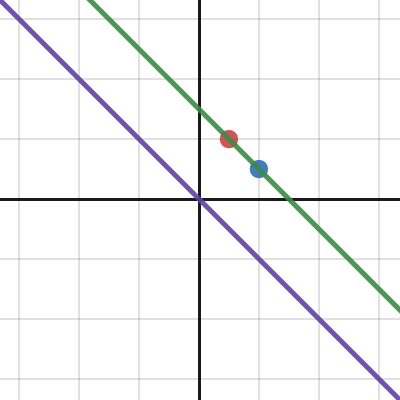
Desmos
grave kettle
just scale the (u - v)
gritty swift
gritty swift
https://www.desmos.com/calculator/g2jaypmmf4
see here, mine is the green line, yours is purple
to make your method work you'd need to add an offset
v + c(u -v)
which would simplify to
cu + (1 - c)v
grave kettle
oh
gritty swift
gritty swift
if you have a line between vectors v,w [a is a scalar]
av + (1-a)w
after the tra...
does this make sense now?
grave kettle
grave kettle
so it’s simply designed around preserving these?
i still don’t understand whether this is yes or no
or what
grave kettle
?
gritty swift
"all lines remain lines" and T(av + bw) = aTv + bTw are the same thing
grave kettle
original question was why requirements for linear transformations are they way they are
gritty swift
because... that's what linear means
I mean, you could have an affine transformation that doesn't fix the origin
grave kettle
gritty swift
because... that's what linear means
what does it mean
gritty swift
but affine transformations aren't as nice as linear ones because the whole theory of nullspaces doesn't work (at least, not by default)
there are lots of mathematical transformations, after studying all of them linear ones tended to lead to especially nice theorems. hence linear algebra
grave kettle
gritty swift
because... that's what linear means
so what does it mean lol
i’m now unconvinced that linear algebra is called linear because it ‘studies linear equations’
gritty swift
a transformation T is linear if T(ax + by) = aT(x) + bT(y) for scalar a,b and vector x,y
gritty swift
grave kettle
i’m now unconvinced that linear algebra is called linear because it ‘studies lin...
linear equations and linear transformations are the same thing
linear transformations are the same as matrices which are the same as linear equations
wintry steppe
Given the basis for two subspaces I need to find a basis for their intersection.
I solved for linear combination of the basis of first subspace = linear combination of the basis of second subspace and got some relation between the coefficients, I also know that the dimension of intersection is 2, now should I just pick two linearly independent vectors from the solution set in order to get a basis?
gritty swift
for example: if A is a matrix, x is a vector and b is a vector
Ax = b
is a system of linear equations, but A is also a linear transformation
this will always be solvable if Ax = 0 implies x = 0 for example
gritty swift
wintry steppe
Given the basis for two subspaces I need to find a basis for their intersection....
yes
gritty swift
grave kettle
so what does it mean lol
finish the 3b1b series hopefully it makes more sense, https://youtu.be/TgKwz5Ikpc8 might explain it to you
This is really the reason linear algebra is so powerful.
Help fund future projects: https://www.patreon.com/3blue1brown
An equally valuable form of support is to simply share some of the videos.
Home page: https://www.3blue1brown.com/
Full series: http://3b1b.co/eola
Future series like this are funded by the community, through Patreon, where ...
wintry steppe
gritty swift
yes
what if the dimension of the intersection is n, how can we pick n independent vectors from the solution set?
or will they automatically be independent?
gritty swift
they won't be automatically independent, you've got to pick them that way
in matrix form if you have Ax = b and want n solutions for x, you can pick a particular solution x_p all the other solutions will be x_p + x_n for x_n in the nullspace. then the problem is reduced to finding a basis for the nullspace then adding x_p
though you can probably do it directly for small n
actually you can do it more directly i think i havent done computational LA for a bit
put the system in reduced row echelon form then i think you can eyeball independent solutions
gritty swift
wintry steppe
or will they automatically be independent?
actually for 2d they will be
since Ax = A(cx) = c(Ax) is only true if c = 1 or Ax = 0
I think
wintry steppe
yea but I think a more general approach would be better
for 2d its still only independent vectors, but still
I'll read about nullspaces and stuff
gritty swift

MIT 18.06 Linear Algebra, Spring 2005
Instructor: Gilbert Strang
View the complete course: http://ocw.mit.edu/18-06S05
YouTube Playlist: https://www.youtube.com/playlist?list=PLE7DDD91010BC51F8
- Solving Ax = 0: Pivot Variables, Special Solutions
License: Creative Commons BY-NC-SA
More information at https://ocw.mit.edu/terms
More courses at ...
wintry steppe
thanks
fringe fjord
karmic oracle
Is there a standard name for B^T A B (where I'm sort of conjugating, by by a tra...
In mathematics, two square matrices A and B over a field are called congruent if there exists an invertible matrix P over the same field such that
PTAP = Bwhere "T" denotes the matrix transpose. Matrix congruence is an equivalence relation.
Matrix congruence arises when considering the effect of change of basis on the Gram matrix attached t...
 viral magnet
@grave kettle you should do this problem
https://cdn.discordapp.com/attachments/903481105888452609/949104624751747072/Screenshot_29.png

spoilers
#help-22 message
sauce
#help-22 message
 slow silo
hey im a bit confused on the start of this question it says we are given a collection of $n^2$ matrices $E_{ij}$ whose components are given by $(E_{ij}){kl}=\delta{ik} \delta_{jl}$, what would a matrix of this type look like, im finding it hard to visualise :x
stoic pythonBOT
Wingardium Matrix-Leviosa

 gray dust
slow silo
hey im a bit confused on the start of this question it says we are given a colle...
gray dust
slow silo
hey im a bit confused on the start of this question it says we are given a colle...
E_ij is the matrix with 1 at the (i,j) slot & 0 elsewhere
slow silo
gray dust
E_ij is the matrix with 1 at the (i,j) slot & 0 elsewhere
is that just an identity matrix?
gray dust
no, the identity has 1 on the whole diagonal
slow silo
what do you mean (i,j) slot?
gray dust
row i, col j
gray dust
u need to specify i,j first
slow silo
row 1 , col 2
gray dust
E_23 is the matrix with 1 at the (2,3) slot & 0 elsewhere
slow silo
oh righttt
and $E_{12} is the matrix $\begin{pmatrix}
0 & 1 & 0\
0 & 0& 0\
0& 0& 0
\end{pmatrix}$
stoic pythonBOT
Wingardium Matrix-Leviosa
Compile Error! Click the  reaction for more information.
(You may edit your message to recompile.)
 gray dust
yes
gray dust
used to define the matrix entries
for each matrix A u need 2 indices to define its entries
usually theyre ij, so like A_ij
but ij is already used to specify where the 1 goes
slow silo
so now we are specifying where other 1's go?
slow silo
yeah kronecker delta
gray dust
yeah so when defining E_ij
slow silo
1 if i=j 0 otherwise
gray dust
ij are fixed
slow silo
yeah
gray dust
then u go thru each combo of kl
slow silo
right right
so we need to have basically diagonal entries for this to work?
to satisfy i=j and k=l?
err
stoic pythonBOT
RokabeJintaro
 slow silo
yeah mb i was thinking of it wrong
gray dust
when is this 1? 0?
slow silo
so for our case
say E_23
we get delta_2k delta_3l
yeah im lost
how does a matrix = this kronecker delta
k has to be 2 and l has to be 3
gray dust
for it to be 1
slow silo
yeah
gray dust
what if k!=2 or l!=3
slow silo
what do you mean by !=
gray dust
not equal
gray dust
E_23 is the matrix with 1 at the (2,3) slot & 0 elsewhere
do u see how it matches this
slow silo
is that right?
slow silo
gray dust
> E_23 is the matrix with 1 at the (2,3) slot & 0 elsewhere
do u see how it matc...
oh its picking out the matrix entries of the matrix E_ij that we have chosen*
does that make sense?
gray dust
i mean in general this is how one compactly defines matrices
for a matrix A
u take 2 dummy indices, usually ij, in order to define each entry A_ij
eg each entry of the transpose of $A$ is $A^T_{ij}=A_{ji}$
stoic pythonBOT
RokabeJintaro
 slow silo
right right
gray dust
each entry of the sum of matrices $A,B$ is $(A+B){ij}=A{ij}+B_{ij}$
stoic pythonBOT
RokabeJintaro
 gray dust
same thing here
its just we already fix ij
so we use kl instead as dummy indices when defining E_ij
slow silo
that makes sense
gray dust
so when u work out the definition of E_ij in general (similar to how u do E_23) u should get
E_ij is the matrix with 1 at the (i,j) slot & 0 elsewhere
slow silo
ok that makes sense
So we have say
for n=3
$E_{ij}=\begin{pmatrix}
E_{11} & E_{12} & E_{13}\
E_{21} & E_{22}& E_{23}\
E_{31} & E_{32}& E_{33}
\end{pmatrix}$
stoic pythonBOT
Wingardium Matrix-Leviosa
 gray dust
E_11 is a matrix not a number
slow silo
but going through each combo of k and l we have to pick that they are the same as i and j or we get 0
oh
oh yeah
i think im too tired for matrices lol
slow silo
right right yeah sorry
a completely out of the blue question but how does this build a basis for gl(n,k)?
gray dust
write matrices in terms of the E_ij
slow silo
does the lie algebra gl(n,k) contain matrices that have det non zero?
gray dust
yes
slow silo
so we just have to write a matrix that has det non zero using (E_ij)_kl?
gray dust
again, E_ij is the matrix
slow silo
then how does a matrix with 1 entry have det non zero?
slow silo
$\mathfrak{gl}$
stoic pythonBOT
Wingardium Matrix-Leviosa
 gray dust
invertibles arent closed under addition
slow silo
i thought if we have GL(n,K) we can go to the tangent space of the lie group
which is a vector space
gray dust
ok yeah its a lie group of dim n^2
gray dust
for a sec i was thinking of all nxn matrices, which the E_ij IS a basis of
slow silo
wintry steppe
\frak{gl} is the set of all n by n matrices
ahhh ok
how did you know that its the set of n x n matrices
is there a way to work this out?
wintry steppe
of course
wintry steppe
use the matrix exponential
slow silo
oh yeah
do you mean the inverse map
of the matrix exponential?
because the exp: g --> G
wintry steppe
no
i just mean the matrix exponential
the matrix exponential on M(n, R) doesn't even have an inverse
gray dust
$e^A=\sum\frac{A^k}{k!}$
stoic pythonBOT
RokabeJintaro
 slow silo
yeah yeah i know this one 😄
slow silo
wintry steppe
the matrix exponential on M(n, R) doesn't even have an inverse
is this because of the 0 matrix?
slow silo
stoic python
**RokabeJintaro**
and we just get 0/0 undefined?
wintry steppe
the 0 matrix isn't in GL(n, R)
gray dust
slow silo
and we just get 0/0 undefined?
wdym
slow silo
wintry steppe
the 0 matrix isn't in GL(n, R)
i thought you said the matrix exp on M(n,R)?

wintry steppe
the matrix exponential is a map M(n, R) -> GL(n, R)
to show that $$\mathfrak{gl}(n, \bR) = M(n, \bR),$$ just show each inclusion. the only non-trivial part is showing that any $A \in M(n, \bR)$ is showing that there's a curve in $GL(n, \bR)$ through the identity whose tangent vector is $A$. the matrix exponential gives this curve to you
stoic pythonBOT
TTerra
 wintry steppe
that curve is \exp(tA)
slow silo
right right
this is ringing bells
right yesss
GL(n,R) is a contained in M(n,R) and its an open set so its tangent space at any g in GL(n,R) is just M(n,R)
i think i need to sleep, im getting confused on basic matrix stuff 
thank you so much for your help TTera and Rokabe
wintry steppe
slow silo
GL(n,R) is a contained in M(n,R) and its an open set so its tangent space at any...
this also works lmao
but the matrix exponential thing is good to keep in mind, because you're going to want to use it or something similar when computing lie algebras of other matrix groups
 blissful vault
Does my explanation make sense? The value of cos(theta) must be between -1 and 1. Since cos(theta) is equal to the inner product of x,y over norm(x)*norm(y), we must check that this value is between -1 and 1. It is straightforward using the Cauchy-Schwarz inequality.
 slow silo
wintry steppe
but the matrix exponential thing is good to keep in mind, because you're going t...
slow silo
wintry steppe
but the matrix exponential thing is good to keep in mind, because you're going t...
yeah i will keep it in mind, thank you so much!:)
 hardy inlet
Hello again Kings 👑
I'm trying to think what T² = I means
 wintry steppe
it means T \circ T is the identity
hardy inlet
thats the definition of T² ye. But what does this say about T?
I dont have any idea how to make the identity from a square, other than the identity
but whats this -1 EV having to do with anything

i like half proved that if it is an EV that T²=I, but idk what to do about not -1
wintry steppe
it being an eigenvalue does not imply that T^2 = I...
it implies that on the corresponding eigenspace, sure, but not everywhere
one way i can think of is to figure out what the eigenvalues of T can be, and to diagonalize it (why is it diagonalizable?)
it's hard to suggest a way to proceed with this kind of question without knowing what you know
because there are quite a few ways to approach it imo
the fastest proof i can think of uses the minimal polynomial
 fair siren
quick question about matrieces what does the curly braces mean

is just multiplication?
 fallen karma
Is cross product an example of a more general type of operation?
wintry steppe
in a few ways
it's a lie algebra structure on R^3
there's a more general "cross product" of n - 1 vectors on R^n
wedge product
to name a few
fallen karma
Oh ok
Neat
Cross product. It's not associative. I want to say it's anti commutative
Iirc
wintry steppe
correct
 patent tendon
2+2= airplane
hardy inlet
I found an outline of the proof online, fluffed it up to show the missing steps, and got this. Dunno how we can split T^2-I tho
 wintry steppe
i can't follow this after the "for some w"
fallen karma
Eigenspaces🔥
wintry steppe
have you tried doing the exercise yourself?
hardy inlet
since (T+I)[(T-I)v]=0, then either (T+I)v = 0 or (T-I)v = 0
wintry steppe
ah, nevermind, i see what you're getting at
you're saying that if (T - I)v is non-zero, then it's an eigenvector of T with eigenvalue -1, a contradiction
hardy inlet
I guess I didn't explicity say "Case (T-I)v = 0
wintry steppe
this proof is fine logically
presentation could be improved but it works
T^2 - I = (T + I)(T - I) is a trivial equality
hardy inlet
well since (T+I)w = 0 implies that lambda = -1, then we know (T-I)w MUST equal 0
and the last temp of
Tv = Iv, why are we allowed to say T=I? Is that some identity too?
wintry steppe
if Tv = Iv for all v then T = I
gray dust
hardy inlet
ahhh i have to specify FOR ALL v
in general thats how we define function equality
f=g if f(x)=g(x) for all x
wintry steppe
||the minimal polynomial of T divides x^2 - 1 = (x - 1)(x + 1) and cannot be divisible by x + 1, so x - 1 annihilates T, meaning T = I||
hardy inlet
it isn't divisible by x + 1 because if λ = -1 then (-1) + 1 = 0 and DIV0 error?
wintry steppe
what
hardy inlet
u said that poly wasn't divisible by x+1
hardy inlet
wintry steppe
T^2 - I = (T + I)(T - I) is a trivial equality
wait so does difference of squares apply to transformations?
wintry steppe
as you should show, since you're uncertain, yes
i took linear algebra three years ago
hardy inlet
i guess u can just distribute it right, T²+TI-TI-I² = T^2 - I
wintry steppe

gray dust
theres also the implicit use of the fact I commutes with every map
wintry steppe
it is.
gray dust
try it for (A+B)(A-B)
hardy inlet
yeah it ends up just being T²+TI-TI-I² with replacing A and B
gray dust
try again
hardy inlet
the fact that its on a map feels weird
gray dust
think of em as matrices
hardy inlet
(A+B)(A-B) = A² - AB + AB -B² = A² - B²
hardy inlet
sorry i always get them backwards
anyways, A² - AB + BA -B²
can that be simplified?
fallen karma
Who wants to talk about dual spaces
hardy inlet
ok and since identity is commutative (able to commute/move freely) then it holds on I
gray dust
we dont say I is commutative
hardy inlet
TI ?
gray dust
we say I commutes with every matrix
hardy inlet
ah that makes more english sense
gray dust
this is a lesson in algebra where things dont always commute
hardy inlet

wintry steppe
fallen karma
Who wants to talk about dual spaces
go on
hardy inlet
is this sound?
 wintry steppe
ABv = 0 doesn't imply that one of Av or Bv is zero
i suggest not copying proofs you find online
hardy inlet
that is a good suggestion 
Does it imply that (T-I)v = 0 or (T+I)[(T-I)v] = 0 
i need the composition right
wintry steppe
it certainly implies (T + I)((T - I)v) = 0, and that's all you need for the proof
er, (T - I)((T + I)v) = 0, but this is alright since T - I and T + I commute
hardy inlet
(T + I)((T - I)v) = 0 \land (T - I)((T + I)v) = 0
im not sure how thats enough for the proof
wintry steppe
read over the proof you found online, then
because it's either wrong or you misunderstood it
hardy inlet
i dont like that one D:
was using it as a starter piece
fallen karma
The dual map of T
If T has matrix representation A
Then T' has A^T
Because dual map T': W'-V' is...
wintry steppe

hardy inlet
(T + I)((T - I)v) = 0 \land (T - I)((T + I)v) = 0 so either ((T - I)v) = 0 and ((T + I)v) = 0? and the first equation violates our assumption of no -1 ev, so solving the second we get T=I right?
 sick sandal
T* *!
wintry steppe
hardy inlet
(T + I)((T - I)v) = 0 \land (T - I)((T + I)v) = 0 so either ((T - I)v) = 0 and (...
NO!
ABv = 0 DOES NOT IMPLY Av = 0 or Bv = 0!
hardy inlet
right but i thought since we had commuted the T+I and T-I to form both that would work
wintry steppe
even if A and B commute, NO
wintry steppe
that's its definition, yes
hardy inlet
im trying to understand how
it certainly implies (T + I)((T - I)v) = 0, and that's all you need for the proof
wintry steppe
fallen karma
Are they all that
i don't know what you mean by this
wintry steppe
hardy inlet
im trying to understand how
> it certainly implies (T + I)((T - I)v) = 0, and th...
i'm not trying to imply the proof follows immediately from this or anything
i'm saying this is all you know
and you have to use to prove the statement you want
(the point of the exercise)
 past yew
 gray dust
@past yew is this a test?
past yew
Yup yesterday test
hardy inlet
i cant tell if I repeated the same mistake
 past yew
A & B are correct according to me
wintry steppe
hardy inlet
i cant tell if I repeated the same mistake
it's very sloppy, but looks a little more correct
hardy inlet
could u please elaborate on what causes it to be sloppy
wintry steppe
"...which contradicts our assumption"
what assumption? this isn't clear
hardy inlet
yeah... thats not needed is it. since T0 = 0 for any T
wintry steppe
well if you're using w as an eigenvector corresponding to -1 to get a contradiction, it better be non-zero
and if that's not what you're doing
then it's not clear
hardy inlet
sec i think im onto somethign
i think i've gotten stuck again

i feel like I cant say w=0
wintry steppe
this works
hardy inlet
this was the bottom of what i had that i was too embarrased to show; I beat my head some more and the mistake i made at the very end was substituting W into itself
 wintry steppe
you're getting there
hardy inlet
its this whole \neq0 thats screwing me up
 wintry steppe
well T and I certainly agree when v = 0 as well.
hardy inlet
T0 = I0 right
but I technically only proved for not equal, so would I just throw in a sentence about T0=I0 therefore Tv=Iv forall v
wintry steppe
if you want
hardy inlet
the mona lisa v2:
 wintry steppe
the logic works out


 hardy inlet
so its no different that T \in L(V)
wintry steppe
if you like writing them as T, sure
hardy inlet
the \align at the end feels questionable; especially the part where I dropped the dimentions
 zinc timber
hardy inlet
zinc timber
what's fundamental theorem of linear maps
hardy inlet
axlers textbook does
 hardy inlet
 zinc timber
hardy inlet
the \align at the end feels questionable; especially the part where I dropped th...
zinc timber
hardy inlet
the \align at the end feels questionable; especially the part where I dropped th...
these steps feel sus
zinc timber
align one
since you know V = N(T)+R(T) you can also show their intersection is trivial and so it's a direct sum
 zinc timber
ya
hardy inlet
which is why we had the P² = P so that we cant apply the transformation once, get something in the nullspace, then apply such and get 0
zinc timber
unfortunately I can't think of an easy example now
zinc timber
hardy inlet
which is why we had the P² = P so that we cant apply the transformation once, ge...
idk what it exactly means but yes
your intuition is correct
hardy inlet
I think i have an example
 zinc timber
ig it works
hardy inlet
which means (0,0,1) is in the intersection
thus non trivial and cant take a direct sum
ok I think i cleared it up better:

oops now I left out the direct sum part

 slow scroll
yea idk this doesn't make much sense to me. Its not true that "for all v in V, (P - I)v = 0" (this would imply that P = I), and that does not imply that null P = {(P - I)v : v in V}
your v = Pv + (P - I)v = Pv + 0 = Pv is almost the right idea to show that null P + range P = V, but again (P - I)v != 0 in general.
hardy inlet
yeah... 😬 thats a good point in the first part. idk how to derive the nullP then
slow scroll
I don't think you really need to. while you can't say null P = {(P - I)v : v in V}, you can say null P \supset {(P - I)v : v in V}
hardy inlet
wait wouldn't it be a subset
slow scroll
if you have (P - I)v in {(P - I)v : v in V}, then P((P-I)v) = 0, so (P - I)v is in null P
so its as a wrote it
hardy inlet
so at least everything in (P-I)v is in the null?
slow scroll
ye
hardy inlet
im trying to figure out how there can be more
wait nvm its not saying every vector in V; its saying every vector acted on by (P-I)
so there could be some w \not \in range(P-I)
such that Pw = 0
slow scroll
yes
the other inclusion might hold actually, but its not necessary for this
in fact i think it does hold
yea it does
the other inclusion is one of those things that are so trivial its easy to miss. But anyway, as far as correcting this proof, what you have here
v = Pv + (P - I)v
is almost correct, but Pv + (P - I)v = 2Pv - Iv, which need not be v. There's a simple way to fix this so you get the right thing
hardy inlet
yeah i saw that and flipped the sign but idk what to do with it
slow scroll
i.e. v = Pv + (I - P)v?
hardy inlet
 slow scroll
ah yea, so that fixes that
slow scroll
yeah, idk why you have that
the correct conclusion from v = Pv - (P - I)v is that V = range P + null P
hardy inlet
plus null P?
slow scroll
ye
null P is closed under scalar multiplication, so (P - I)v in null P implies -(P - I)v is in null P as well
 slow scroll
if you can show that null P = {(P - I)v : v in V}, then your proof that null P \cap range P = 0 works. But there's also a different way to do that
and then once you have V = range P + null P and null P \cap range P = 0, that's it. You don't need the "fundamental theorem of linear maps" for this.
hardy inlet
yeah just the definition of directsum
slow scroll
In fact, you shouldn't use it, because it only works in finite dimensions
 slow scroll
ye, that's perfect
hardy inlet
ah right nullP is a superset
so (P-1)v is definitely in it
aha
my brain was still thinking the subset
but that still doesn't solve the issue of nullP's exact form
like I can't set an equality on it to compute the intersection can i
slow scroll
hardy inlet
like I can't set an equality on it to compute the intersection can i
im not sure what you mean by this. Your proof that null P \cap range P = 0 uses that null P = {(P - I)v : v in V}, so if you want to use that proof, then you'll need to figure out the other inclusion (which i verified does hold). You also don't have to use it. There is another way to see that null P \cap range P = 0 as well.
hardy inlet
well how'd u show the equality of null P = (P-I)v that sounds difficult
slow scroll
here's a hint, but it basically gives it away: || let v be in null P. v = -(P - I)v (why?) ||
oops fixed it
hardy inlet
i thought scalars didn't matter
slow scroll
hardy inlet
i thought scalars didn't matter
wdym?
hardy inlet
u swaped from v= (P-1)v to v = -(P-1)v
hardy inlet
 carmine echo
Pv = 0 => v = (P - (P - I))v = Pv - (P - I)v = -(P - I)v
carmine echo
Pv = 0 => v = (P - (P - I))v = Pv - (P - I)v = -(P - I)v
oh... that is quite trival
i just dont have the brain
slow scroll
well scalars could matter as far as making an equality hold. btw, i should have written
v = (P-1)(-v). Now its really clear that v in null P implies v is in {(P-I)v : v in V}
hardy inlet
it took me like 3 minutes to notice its trivialness
slow scroll
the other inclusion is one of those things that are so trivial its easy to miss
hence what i said earlier
 carmine echo
for me to have figured it despite really sucking at vector space and being an absolute beginner to it, yes it has to have been trivial
dim V = dim null P + dim range P though, is clearly not trivially intuitively visible to me ._.
the proof makes sense tho, so yeah
hardy inlet
shouldn't this have a negative coefficient now
 carmine echo
$\mathcal{L}$
stoic pythonBOT
Ansh
 slow scroll
well scalars could matter as far as making an equality hold. btw, i should have ...
slow scroll
slow scroll
well scalars could matter as far as making an equality hold. btw, i should have ...
you would write v = (P-I)(-v)
slow scroll
linear operators on V, yea
hardy inlet
T \in L(V) means T is in the set of linear maps from vector space V to itself
L(V,W) is V to W
(the set of all)
carmine echo
Ty 
slow scroll
slow scroll
you would write v = (P-I)(-v)
does this make sense matt? if v is in null P, there exists an element of V, i.e. w = -v such that v = (P - I)w
hardy inlet
vaguely?
carmine echo
I mean: v = Iv = Pv - (P - I)v = (P - I)(-v) = (P - I)w
slow scroll
well, what does it mean for w to be in {(P-I)v : v in V}? It means exactly that there exists v in V such that w = (P - V)v
and what we've shown is that v = (P - I)w for w = -v in V
hardy inlet
is it necesary to create a w?
slow scroll
Not necessarily. Some proofs of existence use non constructive methods like contradiction.
hardy inlet
this is the current
 carmine echo
uhh, null P = {x | Px = 0, x \in V}
and you figured that (P - I)v for all v in V satisfies P(P - I)v = 0
hence, (P - I)v must've been a subset of null P
:o


 zinc timber

 knotty hazel
ryu
carmine echo
hardy inlet
<:flonshed:629835071465062410>
share all the Qs with solutions lmfao
I believe questions and solutions suit me better than grinding my brains with the theory :|
hardy inlet
i aint got the solutions 
carmine echo
after you're done then..
hardy inlet
yeah....
the goal is to finish; but no guarantees on that one
this one feels easy so i wrote the definitions...
 hardy inlet
not sure how to finish this or if its a good direction

so it appears that I have the magnitude of c is 1, but I need c to be exactly 1 right
then u = cv → u = v
slow scroll
hardy inlet
so it appears that I have the magnitude of c is 1, but I need c to be exactly 1 ...
i agree
hardy inlet
i feel like theres something super basic with this but idk
hardy inlet
ohhh yeah those properties + the substitution
3am brain mode be like
ty
wait does that finish it tho..
hardy inlet
what about complex tho?
lavish jewel
c*1 = 1
hardy inlet
couldn't c * 1 = c?
dusky epoch
lavish jewel

lavish jewel
you should stop doing math so late
you'll make mistakes and won't retain the knowledge
hardy inlet
yeah I know i need to start sooner,
but heres the pwoof

not sure on the syntax here, I feel like I should have <e_1, e_2> but the problem doesn't have that

oh it says function not inner product; thats why. Should I give it a name like phi?
 lavish jewel
i wouldn't say this is a contradiction, more like a counterexample
you didn't use the assumption that it was an inner product at any point
hardy inlet
fair enough
would an obscure counterexample even suffice; or is this sort of an existance problem

if lambda is not an eigenvalue then its invertible and by the rank nullity theorem f(lambda) = dimV; and if it is an eigenvalue; then its not invertible, hence nullity \geq 1, and thus f() <= dimV-1
i guess we're assuming the dimention a nonnegative integer
stoic pythonBOT
 zinc timber
and ..
lavish jewel
which one are you addressing
 lavish jewel
how would you do the last one, ryu
zinc timber
which one? not continuous one?
zinc timber
hardy inlet
yeah I know i need to start sooner,
but heres the pwoof
or this?
lavish jewel
the not cont one, yea
zinc timber
in C, we must have one eigen value λ amd f(λ) <= n-1 but for all points near to λ, f(λ)=n so we cannot make |f(x)-f(λ)|< eps for any δ>0
lavish jewel
would you have accepted using a limit
zinc timber
or or, if f were continuous then f(C) would be connected in N but it isn't, so f couldn't have been continuous
lavish jewel
or eps delta preferred?
zinc timber
I prefer the topology one 🙈
zinc timber
lavish jewel
would you have accepted using a limit
limit feels like easier
lavish jewel
should work, right?
zinc timber
ya
 outer goblet
is there a quick way to tell if a matrix is diagonalisable
dusky epoch
no
outer goblet
:(
outer goblet
mm cuz seeing if the characteristic polynomial splits can be pretty hard without a calculator
wintry steppe
for example, any diagonal matrix is diagonalizable
zinc timber
outer goblet
mm cuz seeing if the characteristic polynomial splits can be pretty hard without...
if the minimal polynomial is separable then it's diagonalizable
it's iff condition
outer goblet
yeas ik lol
wintry steppe
have fun computing the minimal polynomial
outer goblet
its just hard to see lol
zinc timber
compute the char poly
wintry steppe
clench your teeth and get computing
outer goblet
hehe
outer goblet
yea algebra is so hard
wintry steppe
sometimes you just have to do a little bit of work
 outer goblet
zinc timber
just use a computer
outer goblet
im not allowed on exam lol
wintry steppe
doesn't mean you can't
 brave cliff

Im looking at part b for this question.
If a matrix is linearly dependent, can it be said that it doesn't span the certain dimensions

 zinc timber
brave cliff
Im looking at part b for this question.
If a matrix is linearly dependent, can ...
zinc timber
brave cliff
Im looking at part b for this question.
If a matrix is linearly dependent, can ...
not necessarily
u need to be more specific about what you mean
example there could be 3 LD vectors of lR² that spans lR²
brave cliff
Oh, that's not my work, that's my prof's solution sheet
 steep sinew
does this chat include algebra 2?
zinc timber
hardy inlet
i had a problem in my old version since i said <u,v> = 0 instead of <v,v> = 0
This works for showing a property doesnt hold, correct?:
 zinc timber
$\overset{?}{=}$ is not a good practice. calculate them separately and show they are not equal
stoic pythonBOT
 dusky epoch
@zinc timber \overset?= is fine
 quiet wren

Hi could anyone explain to me why this is true?
aj and w are n dimensional real vectors
Why is normalisation of w leads to the inner product being the distance to the hyper lane with normal vector w ?
hardy inlet
stoic python
ok thanks
^ryu
So rn im stuck on knowing that (T- λI) is invertible if λ is not an eigenvalue
gray dust
@quiet wren heres a sketch
 quiet wren
gray dust
<@939509782572830780> heres a sketch
quiet wren
gray dust
<@939509782572830780> heres a sketch
Thanks. Just a few things to clarify my understanding
Here you have written the projection of aj onto H right?
Is it a formula?
lavish jewel
that's the projection onto w, not H
hardy inlet
i dont know if I can say this (red arrow)
 lavish jewel
you can use geometry and the definition of the dot product to show how/why this works
your last 2 sentences break down
f(x) = x also satisfies what you wrote there
quiet wren
lavish jewel
that's the projection onto w, not H
right so the projection of aj onto w gives the distance to H right?
since w is a normal vector
lavish jewel
that's what you wrote in the original picture you sent, sure
it's not enough that it's a normal vector though
or what do you mean by normal here?
w is normal to H
quiet wren
lavish jewel
w is normal to H
yeah a normal vector to the plane
lavish jewel
you're saying exactly what is written in the image you sent
so yes
this is not the answer to "why" though
that is in rokabe's drawing
quiet wren
yeah he also provide a formula for the projection of aj onto w which I was missing
lavish jewel
all right
hardy inlet
lavish jewel
your last 2 sentences break down
does this imply the others are fine. Why it (T- λI) invertible/surjective tho?
hardy inlet
(T- λI) = (T - TI) = 0
lavish jewel
what are you asking me?
lavish jewel
i didn't understand what you wrote in what you asked me
ah
same reasoning as you did rn
take (T - lambda I)v
hardy inlet
(T-λI) != 0?
lavish jewel
right
so you get a linear combination of 2 vectors
and you know for a fact they are not scalar mults of each other
you can show that for 2 vectors, linear dependence means one is a scalar mult of hteo ther
gray dust
quiet wren
Here you have written the projection of aj onto H right?
no its onto w
lavish jewel
this means you cannot get 0
quiet wren
Yeah thanks