#linear-algebra
2 messages · Page 270 of 1
 fringe fjord
 wintry steppe
For example span({a, b, a+b}) = a(1, 0, 1,) + b(0, 1, 1).
a basis {(1, 0, 1), (0, 1, 1)}, dim = 2
 nocturne jewel
Oh yeah duh
fringe fjord
In which case {(1,1,1,-1),(0,1,0,-1),(4,2,1,-2)} would be a basis.
wintry steppe
@fringe fjord sorry im confused... what are you trying to say?
fringe fjord
I'm suggesting a basis for your span.
 dusky epoch
hold on what
@wintry steppe can you show the problem exactly as stated please
as a screenshot maybe
wintry steppe
Sorry not in English. :( But I have to find a basis if $V = span({a, b, \frac{a}{b^2}, -b}), a, b \in \bR, b \neq 0$.
 stoic pythonBOT
mate
 wintry steppe
Basically I have a set of all 2x2 matrices ({a, b}, {c, d})
and a = -d, bc = -(a/d)
dusky epoch
can you send the screenshot no matter what language it's in? please?
i have a strong suspicion that you are messing up the notation severely
and span() does not mean what you think it means
 vivid crypt
hi
dusky epoch
mate
do you have
a PICTURE
i want a PICTURE not a translation not a transcription just a PICTURE or a SCREENSHOT
wintry steppe
Sorry, Ann, I do not. And that actual problem does not exist (I just need it to solve something else).
It just a part of my problem.
dusky epoch
can you show the whole problem then
im extremely suspicious of all this
you're tasking us with finding a basis for something that either isn't a vector space at all or has a very obvious one-element basis
wintry steppe
Lets try with this.
$X$ is a set of all 2-by-2 matrices $A$ such that $A^2 = 0$. Find a basis for span(X).
stoic pythonBOT
mate
 wintry steppe
We defined a linear span as a set of all linear combinations of elements of that set.
dusky epoch
okay so you start with the set of all 2x2 matrices whose square is zero and you take the span of that
 tall gull
hey guys
im only in calc 1 in school but i got a book on linear algebra and its rlly interesting
ok nvm this question was dumb
sorry
wintry steppe
dusky epoch
okay so you start with the set of all 2x2 matrices whose square is zero and you ...
I find out if I take any reals a, b(not equal 0) then for matrix
({a, b}, {(-a^2)/b, -a})
A^2 = 0.
dusky epoch
ok sure that describes a subset of X
i don't think that'll help you much in finding span(X)
wintry steppe
And I am stuck because I have never had to find a basis if I have squares or fractions.
That is the problem...
dusky epoch
you're confusing this desc of a subset of X with the span of X
i think span(X) might just be all of R^(2×2) but im not 100% sure about that
wintry steppe
We need to find a basis for a vector space, right? I am confused.
dusky epoch
you're confusing yourself on what said vector space even is
wintry steppe
Take all such matrices and make all linear combinations and find a basis for that vector space.
dusky epoch
and make all linear combinations
thats precisely what your desc doesnt capture
(but i would STRONGLY ADVISE AGAINST trying to make it do that)
i can say for sure [0 1; 0 0] and [0 0; 1 0] are in our space so its dimension is at least 2
fringe fjord
If Mate does indeed have all the nilpotent matrices there, then the span does not have dimension 4 because they all have trace 0.
fringe fjord
I think trace and determinant both 0 is a necessary and sufficient condition.
wintry steppe
fringe fjord
I think trace and determinant both 0 is a necessary and sufficient condition.
Yes.
That is what I am using here.
dusky epoch
necessary and sufficient condition for what
fringe fjord
For being nilpotent, not being in the span.
stoic pythonBOT
Ann
 fringe fjord
OTOH I found three lin indep members an hour ago, so we are indeed looking at just the trace-0 matrices.
As matrices we could just take ((0,1),(0,0)) and ((0,0),(1,0)) and ((1,-1),(1,-1)).
These are all easily nilpotent, independent, and since we agree every matrix in the span has trace 0, there can't be more than 3 matrices in a basis.
wintry steppe
@fringe fjord and @dusky epoch , thank you very much!!
 barren sandal
What would you guys say are the prerequisites to self learning linear algebra?
nocturne jewel
Nothing really imo
 molten pilot
What really is the cross product?
I mean, it seems awfully limiting to create an operation that would only work in R^3
nocturne jewel
Exterior Product
molten pilot
What?
nocturne jewel
but it's just a product that gives a mutually orthogonal vector to 2 other vectors
wintry steppe
one way to look at it is as the vector v x w with <v x w, -> = det(v, w, -). this lets you extend it to any R^n, but then you have to put in n - 1 vectors instead of two
wintry steppe
for any vector u, <v x w, u> = det(v, w, u)
molten pilot
Ah, you mean the dot product
wintry steppe
yes
 dapper gorge
Does the generalized binomial theorem hold for 1/n, where n is a natural number in the case (I+N)^(1/n) where N is nilpotent? Wikipedia assumes the case for n=2. How would you go about proving something like this? N is nilpotent so the formula is just a finite sum, but rather complicated
Just curious, as I don't even feel too comfortable with power series with just ordinary real numbers
In mathematics, the square root of a matrix extends the notion of square root from numbers to matrices. A matrix B is said to be a square root of A if the matrix product BB is equal to A.Some authors use the name square root or the notation A1/2 only for the specific case when A is positive semidefinite, to denote the unique matrix B that is po...
4.4. Jordan decomposition
fringe fjord
molten pilot
I mean, it seems awfully limiting to create an operation that would only work in...
Another answer could be that the cross product is a prototypical example of an antisymmetric bilinear map. Now for each vector space V there's a systematic way to construct a universal antisymmetric bilinear map, meaning a vector space W and a antisymmetric bilinear map f: V×V -> W such that every other antisymmetric bilinear map V×V -> U for any U is the composition of f with a unique linear transformation W -> U.
In general, if V has dimension n, W ends up having dimension n(n-1)/2, so W is cannot be the same vector space as W -- except that n(n-1)/2=n iff n=3. So exacty for 3 dimensions we can choose W to be V itself, and the cross product then turns out to be a possible definition for a universal f: V×V -> V.
(There are many possible f: R³×R³ -> R³ with this universal property, though, so it's not the entire story. However, the cross product (together with its negative) additionally distinguishes itself by being the only one to satisfy T(v×w) = T(v)×T(w) whenever T is an orientation-preserving rotation, which is nice enough to prefer it. The fact that this is even possible is another low-dimensional coincidence, though).
 thorn nexus
hey, can someone help me?
with a system of equations
10x+7y=263
4x+8y=230
i have to solve for x and y
bro wtf
is no one gonna snwerr
answer
nocturne jewel
thorn nexus
10x+7y=263
4x+8y=230
set up the augmented matrix then invert.
nocturne jewel
since you're asking here and not #prealg-and-algebra , I'm assuming you're learning Linear Algebra
nocturne jewel
You can ask your question there, yes
 still lodge
what material should be covered in college level lin alg class
for theoretical purposes let’s make it an honors class
im starting to feel like my lin alg class was lacking and would like to fix that
 gleaming knot
I'm curious, what's lacking?
 deft apex
what did you cover?
nocturne jewel
still lodge
im starting to feel like my lin alg class was lacking and would like to fix that
well what did you cover?
still lodge
i dont have my notebook with me to say exactly (there was no syllabus  ) the matrix stuff youd expect, eigenstuffs, JCF
some very light inner product stuff
cayley hamilton (w/o proof) and some work with polynomials
nocturne jewel
I mean, sounds typical
nocturne jewel
but you can also just add the proof for Cayley-Hamilton in yourself, it's not that hard imo
still lodge
cuz i remember it looking cool/important and opening up to other stuff
perhaps im overthinking im just curious what other people might have done in their classes
nocturne jewel
R^n stuff, abstract vector spaces, inner products, least-squares, transformations/matrices, eigentheory
still lodge
wdym exactly by abstract vector spaces
the entire class was done in R2 R3 and polynomial space for me
nocturne jewel
polynomial space, matrix space, function space
vectors that aren't coordinate vectors
still lodge
ah
ok well he gave us a question involving matrix space on the final which was very cool and good
but thats it lol
i’ll probably just try and fill in some gaps then
 hushed hedge
Is it possible to check whether two lines are intersecting with each other only using the affine form?
If i have this:
x+y+3z+6=0
2x+y-2z-10=0, can i check using the affine form or do i have to make a equationsystem?
 queen oxide
anyone have any ideas for this

i tried the usual x+yi stuff but it becomes a huge mess and idk if its the right way of doing it
dusky epoch
consider: |z* + 2i| = |z - 2i|
queen oxide
dusky epoch
consider: |z* + 2i| = |z - 2i|
we still have sum of surds that doesnt simplify nicely afaik? like idk how to get rid of the sqrt
or is there a way of doing this without converting to cartesian lol
dusky epoch
you'll have the equation of an ellipse.
queen oxide
dusky epoch
you'll have the equation of an _ellipse_.
from sqrt(x^2 + (2-y)^2) + sqrt(x^2 + y^2)?
dusky epoch
no you're overthinking it
you know the definition of an ellipse, right?
it's the set of all points for which the sum of the distances to two foci is constant
wintry steppe
@dusky epoch can I ask you a question
dusky epoch
why me specifically
wintry steppe
Cause it's related to LA and you seem knowledgeable
dusky epoch
you can certainly try but don't expect me to answer immediately
wintry steppe
How important are polynomials in LA? Thus far we have used them alot in class but from what I've seen in LA books they are not covered excessively
If you have a good resource on polynomials that'd be great
dusky epoch
i mean
i guess they serve as good examples of vector spaces to examine that arent just R^n
 zinc timber
(sometimes useful to find the eigen values)
 vapid lake
Let V be the free F2 vector space over {a, b} and let U = {0, a + b} ⊆ V .
What does this mean?
V = {a, b, U} ?
 stable kindle
is this just {0, a, b, a+b}?
 subtle walrus
ye, all F2-linear combinations of a and b
wintry steppe
One quick question: i have a 2x2 matrix C, a 2x3 matrix A and a 3x2 matrix B such that AB = C, now i want to show that C is invertible, i was wondering if it suffices to show that both A and B have rank 2
I already forgot linear algebra lol
zinc timber
AB=C does not necessarily mean C is invertible, even if A and B have rank 2
$A = \m{1 & 0 & 0 \ 0 & 1 & 0}, B = \m{1 & 0 \ 0 & 0 \ 0 & 1}, C = AB = \m{1 & 0 \ 0 & 0 }$
stoic pythonBOT
 wintry steppe
Ah damn you are right
Ye i think it was rank(AB) <= min(rank(A), rank(B)), not "="
Any advice what i could try here?
wintry steppe
Its a little bit much to explain, but i think i will just brutally calculate it. Thanks!
 haughty berry
wintry steppe
Ye i think it was rank(AB) <= min(rank(A), rank(B)), not "="
haughty berry
wintry steppe
Ye i think it was rank(AB) <= min(rank(A), rank(B)), not "="
You could write it that way, or just rank(AB)<=rank(A),rank(B), but yes. Not equal
wintry steppe
why is 0 a vector and 1 a scalar ?; can't 1 be a vector too ?

 broken notch
What's the best book for numerical linear algebra?
zinc timber
0 is taken as an element of the vector space V, whereas 1 is taken as an element of the field
wintry steppe
why is 0 not a scalar too then ?
zinc timber
if you take it as an element of F then yes
if it confuses you, take $0_V \in V $ and $0_F \in F$ to distinguish them
stoic pythonBOT
 wintry steppe
So multiplying by the zero vector is the same as multiplying by the scalar 0 ?
 tranquil steeple
broken notch
What's the best book for numerical linear algebra?
tranquil steeple
broken notch
What's the best book for numerical linear algebra?
Best in what sense? NLA by Trefethen and Bau is pretty popular, and ANLA by Demmel and Iterative methods by Saad
broken notch
tranquil steeple
Best in what sense? NLA by Trefethen and Bau is pretty popular, and ANLA by Demm...
best as in easy to understand well explained etc
broken notch
tranquil steeple
Best in what sense? NLA by Trefethen and Bau is pretty popular, and ANLA by Demm...
this one?
 tranquil steeple
broken notch
this one?
tranquil steeple
broken notch
this one?
Yes, it is quite widely used as far as I know
here is the saad book, the other ones are on libgen https://www-users.cse.umn.edu/~saad/IterMethBook_2ndEd.pdf
wintry steppe
wintry steppe
So multiplying by the zero vector is the same as multiplying by the scalar 0 ?
Note that there is no vector multiplication required for a vector space. You only have a vector addition and a scalar multiplication
broken notch
tranquil steeple
Yes, it is quite widely used as far as I know
do you know a numerical linear alg book that applies python?
tranquil steeple
broken notch
do you know a numerical linear alg book that applies python?
No (I only use Julia so have never looked)
wintry steppe
wintry steppe
Note that there is no vector multiplication required for a vector space. You onl...

Yes
You can write 0 for the 0 scalar and the 0 vector, if v is a vector and you write v + 0, its clear that its the 0 vector here. If you write 0*v then its clear that its the 0 scalar here
now im confused

But v + 0 makes no sense if 0 is meant to be a scalar
Yes, vector addition and scalar multiplication
So you can add vectors together and you can scale them, but nowhere it says that you can multiply vectors
You know what i mean?
yeah

 teal grotto
F(R,R) is the space of all functions from R to R
im not sure why they were inconsistent
wintry steppe
yeah if so why not write C(R,R) ?
teal grotto
typically, you will see C(X,Y) denote the space of all continuous functions from X to Y, and if X = Y, its shortened to C(X)
teal grotto
wintry steppe
yeah if so why not write C(R,R) ?
not sure, but either way it doesnt matter
vapid lake
vapid lake
Let V be the free F2 vector space over {a, b} and let U = {0, a + b} ⊆ V .
What ...
@subtle walrus what would a + (a + b) equal?
 hearty rapids
can someone eli5 what a linear transformation is to me
all i can understand is you're changing the dimensions of a vector
hearty rapids
ooh no idk what a vector space is
should i learn what a vector space is first?
the video series i was using didn't teach the vector space before they did the linear transformation

for context this is the video
ik what a span of vectors is
a span is just the set of all linear combinations of v1,..., vp
 silver cradle
im not familiar with the cauchy schwartz inequality, could someone explain how i would go about using it here?
 nocturne jewel
$\abs{u\cdot v}\leq \norm{u}\norm{v}$
stoic pythonBOT
Mosh
 nocturne jewel
That's cauchy schwarz 
silver cradle
stoic python
**Mosh**
ah thanks, i see it now @nocturne jewel
nocturne jewel
yeah, abs value CS-Ineq QED
silver cradle
would this be trivial if we assume the first property?

i was thinking maybe they did not want us to use it in that case then
nocturne jewel
trivial based on what you just proved tbh
silver cradle
gotcha
 static jasper
can someone help me putting this matrix in superior triangular?

 drifting scarab
hearty rapids
all i can understand is you're changing the dimensions of a vector
drifting scarab
hearty rapids
all i can understand is you're changing the dimensions of a vector
basically a transformation T is linear if T(a * v1 + b * v2) = a * T(v1) + b * T(v2)
vapid lake
On transformation,
T : V → W be the unique linear transformation such that T(a) = c + d, T(b) = c + d. where V ={a , b} and W = {c , d}. Im trying to find kernel and image of this
 halcyon spindle
vapid lake
On transformation,
T : V → W be the unique linear transformation such that T(a) ...
halcyon spindle
vapid lake
On transformation,
T : V → W be the unique linear transformation such that T(a) ...
Since V = {a, b} one of the elements has to be zero of V, so it must be the other element is also 0 for V to be a vector space. Same thing with W. So the kernel is the just the only element in V which is 0.
The image would also be the only element in W which is 0.
halcyon spindle
static jasper
can someone help me putting this matrix in superior triangular?
Try row reducing it maybe.
 spring oriole
What's a good linear algebra textbook for someone that needs to relearn linear algebra
dapper gorge
In most cases, we say that a subset S of some inner product space is orthogonal if given any two elements x,y in S, x and y are orthogonal. What if there are no two distinct elements in a set? Do we consider the set {x}, where x is non zero, to be orthogonal? Although by definition ⟨x,x⟩>0, but I'm wondering if this is a special case
In a text I'm using I think this assumption is made
wintry steppe
post text
dapper gorge
ok
wintry steppe
S should be orthogonal if that condition holds for distinct elements
otherwise the only orthogonal set is {0}

 dapper gorge
yeah
I have pointed that
So what about the case {x}? i.e., a set where there are no distinct elements?
Again, if x is non zero (x,x)>0, but idk
wintry steppe
singleton is vacuously orthogonal
there's no other element in {x} to take the inner product with
dapper gorge
This is a question on definitions
I don't think the definition above adresses the singleton set
?
If it does I don't see it at least
wintry steppe
wintry steppe
singleton is vacuously orthogonal
.
dapper gorge
According to what definition of orthogonality of sets?
wintry steppe
the one in the book
dapper gorge
wintry steppe
this?
btw
I'm not questioning singleton set is not orthogonal, just a matter of definitions
wintry steppe
the book's definition doesn't assume there are actually two distinct vectors in S to take the inner product of. it says if there are, then their inner product is zero
wintry steppe

vapid lake
How many elements are in the free F2 vector space over S when S is a set of n elements? F2 should include the basis, im not sure how it affects the dimension
zinc timber
free F2 vs of dim n has 2ⁿ elements
vapid lake
why @zinc timber
zinc timber
basic fact about vector spaces
$F_2^n ={ (x_i, x_2, \cdots, x_n) | x_i \in F_2 }$ you have 2 choices for each $x_i$ so $2^n$
stoic pythonBOT

 thorn cypress
is the dot product iv.iv = ||v| |^2 where i is the imaginary
and v is complex vector
stoic pythonBOT

 quartz compass
I would have said no by how I interpreted the question, since I interpret the dot product to be distinct from the inner product
zinc timber
dot products are inner products, so component wise multiplication (that u r calling dot) is not an ip
so can't be a valid dot (ip)
quartz compass
I'm saying without asking the person who asked the question, it's ambiguous
wintry steppe
What does direction ratio/number mean geometrically in 3D??
 wintry steppe
 errant palm
i cant figure out how they got this answer, can someone pls help me? ty
errant palm
i cant figure out how they got this answer, can someone pls help me? ty
They performed row operations and reduced the matrix to a lower triangular matrix
errant palm
oh hbooy
 gentle relic
Can u pls help me understand augmented matrix
hushed hedge
determine all the vectors that are orthogonal to u = (2,0,4) and v = (-1,2,3), aren't you suppose to use the cross product for u x v? I get (-8,-10,4) but that's wrong
dusky epoch
you've determined just one vector orthogonal to both u and v
you're not trying to claim it's the only one in existence, are you?
@hushed hedge
hushed hedge
ah sorry
are there more? is v x u another vector orthogonal?
actually v x u is wrong, if u x v is one vector, how do i find the second one?
dusky epoch
there are not just two such vectors
theres infinitely many of them
consider: scaling u × v by 2 would still yield a vector orthogonal to both u and v
hushed hedge
right
hushed hedge
but how does my book get t(4,5,-2)?
i should make a equationsystem right? To figure it how they behave (?)
dusky epoch
your book knows that the vectors orthogonal to u and v form a line going through the origin
and u×v is just one vector on said line
halcyon spindle
gentle relic
Can u pls help me understand augmented matrix
What don’t you understand about it, it really just the coefficients matrix A joined together with rhs of Ax = b.
gentle relic
halcyon spindle
What don’t you understand about it, it really just the coefficients matrix A joi...
wow ok like i dont know anything about augmented matrix but like i know matrix are the two related ?
like jee main level if u know jee
 fickle citrus
It's just vocabulary
gentle relic
like ... ? i did not get you
dusky epoch
"augmented matrix" is just a name
it's what we call the matrix A with the column b attached to it on the right
fickle citrus
It's specifically referring to attaching the coefficients to the original matrix
^
dusky epoch
(where A and b come from your linear system, Ax=b)
fickle citrus
no, it's a more compact way of writing everything
writing everything out explicitly
Since the x does not matter
wintry steppe
i think it's genuinely confusing when students are asked to try interpreting matrices, and then we say "oh yeah and this augmented matrix is just like, better for rote row reductions, lmao"
 severe nymph
x²+(y-3√2x)²=1 solve this equation
zinc timber
no
haughty berry
^
hearty rapids
so all a linear transformation is
is checking if T( vector u + vector v) = T(vector u) + T(vector v)
which is the first condition
and then
T( c * vector u) = c (T * vector u)
 gray dust
yes
 fringe fjord
Looks good to me.
 crystal plover
thx
 polar marsh
i have a problem from my linear algebra exam that i couldn't solve
let B is an element of M_n(R) and we now that BB=B and that B^T * B=BB^T, we now have to show that this implies B=B^T
 golden ermine
Try showing that B^T = (B^T)^2
polar marsh
golden ermine
Try showing that B^T = (B^T)^2
i have shown this already
you can transpose both side
s
nocturne jewel
then dont ask anything
Yeah, we don't care for stupid questions. You're not obligated to ask anything.
crystal plover
ok another question, wolfram tells x=67 but i don't really know how to get it :/

 winter harbor
polar marsh
let B is an element of M_n(R) and we now that B*B=B and that B^T * B=B*B^T, we n...
winter harbor
polar marsh
let B is an element of M_n(R) and we now that B*B=B and that B^T * B=B*B^T, we n...
$\cdot$ (Part 1 : The Idea)
If you have a any matrix $B \in \mathcal{M}_{n}(\mathbb{C})$, then it is always the case that:
$$
\langle Bx, y \rangle = \langle x, B^{\ast} y\rangle
$$
Where $B^{\ast}$ is the adjoint of B, i.e its conjugate transpose, $x,y \in \mathbb{C}^{n}$ and $\langle \cdot, \cdot \rangle$ is the hermitian inner product on $\mathbb{C}^{n}$.
Since we are over $\mathbb{R}^{n}$, then the adjoint is just the usual transpose and the hermitian inner product is just the euclidean inner product on $\mathbb{R}^{n}$. So in any case, we have that:
$$
\langle Bx, y \rangle = \langle x, B^{t} y \rangle
$$
Still holds. Moreover, we have that, by definition:
$$
\langle x, y \rangle = x^{t} y
$$
For any two vectors in $\mathbb{R}^{n}$.
\
\
With this is mind, we can now prove your result by showing that for any two given $x,y \in \mathbb{R}^{n}$, we have that:
$$
\langle Bx, y \rangle = \langle B^{t} x, y \rangle
$$
Is this good enough so far?
I will write down the proof now
I just wrote down a few definitions to see if we are on the same page
stoic pythonBOT
MISTERSYSTEM

 wise oriole
 winter harbor
Hmmm
winter harbor
polar marsh
let B is an element of M_n(R) and we now that B*B=B and that B^T * B=B*B^T, we n...
I am not actually being able to prove this only using trivial stuff.
But there's a really simple proof that just got to my mind
Since B^2 = B, then unless B = Id or B = 0, then the minimial polynomial of B is p(x) = x(x-1). In the case B = Id, then the minimal polynomial is just p(x) = x - 1 and in the case B = 0 we have that p(x) = x.
In any case, the only eigenvalues of B are either 1 or 0, which are all real.
Moreover, since BB^t = B^t B, then B is a normal matrix. Since B is a normal matrix with real eigenvalues, then B is hermitian, and as a consequence of B being a real matrix it is also symmetric; i.e B = B^t (as a consequence of the spectral theorem)
If you still haven't seen the spectral theorem for normal matrices in your class
You probably can't approach the problem like this tho lmao
zinc timber
I think I have an different approach to this problem, we already know that $B$ is diagonalizable with eigen values $0, 1$. Now If we could show that $E_0$ and $E_1$ are mutually perpendicular, then we'll be able to find an orthonormal basis that makes $B$ into a diagonal one, which would imply $B^t = B$. \
Now we see that $B^tB = BB^t$ i.e. they commute implying they preserve each others eigen spaces, which can be seen by following, let $v\in E_0$ of $B$ then $B^TBv = 0 = B B^Tv \imply B^Tv \in N(B)$.
stoic pythonBOT
Compile Error! Click the  reaction for more information.
(You may edit your message to recompile.)
 dusky epoch
k0 - 2k1 = 0
k2 +3(k3) = 0
however there seems to be no solution.
how are you getting that there is no solution
you claim the system $\begin{cases} k_0 - 2k_1 = 0 \ k_2 + 3k_3 = 0 \end{cases}$ has no solutions at all?
stoic pythonBOT
Ann
 dusky epoch
im adhering to your notation here btw, even though it is a little wonky (though not in a way that seriously affects anything)
does all this resolve your question
there are much less wonky ways of saying that but yes
polar marsh
winter harbor
I am not actually being able to prove this only using trivial stuff.
okay thank you
i can't find really something on normal matrices in my book
we have just seen that if a matrix is hermitian then its eigenvalues are real
 barren sentinel
guys i need some help

i have got these matrices which apply transformation to the world coordinates to convert it into image coordinates
(for a camera)
how would i do the opposite?
 devout hedge
Are there any websites with linear algebra lessons?
zinc timber
yes youtube
devout hedge
Any specific channel?
 lavish jewel
gilbert strang's MIT OCW
devout hedge
👍
barren sentinel
how do u invert R4 to R3?
do i need to transpose or something?
or its just not possible?
dusky epoch
what do you mean by "invert R4 to R3?"?
 odd kite
yes do you mean a linear function from R4 to R3 for example
 slim cedar
Probably a very simple question, but given a d times d matrix A, and two vectors x,y in R^d, can i say anything about <Ax, Ay> if Det(A)=1?
barren sentinel
barren sentinel
trying to make a backwards imaging mordel but i understand that i cant invert 4x3 matrix 🤔
slim cedar
surely the inner product is the same as <x,y> right?


 versed rock
So, if i have these 2 vector [2, -4] and [-1, 2]. Can i say that [x, y] = [2, -4] + t[-1, 2] , right?
nocturne jewel
versed rock
So, if i have these 2 vector [2, -4] and [-1, 2]. Can i say that [x, y] = [2, -4...
sure, that doesn't mean much though
however they're parallel vectors
odd kite
@barren sentinel can you link the whole document or give some more context
barren sentinel
@odd kite
versed rock
Exercise 18 and 19 should be trivial right?

I Know it's true, but i don't think the way i do it is right
odd kite
18 is
 stoic pythonBOT
 nocturne jewel
versed rock
Exercise 18 and 19 should be trivial right?
nocturne jewel
versed rock
Exercise 18 and 19 should be trivial right?
18 is trivial as in obviously true, 19 less so

 versed rock
Like this?
 nocturne jewel
yeah, just make c_i = 0 for all i b/w k+1 and m
$v=\sum_{i=1}^k c_iu_i=\sum_{i=1}^k c_iu_i+\sum_{i=k+1}^m 0u_i$
stoic pythonBOT
Mosh
 hushed hedge
My book writes the basis for the zero vector space like this: (-1,5,3), is it equivalent to (1/3,-5/3,1) ?
 nocturne jewel
hushed hedge
My book writes the basis for the zero vector space like this: (-1,5,3), is it eq...
nocturne jewel
hushed hedge
My book writes the basis for the zero vector space like this: (-1,5,3), is it eq...
yes, and zero vector space is something different
you mean nullspace or kernel
hushed hedge
Yeah, i mean nullspace. Thanks!
 wintry steppe
factor the quadratic
 forest wave
well how do I do that?
wintry steppe
that's a question for #prealg-and-algebra
forest wave
actually I figured it out
 vast bobcat

I don't remember how to answer these
can anyone help with with steps for 8. a at least
fringe fjord
The first step would be to reread the section in your textbook (or lecture notes or whatever) that describes diagonalization of matrices.
(If you're looking for a mindless step-by-step procedure, you might end up doing a lot more work than if you exploit the specific features of each example anyway).
vast bobcat
fringe fjord
The first step would be to reread the section in your textbook (or lecture notes...
we actually haven't learnt diagonalization
 keen sierra
vast bobcat
can anyone help with with steps for 8. a at least
keen sierra
vast bobcat
can anyone help with with steps for 8. a at least
You know that if $A$ is diagonalizable, then the diagonal elements of $P^{-1}AP$ will be the eigenvalues of $A$. And you know the columns of $P$ will be eigenvectors associated with those eigenvalues. So if you don't see any obvious shortcuts, you may as well proceed by finding eigenvalues.
stoic pythonBOT
OurBelovedBungo

 dull rose

I don't understand how these vectors becomes a line, and I am not sure how to do the vector equation.
This is the answer.
 golden ermine
Well: the vector < 2, 4 > is just 2 * < 1, 2 > and similarly, < -3, -6 > = -3 * < 1, 2 >
So these vectors also belong in the span of < 1, 2 >
dull rose
but then I could make the same argument for < 2,4 > since it equals 2 * < 1,2 > and (-2/3) * < -3, -6 > ? And therefore wouldn't this make the vectors belong in the span of < 2,4 >? Or is < 2,4 > acceptable too?
dull rose
Oh alright, thanks!
 compact tartan
if i have to put one more matrix in reduced row echelon form I am going to combust
 exotic horizon
is there a faster method to calculate the inverse of this method or do I need to calculate the minor matrixes every time ? I know how to calculate the determinant here already
 wintry steppe
pairing it with the identity, row reducing it itself to the identity, and taking the new matrix seems especially feasible as this is a triangular matrix
exotic horizon
I thought that this could only be used to calculate the determinant? Isn't the new matrix just the identity of this one ?
 sharp shell
the difference between A*A^T and A^T * A is that the first one has the dot product of the the coloms on the diagonal and the second the dot products of the rows correct?
fringe fjord
It's the other way around. (And it's not just the diagonal).
exotic horizon
zinc timber
you calculate the inverse using row reduction
sorry i'm really confused, won't that just give me the reduced matrix?
zinc timber
No you attach the identity matrix with it
$\left[\begin{array}{cc|cc} 1 & 2 & 1 & 0 \ 3 & 4 & 0 & 1 \end{array}\right]$ for example
stoic pythonBOT
 exotic horizon
zinc timber
$\left[\begin{array}{cc|cc} 1 & 2 & 1 & 0 \\ 3 & 4 & 0 & 1 \end{array}\right]$ ...
exotic horizon
zinc timber
$\left[\begin{array}{cc|cc} 1 & 2 & 1 & 0 \\ 3 & 4 & 0 & 1 \end{array}\right]$ ...
oh! you mean the matrix i obtain after row reducing here will be the inverse ?
lavish jewel
the one on the right, where the identity matrix originally was
 pliant kayak
can you do the LU decomposition with a non quadratic matrix?
tranquil steeple
pliant kayak
can you do the LU decomposition with a non quadratic matrix?
The matrix does not have to be square for LU.
pliant kayak
thanks
exotic horizon
lavish jewel
the one on the right, where the identity matrix originally was
okay thanks!
wintry steppe
exotic horizon
is there a faster method to calculate the inverse of this method or do I need to...
I were you i would use Laplace
pliant kayak
if you multiply a row with -1/3 for example by doing the LU decomposition, how do you change the matrix L? I.e. here the second line has everywhere -1, if I wanna take that away, what do I have to do in Mat L?
 lavish jewel
you can put a -1 in the corresponding diagonal element
pliant kayak
but what if I multiply with -1/3, do I have to put a -3?
lavish jewel
right
idk if this makes it clearer, so that you don't mix the two up. you're really doing L (L^-1 A)
so if you multiplied by -1/3 and you want the matrix to still be A, you need to do the inverse transformation too
which is -3
lavish jewel
do notice that doing this essentially does nothing
you have to keep the two matrices separate
wintry steppe
y is supossed to be 7/38 what did I do wrong?

 clever karma
wintry steppe
y is supossed to be 7/38 what did I do wrong?
clever karma
wintry steppe
y is supossed to be 7/38 what did I do wrong?
you added 27/38 + (-10/19). not the same denominators
hearty rapids

is #5 just about getting it into reduced row echelon form?
i tried swapping row 1 with row 4 to get row 4 on top so there is a 1 on the top left corner
actually no it seems like swapping the third row with the first row is the better approach
sigh
ok i figured it out
x4 has to be a free
lavish jewel
it's a line that doesn't necessarily pass through the origin
 lucid rose
lavish jewel
it's a line that doesn't necessarily pass through the origin
lucid rose
lavish jewel
it's a line that doesn't necessarily pass through the origin
For example say we have a linear system in the form of a matrix
When is the set of solutions a one dimensional flat
lavish jewel
when the n-1-dimensional flats defined by the rows of the matrix intersect in a line
that would indeed be the case when you have one free parameter
since then the solution would have a particular term, call it x0, and then a null space component, let's say xn
so that the solutions are of the form x0 + c xn for some scalar c
lucid rose
lavish jewel
that would indeed be the case when you have one free parameter
Ok great thanks
I’m guessing for two dimensional flat it would be 2 free parameters?
lavish jewel
sounds about right
lucid rose
So say if it’s like R^4
If the solution is a single vector
Then x1-x4 all have one possible solution
exotic horizon
do any of you know a resource where I could learn LU decomposition? It's still very confusing to me and I struggle with what I'm finding online
 sleek spruce
replace x1 with x and x2 with y to help conceptualize it
sleek spruce
even if you replace it with z, you get a plane
but in a different axis
just let the grader know that x1 = x
and x3 = z
the purpose of the homework is to practice sketching in 3d, so both answers would work
if you really wanted to, you could do it for xy, xz, yz
 soft moss
can someone help with this one please?
 zinc timber
 nocturne jewel
sharp shell
whats the cross thingy for?
nocturne jewel
sharp shell
whats the cross thingy for?
dagger
zinc timber
phys guys use it for adjoint
sharp shell
so what do I take it for if I see it in lin algebra context
zinc timber
idk check yr textbook what they have mentioned
odd kite
sharp shell
so what do I take it for if I see it in lin algebra context
often it's conjugate transpose
lavish jewel
i would really suggest to check in the book, i've just as often seen * and H for conjugate transpose
odd kite
but usually when that's the case, no daggers appear I think
lavish jewel
in those cases the dagger can mean pseudo inverse or something like that
if abdos showed the RHS, it would help
dusky epoch
context?
 dusky wadi
an orthogonal projection matrix from R² to the line x_1 = -2x_2
zinc timber
means you project onto a subspace along it's orthogonal complement
dusky wadi
context: I'm in chapter 1
they've barely introduced matrix multiplication
zinc timber

lavish jewel
are you sure you're supposed to be seeing how to solve this yet? 😛 have you done more abstract linear algebra before?
dusky wadi
I was just trying to parse what an exercise meant
lavish jewel
have you seen orthogonality?
dusky wadi
no
 dusky wadi
this may be a problem with the texbook
zinc timber
lavish jewel
sounds like it
zinc timber
yeah read ahead like me then come back 
dusky epoch
can i have a pdf and page reference
lavish jewel
a quick ctrl f search says that is the first occurrence of "projection" in the book
dusky wadi
oh oof
lavish jewel
this book is like, hint:
 lavish jewel
page 1: the end
 pastel brook
lavish jewel
a quick ctrl f search says that is the first occurrence of "projection" in the b...
pastel brook
lavish jewel
a quick ctrl f search says that is the first occurrence of "projection" in the b...
In the preface:
The title of the book sounds a bit mysterious. Why should anyone read this
book if it presents the subject in a wrong way?
That's a really good question (note that it's never actually answered)
dusky wadi
it's pretty good otherwise
halcyon spindle
dusky wadi
linalg done wrong asked for it without explanation
I did that problem by following his example for that section for reflection and using demos to figure out how the hell am suppose to do it. His hint and stackexchange help.
He later asks you in the next section to find the matrix of the rotation around (2,2,3)^T after introducing invertible linear transformation.
 unborn heart
i think you can still solve this problem by thinking projection as like an "informal everyday word" without formally knowing what projection is
halcyon spindle
He hint was confusing, “imagine your on the tip of the vector looking down towards the tail” or something.
unborn heart
very informally, if you were to project the blue point onto the red line, it would go to the green point
 wintry steppe
Guys can i show that something is true by logic and not by using math? I explain: If I am consider Grassmann's theorem can i prove that it's true by logic and not by mathematical process? because to me is more easy
gleaming knot
Cool question. Yes, a proof by logic is a mathematical proof. To think otherwise would be a pretty weird misconception
After all, math is logic and logic is math
wintry steppe
Yes, you are right.. and sorry for my english but i come from italy and i'm try doing my best
 agile plover
Are there any tricks of linear algebra that would allow me to compute a multivariate Gaussian likelihood without a full matrix inversion?
$e^{-\frac{1}{2}\sum_i(x_i - \mu)^tS^{-1}(x_i - \mu)}$
stoic pythonBOT
PT
 agile plover
x, mu are d x 1, S is d x d, so this becomes 1x1 at the end. there are tricks for sampling from a multivariate gaussian, where you only have to do either a cholesky or LU decomposition, but those aren't used for calculating likelihood.
 waxen turret
how do we solve this kind of problem??
 zinc timber
 little frigate
Let A be a 3x3 matrix and consider the invariant that AD = 0
how could one possibly find all the matrices D that would fit that condition
zinc timber
AD =0 means cols of D are in null A
little frigate
null A being... what people often refer as null space?
zinc timber
ye
little frigate
mmhm, the course started one week ago...
unless the concept itself is simpler than I think it is
I don't think we're being expected to know that- I only personally know that because I've already heard about it outside of that class context. It will be seen later
Here's what the matrix A looks like, I think that helps since it's filled with essentially 1s and zeros for the most part, so perhaps some technique could be preferred

I think that the two following propositions could help although


For clarifications purposes, B_1 ... B_n corresponds to the columns of B
so there definitely seems to be something revolving around columns hmmm
Oh
little frigate
zinc timber
AD =0 means cols of D are in null A
doesn't seem that crazy, I'll take it for now, thanks
 ripe birch
any idea how to approach this? A is just some arbitrary operator and a_n is an eigenvalue of that operator (and apparently it's multiplied into an identity matrix that isn't shown so that it can be subtracted from A).
My first thought was come up with a formula for the nth degree polynomial of (A - a_n)^n and see what kinda magic I could do but I don't really don't see anything. I do have a solution manual to this but I don't really follow a key step, and it may not make any sense to math people since it's a physics problem written in physics form
 dusky epoch
sounds vaguely like cayley-hamilton
 viral magnet
ripe birch
any idea how to approach this? A is just some arbitrary operator and a_n is an e...
viral magnet
ripe birch
any idea how to approach this? A is just some arbitrary operator and a_n is an e...
Write an arbitrary vector in terms of the eigenvectors and apply the product. One of the terms in the product will zero out every eigenvector
zinc timber
what if n doesn't have enough eigen values? what if min poly has an irred factor?
is your field ℂ?
viral magnet
I guess it's also nice to prove that every term in the product commutes. So you can just move the term to the front and get the zero vector right away
ripe birch
Looking into Cayley-Hamilton theorem. Seems like it could be related.
@viral magnet so the solution does say to have it act on what's essentially some arbitrary state vector. Not sure where a 0 will come from yet, but I'll keep looking.
@zinc timber I wouldn't think too much into it for that first question. If that 2nd question is asking if it can be complex (im not all that familiar with math terms yet) then yes it can
why do you say one of the terms will zero out?
viral magnet
Take just a 2x2 matrix with distinct eigenvalues
zinc timber
(if F=R² the you cannot write $A=\m{\cos 1 & \sin 1 \ -\sin 1 & \cos 1}$ in that form)
stoic pythonBOT
 zinc timber
that's why I asked whether the field is ℂ of not
viral magnet
@ripe birch
Write an arbitrary vector as a linear combination of eigenvectors. So for 2x2 you have a sum of two vectors say lam1 * v1 + lam2 * v2 where v1 is an eigenvector corresponding to a_1 and similarly for v2.
Calculate (A-a_1 I) * (lam1 * v1) and similarly for v2
 weak needle
ripe birch
any idea how to approach this? A is just some arbitrary operator and a_n is an e...
weak needle
ripe birch
any idea how to approach this? A is just some arbitrary operator and a_n is an e...
the determinant polynomial is the polynomial you get from multiplying (x-a) for all eigen values a (with appropriate multiplicity) so this is true by cayley hamilton
weak needle
viral magnet
<@148548577965113344>
Write an arbitrary vector as a linear combination of eige...
Not every vector can necessarily be written as the sum of eigenvectorrs for a matrix
ripe birch
seems so weird to work. Only thing im caught up on is explaining why our arbitrary vector can definitely be written as a linear combination of eigenvectors. I'm assuming not every vector can be but no basis for that??
@weak needle beat me to it
weak needle
yeah so cayley hamilton is the way to go
zinc timber
can be written as an LC of generalized evs
viral magnet
You learn the Cayley Hamilton theorem in physics class?
zinc timber
(given field is ALC)
ripe birch
bro we don't learn ANYTHING about formal math in physics class. They gave us 1 month of LA, 2 months of ODEs, 3 months of PDEs, and random other crap
i like me some math dont get me wrong, i just am not up to speed on the fields that we use as much as I'd like to be
viral magnet
weak needle
Not every vector can necessarily be written as the sum of eigenvectorrs for a ma...
When can't you?
ripe birch
like @zinc timber you speakin another language to me rn
viral magnet
It's a physics class, they throw words like eigenbasis around like it's given
weak needle
viral magnet
When can't you?
here is a concrete example: the 2x2 matrix with all 0's excet the top right entry
and 1 in that entry
ripe birch
my favorite part was when my professor said "a Hilbert space, just so far as what you need to use it within this class, is some place where you can do calculus". Kind of a paraphrase but you get the gist. We're basically bullied
The internet and this discord is how I learn my math
viral magnet
weak needle
here is a concrete example: the 2x2 matrix with all 0's excet the top right entr...
I'm also gonna assume they assume the matrix has full rank. If not, then it's a separate case
zinc timber
like an obidient pet
zinc timber
viral magnet
I'm also gonna assume they assume the matrix has full rank. If not, then it's a ...
even if of full rank it's true
viral magnet
Right, a simpler proof I believe
ripe birch
am I gonna need to know what a ring is to figure out this cayley-hamilton theorem?
zinc timber
ripe birch
am I gonna need to know what a ring is to figure out this cayley-hamilton theore...
no
absolutely not
ripe birch
riemann i like your showing a lot, i just don't know if i can justify the arbitrary vector consisting of eigenvectors
viral magnet
You don't need Caley Hamilton for a physics class
ripe birch
are any of you familiar with bra-ket notation from quantum mechanics? I think there's a math equivalent of some sort but I'm not sure
in other words. Does this look anything like something you'd be familiar with?

where that alpha ket is basically a vector
lavish jewel
sure, kets are vectors and bras are linear functionals
viral magnet
Yea I am
viral magnet
lavish jewel
sure, kets are vectors and bras are linear functionals
Bras are dual vectors I think
ripe birch
bless. So I follow up until the start of the 2nd line. Looks like operator A just turned into a'' from nothing i dont see it
zinc timber
ripe birch
in other words. Does this look anything like something you'd be familiar with?
what sorcery is this
viral magnet
Or vectors in the dual space
ripe birch
i'm almost positive that's the case. dual space sounds super familiar from my textbook
lavish jewel
viral magnet
Or vectors in the dual space
that's the same thing
ripe birch
@zinc timber This is wizardry
viral magnet
ripe birch
bless. So I follow up until the start of the 2nd line. Looks like operator A jus...
a'' is the eigenvector and the c_a'' are the eigenvalues
zinc timber
if the space is reflexive then they are same, ex for hilbert spaces, they are the the same
lavish jewel
yep it looks like they're decomposing the vector into a basis of vectors a''
viral magnet
lavish jewel
that's the same thing
Linear functional return kets when applied to a ket.
zinc timber
yes but why are they assuming there is such a basis
lavish jewel
linear functionals map to the base field, not to kets
zinc timber

viral magnet
Bras return a complex number when applied to the kets
lavish jewel
they take kets and return elements of the field
linear functionals are linear forms, not just linear maps
zinc timber
wth is happening here
ripe birch
so back to what you said @viral magnet . I see that |a''> is the eigenvector. is the a'' that appears in (a''-a') the eigenvalue from having A apply onto our ket?
lavish jewel
idk, riemann saying linear functionals map vectors to vectors
lavish jewel
if you treat the base field as a vector space, sure
viral magnet
Right, a bit messy on my part. Vectors are functions in Hilbert spaces
 ripe birch
AcHkTuAlLy
viral magnet
Oh shit in uncountable Hilbert spaces
zinc timber
(not all vs are hilbert spaces)
viral magnet
Or countable I forget
zinc timber
(nothing to do with the coutability)
viral magnet
ripe birch
so back to what you said <@!261933205387477002> . I see that |a''> is the eigenv...
Yes? Could you clarify
ripe birch
so my question was that A just turns into a''. You mentioned that a'' was an eigenvector. When A turns into a'' it's still an operator and not a vector, so I'm assuming the a'' you mentioned being an eigenvector was the other a'', not the one I inquired about. Hope that clarifies it. Kinda weird to word
viral magnet
ripe birch
so my question was that A just turns into a''. You mentioned that a'' was an eig...
Oh man this abuse of notation
ripe birch
🙂
viral magnet
Can you rephrase it and use kets where you mean the vector and no kets when you mean eigenvalue
ripe birch
Sure. So we have a line which says (A - a') | a'' >
the following line has (a'' - a') | a'' >
with seemingly no other changes. so operator A just turned into the operator a'' (times identity matrix ofc) and it seems random
ill repost the pic to have it less buried
 zinc timber


lavish jewel
this notation is super unfriendly :x but as riemann says, the transformation A | a'' > yields the eigenvalue corresponding to the eigenvector | a'' >
ripe birch
So this theorem only works on kets which are eigenkets of A?
lavish jewel
and here they have simply removed the | > to denote an element of the field instead of a vector
this would honestly look so much simpler if you were to use matrix notation lol
viral magnet
Wtf now eigenket's a word
ripe birch
😂
viral magnet
Next thing you know they'll make up eigenSchrodinger
ripe birch
listen we're physicists for a reason. we live to brutalize your field
 oblique prairie
i’m just lurking but i was about to say what the heck another eigen thing
ripe birch
eigenket is just an eigenvector in whatever dual space that is
lavish jewel
i'm not even a mathematician, this is just bad notation right now  overloading of the same symbol
viral magnet
oblique prairie
i’m just lurking but i was about to say what the heck another eigen thing
You're gonna have to change your name to eigenQuantum
ripe birch
I'm gonna eigenFreakTheFuckOut this semester
zinc timber
sometimes they look nice
lavish jewel
i can give you an alternative explanation using matrices and vectors
zinc timber
but this is not one of those moments
lavish jewel
if you'd like. otherwise, i'll leave you two be
ripe birch
yeah that works. Does this theorem only work on eigenvectors? or does it produce null kets on ANY vector?
zinc timber
like wtf a'', a and a' all together
viral magnet
Someone take eigenBruh to be the dual of eigenKet
lavish jewel
this works for diagonalizable operators A
ripe birch
and it does not matter if the vector this operator combination acts on is an eigenvector of A or not?
lavish jewel
it doesn't, because if the operator is diagonalizable, its eigenvectors can be used to span any vector it acts on
viral magnet
"All operators are diagonalizable" --physicists
zinc timber
lavish jewel
this works for diagonalizable operators A
the statement is also true if A is not diagonalizable tho
ripe birch
@viral magnet you're not wrong 🤷
lavish jewel
then by linearity, it boils down to using A on several eigenvectors
lavish jewel
zinc timber
the statement is also true if A is not diagonalizable tho
yeah but i wanna avoid thinking
zinc timber
viral magnet
"All operators are diagonalizable" --physicists
all functions are analytic
lavish jewel
also, all series converge
lavish jewel
anyway. do you want the matrix vector explanation?
ripe birch
oooo plz
ripe birch
LMAO
lavish jewel
so let's say there is a diagonalizable matrix A, which has eigenvectors v_i with eigenvalues a_i
ripe birch
physics notation be like
 zinc timber
(i actually prefer dot notation over d/dt)
lavish jewel
and we make a product pi_n (A - I a_i), where I is an identity matrix
the matrix (A - I a_i) has the eigenvector v_i corresponding to a_i as an element of its null space
dusky epoch
$\mathit{\imath}$
stoic pythonBOT
Ann
 dusky epoch
charge
lavish jewel
one can additionally decompose any vector u into a linear combination of the eigenvectors e_i, which in the proof were also assumed to be orthogonal, apparently
ripe birch
oo we're gettin into slightly spooky territory with the jargon, but ill try to follow
i thought we said earlier that perhaps not every vector can be written as a l.c. of eigenvectors
zinc timber
(why not just use Cayley hamilton )

lavish jewel
you can do a change of basis into the eigenbasis by doing a transformation V, a matrix whose columns are the eigenvectors v_i, and doing V V^T u
lavish jewel
sure
ripe birch
let's go
lavish jewel
the proof they showed kinda assumed they were
they're just orthogonally projecting on the eigenvectors lmao
ripe birch
i believe in quantum we always form an orthonormal basis with our eigenvectors
lavish jewel
now the trick is that V V^T u is a sum of eigenvectors
so when we consider A - I a_n, the operator can be replaced by a_j - a_n, where a_n is indexed by the big Pi in front, and j is the index of an eigenvector's corresponding eigenvalue
p_n (a_j - a_n) V V^T u is then 0,
since each eigenvector will be multiplied by some term (a_j - a_n) such that n = j
for completion, it seems the assumption made was that A is self adjoint
diagonalizable in an orthogonal basis
since the proof used orthogonal projections and assumed decomposition in an eigenbasis was possible without ever saying anything about it
ripe birch
i can nearly assure you that assumption is correct. we jump to conclusions more than a clingy ex-gf trying to win you back
lavish jewel
the proof you shared definitely made that assumption
the first step they write is "decompose the ket into the eigenbasis through orthogonal projections"
which is what i did with the V V^T, where V's columns are eigenvectors and therefore V is orthogonal, so that V V^T = I and doesn't affect the result
then in the eigenbasis, linear transformations are simply scaling factors
anyway, yes. orthogonally diagonalizable A
if not, you need something different for the proof
zinc timber
ye like m(x) be mini poly so some power of that poly will be divisible by m(x) which makes it nilpotent 

ripe birch
so let me see if i understand this correctly. We take some arbitrary vector, and we project it onto the eigenbasis. Doing that allows the operator A to extract those eigenvalues a_j and eventually filter for where j=n?
lavish jewel
almost
ripe birch
ill take an almost. that means im close. What isn't quite right there?
lavish jewel
once you have the vector in the eigenbasis, you replace A with the eigenvalue of the corresponding eigenvector
then if you want you can use pigeonhole principle for the product part lol
if you have n pigeons and drill n+1 holes into then, then at least one pigeon has 2 holes
zinc timber
lol
viral magnet
Pigeonhole? More like pigeontroll
ripe birch
so by simply putting our vector into the eigenbasis, A MUST be replaced with the eigenvalue of the eigenvector I projected onto?
oh i guess. because when A acts on it you get that eigenvalue
ripe birch
but you'll get it anyway
lavish jewel
but if you don't, then doing this doesn't help you prove the thing
oblique prairie
lavish jewel
if you have n pigeons and drill n+1 holes into then, then at least one pigeon ha...
horrifying
quartz compass
lmao
ripe birch
ok talking about the projection thing really helped, i appreciate that. I could feel the answer on the tip of my tongue but something was missing I couldn't quite get. Projecting the arbitrary vector along an eigenvector makes sense tho
zinc timber
at least one pigeon has 2 assholes
ripe birch
thank you all for joining me on this adventure. This was 100x more productive than the physics server
zinc timber
ya phys server sucks
ripe birch
it really shouldn't. but it do
viral magnet
Physics server: how about we run a simulation with a mole of spheres
lavish jewel
i'm still butthurt about the linear functionals though
ripe birch
math people are just better to be around. I love physics as a field, but the people of math are just better.
zinc timber
which one?
viral magnet
Kolmogorov will visit you in your dreams and tell you to suck it up
ripe birch
I've met a lot of physicists. wouldn't party with em. Went to a party of grad-level mathematicians, that was a blast. Way more fun 😂
lavish jewel
well get bent, you got this explained to you by an engineer
ripe birch
engineers are also more fun, but also more psychotic
stop using i,j,k as basis vectors you psychopaths
lavish jewel
i don't do that :x
zinc timber
they said maths server not mathematicians
ripe birch
then maybe you're a step above your bretheren
ripe birch
then again i can't speak, my people try to use phi as the azimuthal angle in spherical coorinates
zinc timber
quaternions 
viral magnet
Why use e as unit vector when that's clearly Euler's number
ripe birch
like we use theta in 2D, but flip to phi in 3D
ripe birch
@viral magnet also a thing i never understood. one of my texts did that and i almost cried
thankfully i haven't seen it since
viral magnet
ripe birch
<@!261933205387477002> also a thing i never understood. one of my texts did that...
🫂 I don't wish that on my worst enemies
golden ermine
Number theorists using pi as a function to count the number of primes less than n
ripe birch
EH?
quartz compass
ever1 stop trying to attach universal meaning to symbols
lavish jewel
i'm afraid this has gotten a little off topic, please move over to discussion-i or chill


 viral magnet
lavish jewel
viral magnet
lavish jewel
We'll ill be damned
dusky wadi
viral magnet
Why use e as unit vector when that's clearly Euler's number
broke: $e\$
woke: $\vec{e}$
stoic pythonBOT
Alison40

 spring pasture
@zinc timber
spring pasture
zinc timber
<@734794827077648586> ?
Hoe is you?
spring pasture
zinc timber
the army sam? <:stare:826920038623346729>
Yes
 old swift
I've met a lot of physicists. wouldn't party with em. Went to a party of grad-level mathematicians, that was a blast. Way more fun 😂
hearty rapids

i'm so confused
why is a arbritary?
because there is already a 1 in R1?
how is it reduced row echelon form when there is a 3 above the 1 in column 4?
sharp shell
u have to choose the values so it is row reduced
there can be a 3 above the 1 if u choose the c accordingly
hearty rapids
huh?
i thought reduced row echelon form meant if there is a 1 in any column
it has to be zeroes above and below
 dim epoch
hearty rapids
i thought reduced row echelon form meant if there is a 1 in any column
dim epoch
hearty rapids
i thought reduced row echelon form meant if there is a 1 in any column
only if its the leading 1

 tulip basalt
Is there a way to like solve (A+B+C)x=0? A is a Vandermond matrix and B and C look like each other so I think this will be an easier way to solve my system but I have no idea how.
lavish jewel
wdym by "look like each other"
tulip basalt
They're both the operators applied to the exponential function with different exponent and such
and A contains those exponentials
It's like if T and S are operatos B=T(A) and C=S(A) applied component-wise
Does anyone how I can solve a system like this one?
Can I just take out an operator like (I+T+S)Ax=0 then apply the inverse on both sides to get Ax=0?
viral magnet
tulip basalt
Can I just take out an operator like (I+T+S)Ax=0 then apply the inverse on both ...
Your question is still too vague to answer. Come up with a 2 or 3 dimensional example
tulip basalt
Let $A=\left[\begin{matrix}
e^{ikx_1\cdot y_1} & e^{ikx_2\cdot y_1} \
e^{ikx_1\cdot y_2} & e^{ikx_2\cdot y_2}
\end{matrix}\right]\in (L^2(\Omega))^2\times(L^2(\Omega))^2$, $T,S: L^2(\Omega)\to L^2(\Omega')$ be compact operators.
Then, let $B=T(A),C=S(A)$ applied component-wise. How can I solve (A+B+C)x=0? Thanks!
stoic pythonBOT
emphatic_wax
 viral magnet
Well that's beyond my linear algebra knowledge
 echo night
Can some kind soul check my life dilemma about a Change of Basis on #help-3?
viral magnet
tulip basalt
thanks for everyone. i solved it
What did you do
tulip basalt
Well I figured I proved some weeks ago that my operators are injective so I just pull them out and take the inverse so I'll have Ax=0
And I know the answer to this from a paper I read
 ashen bane
hearty rapids
how is it reduced row echelon form when there is a 3 above the 1 in column 4?
ashen bane
hearty rapids
how is it reduced row echelon form when there is a 3 above the 1 in column 4?
it's not a leading 1
 serene solstice

 boreal spindle
hey can someone explain me the solution for this excersize question?
 fringe fjord
Please don't ping helpers after waiting just two minutes.
boreal spindle
Oh sorry!
fringe fjord
Also, when the solution you're asking about takes up half a page, please explain which parts of it your problems start at. Otherwise you're basically asking people to repeat what is already there, in the hope that they'll randomly guess the rewording you need.
boreal spindle
I didn't understand almost all of it unfortunately
it's the solution for part a) though
I understood the part where they explained that the matrix is supposed to be 2x3 and the rest I'm lost
<@&286206848099549185>
viral magnet
boreal spindle
hey can someone explain me the solution for this excersize question?
What's the subscript on R?
boreal spindle
In the original question?
fringe fjord
It would make sense if $\mathbb R_k[x]$ means the vector space of polynomials of degree at most $k$.
stoic pythonBOT
Troposphere
 boreal spindle
it's 2 and 1
 sand sinew
tulip basalt
thanks for everyone. i solved it
sand sinew
tulip basalt
thanks for everyone. i solved it
Moment of ecstasy
ashen bane
boreal spindle
<@&286206848099549185>
guy pings after waiting 16 minutes lmao
oblique prairie
sometimes people ping after exactly 15
exotic horizon
how can I find a matrix when given the eigenvectors associated to it ?
lavish jewel
do you have the eigenvalues as well?#
exotic horizon
yes
lavish jewel
are the eigenvectors orthogonal?
well, in general you'd take the eig vecs as columns of a matrix Q and the eigvals along the diagonal of a diagonal matrix D
then the matrix is QDQ^-1
quartz compass
the way I like to think of it is, you know the eigenvalue equation $Av=v \lambda $ instead of writing one of these for each eigenvalue/eigenvector, you can throw all the eigenvectors in a matrix at once and write this as $AV=VD$, here the matrix $V$ has its columns the eigenvectors and $D$ is a diagonal matrix of eigenvalues.
stoic pythonBOT
Merosity
 zinc timber
what if I write it as Av = lambda v 
 quartz compass
heh I was gonna explain why I wrote it that way but it was getting too long
lavish jewel
once you consider more than one vector at a time
quartz compass
I think of multiplying on the right as column operations and multiplying on the left as row operations
zinc timber
yes that interpretation is actually helpful
quartz compass
since D is putting a scalar on the entire column, that's why I wrote it with the scalars on the right yup
zinc timber
though I still need to pause for a moment
lavish jewel
you don't have to worry about it if you use einstein notation
 stoic pythonBOT
 zinc timber
btw I ended up ordering a larger one, edd
zinc timber
no it'll take like a week
they also dropped the price after I ordered it, those scammers
lavish jewel
haha
exotic horizon
quartz compass
the way I like to think of it is, you know the eigenvalue equation $Av=v \lambda...
that's a good way to see it ! thank you and thanks everyone who answered
quartz compass
you're welcome 👍
dusky wadi
would the matrix from R² to R² for the orthogonal projection onto $x_1 = -2x_2$ be $\begin{bmatrix} \frac{1}{\sqrt{5}} && 0 \ \ -\frac{2}{\sqrt{5}} && 0\end{bmatrix}$
stoic pythonBOT
Alison40
 zinc timber
no check again
quartz compass
a nice way to project onto a space spanned by a vector v is to make the matrix $P=\frac{vv^T}{v^Tv}$
stoic pythonBOT
Merosity
 quartz compass
(it follows from the usual derivation with dot products, also fun to check P^2=P)
dusky wadi
ok I'll actually come back to this question
i thought i could do it with rotation matrices but i was wrong
quartz compass
the only part where you "need" rotation matrices is the fact that $x+2y=0$ can be seen as $(1,2)\cdot (x,y)=0$ so you can do a 90 degree rotation or just see by inspection $(x,y)=(2,-1)$ is a basis for this 1D subspace
stoic pythonBOT
Merosity
 dusky wadi
i just realised i can solve it using simultaneous equations
 thorn yacht
Hey, could I just ask whether the following statement is true or false?:
If f is a linear operator over the finite-dimensional vector space V, then V has a basis that consists of eigenvectors for f: V->V.
(My TA said that this was true, but from what I can see, this isn't always the case, so if someone could perhaps clear this up, that would be very helpful, thanks.)
zinc timber
no that's not always true, (the special case when it is true, we call T diagonalizable)
lavish jewel
as ryu says
zinc timber
ex the matrix $\m{1 & 1 \ 0 & 1}$ do not have a basis consisting of evs
stoic pythonBOT
 lavish jewel
that's a so-called "defective matrix"
the requirement for what you said to be true is for the operator to have n linearly independent eigenvectors, where n is the dimension of the vector space
zinc timber
(My TA said that this was true, but from what I can see, this isn't always the case, so if someone could perhaps clear this up, that would be very helpful, thanks.)
 thorn yacht
Thanks for clearing it up 🙂 👍
zinc timber
subtle walrus
please read #❓how-to-get-help
zinc timber
 severe heron
Let A and B be 4 × 4 matrices. Suppose that A has eigenvalues
x1, x2, x3, x4 and B has eigenvalues 1/x1, 1/x2, 1/x3, 1/x4, where each xi > 1. Prove that A + B has at least one eigenvalue greater than 2. Can someone help? Any hints on how to start?
quartz compass
idk maybe try to look at manipulating their characteristic equations to try to make an inequality
zinc timber
no other information given on A or B?
 zinc timber
maybe you can show that B and A^-1 are similar
quartz compass
something I have in mind is f(x) is the characteristic polynomial of A, then x^4 f(1/x) is the characteristic polynomial of B, then try to do something with cayley hamilton by plugging in the matrix A+B and break it into an inequality in terms of A and B separately
zinc timber
I'm not super sure on this because xi's may not be distinct
severe heron
okay i'll try that out
quartz compass
I guess now that I think of it, their characteristic polynomials are the same, just with the coefficients reversed
quartz compass
zinc timber
maybe you can show that B and A^-1 are similar
that might play well with this
zinc timber
if confused on the multiplicity part, like they didn't mention distinct
quartz compass
oh, why does it matter
zinc timber
like if they are taking something like [1 1 \ 0 1] has ev 1, 1, then it might not work, idk
quartz compass
hmm
zinc timber
because say $A = \m{2 & 0 \ 0 & 2}$ and $B=\m{1/2 & 1 \ 0 & 1/2}$ fits the description
stoic pythonBOT
 severe heron
4 by 4
zinc timber
(just any 2x2 block, that's not the point)
severe heron
okay
severe heron
i used the fact that sum of ev of (A+B)=sum of individual ev of A and B= x1+1/x1+x2+1/x2+x3+1/x3+x4+1/x4 > 8 using am gm
and now since there are 4 eigenvalues of (A+B) we can say by PHP that one of them must be greater than 2 i guess
exotic horizon
Hi! does anyone know how to find the dimension of an eigenspace (we are given a matrix and eigenvalue) ?
zinc timber
nullity (A-cI)
exotic horizon
c is a real number right ? What is nullity ?
exotic horizon
thank you!
 magic light
Need some reminders on what operations are allowed on determinants
I know you can add columns together like C1: C1 + C2 - C3
and that you can take a constant out of a row like
|aa ab|
|c d|
a * |a b |
|c d|
but what else? can I do row operations?
haughty berry
magic light
but what else? can I do row operations?
(The transpose of a matrix doesnt affect its determinant, so anything that works for rows goes for columns as well)
You can add rows by a constant without affecting the determinant. So like R1: R1 + 3R2 wont affect the determinant
Multiplying a row by a scalar multiplies the determinant by the scalar
Swapping two rows multiplies the determinant by -1
Determinants are also multilinear
magic light
magic light
I know you can add columns together like C1: C1 + C2 - C3
wait so why does this not change the determinant?
also 1 is constant right?
R1: R1 + R2 => unchanged?
haughty berry
It doesnt really matter in the case that youre adding rows
So like
R1: R1 + 3R2 => unchanged as well
Lemme show you
magic light
this makes me feel like I can just do gaussian elimination on a determinant, no?
also a follow up - can I take a constant from a column?
haughty berry
\def\sline{\text{---}}
Suppose you have:
\[ \det\begin{pmatrix} \sline v_1 \sline \\\vdots\\\sline v_n \sline\end{pmatrix} \]
And say you add $\alpha v_i$ to $v_1$ ($i\neq 1$):
\[ \det\begin{pmatrix} \sline v_1 + \alpha v_i \sline \\\vdots\\\sline v_n \sline\end{pmatrix} \]
Since determinants are multilinear:
\[ = \det\begin{pmatrix} \sline v_1 \sline \\\vdots\\\sline v_n \sline\end{pmatrix} + \alpha\det\begin{pmatrix} \sline v_i \sline \\\vdots\\\sline v_n \sline\end{pmatrix} \]
The second determinant above has $v_i$ twice (once in the first row, the second in the $i$th row), so it is just $0$:
\[ = \det\begin{pmatrix} \sline v_1 \sline \\\vdots\\\sline v_n \sline\end{pmatrix} \]
Which is your original determinant
Just about. Multiplying by a row by a constant multiplies the whole determinant by that constant, and swapping rows multiplies the determinant by -1
stoic pythonBOT
Slurp
 haughty berry
magic light
also a follow up - can I take a constant from a _column_?
haughty berry
magic light
also a follow up - can I take a constant from a _column_?
Anything that is true for rows is true for columns since the transpose doesnt affect the determinant
magic light
stoic python
**Slurp**
if a row of 0s => determinant is 0?
haughty berry
Yeah, but that's not related to adding rows
magic light
I was just curious why that thing is 0
haughty berry
Oh
You remember how the determinant of a non invertible matrix is 0?
So if the rows are linearly dependent, then the determinant is 0
magic light
I see.
My professor likes giving us a bunch of tricks in the determinants. If we solve it by brute forcing we get a cubed equation.
No calculators in the test.
magic light
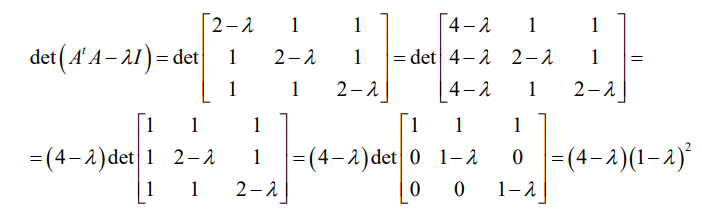


 haughty berry
Characteristic polynomials?