#linear-algebra
2 messages · Page 263 of 1
 autumn kraken
I got what you're saying
thanks
<<M>> is the smallest subspace that contains <M>, and <M> contains instself, thus <M> is the smallest subspace that contains <M>, thus <<M>> = <M>
right?
 marble lance
@autumn kraken yep
autumn kraken
I always think I need to write something down with math symbols
dunno why
<M ∩ N> = <M> ∩ <N>
This is false right?
I think I have a counter-example but not sure
autumn kraken
hm I don't think I understand that example
isn't then <M>={(x,x) | x in R} and <N> too?
 errant mist
This is defined for $x \in \mathbb{R}^n, x \geq 0$. Im not sure I understand the equivalency described here. How exactly do we get $||x||_2 \leq 1$ here?

 stoic pythonBOT
Fredrikpiano
 marble lance
Let y = x/norm(x)
errant mist
I believe it should relate the cauchy-schwarz inequality
errant mist
marble lance
Let y = x/norm(x)
right, that works
we are allowed to make that replacement since norm(y) = 1 right?
marble lance
Yeah
Possibly you have x = 0
Then that doesn't work
But then norm(0) <= 1
So treat it as a separate case
errant mist
thanks)

 zinc timber
what is the question?
find the true one?
do you know that $\det(MN) = \det(M)\det(N)$?
stoic pythonBOT

 azure bolt
yes
zinc timber
use it to find which one is true
zinc timber
yes I am
 keen carbon
Hey guys, say I'm given a square matrix X but then I change only one of the columns so I have a new matrix X'. Is there a quick computation for the determinant of X' in terms of the determinant of X
Specifically, all the values in each matrix are uniformly distributed from 0 to 1, but then the new matrix X' will keep all the values the same except for one row which are new random values
keen carbon
It's alright, just something that can guide me in some direction would be helpful
yeah, the det is almost always not 0
zinc timber
then you can write the new col in terms of the linear comb of the col vectors
but finding the coefficient is not that fast so don't think it'll give you any speedup to begin with
keen carbon
so the new col in X' can be written as a linear combination of the col vectors of old matrix X
zinc timber
yes
keen carbon
ah I see
keen carbon
yeah, but then I'd have to compute the coefficients in terms of the column vectors which may take some time you said
azure bolt
zinc timber
find the true one?
help me please
I try to solve and give me 3 solutions...
zinc timber
which ones
azure bolt
 azure bolt
zinc timber
which ones
azure bolt
zinc timber
which ones
the result it is correct?
 median ocean
@zinc timber yes I’ve found the QR
zinc timber
azure bolt
the result it is correct?
yes?
zinc timber
median ocean
<@!468830761261203476> yes I’ve found the QR
So now you have $QRx = b \implies Q^TQRx = Q^Tx \implies Rx=Q^Tx$
stoic pythonBOT


 zinc timber
Q^T
median ocean
zinc timber
So now you have $QRx = b \implies Q^TQRx = Q^Tx \implies Rx=Q^Tx$
So I first do Q transpose QR*x
zinc timber
Q^tQRx = b
median ocean
Qtranspose x Q x R x X
 median ocean
zinc timber
Q^tQRx = b
median ocean
zinc timber
Q^tQRx = b
That’s what I got it from

 zinc timber
median ocean
That’s what I got it from
zinc timber
median ocean
That’s what I got it from
??
zinc timber
azure bolt
where are you stuck?
 dark brook
If v is orthogonal on every column in A, what subspace is v in?
 outer goblet

translation:
let
where a, b, c, and d are real numbers, and let
show that p(A) is equal 2x2 0 matrix, such that
is
so obviosuly is i change lambda into A i get
det(A-A) = det(0) = 0
but why is 0 determinant allowed to be considered a 0 matrix
 dusky epoch
you cannot change λ into A in det(λI - A)
 ionic laurel
Hi I have a question
dusky epoch
outer goblet
what else would p(A) mean
it means p(A) = α_2 A^2 + α_1 A + α_0 I
but plugging A into det(λI - A) makes no sense
A is a matrix and so is p(A)
p(A) is the zero matrix but not zero as a number
stoic pythonBOT
eswag
Compile Error! Click the  reaction for more information.
(You may edit your message to recompile.)
 ionic laurel
okay im pretty bad at inputting matrices using texit
dark brook
doing a 5x5 matrix?
ionic laurel
6x5
dark brook
Use #latex-testing if you want to 🙂
 signal mulch
Can someone help with Part B? I know that I need to prove that M has n linearly independent eigenvectors but I'm not sure how to prove it

I'm done part A, and got 2 distinct values to be 0 and 1
stoic pythonBOT
eswag

 lavish jewel
to make sure, do you mean the span of the columns of the matrix, or the span of a set that contains the matrix?
ionic laurel
yea my bad i mean the columns of the matrix
im not good at using texit sorry
so the problem thats given to me is that those columns of the matrix span the subspace W of R^6
it says to find a basis for W but the columns are not linearly independent
And the hint is to treat W as the column space A
assuming A is a matrix made up of those 5 columns
is the basis just picking out the columns with pivots? @lavish jewel
lavish jewel
yep
dark brook
C(A) 🙂
lavish jewel
the column space is the vector space spanned by the set of vectors that make up the matrix columns
ionic laurel
right
and the nonpivot columns can be written as linear combinations
of the pivot columns
lavish jewel
that is not the full story, but yes
ionic laurel
okay one more question
signal mulch
signal mulch
Can someone help with Part B? I know that I need to prove that M has n linearly ...
@lavish jewel Can you help me with this question?
ionic laurel
So if i make a new matrix out of those pivot columns into a matrix B
and do QR factorization
If I were to multiply Q * Q^T as well as the orthogonal projection of an orthonormal basis onto the perpendicular subspace, then would adding those two matrices result in the identity matrix?
lavish jewel
signal mulch
<@!467435887236612106> Can you help me with this question?
think of what happens to vectors y = Ax, and Ay = A^2x
lavish jewel
ionic laurel
If I were to multiply Q * Q^T as well as the orthogonal projection of an orthono...
what's Q, and orthogonal complement to what?
signal mulch
lavish jewel
think of what happens to vectors y = Ax, and Ay = A^2x
Vector y? could u explain how u got that?
ionic laurel
lavish jewel
what's Q, and orthogonal complement to what?
Let's say if A is an mxn matrix with linearly independent columns using basis of W, A can be written as QR where Q is an mxn matrix whose columns form an orthonormal basis for ColA and R is an nxn upper triangular matrix
lavish jewel
any vector y that you get out of multiplying an arbitrary vector x with A
ionic laurel
And if we find Q from augmented matrix using the basis for W perp,
Would adding those two matrices equal to the identity matrix
 lavish jewel
you could see this by noting that QQ^T + PP^T (where P is a matrix whose columns form an orthonormal basis for the orthogonal complement of the span of the columns of Q) can be rewritten as a sum of rank 1 matrices, each of which is the outer product of one of the columns of Q or P with itself
so it's equivalent to augmenting Q and P into a matrix, let's say M, such that M = [Q P], which by construction has columns that form an orthonormal basis for the whole vector space, and writing MM^T
then we would have that M^TM = I, and since M is squared, MM^T = I as well
median ocean
@lavish jewel could you help me
zinc timber
signal mulch
Can someone help with Part B? I know that I need to prove that M has n linearly ...
I have different approach to b, given p^2-p = 0 means that f(x)=x^2-x is an annihilator of M. Now it means that the minimal poly must divide f(x) so possible forms of minimal poly are m(x) = x, x-1, x(x-1). either case, the minimal poly splits into linear factor and has only one factor of each, (forgot what it's technically called) so M is diagonalizable. It may not be solution you were looking for tho
zinc timber
median ocean
<@!467435887236612106> could you help me
I still have no idea what your question is
 wintry steppe
zinc timber
I have different approach to b, given p^2-p = 0 means that f(x)=x^2-x is an anni...
wintry steppe
zinc timber
I have different approach to b, given p^2-p = 0 means that f(x)=x^2-x is an anni...
i love this
best solution
zinc timber

wintry steppe
i really like arguments in linear algebra that work with the minimal/characteristic polynomials
very pleasing to me
zinc timber
yes same
wintry steppe
e.g. if T is an operator on a real vector space of finite dimension with T^2 = -I, then V has even dimension
zinc timber
I remember that one
wintry steppe
m(x) has to divide x^2 + 1, so it's just x^2 + 1, and since the minimal and characteristic polynomials have the same irreducible factors, the degree of the latter is 2n for some n
it's cute
there is an easier way to see this though
just define (a + bi)v = av + bTv and check that this extends the real structure to a complex one
fun stuff!
zinc timber
 zinc timber
wintry steppe
m(x) has to divide x^2 + 1, so it's just x^2 + 1, and since the minimal and char...
zinc timber
wintry steppe
m(x) has to divide x^2 + 1, so it's just x^2 + 1, and since the minimal and char...
is det(M+eI) = det(M)+e tr(I) true here also?

 teal grotto
zinc timber
teal grotto
zinc timber
this is going to distract me. musn't... think... about... why this is true
zinc timber
think you cn take Eii but idk a better approach
teal grotto
welp, ive been working on my cs project all day anyway
um
i was trying to just symbol bash it but i dont think that gets anywhere
teal grotto
zinc timber
is det(M+eI) = det(M)+e tr(I) true here also?
this one is kinda crazier tho. every matrix can be well approximated by an invertible one
zinc timber
every matix is almost diagonalizable as well
teal grotto

zinc timber
in C tho
teal grotto
oh sheet true
zinc timber

teal grotto
zinc timber
think you cn take Eii but idk a better approach
so you were gonna show that PE_ii = E_iiP for all i
teal grotto
zinc timber
if A+B=AB prove AB=BA
nah i dont believe this one dude
zinc timber
it's true
teal grotto
i
zinc timber
i don't either but
answer is true
so i must prove it
these guys do set some good problems
teal grotto
yea fr
teal grotto
zinc timber
there's more u wanna try?
sure
teal grotto
zinc timber
I could use some help fr
we can be stuck together

 spring pasture
zinc timber
if A+B=AB prove AB=BA
spring pasture
zinc timber
if A+B=AB prove AB=BA
Can be done by BA=A+B right 
spring pasture
By showing that
spring pasture
A+B=AB
So AB-A-B=0
So (B-I)A-B=0
I guess I'm going right here
So (B-I)A-(B-I)-I=0
(B-I)(A-I)=I
(A-I)=(B-I)
I=(A-I)(B-I)
I=AB-A-B+I
Gimme a sec
lavish jewel
not sure what you did to get to (A-I) = (B-I)
spring pasture
I wanted to get BA
lavish jewel
the rest looks ok so far
zinc timber
so you showed B-I and A-I are inverses that I understand
spring pasture
Oh yeah I screwed there
spring pasture
(B-I)(A-I)=I is clear upto this
lavish jewel
yep
spring pasture
So yeah we swap it
zinc timber
this was more ring theory than LA
lavish jewel
(a-i)(b-i) is what you started with
spring pasture
Yeah feels like that
spring pasture
spring pasture
A+B=AB
So AB-A-B=0
So (B-I)A-B=0
I started here
lavish jewel
(b-i)(a-i) = i expands into ba = a + b, and you're done
zinc timber
yes
spring pasture
Yeah or (B-I)(A-I)=(A-I)(B-I)
zinc timber
so strange that it's actually true
spring pasture
lavish jewel
but you start with (a-i)(b-i) = i
That's true but how do we come up with it
zinc timber
inverses
lavish jewel
the way you did it is fine, it's just that ryu said "then we just expand (a-i)(b-i)" but that's what you started with
spring pasture
I don't know how I can pull that out directly from knowing A+B=AB
lavish jewel
i'm saying you did it fine but you didn't do the last step right to end up with something that has BA instead of AB
you just multiplied out the same thing again
or well, ryu did
just be careful, you had it right
zinc timber
yes I figured the rest no worries
spring pasture
Yes ik that thing but I'm asking how would I think about (a-i)(b-i)=i intuition directly cuz I won't be thinking that I'll multiply (a-i) and (b-i) by knowing a+b=i
So I just wanted to know is there an easy way to figure out that we have to use such product
lavish jewel
you did some arithmetic to show that (A-I)(B-I) = I
if the matrices are square, this is enough to say they are inverses of each other
teal grotto
zinc timber
i think for this one, we want to look at eigen spaces or something
something with eigenvalues
zinc timber
easy argument, P is diagonalizable, so for M to commute with P, it must have to be simultaneously diagonalizable. so asfhasekfa and M is scalar
teal grotto
damg how is P diagonalizable
zinc timber
zinc timber
I have different approach to b, given p^2-p = 0 means that f(x)=x^2-x is an anni...
^
teal grotto
oh that was for that problem
lavish jewel
it was for someone else's, but happy coincidence
teal grotto
o
teal grotto
zinc timber
is det(M+eI) = det(M)+e tr(I) true here also?
lol is this one still up for grabs
zinc timber
yes
teal grotto
f(x) = det(A + xI) is a real polynomial in x right
zinc timber
yes
teal grotto
wut
teal grotto
why
wait
f(x) has at most n roots
so for small enough x, det(A + xI) should be non-zero
i think that does it
like theres only finitely many roots to this poly. you can just zoom in on a neighborhood of zero and miss all of them
zinc timber
lol
zinc timber
proof my imagination
teal grotto
lol
um. hmm.
if there are no zeros then were done, since A + xI is invertible for all x
if theres only one then we obviously done
otherwise, take the minimum distance between all the roots
call this r
fuck
zinc timber
teal grotto
nooooo its so close aah
if we can show this then we're good, cus we can get a sequence of A + x_n I converging to A
all invertible

agh
purple dots are the invertible ones that approximate some non-invertible matrix A
spring pasture
Is that mitochondria?
teal grotto
red squiggly is the det(A + xI) function
zinc timber
lol
teal grotto
spring pasture
Is that mitochondria?
powerhouse of the cell
spring pasture
The only definition I remember 
 rigid raft
is this chat free to ask a question?
zinc timber
always is
rigid raft
is what ive done right to find the hermitian? is that what I should be doing to solve 1, and if it is what do i do from there? make it equal to T hat?

 worldly merlin
Are there other vector spaces apart from {0} that only have a single basis?
wintry steppe
the field {0, 1} over itself?
worldly merlin
wintry steppe
the field {0, 1} over itself?
makes sense, thank you!
worldly merlin
I'm trying to determine in which cases there is only a single isomorphism from a vector space to its dual. Is it true that this is the case iff the vector space only has a single basis?
It holds for the above two examples and I know that when a vector space has multiple bases we can construct multiple such isomorphisms
but I'm not sure if there are spaces with a single basis for which we can still construct multiple such isomorphisms
teal grotto
try taking a basis of any vector space and making a new basis, but not by permuting the elements
worldly merlin
yes, then we can get a different isomorphism right?
but I'm trying to go in the other direction
teal grotto
no, this will show that if a vector space has exactly one non-empty basis, then it has to be isomorphic to Z/2Z
worldly merlin
alright
zinc timber
rigid raft
is what ive done right to find the hermitian? is that what I should be doing to ...
didn't understand the notation, ik bras and kets but what's ⟨..|+tj|...⟩
 vast iron
rigid raft
is what ive done right to find the hermitian? is that what I should be doing to ...
vast iron
rigid raft
is what ive done right to find the hermitian? is that what I should be doing to ...
Taking hermitian conjugate means you also reverse the order of multiplication, and also convert scalars into their complex conjugates:
$$(C \ket{A} \bra{B})^{\dagger} = C^{}\ket{B} \bra{A}$$
Applying that here yields
$$\sum t_j ^{} \ket{j+1} \bra{j} + t_j ^{*} \ket{j} \bra{j+1}$$
stoic pythonBOT
Dovahkiin
 vast iron
Where summation is over j on both terms, obviously.
Compare this with T, should be obvious under what condition they're both equal.
Probably don't use Dirac notation in math server lest you want to get murdered 
rigid raft
so $t_j$ must be complex?
stoic pythonBOT
nova
 vast iron
rigid raft
so $t_j$ must be complex?
vast iron
rigid raft
so $t_j$ must be complex?
t_j is a complex number. If you compare T and it's conjugate, you see that the condition for T to be hermitian is that t_j* = t_j, or that t_j is real
(or t_j is complex with zero imaginary part)
vast iron
Yeah and keep the Kronecker's delta in your mind.
rigid raft
okay thank you :))
rigid raft
vast iron
Yeah and keep the Kronecker's delta in your mind.
wait so itd just be $t_j\ket{j+1}$?
stoic pythonBOT
nova
 signal mulch
zinc timber
I have different approach to b, given p^2-p = 0 means that f(x)=x^2-x is an anni...
signal mulch
zinc timber
I have different approach to b, given p^2-p = 0 means that f(x)=x^2-x is an anni...
Hey! sry for the late reply
but any idea how I can solve it using rank and nullity theorem?
vast iron
rigid raft
wait so itd just be $t_j\ket{j+1}$?
Split the summation into two
$$\sum (t_j \ket{j} \bra{j+1} \ket{i}) + \sum (t_j \ket{j+1} \bra{j} \ket{i})$$
Which is equal to
$$\sum (t_j \ket{j} \delta_{i, j+1}) + \sum (t_j \ket{j+1} \delta_i,j)$$
The first summation is 0 except when $i-1=j$, and the second is 0 except when $i=j$, so
$$t_{i-1} \ket{i-1} + t_i \ket{i+1}$$
stoic pythonBOT
Dovahkiin
 teal grotto
@signal mulch
if k is an eigen value of M for non-zero x, then we have
Mx = kx --> M(Mx) = kMx = k^2x = M^2x = Mx = kx. so k(k-1)x = 0 thus k = 0 or k = 1.
it suffices to show that the two eigen spaces intersect trivially. if v_0 satisfies Mv_0 = 0 and v_1 satisfies Mv_1 = v_1, then if av_0 = -bv_1, we have 0 = -bv_1 so b = 0. but since v_0 is non-zero, then a = 0
the two eigen spaces form a direct sum of V, so M is diagonalizable (assuming that M has at least one eigen value)
rigid raft
vast iron
Split the summation into two
$$\sum (t_j \ket{j} \bra{j+1} \ket{i}) + \sum (t_j ...
thank you so much, I really appreciate it :))
vast iron
Np, have fun
signal mulch
teal grotto
<@!317690495109300224>
if k is an eigen value of M for non-zero x, then we have...
after solving part a, I got that A has 2 distinct eigen values and those are 0 and 1
essentailly what Im trying to show using rank and nullity theorem is this:
 teal grotto
M doesnt need to have two distinct eigen values. consider M = I
signal mulch
ohh i see
I have a quesiton
what do we know about matrix M? like how many pivot points does it have?
it would be n right?
teal grotto
it has rank(M) = n - null(M) pivots
teal grotto
signal mulch
essentailly what Im trying to show using rank and nullity theorem is this:
this is rank nullity. there is nothing to show. you already know this
zinc timber
teal grotto
<@!317690495109300224>
if k is an eigen value of M for non-zero x, then we have...
correction, eigen spaces intersect trivially doesn't mean it's diagonalizable
 crystal oracle
How to show $(I+ST)^{-1}S=S(I+TS)^{-1}$?
stoic pythonBOT
Phi
 zinc timber
S(I+TS)=S+STS=(I+ST)S
teal grotto
zinc timber
correction, eigen spaces intersect trivially doesn't mean it's diagonalizable
eff bro. the dimensions gotta sum up to n
damn my bad homie
zinc timber
doesn't mean diagonalizable
teal grotto
it does. the sum dimensions of the eigen spaces is dim V iff it’s diagonalizable
crystal oracle
zinc timber
S(I+TS)=S+STS=(I+ST)S
Ehh, and what then?
zinc timber
manipulate
crystal oracle
Oh, right, I can multiply by the inverses. Thanks
Waaait. I hoped for a proof that wouldn’t assume that if $(I+ST)^{-1}$ exists, then $(I+TS)^{-1}$ exists.
stoic pythonBOT
Phi

 crystal oracle
Lol this is the problem I was originally trying to solve.
 crystal oracle
I was trying to prove that if one is invertible, the other one also is. I wanted to use Woodbury identityy, the proof of which used the identity I gave above.
zinc timber
well I don't want to spoil it but
u can try looking into sylverter's law of determinant
crystal oracle
Alright thanks. Although I hate deteterminant so perhaps I’ll try to prove it in some other way.
zinc timber
@crystal oracle can you prove that ST and TS have same eigen values?
if yes, and I+ST is invertible means -1 is not an eigen value of ST, therefore not an eigen value of TS as well, so I+ST and I+TS both are invertible
crystal oracle
zinc timber
if yes, and I+ST is invertible means -1 is not an eigen value of ST, therefore n...
This is clear. But so far I don’t see why they have the same eigenvalues. Thanks for help, I need to go now, will try to solve this later.
zinc timber
"left as an exercise"
 humble meteor
I guess S and T are square matrices. Isn't it that $det(I+ST) = 0$ if and only if $det(ST) = -1$ ? As $det(ST) = det(TS)$ then likewise $det(I+TS) = 0$ only in that case. If the determinant is not zero and the result is a square matrix then it's invertible.
stoic pythonBOT
𝓶𝓸𝓶𝓸𝓶𝓸
 crystal oracle
zinc timber
"left as an exercise"
crystal oracle
zinc timber
"left as an exercise"
Yeah, turns out it's trivial. If TSv=λv, define w=Sv, and then STw=λw.
azure bolt
zinc timber
where are you stuck?
to know which of the lines is correct
zinc timber
crystal oracle
Yeah, turns out it's trivial. If TSv=λv, define w=Sv, and then STw=λw.
kind of,
rigid raft
can anyone point me in the right direction with this? im kinda stuck

 zinc timber
rigid raft
can anyone point me in the right direction with this? im kinda stuck
zinc timber
rigid raft
can anyone point me in the right direction with this? im kinda stuck
is (A+A*) hermitian?
rigid raft
i want to say no
 humble meteor
zinc timber
humble meteor
zinc timber
I thought determinants followed an addition rule. 😦
zinc timber
wish it was true
rigid raft
zinc timber
am I using a wrong definition?
idk, id assume the hermitian conjugate to be A dagger not A*
humble meteor
But det(A - B) = det(A) - det(B), right?
zinc timber
then use A dagger
zinc timber
humble meteor
But det(A - B) = det(A) - det(B), right?
no lol
rigid raft
zinc timber
then use A dagger
so you only have to add A and A dagger and then its hermitian?
humble meteor
zinc timber
no lol
I saw this https://math.stackexchange.com/questions/1943840/determinant-of-a-matrix-subtraction-addition

Mathematics Stack Exchange
I'm trying to find out for square matrices with $n \geq 2$ :
$$ \det(A-B) = \det(A)-\det(B).$$
I know that $\det(AB) = \det(A)\det(B)$, but I'm unable to find proof on why a subtraction (or addit...
Is that not correct?
zinc timber
wait what?
humble meteor
I didn't read the answer properly, so it's my fault. But don't openly laugh at me for making a mistake.
zinc timber

zinc timber
rigid raft
so you only have to add A and A dagger and then its hermitian?
I can't really say for sure that it was the intended solution. not familiar with physics way
rigid raft
zinc timber
I can't really say for sure that it was the intended solution. not familiar with...
ah okay, thank you though
 pearl plaza
rigid raft
can anyone point me in the right direction with this? im kinda stuck
pearl plaza
rigid raft
can anyone point me in the right direction with this? im kinda stuck
Hermitian is similar to transpose, but for complex numbers.
If you can make matrices for transpose, this shouldn't be much of a problem for you.
azure bolt

the subset A is not vector subspace
the subset D is vector subspace
But I can't answer about subset B and C
please help me
azure bolt
MMt means M * the Matrix Transposed
zinc timber
well you can show that 2M doesn't belong to C
zinc timber
just compute (2M)(2M)^T
zinc timber
hm
 zinc timber
azure bolt
iam sorry
zinc timber
azure bolt
iam sorry
stop apologizing 
azure bolt
thank you
 gray dust
 winged prairie
is a linear operator from f: V to V the same thing as an endomorphism
winged prairie
is a linear operator from f: V to V the same thing as an endomorphism
yes
winged prairie
ty
winged prairie
what does it mean for a field to have characteristic
like for example F_256 has characteristic two
what does this mean?
dusky epoch
the characteristic of a ring is the smallest number of copies of 1 that add up to zero if such a number exists, and zero otherwise.
if you're told a ring (or a field) has characteristic 2, it means that 1 + 1 = 0 in that field
winged prairie
ok ty
 fresh socket
Does the kronecker product exist for tensors with rank bigger than 2?
I only ever see it defined for rank 2 tensors
Also is there a relation of the kronecker product to the outer product?
 zinc timber
 tawny grotto
hello so III here is true but i need help with how to figure out the geometric multiplicity for the eigenvalues

i just know the algebraic multiplicity of each is 1
 dusky epoch
@tawny grotto is this an exam? Y/N
wintry steppe
after a shear transformation of a square on a graph, how can i determine if the area is preserved?
i believe its an equation with its matrix?
 nocturne jewel
wintry steppe
after a shear transformation of a square on a graph, how can i determine if the ...
nocturne jewel
wintry steppe
after a shear transformation of a square on a graph, how can i determine if the ...
what tells you how the area changes under a linear transformation?
wintry steppe
nocturne jewel
what tells you how the area changes under a linear transformation?
the determinant?
wintry steppe
if T is R^2 - R^2, what does that mean exactly
wait nevermind
so i take the determinant of the transformed figure and multiply that by the original matrix?
@nocturne jewel
nocturne jewel
No
You asked if a shear transformation (T) preserves area or not
ie you want an area A to, under T, remain with area A
so det(T)=+-1
since $A=\abs{\pm 1}A$
stoic pythonBOT
Mosh
 zinc timber
tawny grotto
its a practice exam
zinc timber
tawny grotto
its a practice exam
not like one's gonna admit it even if it was
wintry steppe
what if i wanted to know if the perimeter is preserved?
nocturne jewel
you'd do a lot of vector norms
wintry steppe
hm
not totally sure i catch that
ok hold on this is my transformation

1 becomes 2
lavish jewel
you're presumably applying the transformation to the position vectors. you can measure the perimeter by making vectors that join pairs of points along the perimeter of the shape, and taking their norms to measure their lengths
mosh suggests you do this before and after transforming
wintry steppe
i seeee what you mean, im not familiar with vector norms so i had to search that up. so A B C and D are coordinates
nocturne jewel
norm aka magnitude aka length
wintry steppe
right
distance between each set of points then i compare that to the values i get in the tranformation i guess
nocturne jewel
You find the perimeter of 1 (which is 4.. cause it's a square of side length 1) and find the perimeter of 2
which is something like 2+2sqrt(2)
wintry steppe
ok yeah that makes sense now
thanks mosh
 vestal yarrow
If I have a system:
$\sum \vec{x_i^T} (\vec{w} \cdot \vec{x_i}) + \sum \vec{x_i^T} b = \sum \vec{x_i^T} y_i$
$\sum \vec{w} \cdot \vec{x_i} + \sum b = \sum y_i$
is there a way I can represent this using Az = c, where $z = \begin{bmatrix} w \ b \end{bmatrix}$
stoic pythonBOT
THEBIGTHREE
 lavish jewel
looks like X^T (Xw + b) = X^Ty
i would advice against using x = [w;b] since you already have x_i for something else
 still lodge
what is the difference between inner product and dot product
i know inner product is a more "general" version
but how
lavish jewel
the dot product is an example of an inner product
an inner product is a map V x V -> F that's linear in the first (or both) argument (more generally sesquilinear) and positive definite
that means it takes 2 vectors and spits out a positive number that can be thought of as a length of sorts
zinc timber
stoic python
**THEBIGTHREE**
I'm not sure what the problem is
zinc timber
lavish jewel
looks like X^T (Xw + b) = X^Ty
oh
lavish jewel
for clarity, the columns of X are the x_i in the original formulation
actually
i have to ask to make sure
what is the dot representing there
elementwise product or dot product?
X^T (X^Tw + b) = X^Ty, on second inspection
zinc timber
tawny grotto
hello so III here is true but i need help with how to figure out the geometric m...
only one option?
feels like multiple option to me tho
vestal yarrow
lavish jewel
elementwise product or dot product?
dot product
lavish jewel
X^T (X^Tw + b) = X^Ty, then
still lodge
lavish jewel
an inner product is a map V x V -> F that's linear in the first (or both) argume...
so suppose we're working in M2(R)
i can define an inner product "however i want" ig
dot product is just an example of one in R^n right
still lodge
ah that's the linear part ig
lavish jewel
however you want as long as it follows the conditions i gave above
still lodge
and as long as it operates on two elements of the same vector space
vestal yarrow
lavish jewel
X^T (X^Tw + b) = X^Ty, then
yeah I guess I could write it like that, but I still need to solve for w and b
zinc timber
though every inner product on finite dims can be written in the form x^TAy where A>0
still lodge
what does it mean for the output to be in a field tho
i havent learned anything about groups, fields, rings, etc.
lavish jewel
vestal yarrow
yeah I guess I could write it like that, but I still need to solve for w and b
then simply let A = [X^T, I] and now you have Ax = y
still lodge
ryu wdym
 zinc timber
seems bout right
zinc timber
still lodge
ryu wdym
what do you mean by 'wym'?
lavish jewel
"what do you mean"
still lodge
my b
but yeah i just wanna understand the rule on the output of the inner product if that makes sense
vestal yarrow
lavish jewel
then simply let A = [X^T, I] and now you have Ax = y
I think I phrased it wrong using Ax = b
in this case it would be A.[w, b] = c
vestal yarrow
lavish jewel
X^T (X^Tw + b) = X^Ty, then
and I dont think this can work since b is a scalar
lavish jewel
ah b is a scalar
vestal yarrow
vestal yarrow
I think I phrased it wrong using Ax = b
in this case it would be A.[w, b] = c
which also probably means this can't work
lavish jewel
you're working with row vectors
that changes things, yes
this is kinda weird if this is really what you mean, btw
cuz you have a sum of b, but b is a scalar
the only way to get this is if you take a vector of 1s and multiply it by b
vestal yarrow
oh yeah i could also just write bn
vestal yarrow
lavish jewel
the only way to get this is if you take a vector of 1s and multiply it by b
why would I need to do that
lavish jewel
if there are different values of b, then it's a vector, not a scalar
vestal yarrow
no its a scalar
vestal yarrow
sorry b*n
yes
originally it was this:
$\sum x_i^T(y_i - \vec{w}.\vec{x_i} + b) = 0$
$\sum (y_i - \vec{w}.\vec{x_i} + b) = 0$
i just broke it up to try and isolate the terms
vestal yarrow
scalar
lavish jewel
what is the sum summing over, i?
stoic pythonBOT
THEBIGTHREE
 vestal yarrow
yeah
vestal yarrow
well the dot product of w and x_i should just be a scalar
so I don't think you need that
well ig removing the sum and representing the X and Y as matricies would work but it seems unncecesary(?)
lavish jewel
you have that \sum (y - X^T w + [1]b) = 0
this is the same as [1]^T (y - X^T w + [1]b) = 0
you can stack w and b together by augmenting X^T with a column of 1s
vestal yarrow
alright yeah that works
so then you can break that up:
[1]^T.(X^Tw) + [1]^T.[1]b = [1]^T.y
is that right?
lavish jewel
right, and you see that gives you the n*b you wanted
vestal yarrow
yeah
vestal yarrow
stoic python
**THEBIGTHREE**
ah thats mb, the (w.x_i + b) should be in parenthesis up there
lavish jewel
ah
vestal yarrow
wait so is the system:
X^T.(X^Tw) + X^T.[1]b = X^T.y
and
[1]^T.(X^Tw) + [1]^T.[1]b = [1]^T.y
hm
 nocturne jewel
 tribal hearth
anyone know how to prove these i suck a proofs?
tribal hearth
anyone know how to prove these i suck a proofs?
what have you tried?
 glad acorn
tribal hearth
glad acorn
tribal hearth
this is basically the reconstruction of inner product by the polarization identity
for (a) and (b)
teal grotto
tribal hearth
do you know what it means for two vectors to be orthogonal? do you know how inner products and norms are related?
 drifting scarab
tribal hearth
drifting scarab
tribal hearth
b) follows directly from a) if you substitute the right vectors
if you defined the norm with a scalar product then it's relatively simple
 sinful valve

the book mentioned like setting j = 1
makes v_1 = 0 ofc however it mentioned changing the second part of the proof
im not too sure what it would change to though
 zinc timber
tribal hearth
zinc timber
tribal hearth
resolved?
zinc timber
@sinful valve so what are you trying to prove?
sinful valve
yeah it was like a specific case they were on about or sumn
like if you selected j= 1
then you could still prove by altering it somehow
zinc timber
honestly I'm not following
the steps you are doing is as follows:
- Check if v1 is 0 or not, if zero remove it, otherwise leave it,
- check v2 is in the span{v1} or not, if yes, remove it, if no, leave it,
- check for v3 ....
.
.
.
you'll eventually run out of v's because your set is finite
sinful valve
huh that's not what the proof is on bout
like they say the largest element of 1 to m
zinc timber
yeah you choose the first vector in you list that turns out to be a LC of the previous ones
sinful valve
oh shit yeah it's just till a_j not 0 then
ig
so the case they had in question was when the vector is the first 1
which makes the linear combo 0 ofc

how does b change for this then they said its obv
gray dust
$u=c_1v_1+\ldots+c_mv_m=c_2v_2+\ldots+c_mv_m$
stoic pythonBOT
RokettoJanpu
 sinful valve
why does that work though
gray dust
v1=0
sinful valve
oh yeah
so thats literally it ight calm
so yeah if j = 1 then the RHS of a which was 0 adds up ye
winged prairie
what does characteristic polynomial have to do with polynomials? i am struggling to see the connection
 dusky epoch
it... is a polynomial in t lol
by the preceding remarks
you might want to show these if you want more explanation
 dusky epoch
in particular, the determinant function is applicable to the ring M_n(F[t]) of matrices with polynomial entries, and it is obvious from the formula for determinants (7.3.2) that the determinant of such a matrix is itself a polynomial.
lavish jewel
what exactly are you struggling with
winged prairie
I didn't understand this "determinant function is applicable to the ring M_n(F[t])"
but now it makes sense
i just didn't read it propely lmao
dusky epoch
lavish jewel
fancy way of saying you can compute the determinant of square matrices whose entries are polynomials
zinc timber
proof of cayley hamilton (|xI-A|)(A) = |IA-A| = |A-A| = 0
autumn kraken
If M is a subspace of V, and f: V -> W is a linear map, how do I start checking if <f(M)> = f(<M>)?
<> being the linear hull
gray dust
unpack all relevant definitions
winged prairie
how do u know when to use det(A-lamba(I)) or det(lamba(I)-A) for eigenvalues ?
zinc timber
both give you same eigen values
winged prairie
so it doesn't matter which one you use?
marble lance
Yes it doesn't matter
winged prairie
ty
 pseudo maple

ho should i prove this, i talked about assosiativity and then i reached to my answer but it does not seem right
zinc timber
can you write $0\in \mbb{F}$ as $\lambda-\lambda = 0 $?
stoic pythonBOT
 still lodge
is it normal for the rational canonical form to feel kinda contrived
still lodge
i do not know modules
still lodge

if i have the polynomial x^4 - 4x^3 + 6x^2 - 4x - 7, is this the right companion matrix
humble meteor
So, if $Q(X) = X^\top A X + B^\top X + c$ then $\vec{\nabla}Q(X) = 2 A X + B$
stoic pythonBOT
𝓶𝓸𝓶𝓸𝓶𝓸
 humble meteor
Where X is a vector, A and B are matrices, and c is a scalar.
Which looks a lot like the rules for polynomial differentiation.
But I don't know why $X^\top A X$ would be 'equivalent' to $ax^2$.
stoic pythonBOT
𝓶𝓸𝓶𝓸𝓶𝓸
 humble meteor
Is there a set of rules for this?
dusky epoch
is there a matrix equivalent for x^3? i can't think of one
still lodge
inf column of zeroes w a 1 in the 4th slot...?
zinc timber
still lodge
think it's ok
humble meteor
zinc timber
matrix cookbook
What's that?
humble meteor
Thanks! Is that the latest version?
 lavish trout

why do I need to prove that T is a scalar multiple of the identity operator?
is it not sufficient to show that any v which is not a characteristic vector is a cyclic vector?
marble lance
I think you are misreading it. You are not using the second statement to prove the first. You are proving the first statement and then using that to prove the second.
lavish trout
No, I think I understand that. It's simple to show that T has a cyclic vector. I don't get why I would also have to show the scalar multiple part
the "either ... or ..."
is this more appropriate in #groups-rings-fields ?
lavish trout
I don't understand how the second sentence is equivalent to the third
marble lance
Assume you have proved the second statement. Now, we want to prove that either T has a cyclic vector or T is a scalar multiple of the identity operator.
So suppose T has no cyclic vectors.
Then by the second statement, that means every nonzero vector is a characteristic vector
Use that to show T is a multiple of the identity operator
lavish trout
is it not saying that the second statement is equivalent to the third?
ionic laurel
Can anyone help me with whether my answer/work for this question is right?
marble lance
lavish trout
is it not saying that the second statement is equivalent to the third?
No?
lavish trout
then why the "hence..."
ionic laurel
(From a past final)
Would you just do [5b1 + 3b2]_C so you would then break it up into
5[b1]_C + 3[b2]_C which is just 5[-1 4] + 3[5 -3] = [10 11] ?
 marble lance
That works
marble lance
Yes
marble lance

marble lance
👍
 wispy pewter
is there a methodical way to solve these with matrices?
 marble lance
Not really with matrices. This is more about knowledge of trig
wispy pewter
$$ a + b\sin^{2}(x) = 2( 1 - 2\sin^{2}(x))$$
stoic pythonBOT
EmilD
 wispy pewter
$$a + (b+4)\sin^{2}(x) = 2$$
stoic pythonBOT
EmilD
 wispy pewter
b = -4 a =2 is that how you do that
wispy pewter
what is the clean way to do it?
 tame mural
I kind of understand why a dot product in R^n is a projection operation
But if I think of the axis as arbitrary
Why does it end up as $|x| |y| cos(\theta)$
stoic pythonBOT
meow
 tame mural
And not sin?
tame mural
Most algebra is non-linear I believe
humble meteor
But "linear algebra" isn't just ax+c. It has non-linear things too.
wintry steppe
quadratic algebra
https://en.wikipedia.org/wiki/Quadratic_form
though these are usually studied in a linear algebra class, they come up in many places
humble meteor
Ah, interesting
wispy pewter
kinda stuck on setting up a matrix for this

I can see that 6ln(x) and 8ln(x) are scalar multiples but not sure which to toss or how to set up a matrix
I know that I can* introduce other equations with the derivatives
humble meteor
In fact, I did see $x^\top A x$ already today, in the context of quadratic implicit curves.
stoic pythonBOT
𝓶𝓸𝓶𝓸𝓶𝓸
 humble meteor
I didn't know where it came from exactly, so this is handy.
wintry steppe
wispy pewter
I can see that 6ln(x) and 8ln(x) are scalar multiples but not sure which to toss...
you can get rid of either of them
you know they can't both be in a basis since they're linearly dependent
so that cuts your basis down to either two or three
after getting rid of one of them are the remaining vectors linearly independent, or do you need to remove more?
wispy pewter
so if I toss the first I have 5A+8Bln(x) + ln(6)Cx = 0
0 + 8B/x + ln(6)C = 0
how do I put that into a matrix?
 hot swallow
quick question, similar matricies have the smae eigenvalue and eigenvectors right?
like do the eigen vectors hve to be exact same and the same amount of eigenvectors?
 tranquil steeple
hot swallow
quick question, similar matricies have the smae eigenvalue and eigenvectors righ...
tranquil steeple
hot swallow
quick question, similar matricies have the smae eigenvalue and eigenvectors righ...
eigenvalues same, not same eigenvectors.
hot swallow
tranquil steeple
eigenvalues same, not same eigenvectors.
https://i.imgur.com/4TsNlBu.png
but these two have same eigen values but are not similar
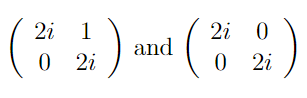 tranquil steeple
correct
hot swallow
ahh i see
tranquil steeple
but similar matrices share eigenvalues. but obviously not eigenvectors
hot swallow
i understand now ty
tranquil steeple
hot swallow
i understand now ty
yeah, so similar matrices implies that they share eigenvalues but sharing eigenvalues does not imply similarity
wintry steppe
wispy pewter
how do I put that into a matrix?
no need to put it into a matrix. can you use this to show that A = B = C = 0, or do you need to do some further reduction of S?
wispy pewter
how are you making the connection that A = B = C = 0?
wintry steppe
that's what it would mean for {5, ln(x^8), ln(6^x)} to be linearly independent
wintry steppe
are you asking how to show that?
wintry steppe
is it clear?
wispy pewter
I dont think so
wintry steppe
if 5A + 8B ln(x) + C(ln 6)x = 0 for all x in (0, 1], and you want to show that A = B = C = 0, then try playing around with the equation a bit
maybe you can put in some points of (0, 1] for x
or use some calculus
wintry steppe
5A + 8B ln(x) + C(ln 6)x = 0 is true for all x in (0, 1]
so you can plug in points
wispy pewter
I know that plugging in points was possible
I just thought we had to show that for all points
so plugging in any one point wouldnt be allowed
wintry steppe
if i let f, g, h, k be the functions on (0, 1] defined by
f(x) = 6 ln x,
g(x) = 5,
h(x) = ln(x^8),
k(x) = ln(6^x),
then S = {f, g, h, k}. you're looking at the subset {g, h, k} and want to show it's linearly independent. this means that if A, B, C are scalars with Ag + Bh + Ck = 0 (i.e. equal to the zero function no (0, 1]), then A = B = C = 0. and saying Ag + Bh + Ck = 0 is the same thing as saying that 5A + 8B ln x + ln(6)Cx = 0 for all x in (0, 1]
to be absolutely precise
wispy pewter
so ok
the only thinking to do here is to see that there is one we can toss
sometimes with vectors there might have been a non obvious linear combination
but you're saying thats not the case here
nocturne jewel
function spaces it's a bit more obvious when things are linearly independent
 nocturne jewel
check if C is invertible
 sacred palm
nocturne jewel
check if C is invertible
sacred palm
nocturne jewel
check if C is invertible
doesnt work
nocturne jewel
wdym doesnt work
sacred palm
determine is 0
sacred palm
nocturne jewel
then solve Cx = that vector
when u say compute (0,1,1)
what do you mean
a bit lost hehe
nocturne jewel
so then solve Cx=that vector
sacred palm
i think im misunderstanding the compute part (im from a french sector just switched to an english school
nocturne jewel
so solve Cx=[8,3,0]
which is turning it into an augmented matrix, then performing row reduction
sacred palm
i get it but how did u get the 8,3,0?
nocturne jewel
I did the multiplication of C and [0,1,1]
nocturne jewel
$\begin{bmatrix}1&5&3\0&2&1\3&-1&1\end{bmatrix}\begin{bmatrix}0\1\1\end{bmatrix}=\begin{bmatrix}0+5+3\0+2+1\0-1+1\end{bmatrix}$
stoic pythonBOT
Mosh
 nocturne jewel
so then solve $Cx=\begin{bmatrix}8\3\0\end{bmatrix}\to\begin{bmatrix}1&5&3&8\0&2&1&3\3&-1&1&0\end{bmatrix}$
stoic pythonBOT
Mosh
 wintry steppe
any1 knows the forumala to solve linear equation word problems?
nocturne jewel
sacred palm
and name the free variables
yep
wintry steppe
tell
nocturne jewel
wintry steppe
tell
wasnt directed at you... however you just read the problem and form an equation/system and solve from there.
wintry steppe
lol 45 problems
sacred palm
nocturne jewel
wasnt directed at you... however you just read the problem and form an equation/...
what answer u got for that problem i sent you or you havent done it?
because I am looking at the answer sheet not sure why its like that
nocturne jewel
,w RREF{{1,5,3,8},{0,2,1,3},{3,-1,1,0}}
stoic pythonBOT


 Requested by Omegabet_#9771
sacred palm
Requested by Omegabet_#9771
sacred palm
got the same answer
nocturne jewel
yeah, so you have x_3 free
 nocturne jewel
x_3 is free, agree?
nocturne jewel
so x_1=1/2 - x_3/2 and x_2 = 3/2 - x_3/2
so x=[x1,x2,x3]=[0.5-0.5x_3,1.5-0.5x_3,x_3]=[0.5,1.5,0]+[-0.5,-0,5,1]x_3
sacred palm
i see
nocturne jewel
so the subspace is 0.5[1,3,0]+[-1,-1,2]t, t in R
the answer in the book likely made x_1 the free variable
 nocturne jewel
 worldly bear
looks pretty linear to me
dusky epoch
@worldly bear see pins
worldly bear
was just joking around lol
dusky epoch
was not clear you were joking
zinc timber
just calculate A and B first
vast iron
Or
A = M L M^-1, B = N L N^-1
=> L = M^-1 A M = N^-1 B N
=> A = M N^-1 B N M^-1
=> P = M N^-1
 wise pollen
hello! so i was given this root / zero, and I was asked to write it in a polynomial equation and i'm not sure how to do it
 marble lance
If a is a root of a polynomial, then x-a is a factor of the polynomial
Here you are given two roots, so that gives you two factors
wise pollen
okay 😄
what's after this?
i don't think my teacher got to discuss to us about imaginary roots so I'm a bit confused with this one 
lavish jewel
it works exactly the same way as with real ones
wise pollen
wait so, I just ignore the imaginary roots and just solve it like a normal polynomial equation given the roots?
dusky epoch
you don't "ignore the imaginary roots"
lavish jewel
i don't think you were asked to solve any equation, you were asked to find a polynomial that satisfies an equation
wise pollen
the instruction says to convert the given roots to an equation. it basically like finding the roots but backwards, instead of finding the roots of the equation, you find the equation of the given roots! 
lavish jewel
sure, so take the roots and use them to build factors of a poly
marble lance
wise pollen
I got the answer now. thank you from the 3 of you! 
 brisk parrot
can someone help pls?

 potent pewter
Hey guys ! this was my first ever Notebook please go through the notebook and give me your responses. Thank you ! https://www.kaggle.com/supreeth888/linear-algebra-for-machine-learning-1
Explore and run machine learning code with Kaggle Notebooks | Using data from No attached data sources
lavish jewel
potent pewter
Hey guys ! this was my first ever Notebook please go through the notebook and gi...
maybe #math-pedagogy is a better fit for this?
it's not wrong here, but you could get more feedback if you also ask there
potent pewter
lavish jewel
maybe <#541382507656904704> is a better fit for this?
I don't have permission to send message there...
lavish jewel
read #get-advanced-access
potent pewter
lavish jewel
read <#790023107708583946>
Thanks mate !!
wintry steppe
Hi! I want to know if (P(e),∩) is a group, P(e) set of sets of e. I found P(e) as identity element ,[∀A,∈(⊂?)P(e) A∩P(e)=A] but does an inverse element exists or is this not a group?
zinc timber
 torpid socket
Hello so for this question Let A∈M6×6(F) with A ^ 3−2I6 =0. Calculate detA.
Can someone tell me how to approach it
stoic pythonBOT
Kanga Gang Annihilator Ann
 dusky epoch
@torpid socket
gray dust
@torpid socket pls dont multipost
torpid socket
Sorry
torpid socket
dusky epoch
<@202860405431861251>
Yes!
torpid socket
dusky epoch
did you mean $A \in M_{6 \times 6}(F)$ with $A^3 - 2I_6 = 0$?
May I ask how do you do that
$A$
dusky epoch
this is a mathematical markup language called LaTeX
torpid socket
Oh
dusky epoch
...
so it doesn't say?
i mean ok, i guess we should assume F is a field that contains whatever numbers we need it to contain
okay so can you tell us what you know about determinants?
torpid socket
Mhm!
dusky epoch
some properties of the det function perhaps
dusky epoch
no, i'm not asking you to write out the definition of the determinant.
i'm asking you to write out some properties of the determinant. or determinant laws, or whatever else you want to call them
torpid socket
Oh just trying to understand your question I apologize
dusky epoch
for example, how could one rewrite det(AB)?
dusky epoch
yes these laws
torpid socket
Oh yeah I know them!
dusky epoch
okay
so consider those laws and A^3 = 2I_6
maybe it might be good to know what det(2I_6) is
torpid socket
Is it not 2?
dusky epoch
no
torpid socket
Oh
Oh yeah I will check
Wait why not check 2I_6?
I know how to solve it thank you so much! @dusky epoch
Im sorry if my questions were stupid still trying to figure my way with determinat 😅
zinc timber
torpid socket
Hello so for this question Let A∈M6×6(F) with A ^ 3−2I6 =0. Calculate detA.
have you asked this question before? I feel like I have seen this one before
torpid socket
zinc timber
have you asked this question before? I feel like I have seen this one before
I asked it in another channel
Never before today tho
ionic laurel
Hi I have a question
Let's say given this span of vectors

with A being the matrix of those 5 vectors treat W as colA
however the rank of this matrix is 3
so to find a basis for W perp would i just take the columns with a pivot and transpose it (lets say matrix B) so that Bx = 0?
would that be the basis for W perp?
lavish jewel
why the transpose?
ah i see why the transpose lol
yes
i was mixing it up with the null space. you can do it as you say
 raven parrot
What are some applications of Diagionalization?
I do understand the process of getting D from P^-1 A P
 golden ermine
You can find powers of matrices since, if A = PDP^{-1}, then A^k = PD^k P^{-1} where D^k is the matrix where the diagonal entries are raised to the power of k
 vestal yarrow
Does what I did here make sense?
 ionic laurel
lavish jewel
i was mixing it up with the null space. you can do it as you say
ionic laurel
lavish jewel
i was mixing it up with the null space. you can do it as you say
Hm
I’m just confused because
Would i transpose all 5 vector columns
Or would i just take the 3 columns with pivots and transpose that
Thats my concern
 tropic pebble
I am wondering why c = [-1,-1,-2]. I thought x would be positive. Can anyone explain? TIA

 halcyon spindle
tropic pebble
I am wondering why c = [-1,-1,-2]. I thought x would be positive. Can anyone exp...
halcyon spindle
tropic pebble
I am wondering why c = [-1,-1,-2]. I thought x would be positive. Can anyone exp...
You don’t really have to do much if you can see it has a negative z. There only one vector in the picture that satisfies it.
tropic pebble
@halcyon spindle I know. But, why x is -1
halcyon spindle
Tho it does look wrong
tropic pebble
?
halcyon spindle
Yeah that what I just noticed
tropic pebble
The graph is wrong?
tropic pebble
Oh, I struggled with this question, and it turns out that the graph is wrong omg
so, which part is wrong?
halcyon spindle
tropic pebble
so, which part is wrong?
You can’t be sure ask your teacher. My guess is it option d.
vestal yarrow
I think it just looks weird in a 2d representation, not sure how you could clearly show the -x component from that angle
halcyon spindle
Wait his right.
tropic pebble
So, why x is negative then
vestal yarrow
It’s negative in the graph, you just can’t really tell because of the angle it’s shown at
That’s what it seems like to me anyways
tropic pebble
So, the graph is wrong?
vestal yarrow
No the graph is right, but unclear
halcyon spindle
The graph right.
tropic pebble
I see. What if the question asks me the coordinates of c instead
or the sign of x, y, z
vestal yarrow
I would hope they wouldn’t from that angle. You could bring it up with your teacher ig
tropic pebble
Gotcha. Thank you guys so much!
wintry steppe
hi all. i am trying to prove something like the following: "let V be a vector space of matrices equipped with some norm, |.|. then there exists a C such that, for any A in V, A_{i, j}/|A| < C". is this a dumb idea?
 loud halo
wintry steppe
hi all. i am trying to prove something like the following: "let V be a vector sp...
loud halo
wintry steppe
hi all. i am trying to prove something like the following: "let V be a vector sp...
no, it's not dumb.
as long as V is finite dimensional, all norms on it are equivalent.
so you can lower bound by the L^infinity norm, that just takes the max absolute value entry of your matrix
wintry steppe
@wraith wren that is more or less what i am trying to prove (all norms are equivalent for matrix norms)
 wraith wren
wintry steppe
<@!684674576998858770> that is more or less what i am trying to prove (all norms...
wraith wren
wintry steppe
<@!684674576998858770> that is more or less what i am trying to prove (all norms...
why are random people pinging me?
loud halo
i think they're trying to ping other kanga gang people and not recognizing there's many lol
wintry steppe
i have seen a proof for vector norms, but it relied on the particular properties of the 2 norm for vectors. oh yeah sorry my bad
wraith wren
also, where's the question?
loud halo
wintry steppe
hi all. i am trying to prove something like the following: "let V be a vector sp...

wintry steppe
|.| is not necessarily induced by a vector norm
zinc timber
you can map a matrix to n² dim VS

 loud halo
by vector norm i mean that any vector space of (finite dim, nxn) matrices is isomorphic to a vector space consisting of column vectors with n^2 entries
zinc timber
like finding an isomorphism to Rn² and use eqv norms
loud halo
not like operator norm induced by a vector norm
wintry steppe
ok, just wanted to call that out
zinc timber
very complicated way to define a norm but a norm nevertheless