#linear-algebra
2 messages · Page 259 of 1
 still turret
 wintry steppe
yeyeyeye and no problem!
 modest notch
Can someone give me a hint on how to show that if A^2 is equal to the zero matrix, then the only eigenvalue of A is 0? I've already shown that 0 is an eigenvalue, but I'm having trouble showing that it's the only one
 teal grotto
if Ax = kx then A^2x = k^2x = 0 so k^2 = 0 since x is assumed to be non-zero
 viscid lagoon
A finite cycle group is a group with the elements $\left{1, a, a^{2}, a^{3}, \cdots, a^{n-1}\right}$ such that $a^{i} \cdot a^{j}=a^{(i+j) \bmod n} \text { and } a^{n}=1$. Let $A,B$ be finite cycle groups of finite order. Show that A is isomorphic to B if $#A = #B$.
 stoic pythonBOT
lewis
 still turret
(found the error)
 tired fossil
Hello guys, does anybody know how to do d?

 glass axle
cofactor expansion
tired fossil
So det of each element of the matrix?
 half ice
How did you do a-c?
tired fossil
half ice
How did you do a-c?
i didnt, but i am only doing the ones that have answers in the back of the book
still turret
can anyone explain me how to do this
 half ice
@tired fossil
If you've never taken a determinant before, check up on YouTube
tired fossil
half ice
<@397943109239177217>
If you've never taken a determinant before, check up on Y...
I got 2 for d
i know how to do a determinant, but how do i know what c is?
tired fossil
still turret
can anyone explain me how to do this
for this one if I am not mistaken you do [3,4//4, -1]=[1//0] and [3,4//4, -1]=[0//1] for each case you use x and y and multiply them by the 3x2 matrices and subtract them, you should get two columns, that is you A matrix
@still turret

 still turret
,rccw
stoic pythonBOT
 tired fossil
Tahts just the question
wintry steppe
my professor's being a little condescending about this question, so if anyone who's taken linear algebra before could help out, it'd be much appreciated

tldr; the question is “if we use the second biggest eigenvalue” if it says 1, 1, -1, do i pick 1 or -1
half ice
I'm not learning from that professor, and cannot intuit what exactly they mean any better than you can
still turret
your professor uses discord lol
wintry steppe
"largest means >" 
fair, just based on the slide/concept it’s based on i’m trying to get advice from people who’ve studied this concept
wintry steppe
still turret
your professor uses discord lol
yeah lol he doesn’t respond v well tho
half ice
Honestly, if the question is "What is the second largest" then just list them all in order
You can't be wrong
wintry steppe
no like the issue is there’s a repeating eigenvalue
it’s 1 with algebraic multiplicity 2
and -1 with algebraic multiplicity 1
half ice
So write -1, 1, 1 kekw
I don't see why they'd ask "what is the second largest" specifically
Seems odd
wintry steppe
i’m not solving for eigenvalues - it’s asking me for the second largest one because that’s what you need for constrained optimization problems
it’s used for the maximum value of a constrained function on some surface plot

which looks like this
 tired fossil
 granite kraken
Idk
granite kraken
Idk
didnt work
wintry steppe
@tired fossil why not take the determinant of the second one and plug in -2 for ad - bc
tired fossil
will try ty
wintry steppe
i think thats probably it - lmk how it works out
tired fossil
I just did b and got the answer like taht so i think it is the same for a
wintry steppe
for sure
 raven badger
Is this phrase true:
All diagonalmatrices in R^nxn space will have at least one eigenvector associated?
wintry steppe
maybe
 winter harbor
If you have a diagonal matrix A = diag(a_1, ..., a_n) and you take e_i = (0,...,1,...,0) the vector whose i-th coordinate is 1 and the others are 0, then:
A(e_i) = a_i * e_i
 lethal tangle
Hi could someone help me with this question please?
 wintry steppe
 stable kindle
what's the intuition
stable kindle
what's the intuition
a geometric way of viewing it is that $$\left.\frac{d}{dt}\right|_{t=0} \det(I + tA) = \mathrm{trace}(A),$$ so the trace tells you how a matrix $A$ "close to $I$" changes volume
stoic pythonBOT
TTerra
 wintry steppe
lethal tangle
Hi could someone help me with this question please?
wintry steppe
lethal tangle
Hi could someone help me with this question please?
do you know how to show something's a subspace?
 wintry steppe
yes
so to show that $U^\perp$ is a subspace of $\bR^n$, you have to check that those conditions hold
stoic pythonBOT
TTerra
 stable kindle
wintry steppe
a geometric way of viewing it is that $$\left.\frac{d}{dt}\right|_{t=0} \det(I +...
stable kindle
wintry steppe
a geometric way of viewing it is that $$\left.\frac{d}{dt}\right|_{t=0} \det(I +...
tf
wintry steppe
the same thing's probably in the thread but with a better explanation
stable kindle
is that even true
wintry steppe
yes
stable kindle
i don't think i can prove it
wintry steppe
you could use one of the long formulas for the determinant involving permutations or cofactors or some messy thing like that
you could also try to relate det(I + tA) to the characteristic polynomial, which you can factor into a product of (t - eigenvalues)
wintry steppe
if you know some properties of the matrix exponential you may also be able to use those
since I + tA = exp(tA) + o(t)
but that might be a nuke
nuke: det(I + tA) = det(exp(tA) + o(t)) = det(exp(tA)) + o(t) = exp(t trace(A)) + o(t) = 1 + trace(A)t +o(t)
wintry steppe
it's the best thing you'll ever learn
stable kindle
bold of you to assume i'll be able to learn it
wintry steppe
you know how the one dimensional ODE x' = cx, x(0) = 1 has the solution x(t) = e^(ct)?
well if you go to n dimensions and replace c with a matrix
the solution is the matrix exponential of tA times ur initial data
it's cool
stable kindle
bruh
wintry steppe
im being a little imprecise
stable kindle
i get the gist of it
wintry steppe
but it's all very natural stuff
 vagrant hazel
Hi, could someone point me in the right direction with this ? All I can figure out is the for all n it is = 1
Find a formula for the general term of the sequence a n where
a_(n+3 )= 5a_(n+2 ) − 8a_(n+1) + 4a_n ,and
a1 = a2 = a3 = 1.
 zinc timber
you are posting this in LA means you want a matrix solution?
vagrant hazel
yes Indeed 😄
zinc timber
you can try similar thing like in the fibonacci seq
$$\mqty[F_{n+1} \ F_n] = \mqty[ 1 & 1 \ 1 & 0 ] \mqty[F_n \ F_{n-1}]$$
stoic pythonBOT
Ryu?
 zinc timber
but since you have 3 starting element, you'll have to form a 3x3 matrix
vagrant hazel
ok thanks ill have a go now 😄
zinc timber
you have to do some diagonalization shit
 worldly bear
i love diagonalization shit
zinc timber

 silver heath
Question.... If we have $PAP^T$ Where P is an orthagonal matrix
stoic pythonBOT
Elonmosqito96
 silver heath
Is this equal to just A?
because P is a rotation matrix
and then we apply the linear transformation A
and then undo the rotation?
Is something wrong with my logic?
 agile bronze
For orthogonal matrices Q with orthonormal columns, transpose and inverse are equal
If PAP^T = A then PA = AP
You can definitely think of a counterexample with an easy A
silver heath
agile bronze
For orthogonal matrices Q with orthonormal columns, transpose and inverse are eq...
yeah ik this statement is false but what is wrong with my logic/geometrically speaking
agile bronze
What you said describes P^-1(PA) = A
The inverse on the right is not the exact same as undoing what P did on the left of A
You might be familiar with matrices acting "on the rows or columns" depending on whether it's on the left or right of a matrix
silver heath
agile bronze
The inverse on the right is not the exact same as undoing what P did on the left...
Wait im confused, does AB apply transformation A and then transformation B? If so doesnt PAP^-1 apply rotation P then transformation A then undo rotation P????????
*edit... what does P^-1 do if its not undoing the rotation then?
agile bronze
ABC applies B to C and then A after (to BC)
silver heath
(AB)C means that A applies to B and then AB applies to C?
agile bronze
To answer your question, the P^-1 does not completely reverse what P did on the other side
silver heath
sry to be a fly, but what does P^-1 do then?
agile bronze
Let's say P on the left did something to the columns of A. Then, P^-1 = P^T did something similarly to the columns (it would be rows since it's on the right, but it's the transpose) again of A.
If anything, they have a constructive effect instead of a reversing effect.
lethal tangle
Hi could someone help me with part c) and d)

 vocal isle
hey folks can someone show me a proof for why the minimum of f(x) is the solution to Qx = c ?

 lavish jewel
if Q is symmetric positive definite, then f(x) is a quadratic form, which is strictly convex
that means that, if it has a minimizer, it is unique, and at that point, the gradient of f(x) will be 0
the gradient of f(x) is precisely Qx + c, and the minimizer x* is found by setting the gradient equal to 0
so that Qx = -c, and x* = Q^-1 c
this isn't really linear algebra, though, in spite of there being matrices and vectors involved. it's part of multivar calc/optimization
you can easily google proofs of the uniqueness of the minimizer of a quadratic form, and also explanations on convex optimization
lots of fun with line segments/convex combinations and setting up nice inequalities based on the definition of convexity
the only real link to linalg is in the final statement that x needs to satisfy Qx = -c, since the problem may have one, infinitely many, or no sols depending on the rank of Q
vocal isle
thanks Edd, Ok maybe i'll use the multivariable calc for further questions. But all of these statements are trival except for the ones which involve linear algebra. For example, why does Q being positive definite mean that it' sstricly convex? Also how do you take the gradient when you've got transposes in there?
solving this in the 1d case is trivial. It's min 1/2 Q x^2 + cx ---> Qx + c = 0 ---> x = -c/Q
but it's the linear algebra part that gets me 😦
lavish jewel
for the gradients, that's still calc. what i can tell you is to use the matrix cookbook and/or look up matrix calculus on wikipedia. at the end of the day, what you want is to write the matrix-vector products as sums and then use your regular calculus rules on each element of the result
for example, x^TQx is a scalar that depends on all of the x_i in the vector x. the gradient is therefore a vector of the same size as x
and you can compute the gradient by differentiating every element in the (double) sum that defines the product x^TQx
you should only need to do it for a couple of elements to conclude that the gradient of x^TQx is 2Qx
as for the part of positive (semi) definiteness implying convexity, gimme a second to fetch some notes
that is a bit more involved
(and also not linalg)
ok, this is the direction convex -> pos semi def

and next, pos semi def -> convex
 vocal isle
thanks Edd
I've also been looking at the following source: I can understand how this is true:

and now i need t somehow use the product rule to show tha tthis is true:

i think d/dx(xTAx) = d/dx(xT b) where b = Ax
then d/dx (xT b) = bT
vocal isle
yes there is, but i'm breaking it into parts
so i'm just considering the xT A x part first
vocal isle
thank you so much! Do you made these, is hat right?
so you made this, is that right **
lavish jewel
yeah
vocal isle
wow impressive, thanks for sharing!
lavish jewel
i don't have any matrix calc stuff in there though, i only use its results in the framework of convex opt
vocal isle
do you have any other notes in convex optimization? At the end of the day thats what i want to really learn 🙂
lavish jewel
i think the references in the pdf will do well
i link to some slides used by other unis, and also to a book and a smaller manuscript by stephen boyd
stephen boyd is pretty up there in convex opt
regarding the derivatives you're looking at rn, i just found this on stack exchange


 warm frost
 lavish jewel
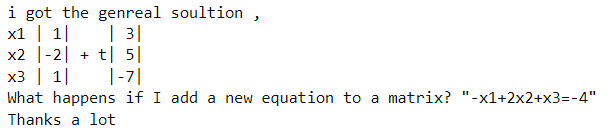
depending on the equation and the original system, either nothing, the system becomes inconsistent, or there is now only one unique solution
vocal isle
thanks Edd, I'll look at all these resources! But there's one thing, in this image, I believe the ansewr is wrong. the answer should be a, not a^T, right?
 lavish jewel
vocal isle
thanks Edd, I'll look at all these resources! But there's one thing, in this ima...
lavish jewel
vocal isle
thanks Edd, I'll look at all these resources! But there's one thing, in this ima...
ah, that's the shitty part
there is no universal convention for this
it could be either
from the linalg perspective, a makes sense because we wanna see what happens to the vectors in the original vector space
thinking about linear transformations instead of elements of the original vector space though, the transpose can make more sense because it is used to define differentials
i.e. the gradient is also a linear transformation, and particularly, it is involved in determining a first order linear approximation to a function
in these cases were we have f:R^n -> R, the line between jacobian and gradient is blurry, i would say 😛 (i might be wildly wrong, i'm not a mathematician)
at any rate, in the real case, this is only a transpose
in the complex case, CR calc time, usually

vocal isle
so are you saying df/dx (where x = nx1 vector) is not well defined?
I would have thought df/dx = [df/dx11; df/dx2; df/dx3 ...]
which is also a nx1 vector
lavish jewel
it is well defined, the notation is not unique
vocal isle
also df/dx1 is the PARTIAL derivative
lavish jewel
and the deal is that the dual space of R^n can be obtained by transposing vectors in it
so the question is, do you want vectors in R^n, or linear maps R^n -> R
and ofc it depends on what you're doing
if you wanna do gradient descent, for example, you care about the gradient as a vector in R^n
in taylor approximations, you care about it as a linear form
so what you have to do is simply make your notation clear
at the beginning of what you're writing, you say something like "we use numerator/denominator notation" or "let the gradient be ... "
teal grotto
the map f(A) = AA^T - I_n from the space of real n by n matrices to the space of real symmetric matrices should be surjective right?
lavish jewel
can't confirm nor deny :x
teal grotto
cry
like, its directional derivatives are, Df_A(V) = AV^T + A^TV
wait
that might be a lie, i need to check something
well, my whole goal was to show that the map from Mat_n(R) --> Sym_n(R) given by AA^T - I_n has zero set O(n)
and that this map was smooth
lavish jewel
what is O(n)?
teal grotto
group of real orthogonal matrices
teal grotto
because this map basically shows you that O(n) is a compact Lie group and an n manifold without boundary as a subset of Mat_n(R) (that last part i also need some help with)
working with manifolds is just super not natural/intuitive for me rn
lavish jewel
i know nothing about them :x let's wait for someone else to materialize
zinc timber
any non brute force method to see why this is true?
$$
\det(AB-BA) =\frac{\tr[(AB-BA)^3]}{3}$$
stoic pythonBOT
Ryu?
 zinc timber
teal grotto
well, my whole goal was to show that the map from Mat_n(R) --> Sym_n(R) given by...
zinc timber
teal grotto
well, my whole goal was to show that the map from Mat_n(R) --> Sym_n(R) given by...
feels like surjective but can't say 100%
teal grotto
i dont think i really need it anyway
i just have no idea how to show that something is a manifold
zinc timber
hmm like you can solve AA^T for any any B+I, feels like it dhould have a solution
teal grotto
yea
been playing around with a bunch of diff expressions. nothing is really working
but again, i dont think i require it. i was confusing something with something else
zinc timber
if B+I is +ve def then cholesky would work
teal grotto
gonna look up what that is later
teal grotto
stoic python
**Ryu?**
is this just true for all square matrices?
teal grotto
that seems crazy to me
zinc timber
IKR

but again, AB-BA has a lot of degeneracy
wait A^TA is always +ve semidefinite but not all symmetric matrix are, don't think it's surjective now @teal grotto
lavish jewel
it does have that -I term that mangles the eigenvalues though
zinc timber
hmm
lavish jewel
since AA^T - I is diagonalizable as Q (D-I) Q^-1, and D has diag entries that are >= 0
teal grotto
stoic python
**Ryu?**

Mathematics Stack Exchange
I want a correct and feasible answer to this question.
So does anyone have any creative ideas to prove this equation?
$A$ and $B$ are $3\times3$ matrices.
$\det(AB - BA) = \dfrac{1}{3}\operat...
these are kinda just answers, but i assumed u wanted one since u were asking here anyways, lol
zinc timber
yeah should have googled first 
teal grotto
its more fun asking here tho
vocal isle
So I've been trying to find a linear algebra way to differentiate xTAx where x is a nx1 vector and A is a nxn matrix. I was previously told that the answer to this is 2Ax. But this is not true! The general answer is (A+AT)x which only = 2Ax if A is symmetric (because AT=A)
i've found these lecture notes, but they only prove the result by breaking it down into its constituent components
is there a "linear algebra way" to find d/dx (xTAx) ?
lavish jewel
ah, i assumed A was symmetric, since you were looking at a quadratic form earlier
zinc timber
yu cn find it componentwise and reconstruct the matrix
lavish jewel
this is calculus, there is no "linalg way" of calculating a derivative
vocal isle
why does quadratic form imply that A must be symmetric? I thought quadratic form just meant 1/2 xTAx + xTb
lavish jewel
all of the properties you see in the matrix cookbook come from doing what ryu says
no, it's only a quadratic form if A is pos semi def
vocal isle
oh
lavish jewel
at any rate, you'd have to split it componentwise and see what you get
say x^T (Ax), then use the chain rule
zinc timber
also A is a quadratic form then you can write A equivalently with a symmetric matrix B, , say B=½(A+A^T)
lavish jewel
you'd get Ax + (x^TA)^T = Ax + A^Tx
(that easily if you already know how to differentiate forms c^T x and Ax, which is done... by looking at it componentwise and learning the result from the pain)
or transpose the result if you like row vectors better
the answer will always be "LoOk aT tHe SuM!"
zinc timber
yeah, I do find the derivatives little confusing in my optimization class
wHeRe ShOuLd thE ^T gO 
lavish jewel

zinc timber
that cook book came in handy tho
 dark brook
If I wanted to check a set of 3 4x1 vectors if they are linear independent, I would just do RREF as one way to do it?
lavish jewel
sure, that would work
dark brook
Would you prefer any other ways?
lavish jewel
on paper, not really
unless the vectors are so simple that you can just look at it and go "ah!", RREF is pretty safe
dark brook
Neat, it is just an assignment, but the exam is going to be on paper. Thanks 🙂
 wintry steppe
is there a way to generalize tensors to fractional ranks? or as the methmeticians would say "extending the definition"
 outer goblet
but isnt q here just 0?
outer goblet
so only if w=(1,1)
 dusky epoch
what no
outer goblet
hm
dusky epoch
do you think span{u_1, u_2} consists of u_1, u_2, u_1+u_2 and nothing else
if so then you have a huge misunderstanding of what span is and should read up on it later
outer goblet
hm
dusky epoch
anyway, you should remember that $\mathrm{proj}{\bd{u}}(\bd{w}) \cdot \bd{u} = \bd{w} \cdot \bd{u}$ and also that $\mathrm{proj}{\bd{u}}(w)$ is parallel to $\bd{u}$
stoic pythonBOT
Ann
 dark brook
When you want to find an orthonomalbasis for V, you'll use the Gram-Schmidt process for finding it, right?
 dim epoch
gram schmidt gives you an orthogonal basis but you can define every element of that basis multiplied with 1/its norm and get an orthonormal basis
dark brook
Yea, I was just not sure if I had to use another gram Schmidt process or the regular one
zinc timber
pretty sure gram-schmidt also includes the normalization
 nocturne jewel
Gram Schmidt orthonormalizes and maintains span iirc
dim epoch
?
teal grotto
bruh i’m misreading things my bad holmes
dim epoch
LOL
all g
uh in my course we just considered them different algorithms
gram-schmidt orthogonalizing algorithm and gram-schmidt orthonormalizing algorithm (idk if that translation is correct)
since the second just includes an extra step after every vector
dim epoch
yeah
i just checked wikipedia
the german article covers both and considers them different processes but the english one only talks about orthonormalizing
 ebon river
Is this correct? If so then is the result not true for $M_n(\mathbb{R})$?
 stoic pythonBOT
MrFlaze
 zinc timber
just describe a little more why E_\lambda = C^n means A = \lambda I
ebon river
zinc timber
just describe a little more why E_\lambda = C^n means A = \lambda I
The maps corresponding to A and $\lambda I$ match on entire domain, so they must be the same right?
stoic pythonBOT
MrFlaze
 zinc timber
yeah
but just write another line showing that
$A-\lambda I = 0 ,\forall v\in V \implies A=\lambda I$
stoic pythonBOT
Ryu?
 ebon river
zinc timber
but just write another line showing that
ebon river
zinc timber
but just write another line showing that
Ohk
But so this doesn't work on $\mathbb{R}^n$ right?
stoic pythonBOT
MrFlaze
 ebon river
Atleast this proof
zinc timber
the proof doesn't but the statement is true
in abstract terms we say that the center of M_n is scalar matrices
ebon river
zinc timber
the proof doesn't but the statement is true
ohh...so can you give a hint as to prove that for that case also?
Since the characteristic polynomial may not have a root, idk how to proceed exactly
zinc timber
I had one approach in mind but I don't know if you'll be able to understand it
let me think of a better one
 gleaming glacier
Hello everyone, im writing a paper on exploring the use of eigenvectors and eigenvalues to solve systems of linear differential equations, and was wondering how to formally explain why each eigenvalue of a matrix will correspond to a unique solution to a linear ODE, could anyone please help? Thank you!
zinc timber
what do you mean by "each eigen value of a matrix will corresponding to a unique solution ..."?
gleaming glacier
systems of linear DEs come in the form y' = Ay, where A is a matrix. Apparently, each eigenvalue of A will correspond to a linearly independent solution to the system of ODEs, but why does this occur? is essentially what I am asking
hope this is a bit clearer!
zinc timber
by unique do you happen to mean Lineary Independent solution?
 random axle
What does it mean 'forms a group'
 gleaming glacier
zinc timber
by unique do you happen to mean Lineary Independent solution?
gleaming glacier
zinc timber
by unique do you happen to mean Lineary Independent solution?
yep sorry
zinc timber
random axle
What does it mean 'forms a group'
anything that contains 'matrix' isn't linear algebra, try #groups-rings-fields
dusky epoch
ryu, did you mean "not everything that contains matrices is linear algebra"?
zinc timber
hm..
dusky epoch
you said $$\forall x (x \text{ contains matrices} \to x \text{ isn't linear algebra})$$ when you meant $$\neg\forall x(x \text{ contains matrices} \to x \text{ is linear algebra})$$
stoic pythonBOT
Ann


 random axle
dusky epoch
anyway
zinc timber

dusky epoch
azeem, do you know what a group is
random axle
a group of what
zinc timber
I'm not gonna edit that, let others enjoy the humor
dusky epoch
a group in the group-theoretic sense
i.e. a set of elements with a binary operation upon it which satisfies a bunch of axioms
random axle
dusky epoch
i.e. a set of elements with a binary operation upon it which satisfies a bunch o...
nope. dont think i have learned it. is it hard to pick up?
dusky epoch
have you encountered this before
oh

what
can you look in your text for the defn of a group
random axle
im using old a-level textbook, it has nothing here on groups
this question is under matrix algebra is there no way to solve the question with just knowledge of matrices?
random axle
oki, thanks anyway
zinc timber
gleaming glacier
systems of linear DEs come in the form y' = Ay, where A is a matrix. Apparently,...
have you solved any system with eigen values/vectors before?
gleaming glacier
yeah ive done some questions n stuff, but intuitively im not immediately sure why this occurs
zinc timber
do you know that distinct eigen vectors corresponding to distinct eigen values are linearly independent ?
it has to do something with this fact
gleaming glacier
ah okay, yeah i seem to remember learning that a bit back
if I may ask, what is the direct relationship between this fact and solns to systems of odes?
zinc timber
say you have 2 distinct eigen values $m_1, m_2$ and the corresponding eigen vector $v_1, v_2$. you write the general solution as $\vb{x} = c_1 v_1 e^{m_1t} + c_2v_2 e^{m_2 t}$
stoic pythonBOT
Ryu?
 zinc timber
so sol corresponding to $m_1$ is $v_1e^{m_1t}$ and for $m_2$ we have $v_2e^{m_2t}$
stoic pythonBOT
Ryu?
 zinc timber
what can you say about them given v1, v2 are linearly independent?
gleaming glacier
im not very sure.... sorry!
zinc timber
ok, how do you solve a system of ODE given eigen values m1, m2?
gleaming glacier
wouldnt the solutions of the system come in the form similar to what you said, such as c1e^m1t and c2e^m2t
random axle
2 more weeks of learning this matrix algebra and then i can leave this channel for good 
zinc timber
gleaming glacier
wouldnt the solutions of the system come in the form similar to what you said, s...
yeah so if $m_1 \neq m_2$ can you write them $e^{m_1t}$ and $e^{m_2t}$ as a constant multiple of other?
stoic pythonBOT
Ryu?
 gleaming glacier
are you asking whether we can write e^(m1)t as c1e^(m2)t or something like that?
gleaming glacier
oh okay, id presume no then right, as they are linearly independent if i am correct (im really not sure, im struggling w lin algebra, thanks for being patient)
gleaming glacier
yep ive learnt it while doing variation of parameters i think
zinc timber
hmm it's basically the same
to show $y_1, y_2$ are linearly independent, you show that $$\left| \mqty{y_1 & y_2 \ y_1' & y_2'}\right| \neq 0$$
stoic pythonBOT
Ryu?
 gleaming glacier
okay sure
okay, so i calculated and since m1 and m2 are different, e^m1t and e^m2t are linearly independent, so then how do i relate it back to the eigenvalues thing?
sorry once again for being a bit slow lol
zinc timber
well yeah
if eigen values are different, the so is the exponential part
so they are LI
isn't that what you were asking?
gleaming glacier
i was more asking why each eigenvalue corresponds to a solution of the system
zinc timber
gleaming glacier
systems of linear DEs come in the form y' = Ay, where A is a matrix. Apparently,...
so you were asking why each eigen vector corresponding to a LI solution
if eigen values are different, then you just showed that $e^{m_1t}$ and $e^{m_2t}$ are LI, so the solution corresponding to them are $\vb{v}_1e^{m_1t}$ and $\vb{v}_2e^{m_2t}$ are also LI
stoic pythonBOT
Ryu?
 zinc timber
so each eigen values corresponding to LI solution of the system
gleaming glacier
ahhh okay, makes sense, thanks a lot for your time haha
nocturne jewel
$\langle v,v\rangle=\norm{v}^2$
stoic pythonBOT
Mosh
 nocturne jewel
picking <> as the dot product gives v.v=|v|^2
 silk scroll
ebon river
Is this correct? If so then is the result not true for $M_n(\mathbb{R})$?
silk scroll
ebon river
Is this correct? If so then is the result not true for $M_n(\mathbb{R})$?
maybe just let B = Eij, then we can get aii=ajj, aij =0 , i not equal j. then we can get A= a11 I. R and C seem no change.
 winged prairie
hey guys i have a question about the dual map. My understanding of this is that the LHS of the equation goes from W'---> V' but the RHS goes from V --> F, so how can they be equal

 north hedge
T' takes in a map phi in W' and gives you back a map in V', yes
and that given map is phi composed T which as you said is from V to F so is indeed an element of V'
T' maps a map to another map so its a little bit of a tongue twister at first
@winged prairie
winged prairie
north hedge
T' maps a map to another map so its a little bit of a tongue twister at first
I understand this part
winged prairie
north hedge
and that given map is phi composed T which as you said is from V to F so is inde...
its this part i am having trobule undertanding
north hedge
T' maps phi which is in W' to phi composed T which is in V'
north hedge
phi composed T is an element of V'
but you can also consider it as a map from V to F
winged prairie
and an element of V' is an element which takes an element in V to an element to F
north hedge
elements of V' are maps from V to F yes
north hedge
its more useful to think of the map V to F as an object thats being mapped onto rather than a map itself in the context
winged prairie
north hedge
its more useful to think of the map V to F as an object thats being mapped onto ...
i don't get this
winged prairie
ye it makes sense when i see it like that
north hedge
north hedge
its more useful to think of the map V to F as an object thats being mapped onto ...
maybe this was phrased badly ignore it lol
winged prairie
phi would be a 1*n matrix right
north hedge
yes it looks like a row vector
winged prairie
ye helps to look at it like that
winged prairie
sorry another theory question, why do we define the annihalitor on a subspace rather than a vector space

 tropic pebble
Anyone knows can geometric multiplicity be zero?
zinc timber
no
GM of an eigen values is at least one, since an eigen value exists mean there is a eigen vector
zinc timber
winged prairie
sorry another theory question, why do we define the annihalitor on a subspace ra...
you can define it on the whole space, but it'll just be the {0} functional
so not much interesting
@tropic pebble@winged prairie
wintry steppe
annihilator of a subspace is just the kernel of the dual map to its inclusion
very natural thing to consider
winged prairie
zinc timber
you can define it on the whole space, but it'll just be the {0} functional
ok ty
outer goblet
is asking for base for eigenspace the same as asking for eigenvectors?
wintry steppe
the word "base" should give it away
outer goblet
so yes or no???
lavish jewel
in general no, because a basis needs to have lin indep elements
zinc timber
wth is a 'base'?
lavish jewel
and the eigenvectors need not be lin indep for defective matrices
i assumed they meant basis
zinc timber
oh
outer goblet
how did i find the eigenvectors then
lavish jewel
anyway, you do need to find the eigenvectors to find if they're lin indep
outer goblet
all the book has is base for eigenspace
tropic pebble
zinc timber
no
thank you!
wintry steppe
If M is a nontrivial subspace of V, what is the linear span of V \ M?
teal grotto
is this V mod M or V cut M
dark brook
This is about the least square method. I've got a function
$f(t) = \alpha_1 (t^2 - 1) + \alpha_2 t + \alpha_3$ and I've put in the values for 4 coordinates (-1,0), (0,4), (1,-2) and (2,2). My question, is it true that I only get two values out for x? I try to do $A^T A x = A^T b$
I get $x = \begin{pmatrix} \frac{1}{3} \ 0 \end{pmatrix}$
 stoic pythonBOT
HrJonas
 wintry steppe
teal grotto
is this V mod M or V cut M
wintry steppe
teal grotto
is this V mod M or V cut M
set difference I believe
stoic pythonBOT
Phi

 dull pilot


the text says that these are easy consequences and thus doesn't bother to prove them
but I don't intuitively see the connection
could someone help explain?
 crystal oracle
@dull pilot What is a_λ and what is g_λ?
dull pilot
the algebraic and geometric multiplicity of an eigenvalue
respectively
@crystal oracle
crystal oracle
@dull pilot About Corollary 42.10. For any n×n matrix, the sum of its algebraic multiplicities is never greater than n, and the sum of its geometric multiplicities is never greater than the sum of its algebraic multiplicities. Having a basis consisting of eigenvectors is equivalent to the sum of geometric multiplicities being n.
About corollary 42.11. If an n×n matrix has n distinct eigenvalues, then it has n distinct eigenvectors, so there is a basis of its eigenvectors, so it's diagonalizable by Theorem 42.9.
zinc timber
stoic python
**Phi**
what's T and T_i, i'm confused
 limber sierra
 zinc timber
hmm So $T_i$ is the row of the matrix, i.e.
$$ T_{ij} = f^{(i)}(x_j)$$?
stoic pythonBOT
 zinc timber
I thought you are talking about a sequence of T_i's
crystal oracle
Oh shit, I made some typos there. One moment.
zinc timber
T \in ?
zinc timber

ebon river
Does this work as a proof or is induction necessary?
 crystal oracle
Rewrote a bit:
Consider the space $\mathcal{P}{m-1}$ of real polynomials of degree at most $m-1$. Suppose $T \in \mathcal{L}(\mathcal{P}{m-1}, \mathbb{R}^m)$ is a linear function s.t. the i-th row of its matrix (w.r.t the basis $1, x, x^2, x^3, \dots, x^{m-1}$) evaluates the $k_i$-th derivative of the polynomial at a point $x_i$. So, $T_{i,j}=(j-1)(j-2)\cdots(j-k_i)x_i^{j-1-k_i}$. Suppose $T$ has the property that, if some row of $T$ evaluates the $(k+1)-th$ derivative at a point, then another row of $T$ evaluates the $k$-th derivative at the same point (we consider the zeroth derivative to be the identity operator). I want to prove that $T$ is invertible.
@zinc timber @limber sierra Sorry for the confusion and for typos. Btw, I no longer think that a simple proof exists because looking up such things on the interwebz gives me blah blah chinese remainder theorem in the best case and huge unreadable formulas in the worst case.
stoic pythonBOT
Phi
 random axle
I am trying to make sense of this proof. What does the first summation represent?
 dusky epoch
the (i,j) entry in AB
zinc timber
stoic python
**Phi**
try to compute the matrix for the given basis and you'll see why this is invertible
random axle
dusky epoch
> the (i,j) entry in AB
But why is that a summation?
limber sierra
do you know how to multiply matrices?
random axle
dusky epoch
> the (i,j) entry in AB
please spell it out for me if you can, it's early morning again
limber sierra
thats just a way to represent a given entry in matrix multiplication
dusky epoch
do you know how to multiply matrices
limber sierra
you multiply every member of the i'th row of A with a corresponding entry in the j'th column of B
and add them together
dusky epoch
this is the definition of matrix multiplication
ebon river
ebon river
Does this work as a proof or is induction necessary?
Anyone?
crystal oracle
@zinc timber Alright, but even for the case of two points and one derivative (so a 4×4 matrix) the matrix doesn't look nice.
stoic pythonBOT
Phi

 crystal oracle
Performing Gaussian elimination on this particular matrix didn't give me any insight on why it would always work in the general case 😦 Alright, I think I'm gonna give up because this is too difficult and not important enough for me. If I ever need this in the future, I think I'll read https://en.wikipedia.org/wiki/Chinese_remainder_theorem#Hermite_interpolation (where I don't understand why a polynomial's remainder after division over (X-x_i)^{r_i} must be its Taylor polynomial at x_i) and https://artofproblemsolving.com/community/c1157h990758


 wintry steppe
or u can just directly use the definition of transpose
random axle
wintry steppe
or u can just directly use the definition of transpose
Show me this method pls
wintry steppe
no
random axle
oh
wintry steppe
(im on my phone and don't wanna type indices)
teal grotto
wintry steppe
or u can just directly use the definition of transpose
are u talking about the dual space def?
random axle
wintry steppe
(im on my phone and don't wanna type indices)
By definition of transpose, what do you mean? I was taught that the transpose is just the rows and columns interchanged. I don't get that fancy double summation thing above
wintry steppe
teal grotto
are u talking about the dual space def?
no just the matrix transpose lol
wintry steppe
random axle
By definition of transpose, what do you mean? I was taught that the transpose is...
rows and columns interchanged, yes
lavish jewel
if your matrix is originally indexed as A_ij, the transpose is A_ji
i had never seen such cursed notation for an identity matrix, what the fuck
teal grotto
stoic python
**c squared**
that’s where i was gonna go with this
teal grotto
lavish jewel
i had never seen such cursed notation for an identity matrix, what the fuck
wait what lol
lavish jewel
why E_ij, what
teal grotto
that’s not an identity matrix
lavish jewel
what do you wanna do with that then
random axle
im so confused
teal grotto
E_{ij} is literally the matrix with a 1 in its ith row and nth column, zero everywhere else
lavish jewel
oh shit you wanted to split it into one matrix per element
teal grotto
yea lol. the thing that bases are used for
lavish jewel
denoting scalars AND matrices as M_ij is cursed anyway
zinc timber
,, (AB)^T = B^T A^T 
stoic pythonBOT
 teal grotto
lavish jewel
denoting scalars AND matrices as M_ij is cursed anyway
teal grotto
lavish jewel
denoting scalars AND matrices as M_ij is cursed anyway
lmao how else do u do it
lavish jewel
why not just use the definition of the transpose
teal grotto
what is this definition that everybody is talking about 💀
lavish jewel
i would use boldface caps for matrices, boldface lower for vectors, and no bold for mats
A^T_ij = A_ji
teal grotto
oh sheet
lavish jewel
what the fuck lol
teal grotto
dying over here rn
lavish jewel
worst part is you were probably gonna use that anyway
but applying it on your cursed E_ij matrices
teal grotto
yea i was holy fawk dude

 lavish jewel

 sudden narwhal
lavish jewel
<:bleakkekw:913344117981999125>
sudden narwhal
lavish jewel
<:bleakkekw:913344117981999125>

lavish jewel
first time that emoji is suitable for a situation
teal grotto
yw
zinc timber
zinc timber

I have to show that it's false, approach I am trying is assuming the EVs are $\lambda_i;i=1, 2, \cdots r$ and we have show that $2^{\sqrt{n}} \leq |\tr(A^n)| \leq 2020\cdot 2^{\sqrt{n}}$
stoic pythonBOT
 zinc timber
i.e. $2^{\sqrt{n}} \leq \sum_{i=1}^r \lambda_i^n \leq 2020\cdot 2^{\sqrt{n}}$ is not possible
stoic pythonBOT
 wintry steppe
M = {(a, b, c, d) : a + b + c + d = 0, b - c + d = 0}
I must find a basis for this subspace. I did the following: a + b + c = b - c, which means a = -2c. So our subspace is M = {(-2c, b, c, d)}. The answer is (for example) B = {(-2, 0, 1, 0), (0, 1, 0, 0), (0, 0 ,0, 1)}.
Could someone tell if this is correct?
zinc timber
no it's not
you have only used one condition, use both and you'll get a 2 dimensional subspace, not 3 dimensional
wintry steppe
Thank you, @zinc timber
teal grotto
stoic python
i feel like something with cauchy schwarz helps here when you square everything
zinc timber
there's a general form of CS which can be used but I don't see how it'll be useful
 bold sun
hey basically i am trying to do this question.....''Prove that a triangular matrix is invertible if and only if its diagonal entries are all non-zero.''
this is how ive started but would it be valid like as a proof for =>
 zinc timber
think about the rank
bold sun
wdym rank?
zinc timber
also you said you are doing for triangular matrix, then why have you written diagonal?
bold sun
cuz i have to prove that diagonals entries are non zero
zinc timber
showing that diagonal entries are non-zero and actually assuming your matrix is diagonal are totally different thing
bold sun
also it didn't specify upper or lower triangular so technically diagonal matrix is a triangular 1 right?
zinc timber
not all triangular matrix can be turned into a diagonal one
wintry steppe
I have to find intersection of two 3D subspaces in R^4. Is there a better way than solving 4 equations system?
bold sun
hmm i thought that diagnal matrix are triangular like both upper and lower?
zinc timber
wintry steppe
I have to find intersection of two 3D subspaces in R^4. Is there a better way th...
honestly use a computer
zinc timber
bold sun
hmm i thought that diagnal matrix are triangular like both upper and lower?
diagonal are triangular, but not the converse
wintry steppe
zinc timber
honestly use a computer
thats my homework unfortunately
bold sun
hmm so how would i start then......
zinc timber
bold sun
hmm so how would i start then......
think about the rank
bold sun
wdym rank?
zinc timber
rank of the matrix
bold sun
sorry never heard of that before ngl
zinc timber
bold sun
i did quick find in notes and the term rank is used in chapter 8 were only on 3 lol....
zinc timber
I would have suggested you to look at the characteristic polynomial, but since you haven't reached that far yet
bold sun
hmm nope aint done that either
 tranquil steeple
bold sun
hmm nope aint done that either
tranquil steeple
bold sun
hmm nope aint done that either
the eigenvalues of the triangular matrix are given by the diagonal. can you invert a matrix with a 0 eigenvalue?
bold sun
whats eigenvalues??
tranquil steeple
😛
bold sun
lol haven't heard of that either- i only began uni and lin algebra 2 months ago now lol so havent done alott
nocturne jewel
Assume A_kk is 0, then Ax=0 has a 0 row, hence a free variable
bold sun
basically we have a test next week so im just trying to revise for that and do as many qs for revison as possible cuz i have no idea what uni tests r like....
nocturne jewel
bold sun
basically we have a test next week so im just trying to revise for that and do a...
They're like regular tests.. just typically shorter
bold sun
nocturne jewel
Assume A_kk is 0, then Ax=0 has a 0 row, hence a free variable
isnt that kind of what i did?
bold sun
nocturne jewel
They're like regular tests.. just typically shorter
ooh really its meant to be like 1hr 15 mins or something but the room is booked fr 2 hrs or smthing....he sed revise proofs multiple choice qs and normal calculation qs so thats basically evrything weve learnt so far...but im doing content propely and im awful at proofs so im focusing on that too
bold sun
nocturne jewel
Assume A_kk is 0, then Ax=0 has a 0 row, hence a free variable
oh so here can i say it haz zero column too so its not invertible too...which is a contradiction?
nocturne jewel
Yeah, you just prove a bigger case, ie Ax=b has a unique solution for all sensible b iff A is invertible
You're proving one of the equivalences in FTIM
bold sun
nocturne jewel
Yeah, you just prove a bigger case, ie Ax=b has a unique solution for all sensib...
oh is that what the q is asking?
nocturne jewel
It's asking for the 3rd statement of FTIM (in typical taught order)
bold sun
FTIM?
bold sun
ooh okk i think it was second fr us
wow okk yeah we only learnt 4 properties out of them
so how would i prove this way then <= assume that it has a uniqe solution prove its invertible?
nocturne jewel
If it has a unique solution, RREF(A) must be I
bold sun
oh ok and if it is an identity matrix then it must have inverse as a(a^-1) is identity matrix
outer goblet
for a set to be a subspace of Rn, its span has to be the same or lower than Rn? right?
like only sets in R1,R2,R3 can be subspaces of R3?
wintry steppe
If basis for A is (a1, a2, a3) and for B is (b1, b2, b3) and (a1, a2, a3, b1, b2, b3) is a lineary independent set, does that mean A intersection B is {0}?
wintry steppe
outer goblet
like only sets in R1,R2,R3 can be subspaces of R3?
R^1 and R^2 are not subspaces of R^3.
outer goblet
sets thru origins in R_1 and R_2 are subspaces of R_3
vectors and planes thru origin are subspaces of R_3
wintry steppe
subspaces of R3 are
a) {(0,0,0)}
b) {t(x,y,z)} (lines)
c) {t(x,y,z) + s(x, y, z)} (planes)
d) R3
outer goblet
yeah thats what i said
wintry steppe
subspaces of R2 are
a) {(0, 0)}
b) {t(x, y)}
c) R2
wintry steppe
outer goblet
vectors and planes thru origin are subspaces of R_3
But R2 is (first, second). R3 is (first, second, third). Right?
outer goblet
i guess so
 spring pasture
wintry steppe
If basis for A is (a1, a2, a3) and for B is (b1, b2, b3) and (a1, a2, a3, b1, b2...
spring pasture
wintry steppe
If basis for A is (a1, a2, a3) and for B is (b1, b2, b3) and (a1, a2, a3, b1, b2...
Not enough info
Are a1,a2,a3,b1,b2,b3 independent or you deducting from A and B basis
wintry steppe
spring pasture
Are a1,a2,a3,b1,b2,b3 independent or you deducting from A and B basis
no vector from B can be expressed as a linear combination of vectors in A.
spring pasture
wintry steppe
no vector from B can be expressed as a linear combination of vectors in A.
So like b1= k1a1 + k2b2 + k3b3
Not all k1,k2,k3 being zeros
wintry steppe
spring pasture
So like b1= k1a1 + k2b2 + k3b3
yeah
spring pasture
Then A intersction B won't be {0}
wintry steppe
thanks. why?
spring pasture
wintry steppe
thanks. why?
For any k in R , kb1 belongs to both A and B
wintry steppe
thank you
 stoic pythonBOT
Toge

 faint dune
do we assume these norms to be compatible with vectornorm
zinc timber
do you know why $\norm{A^{-1}\cdot\delta b} \leq \norm{A^{-1}}\cdot\norm{\delta b}$ is true?
stoic pythonBOT
 zinc timber
,texconfig colour white
stoic pythonBOT
You have switched to the white colourscheme.
faint dune
I can say this is true only if matrix norm is compatible with the vector norm.
zinc timber
yeah that's how you define norms for operators, operator norm are induced norm of the spaces involved
Now $$\norm{b} = \norm{A\cdot A^{-1}, b} \leq \norm{A}\cdot \norm{A^{-1}, b}$$
stoic pythonBOT
 zinc timber
so this gives you $$\frac{1}{\norm{A^{-1}b}} \leq \frac{\norm{A}}{\norm{b}}$$
stoic pythonBOT
 zinc timber
combine it with previous result and you have the what you need
faint dune
ahh thank you.
zinc timber
you should have tried proving this on your own, it's a good exercise
faint dune
it was not a proof task, but yes. The prof just describes steps where I think I am missing an obvious step...
wintry steppe
a = (1, -2, -1), b = (-1, 2, X), c = (1, -Y, 0)
For which X, Y is span{a+b, c}= span{a, b}?
Could someone help me?
outer goblet
how do i know in which order to put the eigenvector bases for a diagonalizing matrix, is it from biggest eigenvalue to smallest?
zinc timber
doesn't matter
tranquil steeple
outer goblet
how do i know in which order to put the eigenvector bases for a diagonalizing ma...
Depends. most numerical solvers return them in non-decreasing order. But you might want them in some other order.
outer goblet
so it doesnt matter?
tranquil steeple
it matters sometimes. but if you know, you know.
outer goblet
i dont know tho
tranquil steeple
then it won't matter for you. 🙂
outer goblet
ait thx
tranquil steeple
outer goblet
ait thx
so, the most standard way would be to sort them in non-decreasing order (real part first if complex). And most svd solvers will return the singular values in the opposite order (non-increasing)
outer goblet
ill just do what the book does cuz im not advanced yet to understand what you mean lol 👍
tranquil steeple
smallest first 🙂
lavish jewel
hmm i'm curious why you'd call non-decreasing the most standard
nocturne jewel
What would you call most standard Edd?
spring pasture
Why would you call Edd?
zinc timber

outer goblet
If im finding basis for column space, i reduce the matrix to row echelon form, note which column number has leading ones, and the base will be the columns that had that number, but in non reduced matrix? right?
or do i have to transpose it first?
silver heath
a
outer goblet
so no transpose?
silver heath
transposing first would get you the row space
which is the same thing as the column space but just transposed
row A^T = col A
outer goblet
thats what i thought too

but the exam solution does this like this

where this is the matrix
silver heath
could you translate the german bit at the bottom right?
outer goblet
its norwegian, but basicaily says that column vectors are (1,2,-2) and (0,1,-3/5)
silver heath
oh sry xD
hmm... not sure. Are we trying to get the row space or the column space here?
outer goblet
column space lol
i mean i checked the span and its the same with those vectors and the vectors i found
im just trying to understand why to solve it weirdly like that
silver heath
Oh wait hahaha...
Elementary row operations don't change the row space
so the pivot rows of the rref matrix is the basis for the row space
outer goblet
so basicailyl they overcomplicate it for no reason at all
silver heath
yep
outer goblet
like using quadratic formula on x^2+2x+1 lol
silver heath
well as you can see its quite obvious this x^2+2x+1 equation is homomorphic to the blah blah blah blah maximums and minimums of the quadratic form in r^6
outer goblet
haha
tranquil steeple
lavish jewel
hmm i'm curious why you'd call non-decreasing the most standard
Most numerical solvers do that (at least for Hermitian matrices. For non-Hermitian, for example, Matlab can return very strange orderings)
Julia is better in that regard.
wintry steppe
I have to find basis for vector space that contains polynomials p degree 3 or less such that p(2) = 2p(1). I just found polynomials of degree 1, 2 and 3 that satisfy that condition. Is there any other way of doing it?
lavish jewel
i would've thought finding them in the reverse order is easier, using something like arnoldi
wintry steppe
wintry steppe
I have to find basis for vector space that contains polynomials p degree 3 or le...
so this is the only way for a beginner? i have just started learning linear algebra
zinc timber
wintry steppe
I have to find basis for vector space that contains polynomials p degree 3 or le...
?
wintry steppe
zinc timber
?
sorry could you explain what is confusing you
zinc timber
oh nvm I was thinking of char polynomial
faint dune
Let | |B| | < 1. Then the matrix I+B is regular. part of proof: | |(I+B)x| | >= (1 - | |B| |) | |x| |. Since 1-| |B| |>0, I+B is injective so regular.
I dont get the last part 😞
wintry steppe
if x is non-zero then |(I + B)x| >= (1 - |B|)|x| > 0, which means you cannot have (I + B)x = 0
or is it the regular matrix part
faint dune
I get ur first line. I have to think about the second. 🦢
wintry steppe
if you had (I + B)x = 0 for a non-zero x (which is precisely what non-injectivity is), then the computation gives 0 > 0
so you gotta be injective
warm frost
Hi guys, i have a question, if i know that A=A^-1, so A=+=I?
(A unit matrix)
@wintry steppe Can you help me please?
warm frost
- = I (unit matrix)
wintry steppe
are you asking if A^2 = I implies A = I?
i don't get what + = I means
if you're reading something can you post a screenshot?
can you type it precisely using the latex bot?
 marble lance
😵💫
 tranquil steeple
wintry steppe
two examples
tranquil steeple
wintry steppe
two examples
For example the discrete sine transform $A_{ij}=\sqrt{2/(n+1)}\sin(ij\pi/(n+1))$
stoic pythonBOT
Sven-Erik
 wintry steppe
cool
tranquil steeple
wintry steppe
cool
julia> n=5; A=sqrt(2/(n+1))*[sin.(i*j*pi/(n+1)) for i in 1:n, j in 1:n]
5×5 Matrix{Float64}:
 0.288675   0.5          0.57735      0.5          0.288675
 0.5        0.5          7.0705e-17  -0.5         -0.5
 0.57735    7.0705e-17  -0.57735     -1.4141e-16   0.57735
 0.5       -0.5         -1.4141e-16   0.5         -0.5
 0.288675  -0.5          0.57735     -0.5          0.288675

julia> norm(A*A-I)
8.446231779064342e-16
 surreal river
how do u find the dimension of kernel and image without calculating kernel and image
wintry steppe
specific example in mind?
A=span{(1,-1,0,2), (3,-1,-3,1), (2,-1,-1, 2)}, B=span{(1,2,-1,-2), (1,-2,-3,4),(-1,-1,3,-1)}
Guys, how do I find basis for A + B? I am confused.
surreal river
 surreal river
wintry steppe
specific example in mind?
surreal river
wintry steppe
specific example in mind?
this matrix
agile bronze
wintry steppe
A=span{(1,-1,0,2), (3,-1,-3,1), (2,-1,-1, 2)}, B=span{(1,2,-1,-2), (1,-2,-3,4),(...
The columns of A are able to be written of a linear combination of the vectors in the first span (and columns of B for second span)
Regardless of what the new columns are in A + B, you should consider how the spans together will contribute
wintry steppe
thanks, @agile bronze
but I didnt understand... are you talking about matrices?
wintry steppe
sorry I am a beginner and havent studied matrices yet
agile bronze
Ok, so are A and B vector spaces?
agile bronze
The set of all vectors expressed with the span is a subspace
Might be more accurate ^
So the span tells you that every vector in R^4 that's in A is written as a linear combination of the 3 vectors you see in that span
Same logic with B's vectors with the span of B
Let's call the vectors in A's span v_1, v_2, v_3, and B's span w_1, w_2, w_3 (the order we label these does not matter). So generally, for any $a\in{A}, a = c_1v_1 + c_2v_2 + c_3v_3 \text{and for any} b\in{B}, b = d_1w_1 + d_2w_2 + d_3w_3$.
stoic pythonBOT
Len
Compile Error! Click the  reaction for more information.
(You may edit your message to recompile.)
 stoic pythonBOT
Len
 agile bronze
$b\in{B}, b = d_1w_1 + d_2w_2 + d_3w_3$
stoic pythonBOT
Len
 agile bronze
The c_i's and d_i's are just the coefficient's that let the vectors a and b be some linear combination of the things in the span
A + B is the vector space of all vectors e = a + b, where a comes from A, b comes from B
So what can you say about vectors e with respect to the above stuff?
wintry steppe
vectors e can be expressed as a linear combination of some vectors from basis of A and of B?
agile bronze
Yep
So we know every vector e can be expressed as a combination of v_1, v_2, v_3, w_1, w_2, and w_3
But the question asked for a basis, which means we want a set of linearly independent vectors
wintry steppe
so i pick any four from basis A and B that are linearly independent? for example v1 v2 v3 and w2?
agile bronze
If v1, v2, v3, and w2 are linearly independent then that's right. You have to check, though. Of course, our basis at least 3 (because the span of A and B should be linearly independent already) and at most 4 (because we always have at most n in R^n).
So picking v1, v2, and v3 and finding which of those w's are independent if any will be your answer.
wintry steppe
I understand. Thank you very much, Len!
agile bronze
no problem
wintry steppe
wintry steppe
A=span{(1,-1,0,2), (3,-1,-3,1), (2,-1,-1, 2)}, B=span{(1,2,-1,-2), (1,-2,-3,4),(...
@agile bronze if you have one more min
And to find a basis for intersection of A and B I have to write some v as a linear combination of vectors in basis of A and then as a linear combination of vectors in basis of B and find coefficients for which equality holds? is there any shortcut?
 gray dust
wintry steppe
<@178711326686838798> if you have one more min
And to find a basis for interse...
gray dust
wintry steppe
<@178711326686838798> if you have one more min
And to find a basis for interse...
pretty much that
wintry steppe
thanks!
wintry steppe
{b1, b2...bn} is a basis for B. L is a subspace of B which contains only linear combinations of b1...bn such that sum of coefficients is 0.
is dim L = n - 1?
x from L
x = -A2(b1 - b2) -A3(b1 - b3) -... -An(b1 - bn)
and basis for L {b1 - b2, b1 - b3... b1 - bn}?
stable kindle
yes
wintry steppe
thanks :)
bold sun
hey sorry if this is a silly question i just wannt this clarifying in maths what does notion mean like for example ''define the notion of a determinant? - would that just be det(a)??
or like define notion of like elementary matrices that would just be e1...ek?
like is it symbols or does it mean to like actually write the defintion of it?
nocturne jewel
notion = idea
Like what's the idea of a determinant? It's how a unit of "volume" changes under a matrix transformation, it's a function that maps a matrix to a number with certain properties (f(1)=1, multilinear, alternating)
@bold sun
bold sun
ooooh okk that makes sense lol i acc thought it was just the symbols whoops lol
so elementary matrices would be the operations you use to get to identity matrix right?
worldly bear
correct
if it takes 3 row operations to reduce to the identity matrix then you will have 3 elementary matrices
each of which has the same respective row operation used to reduce the matrix A to the identity
nocturne jewel
bold sun
so elementary matrices would be the operations you use to get to identity matrix...
Elementary matrices induce an ERO when left multiplied to a matrix
So it's the "matrix form" of row reduction
wintry steppe
agile bronze
_If_ v1, v2, v3, and w2 are linearly independent then that's right. You have to ...
If w1, w2 and w3 could be expressed as a linear combination of v1, v2 and v3, would that mean that B is a subspace of A and A + B = A?
bold sun
hey ok i need some help on this - how would i know where to start from and when and where to stop

in the lect notes in the e.g they did theve started at random places and randomly stopped it dont make sense....
like what is the aim obv to find the determinant but yeah idk what im doing with row reduction here..bit confused if im making sense
nocturne jewel
bold sun
in the lect notes in the e.g they did theve started at random places and randoml...
you pick the place that makes it easiest to evaluate
bold sun
so that would be the -1?
bold sun
hm so what would the row reduction would be to get it 0?
bold sun
yeah...idm using the formula its easier then this but the q dont alow it
nocturne jewel
When you find det with EROs, you aim to get the matrix into upper triangular
cause it's known the determinant of an upper triangular matrix is the product of the diagonal entries (Prove it yourself)
bold sun
oh ok so make the 2 and 5 equal 1
nocturne jewel
Not necessarily
bold sun
hm then
nocturne jewel
You want it upper triangular
bold sun
also it has a 0 in the diagonal is that even allowed?
nocturne jewel
yep
bold sun
oh so make 2 and -1 equal 0
nocturne jewel
yes
bold sun
nocturne jewel
yep
oh ok didnt know that i thought all diagonal had to be non 0
nocturne jewel
Then of course keep track of the EROs you do, because ERO affects determinant
nocturne jewel
(alternatively you just use elementary matrices and then apply det(AB)=det(A)det(B) a bunch)
bold sun
okk i got determinant is 10 for first
bold sun
nocturne jewel
(alternatively you just use elementary matrices and then apply det(AB)=det(A)det...
okk yeah tht makes sense
nocturne jewel
I think it's suppose to be -10
bold sun
hmm okk lemme check my workings....
bold sun
still get 10 what did i do/am i doing wrong?

ohh wait its okay my bad i figured it out i should have swapped rows duhhh
that makes sense and works now- im gnna try the rest then see if i need to find more qs like this for practice too....
thanks tho for explaining what to do 🙂
 vapid pine
 barren sentinel

i got null space basis as a vec <-9, 5, 1, 0>
im not sure if u is in it?
it shouldnt right?
teal grotto
can really help if we don’t know what A is
zinc timber
yeah
barren sentinel
teal grotto
can really help if we don’t know what A is
sec

u dont really need a cuz i already told u what the basis for null space is
but here u go
lemme also know a and b in this case, just to double check cuz im unsure
a) k = 3, b) k = 4, and then c)i) and ii) im not sure
i found 2 eigenvectors

so dimension is 2?
wintry steppe
perhaps
assuming you mean you found a basis for the eigenspace and it had two vectors, that is
wintry steppe
a - d - 2e - f = 0
-a -d - 3e - 2f = 0
b + d - f = 0
c - d - e = 0
whats the best strategy for solving such systems (no matrices)? if every equation had 6 unknowns, that would be easy, but now i am stuck
y no matrix
the first thing i'd do is try to add some equations together to try and eliminate some variables
dusky epoch
a + 0b + 0c - d - 2e - f = 0
-a + 0b + 0c - d - 3e - 2f = 0
0a + b + 0c + d + 0e - f = 0
0a + 0b + c - d - e + 0f = 0

here now every equation has six unknowns
dusky epoch
oh yes how could i forget
wintry steppe
wintry steppe
y no matrix
sorry but i am a beginner and we only told that matrices are vectors and how we add them
wintry steppe
wintry steppe
the first thing i'd do is try to add some equations together to try and eliminat...
thanks!
matrices can also help you solve systems of linear equations
but if you don't know how yet that's ok
wintry steppe
dusky epoch
a + 0b + 0c - d - 2e - f = 0
-a + 0b + 0c - d - 3e - 2f = 0
0a + b + 0c + d + 0e...
thanks Ann! this is brilliant
dusky epoch
what
wintry steppe
it's brilliant
wintry steppe
dusky epoch
are you being serious rn
nah
dusky epoch
okay so you were being sarcastic.
wintry steppe
i like your and Edds comment, didnt mean to be rude
dusky epoch
but you are admitting to not being serious, therefore i must have been of no help to you.
wintry steppe
dusky epoch
but you are admitting to not being serious, therefore i must have been of no hel...
you have!!!
wait
i tried to say you did help me
dusky epoch
yeah, and then i asked you if you were serious and you said no
lavish jewel
in their defense, i'm always serious about my sarcasm
barren sentinel
wintry steppe
assuming you mean you found a basis for the eigenspace and it had two vectors, t...
yeah it does
 wintry steppe
dusky epoch
yeah, and then i asked you if you were serious and you said no
wintry steppe
dusky epoch
yeah, and then i asked you if you were serious and you said no
i am going to try to solve the system with 0s added
barren sentinel
can someone help me with d here pls?
lavish jewel
for part i, do you know what the definition of the null space is?
barren sentinel
lavish jewel
for part i, do you know what the definition of the null space is?
yeah i got null space to be span of -9 5 1 0
but im unsure of u being in it
i feel like its not
but online it says the two are linearly dependent so im not sure
lavish jewel
well, what's the span of that vector?
lavish jewel
what do the vectors in the span of {[-9 5 1 0]} look like
barren sentinel
lavish jewel
what do the vectors in the span of {[-9 5 1 0]} look like
idk
points/arrows?
passing through origin
barren sentinel
a times that vector
lavish jewel
right
barren sentinel
where a belongs to R
lavish jewel
so, does there exist an a such that a[-9 5 1 0] = [3 -2 -1 0]?
that'd be a no
alternatively, you could just multiply Au and see if you get zero, since that's the definition of the null space
the set of all vectors x such that Ax = 0
barren sentinel
yeah so answer is no?
cool thnx, i thought that was right but was not sure, thnx
lavish jewel
well idk if what you found as a basis of the null space is correct
i just told you how to double check though
wintry steppe
wintry steppe
i am going to try to solve the system with 0s added
@dusky epoch no success
barren sentinel
how do i show this?

i mean b first part
actually whole b part
i got reduced form as
1 1
0 -1
0 0
lavish jewel
first, show that A has rank 2, meaning it is injective
barren sentinel
lavish jewel
first, show that A has rank 2, meaning it is injective
bruh this injective shit is so confusing cuz everything has like 3 names
our class calls them onto or something? idfk tbh
barren sentinel
lavish jewel
first, show that A has rank 2, meaning it is injective
ok then?
barren sentinel
ok
lavish jewel
then you show that the columns of the matrix A are both orthogonal to the normal of the given plane
barren sentinel
lavish jewel
then you show that the columns of the matrix A are both orthogonal to the normal...
wait
why does that prove?
and how do i write range space?
oh its same as column space 🤦♂️
lavish jewel
because then you note that the image of the matrix A is of the form c a_1 + d a_2, where a_1 and a_2 are columns of the matrix and c and d are scalars in R
barren sentinel
i dont quite get it but im in a rush so ill just write it out thnx 😂
lavish jewel
and so the vectors in the image, call them, u, are of the form u= c a_1 + d a_2
and if both a_2 and a_2 are ortho to the normal of that plane, then c n^T a_1 + d n^T a_2 = n^T u = 0, satisfying the equation of the given plane
is this a quiz/test?

barren sentinel
lavish jewel
and so the vectors in the image, call them, u, are of the form u= c a_1 + d a_2
bro what u r writing makes no sense
whats c a_1 + d a_2?
lavish jewel
please read what i wrote, otherwise my answer can only be "what the fuck"
lavish jewel
lavish jewel
because then you note that the image of the matrix A is of the form c a_1 + d a_...
here
zinc timber
just finished a horrible test, ngl it was a disaster
barren sentinel
i did read
zinc timber
teal grotto
zinc timber
just finished a horrible test, ngl it was a disaster
feel that bro. what was it on
lavish jewel
barren sentinel
ok
what the fuck.
zinc timber
teal grotto
feel that bro. what was it on
wanna hear my sad story
barren sentinel
lavish jewel
and if both a_2 and a_2 are ortho to the normal of that plane, then c n^T a_1 + ...
whats this?
 teal grotto
i’m gonna puke actually if it’s not
zinc timber
it was edd it was
lavish jewel
teal grotto


teal grotto

barren sentinel
lavish jewel
plz tell me this is not by hand
thats nothing
teal grotto
zinc timber
part A???
zinc timber
even if I copy it, I still won't be able to finish
teal grotto
what was part B lmao
zinc timber
teal grotto
part A???
oh yeah, another part
 zinc timber
taht one assignment,


 teal grotto
bro that feels like busy work