#linear-algebra
2 messages · Page 198 of 1
 wintry steppe
 acoustic zodiac
it's a normal endomorphism in some prehilbert space
wintry steppe
let $x \in V_{\lambda_1}$ and $y \in V_{\lambda_2}$. you want to prove that $\langle x, y \rangle = 0$. as a hint, consider $$(\lambda_1 - \lambda_2)\langle x, y\rangle$$
 stoic pythonBOT
Terra
 acoustic zodiac
ah, thanks, will try it right now
 reef sleet
@wintry steppe Would you mind explaining it a bit for me?
So, a spanning set S of a vector space V is a set s.t. every vector in V can be written as a linear combination of S
A basis is just the smallest spanning set? Why does linear independency make it the smallest spanning set?
Oh wait
reef sleet
I don't get how Dami's explanation explains the difference between a spanning set and a basis
I Googled a bit and now I understand what he means
reef sleet
reef sleet
Oh wait
It was what I was thinking too over here
Linear independency makes a basis the smallest spanning set because if there are vectors in the set that are linearly dependent, then they can be written as a linear combination of some set of other vectors (which will be smaller than the spanning set)
I'm pretty sure I wrote that wrong
But I understand now
 safe locust

wait
i was able to find a vector orthogonal to the two by using cross product
but the norm was not 3
any ideas?
the vector i got that was orthogonal was <-28,-28,-14>
 sacred crescent
well rescale it
 smoky patio
If A and B are conjugate linear operators can you say they are commutating?
sacred crescent
you mean B is the adjoint of A?
 next vapor
Let F be a field, V = Mn×n(F) the vector space of n × n matrices over F, and
B ∈ V . Define the linear operator T_B on V by the formula T_B(A) = AB − BA. Show that
det(T_B) = 0.
im unsure how to show the determinant of an operator defined generally is 0
any hints on this
 native rampart
Show kernel of T_B is non trivial
native rampart
Yes
next vapor
okay
next vapor
so essentially here an element of the kernel is mapped to the 0 matrix?
native rampart
Yes
native rampart
Sorry, it's 0 matrix
next vapor
okay i was overthinking this alot trying to show they have the same characterisitic polys lol
thank you
next vapor
show that a linear operator over R with no real eigenvalues has positive determinant
okay so i know that the eigenvalues are all complex, but the characteristic polynomial has real coeffcients, so all the eigenvalues come in conjugate pairs, and since the det of T is the product of eigenvalues and c times c conjugate >0, the det is >0
is this enough or am i missing something?
 dusky epoch
yes this is enough
next vapor
okay thanks
 arctic stone
So I was wondering
By cutting cones in different ways you get all the possible equations of 2nd order, circles, ellipses, parabolas and hyperbolas, those are all the equations with things like x^2, y^2 etc.
What about equation of 3rd order? (aka with x^3 and so on) Does there exist some other weird 3d shape such that by cutting it in different ways we'd get all possible equations of 3rd order?
 limber sierra
what do you mean by "order" here
degree? if so, note that conics only correspond nicely to degree two polynomials in two variables
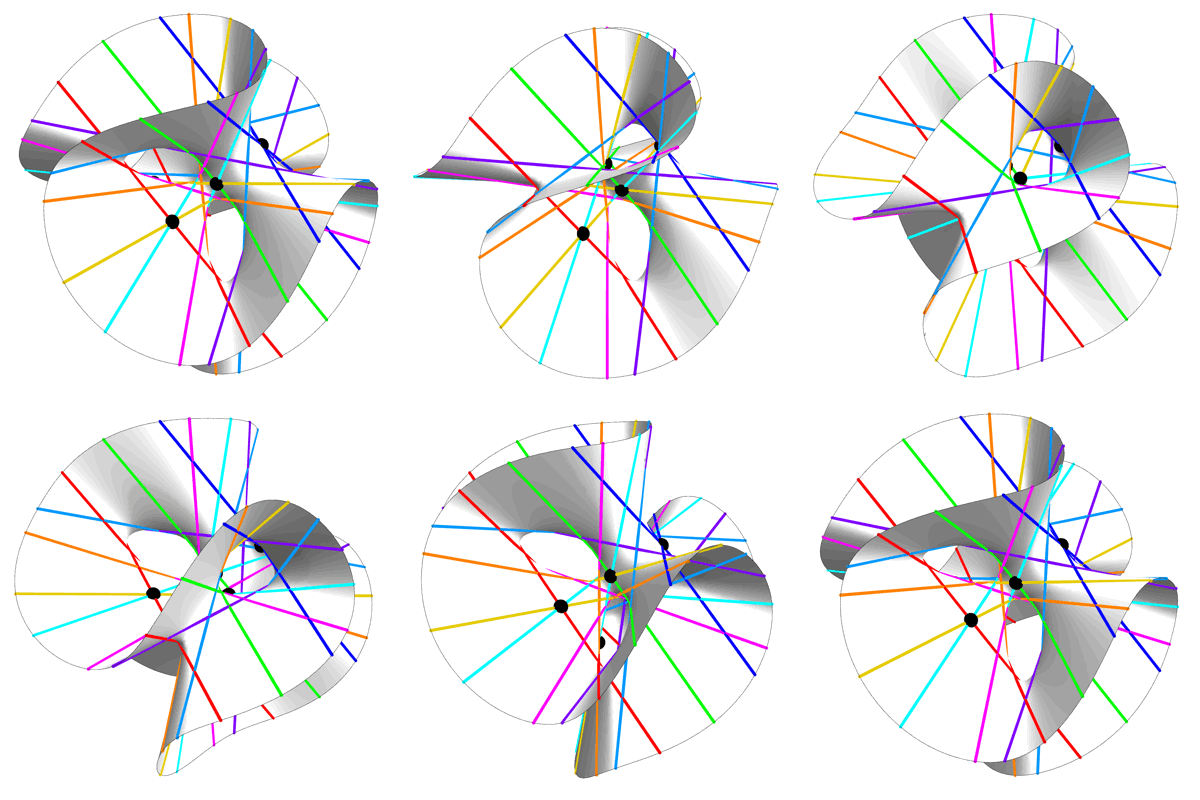
that said, yes, there is a theory of higher conics!
limber sierra
we call them "algebraic curves"
sadly, you cant think of them as cut from a 3d shape so nicely
in general at least
arctic stone
Ah alright, it's still nice to know about the theory
I was trying to imagine some weird conic shape and cut it to get some elliptic curves but nothing seemed to work very well
limber sierra
im not being totally honest
you CAN think of them as cut from a 3d shape
its just not a "uniform" one like you have for conics
@arctic stone
arctic stone
Ty for the link and damn this is a a funny surface lol
limber sierra
yeah, the problem is that you have to construct them based off the polynomial you started with
dusky epoch
wait nami so
limber sierra
so... not quite the same thing as conic sections
limber sierra
since conic sections work for any cones
limber sierra
dusky epoch
is there a universal cubic surface
no
dusky epoch

arctic stone
So this 3d surface is only for a class of 3rd degree equations?
wintry steppe
@arctic stone May you send the photo of this surface?
limber sierra
yeah, a given surface only gives rise to SOME OF the 3rd degree polynomials in 2 variables by intersecting it with the plane
arctic stone
Check the wikipiedia link sent above
wintry steppe
I did check.
arctic stone
and damn that's still really cool
wintry steppe
arctic stone
So this 3d surface is only for a class of 3rd degree equations?
Yes.
This kinda surface is only for 3rd degree eq.
arctic stone
Not all 3rd degree eq's, right?
wintry steppe
Yep
limber sierra
you can construct one from any 3rd degree polynomial
but it wont work for all other 3rd degree polynomials
arctic stone
So now we need a bunch of those funny surfaces for 3rd degree equations
My next question would be if every possible 3rd degree equation can be described as a cut from some 3d surface
or if there exists an outcast, a 3rd degree equation which cannot be represented as a cut from a 3rd degree equation
but I doubt that'd be possible
yeah theoretically we could just extend that 3rd degree equation into 3d
limber sierra
define F(x_1, x_2, x_3, ... x_n, y) = f(x_1, x_2, ... x_n) + y * something
then taking a cut by setting y = 0 gives you your equation
this works for any function of any degree in any number of variables
arctic stone
oh that's neat
limber sierra
this cut wont be particularly "nice" though
but it technically works
also, its worth noting: cubic surfaces arent quite as well-behaved as conics
in particular, its possible to cut them and get something that ISNT a cubic polynomial
in fact, theres a famous result called "27 lines on a cubic"
arctic stone
Oh? well that's quite surprising
limber sierra
which says that there exist precisely 27 such cuts that produce a straight line alongside another curve
arctic stone
I think it's not possible for 2nd degree surfaces like paraboloids etc
limber sierra
right, its not possible for conics.
conics are very very "special" all things considered
the smaller the degree, the nicer your polynomial behaves
[aside: newton tried to classify cuts you can make of a cubic WAYYY back]
arctic stone
Yupp true, it's quite surprising to me that we can still use matrices and other linear algebra methods for those 2nd degree surfaces
limber sierra
[he found, like, almost 100]
[he miscounted slightly but it was a pretty good attempt considering the mathematical tools of his time and the fact that he's mostly remembered for his calculus/physics, not his geometry]
by "classify cuts" i mean describe what sorts of thing you get from a cut
for conics we know we get 4, besides degenerate cases
circles, ellipses, hyperbolae, parabolae
(if you count circles and ellipses as the same, you get 3 instead)
(the point is, wayyyy fewer than cubic surfaces)
arctic stone
and for the 3rd degree we'd get all of these (and more) I think
 limber sierra
yep
that perfectly straight line in the middle is what i was hinting at when i mentioned 27 lines on a cubic
there are exactly 27 for any cubic surface
which is pretty surprising
arctic stone
damn always 27?
limber sierra
its not an easy result to prove though
yep
27 cuts you can make that produce a perfectly straight, unbroken line
eg

oops thats supposed to be animated
one sec
arctic stone
Those cubics are really interesting and surprising
also I think I saw that gif a while ago
limber sierra

if you counted all the lines from all the different perspectives (which is annoying because of the spinning), youd get 27
(now theres a slight technical detail in that this result is usually framed over P^3, not R^3)
arctic stone
For 2nd degree surfaces it could be 0 straight lines or 2 (I think for hyperbolae)
P^3?
limber sierra
for a conic section you have infinitely many by going down the sides of the cone
limber sierra
 arctic stone
I imagined a hyperbola instead of a simple cone
limber sierra
arctic stone
P^3?
projective space, a slight modification of the geometry of R^3
it doesnt really change this particular result
but without it, theres edge cases you have to consider with lines at infinity and whatnot
projective space says that parallel lines "meet at infinity"
arctic stone
I've heard of something like that
limber sierra
the analogy always used is train tracks
 arctic stone
Yupp that's it
limber sierra
anyway, it clears up these technical issues while still matching how we "feel" geometry should behave
so i wouldnt worry about it
i just mentioned it to avoid nitpicks
arctic stone
I'm still not that advanced in this field but exploring all these other things quite fun for me
limber sierra
yeah, this stuff eventually falls within the purview of classical algebraic geometry
which is a very rich and deep subject
a lot of very talented people have done a lot of work on cubic surfaces and theyre still not totally well understood
(https://en.wikipedia.org/wiki/Manin_conjecture comes to mind)
arctic stone
Ty for all the links btw it helps with understanding it
 thin hazel
Hey so if im working in the 2x2 matrices over the field of 2 elements, the characteristic polynomials dont always split into linear factors right?
but im wondering why - if I have the matrix {1 , 1 ; 1 , 1}, the characteristic polynomial is (1-x)^2 - 1
 dusky goblet
Can someone teach me how to solve algebra?
thin hazel
but if I actually expand this: (1-x)^2 - 1 = 1 -2x + x^2 - 1 = -2x + x^2 = x^2 in F_2
native rampart
,yes
thin hazel
so does the characteristic polynomial actually split?
native rampart
That's true for any field in general
Yes,It does indeed split
x*x is a factorisation into irreducibles
thin hazel
so even though F_2 isnt algebraically closed the only matrices I can write in F_2 all have characteristic polynomials that split?
thin hazel
but I cant get that from the characteristic polynomials of 2x2 matrices over F_2
oh I see what you mean, yeah I cant get something like x^2 + 1 from the matrices available to me
native rampart
x^2+1=(x+1)^2 in F_2
You can't factorise x^2+x+1 in F_2
Char polynomial of
$\begin{pmatrix}
-1 & -1\
1 & 0\end{pmatrix}$
stoic pythonBOT
Buncho Drunk
 thin hazel
ahh gotcha, I think whats happening is that there's no matrices of rank 1 whose characteristic polynomials dont split
but there are some of rank 2 where they dont split
 novel hamlet
how should i go proving that

is finite, if and only if all diagonal elements of D are positive
D is NxN diagonal matrix
stoic pythonBOT
Ann
 novel hamlet
im not sure on the term but there is M > 0, so that /x/ ≤ M for all x € E
probably same as bound?
novel hamlet
i dont know how to make straight lines without copy paste
dusky epoch
what's your keyboard layout
 dusky epoch
try altgr + the >< key (left of Z)?
novel hamlet
ah yes that works
dusky epoch
anyway!
if all d_i are positive, you can show E_D is contained in the ball of radius 1/sqrt(m) around 0, where m is the smallest of your d_i
if there is an index i such that d_i < 0 then you can show that E_D contains all points of the form te_i for t ∈ R (i.e. the entire i'th coordinate axis)
novel hamlet
im a bit confused on how that works
dusky epoch
how what works
novel hamlet
how to show that all values are in that radii of 1/sqrt(m)
dusky epoch
let $m = \min_{i \in 1:n} d_i$
stoic pythonBOT
Ann
 dusky epoch
we have that $\sum_{i=1}^n d_i x_i^2 \geq \sum_{i=1}^n mx_i^2 = m \nrm{x}^2$
stoic pythonBOT
Ann
 dusky epoch
does that need explaining?
novel hamlet
okay that makes more sense
dusky epoch
so for any $x \in E$ we have $m \nrm{x}^2 \leq 1$ by the above
stoic pythonBOT
Ann
 novel hamlet
so if we have some D_i that is < 0, then m > 0 and m||x||^2 < 0
novel hamlet
yeah then it checks out
dusky epoch
if there's some d_i that is 0 or negative then E_D contains every point of the form (0,...,t,...,0) where the t is at position i and everything else is 0
 severe heron
How to find the range of the linear function T(v1, v2)=(v1, v2, v1+v2)?
wintry steppe
I need some help with one exercise from an spanish book which says that if A is the set of all the circles in $\mathbb{R}^2$, C is the set of all the ellipse in $\mathbb{R}^2$ and D is the set of all hyperbola in $\mathbb{R}^2$, find $A\cap C, A\cap D$ and $C\cup D$
stoic pythonBOT
Fisher (Nero)
 wintry steppe
I just don't see it
 hollow oar
A n C, for example, contains all circles which are also ellipses
which is just all circles
wintry steppe
Hello, how do i prove that 1, sin x, sin 2x, ... ,sin nx are linearly independant? i started by writing: a + a_1sinx + ... + a_nsin nx = 0 and i proved that a = 0 but am not sure how to proceed for the rest of the coefficients.
wintry steppe
hollow oar
which is just all circles
Well, actually it's easy... when I read your answer I realised
 quartz compass
wintry steppe
Hello, how do i prove that 1, sin x, sin 2x, ... ,sin nx are linearly independan...
quartz compass
wintry steppe
Hello, how do i prove that 1, sin x, sin 2x, ... ,sin nx are linearly independan...
do you have an inner product?
wintry steppe
quartz compass
do you have an inner product?
no
 nocturne jewel
why do you need an IP to show they're indep.?
hollow oar
you can use the fact that orthonomal lists are L.I.
this isn't orthonormal... but it is orthogonal 
nocturne jewel
oh true
quartz compass
hollow oar
this isn't orthonormal... but it is orthogonal <:peepoHappy:586027986055069698>
it is if your inner product is $$\langle f, g\rangle = \frac{1}{\pi} \int_0^{2\pi} f(x)g(x)dx$$
stoic pythonBOT
Merosity
 hollow oar
that's a good idea
i think you can still do the thing too, without knowing about inner products. you integrate the whole sum with respect to sin(kx)
wintry steppe
hollow oar
i think you can still do the thing too, without knowing about inner products. yo...
what’ll that do? why integrate it?
quartz compass
I was thinking we can maybe just sample points from k*pi/n and get a system of equations with determinant nonzero or something but I haven't thought through if that'd be actually good or easy
another thing that's gross is I'm imagining writing sin(kx) as a polynomial in sin(x) and then showing those polynomials are linearly independent... haha gross
hollow oar
$\int_0^\pi \sin(kx)\sin(lx) \text{d}x$ is 0 if $k \neq l$ and is some number i forgot if $k = l$
stoic pythonBOT
Ves
 hollow oar
so then you just get $a_k(some number)$
stoic pythonBOT
Ves
 hollow oar
and it's equal to zero
use the sine product formula to write it in terms of sums of cosines
when k is not equal to l
wintry steppe
stoic python
**Ves**
im still failling to see how that shows that sin kx and sin lx are lin.indep.
hollow oar
well, you do $\int_0^\pi\left(\sum_{k = 1}^n a_k\sin(kx)\right)\sin(jx)\text{d}x$. this gives you $\sum_{k = 1}^n \int_0^\pi a_k\sin(kx)\sin(jx)\text{d}x$. now you can show that $\int_0^\pi \sin(kx)\sin(jx) \text{d}x = 0$ if $k \neq j$, so this whole thing equals $a_j\int_0^\pi \sin(jx)^2 \text{d}x$
stoic pythonBOT
Ves
 hollow oar
and since it's equal to zero, you divide by $\int_0^\pi \sin(jx)\text{d}x$ to get $a_j = 0$. this works for any $j$ with $1 \leq j \leq n$!
stoic pythonBOT
Ves
 hollow oar
i don't remember how to edit the TeX 
should be sin^2(jx)
on that last message. and i meant the ! to be excitement, not n factorial
wintry steppe
ok i think i understand, thank you very much!
hollow oar
basically, you multiply both sides by sin(jx) and integrate both sides, then argue that the integral of sin(kx)sin(jx) equals 0 when k is not equal to j (using the sine product formula i think)
no problem
oh there's a 1 somewhere in there which probably makes things more exciting

 keen coyote
Can someone explain the third Remark to me? I don't get how the 2 sets aren't equivalent
 wintry steppe
hollow oar
oh there's a 1 somewhere in there which probably makes things more exciting
wintry steppe
hollow oar
oh there's a 1 somewhere in there which probably makes things more exciting
not really, you easily show that the first coefficient is 0 (i just put x=1 so all sines =0 thus having only a=0)
keen coyote
Oh nvm
i see the first one is the set of all multilinear functionals
Vs the second is just the ones that are a tensor product
 safe locust
sacred crescent
well rescale it
safe locust
sacred crescent
well rescale it
I forget how to do that
wintry steppe
keen coyote
basically not sure what 5.2 is saying
"show that there are elements of a tensor product space which cannot be written as a tensor product"
i.e., not all elements of V \otimes W are simple tensors
keen coyote
so what would be an example of that?
wintry steppe
well finding an example is the point of the exercise 
wintry steppe
here's a hint/suggestion: try it out with some simple spaces, like R^2 or something, where the outer product of vectors and tensor products agree (i think that's the case)
keen coyote
doesn't it always have to be some type of product though
because it has to map the origin to zero
in each variable
oh nvm i think i see
Thanks for the help
feel kinda dumb now lol
Unrelated to the question
aren't the two spaces isomorphic?
reef sleet
Is my understanding of this theorem correct?

The reason this is true is because if a row-vector becomes zero from elementary row operations, that means it can be written in terms of other vectors, which means it's linearly dependent
 verbal cradle
I think so. As far as I gather, two matrices are row-equivalent if they have the same row space. So whatever basis you find for one rowspace, it's also a basis for the other one.
is this for any matrix with real values?
im pretty sure all are false lol
take A and B 3 x 3 matrices, each entry different. To show it's false, it's enough to show one value doesnt agree on a row or a column.
I took A = (123) (456) (789), where () is a row. and B = (10 11 12) and so on.
well identity doesnt change the matrix, does it? xD
what happens in a) if A is identity, for instance?
I meant, is a) true or false if A is the identity matrix?
You can guess, and if you can back up your guess with an argument, even better!
all good, rest well 🙂
 thorn lichen

the top is an answer to the bottom
but idk where it gets the middle column
I got that eigenvector as [0 0 0]
meaning its not an eigenvector so that respective eigenvalue is undefined right
I got the left and right colum find tho
wintry steppe
means you made a mistake
thorn lichen
😮
ok i know I didnt make a mistake in matrix manipulation cus I used a calculator to double check
manipulation
I got an eigenvalue of -3
and when I apply that to the original matrix I get [4 0 2]. [0 2 2], [2 -2 3] right
1 - (-3) = 4, -1 - (-3) = 2, 0 - (-3) = 3
and that reduced to echelon form is the identity matrix
wintry steppe
it can't be the identity matrix
wintry steppe
maybe
thorn lichen
gonna use an eigenvalue calc to double check
nope that gives me -3 too
i feel like im doing algebra wrong somewhere lol
wintry steppe
i forgive you
thorn lichen
cant copy down a negative sign to save my life
verbal cradle
Hint(s) for the converse of prop 16.3.1 at the botttom?
I tried using the chain rule to find what the derivative of f at a point a might be, but that didnt work. I suspect I could use one of the coordinate maps in terms of the dual basis, but I havent figured how yet. I just need to guess what the map is, showing it satisfies the def. of the derivative at a point a should be fine.

The implication follows from the chain rule, but the converse is >.<
reef sleet
so a linear transformation is only a function if its kernel consists of only the zero vector

 subtle walrus
no
reef sleet
damn it
subtle walrus
the map that sends everything to 0 is linear
it's only injective (i.e. one-to-one) iff its kernel is {0}
reef sleet
 reef sleet
subtle walrus
the map that sends everything to 0 is linear
reef sleet
subtle walrus
the map that sends everything to 0 is linear
I'm confused what this means
why is it not a function if it's one-to-one?
 stable kindle
um
isn't a linear transformation always a function??
it's only injective if the kernel is only the zero vector
injective != function
reef sleet
Kaisheng have mercy on me, I got lost after we started moving to column and row spaces LOL idk what half of this means 😭
or I do but like I don't remember
why is injective != function?
isn't a function a rule that gives a unique output for every input?
injective is one to one, so unique output for every input
...right? 😔
stable kindle
a function is just a thing that gives only one output for every input
the thing that takes everything to 1 is a function, but it's not gonna be injective
reef sleet
thing that takes everything to 1?
so f(x) = 1
is a function
but it's not injective
stable kindle
yes
wintry steppe
stable kindle
the thing that takes everything to 1 is a function, but it's not gonna be inject...
Wrong, it is injective iff the domain is either the empty set or a singleton
reef sleet
wintry steppe
because there are different inputs that result in same output
yeah that's what I meant mb
damn every word matters 😭
wintry steppe
yes every word matters, but it's good if that's what you meant
wintry steppe
stable kindle
context of vector spaces
the 0 space has only 1 element
wintry steppe
i think it's important to pay attention to detail tbh
reef sleet
You're right
 pliant kayak
if you have two inverse matrixes A^-1 B^-1
and it asks you to find (AB)^-1
do you just multiply em together?
wintry steppe
There are two ways to multiply them together
wintry steppe
pliant kayak
do you just multiply em together?
Do you know what the inverse of a matrix means?
pliant kayak
still pretty new to this honestly
wintry steppe
if M is an invertible matrix, then M^-1=N is the (unique) matrix such that MN = NM = I
where I is an identity matrix
pliant kayak
yea that makes sense
but if you have two inverses that dont relate and asked to find (AB)^-1
i dont see how you could do it without finding A and B first
wintry steppe
there happens to be a simple way
you need to find M such that (AB) M = M (AB)= I
Agree?
if you find such M, then M = (AB)^-1 by definition of inverse
pliant kayak
Ok i see where you're getting at
wintry steppe
a property that you probably either proved or was told
is associativity
so in particular if M = B^-1 S for some S, then (AB) M = (AB)(B^-1 S) = A(BB^-1)S = AIS = AS
maybe this hint gives you any idea what S can be for it to work
 hexed mural
Does anyone happen to know what this Notation means
v1 || v2 with respect to vectors
does this mean parallel ?
 midnight forge
The inverse of a matrix is a matrix in which you multiply your non-inverse with to get the identity matrix
Hi, all! 
 calm yoke
Can somebody explain how to calculate the implicit form of a vector to me?
wintry steppe
calm yoke
Can somebody explain how to calculate the implicit form of a vector to me?
There is no such thing
calm yoke
Maybe you know it as reduced?
wintry steppe
I know the norm of a vector
calm yoke
wintry steppe
I know the norm of a vector
Maybe its that
wintry steppe
Well don’t you have a defined problem? It should say the correct word then
calm yoke
Maybe its the form of a line?
calm yoke
wintry steppe
Well don’t you have a defined problem? It should say the correct word then
I translated it roughly
wintry steppe
That’s the problem 😄
calm yoke
wintry steppe
That’s the problem 😄
🧐
 wintry steppe
Implicit equation =/= implicit vector which doesn’t exist as a thing
y + x + 5 = 0 is an implicite equation
 slow scroll
Sounds like someone hasn’t read the rules
Also wrong channel 
I.e. someone hasn’t read the pins
calm yoke
slow scroll
Sounds like someone hasn’t read the rules
Me?
calm yoke
slow scroll
Also wrong channel <:opencry:586078614865444865>
This is linear algebra tho
smoky patio
for part A guys, can someone word this out for me? I'm struggling to understand what the given solution is saying, why is B_1(x, y)= (x_1, ..., x_n) [B_1](y_1, .., y_n) ? (after it says "Then")

 smoky patio
im so dumbn vm
 solemn forum
if a matrix has 3 distinct eiganvalues must it have 3 independant eiganvectors?
slow scroll
calm yoke
This is linear algebra tho
nah not you. someone asking to pay for help on a high school algebra question
solemn forum
if a matrix has 3 eiganvalues, and one is a double root, must it have 2 independant eiganvectors?

or how do i approach this without doing it the long way
or do i have to actually solve it all to figure out
slow scroll
hm so geometric multiplicity is bounded by algebraic multiplicity. So that means there might be only one linearly independent eigenvector corresponding to 4. But there could also be two, so i think you have to check manually unless im forgetting something
solemn forum
i think there must be a shortcut because theres a lot of these problems
im in engineering math and we are touching on linear alegbra
slow scroll
its either 2 or 3. I don't think you can say definitively whether its one or the other without computing the null space of A-4I
solemn forum
ok and my first question
if theres 3 distinct eiganvalues
is there 3 linearly independent eiganvectors?
i would think yes
 edgy kelp
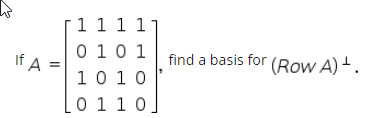

 lavish jewel
(A x)^T = x^T A^T
you can either expand the product as a sum or as a vector of dot products and convince yourself they're equal
 waxen flume

i have two formulas
y = y_hat + z
z = y - y_hat

like that
aren't I suppose to do [1, 1, -2] - my y_hat vector
or is it [0, -1, 2] - my y_hat vector
lavish jewel
x-yhat
you can then double check if that is perpendicular to y
it probably won't be, but you can do a second step of gram schmidt at that point
waxen flume
we haven't learned gram schmidt
xD
but ty

for this problem, I chose the vector [0, -3,1]
b/c when you take the dot product of the two, you get 0
would that work?
lavish jewel
sure
waxen flume
thanks @lavish jewel
 snow jetty
solemn forum
if theres 3 distinct eiganvalues
snow jetty
solemn forum
if theres 3 distinct eiganvalues
If there are 3 eigenvalues, there are 3 or more eigenvectors. But what is sure is that for each eigenvalue you will have at least one eigenvector and eigenvectors associated to different eigenvalues are linearly independent.
For example, for a zero 4x4 matrix you will have only one eigenvalue which is zero, but there will be 4 linearly independent eigenvectors (any vector here is an eigenvector)
In general if you have a homothety you will have only one eigenvalue and "n" eigenvectors, where "n" is the dimension of your square matrix (for instance, the identity matrix has an only eigenvalue 1).
If you want to have three eigenvalues but more eigenvectors then, for example, take an identity matrix (m x m) and "boost" it to a diagonal matrix ((m + 2) x (m + 2))
Something like this

You have three eigenvalues but 5 linearly independent eigenvectors
wintry steppe
Hey guys, what would you do if you dont understand anything on what to do even when watching youtube videos and so on this subject?

Im not asking to solve the questions for me, just on how you would act if you would be in my case
dusky epoch
look up key words, read your textbook, read your own notes, read your lecturer's notes etc
snow jetty
wintry steppe
Hey guys, what would you do if you dont understand anything on what to do even w...
A good exercise is to reduce the not understanding of the subject to a specific question that you can pose.
dusky epoch
that too
snow jetty
wintry steppe
Hey guys, what would you do if you dont understand anything on what to do even w...
Like "on the one hand, if I proceed like this, I would get such result" but it doesn't match with this exercise/reasoning/theorem...
As Robert Sheckley said, "In order to ask a question you must already know most of the answer"
You can try to solve an exercise in many ways, even if some of them are not rational and long, to make sure you understand
wintry steppe
I think what Im doing is to find a similar task on someones youtube video or in textbooks but all I find are definitions. So in your opinion I should learn the definitions first and practise those for a long period of time before i start solving the problem right?
snow jetty
It is enough to understand the definition (at least think like you have understood them), look up some examples...
snow jetty
wintry steppe
I think what Im doing is to find a similar task on someones youtube video or in ...
But the problems you sent are typical, you can surely find YouTube videos on such problems
 wooden gate
in f), one way to solve this is realizing (0, sqrt2, 1) and (sqrt3, sqrt5, 0) is in w_6, but how do they get to that?
 wintry steppe
snow jetty
But the problems you sent are typical, you can surely find YouTube videos on suc...
wintry steppe
snow jetty
But the problems you sent are typical, you can surely find YouTube videos on suc...
Yeah maybe Ive to spend more time and listen more carefully. Thank you and also @dusky epoch
 marble lance
Do that
 atomic flint
i dont have permission to write in there
marble lance
Do you not have access now?
 cursive osprey
does anyone know whats the relation between the rank of a nxn matrix over a field F to its Jordan canonical form?

to help give a little bit of context
I have an intuitive feeling its linked with nullity and the image but im not sure where to go from there
wintry steppe
Null space is the same thing as the eigenspace associated to the eigenvalue 0
 mild current
is there any form of transformation that can take a shape transform it into a line, and the length of the line segment has the maginitude of the area of the shape tranformed
if yes, can it be extended to n-dimensions i.e., take a n-dimension cube and tranform into a line segment whose length is magnitude of the volume of the n-cube
 sage ibex
Linear transformation, and arbitrary shapes?
mild current
sage ibex
Linear transformation, and arbitrary shapes?
*cubes, pardon me
sage ibex
Are the cubes rotated or are the always perpendicular to the axes?
Wait no won't matter
Answer will be no because if you double the size of the cube, the volume becomes 8x but since the transformation is linear, the length of the line segment will be doubled
So won't work if 2 dimensional or higher
mild current
sage ibex
Answer will be no because if you double the size of the cube, the volume becomes...
Thanks for the reply. Kinda off topic, but is there any non-linear transformation?
sage ibex
Seems like much harder problem that might involve measure theory, I can't think of anything immediately
 cursive osprey
try equating one of the variables as zero and see how you can solve the equation with the two variables
wintry steppe
 crisp cloud
HINT: the vector normal to the plane, gets completely reflected by such transformation. So if n is normal to this plane then r(n) = -n
Any 2 (non-colinear) vectors that belong to the plane do not get reflected. So if v1 and v2 are two such vectors r(v1)=v1 and r(v2)=v2
Now which the assumption that v1 and v2 are non-colinear, the normal vector n together with v1 and v2 span the whole of R^3, and so they form the required basis
crisp cloud
you know of any good videos i can reference? I didn't understand it very well 
Sorry, I'm looking at my teacher's notes and I literally cannot read them
 crude falcon
I have a subspace of R^3 such that x = y = 0, how can I find its basis?
 hoary osprey
what form do the elements of your subspace take?
crude falcon
this is what I have
 hoary osprey
right so all vectors in your subspace are of the form (0,0,z), can you find a vector that spans it?
crude falcon
hmm (0,0,1)?
hoary osprey
yes
crude falcon
that is the basis?
hoary osprey
yep
crude falcon
so and since theres only 1 vector in the basis then the dimension of C is 1 right?
 red prawn
cursive osprey
red prawn
cursive osprey
Jordan canonical form tells you $A = P(S + N)P^{-1}$, where P is invertible, S is diagonalizable, N is nilpotent, and S and N commute. Since they commute, you can say something about their eigenspaces.
stoic pythonBOT
Apopheniac

 cunning pier

Given the matrix A find an orthogonal matrix S and a diagonal matrix D such that the equation is satisfied.
Could someone give me a pointer on how to approach this?
lavish jewel
find the eigenvalues and eigenvectors
 blissful vault
is the range and kernel of a matrix always an invariant subspace of said matrix?
native rampart
Range(T) is clearly T-invariant
Same for Ker(T)(since Tx will just be 0 in that case)
blissful vault
im doing this exercise and it seems a bit too .. trivial
 native rampart
Range(T) and Ker(T) are usually not independent spaces,tho
See operator associated with $\begin{pmatrix}
0& 1\
0& 0\end{pmatrix}$ T(0,1)=(1,0) is in range while it's also in Ker(T)
stoic pythonBOT
Buncho Drunk
 native rampart
Well,In this case they might be
blissful vault
hmmm the xor is forcing me to dfind 2 independant subspaces?
native rampart
Prove that,if so
 olive grotto
 blissful vault
thanks star eyes

 hollow garnet
Dot product is linear
 tough breach
Dot product is bilinear (for R^n) so it would be true
 faint lintel
Ok so like
Talking about orthogonal projections and stuff
Say v is in some vector space V and u is in some subspace of V, call it W such that v - u is in the orthogonal complement of W
then we say the distance between v and W is ||v - u||
how does this make any sense
how can we have distance between a vector and a whole subspace
faint lintel
lemme read over this again
hm
I guess that kinda makes sense
and like the proof that such vectors exist with a minimal distance logically makes sense to me
it's strange to me, measuring distance between two seperate objects
stoic pythonBOT
*-*

 wintry steppe
sounds right
crisp cloud
aight, so I've been working on this linear algebra homework for about 8 hours now. Anyone willing to get paid to tutor me? DM pls
nocturne jewel
crisp cloud
aight, so I've been working on this linear algebra homework for about 8 hours no...
OR... just post the question and you can get help for free
crisp cloud
there's like 10 problems though :((
nocturne jewel
ok so post one...
 nocturne jewel
do you know if ${v_1,v_2,v_3}$ is an indep. set?
stoic pythonBOT
moshill1
 crisp cloud
I'm not even sure myself. My teacher literally just said v_1 and v_2 can be anything

like this is literally his handwriting
and I can't read his examples smh
I've just been confused this entire time
wintry steppe
wow that's some garbage handwriting
crisp cloud
I've literally been lost because I can't read it smh
hollow garnet
i also can't read that....
faint lintel
Dumb question but how do I solve for a basis for the null space

for this system of linear equations
nocturne jewel
faint lintel
Dumb question but how do I solve for a basis for the null space
RREF [A|0]
faint lintel
But how does this work with complex values
nocturne jewel
same way, just with arithmetic of complex numbers

 pseudo thicket
A linearly dependent set cannot be orthgonal
is this true or false?
can I claim it is false, since I can use a set that contains 0 vector?
pseudo thicket
I'm confused to be honest, initially the professor said the statement is false
Then he used the contrapositive method and say the statement is true
contrapositive as in:
we know that: an orthogonal set is independent set
the contrapositive term is: a dependent set cannot be orthogonal
native rampart
Orthogonal set is independent is false
Consider {(0,0),(1,0)}
If all the vectors in the orthogonal set are nonzero,it is true
pseudo thicket
an orthogonal set not containing the 0 vector is linearly indepenedent
yes
therefore A linearly dependent set cannot be orthgonal
is false
as it can be orthgonal, right?
native rampart
Yes
pseudo thicket
Thank you so much...let me argue the case with my professor...
got my reply..
Answer true.
Theorem: ON set implies Indep (statement A implies B)
The contrpositive of this theorem can be stated as follows: (not B implies not A)
So Not Linearly indep implies Not Orthogonal
native rampart
native rampart
Consider {(0,0),(1,0)}
Give this counterexample to that Theorem
pseudo thicket
I gave him that as well
"ON set is only defined for non zero vectors"
so he assumes that the ON set is already nonzero vectorsa
and he just used the contrapositive method
I'm so confused, he doesnt make sense
pseudo thicket
hold on, let me check his notes
lavish jewel
did he say orthogonal or orthonormal
 lavish jewel
they did say nonzero tho
pseudo thicket
he didn't explicitly state orthogonal = nonzero
he just state orhtogonal set in the question without specifiying it contains nonzero
lavish jewel
orthogonal set of nonzero vectors
native rampart
Check defn of orthogonal
pseudo thicket

nowhere did it explicitly mention orhtogonal automatically does not contain the zero vector.. right?
native rampart
Yea,It doesn't
lavish jewel
what was the original question? lin dep sets cannot be orthogonal?
and you say it's false cuz you can include the 0 vec?
pseudo thicket
lavish jewel
what was the original question? lin dep sets cannot be orthogonal?
A linearly dependent set cannot be orthgonal
lavish jewel
yeah, you'd have to cherry pick the 0 vector in one of the two definitions
pseudo thicket
the answer is false, isn't it?
lavish jewel
unless they explicitly exclude the 0 vec, yeah
the theorem you put above does exclude it, idk if that's from the same course
pseudo thicket
lavish jewel
the theorem you put above does exclude it, idk if that's from the same course
the theorem expliclity mention that it does not contain 0 vector
an orthogonal set not containg zero vector
but it does not imply explicitly ortghonal set = does not include zero vector
~
Zero vector always warrant special consideration.
If every statement have to include exclusion theorems will be v complicated.
"
lavish jewel
yeah, as i said, you'd have to construct a definition carefully
wintry steppe
Anyone has an hint how to prove/disprove whether the set of 4x4 permutation matrices generate the space of all 4x4 matrices? Pls just hint, i have no idea what to do
limber sierra
generates through linear combinations?
wintry steppe
yea
limber sierra
over R?
limber sierra
well the first counterexample i thought of is over C
hm wait
no my argument works for R as well
let me think of a good way to phrase it
okay how about this
note that the column sum of a column of a permutation matrix is 1
so linear combinations of permutation matrices must satisfy having all columns have the same sum (why?)
but clearly there are 4x4 matrices that dont satisfy that
wintry steppe
oh nice
limber sierra
the matrix with a single 1 and everything else 0, for example
does that make sense? can you see how to prove the (why?) part?
[rows instead of columns would work as well of course]
wintry steppe
yea every sum of a column of a a multiple of a perm matrix will be some number a, and if you sum several of those will be a+etc
so cant generate all
wintry steppe
this doesnt seem to work for fields of characteristic non 0 tho
limber sierra
im not even sure the statement is false in general
wintry steppe
shouldn't be that hard tho i think
cuz every sum of column will be the same mod char F?
limber sierra
sure but i dont think that helps you
wait
that doesnt help for infinite fields of char p > 0 does it?
unless theres something you can do im missing
pseudo thicket
lavish jewel
yeah, as i said, you'd have to construct a definition carefully
lol after further prompting.. he indirectly admitted his mistake by threatening me
wintry steppe
What about this, M matrix that has 1 in (1,1) and 0 everywhere else. then sum of first column is 1, but sum of other columns is 0. And 1 never equal to 0 in a field
if we had linear combo $M = \sum a_nP_n$ then $\sum a_n = 1 = 0$ in $F$ since column sums all the same, right?
i'm kinda paranoid that i m wrong somewhere tho lol but seems right to me
stoic pythonBOT
Carla_

 rose umbra
anyone have good source for learning linear algebra 2 (mainly for transformations / transformations matrix ) etc'
wintry steppe
@wiz when the professor is sus!
 vocal prairie
rose umbra
anyone have good source for learning linear algebra 2 (mainly for transformation...
vocal prairie
rose umbra
anyone have good source for learning linear algebra 2 (mainly for transformation...
If you're looking for books, Linear Algebra and Its Applications by Lay has some stuff. You can browse other standard references on the subject.
 native rampart
AB and BA have the same eigenvalues
 wind pasture
so there's no such example?
 wind pasture
thats nxn though, works for mxn?
wind pasture
so is there an example?
native rampart

Mathematics Stack Exchange
As a part of an exercise I have to prove the following:
Let $A$ be an $(n \times m)$ matrix. Let $A^T$ be the transposed matrix of $A$. Then $AA^T$ is an $(n \times n)$ matrix and $A^TA$ is an $(m \
The first answer is very nice
That works for nxn case too
wind pasture
ah thanks
wintry steppe
Scalar multiplication is defined as $\mathbf{F} \times V \stackrel{\cdot}\longrightarrow V$, right? Where V is a set, and F is a field.
stoic pythonBOT
n/c
 native rampart
Well,V has to be an abelian group
wintry steppe
Can you tell me the full structure of a vector space over F?
It's a set (V, +, *, 0, i)
I meant to say vector space
native rampart
You know group actions?
wintry steppe
No
native rampart
Ok,nvm
wintry steppe
lol
wintry steppe
okay I was thinking what's the third haha
Can you list the structure of it out for me?
Like in parentheses how you would list an algebraic structure?
native rampart
I have no experience with that
I guess you want something like:
"V is an abelian group wrt +"
i.e., There's an identity 0 and an inverse for every element in V(wrt +) and the operation is associative and distributive
wintry steppe
I meant like I listed them above
wintry steppe
Yes exactly but is there anything else?
native rampart
No, That's it
wintry steppe
Okay
 wintry steppe
Ehhh
Why is it using those icons?
For the direct sum and I don't know the other one
lavish jewel
you can use whatever you want as symbols as long as you define them
it's to make clear that addition of vectors is not the same as addition of scalars, and similarly with multiplication
the field comes with its own operations that need not match those of the vectors, but the linearity properties must hold
it's not denoting a direct sum there
wintry steppe
If I want to prove that a vector space V is associative, can I do something like this? $(v +_v w) +_v u = ((v_1 +_F w_1) +_F u_1, \dots, (v_n +_F w_n) +_F u_n) = (v_1 +_F (w_1 +_F u_1), \dots, v_n +_F (w_n +_F u_n)) = v +_v (w_1 +_F u_1, \dots, w_n +_F u_n) = v +_v (w +_v u)$
stoic pythonBOT
n/c
 native rampart
What's +_F?
wintry steppe
Where +_v is addition on V, and +_F is addition on a field F
native rampart
Is this a finite dimensional vector space?
wintry steppe
Yes
native rampart
Yea that works
wintry steppe
How would you do it if it wasn't finite dimensional?
wintry steppe
I meant to say that if you wanted to prove that it is associative
To show that it is a vector space
Among other things
native rampart
Just write out a+(b+c) and (a+b)+c and show they are same,given the operation +
wintry steppe
Yes but that's what I did
native rampart
- here is defined to be component wise addition,so it works(well that works in infinite dimensional cases too,assuming you can write an element in V as an element in K^inf)




 limber sierra
both v and w lie on the plane.
limber sierra
because we're looking at what vectors can be generated by av + bw
which is the plane containing those vectors
limber sierra
u is not on the plane here, meaning it cant be generated by av + bw
hence is linearly independent of them
 wicked lion
so for something to be linearly independent, it cannot be made by adding the other two vectors?
limber sierra
in the 3-dimensional case, yes
adding scalar multiples of the other vectors, that is
to be more precise, we say a vector $u$ is \textbf{linearly indepedent of} a set of vectors ${v_1, v_2, \dots, v_n}$ if[
u \neq \lambda_1 v_1 + \lambda_2 v_2 + \dots + \lambda_n v_n
] for ANY choice of scalars $\lambda_1, \lambda_2, \dots, \lambda_n$
stoic pythonBOT
Namington
 limber sierra
this is equivalent to saying the set ${v_1, v_2, \dots, v_n, u}$ is linearly independent, i.e. if [
0 = \lambda_1 v_1 + \lambda_2 v_2 + \dots + \lambda_{n} v_n + \lambda_{n+1}u]
then all scalars are $0$, that is: [\lambda_1 = \lambda_2 = \dots = \lambda_{n} = \lambda_{n+1} = 0]
stoic pythonBOT
Namington
 limber sierra
[to prove the equivalence, solve for lambda_(n+1)u and note that, if we assume lambda_n+1 is not 0, we can divide both sides by it]
[but we cant if lambda_n+1 = 0]
[also one direction of the equivalence implicitly relies on {v_1, v_2, ... v_n} being itself linearly independent, blahblahblah technical details]
wicked lion
there's basically none except the 3blue1brown one
and khan

honestly dont understand this
can someone explain this

why is his solution 5, 2
why isnt it 3,2
3(2) = 4 + -1(1) = 4 - 1 = 3
-1(-2) = 2 + 2 (0) = 2
so wouldnt it be 3,2
o
im stupid lol
Okay, now I understand it. So to get transformed v, we would need to know the transformed i and j. From the transformed i and j vectors we can simply multiply the original i times the new i vector plus the original j multiplied by the new j vector.
hollow garnet
If $k$ is some scalar and $\vb{v}$ is some vector, then the scalar multiplication is $k \vb{v} = k \langle x, y \rangle = \langle kx, ky \rangle $.
stoic pythonBOT
zslya
 wicked lion
how do we find out what the new i hat and j hat coordinates are going to be, post translation?
limber sierra
determine where the translation maps (1 0) and (0 1)
wicked lion
I guess a better question would be, how do I determine i-hat and j-hat given the vector(randomNum, randomNum)
where randomNum is any number within a set range
hollow garnet
If $\vb{v}$ belongs to $R^2$, $\vb{v} = \langle v_1, v_2 \rangle = v_1 \langle 1, 0 \rangle + v_2 \langle 0, 1 \rangle = v_1i + v_2j$
stoic pythonBOT
zslya
 limber sierra
well reading what theyre doing
i-hat and j-hat may not be unit vectors
but regardless, theres a unique way to write v as a linear combination of i-hat and j-hat
wicked lion
zslya, sorry but idk how to read that lol
wicked lion
i mean, let's say i drew on a piece of grid paper a random vector at 3,2 where x = 3, and y = 2
limber sierra
take any two linearly independent vectors
done
the most common choice is the so-called "standard basis" consisting of (1 0) and (0 1)
and then (3 2) = 3(1 0) + 2(0 1)
wicked lion
that would just give me my original vector of 3,2
but i guess im more wondering like


so in this photo i posted
he isd saying that the transformed i is 1,-2
how did he get that?
limber sierra
apply the transformation to i-hat
wicked lion
what transformation
limber sierra
whatever transformation you're doing.
hollow garnet
which video is this?
wicked lion
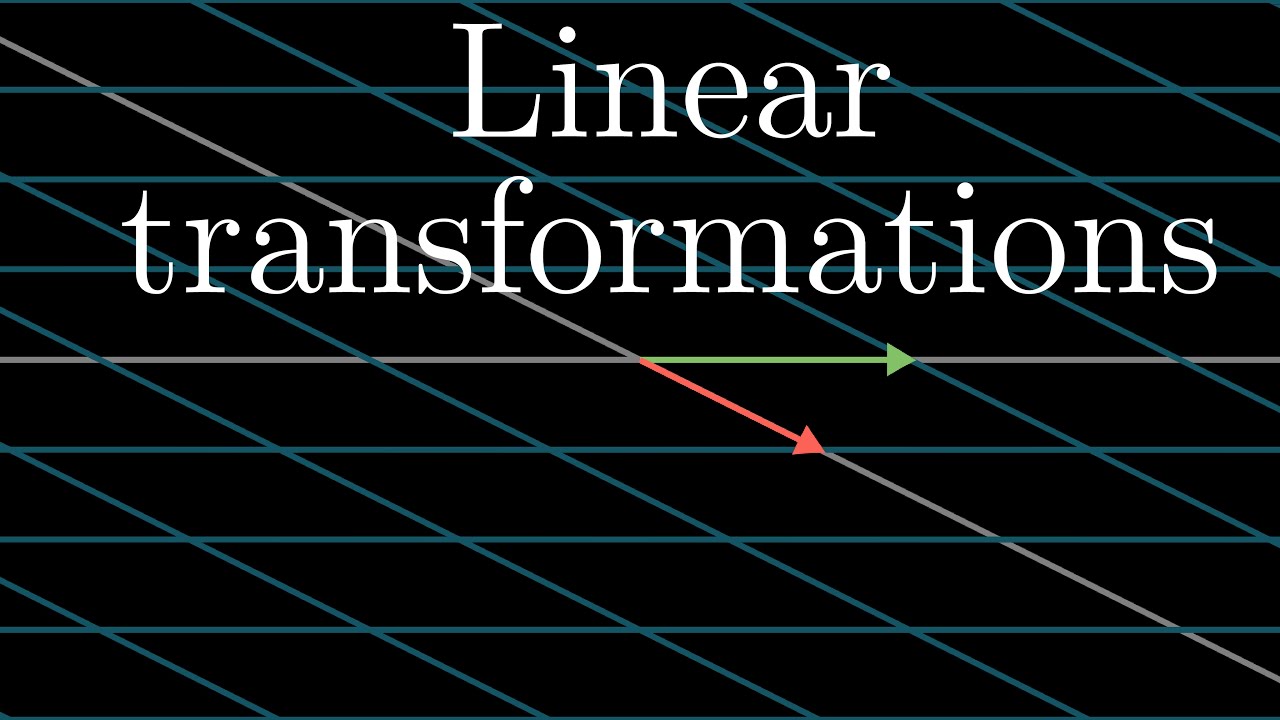
Quite possibly the most important idea for understanding linear algebra.
Help fund future projects: https://www.patreon.com/3blue1brown
An equally valuable form of support is to simply share some of the videos.
Home page: https://www.3blue1brown.com
Full series: http://3b1b.co/eola
Future series like this are funded by the community, through P...
this one
hollow garnet
and at what time
limber sierra
seems he did $\begin{pmatrix}x\y\end{pmatrix} \mapsto \begin{pmatrix}x+3y\-2x\end{pmatrix}$
unless im misreading
hollow garnet
Uh, i think you just need to pay attention to the video properly. The person in the video seems to explain it very well...
stoic pythonBOT
Namington
 hollow garnet
They also tell you how we got the i hat and j hat.
hollow garnet
That is ok, but pay attention to what he is saying slowly, and carefully.
limber sierra
i dont think the fine details of the transformation matter to what he's trying to explain
hollow garnet
Start from 3:40 again, i suggest.
limber sierra
he's just trying to demonstrate how you can determine the effects of a transformation just by looking at what it does to a basis
(i.e. just by looking at how i-hat and j-hat change)
limber sierra
well, you might not know that information
wicked lion
maybe that was intentionally left out
limber sierra
you might be given
hollow garnet
Yes it was given at 3:53
limber sierra
"we have a transformation that maps (1 0) to (1 -2) and (0 1) to (3 0)"
hollow garnet
Please watch 3:53 onwards.
limber sierra
you dont have an explicit formula for that transformation
but you can still determine what it does
since you know what it does to a basis
(if you wanted to, you could FIND a formula for it, which i did above)
(but thats unnecessary)
i think you missed the point of a segment: the point is that the ONLY thing we need to know to know EVERYTHING a linear transformation does, is what it does to its basis
he tells you no information about the transformation OTHER THAN where i-hat and j-hat end up
but that's enough to calculate where v ends up
wicked lion
yeah
i mean i got that
i just was trying to understand more deeply
on how i can use this practically
limber sierra
again, if you want an explicit formula for the transformation, it's given by $\begin{pmatrix}x\y\end{pmatrix} \mapsto \begin{pmatrix}x+3y\-2x\end{pmatrix}$
stoic pythonBOT
Namington
 hollow garnet
What the person in video is trying to explain to you is that that vector he took as an example, we were able to write it as a linear combination of another two vectors.
limber sierra
and i determined that purely from where he said i-hat and j-hat ended up
hollow garnet
yes
wicked lion
yeah
hollow garnet
wicked lion
on how i can use this practically
And make sure you understand this carefully. This is one of the most important concepts in linear algebra.
limber sierra
wicked lion
on how i can use this practically
from a practical perspective, this justifies the existence of coordinate systems.
wicked lion
but if u dont know what i and j hat are...
what i mean is
if u dont know the values
hollow garnet
We will always know what i and j hat are
If we are in r2, one of the choices is always (1, 0), (0, 1)
similarly, in r3, (1, 0, 0), (0, 1, 0), (0, 0, 1)
wicked lion
so going on that formula though, adding them together would give us the translation, from where we were, to where we will be
so if we subtract, would that give us our orgiinal vector?
like if we start with the end translation from our translation
and then subtract that, would we get what we had, pre-transformation
hollow garnet
wicked lion
so going on that formula though, adding them together would give us the translat...
Can you clarify what this line means?
wicked lion
well the formula he gave was basically multiplying the original i and j by the intended i and j offset, and then adding them together to get a new vector
what would happen if instead of adding, we swap the original values to the new ones
and subtract
limber sierra
he wasnt multiplying the original i and j
wicked lion
instead of add
limber sierra
he was replacing them with the transformed i and j
like
we have v = ai + bj
applying the transformation T
T(v) = T(ai + bj)
but T is linear, which means:
T(v) = T(ai + bj) = T(ai) + T(bj) = aT(i) + bT(j)
so if we have v = ai + bj, to determine T(v), we just replace i with T(i) and j with T(j)
i.e. to determine "where v ends up" after the transformation T, we replace i and j with their transformed versions
now it seems youre asking if theres a way to undo this process; there isnt ALWAYS, but there often is
the problem is that some transformations map multiple vectors to the same point
for example, if your transformation "compresses" the entire plane into a line
like, say (x y) gets mapped to (x 0)
then the vectors (6 1) and (6 3) both get mapped to (6 0)
and so if i tell you
"we have (6 0), find the original vector"
you wouldnt be able to answer
since (6 1) would work, or (6 3), or (6 -34091), or (6 7pi/41)
or anything else
you could find SOME vector that maps to (6 0), but not a unique one
so some linear transformations CANT be "undone" unambiguously
some can be though - we call those "invertible"
working with invertibility of transformations and matrices becomes a theme of linear algebra eventually
so i'd wait till later in the course to explore that in detail.
hollow garnet
Since you are watching that video, I would just suggest you draw it out yourself as well, and follow along that video. I think it explains it nicely, and then you can come over here and ask more if you need to.
wicked lion
ok so
from what i understand
theres basically no way of knowing where i hat and j hat will land, given an arbitrary vector
If I asked someone to answer the following question:
Tell me where i-hat and j-hat will land, given the vector v = (3,9)
it's impossible to know
nocturne jewel
Am I smoothbraining this: If A is real nxn and I+A is invertible, A and (I+A)^(-1) commute. Im blanking on how to show that
hollow garnet
wicked lion
If I asked someone to answer the following question:
Tell me where i-hat and j-...
(3, 9) = 3 (1, 0) + 9(0, 1)
limber sierra
i dont think they mean the coefficient
i think theyre asking you where i-hat, j-hat will end up upon applying a transformation
which of course theres no way to determine
hollow garnet
nocturne jewel
Am I smoothbraining this: If A is real nxn and I+A is invertible, A and (I+A)^(-...
If C = (I + A) and AC=CA. Multiply right by A^-1 then left by A^-1
limber sierra
since you know nothing about the transformation
hollow garnet
oh
limber sierra
from just that info
nocturne jewel
doesnt that assume A is invertible
wicked lion
limber sierra
which of course theres no way to determine
this is what i have been getting at for the last 10 mins lol
ok so its not possible to know what i-hat and j-hat vectors are, given a random vector and no other information
if i gave u v1(1,2) there's no way to know what j-hat vector and i-hat vectors would be
nocturne jewel
oh wait i just do that with C not A rightright
wintry steppe
I need to express x and y in fonction of v and y. I’ve been at it for half an hour now, can someone help?
 lavish jewel
try multivar calc
wintry steppe
lavish jewel
try multivar calc
Im not familiar with that
lavish jewel
i mean the channel, #multivariable-calculus
wintry steppe
oh ok
pliant kayak
I have a question asking me to find the p(A) for a given matrix and the polynomial p(x)= x^2 -3x +2
im not sure how to approach this problem
wicked lion
im not able to wrap my head around why the unit vectors of i, j and k are (1,0,-1), (1,1,0), and (1,0,1)
like
what does that even mean
i understood it when it was 2d
nocturne jewel
wicked lion
im not able to wrap my head around why the unit vectors of i, j and k are (1,0,-...
they arent
wicked lion
i was (1, 0) because we don't move anything on the y axis, and j was (0,1) becuse we only move up on y once
nocturne jewel
the canonical basis vectors for R3 are (1,0,0),(0,1,0) and (0,0,1)
wicked lion
what does canonical mean
wicked lion
oh
ok that makes sense then...
can u explain why this guy in this video
explained it differently

What do 3d linear transformations look like?
Help fund future projects: https://www.patreon.com/3blue1brown
An equally valuable form of support is to simply share some of the videos.
Home page: https://www.3blue1brown.com/
Full series: http://3b1b.co/eola
Future series like this are funded by the community, through Patreon, where supporters ge...
at this timestamp
maybe im misunderstanding
wicked lion
what do u mean by map
nocturne jewel
apply a transformation to the basis vectors and you get those vectors
$T[\hat{i}]=[1,0,-1]$
wicked lion
nocturne jewel
the canonical basis vectors for R3 are (1,0,0),(0,1,0) and (0,0,1)
and these are the basis vectors
stoic pythonBOT
moshill1
 nocturne jewel
wicked lion
and these are the basis vectors
nocturne jewel
wicked lion
and these are the basis vectors
yes
so under the transformation T, [1,0,0] maps to [1,0,-1]
rose umbra
how do you found T: R3->R3 if
 nocturne jewel
define find T
wicked lion
so like, how did we turn 1,0,0 into 1,0,-1?
rose umbra
T(x,y,z) = ...
nocturne jewel
wicked lion
so like, how did we turn 1,0,0 into 1,0,-1?
applied the transformation
wicked lion
which transformation
rose umbra
the transformation
nocturne jewel
wicked lion
which transformation
the one 3b1b had in the video
nocturne jewel
rose umbra
T(x,y,z) = ...
so find the matrix representation..?
nocturne jewel
wicked lion
he actually doesnt show one
he does, I just watched the animation
rose umbra
@nocturne jewel i know that
