#linear-algebra
2 messages · Page 194 of 1
 lavish jewel
not that rgb is uncorrelated with height and width
but rather how rgb varies w.r.t. itself as the other 2 values changes
(assuming you care about rgb space. other matrix shapes can have different ranks.)
 neat relic
oh ok..I think I understand clearer now, like what matters is the linear combination of 1 feature (i.e. height, width, rgb) to itself at a point. So what happens if it is a linear combination of it?
I know we learnt in linear algebra that it means it is not linearly independent, but am not sure how it relates to image similarity and collinearity haha..
neat relic
oh ok..I think I have enough to work with, learnt lots today from you, thank you for your time and help.
I'll look into the different distances like Euclidean distance, Cosine distance, etc and figure out the best one to use.
neat relic
cool cool, yeh lucky there's like youtube tutorials around and stuff haha. But yeh will check those out, and yeh thanks heaps for your help.
lavish jewel
aight

 dire thunder
A^TA would be n x n matrix
 dire thunder
https://math.stackexchange.com/questions/3573576/given-an-n-times-m-matrix-a-prove-that-colata-colat for first one

Mathematics Stack Exchange
We're studying Least-Squares in my linear algebra class; one of the theorems we've proven is that $Nul(A^TA)=Nul(A)$.
I understood that proof well-enough, however our professor also stated that $C...
what is P_3, set of polyomials of degree up to 3?
 wind pasture
yep
dire thunder
yes then one-to-one is equivalent to being onto
wind pasture
your link says something different than the Q
dire thunder
i mean dim P_3 = 4 and dim R^4 = 4
dire thunder
wind pasture
your link says something different than the Q
it was for question with col spaces
wind pasture
right but it has col(A^T) on the RHS
 lilac stratus
if dim E = dim F, then any onto linear transfo between E and F is one-to-one
wind pasture
col(A^T A) might equal col(A^T)
dire thunder
wind pasture
right but it has col(A^T) on the RHS
yes which shows that your statement was false
wind pasture
oh ok
lilac stratus
dire thunder
yes which shows that your statement was false
uh ?
dire thunder
they had statement Col(A^TA)=Col(A)
 dire thunder
welll
dim V = dim null S + dim ran S
and dim V >= dim ran S since S is onto
moreover, dim ran S = dim W in that case
thus you get dim V >= dim W
@wind pasture can you see how to complete this argument?
 wicked lion
How can I calculate the 3d collision of two spheres and whether or not they are intersecting?
wind pasture
uh dimW >= dim ran T
dire thunder
yes, and since T is onto, dim ran T is?
wind pasture
dim V?
dire thunder
yep
wind pasture
dimV = dimW = isomorphic?
dire thunder
yes, any two finite-dimensional spaces with the same dimension are isomorphic
wind pasture
great thanks
dire thunder
yw
 wintry steppe
you can prove that by constructing the isomorphism by sending each element of one basis to the other
lilac stratus
wicked lion
How can I calculate the 3d collision of two spheres and whether or not they are ...
what do you know about the spheres ?
wicked lion
@lilac stratus absolutely nothing.
😄
i mean i know like
they have a radius
lmao
 boreal crane
wintry steppe
you can prove that by constructing the isomorphism by sending each element of on...
boreal crane
wintry steppe
you can prove that by constructing the isomorphism by sending each element of on...
bijektively
lilac stratus
Ok so you have radius and centers, right ?
dire thunder
||is that coincidence that your name contains russian vulgarism, shika  ||
||
wicked lion
Uh, I don't know how to calculate it. I just know they exist. @lilac stratus
lilac stratus
how do you went to calculate the intersection of two spheres if you only know they exist but not where 
lilac stratus
dire thunder
||is that coincidence that your name contains russian vulgarism, shika <:catThin...
||no, initially that was a private joke with a friend, and then that lasted and here I am 2 years later with the same nick||
lilac stratus
lilac stratus
how do you went to calculate the intersection of two spheres if you only know th...
(i'm probably misunderstanding the question  )
)
wicked lion
uh
dire thunder
Hint: point is on intersection of two curves/surfaces iff it satisfies equations of both these curves/surfaces
wicked lion
so like, you know how in games, there are spheres over different areas, and when a player overlaps with the sphere it causes something to happen
i essentially want to calculate whether or not something overlaps something else in 3d space
lilac stratus
dire thunder
Hint: point is on intersection of two curves/surfaces iff it satisfies equation...
You can't speak about sphere equation if you don't have the radius/the center of the spheres, though, can you ?
lilac stratus
Well that's why I am confused lol
wicked lion
Does that make sense
lilac stratus
Well yes, but you need informations on that something to do so
wicked lion
idk how to help with that honestly
lilac stratus
If you're programming, and the sphere is a data structure like this:
struct Sphere {
  radius: real
  center: 3DPoint
}
then yes, you can compute the intersection of two spheres
wicked lion
Well yeah
but i think thats irrelevant to the formula isn't it?
the formula would be the same for each and every single situation where you have to do this
i would assume at least
lavish jewel
is it for sure 2 spheres?
lilac stratus
it is irrelevant, indeed, but I was kinda confused cause you told me you had no information on the spheres
lavish jewel
or generally 2 geometric objects
lilac stratus
but you actually have the radius and the center
But like, if you have two spheres S1 and S2 the first one being of radius r1 with a center (x1, y1, z1) and the second one with a radius r2 and a center (x2, y2, z2), then the points of S1 are the points (x, y, z) satisfying the equation:
(x - x1)² + (y-y1)² + (z-z1)² = r1²
and the points of S2 are the points satisfying the equation
(x - x2)² + (y - y2)² + (z-z2)² = r2².
You're looking for points satisfying both equations
wicked lion
oh i'm more trying to learn 3d math
for games
stuff like dot product, cross product, intersections of collision, etc
i've been interviewing with some major game s tudios and realized i don't know enough about 3d math.
I know a lot about programming in general though.
Which is kind of interesting when you think about it lol.
lilac stratus
Well, I'm not sure dot product or cross product is relevant here, I'm fairly sure the best way to compute it programming-wise is really to solve equations (not necessarily the ones I've given tho)
wicked lion
lilac stratus
Well, I'm not sure dot product or cross product is relevant here, I'm fairly sur...
Yeah I know it's not relevant here. I was just saying those are vector math concepts which I've found to be very common on interviews lol.
Honestly, I assume calculating intersecting circles is very similar to intersecting spheres but probably an added term or something
lilac stratus
yeah
lilac stratus
wicked lion
Yeah I know it's not relevant here. I was just saying those are vector math conc...
oh, yeah they are, since this kind of linear algebra is used a lot in 3D programming
Actually, if you want to learn this stuff
I'd recommend you to try doing like a small ray-tracer
if you're a programmer that's probably one of the best way of learning about it (and a funny one)
wicked lion
Where could I read up on that?
lilac stratus
2secs
https://www.realtimerendering.com/raytracing/Ray Tracing in a Weekend.pdf is really really good
wicked lion
o good lord thats a lot of reading XD
lilac stratus
there's a lot of code too
and you get funny results quite fast
(like after reading ten pages you already have some code you can play around with)
wicked lion
Now here's a interesting question I have seen: "Given thousands of spheres inside of a cube, that are floating/moving... how can you optimize collision checks"
lilac stratus
Also, although it does not only speak about raytracing, this website is nice https://www.scratchapixel.com/index.php?redirect
wicked lion
Now I assume this question requires me to have a deep understanding of why the collision works
soo that i could potentially, remove terms or something
so it's less calculations
honestly though, i can't imagine collision checks to be very expensive...
lilac stratus
wicked lion
honestly though, i can't imagine collision checks to be very expensive...
that's one of the most expensive part (in computing time) of the 3D maths
wicked lion
really
lilac stratus
wicked lion
Now here's a interesting question I have seen: "Given thousands of spheres insid...
a good method would be something AABB inspired
I'm only know a little bit of 3D programming, so there may be a lot better, but AABB would be decent, I think
lilac stratus
lilac stratus
I'm only know a little bit of 3D programming, so there may be a lot better, but ...
probably adapted for spheres, like not just looking for intersections of the bounding box but also trying to vaguely guess when the bounding box intersects but not the actual underlying spheres
(not sure how one would do that though)
wicked lion
i gotta figure out like
in which order to learn stuff lol
i have so much stuff i want to learn
and very little time
during the day tbh
i have to work from 7 to 3 pm every day
so its hard to figure out how to prioritize this stuff
lilac stratus
I'd recommend you to like, just code, and learn the maths while doing it
that actually works quite well, if you already know some very basic linear algebra
wicked lion
Honestly, what's embarassing is that the last math course I took was basically algebra 2 lol
i never took calculus
 zealous junco
spheres usually is hard to compute though i'd typically approximate it using a square or something XD
wicked lion
😭
lilac stratus
and if you don't, start with the first chapters of scratchapixel (the website I linked earlier), and then, well.. code (a small raytracer, or even just some rotating cube using an already existing graphic library)

 coral skiff
hey, got a linear algebra question in #help-0 about iteratively solving linear systems with elements on the diagonal of A that aren't all non-zero if any of you think you can help
lilac stratus
like these chapters @wicked lion
lilac stratus
I used to spend a lot of time programming, and 3D programming was something I wanted to learn, so I've spent a lot of time looking for learning resources
It was kinda fun, a few days ago I wanted to restart doing some 3D programming related stuff so I coded a small 3D ascii renderer lol (really small, like only 200 lines)
anyways 
 wicked lion
lilac stratus
It was kinda fun, a few days ago I wanted to restart doing some 3D programming r...
wicked lion
lilac stratus
It was kinda fun, a few days ago I wanted to restart doing some 3D programming r...
sounds like fun
im not very confident in my math skills honestly
my education in mathematics has been godly awful
lilac stratus
Well, I kinda dropped out in like 8th grade, and didn't restart actually going to school since then, so I'd say my education wasn't great either lol. Luckily, internet is full of nice resources to learn by yourself 
lilac stratus
wicked lion
whats that mean lol
wintry steppe
Anyone good with vectors, i can pay
dire thunder
 stable kindle
A^x?
dire thunder
xA conserves since its char polynom preserves roots
stable kindle
what, like (a1^x a2^x a3^x)
wind pasture
like A^2 or A^5
dire thunder
it also conserves afaik
stable kindle
what's the square of a vector again
dire thunder
they prolly meant matrices
stable kindle
hmmmm
wind pasture

my bad
this is what im trying to solve exactly
i found the eigenvalues of A
now im trying to do part b
stable kindle
so i think A^2 will have the square of the eigenvalues of A, tbh
it'll conserve the same eigenvectors
but it'll scale by the eigenvalues twice?
i mean maybe the eigenvalues are just 1 and 0 and -1 or something neat
dire thunder
alright so for xA we have
let T be associated linear transformation
xT(v)=x\lambda v where lambda is eigenvalues for T
thus x\lambda v is eigenvalue of xT and thus of xA
and for A^x
stable kindle
yeah, as i said
wind pasture
so xA conserves?
wind pasture
but how would i solve part b?
dire thunder
not exactly conserves, but eigenvalues of xA are x times eigenvalues of A
wind pasture
actually i think i have a way of solving it
wind pasture
2, -3, -1
stable kindle
huh
wind pasture
can't i just say that eigenvalues are the diagonal entries
stable kindle
lol, only if it's a diagonal matrix
what are the actual eigenvalues
wait
i might be bad at linear algebra lemme check something rq
wind pasture
i think the condition is triangular matrix
stable kindle
yes i'm bad
you are right
ok but wait since it's diagonal you can basically just know the diagonals of A^5 and A^2
and so you can get the diagonal of B really easily
wind pasture
yeah exactly
stable kindle
ok that's how you're meant to do it
wind pasture
i added them and got a 0
stable kindle
lol
wind pasture
in the last row at least
stable kindle
i get the diagonal of B as ||(32, -243, -1) + (8, 18, 2) + (2, -3, -1)||
wind pasture
you mean 2 not 20 right
wind pasture
i got that too
how would i solve part c though?
if i show that A is or isn't diagonalizable, does that mean B is or isn't?
nvm, B is diagonalizable because its an nxn matrix with n distinct eigenvalues
boreal crane
Yeah but in this Case i guess B is diagonalizable exactly when A is because the Eigenvectors dont change just the eigenvalues
and if there is a base of eigenvectors of A there is also one for B
 native rampart
No
boreal crane
Nope x^3 +(-x^3) is not in the set
boreal crane
wait i just need to check what you mean cuz i study math not in english
wintry steppe
0*(x³)
wintry steppe
view matrices as arrays
boreal crane
it is
wintry steppe
it's basically just saying that some entries are 0 and others are arbitrary
wintry steppe
i think it means the i,j entry of A
boreal crane
yeah if you want i-j-1 to be divisible by 2 you just have the possiblity that one is 1 and the other is 0 so this is just the space of diagonal matrices
wintry steppe
you can ignore that condition it doesn't really matter
Hello! I have a small question about this exercice, I have to find the value of alpha such that these two linear applications have the same reduced form (don't know what the term is in english but it's basically almost the diagonal form, so it's upper triangular with the eigenvalues on the diagonal and a 1 on the upper left). So when the discriminant of the characteristic polynomial is 0 or smaller than 0, we can find this reduced form. And my idea was to calculate the reduced forms of the two linear applications and separate among the case of delta=0 or delta<0 but it seems to be way too intense on the calculation and I asked myself if there is another way of solving this problem that is more efficient 🙂
 boreal crane
wintry steppe
you can ignore that condition it doesn't really matter
boreal crane
wintry steppe
you can ignore that condition it doesn't really matter
its important because it tells you that A1,0 and A0,1 are always 0
 quick oak
ohhhh nice
wintry steppe
Any subset of matrices where some entries are 0 and the others are arbitrary is a subspace
boreal crane
jup
wintry steppe
so it doesn't really matter which ones are 0 and which aren't
quick oak
so answer is yes i guess huh?
boreal crane
yes
quick oak
what can I do here?
stable kindle
determinant
quick oak
what do you mean determinant?
 strange delta
what does it mean by describe span{v_1,v_2,v_3} ?
 quick oak
stable kindle
so yeah determinant of a must be 0
quick oak
stable kindle
so yeah determinant of a must be 0
you sure
i am little confused
-101a^2-210ab-34a-109b^2+442b determinant is this
stable kindle
ok so the determinant of a product of matrices is 0 iff at least one of the matrices' determinants is 0
so that's easier now probably
stable kindle
yeah
it's a lot easier since they're simple diagonal matrices
and simple numbers
dire thunder
why you assume X is matrix
A = product of these two matrices
X is presumably vector in F^3
so do det of A which should be zero
stable kindle
right, so at least one of those is 0
 hard vault
Man I feel so stupid... How do you prove that if W is a vector subspace of V with the same dimension then W = V?
dire thunder
finite dimensional?
anyway
just take basis for W and try to extend it to basis of V
hard vault
Well, you can't I guess because they have the same dimension. Right?
wintry steppe
if you consider adding nothing to it an extension then you can
dire thunder
any basis of W has the same length as basis of V thus spans V (by lin. independence)
and by definition it spans W
hard vault
Wait, how does it span V?
 hard vault
Can you argue like this: if it doesn't span V then I could always add elements to the basis of W. But they have the same dimension so it must span V?
Wait, doesn't the proof you "posted" use the same argument as mine?
wintry steppe
yes it kinda does
hard vault
Okay! I guess it's valid then. Btw I like you pfp, Carla
wintry steppe
thanks i like yours too
zealous junco
So for
can someone give an example where say $W_i, i \in I$ are subspace of $V$ and $W_i \cap W_j = 0$ pairwise but then $W_i \cap \sum_{j \in I\backslash {i}}W_j > 0$?
 stoic pythonBOT
Anticipation
 lilac stratus
yeah
actually I can give you an idea on how to construct such an example
If you take two supplementary subspaces F and G
and H = Vect(f+g) for some nonzero f and g in F and G respectively
then F inter H = {0}, G inter H = {0} but F inter G+H = F + V = F
so like to give a concrete example
W1 = (0,1)R², W2 = (1,0)R², W3 = (1,1)R² and i would be 3 here
does that help @zealous junco ?
wintry steppe
Anyone good with vectors, i can pay
lilac stratus
(i'm actually not sure I understood the question right, since the notation saying that "a subspace being > 0" is kinda weird)
native rampart
zealous junco
can someone give an example where say $W_i, i \in I$ are subspace of $V$ and $W_...
Take W_1=span{e_1} ,W_2=span{e_1+e_2}, W_3=span{e_1-e_2}
mb
didn't see someone answered already
lilac stratus
(no prob)
 wintry steppe
count dimensions
if W and W^\perp were isomorphic, what could you say about their dimensions?
wind pasture
they are equal?
wind pasture
why wouldn't it be?
wind pasture
5 = dim(w) + dim(w perp) ?
wintry steppe
yeah
wintry steppe
yup
zealous junco
lilac stratus
does that help <@!734628928420839496> ? <:sweat:488456042364141578>
oh yeaa ops thanks
3 vectors in R^2 would work haha i was being dumb
dire thunder
how you order subspaces tho 
lilac stratus
well you need to chose them carefully, to make sure that atleast 2 of the intersections are equals to {0}
lilac stratus
dire thunder
how you order subspaces tho <:thonk:406575732563902485>
did he speak about any order ?
zealous junco
its just an index set
dire thunder
stoic python
**Anticipation**
0
zealous junco
oh proper subset
zealous junco
anyway does it make sense to say $\sum_{i \in I}W_i$ if I is not finite?
stoic pythonBOT
Anticipation
 dire thunder
well how would u define infinite sum of vector spaces?
zealous junco
ok right
lilac stratus
it may make sense in some topological context (not even sure), but it definitely doesn't make sense in the general case
like, $\sum_{n \in \bN}{\bR}$ wouldn't make anysense
stoic pythonBOT
Shika-Blyat
 lilac stratus
($\bR$ as a subspace of itself)
stoic pythonBOT
Shika-Blyat
 zealous junco
So if I want to write V = direct sum of W_i but I can have infinite many W_i such that this holds
dire thunder
wym
zealous junco
like lets say V is infinite dimensional
then I could find infinite index I so that W_i nontrivial and direct sum of W_i is V
i think?
dire thunder
 brittle juniper
i don't see what prevents you from defining the sum of arbitrary many subspaces to be the subspace generated of the union of the subspaces
dire thunder
well assume we speaking abt P -- vector space of all polynomials
ye
then W_i = span(x^i)
lilac stratus
brittle juniper
i don't see what prevents you from defining the sum of arbitrary many subspaces ...
well actually that would make sense
dire thunder
and P = sum W_i
 dire thunder
i do not think so
well
yes, seems it is not really important finite or infinte dimension (and thus index set) is
zealous junco
Then ok i guess the infinite sum does make sense for subspaces
its just that if w in that summed subspace then w = lin combo of finitely many of vectors in W_i
like it would be if $w \in \sum_{i \in I}W_i$ then $w = \sum_{i \in I}w_i$ where almost all $w_i = 0$.
stoic pythonBOT
Anticipation
 lilac stratus
(sorry ig what I was saying was totally wrong )
 math is hard
 native rampart
inb4 you learn all algebra is quotienting
lilac stratus
^ lol
strange delta
for part d) when showing the lhs is a subset of the rhs, is it ok to just say that linear combination of v1,v2,v3 is a subset of the complex field so there is no need to show anything
 zealous junco
yea just say C^3 over C has dimension 3

 hoary osprey
you havent really show anything
strange delta
what should i do
boreal crane
strange delta
what should i do
do you need to show d)? from the picture you sent?
strange delta
yeah
boreal crane
You need to write those vectors in a 3x3 Matrix and do the Gauss algorithm if the rank of the Matrix is 3 your vectors are linear independent and every vector can be expressed by linear combination of them so the vectors are a base of C^3 @strange delta
zealous junco
well i mean if a) is true in your answer then so is d) if not then d is false
if your working in field of complex number
strange delta
the mark scheme says this but it just assumed it had a solution and went ahead
 lavish jewel
it didn't assume anything, they showed it was invertible
wintry steppe
guys. I need help about the logic of linear-algebra-multiplication.
We're just multiplying the matrices the way it's introduced.
But just memorizing.
I've seen some 3B1B videos.
lavish jewel
have you learned what a dot product is and what it means?
wintry steppe
I know dot product from physics.
lavish jewel
all right. the definition of matrix multiplication is taking dot products between the rows of the matrix on the left and the columns of the matrix on the right
wintry steppe
yeap. I also know that.
lavish jewel
you can interpret it as a bunch of projections, then
wintry steppe
but it's interpreted this way.
strange delta
lavish jewel
it didn't assume anything, they showed it was invertible
so is question is essentially just asking if theres a possible solution, not if the system system can satisfy everything in the complex field
wicked lion
can someone explain to me what the length of a vector is actually representing?
lavish jewel
no. it is asking if there is a unique solution for any x
wicked lion
like, ifth e length of the 2d vector (9, 2) is 9
what does 9 mean?
and how is that different from distance
strange delta
ah ok
wicked lion
im kind of stuck on the difference between length vs distance
strange delta
i guess i was overthinking it
 tame mural
I would say length=norm
To be clear with language
and distance is a metric involving 2 vectors
So at least on a basic level
Norm is a function that needs only 1 vector
And distance requires 2
tame mural
Norm = the "length" of a single vector
lavish jewel
norm is a type of length
lavish jewel
you represent the point by a vector that points from the origin to the point
wicked lion
a dot has no length
lavish jewel
the length of that vector is the distance of the point to the origin
tame mural
Yeah but it has a length to the origin
lavish jewel
of your coordinate system
tame mural
it's the identity element in your system
wicked lion
ok so
the length is
the distance between the starting point of ur coordinate system?
i dont get it still
let me give an example
tame mural
Yes, but let's call that the norm to be clear
wicked lion
len(9, 2) = 9
wicked lion
so if we know the length of the vector 9,2 is 9
what is 9?
9 movements to the right, on the x axis?
if its that, then why?
why isnt 9 elements up on the y?
wicked lion
hmm?
lavish jewel
the length of a vector is usually its euclidean distance to the origin
using the pythagorean theorem
you decided to make up a length that only takes the x coordinate
that's something different
not wrong, but if you made it up, you also have to check what properties it has
the traditional length of a vector [9,2] would be sqrt(9^2 + 2^2)
wicked lion
yea
lavish jewel
in general though, you can make up any kind of "distance" that is a "metric"
wicked lion
but like in this case sqrt(9^2 + 2^2) does = 9
lavish jewel
the interpretation of those, like the one you presented, is not necessarily straightforward nor meaningful
,w sqrt(9^2 + 2^2)
stoic pythonBOT


 lavish jewel
wolfram says you're wrong about that
wicked lion
probably just have my setup wrong then
in my code lol
probably an order of operations issue lol
ohhh wait
no i know why
lavish jewel
my guess is you mixed ints with floats
wicked lion
its coz im using int
yep
well no
its all ints
so it will floor it
9.2 becomes 9
lavish jewel
classic
wicked lion
but
in this case it's fine
it's just an example
and what i want to know is more just about
how can i use length, what is it, and how is it useful?
like
distance between vectors = USEFUL!
length of a vector = ?
like i dont see how getting the length of a vector is practically useful for anything
in the real world
I'm completely ignorant here on the use cases of it
lavish jewel
 wicked lion
the length of 0,0 is 0
lavish jewel
the length of a vector can be used to represent speed without a direction, electric field intensity, radiated power intensity, force
lavish jewel
mhm
lavish jewel
you ever done trigonometry?
lavish jewel
you'll have to review it
wicked lion
i bet
lavish jewel
you're missing middle school level stuff here
wicked lion
ye
i've been afraid of math honestly
for a long time lol
not until recently did i decide i wanna try and get better xD
so its gonna be a steep learning curve probably
for a while
but uhm
let me make a video
of something real quick

@lavish jewel
lavish jewel
@wicked lion the second point is the origin
as you say, the distance from any point to itself is always 0, there is no distance
but vectors are usually built from a "head" and a "tail" as "head-tail", and if nothing is specified, you can just place the tail at the origin and the head at the point, so you have those 2p oints
 pallid rampart
Consider the linear transformation $(\alpha_1,\alpha_2,\alpha_3,\dots)\mapsto\sum_{i=1}^\infty\alpha_i$
stoic pythonBOT
Whoever
 pallid rampart
Well why isn't it one?
Yes
So I think it's pretty clear that this is linear
And it's the sum is always finite since all but finitely many alpha are nonzero
No it's because it's a finite sum
wicked lion
lavish jewel
<@!745303696413425695> the second point is the origin
you see, i'm coming at this from a very different background honestly. lol
but i think i get it now
the idea here would be like
pallid rampart
yes
 edgy kelp
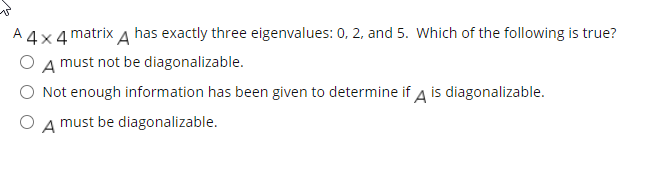 wicked lion
alright so i finally understand size i think lol
https://www.youtube.com/watch?v=lCtH7fYwn9c made a video, hopefully my understanding makes sense 😄
lavish jewel
looks ok
 rare spade
How is $||1||^2=2\pi$ ?

 wintry steppe
could you define what these mean?
stoic pythonBOT
Timur

 lavish jewel
sure
stable kindle
i also do not understand where 2pi is coming from
lavish jewel
$\Vert 1 \Vert_2^2 = 1$
stoic pythonBOT
Edd
 rare spade
I don't get this then
 stable kindle
what's the context for your original thing
wintry steppe
they probably mean the norm where you integrate a function's square on [0, 2pi]
norm on L^2[0, 2pi]
rare spade
Yeah the context is in fourier series in [-pi, pi] -> R
1, cos(𝑥),sin(𝑥), cos(2𝑥),sin(2𝑥), . . . , cos( (𝑘 − 1)𝑥),sin( (𝑘 − 1)𝑥)
lavish jewel
oh lol
wintry steppe
so what's the problem? write out the norm
rare spade
rare spade
I don't get this then
is orthogonal with this
wintry steppe
what's the integral of 1 on [-pi, pi]
wintry steppe
rare spade
I don't get this then
then you get this.
lavish jewel
$\Vert 1 \Vert_2^2 = \int_{-\pi}^{\pi} 1^2 dx$
stoic pythonBOT
Edd
 rare spade
Hmm
stable kindle
??
rare spade
$2\pi \neq 1$
stoic pythonBOT
Timur
 stable kindle
the same thing in different norms can have different things
wintry steppe
whatever you're reading is supposedly using the notation || ||_2 for the vector 2-norm, and || || for the function 2-norm
lavish jewel
because the two spaces are completely different
one of them is of square integrable functions
rare spade
Ohh
lavish jewel
the other was some euclidean R^n space
rare spade
Nice it is only written as a side note in the notes that were given out -.-
 lavish jewel
and this is still not what you had above
but in general, that'll depend on the choice of normalization for the period
rare spade
Yeah the intervals differ (the last ss was from a different example)
Yep I get it now
lavish jewel
aight
wicked lion
Could someone show me some references (written or video format) on dot product and how they work with the different left/right handed systems?
I know I could google one, but I'm worried about the information being incorrect (since I don't know the material, I won't be able to know whether or not it's valid info).
 limber sierra
what is meant by "the different left/right handed systems"?
dot products dont care about orientation
maybe youre thinking of cross products?
wicked lion
Oh yeah
Left and Right handed coordinate systems

Discusses the differences between right handed and left handed coordinate systems. This is generally a matter of which way the z axis is pointing, but the difference in handedness can apply to any axis.
More useful in 3d stuff
rare spade
If I have a space with differentiable functions $f: [0; \pi] \rightarrow \mathbb{R}$ with the $L^2$-inner product $\langle f,g \rangle=\int_0^\pi f(x)g(x)dx$.
Then for $f(x)=1$ the projection of f(x) along sin(x) and sin(3x) is

Does it look correct I just wanna confirm
stoic pythonBOT
Timur
 rare spade
forgot sin(x) and sin(3x) -.-
 stiff marlin
This is probably me being silly but how does the calculation for a1 work?

Apologies if this is the wrong channel haha
pallid rampart
Ok so
If a cubic polynomial has roots $\alpha_1,\alpha_2,\alpha_3$, then the polynomial is $(x-\alpha_1)(x-\alpha_2)(x-\alpha_3)$ right?
stoic pythonBOT
Whoever
 stiff marlin
Yes
pallid rampart
Now expand this
stiff marlin
I understand that bit, it is just the calculation for a1, I don't really understand the summation thingies
pallid rampart
Do you not know what that means or why a_1 is equal to the sum
pallid rampart
Ok
stiff marlin
I understand it when it is written like xy + xz + yz
But obviously I want to use this kind of language because it is better shorthand
pallid rampart
So let's start out in general I guess
A sum $\sum_{i=a}^bf(i)$ is just defined to be $f(a)+f(a+1)+\cdots+f(b-1)+f(b)$
stoic pythonBOT
Whoever
 pallid rampart
$\sum_{k>j}^3$ is the same thing as $\sum_{k=j+1}^3$
stoic pythonBOT
Whoever
 stiff marlin
That makes sense
pallid rampart
Alright
stiff marlin
Yeah because it isn't bigger than or equal, alright yes that makes sense
pallid rampart
Yeah
Exactly
So if the bottom part was k≥j then the sum will be from j to 3 instead of j+1 to 3
pallid rampart
Ok so if you expand the sum out then you will get $\alpha_1\alpha_2+\alpha_1\alpha_3+\alpha_2\alpha_3$
stoic pythonBOT
Whoever
 stoic pythonBOT
Whoever
 pallid rampart
In which case the sum is defined to be 0
It is defined to be 0 whenever the bottom limit is strictly greater than the top limit
stiff marlin
stoic python
**Whoever**
It would just be that thingy you put above
And then sub in the already known values of a3 and a2
pallid rampart
$\sum_{j=1}^3\sum_{k=j+1}^3\alpha_j\alpha_k=\sum_{k=2}^3\alpha_1\alpha_k+\sum_{k=3}^3\alpha_2\alpha_k+\sum_{k=4}^3\alpha_3\alpha_k$
stiff marlin
Oh alright, and then the k = 4 one is 0
pallid rampart
Yeah
stiff marlin
So you are just left with the first two
I see my mistake now
Thank you for explaining this!
stoic pythonBOT
Whoever
 pallid rampart
Nice
stiff marlin
Currently at A level and they aren't very rigorous, we were taught this but I just didn't understand it when using summation notation
pallid rampart
Ah yeah it's really frustrating when people just use notations they haven't defined
pallid rampart
Google, ask people like on this discord, or read more books
stiff marlin
Yeah that is true
I always seem to pick books that are either too difficult to follow or ones that are a cake walk
Video lectures are a good source
stiff marlin
Are you in the US?
pallid rampart
Yes
stiff marlin
It is kind of similar to there, we do trig approximations and binomials and basic differentiation and integration
I could send you a picture of the contents page of my maths syllabus if you want?
The A level course goes more into harder concepts but the language used it really vague
pallid rampart
Huh I see
I mean maybe you should continue reading about calculus
Maybe also read number theory, linear algebra
Just realized your problem isn't linear algebra
stiff marlin
Yeah I messed up with the channels and then realised after and kind of just tried to own it haha
For some reason my brain was like preliminary algebra
Also, now that you mention channels, we probably shouldn't be talking in here
My fault haha
pallid rampart
no big deal
stiff marlin
Thank you once again, now back to this book
wintry steppe
can someone help me with this

why wouldnt the rank of A be 0? why is it 1?
nvm now that i look at it the null space is linearly dependent
 wintry steppe
Cool
 lapis cosmos
wintry steppe
why wouldnt the rank of A be 0? why is it 1?
lapis cosmos
wintry steppe
why wouldnt the rank of A be 0? why is it 1?
Since the rank A is at most 3 therefore there exists the 3*3 “sub” matrix B of A such that the rest 4 rows of A can be linear generated by rows of B. Then rankA =rankB now dim N(A)=dim N(B)=2 therefore rankB =3-dim N(B)=1
I made it unnecessarily complicated... just that rankA is n=3 -dim N(A)=3-2=1😂😂
lavish jewel
you need 9 degrees of freedom for all 3x3 matrices
what you found is for symmetric matrices
wintry steppe
Not the. Basis are not unique except for dim 0 (and dim 1 over Z2)
lavish jewel
looks ok then
 sonic osprey
It's true for all vector spaces
boreal crane
Jup its true for all K-Vectorspaces the Dimension theorem is Just your equation: dim(S+U)=dimS+dimU-dim(S∩U)
 broken sun
Hello. Is there an example of a vector space $V$ and subspaces $U_1$ and $U_2$ of $V$ such that $U_1 \times U_2$ is isomorphic to $U_1+U_2$ but $U_1+U_2$ is not a direct sum?
stoic pythonBOT
MathPhysics
 lilac stratus
no, that's not possible
since $dim(U_1 \times U_2) = dim(U_1) + dim(U_2)$ and $dim(U_1 + U_2) = dim(U_1) + dim(U_2) - dim(U_1 \cap U_2)$
stoic pythonBOT
Shika-Blyat
 lilac stratus
and being isomorphic <=> same dimension
so if they're isomorphic, then $dim(U_1 \cap U_2) = 0$
stoic pythonBOT
Shika-Blyat
 broken sun
lilac stratus
no, that's not possible
broken sun
lilac stratus
no, that's not possible
Thanks. But, I did not assume that the vector space is finite-dimensional. Do these identities hold for infinite- dimensional case?
lilac stratus
the identities does hold, but then i can't anymore deduce that $dim(U_1 \cap U_2) = 0$.
stoic pythonBOT
Shika-Blyat
 lilac stratus
In the infinite dimensional-case, U_1 x U_2 ~ U_1 + U_2 but U_1 cap U_2 != 0 is possible yeah
sonic osprey
In that case you can and its not too hard, just take R^infinity and U_1, U_2 to be infinite dimensional overlapping subspaces
lilac stratus
or like U_1 = R[X] and U_2 = R_n[X] for any n
broken sun
Any two overlapping subspaces work?
broken sun
I cannot see. Can you please elaborate?
lilac stratus
So if you take $E = \bR[X]$, and like $U_1$ any infinite dimensional subspace of $E$
stoic pythonBOT
Shika-Blyat
 lilac stratus
And let $U_2$ be any subspace of $E$
stoic pythonBOT
Shika-Blyat
 lilac stratus
Then, by taking a basis $(e_i)$ of $U_1$ and a basis $(f_j)$ of $U_2$, then $(e_i) \times (f_j)$ is a basis of $U_1 \times U_2$. But since $card((e_i)) = dim(E)$, and $card((f_j)) \leq dim(E)$
stoic pythonBOT
Shika-Blyat
 lilac stratus
so $card((e_i) \times (f_j)) = dim(E)$
stoic pythonBOT
Shika-Blyat
 lilac stratus
and $card((e_i) \times (f_j)) = dim(U_1 \times U_2) = dim(E) = dim(U_1) = dim(U_1 + U_2)$
stoic pythonBOT
Shika-Blyat
 lilac stratus
but that assumes thatt $U_1$ and $U_2$ have basis, so like if you want to avoid this, just let $U_1$ be a subspace with an explicit basis, just like $E$ entirely with the basis $(X^n)_{n \in \bN}$, or any subspace generated by an infinite subfamily of this basis
stoic pythonBOT
Shika-Blyat
 lilac stratus
and take $U_2$ to be the subspace generated by the family of polynomials you want
stoic pythonBOT
Shika-Blyat
 lilac stratus
is this clearer ? @broken sun
broken sun
lilac stratus
is this clearer ? <@!722694050305802302>
Thank you very much for your help.
lilac stratus
what the values of the first row of AB are going to be ?
ok, how do you computed it ? @hollow grove
I mean, what are the calculations you did to get these values
zealous junco
just take first row of A
you did $6R_1+9R_2+0R_3-7R_4$ where $R_i$ is rows of B to get the first row of AB
stoic pythonBOT
Anticipation
 zealous junco
i.e. lin combo of the rows of B by coefficient of first row of A
lavish jewel
a nice and compact way is to start from wAB and force it to be a row from AB, which is trivially done by setting w equal to a canonical basis vector and associating (AB)
then just associate (wA) = v and you're done
if you choose the vector w = e1 = [1,0,0], you get the solution anticipation gave
 quasi vale
wdym?
sonic osprey
you need all three lines to intersect for it to be a solution
like the bottom intersection is only a solution to the red line and the purple line
so if your system is all three lines, then its not a solution
You're basically looking at two different system of equations here
solution 1 is a solution to the system that has the purple line and green line
but it isn't a solution to the system that has all three lines, since it doesn't satisfy the red line
similarly, solution 2 is a solution to the system that has the purple line and green line
but it isn't a solution to the system that has all three lines
zealous junco
this lemma and proof r both valid right? and could i simplify
 sonic osprey
this is vaguely how projective geometry works
you say that parallel lines intersect at "infinity"
 sick tartan
is it okay to use linear algebra approach if your subject is calc 3?
dire thunder
wym
 shut sigil
By any chance would anyone know what the answer to this would be?

or how to solve it?
 gritty swift
wrong channel, but you just take the slope then solve for k
shut sigil
that's what I've been doing but for some reason it still doesn't add up
wait nvm
I just realized my issue
stoic pythonBOT
uli

 quartz compass
really depends on what they're solutions to
 dusky epoch
(x,y,z) and (X,Y,Z) are solutions to what?
a system of linear equations?
great
your answer for b is incorrect
wintry steppe
it is actually possible. Consider the system of linear equations 0=0 over Z2
dusky epoch
we're working over the real numbers.
no finite field stuff.
if 25 planes have two points all in common then they also all pass through the line that goes through those two points @wintry steppe
zealous junco
ah i guess i need to show B_2\B_1 is lin indep
and $B_2\backslash B_1 \cap W = \emptyset$
stoic pythonBOT
Anticipation
 wintry steppe
Anyone good at vectors, dm me - I can pay
zealous junco
nvm this doesnt work
 uneven shore

<@&286206848099549185>
can anyone help me simply this expression
please ping me if anyone can help
wintry steppe
yea, do you know the axioms of a vector space?
uneven shore
nooo 😭😭
 plain saffronBOT
From
Rule 4
If your question has not been answered for a minimum of 15 minutes, you may use the Helpers tag once. Please do not try to bump your question using this ping unnecessarily. Do not abuse this ping. Do not individually ping users with the Helpers tag without their express permission.
limber sierra
that said, do you know how to simplify if x, y, z are regular ol' variables instead of specifically vectors?
since the process is the same
 uneven shore
limber sierra
that said, do you know how to simplify if x, y, z are regular ol' variables inst...
uneven shore
limber sierra
that said, do you know how to simplify if x, y, z are regular ol' variables inst...
is this rightttt
limber sierra
yes.
uneven shore
okay thank you!!
uneven shore
dusky epoch
the arrow isn't supposed to jump from the y to the 5
Oooh okay thank you!!!


 next vapor
how do i show that u1 tensor v1 is equal to u2 tensor v2 if and only if there exists a c in the field such that u1=c u2 and v1=c^-1 v2, where u1,u2 and v1,v2 are in finite dimensional vector spaces U and V?
im guessing this is from the definition of a tensor product but really not sure how to link it togethor
wintry steppe
I need help with my math
next vapor
channel is in use, please try another one
wintry steppe
it could mean scalar multiplication by 0 but that's trivial
native rampart
next vapor
how do i show that u1 tensor v1 is equal to u2 tensor v2 if and only if there ex...
You want u_1(x) v_1(y)=u_2(x) v_2(y) for all x,y in domain for u_1 tensor v_1 to be equal to u_2 tensor v_2.
Now pick a y such that atleast one out of v_1(y) and v_2(y) is nonzero . Let v_2(y) be nonzero. Then v_1(y)=cv_2(y) for some c in F,i.e.,c u_1(x) = u_2(x) for all x
You end up with u_2=cu_1 and cv_2=v_1
 nocturne jewel
Im confused on how singular value decomp works algorithmically, I think I got the sigma and Q* matrices, but how do I get P? $A=P\Sigma Q^*$
stoic pythonBOT
moshill1
 nocturne jewel
My notes say compute $w_i=\frac{1}{\sigma_i}Aq_i$ for the columns of Q then extend to an orthonormal basis
stoic pythonBOT
moshill1
 next vapor
native rampart
You want u_1(x) v_1(y)=u_2(x) v_2(y) for all x,y in domain for u_1 tensor v_1 to...
next vapor
native rampart
You want u_1(x) v_1(y)=u_2(x) v_2(y) for all x,y in domain for u_1 tensor v_1 to...
wait wdym by the first line, You want u_1(x) v_1(y)=u_2(x) v_2(y) for all x,y in domain?
next vapor
uh we didnt really define it like that hm
the way it was defined was a quotient space of the free vector space F(VxU) quotiened by the subspace U with elements of certain properties
honestly idek how to treat elements of the tensor i just know their properties and how theyre defined
native rampart
Yea,in context of finite dimensional spaces,free space just means a normal ordinary vector space
There are no non free finite dimensional vector spaces
next vapor
native rampart
iirc, f tensor g (x,y)=f(x) g(y)
wait this isnt their product right
its the cartesian product?
native rampart
f(x) and g(y) are elements in F. f(x) g(y) is just a product in F
next vapor
i figured out the reverse direction its just the forward one
native rampart
(x,y) is a member of a Cartesian product
next vapor
hmm
okay so their tensor being equal implies that for every bi linear map in their dual space F we have F(u1,v1)=F(u2,v2) right
native rampart
I think so
next vapor
but then what do i do from here lol
native rampart
I think you take a particular bilinear map which simplies your situation
Let's say e_1,e_2,...e_k is basis for V
Consider the bilinear form f such that
f(u_1,e_1)=1,f(u_1,e_2)=1... f(u_1,e_k)=1
and f(x,v)=0 for all x not in span{u_1} and for all v
This will force u_2 to be cu_1 since otherwise one side of this bilinear product will be zero,while the other is nonzero
next vapor
so that means f(u1,v1)=a1+...an, where v=a1e1+...an e_k right
and since we must have F(u1,v1)=F(u2,v2) this means that u2 has to be in the span of u1
okay i see it
but then how do we show the same for v2=c^-1 v1
like what input of F do i consider
native rampart
Repeat the same thing
Consider f such that f(e'_1,v_1)=1,f(e'_2,v_1)=1... f(e'_m,v_1)=1 where that's the basis and f(x,b)=0 b not in span {v_1}
This would imply v_2=c'v_1
native rampart
now f(u_2,v_2)=cc' f(u_1,v_1) for any bilinear form
=f(u_1,v_1)
Now just take a nonzero bilinear form and you end up with cc'=1
native rampart
next vapor
idk how on earth i was meant to come up with that
Yea, That's a very common FDVS technique
Choose a function that makes your life easier
native rampart
Both
nocturne jewel
Is there a way to find an orthonormal basis consisting of eigenvectors of a matrix without finding an eigenbasis and orthonormalizing it?
(Question for ref)

 spiral star
nocturne jewel
Is there a way to find an orthonormal basis consisting of eigenvectors of a matr...
spiral star
nocturne jewel
Is there a way to find an orthonormal basis consisting of eigenvectors of a matr...
not in general. but you wont have to use gram schmidt in this case
nocturne jewel
spiral star
not in general. but you wont have to use gram schmidt in this case
Yeah nudge on how I dont need gram-schmidt please?
Cause Ik C*=C so ik that there is an orthonormal basis by Real Spectral
spiral star
C is self-adjoint so its eigenspaces are orthogonal
you have 4 distinct eigenvalues
so one eigenvector from each space
any choice of an eigenbasis will automatically be orthogonal you just have to make them unit length
in general, for self adjoint maps, you only have to orthogonalize the vectors from the same eigenspace
so if i have v1,v2 from eigenspace E1 and v3 from eigenspace E2 then i only have to orthogonalize {v1,v2}
(as an example)
nocturne jewel
Ok might've just messed up finding the eigenvalues then
spiral star
let's be lazy for a moment
uuuh
,w eigenvalues {{a,0,b,0},{0,a,0,2b},{b,0,a,0},{0,2b,0,a}}
stoic pythonBOT


 Requested by Flow#8160
nocturne jewel
Requested by Flow#8160
nocturne jewel
yeah I messed up the chacteristic poly lol
spiral star
that looks distinct
nocturne jewel
I got complex lambda 
spiral star
anyway, every eigenbasis will be orthogonal since C is symmetric
and you have distinct eigenvalues
so you wont have to worry
nocturne jewel

 acoustic zodiac
how can i show that a projector is orthogonal over a certain subspace?
nocturne jewel
P is orthogonal over V iff $\langle u, P[v]\rangle=\langle P[u],v\rangle , u,v\in V$
stoic pythonBOT
moshill1
 nocturne jewel
(iirc that that's the characterization)
 acoustic zodiac
 north steeple
no, because from a) you can't get (0,1,0)
 acoustic zodiac
in this case you have that every vector follows (a, a, 2a, d)
therefore you get: a(1,1,2,0) + d(0,0,0,1)
so the dimension is 2
 north steeple
i just plugged in 0 for t and the deteminant is 0
acoustic zodiac
plug it for -1
north steeple
why
acoustic zodiac
to check if answer d) is correct
wintry steppe
Yep
wintry steppe
Where is it
north steeple
waitr
wintry steppe
K
wintry steppe
Just send it
wintry steppe
K
acoustic zodiac
north steeple
im happy i have no more math
math is fun tho
acoustic zodiac
vector spaces make a lot of sense once you get them
you just have to get them
it's not like, idk, calculus, even if you know how to integrate, lots of integrals are going to be hard
lilac stratus
acoustic zodiac
no, because from a) you can't get (0,1,0)
you can ? [1, 1, 1] - [1,0,1] ?
acoustic zodiac
lilac stratus
you can ? [1, 1, 1] - [1,0,1] ?
oh shit you are right, guess the teacher was wrong
lilac stratus
Yeah I think that's also a basis
acoustic zodiac
it definitely is, it's just not the usual one
lilac stratus
(pong @north steeple)
acoustic zodiac
anyways yeah, a) is indeed a basis
acoustic zodiac
yep
north steeple
ok
lilac stratus
yeah, pinged you for that reason lol
acoustic zodiac
well let me think for a sec
north steeple
i remeber doing it
acoustic zodiac
i mean, to get something like (3,1,3) you'd have to first do (1,1,1)-(1,0,1) and then add 3(1,1,1)
which means you can't get all vectors in the subspace with just those two vectors
acoustic zodiac
well, not necessarily, this is a bit subtle, in fact
north steeple
im gonna email anyways to try and get a mark for it
acoustic zodiac
a basis of E is "a set of vectors that belong to E, that span E, and that are linearly independent"
a) does span E using a finite number of vectors, (1,1,1) and (1,0,1) obviously belong to the space, and they are linearly independent
therefore it does follow the definition of basis
north steeple
yes that does make kinda make sense
 rough stag
Anyone can help me with 10-12?
 north steeple
thanks
acoustic zodiac
rough stag
Anyone can help me with 10-12?
rough stag
Thanks. Wasn't sure which section this would belong.
wintry steppe


I've been stuck on this for a while
how do i manipulate the right side to get x'?
wintry steppe
Anyone good at vectors, dm me - I can pay
nocturne jewel
wintry steppe
Anyone good at vectors, dm me - I can pay
No
zealous junco
wintry steppe
Try showing $(A-uv^\top)(x+\alpha A^{-1}u) = b$
stoic pythonBOT
Anticipation
 wintry steppe
let me look
zealous junco
thats because $x' = (A-uv^\top)^{-1}b$ and you want to show $x' = x+\alpha A^{-1}u$ also, so you equate the 2 and try to show they are actually equal
stoic pythonBOT
Anticipation
 wintry steppe
hey can i dm you if i get stuck @zealous junco ?
zealous junco
yea
 wintry steppe
find eigenvalue and eigenvectors first
wintry steppe
D = diag(eigenvalues) and P is the eigenvectors
 safe locust
wintry steppe
D = diag(eigenvalues) and P is the eigenvectors
safe locust
wintry steppe
D = diag(eigenvalues) and P is the eigenvectors
so D is the eigenvalues diagonalized ?
wintry steppe
yes the eigenvalues will be along the diagonal of D

 safe locust
anyone lol?
wintry steppe
Remember the definition of a linear transformation
safe locust
wintry steppe
Remember the definition of a linear transformation
so how would i do this prob?