#linear-algebra
2 messages · Page 193 of 1
 stable kindle
then multiply those dot products by the corresponding parameterisation vectors and sum the two together?
i feel like there's an easier way
eh, that'll probs do
 glad hamlet
id prefer an easier way cause ill have to do quite a lot of calculations like this
programming a thing that is supposed to run those kind of calculations many times per second
stable kindle
hmmmm
glad hamlet
i added planeNormal*dot(planeNormal,-vector) to vector
i think
something like that
 hybrid charm
how does one do this?

 gray dust
look up a diagonalization procedure
 drowsy flower
hi i am confused about a definition
Null space means set of vectors x such that Ax = 0. What does spanning set of null space of A mean?
So span means set of all linear combination of set of vectors
is that set called the spanning set?
 wintry steppe
"spanning set of null A" would be a set S, called the spanning set, such that null A = span(S), the set of all linear combinations of elements of S
drowsy flower
sorry i dont understand what Null(a) = span(s) is saying....
wintry steppe
it's saying that null A is the set of all linear combinations of elements of S
 calm yoke
Is there any fast way to know if a matrix has an inverse?
I know that if it has a lower line of 0 it isnt
or that if it isnt square
 faint lintel
A matrix is invertible iff the determinant isn't 0 @calm yoke
calm yoke
So, the sum of its diagonal?
faint lintel
No
Do you know what a determinant is
If you don't then there are other ways to tell if it's invertible
calm yoke
Wait, it came back to me, you multiply each term of both diagonal separately and subtract them
drowsy flower
i think we can also check if it has inverse if we can convert matrix A to identity matrix I right?
faint lintel
Yes @drowsy flower
drowsy flower
yeah i find that way easier
 drowsy flower
just row operations
calm yoke
drowsy flower
yeah i find that way easier
To find the inverse you need to do a lot more than to find the determinant tho
drowsy flower
for 2x2 and 3x3 matrix, finding determinant is not hard, but when it gets larger and larger, it gets hard
calm yoke
Yeah, but row operations are exponentially harder
and to carry an error is really easy
wintry steppe
is there a way i can dumb this down to find the eigenvalues easily?
 faint lintel
calm yoke
faint lintel
calm yoke
That definition only works for 2x2 matrices
But yea what I said still holds
If det(A) =/= 0, A is invertible
calm yoke
faint lintel
That definition only works for 2x2 matrices
Yeah, my bad
 dire thunder
i was speaking that proof that each vector space has basis requires choice 
dire thunder
because if you look at convo anticipation then mentioned this theorem
 tame mural
IMO it's easier to first define invertibility on simpler ideas, because in most intro texts the determinant comes later
 merry imp
Let U be a subspace of V, and define the affine subsets v+U and w+U. Having trouble showing that v+U=w+U implies that the vector v-w is in U
 native rampart
Is v an element of v+U
merry imp
v and w are both vectors in V
native rampart
(That was a Leading question)
merry imp
Ah, yea it is
merry imp
Oh lol does it mean v=w so v-w=0 which is in U?
native rampart
No
It means v=w+u for some u in U
Because elements of w+U are of that form
and v is an element of w+U
 vocal prairie
Suppose $A, B$ and $C$ are matrices of size $l\times m, m\times n$ and $n\times p$, respectively. Is the number of times you need to multiply while computing $AB$ equal to $lmn$? I think so because $m$ entries in $l$ rows of $A$ are multiplied to $n$ columns of $B$. Consequently, the number of times one multiplies to compute $ABC$ is $lmn+lnp$. Is this is the least possible value?
 stoic pythonBOT
Buncho Bombs

 dusky epoch
are we doing it naïvely?
vocal prairie
Oh, it's the answer I came up with
It asks to compute
I guessed that since AB is an l\times n matrix, multiplying with C should be lnp extra steps?
dusky epoch
hm let me see
vocal prairie
The value changes if I start with BC, then A? 
dusky epoch
$(ABC){ij} = \sum{k=1}^m \sum_{r=1}^n a_{ik} b_{kr} c_{rj}$
stoic pythonBOT
Ann
 dusky epoch
which seems to require... 2lmnp operations?
vocal prairie

vocal prairie
It's alright, I'll give it some more thought!
vocal prairie
stoic python
**Ann**
Would try to wrap my head around this notation lmao
native rampart
Shouldn't it be mnlp?
stable kindle
i think if you do (AB)C it is lmn + lnp
for A(BC), BC you get mnp and then it's lxm by mxp so lmp, ie. overall lmp + mnp
stable kindle
i think it's just that multiplying out like that isn't perfectly efficient, like you could do it all in one go
and it would be a more symmetrical thing?
vocal prairie
I think so too
native rampart
vocal prairie
Can you explain Ann's notation above?
Let (BC)=D.
$(AD){ij}=\sum{k} a_{ik} d_{kj}$
vocal prairie
Okayyyy
stoic pythonBOT
Buncho Drunk
 native rampart
And write d_{kj} in terms of entries of B and C to get above formulae
vocal prairie
Hmmmm, okay I seem to understand this
native rampart
Now to compute each entry, you need to do m(n) multiplications
native rampart
stoic python
**Ann**
Referring to this
stable kindle
but actually that's doing it maximally inefficiently
bc doing it piecewise, you can do them in two steps
adding in between
and that turns a whole cuboid of multiplications into just like two grids
clear as mud, okay so like
it's like instead of doing ad + ae + af + bd + be + bf + cd + ce + cf, 9 multiplications
you do (a+b+c)(d+e+f) and that's just 1 multiplication
vocal prairie
Aahhhhhhh
stable kindle
so actually splitting it up makes it more efficient
but there's different ways to split it up, it's just fundamentally not symmetrical
very strange
vocal prairie
Hmmm, so depending on which method optimises the number of steps required, we can go for (AB)C, A(BC) or (ABC)?
vocal prairie
Hmmmmmmm
stable kindle
like, lmnp is degree 4, whereas the others are degree 3?
lmn + lnp for (AB)C, lmp + mnp for A(BC), hmmmm
 gritty swift
$$\det(e^{\mathbf M t}) = e^{\text{Tr}(\mathbf M)t}$$
stoic pythonBOT
uli
 gritty swift
this made my day, its pretty easy to show but it seemed so out of the blue when i first saw it
wintry steppe
can someone walk me thru #28

 sharp idol
gritty swift
this made my day, its pretty easy to show but it seemed so out of the blue when ...
sharp idol
gritty swift
this made my day, its pretty easy to show but it seemed so out of the blue when ...
This seems surprising to me. What's the proof for this?
gritty swift
sharp idol
This seems surprising to me. What's the proof for this?
I ommited some stuff for rigor but here's my reasoning
$$\det\left(e^{\mathbf Mt}\right) = \det\left(\mathbf Se^{\mathbf \Lambda t}\mathbf S^{-1}\right) = \det\left(e^{\mathbf \Lambda t}\right) = e^{\text{Tr}(\mathbf M)t}$$
the last step works because of this (I'm too bad at latex so heres an image)
 stoic pythonBOT
uli
 gritty swift
oh sorry and the second step works by factoring out of the infinite series (assuming it converges)
it kinda makes sense if you think of $\det e^{Mt}$ as how much volume gets scaled after running the differential equation described by $M$ for $t$ seconds, and $e^{\text{Tr}(M)t}$ is saying "volume grows at a rate of the sum of the eigenvalues for t time"
stoic pythonBOT
uli
 gritty swift
it still isn't super clear to me why, but I think eigenvector alignment doesn't matter since the determinant is linear in each column
sharp idol
Nah, I get what you're putting down. Thanks for the info :)
wintry steppe
it's obviously true for diagonal matrices, and diagonal matrices are dense, so by continuity of all the operations involved, it holds for all matrices
 sonic osprey
Do u mean diagonalizable
 limber sierra
"diagonal matrices are dense" and other fun facts with the math discord
 nocturne jewel
i guess im a diagonal matrix then 
 sturdy portal
I find myself confused where I use regular multiplication and dot multiplication in my writing. Is there a common approach to denote that an operation, in my case multiplication , belongs to a particular algebraic structure? Something like $\cdot_{(\mathbb{F})}$
stoic pythonBOT
JohnDark
 sonic osprey
yeah that notation is used sometimes
sturdy portal
Thank you
 vestal abyss
 sonic osprey
what is your question? @vestal abyss
sharp idol
Are you aware of cofactor expansions and how it can apply to any row or column?
sharp idol
vestal abyss
The question lmao
Hint: take the determinant with respect to the first column
sharp idol
Yep! And since it doesn't matter what column or row you take the determinant from, the follow up question should be pretty straightforward :)
 zealous junco
anyoen can help

I dont recall how i integrated rational functions except partial fraction or trig subs
so for R(t), C(t) and Q(t) im trying to find a basis
and i dont see how integration relates
 lapis cosmos
zealous junco
so for R(t), C(t) and Q(t) im trying to find a basis
lapis cosmos
zealous junco
so for R(t), C(t) and Q(t) im trying to find a basis
Union of {t^n for natural numbers n } and {t^n/p(t)^m where n is a natural number smaller than the degree of p, p is irreducible over k, m is a positive integer.}
zealous junco
i see thx
zealous junco
lapis cosmos
Union of {t^n for natural numbers n } and {t^n/p(t)^m where n is a natural numb...
do you see relation w/ integration?
or i guess its just asking us to think of writing polynomial in quotient remainder form
lapis cosmos
Probably. When we calculate the integral of an rational function we also factorize the given rational function into that form
zealous junco
thanks
 next vapor

is the first part of this just literally applying the universal property of exterior products?
cuz that map is multi linear and skew symmetric cuz of dot and cross product properties right
so can i just say by UP theres a multi linear map such that f(v wedge w wedge z)=f(v,w,z) and thus its an element of the dual space
next vapor
<@&286206848099549185>
next vapor
anyone?
 spring pasture
@next vapor what does wedge mean
next vapor
ive been trying to wrap my head around tensor product spaces for a while
anyone got any good resources?
wintry steppe
i believe it is some universal property stuff
next vapor
does what i wrote above make sense?
wintry steppe
let me remind myself of the precise statement of the UP for exterior algebra
sounds about right tho
spring pasture
But is showing that f maps on field F=R enough here to show its dual space
What more is to be done
Does both external and internal composition shows that it belongs to dual space
wintry steppe
next vapor
so can i just say by UP theres a multi linear map such that f(v wedge w wedge z)...
what you've written sounds fine, just replace "skew-symmetric" by "alternating" (more of a linguistic nitpick than a mathematical one)
and then it descends to a linear map \wedge^3 R^3 -> R, i.e., an element of the dual of \wedge^3 R^3
for the second part you should use the fact that \wedge^3 R^3 has dimension 1
tikz was being obtuse so i had to ms paint it

so it's not really f that's in the dual space, but it's the induced map on the exterior power that is
sonic osprey
this seems more appropriate for #groups-rings-fields
wintry steppe
My bad I’ll unsend
 tribal moss
Hi, I'm currently doing linear algebra and I'm going through vector spaces. I understand most of it, but I just don't get why it matter if the set is closed under addition and scalar multiplication. If someone could help with this, I'd really appreciate it. Thank you
limber sierra
you want it to be possible to add/multiply things within your system
if its not closed under one of those, you can add/multiply things and end up "outside of" your system
which is bad
for example, if you try and divide two integers, your result will often be something that is not an integer
in which case youre no longer studying "the integers"
youre studying "the rationals"
of course theres connections, but theyre different systems
tribal moss
Ooh so like a dumb example (this is not the case but if it were) if I add 2 3rd degree polynomials and I get a 4thdegrrr
limber sierra
sure, the point is that we want our operations to "make sense" within the parameters we set up
tribal moss
Oooh alrighty thank you sir!!!
 limber sierra
the size of a basis, yes.
 amber sierra
how do I determine if W is a subspace of R2? My textbook answer is W is not a subspace but I keep getting that it is.
x = x_1
x_2
W = {x: x_1 = x_2 or x_1 = -x_2}
please @ me when answering, thanks! 🙂
wintry steppe
draw a picture of W @amber sierra what does W look like?
amber sierra
would it be like
       |   /
       | /
-------+-------
       | \
       |   \
tbh i don't really understand what a subset is lol
 empty copper
Don't you mean subspace
amber sierra
subspace sorry*
empty copper
Do you know what a vector space is
amber sierra
i have no clue 😅
empty copper
Hmm
amber sierra
is it like a vector field?
empty copper
Nope
I think you might want to recall some basic definitions such as vectors and vector spaces before you can do questions about (linear) subspaces effectively
amber sierra
alright ill look over my notes
my professor kind of skipped around topics so i forgot all the earlier stuff
 glossy parcel
"The transition matrix inverse P^-1 will always exist since the basis vectors comprising P are linearly independent."
i dont understand this reason
wintry steppe
glossy parcel
"The transition matrix inverse P^-1 will always exist since the basis vectors co...
i believe if a matrix A is linearly independent, then det(A) =/= 0
glossy parcel
i know the 2 independent statements are right. i just dont see why they would state that as the reason
wintry steppe
the only time the inverse would not exist is when the det(A) = 0 because you cannot divide by 0
wintry steppe
glossy parcel
i know the 2 independent statements are right. i just dont see why they would st...
just a proof i guess?
stable kindle
glossy parcel
i know the 2 independent statements are right. i just dont see why they would st...
idk, maybe it's easy to verify in the context
wintry steppe
limber sierra
the size of a basis, yes.
how would i exactly go about finding a basis though? i dont know where to start
i did p(0)=p(1), and got something like a0 = a0 +a1 + a2 + a3 but idk how that would help
oop nvm im dumb i get it now
sonic osprey
why?
 pseudo thicket
sonic osprey
why?
pseudo thicket
sonic osprey
why?
considering the zero vector in the set
sonic osprey
yeah
pseudo thicket
sonic osprey
yeah
Thanks!
 dreamy iron
Hi. Lin. Algs.
Please help with an interpretation of this problem.
Page 20 of Treil: LADW.

what is meant by $x_1 = 3x_2$ ?
is it the RED or BLUE line?

Desmos
stoic pythonBOT
ninnymonger
 dreamy iron
Also, second question:
what is meant by rotating the entire plane by an angle of negative gamma?
do i take the x-axis and rotate it up by gamma?
OR
do i take the x-axis and rotate it down by gamma?
 dire thunder
it depends on how your system of coords is set up
but yes i would say x_1 = 3x_2 is blue line
dire thunder
dreamy iron
Also, second question:
what is meant by rotating the entire plane by an angle ...
rotate by gamma clockwise
dreamy iron
we can first rotate the plane by the angle −γ, moving the line x_1 = 3x_2 to the x_1-axis,
i dont see how a clockwise rotation accomplishes this.
I CAN SEE a clockwise rotation if we rotate the BLUE line by negative gamma, then it will sit exactly on the x-axis.
dreamy iron
JUST GOT OUT OF THE SHOWER AND I THINK I SEE IT NOW.
OKAY. So.....
it's like photoshop.
the bottom later is R^2, the plane. it's immovable. call this layer ZERO
sitting on top of that, is another plane, also R^2, but with the blue line embedded in it. call this layer 1.
if you rotate layer 1, by negative gamma, you will not rotate layer 0. so the end effect is that the blue line will sit on the x-axis after a clockwise rotation by gamma.
^shower thoughts.
I think that's right.
faint lintel
Yo for computing the jordan canonical form of a matrix and the associated canonical basis
Do people really use these dot diagram things?
They seems weird and convoluted
Or I guess rather does anyone have a good resource for Jordan Canonical Form?
Cause this Friedberg Insel Spence book is lacking
Especially in the section on how to actually computer the form

Google Docs
Page 497 for the part on how to compute (which also mentions the dot diagram things)
(please ping me)
dusky epoch
no fuck
dusky epoch
dreamy iron
what is meant by $x_1 = 3x_2$ ?
is it the RED or BLUE line?
blue
x = 3y basically
 sonic osprey
what's your definition of orthogonal?
 quartz compass
as a hint, the left inverse of a square matrix is the same as the right inverse
 vast iron
Express the vector 𝑎̅ = 24𝑖̅− 10𝑗̅− 13𝑘̅ in the form 𝑝̅ + 𝑞̅, where 𝑝̅ is parallel
with the vector 2𝑖̅− 2𝑗̅− 𝑘̅ and 𝑞̅ perpendicular to it
I solved this one, my question is that I used ap + bq and then used b = 1 in the end and it worked out.
My question is that, this should've been true for any b right? Like we can find infinitely many vectors p and q that satisfy these conditions right?
 lavish jewel
yeah, you can shrink or stretch p and q as much as you want, as long as a and b compensate for it
vast iron
Thanks.
 strange delta
how do i even begin with part i
 faint lintel
i is just definition of function composition. Follow the arrows
zealous junco
ye basically a definition question, just write sentences of how phi_v transfers a vector into a coordinate w.r.t basis B_v etc
 crude falcon
Can the symmetry and identity element be the same?
wintry steppe
elaborate
crude falcon
Like in algebraic groups exists an identity and symmetry elements
can those two be the same element/number?
or they need to be different from each other
native rampart
What is a symmetry element?
crude falcon
an element p such that a * p = e (identity element)
native rampart
So,inverse?
crude falcon
hmm maybe? I'm not sure since I dont know if the simmetry element needs to be unique or not
native rampart
a symmetric element is specific to an element tho,while the identity is always the identity wrt any element
So,No clue how you can compare those 2
wintry steppe
the only element in a group whose inverse is the identity is the identity
dire thunder
privyet tterra
 quick oak
Can someone explain how this works? The set {(x,y):x≥0,y≥0} is closed under addition, but not under scalar multiplication, since −1⋅(1,1)=(−1,−1), for example.
why we are able to multiply the tuple by (-1)
quartz compass
cause it's a scalar in our field
quick oak
shouldnt we able to multiply it by something >=0
@quartz compass -1 is not in our field?
is it?
quartz compass
it is
we can give another argument for why this isn't a vector space if you don't like the scalar
quick oak
i am having trouble understanding it 😦
quick oak
the scalar value (-1) is not in this area x≥0,y≥0
quartz compass
ok let's back up, what is it exactly that you're trying to show, I'm assuming you're wanting to show this is a vector space is that correct?
quick oak
i can understand that
it is closed under addition
becasue using this set you cannot produce anything out of this set
but multiplication is kinda confusing for me
quartz compass
part of being a vector space is that you have to be able to multiply by scalars in your field, and your field is probably R
R being the real numbers, which contains -1
quartz compass
you can think of this as specifying that your vectors lie only in the first quadrant
 stoic pythonBOT
Merosity
 quartz compass
subject to the condition that $x_1>0$ and $x_2>0$
stoic pythonBOT
Merosity
 quartz compass
as a set, this is perfectly fine
quick oak
A set is closed under addition if you can add any two numbers in the set and still have a number in the set as a result. This is the definition
quartz compass
but if you're trying to prove this is a vector space, then you need to realize you're trying to show that the elements of this set then can do everything in a vector space
quick oak
we should use the numbers in this set and not be able to get out of this set
quick oak
i am not 😦
quartz compass
what are you trying to prove here
quick oak
sorry if i looked like
i know i am wrong, i just want to understand the reasoning
here is where i struggle
quick oak
ah uhm
that it is closed under mult
isnt?
@quartz compass my problem is that we are able to multiply the tuple by (-1) which is <= 0 that is not defined in the question
limber sierra
W is your set of vectors
your set of scalars is ℝ
so you can multiply by -1 since its in your set of scalars
but this takes you outside of W
hence demonstrating that W is not closed under scalar multiplication
quartz compass
quartz compass
part of being a vector space is that you have to be able to multiply by scalars ...
@quick oak that's what I said here haha
quick oak
@quartz compass your explanation required me to emphasize on some points which i dumbfully overlooked, @limber sierra used italic font which got my attention you did you best man I was dumb cheers!
quartz compass
lol

 zinc tapir
can someone break this down for me, i havent done an induction proof in a bit

 obsidian bluff
zinc tapir
can someone break this down for me, i havent done an induction proof in a bit
obsidian bluff
zinc tapir
can someone break this down for me, i havent done an induction proof in a bit
im not sure what the α_k are
I was looking over something and confused myself
I saw that C^3 (complex numbers) has a standard basis {x1, x2, x3}. What are these elements? Are they (1, 0, 0), (0, 1, 0), (0, 0, 1) ? If so how can one achieve every element of C^3 through a linear combination of x_i ? Since this is the definition of a basis. In my head it makes sense that C^3 has 6 elements in its basis, could someone clear the confusion for me please. thanks in advance
 rotund jetty
obsidian bluff
I saw that C^3 (complex numbers) has a standard basis {x1, x2, x3}. What are the...
rotund jetty
obsidian bluff
I saw that C^3 (complex numbers) has a standard basis {x1, x2, x3}. What are the...
Your basis elements are correct! What's key to remember is that if it's three dimensional you're taking $\mathbb{C}^3$ as a vector space over $\mathbb{C}$, so your scalars are complex numbers, not real numbers
stoic pythonBOT
Nicholas
 rotund jetty
stable kindle
feel like you should still need 6
rotund jetty
stable kindle
feel like you should still need 6
as a vector space over R yes, over C no
stable kindle
lol i woulda said 3 for R^3, 6 for C^3
rotund jetty
I said over R, not R^3
you can take C^3 as a vector space over R or over C
over R, it is 6-dimensional, and the standard basis is over R is {(1, 0, 0), (i, 0, 0), (0, 1, 0), (0, i, 0), (0, 0, 1), (0, 0, i)}
stable kindle
oh uhhhh yes right
rotund jetty
Since your scalars are real numbers
which is probably what you were thinking of!
but if you take C^3 as a vector space over C - that is, if your scalars are comlex numbers - then you only need 3 basis vectors
namely, {(1, 0, 0), (0, 1, 0), (0, 0, 1)}
rotund jetty
@obsidian bluff does that make sense to you? it depends what your field of scalars is, and if you're saying C^3 is 3-dimensional, then your scalars must be complex numbers, in which case there are no problems
zinc tapir
obsidian bluff
im not sure what the α_k are
 stable kindle
obsidian bluff
I saw that C^3 (complex numbers) has a standard basis {x1, x2, x3}. What are the...
stable kindle
obsidian bluff
I saw that C^3 (complex numbers) has a standard basis {x1, x2, x3}. What are the...
to get like to (1+i, 0, 0) you'd do (1+i) * (1, 0, 0)
to be clear

 nocturne jewel
I mean right idea, however v_j isnt the span of v_j
it's a specific vector in the span of itself
also as written you're saying v's are scalars, then introduce a's that somehow end up disappearing
 nocturne jewel
strange delta
i changed it a bit, how do i progress from here?
nocturne jewel
strange delta
i changed it a bit, how do i progress from here?
that's still just 1 specific vector in the span of v_j
you want to end up with (any scalar)v_j as a nudge
zinc tapir
like what does he mean by those arrows, am i substituting in r^i ? ****
 strange delta
nocturne jewel
you want to end up with (any scalar)v_j as a nudge
strange delta
nocturne jewel
you want to end up with (any scalar)v_j as a nudge
how about now?

 blissful vault
if you have the eigenvalues for a matrix, how do you find the orthogonal matrix?\

i also found the eigen vectors
1 -1 1
-1 0 -1
1 -1 0
nocturne jewel
strange delta
how about now?
Again, you ended up with v_j
Span(v)=av for scalar a
gritty swift
blissful vault
if you have the eigenvalues for a matrix, how do you find the orthogonal matrix?...
just make the eigenvector matrix orthogonal with graham schmidt I think
gritty swift
remember why diagonalization works, if you have $Ax = \lambda x$ you can write the same thing with matrices $AX = X\Lambda$ then invert $A = X\Lambda X^{-1}$ notice this argument holds for however the eigenvectors are scaled. so we can normalize them if we want (they'll already be orthogonal if $A$ is symmetric)
stoic pythonBOT
uli
 blissful vault
gritty swift
just make the eigenvector matrix orthogonal with graham schmidt I think
blissful vault
gritty swift
just make the eigenvector matrix orthogonal with graham schmidt I think
thanks
gritty swift
btw if the eigenvectors aren't orthogonal you've done something wrong, the eigenvectors for a symmetric matrix are always orthogonal
blissful vault
wow so basically i didn't have to do anything?
gritty swift
blissful vault
wow so basically i didn't have to do anything?
well you had to normalize the eigenvectors
otherwise $Q^TQ$ would be diagonal but not the identity, on the diagonal would be the length (squared) of each eigenvector
stoic pythonBOT
uli
 obsidian bluff
rotund jetty
<@!278946269869899776> does that make sense to you? it depends what your field o...
obsidian bluff
rotund jetty
<@!278946269869899776> does that make sense to you? it depends what your field o...
yes it does, thank you so much. for some reason i was thinking that the coefficients in the linear combinations were Real. thanks again
rotund jetty
obsidian bluff
yes it does, thank you so much. for some reason i was thinking that the coeffici...
So they can be - this is why it depends what vector space your field is over
If you're taking C^3 as a vector space over R, there are 6 basis elements, I listed them out somewhere above
obsidian bluff
yep makes sense
so if we take the standard basis over C then any (a+bi, c+di, e+fi) in C^3 could be achieved by (a+bi)*(1, 0, 0) + (c+di)*(0, 1, 0) + (d+fi)*(0, 0, 1)
obsidian bluff
rotund jetty
So they can be - this is why it depends what vector space your field is over
my source assumes C^3 is over the field C
 waxen flume
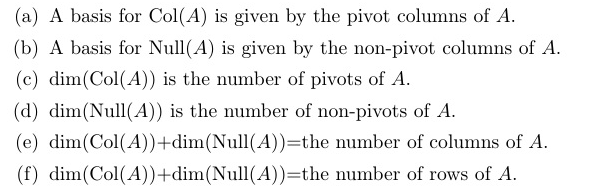
I got
A) always, B) Never, C) Always, D Always, E Always, F sometimes
can anyone check this?
gritty swift
waxen flume
https://i.imgur.com/OHRaFIK.png
do you know strang's four subspaces picture?

also i'm checking it now; my LA is rusty q-q
rotund jetty
obsidian bluff
so if we take the standard basis over C then any (a+bi, c+di, e+fi) in C^3 could...
that last one meant e + fi, but yes, exactly!
obsidian bluff
rotund jetty
that last one meant e + fi, but yes, exactly!
ah yes my bad haha
gritty swift
waxen flume
I got
A) always, B) Never, C) Always, D Always, E Always, F sometimes
can anyone...
B seems susp, can you explain why it can never happen? i'd think it would be sometimes
E is a consequence of C,D
gritty swift
wait really am i just dumb lmao
I thought the basis for C(A) came from the rows since Ax = 0 implies the dot product between x and each row is zero
so x must be orthogonal to the rowspace
@waxen flume
gritty swift
that's different @waxen flume
he isn't taking the non pivot columns
he's solving Ax = 0 then taking all combinations of the solutions
the columns can't be in the nullspace since they're in R^2 when the nullspace vectors must be in R^4
waxen flume
oh i didnt even realize lol
its actually sometimes or never?
im confused if ur agreeing with me
xD
gritty swift
yeah, I think its sometimes but i'm too lazy to come up with an example
its definately not always though
waxen flume
what did you mention about E earlier?
gritty swift
i said you're right
its just a consequence of C and D being true
number of pivots + number of non pivots = number of columns
waxen flume
🙂 yay
the one I had wrong was the sometimes one
any others you felt sus about
@gritty swift
gritty swift
the rest seem right to me :3
if you really care about getting it right you could come up with examples for all the "sometimes" ones, might be good practice too
like examples for B, a full rank matrix A would have the basis for N(A) be {0} which matches the non pivot columns (all cols are pivots)
but a counterexample would be the link you sent where it isn't even the right dimension
waxen flume
If 0 is an eigenvalue for A
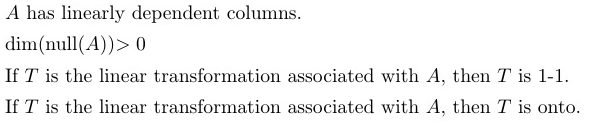
I have to come up w/ which are definitely true
The only one I know is definitely true is the first one
I forgot about linear transformations 😅
gritty swift
well if A has dependent columns the nullspace must be greater then {0}
since you can combine the two dependent guys to get a zero vector
or really the eigenvector with eigenvalue 0 will be in the nullspace
so 2 is true
3 is false, when you have a vector in the nullspace $T(\mathbf v + c \mathbf n) = T(\mathbf v) + cT(\mathbf n) = T(\mathbf v)$ if n is in the nullspace
stoic pythonBOT
uli
 gritty swift
so it isn't 1 to 1
and for 4 i forgot what onto functions are for the 19054391059401590th time 1 sec
the properties i used were just linearity btw, a transformation being linear must obey those laws
waxen flume
in my linear algebra class, linear transformations are the only thing i cant understand so far. I can do complicated calculations for co-factor expansions, eigenvalues, etc but that topic was the one i least understood lol. And I looked at lots of youtube videos on it
gritty swift
did you see the 3blue1brown videos?
the first few videos https://www.3blue1brown.com/essence-of-linear-algebra-page/ cover linear transformations geometrically

3Blue1Brown
Essence of linear algebra. Vectors, span, linear dependence, linear transformations, determinants, column space, change of basis, eigenvectors and eigenvalues, etc.
 normal gulch
Does anyone know how to convert from Cartesian coordinates to conical ones? I've only found one that goes from Spherical to conical which I'd rather not.
nocturne jewel
what dont you understand about transformations exactly?
waxen flume
im not sure who he is, but ive been watching this person since they go hand in hand with my lectures

did you find anything about the last one @gritty swift onto
gritty swift
oh sorry i forgot
waxen flume
i just know that onto functions have pivots in every row
gritty swift
i don't know if they're considering the output space R^n (of the matrix) or the domain of the transformation
so
do we know if A is square?
waxen flume
well
if 0 is an eigenvalue
and eigenvalues only come out of square matrices
i would assume lol?
gritty swift
wait nvm i'm retarded
yeah
so yeah it can't be onto since with n - 1 independent vectors you cant span R^n
and onto means you must span R^n i think
since onto is defined as forall y in the codomain there exists x such that f(x) = y (in other words, it spans the space)
and i'm assuming for linear transformations the codomain is R^n for a n by n matrix
waxen flume
i got this book from my library on linear algebra because its all i could find lol but its like from 1990 xD
ill see if it has anything on linear transformations
thanks for the nice explanations @gritty swift
 waxen flume

Even some kid wrote a question mark next to linear transformations when they used this book🤣
normal gulch
Does anyone know how to convert from Cartesian coordinates to conical ones? I've only found one that goes from Spherical to conical which I'd rather not.
 autumn haven
The engineers told me this class was easy 😦
 rapid prism
aren't the equations on the wiki page? @normal gulch
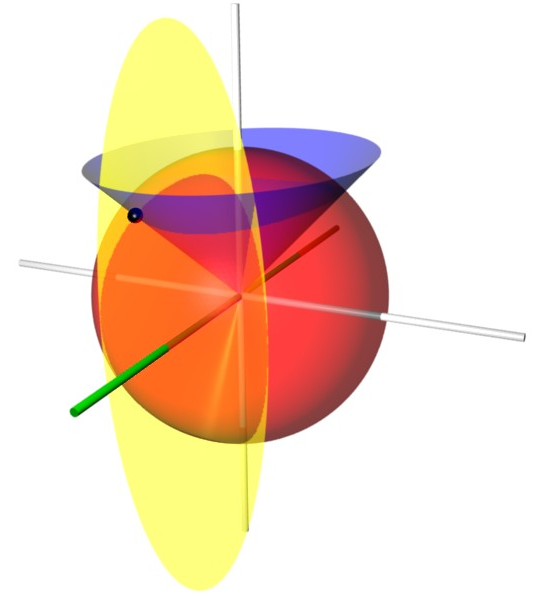
Conical coordinates are a three-dimensional orthogonal coordinate system consisting of
concentric spheres (described by their radius r) and by two families of perpendicular cones, aligned along the z- and x-axes, respectively.
normal gulch
rapid prism
aren't the equations on the wiki page? <@!207147500161859584>
I have to somehow solve for r, μ, and ν in that first proposed "definition" which I have no idea how to do and then figure out the inverse it seems.
Scrolling down theres an equation for spherical to conical which was the one i was referring to before, but still I cant seem to find a reliable formula that converts from Cartesian to conical and then the inverse
Attempting to use that first one just results in a mess:

Or am I maybe just translating it wrong?
Just for clarification I am using r,g and b as x,y, and z.
obsidian bluff
Hi, I'm having trouble getting my head fully around Jordan stuff

this is my definition of a jordan basis for a matrix A
my notes tell me that the matrix of T (the linear map given by A) is this direct sum of jordan blocks. I can't quite understand it and don't see how "It's clear". Perhaps it's quite a simple explanation so it'd be great if someone could enlighten me. thanks in advance
 wintry steppe
well just compute T on each jordan chain
stoic pythonBOT
Buncho Wolves
 wintry steppe
@obsidian bluff
oh hold on i might have fudged that
ok well i can't delete it now so
you just have to write out what the jordan chain looks like and carefully compute the action of T on each of its elements
faint lintel
Yo can someone help me through a long problem

L_A = left multiplication by A
I need help with 2a
so I got my characteristic polynomial is (t-2)^2
so our eigenvalue is 2 with a multiplicity of 2
I know that the generalized eigenspace K_2 is the nullspace of (A- 2I)^2
and since (A- 2I)^2 = the zero matrix
the column vectors (1,0) and (0,1) are the basis of the nullspace of (A- 2I)^2
and hence are a basis for the generalized eigenspace K_2
so I want to find a vector in that nullspace such that (A- 2I)^2 * v = 0 but (A- 2I) * v =/= 0
(1, 0) works cause (A - 2I) * (1,0) = (-1, -1) =/= 0
so then the cycle is {(-1, -1), (1, 0)}
so that cycle is our canonical basis?
(BTW pretend these are column vectors as nessessary I really don't wanna mess with LaTeX rn)
So then I have that cycle
how do I find the Jordan Canonical Form of A?
plz help I am trying to follow the textbook and other resources and it is absolutely not helping
Google Docs
I'm trying to follow what Example 2 on page 492 is doing
[T]_beta is the T relative to the basis beta
if there are other notation questions (and if you can help me) plz ping
native rampart
You know,you could just screenshot that page
faint lintel
I didn't wanna spam any more lol it was already getting kinda long
and like the example references some theorems and stuff in case anyone needed those
but ya I have no fucking idea what I'm doing 😭
<@&286206848099549185>
wintry steppe
can anyone help with this?
 faint lintel
use the discriminant of a quadratic
native rampart
faint lintel
but ya I have no fucking idea what I'm doing 😭
That's just the primary decomposition theorem. So first you divide the vector space into generalised eigenspaces
native rampart
Now,null(T-aI) is spanned by cycles of {u_1,u_2...}
If the dimension of cycle of a vector is 1,it is an eigenvector
faint lintel
but here the cycle is length 2 isn't it?
native rampart
You could have had 2 cycles of length 1 or 1 cycle of length 2
faint lintel
Oh yea true
native rampart
But,the former would imply the dim of null(T-2I) is 2
faint lintel
yea
native rampart
But that's not true by explicit computation, ig
faint lintel
wait what
oh yea
yea so we need a cycle of length 2
so I found a basis for N((T-2I)^2)
but (T-2I)^2 = the zero matrix
so a basis would be ({1, 0), (0, 1)}
the standard basis of R^2
right?
or is that wrong?
native rampart
How did you get that basis?
faint lintel
because (T-2I)^2 = the zero matrix
so N((T-2I)^2) = all vectors
cause any vector * the zero matrix is a zero vector
native rampart
Well,The basis wouldn't exactly be {(1,0),(0,1)}
faint lintel
why not?
native rampart
What does (1,0) mean here?
faint lintel
the column vector
native rampart
We are dealing with elements in R^3
 native rampart
Is the matrix diagonalizable?
faint lintel
no
native rampart
So,you have one cycle)
native rampart
You want the matrix to be in a "triangular form"
faint lintel
yes but that doesn't matter in terms of choice of basis I thought?
native rampart
It's the same reason as to why diagonalizable matrices are preferred over similar non diagonalizable forms
More convenient for computations
faint lintel
yes but I thought that we could pick any basis that works for finding the basis for the generalized eigenspace
the basis for the generalized eigenspace for eigenvalue 2 is the basis for N((T-2I)^2) which could be {(1,0),(0,1)} because N((T-2I)^2) = 0 matrix
native rampart
Yes, that's a basis of generalised eigenspace
faint lintel
that's my logic
native rampart
The matrix is just not nice in that basis
You want a basis such that the matrix is nice
faint lintel
but it should still be able to be used to find the canonical basis I thought??
because we still have (T-2I) * (1, 0) = (-1, -1) =/= 0
which means we have a cycle?
native rampart
Yea,so your canonical basis should be {(1,0),(T-2I)(1,0)}
faint lintel
oh wait in that order?
native rampart
Your matrix in that basis will be
$\begin{bmatrix}
2 & 1\
0 & 2
\end{bmatrix}$
stoic pythonBOT
Buncho Drunk
 native rampart
Write T as (T-2I)+2I
faint lintel
and I thought it would be {(T-2I)(1,0),(1,0)}
and (T-2I)(1,0) = (-1, 1) so we have {(-1, -1), (1,0)}
native rampart
Find matrix of (T-2I) in that basis, which will be Your matrix in that basis will be
$\begin{bmatrix}
0 & 1\
0 & 0
\end{bmatrix}$
stoic pythonBOT
Buncho Drunk
 faint lintel
what?
native rampart
native rampart
Yea,so your canonical basis should be {(1,0),(T-2I)(1,0)}
Nvm,it should be {(T-2I)(1,0),(1,0)}
native rampart
2I in that basis is still
$\begin{bmatrix}
2 & 0\
0 & 2
\end{bmatrix}$
stoic pythonBOT
Buncho Drunk
 glossy parcel
just a quick question i.e. 2 questions
-
If i want to find a column space of a matrix, can i look at the REF form of the matrix, see which columns are independent, and write the columns from the original matrix with those indexes as the basis for the column space?
-
do i have to find the REF form of the matrix transpose in order to find the basis for N(A^T)?
native rampart
Yea,It gets a lot more complicated with matrices on R^4 and above
native rampart
But, yea that's your next section
faint lintel
yea
I've technically read over that section
however
I also understand none of that
but I think imma dig more into this first section
and do more questions from here and then try to reread that second section
 lavish jewel
x only shows up in one equation, and on both sides
once you have found that z and y are 0, the equation with x reads x=x, which is true for any x
@velvet basin
 velvet basin
alright thx
 wet plinth
we have a det of a diagonal matrix with its non zero elements as |A|
how is this det equal to
|A|³ × det of I with order 3x3
<@&286206848099549185>
wintry steppe
Hello guys.
Could some help me to understand "the set of linearly independent vectors" in " The basis of a vector space is a set of linearly independent vectors that span the full space".
 jagged tinsel
dire thunder
jagged tinsel
dire thunder
 plain saffronBOT
From
Rule 3
Stick to one channel and don't post the same question in multiple channels. Please don't ask for help in other channels if no one is responding in the one you have posted your question in.
lavish jewel
people are helping out of their own volition, chill out
wet plinth
i mean this aint the same question but whatever
wet plinth
ye
dire thunder
but det I = 1
🤔
and det of diagonal matrix does not equal itself cubed in general
wet plinth
?
dire thunder
,w det {{1,0,0}, {0,2,0}, {0,0,3}}
stoic pythonBOT


 Requested by Commander Vimes#4407
dire thunder
wet plinth
|A|³ × det of I with order 3x3
Requested by Commander Vimes#4407
dire thunder
wet plinth
|A|³ × det of I with order 3x3
🤔
lavish jewel
the det of a diag matrix is the product of the elements on the diagonal
dire thunder
or you mean that this diagonal matrix has some nonzero A on diagonal?
like {a,0,0},{0,a,0},{0,0,a}
dire thunder
dire thunder
like {a,0,0},{0,a,0},{0,0,a}
well then det of this is a^3 trivially
wet plinth
(adj A) A = |A|I = the diagonal matrix i previously defined
what do you mean trivially?
lavish jewel
the char polynomial is (a-lambda)^3, so all the eigenvalues are a, and the determinant is the product of the eigenvalues
in general, the eigvals of a diagonal mat are the elements on the diagonal
 wary lily
Isomorphic is always one-to-one but one-to-one is not always isomorphic. Is that correct?
wary lily
you meant the at most on solution part
obsidian bluff
wintry steppe
<@!278946269869899776>
Hi, just read this
dire thunder
this is one-to-one but not onto
 wary lily
yes, information is lost
obsidian bluff
when you define each w_i , you use the linear map T, as a matrix? in what basis is this matrix
also you have only one jordan chain it seems, im also trying to understand how this is applied in a jordan basis (multiple chains)
native rampart
obsidian bluff
also you have only one jordan chain it seems, im also trying to understand how t...
You start a new chain with another w_0
wet plinth
every element is of the det is multiplied with |A|
 steel plover
Hello, would someone know if we have results relating the determinant of an invertible matrix P to the action of P over M_2(K) by conjugation?
Of course the relevant information here is the class of det(P) in K*/K*², but I'm wondering it we're able to say get information on this class from looking at conjugation by P.
wintry steppe
Hey guys, I have a question. i know that for any n by n real-valued matrix A it holds that det(A•A^t) >=0. But im wondering if this holds any n by n complex-valued matrix A?
wintry steppe
you might have to replace transpose by conjugate transpose
dusky epoch
wintry steppe
Hey guys, I have a question. i know that for any n by n real-valued matrix A it ...
there's a similar result for complex matrices but it's different
$\det(A \overline{A}^T)$ is real and nonnegative for any $A \in \bC^{n \times n}$ if my memory serves me right
stoic pythonBOT
Ann
 wintry steppe
yup
stoic pythonBOT
Ninja Tuna
 stable kindle
it's like
brb looking up how to latex
well what does A do to (1, 0) and (0, 1)?
$AI = \begin{pmatrix} 4&3 \ -2&11 \end{pmatrix}$ \begin{pmatrix} 1&0 \ 0&1 \end{pmatrix} = \begin{pmatrix} 4&3 \ -2&11 \end{pmatrix}$
stoic pythonBOT
Kaisheng21
Compile Error! Click the  reaction for more information.
(You may edit your message to recompile.)
 stable kindle
like, A sends (1, 0) to (4, -2) and (0, 1) to (3, 11), right?
nocturne jewel
they got help in 3
 pseudo cobalt
nocturne jewel
~~they got help in 3~~
pseudo cobalt
nocturne jewel
~~they got help in 3~~
yeah... sorry for asking it on 2 different channels. Won't do it again.
zealous junco
I think I got this problem figured out, just want to check if sol is ok. Let $\text{dim}(V) = n$ and let $B = {\alpha_1, \cdots \alpha_n}$ the basis such that $[T]B$ is diagonal, and let $\lambda{k_1},\cdots \lambda_{k_m}$ be distinct eigenvalues of $[T]B$. Then for any $\alpha \in V$ we may write $\alpha = \lambda{k_1}(\alpha_1+\cdots+\alpha_{r_1} )+ \cdots+\lambda_{k_m}(\alpha_{r_{m-1}+1}+\cdots+\alpha_n)$. Where each summand live in $E_{\lambda_{k_i}}(T)$. Then all i need to say is that $\alpha = 0$ enforces each $\lambda_{k_m} = 0$ which will conclude the proof right? Since that is sufficient to show that 0 is uniquely represented by the 0's in the eigenspaces.
 stoic pythonBOT
Anticipation
Compile Error! Click the reaction for more information.
(You may edit your message to recompile.)

 prime drum
Quick question on linear independence of polynomials. They should be able to reduce to the identity matrix of the matrix if they are linearly independent right?
wintry steppe
Hey can someone tell me what I'm doing wrong?
limber sierra
prime drum
Quick question on linear independence of polynomials. They should be able to red...
this is a bit clunkily phrased, but if you mean "put the coefficients into a matrix and row reduce"
not necessarily
what if that matrix isnt square?
if you have 0 rows, though, that means you have linear dependence yes
wintry steppe
I'm trying to do an PAQ = LU decomposition using full pivoting but the values are off


I have absolutely zero idea where im making a mistake
 floral thistle
prime drum
Quick question on linear independence of polynomials. They should be able to red...
floral thistle
prime drum
Quick question on linear independence of polynomials. They should be able to red...
That depends on the matrix being square
prime drum
it is a square matrix in the 3x3 field. the question is actually in #help-1 i think i did it correclty but am not 100% sure
floral thistle
Checking
wintry steppe
okay got it
the thing i found online was just incorrect
gotta love when the reason you didnt solve the problem is that
zealous junco
stoic python
**Anticipation**
Compile Error! Click the <:errors:504266556054962196> reaction ...
someone can check this arg above?
 zealous junco
isomorphic means bijection means dimension is same, and use column rank = row rank = rank and row space of A = row space of rref(A)
i think its true
prime drum
to be isomorphic they need the same dimensions, and obvious inverse, the ker and the image etc. So if they are isomorphic i would say that its true aswell
zealous junco
For ii) I think i found explicit inverse to be

1-T+T^2-...+(-T)^(N-1)
im wondering if theres a way to show its invertible without doing this?
wintry steppe
if V is finite-dimensional, then det(T + I) is the characteristic polynomial of T evaluated at (-1), which by part (i) is (-1)^(dim V)
(up to a sign)
as for the infinite-dimensional case idk
zealous junco
wintry steppe
if V is finite-dimensional, then det(T + I) is the characteristic polynomial of ...
how is it (-1)^(dim V) by part 1?
oh
ok
wintry steppe
the only root of the characteristic polynomial is 0
quartz compass
tbh explicitly having the inverse is like the best possible outcome, seems funny that you'd want to spend more time showing it exists with the goal of not having it
zealous junco
thx
i just want to know more abstract method to do it, I feel my linear lagebra is bad
wintry steppe
the more abstract method to doing it is just doing it lol
wintry steppe

can someone explain how T(1) = 1 - t + t^2, T(t) = -1 + t + 2t^2, etc.?
i’m confused how those values are obtained
ah wait i think i get it now
so for example, for T(t), im evaluating what happens to the coefficient of t for the polynomial p(-1), -p(-1), and p(2) right? if anyone can confirm that
native rampart
That's an axiom
native rampart
R^(nxn) is the set of functions from AxA to R where A={1,2,3...n}
R^(n^2) is the set of functions from {1,2,3...n^2} to R
Both can be thought of as the same thing
dusky epoch
$\bR^{n^2}$ consists of column vectors of size $n^2$
stoic pythonBOT
Ann
 dusky epoch
i would not say it's "the same" as R^(n×n)
they're isomorphic sure but isomorphic doesnt mean "the same"
these spaces have the same dimension.
wet plinth
send halp in #help-7|zen1thxyz
native rampart
in context of sets, it means there is a bijection between the sets
dreamy iron
rando QQ, does this formula have a specific name?
 sonic osprey
Don't think so
 wind pasture

i can't tell if this is true or not
i dont know what it means that ColA and ColB are isomorphic
dusky epoch
we say two vector spaces are isomorphic if there exists a bijective linear map between them
it is a theorem that V and W are isomorphic if and only if dim(V) = dim(W)
wind pasture
@dusky epoch so the column space of A and B have the same dimensions
therefore A and B have the same number of pivots
dusky epoch
yes
wind pasture
@dusky epoch if two matrices are similar do they have the same rank?
lapis cosmos
Definitely
( direct computation of the determination of matrices made of elements from s rows and s columns of (PAP^-1. )
 inland bolt
would the Basis for a subspace consisting of a vector of 1 form (a,2a,5a) just be itself?
like if the subspace is just all vectors of form (a,2a,5a) the basis would just always be (1,2,5) right?
or so fourth
or am I dumb
limber sierra
{(1, 2, 5)} is a possible basis yes
assuming your vector space is F^n for F a field [i.e. scalars can take the values of a]
dusky epoch
there's no such thing as a space which has one and only one possible basis.
so one never speaks of "the" basis for a space
limber sierra
(zero space)
dusky epoch
okay yes that is the one exception
i guess also F_2 as a vectorspace over itself
but airick is probably working with real vector spaces
(or complex, idk)
for your example, you can have {(-1, -2, -5)} as another possible basis
inland bolt
idrk new to basis so the the simpler one
not sure I understand them right
it's just a set of vectors that you can come to any point/vector in a subspace right?
limber sierra
through linear combinations, yes
dusky epoch
a basis is like a set of building blocks
limber sierra
thats the key thing to think about here
"can i make any vector of the form (a, 2a, 5a) through linear combinations of {(1, 2, 5)}?"
in this case, yes
inland bolt
like a basis for (2,3,2) could be (1,1,1) and (1,2,1) right?
limber sierra
just multiply it by a
dusky epoch
"a basis for (2,3,2)"?
inland bolt
ok a vector space consisting of vectors of that form
limber sierra
but we can write (2, 3, 2) as a linear combination of (1, 1, 1) and (1, 2, 1)
(1, 1, 1) + (1, 2, 1) = (2, 3, 2)
"that form"?
inland bolt
of form 2a,3a,2a
limber sierra
okay, then yes
a(1, 1, 1) + a(1, 2, 1) = (2a, 3a, 2a)
so we can write any vector of the form (2a, 3a, 2a) as a linear combination of {(1, 1, 1), (1, 2, 1)}
but this does NOT make it a basis
since (1, 1, 1) and (1, 2, 1) are not "of the form (2a, 3a, 2a)"
yes, which is why we moved past it
it wasnt clear at first whether they were working in that context
but evidently they werent
anyway, the point is that we cannot take {(1, 1, 1), (1, 2, 1)} as a basis for the space of vectors of the form (2a, 3a, 2a)
since (1, 1, 1) and (1, 2, 1) are NOT of that form
and hence NOT in that space
so they cant be a basis for it!
a possible basis for that space would be {(2, 3, 2)}
inland bolt
limber sierra
since (1, 1, 1) and (1, 2, 1) are not "of the form (2a, 3a, 2a)"
so the only possible basis's would be something that is a multiple of the form essentially? like 4,6,4?
4,6,4*
limber sierra
yep.
[indeed, this space is one-dimensional, which implies that any nonzero vector in it will form a basis; but you'll probably cover that fact later]
 inland bolt
what would you do for a basis of vectors of the form (a,b,a-b)
that seems a little tricky
wet plinth
send halp in #help-7|zen1thxyz
inland bolt
inland bolt
what would you do for a basis of vectors of the form (a,b,a-b)
would a basis for this form of vectors in a subspace be (1,0,1),(0,1,-1)?
wet plinth
is this "If elements of a row (or column) are multiplied with cofactors of any
other row (or column)" another way of saying that we've got two equal rows/columns?
strange delta
need some help on part b
 sonic osprey
what have you tried

 neat relic
How do you get the mean for a 3d matrix? I know how to get the mean for 1d, i.e. [3,4,5] = 4, but how do you get it for matrices with more dimensions i.e. 2d or 3d or more?
I want to get the mean so that it can be used for stuff like getting sum of squares, standard deviation, the Z score standardization etc etc, which is then used to calculate distance between matrices, specifically image similarity.
sonic osprey
@strange delta can you define the span for me
strange delta
sonic osprey
<@!591696293915787283> can you define the span for me
not sure what you mean by that
isn't it just a_1 * v_1 + ... +a_n * v_n
sonic osprey
Yeah
so the span of v_1, ..., v_n is the set of vectors of the form a_1 * v_1 + ... + a_n * v_n for scalars a_1, ... , a_n in K
So to show the subset, you're trying to show that all vectors in the first span are also in the second span
sonic osprey
I mean, you don't talk about the second span at all
why are you setting something equal to zero


 sonic osprey
I'm saying that its not right
again, how are you showing that something in the first span is also in the second?
strange delta
i thought by showing it was a linear combination
it would somehow work
seems like it's not working
sonic osprey
For one, it doesn't make any sense to set c_1v_1 + ... + c_n v_n = 0, you can't assume that the v's are linearly dependent
and even if they were linearly dependent, not all vectors in the span would be zero
to show that its in the second span
you need to show its a linear combination of alpha v_1, ... , alpha v_n
neat relic
how do you get a 3d point? For example a matrix of shape (2,4,3) is shown like
[ [ [3,4,5],[1,2,3],[2,3,4],[1,3,5] ] , [ [3,3,5],[1,1,3],[2,4,4],[1,1,5] ] ]
in python numpy. However those numbers are just the z values, so how do you find the x and y values in a matrix like this?
When I try to get them, python numpy returns y as a 2d vector, and x as a 3d plane, instead of a number, like how z is.
Which is weird coz we were taught in linear algebra that if you have x1, y1, z1 = (1,2,3), x2,y2,z2 = (4,5,6), that it would form matrix like this:
[1 2 3]
[4 5 6]
So you can see the x and y values here, along with the z values.
quartz compass
depends on how you're storing it, if you're storing them as row or column vectors
you don't have to make your vectors rows
neat relic
oh, so it's not a must to write it that way?
like you could also write it
[1 4]
[2 5]
[3 6]
like that?
lavish jewel
the order itself really doesn't matter
just beware that numpy uses an "unwrapping" order that is perhaps not the most commonly used
as compared to matlab, for example
just remember what order you did stuff in
neat relic
what is unwrapping order? yeh I'm confused by numpy style..coz like for example a 3d matrix like this
[ [ [3,4,5],[1,2,3],[2,3,4],[1,3,5] ] , [ [3,3,5],[1,1,3],[2,4,4],[1,1,5] ] ]
I can't find the x and y values..it only shows the z values..
lavish jewel
if you print the whole matrix, it'll show you everything inside of it
the values are all in there
it's just a question of what order python decides to show them to you in
you would expect it to print stuff in the order rows, columns, 3rd dim, 4th dim, etc
but it doesn't
unless you print stuff out it Fortran order
the real question is only, what order did YOU put stuff into the matrix in?
Fortran order follows the nowadays popular scheme of

python starts with rows, and i don't remember if it goes backwards after that
you can find it in their documentation
neat relic
ok so I printed it out as a matrix.
[[[3 4 5]
[1 2 3]
[2 3 4]
[1 3 5]]
[[3 3 5]
[1 1 3]
[2 4 4]
[1 1 5]]]
This is what I got. so which is the x and y?
And yeh coz like we learn that for example in feature analysis, if there are more columns in a table, there are more dimensions. Say 3 colomns with name, age, income, would have 3 dimensions. But the dimensions don't show as columns in numpy, I think.
lavish jewel
i would suggest you make nested for loops then, and print it out in the order you want
since you're the one that knows what each entry in the array means
python prints it out however it likes
if you don't know what order stuff is saved into the array in, no one else can help you 😛
you can take a wild guess based on the structure and say that since you have an array of size 2,4,3, the first matrix shown up there is [0,:,:], the second is [1,:,:]
then the rows are the second index, and the columns of the matrices are the third index.
and since you're in 3d, then the last index is probably what corresponds to x,y,z. but that's just a guess since i don't know what the other indices of the array mean
neat relic
ok so I printed out in the for loop, was like this
x: [[3, 4, 5], [1, 2, 3], [2, 3, 4], [1, 3, 5]]
y: [3, 4, 5]
z: 3
z: 4
z: 5
y:[1, 2, 3]
z:1
z:2
z:3
Yeh I'm actually working with images and feature maps, so am actually reading 3d matrices..just get confused in interpreting them..
neat relic
height, width, rgb value
lavish jewel
and what did you mean by x,y,z
neat relic
well in linear algebra we were taught like how x = 1, y = 2, z = 3 etc, and how to find if they're linearly independent etc..
So they always give us a concrete x and y value there..but when printing it in numpy, it only shows the z values, but not the x and y, like when I print list[0][0][0], it will return 3. If I print list[0][0], it returns a 1 dimension [3, 4,5], but not a number like how we were given in linear algebra..
lavish jewel
yes but what are you calling x y and z
neat relic
so am kinda confused as to like you know if we want to find the mean along the x axis or y axist, how do we do that when there are no numbers
lavish jewel
you have to pick what the values along the dimensions represent
because you don't have vectors here
you have a vector of vectors of vectors
so if you want to relate this in any way to some geometry, you have to assign them some meaning
there is no x,y,z here by default, you have to choose what you want to refer to in that manner
do you want to make a color space?
neat relic
no I want to measure the distance between image matrices, say for example that are (24, 24, 512). And there are many ways to do that..and I wanna explore the ways to do that, but it involves stuff like finding the mean, the sd. covariance, etc, so I gotta better understand how a 3d matrix works.
Also I think I understand better now when you said I don't have vectors here, but a vector of vectors of vectors..I always thought these numpy arrays were just multiples of vectors.
So when finding the mean in a 3d matrix, is it we just find the mean along all 3 axis?
lavish jewel
if you want
none of these things are defined in a unique way, so you really have to decide what you're doing before you go on
you just choose to treat something as if it were euclidean space, because it can behave in the same way if you define and allow the operations
but for example, that 3d array has 8 rgb vectors. you could measure distances w.r.t. those rgb vectors between two matrices, for example
but you could just as easily rearrange the data in some other way
neat relic
so measuring distance w.r.t those rgb vectors that you mentioned, that would be like np.mean(axis = 3)? right?
lavish jewel
no
it would be like the frobenius norm of a matrix of size 3 x 8, if you choose to rearrange the data in that way
is this 2,4,3 array a single image?
neat relic
uhm, that was actually something I made up to try to better understand in numpy haha..a single image has like (224, 224, 3), which I think means 224 height pixels, 224 width pixels, 3 rgb..then using convolutional neural networks it gets a feature map of like (14, 14, 1024), of which I will be using to find distance.
I am looking into Euclidean distance with like L2 norm, Mahalanobis distance, and cosine similarity/distance. One thing I'm not sure about is that if collinearity and scaling will be factors in this image similarity matrix, because euclidean distance has some issues with it, of which Mahalanobis distance solves, but apparently Mahalanobis distance has some issues with highly correlated data due to the Transpose.
do you think that collinearity and scaling are factors in this distance comparison type of matrix operations?
lavish jewel
scaling for sure
anyway whenever you do correlations, it's easier to interpret them if stuff was normalized beforehand to get rid of the scaling
collinearity idk, depends collinearity of what
if you put the whole image into a single long vector or if you mean among the vectors of the data while it's in matrix form
neat relic
the latter
lavish jewel
i can't comment further without knowing how exactly the distance is computed, then
neat relic
oh ok, coz I am thinking that if two images are same but with different lighting, their matrix would be collinear right? I'm guessing that is what collinearity means..
no wait, it would be their distance that would be small..
hmm, I'll look into it further haha, collinearity is confusing..
neat relic
well the way I was thinking, was like if we have a table of 3 colomns, income, house size, holiday amount, all 3 colomns would be collinear..
so that would be same for 3d matrices right? the correlation of each axis
to another
assuming I am correct that each colomn in the table corresponds to a dimension, which corresponds to an axis
lavish jewel
neat relic
assuming I am correct that each colomn in the table corresponds to a dimension, ...
if you want it to be. you can do whatever you want with the data 😛
so you're talking about the rank of the matrices
the thing is that right now you are talking about a single image
lavish jewel
neat relic
oh ok, coz I am thinking that if two images are same but with different lighting...
but this is comparing two images
and those are different things
neat relic
oh I think I get what you mean now, comparing two images and comparing two axis of an image, are different things.
lavish jewel
indeed
neat relic
I guess what I was thinking of was comparing the x axis of image A, to x axis of image B, comparing y axis of image A, to y axis of image B, and comparing z axis of image C, to z axis of image C.
I guess what I'm looking for is if collinearity in those will affect the calculation of distance.
which would then impact the distance algorithm I would go for.
lavish jewel
sure, the distance would be directly related to the projection of the higher dimensional thing onto the lower dimensional one
the 2-norm measures precisely that
or rather, minimizing the 2norm is done through an orthogonal projection
neat relic
when you say 2 norm, do you mean L2 norm? The one that uses euclidean distance?
Like I don't think the axes in a image matrix would correlate to each other, because height is not correlated to width, and is not correlated to rgb value, so I think they are all linearly independent. So I dont think I need to worry about that.