#linear-algebra
2 messages · Page 159 of 1
 nocturne jewel
 hollow finch
you were given two of linearly independent columns of A. since A has rank 2 (because you were told it has a 2 dimensional column space) we know that all the other columns are just linear combinations of the ones you were given (meaning they span). since they're linearly independent and span, they form a basis.
nocturne jewel
Ok so the answer isnt whether b is in Col(A)?
hollow finch
you could also look at it as if we make the matrix C with the two columns you were given, the system Cx=b has only one solution since it doesnt have a null space (they are linearly independent)
its a two part thing
nocturne jewel
wait so is it inf or 1 solution?
hollow finch
we know there is at least one solutions because b is on Col(A)
nocturne jewel
You said infinite and only 1 confusion
nocturne jewel
hollow finch
you could also look at it as if we make the matrix C with the two columns you we...
You said an alternative way of thinking leads to only 1 soln
but with null(A) logic there are infinite
hollow finch
yeah if we only consider the two columns you were given
nocturne jewel
Ok so Ax=[5,7,-2]^T has inf solution?
hollow finch
we know there is at least one solutions because b is on Col(A)
we know there are infinitely many because Null(A) is not just the zero vector
nocturne jewel
ok so infinite
 slow scroll
idempotent
 fringe matrix
ty! 🙂
slow scroll
or... maybe a projection in this context
fringe matrix
lol that was exacly what i wanted
slow scroll
projection or idempotent?
fringe matrix
projection is a type of idempotent ^_^
i was looking at projection and wanted to give it another name
slow scroll
ah okay
 native rampart
Well,All idempotents are projections
fringe matrix
in matrixes yea..
slow scroll
Well,All idempotents are projections
idk if i would call an idempotent matrix a "projection" outside the context of inner product spaces tho
 brittle juniper
When I was being taught linear algebra for the first time, it went like
an endomorphism p on a vector space E is called
• a projection when E=Ker(p)⊕Im(p) and the restriction of p on Im(p) is the identity
• a projector when p²=p
(maybe it was the other way around)
and the important result was that projections are projectors and projectors are projections (and that's why I don't remember which one was which)
the prehilbert-specific stuff was introduced a lot later
a projection p on a prehilbert space E is said to be orthogonal when the direct sum E=Ker(p)⊕Im(p) is orthogonal
 soft burrow
maybe you could suppose that under some pair of bases, the matrix has exactly dim(range T)-1 non zero entries and derive a contradiction?
 thorny hemlock
hm
soft burrow
in the best possible case you'd have some diagonal matrix with dim(range T)-1 non-zero entries and that should contradict the given value of dim(range T)
thorny hemlock
er
so
each Tv1 ... Tv_n corresponds to an entry in the matrix
so we get dimrangeT-1 = dimrangeT ?
but er
how does that contradiction work
 neat relic
Hey guys, not sure if this belongs here but I've been asked to do a linear algebra online certification as proof of competence before taking on certain projects at a job..was wondering if do you guys have any in depth linear algebra certification you'd recommend pls? There's like so many it's tough to choose haha..
 wintry steppe
are there any topics of linear algebra that you know you'll need in particular?
neat relic
ahh I don't know lol..it's to do with robotics and some machine vision so probably linear algebra topics to do with that..I think he wants proof of competence that I know linear algebra basically..
I guess personally I'm looking for like if it covers subspaces, row echelon, basis, dimension, nullspace, linear independence, eigenvalues eigenvectors, and the tougher stuff like orthonormal orthogonal gram schmidt etc..
neat relic
I guess kinda online course certification
that they want to show that I know linear algebra
 round coral
@neat relic you mean a certificate course in linear algebra, am I right ?
you can look over edx or coursera courses on linear algebra, choose what is best for you
these give certificates of the universities they are being offered by, but are not credit eligible mostly, don't have any exams, just graded quizzes
i guess they may be useful for you
hollow finch
My LA class never touched on generalized eigenvectors so I'm hoping someone can help answer some questions I have about them.
- How unique are they? I know eigenvectors in general are not unique because you can scale them, but from just messing around with GEs it seems adding any scalar multiple of the ordinary eigenvector(s) has no effect on whether or not it's a GE.
- What would be the proper way to "introduce" them in a proof? Like if I have a general nondiagonalizable 2x2 matrix A with eigenvector v and generalized eigenvector w what is the formal way to state that?
and if anyone has any good resources I could look into to understand them better that would be appreciated. The wikipedia page is a bit difficult to understand for me.
 limpid fiber
why is f(x) = x + 4 non-linear
I've seen the proof, but intuitively it feels like a linear function
wintry steppe
it's "highschool linear"
that kinda function would be called affine, usually
linear function plus a constant
round coral
@hollow finch I think these questions will be easily resolved when you study some more about generalized eignevectors, I would recommend , you can read either Chapter 8 of Axler, he covers all about generalized eigenvectors, decomposition theorem etc. in great detail , chapter 7 of Friedberg Insel Spence also covers this in a good way , you can choose any one you like .
hope it helps
hollow finch
round coral
<@!196803594576592896> I think these questions will be easily resolved when you ...
unfortunately i dont know when my next LA class will be 
but thank you! i'll look into those
wintry steppe
your next la class is whenever you next open a linear algebra book 
limpid fiber
Yeah it's highschool linear lol
thank you
limpid fiber
@wintry steppe if it were a line through the origin, that would be enough right?
Is that a consequence or a condition
round coral
if your given map, maps 0 to 0 , then it is not necessary that it's linear but if it is linear then for sure by linearity 0 will be mapped to 0
limpid fiber
I guess it's a consequence of scalar multiplication then
limpid fiber
nice, thank you
nocturne jewel
bit bold to assume 0+0=0 \j
wintry steppe
linear functions........ 
thorny hemlock
if $v1,...,vm$ is a basis of V. we know there exists $T(a_1v_1 + .... + a_mv_m) = c_1v_1 + ... + c_mv_m$. Setting all scalars to zero we can get a specific vector so$ T(a_jv_j) = c_jw_j \rightarrow Tv_j = \frac{c_j}{a_j}v_j$
 stoic pythonBOT
Yes
thorny hemlock
does this answer the question?
wintry steppe
"there exists (equation)" what do you mean by this? what are these scalars? why are you setting these scalars to zero?
why are you writing your basis as v1, ..., vm when the space is 1-dimensional
wintry steppe
you should start the problem by saying "let {v} be a basis for V"
then what can you say?
thorny hemlock
V = span(v) -> for all u in V, u = av for some a in F
thorny hemlock
oh
wintry steppe
but hey it could probably work out 
thorny hemlock
how would you do it
wintry steppe
well you have a basis {v} of V
meaning any element of V is a scalar multiple of v
in particular, T(v) is
thorny hemlock
hm that works
wintry steppe
why?
wintry steppe
you should write a full proof 
thorny hemlock
i dont know how
wintry steppe
think about the problem some more then
remember you ultimately want to show that T equals scalar multiplication by some scalar (one you need to come up with!)
starting from a basis of V is how you find that scalar
i gave a big hint 
wintry steppe
at the start?
thorny hemlock
yah
wintry steppe
i don't understand it, i think it needs to be fleshed out a bit
 blissful pagoda
This matrix is singular because I found its determinant to be 0
Homogeneous systems all have the trivial solution
If it is singular, then it cannot have unique nontrivial solutions
Therefore it has no solutions or infinitely many solutions. The number of equations and unknowns are the same. So I say it has no solutions.
Turns out it has infinitely many solutions, how is that? (part b)
wintry steppe
the set of solutions to the system is the kernel of A. since A is singular, its kernel is nontrivial, thus infinite
blissful pagoda
Wouldn't that imply then that all singular matrices have nontrivial kernels and therefore all singular matrices have infinitely many solutions?
wintry steppe
all singular matrices have nontrivial kernels
this is true (and conversely for square matrices)
an nxn homogeneous linear system of equations Ax = 0 has a unique solution (zero) if and only if the matrix A is nonsingular, and on the other hand, has infinitely many solutions if and only if A is nonsingular. if the system is not homogeneous, then you can't say for certain whether or not there are solutions
in a nonhomogeneous nxn system Ax = b, you will have infinitely many solutions if you have one (b/c ker A is nontrivial)
neat relic
round coral
<@!428804267898437642> you mean a certificate course in linear algebra, am I ri...
Yep that..and ok cool I'll look over the edx and coursera courses, and figure out the most suitable one..thanks..
blissful pagoda
Wait... so if I have a singular matrix (by finding determinant = 0), it will always have infinitely many solutions and never no solution?
(other than the trivial solution of course)
 acoustic path
yep
blissful pagoda
Oh I did not know that. I was under the impression that if a matrix was nonsingular then it had one single unique solution. And if it was singular and if it had more variables than equations then it was infinite, else no solutions. So this is wrong?
blissful pagoda
How can you tell
[4:06 PM] gotta go fast: Wait... so if I have a singular matrix (by finding determinant = 0), it will always have infinitely many solutions and never no solution?
acoustic path
ye i didnt read that first my bad
and wym how can you tell
just how a normal matrix can have zero, one or inf solutions, a singular matrix has zero or infinite, never one
blissful pagoda
I thought a nonsingular matrix can't have zero or infinite solutions 🤔
 pure tangle
Can someone please help me understand why using linear combinations to find variables works? The proof I'm looking at says to think of it like a weighted average which kind of makes sense, but I'm having trouble verbalizing why if we have a weighted average, the point that the two equations intersect at will always be crossed by the equation of the weighted average
 smoky crystal
@pure tangle can you elaborate on the find variable works part? maybe an example
pure tangle
@smoky crystal thanks for the response. Is it alright if i post a link to their explanation?
smoky crystal
im not sure but u can dm me
pure tangle
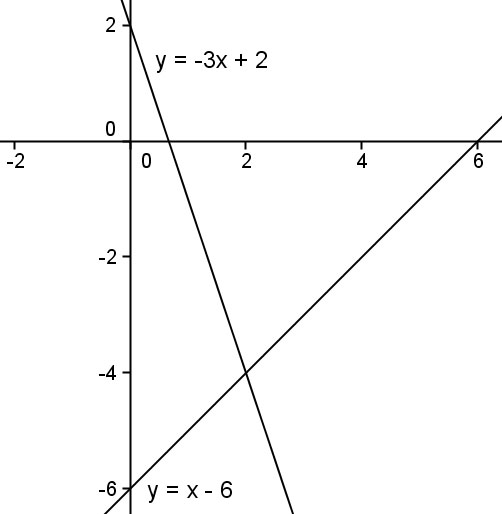
A system of linear equations consists of multiple linear equations. You can think of this as multiple lines graphed on one coordinate plane. Three situations can arise when looking at such a graph.…
smoky crystal
@pure tangle this paragraph answers your question
what will be the weight average at the point (x1,y1) where it intersects?
well it will be exactly (x1,y1)
pure tangle
thanks so much for the response. so that's the paragraph i've been reading over and over and I'm still having trouble understanding
smoky crystal
think of it like this, let (x1,y1) , (x2,y2) be any points on the two lines respectively, if they intersect, then we must have (x1,y1)=(x2,y2) or x1=x2 y1=y2. Now if we take their weight average for the two lines, what will happen to the weighted value at the intersection?
pure tangle
does it not change?
smoky crystal
nope, it will not change
lets go the easy way and talk about average instead of weighted avg
that'll be easier to think of
pure tangle
thanks for being patient with me. I'm still having trouble understanding why that is
sounds good
smoky crystal
now, if you have x1=x2, y1=y2, say pick any points ,eg let x1=x2=4 and y1=y2=6
well the avg for x's will be (x1+x2)/2 correct?
pure tangle
yes
smoky crystal
and same goes with y's
pure tangle
yes
smoky crystal
well plug in the values we have for x's and y's,
so we have (4+4)/2 for x and (6+6)/2 for y
now our average x, y . wouldnt you agree that its the same as the old one?
pure tangle
oh so if they're equal they're not going change after averaging out our line equations
smoky crystal
yep
pure tangle
that makes perfect sense. Thank you so much for taking the time to help me!
smoky crystal
nope problem, and weight average is pretty much the same thing, you can try for yourself
the whole point of using linear combinations is that we can play around with the two equations, and somehow make a 3rd equation such that one of the variables dissapear, or in the context of line, that the line corresponding to it is independent of the values of either x or y
like the case we have here where the blue line is independent of y
pure tangle
that's great. Thank you so much for all the help and patience!
smoky crystal
however, just something that i personally dont like, is the way they call this the weighted avg, but yeah anyway gl
pure tangle
how would you better describe it?
smoky crystal
np, i just so happen to be bored after semester finished for me
well here it describes the weight avg for a particular case of us manipulating the equation, which is multiply both side by a costant before adding
but it doesnt have to be
are you a HS student?
i prob asked too much ,its okay, anyway gl lol
 primal cosmos
@wintry steppe
blissful pagoda
I am so confused what eigenspace is. Can I have some clarification?
I have 1, -2, and 3 as my eigenvalues. My eigenvector corresponding to my eigenvalue of 1 is (1/3, -2/3, 1). My eigenvector corresponding to my eigenvalue of -2 is (-1/3, -1/3, 1). My eigenvector corresponding to my eigenvalue of 3 is (1, 0, 1).
Is my eigenspace {(1/3, -2/3, 1), (-1/3, -1/3, 1), (1, 0, 1)}?
 limber sierra
well those arent your only eigenvectors
in the sense that any scalar multiple of an eigenvector is also an eigenvector, right? (unless that scalar is 0)
since they still satisfy Av = lambda v
your eigenspace is the space of all eigenvectors (as well as the zero vector) of a given eigenalue - so not only will it contain the three vectors you listed, but it will also consider any scalar multiples
if you're familiar with the notion of "span", then the eigenspace is the span of a given eigenvector
this is distinct from the set {(1/3, -2/3, 1), (-1/3, -1/3, 1), (1, 0, 1)} itself
since the span includes all linear combinations
blissful pagoda
Ok I see where ur coming from.
limber sierra
sorry my phrasing was misleading
edited
note that eigenspace is tied to a specific eigenvalue
we dont really talk about "the eigenspace"
since a given matrix/transformation may have multiple eigenspaces
we talk about "the eigenspace of the eigenvalue"
blissful pagoda
The thing I'm mainly confused about is this in my textbook. Isn't this implying that I have one eigenspace for each eigenvalue? The eigenspace being the eigenvalue's eigenvectors + zero vector
limber sierra
yes thats what im saying
blissful pagoda
I see
limber sierra
again my phrasing was poor
so if youre familiar with span
lets take the eigenvalue -2 as an example
the eigenspace of -2 would be span{(-1/3, -1/3, 1)}
or equivalently, the set {k(-1/3, -1/3, 1) | k is a scalar}
or equivalently, the set of eigenvectors associated to the eigenvalue -2, along with the 0 vector
theres a bunch of different ways to think of it
but they all result in the same object
and yes, each eigenvalue will have its own eigenspace
blissful pagoda
that makes sense. So my original thought of the eigenspace being all of the eigenvectors combined of all eigenvalues is just plain wrong. Got it, that's what I was mainly confused about lol
limber sierra
yeah
each eigenvalue has its own
(although some may be the same, if two eigenvalues have the same eigenvectors)
(if that's the case, then your eigenspace is multidimensional and it would be the span of multiple vectors)
(the same definition works though: the set of eigenvectors of a given eigenvalue)
blissful pagoda
it probably depends on instructor/prof but should I write the zero vector if I ever am asked to state the eigenspace?
limber sierra
yes.
or i mean
whatever set you write
should contain 0
so if you write something that doesnt contain 0, make sure to union it with {0}
blissful pagoda
gotcha
limber sierra
the definition they give - the set of eigenvectors together with {0} - is the best one
[although if you know what a "kernel" is there's another very handy definition]
[the eigenspace of a vector lambda is the kernel of (A - lambda I)]
[if you dont know what that means or if its weird to think about, dont worry about it]
[["kernel" and "null space" are the same thing]]
blissful pagoda
The kernel is defined in my textbook "the set of all vectors v in V that satisfy T(v) = 0 is the kernel of T and is denoted by ker(T)" but I don't know how it relates to eigenvalues and stuff
I do understand the kernel = nullspace thing though
limber sierra
well the idea is
if v is an eigenvector then it satisfies Av = lambda v
we can rearrange this to Av - lambda v = 0
and then factoring out the vector v
(A - lambda I)v = 0
where I is the identity matrix (of the appropriate size)
so now if we interpret (A - lambda I) as a linear transformation, call it T
this is the set of vectors v such that T(v) = 0
i.e. the kernel of T
blissful pagoda
Oh I see
limber sierra
where T corresponds to multiplication by (A - lambda I)
anyway, this isnt really necessary to worry about at first
but it might come up later on
(it's arguably a more "natural" perspective)
blissful pagoda
(lambda I - A) and (A - lambda I) are the same right (row equivalent in the end)
because my textbook has it as the former
limber sierra
oh yeah you end up with the same definitions
thats just what you get when you go from "Av = lambda v" to "lambda v - Av = 0" (instead of what i dod, going to "A - lambda v = 0")
the manipulations are the exact same
blissful pagoda
yeah okay gotcha
 karmic bronze
How hard is this course
thorny hemlock
idk how to get (ST)^2 = 0
all those vectors that S maps are actually the zeroes in T so T(Sv) = 0 for any vector in V
native rampart
If TS is 0 ,STST is 0
thorny hemlock
i see
so the first T gives a vector and then S gives another vector, the third T makes it zero yes?
native rampart
Yes
thorny hemlock
i see
 gray dust
maps V->V associate under composition so we can simplify STST whatever way, STST=S(TS)T=S0T=0
 past meteor
For the question:
Show that any set of five points from the plane R 2 lie on a common conic section, that is, they all satisfy some equation of the form ax2 + by2 + cxy + dx + ey + f = 0 where some of a, . . . , f are nonzero.
The solution said:
*On plugging in the five pairs (x, y) we get a system with the five equations and six unknowns a, . . . , f. Because there are more unknowns than equations, if no inconsistency exists among the equations then there are infinitely many solutions (at least one variable will end up free).
But no inconsistency can exist because a = 0, . . . , f = 0 is a solution (we are only using this zero solution to show that the system is consistent— the prior paragraph shows that there are nonzero solutions).*
I'm confused about the last line, why does using the zero solution show the system is consistent? The question says "where some of a, ..., f are nonzero" but how does this translate to a = 0, ..., f =0 being solutions?
 marble lance
The a to f are the variables in your system of equations
Now if there are fewer variables than equations, then a system of equations has either no solutions(if there is an inconsistency) or infinitely many distinct solutions
Because there is one solution (the solution where a to f are all 0), that eliminates the possibility of there being no solutions
So then there must be infinitely many solutions (and in other solutions, some of the variables are nonzero)
Unknowns probably better word than variables
@past meteor
past meteor
I'm still a littlee confused, so if the system has either no solutions or infinitely many, I don't get how there's still the one solution when all a to f are 0
marble lance
Do you not think making all the unknowns 0 is a solution?
past meteor
how does that make it solution
marble lance
Take an equation, make them all 0, and the equation is true
marble lance
Np
round coral
alright
marble lance
I don't think I want to give anything away.
You could do a proof by contradiction and assume there is a T where U = null T, but this is NOT what the solution is doing.
gray dust
it's the multiple helpers thing
thorny hemlock
but isnt the question saying that the kernal equals (x1 x2 x3 x4 x5) where x1=3x2 and x3=x4=x5 ?
marble lance
Yeah, yeah, but I still owe you for last time and I thought that was worth pointing out. Go ahead.
thorny hemlock
Vectors of that form get sent to zero
gray dust
the exercise is showing that for any T in L(F^5,F^2), ker(T)**!=**U
thorny hemlock
i see
gray dust
keyword !=. reread 'does not exist' in the text
thorny hemlock
What if we wanted to do it by assuming that there is a linear map from F5 to F2 such that the null space is that
then we would get that dim(RangeT) would be 3
then dimRangeT > dimF2
which is contradiction
thorny hemlock
So in the solution, they did a kinda direct proof?
gray dust
if that's what you call any proof not using contradiction
thorny hemlock
im bad at proofs
wintry steppe
sad
thorny hemlock
:(
gray dust
it 'directly' aims to show any linear map F^5->F^2 doesn't have U as its kernel
 old flame
One question, how does $<Tv,v>=\overline{<Tv,v>}$, makes $<Tv,v> \in \mathbb{R}$
thorny hemlock
which is more commonly used? null or kernal ?
stoic pythonBOT
Otoro
gray dust
@thorny hemlock axler uses nullspace. i use kernel bc it used in more contexts in abstract algebra
old flame
yeah ?
native rampart
(Take a=x+iy,x,y in R
conj(a) will be x-iy, x+iy=x-iy implies y=0
)
old flame
ah I see what u mean there
so since inner product gives out a scalar, the scalar is equal to its conjugate
got it thanks
stoic pythonBOT
MoonWolves-T-
old flame
Could someone explain how does the third line transform to the fourth ?
wintry steppe
the definition of the adjoint
$\langle T^* Tv, v \rangle = \langle Tv, Tv \rangle$ by the definition of $T^*$, and that's just $|Tv|^2$. similarly for the other side
stoic pythonBOT
MoonWolves-T-
wintry steppe
@old flame
old flame
ahhhh
so the vector in the definition is instead $Tv$ and $T^{*}v$ in the other case then
stoic pythonBOT
Otoro
wintry steppe
i guess so
old flame
I mean by definition I just know that $\langle Tv,w \rangle = \langle v, T^{}w \rangle$. So from that we would have $\langle TT^{}v,v \rangle = \langle T^{}v, T^{}v \rangle$, So I guess its because the conjugates are equal, so the last one could swap places right ?
stoic pythonBOT
Otoro
wintry steppe
i'm not sure what this has to do with conjugates
old flame
The one im talking about is $\langle T^{*}Tv,v \rangle
because from the definition the adjoint is in the right
old flame
so self adjoints have this property $\langle v, T^{}w \rangle = \langle T^{}w,v \rangle$ ?
stoic pythonBOT
Otoro
wintry steppe
nno i don't think so, try T = identity, so that that fails if <v, w> is not a real number
maybe i misunderstood what you meant by "because the conjugates are equal, so the last one could swap places"
let me write something out
stoic pythonBOT
MoonWolves-T-
wintry steppe
sorry i forgot how to tex there
the second equality sign is the definition of the adjoint
where it's on the right argument of the inner product
then you can undo the conjugate because swapping the arguments in <Tv, Tv> changes nothing
and then you just get the norm squared of Tv
old flame
oh
wintry steppe
does that make sense?
old flame
yes, so instead the swapping occurs during Tv,Tv, so it doesnt matter as its the same anyways
wintry steppe
mmhm
old flame
so I guess whenever I see T^* up front, should try to think of conjugating it to use the definition
wintry steppe
probably a good thing to keep in mind, yeah
old flame
alright, thanksssss
thorny hemlock
i dont get the solution for the second part
they just chose a specific transformation so all the u's get sent to zero and say nullT = U ?
thorny hemlock
theres too many problems
If i wrote full proofs for each one
it will take me hours
wintry steppe
well then at least convince yourself that null T = U by writing it down
thorny hemlock
i did
wintry steppe
so what part of the solution is confusing you
thorny hemlock
i think ive understood now
for the second part,
We just need to show that there exists a Linear transformation such that nullT=U under assumptions given right
wintry steppe
yes
thorny hemlock
yeah i think ive got it
thorny hemlock
$Forward: \ $T is injective \Rightarrow dimV \leq dimW \ $define $T(v_j) = w_j $ (This is injective and linear)\ Define S so $Sw_i = v_i$ for $i = {1...n}$ $Sw_i = 0$ for $i = {n+1....m}$ w1...wm is basis of W then $STv_j = v_j$
stoic pythonBOT
Yes
Compile Error! Click the  reaction for more information.
(You may edit your message to recompile.)
thorny hemlock
does something like this work ? the solution does it a different way
wintry steppe
what are the v_j's? w_j's?
thorny hemlock
basis
v1..vn basis of V w1...wm basis of W, j is just a specific something 1<= j<= n
@wintry steppe is this ... somwhat ok?

native rampart
Yea, That's fine
thorny hemlock

 slate fox
Let V be an infinite dimensional vector space over a field F. Suppose that T : V → V
is a linear transformation such that Ker(T) is finite dimensional. Prove that Im(T) is infinite dimensional.
I was able to do this by finding a finite basis for V
but i remember seeing a clever solution using the first iso theorem that i cant recall
anyone know?
thorny hemlock
:0
 slate fox
yea contradiction
native rampart
That's Pretty direct,ig
slate fox
if i assume both ker and Im are finite dim
 steady fiber
oh I see what you mean
native rampart
im(phi) iso to V/(ker phi)
thorny hemlock

slate fox
native rampart
im(phi) iso to V/(ker phi)
yea it used that
somehow
i dont remember how tho
and i cant find it
native rampart
Do you know dim(A/B)=dim(A)-dim(B)?
slate fox
yes
native rampart
dim(im(phi)) would be dim(V) -dim(ker phi)
Since dim(V) is infinite ,dim(im(phi)) is also infinite
slate fox
native rampart
Do you know dim(A/B)=dim(A)-dim(B)?
doesnt this only work if B is a subspace tho
native rampart
ker phi is a subspace of V
thorny hemlock
did the normal chatting channels get deleted?
thorny hemlock
oh lmao
slate fox
hm
 brisk fractal
apologies for the weird notation (it's just the linear maps as matrices in their respective spaces)
 spice storm
looks like linear done right book
brisk fractal
I'm a bit confused in the end result, is B^T = A or is B = A?
brisk fractal
spice storm
looks like linear done right book
this is basic algebra by knapp
spice storm
what does that cover?
brisk fractal
it's an abstract algebra textbook for the most part but he spends like 4 chapters covering LA in an abstract setting to build motivation
spice storm
oh cool
brisk fractal
I was reviewing his sections on dual spaces and quotient vector spaces so I would have a better understanding of inner direct products of groups
spice storm
sounds like grad school is making you busy during winter break
brisk fractal
I'm putting myself through this actually, I've felt kind of bad for my woeful lack of algebra knowledge
spice storm
oh nice. Is it so far worth it
brisk fractal
Knapp is seemingly very well written
I haven't done any abstract algebra beyond linear algebra and although it's aimed at graduates it's a fairly pleasant read
I'm actually enjoying myself despite pretty much only doing analysis/topology/geometry
wintry steppe
contragredient
this notation is really confusing
contragredient makes me feel like i'm gonna be eating food soon, too close to "ingredient"
but all i'm fed is shitty indices
shouldn't the end result be A^T = B (matrix transpose) anyways
i agree with you slim
not in the statement of the proposition, unless i've failed to interpret that notation from the context

some weird way of writing the matrix that represents a linear map
what else?
lol
@brisk fractal typo in the statement probably, end result should be B^T = A
i checked against another book (friedberg) to be sure
bacono can utell us what the notation means
pls
i don't like this
stoic pythonBOT
slimvesus
wintry steppe
bacono depriving us rn
$[T]_\beta^\gamma$ means the matrix of $T \colon V \to W$ with respect to the bases $\beta, \gamma$.
stoic pythonBOT
TTerra
wintry steppe
friedberg
fries burger
yes
i don't think friedberg contains much more than axler
😔
roman talks about infinite dimensional space stuff
neat
brisk fractal
hello I am back on my computer
yeah so I think it is a typo tterra
the reason I ask is because in the proof it claims that A, B are just the matrices given in the statement, but then it proves that A^T = B instead of A=B
 brisk fractal

wintry steppe

brisk fractal
don't worry about it
wintry steppe
wintry steppe
<@!150816219606417409> typo in the statement probably, end result should be B^T ...
.
just reinforces what you said
"read a linear algebra book"
steady fiber
there was a typo in my textbook yesterday, I spent half an hour trying to prove something impossible
typos do make me mald
if they're critical
I only found out in some comment of a math stackexchange post
that it was a typo
fixed in later versions
@wintry steppe I'm on the cringe part of the Sylow section
wintry steppe
have fun!
 pallid rampart
😩
wintry steppe
i like how all of these require you to find the prime factorization
steady fiber
I just have a prime factoring website open
stoic pythonBOT
slimvesus
thorny hemlock
-1 as in inverse?
thorny hemlock
i havnt learnt all of this yet :0
maybe theres an easier way of doing it
no
doing the axler book
stoic pythonBOT
slimvesus
thorny hemlock
oh yeah
lol
lmao
ok
T-1 takes a vectors from W to U ?
confusion
er
T-1(nullS) = u \in U where u is in nullS ?
ok
i see, then use rank nulitiy thing
yeah got it
 sweet vine
what the hell 'positive definite' mean? @ me
limber sierra
sweet vine
ok 🤔
sweet vine
alright thanks Namington
old flame
How does he find the diagonal matrix with respect to the eigenvectors from the orthonormal basis ? what is the calculation procedure ?
native rampart
Just find the eigenvalues
He found the diagonal matrix and used that to find the eigenbasis
old flame
so use the basis to find the eigenvalues ? then find the corresponding eigenvectors right ?
old flame
oh but that is taught in chapter 8
native rampart
Anyway,The point is that there will always be a diagonal matrix,similar to a normal matrix
old flame
I mean I was trying to verify and that was stated, but not sure how lol
yeah well I get his point, which its literally the complex spectral theorem up next
old flame
native rampart
Anyway,The point is that there will always be a diagonal matrix,similar to a nor...
one to one correspndance ?
old flame
I see, thanks
old flame
I am just wondering why is the decomposition in terms of null spaces ? This I still don't really fully understood, even though I have seen this a couple chapters back
slow scroll
well null(...) are just the eigenspaces
stoic pythonBOT
Otoro
native rampart
null(T-xI) will be the subspace of eigenvectors with eigenvalue x
slate fox
Let V = W = R^3 and T : V → W be the linear transformation T(x, y, z) =
(x + 2y + 3z, y + 2z, 2y + 4z). Find a basis BV for V and a basis BW for W such that the matrix representing T with respect to the bases BV , BW is a diagonal matrix
so i need to find bases {v1,v2,v3} and {u1,u2,u3} such that T(v1)=au1, T(v2)=bu2 and T(v3)=cu3
is this just guess and check from here?
slate fox
it doesnt look very linear
thorny hemlock
Ah
slate fox
slate fox
Let V = W = R^3 and T : V → W be the linear transformation T(x, y, z) =
(x + 2y ...
<@&286206848099549185> any hint?
slate fox
how do I show that a cyclic operator T such that T^2=T cant be invertible
native rampart
Well,You can take it that way
slate fox
how do we know the det is 0 tho
native rampart
If T^2=T,The minimal polynomial of T is either x or x-1 or x(x-1)
In first case,T=0 ,in second case T=I and in the final case,T is diagonal in some basis,with zero as an eigenvalue
native rampart
Minimal polynomial of T is a polynomial p,such that p(T)=0(i.e, p(T)v=0 for all v)
slate fox
yea havent met yet that
native rampart
slate fox
how do I show that a cyclic operator T such that T^2=T cant be invertible
What do you mean by cyclic operator?
T on a Tcyclic subspace?
slate fox
T is cyclic if there exists a v such that the set {v,T(v), T^2(v)...} spans V
native rampart
You can conclude,V is atmost 2 dimensional in your case
Because {v,Tv,T^2v...}={v,Tv}
Since T^2=T
And then consider matrix of T in basis {v,Tv}(if 2 dimensional)
If V is one dimensional,T=I,and T is invertible
slate fox
shouldnt it be at least 2 dimensional?
nvm its not
ok yea if it has dimension 2 then it cant be invertible
but if it has dimension 1 doesnt that mean the question is wrong?
cuz the identity operator is invertible right
right? @native rampart
 crimson pelican
if U,V and W be subspaceses or R^n . Is U∩(V+W)=(U∩V)+(U∩W) true ? If it is true how could I proof that ?
<@&286206848099549185>
native rampart
slate fox
right? <@!734020733595942952>
Yes
slate fox
ok thank you
thorny hemlock
crimson pelican
if U,V and W be subspaceses or R^n . Is U∩(V+W)=(U∩V)+(U∩W) true ? If it is tr...
Doesn’t look very true
crimson pelican
why how can I conclude that
thorny hemlock
Finding an example that fails
wintry steppe
it is very false, not hard to come up with a counterexample in R^2
crimson pelican
what if I defined a element of V and b element of W then define x= a+b then if x element of U∩(V+W) then x also element of U and x element of (V+W) . But (U∩V) does not contain x and (U∩W) does not contain x.
@wintry steppe @wintry steppe @thorny hemlock
steady fiber
find a case when the intersection of U with V+W is small, but the intersection of U with one of V or W is large
crimson pelican
included two vectors which have two row and one column
this vectors must hold 3 condition
okay what are the types
lines through the origin
lets choose x+y=0 and x+2y=0
wintry steppe
This is a physics question that has to do with vectors, so I thought this may be the right channel. If not, please lmk.
My question is why can't I multiply the magnitudes of F and ∆d together to get work? Why do I have to use the dot product?
crimson pelican
@wintry steppe we are trying solve the quesiton and you send quuesiton bro c'mon
steady fiber
#old-network physics server might be more useful
wintry steppe
It's a conceptual question, so I don't think the answer should matter
steady fiber
they could give you a better conceptual understanding of force and distance and work
wintry steppe
Gotcha - thanks!
crimson pelican
ı dont understand
stoic pythonBOT
pancakehammer
crimson pelican
(0,0)
marble lance
And the sum?
crimson pelican
sum is still (0,0) but now we have not false statement
marble lance
No
crimson pelican
yes
stoic pythonBOT
slimvesus
wintry steppe
crimson pelican
left hand side can be equal ${0}$
its vector addition ı dont know
its line through the origin nvm ı cant find it
wintry steppe
wintry steppe
v and w are linearly independent, so their span is 2 dimensional. what are the 2 dimensional subspaces of R^2
wintry steppe
 hoary osprey
thats not a subspace
wintry steppe
the only 2 dimensional subspace of R^2 is R^2 itself.
so the span of v and w is R^2.
crimson pelican
and left hand side is R^2 but right hand side is 0
wintry steppe
you mean of U∩(V+W)=(U∩V)+(U∩W)?
crimson pelican
yeap
wintry steppe
almost
crimson pelican
U are included R2
crimson pelican
yes but (V+W) included R2
wintry steppe
?
wintry steppe
V + W is R^2, but U is a subset of R^2, so the intersection is just U
one side is U, one side is empty
 fallen karma
if a finite dimensional vector space V with dim(V)=n has a linear map T with n distinct eigenvalues, where v_1,v_2,...,v_n are the corresponding eigenvectors, then is any invariant subspace under T just the span of some collection of those eigenvectors?
just yes or no will help me
fallen karma
nm think I figured it out
fallen karma
haha idk yet but I suspect yes. I'm trying something with quotient operators
wintry steppe
i'm tempted to say yes
cause if you diagonalize T then it's clear that the invariant subspaces (identifying V with R^n) are just the axes, and then something about changing bases and how that interacts with subspaces idk puts away crack pipe
fallen karma
that's an interesting take
fallen karma
it'd be nice if it was true so it is true right??😆
what was wrong with what you said?
wintry steppe
i wanna check it before i un-strikethrough it just to make sure i'm not saying complete bs
cause also the entire space is invariant and so is {0} so i have to be a bit more careful with that claim
wintry steppe
maybe "the only non-trivial proper T-invariant subspaces are the axes" ?
just thinking about how like, a diagonal matrix is just scaling along each axis, it makes sense
 quartz compass
I figure just represent anything in the eigenbasis, it will automatically be trapped in the span
wintry steppe
skimming over my LA book to see if there're any nice results about invariant subspaces that could be used here
alright so if you restrict T to any invariant subspace, you get an operator whose characteristic polynomial must divide that of T. now, by assumption, the char poly of T splits, so the char poly of T restricted to any invariant subspace splits
i.e. T restricted is also diagonalizable with some subset of the original eigenvalues
(still doesn't really answer the original q tho)
fallen karma
wintry steppe
alright so if you restrict T to any invariant subspace, you get an operator whos...
that's cool I didn't know that
wintry steppe
try proving it, you take a basis of the invariant subspace and extend it
wintry steppe
overcomplicating is fun
fallen karma
i tried representing in the eigenbasis earlier but it got messy. so i went looking for another way
quartz compass
eh?
wintry steppe
Let $W \subset V$ be a $T$-invariant subspace of $V$. Since $T$ is diagonalizable, $T|_W$ is also diagonalizable in $\mathrm{End}(W)$. That is, $W$ is spanned by some of the eigenvectors of $T$.
stoic pythonBOT
TTerra
wintry steppe
@fallen karma some relevant facts/exercises
(from section 5.4 of the linear algebra book by friedberg, insel, spence)
quartz compass
I was thinking of something a bit simpler
suppose you take any invariant subspace, then all its vectors can be represented by a linear combination of some set of eigenvectors. Then let's show it actually contains the entire span of these eigenvectors
limpid fiber
Sorry to interupt, why is it true that if $Ax = 0$ only has the trivial solution then A cannot have a free variable?
stoic pythonBOT
pancakehammer
quartz compass
so take some u in the invariant subspace, it has coefficients, $$u = \sum_{i=1}^n a_i \vec e_i$$ now we can get the vectors in our invariant subspace $Au$, $A^2u$,..., $A^{n-1}u$ to get $A^k u = \sum_{i=1}^n a_i \lambda_i^k \vec e_i$ which gets us a system of linear equations
stoic pythonBOT
Merosity
quartz compass
it's a nice vandermonde matrix that we can invert which has det !=0 since the eigenvalues are distinct, so we can solve for any eigenvector as a linear combination of the A^k u
and by being a subspace we have all scalar multiples
fallen karma
wintry steppe
<@!473605151857573891> some relevant facts/exercises
oh thanks
fallen karma
yeah bet, I didn't think about applying the operator more than once
wintry steppe
just wait until you get to cyclic subspace nonsense 
wintry steppe
How could I forget this place exists?
 half ice
 tame mural
Does the set with only the 0 vector have a name?
quartz compass
Dunno, maybe 'the trivial vector subspace' or something like that maybe
smoky crystal
its just the zero space
tame mural
if a transformation preserves the dot product, does that also mean it always preserves angles?
 blissful vault
Correct or not? How is my writing?
quartz compass
well, do you know any formulas that relate the dot product to the angle? @tame mural
native rampart
blissful vault
Correct or not? How is my writing?
It's correct
tame mural
Sure, it's the dot product of two vectors divided by the product of their norms
blissful vault
Is there anything I can improve in my writing?
quartz compass
tame mural
Sure, it's the dot product of two vectors divided by the product of their norms
yeah pretty much, and the norms, can those be written in terms of dot products?
 bold garden
hello, i had a question about the following proof:
I understand the general point of the proof, but I was confused because I thought the stuff in the blue brackets might be too informal
I also don't understand what the finite-ness of S has to do with anything - why couldn't this work for a potentially infinite S (besides the fact that the theorem would be false)?
marble lance
I mean, you could end up choosing all the vectors of S if they are all linearly independent
But that's it, then you can't choose any more
bold garden
sure, but what I'm saying is why the statement "continue, if possible, choosing vectors such that $${u_1, u_2, ..., u_k}$$ is linearly independent" is the right way to do it
stoic pythonBOT
kirafa
bold garden
shouldn't there be some kind of induction involved?
marble lance
I don't know what you mean. It's basically "in a finite number of steps, you can either choose vectors so that you cannot choose another so that's its linearly independent or you have chosen them all."
There's nothing wrong with saying you can do something a finite number of times
thorny hemlock
Tv = a1w1 + .... + amwm where a's/in F
S1(v) = a1 .... Sm(v) = am
thats correct right?
 wild fern
there is $$T_1, T_2 \in L(V,W)$$, prove inversible transforms $ R \in L(V,V)$ and $S \in L(W,W)$ exists such that $T_1 = ST_2R$ iff $ dim(N(T_1)) = dim(N(T_2))$
stoic pythonBOT
Amirali
native rampart
thorny hemlock
thats correct right?
Yes
wild fern
wild fern
there is $$T_1, T_2 \in L(V,W)$$, prove inversible transforms $ R \in L(V,V)$ an...
any help will be appreciated
round coral
@wild fern you know change of basis, it follows from that
except that what is N in dim(N(T_1)) = dim(N(T_2)) , you didn't define that
wild fern
N is nullspace
round coral
well seen that notation for first time, either use null or ker , I don't think N is the official notation for nullspce
wild fern
round coral
well seen that notation for first time, either use null or ker , I don't think ...
its in linear algebra by carl d. mayer
round coral
ok, I am really ignorant, but that Q follows directly from change of basis of a linear transformation
hope it helps
wild fern
round coral
hope it helps
thank you ill try
round coral

Mathematics Stack Exchange
What exactly is the matrix of a quadratic form? I have seen this notation occuring in a few papers (e.g. Siegel's unreadable German papers), with particular reference to the trace of a quadratic fo...
soft burrow
that's the inverse process, the quadratic form of a (e.g. real) matrix $A\in \mathcal M_{n\times n}(\bR)$ is $q: \bR^n\times \bR^n \to \bR$ given by
$$
q(x,y)=x^{\mathsf T}Ay.
$$
stoic pythonBOT
derivada.schwarziana
soft burrow
all it does is associate a degree two polynomial to the matrix. It appears naturally in mathematics, e.g. inner products can be defined by quadratic forms. One proves that quadratic forms are esseentially the same as symmetric square matrices (in fact each quadratic form has a unique such matrix)
soft burrow
native rampart
The corresponding quadratic form is q(x,x)
ah that's right I keep confusing them
native rampart
Gram-Schmidt will not always give you an eigenbasis
Just Take a non eigenbasis(Start your construction with a non eigenvector) and apply gram schmidt,you wouldn't get a eigenbasis
I don't think that's true in general
stoic pythonBOT
pancakehammer
limpid fiber
limpid fiber
yes, sorry about that typo
wintry steppe
or better, the null space of the 1 by 2 matrix (2 -3)
had a brain fart for a sec but that's what it should be
wintry steppe
the elements of V are vectors
what does Nul(2 -3) mean to you
that may help clarify things
stoic pythonBOT
pancakehammer
limpid fiber
I am confuse because $[\begin{bmatrix}
2 \
-3 \
\end{bmatrix}]$ is in $R^2$ and $[2 -3]$ is in $R^1$ but it feels like they liberally switch between them?
round coral
what's so confusing about it ?
stoic pythonBOT
pancakehammer
wintry steppe
how is that second one in R^1
wat
the distinction between column vectors and row vectors / tuples is usually blurred
just something you have to get used to
round coral
do you know how the vectors in R^2 and R look
limpid fiber
yeah, I guess they'd both be lines?
that's good to know though I appreciate that @wintry steppe
round coral
this is an important point #linear-algebra message
limpid fiber
but the former line is in R^2 and the latter R^1?
round coral
see it clearly
limpid fiber
okay I will look now, thank you
wintry steppe
limpid fiber
that's good to know though I appreciate that <@456226577798135808>
addendum: for the sake of multiplying vectors by matrices, they are column vectors. however, they will sometimes be written as row vectors to save space, which is why sometimes you see authors write things like [2 -3]^T inline
limpid fiber
Does the same thing hold for a 2x2 matrix, I know the row 'picture' and vector/columns 'picutre' are the same , but I'm not exactly sure why yet
or is that different from what y'all are talking about?
round coral
these are equivalent
actually the 3) is the one , from which 2) comes out as I studied in the beginning, but you can do from 2) to 3) as well
doesn't make a difference
limpid fiber
nice, I hope this is related to what you were saying
yes what you say about 2 and 3 makes sense I think
I still cannot connect 1 and 3 or 1 and 2 though, I know the proof that they must have the same solution set which I know is true but still feels unenlightening
is that something that will become clearer as I progress in Linear algebra?
round coral
1 -> 2 are what you first study in any book, how to write a system of linear equations in matrix form
as 2 and 3 are equi 1 and 3 are equi , you just need to look at it
limpid fiber
yeah you're right I can see 1 and 3 must be the same by definition now that I look
but in my mind 1 is the equation for two planes, wheres 3 is a linear combination of vectors
round coral
although I do not like it, you can read Strang's Chapter 1 , he has discussed about geometry of linear equations well
@limpid fiber
 prisma tide
anyone done quaternions here?
soft burrow
 (possibly in #groups-rings-fields depending on what your question's about)
hollow finch
is there a special name for the matrix $\pm\begin{bmatrix}0&1\-1&0\end{bmatrix}$?
stoic pythonBOT
nix
hollow finch
i know its the matrix representation of the complex number plus minus i but does it have a name?
soft burrow
definitely not a unique standard name
some authors use $\mathbf{1}=\begin{pmatrix} 1&0\0&1 \end{pmatrix}$ and $\mathbf{i}=\begin{pmatrix} 0&1\-1&0 \end{pmatrix}$
stoic pythonBOT
derivada.schwarziana
hollow finch
soft burrow
some authors use $\mathbf{1}=\begin{pmatrix} 1&0\\0&1 \end{pmatrix}$ and $\mathb...
i see. thank you 🙂
 winter harbor
Given a real vector space $V$ and being $\mathscr{A}{n}(V)$ the space of all alternating n-forms $\varphi : V \times \hdots \times V \rightarrow \mathbb{R}$. We can define $A^{#} : \mathscr{A}{n}(V) \rightarrow \mathscr{A}{n}(V)$ as $(A^{#}\varphi)(v_1,\hdots,v_n) = \varphi(Av{1}, \hdots, Av_{n})$
\
\
The important thing to know is that since $\dim \mathscr{A}{n} = 1$, then the LHS is just equal to $\varphi$ times a constant, which we define as the determinant of the linear operator A.
\
\
So $\det A$ satisfies by definition:
\
\
$\det A \cdot \varphi(v{1}, \hdots, v_{n}) = \varphi(Av_{1},\hdots,Av_{n})$
stoic pythonBOT
MisterSystem
winter harbor
I just wonder if this A hash operator has a name
or is just a trick we use only once to define the determinant of a operator
I also wonder what's the intuition behind this definition
if it has some geometrical insight if it's R^n maybe
oh, V is finite and has dimension n
I forgot to say that
But how can we prove using this definition that $\det A = \int_{ [0,1]^{n}} 1 dx$
stoic pythonBOT
MisterSystem
winter harbor
(Damn I'm horrible at typesetting)
wintry steppe
winter harbor
I just wonder if this A hash operator has a name
pullback by A
wintry steppe
winter harbor
or is just a trick we use only once to define the determinant of a operator
it's pretty important, i'd say it's got a lot more applications than just this
e.g. in slightly more generality, if you have a linear A : V -> W, then you can define the pullback A^* : {k-tensors on W} -> {k-tensors on V} in an entirely analogous way
particularly useful in smooth manifold theory
also i think you mean to write $$\det A = \int_{A([0, 1]^n)} 1$$
stoic pythonBOT
TTerra
wintry steppe
in that case, you can use the change of variables theorem for integrals
thorny hemlock

wintry steppe
\begin{align*}
\int_{A([0,1]^n)} 1 , dx^1 \wedge \cdots \wedge dx^n &= \int_{[0, 1]^n} A^(dx^1 \wedge \cdots \wedge dx^n) \
&= \int_{[0,1]^n}\det(A),dx^1\wedge\cdots\wedge dx^n \
&= \det(A) \int_{[0,1]^n} 1 , dx^1 \wedge \cdots \wedge dx^n \
&= \det(A)
\end{align}
thorny hemlock

wintry steppe
can you wait?
thorny hemlock
yep sorry
stoic pythonBOT
TTerra
wintry steppe
@winter harbor
eh tbh you don't need to do the pullback and differential forms nonsense to prove that, that just follows pretty easily from the classic change of variables theorem
but i wrote it like that to try and emphasize your definition of det A, i guess
overkill is fun
 winter harbor
oh yeah, you are right, I meant A([0,1]^{N})
primal cosmos
is that a lebsegue integral?
winter harbor
thanks
wintry steppe
np
winter harbor
riemman integral in R^n
wintry steppe
differential forms are fun
primal cosmos
?
thorny hemlock
primal cosmos
are these lebsegue integrals?
wintry steppe
no
thorny hemlock
no
winter harbor
nah
primal cosmos
oh
thorny hemlock
rein
limber sierra
wintry steppe
plain old riemann integrals
limber sierra
limber sierra
wintry steppe

winter harbor
this is just the riemman integral in R^n as I have said before
thorny hemlock
lmao
primal cosmos
why don't they have an upper bound?
limber sierra
theyre multidimensional
wintry steppe
because you're integrating over a region in R^n
winter harbor
yup
primal cosmos
woah
winter harbor
I mean
thorny hemlock
oke, for my question, 1/x^3 , 1/2x^2 , x , 1 for p3 and x^2 , x, 1 is correct ?
primal cosmos
@thorny hemlock what was your question?
thorny hemlock
primal cosmos
oh woah
winter harbor
when you have an integrable function $\varphi{phi} : [a,b] \rightarrow \mathbb{R}$, and you want integrate this function over an its domain, you could just write it as $\int_{[a,b]} \varphi(x) dx$
stoic pythonBOT
MisterSystem
winter harbor
it means that you are interating from a to b
or more generally
integrating this function over the region [a,b]
thorny hemlock
integrals are scary
acoustic path
integrals 😠
winter harbor
it's just that we are used historically to write it as $\int\limits_{a}^{b} \varphi(x) dx$
stoic pythonBOT
MisterSystem
winter harbor
but in general
wintry steppe
Define $F \colon Vect_k \to Vect_k$ by $F(V) = {\text{$k$-tensors on $V$}}$ for objects $V$ and $F(T) = T^* \colon F(W)\to F(V)$ for $T\in Mor(V,W)$ by $T^*\omega(v_1,\dots,v_k)=\omega(Tv_1,\dots,Tv_k)$. Then $F$, the pullback, is a contravariant functor
stoic pythonBOT
TTerra
wintry steppe
if only texit displayed emotes
primal cosmos
integrals are not always so bad to set up, but the scary thing is the integration
winter harbor
when you are dealing with integral operators over more complicated regions in a way more complicated space as R^n (say differentiable manifolds) we just write the region we are integrating on below the integral symbol
for example
stokes theorem for a general Manifold M may be written like this
$\int_{\partial \Omega} \omega = \int_{\Omega} d \omega$
wintry steppe
\integral isn't a thing, use \int
winter harbor
I forgot it lol
wintry steppe
you got it right on one side
stoic pythonBOT
MisterSystem
steady fiber
why are we doing stonks theorem in lin alg
wintry steppe
why not?
winter harbor
I mean
winter harbor
it has to do with linear algebra
steady fiber
I'm convinced
wintry steppe
manifolds are just the union of the basepoints of their tangent spaces
so
basically linalg
wintry steppe
algebra...
steady fiber
algebra is the only real math dont @ me
wintry steppe
the term "semidirect product" came up when i was reading IRM today and it felt nice to know what it meant
maybe algebra isn't so bad
steady fiber
lol, I love semidirect products
thorny hemlock
whats IRM
thorny hemlock
nice
limber sierra
i still dont really know what a semidirect product is
limber sierra
okay actual confession
i always forget which way to write
the fish symbol
for semidirect product
i get that its like "the same as" the triangle for normal subgroups
but
still
it just looks wrong
winter harbor
winter harbor
it has to do with linear algebra
little omega is just a differential form, which is a kind of linear-form for general vector spaces, and d little omega is just the exterior derivative which is a linear operator.
Also
steady fiber
isn't it a way of writing a "product" of groups by a homomorphism
and it happens to have some relationships to automorphism groups at times
winter harbor
uhh I said before ''the manifold M'' but I wrote Omega in the latex
and I didn't even say it's an orientable smooth manifold with boundary
steady fiber
if you let the homorphism be from K -> Aut(H) for H (weird x) K
winter harbor
what a shame
wintry steppe
If $\varphi\colon K \times H \to H$ is a group action of $K$ on $H$, written $\phi(k, h) = k \cdot h$, satisfying $k \cdot (h_1h_2)=(k\cdot h_1)(k\cdot h_2)$, then define $\tilde{\varphi}\colon K \to Aut(H)$ by $\tilde{\varphi}(k)(h) = k \cdot h$. Then we have a semidirect product $H \rtimes_{\tilde{\varphi}}K$, and conversely.
stoic pythonBOT
TTerra
steady fiber
no
wintry steppe
dumb fish symobl
winter harbor
Also TTerra
wintry steppe
let's abstract to the group action ur mom had last night
winter harbor
I have studied about Pullbacks and Pushforward in the context of manifolds
but I just don't get the concept at all
I guess that's why I forgot the definition
what's the intuition or the motivation?
wintry steppe
honestly off the top of my head, i don't know what the intuition or motivation is, other than "it's a really useful thing that comes up everywhere"
i'd have to think
winter harbor
it just happens that it's useful when studying 1-differential forms of a smooth manifold
and now it happens to be important to define the notion of the determinant of a linear operator
acoustic path
merry christmas my linear algebra people
winter harbor
stoic python
**TTerra**
@wintry steppe why is it that when you are integrating over A([0,1]^n) it's the same as integrating the pullback of the wedge product of those differential forms over [0,1]^n ?
wintry steppe
you don't actually need the differential forms stuff to do it, there's a simpler proof that avoids it (despite being basically the same thing)
wintry steppe
you can do it with just this guy
also
looking at this and the page i linked, i was a bit sloppy with the signs
you have to be careful to account for the case that det A < 0
winter harbor
yeah you are right
wintry steppe
orientations 🙄
winter harbor
I really meant |det A|
but i didn't know the change of variables theorem had something to do with pullbacks
wintry steppe
well the scalar you get by doing pullback by A will still be det A (without absolute values out front), just when you start integrating you'll pick up a negative sign if det A < 0, whence the absolute value
wintry steppe
i am pretty sure the change of variables theorem on manifolds is just the pictured one in disguise
winter harbor
https://www.youtube.com/watch?v=H9-bAbRFG8Y&t=3170s time to rewatch this again
Programa de Mestrado - Análise em Variedades - Aula 11:
Orientação. 1-formas diferenciais. Pull-back. Álgebra multilinear.
Professor: Luis Adrian Florit
Página do curso:
https://impa.br/
Download dos vídeos:
http://video.impa.br/index.php?page=programa-de-mestrado-2014-analise-em-variedades
Pré-requisito: Análise no Rn
Variedades diferenciá...
so yeah I know some of the motivations now
but I still don't get the intuition behind the concept
maybe math stack has something concerning this
wintry steppe
maybe you can mess around with the 1-dimensional case of pullbacks, in which case it's just composition by the operator
hollow finch
if $A=QS$ where $S$ is symmetric and $Q$ is skew symmetric, will it always be the case that $\operatorname{tr}(A)=0$?
stoic pythonBOT
nix
round coral
yes
hollow finch
why? how could i prove that?
hollow finch
just saying tho thats freakin awesome btw
round coral
tr(AB) = tr(AB)* = tr( B* A*) = tr(-BA) = -tr(BA) = -tr(AB) => tr(AB) =0 here I used * for transpose in order to keep it neat
tr(AB)* = tr( B* A*) this can be proved
wintry steppe
nice
native rampart
Or just writing and expanding the matrix product works
Not as nice, But this approach is kinda obvious
round coral
yeah, that is a good way too by writing the matrix product
hollow finch
so tr(QS)=tr(S*Q*)=tr(-SQ)=-tr(SQ)
because tr(SQ)=tr(QS), we get tr(QS)=-tr(QS) so tr(QS)=0
hollow finch
round coral
tr(AB)* = tr( B* A*) this can be proved
i dont quite get what the transpose of a trace is though. i thought that was a scalar quantity
wintry steppe
mmmhm
native rampart
It's also nice,that transpose is the only functional on matrices such that f(AB)=f(BA)