#linear-algebra
2 messages · Page 156 of 1
 wintry steppe
uh
you asked if "nonoverlapping subspaces" implies orthogonal
i gave you an example of non orthogonal vectors whose spanned subspaces are the closest thing to "not overlapping" i can think of
 tame mural
I see
mm I'm just phrasing it poorly
does it make sense to say
"they don't contribute in other subspaces"
wintry steppe
i still don't know what that means
 quartz compass
sounds like you're asking about having 0 projection
but since projection is related to dot product, that answers the question
tame mural
Mmm I see, I was trying to see if you could define orthogonality without inner products
but it was silly
quartz compass
I think it's a good question since defining an inner product is kind of dependent on the vector space or field, it just doesn't really have some clean general form that I know about unfortunately
 supple seal
hey I'm learning transformations and my prof is terrible. can anyone help me with this question?
wintry steppe
what part do you need help with? what have you tried?
supple seal
I just dont know how to answer it and my prof is suupper russian
said this will be on the test
wintry steppe
🤨
supple seal
how do I find domain and codomain of a transformation?
wintry steppe
well it's a function, so you have to look at what goes into it and what comes out
here, T takes in vectors with 3 entries and spits out vectors with 3 entries
supple seal
Would it just be R3 and R2 then?
wintry steppe
why do you say R2?
supple seal
I'm not confident on why, I've just seen most solutions in the textbook saying that
wintry steppe
well
it spits out vectors with 3 entries
which implies that the codomain should be...?
supple seal
also 3?
wintry steppe
can you be a bit more precise?
supple seal
like I said, the topic is new and my prof hasn't been explaining things very well
wintry steppe
you gave the correct domain but the incorrect codomain
what was your reasoning for the domain being R3?
supple seal
because it takes in 3 values right?
supple seal
so domain is how many it takes in and codomain is how many it spits out?
but what does that have to do with R?
wintry steppe
sure
presumably the x_1, x_2, x_3 are real numbers
i mean they could be complex numbers as well, but the question doesn't say
let's pretend they're real 😌
 brittle orchid
Hey, could someone eli5 this to me, I understand what this is saying but I have no idea why?
nvm I totally missed the fact that there's more below
 humble pumice
Hey guys, i was wondering if you could help me check my answer on this practice problem and lmk which options are correct thanks
 rustic panther
I got to this point
GCD is 3 so somehow I need to manipulate the rows/ columns so I have 3 where 1158 is at right now
 red prawn
There is a theorem saying "positive-definite". Multiply stuff by -1 somewhere in there.
 round coral
this is a baby version of the theorem, in fact you can factorise even non-invertible matrices as A= BC, just a comment
red prawn
Gilbert Strang has a pretty cool course wherein he does decompositions very nicely
 hollow finch
red prawn
Gilbert Strang has a pretty cool course wherein he does decompositions very nice...
hollow finch
red prawn
Gilbert Strang has a pretty cool course wherein he does decompositions very nice...
on youtube?
red prawn
yeah MITopencoursewares
There's a short version, and he has a longer lecture series as well. I've only recently started watching the short ones
round coral
@jolly rivet this is a general case, Let A be a m×n matrix of rank r.
Prove that there exist matrices M and E, of size m×r and r×n respectively, such that M has linearly independent columns and E has linearly independent rows, and
A=ME.
red prawn
This is the short version.
https://youtu.be/YrHlHbtiSM0

MIT A 2020 Vision of Linear Algebra, Spring 2020
Instructor: Gilbert Strang
View the complete course: https://ocw.mit.edu/2020-vision
YouTube Playlist: https://www.youtube.com/playlist?list=PLUl4u3cNGP61iQEFiWLE21EJCxwmWvvek
Professor Strang describes independent vectors and the column space of a matrix as a good starting point for learning lin...
round coral
@red prawn thanks for sharing that
red prawn
He has another Linear Algebra course on the same channel in which he spends more time on each topic. But the short ones are impressive, how fast he demonstrates everything
round coral
Strang is ok, his problem is just that he never goes into the theory, at least his course and book which I have roughly seen, it is more like just result based and computational
for application
red prawn
yeah that's his focus, for applied stuff. No jordan decomposition, or else he'd have to do chinese remainder theorem?
round coral
well I would be interested to see a proof of jordan decomposition through chinese remainder theorem, never seen it. Looks quite interesting if its true
red prawn
See Humphreys' Lie Algebras
round coral
maybe I will, I need to study some more till I go on to Lie Algebras
 spare crystal
I've heard ppl say the inner product or dot product measures the amount of similarity between two vectors
I feel like a much better term is "overlap"
What do you guys think
 spice storm
A dot product is a special case of an inner product. Consequently, every dot product is an inner product, but not vice versa. @spare crystal
 native rampart
Every inner product is a dot product with the right choice of basis
tame mural
native rampart
Every inner product is a dot product with the right choice of basis
Right choice of basis?
native rampart
I meant that a inner product is a dot product wrt an orthonormal basis
hollow finch
spare crystal
I feel like a much better term is "overlap"
Overlap is nice. I like to think of the inner product as a definition of "distance" in a sense.
native rampart
Have you heard of Gram–Schmidt?
hollow finch
native rampart
I meant that a inner product is a dot product wrt an orthonormal basis
Would you mind showing me how that's true with an integral inner product?
native rampart
Yea,So that point kinda follows from gram schmidt
hollow finch
I can't picture it atm
 stoic pythonBOT
nix
tame mural
Is this just orthogonality of two functions?
native rampart
Pn is polynomials of degree less than or equal to n?
hollow finch
Ye
I'm trying to imagine how exactly a dot product like thing would come out of it but I'm just about to pass out lol
native rampart
Take P2 as an example
hollow finch
 near nova
Try turning the third row of your augmented matrix back into an equation (like you started with) and see what it tells you (it's telling you something very important)
hollow finch
native rampart
Take P2 as an example
Sure
near nova
3a-b-c= 0 so does that mean i can plug in 0 into the rest of the rows
 fallow coral
guys
when we say
ker(L)
do we mean the basis for the kernel
of all the vectors in the kernel
native rampart
hollow finch
Sure
Consider the basis {1, (x-1/2) , (x^2-x+1/6)}
(ok, not exactly orthonormal,but just divide by their norms)
fallow coral
to show V and W are not ismophoric is it enough to show a linear transformation from V-> W is not one to one
hollow finch
fallow coral
to show V and W are not ismophoric is it enough to show a linear transformation ...
Yes
fallow coral
but could there not exist another linear transformation from V->W that is an isomorphism?
hollow finch
Oh wait I thought you meant if a transformation is not an isomorphism
fallow coral
ohh nah i meant the 2 subspaces being ismorphic or not
like i have a linear transformation
i proved that its not an isomorphism
does this mean the 2 subspaces arnt isomoprhic
or not nessessairly
hollow finch
No definitely not
There are transformations V->V which aren't isomorphisms
Two vector spaces are isomorphic iff they have the same dimension I believe
fallow coral
ah
okok
one more thing
what does it mean when they say
"finite dimensional vector space"
like whats the significane of the word finite
hollow finch
${1,\sqrt{3}(2x-1),\sqrt{5}(6x^2-6x+1)}$
stoic pythonBOT
nix
native rampart
Yeah,that works
hollow finch
I think that's the orthonormal basis
fallow coral
is R3 finite dimensional
hollow finch
I definitely need to sleep now but I'll check back in tomorrow morning
In general tho thank you Drake for taking the time and effort to help a tired fool lol
hollow finch
fallow coral
is R3 finite dimensional
Yes
near nova
why is this asking why these 4 things are the same
b doesnt necessarily have to be 0 unlike a though
 limber sierra
correct
"only the trivial solution" means "only the solution where all the variables are 0"
whereas the "exactly one solution" referred to by part (b) will not be all 0
[but there's a way to make it homogenous so that (a) applies; think about the system it represents]
 nocturne jewel
It's just asking about FTIM
rustic panther
I need to find matrices P and Q so that D = PBQ where D is the Smith normal form.
My smith normal form, D is
1 0 0 0
0 3 0 0
0 0 6 0
I know that P is the transformation matrix
and I've done like 20+ steps to get from B to my SNF
I did rows and column operations to go from B to D
round coral
well, is that really the right way?
round coral
but how will you be able to figure out what P is ?
rustic panther
that's my problem lol
find the basis of B?
I can't do a Jordan normal form on a non-square matrix. Or can I?
 gray dust
@rustic panther eigen/jordan decomp is for a square matrix which represents a linear map from a vector space to itself. nonsquares don't represent these and so eigen/jordan decomp doesn't make sense for em
but for nonsquares an analog exists called singular value decomp
rustic panther
@gray dust thought so
what's an analog decomop/ singular value decomp
Can someone kindly help me with the transitional matrix to get from D to B?
 wintry sphinx
you can literally look up singular value decomposition on Google
wintry steppe
I have the set A = $B(0_2, 1) \ {0_2} ⊆ R^2 $ where B is a closed ball
and I need to find the int, fr of A
and find if A is a closed or open set
is it correct to say that int(A) = A\fr(a)?
and that fr(A) = {(x_1, x_2 ∈ R^2 | (x_1)^2 + (x_2)^2 = 1 }
and A is a closed set?
 thorny hemlock
anyone know if a solution manual exists for sheldon axlers Linear algebra book?
thorny hemlock
i feel like i can go through questions and get them all wrong without knowing
 marble lance
Seeing solutions won't do anything for you
If you aren't sure about a solution. First: Go through every claim you make and ask yourself how you can justify it. Second: Ask here for us to take a look.
thorny hemlock
self learning without solution manual is kinda tough no?
wintry steppe
but how can you know if you solved something correctly?
marble lance
No, it's how you should learn
wintry steppe
wintry steppe
I have the set A = $B(0_2, 1) \ {0_2} ⊆ R^2 $ where B is a closed ball
and I nee...
for example, I had this problem and I'm not sure if it's correct
although I "solved" it
marble lance
Ask
round coral
discuss with peers
marble lance
Why aren't you sure about that one?
thorny hemlock
idk
i feel like its wrong until i know its right
also, im new to linear algebra
marble lance
You can just substitute it in, and see if LHS = RHS, and yes it does, so it's right
I can understand more if you are unsure of proofs, but this you just plug in and see if it's right
marble lance
wintry steppe
I have the set A = $B(0_2, 1) \ {0_2} ⊆ R^2 $ where B is a closed ball
and I nee...
What is fr?
wintry steppe
frontier
wintry steppe

Mathematics Stack Exchange
Find the closure , Frontier and boundary of the following set in $ \mathbb{R}^2$ given by
$$ S={(0,1) \cup (2,0) } \cup {(x,y): |x|+|y|< 1 }$$
Answer:
The closure is given by
$Cl \ (A) ...
then in which channel I should ask?
hm, in topology probably
marble lance
I guess that's more appropriate, or analysis. Seems like it's a real analysis question
marble lance
thorny hemlock
2(x1,x2,x3,x4)
You did the right thing, and your answer is fine
gray dust
@marble lance eh just closure-interior
marble lance
Oh, thanks
gray dust
inner product naturally defines a norm by $\norm{x}=\sqrt{\ip x}$
stoic pythonBOT
RokabeJintarou
gray dust
as for the other way, a norm must satisfy the parallelogram law to naturally define an inner product
tame mural
Hmmm... thx!
 hallow lodge
So I've got this problem with its solution. But i don't understand what the ratio between the two vector's components represents:
limber sierra
note that "parallel" in the context of linear algebra means that one is a scalar multiple of the other
so $u = kv$ for some scalar $k$
stoic pythonBOT
Chillin' with Quillen
limber sierra
and yeah, this computation "behind-the-scenes" is jsut determining what that scalar is
note that vectors "don't care about" position (in a linear algebra context)
so you can imagine all vectors as coming from the origin (0 0 0), hence parallel vectors are "overlapping"
hallow lodge
so say this was in R^2 and the components were (4, -3) and (x, -18). would 4/x = -3/-18?
limber sierra
right
the point is that the ratios will be the same, since one vector is just a "stretched" version of the other
$\begin{pmatrix}4\-3\end{pmatrix} = k\begin{pmatrix}x\-18\end{pmatrix} = \begin{pmatrix}kx\-18k\end{pmatrix}$, so $4 = kx$ and $-3 = -18k$, hence $4 / x = k = -3 / -18$
stoic pythonBOT
Chillin' with Quillen
limber sierra
(the last equation comes from solving both prior equations for k)
so $\frac{4}{x} = \frac{-3}{-18}$
stoic pythonBOT
Chillin' with Quillen
limber sierra
and you can solve for x from there since there's only one unknown.
wintry sphinx
you could start by assuming that ku + lv =0 for some nonzero k, l, (u and v are linearly dependent)
Then try applying A to it
thorny hemlock
whats this Question asking?
is it just that infinity isnt even part of the Real set?
 hexed mural
Question, when some sets for a matrix is said to be Det = +1
does this mean the transformation is preserved?
hollow finch
wdym by preserved
hexed mural
for a square matrix
for example SO(3) for the Orthogonal set
3x3 matrix it says with Determinate = +1
hollow finch
right if the determinant is involved its definitely square i just dont know what you mean by 'preserved'
hexed mural
So if a determinate is > 1 then the transformation is scaled linearally?
or positive
maybe I am mixing up vocab here
hollow finch
the determinant cant be interpreted geometrically as the factor by which things are scaled, with a negative value implying a change in orientation. so det(A)=1 means that area is preserved, but that doesnt necessarily mean its an isometry which might be what youre referring to
hollow finch
things get stretched basically
hexed mural
Indeed
so more positive more stretch
negative reverse stretch
0 no stretch at all
hollow finch
more magnitude means more stretch. if its negative then i guess you could say somethings getting flipped. zero means things are squashed into a smaller dimension.
for 3x3s a determinant of zero means things are squished onto a plane, a line, or just a point at the origin if you want to think geometrically
hexed mural
that makes sense
hollow finch
if 0<|det(A)|<1 then theres a bit of shrinkage
hexed mural
K just wanted to make sure
because I always seem to come back to Det's and looking at them wrt to rotation matricies
side tangnet but nix are you familiar with Quaternions?
hollow finch
yea its good to have a good geometric understanding of things in linear, it can help a lot. rotation/reflection matrices are definitely one way to have |det(A)|=1 but theres also shears.
and no not really
hexed mural
are you familiar with Rotation matricies?
hollow finch
yeah i guess
hexed mural
Well I am a bit familar with Quats currently I am trying to map the operations from a Rot Matrix and do the analogous in Quaterion land
So regarding a Rotation Matrix, If I construct a Rotation Matrix from Two Axis Vectors, V1 (Remaining Fixed) V2, being some other axis lets say Z-axis thus Y-Axis being the new computed (Cross product between) X-Y Where Y = X cross Z where would axis of rotation be?
for this to make more sense say I have some vectors A B C in 3d space
A=(1,0,0) Aligned with the X-axis of some 3D coordinate system, and I want to Align that reference frame with some New Vector Call it B, Z=(1,0,0)
A's Z axis is aligned with (0,0,1)
but I want to align with a new Z so as shown (1,0,0)
then my Vector A gets rotated 90 degrees about the Y axis
if I make a Rotation Matrix from a vector along the x axis and rotated to to align to a new Z reference then the cross product would the be the rotation between those two which would be my Y-axis
?
hollow finch
that is a very interesting problem. i cant say im familiar enough to be of much help. that said, for 3 space you can obtain the axis of rotation by finding the eigenvector with eigenvalue 1 (so if you have the matrix for that transformation A basically just find the null space of A-I). in four space, however, im fairly confident 1 will not always be an eigenvalue, so im not sure how an axis would be determined. a four dimensional rotation is quite a difficult thing to imagine.
hexed mural
So I wrote it in C++, I take two vectors one X-Axis vector in some 3d space and the Z-Axis vector I want to align too
and it works
so for example
say in a video game you have gravity aligned
Z=(0,0,-1)
suppose you want to rotate your character to be upright on another 2D Plane
but you need to rotate gravity itself
to align with the new reference frame
you can use the Rotaion matrix to do this
the other option besides a rotation matrix is to use a quaterion to perform rotations
but to do this you need to construct a quaternion that describes the same axis angle rotation that the Rot Matrix would output
then take your system as a quat
and right multiply it by the quaterion you just constructed that is rotated by that quat to align with the new Z
We can cheat Nix
and create 1:1 mapping to 3d
for the axis of rotation
where we set a quaterions real component to 0
and the vector part to be some vector
hence q = w + vxi+vyj+vzk, pure quat w = 0 q = 0 + 0i + vyj + 0k means a axis of rotation about the j axis which is pitch
anywho thanks tho nix
I will dig deeper
hollow finch
sorry i couldnt be of more help. i wish you the best of luck though
hexed mural
thanks happy holidays
hollow finch
you too 🙂
 acoustic path
merry christmas
thorny hemlock
how to formally prove the forward the statement?
ik its obvious to see it holds
gray dust
call the set U. the forward direction is 'if U is a subspace of F^4 then b=0'. we show it by assuming U is a subspace of F^4 then showing b=0
gray dust
from the definition of U & the assumption U is a subspace
thorny hemlock
-_-
 last gazelle
what does rank tell me about linear independance
gray dust
for a matrix A, rank(A) gives the maximum number of linearly independent cols A has
hallow lodge
Can someone explain to me how this works?
limber sierra
the idea is that we know what T does to (1, 0) and we know what it does to (0, 1)
we dont know what it does to (-1, 5), but we can use linearity to figure it out
acoustic path
the basis vectors
limber sierra
since T(-1, 5) = T(-1, 0) + T(0, 5) = -T(1, 0) + 5T(0, 1)
again this is just linearity; "linear" means that:
- T(a+b) = T(a) + T(b), and
- T(sa) = s*T(a) [where s is a scalar]
so we just apply these rules to "break up" T(-1, 5) into -T(1, 0) + 5T(0, 1)
[you might've heard something like "linear transformations are determined by how they act on the basis" to describe this idea]
and since we know what T(1, 0) is
and what T(0, 1) is
we can just substitute those in
then simplifying gives us our answer.
hallow lodge
thanks, might take me a few mins to grasp it
is there an equivalent kind of procedure done on normal functions I can abstract this from
like, i get it, but i feel like i've never done it before, but suspect i have with functions
limber sierra
this doesn't work for general functions since it relies on linearity
hallow lodge
ahh
limber sierra
in fact, this ability to study linear functions based entirely off what they do to a small defining set of vectors (a "basis") is why we care about linear functions/linear algebra at all
though analogues do come up in other areas, e.g. group homomorphisms are determined by what they do to the generators of that group
[in fact, linear functions can be regarded as homomorphisms of vector spaces - but thats a bit beyond this conversation]
hallow lodge
seems like it
 brisk sparrow
hi is it just me or is this wrong? https://i.imgur.com/561ebyO.png
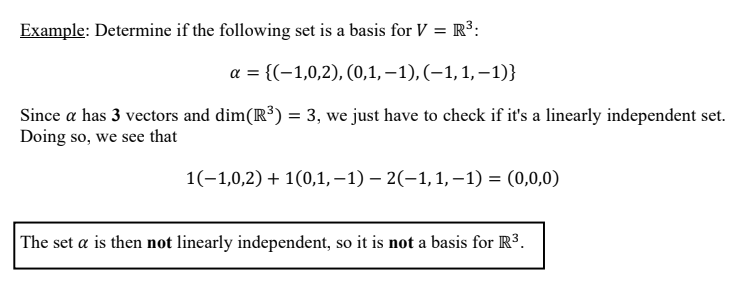
that linear combination doesnt work right?
brisk sparrow
ya ok im going crazy no one pointed this glaring mistake and its too late to tell my TA
hollow finch
if all three are wrong then maybe they were originally different vectors for which it was true, and then the writer changed them but forgot to change that part?
 true goblet
this example is shockingly wrong 😮
 steady fiber
ya
if the 2 was swapped to -2, and -1 in (0, 1, -1) was swapped to 1
then it would be linearly dependent
two signs off
last gazelle
wait is basis of range the same as basis of column space
hollow finch
pretty much. the column space can be thought of as the range of the matrix transformation
last gazelle
is basis of the subspace just the linearly independent vectors?
wintry sphinx
a basis of a subspace is a list of linearly independent vectors with length equal to the dimension of the subspace
(though tbh that's how "dimension" is defined, so it's fairly useless)
it's a list of vectors that spans the subspace and is linearly independent
last gazelle
so i put the vectors into a matrix, do RREF, and then any column with a leading 1 corresponds to a vector in my subspace
wintry sphinx
which subspace
last gazelle
because any column with a leading 1 is linearly independant
wintry sphinx
the row space or the column space?
RREF will give you the columns that are linearly independent, but you have to remember that you have to go back to the original matrix to figure out the actual basis vectors
last gazelle
okim confused
theres basis of row space, basis of column space and basis of subspace right?
wintry sphinx
the row space and column spaces are subspaces of vector spaces
say you have an mxn matrix; this represents a linear transformation from R^n -> R^m
the row space is a subspace of R^n
and the column space is a subspace of R^m
last gazelle
so basis of subspace is something that is found through finding the basis of columnspace and rowspace
or am i just making that up
round coral
I think you need to first understand what is the basis of vector space?
could you tell what it is?
last gazelle
i mean i know it involves RREF and linearly independat vectors
wintry sphinx
no
last gazelle
oop
wintry sphinx
it involves the concept of linear independence
but "involves" is basically a useless word
and taking an rref might be used to calculate something
but almost all definitions of "basis" do not mention the rref of a matrix
round coral
a basis for a vector space, say V is a list of linearly independent vectors that span V
round coral
in your case in order to find basis of row space and column space, rref is ok , using that you can easily tell which are linearly independent rows and columns respectively
 rocky wolf
basically if you take the span of the basis then you'll get the whole vector space
round coral
but you don't need rref always. It is just one way of doing it.
gray dust
all these mentions of span without someone defining it
round coral
follow a good book with 3blue1brown as well , his videos are not enough
3blue1brown also uses determinants way much when it isn't needed
last gazelle
I just watch his videos for context really
im done with lin algebra after this final exam as far as i can tell
ya but i understand how to do it
just not the concept
round coral
well
last gazelle
ik im not setting myself up for success
hollow finch
True or False
If $A^2+3A+4I_3=0$ for a $3\times 3$ matrix $A$, then $A$ must be invertible.
stoic pythonBOT
nix
hollow finch
I believe this is true but I want to prove it either way.
hollow finch
aha ill try that
native rampart
A^-1 will be ||(A+3I)/(-4)||
hollow finch
thank you! ill be able to check my answer when im done 🙂
hollow finch
native rampart
A^-1 will be ||(A+3I)/(-4)||
that is indeed what i got. very interesting
would the fact that A is 3x3 imply that the eigenvalues of A are the roots to the quadratic x^2+3x+4, and one of them has an algebraic multiplicity of 2?
native rampart
The eigenvalue could just be one of the roots of x^2+3x+4
That is the minimal polynomial is a factor of x^2+3x+4
hollow finch
i see. that makes sense
so then any matrix which satisfies a quadratic like that where the coefficient on I is nonzero must be invertible
i said the coefficient on I is nonzero, so that wouldnt apply
native rampart
hollow finch
so then any matrix which satisfies a quadratic like that where the coefficient o...
Yea,you could construct an Inverse by "dividing with A" on both sides
However,If The coefficient of I is zero,The matrix could still have an inverse
Take A^2-A=0 Identity satisfies this and has an inverse
Minimal polynomial of T has a root 0 iff T is not invertible
 little frigate
So apparently in order to find if a matrix is invertible one could just find out if there's a pivot in every column
now may someone explain me why
hollow finch
well what matrix do you have when youve row reduced to have a pivot in every column?
little frigate
a matrix where rows may be linearly independant and 0 0 0 at the bottom?
uhhh
where you basically have pivots also
hollow finch
well if theres a pivot in every column there wont be any rows of zeros since we're talking about square matrices i assume
little frigate
yes square
yes you are right
oh
okay I see now thanks
i just realized that another way of thinking about it would be to think about the determinant with echelon form
because like if you are in R^3 and there is a row of zero you're going to get a degenerated parallelogram hm
i think that this formula can be used for finding the determinant and the inverse,
but if im not mistaken and if i recall correctly
there was a scenario where we don't consider the b_ij
i dont know if it's exactly the b_ij but does anyone know what scenario it is
hollow finch
i guess it could be the cofactor expansion of a matrix full of 1s
little frigate
nvm im stupid
i just didnt know my formulas oof, 2 days before the final
https://cdn.discordapp.com/attachments/306153640023031820/787923720739356682/unknown.png
https://cdn.discordapp.com/attachments/689948583562444858/787922751486558268/unknown.png
so it's in the calculation of the determinant that you must consider the thing at c_ij
not required for the calculation of an inverse- you just take the inverse of that determinant


gotcha
hollow finch
the adjoint is the matrix of cofactors transposed
so for getting the inverse of a 3x3 using the adjoint, you do nine 2x2 determinants and of course the one 3x3 determinant of your original matrix
little frigate
hey
if you had let's say a 4x4 matrix and you wanted to find the determinant
instead of doing this cofactor expansion, would it simply be possible to find the "volume" of the shape that would be generated in 4d by multiplying the column vectors magnitude
sounds kind of weird because it's in 4d doe so idk
considering you put it in row reduced matrix obv
or maybe it should actually be row reduced
ive tried it and it doesn't seem to wrong, not sure if i've done something wrong or if my reasoning is just ape
oh no that wouldn't make sense if it would be row reduced
because the "volume" wouldn't be the same because of row operatoins even doe the system itself would be equivalent
hollow finch
for 3x3s and up i usually row reduce
you just have to account for the operations
so if you switch two rows then add a minus sign out front. if you divide a row by 3 then put a 3 on the outside
luckily if you just add a multiple of one row to another you dont need to change anything
little frigate
oh ok phew
because i was like how he is going to do that with multiple added to rows
makes sense then, thanks
will probably do that for 3x3 and higher
haha i like linear algebras because you can just figure random stuff like that out of nowhere
we never really calculated the determinant in class with row reduce, always cofactors so yep
hollow finch
there are an uncountable number of shortcuts and tricks they dont teach
and you can indeed come up with them yourself
 fair vector
Can anyone help me with this question?
for a part we have to show it is linear so when we put x+y in the left hand side how do we show Qf(x+y)=Qf(x)+Qf(y)
fallow coral
can anyone answer a question i have about orthonomal bases
round coral
@fair vector what have you done till now?
fair vector
For b part i just set the right side =0 and found the kernel to be the space of even functions
round coral
that's right
fair vector
For a part m honestly stuck at the beginning
round coral
do you know the definition of linear map?
fair vector
yep
round coral
then it must satisfy linearity and homogenity
a simple way I use to satisfy both Q( f + a g) = Q(f) + a Q(g)
f, g belong to V
and a belongs to the field over which V is
fair vector
cant it also be Q(bf+ag)
round coral
in this one equation you can satisfy both the conditions , it can be anything, just prove it linear using definition and you are done, you wrote the same thing as me anyway
native rampart
fallow coral
can anyone answer a question i have about orthonomal bases
Go ahead
fallow coral
okay
so
I have an orthogonal basis for a subspace of M2x2(R)
the inner product is <A,B>=B^J times A
^J just means switch out the a11 and the a22 values with each other
anyway
so i found an orthogonal basis for this
and 2 of the matrices in the basis
have norm of 0
so i was unsure on how to normalize them
to make the basis into a orthonormal basis
native rampart
Are you sure this is an inner product
fallow coral
yes
native rampart
Then,You can't have a nonzero element having zero norm
fallow coral
wait soryr
the inner product is
waitttt
omg
i mis read the question
omlllll
LOL
it was B^t not B^j
smh
anyway ty
 crimson snow
Whats the difference between isomorphism and homomorphism in simple terms?
native rampart
Isomorphism is a bijective homomorphism
crimson snow
ok
stoic pythonBOT
Yes
thorny hemlock
ye
 dusky epoch
so really what you would've done instead is $$U+W = { (x_1, x_1, y_1, y_1) + (x_2, x_2, x_2, y_2) \mid x_1, x_2, y_1, y_2 \in F }$$
ugh
thorny hemlock
$U+W = { (x_1, x_1, y_1, y_1) + (x_2, x_2, x_2, y_2) \mid x_1, x_2, y_1, y_2 \in F }$
stoic pythonBOT
Yes
dusky epoch
\{ and \} but whatever
thorny hemlock
i see
stoic pythonBOT
Ann
dusky epoch
yes basically
thorny hemlock
wdym
thorny hemlock
dusky epoch
this is rough wor
whats rough work
dusky epoch
scratch work
notes you make for yourself while doing a problem
yknow, shit like that
stuff you don't submit for grading
thorny hemlock
yeh
are you saying that his example is scratch work?
im confused on what is better
dusky epoch
no
god
ijghj\s
dgghuhufhg
ugh
no
im saying
the x1 and x2 thing that i gave you
is rough work
in an attempt to explain to you why the answer isnt what you wrote


 dusky epoch
did i ever say rough work == incorrect work
thorny hemlock
well
you did say u dont submit rough work
u usually only submit correct work no?
dusky epoch
rough work and incorrect work are both things not submitted but the two are not the same omg
thorny hemlock
ok
thorny hemlock
what does U intersect W even look like?
if (x,y,0) \in U and (0,0,z) \in W. why is the intersect 0 ?
are we doing the intersection element wise?
why is the result only 1 element and not the same amount of elements as U or W
dusky epoch
if (x,y,0) \in U and (0,0,z) \in W. why is the intersect 0 ?
the only vector which can be represented in the form (x,y,0) AND in the form (0,0,z) is the zero vector
are we doing the intersection element wise?
what does that even mean...
intersection is intersection
thorny hemlock
i dont know ...
but i understand what you said
i thought about it another way tho
If all vectors start at zero
thats the only point they have in common
round coral
0 is there because every subspace, or rather vector space has 0 as a vector
thorny hemlock
yeah
round coral
so kind of an analogy for two subspaces to have intersection as 0 , would be that two sets are disjoint
though this is not a nice way of explaining that
thorny hemlock
yep
for the forward
U + W only has one representation
i dont get the 0 = v + (-v) part
native rampart
If a non zero v exists in U int W,0 will have atleast 2 representations
0+0 and v+(-v)
thorny hemlock
-v could also be in U tho?
native rampart
-v can be seen as an element of W
wintry steppe
hi
so I had this question:
Find a∈R so that the list v=[v1,v2,v3]t is a base of R3, where
v1=(a,1,1), v2=(1,a,1), v3=(1,1,a),
I've found a = R \ {-2, 1}
now how can I prove that the vectors span the space?
 fickle citrus
Did you try proving by definition
Meaning, for anything in R3, there is a linear combination of your list that is equal to that?
And IIRC, the linear combination is unique, there should be one and only one solution for any vector in R3
round coral
if you show the list v is linearly independent, you are done
fickle citrus
^that's a little indirect
I mean it's true yes but you wouldn't be so sure that's what the marker would accept
And if the marker doesn't accept a proof by definition then nothing would work LOL
round coral
I am writing to explain him not writing a solution for my assignment
I won't write like that obviously
fickle citrus
I mean, I assume it's a question from homework tbh
wintry steppe
fickle citrus
Did you try proving by definition
I want to say that <v> = {a1v1 + a2v2+ a3v3 | a1, a2, a3 $\in$ R}
fickle citrus
If it were a normal question yeah I'd just get the rank
stoic pythonBOT
hivo
round coral
to write the correct way is his job, we are just to guide him
wintry steppe
fickle citrus
I mean, I assume it's a question from homework tbh
it is, yes:))
wintry steppe
wintry steppe
I want to say that <v> = {a1v1 + a2v2+ a3v3 | a1, a2, a3 $\in$ R}
because this would be the definition, no?
wintry steppe
so I need to show that <v> is included in a1v1 + a2v2+ a3v3 | a1, a2, a3 $\in$ R
wintry steppe
and a1v1 + a2v2+ a3v3 | a1, a2, a3 $\in$ R is included in <v>
stoic pythonBOT
hivo
 mint dagger
The longest side of a triangle is 11 meters longer than the shortest side. The medium side is 15 meters long. The perimeter of the triangle is 46 meters. Find the length of the shortest side of the triangle.
mint dagger
mint dagger
The longest side of a triangle is 11 meters longer than the shortest side. The m...
Can anybody help me with that?
mint dagger
What channel?
native rampart
mint dagger
Oki thx
wintry steppe
actually to show that v is a basis of R^3, I should say that <v> spans R^3.
then <v> = {a1v1 + a2v2 + a3v3 | a1, a2, a3 ∈ R}
and that <v> ⊆ R^3, which is obvious
and that R^3 ⊆ <v>
fickle citrus
_> nothing is obvious
fickle citrus
I mean, you're kinda saying the definition - the 'proof' is somewhat not there
Do you know what's a determininant
wintry steppe
yes
fickle citrus
So the 'there exists a1 a2 a3, for any v' forms a system of linear equations
Then the statement becomes is there a solution for any unknown v
Then the statement becomes, is the determinant of the coefficient matrix of the system of linear equations 0
then you show it's not 0, then all the iff statements connect and you get your 'vectors span space' proven
^ if anyone has a better proof please do share
wintry steppe
fickle citrus
So the 'there exists a1 a2 a3, for any v' forms a system of linear equations
don't we have an infinity of linear equations?
fickle citrus
No you have 3 equations
For any vector in R^3
I am saying, for any $v\in\mathbb{R}^{3}$ with components $v_{1},v_{2},v_{3}$, that
$$\begin{pmatrix}v_{1}\v_{2}\v_{3}\end{pmatrix}=\alpha_{1}\begin{pmatrix}a\1\1\end{pmatrix}+\alpha_{2}\begin{pmatrix}1\a\1\end{pmatrix}+\alpha_{3}\begin{pmatrix}1\1\a\end{pmatrix}$$
for some $a$ you determine, where $\alpha_{1}$, $\alpha_{2}$ and $\alpha_{3}$ depend on $v$ itself.
stoic pythonBOT
ShatteredSunlight
fickle citrus
Oh wait nvm, it is spanning for those a you found, yup
fickle citrus
wintry steppe
Yup seems simiilar
wintry steppe
I wanted to prove that there isn't any other a outside {-2, 1} for which the system is linear
wintry steppe
okay, thank you:D
So what I wrote above proves that <v> spans R^3?
A "basis" for a vector space of dimension n is a set of vectors that has three properties:
The vectors span the space.
The vectors are independent.
There are n vectors in the set.
And they are equivaent
So I guess yes
:-?
fickle citrus
wintry steppe
So what I wrote above proves that <v> spans R^3?
I'd say it's the necessary working
I mean 😦 it kinda implies that it is not the case there is not a solution rather than there is a solution, which is kind of different you know?
fickle citrus
wintry steppe
So what I wrote above proves that <v> spans R^3?
Actually honestly yeah I think you should write further "since the determinant ..." "hence ..." it's a few more lines of English and you already have the working so why not
wintry steppe
fickle citrus
I mean 😦 it kinda implies that it is not the case there is not a solution rathe...
yeah, I know. I'm not sure how to prove that there is a solution
wintry steppe
fickle citrus
Actually honestly yeah I think you should write further "since the determinant ....
yup, I will!
fickle citrus
wintry steppe
yeah, I know. I'm not sure how to prove that there is a solution
Existence of solution is tied to the determinant
It ties in to invertibility
I mean, it's why invertibility of matrices has a huge "The following are equivalent"
wintry steppe
fickle citrus
https://en.wikipedia.org/wiki/Invertible_matrix#The_invertible_matrix_theorem
thank you. I didn't know about this one
wintry steppe
fickle citrus
Existence of solution is tied to the determinant
hmm, then there should be a solution for any b in R {-2, 1} because the determinant is not equal with 0
fickle citrus
Yup
I guess you mean for any a not equal to -2, or 1 - and then for any vector in R^3
wintry steppe
fickle citrus
I guess you mean for any a not equal to -2, or 1 - and then for any vector in R^...
yup
wintry steppe
wintry steppe
couldn't I take a vector y in R^3 (with y1, y2, y3) and try to write it like thi...
to see if for any a in b in R \ {-2, 1} v generates R^3
wintry steppe
Hi:)) I have one more question. I'm solving this problem
First I proved that b is a basis by calculating the determinant (which is always equal with -18, thus it is always linearly independent)
and now I want to find the coordinates of x in relation to the basis
should I take each vector one by one?
I said that [x]B = [x,y,z,t]
and x*[1,2,-1,2] + y[1,2,1,4] + z[2,3,0,-1] + t[1,3,-1,0] = [2,3,2,10]
I wrote it as a system
then solved it using the inverse of a matrix
so the coordinates are [1,2,0,-1]
is this right?
 surreal thistle
yo if i have two linear transformations that map R3 to R3 and they both have rank 2
what are the possible values of the ranks be if i compose them
 frosty orbit
Have no idea what to do
dusky epoch
do you know the defn of linear independence
frosty orbit
I don't know how to write it
When the vectors are in this form
Just a1f1 + a2f2 + a3*f3= 0?
dusky epoch
remember what the zero vector of C^2[0,pi] is, & what it means for two functions to be equal
but yes the form isnt any different
 tall thunder
Is anyone able to explain this like I’m 5?
stoic pythonBOT
Nyrre
tall thunder
Ok so I do that formula
Like lambda + 11 and then all the way across diagonally
Right ?
Then just get the det of that
But what about the invertivle matrix part
round coral
you need to diagonalize the matrix A, if possible. So first find the eigenvalues, you can either use gaussian elimination to find the characteristic polynomial or just use the determinant
 tawny tulip
@tall thunder
round coral
look it up online how to do diagonalization, we can't help you like baby. First learn how to find eigenvalues and eigenvectors for an operator
stoic pythonBOT
Nyrre
round coral
first study then come here
tall thunder
@tawny tulip is your negatives mixed up ? For the example you showed
Or was that like a thing your supposed to do
Nvm I got it 😇☠️ thanks
hollow finch
tall thunder
Is anyone able to explain this like I’m 5?
maybe not for 5 year olds but if youre fairly comfortable with the column perspective of matrix multiplication:
multiplying the eigenvectors of A by A is just scaling them. so if you put the eigenvectors as the columns of a matrix P then AP is just P with its columns scaled by each eigenvectors' eigenvalues. but that can also be achieved by multiplying P on the right by a diagonal matrix with the eigenvalues D. so AP=PD. from there you can solve for A or D by multiplying P^-1.
tall thunder
Hey nix, thanks for explaining I really appreciate it
surreal thistle
yo can someone help me out with this
i dont really understand how you can just multiply a vector b that number
wintry steppe
any vector takes on the form (x, y), and you identify that with the complex number x + iy
now multiply complex numbers
when you get the result in the form a + ib, what vector does it correspond to?
wintry steppe
okay, let me write it out in a bit more detail
When it says "Consider $\bC$ as a two-dimensional real vector space with basis ${1,i}$," it means that our vectors are literally complex numbers, of the form $a + ib$ for real numbers $a, b \in \bR$. If you're used to writing vectors as tuples, then you can write $(a, b)$, and think of this as the complex number $a + ib$. Now, we want to figure out what multiplication by $1+i$ means. Given any vector $(a, b)$, where $a$ and $b$ are real numbers, the multiplication is given by $$ (1 + i)(a + ib). $$ Now write this out.
stoic pythonBOT
TTerra
wintry steppe
you're literally just doing complex number multiplication lol
just the "consider C as a two dimensional real vector space with basis {1, i}" part may be a bit confusing
 split heart
Hi, if I have a f:R3 -> R2, with canonical basis in domain and domain, and a matrix A, what process should I follow? Sorry by mistakes
It's about linear transformations.
wintry steppe
what are you trying to do
surreal thistle
wintry steppe
just the "consider C as a two dimensional real vector space with basis {1, i}" p...
ok i understood that part but I kinda just have trouble creating a matrix from that information
gray dust
we want to find f(x,y,z)=...
split heart
Yes
surreal thistle
this the right idea?
i put the left vector on the wrong side by mistake i think
 kindred locust
^I'm also confused about this problem 😖
 safe root
Does slope count as algebra?
wintry steppe
Not this algebra
limber sierra
quartz compass
take two arbitrary elements and show that their sum obeys the identity
thorny hemlock
ok
quartz compass
just try something, play around a bit and see if you can get it
quartz compass
R^(-4,4) is the set of real valued functions on (-4,4), don't think this is like R^n it's a separate notation
tame mural
Axler's talks about a product of vector spaces, but it seems hard to search up
Is that just his own thing?
gray dust
@tame mural it's just cartesian products
tame mural
I see
thorny hemlock
for the forward, under the assumption that its closed under addition. Taking another real valued continuous function on interval [0,1] g $\int^1_0f + g = 2b$
stoic pythonBOT
Yes
 hoary osprey
yes
limber sierra
another?
recall that $U + U$ is the subspace composed of all $u_1 + u_2$ for $u_1, u_2 \in U$
stoic pythonBOT
Chillin' with Quillen
limber sierra
but also recall that $U$ is closed under addition, since it's a subspace
stoic pythonBOT
Chillin' with Quillen
limber sierra
what does this tell you?
limber sierra
right, $U+U = U$
stoic pythonBOT
Chillin' with Quillen
tame mural
What is the difference between isomorphism and equailty?
limber sierra
equality says two things are literally the same, isomorphism says that they behave the same/can be considered the same
so theyre very related notions
tame mural
I see, so I'm not going to go wrong by thinking of them as the same
limber sierra
but with a slight semantic difference
tame mural
I see, so linear isomorphism = equal as far as linear algebra is considered?
tame mural
I have a feeling this is for a test, but
Shouldn't all subspaces always have inverses and identity?
thorny hemlock
no, its from the axler book
lol
yay
yep
exactly my thoughts, just needed to confirm
yeah
i see
thorny hemlock
How is something like this done?
Working backwards for multiple linear equations?
hoary osprey
you want to find a sub space that intersects trivially with U and behaves in a way such that V=U+W
so try out a couple of options
thorny hemlock
my initial thought its (0,0,-y,y,0) but that obviously doesnt work
acoustic path
W=0 vector 🕶️
thorny hemlock
W = {0} doesnt work
acoustic path
cap
acoustic path
if W = {0} we just get U which is in F^5
acoustic path
yea im not sure lol
split heart
How can I develop this binomial using newton’s binomial theorem?
I'm confused about -1/2
split heart
Isn't linear algebra?
split heart
Right, ty
thorny hemlock
hoary osprey
do you have any guesses <@252055487774720000>
nope
like
i dont see it
hoary osprey
try (t,2t,w,2w)
 slender tangle
Ok I need a quick verification because this is driving me nuts. I have a 6x4 matrix which represents a homogeneous linear system
When is it possible for this system to have non-trivial solutions?
I thought I had it didn't work
hollow finch
there are nontrivial solutions to the homogeneous system when the nullity of a matrix is nonzero. since nullity=# of columns - rank, the matrix would need a rank less than 4
slender tangle
Hmm ok so far so good, is there a way of finding the rank in general as a function of the elements in my matrix?
I vaguely remember looking at the determinants of 4x4 submatrices
hollow finch
hm that definitely wont always work
limber sierra
"as a function of the elements"
does "perform gaussian elimination" count?
since thats the general algorithm
hollow finch
the normal way to compute rank is to get it into ref or rref and count the pivots
slender tangle
I was hoping to get a polynomial out of this
hollow finch
is there something different about this matrix that would lead you to think something like that is possible?
slender tangle
About half the elements are 0
hollow finch
i see
slender tangle
I'll make a quick picture
hollow finch
yea was just about to ask
hollow finch
right i see what you mean now
slender tangle
I guess I can do a Gauss elimination but I'd hoped there was an "cleaner" way to solve it
The annoying part is, I know that it has non trivial as soons as a single variable is 0
So the only remaining problem is all 4 being non zero
hollow finch
elimination is very tedious with variable entries yeah
well the rank is also the number of linearly independent columns, right?
hollow finch
yeah so i think id try examining the conditions for one of the columns to be linearly dependent. then it would have nullity of at least 1.
since there are so many zeros this should be pretty feasible
slender tangle
I could of course cheese it by putting it in a calculator but that would be the easy way out
Them again my deadline is in 18 hours and I still have much to write
Hmm wait this is interesting
"the rank of the matrix is strictly smaller than n-d it and only if all n-d square minors vanish"
With n being the number of columns
hollow finch
what is d?
slender tangle
In this case the dimension of a variety but it's arbitrary in the general case
I think
But I fear this will just lead me into a circle for my specific problem
slender tangle
Project matrix is a diagonal matrix of full rank? As in no 0's on the diagonal?
 prisma bough
hm.. we defined a projection matrix as "if it corresponds to a projection onto a subspace"
or if a linear transformation P satisfies P^2 = P
slender tangle
What you've written down is basically "Any square matrix can be Gauss Eliminated"
prisma bough
for context, this is a question that I am given a possibly correct/incorrect statement, and I have to explain if it's true or false
slender tangle
Are you working over the real numbers?
prisma bough
yeah
slender tangle
I'm not sure about that P^2 = P part
Because indeed, any matrix can be gauss eliminated (those elementary matrices) into a matrix with only elements on the diagonal
But I don't think that it's possible to have that P^2 = P property for reals
prisma bough
oh
slender tangle
Though you might wanna wait for a second opinion on that
prisma bough
yeah, but thanks anyway
slender tangle
*I don't thinks it's always possible
hallow lodge
anyone want these? Professor gave these at the start of the semester and said good luck on your exams.
wintry steppe
are all unitary operators hermititian. or is it the other way round?
native rampart
I don't think it's either
 raw magnet
so to show this i have to make sure that
- f is one to one and onto
- it preserves the property of linear transformation
but how do i do it if i dont have an explicit definition of the transformation?
hollow finch
you can just make one. thats what its asking you to do
i wouldnt think too hard about it. keep it simple
raw magnet
so let say, i make v be p2(c) and w be C_3, then the transformation is just T(a_0 + a_1 X +a_2 X^2 ) = (a_1,a_2,a_3) ?
raw magnet
raw magnet
so to show this i have to make sure that
1. f is one to one and onto
2. it pres...
then from that i show these
hollow finch
your index is off but i like the idea
native rampart
Well, Check the numbering,but yea it works
raw magnet
Oh thanks both, notice that 🙂
raw magnet
P_2(C) over C is isomorphic to C_3, would P_2(C) over R be?
is it no, because p_2(C) over R has dim 6 while C_3 only has dim 3?
native rampart
Yea,It won't be
raw magnet
raw magnet
is it no, because p_2(C) over R has dim 6 while C_3 only has dim 3?
Is this a good reasoning?
raw magnet
Thanks
native rampart
Also,2 vector spaces of same dimension need not be isomorphic(when the corresponding fields are different)
For example V over F_2 is not isomorphic to V over F_3
stoic pythonBOT
xD_Lopez
 arctic karma
when getting the bases of row and column space of a matrix, do i use rows and columns of the original matrix?
the row space should be R1 and R2 since they're non-zero, and column space should be C1 and C4 since they have the leading entries
native rampart
You can use the final thing as well
Span{original rows}=span{rows obtained in rref}
stoic pythonBOT
xD_Lopez
native rampart
Yes
arctic karma
thank you!
native rampart
The row space wouldn't be span{(1,-3...) ,(3,-9...)} though. you also need to include the other 2 rows
arctic karma
but if it's asking for the basis then it would only need the first two rows right
thorny hemlock
Not sure i understand that last part
I get that the span contains each individual vector
I dont get how he deduced that its the smallest subspace of V
thorny hemlock
<@&286206848099549185>
limber sierra
do you see why, if a vector space contains each v_j, then it must contain span(v_1, ... v_m)?
thorny hemlock
no
limber sierra
well span(v_1, ... v_m) is the set of all linear combinations of vectors from {v_1, ... v_m}
thorny hemlock
yes
limber sierra
and if your space contains {v_1, ... v_m}
as well as maybe some other vectors
we can certainly take linear combinations of {v_1, ... v_m}
even if we entirely ignore the other vectors in that space
hence we have all linear combinations, i.e. we have span(v_1, ... v_m)
so ${v_1, \dots, v_m} \in V$ implies $\mathrm{span}(v_1, \dots, v_m) \subseteq V$
stoic pythonBOT
Chillin' with Quillen
limber sierra
that is to say, any vector space containing {v_1, ... v_m} must contain the span of these vectors, and hence be "at least as large"
so the smallest is the one that contains only the span
(i.e. when that subset sign is an = sign)
thorny hemlock
i understood most of what you said
limber sierra
basically:
vector space contains {v_1, ... v_m}
vector spaces are closed under + and scalar *
which means we can take any linear combinations of this set
thorny hemlock
ye
limber sierra
and they'll still be in the space
thorny hemlock
ye
limber sierra
hence span(v_1, ... v_m) is in the space
thorny hemlock
ye
limber sierra
so if V is our vector space, span(v_1, ... v_m) is a subset of V
limber sierra
since span(v_1, ... v_m) will always be a subset, the smallest possible vector space is span(v_1, ... v_m) itself
uh okay forget the linear algebra, maybe we just need to think about sets then
suppose i have the set {1, 5, 6}
thorny hemlock
ok
limber sierra
what is the smallest set with {1, 5, 6} as a subset?
thorny hemlock
{1,5,6}
limber sierra
right
replace {1, 5, 6} with span(v_1, ... v_m)
and the conclusion follows*
*well, we also need to make sure that span(v_1, ... v_m) is actually a vector space [that is, a subspace], but that's what the first half of the proof did
thorny hemlock
ok
so
i think i understand
if we have the vector (1,1,1)
the theorem states that a(1,1,1) is the smallest subspace of V that contains (1,1,1)
limber sierra
not 100% sure what the notation a(1, 1, 1) means
thorny hemlock
a is a scalar
limber sierra
oh
the set {a(1, 1, 1) | a is a scalar} is the smallest subspace containing (1, 1, 1) yes
thorny hemlock
that visually doesnt make sense to me
{a(1,1,1) | a is odd scalar} is a smaller subspace containing (1,1,1) ?
limber sierra
that's not a subspace
thorny hemlock
ohhhh
limber sierra
subspaces should be closed under scalar multiplication
limber sierra
for three-dimensional real vectors, you can visualize subspaces as lines (if one-dimensional), planes (if two-dimensional), or the entire space (if three-dimensional)
{a(1, 1, 1) | a is a scalar} is then one long line that you get if you "stretch out" the vector (1, 1, 1) [centered at the origin] infinitely in both directions
thorny hemlock
i understand
limber sierra
and this line is certainly the smallest subspace with (1, 1, 1) inside it