#discrete-math
1 messages · Page 206 of 1
 coral parcel
 wide vine
the teacher I guess
I guess she believed the omitted 2 wasnt such a big deal
Im also confused on my teachers emails and really don't know what more to say
coral parcel
I'm a bit confused about what's confusing you, then. It sounded vaguely like you thought the comment in red was a criticism of the answer, but it looks to me like it's explaining how the answer is right.
wide vine
coral parcel
I'm a bit confused about what's confusing you, then. It sounded vaguely like you...
Yeah I wasn't sure if it was a comment or not
 sharp shell
How do you solve 500n^2 < 2^n
 coral parcel
How do you solve 500n^2 < 2^n
I iterate n --> ceil(log2(500n²)) until I reach a fixed point. It happens fairly quickly.
 olive condor
 silent hinge
for number one \
silent hinge
for number one \
Nope, maybe it helps if you read “everybody is an obnoxious elf” as “for all character x in a fantasy world, x is an elf and x is obnoxious”
And for number two, don’t omit the parentheses around the implication. It means two different things with and without parentheses in this case
silent hinge
Thanks man
 civic cedar


 floral abyss
How would I go about proving the following
Suppose a,b,c are in R
Prove that a(b+c)=ab+ac
 stray reef
you need a construction of R
because sometimes R is constructed axiomatically and this is just one of the axioms
otherwise it's probably constructed via cauchy sequences of rationals in which case the distributive law in R reduces to the same in Q
floral abyss
I think we’re constructing it from Q
floral abyss
Honestly no idea they never said anything about that
stray reef
.......
floral abyss
I’m assuming the simplest way to construct it whatever that is
stray reef
again.
no construction
no proof
you need notes from your class
that say how R is constructed formally by your professor
because if you use a different construction than your professor, then your proof will be pointless
is this for an assignment?
floral abyss
stray reef
is this for an assignment?
It’s just for homework
Doesn’t count so I guess I’ll just go to his office hours and ask him
stray reef
a homework assignment
can you share it in its entirety
i have a feeling that there might be something else in there that helps clarify what's going on
floral abyss
There’s like 900 pages lol
Idk how I’d share that
I think it’s something to do with Cauchy sequences and converges but honestly not sure
stray reef
floral abyss
There’s like 900 pages lol
how does ONE homework assignment take up nine hundred pages
floral abyss
stray reef
how does ONE homework assignment take up nine hundred pages
Wait no that’s the notes for the whole course
The questions are inside the notes
stray reef
well i'm asking you to share the questions that were given to you as homework
floral abyss
They’re scattered throughout the notes
I mean I can screenshot like 20 pages lol but idk if that’ll help
stray reef
well fine then i guess i'm not going to get any clarification
 pale epoch
you already gave the correct answer, ann
which is "figure out what a real numbers is and how to add an multiply them"
stray reef
pale epoch
which is "figure out what a real numbers is and how to add an multiply them"
did you word it that way on purpose 
pale epoch
i wanted to sum up what op is supposed to do and possibly come back with
in case they are still reading
stray reef
i mean "real numbers" instead of "real number"
pale epoch
i just cant type 
stray reef
ah
 shadow geyser
Hello!
Can anyone explain me understand how this was to be manipulated?

i'm just trying to understand why the second term was broken up into two of the same terms
 livid cobalt
p + p <=> p
shadow geyser
what does <=> mean?
shadow geyser
livid cobalt
logically equivalent
not sure why that was still broken up though
you could just pull out the NotX in the first line
like NotX (NotY + Y) + XY
so that NotX + XY leading to (NotX + X)(NotX + Y) which cancels to NotX + Y
Still looking for help if anyone can btw ^
 pearl apex
Hello guys
I had a question pls

how can those be symmetric ?
like for example if I have the pair (1,2)
how can this be symmetric ?
how is 1 = 2 !?
or am I assume that if 1 = 2 then 2 = 1 aswell ?
floral abyss
@stray reef prof said R is the completion of Q in which there are 2 possibilities of constructing R
- Dedekind
- Cauchy: in which every Cauchy sequence converges
(with respect to | | )
We’re using the 2nd definition to answer the question
 cerulean wind
pearl apex
like for example if I have the pair (1,2)
cerulean wind
pearl apex
like for example if I have the pair (1,2)
(1,2) is only in R_6 for the symmetric relations
pearl apex
so how is R_3 and R_4 symmetric ?
does he mean like if (1,-1) works in R_3 then (-1,1) should work aswell?
and in R_4, if (a=2,b=2) work then (b=2,a=2) should work aswell ?
one more thing cuz it confuses me
here

why R1 is antisymmetric ?
 worthy mist
Well does it fulfill the definition of antisymmetry?
 hard citrus
shadow geyser
hard citrus
shadow geyser
$\bar{X}\bar{Y}+\bar{X}Y+XY = \bar{X}(\bar{Y}+Y)+XY = \bar{X}+XY = (\bar{X}+X)(\bar{X}+Y) = \bar{X}+Y$
 vital dewBOT
.itsjustnai
 hard citrus
for the first one
shadow geyser
i understand that
but my TA wrote what i sent instead
im just trying to understand why that was written
livid cobalt
if that's a minimization exercise, expanding like that seems completely useless
but it's still valid
hard citrus
When you have
x+x it is the same as having just x
shadow geyser
hm
okay
does that apply for any case within boolean algebra?
you can break up one thing into two of itself
vital dewBOT
.itsjustnai
 livid cobalt
shadow geyser
does that apply for any case within boolean algebra?
livid cobalt
shadow geyser
does that apply for any case within boolean algebra?
yes, for any proposition p, p + p = p
it's called the idempotent law
shadow geyser
livid cobalt
yes, for any proposition p, p + p = p
it's called the idempotent law
idempotent law
i se
thank you
pearl apex
worthy mist
Well does it fulfill the definition of antisymmetry?
yes but how can it be symmetric and antisymmetric at the same tijme
worthy mist
pearl apex
yes but how can it be symmetric and antisymmetric at the same tijme
it isnt? Your previous slide even says that R_1 is not symmetric
 lone raft
We know (-1)^n gives us the sequence -1, 1, -1, 1,.... Is it possible to find something similar for 1, 1, -1, 1, 1, -1. Two positive then negative etc?
pearl apex
yea sry i meant R_4
I think I kinda understood it
its cuz (2,2) is symmetric cuz (2,2) would work aswel
and (2,2) in R_4 is anti cuz (2,2) and (2,2) works but ( 2 = 2 )
then it is isymmetric
livid cobalt
lone raft
We know (-1)^n gives us the sequence -1, 1, -1, 1,.... Is it possible to find so...
it exists on oeis, so i guess
pale epoch
something similar?
$$a_n = \begin{cases}
-1 &\text{ if $n \equiv 0 \pmod{3}$, }\
1 &\text{ otherwise.}
\end{cases}$$
vital dewBOT
Lochverstärker
 stray reef
well you can do $(-1)^{n(n+1)/2 + 1}$ i think
vital dewBOT
Ann
 pearl apex
is 2 a rational number in discrete mathematics ?
and is 1/3 and 1/4 rational numbers ?
stray reef
a rational number in discrete mathematics as opposed to a rational number in what?
do you think the answer to the question "is 2 a rational number?" depends on the phase of the moon or something?
if you know what a rational number is (i.e. that it is a number expressible as the ratio of two integers, the denominator being nonzero) then you should be able to answer yourself whether 2, 1/3 and 1/4 are rational.
 tidal tulip
if i want to prove “1 divides any even number” would this be valid: the definition of even is n=2k, k in Z and the definition of a divides b is b=am for some integers b,a,m. from the definitions we see that 2k=1m, hence we see that 1 divides any even integer
stray reef
sure, though it's unnecessarily long
1 divides any integer, and in particular it divides any even integer
tidal tulip
how do you prove it divides any integer. like n=1k for some int k?
stray reef
n = 1*n
or if you really insist on introducing another variable, n = 1*k for some integer k, specifically for k = n.
 limpid fossil
for a complete binary tree with 2^k - 1 nodes and no duplicate keys, how can i show the worst case number of nodes that must be examined to search for a node is the number of nodes?
pale epoch
how does the search work?
limpid fossil
pale epoch
how does the search work?
the pseudo code is like this
 pale epoch
then it's not true? you discard half the (sub)tree at every call of that function
limpid fossil
oh.. does complete binary tree mean every node has two children
pale epoch
not necessarily
if you have an odd number of nodes, then not
also leaves do not have any children
otherwise yes
but thats just what binary tree means
complete means that every layer except the last is filled completely
and the last layer is filled from left to right so to say
limpid fossil
so.. the worse case would be the height?
pale epoch
yes
limpid fossil
but how do we prove that is true?
pale epoch
induction on the height works
limpid fossil
for the sake of the question, we were given 2^k - 1 nodes
so can we use the property that the height is log_2(# nodes)
pale epoch
sure but the height will still depend on k
limpid fossil
how would the inductive step work? for the base case on a height of one we only have to check the root, and that is height 1
pale epoch
you check the root and the immediately move into a subtree that has lower height
thats basically it
limpid fossil
so is the predicate forall n in N, if T is a complete binary tree with height n then the worst case nodes examined is height n?
coral parcel
Phrasing it as induction might be making it more cumbersome for yourself than it needs to be -- especially if you can get away with saying something like "each recursive call is for a node on a lower level, so we'll examine at most one node at each level, so in total we'll examine at most k nodes".
limpid fossil
right, but for the sake of this problem im trying to construct a formal proof and it sounds like it would be done by induction
coral parcel
"Formal proof" is a technical term from proof theory, and I somewhat doubt that technical concept is being used in the same breath as a property as intricate as binary search trees.
I believe even the definitions necessary for even stating the property you're proving in a completely formal notation would run to several pages.
tidal tulip
Let $P(f)$ be the following statement:
$\forall \epsilon > 0 , \exists \delta>0$ such that $\forall x \in (2-\delta, 2 + \delta)$, we have $L - \epsilon < f(x)$ and $f(x)< L + \epsilon$.
vital dewBOT
strings
 tidal tulip
Is the negation of $P(f)$: $\exists \epsilon \leq 0$ such that $\forall \delta \leq 0 $, $\exists x \in (2-\delta, 2 + \delta)$, we have we have $L - \epsilon \geq f(x)$ or $f(x)\geq L + \epsilon$?
vital dewBOT
strings
 tidal tulip
Is the negation of $P(f)$: $\exists \epsilon \leq 0$ such that $\forall \delta \leq 0 $, $\exists x \in (2-\delta, 2 + \delta)$, we have $L - \epsilon \geq f(x)$ or $f(x)\geq L + \epsilon$?
vital dewBOT
strings

 ember obsidian
dont blindly negate every symbol
$\forall\ep>0$ is shorthand for 'for all $\ep$ in the set of positive reals'
vital dewBOT
RokabeJintaro
 tidal tulip
ok
then $\exists \epsilon \leq 0$ means for all $\epsilon$ in the set of the negative reals or 0?
vital dewBOT
strings
 ember obsidian
u wrote exists
tidal tulip
oops
$\exists \epsilon \leq 0$ means there exist an $\epsilon$ which is either 0, or in the set of negative reals?
vital dewBOT
strings
 ember obsidian
yes, u can also say nonpositive reals
ember obsidian
my point is u dont blindly negate every symbol u see
negating a quantifier is just swapping forall by exists & vice versa
tidal tulip
yeah
ember obsidian
so 'for all ep in the set of positive reals' negates to 'exists ep in the set of positive reals'
or exists ep>0 for short
tidal tulip
i am confused, isn't $\forall \epsilon > 0$ negated: $\exists \epsilon \leq 0$
vital dewBOT
strings
 tidal tulip
i want to see whether P(f) negated is: $P(f)$: $\exists \epsilon \leq 0$ such that $\forall \delta \leq 0 $, $\exists x \in (2-\delta, 2 + \delta)$, we have $L - \epsilon \geq f(x)$ or $f(x)\geq L + \epsilon$
vital dewBOT
strings
 ember obsidian
dont blindly negate every symbol
'forall ep>0' is shorthand for 'for all ep in the set of positive reals'
negating a quantifier is just swapping forall by exists & vice versa
so 'for all ep in the set of positive reals' negates to 'exists ep in the set of positive reals'
or exists ep>0 for short
tidal tulip
what don't you negate the inequality there
ember obsidian
'forall ep>0' is shorthand for 'for all ep in the set of positive reals'
this is the key to the misconception
ember obsidian
just having > does NOT make it a statement
its just a way to lazily write a quantifier
tidal tulip
ok i see
when you negate things you shouldnt negate the domain the elements reside in?
and thats what i did
incorrectly yeah?
ember obsidian
you basically replaced 'in' by 'not in'
tidal tulip
ok, that makes sense
ember obsidian
but the only replacement should be 'forall' to 'exists'
tidal tulip
i'll re-tex it
how is this
Negation of $P(f)$: $\exists \epsilon > 0$ such that $\forall \delta > 0 $, $\exists x \in (2-\delta, 2 + \delta)$, such that $L - \epsilon \geq f(x)$ or $f(x)\geq L + \epsilon$
vital dewBOT
strings
 ember obsidian
yes
tidal tulip
ok, what you said makes sense
ember obsidian
yeah so in the future look out for symbols used to denote the set a variable is in
tidal tulip
ok, good call. i'll do that
 floral field
So, I played around with this a little bit, and I noticed that we are pretty much permuting the elements of [n] in each case. So, my claim is that there are n! ways to place n rooks. I think this is reasonable, so I was wondering if someone could point me towards a good direction of how I could argue this.

I feel like my instinct is to try induction, but I feel like there's a clever counting argument for this
 obtuse lance
the way I think of it is when you place a rook on an n by n board, you have to remove the row and column that it's in, and you're left with an n-1 by n-1 board. There's n ways to place it in the first row, then n-1 for the second row, etc... so n! ways to place them, seems like what you're saying is fine
floral field
obtuse lance
the way I think of it is when you place a rook on an n by n board, you have to r...
Would this be sufficient to prove my claim?
obtuse lance
it's sufficient to me, idk
 tidal tulip
@ember obsidian in regards to the negation problem yesterday it asked to show a graph that shows P(f) is false. is L here a constant or are they using L as a limit? assuming it’s a limit my attempt was lim x->2 f(x)=2 and f(x)=L+1=2+1 with a graph like this, does that work?


or no because f(x)=2 except when x=2, f(x)=3
and if not how do i fix it
ember obsidian
tidal tulip
<@!150414892225134592> in regards to the negation problem yesterday it asked to ...
L is any constant
this isnt a limit. a limit at 2 further requires x!=2 in the x quantifier
tidal tulip
so f(x)=L+1 works
what do you mean a limit at 2 requires x!=2 in the x quantifier?
let L=2, then f(x)=L+1 would break the inequality making P(f) false
i got super confused thinking this was about a limit
if it isn’t about a limit then i won’t worry about it further too many other problems to do.
but now i’m curious. would this statement be true for limits?
ember obsidian
the def of limit at 2 instead has $\forall x\in(2-\delta,2+\delta)-\brc2$
vital dewBOT
RokabeJintaro

 weary tiger
tidal tulip
weary tiger
tidal tulip
I have a question about this negation here. The statement we're trying to negative is $\forall \epsilon \in S, \exists \delta \in S, \forall x \in I, |f(x) - L| < \epsilon$.
vital dewBOT
n/c
 weary tiger
The negation would then be $\exists \epsilon \in S, \forall \delta \in S, \exists x \in I, |f(x) - L| \ge \epsilon$?
I didn't read their negation yet
But is this how you would do it?
vital dewBOT
n/c
 tidal tulip
i write my negation above i don’t have a lot of time to tex it got like 10 mins free but scroll up a bit
wrote
sorry super busy
weary tiger
tidal tulip
Negation of $P(f)$: $\exists \epsilon > 0$ such that $\forall \delta > 0 $, $\ex...
Oh cool this
weary tiger
Okay
I think mine matches yours
Sorry for interrupting just wanted to practice lol
tidal tulip
np! glad you asked
ember obsidian
tidal tulip
and graph f(x)=3
sure
 hearty elbow
Why is it that when you
have an even number and you mod it by an even number
it gives you an even number
2k (mod 2n) = 2x
pale epoch
even number - even number = even number
weary tiger
Can we hide discrete in primes series ? Like hiding a markov chain in a prime series ?
I think it's a safe bet.
I think its a safe bet to say you can hide P(universe)!=1 in P(universe)=1
At least P(universe)!=1 is max n-1
How i know that ? Because to do retro analisys we used markov chain property. It don't think it's safe to use them to predict. But to retro analyze stuff, it's pretty safe actually.
I have others bets to talk about the wheeler experiment. First i will wait some feedback from you all.
weary tiger
ZFC is consistent
It means that you can say everything AND its opposite
ZFC is reducible to a number
This number is the number of space units available in ZFC
So if a model uses all the space units available in ZFC then although it cannot be proved, this number is contradictory.
What about QM ?
olive condor
weary tiger
3^2 - 1 = 8 = even? So when x = 3, R(x) => Q(x) is true
But this alone is not sufficient to prove the theorem
Since you have only proven it’s true when x = 3, while you need to prove it for all x
olive condor
Since the theorem claims that it’s true for k >= 2, you can “disprove” it with a single counter-example
You can show that when k = 2, the equality doesn’t hold
olive condor
Ya, just plug it in, do something like:
 olive condor
weary tiger
what did they sub k-2 for?
olive condor
weary tiger
what did they sub k-2 for?
Huh? k-2?
 olive condor
It seems overkill to me. This is to prove that for all k >= 2, k^2+k < 3k is false
weary tiger
hmmmmmm
olive condor
But one case of a counter-example is sufficient to show that the theorem is incorrect
Doesn’t it make sense? If the theorem claims that it’s true for all k >= 2, but you found out that it’s false for some value k = 2, then the theorem is false
Since it’s no longer true for all k >= 2
olive condor
olive condor
It seems overkill to me. This is to prove that for all k >= 2, k^2+k < 3k is fal...
But if your instructor insists you to prove this ⬆️, then maybe you should stick to it
Does it make sense to you? 
weary tiger
olive condor
Does it make sense to you? <:catthonk:586238610957926430>
but whats
I don't get how the instructor went from l(k-2)>0
to saying well this means it's a contradiction
I dont get how is k^2+k >3k
olive condor
It adds 3k to both sides
 weary tiger
oh wait so
ok now thats so clear
thank u so much
but I have a small quesiton
when we you move the 3k to other side
in step 1
shouldn't be elss 0
since its k^2+k- <3k
so k^2-2k<0 no?
like
why did we flip the inequality
olive condor
Wait, hold on, what are you saying?
So you’re asking why adding 3k to both sides doesn’t flip the inequality?
Erm, because adding and subtracting will never flip the inequality
You flip the inequality only when you are multiplying or dividing a negative number
It makes sense because the inequality will still hold after the operations:
 weary tiger
no no I'm saying
weary tiger
olive condor
Wait, hold on, what are you saying?
I'm saying from
going from k^2+k<3k to k^2+k-3k>0
 sturdy walrus
Hi I am having a hard time understanding this proposition. Could someone please take a moment and help me understand this?
 olive condor
weary tiger
going from k^2+k<3k to k^2+k-3k>0
olive condor
weary tiger
going from k^2+k<3k to k^2+k-3k>0
No, no, if you read the proof, there is no k^2+k<3k, only k(k-2)>=0
And you are going to prove or “disprove” k^2+k<3k, which is the goal of your proof
olive condor
sturdy walrus
Hi I am having a hard time understanding this proposition. Could someone please ...
If (x-1) is a factor of p(x), you can write p(x) = (x-1) * q(x). So when x=1, p(1) = 0*q(x) = 0. Since p(x) = ax^n + …, p(1) = a_n + a_(n-1) + … + a_0. Thus, a_n + a_(n-1) + … + a_0 = 0.
weary tiger
@olive condor
 olive condor
weary tiger
<@!511826957558611968>
olive condor
weary tiger
<@!511826957558611968>
Ya? So that’s the goal, you want to prove it to be true
But you are only given k is an integer and k >= 2
So a proof is a series of steps going from the givens to the goal
olive condor
Wait, it seems that you are very confused. Read your given “proof” again.
So, you are only given k >= 2. From k >= 2, you get k(k-2) >= 0. Then, by adding 3k to both sides, you get k^2 + k >= 3k, which is the total opposite of your goal. So you conclude that the theorem is incorrect.
I won’t say it’s a contradiction 🤷♂️
weary tiger
floral field
So, I played around with this a little bit, and I noticed that we are pretty muc...
What is non-attacking roots ?
floral field
weary tiger
What is non-attacking roots ?
So, if I have two rooks on the same column, they would attack eachother (regardless of side)
weary tiger
obtuse lance
the way I think of it is when you place a rook on an n by n board, you have to r...
It's a markov chain property
weary tiger
So i ask my question again
I have some surface to say everything AND its opposite.
This surface is strictly divisible by n entities.
So I have a number of size n.
Can this number be said contradictory ?
Can we prove by this number that it is contradictory ?
pale epoch
surface?
coral parcel
What do you mean by a number being "contradictory"?
 stray reef
do you have the original problem statement
 versed sigil
Literally draw the directed graph from the hasse diagram
stray reef
right, so you're asked to draw all arrows for the order relation...
then yeah, d->g and e->g are missing.
versed sigil
Okay phew I thought I was losing my mind
 storm drum
Hi, is the following phrase true?
if X⊆(A-B) ⇒ X⊆A∧X⊈B
in words: If X is a subset of the difference between A and B so , X is a subset of A and X is not a subset of B
no, this is not true
storm drum
can you give me an example how to disprove it?
stray reef
the simplest counterexample would be X = empty set
storm drum
i am trying to understand the logic, i tried the empty set and ye it disproved it, but i don't really get it why its not true
stray reef
you have literally been presented with a counterexample
stray reef
???????????
"i know this shows why it isn't true, but why isn't it true?"
do you hear yourself
storm drum
ye i do, and i am trying to figure out why my intuition told me it is true
while it isn't
stray reef
you only brought up intuition now.
and honestly, there could be any number of reasons why your intuition misled you.
storm drum
Thanks
 heavy tinsel
From practice test
 heavy tinsel
I cant think of another way of solving this without brute forcing it, like dividing this into three cases: 1) H is at the end, 2) I is at the end, 3) E is at the end. Then in each of these cases, "slide" the P or G around to make it the third consonent
But that would take too long
 proven silo
Start with fixing placement of 3rd letter, then fix placement of the rightmost letter then count ways to arrange the O’s
heavy tinsel
proven silo
Start with fixing placement of 3rd letter, then fix placement of the rightmost l...
so like the "opposite" steps of what ive done?
proven silo
The idea is you fix the most “restrictive” thing first in these types of questions
Only 2 ways to have 3rd letter correct so start with that
proven silo
proven silo
The idea is you fix the most “restrictive” thing first in these types of questio...
Just by following this it also prevents double counting in most questions
heavy tinsel
ok, i'll give that a try
But just to make sure I understand, there would be two partitions: 1) P is the third consonant, 2) G is the third consonant. Then there are sub-cases for the third condition. Is that correct?
 nova star
T(n) = T(n-1) + T(n-2) +n
is this relation similar to lucas numbers?
the last +n is through me off
stray reef
similar in what sense?
 gritty agate
Would anyone know how to simply this? The answer is supposed to be the complement of B. I simplified each side on its own and ended up with:

 nova star
stray reef
similar in what sense?
nova star
stray reef
similar in what sense?
idk i just have to find upper and lower bounds but im not sure how to do it
stray reef
oh you've multiposted...
 craggy juniper
multiposting can result in someone spending a lot of time helping you without them knowing that you’ve already solved the problem
so basically that person wasted their time
heavy tinsel
Can anyone give some general advice on proving identities by combinatorial arguments? Im kind of stuggling on this type of proof
Simpler ones I can do, but ones like these take a while
 stray reef
nC3 is the number of ways to choose 3 numbers out of n
try looking at this in a different way
imagine that the numbers are sitting in a row in increasing order
heavy tinsel
ok, so 1, 2, ..., k-1, k, k+1, ..., n. So then (k-1) essentially takes 1 number before k, and n-k essentially takes 1 number after k. So we still take 3 numbers out of n.
What about the sigma part?
weary tiger
pale epoch
surface?
Space
pale epoch
that is even less descriptive
weary tiger
coral parcel
What do you mean by a number being "contradictory"?
Can not be true at the same time.
coral parcel
What does it mean for a number to "be true at the same time"? Or even just "be true"?
weary tiger
coral parcel
What does it mean for a number to "be true at the same time"? Or even just "be t...
Any metrics.
stray reef
congratulations @weary tiger you've somehow managed to be even more and more incomprehensible with every message
stray reef
heavy tinsel
What about the sigma part?
that sums over all possible values of k, the middle number
weary tiger
I have the answer
pale epoch
glad we could help then
weary tiger
The point here is to compare what is in my mind is the same in yours about this problème.
I'm not a mathematician
stray reef
nobody has any idea what you're talking about, malebranche.
pale epoch
well, you use words that have some mathematical meaning (or at least connotations) but they dont really fit together
so you will have to be a lot more precise for anyone to even guess what you mean
weary tiger
pale epoch
well, you use words that have some mathematical meaning (or at least connotation...
So What is the meaning of 'markov chain' ?
heavy tinsel
stray reef
that sums over all possible values of k, the middle number
ahh right that brings it together
its hard to piece that together sometimes
I guess i just need more practice
pale epoch
weary tiger
So What is the meaning of 'markov chain' ?
there is a lot of stuff going into the definition
weary tiger
Good thing.
I'm a specialist, an expert in définition
weary tiger
I will give u the result now. This for you to be able to tell me with maths, if it's the good result.
Some are saying the number is undefine.
There is 2 cases
P(universe)=1
P(universe)!=1
When it's well defined there is no doubt.
The space unit is the space needed to compare their lenght.
P(universe)!=1 is at max 'n-1'
I will stay here and wait for an answer.
Go on talking your stuffs guys.
It will take time to get my answer.
 soft bobcat
Hey, I need a little bit of help getting to an answer on this homework assignment, I asked in the help channel but there's not much luck,
 soft bobcat
I don't even know where to start. I know I need to prove that R is antisymmetric, which isn't much of a problem. I'm just not sure what to start with this proof
soft bobcat
weary tiger
and post a pic without the pencil in top left corner
I just removed that because it has my real name
soft bobcat
When a relation is antisymmetric, it the definition (in my eyes) is that if you have the point (a,b) and (a,b) is in a relation r, and (b,a) is in the relation r, then a = b
weary tiger
yeah
so if (a,b)R(x,y) and (x,y)R(a,b) then (a,b) = (x,y)
So you have kinda 2 choices
soft bobcat
Yep! That's the part that I understand, I'm just not sure how to define that relation
weary tiger
Because for elements in relation R you either have that a<x or the second thing
it cant be the first property of the relation
because that would imply a<x and x<a
right?
soft bobcat
Correct.
weary tiger
Okay so you need to look at the second condition
which means: a=x and b<=y and x=a and y<=b
so now I guess its easy to see (a,b)=(x,y)
soft bobcat
And that condition works perfectly, since the or condition only requires one of the conditions to be true
weary tiger
I also think its often beneficial to draw the relation on the plane in this case
for some numbers
to understand it more
soft bobcat
What do you mean?
weary tiger
like for example why (1,2)R(7,2)
or (7,7)R(7,123)
on R^2 plane
so if the first coordinate is smaller than the first coordinate of the other point, they are in the relation
but if you had lest say numbers (7,2) and (1,2) then its not true that (7,2)R(1,2)
and if the first coordinates are the same then you compare the second coordinate like normal numbers
this is the definition of this relation
soft bobcat
Alright, I understand. But I wouldn't be too sure how to go about drawing that
weary tiger
I guess can't really 'draw' it, just pick some random numbers and see if they are in the relation
for example, point (0,0) is in relation with all the numbers on the right of that point
but not vice versa
thats why its antisymmetric
limpid fossil
for a max heap, storing consecutive numbers from 1 to n, if you know the value of the second node, what is the possible values n can take?
soft bobcat
I see, I see. That does make sense. But how would I start a direct proof on this?
limpid fossil
i know it must be atleast 1 + the value of the node
but i dont know whawt it at most can be.
weary tiger
Well what I said at first is pretty much the proof: you assume aRb and bRa. From this you conclude the first coordinate has to be the same
Then you conclude the 2nd coordinate has to be the same
End of proof
soft bobcat
It's that simple?
weary tiger
Yeah
I guess fill in the details why you can conclude those things
like b <= y and y<=b implies b=y
soft bobcat
Alright great! I'm going to start writing this all out, can I tag you if I have any more questions?
weary tiger
All good, relations seemed pretty hard for me when I first learned them, its much easier when you first try to understand how it works (i.e. what numbers are in relation with each other)
(on a side note, this is often called 'an alphabetical order' for an obvious reason)
soft bobcat
weary tiger
All good, relations seemed pretty hard for me when I first learned them, its muc...
Oh wait, you said assume that aRb and that bRa, could you go into more detail of that in the context of this question?
coral parcel
It is more common to see this order called "lexicographic". Apparently "alphabetical" is too obvious a name. :p
soft bobcat
weary tiger
a and b being points on R^2
So is "a" a point on R^2 or is it just the x value of another point?
coral parcel
The a in the definition of "antisymmetric" is an entire point of R^2.
It makes it somewhat confusing that the a in the definition of your particular R is just one half of that point.
soft bobcat
Gotcha, so I need to assume that (a,b)R(x,y) and that (x,y)R(a,b) and then go from there?
coral parcel
Excactly.
soft bobcat
Gotcha, gotcha. This stuff is complicated lol
weary tiger
coral parcel
It makes it somewhat confusing that the a _in the definition of your particular ...
Wich one ? This point is half of sinus !
 weary tiger
Its pretty wrong
Not 'we will use 2nd condition' - we dont have choice, its forced because you cannot have a<x and x<a
And later on I dont see why you can conclude such things - you didnt use the fact you assume two relations hold
'This shows R is anti...' no you didnt show it yet
soft bobcat
So what can I say to assume that fact?
weary tiger
youre ussing only the fact that xRy not yRx
You concluded b<=y rightuflly, but I dont see how you concluded the other direction
'therefore (x,y)R(a,b)...' you knew that at the start (thats what youre assuming)
soft bobcat
I see, I see. Let me try again. Is that all that's wrong?
weary tiger
https://electronics.stackexchange.com/questions/456257/ltspice-antisymmetric-sine-pulse
Just to show i'm a real expert

Electrical Engineering Stack Exchange
I am trying to create a pulse voltage source in ltspice. The pulse should look like a half cycle of a sine wave however the rise and fall times should be different. I can create such pulse with the...
soft bobcat
weary tiger
'therefore (x,y)R(a,b)...' you knew that at the start (thats what youre assuming...
This one should be much better

 weary tiger
 dark geode
can anyone help?
dark geode
can anyone help?
what is your question?
how to solve it
or what is the right approach
dark geode
weary tiger
or what is the right approach
!!
and if i further need help
i can hopefully ask for that
hwo would i go about it
weary tiger
Uniform numbers or repunits are composed only of the digit 1 (concatenation of the digits 1).
Their multiples, all made of the same digit, are the repdigits.
In base decimal, a repunit is: 999... / 9 = (10k - 1) / (10 - 1)
In base b, a generalized repunit is worth: (bk - 1) / (b - 1)
n-1
Bye all
coral parcel
I don't think it was intended as a reply to you.
weary tiger
coral parcel
I don't think it was intended as a reply to you.
you can include P(univers)!=1 into P(universe)=1
You can use the space unit of p(u)=1 to catch the period of p(u)!=1
You can hide any markov chain into primes.
Repunit is an example of that.
dark geode
oh
heavy tinsel
why is the 600 here the pigeonholes? Isnt that number just the sum of the elements of the largest subset? Like 10 ppl who are 60?

 distant bobcat
If I have a weighted directed graph with positive weights how do calculate the probability for moving from one vertex to the next? This is in relation to random walks on a graph. I found the formula for directed graphs where its 1/deg(v_J), where v_j is vertex and 0 else, but not for weighted (positive) directed graphs.
nevermind I found it
coral parcel
heavy tinsel
why is the 600 here the pigeonholes? Isnt that number just the sum of the elemen...
Yes, so there are at most 600 different possible sums any nonempty subset can have.
One of these sums is 600 itself. There are 599 other possibilities.
heavy tinsel
yeah, that just clicked for me, we can construct a bijection using the possible sums of the non empty subsets and the numbers 1 - 600.
thanks for confirming it
coral parcel
Well, the possible sums for nonempty subsets are the numbers 1 through 600.
heavy tinsel
yeah... that makes sense.
 obtuse lance
is the stuff written related to the problem being asked or you just are using it as a white paper to write on
 obtuse lance
I know I saw you on that other problem the other day, I thought you were getting incredibly creative with your efforts haha
weary tiger
okay, try to assume by contradiction
obtuse lance
I don't think you can bring in sqrt(3) like that
I'd try reducing mod 3, one way is probably the method of descent
 valid wave
Why mod 3
coral parcel
You've just concluded that a²+b² == 0 (mod 3)
obtuse lance
well you know z=0 mod 3 so it's divisible by 3, substitute in z=3c and then divide through and repeat
valid wave
Can you tell me more of your thought process
valid wave
obtuse lance
well you know z=0 mod 3 so it's divisible by 3, substitute in z=3c and then divi...
Mod 3 because it’s divisible by 3?
coral parcel
Yes.
Also, the only squares modulo 3 are 0 and 1, so the only way to have a²+b²==0 (mod 3) is if a² and b² are each multiples of 3.
valid wave
this is going over my head
so mod 3 since because everything is divisble by 3
but then
that jump of a^2+b^2 = 0
im not seeing
this whole question just had me stumped
weary tiger
lets assume that x or y or z not equaling to zero
x != 0
x = sqrt((z^2-3y^2)/3)
we need x to be an integer so (z^2-3y^2 )/3needs to be a power, so we have three options for each one that y = 0 and one is z = o and one is they are both integers. this is the structure, do it and I think it'll be fine
weary tiger
weary tiger
lets assume that x or y or z not equaling to zero
x != 0
x = sqrt((z^2-3y^2)/3)
...
also sorry if I have English mistakes, I learn math in another language
obtuse lance
when you look at x^2+y^2=0 mod 3, it helps to know what the squares are mod 3. So just square everything, 0^2=0, 1^2=1, and 2^2=1. In other words, we're looking for ways to make 0 mod 3 by adding only 0 or 1 together since 2 is not a square mod 3. we have 0+0=0, 0+1=1 and 1+1=2 so we're stuck to assuming x^2=0 and y^2=0 mod 3
so that's where I plug in x=3a and y=3b and then simplify my equation down to 3(a^2+b^2)=c^2 and we're back where we started but a,b,c are all a third of what they were. that's what infinite descent is about, cause we could keep repeating this forever with a solution. This means the only possibility is x=y=z=0
valid wave
im somewhat following
"what the squares are mod 3"
can you elaborate on this portion
coral parcel
(clarifying question here: are you familiar with modular arithmetic already, or just trying to follow along by looking up definitions?)
valid wave
obtuse lance
when you look at x^2+y^2=0 mod 3, it helps to know what the squares are mod 3. S...
i understand the first section after rereading
but
we have 0+0=0, 0+1=1 and 1+1=2 so we're stuck to assuming x^2=0 and y^2=0 mod 3
how are we stuck to make this assumptions
0+0=0, 0+1=1 and 1+1=2
are you saying these are the possible options
mod3
in our case
coral parcel
Yes, those are the only ways to add two numbers that are each either 0 or 1.
(Unless you count 1+0=1 as a fourth option, but that doesn't change the conclusion).
valid wave
hm interesting
but
"we're stuck to assuming x^2=0 and y^2=0 mod 3"
how are we stuck to assume this
and thanks for all the help
valid wave
valid wave
how are we stuck to assume this
when we have other "options" if im understanding correctly
waitttt
i think its clicking
we have 0+0=0, 0+1=1 and 1+1=2 so we're stuck to assuming x^2=0 and y^2=0 mod 3
this is like the logic table of all the possible options for us to end up with 0 mod 3
wouldnt we end this here
why is

this second paragraph needed
also it seems like a weird formal proof to just basically say that we are dealing with mod 3
in these possible casses mod 3 = 0 doesnt happen
thus statement true
obtuse lance
well we went from 3(x^2+y^2)=z^2 down to 3(a^2+b^2)=c^2
we assumed we had a solution, then showed that if we divided everything by 3, we'd get another solution
and we can do this infinitely
but dividing an integer other than 0 by 3 arbitrarily many times is going to end up giving us something that's not an integer anymore, which is the interesting part
hearty elbow
If I want to show equation A is equal to equation B
do I need to show how I can go from A to B
and from B to A?
or just A to B?
 dire obsidian
Did I mess up anywhere?
 coral parcel
hearty elbow
If I want to show equation A is equal to equation B
coral parcel
hearty elbow
If I want to show equation A is equal to equation B
If you want to show they're equivalent (that is, satisfied by exactly the same numbers) then you need both directions.
coral parcel
dire obsidian
Did I mess up anywhere?
The beginning and end are equivalent all right. Is there anything in the middle you doubt in particular?
dire obsidian
coral parcel
The beginning and end are equivalent all right. Is there anything in the middle ...
I'm kind of new to logic laws
idk if i misapplied any of them
@coral parcel
 manic zinc

Is this accurate big o by definition ?
For c*gx I picked 12
<@&286206848099549185>
 worldly knot
 candid harbor
uwuquote 938564076534136920
oh rip
lemme post a message link instead
@rich fossil from #help-14 message
is there a formal way to prove
What did you not find formal enough about this proof?
Consider n = 2a books in a library, of which one is your favorite. The left sum represents the number of ways to choose an even number of books, the right sum represents the number of ways to choose an odd number of books. Make unique pairs between an even number of books and an odd number of books by unselecting your favorite book if you have selected your favorite book and vice versa. By bijection this means the right sum equals the left sum. But since these sums added together gives 2^n, we have proven the identity.
 muted patio
manic zinc
Is this accurate big o by definition ?
muted patio
manic zinc
Is this accurate big o by definition ?
sorta. I think you need an index capital N for which f > g for all n > N

 coral parcel
Send De Morgan to rehab, it doesn't work well on drugs. (You forgot to flip OR to AND in the last conjunct).
dire obsidian
coral parcel
Send De Morgan to rehab, it doesn't work well on drugs. (You forgot to flip OR t...
Can you give me the line number? I'm really new to this and am having a headache
coral parcel
There are no line numers in the image I can see.
dire obsidian
there's a conjunction law?
coral parcel
I don't understand that question.
dire obsidian
Ok which law did i declare that I forgot to flip?
coral parcel
The one annotated "De Morgan's laws on drugs".
dire obsidian
sht
I messed up big
thanks a lot
can I use commutative law even if the operators are different from one another? (and/or) @coral parcel
coral parcel
The commutative law works only on one operator at a time, so I'm not sure what you mean there.
dire obsidian
wait mb
I meant associatative
wait sorry let me rephrase
I need to write stuff dow
n
coral parcel
No, (a AND b) OR c is not the same as a AND (b OR c).
dire obsidian
so the operators have to be the same
coral parcel
Yes. If they are different, you might want distributive instead.
dire obsidian
coral parcel
Yes. If they are different, you might want distributive instead.
can you explain why this works?
 coral parcel
A OR (B AND C) <=> (A OR B) AND (A OR C)
with A = ~p, B = p, C = q AND ~r
dire obsidian
$\neg p \lor (p \land (q \land \neg r) \Leftrightarrow [(\neg p \lor p) \land (\neg p \lor (q \land \neg r)]$
does latex bot not work in this channel
vital dewBOT
Salt
 dire obsidian
coral parcel
A OR (B AND C) <=> (A OR B) AND (A OR C)
with A = ~p, B = p, C = q AND ~r
dire obsidian
coral parcel
A OR (B AND C) <=> (A OR B) AND (A OR C)
with A = ~p, B = p, C = q AND ~r
what we never learned this law
nvm
this is so weird
ok I see
wow
@coral parcel wait why can you just randomly add brackets like that
from $\neg p \lor (p \land q \land \neg r)$ to $\neg p \lor (p \land (q \land \neg r))$
is it still associatative?
vital dewBOT
Salt
 dire obsidian
you can add as many wacky brackets as you want as long as same operator?
coral parcel
Yes, the fact that \land is "associative" means that you get to bracket a chain of \land's however you want.
dire obsidian
coral parcel
Yes, the fact that \land is "associative" _means_ that you get to bracket a chai...
so if you have \lor you can also chain as many as you want?
since duals
part of same associative law
coral parcel
Yes, just like (as a more familiar example) addition. If we write simply "1+2+3+4", we can choose to interpret that as (1+2)+(3+4) or (1+(2+3))+4 or 1+(2+(3+4)), etc. etc. etc., and all these have the same result because addition is associative.
dire obsidian
I see thanks a bunch
logic questions has just been made a lot easier for me thanks to that revelation
frick did i @ the right person
@unkempt fiber do you have any tips or tricks to solving logic proposition problems?
weary tiger
I'm not Ansh but I learned by just doing a lot of problems
dire obsidian
I'm starting to feel like
you just group like variables together
and hope for the best
since most of the cancellation comes from 2 same variable
negation law is wack
without negation logic problems would be a lot easier
 unkempt fiber
weary tiger
I'm not Ansh but I learned by just doing a lot of problems
unkempt fiber
weary tiger
I'm not Ansh but I learned by just doing a lot of problems
 and just follow the laws right ✓
n try to bring the same variables together
dire obsidian
ah so I was on the right track

 dire obsidian
yeah that's what I ended up doing
dire obsidian
unkempt fiber
Also, you could've just used the identity again instead of distributing
so with distributive law the operation symbols don't have to be opposite (and/or)
unkempt fiber
dire obsidian
so with distributive law the operation symbols don't have to be opposite (and/or...
with distributive, you have (p V q) V r = (p V r) V (q V r)
wide vine
is there a symbol for exclusive or?
dire obsidian
wide vine
is there a symbol for exclusive or?
yeah
dire obsidian
unkempt fiber
with distributive, you have (p V q) V r = (p V r) V (q V r)
I see
weary tiger
I'm having trouble approaching this problem: Prove if A is a countable set, then cardinality of the power set of A is <= the cardinality of the real numbers. A hint would be greatly appreciated.
wide vine
dire obsidian
yeah
is it $\directsum$
vital dewBOT
Brandon7716
Compile Error! Click the  reaction for more information.
(You may edit your message to recompile.)
 dire obsidian
wide vine
:/
dire obsidian
wide vine
:/
I kinda lied to you srry $\underline{\vee}$
vital dewBOT
Salt
 dire obsidian
very scuffed but works
wide vine
dire obsidian
I kinda lied to you srry $\underline{\vee}$
is ⊕ also commonly used?
dire obsidian
dang
dire obsidian
bruh I am stuck again
how do you go from first line to second line

im so confused
wide vine
well I just started logic so 🙂
dire obsidian
ah dang
wide vine
but maybe demorgan or something idk
let me write this out and see if I can get anywhere :V
dire obsidian
wide vine
let me write this out and see if I can get anywhere :V
look at #help-10 ansh answered
it's backwards distributive
dang
wide vine
will do 😉
 tired sable
~~ Anyone here know how to do Logical implication and rules of inference? Thanks.~~ solved
dire obsidian
@unkempt fiber thanks a lot for all the help. Sorry for the late post
unkempt fiber
np
weary tiger
anyone recommend any problem set(s) for DFAs, NDFAs, moore mealy machines, their interconversions ?
 whole hamlet
The following algorithm defines a sum. Following through, find the values for the lower bound a, the upper bound b, and the formula being multiplied by.
stop = 11
index = 4
result = 1
while index < stop:
result = result + (6
⋅
index+2)
index += 1
Can someone help me understand what the lower bound limit would be?
I understand that the upperbound limit is 4 and the function of the sum is 6x+2 but I dont understand hte lowerboud
 narrow robin
How to convert a number from base x to base y without passing by base 10?
weary tiger
narrow robin
How to convert a number from base x to base y without passing by base 10?
If you are an adult, you must understand first what a base is.
When you will get it, you will know the answer.
narrow robin
weary tiger
If you are an adult, you must understand first what a base is.
When you will get...
Bro this isn't helping
😂 😂
If you have no intention to help please don't answer
weary tiger
narrow robin
If you have no intention to help please don't answer

Purplemath
Introduces the concepts behind different number bases, and shows how to convert between decimal (base ten) and binary (base two) numbers.
I built one, i call it base(p). Base primes.
narrow robin
weary tiger
https://www.purplemath.com/modules/numbbase.htm
This has no examples of how to change bases without passing through base 10
I know how to do it passing through base 10
stray reef
narrow robin
How to convert a number from base x to base y without passing by base 10?
you would do the same thing as for converting base 10 into base y, but you would just do all arithmetic in base x
this includes having a multplication table or something for base x
weary tiger
weary tiger
I built one, i call it base(p). Base primes.
This base is dissociative.
weary tiger
stray reef
this includes having a multplication table or something for base x
Exactly, and we get 'n-1' and repunit example.
I know where this base primes come from.
It is from radius.
That's why i'm here.
You mathematicians made this unit become in your order a derived unit.
You must correct that.
https://en.m.wikipedia.org/wiki/Radian
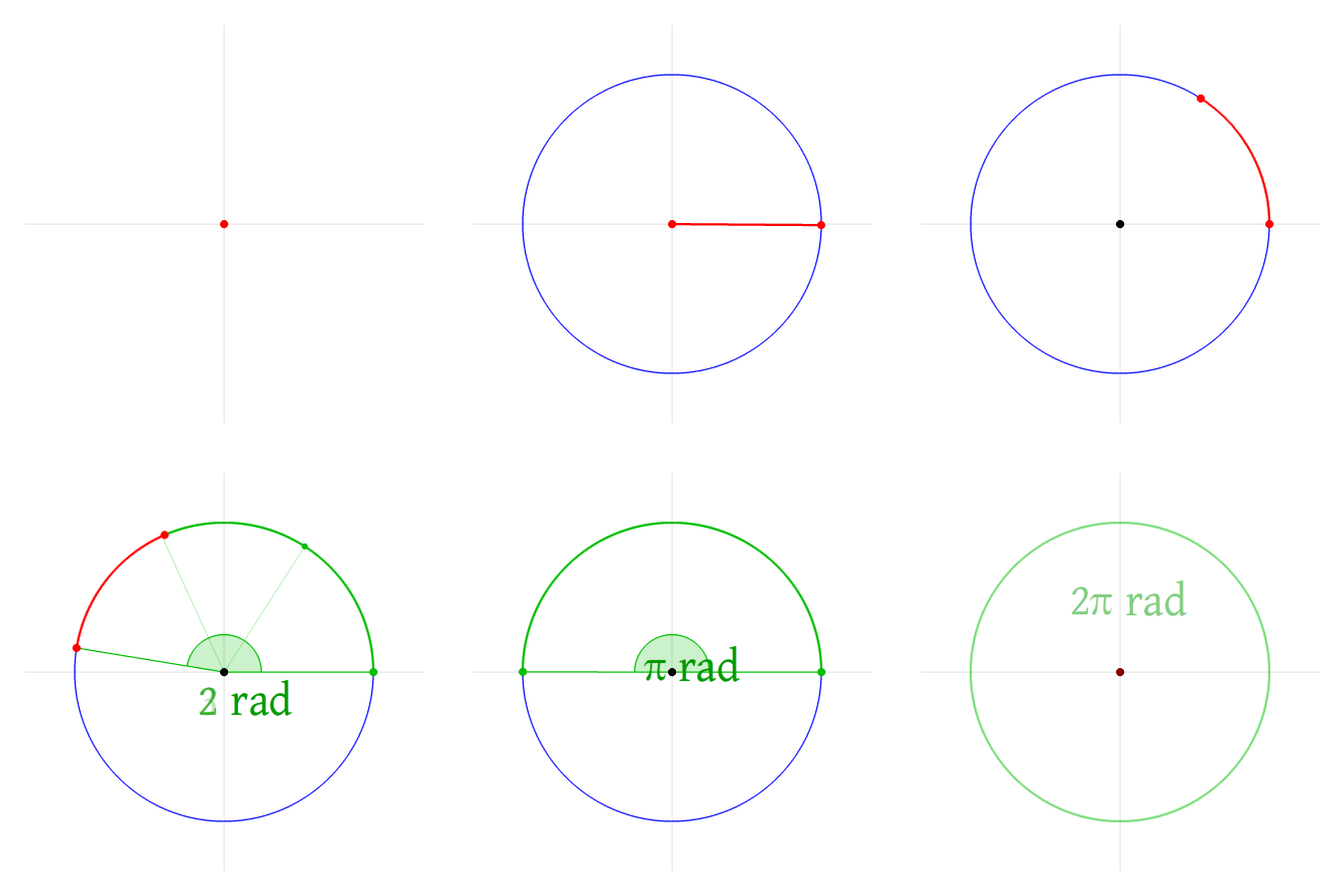
The radian, denoted by the symbol
      rad


{\displaystyle {\text{rad}}}
, is the SI unit for measuring angles, and is the standard unit of angular measure used in many areas of mathematics. The unit was formerly an SI supplementary unit (before that category was abolished in 1995) and the ...
valid wave
obtuse lance
so that's where I plug in x=3a and y=3b and then simplify my equation down to 3(...
hello back again, you said that we can do this process infinitely. Isnt this just rewritting varaible names
when you look at x^2+y^2=0 mod 3, it helps to know what the squares are mod 3. So just square everything, 0^2=0, 1^2=1, and 2^2=1. In other words, we're looking for ways to make 0 mod 3 by adding only 0 or 1 together since 2 is not a square mod 3. we have 0+0=0, 0+1=1 and 1+1=2 so we're stuck to assuming x^2=0 and y^2=0 mod 3
valid wave
this by itself seems like proof in itself enough to prove num 3 right?
valid wave
obtuse lance
no because (x,y,z) = 3 * (a,b,c)
so where does the fact that x^2 = 0 mod 3 come into this
valid wave
ah so 3a + 3b = z
valid wave
so where does this leave us though
valid wave
god i have a pea brain

because a^2+b^2 have to be 0
because the mod arthemtic we were doing earlier
obtuse lance
I think you're mixing steps up
valid wave
if you haave time
obtuse lance
which is understandable, yesterday there were like 3 people trying to talk lol
obtuse lance
wanna go into vc I can just write it out in order
valid wave
ok 😄
obtuse lance
k one sec
valid wave
yes
valid wave
thanks again @obtuse lance
 devout vault
Could someone please help me understand how to draw a covering graph
The idea of a covering makes sense
Is it just taking the verticies from the covering and making a new graph with them?
<@&286206848099549185>
 spring surge

It generates elements like (c 1) (d 1) (c 2)...
How to modify it so that there are no repeating elements? Like we have (c 1) so no elements (c ...) or (.. 1) ?
 inner lava
Does graph theory come under discrete mathematics
I have a vehicle routing problem and I'm struggling to categorise what VRP it actually is.
tidal tulip
does my proof work: I want to prove if a,b,c in Z and a|b, b|c, then a|c. Proof: Suppose a,b,c in Z and a|b and b|c. Then there exist k in Z st b=ak and there exist m in Z s.t. c=bm. So we have c=(ak)m -> c=a(km) [since mult is assoc] and therefore we see a|c
tidal tulip
@craggy juniper awesome thanks!
 wicked basin

do i consider the cases where
x is even and y is even,
x is even and y is odd,
x is odd and y is even,
x is odd and y is odd?
 native zodiac
wicked basin
native zodiac
wicked basin
Yes, basically. When doing addition and substraction the parity behaves as follows:
even ± even = even
even ± odd = odd
odd ± odd = even
So you apply the pigeonhole principle on the set elements and prove it
olive condor
Huh? “There exists” means you only need to prove it for one case
coral parcel
They have to be elements of S, though.
And you can't pick any one of the cases and be sure it occurs in S.
craggy juniper
olive condor
Huh? “There exists” means you only need to prove it for one case
we don’t know which case it is
inner lava
Is there a version of the multi commodity flow problem where the construction of the network is being optimized rather than the flow within it?
olive condor
Ohhh, okay 😯
wicked basin

idk how to do the 3rd paragraph
i know i have to apply the binomial theorem
but idk how
coral parcel
I don't see any obvious need for the binomial theorem here.
wicked basin
o i mean i dont know how to do the "Generalize the previous two parts"
coral parcel
That's the fourth paragraph as far as I can count.
wicked basin
o ya
coral parcel
There's a pretty clear pattern already. "Difference divisible by 2" requires 3 numbers. "Difference divisible by 3" requires 4 numbers ...
coral parcel
At least that's a fair guess. Try to prove it, or find a counterexample.
wicked basin
what do u mean for
coral parcel
Sorry, typo fixed.
floral field
So, we did this example in class, and we stopped a little early. How would I count the set of integers coprime to both 2 and 3?
 wicked basin
coral parcel
Sorry, typo fixed.
wicked basin
coral parcel
Sorry, typo fixed.
ahhhhh so now i use binomial thm
wide vine
can a partition of a set be 1 set?
In others set you have some Set A
can you have a partition that is one set B
where B = A
I guess this has to be possibly
true*
let A = empty set
 wait now im confused
nvm
If $\emptyset$ then the partition is ${{ }}$
vital dewBOT
Brandon7716
 wide vine
right?
 amber prism
it'd be the set containing emptyset
wide vine
okay
amber prism
since ${\emptyset}\not\subseteq\emptyset$
vital dewBOT
Mosh
 amber prism
I'm not sure on the exact notation, however that feels fine as long as you define it like that 
wide vine
Yeah im not sure either on it
amber prism
when it doubt define your own notation
wide vine
For any non-empty proper subset A of a set U, the set A together with its complement form a partition of U, namely, { A, U ∖ A }. what does the {A, U \ A} mean
a set defined with sets A given U is the complement of A? NVM figured it out
inner lava
Does anyone know if there is a name for a version of the vehicle routing problem where the demand and supply is being generated in real time while the deliveries are happening? This effectively means that a longer delivery route will deliver less as a backlog of deliveries is being generated the longer its out and the vehicles will be a constant looping closed path inside the network to keep the flow going.
I am unsure if this problem is actually the vehicle routing problem or a subset of the network flow problem
amber prism
wide vine
`For any non-empty proper subset A of a set U, the set A together with its compl...
Yeah, A and the complement of A form a partition
(provided A non-empty or A=U)
wide vine
amber prism
Yeah, A and the complement of A form a partition
yeah im just not familiar with the A\ B notation
amber prism
$A\setminus B :={a\in A|a\notin B}$
vital dewBOT
Mosh
 amber prism
ie take A and literally remove everything from B that's in A
wide vine
and this is called a relative complement?
amber prism
A\B is set difference
wide vine
oh
well how do you define a complement
with an unknown U
and why would they not just say A-B?
vital dewBOT
Mosh
 amber prism
U is usually implied from A

 balmy ivy
for a question like that would it be mathematically rigorous enough if i use a direct proof involving euclid's algo?
 obtuse lance
yeah that's preferred
floral field
So, I played around with some examples and claimed that this is the number of ways. Below it, I wrote down part of an argument, but I’m not sure how to finish it

In particular, I'm not sure what considering (n-1)x(n-1) matrix instead of nxn has anything to do with the sums/columns being even
vital dewBOT
beeswax
 stray reef
@floral field consider constructing a matrix of the kind they ask you for as follows:
fill the top left (n-1)×(n-1) submatrix arbitrarily. (this means everything except the last row & the last column)
then there will be exactly one way to fill the last row and the last column in such a way that each row and col has an even sum
floral field
stray reef
<@!709959727098101810> consider constructing a matrix of the kind they ask you f...
So, you're basically saying that once we fill out the matrix except the last row and column, our hand is foced for those?
stray reef
yes
and of course the number of ways to fill the top left (n-1)×(n-1) submatrix is 2^{(n-1)^2}
floral field
Ahh, I understand. Thank u
floral field
Sorry, another counting question. I claimed this for this exercise, but I’m not quite sure how to argue this.
 stray reef
each quadruplet of points uniquely determines an intersection of diagonals
floral field
stray reef
each quadruplet of points uniquely determines an intersection of diagonals
Wait, what does this mean? Like for n=5, I have this figure:
 stray reef
nC4 by defn counts the number of quadruplets that can be made from n points
each diagonal intersection point can be mapped to a quadruplet by looking at the four endpoints of the two diagonals that intersect at it
i guess that's going the other way around
to go from a quadruplet of points to a diagonal intersection, consider the quadrilateral formed by the four points in the quadruplet and look at the intersection of its two diagonals
floral field
Ahh
weary tiger
sosososo
like im watching this utube series n topic is relations now
i didnt understand this one
si
so*
is the formula for no of possibilties of reflexive relations
2^(n^2)-n
or
2^(n^2) - 2^(n^2)-n
????
where set is
like
a = {1,2,3}
a x a
set
spring surge
I want to define a set which says { a and all x's which are bigger than a }
{ 1 3 5 6 7} { 2 4 5 6}
How to do it in set builder notation? Am I allowed to self reference a set in its definition?
Example. C = { x | x=3 -> x not belongs in C } ?
olive condor
Erm, what is “a”?
Don’t really get what you meant
You can do something like let A = {1,3,5,6,7}, B = {2,4,5,6}, then $C = {a \in A | \forall b \in B (a > b)}$
vital dewBOT
zacque
 olive condor
It says C is the set of elements in A such that each of them is larger than all elements in B. In this case, C = {7}.
Self-referencing is not allowed as far as I know 🤔 Because if the set is not yet defined, how can you refer to it?
spring surge
olive condor
It says C is the set of elements in A such that each of them is larger than all ...
That's nice clarity in logic. Sometimes I forget those pure sane questions to ask.
 olive condor
No, no, “a belongs to a set” means $a \in A$ for some set A
vital dewBOT
zacque
 olive condor
“A set which has no element smaller than a” means ${x | \neg (x < a) }$
So, all in all, it’s $a \in {x | \neg (x < a) }$

 olive condor
Not sure where your {1..10} fits in though
 mortal hemlock
agghhh
tidal tulip
does this proof work: prove that the statement “if p is a prime number then p+1 is not a prime number” is false
proof by contradiction: assume p is a prime number then p+1 is not a prime number. then let’s consider 2 which is prime. then this means that 3 is not a prime by our assumption, but this is a contradiction since 3 is prime. thus our assumption that if p is prime then p+1 is not a prime is false. so we see if p is prime then p+1 may also be prime
i’m shaky on the last statement “if p is prime then p+1 may also be prime” line in my proof because it isn’t always the case if p is prime then p+1 is prime but the statement itself that ‘if p is prime then p+1 is not prime’ is false in certain cases so i wasn’t sure how to word the conclusion there
mortal hemlock
@tidal tulip do you know what quantifiers are?
or just basic propositional/predicate logic in general
tidal tulip
yes
mortal hemlock
okay great this will be much easier
tidal tulip
k
mortal hemlock
so you can try to formulate the proposition they gave with quantifiers
tidal tulip
ok
mortal hemlock
like this:
$\forall p \in \mathbb{N},\ p \text{ prime} \Longrightarrow p+1 \text{ not prime}$
vital dewBOT
Loxvan
 tidal tulip
that makes sense!
mortal hemlock
yes exactly
tidal tulip
how would i reword my proof then
mortal hemlock
so now you have proven that the statement is false, so its negation is true
to reword it, just write the negation using quantifiers and word it in plain english
tidal tulip
would the negation be ~(p->q) = ~(~ p or q) = ~~p and ~q= p and ~q
but does that imply if p is prime then p+1 is always prime?
mortal hemlock
correct, but you negate the entire statement, with the quantifier
mortal hemlock
tidal tulip
but does that imply if p is prime then p+1 is always prime?
no, because you're missing a quantifier
tidal tulip
which one
mortal hemlock
the negation is this:
$\exists p \in \mathbb{N},\ p \text{ prime}\ \wedge \ p+1 \text{ prime}$
vital dewBOT
Loxvan
 mortal hemlock
for all becomes there exists
tidal tulip
ah i see!
i’ll rewrite in a bit and tag you but have to go right now and i’d like to see if my revision id correct. i’ll tex it up with quantifiers and add more detail than necessary to verify my understanding
thank you
mortal hemlock
you're welcome
the key thing here is to always negate the whole statement including the quantifiers
tidal tulip
k
mortal hemlock
good luck!
alright now i finally got that tex to format right so i can ask my question
_ _
_ _
_ _
Anyone know some good (free) sources with relatively advanced analytical proofs for some identities/results in combinatorics (counting)?
I don't have time to work them all out by myself and sometimes I get stuck, and I haven't found much on YouTube. Most of the videos establish very basics results like nCr = nCn-r; I want something more elaborate and advanced, for example this:
\[
\text{Proof that } \binom{n}{0} - \binom{n}{1} + \binom{n}{2} + \dots + (-1)^n \binom{n}{n} = 0\]
\[\text{Let } S = \binom{n}{0} - \binom{n}{1} + \binom{n}{2} + \dots + (-1)^n \binom{n}{n}\]
\[S = \sum_{k=0}^{n}\binom{n}{k} (-1)^k = \sum_{k=0}^{n}\binom{n}{k} (-1)^k1^{n-k}\]
Using the binomial theorem
\[S = (-1+1)^n = 0^n = 0
\]
Loxvan
 mortal hemlock
What I mean by analytical is, proving it using the formulae and working it out merely by calculation, not the combinatorial argument. It's kind of frustrating being stuck on one for a while and then finding that it's just proven by induction and that there aren't any other simple methods.
It doesn't matter what the type of the source is, whether it's a video (doesn't have to be on YouTube), an article on a website, an ebook/paper, as long as it's not behind a paywall I'll take it.
Also I'm not looking for just one or two, preferably many of them.
weary tiger
hello, since 15 min have passed I'll ask my q:
so, I'm reviewing some graph theory and I came across Euler's theorem; and wanted to ask if someone could confirm my understanding of it. First we define the eulerian circuit and eulerian path, which means that we use each of the edges only once for both, however, for the eulerian circuit we start and end on some vertex X as well as fulfilling the aforementioned condition. Now comes the part I'm not so sure about, to my understanding - euler's theorem states, that, if a graph has a vertex with an odd degree, then no eulerian circuit is possible. However, a eulerian path exists if all but two vertices have an even degree, is my understanding correct? what if we have only one vertex of odd degree?
pale epoch
what if we have only one vertex of odd degree?
then you won't have an eulerian path
just look into the proof
pale epoch
basically you have to leave a vertex as often as you enter it
this gives you a circuit if every degree is even
weary tiger
so to clarify then, my understanding is correct insofar as: if we have two vertices with an odd degree, we can form a eulerian path however a eulerian circuit is impossible
pale epoch
but if you only need a path you can leave the starting vertex once more than you enter it
and enter the ending vertex once more than you leave it
allowing for exactly two odd degree vertices
ye, everything you said is correct
weary tiger
I see I see, thank you then
so if we have one graph of which one vertex has an odd degree, neither the eulerian path nor the circuit are possible
got it
pale epoch
👍
 cold hound
If a connected regular bipartite graph has a Hamilton cycle then it has an Euler tour.
is this statement true?
coral parcel
weary tiger
so if we have one graph of which one vertex has an odd degree, neither the euler...
You can't have a (finte) simple graph where exactly one vertex has odd degree.
The sum of the degrees is always even.
(Because it is twice the number of edges).
stray reef
weary tiger
so if we have one graph of which one vertex has an odd degree, neither the euler...
this is vacuously true
but emphasis on vacuously
weary tiger
I am not a big brain and hence will search up the definition of vacuously
be right back
coral parcel
She means it is true for all such graphs that they have no eulerian path, because there are no such graphs.
It's equally true for all such graphs that they do have an eulerian path.
spring surge
I want to describe a set like where all elements are the pairs of numbers which represent same fractions. Am I doing it right? Is there simpler ways to represent relations between the elements in a set in set builder notation?
 coral parcel
Hmm, can you give a concerete example of one of the things you want to be an element of your set?
What you've written so far is just a roundabout way to write the set of all pairs of numbers (which can be divided), which I don't think is what you indend.
spring surge
{ (1 2) (2 4) (3 6) (4 8) ... } or { (4 1) (16 4) (20 5)... }
coral parcel
Do you want each of those sets to be an element of the set you're trying to define?
spring surge
No.
ember obsidian
it seems each set should be the result of fixing the value of the fraction
to get { (1 2) (2 4) (3 6) (4 8) ... }, u write smth like
spring surge
I want that my set would define both of those if its possible
ember obsidian
$\brc{(a,b)\in\bN^2:\frac ab=2}$
vital dewBOT
RokabeJintaro
 vital dewBOT
RokabeJintaro
 spring surge
that means that every pair represents same n?
ember obsidian
this set is defined as the set of pairs (a,b) satisfying a/b=n

